


IEC TR 62543:2022
(Main)High-voltage direct current (HVDC) power transmission using voltage sourced converters (VSC)
General Information
- Abstract
IEC TR 62543:2022 gives general guidance on the subject of voltage sourced converters (VSC) used for transmission of power by high voltage direct current (HVDC). It describes converters that are not only voltage sourced (containing a capacitive energy storage medium and where the polarity of DC voltage remains fixed) but also self-commutated, using semiconductor devices which can both be turned on and turned off by control action. The scope includes 2‑level and 3-level converters with pulse-width modulation (PWM), along with multi-level converters, modular multi-level converters and cascaded two-level converters, but excludes 2‑level and 3-level converters operated without PWM, in square-wave output mode. HVDC power transmission using voltage sourced converters is known as "VSC transmission". The various types of circuit that can be used for VSC transmission are described in this document, along with their principal operational characteristics and typical applications. The overall aim is to provide a guide for purchasers to assist with the task of specifying a VSC transmission scheme. Line-commutated and current-sourced converters are specifically excluded from this document. This edition includes the following significant technical changes with respect to the previous edition:
- in Clause 3, some redundant definitions which were identical to those listed in IEC 62747 have been deleted;
- in 4.3.4, description and diagrams have been added for the cases of a bipole with dedicated metallic return and a rigid bipole;
- in 4.4, mention is made of the bi-mode insulated gate transistor (BiGT) and injection enhanced gate transistor (IEGT) as possible alternatives to the IGBT;
- in 5.6, the reference to common-mode blocking reactors has been deleted since these are very rarely used nowadays.
- Status
- Published
- Publication Date
- 29-Mar-2022
- Drafting Committee
- MT 23 - TC 22/SC 22F/MT 23
- Current Stage
- PPUB - Publication issued
- Start Date
- 30-Mar-2022
- Completion Date
- 22-Apr-2022
Buy Documents
IEC TR 62543:2022 - High-voltage direct current (HVDC) power transmission using voltage sourced converters (VSC) Released:3/30/2022
IEC TR 62543:2022 RLV - High-voltage direct current (HVDC) power transmission using voltage sourced converters (VSC) Released:3/30/2022
Overview
IEC TR 62543:2022 provides general guidance on high-voltage direct current (HVDC) power transmission using voltage sourced converters (VSC). The technical report describes VSCs that contain capacitive DC energy storage and are self‑commutated using semiconductor devices that can be actively turned on and off. Covered converter families include 2‑level and 3‑level converters operated with pulse‑width modulation (PWM), multi‑level converters, modular multi‑level converters (MMC) and cascaded two‑level converters. The report excludes line‑commutated and current‑sourced converters and converters operated in square‑wave (non‑PWM) mode. Its primary aim is to guide purchasers and specifiers in defining a VSC transmission scheme.
Key topics and technical requirements
- Converter topologies and characteristics
- 2‑level and 3‑level PWM converters, multi‑level topologies, MMC and cascaded converters.
- Operating principles for active and reactive power control and steady‑state capability.
- DC system configurations
- Monopole, bipolar, bipole with dedicated metallic return and rigid bipole arrangements.
- Semiconductors and valve design
- Use of IGBT and mention of alternatives such as BiGT and IEGT; valve reliability, current rating and transient requirements.
- Control and operational modes
- Power transfer control, telecommunication needs between converter stations, reactive power/AC voltage control, black‑start capability and connection to wind farms.
- Harmonics, filtering and EMC
- Harmonic performance, AC and DC side filtering design considerations, EMC and radio‑frequency interference mitigation.
- Auxiliary equipment
- DC capacitors, DC reactors, valve reactors, interface transformers, AC harmonic filters and substation circuit breaker considerations.
- Testing, commissioning and documentation
- Factory tests, control system tests, pre‑commissioning and system tests; informative annex with purchaser functional specification requirements.
- Environmental and operational impacts
- Audible noise, electromagnetic fields (EMF), and other environmental aspects.
Practical applications and who uses this standard
IEC TR 62543:2022 is useful for:
- Transmission system planners and utilities specifying HVDC VSC projects (point‑to‑point, multi‑terminal, submarine cable links, overhead lines).
- Project managers and procurement teams preparing technical specifications and tender documents.
- OEMs and converter manufacturers developing MMC, 2‑level/3‑level PWM converters and related substation equipment.
- Protection, control and commissioning engineers responsible for testing, harmonic mitigation and EMC compliance.
- Renewable integration specialists (e.g., offshore wind) seeking VSC solutions for grid support and black‑start capability.
Keywords: HVDC VSC, voltage sourced converter, MMC, IGBT, PWM, VSC transmission, harmonic filters, bipolar monopole, black start.
Related standards
- The report references and aligns terminology with related IEC publications (for example, IEC 62747 where overlapping definitions were previously consolidated). Users should consult the latest IEC standards for normative measurement and test procedures.
Relations
- Effective Date
- 05-Sep-2023
- Effective Date
- 05-Sep-2023
- Effective Date
- 05-Sep-2023
- Effective Date
- 05-Sep-2023
Buy Documents
IEC TR 62543:2022 - High-voltage direct current (HVDC) power transmission using voltage sourced converters (VSC) Released:3/30/2022
IEC TR 62543:2022 RLV - High-voltage direct current (HVDC) power transmission using voltage sourced converters (VSC) Released:3/30/2022
Get Certified
Connect with accredited certification bodies for this standard

IMQ S.p.A. (Certification)
Italian electrical product certification.

SLG Prüf- und Zertifizierungs GmbH
German testing and certification body.

UL Solutions
Global safety science company with testing, inspection and certification.
Sponsored listings
Frequently Asked Questions
IEC TR 62543:2022 is a technical report published by the International Electrotechnical Commission (IEC). Its full title is "High-voltage direct current (HVDC) power transmission using voltage sourced converters (VSC)". This standard covers: IEC TR 62543:2022 gives general guidance on the subject of voltage sourced converters (VSC) used for transmission of power by high voltage direct current (HVDC). It describes converters that are not only voltage sourced (containing a capacitive energy storage medium and where the polarity of DC voltage remains fixed) but also self-commutated, using semiconductor devices which can both be turned on and turned off by control action. The scope includes 2‑level and 3-level converters with pulse-width modulation (PWM), along with multi-level converters, modular multi-level converters and cascaded two-level converters, but excludes 2‑level and 3-level converters operated without PWM, in square-wave output mode. HVDC power transmission using voltage sourced converters is known as "VSC transmission". The various types of circuit that can be used for VSC transmission are described in this document, along with their principal operational characteristics and typical applications. The overall aim is to provide a guide for purchasers to assist with the task of specifying a VSC transmission scheme. Line-commutated and current-sourced converters are specifically excluded from this document. This edition includes the following significant technical changes with respect to the previous edition: - in Clause 3, some redundant definitions which were identical to those listed in IEC 62747 have been deleted; - in 4.3.4, description and diagrams have been added for the cases of a bipole with dedicated metallic return and a rigid bipole; - in 4.4, mention is made of the bi-mode insulated gate transistor (BiGT) and injection enhanced gate transistor (IEGT) as possible alternatives to the IGBT; - in 5.6, the reference to common-mode blocking reactors has been deleted since these are very rarely used nowadays.
IEC TR 62543:2022 gives general guidance on the subject of voltage sourced converters (VSC) used for transmission of power by high voltage direct current (HVDC). It describes converters that are not only voltage sourced (containing a capacitive energy storage medium and where the polarity of DC voltage remains fixed) but also self-commutated, using semiconductor devices which can both be turned on and turned off by control action. The scope includes 2‑level and 3-level converters with pulse-width modulation (PWM), along with multi-level converters, modular multi-level converters and cascaded two-level converters, but excludes 2‑level and 3-level converters operated without PWM, in square-wave output mode. HVDC power transmission using voltage sourced converters is known as "VSC transmission". The various types of circuit that can be used for VSC transmission are described in this document, along with their principal operational characteristics and typical applications. The overall aim is to provide a guide for purchasers to assist with the task of specifying a VSC transmission scheme. Line-commutated and current-sourced converters are specifically excluded from this document. This edition includes the following significant technical changes with respect to the previous edition: - in Clause 3, some redundant definitions which were identical to those listed in IEC 62747 have been deleted; - in 4.3.4, description and diagrams have been added for the cases of a bipole with dedicated metallic return and a rigid bipole; - in 4.4, mention is made of the bi-mode insulated gate transistor (BiGT) and injection enhanced gate transistor (IEGT) as possible alternatives to the IGBT; - in 5.6, the reference to common-mode blocking reactors has been deleted since these are very rarely used nowadays.
IEC TR 62543:2022 is classified under the following ICS (International Classification for Standards) categories: 29.200 - Rectifiers. Convertors. Stabilized power supply; 29.240.99 - Other equipment related to power transmission and distribution networks. The ICS classification helps identify the subject area and facilitates finding related standards.
IEC TR 62543:2022 has the following relationships with other standards: It is inter standard links to IEC TR 62543:2011/AMD1:2013, IEC TR 62543:2011/AMD2:2017, IEC PAS 62543:2008, IEC TR 62543:2011. Understanding these relationships helps ensure you are using the most current and applicable version of the standard.
IEC TR 62543:2022 is available in PDF format for immediate download after purchase. The document can be added to your cart and obtained through the secure checkout process. Digital delivery ensures instant access to the complete standard document.
Standards Content (Sample)
IEC TR 62543 ®
Edition 2.0 2022-03
TECHNICAL
REPORT
colour
inside
High-voltage direct current (HVDC) power transmission using voltage sourced
converters (VSC)
All rights reserved. Unless otherwise specified, no part of this publication may be reproduced or utilized in any form
or by any means, electronic or mechanical, including photocopying and microfilm, without permission in writing from
either IEC or IEC's member National Committee in the country of the requester. If you have any questions about IEC
copyright or have an enquiry about obtaining additional rights to this publication, please contact the address below or
your local IEC member National Committee for further information.
IEC Secretariat Tel.: +41 22 919 02 11
3, rue de Varembé info@iec.ch
CH-1211 Geneva 20 www.iec.ch
Switzerland
About the IEC
The International Electrotechnical Commission (IEC) is the leading global organization that prepares and publishes
International Standards for all electrical, electronic and related technologies.
About IEC publications
The technical content of IEC publications is kept under constant review by the IEC. Please make sure that you have the
latest edition, a corrigendum or an amendment might have been published.
IEC publications search - webstore.iec.ch/advsearchform IEC Products & Services Portal - products.iec.ch
The advanced search enables to find IEC publications by a Discover our powerful search engine and read freely all the
variety of criteria (reference number, text, technical publications previews. With a subscription you will always
committee, …). It also gives information on projects, replaced have access to up to date content tailored to your needs.
and withdrawn publications.
Electropedia - www.electropedia.org
IEC Just Published - webstore.iec.ch/justpublished
The world's leading online dictionary on electrotechnology,
Stay up to date on all new IEC publications. Just Published
containing more than 22 300 terminological entries in English
details all new publications released. Available online and
and French, with equivalent terms in 19 additional languages.
once a month by email.
Also known as the International Electrotechnical Vocabulary
(IEV) online.
IEC Customer Service Centre - webstore.iec.ch/csc
If you wish to give us your feedback on this publication or
need further assistance, please contact the Customer Service
Centre: sales@iec.ch.
IEC TR 62543 ®
Edition 2.0 2022-03
TECHNICAL
REPORT
colour
inside
High-voltage direct current (HVDC) power transmission using voltage sourced
converters (VSC)
INTERNATIONAL
ELECTROTECHNICAL
COMMISSION
ICS 29.200; 29.240.99 ISBN 978-2-8322-1090-6
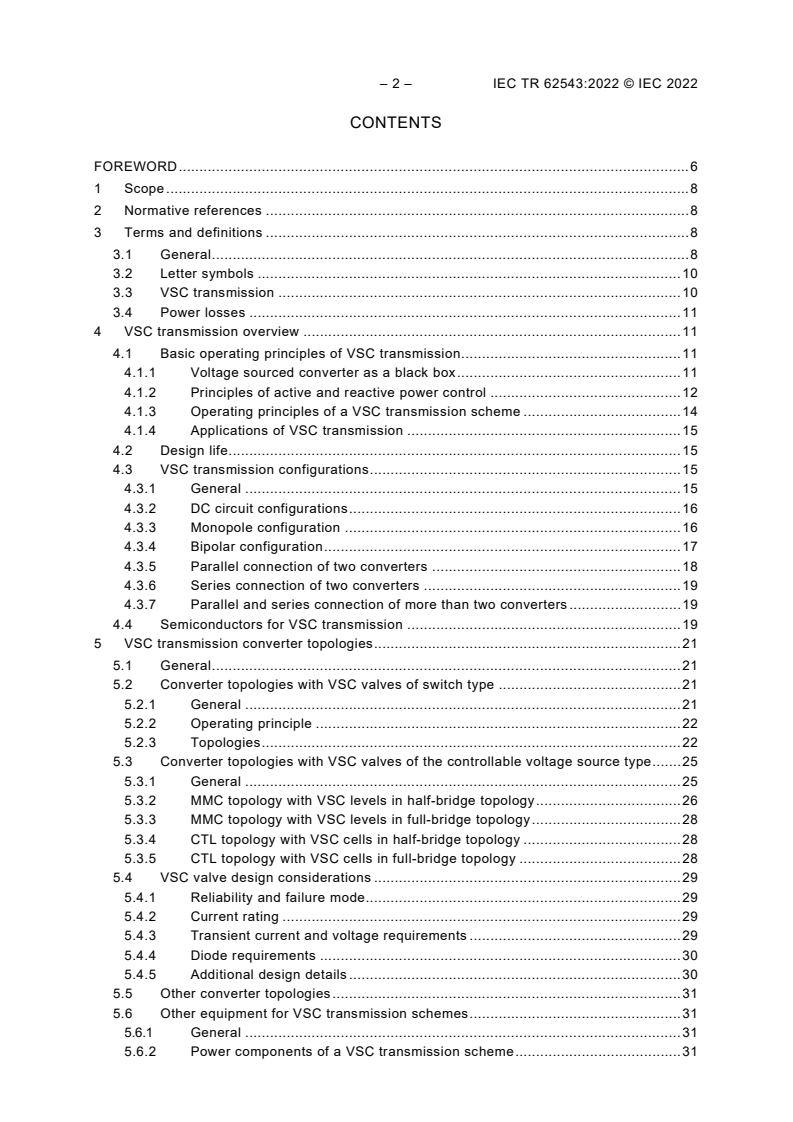
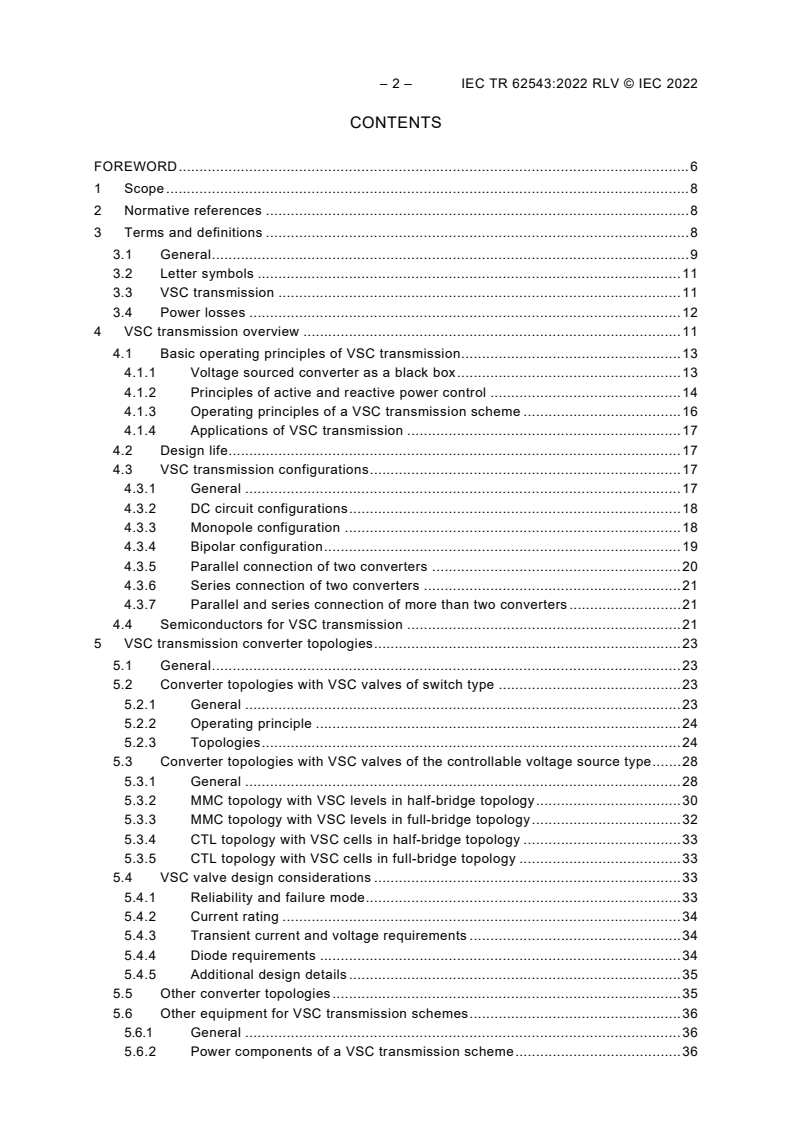
– 2 – IEC TR 62543:2022 © IEC 2022
CONTENTS
FOREWORD . 6
1 Scope . 8
2 Normative references . 8
3 Terms and definitions . 8
3.1 General . 8
3.2 Letter symbols . 10
3.3 VSC transmission . 10
3.4 Power losses . 11
4 VSC transmission overview . 11
4.1 Basic operating principles of VSC transmission . 11
4.1.1 Voltage sourced converter as a black box . 11
4.1.2 Principles of active and reactive power control . 12
4.1.3 Operating principles of a VSC transmission scheme . 14
4.1.4 Applications of VSC transmission . 15
4.2 Design life. 15
4.3 VSC transmission configurations . 15
4.3.1 General . 15
4.3.2 DC circuit configurations . 16
4.3.3 Monopole configuration . 16
4.3.4 Bipolar configuration . 17
4.3.5 Parallel connection of two converters . 18
4.3.6 Series connection of two converters . 19
4.3.7 Parallel and series connection of more than two converters . 19
4.4 Semiconductors for VSC transmission . 19
5 VSC transmission converter topologies . 21
5.1 General . 21
5.2 Converter topologies with VSC valves of switch type . 21
5.2.1 General . 21
5.2.2 Operating principle . 22
5.2.3 Topologies . 22
5.3 Converter topologies with VSC valves of the controllable voltage source type . 25
5.3.1 General . 25
5.3.2 MMC topology with VSC levels in half-bridge topology . 26
5.3.3 MMC topology with VSC levels in full-bridge topology . 28
5.3.4 CTL topology with VSC cells in half-bridge topology . 28
5.3.5 CTL topology with VSC cells in full-bridge topology . 28
5.4 VSC valve design considerations . 29
5.4.1 Reliability and failure mode . 29
5.4.2 Current rating . 29
5.4.3 Transient current and voltage requirements . 29
5.4.4 Diode requirements . 30
5.4.5 Additional design details . 30
5.5 Other converter topologies . 31
5.6 Other equipment for VSC transmission schemes . 31
5.6.1 General . 31
5.6.2 Power components of a VSC transmission scheme . 31
5.6.3 VSC substation circuit breaker . 32
5.6.4 AC system side harmonic filters . 32
5.6.5 Radio frequency interference filters . 32
5.6.6 Interface transformers and phase reactors . 32
5.6.7 Valve reactor . 33
5.6.8 DC capacitors . 33
5.6.9 DC reactor . 35
5.6.10 DC filter . 36
5.6.11 Dynamic braking system . 36
6 Overview of VSC controls . 36
6.1 General . 36
6.2 Operational modes and operational options . 37
6.3 Power transfer . 38
6.3.1 General . 38
6.3.2 Telecommunication between converter stations . 38
6.4 Reactive power and AC voltage control . 38
6.4.1 AC voltage control . 38
6.4.2 Reactive power control . 39
6.5 Black start capability . 39
6.6 Supply from a wind farm . 39
7 Steady-state operation . 40
7.1 Steady-state capability . 40
7.2 Converter power losses . 41
8 Dynamic performance . 42
8.1 AC system disturbances. 42
8.2 DC system disturbances . 42
8.2.1 DC cable fault . 42
8.2.2 DC overhead line fault . 43
8.3 Internal faults . 43
9 HVDC performance requirements . 44
9.1 Harmonic performance . 44
9.2 Wave distortion . 45
9.3 Fundamental and harmonics . 45
9.3.1 Three-phase 2-level VSC . 45
9.3.2 Multi-pulse and multi-level converters . 45
9.4 Harmonic voltages on power systems due to VSC operation . 46
9.5 Design considerations for harmonic filters (AC side) . 46
9.6 DC side filtering . 46
10 Environmental impact . 47
10.1 General . 47
10.2 Audible noise . 47
10.3 Electric and magnetic fields (EMF) . 47
10.4 Electromagnetic compatibility (EMC) . 47
11 Testing and commissioning. 48
11.1 General . 48
11.2 Factory tests . 49
11.2.1 Component tests . 49
11.2.2 Control system tests . 49
– 4 – IEC TR 62543:2022 © IEC 2022
11.3 Commissioning tests/system tests. 49
11.3.1 General . 49
11.3.2 Precommissioning tests . 50
11.3.3 Subsystem tests . 50
11.3.4 System tests . 50
Annex A (informative) Functional specification requirements for VSC transmission
systems . 55
A.1 General . 55
A.2 Purchaser and manufacturer information requirements . 55
A.2.1 General . 55
A.2.2 General requirements . 56
A.2.3 Detailed descriptions . 57
Annex B (informative) Modulation strategies for 2-level converters . 61
B.1 Carrier wave PWM . 61
B.2 Selective harmonic elimination modulation . 62
Bibliography . 64
Figure 1 – Major components that can be found in a VSC substation . 9
Figure 2 – Diagram of a generic voltage source converter . 12
Figure 3 – Principle of active power control . 13
Figure 4 – Principle of reactive power control . 14
Figure 5 – A point-to-point VSC transmission scheme . 14
Figure 6 – VSC transmission with a symmetrical monopole . 16
Figure 7 – VSC transmission with an asymmetrical monopole with metallic return . 17
Figure 8 – VSC transmission with an asymmetrical monopole with earth return . 17
Figure 9 – VSC transmission in bipolar configuration with earth return . 17
Figure 10 – VSC transmission in bipolar configuration with dedicated metallic return . 18
Figure 11 – VSC transmission in rigid bipolar configuration . 18
Figure 12 – Parallel connection of two converter units . 19
Figure 13 – Symbol of a turn-off semiconductor device and associated free-wheeling
diode . 20
Figure 14 – Symbol of an IGBT and associated free-wheeling diode . 20
Figure 15 – Diagram of a three-phase 2-level converter and associated AC waveform
for one phase . 23
Figure 16 – Single-phase AC output for 2-level converter with PWM switching at 21
times fundamental frequency . 23
Figure 17 – Diagram of a three-phase 3-level NPC converter and associated AC
waveform for one phase . 24
Figure 18 – Single-phase AC output for 3-level NPC converter with PWM switching at
21 times fundamental frequency . 25
Figure 19 – Electrical equivalent for a converter with VSC valves acting like a
controllable voltage source . 26
Figure 20 – VSC valve level arrangement and equivalent circuit in MMC topology in
half-bridge topology . 27
Figure 21 – Converter block arrangement with MMC topology in half-bridge topology . 27
Figure 22 – VSC valve level arrangement and equivalent circuit in MMC topology with
full-bridge topology . 28
Figure 23 – Typical SSOA for the IGBT . 29
Figure 24 – A 2-level VSC bridge with the IGBTs turned off . 30
Figure 25 – Representing a VSC unit as an AC voltage of magnitude U and phase
angle δ behind reactance . 36
Figure 26 – Concept of vector control . 37
Figure 27 – VSC power controller . 38
Figure 28 – AC voltage controller . 39
Figure 29 – A typical simplified PQ diagram . 41
Figure 30 – Protection concept of a VSC substation . 43
Figure 31 – Waveforms for three-phase 2-level VSC . 45
Figure 32 – Equivalent circuit at the PCC of the VSC . 46
Figure B.1 – Voltage harmonics spectra of a 2-level VSC with carrier frequency at 21st
harmonic . 62
Figure B.2 – Phase output voltage for selective harmonic elimination modulation
(SHEM) . 63
– 6 – IEC TR 62543:2022 © IEC 2022
INTERNATIONAL ELECTROTECHNICAL COMMISSION
____________
HIGH-VOLTAGE DIRECT CURRENT (HVDC) POWER
TRANSMISSION USING VOLTAGE SOURCED CONVERTERS (VSC)
FOREWORD
1) The International Electrotechnical Commission (IEC) is a worldwide organization for standardization comprising
all national electrotechnical committees (IEC National Committees). The object of IEC is to promote
international co-operation on all questions concerning standardization in the electrical and electronic fields. To
this end and in addition to other activities, IEC publishes International Standards, Technical Specifications,
Technical Reports, Publicly Available Specifications (PAS) and Guides (hereafter referred to as “IEC
Publication(s)”). Their preparation is entrusted to technical committees; any IEC National Committee interested
in the subject dealt with may participate in this preparatory work. International, governmental and non-
governmental organizations liaising with the IEC also participate in this preparation. IEC collaborates closely
with the International Organization for Standardization (ISO) in accordance with conditions determined by
agreement between the two organizations.
2) The formal decisions or agreements of IEC on technical matters express, as nearly as possible, an international
consensus of opinion on the relevant subjects since each technical committee has representation from all
interested IEC National Committees.
3) IEC Publications have the form of recommendations for international use and are accepted by IEC National
Committees in that sense. While all reasonable efforts are made to ensure that the technical content of IEC
Publications is accurate, IEC cannot be held responsible for the way in which they are used or for any
misinterpretation by any end user.
4) In order to promote international uniformity, IEC National Committees undertake to apply IEC Publications
transparently to the maximum extent possible in their national and regional publications. Any divergence
between any IEC Publication and the corresponding national or regional publication shall be clearly indicated in
the latter.
5) IEC itself does not provide any attestation of conformity. Independent certification bodies provide conformity
assessment services and, in some areas, access to IEC marks of conformity. IEC is not responsible for any
services carried out by independent certification bodies.
6) All users should ensure that they have the latest edition of this publication.
7) No liability shall attach to IEC or its directors, employees, servants or agents including individual experts and
members of its technical committees and IEC National Committees for any personal injury, property damage or
other damage of any nature whatsoever, whether direct or indirect, or for costs (including legal fees) and
expenses arising out of the publication, use of, or reliance upon, this IEC Publication or any other IEC
Publications.
8) Attention is drawn to the Normative references cited in this publication. Use of the referenced publications is
indispensable for the correct application of this publication.
9) Attention is drawn to the possibility that some of the elements of this IEC Publication may be the subject of
patent rights. IEC shall not be held responsible for identifying any or all such patent rights.
IEC TR 62543 has been prepared by subcommittee 22F: Power electronics for electrical
transmission and distribution systems, of IEC technical committee 22: Power electronic
systems and equipment. It is a Technical Report.
This second edition cancels and replaces the first edition published in 2011,
Amendment 1:2013 and Amendment 2:2017. This edition constitutes a technical revision.
This edition includes the following significant technical changes with respect to the previous
edition:
a) in Clause 3, some redundant definitions which were identical to those listed in IEC 62747
have been deleted;
b) in 4.3.4, description and diagrams have been added for the cases of a bipole with
dedicated metallic return and a rigid bipole;
c) in 4.4, mention is made of the bi-mode insulated gate transistor (BiGT) and injection
enhanced gate transistor (IEGT) as possible alternatives to the IGBT;
d) in 5.6, the reference to common-mode blocking reactors has been deleted since these are
very rarely used nowadays.
The text of this Technical Report is based on the following documents:
Draft Report on voting
22F/649/DTR 22F/669/RVDTR
Full information on the voting for its approval can be found in the report on voting indicated in
the above table.
The language used for the development of this Technical Report is English.
This document was drafted in accordance with ISO/IEC Directives, Part 2, and developed in
accordance with ISO/IEC Directives, Part 1 and ISO/IEC Directives, IEC Supplement,
available at www.iec.ch/members_experts/refdocs. The main document types developed by
IEC are described in greater detail at www.iec.ch/publications.
The committee has decided that the contents of this document will remain unchanged until the
stability date indicated on the IEC website under webstore.iec.ch in the data related to the
specific document. At this date, the document will be
• reconfirmed,
• withdrawn,
• replaced by a revised edition, or
• amended.
IMPORTANT – The "colour inside" logo on the cover page of this document indicates that it
contains colours which are considered to be useful for the correct understanding of its
contents. Users should therefore print this document using a colour printer.
– 8 – IEC TR 62543:2022 © IEC 2022
HIGH-VOLTAGE DIRECT CURRENT (HVDC) POWER
TRANSMISSION USING VOLTAGE SOURCED CONVERTERS (VSC)
1 Scope
This document gives general guidance on the subject of voltage sourced converters (VSC)
used for transmission of power by high voltage direct current (HVDC). It describes converters
that are not only voltage sourced (containing a capacitive energy storage medium and where
the polarity of DC voltage remains fixed) but also self-commutated, using semiconductor
devices which can both be turned on and turned off by control action. The scope includes
2-level and 3-level converters with pulse-width modulation (PWM), along with multi-level
converters, modular multi-level converters and cascaded two-level converters, but excludes
2-level and 3-level converters operated without PWM, in square-wave output mode.
HVDC power transmission using voltage sourced converters is known as "VSC transmission".
The various types of circuit that can be used for VSC transmission are described in this
document, along with their principal operational characteristics and typical applications. The
overall aim is to provide a guide for purchasers to assist with the task of specifying a VSC
transmission scheme.
Line-commutated and current-sourced converters are specifically excluded from this
document.
2 Normative references
The following referenced documents are indispensable for the application of this document.
For dated references, only the edition cited applies. For undated references, the latest edition
of the referenced document (including any amendments) applies.
IEC 62501, Voltage sourced converter (VSC) valves for high-voltage direct current (HVDC)
power transmission – Electrical testing
IEC 62747, Terminology for voltage-sourced converters (VSC) for high-voltage direct current
(HVDC) systems
3 Terms and definitions
For the purposes of this document, the terms and definitions given in IEC 62747, IEC 62501
and the following apply.
ISO and IEC maintain terminological databases for use in standardization at the following
addresses:
• IEC Electropedia: available at http://www.electropedia.org/
• ISO Online browsing platform: available at http://www.iso.org/obp
3.1 General
Basic terms and definitions for voltage sourced converters used for HVDC transmission are
given in IEC 62747. Terminology on electrical testing of VSC valves for HVDC transmission is
given in IEC 62501.
To support the explanations, Figure 1 presents the basic diagram of a VSC system.
Dependent on the converter topology and the requirements in the project, some components
can be omitted or can differ.
Key
3)
1 circuit breaker 9 VSC unit
4)
2 pre-insertion resistor 10 VSC DC capacitor
1) 1)
3 line side harmonic filter 11 DC harmonic filter
6) 7)
4 line side high frequency filter 12 dynamic braking system
5)
5 interface transformer 13 neutral point grounding branch
1) 8)
6 converter side harmonic filter 14 DC reactor
2)
7 + 8 converter side high frequency filter 15 DC cable or overhead transmission line
2)
8 phase reactor
1)
In some designs of VSC based on controllable voltage source valves, it is possible the harmonic filter is not
required.
2)
In some designs of VSC, the phase reactor can fulfil part of the function of the converter-side high frequency
filter.
3)
In some VSC topologies, each valve of the VSC unit can include a "valve reactor", which can be built into the
valve or provided as a separate component.
4)
In some designs of VSC, the VSC DC capacitor can be partly or entirely distributed amongst the three-phase
units of the VSC unit, where it is referred to as the DC submodule capacitors.
5)
The philosophy and location of the neutral point grounding branch can be different depending on the design of
the VSC unit.
6)
In some designs of VSC, the interface transformer can fulfil part of the function of the line-side high frequency
filter.
7)
Optional.
8)
Optional.
Figure 1 – Major components that can be found in a VSC substation
– 10 – IEC TR 62543:2022 © IEC 2022
3.2 Letter symbols
U line-to-line AC voltage of the converter unit(s), RMS value, including harmonics
conv
I alternating current of the converter unit(s), RMS value, including harmonics
conv
U line-to-line AC voltage of the AC system, RMS value, including harmonics
L
I alternating current of the AC system, RMS value, including harmonic
L
U DC terminal-to-terminal voltage of one converter unit
dc
I DC current of the DC bus of the VSC transmission system
d
3.3 VSC transmission
3.3.1
VSC DC capacitor
capacitor bank(s) (if any) connected between two DC terminals of the VSC, used for energy
storage and/or filtering purposes
3.3.2
AC side radio frequency interference filter
RFI filter
filters (if any) used to reduce penetration of radio frequency interference (RFI) into the AC
system to an acceptable level
3.3.3
converter side high frequency filter
filters (if any) used to mitigate the HF stresses of the interface transformer
3.3.4
DC side radio frequency interference filter
filters (if any) used to reduce penetration of radio frequency (RF) into the DC system to
acceptable limits
3.3.5
type tests
tests carried out to verify that the components of VSC transmission system design will meet
the requirements specified
Note 1 to entry: In this document, type tests are classified under two major categories: dielectric tests and
operational tests.
3.3.6
dielectric tests
tests carried out to verify the high voltage withstanding capability of the components of VSC
transmission system
3.3.7
operational tests
tests carried out to verify the turn-on (if applicable), turn-off (if applicable), and current related
capabilities of the components of VSC transmission system
3.3.8
production tests
tests carried out to verify proper manufacture, so that the properties of the certain component
of VSC transmission system correspond to those specified
3.3.9
sample tests
production tests which are carried out on a small number of certain VSC transmission
components, for example valve sections or special components taken at random from a batch
3.4 Power losses
3.4.1
auxiliary losses
electric power required to feed the VSC substation auxiliary loads
Note 1 to entry: The auxiliary losses depend on whether the substation is in no-load or carrying load, in which
case the auxiliary losses depend on the load level.
3.4.2
no-load operating losses
losses produced in an item of equipment with the VSC substation energized but with the
VSCs blocked and all substation service loads and auxiliary equipment connected as required
for immediate pick-up of load
3.4.3
idling operating losses
losses produced in an item of equipment with the VSC substation energized and with the
VSCs de-blocked but with no real or reactive power output
3.4.4
operating losses
losses produced in an item of equipment at a given load level with the VSC substation
energized and the converters operating
3.4.5
total system losses
sum of all operating losses, including the corresponding auxiliary losses
3.4.6
station essential auxiliary load
loads whose failure will affect the conversion capability of the HVDC converter station
(e.g. valve cooling), as well as the loads that need to remain working in case of complete loss
of AC power supply (e.g. battery chargers, operating mechanisms)
Note 1 to entry: Total "operating losses" minus "no-load operating losses" can be considered as being
quantitatively equivalent to "load losses" as in conventional AC substation practice.
4 VSC transmission overview
4.1 Basic operating principles of VSC transmission
4.1.1 Voltage sourced converter as a black box
The operation of a voltage sourced converter is described in greater detail in Clause 5. In 4.1,
the converter is treated as a black box that can convert from AC to DC and vice versa, and
only steady-state operation is considered.
Figure 2 depicts a schematic diagram of a generic voltage sourced converter connected to a
DC circuit on one side and to an AC circuit on the other.
– 12 – IEC TR 62543:2022 © IEC 2022
NOTE AC filters are not shown.
Figure 2 – Diagram of a generic voltage source converter
The VSC can be operated as either an inverter, injecting real power into the AC network (I ×
d
U > 0), or as a rectifier absorbing power from the AC network (I × U < 0). Similarly, the
dc d dc
VSC can be operated either capacitively, injecting reactive power into the AC network
(Im(U ·I ) > 0) , or inductively, absorbing reactive power from the AC network (Im(U ·I ) < 0).
L L L L
The VSC can be operated capacitively or inductively in both the inverter and the rectifier
mode.
The designation voltage sourced converter is used because the function of the VSC is
predicated on the connection of a voltage source on the DC side.
To the left in Figure 2, a DC voltage source U is shown with a DC resistor R representing
S d
the DC circuit resistance, and a DC capacitor connected. The DC shunt capacitor serves the
purpose of stabilizing the DC voltage U . Depending on the VSC converter topology, the DC
d
storage capacitor is realized either as a central DC storage capacitor between both poles or
as multiple storage capacitors distributed within the converter phase units. The conversion
from DC to AC takes place in the VSC as explained in Clause 5.
On the AC side, an interface inductance X is provided which serves two purposes: first, it
conv
stabilizes the AC current, and secondly, it controls active and reactive output power from the
VSC, as explained in 4.1.2. The interface inductance can be implemented as reactors, as
leakage inductances in transformers, or as a combination thereof. The DC capacitor on the
input side and the AC interface inductance on the output side are important components for
the proper functioning of a VSC.
A passive or active AC network can be connected on the AC side of the VSC. If the VSC is
connected to a passive network on its AC side, the power flow can be only from the DC input
side towards the passive load on the AC side. However, if the AC side is connected to an
active AC network, the power flow can be in both directions by controlling the AC voltage
output U of the VSC.
conv
By controlling the phase angle of U , the active power through the VSC can be controlled
conv
as explained in 4.1.2.2. By controlling the voltage amplitude of U , the reactive power
conv
through the VSC can be controlled as explained in 4.1.2.3.
4.1.2 Principles of active and reactive power control
4.1.2.1 General
The VSC can be considered as an equivalent of a synchronous generator without inertia,
which has the capability of individually controlling active and reactive power.
The exchange of active and reactive power between a VSC and the AC grid is controlled by
the phase angle and amplitude of the VSC output voltage in relation to the voltage of the AC
grid.
The active and reactive power are related to the AC voltages U and U of the AC system
L conv
and converter respectively, the reactance X between these voltages and the phase angle δ
between them, according to the following:
UU×× sinδ
L conv
P=
X
U ×−(UU × cosδ)
L L conv
Q=
X
If U is in phase with the line voltage U and its amplitude is equal to U , there is no AC
conv L L
current I from the VSC. Under these conditions, the DC current I becomes zero and the
conv d
DC capacitor voltage U becomes equal to the DC source voltage U .
dc s
4.1.2.2 Principle of active power control
The principle of active power control is depicted in Figure 3, where the active power through
the interface inductance is controlled by regulating the VSC voltage angle.
Figure 3 – Principle of active power control
If the angle of the VSC output voltage leads the AC grid voltage, the VSC will inject active
power to the AC grid, i.e., it operates as an inverter. On the DC side, an equivalent current
will be drawn from the DC source and the voltage U will decrease in accordance with Ohm's
dc
law (U = U − R ·I ).
dc s d d
If, on the other hand, the VSC output voltage lags the voltage of the AC grid, the VSC will
absorb active power from the AC grid, i.e., it operates as a rectifier. On the DC side, an
equivalent current will be injected into the DC source and the voltage U will increase in
dc
= U + R ·I ).
accordance with Ohm's law (U
dc S d d
If the VSC is connected to a passive load, an AC output current will be drawn from the VSC
determined by Ohm's law I = U /Z. Again, an equivalent DC current will be drawn from
conv conv
the source and the voltage U on the DC capacitor will drop to a value determined by Ohm's
dc
law. No active power can be drawn from the AC side, because it is a passive AC circuit.
– 14 – IEC TR 62543:2022 © IEC 2022
4.1.2.3 Principle of reactive power control
When active power P = 0 the principle of reactive power control is depicted in Figure 4, where
the reactive power through the interface inductance is controlled by regulating the amplitude
of the VSC output AC voltage.
If the amplitude of the VSC output voltage U is higher than the AC grid voltage U , the
conv L
VSC will inject reactive power in the AC grid, i.e., will operate in the capacitive mode. If the
amplitude of the VSC output voltage is lower than the AC grid voltage, the VSC absorbs
reactive power from the AC grid, i.e., the inductive operating mode.
Figure 4 – Principle of reactive power control
4.1.3 Operating principles of a VSC transmission scheme
The point-to-point VSC transmission scheme shown in Figure 5 consists of two VSCs
interconnected on the DC side via a DC transmission line and connected to two different AC
grids on the AC side. The basic characteristics of a VSC have been described in 4.1.1 and
4.1.2. One of these characteristics is that the DC voltage polarity usually remains the same (in
contrast with line-commutated converter (LCC) HVDC, where the polarity of DC voltage
depends on the direction of power transfer). Therefore, the direction of the power flow on the
DC line is usually determined by the direction of the DC current. In Figure 5, the current flow
and the power flow are from VSC1 (the sending or rectifier end) to VSC2 (the receiving or
inverter end) of the DC line.
Figure 5 – A point-to-point VSC transmission scheme
The direction of a DC current is always from a higher DC voltage level to a lower DC voltage
level. The DC voltage at the sending end of the DC line therefore needs to be higher than the
DC voltage at the receiving end. The value of the current is determined by Ohm's law, as the
voltage difference between sending and receiving ends divided by the resistance in the DC
line I = (U − U )/R .
d d1 d2 d
For example, the DC line power flow can be controlled by holding the DC voltage at the
receiving end converter (the inverter) at a constant value, and by letting the sending end
converter (the rectifier) control the DC current.
4.1.4 Applications of VSC transmission
In general, the main fields of application of HVDC transmission are interconnection of
asynchronous AC systems and long-distance transmission via overhead lines and cables. The
following characteristic features of VSC transmission are decisive for different applications.
• The smaller amount of external equipment such as AC harmonic filters results in a
compact design of VSC converter stations. Small footprints are beneficial for applications
with spatial limitations such as installations in city centres or on remote offshore platforms.
• Since VSC transmission is based on self-commutating operation, applications with isolated
and weak AC systems are feasible. During normal operation, the VSC provides voltage
and frequency control of the AC system. Operation during AC faults is a major criterion for
VSC. The ability of the VSC to inject fault currents facilitates AC system protection and
fault clearing. Examples are connection of remote wind farms, oil and gas platforms and
remote mines.
• In most cases, VSC transmission operates with a fixed DC voltage polarity. A reversal of
direction of power flow requires the reversal of DC current. In case of parallel
interconnection of AC systems via AC and DC lines, fast power reversals via DC current
control provide an accurate measure for load flow stabilization between the AC systems.
Since the polarity of DC voltage does not reverse, multi-terminal systems and HVDC grids
are easier to realize with VSC than with LCC HVDC.
4.2 Design life
The selection of VSC transmission as an alternative to LCC HVDC, AC transmission, or local
generation is normally motivated by financial, technical or environmental advantages. When
evaluating different technologies, it is import
...
IEC TR 62543 ®
Edition 2.0 2022-03
REDLINE VERSION
TECHNICAL
REPORT
colour
inside
High-voltage direct current (HVDC) power transmission using voltage sourced
converters (VSC)
All rights reserved. Unless otherwise specified, no part of this publication may be reproduced or utilized in any form
or by any means, electronic or mechanical, including photocopying and microfilm, without permission in writing from
either IEC or IEC's member National Committee in the country of the requester. If you have any questions about IEC
copyright or have an enquiry about obtaining additional rights to this publication, please contact the address below or
your local IEC member National Committee for further information.
IEC Secretariat Tel.: +41 22 919 02 11
3, rue de Varembé info@iec.ch
CH-1211 Geneva 20 www.iec.ch
Switzerland
About the IEC
The International Electrotechnical Commission (IEC) is the leading global organization that prepares and publishes
International Standards for all electrical, electronic and related technologies.
About IEC publications
The technical content of IEC publications is kept under constant review by the IEC. Please make sure that you have the
latest edition, a corrigendum or an amendment might have been published.
IEC publications search - webstore.iec.ch/advsearchform IEC Products & Services Portal - products.iec.ch
The advanced search enables to find IEC publications by a Discover our powerful search engine and read freely all the
variety of criteria (reference number, text, technical publications previews. With a subscription you will always
committee, …). It also gives information on projects, replaced have access to up to date content tailored to your needs.
and withdrawn publications.
Electropedia - www.electropedia.org
IEC Just Published - webstore.iec.ch/justpublished
The world's leading online dictionary on electrotechnology,
Stay up to date on all new IEC publications. Just Published
containing more than 22 300 terminological entries in English
details all new publications released. Available online and
and French, with equivalent terms in 19 additional languages.
once a month by email.
Also known as the International Electrotechnical Vocabulary
(IEV) online.
IEC Customer Service Centre - webstore.iec.ch/csc
If you wish to give us your feedback on this publication or
need further assistance, please contact the Customer Service
Centre: sales@iec.ch.
IEC TR 62543 ®
Edition 2.0 2022-03
REDLINE VERSION
TECHNICAL
REPORT
colour
inside
High-voltage direct current (HVDC) power transmission using voltage sourced
converters (VSC)
INTERNATIONAL
ELECTROTECHNICAL
COMMISSION
ICS 29.200; 29.240.99 ISBN 978-2-8322-4546-0
– 2 – IEC TR 62543:2022 RLV © IEC 2022
CONTENTS
FOREWORD . 6
1 Scope . 8
2 Normative references . 8
3 Terms and definitions . 8
3.1 General . 9
3.2 Letter symbols . 11
3.3 VSC transmission . 11
3.4 Power losses . 12
4 VSC transmission overview . 11
4.1 Basic operating principles of VSC transmission . 13
4.1.1 Voltage sourced converter as a black box . 13
4.1.2 Principles of active and reactive power control . 14
4.1.3 Operating principles of a VSC transmission scheme . 16
4.1.4 Applications of VSC transmission . 17
4.2 Design life. 17
4.3 VSC transmission configurations . 17
4.3.1 General . 17
4.3.2 DC circuit configurations . 18
4.3.3 Monopole configuration . 18
4.3.4 Bipolar configuration . 19
4.3.5 Parallel connection of two converters . 20
4.3.6 Series connection of two converters . 21
4.3.7 Parallel and series connection of more than two converters . 21
4.4 Semiconductors for VSC transmission . 21
5 VSC transmission converter topologies . 23
5.1 General . 23
5.2 Converter topologies with VSC valves of switch type . 23
5.2.1 General . 23
5.2.2 Operating principle . 24
5.2.3 Topologies . 24
5.3 Converter topologies with VSC valves of the controllable voltage source type . 28
5.3.1 General . 28
5.3.2 MMC topology with VSC levels in half-bridge topology . 30
5.3.3 MMC topology with VSC levels in full-bridge topology . 32
5.3.4 CTL topology with VSC cells in half-bridge topology . 33
5.3.5 CTL topology with VSC cells in full-bridge topology . 33
5.4 VSC valve design considerations . 33
5.4.1 Reliability and failure mode . 33
5.4.2 Current rating . 34
5.4.3 Transient current and voltage requirements . 34
5.4.4 Diode requirements . 34
5.4.5 Additional design details . 35
5.5 Other converter topologies . 35
5.6 Other equipment for VSC transmission schemes . 36
5.6.1 General . 36
5.6.2 Power components of a VSC transmission scheme . 36
5.6.3 VSC substation circuit breaker . 36
5.6.4 AC system side harmonic filters . 36
5.6.5 Radio frequency interference filters . 37
5.6.6 Interface transformers and phase reactors . 37
5.6.7 Valve reactor . 38
5.6.8 DC capacitors . 38
5.6.9 DC reactor . 40
5.6.10 Common mode blocking reactor .
5.6.10 DC filter . 40
5.6.11 Dynamic braking system . 40
6 Overview of VSC controls . 41
6.1 General . 41
6.2 Operational modes and operational options . 42
6.3 Power transfer . 43
6.3.1 General . 43
6.3.2 Telecommunication between converter stations . 44
6.4 Reactive power and AC voltage control . 44
6.4.1 AC voltage control . 44
6.4.2 Reactive power control . 44
6.5 Black start capability . 45
6.6 Supply from a wind farm . 45
7 Steady-state operation . 45
7.1 Steady-state capability . 45
7.2 Converter power losses . 47
8 Dynamic performance . 47
8.1 AC system disturbances. 47
8.2 DC system disturbances . 48
8.2.1 DC cable fault . 48
8.2.2 DC overhead line fault . 48
8.3 Internal faults . 48
9 HVDC performance requirements . 49
9.1 Harmonic performance . 49
9.2 Wave distortion . 50
9.3 Fundamental and harmonics . 50
9.3.1 Three-phase 2-level VSC . 50
9.3.2 Multi-pulse and multi-level converters . 51
9.4 Harmonic voltages on power systems due to VSC operation . 51
9.5 Design considerations for harmonic filters (AC side) . 52
9.6 DC side filtering . 52
10 Environmental impact . 52
10.1 General . 52
10.2 Audible noise . 52
10.3 Electric and magnetic fields (EMF) . 53
10.4 Electromagnetic compatibility (EMC) . 53
11 Testing and commissioning. 54
11.1 General . 54
11.2 Factory tests . 54
11.2.1 Component tests . 54
– 4 – IEC TR 62543:2022 RLV © IEC 2022
11.2.2 Control system tests . 54
11.3 Commissioning tests/system tests. 55
11.3.1 General . 55
11.3.2 Precommissioning tests . 55
11.3.3 Subsystem tests . 55
11.3.4 System tests . 55
Annex A (informative) Functional specification requirements for VSC transmission
systems . 60
A.1 Introduction General . 60
A.2 Purchaser and manufacturer information requirements . 60
A.2.1 General . 60
A.2.2 General requirements . 61
A.2.3 Detailed descriptions . 62
Annex B (informative) Modulation strategies for 2-level converters . 66
B.1 Carrier wave PWM . 66
B.2 Selective harmonic elimination modulation . 67
Bibliography . 69
Figure 1 – Major components that may can be found in a VSC substation . 10
Figure 2 – Diagram of a generic voltage source converter . 13
Figure 3 – Principle of active power control . 15
Figure 4 – Principle of reactive power control . 16
Figure 5 – A point-to-point VSC transmission scheme . 16
Figure 6 – VSC transmission with a symmetrical monopole . 18
Figure 7 – VSC transmission with an asymmetrical monopole with metallic return . 18
Figure 8 – VSC transmission with an asymmetrical monopole with earth return . 19
Figure 9 – VSC transmission in bipolar configuration with earth return . 19
Figure 10 – VSC transmission in bipolar configuration with dedicated metallic return . 20
Figure 11 – VSC transmission in rigid bipolar configuration . 20
Figure 12 – Parallel connection of two converter units . 21
Figure 13 – Symbol of a turn-off semiconductor device and associated free-wheeling
diode . 22
Figure 14 – Symbol of an IGBT and associated free-wheeling diode . 22
Figure 15 – Diagram of a three-phase 2-level converter and associated AC waveform
for one phase . 25
Figure 16 – Single-phase AC output for 2-level converter with PWM switching at 21
times fundamental frequency . 26
Figure 17 – Diagram of a three-phase 3-level NPC converter and associated AC
waveform for one phase . 27
Figure 18 – Single-phase AC output for 3-level NPC converter with PWM switching at
21 times fundamental frequency . 28
Figure 19 – Electrical equivalent for a converter with VSC valves acting like a
controllable voltage source . 29
Figure 20 – VSC valve level arrangement and equivalent circuit in MMC topology in
half-bridge topology . 30
Figure 21 – Converter block arrangement with MMC topology in half-bridge topology . 32
Figure 22 – VSC valve level arrangement and equivalent circuit in MMC topology with
full-bridge topology . 32
Figure 23 – Typical SSOA for the IGBT . 34
Figure 24 – A 2-level VSC bridge with the IGBTs turned off . 34
Figure 25 – Representing a VSC unit as an AC voltage of magnitude U and phase
angle δ behind reactance . 41
Figure 26 – Concept of vector control . 43
Figure 27 – VSC power controller . 43
Figure 28 – AC voltage controller . 44
Figure 29 – A typical simplified PQ diagram . 46
Figure 30 – Protection concept of a VSC substation . 49
Figure 31 – Waveforms for three-phase 2-level VSC . 51
Figure 32 – Equivalent circuit at the PCC of the VSC . 51
Figure B.1 – Voltage harmonics spectra of a 2-level VSC with carrier frequency at 21st
harmonic . 67
Figure B.2 – Phase output voltage for selective harmonic elimination modulation
(SHEM) . 68
– 6 – IEC TR 62543:2022 RLV © IEC 2022
INTERNATIONAL ELECTROTECHNICAL COMMISSION
____________
HIGH-VOLTAGE DIRECT CURRENT (HVDC) POWER
TRANSMISSION USING VOLTAGE SOURCED CONVERTERS (VSC)
FOREWORD
1) The International Electrotechnical Commission (IEC) is a worldwide organization for standardization comprising
all national electrotechnical committees (IEC National Committees). The object of IEC is to promote
international co-operation on all questions concerning standardization in the electrical and electronic fields. To
this end and in addition to other activities, IEC publishes International Standards, Technical Specifications,
Technical Reports, Publicly Available Specifications (PAS) and Guides (hereafter referred to as “IEC
Publication(s)”). Their preparation is entrusted to technical committees; any IEC National Committee interested
in the subject dealt with may participate in this preparatory work. International, governmental and non-
governmental organizations liaising with the IEC also participate in this preparation. IEC collaborates closely
with the International Organization for Standardization (ISO) in accordance with conditions determined by
agreement between the two organizations.
2) The formal decisions or agreements of IEC on technical matters express, as nearly as possible, an international
consensus of opinion on the relevant subjects since each technical committee has representation from all
interested IEC National Committees.
3) IEC Publications have the form of recommendations for international use and are accepted by IEC National
Committees in that sense. While all reasonable efforts are made to ensure that the technical content of IEC
Publications is accurate, IEC cannot be held responsible for the way in which they are used or for any
misinterpretation by any end user.
4) In order to promote international uniformity, IEC National Committees undertake to apply IEC Publications
transparently to the maximum extent possible in their national and regional publications. Any divergence
between any IEC Publication and the corresponding national or regional publication shall be clearly indicated in
the latter.
5) IEC itself does not provide any attestation of conformity. Independent certification bodies provide conformity
assessment services and, in some areas, access to IEC marks of conformity. IEC is not responsible for any
services carried out by independent certification bodies.
6) All users should ensure that they have the latest edition of this publication.
7) No liability shall attach to IEC or its directors, employees, servants or agents including individual experts and
members of its technical committees and IEC National Committees for any personal injury, property damage or
other damage of any nature whatsoever, whether direct or indirect, or for costs (including legal fees) and
expenses arising out of the publication, use of, or reliance upon, this IEC Publication or any other IEC
Publications.
8) Attention is drawn to the Normative references cited in this publication. Use of the referenced publications is
indispensable for the correct application of this publication.
9) Attention is drawn to the possibility that some of the elements of this IEC Publication may be the subject of
patent rights. IEC shall not be held responsible for identifying any or all such patent rights.
This redline version of the official IEC Standard allows the user to identify the changes made to
the previous edition IEC TR 62543:2011+AMD1:2013+AMD2:2017 CSV. A vertical bar appears in
the margin wherever a change has been made. Additions are in green text, deletions are in
strikethrough red text.
IEC TR 62543 has been prepared by subcommittee 22F: Power electronics for electrical
transmission and distribution systems, of IEC technical committee 22: Power electronic
systems and equipment. It is a Technical Report.
This second edition cancels and replaces the first edition published in 2011,
Amendment 1:2013 and Amendment 2:2017. This edition constitutes a technical revision.
This edition includes the following significant technical changes with respect to the previous
edition:
a) in Clause 3, some redundant definitions which were identical to those listed in IEC 62747
have been deleted;
b) in 4.3.4, description and diagrams have been added for the cases of a bipole with
dedicated metallic return and a rigid bipole;
c) in 4.4, mention is made of the bi-mode insulated gate transistor (BiGT) and injection
enhanced gate transistor (IEGT) as possible alternatives to the IGBT;
d) in 5.6, the reference to common-mode blocking reactors has been deleted since these are
very rarely used nowadays.
The text of this Technical Report is based on the following documents:
Draft Report on voting
22F/649/DTR 22F/669/RVDTR
Full information on the voting for its approval can be found in the report on voting indicated in
the above table.
The language used for the development of this Technical Report is English.
This document was drafted in accordance with ISO/IEC Directives, Part 2, and developed in
accordance with ISO/IEC Directives, Part 1 and ISO/IEC Directives, IEC Supplement,
available at www.iec.ch/members_experts/refdocs. The main document types developed by
IEC are described in greater detail at www.iec.ch/publications.
The committee has decided that the contents of this document will remain unchanged until the
stability date indicated on the IEC website under webstore.iec.ch in the data related to the
specific document. At this date, the document will be
• reconfirmed,
• withdrawn,
• replaced by a revised edition, or
• amended.
IMPORTANT – The "colour inside" logo on the cover page of this document indicates that it
contains colours which are considered to be useful for the correct understanding of its
contents. Users should therefore print this document using a colour printer.
– 8 – IEC TR 62543:2022 RLV © IEC 2022
HIGH-VOLTAGE DIRECT CURRENT (HVDC) POWER
TRANSMISSION USING VOLTAGE SOURCED CONVERTERS (VSC)
1 Scope
This document gives general guidance on the subject of voltage sourced converters (VSC)
used for transmission of power by high voltage direct current (HVDC). It describes converters
that are not only voltage sourced (containing a capacitive energy storage medium and where
the polarity of DC voltage remains fixed) but also self-commutated, using semiconductor
devices which can both be turned on and turned off by control action. The scope includes
2-level and 3-level converters with pulse-width modulation (PWM), along with multi-level
converters, modular multi-level converters and cascaded two-level converters, but excludes
2-level and 3-level converters operated without PWM, in square-wave output mode.
HVDC power transmission using voltage sourced converters is known as "VSC transmission".
The various types of circuit that can be used for VSC transmission are described in this
document, along with their principal operational characteristics and typical applications. The
overall aim is to provide a guide for purchasers to assist with the task of specifying a VSC
transmission scheme.
Line-commutated and current-sourced converters are specifically excluded from this
document.
2 Normative references
The following referenced documents are indispensable for the application of this document.
For dated references, only the edition cited applies. For undated references, the latest edition
of the referenced document (including any amendments) applies.
IEC 61975, High-voltage direct current (HVDC) installations – System tests
IEC 62501, Voltage sourced converter (VSC) valves for high-voltage direct current (HVDC)
power transmission – Electrical testing
IEC 62747, Terminology for voltage-sourced converters (VSC) for high-voltage direct current
(HVDC) systems
IEC 62751 (all parts), Power losses in voltage sourced converter (VSC) valves for high
voltage direct current (HVDC) systems
3 Terms and definitions
For the purposes of this document, the terms and definitions given in IEC 62747, IEC 62501
and the following apply.
ISO and IEC maintain terminological databases for use in standardization at the following
addresses:
• IEC Electropedia: available at http://www.electropedia.org/
• ISO Online browsing platform: available at http://www.iso.org/obp
3.1 General
Basic terms and definitions for voltage sourced converters used for HVDC transmission are
given in IEC 62747. Terminology on electrical testing of VSC valves for HVDC transmission is
given in IEC 62501.
To support the explanations, Figure 1 presents the basic diagram of a VSC system.
Dependent on the converter topology and the requirements in the project, some components
can be omitted or can differ.
IEC
– 10 – IEC TR 62543:2022 RLV © IEC 2022
Key
3)
1 circuit breaker 9 VSC unit
4)
2 pre-insertion resistor 10 VSC DC capacitor
1) 1)
3 line side harmonic filter 11 DC harmonic filter
6) 7)
4 line side high frequency filter 12 dynamic braking system
5)
5 interface transformer 13 neutral point grounding branch
1) 8)
6 converter side harmonic filter 14 DC reactor
2)
7 + 8 converter side high frequency filter 15 DC cable or overhead transmission line
2)
8 phase reactor
1)
In some designs of VSC based on controllable voltage source valves, it is possible the harmonic filters may is
not be required.
2)
In some designs of VSC, the phase reactor may fulfill can fulfil part of the function of the converter-side high
frequency filter.
3)
In some VSC topologies, each valve of the VSC unit may can include a "valve reactor", which may can be built
into the valve or provided as a separate component.
4)
In some designs of VSC, the VSC DC capacitor may can be partly or entirely distributed amongst the three-
phase units of the VSC unit, where it is referred to as the DC submodule capacitors.
5)
The philosophy and location of the neutral point grounding branch may can be different depending on the
design of the VSC unit.
6)
In some designs of VSC, the interface transformer may fulfill can fulfil part of the function of the line-side high
frequency filter.
7)
Optional.
8)
Optional, if phase reactors are located on the d.c. side of the converter.
Figure 1 – Major components that may can be found in a VSC substation
3.2 Letter symbols
U line-to-line AC voltage of the converter unit(s), RMS value, including harmonics
conv
I alternating current of the converter unit(s), RMS value, including harmonics
conv
U line-to-line AC voltage of the AC system, RMS value, including harmonics
L
I alternating current of the AC system, RMS value, including harmonic
L
U d.c. line-to-line voltage of the d.c. bus of the VSC transmission system;
d
U DC terminal-to-terminal voltage of one converter unit
dc
I DC current of the DC bus of the VSC transmission system
d
3.3 VSC transmission
3.3.1
VSC DC capacitor
capacitor bank(s) (if any) connected between two DC terminals of the VSC, used for energy
storage and/or filtering purposes
3.3.2
AC side radio frequency interference filter
RFI filter
filters (if any) used to reduce penetration of radio frequency interference (RFI) into the AC
system to an acceptable level
3.3.3
valve side harmonic filter converter side high frequency filter
filters (if any) used to mitigate the HF stresses of the interface transformer
3.5.10
d.c. harmonic filter
d.c. filters (if any) used to prevent harmonics generated by VSC valve from penetrating into
the d.c. system.
NOTE The filter can consist of a tuned shunt branch, smoothing reactor or common mode blocking reactor or
combinations thereof.
3.5.11
d.c. reactor
a reactor (if any) connected in series to a d.c. busbar
NOTE DC reactor is used to reduce harmonic currents flowing in the d.c. line or cable and to detune critical
resonances within the d.c. circuit. A d.c. reactor might also be used for protection purposes.
3.3.4
DC side radio frequency interference filter
filters (if any) used to reduce penetration of radio frequency (RF) into the DC system to
acceptable limits
3.3.5
type tests
tests carried out to verify that the components of VSC transmission system design will meet
the requirements specified
Note 1 to entry: In this document, type tests are classified under two major categories: dielectric tests and
operational tests.
– 12 – IEC TR 62543:2022 RLV © IEC 2022
3.3.6
dielectric tests
tests carried out to verify the high voltage withstanding capability of the components of VSC
transmission system
3.3.7
operational tests
tests carried out to verify the turn-on (if applicable), turn-off (if applicable), and current related
capabilities of the components of VSC transmission system
3.3.8
production tests
tests carried out to verify proper manufacture, so that the properties of the certain component
of VSC transmission system correspond to those specified
3.3.9
sample tests
production tests which are carried out on a small number of certain VSC transmission
components, for example valve sections or special components taken at random from a batch
3.4 Power losses
3.4.1
auxiliary losses
electric power required to feed the VSC substation auxiliary loads
Note 1 to entry: The auxiliary losses depend on whether the substation is in no-load or carrying load, in which
case the auxiliary losses depend on the load level.
3.4.2
no-load operating losses
losses produced in an item of equipment with the VSC substation energized but with the
VSCs blocked and all substation service loads and auxiliary equipment connected as required
for immediate pick-up of load
3.4.3
idling operating losses
losses produced in an item of equipment with the VSC substation energized and with the
VSCs de-blocked but with no real or reactive power output
3.4.4
operating losses
losses produced in an item of equipment at a given load level with the VSC substation
energized and the converters operating
3.4.5
total system losses
sum of all operating losses, including the corresponding auxiliary losses
3.4.6
station essential auxiliary load
loads whose failure will affect the conversion capability of the HVDC converter station
(e.g. valve cooling), as well as the loads that shall need to remain working in case of complete
loss of AC power supply (e.g. battery chargers, operating mechanisms)
Note 1 to entry: Total "operating losses" minus "no-load operating losses" may can be considered as being
quantitatively equivalent to "load losses" as in conventional AC substation practice.
4 VSC transmission overview
4.1 Basic operating principles of VSC transmission
4.1.1 Voltage sourced converter as a black box
The operation of a voltage sourced converter is described in greater detail in Clause 5. In 4.1,
the converter is treated as a black box that can convert from AC to DC and vice versa, and
only steady-state operation is considered.
Figure 2 depicts a schematic diagram of a generic voltage sourced converter connected to a
DC circuit on one side and to an AC circuit on the other.
P
conv
VSC
R
d
I
d
~
X
conv
I
conv
+ +
U U
s d
~
U U
conv L
- -
=
DC VSC d.c.
IEC 568/11
resistor capacitor
NOTE AC filters are not shown.
Figure 2 – Diagram of a generic voltage source converter
The VSC can be operated as either an inverter, injecting real power into the AC network (I ×
d
U > 0 I × U > 0), or as a rectifier absorbing power from the AC network (I × U < 0 I ×
d d dc d d d
U < 0). Similarly, the VSC can be operated either capacitively, injecting reactive power into
dc
the AC network (Im(U ·I ) > 0) , or inductively, absorbing reactive power from the AC network
L L
(Im(U ·I ) < 0). The VSC can be operated capacitively or inductively in both the inverter and
L L
the rectifier mode.
The designation voltage sourced converter is used because the function of the VSC is
predicated on the connection of a voltage source on the DC side.
To the left in Figure 2, a DC voltage source U is shown with a DC resistor R representing
S d
the DC circuit resistance, and a DC capacitor connected. The DC shunt capacitor serves the
purpose of stabilizing the DC voltage U . Depending on the VSC converter topology, the DC
d
storage capacitor is realized either as a central DC storage capacitor between both poles or
as multiple storage capacitors distributed within the converter phase units. The conversion
from DC to AC takes place in the VSC as explained in Clause 5.
On the AC side, an interface inductance X is provided which serves two purposes: first, it
conv
stabilizes the AC current, and secondly, it enables the control of controls active and reactive
output power from the VSC, as explained in 4.1.2. The interface inductance can be
– 14 – IEC TR 62543:2022 RLV © IEC 2022
implemented as reactors, as leakage inductances in transformers, or as a combination thereof.
The DC capacitor on the input side and the AC interface inductance on the output side are
important components for the proper functioning of a VSC.
A passive or active AC network can be connected on the AC side of the VSC. If the VSC is
connected to a passive network on its AC side, the power flow can be only from the DC input
side towards the passive load on the AC side. However, if the AC side is connected to an
active AC network, the power flow can be in both directions by controlling the AC voltage
output U of the VSC.
conv
By controlling the phase angle of U , the active power through the VSC can be controlled
conv
as explained in 4.1.2.2. By controlling the voltage amplitude of U , the reactive power
conv
through the VSC can be controlled as explained in 4.1.2.3.
4.1.2 Principles of active and reactive power control
4.1.2.1 General
The VSC can be considered as an equivalent of a synchronous generator without inertia,
which has the capability of individually controlling active and reactive power.
The exchange of active and reactive power between a VSC and the AC grid is controlled by
the phase angle and amplitude of the VSC output voltage in relation to the voltage of the AC
grid.
The active and reactive power are related to the AC voltages U and U of the AC system
L conv
and converter respectively, the reactance X between these voltages and the phase angle δ
between them, according to the following:
UU×× sinδ
L conv
P =
X
U ×−(UU × cosδ)
L L conv
Q =
X
If U is in phase with the line voltage U and its amplitude is equal to U , there is no AC
conv L L
current I from the VSC. Under these conditions, the DC current I becomes zero and the
conv d
DC capacitor voltage U U becomes equal to the DC source voltage U .
d dc s
4.1.2.2 Principle of active power control
The principle of active power control is depicted in Figure 3, where the active power through
the interface inductance is controlled by regulating the VSC voltage angle.
Figure 3 – Principle of active power control
If the angle of the VSC output voltage leads the AC grid voltage, the VSC will inject active
power to the AC grid, i.e., it operates as an inverter. On the DC side, an equivalent current
will be drawn from the DC source and the voltage U U will decrease in accordance with
d dc
Ohm's law (U U = U − R ·I ).
d dc s d d
If, on the other hand, the VSC output voltage lags the voltage of the AC grid, the VSC will
absorb active power from the AC grid, i.e., it operates as a rectifier. On the DC side, an
equivalent current will be injected into the DC source and the voltage U U will increase in
d dc
accordance with Ohm's law (U U = U + R ·I ).
d dc S d d
If the VSC is connected to a passive load, an AC output current will be drawn from the VSC
determined by Ohm's law I = U /Z. Again, an equivalent DC current will be drawn from
conv conv
the source and the voltage U U on the DC capacitor will drop to a value determined by
d dc
Ohm's law. No active power can be drawn from the AC side, because it is a passive AC circuit.
4.1.2.3 Principle of reactive power control
When active power P = 0 the principle of reactive power control is depicted in Figure 4, where
the reactive power through the interface inductance is controlled by regulating the amplitude
of the VSC output AC voltage.
If the amplitude of the VSC output voltage U is higher than the AC grid voltage U , the
conv L
VSC will inject reactive power in the AC grid, i.e., will operate in the capacitive mode. If the
amplitude of the VSC output voltage is lower than the AC grid voltage, the VSC absorbs
reactive power from the AC grid, i.e., the inductive operating mode.
– 16 – IEC TR 62543:2022 RLV © IEC 2022
Figure 4 – Principle of reactive power control
4.1.3 Operating principles of a VSC transmission scheme
The point-to-point VSC transmission scheme shown in Figure 5 consists of two VSCs
interconnected on the DC side via a DC transmission line and connected to two different AC
grids on the AC side. The basic characteristics of a VSC have been described in 4.1.1 and
4.1.2. One of these characteristics is that the DC voltage polarity is always usually remains
the same (in contrast with line-commutated converter (LCC) HVDC, where the polarity of DC
voltage depends on the direction of power transfer). Therefore, the direction of the power flow
on the DC line is usually determined by the direction of the DC current. In Figure 5, the
current flow and the power flow are from VSC1 (the sending or rectifier end) to VSC2 (the
receiving or inverter end) of the DC line.
DC transmission line
AC grid 1 AC grid 2
VSC1 VSC2
R
d
I
d
~
Z X X Z
L1 conv1 conv2 L2
+ + ~
U U
d1 d2
~
~
U U
L1 L2
- -
=
=
Sending end Receiving end
Figure 5 – A point-to-point VSC transmission scheme
The direction of a DC current is always from a higher DC voltage level to a lower DC voltage
level. The DC voltage at the sending end of the DC line shall therefore needs to be higher
than the DC voltage at the receiving end. The value of the current is determined by Ohm's law,
as the voltage difference between sending and receiving ends divided by the resistance in the
DC line I = (U − U )/R .
d d1 d2 d
For example, the DC line power flow can be controlled by holding the DC voltage at the
receiving end convert
...