

IEC 60245-8:2026
(Main)Rubber insulated cables - Rated voltages up to and including 450/750 V - Part 8: Cords for applications requiring high flexibility
General Information
- Abstract
IEC 60245-8:2026 defines the particular requirements for rubber insulated and textile braid covered cords of rated voltage 300/300 V, for use in applications where high flexibility is required, for example iron cords, which apply in addition to the general requirements specified in IEC 60245-1, which apply to all cables. The tests for cables specified in the IEC 60245 series are described in IEC 63294.
IEC 60245-8:2026 includes the following significant technical changes with respect to the previous edition:
a) reference to IEC 60245-2 for the tests has been deleted and replaced by IEC 63294;
b) reference to lift cable according to IEC 60245-5 has been deleted;
c) normative references have been updated.
This document is to be used in conjunction with IEC 60245-1.
- Status
- Published
- Publication Date
- 09-Apr-2026
- Technical Committee
- TC 20 - Electric cables
- Drafting Committee
- WG 17 - TC 20/WG 17
- Current Stage
- PPUB - Publication issued
- Start Date
- 10-Apr-2026
- Completion Date
- 03-Apr-2026
Buy Documents
IEC 60245-8:2026 - Rubber insulated cables - Rated voltages up to and including 450/750 V - Part 8: Cords for applications requiring high flexibility
REDLINE IEC 60245-8:2026 RLV - Rubber insulated cables - Rated voltages up to and including 450/750 V - Part 8: Cords for applications requiring high flexibility
Overview
IEC 60245-8:2026 is an internationally recognized standard published by the International Electrotechnical Commission (IEC). It specifies the requirements for rubber insulated and textile braid covered cords, with a rated voltage of 300/300 V, designed for applications demanding high flexibility-such as iron cords. These cords are intended for use where repeated movement or bending is common, making flexible cable performance critical for safe and reliable operation. This standard is to be used in conjunction with IEC 60245-1, which outlines the general requirements for all cables in the IEC 60245 series. The testing procedures relevant to these flexible cords are detailed in IEC 63294.
Key Topics
- High flexibility: Defines construction requirements for cords subjected to frequent bending and movement.
- Rubber insulation: Emphasizes the use of EPR (ethylene propylene rubber) compounds that provide durability and electrical safety.
- Textile braid covering: Outlines specifications for textile braid coverings, improving mechanical strength and flexibility.
- Testing requirements: Details comprehensive electrical, mechanical, and thermal tests to ensure cable safety and performance.
- Updates in Edition 2.0:
- Test references changed from IEC 60245-2 to IEC 63294.
- Removal of references to lift cables from IEC 60245-5.
- Updated normative references to reflect the latest standards.
Applications
IEC 60245-8:2026 cables are suitable for a variety of applications where high flexibility and durability are essential:
- Household appliances: Especially irons and other devices requiring movement during operation.
- Portable tools: Electric tools and appliances that involve frequent handling and flexing.
- Mobile and temporary installations: Extensions where cables are wound and unwound frequently.
- Commercial and industrial environments: Where cords may be subject to mechanical stress and small bending radii.
Adherence to this standard ensures safety, longevity, and optimal electrical performance in demanding environments where flexible cords are exposed to continuous mechanical stress.
Practical Value
Implementing IEC 60245-8:2026 provides several key benefits:
- Enhanced safety: Rigorously tested materials and constructions help minimize fire and electrical hazards.
- Product reliability: Ensures cords withstand frequent flexing and tension, reducing failures and downtime.
- International compatibility: Facilitates global trade and acceptance by aligning products with internationally recognized safety and performance requirements.
- Reduced maintenance: Cords performing to this standard require less frequent replacement due to wear or mechanical failure.
Related Standards
When working with or specifying cords according to IEC 60245-8:2026, the following standards are particularly relevant:
- IEC 60245-1: General requirements for rubber insulated cables up to 450/750 V.
- IEC 60228: Conductors of insulated cables-requirements for conductor classes and performance.
- IEC 63294: Test methods for electric cables up to and including 450/750 V.
- IEC 60811-401, -403, -412, -501, -507: Various test methods for the mechanical and thermal properties of non-metallic cable materials.
- IEC 62440: Guidance on the safe use of electric cables with rated voltage up to 450/750 V.
By following IEC 60245-8:2026, manufacturers and users can ensure high-performance, flexibility, and compliance in applications where cable movement and durability are essential. This fosters safe, efficient, and cost-effective operation in both domestic and industrial settings.
Relations
- Effective Date
- 28-Jun-2024
- Effective Date
- 28-Jun-2024
- Effective Date
- 08-Mar-2024
Buy Documents
IEC 60245-8:2026 - Rubber insulated cables - Rated voltages up to and including 450/750 V - Part 8: Cords for applications requiring high flexibility
REDLINE IEC 60245-8:2026 RLV - Rubber insulated cables - Rated voltages up to and including 450/750 V - Part 8: Cords for applications requiring high flexibility
Get Certified
Connect with accredited certification bodies for this standard

IMQ S.p.A. (Certification)
Italian electrical product certification.

SLG Prüf- und Zertifizierungs GmbH
German testing and certification body.

UL Solutions
Global safety science company with testing, inspection and certification.
Sponsored listings
Frequently Asked Questions
IEC 60245-8:2026 is a standard published by the International Electrotechnical Commission (IEC). Its full title is "Rubber insulated cables - Rated voltages up to and including 450/750 V - Part 8: Cords for applications requiring high flexibility". This standard covers: IEC 60245-8:2026 defines the particular requirements for rubber insulated and textile braid covered cords of rated voltage 300/300 V, for use in applications where high flexibility is required, for example iron cords, which apply in addition to the general requirements specified in IEC 60245-1, which apply to all cables. The tests for cables specified in the IEC 60245 series are described in IEC 63294. IEC 60245-8:2026 includes the following significant technical changes with respect to the previous edition: a) reference to IEC 60245-2 for the tests has been deleted and replaced by IEC 63294; b) reference to lift cable according to IEC 60245-5 has been deleted; c) normative references have been updated. This document is to be used in conjunction with IEC 60245-1.
IEC 60245-8:2026 defines the particular requirements for rubber insulated and textile braid covered cords of rated voltage 300/300 V, for use in applications where high flexibility is required, for example iron cords, which apply in addition to the general requirements specified in IEC 60245-1, which apply to all cables. The tests for cables specified in the IEC 60245 series are described in IEC 63294. IEC 60245-8:2026 includes the following significant technical changes with respect to the previous edition: a) reference to IEC 60245-2 for the tests has been deleted and replaced by IEC 63294; b) reference to lift cable according to IEC 60245-5 has been deleted; c) normative references have been updated. This document is to be used in conjunction with IEC 60245-1.
IEC 60245-8:2026 is classified under the following ICS (International Classification for Standards) categories: 29.060.20 - Cables. The ICS classification helps identify the subject area and facilitates finding related standards.
IEC 60245-8:2026 has the following relationships with other standards: It is inter standard links to IEC 60245-8:1998/AMD1:2003, IEC 60245-8:1998/AMD2:2011, IEC 60245-8:1998. Understanding these relationships helps ensure you are using the most current and applicable version of the standard.
IEC 60245-8:2026 is available in PDF format for immediate download after purchase. The document can be added to your cart and obtained through the secure checkout process. Digital delivery ensures instant access to the complete standard document.
Standards Content (Sample)
IEC 60245-8 ®
Edition 2.0 2026-04
INTERNATIONAL
STANDARD
Rubber insulated cables - Rated voltages up to and including 450/750 V -
Part 8: Cords for applications requiring high flexibility
ICS 29.060.20 ISBN 978-2-8327-1174-3
All rights reserved. Unless otherwise specified, no part of this publication may be reproduced or utilized in any form or
by any means, electronic or mechanical, including photocopying and microfilm, without permission in writing from either
IEC or IEC's member National Committee in the country of the requester. If you have any questions about IEC copyright
or have an enquiry about obtaining additional rights to this publication, please contact the address below or your local
IEC member National Committee for further information.
IEC Secretariat Tel.: +41 22 919 02 11
3, rue de Varembé info@iec.ch
CH-1211 Geneva 20 www.iec.ch
Switzerland
About the IEC
The International Electrotechnical Commission (IEC) is the leading global organization that prepares and publishes
International Standards for all electrical, electronic and related technologies.
About IEC publications
The technical content of IEC publications is kept under constant review by the IEC. Please make sure that you have the
latest edition, a corrigendum or an amendment might have been published.
IEC publications search - IEC Products & Services Portal - products.iec.ch
webstore.iec.ch/advsearchform Discover our powerful search engine and read freely all the
The advanced search enables to find IEC publications by a publications previews, graphical symbols and the glossary.
variety of criteria (reference number, text, technical With a subscription you will always have access to up to date
committee, …). It also gives information on projects, content tailored to your needs.
replaced and withdrawn publications.
Electropedia - www.electropedia.org
The world's leading online dictionary on electrotechnology,
IEC Just Published - webstore.iec.ch/justpublished
Stay up to date on all new IEC publications. Just Published containing more than 22 500 terminological entries in English
details all new publications released. Available online and and French, with equivalent terms in 25 additional languages.
once a month by email. Also known as the International Electrotechnical Vocabulary
(IEV) online.
IEC Customer Service Centre - webstore.iec.ch/csc
If you wish to give us your feedback on this publication or
need further assistance, please contact the Customer
Service Centre: sales@iec.ch.
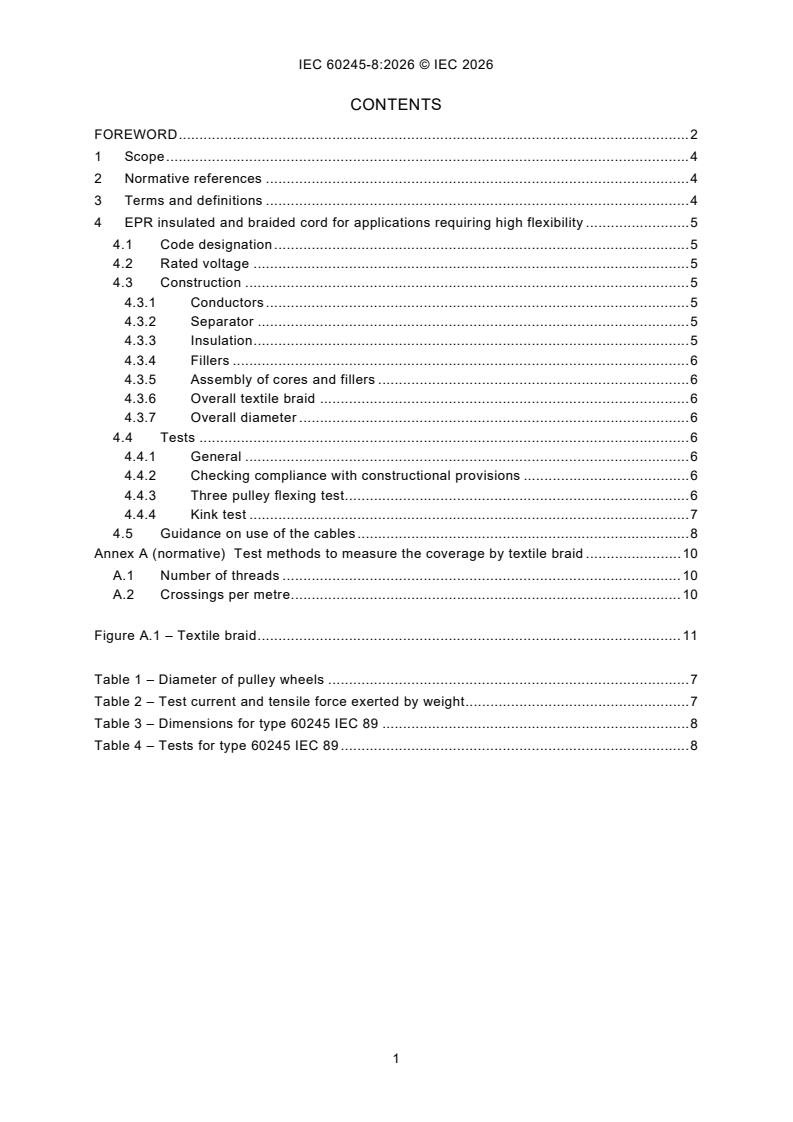
CONTENTS
FOREWORD . 2
1 Scope . 4
2 Normative references . 4
3 Terms and definitions . 4
4 EPR insulated and braided cord for applications requiring high flexibility . 5
4.1 Code designation . 5
4.2 Rated voltage . 5
4.3 Construction . 5
4.3.1 Conductors . 5
4.3.2 Separator . 5
4.3.3 Insulation . 5
4.3.4 Fillers . 6
4.3.5 Assembly of cores and fillers . 6
4.3.6 Overall textile braid . 6
4.3.7 Overall diameter . 6
4.4 Tests . 6
4.4.1 General . 6
4.4.2 Checking compliance with constructional provisions . 6
4.4.3 Three pulley flexing test . 6
4.4.4 Kink test . 7
4.5 Guidance on use of the cables . 8
Annex A (normative) Test methods to measure the coverage by textile braid . 10
A.1 Number of threads . 10
A.2 Crossings per metre . 10
Figure A.1 – Textile braid . 11
Table 1 – Diameter of pulley wheels . 7
Table 2 – Test current and tensile force exerted by weight . 7
Table 3 – Dimensions for type 60245 IEC 89 . 8
Table 4 – Tests for type 60245 IEC 89 . 8
INTERNATIONAL ELECTROTECHNICAL COMMISSION
____________
Rubber insulated cables -
Rated voltages up to and including 450/750 V -
Part 8: Cords for applications requiring high flexibility
FOREWORD
1) The International Electrotechnical Commission (IEC) is a worldwide organization for standardization comprising
all national electrotechnical committees (IEC National Committees). The object of IEC is to promote international
co-operation on all questions concerning standardization in the electrical and electronic fields. To this end and
in addition to other activities, IEC publishes International Standards, Technical Specifications, Technical Reports,
Publicly Available Specifications (PAS) and Guides (hereafter referred to as "IEC Publication(s)"). Their
preparation is entrusted to technical committees; any IEC National Committee interested in the subject dealt with
may participate in this preparatory work. International, governmental and non-governmental organizations liaising
with the IEC also participate in this preparation. IEC collaborates closely with the International Organization for
Standardization (ISO) in accordance with conditions determined by agreement between the two organizations.
2) The formal decisions or agreements of IEC on technical matters express, as nearly as possible, an international
consensus of opinion on the relevant subjects since each technical committee has representation from all
interested IEC National Committees.
3) IEC Publications have the form of recommendations for international use and are accepted by IEC National
Committees in that sense. While all reasonable efforts are made to ensure that the technical content of IEC
Publications is accurate, IEC cannot be held responsible for the way in which they are used or for any
misinterpretation by any end user.
4) In order to promote international uniformity, IEC National Committees undertake to apply IEC Publications
transparently to the maximum extent possible in their national and regional publications. Any divergence between
any IEC Publication and the corresponding national or regional publication shall be clearly indicated in the latter.
5) IEC itself does not provide any attestation of conformity. Independent certification bodies provide conformity
assessment services and, in some areas, access to IEC marks of conformity. IEC is not responsible for any
services carried out by independent certification bodies.
6) All users should ensure that they have the latest edition of this publication.
7) No liability shall attach to IEC or its directors, employees, servants or agents including individual experts and
members of its technical committees and IEC National Committees for any personal injury, property damage or
other damage of any nature whatsoever, whether direct or indirect, or for costs (including legal fees) and
expenses arising out of the publication, use of, or reliance upon, this IEC Publication or any other IEC
Publications.
8) Attention is drawn to the Normative references cited in this publication. Use of the referenced publications is
indispensable for the correct application of this publication.
9) IEC draws attention to the possibility that the implementation of this document may involve the use of (a)
patent(s). IEC takes no position concerning the evidence, validity or applicability of any claimed patent rights in
respect thereof. As of the date of publication of this document, IEC had not received notice of (a) patent(s), which
may be required to implement this document. However, implementers are cautioned that this may not represent
the latest information, which may be obtained from the patent database available at https://patents.iec.ch. IEC
shall not be held responsible for identifying any or all such patent rights.
IEC 60245-8 has been prepared by IEC technical committee TC 20: Electric cables. It is an
International Standard.
This second edition cancels and replaces the first edition published in 1998, Amendment 1:2003
and Amendment 2:2011. This edition constitutes a technical revision.
This edition includes the following significant technical changes with respect to the previous
edition:
a) reference to IEC 60245-2 for the tests has been deleted and replaced by IEC 63294;
b) reference to lift cable according to IEC 60245-5 has been deleted;
c) normative references have been updated.
The text of this International Standard is based on the following documents:
Draft Report on voting
20/2276/FDIS 20/2285/RVD
Full information on the voting for its approval can be found in the report on voting indicated in
the above table.
The language used for the development of this International Standard is English.
This document was drafted in accordance with ISO/IEC Directives, Part 2, and developed in
accordance with ISO/IEC Directives, Part 1 and ISO/IEC Directives, IEC Supplement, available
at www.iec.ch/members_experts/refdocs. The main document types developed by IEC are
described in grea
...
IEC 60245-8 ®
Edition 2.0 2026-04
INTERNATIONAL
STANDARD
REDLINE VERSION
Rubber insulated cables - Rated voltages up to and including 450/750 V -
Part 8: Cords for applications requiring high flexibility
ICS 29.060.20 ISBN 978-2-8327-1208-5
All rights reserved. Unless otherwise specified, no part of this publication may be reproduced or utilized in any form or
by any means, electronic or mechanical, including photocopying and microfilm, without permission in writing from either
IEC or IEC's member National Committee in the country of the requester. If you have any questions about IEC copyright
or have an enquiry about obtaining additional rights to this publication, please contact the address below or your local
IEC member National Committee for further information.
IEC Secretariat Tel.: +41 22 919 02 11
3, rue de Varembé info@iec.ch
CH-1211 Geneva 20 www.iec.ch
Switzerland
About the IEC
The International Electrotechnical Commission (IEC) is the leading global organization that prepares and publishes
International Standards for all electrical, electronic and related technologies.
About IEC publications
The technical content of IEC publications is kept under constant review by the IEC. Please make sure that you have the
latest edition, a corrigendum or an amendment might have been published.
IEC publications search - IEC Products & Services Portal - products.iec.ch
webstore.iec.ch/advsearchform Discover our powerful search engine and read freely all the
The advanced search enables to find IEC publications by a publications previews, graphical symbols and the glossary.
variety of criteria (reference number, text, technical With a subscription you will always have access to up to date
committee, …). It also gives information on projects, content tailored to your needs.
replaced and withdrawn publications.
Electropedia - www.electropedia.org
The world's leading online dictionary on electrotechnology,
IEC Just Published - webstore.iec.ch/justpublished
Stay up to date on all new IEC publications. Just Published containing more than 22 500 terminological entries in English
details all new publications released. Available online and and French, with equivalent terms in 25 additional languages.
once a month by email. Also known as the International Electrotechnical Vocabulary
(IEV) online.
IEC Customer Service Centre - webstore.iec.ch/csc
If you wish to give us your feedback on this publication or
need further assistance, please contact the Customer
Service Centre: sales@iec.ch.
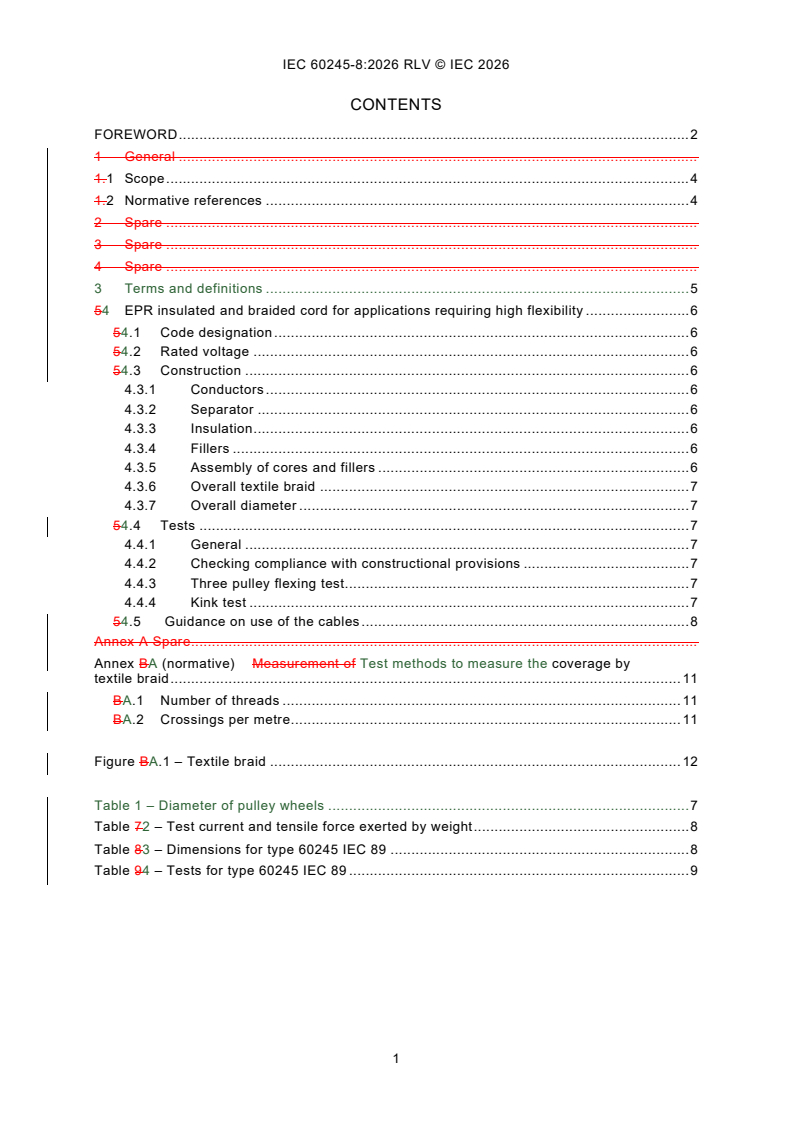
CONTENTS
FOREWORD . 2
1 General .
1.1 Scope . 4
1.2 Normative references . 4
2 Spare .
3 Spare .
4 Spare .
3 Terms and definitions . 5
54 EPR insulated and braided cord for applications requiring high flexibility . 6
54.1 Code designation . 6
54.2 Rated voltage . 6
54.3 Construction . 6
4.3.1 Conductors . 6
4.3.2 Separator . 6
4.3.3 Insulation . 6
4.3.4 Fillers . 6
4.3.5 Assembly of cores and fillers . 6
4.3.6 Overall textile braid . 7
4.3.7 Overall diameter . 7
54.4 Tests . 7
4.4.1 General . 7
4.4.2 Checking compliance with constructional provisions . 7
4.4.3 Three pulley flexing test . 7
4.4.4 Kink test . 7
54.5 Guidance on use of the cables . 8
Annex A Spare .
Annex BA (normative) Measurement of Test methods to measure the coverage by
textile braid . 11
BA.1 Number of threads . 11
BA.2 Crossings per metre . 11
Figure BA.1 – Textile braid . 12
Table 1 – Diameter of pulley wheels . 7
Table 72 – Test current and tensile force exerted by weight . 8
Table 83 – Dimensions for type 60245 IEC 89 . 8
Table 94 – Tests for type 60245 IEC 89 . 9
INTERNATIONAL ELECTROTECHNICAL COMMISSION
____________
Rubber insulated cables -
Rated voltages up to and including 450/750 V -
Part 8: Cords for applications requiring high flexibility
FOREWORD
1) The International Electrotechnical Commission (IEC) is a worldwide organization for standardization comprising
all national electrotechnical committees (IEC National Committees). The object of IEC is to promote international
co-operation on all questions concerning standardization in the electrical and electronic fields. To this end and
in addition to other activities, IEC publishes International Standards, Technical Specifications, Technical Reports,
Publicly Available Specifications (PAS) and Guides (hereafter referred to as "IEC Publication(s)"). Their
preparation is entrusted to technical committees; any IEC National Committee interested in the subject dealt with
may participate in this preparatory work. International, governmental and non-governmental organizations liaising
with the IEC also participate in this preparation. IEC collaborates closely with the International Organization for
Standardization (ISO) in accordance with conditions determined by agreement between the two organizations.
2) The formal decisions or agreements of IEC on technical matters express, as nearly as possible, an international
consensus of opinion on the relevant subjects since each technical committee has representation from all
interested IEC National Committees.
3) IEC Publications have the form of recommendations for international use and are accepted by IEC National
Committees in that sense. While all reasonable efforts are made to ensure that the technical content of IEC
Publications is accurate, IEC cannot be held responsible for the way in which they are used or for any
misinterpretation by any end user.
4) In order to promote international uniformity, IEC National Committees undertake to apply IEC Publications
transparently to the maximum extent possible in their national and regional publications. Any divergence between
any IEC Publication and the corresponding national or regional publication shall be clearly indicated in the latter.
5) IEC itself does not provide any attestation of conformity. Independent certification bodies provide conformity
assessment services and, in some areas, access to IEC marks of conformity. IEC is not responsible for any
services carried out by independent certification bodies.
6) All users should ensure that they have the latest edition of this publication.
7) No liability shall attach to IEC or its directors, employees, servants or agents including individual experts and
members of its technical committees and IEC National Committees for any personal injury, property damage or
other damage of any nature whatsoever, whether direct or indirect, or for costs (including legal fees) and
expenses arising out of the publication, use of, or reliance upon, this IEC Publication or any other IEC
Publications.
8) Attention is drawn to the Normative references cited in this publication. Use of the referenced publications is
indispensable for the correct application of this publication.
9) IEC draws attention to the possibility that the implementation of this document may involve the use of (a)
patent(s). IEC takes no position concerning the evidence, validity or applicability of any claimed patent rights in
respect thereof. As of the date of publication of this document, IEC had not received notice of (a) patent(s), which
may be required to implement this document. However, implementers are cautioned that this may not represent
the latest information, which may be obtained from the patent database available at https://patents.iec.ch. IEC
shall not be held responsible for identifying any or all such patent rights.
This redline version of the official IEC Standard allows the user to identify the changes made
to the previous edition IEC 60245-8:1998+AMD1:2003+AMD2:2011 CSV. A vertical bar appears
in the margin wherever a change has been made. Additions are in green text, deletions are in
strikethrough red text.
IEC 60245-8 has been prepared by IEC technical committee TC 20: Electric cables. It is an
International Standard.
This second edition cancels and replaces the first edition published in 1998, Amendment 1:2003
and Amendment 2:2011. This edition constitutes a technical revision.
This edition includes the following significant technical changes with respect to the previous
edition:
a) reference to IEC 60245-2 for the tests has been deleted and replaced by IEC 63294;
b) reference to lift cable according to IEC 60245-5 has been deleted;
c) normative references have been updated.
The text of this International Standard is based on the following documents:
Draft Report on voting
20/2276/FDIS 20/2285/RVD
Full information on the voting for its approval can be found in the report on voting indicated in
the above table.
The language used for the development of this International Standard is English.
This document was drafted in accordance with ISO/IEC Directives, Part 2, and developed in
accordance with ISO/IEC Directives, Part 1 and ISO/IEC Directives, IEC Supplement, available
at www.iec.ch/members_experts/refdocs. The main document types developed by IEC are
described in greater detail at www.iec.ch/publications.
This document is to be used in conjunction with IEC 60245-1:2026.
A list of all the parts in the IEC 60245 series, published under the general title Rubber insulated
cables - Rated voltages up to and including 450/750 V, can be found on the IEC website.
The committee has decided that the contents of this document will remain unchanged until the
stability date indicated on the IEC website under webstore.iec.ch in the data related to the
specific document. At this date, the document will be
– reconfirmed,
– withdrawn, or
– revised.
1 General
1.1 Scope
This part of IEC 60245 defines the particular specifications requirements for rubber insulated
and textile braid covered cords of rated voltage 300/300 V, for use in applications where high
flexibility is required, for example iron cords, which apply in addition to the general requirements
specified in IEC 60245-1, which apply to all cables.
All cables should comply with the appropriate requirements given in IEC 60245-1 and the
individual types of cables should each comply with the particular requirements of this part.
The tests for cables specified in the IEC 60245 series are described in IEC 63294.
1.2 Normative references
The following documents are referred to in the text in such a way that some or all of their content
constitutes requirements of this document. For dated references, only the edition cited applies.
For undated references, the latest edition of the referenced document (including any
amendments) applies.
NOTE The IEC 60811 series is currently undergoing a revision, which will lead to a restructuring of its parts. A description
of this, as well as a cross-reference table between the current and planned parts is given in IEC 60811-100.
IEC 60228:2024, Conductors of insulated cables
IEC 60245-1:20032026, Rubber insulated cables - Rated voltages up to and including
450/750 V - Part 1: General requirements
Amendment 1: 2007
IEC 60245-2:1994, Rubber insulated cables – Rated voltages up to and including 450/750 V –
Part 2: Test methods
Amendment 1:1997
Amendment 2:1997
IEC 60719, Calculation of the lower and upper limits for the average outer dimensions of cables
with circular copper conductors and of rated voltages up to and including 450/750 V
IEC 60811-1-1:1993, Common test methods for insulating and sheathing materials of electric
cables and optical cables – Part 1-1: Methods for general application – Measurement of
thickness and overall dimensions – Tests for determining the mechanical properties
Amendment 1:2001
IEC 60811-1-2:1985, Common test methods for insulating and sheathing materials of electric
cables – Part 1: Methods for general application – Section Two: Thermal ageing methods
Amendment 1:1989
Amendment 2:2000
IEC 60811-2-1:1998, Insulating and sheathing materials of Electric and optical cables –
Common Test methods– Part 2-1: Methods specific to elastomeric compounds – Ozone
resistance, Hot set and mineral oil immersion tests
Amendment 1:2001
IEC 60811-401, Electric and optical fibre cables - Test methods for non-metallic materials -
Part 401: Miscellaneous tests - Thermal ageing methods - Ageing in an air oven
IEC 60811-403:2012, Electric and optical fibre cables - Test methods for non-metallic materials
– Part 403: Miscellaneous tests - Ozone resistance test on cross-linked compounds
IEC 60811-412, Electric and optical fibre cables - Test methods for non-metallic materials -
Part 412: Miscellaneous tests - Thermal ageing methods - Ageing in an air bomb
IEC 60811-501, Electric and optical fibre cables - Test methods for non-metallic materials –
Part 501: Mechanical tests - Tests for determining the mechanical properties of insulating and
sheathing compounds
IEC 60811-507, Electric and optical fibre cables - Test methods for non-metallic materials –
Part 507: Mechanical tests - Hot set test for cross-linked materials
IEC 62440, Electric cables with a rated voltage not exceeding 450/750 V - Guide to use
IEC 63294:2021, Test methods for electric cables with rated voltage up to and including
450/750 V
2 Spare
3 Spare
4 Spare
3 Terms and definitions
For the purposes of this document, the terms and definitions given in IEC 60245-1 and the
following apply.
ISO and IEC maintain terminology databases for use in standardization at the following
addresses:
– IEC Electropedia: available at https://www.electropedia.org/
– ISO Online browsing platform: available at https://www.iso.org/obp
3.1
type test
T
test required before supplying a type of cable covered by this document on a general
commercial basis, in order to demonstrate satisfactory performance characteristics to meet the
intended application
Note 1 to entry: Type tests are of such a nature that, after they have been carried out, they do not have to be
repeated unless changes are made in the cable materials or design which can change the performance
characteristics.
3.2
sample test
S
test carried out on samples of a completed cable, or components taken from a completed cable,
to check that the finished product meets the design standard
3.3
thread
single textile unit which, when combined with others, forms the braid of the cable
3.4
carrier
element for the winding of the threads
Note 1 to entry: Each carrier can contain several threads.
3.5
crossing
arrangement of all threads of the carriers in order to provide the braid coverage of the cable
5.4 EPR insulated and braided cord for applications requiring high flexibility
54.1 Code designation
60245 IEC 89.
54.2 Rated voltage
300/300 V.
54.3 Construction
54.3.1 Conductors
Number of conductors: 2 or 3.
The conductors shall comply with the requirements given in IEC 60228:2024, Table 4 for
Class 6 conductors, except that the maximum resistance of conductors at 20 °C shall be
increased by 3 %. The wires may can be plain or tinned.
54.3.2 Separator
A separator of suitable material may can be applied around each conductor.
54.3.3 Insulation
The insulation shall be an EPR compound of type IE 4 applied around each conductor.
The insulation shall be applied by extrusion.
The insulation thickness shall comply with the specified value given in Table 8, Column 2 .
The insulation thickness value is specified in Table 3.
54.3.4 Fillers
The fillers shall be of textile material.
54.3.5 Assembly of cores and fillers
The cores and textile fillers shall be twisted together.
The maximum length of lay shall not exceed 7,5 times the diameter of the assembly of cores.
The direction of lay shall be the same for the conductors and for the cores.
A centre filler may can be used.
54.3.6 Overall textile braid
The assembly of cores and fillers shall be covered by a textile braid:
– minimum number of threads: 60;
– minimum crossings per metre: 700;
– minimum number of carriers: 24.
54.3.7 Overall diameter
The mean overall diameter shall be within the limits given in Table 8, Columns 3 and 4 Table 3.
54.4 Tests
4.4.1 General
Compliance with the requirements of 5.3 shall be checked by inspection and by the tests given
in Table 9.
The test methods specified in Table 4 shall be used to perform the tests to check the compliance
with the requirements specified in 4.3.
5.4.14.4.2 Checking compliance with constructional provisions
For 5.3.5 4.3.5, the length of lay shall be determined by measuring the length of 10 pitches of
a sample and dividing this length by 10. The result is the length of lay of the laid-up cores.
5.4.24.4.3 Three pulley flexing test
This test shall be carried out in accordance with 3.5 of IEC 60245-2 IEC 63294:2021, 6.12.
The three pulley wheels of modified carrier C shall be of equal diameter in accordance with
Table 1.
Table 1 – Diameter of pulley wheels
Cable type (Number and nominal cross-sectional area of conductor) Diameter of pulley wheels
mm mm
2 × 0,75 40
2 × 1 40
2 × 1,5 45
3 × 0,75 40
3 × 1 45
3 × 1,5 50
The number of cycles required shall be 2 000, i.e. 4 000 single movements and the test voltage
shall be as specified in Table 2 Table 4.
5.4.34.4.4 Kink test
4.4.4.1 General
This test shall be carried out in accordance with 3.6 of IEC 60245-2 IEC 63294:2021, 6.13.
Test current and tensile force shall be as specified in Table 2.
Table 72 – Test current and tensile force exerted by weight
Tension force exerted by weight for cords:
Nominal cross-sectional
Test current
area of conductor
2-core 3-core
mm A N N
0,75 6 15 20
1,0 10 20 25
1,5 16 25 30
5.4.3.14.4.4.2 Sample
In order to prevent the tensioning weight reaching the top of its guide and either hitting an end-
stop or rising clear of the guide, the following sample preparation shall be carried out prepared
as follows:
a) the three twists shall be set in the sample and temporarily secured with adhesive tape before
presenting positioning the sample to on the equipment;
b) the ends of the sample shall be located in the fixing clamps and the adhesive tape shall
then be removed;
c) the fixing clamps shall be slowly moved apart to ensure that the sample achieves a straight
orientation when the clamps are fully extended, with the tensioning weight still in the guide
and satisfying complying the 50 mm lift specified in 3.6.4 of IEC 60245-2 IEC 63294:2021,
6.13.4. When the fully extended position is reached, the tensioning weight shall not make
contact with any end-stop in the guide;
d) if this straight orientation is not achieved, up to 30 slow test cycles shall be performed
during which the sample shall be manipulated to distribute twists more evenly over the sample
length and so that a knot does not occur to avoid the creation of knots during the initial phase
of the test procedure.
5.4.3.24.4.4.3 Requirements Test procedure
A total of 1 500 cycles shall be made on each sample.
54.5 Guide to use (informative) Guidance on use of the cables
The use of cable type 60245 IEC 89 shall comply with IEC 62440, which provides guidance on
the safe use of electric cables with a rated voltage not exceeding 450/750 V.
Maximum conductor temperature in normal use: 60 °C.
NOTE Other guidelines are under consideration.
Table 83 – Dimensions for type 60245 IEC 89
Number and nominal cross-sectional Mean overall diameters
Thickness of insulation,
area of conductors
specified value
Lower limit Upper limit
mm mm mm
mm
2 × 0,75 0,8 5,5 7,2
2 × 1 0,8 5,7 7,6
2 × 1,5 0,8 6,2 8,2
3 × 0,75 0,8 5,9 7,7
3 × 1 0,8 6,2 8,1
3 × 1,5 0,8 6,7 8,8
Table 94 – Tests for type 60245 IEC 89
Ref No. Tests Category
Test methods
of test
1 Electrical tests
1.1 Resistance of conductors T, S 6
...