

IEC TR 61850-90-8:2016
(Main)Communication networks and systems for power utility automation - Part 90-8: Object model for E-mobility
General Information
- Abstract
IEC TR 61850-90-8:2016(E) shows how IEC 61850-7-420 can be used to model the essential parts of the E-Mobility standards related to Electric Vehicles and Electric Vehicle Supply Equipments (IEC 62196, IEC 61851, IEC 15118) and the Power system (IEC 61850-7-420), in order to secure a high level of safety and interoperability.
- Status
- Published
- Publication Date
- 06-Apr-2016
- Technical Committee
- TC 57 - Power systems management and associated information exchange
- Drafting Committee
- WG 10 - TC 57/WG 10
- Current Stage
- PPUB - Publication issued
- Start Date
- 07-Apr-2016
- Completion Date
- 30-Jun-2016
Overview
IEC TR 61850-90-8:2016 provides an object model that links the IEC 61850 power-utility automation data model (notably IEC 61850-7-420) with E‑Mobility domain standards (IEC 62196, IEC 61851, ISO/IEC 15118). The Technical Report shows how to model Electric Vehicles (EVs), Electric Vehicle Supply Equipment (EVSE), charging outlets and power-system interfaces to achieve a high level of safety, interoperability, and consistent information exchange between the grid and charging infrastructure.
Key topics and technical requirements
- Object model mapping: Guidance for mapping EV/EVSE domain information (AC and DC) into the IEC 61850 information model, including mappings for IEC 61851 (AC), IEC 61851-23/24 (DC), and ISO 15118 (V2G).
- Logical Nodes (normative definitions in Annex C): New and existing IEC 61850 Logical Nodes tailored to E‑Mobility, for example:
- DESE – E‑Mobility supply equipment
- DEAO – E‑Mobility AC charging outlet
- DEDO – E‑Mobility DC charging outlet
- DEEV – E‑Mobility Electric Vehicle
- ZCAB – Power cable
- FSCH – Schedule (charge scheduling)
- Use cases & functional scenarios: Identification (ID), charging status and control (use cases E2 & E3), AC/DC charging workflows, and charge-schedule exchange.
- Data objects and signals: Standardized objects for plug presence, outlet charging current and power rating, charging cable and supply-cable characteristics, PWM signalling, EV/EVSE identification and nameplate, State of Charge (SoC), fault reporting (isolation, short-circuit, welding), and loss of digital communication.
- Charge scheduling and control: Common information model for charge schedules, schedule states, interval types and examples for EVSE with one outlet.
- Architectural guidance: Implementation concepts showing mapping options (e.g., dedicated or centralized SECC), and practical mapping examples for System A and System C DC charging.
Practical applications and who uses this standard
- Utilities and grid operators integrating EV loads into distribution automation and DER management systems.
- EVSE manufacturers and charging-station integrators implementing IEC 61850-compliant information models for interoperability with energy management systems.
- Software developers and system integrators building charge‑scheduling, monitoring and control platforms that bridge ISO 15118 and IEC 61850.
- Test labs, certification bodies and standards developers aligning EV/EVSE products with power-system communication models.
Related standards (mentioned)
- IEC 61850-7-420 (DER/Energy resources model)
- IEC 62196 (plugs and connectors)
- IEC 61851 (conductive charging)
- IEC 61851-23/24 (DC charging system variants)
- ISO/IEC 15118 (vehicle-to-grid communication interface)
This TR is essential for stakeholders aiming to enable standardized, secure communication between EVs, chargers and power systems using the IEC 61850 framework.
Get Certified
Connect with accredited certification bodies for this standard

ANCE
Mexican certification and testing association.

Intertek Slovenia
Intertek testing, inspection, and certification services in Slovenia.

LNE (Laboratoire National de Métrologie et d'Essais)
French national laboratory for metrology and testing.
Sponsored listings
Frequently Asked Questions
IEC TR 61850-90-8:2016 is a technical report published by the International Electrotechnical Commission (IEC). Its full title is "Communication networks and systems for power utility automation - Part 90-8: Object model for E-mobility". This standard covers: IEC TR 61850-90-8:2016(E) shows how IEC 61850-7-420 can be used to model the essential parts of the E-Mobility standards related to Electric Vehicles and Electric Vehicle Supply Equipments (IEC 62196, IEC 61851, IEC 15118) and the Power system (IEC 61850-7-420), in order to secure a high level of safety and interoperability.
IEC TR 61850-90-8:2016(E) shows how IEC 61850-7-420 can be used to model the essential parts of the E-Mobility standards related to Electric Vehicles and Electric Vehicle Supply Equipments (IEC 62196, IEC 61851, IEC 15118) and the Power system (IEC 61850-7-420), in order to secure a high level of safety and interoperability.
IEC TR 61850-90-8:2016 is classified under the following ICS (International Classification for Standards) categories: 33.200 - Telecontrol. Telemetering. The ICS classification helps identify the subject area and facilitates finding related standards.
IEC TR 61850-90-8:2016 is available in PDF format for immediate download after purchase. The document can be added to your cart and obtained through the secure checkout process. Digital delivery ensures instant access to the complete standard document.
Standards Content (Sample)
IEC TR 61850-90-8 ®
Edition 1.0 2016-04
TECHNICAL
REPORT
colour
inside
Communication networks and systems for power utility automation –
Part 90-8: Object model for E-mobility
All rights reserved. Unless otherwise specified, no part of this publication may be reproduced or utilized in any form
or by any means, electronic or mechanical, including photocopying and microfilm, without permission in writing from
either IEC or IEC's member National Committee in the country of the requester. If you have any questions about IEC
copyright or have an enquiry about obtaining additional rights to this publication, please contact the address below or
your local IEC member National Committee for further information.
IEC Central Office Tel.: +41 22 919 02 11
3, rue de Varembé Fax: +41 22 919 03 00
CH-1211 Geneva 20 info@iec.ch
Switzerland www.iec.ch
About the IEC
The International Electrotechnical Commission (IEC) is the leading global organization that prepares and publishes
International Standards for all electrical, electronic and related technologies.
About IEC publications
The technical content of IEC publications is kept under constant review by the IEC. Please make sure that you have the
latest edition, a corrigenda or an amendment might have been published.
IEC Catalogue - webstore.iec.ch/catalogue Electropedia - www.electropedia.org
The stand-alone application for consulting the entire The world's leading online dictionary of electronic and
bibliographical information on IEC International Standards, electrical terms containing 20 000 terms and definitions in
Technical Specifications, Technical Reports and other English and French, with equivalent terms in 15 additional
documents. Available for PC, Mac OS, Android Tablets and languages. Also known as the International Electrotechnical
iPad. Vocabulary (IEV) online.
IEC publications search - www.iec.ch/searchpub IEC Glossary - std.iec.ch/glossary
The advanced search enables to find IEC publications by a 65 000 electrotechnical terminology entries in English and
variety of criteria (reference number, text, technical French extracted from the Terms and Definitions clause of
committee,…). It also gives information on projects, replaced IEC publications issued since 2002. Some entries have been
and withdrawn publications. collected from earlier publications of IEC TC 37, 77, 86 and
CISPR.
IEC Just Published - webstore.iec.ch/justpublished
Stay up to date on all new IEC publications. Just Published IEC Customer Service Centre - webstore.iec.ch/csc
details all new publications released. Available online and If you wish to give us your feedback on this publication or
also once a month by email. need further assistance, please contact the Customer Service
Centre: csc@iec.ch.
IEC TR 61850-90-8 ®
Edition 1.0 2016-04
TECHNICAL
REPORT
colour
inside
Communication networks and systems for power utility automation –
Part 90-8: Object model for E-mobility
INTERNATIONAL
ELECTROTECHNICAL
COMMISSION
ICS 33.200 ISBN 978-2-8322-3256-9
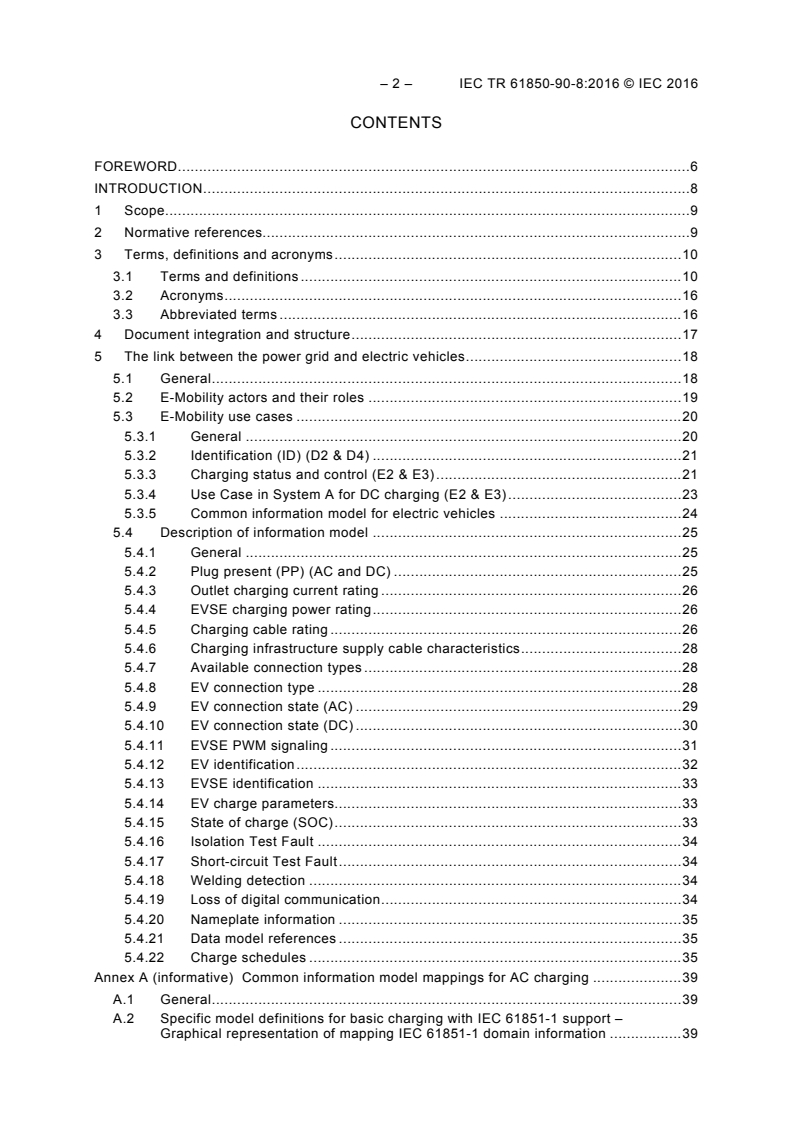
– 2 – IEC TR 61850-90-8:2016 © IEC 2016
CONTENTS
FOREWORD . 6
INTRODUCTION . 8
1 Scope . 9
2 Normative references. 9
3 Terms, definitions and acronyms . 10
3.1 Terms and definitions . 10
3.2 Acronyms . 16
3.3 Abbreviated terms . 16
4 Document integration and structure . 17
5 The link between the power grid and electric vehicles . 18
5.1 General . 18
5.2 E-Mobility actors and their roles . 19
5.3 E-Mobility use cases . 20
5.3.1 General . 20
5.3.2 Identification (ID) (D2 & D4) . 21
5.3.3 Charging status and control (E2 & E3) . 21
5.3.4 Use Case in System A for DC charging (E2 & E3) . 23
5.3.5 Common information model for electric vehicles . 24
5.4 Description of information model . 25
5.4.1 General . 25
5.4.2 Plug present (PP) (AC and DC) . 25
5.4.3 Outlet charging current rating . 26
5.4.4 EVSE charging power rating . 26
5.4.5 Charging cable rating . 26
5.4.6 Charging infrastructure supply cable characteristics . 28
5.4.7 Available connection types . 28
5.4.8 EV connection type . 28
5.4.9 EV connection state (AC) . 29
5.4.10 EV connection state (DC) . 30
5.4.11 EVSE PWM signaling . 31
5.4.12 EV identification . 32
5.4.13 EVSE identification . 33
5.4.14 EV charge parameters. 33
5.4.15 State of charge (SOC) . 33
5.4.16 Isolation Test Fault . 34
5.4.17 Short-circuit Test Fault . 34
5.4.18 Welding detection . 34
5.4.19 Loss of digital communication . 34
5.4.20 Nameplate information . 35
5.4.21 Data model references . 35
5.4.22 Charge schedules . 35
Annex A (informative) Common information model mappings for AC charging . 39
A.1 General . 39
A.2 Specific model definitions for basic charging with IEC 61851-1 support –
Graphical representation of mapping IEC 61851-1 domain information . 39
A.3 Specific model definitions for smart charging with ISO 15118 support –
Graphical representation of mapping IEC 61851-1 and ISO 15118-2 domain
information . 39
Annex B (informative) Common information model mappings for DC charging . 41
B.1 General . 41
B.2 Specific model definitions for IEC 61851-23/24 system A – DC charging –
Graphical representation of mapping IEC 61851-23/24 system A domain
information . 41
B.3 Specific model definitions for IEC 61851-23/24 system C – DC charging –
Graphical representation of mapping IEC 61851-23/24 system C domain
information . 42
Annex C (normative) 61850 Logical Nodes for Electric Mobility . 44
C.1 Overview. 44
C.2 New and existing logical nodes . 44
C.2.1 LN: E-Mobility supply equipment Name: DESE . 44
C.2.2 LN: E-Mobility AC charging outlet Name: DEAO . 46
C.2.3 LN: E-Mobility DC charging outlet Name: DEDO . 49
C.2.4 LN: E-Mobility Electric Vehicle Name: DEEV . 52
C.2.5 LN: Power cable Name: ZCAB . 54
C.2.6 LN: Schedule Name: FSCH . 55
C.2.7 Schedule states (ScheduleStateKind enumeration) . 57
C.2.8 Scheduling interval types (ScheduleIntervalKind enumeration) . 57
C.3 Example of an AC charging station model . 58
C.3.1 General . 58
C.3.2 Exploded view of DESE1 and DESE2 . 59
C.3.3 Exploded view of DEAO1 and DEAO2. 59
C.3.4 Exploded view of DEEV1 and DEEV2 . 60
C.3.5 Exploded view of FSCH1 and FSCH2 . 61
C.4 Example of a DC charging station model (system A) . 62
C.4.1 General . 62
C.4.2 Exploded view of DESE1 and DESE2 . 63
C.4.3 Exploded view of DEDO1 and DEDO2 . 65
C.4.4 Exploded view of DEEV1 and DEEV2 . 66
Annex D (informative) Information exchange between EV, EVSE and CIO for charge
scheduling . 68
Annex E (informative) Architectural concepts (implementation guide) . 69
E.1 Overview. 69
E.2 Architectural concept for mapping ISO 15118 to IEC 61850 . 69
E.3 Architectural concept for mapping IEC 61851-23/24 system A to IEC 61850 . 71
Annex F (informative) Relevant standards for E-Mobility object model . 72
F.1 Overview. 72
F.2 Basic structure of IEC 62196 − Plugs, socket-outlets, vehicle couplers and
vehicle inlets – Conductive charging of electric vehicles . 72
F.3 Basic structure of IEC 61851 − Electric vehicle conductive charging system . 73
F.4 Basic structure of ISO 15118 − Vehicle to grid communication interface . 73
F.5 Basic structure of IEC 61980 − Electric vehicle wireless power transfer
systems . 75
Annex G (informative) Typical use of data objects in the charger domains . 76
Bibliography . 79
– 4 – IEC TR 61850-90-8:2016 © IEC 2016
Figure 1 – Overall structure of IEC 61850 parts . 17
Figure 2 – Overview on document structure . 18
Figure 3 – Conceptual organization of Logical Devices and Logical Nodes of DER
systems . 19
Figure 4 – Generic role model of relevant actors for smart charging EVs [CEN BT N987]
Figure 5 – Communication architecture of System A . 24
Figure 6 – IEC 61850 Logical Nodes overview, based on [IEEE VPPC2012] . 25
Figure 7 – State of DC charging state in IEC 61851-23/24 system A . 31
Figure 8 – Exemplary exchange of charge schedule information for an EVSE with one
outlet, based on [IEEE VPPC2011] . 37
Figure A.1 – Mapping of IEC 61851-1 domain information to IEC 61850-7-420
information model for AC charging . 39
Figure A.2 – Mapping of ISO 15118-2 and IEC 61851-1 domain information to
IEC 61850-7-420 information model for AC charging. 40
Figure B.1 – Mapping of IEC 61851-23/24 system A domain information to
IEC 61850-7-420 information model for DC charging . 42
Figure B.2 – Mapping of IEC 61851-23/24 system C (ISO 15118-2 and IEC 61851-1)
domain information to IEC 61850-7-420 information model for DC charging . 43
Figure C.1 – Example of an AC charging station . 58
Figure C.2 – Example of a DC charging station . 63
Figure D.1 – EV, EVSE and CIO information exchange . 68
Figure E.1 – Basic concept of mapping ISO 15118 V2G Communication Interface to
IEC 61850 DERs with dedicated SECC in the EVSE managing one EV . 69
Figure E.2 – Basic concept of mapping ISO 15118 V2G Communication Interface to
IEC 61850 DERs with centralized SECC outside of EVSE managing a set of EVs . 70
Figure E.3 – Basic concept of mapping IEC 61851-23/24 system A communication
interface to IEC 61850 DERs . 71
Figure F.1 – Overview of relevant E-Mobility ISO standards for the V2G interface,
based on [EVS27 2013] . 72
Figure F.2 – ISO 15118 document structure according to ISO/IEC 7498-1 OSI-layers,
based on [IEEE VPPC2012] . 75
Table 1 – Overview of use cases relevant to secondary actors [ISO 15118-1:2013] . 21
Table 2 – Selected use cases E2 and E3 from [ISO 15118-1:2013] . 22
Table 3 – Data objects for plug present . 26
Table 4 – Data object for charging current rating . 26
Table 5 – Data object for charging power rating . 26
Table 6 – Resistor coding for vehicle AC connectors and plugs [IEC 61851-1] . 27
Table 7 – Data object for AC charging cable rating . 27
Table 8 – Data object for DC charging cable rating . 27
Table 9 – Data objects allowing overload of a cable . 28
Table 10 – Data objects for supported connection types of an outlet . 28
Table 11 – Data object showing the selected connection type of an EV . 29
Table 12 – Functions of control pilot pin [IEC 61851-1] . 29
Table 13 – Data object showing the connection status on an outlet . 30
Table 14 – DC connection status in IEC 61851-23/24 system A . 30
Table 15 – Maximum current to be drawn by vehicle [IEC 61851-1] . 32
Table 16 – Data objects for handling PWM related features on an outlet . 32
Table 17 – Data object for EV nameplate information . 32
Table 18 – Data object for EVSE nameplate information . 33
Table 19 – Data objects for target setting and limit . 33
Table 20 – Data object for showing SOC from the EV . 34
Table 21 – Data object for status of an isolation test . 34
Table 22 – Data object for status of a short-circuit test . 34
Table 23 – Data object for status of welding test . 34
Table 24 – Data object for loss of digital communication . 35
Table 25 – Data objects for nameplate information . 35
Table 26 – Data objects for logical node references . 35
Table 27 – Data objects for a Local Limit Profile power schedule . 38
Table 28 – Data objects for a Local Reservation Profile power schedule . 38
Table C.1 – E-Mobility supply equipment logical node . 45
Table C.2 – E-Mobility AC charging outlet logical node . 47
Table C.3 – Literals of EVACConnectionStateKind . 48
Table C.4 – Literals of EVACPlugStateKind . 48
Table C.5 – Literals of EVACCableCapabilityKind . 49
Table C.6 – E-Mobility DC charging outlet logical node . 50
Table C.7 – Literals of EVDCConnectionStateAKind . 51
Table C.8 – Literals of EVDCConnectionStateCKind . 51
Table C.9 – Literals of EVDCCableCapabilityKind . 52
Table C.10 – Literals of EVDCPlugStateKind . 52
Table C.11 – E-Mobility electric vehicle logical node . 53
Table C.12 – Literals of EVConnectionChargingKind . 54
Table C.13 – Additions to power cable logical node . 54
Table C.14 – Schedule logical node . 56
Table C.15 – Literals of ScheduleStateKind . 57
Table C.16 – Literals of ScheduleIntervalKind . 58
Table C.17 – Example logical node instances . 59
Table C.18 – Exploded view of DESE1 and DESE2 . 59
Table C.19 – Exploded view of DEAO1 and DEAO2 . 60
Table C.20 – Exploded view of DEEV1 and DEEV2 . 61
Table C.21 – Exploded view of FSCH1 and FSCH2 . 62
Table C.22 – Example logical node instances . 63
Table C.23 – Exploded view of DESE1 and DESE2 . 64
Table C.24 – Exploded view of DEDO1 and DEDO2 . 65
Table C.25 – Exploded view of DEEV1 and DEEV2 . 67
Table G.1 – Use of data objects in charging systems . 77
– 6 – IEC TR 61850-90-8:2016 © IEC 2016
INTERNATIONAL ELECTROTECHNICAL COMMISSION
____________
COMMUNICATION NETWORKS AND SYSTEMS
FOR POWER UTILITY AUTOMATION –
Part 90-8: Object model for E-mobility
FOREWORD
1) The International Electrotechnical Commission (IEC) is a worldwide organization for standardization comprising
all national electrotechnical committees (IEC National Committees). The object of IEC is to promote
international co-operation on all questions concerning standardization in the electrical and electronic fields. To
this end and in addition to other activities, IEC publishes International Standards, Technical Specifications,
Technical Reports, Publicly Available Specifications (PAS) and Guides (hereafter referred to as “IEC
Publication(s)”). Their preparation is entrusted to technical committees; any IEC National Committee interested
in the subject dealt with may participate in this preparatory work. International, governmental and non-
governmental organizations liaising with the IEC also participate in this preparation. IEC collaborates closely
with the International Organization for Standardization (ISO) in accordance with conditions determined by
agreement between the two organizations.
2) The formal decisions or agreements of IEC on technical matters express, as nearly as possible, an international
consensus of opinion on the relevant subjects since each technical committee has representation from all
interested IEC National Committees.
3) IEC Publications have the form of recommendations for international use and are accepted by IEC National
Committees in that sense. While all reasonable efforts are made to ensure that the technical content of IEC
Publications is accurate, IEC cannot be held responsible for the way in which they are used or for any
misinterpretation by any end user.
4) In order to promote international uniformity, IEC National Committees undertake to apply IEC Publications
transparently to the maximum extent possible in their national and regional publications. Any divergence
between any IEC Publication and the corresponding national or regional publication shall be clearly indicated in
the latter.
5) IEC itself does not provide any attestation of conformity. Independent certification bodies provide conformity
assessment services and, in some areas, access to IEC marks of conformity. IEC is not responsible for any
services carried out by independent certification bodies.
6) All users should ensure that they have the latest edition of this publication.
7) No liability shall attach to IEC or its directors, employees, servants or agents including individual experts and
members of its technical committees and IEC National Committees for any personal injury, property damage or
other damage of any nature whatsoever, whether direct or indirect, or for costs (including legal fees) and
expenses arising out of the publication, use of, or reliance upon, this IEC Publication or any other IEC
Publications.
8) Attention is drawn to the Normative references cited in this publication. Use of the referenced publications is
indispensable for the correct application of this publication.
9) Attention is drawn to the possibility that some of the elements of this IEC Publication may be the subject of
patent rights. IEC shall not be held responsible for identifying any or all such patent rights.
The main task of IEC technical committees is to prepare International Standards. However, a
technical committee may propose the publication of a technical report when it has collected
data of a different kind from that which is normally published as an International Standard, for
example "state of the art".
IEC TR 61850-90-8, which is a technical report, has been prepared by IEC technical
committee 57: Power systems management and associated information exchange.
The text of this technical report is based on the following documents:
Enquiry draft Report on voting
57/1603/DTR 57/1651/RVC
Full information on the voting for the approval of this technical report can be found in the
report on voting indicated in the above table.
This publication has been drafted in accordance with the ISO/IEC Directives, Part 2.
A list of all parts in the IEC 61850 series, published under the general title Communication
networks and systems for power utility automation, can be found on the IEC website.
The committee has decided that the contents of this publication will remain unchanged until
the stability date indicated on the IEC website under "http://webstore.iec.ch" in the data
related to the specific publication. At this date, the publication will be
• reconfirmed,
• withdrawn,
• replaced by a revised edition, or
• amended.
A bilingual version of this publication may be issued at a later date.
IMPORTANT – The 'colour inside' logo on the cover page of this publication indicates
that it contains colours which are considered to be useful for the correct
understanding of its contents. Users should therefore print this document using a
colour printer.
– 8 – IEC TR 61850-90-8:2016 © IEC 2016
INTRODUCTION
This part of IEC 61850-90, which is a technical report, describes how current standardization
for Electric Road Vehicles (EV) and the Vehicle-to-Grid Communication Interface can be
linked to IEC 61850-7-420, which deals with Distributed Energy Resources (DER). This
technical report provides necessary background information and proposes an object model for
E-Mobility in order to establish an EV plugged into the power grid as DER according to the
principles of IEC 61850-7-420. The basic information modeling in IEC 61850 and
IEC 61850-7-420 already covers a lot of needs for the E-Mobility domain. Missing parts can
be modeled as new logical nodes and data objects, which this technical report defines.
NOTE Editorial Notes on this technical report are summarized in Annex G.
COMMUNICATION NETWORKS AND SYSTEMS
FOR POWER UTILITY AUTOMATION –
Part 90-8: Object model for E-mobility
1 Scope
This part of IEC 61850-90, which is a technical report, shows how IEC 61850-7-420 can be
used to model the essential parts of the E-Mobility standards related to Electric Vehicles and
Electric Vehicle Supply Equipments (IEC 62196, IEC 61851, IEC 15118) and the Power
system (IEC 61850-7-420), in order to secure a high level of safety and interoperability.
The namespace of this document is:
• “(TR) IEC 61850-90-8:2015”
The name space "IEC 61850-90-8" is considered as "Transitional" since the model is
expected to be included in the next edition of IEC 61850-7-420 . Potential
extensions/modifications may happen if/when the model is given International Standard status.
The most optimal backward compatibility with the original content will be strived for during this
move.
In accordance with the status of the ISO 15118 series and systems determined in
IEC 61851-23 and -24, this technical report focuses on EV charging processes only.
Discharging processes in order to support grid services are out of scope, but will be adopted
when available in future versions of ISO 15118-2 and IEC 61851-1, -23 and -24.
2 Normative references
The following documents, in whole or in part, are normatively referenced in this document and
are indispensable for its application. For dated references, only the edition cited applies. For
undated references, the latest edition of the referenced document (including any
amendments) applies.
IEC 61850-7-4:2010, Communication networks and systems for power utility automation –
Part 7-4: Basic communication structure – Compatible logical node classes and data object
classes
IEC 61850-7-420:2009, Communication networks and systems for power utility automation –
Part 7-420: Basic communication structure – Distributed energy resources logical nodes
IEC 61851-1:2010, Electric vehicle conductive charging system – Part 1: General
requirements
IEC 61851-21-1:−, Electric vehicle conductive charging system – Part 21-1: Electric vehicle
onboard charger EMC requirements for conductive connection to a.c./d.c. supply
IEC 61851-21-2:−, Electric vehicle conductive charging system – Part 21-2: EMC
requirements for OFF board electric vehicle charging systems
___________
To be published.
– 10 – IEC TR 61850-90-8:2016 © IEC 2016
IEC 61851-23:2014, Electric vehicle conductive charging system – Part 23: DC electric
vehicle charging station
IEC 61851-24:2014, Electric vehicle conductive charging system – Part 24: Digital
communication between a d.c. EV charging station and an electric vehicle for control of d.c.
charging
IEC 62196-1:2014, Plugs, socket-outlets, vehicle connectors and vehicle inlets – Conductive
charging of electric vehicles – Part 1: General requirements
IEC 62196-2:2011, Plugs, socket-outlets, vehicle connectors and vehicle inlets – Conductive
charging of electric vehicles – Part 2: Dimensional compatibility and interchangeability
requirements for a.c. pin and contact-tube accessories
IEC 62196-3:2014, Plugs, socket-outlets, vehicle connectors and vehicle inlets – Conductive
charging of electric vehicles – Part 3: Dimensional compatibility and interchangeability
requirements for d.c. and a.c./d.c. pin and contact-tube vehicle couplers
ISO 15118-1:2013, Road vehicles – Vehicle to grid communication interface – Part 1: General
information and use-case definition
ISO 15118-2:2014, Road vehicles – Vehicle-to-grid communication interface – Part 2: Network
and application protocol requirements
ISO 15118-3:2015, Road vehicles – Vehicle-to-grid communication interface communication
interface – Part 3: Physical and data link layer requirements
3 Terms, definitions and acronyms
For the purposes of this document, the following terms, definitions and acronyms apply.
3.1 Terms and definitions
3.1.1
Balance Responsible Party
BRP
party that has a contract proving financial security and identifying balance responsibility with
the Imbalance Settlement Responsible of the Market Balance Area entitling the party to
operate in the market
Note 1 to entry: This is the only role allowing a party to nominate energy on a wholesale level.
Note 2 to entry: The meaning of the word "balance" in this context signifies that that the quantity contracted to
provide or to consume must be equal to the quantity really provided or consumed.
Note 3 to entry: This is equivalent to "Program responsible party" in the Netherlands, "Balance group manager" in
Germany and "market agent" in Spain.
[SOURCE: ENTSO-E RM:2014-01]
3.1.2
CHArge de Move
CHAdeMO
Socket, connector and charging system for DC quick charging, equivalent to "move by
charge"
3.1.3
Charging Infrastructure Operator
CIO
legal entity that operates and maintains the EVSE
Note 1 to entry: It is not obligatory that there is an operator for the EVSE, but e. g. in case of ID validation or
Smart Charging where communication is needed, the responsible entity regarding the communication will be the E-
Mobility Infrastructure Operator.
Note 2 to entry: This entry corresponds to the Charging Station Operator (CSO or CSIO) in the upcoming IEC TS
62913-2-4 .
3.1.4
Charging Station
single or multiple EV Supply Equipment(s)
Note 1 to entry: See also EVSE.
3.1.5
Building Energy Management System
BEMS
providers, delivering the systems which facilitate management and control of building facilities,
realizing energy saving and increasing comfortability of users of buildings and making full use
of the state-of-the-art Information Technology.
[SOURCE: EG3 Deliverable:2011]
3.1.6
Demand Clearing House
DCH
entity for grid negotiation that provides information on the load of the grid
Note 1 to entry: The demand clearing house mediates between two clearing partners – a SECC and the part of
the power grid connected to this SECC. Most likely this function will be served by a system operator.
Note 2 to entry: Demand Clearing House and meter operator may exchange information with each other as well
as with other actors.
EXAMPLE A DCH typically fulfils following tasks:
• Collect all necessary information from all parts of the power grid, e.g. current or forecasted load of local trans-
formers, distribution grid, power substation, transmission grid, transmission substation, power plants (incl. re-
newable energies), and predicted charging schedules submitted by EVCCs.A Charging Station represents a
single or multiple EV Supply Equipment(s) (see also EVSE).
• Consolidate the collected grid information to a ―grid profile‖ and offer it to SECCs / EVCCs.
• Provide charging schedule proposal for the connected EV to the requesting SECC based on the collected grid
profile.
• Inform the SECC as to the necessity for an updated charging schedule if the grid profile has changed.
• On the contrary, the SECC will inform the demand clearing house if the EV's charging schedule has changed.
[SOURCE: ISO 15118-1:2013]
3.1.7
digital communication
digitally encoded information exchanged between an EV charging station and an EV, as well
as the method by which it is exchanged
Note 1 to entry:
• 1. CAN based using a dedicated data communication circuit; CAN protocol is given in ISO 11898-1; refer to
IEC 61851-24:2014, Annex A and Annex B for specific implementation details;
___________
Under consideration.
– 12 – IEC TR 61850-90-8:2016 © IEC 2016
• 2. Powerline Communication (Homeplug Green PHY TM) over the control pilot line; refer to IEC 61851-24:2014,
Annex C for specific implementation details.
3.1.8
Distribution System Operator
DSO
natural or legal person responsible for operating, ensuring the maintenance of and, if
necessary, developing the distribution system in a given area and, where applicable, its
interconnections with other systems and for ensuring the long-term ability of the system to
meet reasonable demands for the distribution of electricity, according to Article 2.6 of the
Directive
Note 1 to entry: Moreover, the DSO is responsible for regional grid access and grid stability, integration of
renewables at the distribution level and regional load balancing.
[SOURCE: EG3 Deliverable:2011]
3.1.9
E-Mobility Clearing House
entity mediating between two clearing partners to provide validation services for roaming
regarding contracts of different E-Mobility Service Providers
Note 1 to entry: The E-Mobility clearing house's purpose is to:
• collect all necessary contract information like Contract ID, E-Mobility Service Provider (EMSP), communication
path to E-Mobility Service Provider, roaming fees, begin- and end-date of contract, etc.
• provide SECC with confirmation that an E-Mobility Service Provider (EMSP) will pay for a given Contract ID
(authentication of valid contract) and transfer a corresponding Service Detail Record (SDR) after each
charging session to the corresponding E-Mobility Service Provider (EMSP).
Note 2 to entry: E-Mobility Clearing House, E-Mobility Service Provider (EMSP) and Meter Operator (MO) may
exchange information with each other as well as other actors.
3.1.10
E-Mobility Customer
legal entity being associated to an E-Mobility Service Provider
Note 1 to entry: The E-Mobility Customer may be bound to an E-Mobility Service Provider by the legal means of a
contract.
3.1.11
E-Mobility Infrastructure Producer
legal entity that manufactures E-Mobility infrastructure components (e. g. EVSEs)
3.1.12
E-Mobility Infrastructure Owner
legal entity that owns E-Mobility infrastructure (e.g. EVSEs)
3.1.13
E-Mobility Service Provider
EMSP
legal entity that provides services to the Electric Vehicle User (EVU) related to the operation
of an EV
Note 1 to entry: This definition is also considered in the upcoming IEC TS 62913-4 .
___________
Under consideration.
3.1.14
Electric Energy Meter
EEM
equipment to measure electrical energy by integrating power with respect to time, which
complies with IEC 62052-11 and IEC 62053-21, IEC 62053-52
Note 1 to entry: Some use cases need the amount of electric energy measured by the electric energy meter and
communicated through the SECC to the EVCC, while other scenarios do not need a separate electric energy meter.
The EV may get this information and use it according to the intentions of the OEM.
Note 2 to entry: The EEM may be operated by a Metering Operator.
[SOURCE: ISO 15118-1:2013]
3.1.15
Electric Vehicle
EV
any vehicle propelled by an electric motor drawing current from a rechargeable storage
battery or from other portable energy storage devices (rechargeable, using energy from a
source off the vehicle such as a residential or public electric service), which is manufactured
primarily for use on public streets, roads or highways
[SOURCE: ISO 15118-1:2013]
3.1.16
Electric Vehicle Communication Controller
EVCC
embedded system, within the vehicle, that implements the communication between the vehicle
and the SECC in order to support specific functions
Note 1 to entry: Such specific function could be e.g. controlling in- and output channels, encryption, or data
transfer between vehicle and SECC.
[SOURCE: ISO 15118-1:2013]
3.1.17
Electric Vehicle Manufacturer
OEM
legal entity responsible for all the technologies inside the EV also in relation to the data
communication
Note 1 to entry: This is commonly known as OEM (Original Equipment Manufacturer).
3.1.18
Electric Vehicle Supply Equipment
EVSE
conductors, including the phase(s), neutral and protective earth conductors, the EV couplers,
attached plugs, and all other accessories, devices, power outlets or apparatuses installed
specifically for the purpose of delivering energy from the premises wiring to the EV and
allowing communication between them as necessary
Note 1 to entry: For the purposes of this document, it is assumed that an EVSE may host multiple outlets each
being managed according to IEC 61851-1 Annex A.
[SOURCE: ISO 15118-1:2013]
3.1.19
Electric Vehicle User
EVU
person or legal entity using the vehicle and providing information about driving needs and
consequently influences charging patterns
– 14 – IEC TR 61850-90-8:2016 © IEC 2016
Note 1 to entry: Driving needs such as range and time of availability are necessary to achieve the most
appropriate charging scenario.
Note 2 to entry: There shall be a relationship/association between the EVU and the E-Mobility Customer (EC).
However, the exact nature of this relationship/association depends on the underlying business models and use
cases.
[SOURCE: ISO 15118-1:2013]
3.1.20
Electricity Provider
EP
body of secondary actor to provide electricity
3.1.21
Energy Market
commodity markets that deal specifically with the trade and supply of energy (purchase and
sale of energy products)
Note 1 to entry: Energy market may refer to an electricity market, but can also refer to other sources of energy.
Note 2 to entry: It typically describes a wholesale market for energy producers and energy retailers. Other
participants in the wholesale energy market include financial intermediaries, energy traders and large consumers.
3.1.22
energy Supplier
retailer
entity that offers contracts for supply of energy to a consumer (the supply contract)
Note 1 to entry: Within this role the energy Supplier will initiate DSM activities.
Note 2 to entry: In some countries referred to as Retailer.
3.1.23
High Level Communication
HLC
bidirectional digital communication using protocol and messages specified in ISO 15118-2
and physical and data link layer specified in ISO 15118-3
Note 1 to entry: High-level communication in ISO 15118 is compliant to the term digital communication in SAE
J1772/2836/2847/2931.
[SOURCE:ISO 15118-1:2013]
3.1.24
Meter Operator
MO
party responsible for installing, maintaining, testing, certifying and decommissioning physical
meters
[SOURCE: ENTSO-E RM:2014-01]
3.1.25
Power Outlet
part of a plug and socket-outlet intended to be installed with the fixed wiring
Note 1 to entry: All power outlets shall have the pilot function.
[SOURCE: ISO 15118-1:2013]
3.1.26
Primary Actor
PA
role involved directly in the charging process
[SOURCE: ISO 15118-1:2013]
3.1.27
Secondary Actor
SA
role involved indirectly in the charging process
Note 1 to entry: Secondary actors may exchange information between each other.
Note 2 to entry: Secondary actors could also be a
...