

IEC TR 63091:2017
(Main)Study for the derating curve of surface mount fixed resistors - Derating curves based on terminal part temperature
General Information
- Abstract
IEC TR 63091:2017(E) is a technical report and is applicable to SMB resistors with sizes equal or smaller than the RR6332M, including the typical rectangular and cylindrical SMD resistors mentioned in IEC 60115-8.
- Status
- Published
- Publication Date
- 23-May-2017
- Technical Committee
- TC 40 - Capacitors and resistors for electronic equipment
- Drafting Committee
- WG 41 - TC 40/WG 41
- Current Stage
- PPUB - Publication issued
- Start Date
- 24-May-2017
- Completion Date
- 31-May-2017
Overview
IEC TR 63091:2017 - "Study for the derating curve of surface mount fixed resistors – Derating curves based on terminal part temperature" is an IEC technical report that analyzes power derating for surface-mount device (SMD) fixed resistors. The report is applicable to SMB resistors with sizes equal to or smaller than RR6332M and covers typical rectangular and cylindrical SMD resistors referenced in IEC 60115-8. Rather than using ambient temperature alone, IEC TR 63091 investigates derating curves tied to the terminal part temperature and provides measurement methods, thermal resistance data, and guidance for establishing practical derating limits.
Key topics and technical requirements
- Derating approach: Comparison of existing ambient-temperature based derating curves with the proposed terminal part temperature–based derating curves and rationale for the change.
- Temperature measurement methods: Detailed procedures for measuring terminal part temperature using thermocouples and infrared thermographs, including attachment, wiring, spatial resolution and error considerations (Annexes G, I).
- Thermal resistance and heat paths: Measurement and definitions of thermal resistance from terminal to surface hotspot (R_th shs-t), plus methods used by resistor manufacturers (Annexes F, H).
- Test setups and environmental effects: Influence of printed circuit board (PCB) layout, number of mounted resistors, airflow/wind speed in test chambers, and board thermal properties on temperature rise (Annexes B, C, D, K).
- Practical guidance: Recommended measurement systems, calculation of measurement error, and suggestions for applying terminal-temperature derating curves in product design (Sections 4, Annex E).
- Terminology & scope: Terms, normative references and applicability to SMB-size SMD resistors (Sections 1–3).
Practical applications
- Establishing power derating limits for SMD resistors in high-reliability electronics.
- Validating resistor operating temperature for PCB designers, component engineers, and reliability engineers to prevent overheating and premature failure.
- Designing thermal test protocols in component and test laboratories to measure terminal temperatures and thermal resistance accurately.
- Informing resistor manufacturers on test-board configurations and reporting practices for datasheets and customer guidance.
Who should use this standard
- Resistor manufacturers and test laboratories
- Electronic component engineers and designers
- PCB/layout engineers concerned with thermal management
- Reliability and quality assurance teams
- Standards developers and consultants working with passive component qualification
Related standards
- IEC 60115-8 (referenced for resistor types and sizes)
- Relevant IEC test-method and component reliability standards for passive components
Keywords: IEC TR 63091:2017, derating curve, surface mount fixed resistors, terminal part temperature, SMD resistors, thermal resistance, thermocouple, infrared thermograph, power derating, PCB heat dissipation.
Frequently Asked Questions
IEC TR 63091:2017 is a technical report published by the International Electrotechnical Commission (IEC). Its full title is "Study for the derating curve of surface mount fixed resistors - Derating curves based on terminal part temperature". This standard covers: IEC TR 63091:2017(E) is a technical report and is applicable to SMB resistors with sizes equal or smaller than the RR6332M, including the typical rectangular and cylindrical SMD resistors mentioned in IEC 60115-8.
IEC TR 63091:2017(E) is a technical report and is applicable to SMB resistors with sizes equal or smaller than the RR6332M, including the typical rectangular and cylindrical SMD resistors mentioned in IEC 60115-8.
IEC TR 63091:2017 is classified under the following ICS (International Classification for Standards) categories: 01 - GENERALITIES. TERMINOLOGY. STANDARDIZATION. DOCUMENTATION; 31.040.10 - Fixed resistors. The ICS classification helps identify the subject area and facilitates finding related standards.
IEC TR 63091:2017 is available in PDF format for immediate download after purchase. The document can be added to your cart and obtained through the secure checkout process. Digital delivery ensures instant access to the complete standard document.
Standards Content (Sample)
IEC TR 63091 ®
Edition 1.0 2017-05
TECHNICAL
REPORT
Study for the derating curve of surface mount fixed resistors – Derating curves
based on terminal part temperature
All rights reserved. Unless otherwise specified, no part of this publication may be reproduced or utilized in any form
or by any means, electronic or mechanical, including photocopying and microfilm, without permission in writing from
either IEC or IEC's member National Committee in the country of the requester. If you have any questions about IEC
copyright or have an enquiry about obtaining additional rights to this publication, please contact the address below or
your local IEC member National Committee for further information.
IEC Central Office Tel.: +41 22 919 02 11
3, rue de Varembé Fax: +41 22 919 03 00
CH-1211 Geneva 20 info@iec.ch
Switzerland www.iec.ch
About the IEC
The International Electrotechnical Commission (IEC) is the leading global organization that prepares and publishes
International Standards for all electrical, electronic and related technologies.
About IEC publications
The technical content of IEC publications is kept under constant review by the IEC. Please make sure that you have the
latest edition, a corrigenda or an amendment might have been published.
IEC Catalogue - webstore.iec.ch/catalogue Electropedia - www.electropedia.org
The stand-alone application for consulting the entire The world's leading online dictionary of electronic and
bibliographical information on IEC International Standards, electrical terms containing 20 000 terms and definitions in
Technical Specifications, Technical Reports and other English and French, with equivalent terms in 16 additional
documents. Available for PC, Mac OS, Android Tablets and languages. Also known as the International Electrotechnical
iPad. Vocabulary (IEV) online.
IEC publications search - www.iec.ch/searchpub IEC Glossary - std.iec.ch/glossary
The advanced search enables to find IEC publications by a 65 000 electrotechnical terminology entries in English and
variety of criteria (reference number, text, technical French extracted from the Terms and Definitions clause of
committee,…). It also gives information on projects, replaced IEC publications issued since 2002. Some entries have been
and withdrawn publications. collected from earlier publications of IEC TC 37, 77, 86 and
CISPR.
IEC Just Published - webstore.iec.ch/justpublished
Stay up to date on all new IEC publications. Just Published IEC Customer Service Centre - webstore.iec.ch/csc
details all new publications released. Available online and If you wish to give us your feedback on this publication or
also once a month by email. need further assistance, please contact the Customer Service
Centre: csc@iec.ch.
IEC TR 63091 ®
Edition 1.0 2017-05
TECHNICAL
REPORT
Study for the derating curve of surface mount fixed resistors – Derating curves
based on terminal part temperature
INTERNATIONAL
ELECTROTECHNICAL
COMMISSION
ICS 31.040.10 ISBN 978-2-8322-4368-8
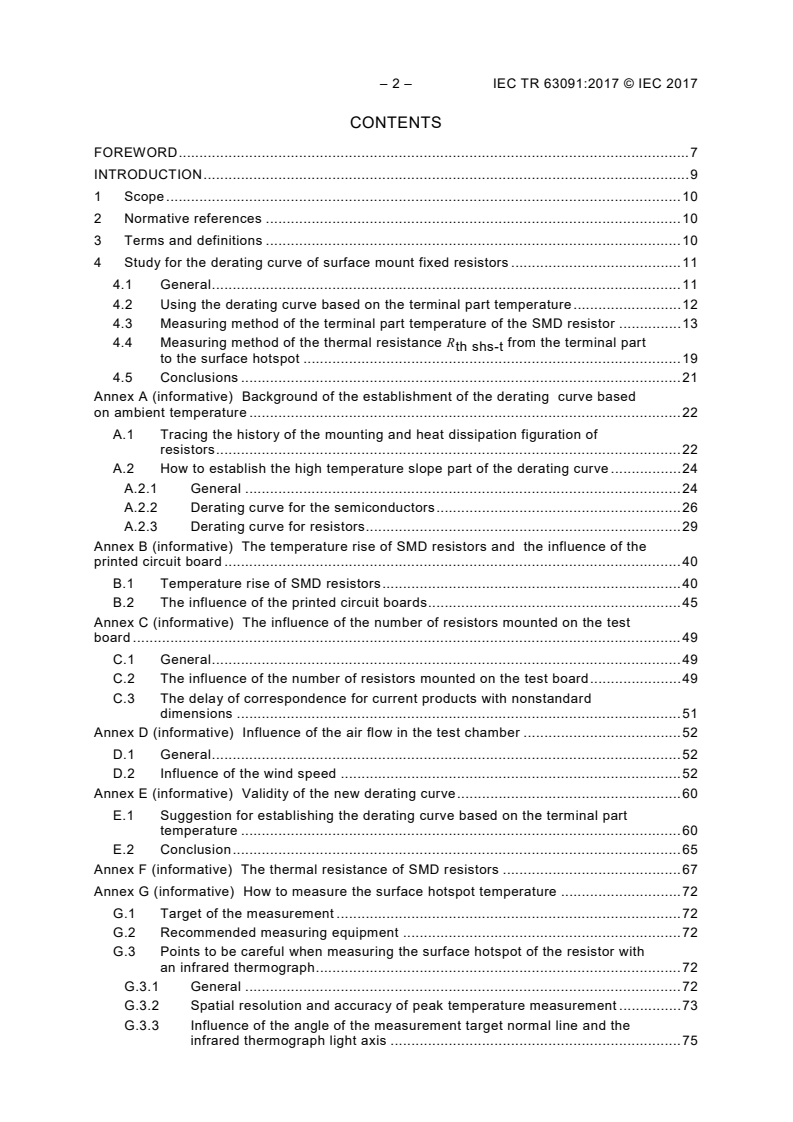
– 2 – IEC TR 63091:2017 © IEC 2017
CONTENTS
FOREWORD . 7
INTRODUCTION . 9
1 Scope . 10
2 Normative references . 10
3 Terms and definitions . 10
4 Study for the derating curve of surface mount fixed resistors . 11
4.1 General . 11
4.2 Using the derating curve based on the terminal part temperature . 12
4.3 Measuring method of the terminal part temperature of the SMD resistor . 13
4.4 Measuring method of the thermal resistance R from the terminal part
th shs-t
to the surface hotspot . 19
4.5 Conclusions . 21
Annex A (informative) Background of the establishment of the derating curve based
on ambient temperature . 22
A.1 Tracing the history of the mounting and heat dissipation figuration of
resistors . 22
A.2 How to establish the high temperature slope part of the derating curve . 24
A.2.1 General . 24
A.2.2 Derating curve for the semiconductors . 26
A.2.3 Derating curve for resistors . 29
Annex B (informative) The temperature rise of SMD resistors and the influence of the
printed circuit board . 40
B.1 Temperature rise of SMD resistors . 40
B.2 The influence of the printed circuit boards . 45
Annex C (informative) The influence of the number of resistors mounted on the test
board . 49
C.1 General . 49
C.2 The influence of the number of resistors mounted on the test board . 49
C.3 The delay of correspondence for current products with nonstandard
dimensions . 51
Annex D (informative) Influence of the air flow in the test chamber . 52
D.1 General . 52
D.2 Influence of the wind speed . 52
Annex E (informative) Validity of the new derating curve . 60
E.1 Suggestion for establishing the derating curve based on the terminal part
temperature . 60
E.2 Conclusion . 65
Annex F (informative) The thermal resistance of SMD resistors . 67
Annex G (informative) How to measure the surface hotspot temperature . 72
G.1 Target of the measurement . 72
G.2 Recommended measuring equipment . 72
G.3 Points to be careful when measuring the surface hotspot of the resistor with
an infrared thermograph . 72
G.3.1 General . 72
G.3.2 Spatial resolution and accuracy of peak temperature measurement . 73
G.3.3 Influence of the angle of the measurement target normal line and the
infrared thermograph light axis . 75
Annex H (informative) How the resistor manufacturers measure the thermal resistance
of resistors . 79
H.1 The measuring system . 79
H.2 Definition of the two kinds of temperatures. 80
H.3 Errors in the measurement . 83
Annex I (informative) Measurement method of the terminal part temperature of the
SMD resistors . 88
I.1 Measuring method using an infrared thermograph . 88
I.2 Measuring method using the thermocouple . 89
I.3 Estimating the error range of the temperature measurement using the
thermal resistance of the thermocouple . 90
I.3.1 General . 90
I.3.2 When using the type T thermocouples . 97
I.4 Thermal resistance of the board . 97
I.5 Conclusion of this annex . 100
Annex J (informative) The variation of the heat dissipation fraction caused by the
difference between the resistor and its mounting configuration . 101
J.1 Heat dissipation ratio of cylindrical resistors wired in the air. 101
J.2 Heat dissipation ratio of SMD resistors mounted on the board . 102
J.3 Heat dissipation ratio of the cylindrical resistors mounted on the through-
hole printed board . 104
Annex K (informative) Influence of airflow on SMD resistors . 105
K.1 General . 105
K.2 Measurement system . 105
K.3 Test results (orthogonal) . 106
K.4 Test results (parallel) . 110
Annex L (informative) The influence of the spatial resolution of the thermograph . 115
L.1 The application for using the thermograph when measuring the temperature
of the SMD resistor . 115
L.2 The relation between the minimum area that the accurate temperature could
be measured and the pixel magnification percentage . 115
L.3 Example of the RR1608M SMD resistor hotspot's actual measurement . 120
L.4 Conclusion . 121
Annex M (informative) Future subjects . 122
Bibliography . 123
Figure 1 – Existing derating curve based on ambient temperature . 12
Figure 2 – Suggested derating curve based on terminal temperature . 12
Figure 3 – Attachment position of the thermocouple when measuring the temperature
of the terminal part . 13
Figure 4 – Attaching type K thermocouples . 14
Figure 5 – Wiring routing of the thermocouple . 15
Figure 6 – The true value and the actual measured value of the terminal part
temperature . 16
Figure 7 – Thermal resistance R of the FR4 single side board (thickness 1,6 mm). 17
th eq
Figure 8 – Length that cause the heat dissipation and the thermal resistance of the
type-K thermocouple (calculated) . 18
Figure 9 – Example of calculation of the measurement error ∆T caused by the heat
dissipation of the thermocouple . 19
– 4 – IEC TR 63091:2017 © IEC 2017
Figure 10 – Recommended measurement system of T and T for calculating R
shs t th
..................................................................................................................................... 20
shs-t
Figure A.1 – Wired in the air using the lug terminal . 22
Figure A.2 – Heat path when wired in the air using the lug terminal . 23
Figure A.3 – Test condition for resistors with category power 0 W . 24
Figure A.4 – Test condition for resistors with category power other than 0 W . 25
Figure A.5 – Example of reviewing the derating curve . 26
Figure A.6 – T , T and R of transistors . 27
j c th j-c
Figure A.7 – Derating curves for transistors . 28
Figure A.8 – Trajectory of T when P is reduced according to the derating curve . 29
j
Figure A.9 – Leaded resistors with small temperature rise . 30
Figure A.10 – Leaded resistors with large temperature rise . 31
Figure A.11 – Trajectory of T for the lead wire resistors with small temperature rise . 31
hs
Figure A.12 – Trajectory of T for the lead wire resistors with large temperature rise . 33
hs
Figure A.13 – Trajectory of T for resistors with category power other than 0 W . 34
hs
Figure A.14 – T and MAT for lead wire resistors with large temperature rise . 35
sp
Figure A.15 – T and MAT for lead wire resistors with small temperature rise . 36
sp
Figure A.16 – Resistors for which the hotspot is the thermally sensitive point . 37
Figure A.17 – Resistor that have derating curve similar to the semiconductor . 38
Figure B.1 – Temperature distribution of the SMD resistors mounted on the board . 41
Figure B.2 – Temperature rise of the SMD resistors from the ambient temperature . 42
Figure B.3 – Measurement system layout and board dimension . 43
Figure B.4 – Temperature rise of RR2012M (thickness 35 μm, 0,25 W applied) . 44
Figure B.5 – Temperature rise of RR2012M (thickness 70 μm, 0,25 W applied) . 45
Figure B.6 – Trajectory of the terminal part and hotspot temperature of the SMD
resistors . 46
Figure B.7 – Operating temperature of the resistor on the board with narrow patterns. 47
Figure C.1 – Test board compliant with the IEC standard for RR1608M . 50
Figure C.2 – Relation between the number of samples and the surface hotspot
temperature rise . 50
Figure C.3 – Infrared thermograph image in the same scale when power is applied to 5
samples and 20 samples . 51
Figure D.1 – Wind speed and the terminal part temperature rise of the RR6332M . 53
Figure D.2 – Test system for the natural convection flow . 53
Figure D.3 – Observing the influence of the agitation wind in the test chamber . 55
Figure D.4 – Wind speed and the terminal part temperature rise of the RR5025M . 56
Figure D.5 – Wind speed and the terminal part temperature rise of the RR3225M . 56
Figure D.6 – Wind speed and the terminal part temperature rise of the RR3216M . 57
Figure D.7 – Wind speed and the terminal part temperature rise of the RR2012M . 57
Figure D.8 – Wind speed and the terminal part temperature rise of the RR1608M . 58
Figure D.9 – Wind speed and the terminal part temperature rise of the RR1005M . 58
Figure E.1 – Derating conditions of SMD resistors on the resistor manufacturer test
board . 60
Figure E.2 – New derating curve provided by the resistor manufacturer to the
electric/electronic designers . 63
Figure E.3 – Derating curve based on the terminal part temperature . 64
Figure E.4 – Derating curve based on the terminal part temperature . 65
Figure F.1 – Definition of the thermal resistance in a strict sense . 68
Figure F.2 – Thermal resistance of the resistor . 69
Figure G.1 – Difference of the measured hotspot temperature caused by the spatial
resolution . 74
Figure G.2 – Measuring system for the error caused by the angle . 76
Figure G.3 – Error caused by the angle of the optical axis and the target surface
(natural convection) . 77
Figure G.4 – Error caused by the angle of the optical axis and the target surface (0,3
m/s air ventilation from the side) . 77
Figure H.1 – Measuring system for calculating the thermal resistance between the
surface hotspot and the terminal part . 80
Figure H.2 – Simulation model . 81
Figure H.3 – Temperature distribution of the copper block surface (calculated) . 84
Figure H.4 – Isothermal line of the fillet part (calculated) . 86
Figure I.1 – Temperature drop caused by the attached thermocouple . 89
Figure I.2 – Example of the printed board . 90
Figure I.3 – Printed board shown with the thermal network . 91
Figure I.4 – Equivalent circuit of the printed board shown with the thermal network . 92
Figure I.5 – Equivalent circuit when the thermocouple is connected . 93
Figure I.6 – Ambient temperature and the space need for the heat dissipation of the
thermocouple . 94
Figure I.7 – Equivalent circuit when the thermocouple is connected . 95
Figure I.8 – Length that causes the heat dissipation and the thermal resistance of the
type K thermocouple (calculated) . 96
Figure I.9 – Length that cause the heat dissipation and the thermal resistance of the
type T thermocouple (calculated) . 97
Figure I.10 – Thermal resistance R of the FR4 single side board (thickness 1,6 mm) . 98
th eq
Figure I.11 – Calculating the thermal resistance of the board from the fillet side . 99
Figure J.1 – Simulation model of the lead wire resistors wired in the air . 101
Figure J.2 – Heat dissipation ratio of the leaded cylindrical resistors (calculated) . 102
Figure J.3 – Measurement system of the heat dissipation ratio of SMD resistors
mounted on the board . 103
Figure K.1 – Measurement system . 106
Figure K.2 – Relationship between the terminal part temperature rise and the wind
speed for the RR6332M (orthogonal) . 107
Figure K.3 – Relationship between the terminal part temperature rise and the wind
speed for the RR5025M (orthogonal) . 107
Figure K.4 – Relationship between the terminal part temperature rise and the wind
speed for the RR3225M (orthogonal) . 108
Figure K.5 – Relationship between the terminal part temperature rise and the wind
speed for the RR3216M (orthogonal) . 108
Figure K.6 – Relationship between the terminal part temperature rise and the wind
speed for the RR2012M (orthogonal) . 109
Figure K.7 – Relationship between the terminal part temperature rise and the wind
speed for the RR1608M (orthogonal) . 109
– 6 – IEC TR 63091:2017 © IEC 2017
Figure K.8 – Relationship between the terminal part temperature rise and the wind
speed for the RR1005M (orthogonal) . 110
Figure K.9 – Relationship between the terminal part temperature rise and the wind
speed for the RR6332M (parallel) . 111
Figure K.10 – Relationship between the terminal part temperature rise and the wind
speed for the RR5025M (parallel) . 111
Figure K.11 – Relationship between the terminal part temperature rise and the wind
speed for the RR3225M (parallel) . 112
Figure K.12 – Relationship between the terminal part temperature rise and the wind
speed for the RR3216M (parallel) . 112
Figure K.13 – Relationship between the terminal part temperature rise and the wind
speed for the RR2012M (parallel) . 113
Figure K.14 – Relationship between the terminal part temperature rise and the wind
speed for the RR1608M (parallel) . 113
Figure K.15 – Relationship between the terminal part temperature rise and the wind
speed for the RR1005M (parallel) . 114
Figure K.16 – Terminal part temperature rise of RR6332M, difference between the
windward and leeward sides when placed parallel . 114
Figure L.1 – Step response of the Gaussian filter of the various cut-off spatial
frequencies (calculated) . 116
Figure L.2 – Temperature distribution (cross-section) when measuring the object that
becomes high temperature only in the range of 0,2 mm in diameter . 117
Figure L.3 – Measuring system of spatial frequency filter of the infrared thermograph . 118
Figure L.4 – Actual measured value of the step response of various magnifier lenses . 119
Figure L.5 – Comparison of the actual measured value and the calculated value (step
response) . 120
Figure L.6 – Comparison of the actual measured value and the calculated value
(surface hotspot of the resistor) . 121
Table D.1 – Number of samples mounted and the applied power . 54
Table H.1 – Results of the fillet part temperature simulation (calculated value) . 82
Table H.2 – Simulation result of the fillet part's temperature where it is measurable
(calculated value) . 82
Table H.3 – Simulation result of the fillet part's temperature where it is measurable
(calculated value) . 83
Table H.4 – Thermal resistance simulation results between the surface hotspot and the
terminal part based on the copper block temperature (calculated value) . 85
Table J.1 – Analysis result of the heat dissipation ratio of SMD resistors (calculated
value and value actually measured) . 104
INTERNATIONAL ELECTROTECHNICAL COMMISSION
____________
STUDY FOR THE DERATING CURVE
OF SURFACE MOUNT FIXED RESISTORS –
Derating curves based on terminal part temperature
FOREWORD
1) The International Electrotechnical Commission (IEC) is a worldwide organization for standardization comprising
all national electrotechnical committees (IEC National Committees). The object of IEC is to promote
international co-operation on all questions concerning standardization in the electrical and electronic fields. To
this end and in addition to other activities, IEC publishes International Standards, Technical Specifications,
Technical Reports, Publicly Available Specifications (PAS) and Guides (hereafter referred to as “IEC
Publication(s)”). Their preparation is entrusted to technical committees; any IEC National Committee interested
in the subject dealt with may participate in this preparatory work. International, governmental and non-
governmental organizations liaising with the IEC also participate in this preparation. IEC collaborates closely
with the International Organization for Standardization (ISO) in accordance with conditions determined by
agreement between the two organizations.
2) The formal decisions or agreements of IEC on technical matters express, as nearly as possible, an international
consensus of opinion on the relevant subjects since each technical committee has representation from all
interested IEC National Committees.
3) IEC Publications have the form of recommendations for international use and are accepted by IEC National
Committees in that sense. While all reasonable efforts are made to ensure that the technical content of IEC
Publications is accurate, IEC cannot be held responsible for the way in which they are used or for any
misinterpretation by any end user.
4) In order to promote international uniformity, IEC National Committees undertake to apply IEC Publications
transparently to the maximum extent possible in their national and regional publications. Any divergence
between any IEC Publication and the corresponding national or regional publication shall be clearly indicated in
the latter.
5) IEC itself does not provide any attestation of conformity. Independent certification bodies provide conformity
assessment services and, in some areas, access to IEC marks of conformity. IEC is not responsible for any
services carried out by independent certification bodies.
6) All users should ensure that they have the latest edition of this publication.
7) No liability shall attach to IEC or its directors, employees, servants or agents including individual experts and
members of its technical committees and IEC National Committees for any personal injury, property damage or
other damage of any nature whatsoever, whether direct or indirect, or for costs (including legal fees) and
expenses arising out of the publication, use of, or reliance upon, this IEC Publication or any other IEC
Publications.
8) Attention is drawn to the Normative references cited in this publication. Use of the referenced publications is
indispensable for the correct application of this publication.
9) Attention is drawn to the possibility that some of the elements of this IEC Publication may be the subject of
patent rights. IEC shall not be held responsible for identifying any or all such patent rights.
The main task of IEC technical committees is to prepare International Standards. However, a
technical committee may propose the publication of a technical report when it has collected
data of a different kind from that which is normally published as an International Standard, for
example "state of the art".
IEC TR 63091, which is a technical report, has been prepared by IEC technical committee 40:
Capacitors and resistors for electronic equipment.
The text of this technical report is based on the following documents:
Enquiry draft Report on voting
40/2502/DTR 40/2532/RVDTR
Full information on the voting for the approval of this technical report can be found in the
report on voting indicated in the above table.
– 8 – IEC TR 63091:2017 © IEC 2017
This document has been drafted in accordance with the ISO/IEC Directives, Part 2.
The committee has decided that the contents of this document will remain unchanged until the
stability date indicated on the IEC website under "http://webstore.iec.ch" in the data related to
the specific document. At this date, the document will be
• reconfirmed,
• withdrawn,
• replaced by a revised edition, or
• amended.
A bilingual version of this publication may be issued at a later date.
INTRODUCTION
Work began in 2012 to adopt the new derating curve suitable for the surface mount fixed
resistors that use the terminal part temperature as the horizontal axis.
The derating curves for surface mount fixed resistors are defined in JIS C 5201-8:2014.
However, the principle of the derating curve was established when the resistors were
cylindrically shaped, wired in the air and the heat was dissipated directly from the resistor
body into the ambient environment. Therefore, it is not suitable for the surface mount fixed
resistors that use the printed circuit boards as the main heat path.
It is necessary to fulfill the demands from the electric and electronic device manufacturers for
raising the power ratings safely. Additionally, it is required to establish a new derating curve
that is suitable for the surface mount fixed resistors so that they can be used safely in a high
temperature environment, typically in automotive electronic devices.
Making a change of the temperature rule for evaluation of the fixed resistors from the ambient
temperature to the temperature of the connection point (terminal part temperature of the
resistor) will affect many defined contents of multiple standards in the IEC 60115 series.
Additionally, it will mean changing the users' evaluation rules, so the impact will be enormous.
Therefore, it has been decided to issue the Technical Report first to attract attention of the
relevant market players and then, we will start working on changing the defined contents of
the IEC 60115 series.
– 10 – IEC TR 63091:2017 © IEC 2017
STUDY FOR THE DERATING CURVE
OF SURFACE MOUNT FIXED RESISTORS –
Derating curves based on terminal part temperature
1 Scope
This Technical Report is applicable to SMD resistors with sizes equal or smaller than the
RR6332M, including the typical rectangular and cylindrical SMD resistors mentioned in
IEC 60115-8.
2 Normative references
The following documents are referred to in the text in such a way that some or all of their
content constitutes requirements of this document. For dated references, only the edition
cited applies. For undated references, the latest edition of the referenced document (including
any amendments) applies.
IEC 60115-1:2008, Fixed resistors for use in electronic equipment – Part 1: Generic
specification
IEC 60115-8:2009, Fixed resistors for use in electronic equipment – Part 8: Sectional
specification: Fixed chip resistors
3 Terms and definitions
For the purposes of this document, the following terms and definitions apply.
ISO and IEC maintain terminological databases for use in standardization at the following
addresses:
• IEC Electropedia: available at http://www.electropedia.org/
• ISO Online browsing platform: available at http://www.iso.org/obp
3.1
terminal part temperature
T
t
temperature of terminal part of the resistor
3.2
rated terminal part temperature
terminal part temperature of the resistor at the time of the rated load life test
3.3
hotspot of the resistor
hottest part of the resistor that is caused by the Joule heat generated from the resistive
element when the current is applied and is generally located inside resistor's body
3.4
hotspot temperature
T
hs
temperature of the internal hotspot of the resistor
3.5
surface hotspot of the resistor
hottest part on the surface of the resistor generally near the hotspot
3.6
surface hotspot temperature
T
shs
temperature of the surface hotspot of the resistor
Note 1 to entry: Generally, the internal hotspot temperature is higher than the surface hotspot temperature.
3.7
thermal resistance of the resistor
R
th
restraint of the thermal flow from the resistor's hotspot to the environment
Note 1 to entry: Thermal resistance is calculated by dividing the difference between the surface hotspot
temperature T and the terminal part temperature T by the applied power P and usually expressed in K/W.
shs t
3.8
thermally sensitive point temperature
T
sp
temperature of the part the most sensitive to temperature rise in the resistor
3.9
maximum allowable temperature
MAT
ideal maximum temperature at which the resistor is able to keep its function
3.10
maximum terminal part temperature
MTT
maximum temperature of the terminal part of the resistor
4 Study for the derating curve of surface mount fixed resistors
4.1 General
The electric/electronic device designers are reducing the power applied to the resistor below
the level shown in the derating curves provided by the resistor manufacturer based on the
ambient temperature of the unloaded resistor, but the ambient temperature of the board rises
when they use SMD resistors.
But, the body temperature of the SMD resistor may become higher than the temperature
verified in the test implemented by the resistor manufacturer even when this rule is observed.
On the other hand, in some cases excessive derating is requested and an extremely large
margin is set.
In this Technical Report, the reasons why the derating curves, which are defined in
2.2.4 of IEC 60115-1:2008 and in 2.2.3 of IEC 60115-8:2009, provided by the resistor
manufacturers sometimes cannot be used by electric/electronic device designers in their
design activity will be given, and the method of changing them into a practical designing tool
will be suggested.
There are three key points. The first and most important point is to use the derating curve
based on the terminal temperature instead of the ambient temperature. The second point is
the measuring method of the terminal part temperature of the SMD mounted on the printed
circuit board. The third point is the measuring method of the thermal resistance R of the
th shs-t
– 12 – IEC TR 63091:2017 © IEC 2017
resistor terminal part to the surface hotspot. The second and third points are the issues that
need to be defined in association with the first point.
4.2 Using the derating curve based on the terminal part temperature
Using Figure 2 instead of Figure 1 is suggested for the design of high-power applications of
the SMD resistors in excess of the conventional rated dissipation (e.g. 100 mW for RR1608M).
The validity of using the derating curve based on the terminal part temperature is explained in
Annex E.
P
r
P
UCT
T T
ra a
IEC
Key
P Applied power
P Rated power
r
T Ambient temperature
a
UCT Upper category temperature
T Rated ambient temperature
ra
Figure 1 – Existing derating curve based on ambient temperature
P
r
P
MTT
T T
rt t
IEC
Key
P Applied power
P Rated power
r
T Terminal part temperature
t
MTT Maximum terminal temperature
T Rated terminal temperature
rt
Figure 2 – Suggested derating curve based on terminal temperature
4.3 Measuring method of the terminal part temperature of the SMD resistor
The measurement will be done on the commonly-used printed circuit board, but the resistor
manufacturer can replace it with the board defined in the standard. The temperature
measurement position will be the centre part of the fillet regardless of the size. The
measurement sensor will be the thermocouple. The measurement point is shown in Figure 3.
A type K thermocouple with a wire diameter (single wire) of 0,1 mm is recommended. As in
Figure 4, the tips of the type K thermocouple should be spot-welded and pre-treated by
applying suitable flux and dipped in melted solder so that it can be surely and directly
soldered to the fillet of the target resistor.
This report is based on the use of type K thermocouples due to their low thermal conductivity.
If other thermocouples are to be used, their thermal properties need to be considered, as
shown for type T thermocouples in Annex I.
The measured value should be corrected as necessary by estimating the influence of the heat
dissipation through the thermocouple. The method will be mentioned in Formula (1).
(b)
(a)
(c)
IEC
Key
1 Resistor
2 Solder fillet
3 Copper pattern
4 Printed board
5 Thermocouple (Tip is the measuring point)
(b) Attachment position of the thermocouple when fillet is large (centre of solder meniscus)
(c) Attachment position of the thermocouple when fillet is small (centre of solder meniscus)
Figure 3 – Attachment position of the thermocouple
when measuring the temperature of the terminal part
– 14 – IEC TR 63091:2017 © IEC 2017
3 1 4 5
IEC
Key
1 Thermocouple wire (alumel wire)
2 Thermocouple wire (chromel wire)
3 Spot-welded part
4 Flux-coated part
5 Dipped in melted solder
6 Connected to the fillet
Figure 4 – Attaching type K thermocouples
The thermocouple connected to the measuring point will be wired along the isothermal line.
When the isothermal line is unknown, make sure that the thermocouple is not affected directly
by other heat-generating products on the board. The thermocouple should not be closely-
attached with other products or the board, and they should be wired parallel to the board as
shown in Figure 5.
(B)
(A)
Large SMD resistor with large heat generation
Small SMD resistor with small heat generation
Semiconductor such as TEF, IGBT (large heat generation)
IC (small / large heat generation)
Ceramic capacitor (no heat generation)
Heat dissipation
IEC
Key
1 Wiring close to the parts with large heat generation such as the dotted line shall be avoided.
2 No mechanical strength when only the tip of the thermocouple is soldered, so fix the wiring and trunking onto
the parts with no heat generation.
3 Avoid the heat generating parts when wiring.
(A) Inadequate wiring.
(B) Suitable wiring.
Figure 5 – Wiring routing of the thermocouple
Next, the temperature drop caused by the heat dissipation from the thermocouple will be
estimated by comparing the measured temperature T ’ and the true value T when there is no
t t
thermocouple connected. Each symbol will be shown in Figure 6 (refer to Figure 9 for the
example of T ).
base
– 16 – IEC TR 63091:2017 © IEC 2017
=R
th tc
T
tca
2T
t
T ’
t
IEC
=R
th eq
T
base
IEC
(a) True terminal temperature (b) Actual measured temperature
Key
1 Resistor
2 Copper pattern
3 Printed board
4 Thermocouple for measuring the terminal part temperature
5 Thermocouple for measuring the heat dissipation space temperature
6 Thermocouple for measuring the standard temperature
T Fillet temperature (centre part) before attaching the thermocouple = true terminal temperature
t
T ’ Fillet temperature (centre part) after attaching the thermocouple = actual measured terminal part
t
temperature
T Temperature of the base position for measuring the temperature rise
base
T Temperature of the space where the thermocouple radiates and not always equivalent to T
tca base
R Thermal resistance when the thermocouple is presumed as a heatsink and the thermal resistance between
th tc
the tip of the thermocouple and the heat dissipation space of the thermocouple (T measurement
t
...