

IEC 62828-3:2018
(Main)Reference conditions and procedures for testing industrial and process measurement transmitters - Part 3: Specific procedures for temperature transmitters
General Information
- Abstract
IEC 62828-3:2018 establishes specific procedures for testing temperature transmitters used in measuring and control systems for industrial process and for machinery control systems.
When the process measurement transmitter features the temperature transmitter separated from the sensing element, the standard applies only to the temperature transmitter without the sensing element. In the case of a device where the sensing element is fully integrated with the temperature transmitter, the standard applies to the complete device. For general test procedures, reference is made to IEC 62828-1, which is applicable to all types of industrial and process measurement transmitters (PMT). The sensing element itself as well as radiation thermometers are excluded from the scope of this document. The IEC 62828 series cancels and replaces the IEC 60770 series and proposes revisions for the IEC 61298 series.
NOTE In industrial and process applications to indicate the process measurement transmitters, it is common also to use the terms “industrial transmitters”, or “process transmitters”.
- Status
- Published
- Publication Date
- 17-Apr-2018
- Technical Committee
- SC 65B - Measurement and control devices
- Drafting Committee
- WG 6 - TC 65/SC 65B/WG 6
- Current Stage
- PPUB - Publication issued
- Start Date
- 18-Apr-2018
- Completion Date
- 27-Apr-2018
Buy Documents
IEC 62828-3:2018 - Reference conditions and procedures for testing industrial and process measurement transmitters - Part 3: Specific procedures for temperature transmitters Released:4/18/2018
Overview
IEC 62828-3:2018 is an international standard published by the International Electrotechnical Commission (IEC) that specifies reference conditions and test procedures for temperature transmitters used in industrial processes and machinery control systems. This standard forms Part 3 of the IEC 62828 series, which defines protocols for the testing and verification of industrial and process measurement transmitters (PMTs).
The focus of IEC 62828-3:2018 is on temperature transmitters, either as standalone devices separated from the temperature sensing element (such as RTDs or thermocouples) or fully integrated units combining sensor and transmitter. It complements the general procedures given in IEC 62828-1 and supersedes previous IEC standards including IEC 60770 and parts of IEC 61298.
Key Topics
Scope and Applicability:
Applies to temperature transmitters in industrial measurement and control systems. For transmitters separated from the sensing element, the standard covers only the transmitter. Fully integrated sensor-transmitter devices are covered in their entirety. Sensing elements themselves and radiation thermometers are excluded.Reference Test Conditions:
Defines the specific environmental and operating conditions needed to conduct accurate and repeatable tests.Test Procedures:
Details procedures for determining performance attributes such as accuracy verification, including routine, acceptance, and type tests essential for quality assurance.Performance Parameters:
Covers test methods to evaluate total probable error and other key performance metrics of temperature transmitters.Documentation and Reporting:
Specifies the technical documentation requirements including accurate recording and presentation of test results and measured errors.Device Configurations:
Addresses various device configurations, including those with separated sensing elements (e.g., Resistance Temperature Detectors - RTDs, Thermocouples - TCs) and fully integrated transmitter sensors.
Applications
IEC 62828-3:2018 ensures uniform testing standards for temperature transmitters widely used in:
Industrial Automation and Process Control:
Monitoring and controlling temperature in chemical, petrochemical, pharmaceutical, food and beverage, and other process industries.Machinery Control Systems:
Temperature measurement for controlling equipment in power plants, manufacturing lines, and heavy machinery.Quality and Safety Assurance:
Verifying sensor and transmitter accuracy supports compliance with regulatory requirements and optimizes plant operations.Product Development and Manufacturing:
Assists manufacturers in systematically testing transmitters to meet international standards before market release.
By following IEC 62828-3, manufacturers, users, and testing labs can achieve reliable, consistent, and internationally recognized verification of temperature transmitter performance.
Related Standards
IEC 62828-3 is part of a comprehensive series on industrial and process measurement transmitters, including:
- IEC 62828-1: General procedures for all types of industrial and process measurement transmitters.
- IEC 62828-2: Specific procedures for pressure transmitters.
- IEC 62828-4: Specific procedures for level transmitters.
- IEC 62828-5: Specific procedures for flow transmitters.
This new series replaces the older IEC 60770 series and will lead to revision of IEC 61298 by removing process measurement transmitter coverage.
For complete and standardized testing protocols, operators and manufacturers should consult the entire IEC 62828 series relevant to their device type.
By adhering to IEC 62828-3:2018, stakeholders gain access to reliable test methods and standardized conditions that promote product quality, interoperability, and compliance in industrial temperature measurement systems worldwide.
Relations
- Effective Date
- 05-Sep-2023
- Effective Date
- 05-Sep-2023
- Effective Date
- 05-Sep-2023
Buy Documents
IEC 62828-3:2018 - Reference conditions and procedures for testing industrial and process measurement transmitters - Part 3: Specific procedures for temperature transmitters Released:4/18/2018
Get Certified
Connect with accredited certification bodies for this standard

DVS-ZERT GmbH
German welding certification society.

IMQ S.p.A. (Certification)
Italian electrical product certification.

SLG Prüf- und Zertifizierungs GmbH
German testing and certification body.
Sponsored listings
Frequently Asked Questions
IEC 62828-3:2018 is a standard published by the International Electrotechnical Commission (IEC). Its full title is "Reference conditions and procedures for testing industrial and process measurement transmitters - Part 3: Specific procedures for temperature transmitters". This standard covers: IEC 62828-3:2018 establishes specific procedures for testing temperature transmitters used in measuring and control systems for industrial process and for machinery control systems. When the process measurement transmitter features the temperature transmitter separated from the sensing element, the standard applies only to the temperature transmitter without the sensing element. In the case of a device where the sensing element is fully integrated with the temperature transmitter, the standard applies to the complete device. For general test procedures, reference is made to IEC 62828-1, which is applicable to all types of industrial and process measurement transmitters (PMT). The sensing element itself as well as radiation thermometers are excluded from the scope of this document. The IEC 62828 series cancels and replaces the IEC 60770 series and proposes revisions for the IEC 61298 series. NOTE In industrial and process applications to indicate the process measurement transmitters, it is common also to use the terms “industrial transmitters”, or “process transmitters”.
IEC 62828-3:2018 establishes specific procedures for testing temperature transmitters used in measuring and control systems for industrial process and for machinery control systems. When the process measurement transmitter features the temperature transmitter separated from the sensing element, the standard applies only to the temperature transmitter without the sensing element. In the case of a device where the sensing element is fully integrated with the temperature transmitter, the standard applies to the complete device. For general test procedures, reference is made to IEC 62828-1, which is applicable to all types of industrial and process measurement transmitters (PMT). The sensing element itself as well as radiation thermometers are excluded from the scope of this document. The IEC 62828 series cancels and replaces the IEC 60770 series and proposes revisions for the IEC 61298 series. NOTE In industrial and process applications to indicate the process measurement transmitters, it is common also to use the terms “industrial transmitters”, or “process transmitters”.
IEC 62828-3:2018 is classified under the following ICS (International Classification for Standards) categories: 17.200.20 - Temperature-measuring instruments; 25.040.40 - Industrial process measurement and control; 29.060.20 - Cables. The ICS classification helps identify the subject area and facilitates finding related standards.
IEC 62828-3:2018 has the following relationships with other standards: It is inter standard links to IEC 60770-1:2010, IEC 60770-3:2014, IEC 60770-2:2010. Understanding these relationships helps ensure you are using the most current and applicable version of the standard.
IEC 62828-3:2018 is available in PDF format for immediate download after purchase. The document can be added to your cart and obtained through the secure checkout process. Digital delivery ensures instant access to the complete standard document.
Standards Content (Sample)
IEC 62828-3 ®
Edition 1.0 2018-04
INTERNATIONAL
STANDARD
NORME
INTERNATIONALE
colour
inside
Reference conditions and procedures for testing industrial and process
measurement transmitters –
Part 3: Specific procedures for temperature transmitters
Conditions de référence et procédures pour l'essai des transmetteurs de mesure
industrielle et de processus –
Partie 3: Procédures spécifiques pour les transmetteurs de température
All rights reserved. Unless otherwise specified, no part of this publication may be reproduced or utilized in any form
or by any means, electronic or mechanical, including photocopying and microfilm, without permission in writing from
either IEC or IEC's member National Committee in the country of the requester. If you have any questions about IEC
copyright or have an enquiry about obtaining additional rights to this publication, please contact the address below or
your local IEC member National Committee for further information.
Droits de reproduction réservés. Sauf indication contraire, aucune partie de cette publication ne peut être reproduite
ni utilisée sous quelque forme que ce soit et par aucun procédé, électronique ou mécanique, y compris la photocopie
et les microfilms, sans l'accord écrit de l'IEC ou du Comité national de l'IEC du pays du demandeur. Si vous avez des
questions sur le copyright de l'IEC ou si vous désirez obtenir des droits supplémentaires sur cette publication, utilisez
les coordonnées ci-après ou contactez le Comité national de l'IEC de votre pays de résidence.
IEC Central Office Tel.: +41 22 919 02 11
3, rue de Varembé info@iec.ch
CH-1211 Geneva 20 www.iec.ch
Switzerland
About the IEC
The International Electrotechnical Commission (IEC) is the leading global organization that prepares and publishes
International Standards for all electrical, electronic and related technologies.
About IEC publications
The technical content of IEC publications is kept under constant review by the IEC. Please make sure that you have the
latest edition, a corrigenda or an amendment might have been published.
IEC Catalogue - webstore.iec.ch/catalogue Electropedia - www.electropedia.org
The stand-alone application for consulting the entire The world's leading online dictionary of electronic and
bibliographical information on IEC International Standards, electrical terms containing 21 000 terms and definitions in
Technical Specifications, Technical Reports and other English and French, with equivalent terms in 16 additional
documents. Available for PC, Mac OS, Android Tablets and languages. Also known as the International Electrotechnical
iPad. Vocabulary (IEV) online.
IEC publications search - webstore.iec.ch/advsearchform IEC Glossary - std.iec.ch/glossary
The advanced search enables to find IEC publications by a 67 000 electrotechnical terminology entries in English and
variety of criteria (reference number, text, technical French extracted from the Terms and Definitions clause of
committee,…). It also gives information on projects, replaced IEC publications issued since 2002. Some entries have been
and withdrawn publications. collected from earlier publications of IEC TC 37, 77, 86 and
CISPR.
IEC Just Published - webstore.iec.ch/justpublished
Stay up to date on all new IEC publications. Just Published IEC Customer Service Centre - webstore.iec.ch/csc
details all new publications released. Available online and If you wish to give us your feedback on this publication or
also once a month by email. need further assistance, please contact the Customer Service
Centre: sales@iec.ch.
A propos de l'IEC
La Commission Electrotechnique Internationale (IEC) est la première organisation mondiale qui élabore et publie des
Normes internationales pour tout ce qui a trait à l'électricité, à l'électronique et aux technologies apparentées.
A propos des publications IEC
Le contenu technique des publications IEC est constamment revu. Veuillez vous assurer que vous possédez l’édition la
plus récente, un corrigendum ou amendement peut avoir été publié.
Catalogue IEC - webstore.iec.ch/catalogue Electropedia - www.electropedia.org
Application autonome pour consulter tous les renseignements
Le premier dictionnaire en ligne de termes électroniques et
bibliographiques sur les Normes internationales,
électriques. Il contient 21 000 termes et définitions en anglais
Spécifications techniques, Rapports techniques et autres
et en français, ainsi que les termes équivalents dans 16
documents de l'IEC. Disponible pour PC, Mac OS, tablettes
langues additionnelles. Egalement appelé Vocabulaire
Android et iPad.
Electrotechnique International (IEV) en ligne.
Recherche de publications IEC -
Glossaire IEC - std.iec.ch/glossary
webstore.iec.ch/advsearchform
67 000 entrées terminologiques électrotechniques, en anglais
La recherche avancée permet de trouver des publications IEC et en français, extraites des articles Termes et Définitions des
en utilisant différents critères (numéro de référence, texte, publications IEC parues depuis 2002. Plus certaines entrées
comité d’études,…). Elle donne aussi des informations sur les antérieures extraites des publications des CE 37, 77, 86 et
projets et les publications remplacées ou retirées. CISPR de l'IEC.
IEC Just Published - webstore.iec.ch/justpublished Service Clients - webstore.iec.ch/csc
Restez informé sur les nouvelles publications IEC. Just Si vous désirez nous donner des commentaires sur cette
Published détaille les nouvelles publications parues. publication ou si vous avez des questions contactez-nous:
Disponible en ligne et aussi une fois par mois par email. sales@iec.ch.
IEC 62828-3 ®
Edition 1.0 2018-04
INTERNATIONAL
STANDARD
NORME
INTERNATIONALE
colour
inside
Reference conditions and procedures for testing industrial and process
measurement transmitters –
Part 3: Specific procedures for temperature transmitters
Conditions de référence et procédures pour l'essai des transmetteurs de mesure
industrielle et de processus –
Partie 3: Procédures spécifiques pour les transmetteurs de température
INTERNATIONAL
ELECTROTECHNICAL
COMMISSION
COMMISSION
ELECTROTECHNIQUE
INTERNATIONALE
ICS 17.200.20; 25.040.40 ISBN 978-2-8322-5586-5
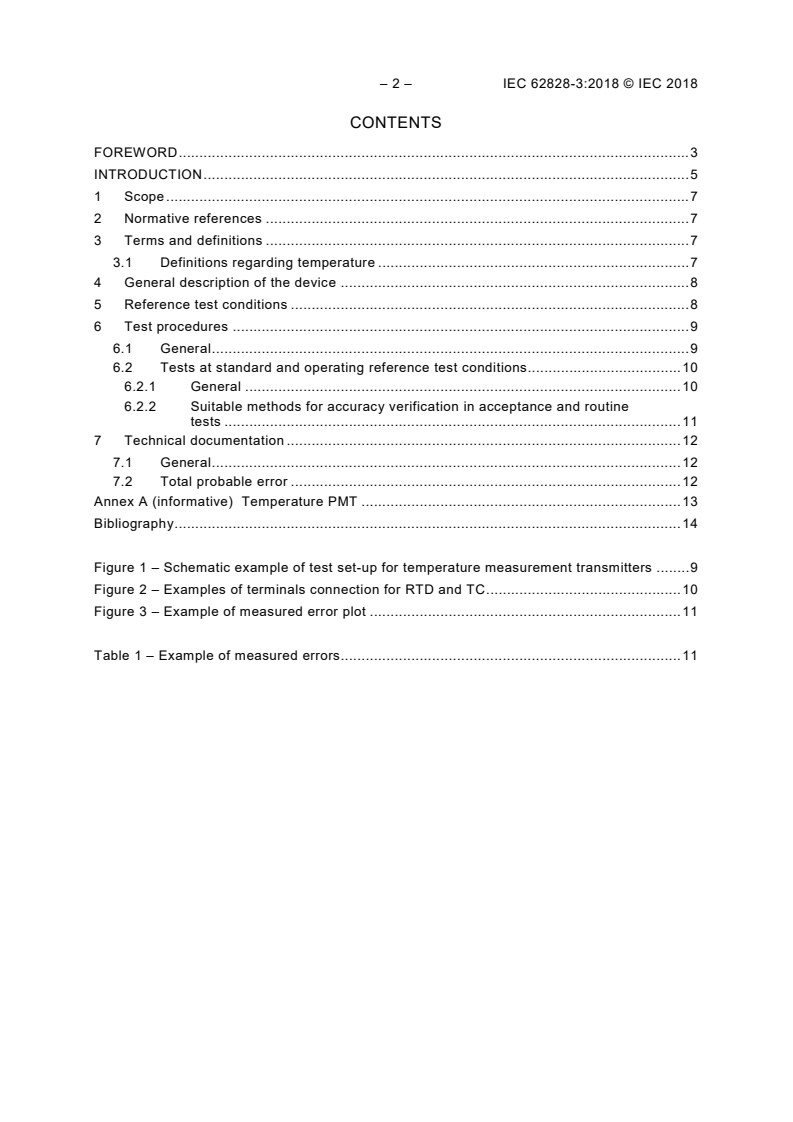
– 2 – IEC 62828-3:2018 © IEC 2018
CONTENTS
FOREWORD . 3
INTRODUCTION . 5
1 Scope . 7
2 Normative references . 7
3 Terms and definitions . 7
3.1 Definitions regarding temperature . 7
4 General description of the device . 8
5 Reference test conditions . 8
6 Test procedures . 9
6.1 General . 9
6.2 Tests at standard and operating reference test conditions. 10
6.2.1 General . 10
6.2.2 Suitable methods for accuracy verification in acceptance and routine
tests . 11
7 Technical documentation . 12
7.1 General . 12
7.2 Total probable error . 12
Annex A (informative) Temperature PMT . 13
Bibliography . 14
Figure 1 – Schematic example of test set-up for temperature measurement transmitters . 9
Figure 2 – Examples of terminals connection for RTD and TC . 10
Figure 3 – Example of measured error plot . 11
Table 1 – Example of measured errors. 11
INTERNATIONAL ELECTROTECHNICAL COMMISSION
____________
REFERENCE CONDITIONS AND PROCEDURES FOR TESTING
INDUSTRIAL AND PROCESS MEASUREMENT TRANSMITTERS –
Part 3: Specific procedures for temperature transmitters
FOREWORD
1) The International Electrotechnical Commission (IEC) is a worldwide organization for standardization comprising
all national electrotechnical committees (IEC National Committees). The object of IEC is to promote
international co-operation on all questions concerning standardization in the electrical and electronic fields. To
this end and in addition to other activities, IEC publishes International Standards, Technical Specifications,
Technical Reports, Publicly Available Specifications (PAS) and Guides (hereafter referred to as “IEC
Publication(s)”). Their preparation is entrusted to technical committees; any IEC National Committee interested
in the subject dealt with may participate in this preparatory work. International, governmental and non-
governmental organizations liaising with the IEC also participate in this preparation. IEC collaborates closely
with the International Organization for Standardization (ISO) in accordance with conditions determined by
agreement between the two organizations.
2) The formal decisions or agreements of IEC on technical matters express, as nearly as possible, an international
consensus of opinion on the relevant subjects since each technical committee has representation from all
interested IEC National Committees.
3) IEC Publications have the form of recommendations for international use and are accepted by IEC National
Committees in that sense. While all reasonable efforts are made to ensure that the technical content of IEC
Publications is accurate, IEC cannot be held responsible for the way in which they are used or for any
misinterpretation by any end user.
4) In order to promote international uniformity, IEC National Committees undertake to apply IEC Publications
transparently to the maximum extent possible in their national and regional publications. Any divergence
between any IEC Publication and the corresponding national or regional publication shall be clearly indicated in
the latter.
5) IEC itself does not provide any attestation of conformity. Independent certification bodies provide conformity
assessment services and, in some areas, access to IEC marks of conformity. IEC is not responsible for any
services carried out by independent certification bodies.
6) All users should ensure that they have the latest edition of this publication.
7) No liability shall attach to IEC or its directors, employees, servants or agents including individual experts and
members of its technical committees and IEC National Committees for any personal injury, property damage or
other damage of any nature whatsoever, whether direct or indirect, or for costs (including legal fees) and
expenses arising out of the publication, use of, or reliance upon, this IEC Publication or any other IEC
Publications.
8) Attention is drawn to the Normative references cited in this publication. Use of the referenced publications is
indispensable for the correct application of this publication.
9) Attention is drawn to the possibility that some of the elements of this IEC Publication may be the subject of
patent rights. IEC shall not be held responsible for identifying any or all such patent rights.
International Standard IEC 62828-3 has been prepared by Subcommittee 65B: Measurement
and control devices, of IEC Technical Committee 65: Industrial-process measurement, control
and automation.
The IEC 62828 series cancels and replaces the IEC 60770 series and proposes revisions for
the IEC 61298 series.
In IEC 61298, all parts related to PMT’s will be deleted, leaving all the requirements regarding
all devices but PMT’s.
– 4 – IEC 62828-3:2018 © IEC 2018
The text of this International Standard is based on the following documents:
FDIS Report on voting
65B/1110A/FDIS 65B/1114/RVD
Full information on the voting for the approval of this International Standard can be found in
the report on voting indicated in the above table.
This document has been drafted in accordance with the ISO/IEC Directives, Part 2.
A list of all parts in the IEC 62828 series, published under the general title Reference
conditions and procedures for testing industrial and process measurement transmitters, can
be found on the IEC website.
The committee has decided that the contents of this document will remain unchanged until the
stability date indicated on the IEC website under "http://webstore.iec.ch" in the data related to
the specific document. At this date, the document will be
• reconfirmed,
• withdrawn,
• replaced by a revised edition, or
• amended.
IMPORTANT – The 'colour inside' logo on the cover page of this publication indicates
that it contains colours which are considered to be useful for the correct
understanding of its contents. Users should therefore print this document using a
colour printer.
INTRODUCTION
Most of the current IEC standards on industrial and process measurement transmitters are
rather old and were developed having in mind devices based on analogue technologies. Many
industrial and process measurement transmitters are meanwhile evolved and are quite
different from those analogue transmitters: they are often digital and include more functions
and newer interfaces, both towards the computing section (mostly digital electronic) and
towards the measuring section (mostly mechanical). Even if some standards dealing with
digital process measurement transmitters already exist, they are not sufficient, since some
aspects of the performance are not covered by appropriate test methods.
In addition, existing IEC test standards for industrial and process measurement transmitters
are spread over many documents, so that for manufacturers and users it is difficult,
impractical and time-consuming to identify and select all the standards to be applied to a
device measuring a specific process quantity (pressure, temperature, flow, level, etc.).
To help manufacturers and users, it was decided to review, complete and reorganize the
relevant IEC standards and to create a more suitable, effective and comprehensive standard
series that provides in a systematic way all specifications and tests required for different
industrial and process measurement transmitters.
To solve the issues mentioned above and to provide an added value for the stakeholders, the
new standard series on industrial and process measurement transmitters covers the following
main aspects:
• applicable normative references;
• specific terms and definitions;
• typical configurations and architectures for the various types of industrial and process
measurement transmitters;
• hardware and software aspects;
• interfaces (to the process, to the operator, to the other measurement and control devices);
• physical, mechanical and electrical requirements and relevant tests; clear definition of the
test categories: type tests, acceptance tests and routine tests;
• performance (its specification, tests and verification);
• environmental protection, hazardous areas application, functional safety, etc.;
• structure of the test report and of the technical documentation.
To cover in a systematic way all the topics to be addressed, the standard series is organized
in several parts. At the moment of the publication of this document, the IEC 62828 series
consists of the following parts:
• IEC 62828-1: General procedures for all types of transmitters
• IEC 62828-2: Specific procedures for pressure transmitters
• IEC 62828-3: Specific procedures for temperature transmitters
• IEC 62828-4: Specific procedures for level transmitters
• IEC 62828-5: Specific procedures for flow transmitters
– 6 – IEC 62828-3:2018 © IEC 2018
In preparing the IEC 62828 series many test procedures were taken, with the necessary
improvements, from the IEC 61298 series. As the actual IEC 61298 series is applicable to all
process measurement and control devices, when the IEC 62828 series is completed the
IEC 61298 series will be revised to harmonise it with the IEC 62828 series, taking out from its
scope the industrial and process measurement transmitters. During the time when 61298
scope is being updated, the new series IEC 62828 takes precedence for industrial and
process measurement transmitters.
When the IEC 62828 series is published, the IEC 60770 series will be withdrawn.
REFERENCE CONDITIONS AND PROCEDURES FOR TESTING
INDUSTRIAL AND PROCESS MEASUREMENT TRANSMITTERS –
Part 3: Specific procedures for temperature transmitters
1 Scope
This part of IEC 62828 establishes specific procedures for testing temperature transmitters
used in measuring and control systems for industrial process and for machinery control
systems.
When the process measurement transmitter features the temperature transmitter separated
from the sensing element (RTD, TC, etc.), the standard applies only to the temperature
transmitter without the sensing element. In case of device where the sensing element is fully
integrated with the temperature transmitter, the standard applies to the complete device.
For general test procedures, reference is made to IEC 62828-1, which is applicable to all
types of industrial and process measurement transmitters (PMT).
NOTE In the industrial and process applications, to indicate the process measurement transmitters, it is common
also to use the terms “industrial transmitters”, or “process transmitters”.
The sensing element itself (e.g., RTD, TC, etc.) as well as radiation thermometers are
excluded from the scope of this document.
2 Normative references
The following documents are referred to in the text in such a way that some or all of their
content constitutes requirements of this document. For dated references, only the edition
cited applies. For undated references, the latest edition of the referenced document (including
any amendments) applies.
IEC 60584 (all parts), Thermocouples
IEC 62828-1:2017, Reference conditions and procedures for testing industrial and process
measurement transmitters – Part 1: General procedures for all types of transmitters
3 Terms and definitions
3.1 Definitions regarding temperature
For the purposes of this document, the terms and definitions given in IEC 62828-1 and the
following apply.
ISO and IEC maintain terminological databases for use in standardization at the following
addresses:
• IEC Electropedia: available at http://www.electropedia.org/
• ISO Online browsing platform: available at http://www.iso.org/obp
– 8 – IEC 62828-3:2018 © IEC 2018
3.1.1
cold junction compensation
CJC
suitable automatic system to compensate the thermocouple EMF to 0 °C
3.1.2
International Temperature Scale of 1990
ITS 90
temperature scale adopted by the International Committee on Weights and Measures (CIPM)
in 1989 for the purpose of practical measurements
Note 1 to entry: The quantities corresponding to thermodynamic temperature and Celsius temperature defined by
this scale are denoted T and t , respectively, where t = T – T with T = 273,15 K.
90 90 90 90 0 0
Note 2 to entry: The units for T and t are the kelvin, symbol K, and the degree Celsius, symbol °C,
90 90
respectively.
[SOURCE: IEC 60050-113:2011, 113-04-18]
3.1.3
resistance temperature detector
RTD
temperature sensor containing a sensing element made of platinum or other metals whose
resistance changes with temperature
Note 1 to entry: Resistance thermometers are often called RTDs.
Note 2 to entry: A platinum resistance thermometer (PRT) is an RTD that has a sensing element made of
platinum; other common RTDs are nickel resistance thermometers (NRT) and copper resistance thermometers
(CRT), with the sensing element made of nickel or copper respectively.
[SOURCE: IEC 62465:2010, 3.20, modified – The notes have been added.]
3.1.4
thermocouple
TC
pair of conductors of dissimilar materials joined at one end and forming part of an
arrangement using the thermoelectric effect for temperature measurement
Note 1 to entry: The production of an electromotive force (EMF) due to a temperature gradient along a conductor
is called thermoelectric effect (or Seebeck effect).
[SOURCE: IEC 60584-1:2013, 2.3, modified – The abbreviation and notes have been
added.]
4 General description of the device
The general description outlined in Clause 4 and Annex A of IEC 62828-1:2017 is applicable.
In Annex A of this document, some additional information is only given regarding the
measuring section of a temperature industrial and process measurement transmitter
(temperature PMT).
5 Reference test conditions
To verify the influence of external quantities on accuracy, as well as the mechanical and
electrical conditions which a device can withstand and still work within specification, the
corresponding clause of IEC 62828-1 applies, both for standard reference test conditions and
for operating reference test conditions.
6 Test procedures
6.1 General
Clause 6 of IEC 62828-1:2017 applies, with the following additional requirements.
The general schematic test set-up for a typical temperature PMT is reported in Figure 1.
NOTE 1 Annex A provides information on the several typologies of typical temperature transmitters.
Optional
Power supply
wireless output
(internal or
TC CJC
signal
external)
Standard source PMT Analogue or
generator for under digital output
RTD and TC test signal
Input
Output
terminal
terminal
IEC
Figure 1 – Schematic example of test set-up for
temperature measurement transmitters
NOTE 2 The test source generator for RTD is a decade resistance standard or a multifunction temperature
calibrator.
NOTE 3 The test source generator for TC is a voltage generator or a multifunction temperature calibrator.
NOTE 4 To compensate the TC signal for the reference temperature of 0 °C, Cold Junction Compensation CJC
may be used for TC transmitters.
NOTE 5 In case of temperature sensing element fully integrated into the temperature PMT, a reference
temperature is used.
NOTE 6 The optional digital output signal is provided for smart and intelligent transmitters and is detected by
handheld or PC communicator (configurator).
Figure 2 shows an example of terminal connections for a generic temperature PMT. In this
figure, the supply and the output terminals (+, -) are on the upper side, and the input
connections to the RTD or TC sensors (1, 2, 3, 4) are on the lower side.
For testing, the RTD and TC shall be replaced by the relevant test source generator.
– 10 – IEC 62828-3:2018 © IEC 2018
+
-
+ -
2 4 3 1
2 4 3 1
RTD
IEC IEC
Two wire connection Positive
Option for third wire connection Negative
Option for fourth wire connection
a) Connection example for RTD b) Connection example for TC
Figure 2 – Examples of terminals connection for RTD and TC
NOTE 7 The RTD can be simulated as a two, three or four-wire connection. For platinum RTD, more details are
given in IEC 60751.
NOTE 8 The TC is simulated using specific extension or compensating cables. More details are given in
IEC 60584-1 and IEC 60584-3.
For specifications and tolerances of temperature sensors used with temperature PMTs, see:
• IEC 60584 and IEC 62460 for TC sensors;
• IEC 60751 for RTD sensors.
6.2 Tests at standard and operating reference test conditions
6.2.1 General
For the majority of the tests, the corresponding clause of Part 1 applies, in particular see:
• Annex B in IEC 62828-1:2017 for the summary of the tests at standard reference
conditions;
• Annex C in IEC 62828-1:2017 for the summary of the tests at operating reference
conditions.
The tests are conducted on a test set-up similar to the one shown schematically in Figure 1.
The test source generator (in case of sensing element not integrated into the temperature
PMT) or the reference temperature (in case of sensing element fully integrated into the
temperature PMT) needed to stimulate the response of the device under test shall have
characteristics and performances suitable to the tests required.
In addition to the error due to the sensing element, the process measurement transmitter shall
not introduce an additional error greater than 50 % of the error relevant to the pertinent
tolerance class of the sensing element.
The following specific tests for temperature transmitters shall be performed in addition.
6.2.2 Suitable methods for accuracy verification in acceptance and routine tests
6.2.2.1 General
The input-output characteristic shall be measured under reference conditions in one
measurement cycle, in only one full range direction traversing, either increasing or
decreasing.
For this, at least five points of measurement shall be evenly distributed over the range; they
shall include points at or near (within 10 % of span) the 0 % and 100 % values of the span.
6.2.2.2 Measurement procedure
The test shall be performed in the following way. Initially, an input signal equal to the lower
range value is generated and the value of the corresponding input and output signal is noted.
Then the input signal is slowly (the rate of change depends on the PMT) increased to reach
without overshoot the first test point. After a sufficient stabilization period (e.g. reaching a
steady state), the value of the corresponding input and output signal is noted. The operation
is repeated for all the predetermined values up to 100 % of the input span.
6.2.2.3 Data analysis
Applying 6.2.2.1 and 6.2.2.2, the difference between the output signal values obtained at each
test point and the corresponding true values are recorded as measured errors. The measured
errors shall be expressed as percent of the nominal output span or better in the engineering
unit °C or K.
All measured errors can be shown in a tabular form (see Table 1) and presented graphically
(see Figure 3).
From Table 1, the maximum measured error found is -0,10 °C at 80 °C of output.
Table 1 – Example of measured errors
Input (°C) 0 20 40 60 80 100
Output (°C) 0,00 20,03 39,98 59,91 79,90 100,05
Maximum measured error (°C) 0,00 0,03 –0,02 –0,09 –0,10 0,05
0,15
0,1
0,05
0 10 20 30 40 50 60 70 80 90 100
Maximum
measured
–0,05
error
–0,1
–0,15
Output (°C)
IEC
Figure 3 – Example of measured error plot
Error (°C)
– 12 – IEC 62828-3:2018 © IEC 2018
7 Technical documentation
7.1 General
There are no specific additional requirements. See IEC 62828-1 for the technical
documentation to be prepared.
7.2 Total probable error
General information on the calculation of the total probable error is given in Clause 7 of
IEC 62828-1:2017. For temperature PMT, usually the most prominent source of error is the
ambient temperature’s effect on the electronics, yet other influence parameters (e.g. vibration
and load) could also have some influence.
To estimate the total error for temperature PMTs it is necessary to consider the overall
contribution of the different errors, in particular accuracy, ambient temperature effects, zero
and span setting, long-term stability and other errors (e.g., analogue output error or digital
measuring error, etc.) have always to be considered.
An example of the calculation of the total error for temperature PMT is here provided with
actual figures.
2 2 2 2 2 2 2 2 2 2
TPE = A + B +C + D + E = °C
0,400 + 0,015 + 0,01 + 0,25 + 0,12 =±0,49
where
A is the accuracy ± 0,400 °C
B is the ambient temperature effect (–40 °C ÷ +85 °C)
± 0,015 °C
C is the zero and span setting ± 0,010 °C
D is the long term stability (5 years)
± 0,250 °C
E are the other errors ± 0,120 °C
Annex A
(informative)
Temperature PMT
General description of a temperature transmitter:
Electrical temperature transmitters are essentially based on an analogue or digital circuit
suitable to transform an electrical signal from a standardized Resistance Temperature
Detectors (RTD), or Thermocouple (TC), into an output signal that can easily be transmitted
over long distances to the process control system or controller. For long distances, only 2 wire
connections are used (not 3 or 4 wire ones) for RTDs, and two extension or compensating
cables are used for TCs (see also IEC 60584-3).
Obviously measuring ranges, shapes, characteristics, process interface, etc. are extremely
variable depending on the specific application, however temperature transmitters may have
different output signals as follows:
• analogue direct current signal 4 mA – 20 mA; ®
• 4 mA – 20 mA signal with superimposed HART protocol;
• digital signal for fieldbus protocol.
NOTE 1 For temperature transmitters, in addition to the possibility of connecting different types of non-
internationally standardized RTDs or TCs to the input , it is also possible to have the possibility to connect other
input signals, for example for voltage, resistance or frequency.
In relation to practical mounting in the process, temperature transmitters are divided in three
main construction types:
• Head mounting
The transmitter is integrated in the housing (connection head) of the temperature sensor.
Temperature transmitters which are used for this mounting design are designated as
sensor head transmitters. This mounting solution increases the measuring accuracy
resulting from conversion of the sensor signal into a stable output signal close to the
sensor, and, for TC applications, without extension or compensating cables.
• Field mounting
The transmitter is mounted in its own rugged housing. The field mounted temperature
transmitter can also be used in hostile industrial environments without the requirement for
special protective measures and can be mounted in close proximity to the sensor. The
compact and robust field mounted temperature housing can also have optional indicators.
• Rail mounting
The transmitter is mounted on a 19” rail mounting system or DIN rail that can be relatively
close or far from the sensor. Due to this feature and their compact design, these
transmitters can be mounted in confined spaces such as connector boxes or cabinets.
NOTE 2 “DIN rail” is a common way to refer the system described in the standard IEC 60715. This is the most
widely adopted system for rail mounting.
_____________
HART® is the trade name of a communication protocol specified by FieldComm Group. This information is
given for the convenience of users of this document and does not constitute an endorsement by IEC of the
product named. Equivalent products may be used if they can be shown to lead to the same results.
– 14 – IEC 62828-3:2018 © IEC 2018
Bibliography
[1] IEC 60050-113, International Electrotechnical Vocabulary – Part 113: Physics for
electrotechnology
[2] IEC 60584-1:2013, Thermocouples – Part 1: EMF specifications and tolerances
[3] IEC 60584-3:2007, Thermocouples – Part 3: Extension and compensating cables –
Tolerances and identification system
[4] IEC 60715, Dimensions of low-voltage switchgear and controlgear - Standardized
mounting on rails for mechanical support of switchgear, controlgear and accessories
[5] IEC 60751:2008, Industrial platinum resistance thermometers and platinum
temperature sensors
[6] IEC 61152:1992, Dimensions of metal-sheathed thermometer elements
[7] IEC 61515:2016, Mineral insulated metal-sheathed thermocouple cables and
thermocouples
[8] IEC 61298 (all parts), Process measurement and control devices – General methods
and procedures for evaluating performance
[9] IEC 61520:2000, Metal thermowells for thermometer sensors – Functional dimensions
[10] IEC 61987-14:2016, Industrial-process measurement and control – Data structures and
elements in process equipment catalogues – Part 14: Lists of properties (LOP) for
temperature measuring equipment for electronic data exchange
[11] IEC 62460:2008, Temperature – Electromotive force (EMF) tables for pure-element
thermocouple combinations
[12] IEC 62465:2010, Nuclear power plants – Instrumentation and control important to
safety – Management of ageing of electrical cabling systems
[13] OIML R 84:2003, Platinum, Copper and Nickel resistance thermometers (for industrial
and commerce use)
___________
– 16 – IEC 62828-3:2018 © IEC 2018
SOMMAIRE
AVANT-PROPOS . 17
INTRODUCTION . 19
1 Domaine d'application . 21
2 Références normatives . 21
3 Termes et définitions . 21
3.1 Définitions relatives à la température . 21
4 Description générale de l'appareil . 22
5 Conditions d'essais de référence . 23
6 Procédures d'essais . 23
6.1 Généralités . 23
6.2 Essais aux conditions d'essais de référence normalisées et de
fonctionnement . 24
6.2.1 Généralités . 24
6.2.2 Méthodes adaptées de vérification de la précision dans les essais de
réception et les essais individuels de série . 25
7 Documentation technique . 26
7.1 Généralités . 26
7.2 Erreur probable totale . 26
Annexe A (informative) PMT de température . 27
Bibliographie . 28
Figure 1 – Exemple schématique de configuration d'essai pour transmetteurs de
mesure de température . 23
Figure 2 – Exemples de connexions de borne pour RTD et TC . 24
Figure 3 – Exemple de tracé d'erreur mesurée . 26
Tableau 1 – Exemple d'erreurs mesurées . 25
COMMISSION ÉLECTROTECHNIQUE INTERNATIONALE
____________
CONDITIONS DE RÉFÉRENCE ET PROCÉDURES POUR L'ESSAI DES
TRANSMETTEURS DE MESURE INDUSTRIELLE ET DE PROCESSUS –
Partie 3: Procédures spécifiques pour les transmetteurs de température
AVANT-PROPOS
1) La Commission Electrotechnique Internationale (IEC) est une organisation mondiale de normalisation
composée de l'ensemble des comités électrotechniques nationaux (Comités nationaux de l’IEC). L’IEC a pour
objet de favoriser la coopération internationale pour toutes les questions de normalisation dans les domaines
de l'électricité et de l'électronique. A cet effet, l’IEC – entre autres activités – publie des Normes
internationales, des Spécifications techniques, des Rapports techniques, des Spécifications accessibles au
public (PAS) et des Guides (ci-après dénommés "Publication(s) de l’IEC"). Leur élaboration est confiée à des
comités d'études, aux travaux desquels tout Comité national intéressé par le sujet traité peut participer. Les
organisations internationales, gouvernementales et non gouvernementales, en liaison avec l’IEC, participent
également aux travaux. L’IEC collabore étroitement avec l'Organisation Internationale de Normalisation (ISO),
selon des conditions fixées par accord entre les deux organisations.
2) Les décisions ou accords officiels de l’IEC concernant les questions techniques représentent, dans la mesure
du possible, un accord international sur les sujets étudiés, étant donné que les Comités nationaux de l’IEC
intéressés sont représentés dans chaque comité d’études.
3) Les Publications de l’IEC se présentent sous la forme de recommandations internationales et sont agréées
comme telles par les Comités nationaux de l’IEC. Tous les efforts raisonnables sont entrepris afin que l’IEC
s'assure de l'exactitude du contenu technique de ses publications; l’IEC ne peut pas être tenue responsable de
l'éventuelle mauvaise utilisation ou interprétation qui en est faite par un quelconque utilisateur final.
4) Dans le but d'encourager l'uniformité internationale, les Comités nationaux de l’IEC s'engagent, dans toute la
mesure possible, à appliquer de façon transparente les Publications de l’IEC dans leurs publications nationales
et régionales. Toutes divergences entre toutes Publications de l’IEC et toutes publications nationales ou
régionales correspondantes doivent être indiquées en termes clairs dans ces dernières.
5) L’IEC elle-même ne fournit aucune attestation de conformité. Des organismes de certification indépendants
fournissent des services d'évaluation de conformité et, dans certains secteurs, accèdent aux marques de
conformité de l’IEC. L’IEC n'est responsable d'aucun des services effectués par les organismes de certification
indépendants.
6) Tous les utilisateurs doivent s'assurer qu'ils sont en possession de la dernière édition de cette publication.
7) Aucune responsabilité ne doit être imputée à l’IEC, à ses administrateurs, employés, auxiliaires ou
mandataires, y compris ses experts particuliers et les membres de ses comités d'études et des Comités
nationaux de l’IEC, pour tout préjudice causé en cas de dommages corporels et matériels, ou de tout autre
dommage de quelque nature que ce soit, directe ou indirecte, ou pour supporter les coûts (y compris les frais
de justice) et les dépenses découlant de la publication ou de l'utilisation de cette Publication de l’IEC ou de
toute autre Publication de l’IEC, ou au crédit qui lui est accordé.
8) L'attention est attirée sur les références normatives citées dans cette publication. L'utilisation de publications
référencées est obligatoire pour une application correcte de la présente publication.
9) L’attention est attirée sur le fait que certains des éléments de la présente Publication de l’IEC peuvent faire
l’objet de droits de brevet. L’IEC ne saurait être tenue pour responsable de ne pas avoir identifié de tels droits
de brevets et de ne pas avoir signalé leur existence.
La Norme internationale IEC 62828-3 a été établie par le sous-comité 65B: Équipements de
mesure et de contrôle-commande, du comité d'études 65 de l'IEC: Mesure, commande et
automation dans les processus industriels.
La série IEC 62828 annule et remplace la série IEC 60770 et propose des révisions pour la
série IEC 61298.
Dans l'IEC 61298, toutes les parties concernant les PMTs seront supprimées, laissant toutes
les exigences concernant tous les appareils, sauf les PMTs.
– 18 – IEC 62828-3:2018 © IEC 2018
Le texte de cette Norme internationale est issu des documents suivants:
FDIS Rapport de vote
65B/1110A/FDIS 65B/1114/RVD
Le rapport de vote indiqué dans le tableau ci-dessus donne toute information sur le vote ayant
abouti à l'approbation de cette Norme internationale.
Ce document a été rédigé selon les Directives ISO/IEC, Partie 2.
Une liste de toutes les parties de la série IEC 62828, publiées sous le titre général Conditions
de référence et procédures pour l'essai des transmetteurs de mesure industrielle et de
processus, peut être consultée sur le site web de l'IEC.
Le comité a décidé que le contenu de ce document ne sera pas modifié avant la date de
stabilité indiquée sur le site web de l’IEC sous "http://webstore.iec.ch" dans les données
relatives au document recherché. A cette date, le document sera
• reconduit,
• supprimé,
• remplacé par une édition révisée, ou
• amendé.
IMPORTANT – Le logo "colour inside" qui se trouve sur la page de couverture de cette
publication indique qu'elle contient des couleurs qui sont considérées comme utiles à
une bonne compréhension de son contenu. Les utilisateurs devraient, par conséquent,
imprimer cette publication en utilisant une imprimante couleur.
INTRODUCTION
La plupart des normes IEC actuelles relatives aux transmetteurs de mesure industrielle et de
processus sont assez anciennes; elles ont été développées pour des appareils reposant sur
des technologies analogiques. Les transmetteurs de mesure industrielle et de processus ont,
pour bon nombre d'entre eux, évolué et sont très différents de ces transmetteurs analogiques:
il s'agit le plus souvent de transmetteurs numériques, qui comprennent de plus nombreuses
fonctions et de nouvelles interfaces, en ce qui concerne tant la section de calcul
(l'électronique numérique principalement) que la section de mesure (mécanique
...