

IEC 62433-4:2016
(Main)EMC IC modelling - Part 4: Models of integrated circuits for RF immunity behavioural simulation - Conducted immunity modelling (ICIM-CI)
General Information
- Abstract
IEC 62433-4:2016 specifies a flow for deriving a macro-model to allow the simulation of the conducted immunity levels of an integrated circuit (IC). This model is commonly called Integrated Circuit Immunity Model - Conducted Immunity, ICIM-CI. It is intended to be used for predicting the levels of immunity to conducted RF disturbances applied on IC pins. In order to evaluate the immunity threshold of an electronic device, this macro-model will be inserted in an electrical circuit simulation tool. This macro-model can be used to model both analogue and digital ICs (input/output, digital core and supply). This macro-model does not take into account the non-linear effects of the IC. The added value of ICIM-CI is that it could also be used for immunity prediction at board and system level through simulations. This part of IEC 62433 has two main parts:
- the electrical description of ICIM-CI macro-model elements;
- a universal data exchange format called CIML based on XML. This format allows ICIM-CI to be encoded in a more useable and generic form for immunity simulation.
- Status
- Published
- Publication Date
- 24-May-2016
- Technical Committee
- SC 47A - Integrated circuits
- Drafting Committee
- WG 2 - TC 47/SC 47A/WG 2
- Current Stage
- PPUB - Publication issued
- Start Date
- 25-May-2016
- Completion Date
- 30-Jun-2016
Buy Documents



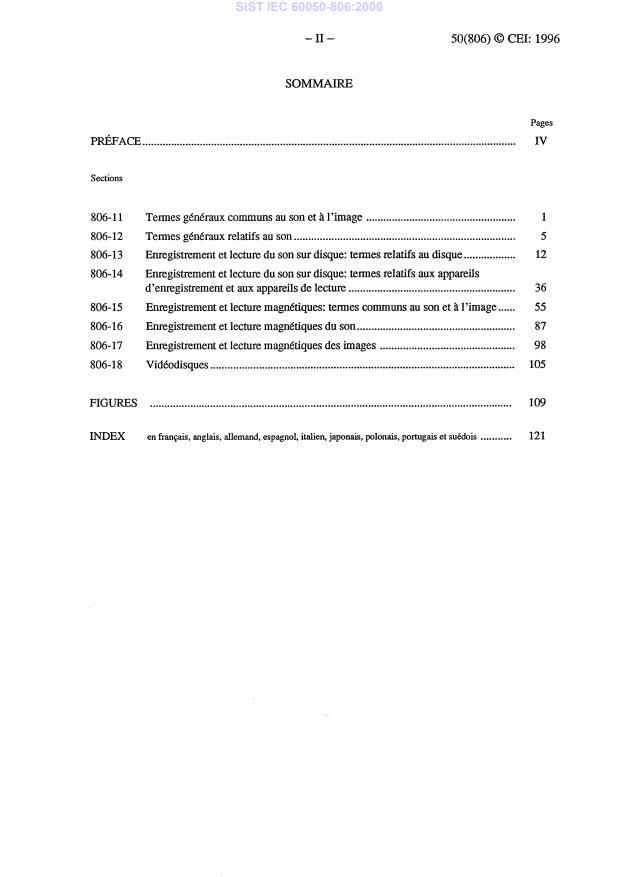
IEC 62433-4:2016 - EMC IC modelling - Part 4: Models of integrated circuits for RF immunity behavioural simulation - Conducted immunity modelling (ICIM-CI) Released:5/25/2016
Overview
IEC 62433-4:2016 is an international standard published by the International Electrotechnical Commission (IEC) that specifies modeling methods for integrated circuits (ICs) to simulate their radio frequency (RF) immunity behavior. Part 4 of the IEC 62433 series focuses on Conducted Immunity Modelling (ICIM-CI), which provides a standardized flow to derive macro-models for predicting IC immunity levels against conducted RF disturbances on IC pins. These macro-models, known as ICIM-CI, enable engineers to simulate IC responses to electromagnetic interferences within electrical circuit simulation tools.
The standard supports modeling of both analog and digital ICs-including inputs/outputs, digital cores, and power supplies-and offers a valuable approach for immunity prediction not only at the IC level but extended to board and system-level simulations. Importantly, ICIM-CI models focus on linear behaviors and do not consider non-linear IC effects.
IEC 62433-4 also introduces the Conducted Immunity Modeling Language (CIML), a universal XML-based data exchange format for encoding ICIM-CI models in a standardized, portable, and machine-readable form.
Key Topics
ICIM-CI Macro-Model Elements
Detailed electrical descriptions define model components such as Power Distribution Networks (PDN), Injection Blocking Capacitors (IBC), and Injection Blocks (IB). These elements characterize the IC’s conducted RF immunity behavior for simulation accuracy.Conducted Immunity Simulation
Provides methods for evaluating immunity thresholds by inserting ICIM-CI macro-models directly into circuit simulation environments, paving the way for advanced RF immunity design and verification.CIML XML Data Format
Defines the structure and syntax for universal data interchange of IC immunity models, simplifying sharing, updating, and integration of models across different tools and platforms.Model Extraction and Validation
Outlines test and measurement techniques for deriving model parameters, including RF injection probe methods and vector network analyzer measurements. Validation procedures ensure the model’s linearity assumptions and immunity criteria alignment.
Applications
Integrated Circuit Design
Designers use IEC 62433-4 compliant ICIM-CI models to predict an IC’s RF conducted immunity during development, enabling more robust product design against electromagnetic disturbances.Electromagnetic Compatibility (EMC) Testing
Simulation driven by ICIM-CI models supplements EMC lab tests, helping to identify critical susceptibility points early in the design cycle, thereby reducing testing costs and time.System-Level Immunity Analysis
The standard's approach allows integration of IC models in board and system simulations to evaluate conducted RF immunity comprehensively, aiding system architects in mitigating interference effects at multiple levels.Tool and Software Development
Simulation software vendors can implement support for CIML, enhancing interoperability and promoting wider adoption of standardized immunity modeling in RF and EMC simulation suites.
Related Standards
IEC 62433 Series
The broader IEC 62433 series covers multiple aspects of EMC IC modeling, providing complementary guidelines for radiated immunity and emission modeling.IEC 61000 Series
This series includes EMC testing and measurement standards that complement the simulation approaches detailed in IEC 62433-4 by specifying practical test procedures for immunity and emissions.CISPR and IEEE EMC Standards
Relevant for comprehensive EMC compliance and harmonization efforts, these standards intersect with IEC 62433-4 in areas of immunity measurement and RF disturbance management.
By adopting IEC 62433-4:2016, engineers and manufacturers unlock advanced possibilities to simulate and predict the RF immunity behavior of integrated circuits with high precision. The standard's focus on conducted immunity modeling, combined with its universal CIML format, facilitates better EMC design practices, streamlines simulation workflows, and promotes global interoperability in EMC simulation and design validation efforts.
Buy Documents
IEC 62433-4:2016 - EMC IC modelling - Part 4: Models of integrated circuits for RF immunity behavioural simulation - Conducted immunity modelling (ICIM-CI) Released:5/25/2016
Frequently Asked Questions
IEC 62433-4:2016 is a standard published by the International Electrotechnical Commission (IEC). Its full title is "EMC IC modelling - Part 4: Models of integrated circuits for RF immunity behavioural simulation - Conducted immunity modelling (ICIM-CI)". This standard covers: IEC 62433-4:2016 specifies a flow for deriving a macro-model to allow the simulation of the conducted immunity levels of an integrated circuit (IC). This model is commonly called Integrated Circuit Immunity Model - Conducted Immunity, ICIM-CI. It is intended to be used for predicting the levels of immunity to conducted RF disturbances applied on IC pins. In order to evaluate the immunity threshold of an electronic device, this macro-model will be inserted in an electrical circuit simulation tool. This macro-model can be used to model both analogue and digital ICs (input/output, digital core and supply). This macro-model does not take into account the non-linear effects of the IC. The added value of ICIM-CI is that it could also be used for immunity prediction at board and system level through simulations. This part of IEC 62433 has two main parts: - the electrical description of ICIM-CI macro-model elements; - a universal data exchange format called CIML based on XML. This format allows ICIM-CI to be encoded in a more useable and generic form for immunity simulation.
IEC 62433-4:2016 specifies a flow for deriving a macro-model to allow the simulation of the conducted immunity levels of an integrated circuit (IC). This model is commonly called Integrated Circuit Immunity Model - Conducted Immunity, ICIM-CI. It is intended to be used for predicting the levels of immunity to conducted RF disturbances applied on IC pins. In order to evaluate the immunity threshold of an electronic device, this macro-model will be inserted in an electrical circuit simulation tool. This macro-model can be used to model both analogue and digital ICs (input/output, digital core and supply). This macro-model does not take into account the non-linear effects of the IC. The added value of ICIM-CI is that it could also be used for immunity prediction at board and system level through simulations. This part of IEC 62433 has two main parts: - the electrical description of ICIM-CI macro-model elements; - a universal data exchange format called CIML based on XML. This format allows ICIM-CI to be encoded in a more useable and generic form for immunity simulation.
IEC 62433-4:2016 is classified under the following ICS (International Classification for Standards) categories: 01.040.33 - Telecommunications. Audio and video engineering (Vocabularies); 31.200 - Integrated circuits. Microelectronics. The ICS classification helps identify the subject area and facilitates finding related standards.
IEC 62433-4:2016 is available in PDF format for immediate download after purchase. The document can be added to your cart and obtained through the secure checkout process. Digital delivery ensures instant access to the complete standard document.
Standards Content (Sample)
SLOVENSKI STANDARD
01-april-2000
International Electrotechnical Vocabulary - Chapter 806: Recording and
reproduction of audio and video
International Electrotechnical Vocabulary - Chapter 806: Recording and reproduction of
audio and video
Vocabulaire Electrotechnique International - Chapitre 806: Enregistrement et lecture du
son et des images
Ta slovenski standard je istoveten z: IEC 60050-806
ICS:
01.040.33 Telekomunikacije. Avdio in Telecommunications. Audio
video tehnika (Slovarji) and video engineering
(Vocabularies)
33.160.01 Avdio, video in avdiovizualni Audio, video and audiovisual
sistemi na splošno systems in general
2003-01.Slovenski inštitut za standardizacijo. Razmnoževanje celote ali delov tega standarda ni dovoljeno.
CEI
NORME
1EC
INTERNATIONALE
50(806)
INTERNATIONAL
STANDARD
Deuxième édition
Second edition
1996-12
Electrotechnique International
Vocabulaire
Chapitre 806:
et lecture du son et des images
Enregistrement
International Electrotechnical Vocabulary
Chapter 806:
Recording and reproduction of audio and video
de reproduction réservés — Copyright — all rights reserved
© CE' 1996 Droits
partie de cette publication ne peut être repro- No part of this publication may be reproduced or
Aucune
sous forme que ce soit et utilized in any form or by any means, electronic or
duite ni utilisée quelque
par aucun procédé, électronique ou mécanique, y mechanical, including photocopying and microfilm
microfilms, sans without permission in writing from the publisher.
compris la photocopie et les
de l'éditeur.
l'accord écrit
Suisse
Bureau Central de Commission Electrotechnique Internationale 3, rue de Varembé Genève,
la
CODE PRIX Commission Electrotechnique Internationale
International Electrotechnical Commission X C
PRICE CODE
1EC ическая Комиссия
Международная Электротехн
• vigueur
. Pour prix, voir catalogue en
For price, see current catalogue
— II — 50(806) © CEI: 1996
SOMMAIRE
Pages
PRÉFACE IV
Sections
Termes généraux communs au son et t l'image 1
806-11
806-12 Termes généraux relatifs au son 5
du son sur disque: termes relatifs au disque 12
806-13 Enregistrement et lectu re
806-14 Enregistrement et lecture du son sur disque: termes relatifs aux appareils
d'enregistrement et aux appareils de lecture
806-15 Enregistrement et lecture magnétiques: termes communs au son et à l'image 55
806-16 Enregistrement et lecture magnétiques du son 87
806-17 Enregistrement et lecture magnétiques des images
806-18 Vidéodisques 105
FIGURES 109
INDEX en français, anglais, allemand, espagnol, italien, japonais, polonais, portugais et suédois
50(806) © IEC: 1996 — III —
CONTENTS
Page
FOREWORD V
Section
806-11 General terms relating to both audio and video
806-12 General terms relating to audio
806-13 Sound recording and reproduction on disk: terms relating to disk 12
806-14 Sound recording and reproduction on disk: terms relating to recording
equipment and to reproducing equipment 36
806-15 Magnetic recording and reproduction: terms relating to both audio and video
806-16 Magnetic recording and reproduction of sound 87
806-17 Magnetic recording and reproduction of video
806-18 Videodisks
FIGURES
INDEX in French, English, German, Spanish, Italian, Japanese, Polish, Portuguese and Swedish 121
50(806) © CEI: 1996
- IV -
ÉLECTROTECHNIQUE INTERNATIONALE
COMMISSION
VOCABULAIRE ÉLECTROTECHNIQUE INTERNATIONAL
CHAPITRE 806: ENREGISTREMENT ET LECTURE DU SON
ET DES IMAGES
AVANT-PROPOS
La CEI (Commission Electrotechnique Internationale) est une organisation mondiale de normalisation
1)
composée de l'ensemble des comités électrotechniques nationaux (Comités nationaux de la CEI). La CEI a
pour objet de favoriser la coopération internationale pour toutes les questions de normalisation dans les
domaines de l'électricité et de l'électronique. A cet effet, la CEI, entre autres activités, publie des Normes
internationales. Leur élaboration est confiée à des comités d'études, aux travaux desquels tout Comité
national intéressé par le sujet traité peut participer. Les organisations internationales, gouvernementales et
non gouvernementales, en liaison avec la CEI, participent également aux travaux. La CEI collabore
étroitement avec l'Organisation Internationale de Normalisation (ISO), selon des conditions fixées par
accord entre les deux organisations.
Les décisions ou accords officiels de la CEI concernant des questions techniques, représentent, dans la
2)
mesure du possible, un accord international sur les sujets étudiés, étant donné que les Comités nationaux
intéressés sont représentés dans chaque comité d'études.
3) Les documents produits se présentent sous la forme de recommandations internationales; ils sont pub iés
comme normes, rapports techniques ou guides et agréés comme tels par les Comités nationaux.
Dans le but d'encourager l'unification internationale, les Comités nationaux de la CEI s'engagent
4)
possible, les Normes internationales de la CEI dans
à appliquer de façon transparente, dans toute la mesure
leurs normes nationales et régionales. Toute divergence entre la norme de la CEI et la norme nationale ou
régionale correspondante doit êtrе indiquée en termes clairs dans cette dernière.
5) La CEI n'a fixé aucune procédure concernant le marquage comme indication d'approbation et sa
responsabilité n'est pas engagée quand un matériel est déclaré conforme à l'une de ses normes.
L'attention est attirée sur le fait que certains des éléments de la présente Norme internationale peuvent faire
6)
l'objet de droits de propriété intellectuelle ou de droits analogues. La CEI ne saurait êtrе tenue pour
responsable de ne pas avoir identifié de tels droits de propriété et de ne pas avoir signalé leur existence.
La présente Norme internationale a été étame ie par le Groupe de Travail 5 du Comité d'Etudes 60 de la CEI:
Enregistrement, sous la responsabilité du Comité d'Etudes 1 de la CEI: Terminologie.
Cette dеuкièте édition annule et remplace la première édition de la CEI 50(806) parue en 1975 et le premier
complément CEI 50(806А) paru en 1984.
Le texte de cette norme est issu des documents suivants:
Rapports de vote
DIS
1(VEI 806) 1(VEI 806) (BC) 1267
(BC) 1231
1/60(VEI 806) 1/60(VEI 806) (BC) 1289/20
(BC) 1266/17
1/60(VEI 806) 130323 1/60(VEI 806) (BC) 131425
(BC)
1/60(VEI 806) 1/60(VEI 806) (BC) 1290/21
(BC) 1268/18
ci-dessus donnent toute information sur le vote ayant abouti à
Les rapports de vote indiqués dans le tableau
l'approbation de cette norme.
Dans ce chapitre du VEI les termes et définitions sont donnés en français et en anglais; les termes sont, de plus,
indiqués en allemand (de), espagnol (es), italien (it), japonais (ja), polonais (p1), portugais (pt) et suédois (sv).
—V-
50(806) © IEС: 1996
INTERNATIONAL ELECTROTECHNICAL COMMISSION
INTERNATIONAL ELECTROTECHNICAL VOCABULARY
CHAPTER 806: RECORDING AND REPRODUCTION
OF AUDIO AND VIDEO
FOREWORD
The IEC (International Electrotechnical Commission) is a worldwide organization for standardization
1)
comprising all national electrotechnical committees (IEC National Committees). The object of the IEC
is to promote international cooperation on all questions concerning standardization in the electrical and
electronic fields. To this end and in addition to other activities, the IEC publishes International
Standards. Their preparation is entrusted to technical committees; any IEC National Committee
interested in the subject dealt with may participate in this preparatory work. International,
governmental and non-governmental organizations liaising with the IEC also participate in this
preparation. The IEC collaborates closely with the International Organization for Standardization (ISO)
in accordance with conditions determined by agreement between the two organizations.
The formal decisions or agreements of the IEC on technical matters express, as nearly as possible an
2)
international consensus of opinion on the relevant subjects since each technical committee has
representation from all interested National Committees.
The documents produced have the form of recommendations for international use and are published in
3)
the form of standards, technical reports or guides and they are accepted by the National Committees in
that sense.
In order to promote international unification, IEC National Committees undertake to apply IEC
4)
International Standards transparently to the maximum extent possible in their national and regional
standards. Any divergence between the IEC Standard and the corresponding national or regional
standard shall be clearly indicated in the latter.
5) The IEC provides no marking procedure to indicate its approval and cannot be rendered responsible for
any equipment declared to be in conformity with one of its standards.
6) Attention is drawn to the possibility that some of the elements of this International Standard may be the
subject of patent rights. The IEC shall not be held responsible for identifying any or all such patent
rights.
This standard has been prepared by Working Group 5 of IEC Technical Committee 60: Recording, under
the responsibility of IEC Technical Committee 1: Terminology.
This second edition cancels and replaces the first edition of IEC 50(806) published in 1975 and its first
supplement IEC 50(806А) published in 1984.
The text of this standard is based on the following documents:
Reports on voting
DIS
1(IEV 806) (CO) 1267
1(IEV 806) (CO) 1231
1/60(IEV 806) (CO) 128920
1/60(1EV 806) (CO) 1266/17
1l60(IEV 806) (CO) 131425
1/60(IEV 806) (CO) 130323
1/60(IEV 806) (CO) 129021
1/60(IEV 806) (CO) 1268/18
Full information on the voting for the approval of this standard can be found in the reports on voting
indicated in the above table.
In this 1EV chapter the terms and definitions are written in French and English, and in addition the terms
(ja), Polish (p1), Portuguese (pt) and
are indicated in German (de), Spanish (es), Italian (it), Japanese
Swedish (sv).
- 1 -
50(806) © IEС: 1996
CHAPITRE 806: ENREGISTREMENT ET LECTURE DU SON
ET DES IMAGES
CHAPTER 806: RECORDING AND REPRODUCTION OF
AUDIO AND VIDEO
SECTION 806-11 - TERMES GÉNÉRAUX COMMUNS AU SON
ET À L'IMAGE
GENERAL TERMS RELATING TO BOTH
SECTION 806-11 -
AUDIO AND VIDEO
806-11-01 enregistrement
matériel.
des signaux sont inscrits de façon convenable sur un support
1- Action par laquelle
information sur un support matériel en
2 - Ensemble des techniques permettant d'inscrire une
sa restitution ultérieure.
vue de sa conservation et de
inscription et, par extension, les signaux eux-mêmes
3 - Support matériel des signaux après
après restitution.
recording
1 - Action by which signals are suitably embodied in a material base.
2 - Techniques whereby information is embodied in a material base with the aim of preserving
them with a view to their subsequent reproduction.
3 - Material base for signals after embodiment and, through extension, the signals themselves
after reproduction.
de Aufzeichnung
es registro
registrazione
it
ja
p1 zapisywanle; nagrywanle; rejestrujące
pt gravação
sv inspelning
806-11-02 support d'enregistrement
matériel convenant à l'enregistrement de signaux.
Support
recording medium
Material suitable for recording signals.
de Aufzeichnungstrãger
es soporte del registro
supporto di registrazione
it
ja
ёf 1
nośnik (zapisu)
p1
pt suporte de gravação
sv inspelningsmedium
806-11-03 système d'enregistrement
support d'enregistrement approprié peut être
Dispositif par lequel l'état ou la géométrie d'un
modifié par des signaux, de telle sorte que ces signaux puissent être restitués.
recording system
Apparatus whereby the state or configuration of a suitable recording medium can be changed in
conformity with signals, in such a way that these signals can be reproduced.
Aufzeichnungssystem
de
es sistema de registro
sistema registrazione
it dl
ja
CO:7
A
p1 urządzenie zapisujące; urządzenie rejestrujące
pt sistema de gravação
sv inspelningssystem
- 2 - 50(806) © CEI: 1996
806-11-04 voie d'enregistrement
pour objet d'acheminer un signal à enregistrer à partir d'une source
Voie de transmission ayant
d'enregistrement.
de signal jusqu'au support
Note. – Un système d'enregistrement peut comporter plusieurs voies.
recording channel
Transmission channel for the purpose of carrying the signal to be recorded from a signal source
to the recording medium.
Note. – A recording system may have several channels.
de Aufzeichnungskanal
es canal de registro
di registrazione
it canale
. *lL'
ja ёa^
p1 kanal zapisywania
pt canal de gravação
sv inspelningskanal
806-11-05 chaîne d'enregistrement
signaux depuis l'entrée du système jusqu'au support d'enregistrement
Chaine de transmission de
inclus.
recording chain
Chain for transmission of signals from the input of the system to and including the recording
medium.
de Aufzeichnungskette
es cadena de registro
it catena di registrazione
ё Jf
ja
zap isywania
p1 tor
pt cadeia de gravação
sv inspelningskedja
806-11-06 lecture
initiale de signaux enregistrés.
Restitution sous leur forme
reproduction
playback
replay
Regeneration of recorded signals in their original form.
de Wiedergabe
es lectura; reproducción
it riproduzione
ja
4t
p1 odczytywanie; odgrywanle; odtwarzanie
pt leitura
sv ayspelning; återgivning
806-11-07 système de lecture
Appareil qui permet de restituer les signaux inscrits sur un support d'enregistrement.
reproducing system
Equipment for re-creating signals embodied in a recording medium.
de Wiedergabesystem
es sistema de lectura
it sistema di riproduzione
ja f- 2.
N '
p1 urządzenie odczytujące; urządzenie odgrywające; urządzenie odtwarzające
pt sistema de leitura
sv avspelningssystem
50(806) © IEC: 1996 — 3 —
806-11-08 voie
de lecture
Voie acheminer le signal à restituer, d'un support d'enregistrement
de transmission destinée à
jusqu'à des bornes de sortie, celles-ci étant considérées alors comme la source du signal.
Note. – Un système de lecture peut comprendre plusieurs voies.
reproducing channel
Transmission channel for the purpose of canying the signal being reproduced from a recording
medium to an output, this output then being considered as the signal source.
Note. – Several channels may be included in a reproducing system.
de Wiedergabekanal
es canal de lectura
it canale di riproduzione
ja Nt
t ^t
p1 kanal odczytywania
pt canal de leitura
sv ayspelningskanal
806-11-09 chafne de lecture
la sortie du
Chaîne de transmission de signaux depuis le support d'enregistrement jusqu'à
système.
reproducing chain
Chain for transmission of the signals from the recording medium to the output of the system.
de Wiedergabekette
es cadena de lectura
it catena de riproduzione
ja
p1 tor odczytywanla
pt cadeia de leitura
sv ayspelningskedja
806-11-10 correction d'un système d'enregistrement ou de lecture
Modification des caractéristiques de la courbe de réponse amplitude-fréquence d'un système
d'enregistrement ou de lecture afin de remédier à certains de ses défauts.
equalization
Modification of the amplitude/frequency response characteristics of a recording or reproducing
system with the purpose of compensating for deficiencies within the system.
de Entzerrung
es ecualización
registrazione o di riproduzione
it correzione di un sistema di
ja
4{L
p1 korekcja
pt igualização
sv utjämning; korrigering
806-11-11 pré-accentuation
pré-correction
Modification de la caractéristique amplitude-fréquence du signal à enregistrer.
pre-emphasis
pre-equalization
Operation which consists in modifying the amplitude/frequency characteristic of the signal to be
recorded.
de Preemphase
es preacentuación; precorrección
it pre-enfasi
ja 7.9sì7 i
p1 korekcja zapisywania; preemfaza
pt pré-igualização
sv inspelningskorrigering; pre-emfas
50(806) © CEI: 1996
-4-
806-11-12 désaccentuation
post-correction
amplitude-fréquence du signal enregistré, lors de
Rétablissement de la caractéristique originale
la lecture.
de-emphasis
post-equalization
Operation which consists in restoring the original amplitude/frequency characteristic of the
recorded signal on reproduction.
de Deemphase
es desacentuación; postecualización
it de-enfasi
ja f7-, v^
p1 korekcja odczytywania; deemfaza
pt pós-igualização
sv ayspelningskorrigering; de-emfas
806-11-13 duplication
copie
l'obtention d'un ou plusieurs exemplaires de tout ou partie d'un signal
Opération destinée à
enregisцé.
duplicating
copying
Operation for obtaining one or several examples of all or part of a recorded signal.
de Vervielfältigen; Kopieren
copia
es duplicación;
it duplicazione
i l_-
V;
ja
p1 koplowanle; powielanie
pt duplicação; cópia
sv duplicering; kopiering
806-11-14 réenregistrement
support d'enregistrement, de tout ou partie
Enregistrement, par une méthode quelconque, sur un
d'un signal déjà enregistré.
re-recording
Operation consisting in obtaining, by any method, on a recording medium all or part of a
previously recorded signal.
de Umspielen
es nuevo registro
it riregistrazione
ja NEU
p1 przepisywanie
pt regravação
sv överspelning
806-11-15 montage
deux ou plusieurs enregistrements en un enregistrement complexe par réenге-
Combinaison de
gistrement.
dubbing
Combination of two or more recordings into a composite recording by re-recording.
de Überspielen
es montaje
it montaggio
t ì 7
ja 5'
p1 zgranie (zapisów)
pt montagem
sv dubbning
50(806) © IEC: 1996 - 5 -
806-11-16 perte de niveau
Affaiblissement momentané et important du niveau du signal.
drop-out
Serious momentary reduction of the signal level.
de Aussetzer
es pérdida de nivel
it perdita di segnale
ja h q у
iJ7rJh
p1 zanik
pt perda de navel
sv nivåfall
SON
SECTION 806-12 - TERMES GÉNÉRAUX RELATIFS AU
SECTION 806-12 - GENERAL TERMS RELATING TO AUDIO
806-12-01 enregistrement monophonique
équences au moyen d'une seule voie d'enregistrement.
Enregistrement de signaux audio fr
monophonic recording
Recording of audiofrequency signals via a single recording channel.
de monophone Aufzeichnung
es registro monofónico
it registrazione monofonica
ja
p1 zaplsywanie monofoniczne
pt gravação monofónica
sv monofonisk inspelning; monoinspelning
enregistrement stéréophonique
806-12-02
à partir de deux voies d'enregistrement, de telle sorte qu'après
Enregistrement de deux signaux
restitution l'information propre à chaque voie soit séparément disponible.
stereophonic recording
Recording of two signals from two recording channels, in such a way that after the reproducing
process the information on each recording channel is separately available.
de stereophone Aufzeichnung
es registro estereofónico
it registrazione stereofonica
ja
хТ1Y ё
p1 zapisywanle stereofoniczne
pt gravação estereofónica
sv stereofonisk inspelning; stereoinspelning
806-12-03 lecture monophonique
Restitution d'un enregistrement effectué sur une voie ou sur plusieurs voies, à la sortie d'une
seule voie.
monophonic reproduction
Reproduction of a single or multi-channel recording through a single channel.
de monophone Wiedergabe
es lectura monofónica
it riproduzione monofonica
.
ja -
J t r 7
p1 odczytywanle monofoniczne
pt leitura monofónica
sv monofonisk återgivning; monoåtergivning
50(806) © CEI: 1996
- 6 -
806-12-04 lecture stéréophonique
deux voies.
Restitution d'un enregistrement effectué sur plusieurs voies, à la sortie de
stereophonic reproduction
Reproduction of a multi-channel recording through two channels.
de stereophone Wiedergabe
es lectura estereofónica
it riproduzione stereofonica
ja х
тVt
pl odczytywanie stereofonlczne
pt leitura estereofónica
sv stereofonisk återgivning; stereoåtergivning
806-12-05 enregistrement multivoie
d'enregistrement utilisant plusieurs voies.
Technique
Note. – Par exemple: stéréophonie (deux voies), tétraphonie (quatre voies).
multi-channel recording
Recording technique using several channels.
Note. – E.g.: stereophony (two channels); quadrophony (four channels).
de Mehrkanal-Aufzeichnung
es registro multicanal
it registrazione pluricanale
ja '7 11, * ll/ a
p1 zaplsywanle wielokanalowe
pt gravação multicanal
sv flerkanalsinspelning
806-12-06 lecture multivoie
Technique de lecture utilisant plusieurs voies.
Note. – Par exemple: stéréophonie (deux voies), tétraphonie (quatre voies).
multi-channel reproduction
Reproducing technique using several channels.
Note. – E.g.: stereophony (two channels); quadrophony (four channels).
de Mehrkanal-Wiedergabe
es lectura multicanal
it riproduzione pluricanale
ja a Ail- .' *Jt'4
p1 odczytywanie wielokanalowe
pt leitura multicanal
sv flerkanalsåtergivning
806-12-07 niveau de référence
Valeur particulière d'une grandeur représentative du niveau de modulation d'un support
en décibels.
d'enregistrement, par rapport à laquelle on exprime d'autres niveaux, généralement
Note. – Cette grandeur est la vélocité (en cm/s) de la pointe de gravure pour le disque
analogique, et le flux de court-circuit (en nWb/m) sur la bande magnétique.
reference level
Special value of a quantity expressing the degree of modulation of a recording medium, in terms
of which other degrees of modulation are expressed, usually in decibels.
Note. – This quantity is the velocity (in cm/s) of the recording stylus for analogue disks, and the
short-circuit flux (in nWb/m) on magnetic tape.
de Bezugspegel
es nivel de referencia
it livello di riferimento
li1L
ja
p1 poziom odniesienia
pt navel de referência
sv referensnivå
- 7 -
50(806) © IEC: 1996
niveau enregistré
806-12-08
Valeur du niveau de signal sur un suppo rt enregistré, défini par son écart généralement exprimé
en décibels, avec un niveau de référence qui est le niveau de référence 0 dB.
recorded level
Value of the signal level on a recorded medium defined by comparison with a reference level,
usually expressed in decibels, where the reference level is 0 dB.
de aufgezeichneter Pegel
es nivel registrado
it livello registrato
СSi 7f L^1f
Ja
pl poziom zapisu
pt nível gravado
sv inspelad nivå
806-12-09 niveau d'enregistrement
donne une valeur spécifiée d'un type spécifié
Pour un support enregis é, niveau enregistré qui
tr
de distorsion.
recording level
For a recording medium, the recorded level which results in a specified value of a specified type
of distortion.
de Aufzeichnungspegel
es nivel de registro
it live lb di registrazione
ja
;aL КII
p1 poziom zapisu umowny
pt nível de gravação
sv inspelningsnivå
caractéristique d'enregistrement
806-12-10
signal de niveau
de variation, en fonction de la fréquence, du niveau enregistré, lorsqu'un
Loi
est appliqué à l'entrée d'un système d'enregistrement.
constant et de fréquence variable
le niveau enregistré est exprimé par la vélocité, dans
Note. – Dans l'enregistrement sur disque,
par le flux de court-circuit.
l'enregistrement magnétique
recording characteristic
Variation, with respect to frequency, of the recorded level, when a signal of constant level and
variable frequency is applied to the input of a recording system.
In disk recording, the recording characteristic is defined in terms of velocity, in mag-
Note. –
netic recording in terms of short-circuit flux.
de Aufnzeichnungscharakteristik
es caracteristica de registro
it caratteristica di registrazione
ja
ё 4
ka zapisu
p1 charakterys ty
pt caracteristica de gravação
sv inspelningskarakteristik
806-12-11 perte d'enregistrement
du niveau d'un signal enregistré, en fonction
Dans un système d'enregistrement, affaiblissement
de la fréquence.
finies d'un burin
Note. – La perte peut êtrе due à différentes causes, par exemple les dimensions
de gravure.
recording loss
Attenuation, in a recording system, of the level of a recorded signal with respect to frequency.
The loss may be due to different causes, e.g. the finite dimensions of a cutting stylus.
Note. –
de lineare Aufnzeichnungsverzerrung
es pérdida de registro
it perdita di registrazione
ja #^
p1 spadek poziomu zapisu
pt perda de gravação
sv inspelningsförluster
50(806) © CEI: 1996
- 8 -
806-12-12 transducteur idéal
Transducteur dont les pertes sont négligeables.
ideal transducer
Transducer, the losses of which are negligible.
de idealer Wandler
es transductor ideal
it trasduttore ideale
ja
gEF5ìхfm.--}-
p1 przetwornik idealny
pt transdutor ideal
sv ideal omvandlare
caractéristique de lecture
806-12-13
d'un transducteur idéal lors de
Loi de variation, en fonction de la fréquence, du niveau de sortie
la lecture d'un support, enregistré avec une caractéristique d'enregistrement donnée.
caractéristique de lecture est définie
Note. – Dans le domaine de l'enregistrement sur disque, la
par le flux
par la vélocité du signal enregistré, dans le domaine de l'enregistrement magnétique
de court-circuit.
reproducing characteristic
Variation, with respect to frequency of the output level of an ideal reproducing transducer, when
reproducing a medium, recorded with a given recording characteristic.
In disk recording, the reproducing characteristic is defined in terms of recorded velocity;
Note. –
in magnetic recording, in terms of short-circuit flux.
de Wiedergabecharakteristik
es caracteristica de lectura
it caratteristica di rip roduzione
Nth
jа
p1 charàkterystyka odczytywania
pt caracteristica de leitura
sv å tergivningskarakteristik
806-12-14 perte de lecture
de lecture
Affaiblissement, en fonction de la fréquence, du niveau de sortie d'un transducteur
de lecture idéal.
comparé à celui d'un transducteur
Note. – La perte de lecture peut être occasionnée dans le domaine de l'enregistrement sur disque
de la pointe de lecture ou par la déformation des flancs
par les dimensions finies de l'extrémité
de la
du sillon, et dans le domaine de l'enregistrement magnétique par la longueur de l'entrefer
les pertes dans le noyau de la tête, ou les deux, lors de la lecture.
tête magnétique ou par
reproducing loss
Attenuation, with respect to frequency, of the output of a reproducing transducer when compared
to the output of an ideal reproducing transducer.
Note. – The reproducing loss may be due in disk recording to the finite dimensions of the
reproducing stylus tip, or to groove wall deformations, and in magnetic recording to the mag-
netic head gap length and/or head core losses, during reproduction.
de Wiedergabeverlust
es pérdida de lectura
it perdita di riproduzione
ja
4t1
p1 spadek poziomu odczytywania
pt perda de leitura
sv å tergivningsfürluster
bruit de fond
806-12-15
Signaux parasites produits à la sortie d'une voie de transmission en l'absence de tout signal utile,
normales d'utilisation.
lorsque cette voie fonctionne dans des conditions
50(806) © IEC: 1996 - 9 -
806-12-15 background noise
Unwanted signals present at the output of a transmission channel in the absence of the wanted
signal, when the channel is in normal operation.
de Eigengeräusch
es ruido de fondo
it rumore di fondo
ja
p1 szum własny
pt ruído de fundo
sv bakgrundsbrus
bruit de modulation
806-12-16
de la
signal utile, à l'exclusion de ceux relatifs aux produits
Signaux parasites produits par un
distorsion harmonique et de la distorsion d'intermodulation.
d'enregistrement aussi bien que
de la nature du support
Note. — Leurs caractéristiques dépendent
de la caractéristique propre au signal.
modulation noise
signals generated by a wanted signal, excluding those due to harmonic and inter-
Unwanted
modulation products.
medium as well as the signal
Their characteristics are dependent upon the recordmg
Note. —
characteristic.
de Modulationsrauschen
es ruido de modulación
it rumore di modulazione
ja VJWWá
p1 szum modulacyjny
pt rufdo de modulação
sv modulationsbrus
806-12-17 séparation des voies
apparaissant à la sortie d'une voie donnée A,
exprimé en décibels, de deux tensions
Rapport,
due au signal parasite
par le signal utile appliqué à la voie A, et U'B
c'est-à-d re: UA produite
produit par la voie B dans la voie A.
channel separation
Ratio, expressed in decibels, between two voltages occurring at the output terminals of a given
due to the
due to the wanted signal intended for channel A, and U'B
channel A, viz. UA
unwanted signal produced by channel B in channel A.
de Kanaltrennung
separation de canales
es
it separazione dei canali
ja
p1 separacja międzykanalowa
pt separação de canais
sv kanalseparation
806-12-18 diaphonie
Rapport, exprimé en décibels, de deux tensions apparaissant respectivement à la sortie de deux
produite
produite par un signal utile appliqué à la voie A, et U'A
voies A et B, c'est-à-dire U
un signal parasite engendгé par la voie A dans la voie B.
par
cross-talk
Ratio, expressed in decibels, between two voltages occurring at the output terminals of channels
due to the unwanted
due to the wanted signal intended for channel А. and U'A
A and B, viz. U
A
signal produced by channel A in channel B.
Übersprechdämpfung
de
es diafonia
diafonia
it
ja 7а7J.-
p1 przesluch
pt diafonia
sv överhörning
50(806) © CEI: 1996
- 10 -
806-12-19 équilibrage des voies
obtenir des carac-
régler les paramètres d'un système stéréophonique pour
Opération consistant à
des voies.
téristiques identiques dans chacune
channel balancing
Operation consisting in adjusting the parameters of a stereophonic system, in order to obtain
identical characteristics in each channel.
de Kanalabgleich
es equilibrado de canales
it equilibramento
ja * ]1 1,i-
^ì^
p1 równoważenie kanalów
pt equilibragem de canais
sv kanalbalansering
806-12-20 mise en phase des voies
de lecture stéréophonique de
Opération consistant à relier en tre eux les éléments d'une chaîne
appliqués en phase simultanément aux entrées des voies soient en
telle sorte que les signaux
phase dans chacune d'elles en des points homologues.
channel phasing
The correct connection of sterophonic reproducing equipment so that signals applied in phase to
the input of both channels are in phase at corresponding points in each channel.
de Kanalpolung
puesta en fase de canales
es
it messa in fase dei canali
ja 1-t*ma t
p1 fazowanie kanalów
pt fasagem de canais
sv kanalfasning
806-12-21 fluctuation de vitesse
introduite dans le signal enregistré, provoquée généralement
Modulation de fréquence parasite
d'enregistrement.
par une variation de la vitesse de défilement du support
speed fluctuation
spurious frequency modulation in the recorded signal, in general caused by variation of the
A
speed of the recording medium.
de Geschwindigkeitsschwankung
es fluctuación de velocidad
it fluttuazione di velocità
j
nierównomlerno§é prędkości
pt flutuação de velocidade
sv svajning
806-12-22 scintillement
fréquence introduit dans le signal enregistré par un mouvement
Effet parasite de modulation de
pendant l'enregistrement ou la lecture et dont la fréquence
iпégulieг du support d'enregistrement
est supérieure à 10 Hz.
flutter
An undesired form of frequency modulation introduced into the recorded signal by an irregular
motion of the recording medium during the recording or reproducing process, the frequency of
which is above 10 Hz.
de Flutter
es centelleo
it scintillamento
ja 7 5 y 5'
p1 drżenle
pt cintilação
sv snabb svajning
50(806) © IEC: 1996 — 11 —
806-12-23 pleurage
Effet parasite de modulation de fréquence introduit dans le signal enregistré par un mouvement
régulier du support d'enregistrement pendant l'enregistrement ou la lecture et dont la fréquence
est comprise entre 0,1 Hz et 10 Hz.
wow
An undesired form of frequency modulation introduced into the recorded signal by an irregular
motion of the recording medium during the recording or reproducing process, the frequency of
which is included between 0,1 Hz and 10 Hz.
de Wow
es gimoteo
it miagolio
ja
p1 kołysanie
pt choro
sv långsam svajning
806-12-24 dérive
vitesse du support d'enregistrement ou la lecture.
Lente variation parasite de la
drift
An undesired slow variation of the speed of the recording medium during the recording or repro-
ducing process.
de Drift
es deriva
it deriva
ja ) I) 7 h
p1 dryft; plynięcie prędkośc1
pt deriva
sv drift
806-12-25 mélange
Combinaison en un seul signal de signaux provenant simultanément de plusieurs sources.
mixing
Process for combining several signals appearing simultaneously from several sources into a
single signal.
de
Mischen
es mezcla
it miscelamento
ja 7ìi
p1 mleszanle
pt mistura
sv mixning
806-12-26 écart de vitesse par rapport à la vitesse nominale (de défilement ou de rotation)
Ecart relatif de la vitesse réelle (de défilement ou de rotation) par rapport à la vitesse nominale
(de défilement ou de rotation).
Note. — L'écart est exprimé en pourcentage, affecté du signe (+) ou du signe (-) selon que la
vitesse réelle est supérieure ou inférieure à la vitesse nominale. Il est donné par l'expression:
vitesse moyenne réelle - vitesse nominale
x 100 %
vitesse nominale
deviation from rated speed (tape speed or speed of rotation)
The relative deviation of the mean measured speed (tape speed or speed of rotation) with respect
to the rated speed (tape speed or speed of rotation).
Note. — The deviation is expressed in percentage, regarded either as positive (+) when the
measured speed is higher than the rated speed, or as negative (-) when it is lower. It is given by:
mean measured speed — rated speed
X 100 %
rated speed
de Geschwindigkeitsabweichung
es desviación de Ia velocidad nominal (de cinta y de rotación)
it deviazione dalla velocità nominale (velocità di nastro o velocità di rotazione)
Jr
М,ZAt ' Ф4
ja
p1 odchyłka od prędkości znamlonowej (prędkości przesuwu taśmy lub prędkości obrotowej)
ou
pt desvio de velocidade em relação à velocidade nominal (de desfilamento de rotação)
sv procentuell hastighetsavvikelse
- 12 - 50(806) © CEI: 1996
ET LECTURE DU SON
SECTION 806-13 - ENREGISTREMENT
SUR DISQUE: TERMES RELATIFS AU DISQUE
SECTION 806-13 - SOUND RECORDING AND REPRODUCTION
ON DISK: TERMS RELATING TO DISK
disque
806-13-01
en forme de disque sur laquelle est enregistré un signal.
Pièce de matériau plastique ou métallique
record
disk
disc
A piece of plastic or metallic material in the form of a disk on which a signal is recorded.
de Schallplatte
es disco
it disco
li p x
ja - F , T 4 4
plyta (gramofonowa)
pl
pt disco
sv grammofonskiva
806-13-02 sillon
sans modulation, gravée ou moulée à la surface du disque.
Piste en forme de spirale avec ou
groove
A track in the form of a spiral with or without modulation, inscribed or moulded in the surface of
a disk.
de Rille
es surco
it soleo
ja ł
pl rowek
pt sulco
sv spår
806-13-03 flanc interne du sillon
Flanc du sillon le plus proche du centre du disque.
Note. – Voir figure 806-9.
internal groove sidewall
The groove wall nearer to the centre of the disk.
Note. – See figure 806-9.
de innere Rillenflanke
es flanco interno del surco
it fianco interno del solco
ja Fk1i91f
p1 ściana wewnętrzna rowka
anco interno do sulco
pt fl
sv inre spårsida
806-13-04 flanc externe du sillon
Flanc sillon le plus proche du bord externe du disque.
du
Note. – Voir figure. 806-9.
external groove sidewall
The groove wall nearer to the external rim of the disk.
Note. – See figure 806-9.
de dußere Rillenflanke
es flanco externo del surco
it fianco esterno del solco
ja
5í-419i ff1
p1 śсlaпа zewnętrzna rowka
pt flanco externo do sulco
sv yttre spårsida
50(806) © IEC: 1996 - 13 -
806-13-05 largeur du
sillon
disque.
du sillon mesurée suivant un rayon à la surface du
Distance entre les deux flancs
Note. – Voir figure 806-9.
groove width
Radial distance between the intersections of the groove sidewalls and the surface plane of the
disk.
Note. – See figure 806-9.
de Rillenbreite
es anchura del surco
it larghezza del solco
ja
pl szeroko§ć rowka
pt largura do sulco
sv spårbredd
806-1 З-Об profondeur du sinon
disque au fond du sillon.
Distance normale joignant la surface du
Note. – Voir figure 806-9.
groove depth
Perpendicular distance from the disk surface to the groove bottom.
Note. – See figure 806-9.
de Rillentiefe
es profundidad del surco
it profondità del solco
cЁ
ja
p1 głęboko§ć rowka
Pt profundidade do sulco
sv spårdjup
806-13-07 angle d'ouverture du sillon
sillon d'un disque, mesuré dans un plan radial perpendi-
Angle compris entre les deux flancs du
disque.
culaire à la surface du
Note. – Voir figure 806-9.
groove angle
The included angle between the two sidewalls of the groove of a disk measured in a radial plane
perpendicular to the disk surface.
Note. – See figure 806-9.
de Öffnungswinkel der Rille
es ángulo de abertura del surco
it angolo di apertura del solco
F&
ja
pl kąt rowka
pt âпgulo de abertura do sulco
sv spårvinkel
rayon du fond du sillon
806-13-08
sillon.
Rayon de l'arrondi formant le fond du
Note. – Voir figure 806-9.
bottom radius
Radius of the bottom of a groove.
Note. – See figure 806-9.
de Verrundungsradius
es radio del fondo del surco
it raggio del fondo del solco
ja
a*a
promień dna rowka
pl
pt raio do fundo do sulco
sv bottenradie
- 15 -
50(806) © IEC: 1996
806-13-13 pas de sillonnage
Inverse du nombre de sillons par unité de largeur.
imètre est pris en général comme unité.
Note. – Le mill
pitch
Reciprocal of the number of grooves per unit width.
The millimetre is generally taken as unit.
Note. –
de Rillensteigung
es paso entre surcos
it passo del solco
ja t r
pl skok rowka
pt passo (do sulco)
sv stigning
806-13-14 sillon blanc
sillon non modulé
non modulé.
Partie de sillon
plain groove
blank groove
Any length of unmodulated groove.
de Leerrille
es surco blanco
it solco non modulato
Ja f?
pl rowek niemodulowany
pt sulco branco; sulco nãо modulado
sv omodulerat spår; tomgångsspår
806-13-15 sillon modulé
lаtéral ou vertical, ou un enregistrement stéréophonique
Sillon comportant un enregistrement
45° x 45°.
modulated groove
Groove containing lateral or vertical, or 45° x 45° stereophonic recording.
de modulierte Rille
es surco modulado
it solco modulato
ja +céì
p1 rowek modulowany
pt sulco modulado
sv modulerat spar
sillon de départ
806-13-16
supérieшΡ
disque, précédant le sillon enregistré et dont le pas est
Sillon blanc, placé au début du
au pas normal d'enregistrement.
Note. – Vоir figure 806-1.
lead-in groove
the periphery of the record passing to the recorded section, the pitch
Plain groove that starts near
of the lead-in groove being greater than the normal recording pitch.
Note. – See figure 806-1.
de Einlaufrille
es surco de partida
it solco di attacco
ja
4/lł
p1 rowek wprowadzający
pt suko de entrada
sv ingångsspår
50(806) © CEI: 1996
- 16 -
806-13-17 sillon de sortie
sillon enregistré, dont le pas est supérieur au pas normal
Sillon blanc qui fait suite au
d'enregistrement.
Note. – Voir figure 806-1.
lead-out groove
Plain groove which follows the modulated groove, whose pitch is greater than the normal
recording pitch.
Note. – See figure 806-1.
de Auslaufrille
es surco de salida
it solco di uscita
ja
4í`6l
p1 rowek wyprowadzający
pt sulco de saída
sv utgångsspår
sillon final
806-13-18
mouvement radial
Sillon blanc circulaire, qui fait suite au sillon de sortie, destiné à terminer le
de la tête de lecture.
Note. – Voir figure 806-1.
finishing groove
locked groove
Plain circular groove which follows the lead-out groove and is used for the purpose of termin-
ating radial movement of the pick-up head.
Note. – See figure 806-1.
de Endrille
es surco final
it solco finale
)a Rr1
p1 rowek zamykający
pt sulco final
sv slutspår
806-13-19 sillon interplages
Sillon en forme de spirale reliant deux surfaces gravées sur un disque.
Note. – Voir figure 806-1.
lead-over groove
Spiral groove connecting two sections or bands of a disk.
Note. – See figure 806-1.
de Überlaufrille
es surco de enlace
it solco intermedio
ja it
p1 rowek przejśclowy
pt sulco separador
sv iivergångsspår
806-13-20 sillon excentré
ne coïncide pas avec l'axe de rotation du disque.
Sillon circulaire dont le centre
eccentric groove
Circular groove, the centre of which is not coincident with the normal axis of rotation of the
disk.
de exzentrische Rille
es surco excéntrico
it solco eccentrico
ja
pł rowek mimośrodowy
pt sulco excêntrico
sv excentrisktspår
50(806) © IEC: 1996 — 17 —
806-13-21 sillon à grand pas
si on enregistré.
Sillon non modulé sur un disque ayant un pas beaucoup plus grand que celui du ll
fast spiral groove
Unmodulated groove on a disk having a spacing that is much greater than that of the modulated
groove.
de Rille mit großer Steigung
es paso
surco de gran
it solco con grande passo
ja 0
p1 rowek o dużym skoku
pt sulco de passo grande
sv spår med brant stigning
806-13-22 sillon à pas variable
fonction de l'amplitude des déplacements latéraux ou verticaux du
Sillon dont le pas varie en
burin de gravure.
groove with variable pitch
groove, the pitch of which varies in relation to the lateral and/or vertical modulation amplitude
A
displacement of the cutting stylus.
de Rille mit variabler Steigung
es surco de paso variable
it solco con passo variabile
ja
t `c Y +t
p1 rowek o zmiennym skoku
pt suko de passo variável
sv spår med variabel stigning
806-13-23 sillon à profondeur variable
en fonction de l'amplitude verticale de la modulation.
Sillon dont la profondeur moyenne varie
groove with variable depth
A groove, the average depth of which varies in relation to the vertical amplitude of the modulation.
de Rille mit variabler Tiefe
es surco de profundidad variable
it solco con profondità variabile
f:/
ja
p1 rowek o zmiennej gleboko §ci
pt sulco de profundidade variável
sv
spår med variabelt djup
806-13-24 irrégularité du pas du sillon
sillon sur la surface gravée, due à un mouvement de
Répartition irrégulière des spirales du
translation irrégulier du chariot portant le graveur.
grouping
Non-uniformity in spacing between the spiral grooves of a disk caused by an irregular motion of
the recording lathe feed screw.
de willkürlich schwankende Rillensteigung
paso de surco
es irregularidad del
it irregolarità del passo del solco
ja t у ?
Jij
p1 nierównomierno§ć skoku zapisu
pt irregularidade do passo do sulco
sv
oregelbunden spårstigning
806-13-25 surface gravée
plage de modulation
le sillon modulé.
Partie de la surface d'un disque contenant
Note. – Voir figure 806-1.
- 18 - 50(806) © CEI: 1996
806-13-25 recorded surface
modulated section
Portion of the surface of a disk containing modulation.
Note. – See figure 806-1.
de bespielte Oberfläche
es superficie grabada
it superficie modulata
ja ёn ;
aáf
pl powierzchnia zaplsu
pt superffcie gravada; zona modulada
sv inspelad yta
806-13-26 diamètre intérieur de la surface gravée
Diamètre de la dernière spire modulée au point ой commence le sillon de sortie.
Note. – Voir figure 806-1.
inner diameter of the recorded surface
Diameter of the last modulated groove at the point where the lead-out groove commences.
Note. – See figure 806-1.
de Innendurchmesser der bespielten Oberfläche
es diámetro interior de la superficie grabada
it diametro interno della superficie modulata
ja t ffia)V a
p1 średnlca zaplsu wewnętrzna
pt diâmetro interior superficie gravada
da
sv
...
IEC 62433-4 ®
Edition 1.0 2016-05
INTERNATIONAL
STANDARD
NORME
INTERNATIONALE
colour
inside
EMC IC modelling –
Part 4: Models of integrated circuits for RF immunity behavioural simulation –
Conducted immunity modelling (ICIM-CI)
Modèles de circuits intégrés pour la CEM –
Partie 4: Modèles de circuits intégrés pour la simulation du comportement
d’immunité aux radiofréquences – Modélisation de l'immunité conduite (ICIM-CI)
All rights reserved. Unless otherwise specified, no part of this publication may be reproduced or utilized in any form
or by any means, electronic or mechanical, including photocopying and microfilm, without permission in writing from
either IEC or IEC's member National Committee in the country of the requester. If you have any questions about IEC
copyright or have an enquiry about obtaining additional rights to this publication, please contact the address below or
your local IEC member National Committee for further information.
Droits de reproduction réservés. Sauf indication contraire, aucune partie de cette publication ne peut être reproduite
ni utilisée sous quelque forme que ce soit et par aucun procédé, électronique ou mécanique, y compris la photocopie
et les microfilms, sans l'accord écrit de l'IEC ou du Comité national de l'IEC du pays du demandeur. Si vous avez des
questions sur le copyright de l'IEC ou si vous désirez obtenir des droits supplémentaires sur cette publication, utilisez
les coordonnées ci-après ou contactez le Comité national de l'IEC de votre pays de résidence.
IEC Central Office Tel.: +41 22 919 02 11
3, rue de Varembé Fax: +41 22 919 03 00
CH-1211 Geneva 20 info@iec.ch
Switzerland www.iec.ch
About the IEC
The International Electrotechnical Commission (IEC) is the leading global organization that prepares and publishes
International Standards for all electrical, electronic and related technologies.
About IEC publications
The technical content of IEC publications is kept under constant review by the IEC. Please make sure that you have the
latest edition, a corrigenda or an amendment might have been published.
IEC Catalogue - webstore.iec.ch/catalogue Electropedia - www.electropedia.org
The stand-alone application for consulting the entire The world's leading online dictionary of electronic and
bibliographical information on IEC International Standards, electrical terms containing 20 000 terms and definitions in
Technical Specifications, Technical Reports and other English and French, with equivalent terms in 15 additional
documents. Available for PC, Mac OS, Android Tablets and languages. Also known as the International Electrotechnical
iPad. Vocabulary (IEV) online.
IEC publications search - www.iec.ch/searchpub IEC Glossary - std.iec.ch/glossary
The advanced search enables to find IEC publications by a 65 000 electrotechnical terminology entries in English and
variety of criteria (reference number, text, technical French extracted from the Terms and Definitions clause of
committee,…). It also gives information on projects, replaced IEC publications issued since 2002. Some entries have been
and withdrawn publications. collected from earlier publications of IEC TC 37, 77, 86 and
CISPR.
IEC Just Published - webstore.iec.ch/justpublished
Stay up to date on all new IEC publications. Just Published IEC Customer Service Centre - webstore.iec.ch/csc
details all new publications released. Available online and If you wish to give us your feedback on this publication or
also once a month by email. need further assistance, please contact the Customer Service
Centre: csc@iec.ch.
A propos de l'IEC
La Commission Electrotechnique Internationale (IEC) est la première organisation mondiale qui élabore et publie des
Normes internationales pour tout ce qui a trait à l'électricité, à l'électronique et aux technologies apparentées.
A propos des publications IEC
Le contenu technique des publications IEC est constamment revu. Veuillez vous assurer que vous possédez l’édition la
plus récente, un corrigendum ou amendement peut avoir été publié.
Catalogue IEC - webstore.iec.ch/catalogue Electropedia - www.electropedia.org
Application autonome pour consulter tous les renseignements
Le premier dictionnaire en ligne de termes électroniques et
bibliographiques sur les Normes internationales,
électriques. Il contient 20 000 termes et définitions en anglais
Spécifications techniques, Rapports techniques et autres
et en français, ainsi que les termes équivalents dans 15
documents de l'IEC. Disponible pour PC, Mac OS, tablettes
langues additionnelles. Egalement appelé Vocabulaire
Android et iPad.
Electrotechnique International (IEV) en ligne.
Recherche de publications IEC - www.iec.ch/searchpub
Glossaire IEC - std.iec.ch/glossary
La recherche avancée permet de trouver des publications IEC 65 000 entrées terminologiques électrotechniques, en anglais
en utilisant différents critères (numéro de référence, texte, et en français, extraites des articles Termes et Définitions des
comité d’études,…). Elle donne aussi des informations sur les publications IEC parues depuis 2002. Plus certaines entrées
projets et les publications remplacées ou retirées. antérieures extraites des publications des CE 37, 77, 86 et
CISPR de l'IEC.
IEC Just Published - webstore.iec.ch/justpublished
Service Clients - webstore.iec.ch/csc
Restez informé sur les nouvelles publications IEC. Just
Published détaille les nouvelles publications parues. Si vous désirez nous donner des commentaires sur cette
Disponible en ligne et aussi une fois par mois par email. publication ou si vous avez des questions contactez-nous:
csc@iec.ch.
IEC 62433-4 ®
Edition 1.0 2016-05
INTERNATIONAL
STANDARD
NORME
INTERNATIONALE
colour
inside
EMC IC modelling –
Part 4: Models of integrated circuits for RF immunity behavioural simulation –
Conducted immunity modelling (ICIM-CI)
Modèles de circuits intégrés pour la CEM –
Partie 4: Modèles de circuits intégrés pour la simulation du comportement
d’immunité aux radiofréquences – Modélisation de l'immunité conduite (ICIM-CI)
INTERNATIONAL
ELECTROTECHNICAL
COMMISSION
COMMISSION
ELECTROTECHNIQUE
INTERNATIONALE
ICS 31.200 ISBN 978-2-8322-3417-4
– 2 – IEC 62433-4:2016 © IEC 2016
CONTENTS
FOREWORD . 7
1 Scope . 9
2 Normative references. 9
3 Terms, definitions, abbreviations and conventions . 10
3.1 Terms and definitions . 10
3.2 Abbreviations . 11
3.3 Conventions . 11
4 Philosophy . 12
5 ICIM-CI model description . 12
5.1 General . 12
5.2 PDN description . 14
5.3 IBC description . 15
5.4 IB description . 16
6 CIML format . 17
6.1 General . 17
6.2 CIML structure . 18
6.3 Global keywords . 19
6.4 Header section . 19
6.5 Lead definitions . 20
6.6 SPICE macro-models . 21
6.7 Validity section . 23
6.7.1 General . 23
6.7.2 Attribute definitions . 23
6.8 PDN . 25
6.8.1 General . 25
6.8.2 Attribute definitions . 26
6.8.3 PDN for a single-ended input or output . 29
6.8.4 PDN for a differential input . 36
6.8.5 PDN multi-port description. 39
6.9 IBC . 40
6.9.1 General . 40
6.9.2 Attribute definitions . 41
6.10 IB . 42
6.10.1 General . 42
6.10.2 Attribute definitions . 43
6.10.3 Description . 48
7 Extraction . 50
7.1 General . 50
7.2 Environmental extraction constraints . 50
7.3 PDN extraction . 51
7.3.1 General . 51
7.3.2 S-/Z-/Y-parameter measurement . 51
7.3.3 RFIP technique . 51
7.4 IB extraction. 52
7.4.1 General . 52
7.4.2 Direct RF power injection test method . 52
7.4.3 RF Injection probe test method . 54
7.4.4 IB data table . 55
7.5 IBC . 56
8 Validation of ICIM-CI hypotheses . 56
8.1 General . 56
8.2 Linearity . 57
8.3 Immunity criteria versus transmitted power . 58
9 Model usage . 59
Annex A (normative) Preliminary definitions for XML representation . 61
A.1 XML basics . 61
A.1.1 XML declaration . 61
A.1.2 Basic elements . 61
A.1.3 Root element . 61
A.1.4 Comments . 62
A.1.5 Line terminations . 62
A.1.6 Element hierarchy . 62
A.1.7 Element attributes . 62
A.2 Keyword requirements . 62
A.2.1 General . 62
A.2.2 Keyword characters . 63
A.2.3 Keyword syntax . 63
A.2.4 File structure . 63
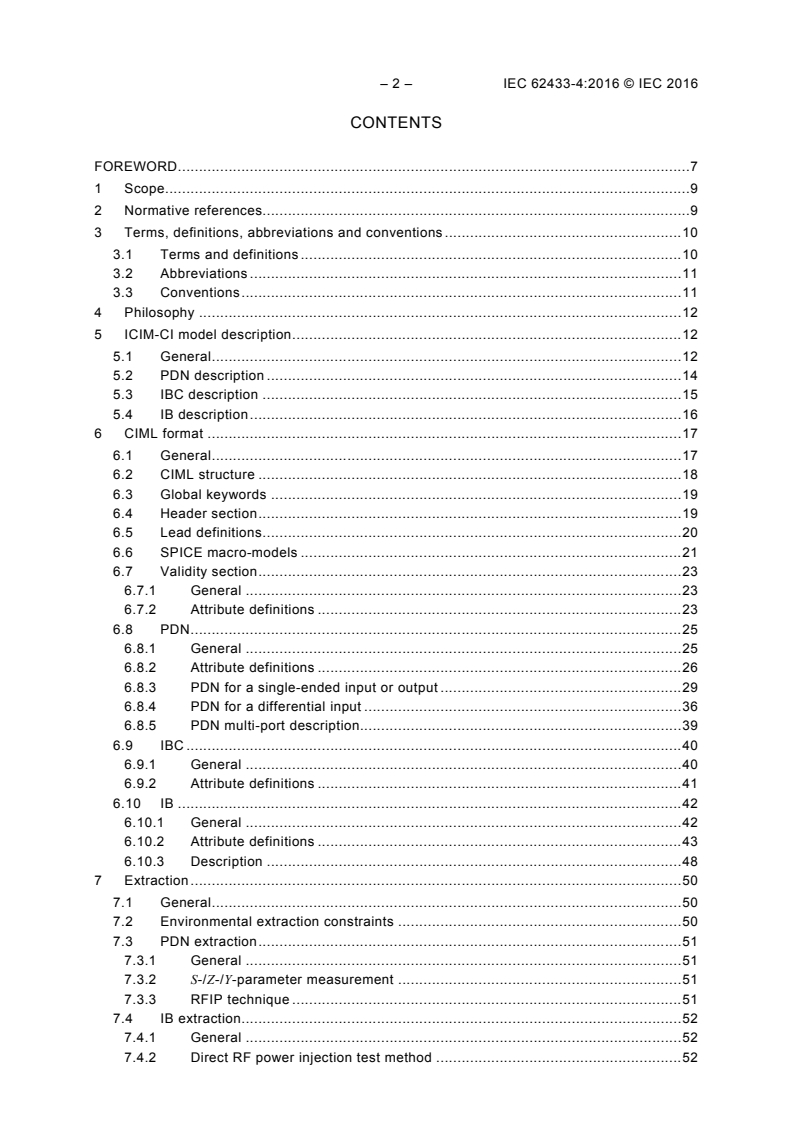
A.2.5 Values . 65
Annex B (informative) ICIM-CI example with disturbance load . 68
Annex C (informative) Conversions between parameter types . 69
C.1 General . 69
C.2 Single-ended input or output . 69
C.3 Differential input or output . 70
Annex D (informative) Example of ICIM-CI macro-model in CIML format . 74
Annex E (normative) CIML Valid keywords and usage . 79
E.1 Root element keywords . 79
E.2 File header keywords . 79
E.3 Validity section keywords . 81
E.4 Global keywords . 81
E.5 Lead keyword . 82
E.6 Lead_definitions section attributes . 82
E.7 Macromodels section attributes . 83
E.8 Pdn section keywords . 84
E.8.1 Lead element keywords . 84
E.8.2 Netlist section keywords . 86
E.9 Ibc section keywords . 87
E.9.1 Lead element keywords . 87
E.9.2 Netlist section keywords . 89
E.10 Ib section keywords . 89
E.10.1 Lead element keywords . 89
E.10.2 Max_power_level section keywords . 91
E.10.3 Voltage section keywords . 91
E.10.4 Current section keywords . 93
– 4 – IEC 62433-4:2016 © IEC 2016
E.10.5 Power section keywords . 94
E.10.6 Test_criteria section keywords . 95
Annex F (informative) PDN impedance measurement methods using vector network
analyzer . 97
F.1 General . 97
F.2 Conventional one-port method . 97
F.3 Two-port method for low impedance measurement . 97
F.4 Two-port method for high impedance measurement . 98
Annex G (informative) RFIP measurement method description . 99
G.1 General . 99
G.2 Obtaining immunity parameters . 99
Annex H (informative) Immunity simulation with ICIM model based on pass/fail test . 101
H.1 ICIM-CI macro-model of a voltage regulator IC . 101
H.1.1 General . 101
H.1.2 PDN extraction . 101
H.1.3 IB extraction . 101
H.1.4 SPICE-compatible macro-model . 102
H.2 Application level simulation and failure prediction . 102
Annex I (informative) Immunity simulation with ICIM model based on non pass/fail test . 104
Bibliography . 106
Figure 1 – Example of ICIM-CI model structure . 13
Figure 2 – Example of an ICIM-CI model of an electronic board . 14
Figure 3 – Example of an IBC network . 16
Figure 4 – ICIM-CI model representation with different blocks . 16
Figure 5 – CIML inheritance hierarchy . 18
Figure 6 – Example of a netlist file defining a sub-circuit . 22
Figure 7 – PDN electrical schematics . 29
Figure 8 – PDN represented as a one-port black-box . 29
Figure 9 – PDN represented as S-parameters in Touchstone format . 32
Figure 10 – PDN represented as two-port S-parameters in Touchstone format . 33
Figure 11 – Example structure for defining the PDN using circuit elements . 34
Figure 12 – Example of a single-ended PDN Netlist main circuit definition . 35
Figure 13 – Example of a single-ended PDN Netlist with both sub-circuit and main
circuit definitions . 35
Figure 14 – Differential input schematic . 37
Figure 15 – PDN represented as a two-port black-box . 37
Figure 16 – PDN data format for differential input or output . 37
Figure 17 – Differential inputs of an operational amplifier example . 39
Figure 18 – ICIM-CI Model for a 74HC08 component . 40
Figure 19 – Example IB file obtained from DPI measurement . 50
Figure 20 – Test setup of the DPI immunity measurement method as specified in
IEC 62132-4 . 52
Figure 21 – Principle of single and multi-pin DPI . 53
Figure 22 – Electrical representation of the DPI test setup . 54
Figure 23 – Test setup of the RFIP measurement method derived from the DPI method . 55
Figure 24 – Example setup used for illustrating ICIM-CI hypotheses . 57
Figure 25 – Example of linearity assumption validation . 58
Figure 26 – Example of transmitted power criterion validation . 59
Figure 27 – Use of the ICIM-CI macro-model for simulation . 59
Figure A.1 – Multiple XML (CIML) files . 64
Figure A.2 – XML files with data files (*.dat) . 64
Figure A.3 – XML files with additional files . 65
Figure B.1 – ICIM-CI description applied to an oscillator stage for extracting IB. 68
Figure C.1 – Single-ended DI . 69
Figure C.2 – Differential DI . 70
Figure C.3 – Two-port representation of a differential DI . 70
Figure C.4 – Simulation of common-mode injection on a differential DI based on DPI . 72
Figure C.5 – Equivalent common-mode input impedance of a differential DI . 72
Figure C.6 – Determination of transmitted power for a differential DI . 72
Figure D.1 – Test setup on an example LIN transceiver . 74
Figure D.2 – PDN data in touchstone format (s2p), data measured using VNA . 76
Figure D.3 – PDN data of leads 6 (LIN) and 7 (VCC) . 77
Figure D.4 – IB data in ASCII format (.txt), data measured using DPI method –
Injection on VCC pin . 77
Figure D.5 – IB data for injection on VCC pin . 78
Figure F.1 – Conventional one-port S-parameter measurement . 97
Figure F.2 – Two-port method for low impedance measurement . 98
Figure F.3 – Two-port method for high impedance measurement. 98
Figure G.1 – Test setup of the RFIP measurement method derived from DPI method . 99
Figure G.2 – Principle of the RFIP measurement method . 99
Figure H.1 – Electrical schematic for extracting the voltage regulator’s ICIM-CI . 101
Figure H.2 – ICIM-CI extraction on the voltage regulator example . 102
Figure H.3 – Example of a SPICE-compatible ICIM-CI macro-model of the voltage
regulator . 102
Figure H.4 – Example of a board level simulation on the voltage regulator’s ICIM-CI
with PCB model and other components including parasitic elements . 103
Figure H.5 – Incident power as a function of frequency that is required to create a
defect with a 10 nF filter . 103
Figure I.1 – Example of an IB file for a given failure criterion . 104
Figure I.2 – Comparison of simulated transmitted power and measured immunity
behaviour . 105
Table 1 – Attributes of Lead keyword in the Lead_definitions section . 20
Table 2 – Compatibility between the Mode and Type fields for correct CIML annotation . 20
Table 3 – Subckt definition . 21
Table 4 – Definition of the Validity section . 23
Table 5 – Definition of the Lead keyword for Pdn section . 25
Table 6 – Valid data formats and their default units in the Pdn section . 28
Table 7 – Valid file extensions in the Pdn section . 28
Table 8 – Valid fields of the Lead keyword for single-ended PDN . 30
– 6 – IEC 62433-4:2016 © IEC 2016
Table 9 – Netlist definition. 34
Table 10 – Valid fields of the Lead keyword for differential PDN . 38
Table 11 – Differences between the Pdn and Ibc section fields . 41
Table 12 – Valid fields of the Lead keyword for IBC definition . 42
Table 13 – Definition of the Lead keyword in Ib section . 43
Table 14 – Max_power_level definition . 44
Table 15 – Voltage, Current and Power definition . 45
Table 16 – Test_criteria definition . 45
Table 17 – Default values of Unit_voltage, Unit_current and Unit_power tags as a
function of data format . 48
Table 18 – Valid file extensions in the Ib section . 48
Table 19 – Example of IB table pass/fail criteria . 56
Table A.1 – Valid logarithmic units . 66
Table C.1 – Single-ended parameter conversion . 70
Table C.2 – Differential parameter conversion . 71
Table C.3 – Power calculation . 73
Table E.1 – Root element keywords . 79
Table E.2 – Header section keywords . 80
Table E.3 – Validity section keywords . 81
Table E.4 – Global keywords . 82
Table E.5 – Lead element definition . 82
Table E.6 – Lead_definitions section keywords . 83
Table E.7 – Macromodels section keywords . 83
Table E.8 – Lead element keywords in the Pdn section . 84
Table E.9 – Netlist section keywords . 87
Table E.10 – Lead element keywords in the Ibc section . 87
Table E.11 – Lead element keywords in the Ib section . 90
Table E.12 – Max_power_level section keywords . 91
Table E.13 – Voltage section keywords . 92
Table E.14 – Current section keywords . 93
Table E.15 – Power section keywords . 94
Table E.16 – Test_criteria section keywords . 96
INTERNATIONAL ELECTROTECHNICAL COMMISSION
____________
EMC IC MODELLING –
Part 4: Models of integrated circuits for RF immunity behavioural
simulation – Conducted immunity modelling (ICIM-CI)
FOREWORD
1) The International Electrotechnical Commission (IEC) is a worldwide organization for standardization comprising
all national electrotechnical committees (IEC National Committees). The object of IEC is to promote
international co-operation on all questions concerning standardization in the electrical and electronic fields. To
this end and in addition to other activities, IEC publishes International Standards, Technical Specifications,
Technical Reports, Publicly Available Specifications (PAS) and Guides (hereafter referred to as “IEC
Publication(s)”). Their preparation is entrusted to technical committees; any IEC National Committee interested
in the subject dealt with may participate in this preparatory work. International, governmental and non-
governmental organizations liaising with the IEC also participate in this preparation. IEC collaborates closely
with the International Organization for Standardization (ISO) in accordance with conditions determined by
agreement between the two organizations.
2) The formal decisions or agreements of IEC on technical matters express, as nearly as possible, an international
consensus of opinion on the relevant subjects since each technical committee has representation from all
interested IEC National Committees.
3) IEC Publications have the form of recommendations for international use and are accepted by IEC National
Committees in that sense. While all reasonable efforts are made to ensure that the technical content of IEC
Publications is accurate, IEC cannot be held responsible for the way in which they are used or for any
misinterpretation by any end user.
4) In order to promote international uniformity, IEC National Committees undertake to apply IEC Publications
transparently to the maximum extent possible in their national and regional publications. Any divergence
between any IEC Publication and the corresponding national or regional publication shall be clearly indicated in
the latter.
5) IEC itself does not provide any attestation of conformity. Independent certification bodies provide conformity
assessment services and, in some areas, access to IEC marks of conformity. IEC is not responsible for any
services carried out by independent certification bodies.
6) All users should ensure that they have the latest edition of this publication.
7) No liability shall attach to IEC or its directors, employees, servants or agents including individual experts and
members of its technical committees and IEC National Committees for any personal injury, property damage or
other damage of any nature whatsoever, whether direct or indirect, or for costs (including legal fees) and
expenses arising out of the publication, use of, or reliance upon, this IEC Publication or any other IEC
Publications.
8) Attention is drawn to the Normative references cited in this publication. Use of the referenced publications is
indispensable for the correct application of this publication.
9) Attention is drawn to the possibility that some of the elements of this IEC Publication may be the subject of
patent rights. IEC shall not be held responsible for identifying any or all such patent rights.
International Standard IEC 62433-4 has been prepared by subcommittee 47A: Integrated
circuits, of IEC technical committee 47: Semiconductor devices.
The text of this standard is based on the following documents:
FDIS Report on voting
47A/988/FDIS 47A/989/RVD
Full information on the voting for the approval of this standard can be found in the report on
voting indicated in the above table.
This publication has been drafted in accordance with the ISO/IEC Directives, Part 2.
– 8 – IEC 62433-4:2016 © IEC 2016
The committee has decided that the contents of this publication will remain unchanged until
the stability date indicated on the IEC website under "http://webstore.iec.ch" in the data
related to the specific publication. At this date, the publication will be
• reconfirmed,
• withdrawn,
• replaced by a revised edition, or
• amended.
IMPORTANT – The 'colour inside' logo on the cover page of this publication indicates
that it contains colours which are considered to be useful for the correct
understanding of its contents. Users should therefore print this document using a
colour printer.
EMC IC MODELLING –
Part 4: Models of integrated circuits for RF immunity behavioural
simulation – Conducted immunity modelling (ICIM-CI)
1 Scope
This part of IEC 62433 specifies a flow for deriving a macro-model to allow the simulation of
the conducted immunity levels of an integrated circuit (IC). This model is commonly called
Integrated Circuit Immunity Model – Conducted Immunity, ICIM-CI. It is intended to be used
for predicting the levels of immunity to conducted RF disturbances applied on IC pins.
In order to evaluate the immunity threshold of an electronic device, this macro-model will be
inserted in an electrical circuit simulation tool.
This macro-model can be used to model both analogue and digital ICs (input/output, digital
core and supply). This macro-model does not take into account the non-linear effects of the IC.
The added value of ICIM-CI is that it could also be used for immunity prediction at board and
system level through simulations.
This part of IEC 62433 has two main parts:
• the electrical description of ICIM-CI macro-model elements;
• a universal data exchange format called CIML based on XML. This format allows ICIM-CI
to be encoded in a more useable and generic form for immunity simulation.
2 Normative references
The following documents, in whole or in part, are normatively referenced in this document and
are indispensable for its application. For dated references, only the edition cited applies. For
undated references, the latest edition of the referenced document (including any
amendments) applies.
IEC 62132-1, Integrated circuits – Measurement of electromagnetic immunity – Part 1:
General conditions and definitions
IEC 62132-4, Integrated circuits – Measurement of electromagnetic immunity 150 kHz to 1
GHz – Part 4: Direct RF power injection method
IEC 62433-2, EMC IC modelling – Part 2: Models of integrated circuits for EMI behavioural
simulation – Conducted emissions modelling (ICEM-CE)
ISO 8879: 1986, Information processing – Text and office systems – Standard Generalized
Markup Language (SGML)
ISO/IEC 646: 1991, Information technology – ISO 7-bit coded character set for information
interchange (7-Bit ASCII)
CISPR 17, Methods of measurement of the suppression characteristics of passive EMC
filtering devices
– 10 – IEC 62433-4:2016 © IEC 2016
3 Terms, definitions, abbreviations and conventions
3.1 Terms and definitions
For the purposes of this document, the following terms and definitions apply.
3.1.1
section
XML element placed one level below the root element or within another section and that
contains one or more XML elements, but no value
3.1.2
parent
keyword which is one level above another keyword
3.1.3
child
keyword which is one level below another keyword
3.1.4
external terminal
terminal of an integrated circuit macro-model which interfaces the model to the external
environment of the integrated circuit
EXAMPLE Power supply pins and input/output pins.
Note 1 to entry: In this part of IEC 62433, a terminal is by default considered as external unless otherwise stated.
[SOURCE: IEC 62433-2:2008, 3.1, modified – Note 1 to entry has been changed, Example
has been added]
3.1.5
internal terminal
terminal of an integrated circuit macro-model's component which interfaces the component to
other components of the integrated circuit macro-model
[SOURCE: IEC 62433-2:2008, 3.2]
3.1.6
parser
tool for syntactic analysis of data that is encoded in a specified format
3.1.7
CIML
Conducted Immunity Markup Language
data exchange format for ICIM-CI model
3.1.8
CIMLBase
Conducted Immunity Markup Language Base
abstract type from which all CIML model components are directly or indirectly derived in the
ICIM-CI model definition
3.1.9
DI
Disturbance Input
input terminal for the injection of RF disturbances
Note 1 to entry: It could be any pin of IC, an input, supply or an output.
3.1.10
DO
Disturbance Output
terminal whose load influences the impedance of DI terminal, and/or the transfer
characteristics of PDN, and that outputs a part of the disturbance received on the DI terminals
3.1.11
OO
Observable Output
output terminal where the immunity criteria are monitored during the test
3.1.12
GND
Ground terminal
terminal that is used as reference for return path
3.1.13
PDN
Passive Distribution Network
block that describes the impedance network of one or more ports of the integrated circuit
3.1.14
IB
Immunity Behaviour
block that describes the internal immunity behaviour of the IC
3.1.15
IBC
Inter Block Coupling
block that describes the coupling network between different PDN blocks within an IC
[SOURCE: IEC TS 62433-1:2011, 3.3]
3.1.16
VNA
Vector Network Analyzer
instrument to measure complex network parameters such as S-, Y- or Z- parameters in the
frequency domain
3.1.17
RFIP
Radio Frequency Injection Probe
probe for injecting RF disturbances into a pin of an IC allowing measurement of voltage and
current
3.2 Abbreviations
CIM Conducted Immunity Model
XML eXtensible Markup Language
SPICE Simulation Program with Integrated Circuit Emphasis
ESD ElectroStatic Discharge
3.3 Conventions
For the sake of clarity, but with some exceptions, the writing conventions of XML have been
used in text and tables.
– 12 – IEC 62433-4:2016 © IEC 2016
4 Philosophy
Integrated circuits contain more and more gates, the integration density of technologies is
increasing and supply voltages are becoming lower. The reduction of distance between on-
chip signals, die geometry size reduction and the increase of unwanted currents in parasitic
structures, such as isolation capacitances, leads to increased internal crosstalk.
Consequently, the immunity of integrated circuits is becoming more and more critical.
Due to this increased risk of lower IC immunity, the use of models and simulation tools is
required to optimize the immunity behaviour of both the IC and the application.
This part of IEC 62433 describes such macro-models for simulating immunity behaviour at the
IC level. The model, called ICIM-CI, will be used to predict electromagnetic immunity at the
application level. This model is based on files describing the PDN and the IB containing data
on electromagnetic disturbances leading to a variation of one or more observable signals. The
PDN is considered to be linear, while the inherent non-linearity of the IC is taken into account
in the IB. This assumption is shown in 8.2 (see Figure 25). Users of the model should apply a
failure criterion to the observable signal depending on their requirements.
ICIM-CI model data is arranged in a decipherable nested manner using XML format. The
objective of this exchange format, called Conducted Immunity Markup Language (CIML), is to
create simple and practical universal access to the ICIM-CI model. The preliminary definitions
for XML representation are given in Annex A.
5 ICIM-CI model description
5.1 General
The internal structure of an IC can be broken down into two parts:
a) Passive parts (parasitic elements of pins, bondings and tracks, ESD protection), which
conduct the disturbances from the external environment to the internal IC blocks,
b) Active parts (CPU core, clock system, memory, analogue blocks). It is these active internal
blocks which are sen
...