

IEC 62276:2005
(Main)Single crystal wafers for surface acoustic wave (SAW) device applications - Specifications and measuring methods
General Information
- Abstract
Provides specifications for manufacturing piezoelectric single crystal wafers to be used in surface acoustic wave devices. Applies to the manufacture of synthetic quartz, lithium niobate, lithium tantalate, lithium tetraborate, and lanthanum gallium silicate single crystal wafers intended for use as substrates in the manufacture of surface acoustic wave filters and resonators.
- Status
- Published
- Publication Date
- 29-May-2005
- Technical Committee
- TC 49 - Piezoelectric, dielectric and electrostatic devices and associated materials for frequency control, selection and detection
- Drafting Committee
- WG 5 - TC 49/WG 5
- Current Stage
- DELPUB - Deleted Publication
- Start Date
- 19-Oct-2012
- Completion Date
- 28-Aug-2026
Overview
IEC 62276:2005 - "Single crystal wafers for surface acoustic wave (SAW) device applications - Specifications and measuring methods" - is an international standard published by the IEC (first edition, May 2005). It defines manufacturing specifications and test/measurement methods for piezoelectric single crystal wafers used as substrates in SAW filters and resonators. Materials in scope include synthetic quartz, lithium niobate (LN), lithium tantalate (LT), lithium tetraborate (LBO) and lanthanum gallium silicate (LGS). The standard supports consistent wafer quality and repeatable SAW device performance by standardizing acceptance criteria, inspection, sampling and measurement techniques.
Key topics and requirements
IEC 62276 covers practical technical requirements and measurement methods, including:
- Material and wafer specifications - definition of acceptable materials, wafer orientations and manufacturing lot concepts.
- Dimensional tests - diameter, thickness, offset flat (OF) dimensions and orientation.
- Flatness and form - TV5 (local flatness), TTV (total thickness variation), warp.
- Surface quality - front surface defects, back-surface roughness, inclusions and visual inspection methods.
- Crystallographic measurements - wafer orientation (face angle) by X‑ray and Euler-angle descriptions (Annex A).
- Physical property tests - Curie temperature measurement (DTA and dielectric-constant methods), lattice constant measurement (Bond method).
- Quality management - sampling plans, sampling frequency, inspection of whole population when required, labelling, packaging and delivery condition.
- Annex B (informative) - overview of crystal growth and standard wafer manufacturing processes to aid interpretation.
Measurement procedures described include DTA (differential thermal analysis), dielectric-constant techniques, Bond method for lattice constant, and X‑ray methods for face-angle/orientation.
Applications and who uses it
IEC 62276 is essential for:
- SAW device manufacturers (filters, resonators) specifying wafer acceptance criteria.
- Wafer suppliers and crystal growers ensuring production meets standardized measurement and packaging requirements.
- Quality engineers and test laboratories implementing prescribed test methods (TV5, TTV, warp, Curie temp, lattice constant).
- Procurement and materials engineers writing contracts and purchase specifications for SAW substrates.
Using this standard reduces specification negotiation, improves interchangeability of wafers, and supports predictable acoustic device performance.
Related standards
Normative references in IEC 62276 include:
- IEC 60758 - Synthetic quartz crystal: specifications and guide
- IEC 60410 - Sampling plans and procedures (inspection by attributes)
- ISO 4287 - Surface texture: profile method (terms and parameters)
Keywords: IEC 62276, SAW wafers, single crystal wafers, lithium niobate, lithium tantalate, synthetic quartz, LBO, LGS, wafer orientation, TV5, TTV, warp, Curie temperature, lattice constant, DTA, Bond method, X‑ray measurement.
Relations
- Effective Date
- 05-Sep-2023
- Effective Date
- 05-Sep-2023
Frequently Asked Questions
IEC 62276:2005 is a standard published by the International Electrotechnical Commission (IEC). Its full title is "Single crystal wafers for surface acoustic wave (SAW) device applications - Specifications and measuring methods". This standard covers: Provides specifications for manufacturing piezoelectric single crystal wafers to be used in surface acoustic wave devices. Applies to the manufacture of synthetic quartz, lithium niobate, lithium tantalate, lithium tetraborate, and lanthanum gallium silicate single crystal wafers intended for use as substrates in the manufacture of surface acoustic wave filters and resonators.
Provides specifications for manufacturing piezoelectric single crystal wafers to be used in surface acoustic wave devices. Applies to the manufacture of synthetic quartz, lithium niobate, lithium tantalate, lithium tetraborate, and lanthanum gallium silicate single crystal wafers intended for use as substrates in the manufacture of surface acoustic wave filters and resonators.
IEC 62276:2005 is classified under the following ICS (International Classification for Standards) categories: 31.140 - Piezoelectric devices. The ICS classification helps identify the subject area and facilitates finding related standards.
IEC 62276:2005 has the following relationships with other standards: It is inter standard links to IEC PAS 62276:2001, IEC 62276:2012. Understanding these relationships helps ensure you are using the most current and applicable version of the standard.
IEC 62276:2005 is available in PDF format for immediate download after purchase. The document can be added to your cart and obtained through the secure checkout process. Digital delivery ensures instant access to the complete standard document.
Standards Content (Sample)
INTERNATIONAL IEC
STANDARD 62276
First edition
2005-05
Single crystal wafers for surface acoustic
wave (SAW) device applications –
Specifications and measuring methods
Reference number
Publication numbering
As from 1 January 1997 all IEC publications are issued with a designation in the
60000 series. For example, IEC 34-1 is now referred to as IEC 60034-1.
Consolidated editions
The IEC is now publishing consolidated versions of its publications. For example,
edition numbers 1.0, 1.1 and 1.2 refer, respectively, to the base publication, the
base publication incorporating amendment 1 and the base publication incorporating
amendments 1 and 2.
Further information on IEC publications
The technical content of IEC publications is kept under constant review by the IEC,
thus ensuring that the content reflects current technology. Information relating to
this publication, including its validity, is available in the IEC Catalogue of
publications (see below) in addition to new editions, amendments and corrigenda.
Information on the subjects under consideration and work in progress undertaken
by the technical committee which has prepared this publication, as well as the list
of publications issued, is also available from the following:
• IEC Web Site (www.iec.ch)
• Catalogue of IEC publications
The on-line catalogue on the IEC web site (www.iec.ch/searchpub) enables you to
search by a variety of criteria including text searches, technical committees
and date of publication. On-line information is also available on recently issued
publications, withdrawn and replaced publications, as well as corrigenda.
• IEC Just Published
This summary of recently issued publications (www.iec.ch/online_news/ justpub)
is also available by email. Please contact the Customer Service Centre (see
below) for further information.
• Customer Service Centre
If you have any questions regarding this publication or need further assistance,
please contact the Customer Service Centre:
Email: custserv@iec.ch
Tel: +41 22 919 02 11
Fax: +41 22 919 03 00
INTERNATIONAL IEC
STANDARD 62276
First edition
2005-05
Single crystal wafers for surface acoustic
wave (SAW) device applications –
Specifications and measuring methods
IEC 2005 Copyright - all rights reserved
No part of this publication may be reproduced or utilized in any form or by any means, electronic or
mechanical, including photocopying and microfilm, without permission in writing from the publisher.
International Electrotechnical Commission, 3, rue de Varembé, PO Box 131, CH-1211 Geneva 20, Switzerland
Telephone: +41 22 919 02 11 Telefax: +41 22 919 03 00 E-mail: inmail@iec.ch Web: www.iec.ch
PRICE CODE
Commission Electrotechnique Internationale V
International Electrotechnical Commission
МеждународнаяЭлектротехническаяКомиссия
For price, see current catalogue
– 2 – 62276 IEC:2005(E)
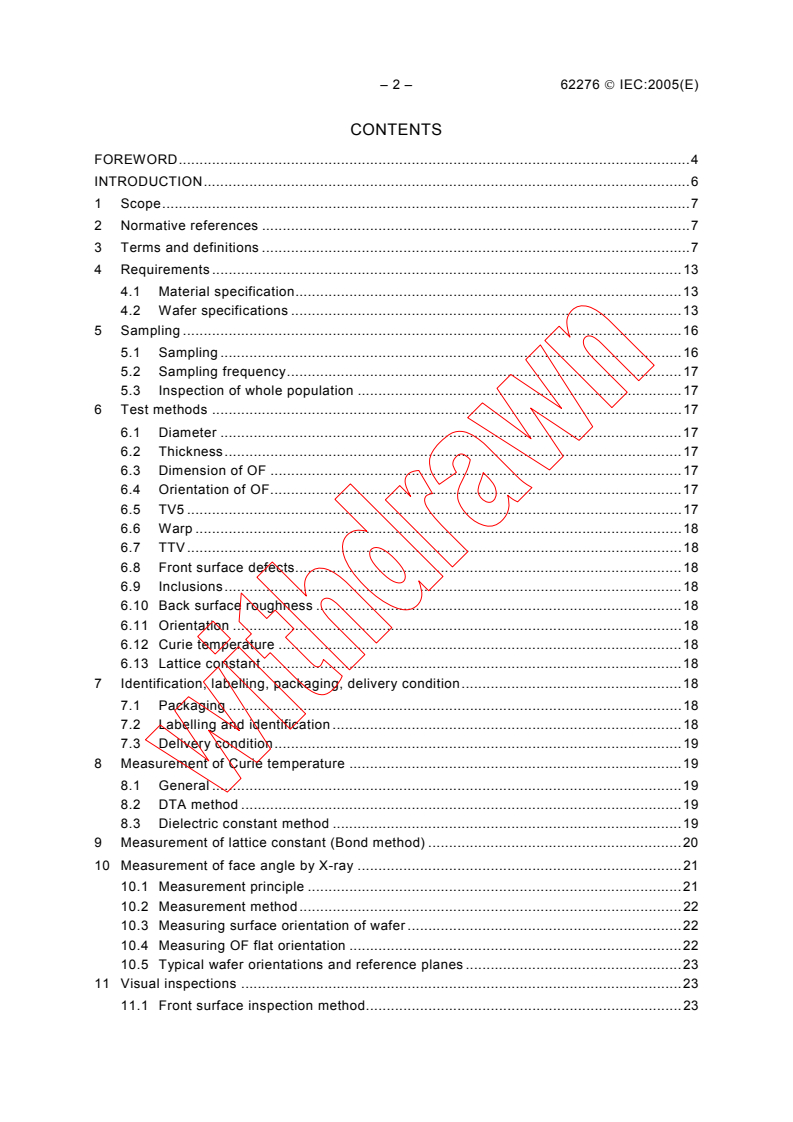
CONTENTS
FOREWORD.4
INTRODUCTION.6
1 Scope.7
2 Normative references .7
3 Terms and definitions .7
4 Requirements .13
4.1 Material specification.13
4.2 Wafer specifications .13
5 Sampling .16
5.1 Sampling .16
5.2 Sampling frequency.17
5.3 Inspection of whole population .17
6 Test methods .17
6.1 Diameter .17
6.2 Thickness.17
6.3 Dimension of OF .17
6.4 Orientation of OF.17
6.5 TV5 .17
6.6 Warp .18
6.7 TTV.18
6.8 Front surface defects.18
6.9 Inclusions.18
6.10 Back surface roughness .18
6.11 Orientation .18
6.12 Curie temperature .18
6.13 Lattice constant.18
7 Identification, labelling, packaging, delivery condition.18
7.1 Packaging .18
7.2 Labelling and identification .18
7.3 Delivery condition.19
8 Measurement of Curie temperature .19
8.1 General .19
8.2 DTA method .19
8.3 Dielectric constant method .19
9 Measurement of lattice constant (Bond method) .20
10 Measurement of face angle by X-ray .21
10.1 Measurement principle .21
10.2 Measurement method.22
10.3 Measuring surface orientation of wafer .22
10.4 Measuring OF flat orientation .22
10.5 Typical wafer orientations and reference planes .23
11 Visual inspections .23
11.1 Front surface inspection method.23
62276 IEC:2005(E) – 3 –
Annex A (normative) Expression using Euler angle description for piezoelectric
single crystals.24
A.1 Wafer orientation using Euler angle description .24
Annex B (informative) Manufacturing process for SAW wafers .27
B.1 Crystal growth methods .27
B.2 Standard mechanical wafer manufacturing .31
Bibliography.33
Figure 1 – Wafer sketch and measurement points for TV5 determination .9
Figure 2 – Schematic diagram of TTV .10
Figure 3 – Schematic diagram of warp .10
Figure 4 – Example of site distribution for LTV measurement. All sites have their
centres within the FQA.11
Figure 5 – LTV is a positive number and is measured at each site .11
Figure 6 – Schematic of a DTA system .19
Figure 7 – Schematic of a dielectric constant measurement system .20
Figure 8 – The Bond method.21
Figure 9 – Measurement method by X-ray.22
Figure 10 – Relationship between cut angle and lattice face .22
Figure A.1 – Definition of Euler angles to rotate coordinate system (X,Y,Z)
onto (x , x , x ).24
1 2 3
Figure A.2 – SAW wafer coordinate system .25
Figure A.3 – Relationship between the crystal axes, Euler angles,
and SAW orientation for some wafer orientations.26
Figure B.1 – Czochralski crystal growth method.27
Figure B.2 – Example of non-uniformity in crystals grown from different starting melt
compositions.29
Figure B.3 – Schematic of a vertical Bridgman furnace and example of temperature
distribution.30
Table 1 – Description of wafer orientations .12
Table 2 – Roughness, warp, TV5 and TTV specification limits .15
Table 3 – Crystal planes to determine surface and OF orientations.23
Table A.1 – Selected SAW substrate orientations and corresponding Euler angles .25
– 4 – 62276 IEC:2005(E)
INTERNATIONAL ELECTROTECHNICAL COMMISSION
____________
SINGLE CRYSTAL WAFERS FOR SURFACE ACOUSTIC
WAVE (SAW) DEVICE APPLICATIONS –
SPECIFICATIONS AND MEASURING METHODS
FOREWORD
1) The International Electrotechnical Commission (IEC) is a worldwide organization for standardization comprising
all national electrotechnical committees (IEC National Committees). The object of IEC is to promote
international co-operation on all questions concerning standardization in the electrical and electronic fields. To
this end and in addition to other activities, IEC publishes International Standards, Technical Specifications,
Technical Reports, Publicly Available Specifications (PAS) and Guides (hereafter referred to as “IEC
Publication(s)”). Their preparation is entrusted to technical committees; any IEC National Committee interested
in the subject dealt with may participate in this preparatory work. International, governmental and non-
governmental organizations liaising with the IEC also participate in this preparation. IEC collaborates closely
with the International Organization for Standardization (ISO) in accordance with conditions determined by
agreement between the two organizations.
2) The formal decisions or agreements of IEC on technical matters express, as nearly as possible, an international
consensus of opinion on the relevant subjects since each technical committee has representation from all
interested IEC National Committees.
3) IEC Publications have the form of recommendations for international use and are accepted by IEC National
Committees in that sense. While all reasonable efforts are made to ensure that the technical content of IEC
Publications is accurate, IEC cannot be held responsible for the way in which they are used or for any
misinterpretation by any end user.
4) In order to promote international uniformity, IEC National Committees undertake to apply IEC Publications
transparently to the maximum extent possible in their national and regional publications. Any divergence
between any IEC Publication and the corresponding national or regional publication shall be clearly indicated in
the latter.
5) IEC provides no marking procedure to indicate its approval and cannot be rendered responsible for any
equipment declared to be in conformity with an IEC Publication.
6) All users should ensure that they have the latest edition of this publication.
7) No liability shall attach to IEC or its directors, employees, servants or agents including individual experts and
members of its technical committees and IEC National Committees for any personal injury, property damage or
other damage of any nature whatsoever, whether direct or indirect, or for costs (including legal fees) and
expenses arising out of the publication, use of, or reliance upon, this IEC Publication or any other IEC
Publications.
8) Attention is drawn to the Normative references cited in this publication. Use of the referenced publications is
indispensable for the correct application of this publication.
9) Attention is drawn to the possibility that some of the elements of this IEC Publication may be the subject of
patent rights. IEC shall not be held responsible for identifying any or all such patent rights.
International Standard IEC 62276 has been prepared by IEC technical committee 49:
Piezoelectric and dielectric devices for frequency control and selection.
This standard cancels and replaces IEC/PAS 62276 published in 2001. This first edition
constitutes a technical revision.
The text of this standard is based on the following documents:
FDIS Report on voting
49/720/FDIS 49/724/RVD
Full information on the voting for the approval of this standard can be found in the report on
voting indicated in the above table.
This publication has been drafted in accordance with the ISO/IEC Directives, Part 2.
62276 IEC:2005(E) – 5 –
The committee has decided that the contents of this publication will remain unchanged until
the maintenance result date indicated on the IEC web site under "http://webstore.iec.ch" in
the data related to the specific publication. At this date, the publication will be
• reconfirmed,
• withdrawn,
• replaced by a revised edition, or
• amended.
A bilingual version of this publication may be issued at a later date.
– 6 – 62276 IEC:2005(E)
INTRODUCTION
A variety of piezoelectric materials are used for surface acoustic wave (SAW) filter and
resonator applications. Prior to the 1996 Rotterdam IEC TC 49 meeting, wafer specifications
were typically negotiated between users and suppliers. During the meeting a proposal was
announced to address wafer standardization. This document has been prepared in order to
provide industry standard technical specifications for manufacturing piezoelectric single
crystal wafers to be used in surface acoustic wave devices.
62276 IEC:2005(E) – 7 –
SINGLE CRYSTAL WAFERS FOR SURFACE ACOUSTIC
WAVE (SAW) DEVICE APPLICATIONS –
SPECIFICATIONS AND MEASURING METHODS
1 Scope
This International Standard applies to the manufacture of synthetic quartz, lithium niobate
(LN), lithium tantalate (LT), lithium tetraborate (LBO), and lanthanum gallium silicate (LGS)
single crystal wafers intended for use as substrates in the manufacture of surface acoustic
wave (SAW) filters and resonators.
2 Normative references
The following referenced documents are indispensable for the application of this document.
For dated references, only the edition cited applies. For undated references, the latest edition
of the referenced document (including any amendments) applies.
IEC 60758, Synthetic quartz crystal – Specifications and guide to the use
IEC 60410, Sampling plans and procedures inspection by attributes
ISO 4287, Geometrical Product Specifications (GPS) – Surface texture: Profile method –
Terms, definitions and surface texture parameters
3 Terms and definitions
For the purposes of this document, the following terms and definitions apply.
3.1
Single crystals for SAW wafer
3.1.1
as-grown synthetic quartz crystal
right-handed or left-handed single crystal quartz is grown hydrothermally. The term
“as-grown” indicates a state prior to mechanical fabrication
NOTE See IEC 60758 for further information concerning crystalline quartz.
3.1.2
lithium niobate
LN
single crystals approximately described by chemical formula LiNbO grown by Czochralski
3,
(crystal pulling from melt) or other growing methods
3.1.3
lithium tantalate
LT
single crystals approximately described by chemical formula LiTaO grown by Czochralski
3,
(crystal pulling from melt) or other growing methods
– 8 – 62276 IEC:2005(E)
3.1.4
lithium tetraborate
LBO
single crystals described by the chemical formula to Li B O , grown by Czochralski (crystal
2 4 7
pulling from melt), vertical Bridgman, or other growing methods
3.1.5
lanthanum gallium silicate
LGS
single crystals described by the chemical formula to La Ga SiO grown by Czochralski
3 5 14,
(crystal pulling from melt) or other growing methods
3.2
manufacturing lot
established by agreement between customer and supplier
3.3 Terms and definitions related to LN and LT crystals
3.3.1
Curie temperature
T
c
phase transition temperature between ferroelectric and paraelectric phases measured by
differential thermal analysis (DTA) or dielectric measurement
3.3.2
single domain
ferroelectric crystal with uniform electrical polarization throughout (for LN and LT)
3.3.3
polarization (or poling) process
electrical process used to establish a single domain crystal
3.4 Terms and definitions related to all crystals
3.4.1
lattice constant
length of unit cell along a major crystallographic axis measured by X-ray using the Bond
method
3.4.2
congruent composition
chemical composition of a single crystal in a thermodynamic equilibrium with a molten solution
of the same composition during the growth process
3.4.3
twin
crystallographic defect occurring in a single crystal.
NOTE The twin is separated from the rest of the material by a boundary, generally aligned along a crystal plane.
The lattices on either side of the boundary are crystallographic mirror images of one another.
3.5
orientation flat
OF
flat portion of wafer perimeter indicating the crystal orientation. Generally, the orientation flat
corresponds to the SAW propagation direction. It is also referred to as the “primary flat” (see
Figure 1)
62276 IEC:2005(E) – 9 –
3.6
secondary flat
SF
flat portion of wafer perimeter shorter than the OF. When present, the SF indicates wafer
polarity and can serve to distinguish different wafer cuts. It is also referred to as the “sub-
orientation flat” (see Figure 1)
3.7
Flatness
3.7.1
fixed quality area
FQA
central area of a wafer surface, defined by a nominal edge exclusion, X, over which the
specified values of a parameter apply
NOTE The boundary of the FQA is at all points (e.g. along wafer flats) the distance X away from the perimeter of
the wafer of nominal dimensions.
3.7.2
reference plane
depends on the flatness measurement and needs to be specified. It can be any of the
following:
a) for clamped measurements, the flat chuck surface that contacts the back surface of the
wafer;
b) three points at specified locations on the front surface within the FQA;
c) the least-squares fit to the front surface using all measured points within the FQA;
d) the least squares fit to the front surface using all measured points within one site.
3.7.3
site
square area on the front surface of the wafer with one side parallel to the OF. Flatness
parameters are assessed either globally for the FQA, or for each site individually
3.7.4
TV5 (thickness variation for five points)
TV5 is a measure of wafer thickness variation and is defined as the maximum difference
between five thickness measurements. Thickness is measured at the centre of the wafer and
at four peripheral points shown in Figure 1
1 6 mm
Index flat
5 4
Orientation flat
IEC 552/05
Figure 1 – Wafer sketch and measurement points for TV5 determination
– 10 – 62276 IEC:2005(E)
3.7.5
total thickness variation (TTV)
measurement of TTV is performed under clamped conditions with the reference plane as
defined in 3.7.2 a). TTV is the difference between maximum thickness (A) and the minimum
thickness (B) as shown in Figure 2
A
B
Reference plane || back surface
IEC 553/05
Figure 2 – Schematic diagram of TTV
3.7.6
warp
warp describes the deformation of an unclamped wafer and is defined as the maximum
difference between a point on the front surface and a reference plane, as shown in Figure 3.
The reference plane is defined by 3-points as described in 3.7.2 b). Warp is a bulk property of
a wafer and not of the exposed surface alone
Warp = |A| + |B|
3 point
reference plane B
A
Reference
point
IEC 554/05
Figure 3 – Schematic diagram of warp
3.7.7
sori
describes the deformation of an unclamped wafer and is defined as the maximum difference
between a point on the front surface and a reference plane. In contrast to warp, in this case
the reference plane is defined by a least-squares fit to the front surface (3.7.2 c))
3.7.8
local thickness variation (LTV)
determined by a measurement of a matrix of sites with defined edge dimensions (e.g. 5 mm ×
5 mm). Measurement is performed on a clamped wafer with the reference plane as defined in
3.7.2 a). A site map example is shown in Figure 4. The value is always a positive number and
is defined for each site as the difference between the highest and lowest points within each
site, as shown in Figure 5. For a wafer to meet an LTV specification, all sites must have LTV
values less than the specified value
62276 IEC:2005(E) – 11 –
1 2 3 ….
…. n ….
IEC 555/05
Figure 4 – Example of site distribution for LTV measurement.
All sites have their centres within the FQA
LTV
Back surface
Site 1 Site 2 Site 3 . Site n .
IEC 556/05
Figure 5 – LTV is a positive number and is measured at each site
3.7.9
percent local thickness variation
PLTV
the percentage of sites that fall within the specified values for LTV. As with the LTV
measurement, this is a clamped measurement
3.7.10
focal plane deviation
FPD
measured relative to the 3-point reference plane as defined in 3.7.2 b). The value indicates
the maximum distance between a point on the wafer surface (within the FQA) and the focal
plane. If that point is above the reference, the FPD is positive. If that point is below the
reference plane, the FPD is negative
3.8
back surface roughness
definitions of R are given in ISO 4287
a
3.9
surface orientation
crystallographic orientation of the axis perpendicular to the surface of wafer
3.10
description of orientation and SAW propagation
indicating the surface orientation and the SAW propagation direction, separated by the
symbol “-“. Specification of a 0º orientation is normally omitted. Typical examples for these
expressions are shown in Table 1.
– 12 – 62276 IEC:2005(E)
Table 1 – Description of wafer orientations
Material LN LT Quartz LBO LGS
crystal
o o o
Expression 128 Y-X X-112 Y ST-X 45 X-Z yxlt/48,5º/26,6º
o
Y-Z 36 Y-X
o
64 Y-X
3.11
ST-cut
although the original definition is 42,75º rotated Y-cut and X-propagation, the actual cut angle
can range from 20º to 42,75º in order to achieve a zero temperature coefficient
3.12
tolerance of surface orientation
acceptable difference between specified surface orientation and measured orientation,
measured by X-ray diffraction
3.13
bevel
slope or rounding of the wafer perimeter. This is also referred to as “edge profile”. The
process of creating a bevel is called “bevelling” or “edge rounding”. The profile and its
tolerances should be specified by the supplier
3.14
diameter of wafer
diameter of circular portion of wafer excluding the OF and SF regions
3.15
wafer thickness
thickness measured at the centre of the wafer
3.16 Definitions of appearance defects
3.16.1
contamination
the first is defined as area and the second as particulate. The first is caused by surface
contaminants that cannot be removed by cleaning or are stained after cleaning. Those may be
foreign matter on the surface of, for example a localized area that is smudged, stained,
discoloured, mottled, etc., or large areas exhibiting a hazy or cloudy appearance resulting
from a film of foreign materials
3.16.2
crack
fracture that extends to the surface and may or may not penetrate the entire thickness of the
wafer
3.16.3
scratch
shallow groove or cut below the established plane of the surface, with a length to width ratio
greater than 5:1
3.16.4
chip
region where material has been removed from the surface or edge of the wafer. The size can
be expressed by its maximum radial depth and peripheral chord length
62276 IEC:2005(E) – 13 –
3.16.5
dimple
smooth surface depression larger than 3 mm diameter
3.16.6
pit
non-removable surface anomaly such as a hollow, typically resulting from a bulk defect or
faulty manufacturing process
3.16.7
orange peel
large featured, roughened surface visible to the unaided eye under diffuse illumination
3.16.8
acceptable quality level
AQL
This definition is the same as in 4.2 of IEC 60410:1973 and is shown here for the reader’s convenience.
The AQL is the maximum percent defective (or the maximum number of defects per hundred
units) that, for purposes of sampling inspections, can be considered satisfactory as a process
average
4 Requirements
4.1 Material specification
4.1.1 Synthetic quartz crystal
A synthetic quartz crystal grown from Z-cut seed shall have an orientation within +5° of arc,
and the wafer should consist of excepting –X growth region. The quality of a synthetic quartz
crystal conforms to or exceeds the following grades in accordance with IEC 60758.
– Infrared absorption coefficient α value Grade D
– Inclusion density (pieces/cm ) Grade II
– Etch channel density (pieces/cm ) Grade 2
4.1.2 LN
LN is a single domain material having a Curie temperature within the specified range.
4.1.3 LT
LT is a single domain material having a Curie temperature or lattice constant within the
specified range.
4.1.4 LBO, LGS
Material not including twins.
4.2 Wafer specifications
The specifications listed here apply in the absence of superseding agreements between user
and supplier. These specifications are expected to evolve and change as existing processes
are refined and new ones are developed. For wafers that are typically used in conjunction with
a photolithographic stepper equipment, LTV is typically specified as one of the flatness
criteria. When using projection lithography for full wafer exposure, FPD is often more relevant
than TTV, as the system will perform a tilt correction referenced off the front surface. Sori is
often more meaningful than warp since the least-squares derived reference plane used in that
measurement typically provides a more accurate representation of the wafer surface.
– 14 – 62276 IEC:2005(E)
4.2.1 Diameters and tolerances
76,2 mm ± 0,25 mm (commonly referred to as a “3 inch” wafer)
100,0 mm ± 0,5 mm
125,0 mm ± 0,5 mm
150,0 mm ± 0,5 mm
4.2.2 Thickness and tolerance
0,3 mm to 0,5 mm ± 0,03 mm for a diameter of up to 100 mm, 0,5 mm to 0,8 mm for larger
wafers.
4.2.3 OF
Dimensions of OF and tolerances
a) 22,0 mm ± 3,0 mm (for a 76,2 mm wafer)
32,5 mm ± 3,0 mm (for a 100 mm wafer)
42,5 mm ± 3,0 mm (for a 125 mm wafer)
57,5 mm ± 3,0 mm (for a 150 mm wafer)
b) Orientation tolerance
Orientation tolerance: ±30’
Orientation of the OF shall be perpendicular to SAW propagation unless otherwise agreed
upon by user and supplier. Orientation of the OF for quartz crystal wafers is X-plane (1 1 .
0) and an arrow pointing from the wafer centre to the OF is in the –X direction.
4.2.4 SF
The dimensions and tolerances are as listed below:
a) Dimensions of SF and tolerances
Dimensions and these tolerances of the SF are specified as reference values
11,2 mm ± 4 mm unless otherwise agreed upon (for 76,2 mm wafer)
18,0 mm ± 4 mm unless otherwise agreed upon (for 100 mm wafer)
27,5 mm ± 4 mm unless otherwise agreed upon (for 125 mm wafer)
37,5 mm ± 4,5 mm unless otherwise agreed upon (for 150 mm wafer)
b) Orientation tolerance of SF
Orientation tolerance of the SF are measured with respect to the OF and are agreed on by
user and supplier with a typical value being ±1,0°
c) Laser marking can be used as an alternative method to indicate the front surface.
4.2.5 Back surface roughness
As agreed upon by user and supplier (see Table 2).
4.2.6 Warp
As specified in Table 2.
4.2.7 TV5 or TTV
As specified in Table 2.
62276 IEC:2005(E) – 15 –
Table 2 – Roughness, warp, TV5 and TTV specification limits
Warp (µm) TV5 (µm) TTV (µm)
Roughness of
Material Diameter of wafer specified specified specified
back surface (R )
a
value value value
0,5 µm or greater 30 10 10
76,2 mm (3 inch)
Less than 0,5 µm 20 10 10
Quartz crystal
0,5 µm or greater 40 10 10
100 mm
Less than 0,5 µm 30 10 10
2,0 µm or greater 50 15 15
76,2 mm (3 inch) 2,0 µm to 0,5 µm 40 15 15
Less than 0,5 µm 40 10 10
2,0 µm or greater 50 20 20
100 mm 2,0 µm to 0,5 µm 40 15 15
Less than 0,5 µm 40 10 10
LN, LT
2,0 µm or greater 60 20 20
125 mm
2,0 µm to 0,5 µm 50 15 15
Less than 0,5 µm 40 10 10
2,0 µm or greater 60 20 25
150 mm
2,0 µm to 0,5 µm 50 15 20
Less than 0,5 µm 40 10 15
0,5 µm or greater 40 15 15
76,2 mm (3 inch)
Less than 0,5 µm 40 10 10
LBO
0,5 µm or greater 40 20 20
100 mm
Less than 0,5 µm 40 10 10
0,5 µm or greater 40 15 15
76,2 mm (3 inch)
Less than 0,5 µm 40 10 10
LGS
0,5 µm or greater 40 20 20
100 mm
Less than 0,5 µm 40 10 10
4.2.8 Front (propagation) surface finish
The front surface shall be mirror polished. Surface finishing details are subject to agreement
between user and supplier.
4.2.9 Front surface defects
a) Scratches
No scratches by visual inspection
b) Chips
1) Edge chips:
Radial depth: less than 0,5 mm
Peripheral chord length: less than 1,0 mm
2) Surface:
No chips by visual inspection
c) Cracks
No cracks by visual inspection
d) Contamination
No contamination by visual inspection
e) Others
Other defects such as dimples, pits, and orange peel: no such defects by visual inspection.
– 16 – 62276 IEC:2005(E)
4.2.10 Surface orientation tolerance
Surface orientation shall be specified by user and supplier.
Quartz crystal: ±10’
LN, LT, LBO: ±20’
LGS crystal: ±10’
4.2.11 Inclusions
LN/LT/LBO/LGS: No visible inclusions by naked eye inspection
Synthetic quartz: material satisfies the specification Grade II of IEC 60758, 1.4.2.
4.2.12 Etch channel density and position of seed for quartz wafer
The etch channel density and the position of the seed are described below:
a) Etch channel within seed portion for a quartz crystal wafer
The density of the etch channel in a state of not passing through from front surface to
back surface is less than 36 as per 76,2 mm wafer or less than 47 as per 100 mm wafer.
b) Position of seed
The seed shall be included within ±3,5 mm centre width of the Z’ direction and parallel to
the X-direction of the centre of the wafer.
4.2.13 Bevel
The bevel shall be as agreed upon by user and supplier.
4.2.14 Curie temperature and tolerance
NOTE Only applies to LN/LT. The centre value for the specification is as agreed upon by user and supplier.
Alternatively, the lattice constant can be specified.
LN: centre value within 1133 °C and 1145 °C. Tolerance ±3 °C
LT: centre value within 598 °C and 608 °C. Tolerance ±3 °C
4.2.15 Lattice constant
NOTE Alternatively, the Curie temperature can be specified.
LT: 0,51538 nm ± 0,00002 nm for a –axis
5 Sampling
A statistically significant sampling plan shall be agreed upon by user and supplier. Sampled
wafers must be randomly selected and representative of the production population, and must
satisfy the quality assurance criteria using the prescribed test methods.
5.1 Sampling
Unless otherwise specified, sampling shall be in accordance with AQL 2,5 %, single sampling
as defined in IEC 60410. The specified AQL applies to the listed groups of defects considered
collectively.
62276 IEC:2005(E) – 17 –
5.2 Sampling frequency
Appropriate statistical methods shall be applied to determine adequate sample size and
acceptance criteria for the considered lot size. In the absence of more detailed statistical
analysis, the following sampling plan can be employed:
a) Dimensions
Diameter 2 wafers/manufacturing lot
Thickness 2 wafers/manufacturing lot
Length of OF 2 wafers/manufacturing lot
b) Surface orientation 2 wafers/manufacturing lot
c) Orientation of OF 2 wafers/manufacturing lot
d) Back surface finishing 2 wafers/manufacturing lot
e) TV5 2 wafers/manufacturing lot
f) Warp 2 wafers/manufacturing lot
g) TTV 2 wafers/manufacturing lot
5.3 Inspection of whole population
The following items shall be inspected for all wafers:
a) Existence and position of OF and SF
b) Surface finish
c) Wafer defects
d) Inclusions
e) Beveling
6 Test methods
6.1 Diameter
Measurement of the wafer diameter (excluding OF and SF portions) using callipers of
sufficient accuracy.
6.2 Thickness
Thickness at the centre of the wafer as measured by a sufficiently accurate (typically 1 µm)
thickness meter, in accordance with ASTM test method F533.
6.3 Dimension of OF
Measurement of the OF length as a straight cut line of the intersection with the circle using
callipers of sufficient accuracy.
6.4 Orientation of OF
Deviation of the geometrical orientation flat from the reference orientation of the lattice plane
as measured with an X-ray diffractometer. The method is explained in detail in 10.4 and
Figure 10.
6.5 TV5
TV5 is measured at the centre and at the four points located 6 mm from the edge of the wafer
using callipers of sufficient accuracy (typically 1 µm) in accordance with ASTM test method
F533.
– 18 – 62276 IEC:2005(E)
6.6 Warp
Warp and other flatness parameters are measured using optical flatness equipment.
6.7 TTV
TTV is measured on clamped wafers using optical flatness equipment.
6.8 Front surface defects
Surface defects on the wafer shall be inspected using the method explained in Clause 11.
6.9 Inclusions
Inspection for inclusions shall be performed using light reflected from the polished wafer
surface. Inspection should be carried out in a clean environment using a high intensity
optically condensed light against a dark background to prevent interference from diffuse light
reflections.
6.10 Back surface roughness
Surface roughness may be measured by either the contact or optical method. The average
roughness (R ) values listed in Table 2 were determined by contact profilometry. Measured
a
values for a given wafer generally depend on the method (stylus radius, sampling interval,
optical parameters).
6.11 Orientation
Crystallographic orientation is determined by XRD (see 10.1 and Figure 9).
6.12 Curie temperature
The Curie temperature of a ferroelectric material may be determined by either calorimetric or
dielectric measurement methods (see 8.1).
6.13 Lattice constant
The crystal lattice constant may be determined by XRD (see Clause 9).
7 Identification, labelling, packaging, delivery condition
7.1 Packaging
Wafers must be packaged so as to avoid contamination or damage during shipping or storage.
Special packaging requirements shall be subject to agreement between the user and supplier.
7.2 Labelling and identification
All wafer containers must include labels with the following information:
a) supplier’s name or trade mark;
b) material type;
c) wafer orientation;
d) manufacturing lot number;
e) quantity.
62276 IEC:2005(E) – 19 –
7.3 Delivery condition
Additional documentation or shipping requirements are to be negotiated between each user
and supplier.
8 Measurement of Curie temperature
8.1 General
Curie temperature (T ) determinations are performed on single crystal lithium tantalate (LT)
c
and lithium niobate (LN). Both the DTA (differential thermal analysis) and dielectric constant
methods used to determine T are destructive tests. Measurements on the same sample using
c
each of these methods may differ from one another depending on experimental conditions and
equipment. Customers using wafers from several suppliers need to be aware that a
correlation of results is required before comparing reported values.
8.2 DTA method
The DTA (differential thermal analysis) method is based on the endothermic or exothermic
reaction observed when a single crystal transitions from the ferroelectric to paraelectric states.
Typically, the sample and a reference material are symmetrically positioned in an oven (see
Figure 6) and heated at a constant rate, while recording the temperature difference between
the materials. Alumina (α-Al O ) is often used as the reference when running DTA
2 3
experiments on LN or LT. Heat is released at the LN or LT sample passes upward through the
phase transition temperature, and the temperature profile relative to the alumina reference is
recorded. The Curie temperature T is defined as the temperature at which the temperature
c
difference arises.
Furnace
Reference Sample
Temperature
control unit
Thermocouple
T
X-Y
ΔT
Recorder
DC amplifier
IEC 764/05
Figure 6 – Schematic of a DTA system
8.3 Dielectric constant method
The dielectric constant method relies upon observing the dielectric constant along the polar
Z-axis of a ferroelectric crystal. The dielectric constant maximum is found to occur at the
phase transition temperature. Since the dielectric constant, and thus the capacitance, for a
given sample are a function of temperature only, the heating or cooling rates can be chosen
to be small enough so as to minimize thermal hysteresis. In the following illustration (Figure 7),
the electrode of Pt or Ag-Pd is placed on the sample so that the electric field runs along the
polar Z axis. While scanning the temperature across the phase transition, the capacitance of
the sample is measured by the LCR-meter. The temperature at which the peak capacitance is
observed corresponds to the Curie temperature T .
c
Heater
– 20 – 62276 IEC:2005(E)
L-C-R Meter
C
X-Y
Recorder
Guard
T
voltage
Input Input
Nickel
Resistance
rod
furnace
Nickel
tubing
Thermocouple
Ketos Sample
spring
IEC 765/05
steel
Figure 7 – Schematic of a dielectric constant measurement system
9 Measurement of lattice constant (Bond method)
As the chemical composition of a crystal changes, so do the SAW velocities and lattice
–4
constants. In order to control the SAW velocity to within one part per ten thousand (10 ), the
–5
lattice constants must be controlled within 10 . The measurement method in turn must
–6
achieve part per million (10 ) resolution.
X-ray diffraction is used to measure lattice constants. The method is based on Bragg’s law as
follows:
2 d sinθ = nλ
where d is the lattice spacing, θ the Bragg angle, λ the X-ray wavelength and n the integer
diffraction order.
If λ is given, d and lattice constants are determined by measuring θ. A sensitivity analysis
yields
Δd
= − cotθ × Δθ
d
where Δθ must be measured correctly to within an arc second in order to measure Δd/d on a
–6 –7
scale of 10 to 10 . In 1960, Dr. Bond developed a method to measure the value of the
lattice constants precisely.
In the Bond method, two measurements are made, (i.e. the ‘plus-side’ and ‘minus-side’),
located symmetrically around the same lattice face. The values ω and ω from the peaks of
1 2
rocking curve are determined as Figure 8 shows and θ is calculated as:
θ =()180° − ω − ω
1 2
62276 IEC:2005(E) – 21 –
This method eliminates off-centre error plus absorption and zero error are theoretically
eliminated as well. Note that temperature, refraction, divergence and Lorentz-polarization
corrections should be taken into account.
For the case of LiTaO , the Miller index (33,0) was evaluated by the Bond method. The a-axis
lattice constant is calculated as follows:
a = 6d
33,0
After applying various corrections, the lattice constant of LiTaO is determined to an accuracy
–6 –7
of 10 to 10 .
180° – 2θ
Detector
ω
ω
+ 1
Collimator
Single
crystal
–
θ=(1/2) (180° – │ω – ω │)
1 2
IEC 766/05
Figure 8 – The Bond method
10 Measurement of face angle by X-ray
10.1 Measurement principle
If the distance between each lattice face is d, the X-ray wavelength is λ and the diffraction
order is n, the X-ray beam diffracts when the Bragg angle θ condition is satisfied as follows:
2 d sinθ = nλ
The X-ray source consists of a collimated beam and an optional reflecting crystal plate. An X-
ray detector is positio
...