

IEC 63365:2022
(Main)Industrial process measurement, control and automation - Digital nameplate
General Information
- Abstract
IEC 63365:2022 applies to products used in the process measurement, control and automation industry. It establishes a concept and requirements for the digital nameplate and provides alternative electronically readable solutions (e.g. 2D codes, RFID or firmware) to current conventional plain text marking on the nameplate or packaging of products.
The digital nameplate information is contained in the electronically readable medium affixed to the product, the packaging or accompanying documents. The digital nameplate information is available offline without Internet connection. After electronic reading, all digital nameplate information is displayed in a human readable text format. The digital nameplate also includes the Identification Link String according to IEC 61406-1 which provides additional online information for the product.
This document does not specify the contents of the conventional nameplate, which are subject to regional or national regulations and standards.
- Status
- Published
- Publication Date
- 17-Oct-2022
- Technical Committee
- SC 65E - Devices and integration in enterprise systems
- Drafting Committee
- WG 2 - TC 65/SC 65E/WG 2
- Current Stage
- PPUB - Publication issued
- Start Date
- 18-Oct-2022
- Completion Date
- 25-Nov-2022
Overview
IEC 63365:2022 specifies the concept and essential requirements for digital nameplates in the industrial process measurement, control, and automation sector. Published by the International Electrotechnical Commission (IEC), this standard enables manufacturers to provide product identification and required information using electronically readable media, such as 2D barcodes, RFID transponders, or embedded firmware. The adoption of digital nameplates addresses the challenges of space limitations on conventional plates and supports the increasing demands for traceability, regulatory conformity, and digital transformation in industrial automation.
Key Topics
Digital Nameplate Definition: A digital nameplate is an electronically readable marking that encodes product information in media such as QR codes, Data Matrix codes, RFID/NFC transponders, or within product firmware. Unlike traditional nameplates, it is optimized for both human and machine readability.
Information Enclosure and Accessibility: Digital nameplate data is stored in a medium affixed to the product, its packaging, or in accompanying documentation. Users can access this information offline, without the need for an Internet connection, ensuring operability in sensitive or remote locations.
Identification Link String: Conformance with IEC 61406-1 is required for incorporating an Identification Link String, which enables additional online information access when an Internet connection is available, thereby bridging physical products to digital product databases.
Data Types: The standard allows encoding of critical information such as basic product details, technical specifications, and certificates. Regulatory or region-specific requirements may still mandate some information in plain human-readable text.
Storage Technologies: Multiple technology options are outlined for implementing digital nameplates:
- 2D Codes: QR and Data Matrix codes, readable by standard devices (e.g., smartphones).
- RFID/NFC Transponders: Passive (no battery) transponders suitable for long-term identification, especially on metal or small products.
- Firmware: Product marking integrated within the device firmware, accessible via electronic interfaces or on-device displays.
Conformance and Quality: IEC 63365 aligns symbol design, error correction, and print quality with existing international standards, ensuring reliability and durability of the digital marking under industrial conditions.
Applications
IEC 63365:2022 offers significant advantages for both manufacturers and operators in the process industry:
Efficient Product Identification: Facilitates detailed product identification for small devices where space for conventional markings is limited, supporting compliance with global regulatory marks.
Traceability and Data Integration: Enables direct integration with enterprise systems (such as ERP) for inventory management, maintenance, and documentation updates, thanks to machine-readable and structured data.
Smart Manufacturing: Supports Industry 4.0 initiatives by allowing automated material flow, service, and inspection processes using barcodes or RFID scans, and paves the way for digital twins.
Regulatory Compliance: Ensures products can display all required certifications and approval marks (such as Ex, CE, UKCA) through digital means, helping manufacturers address ever-growing regional and international requirements.
Flexibility and Space Optimization: Reduces the space needed for product identification, enabling more compact designs and improved aesthetics, especially for sensors and small industrial components.
Offline and Online Use: Ensures all critical product data remains available offline while supporting online augmentation for richer digital documentation when Internet connectivity is available.
Related Standards
Implementing IEC 63365:2022 may require reference to or integration with the following standards:
- IEC 61406-1: Identification link - foundational for online product information access via digital codes.
- ISO/IEC 18004: QR Code symbology specification.
- ISO/IEC 16022: Data Matrix code specification.
- ISO/IEC 15415: Print quality test for 2D barcodes.
- ISO/IEC 29158: Direct Part Mark (DPM) quality guideline.
- ISO/IEC 18092: Near Field Communication (NFC) interface specification.
- IEC 60079-14: Marking for explosion-protected equipment.
For organizations transitioning to digital nameplates, IEC 63365:2022 offers a robust framework that meets international demands for secure, readable, and integrated industrial product identification.
Get Certified
Connect with accredited certification bodies for this standard

BSI Group
BSI (British Standards Institution) is the business standards company that helps organizations make excellence a habit.

NYCE
Mexican standards and certification body.

ANCE
Mexican certification and testing association.
Sponsored listings
Frequently Asked Questions
IEC 63365:2022 is a standard published by the International Electrotechnical Commission (IEC). Its full title is "Industrial process measurement, control and automation - Digital nameplate". This standard covers: IEC 63365:2022 applies to products used in the process measurement, control and automation industry. It establishes a concept and requirements for the digital nameplate and provides alternative electronically readable solutions (e.g. 2D codes, RFID or firmware) to current conventional plain text marking on the nameplate or packaging of products. The digital nameplate information is contained in the electronically readable medium affixed to the product, the packaging or accompanying documents. The digital nameplate information is available offline without Internet connection. After electronic reading, all digital nameplate information is displayed in a human readable text format. The digital nameplate also includes the Identification Link String according to IEC 61406-1 which provides additional online information for the product. This document does not specify the contents of the conventional nameplate, which are subject to regional or national regulations and standards.
IEC 63365:2022 applies to products used in the process measurement, control and automation industry. It establishes a concept and requirements for the digital nameplate and provides alternative electronically readable solutions (e.g. 2D codes, RFID or firmware) to current conventional plain text marking on the nameplate or packaging of products. The digital nameplate information is contained in the electronically readable medium affixed to the product, the packaging or accompanying documents. The digital nameplate information is available offline without Internet connection. After electronic reading, all digital nameplate information is displayed in a human readable text format. The digital nameplate also includes the Identification Link String according to IEC 61406-1 which provides additional online information for the product. This document does not specify the contents of the conventional nameplate, which are subject to regional or national regulations and standards.
IEC 63365:2022 is classified under the following ICS (International Classification for Standards) categories: 33.080 - Integrated Services Digital Network (ISDN); 35.040.50 - Automatic identification and data capture techniques. The ICS classification helps identify the subject area and facilitates finding related standards.
IEC 63365:2022 is available in PDF format for immediate download after purchase. The document can be added to your cart and obtained through the secure checkout process. Digital delivery ensures instant access to the complete standard document.
Standards Content (Sample)
IEC 63365 ®
Edition 1.0 2022-10
INTERNATIONAL
STANDARD
NORME
INTERNATIONALE
colour
inside
Industrial process measurement, control and automation – Digital nameplate
Mesurage, commande et automatisation dans les processus industriels –
Plaque signalétique numérique
All rights reserved. Unless otherwise specified, no part of this publication may be reproduced or utilized in any form
or by any means, electronic or mechanical, including photocopying and microfilm, without permission in writing from
either IEC or IEC's member National Committee in the country of the requester. If you have any questions about IEC
copyright or have an enquiry about obtaining additional rights to this publication, please contact the address below or
your local IEC member National Committee for further information.
Droits de reproduction réservés. Sauf indication contraire, aucune partie de cette publication ne peut être reproduite
ni utilisée sous quelque forme que ce soit et par aucun procédé, électronique ou mécanique, y compris la photocopie
et les microfilms, sans l'accord écrit de l'IEC ou du Comité national de l'IEC du pays du demandeur. Si vous avez des
questions sur le copyright de l'IEC ou si vous désirez obtenir des droits supplémentaires sur cette publication, utilisez
les coordonnées ci-après ou contactez le Comité national de l'IEC de votre pays de résidence.
IEC Secretariat Tel.: +41 22 919 02 11
3, rue de Varembé info@iec.ch
CH-1211 Geneva 20 www.iec.ch
Switzerland
About the IEC
The International Electrotechnical Commission (IEC) is the leading global organization that prepares and publishes
International Standards for all electrical, electronic and related technologies.
About IEC publications
The technical content of IEC publications is kept under constant review by the IEC. Please make sure that you have the
latest edition, a corrigendum or an amendment might have been published.
IEC publications search - webstore.iec.ch/advsearchform IEC Products & Services Portal - products.iec.ch
The advanced search enables to find IEC publications by a Discover our powerful search engine and read freely all the
variety of criteria (reference number, text, technical publications previews. With a subscription you will always
committee, …). It also gives information on projects, replaced have access to up to date content tailored to your needs.
and withdrawn publications.
Electropedia - www.electropedia.org
IEC Just Published - webstore.iec.ch/justpublished
The world's leading online dictionary on electrotechnology,
Stay up to date on all new IEC publications. Just Published
containing more than 22 300 terminological entries in English
details all new publications released. Available online and
and French, with equivalent terms in 19 additional languages.
once a month by email.
Also known as the International Electrotechnical Vocabulary
(IEV) online.
IEC Customer Service Centre - webstore.iec.ch/csc
If you wish to give us your feedback on this publication or
need further assistance, please contact the Customer Service
Centre: sales@iec.ch.
A propos de l'IEC
La Commission Electrotechnique Internationale (IEC) est la première organisation mondiale qui élabore et publie des
Normes internationales pour tout ce qui a trait à l'électricité, à l'électronique et aux technologies apparentées.
A propos des publications IEC
Le contenu technique des publications IEC est constamment revu. Veuillez vous assurer que vous possédez l’édition la
plus récente, un corrigendum ou amendement peut avoir été publié.
Recherche de publications IEC - IEC Products & Services Portal - products.iec.ch
webstore.iec.ch/advsearchform Découvrez notre puissant moteur de recherche et consultez
La recherche avancée permet de trouver des publications IEC gratuitement tous les aperçus des publications. Avec un
en utilisant différents critères (numéro de référence, texte, abonnement, vous aurez toujours accès à un contenu à jour
comité d’études, …). Elle donne aussi des informations sur adapté à vos besoins.
les projets et les publications remplacées ou retirées.
Electropedia - www.electropedia.org
IEC Just Published - webstore.iec.ch/justpublished
Le premier dictionnaire d'électrotechnologie en ligne au
Restez informé sur les nouvelles publications IEC. Just
monde, avec plus de 22 300 articles terminologiques en
Published détaille les nouvelles publications parues.
anglais et en français, ainsi que les termes équivalents dans
Disponible en ligne et une fois par mois par email.
19 langues additionnelles. Egalement appelé Vocabulaire
Electrotechnique International (IEV) en ligne.
Service Clients - webstore.iec.ch/csc
Si vous désirez nous donner des commentaires sur cette
publication ou si vous avez des questions contactez-nous:
sales@iec.ch.
IEC 63365 ®
Edition 1.0 2022-10
INTERNATIONAL
STANDARD
NORME
INTERNATIONALE
colour
inside
Industrial process measurement, control and automation – Digital nameplate
Mesurage, commande et automatisation dans les processus industriels –
Plaque signalétique numérique
INTERNATIONAL
ELECTROTECHNICAL
COMMISSION
COMMISSION
ELECTROTECHNIQUE
INTERNATIONALE
ICS 33.080 ISBN 978-2-8322-5894-1
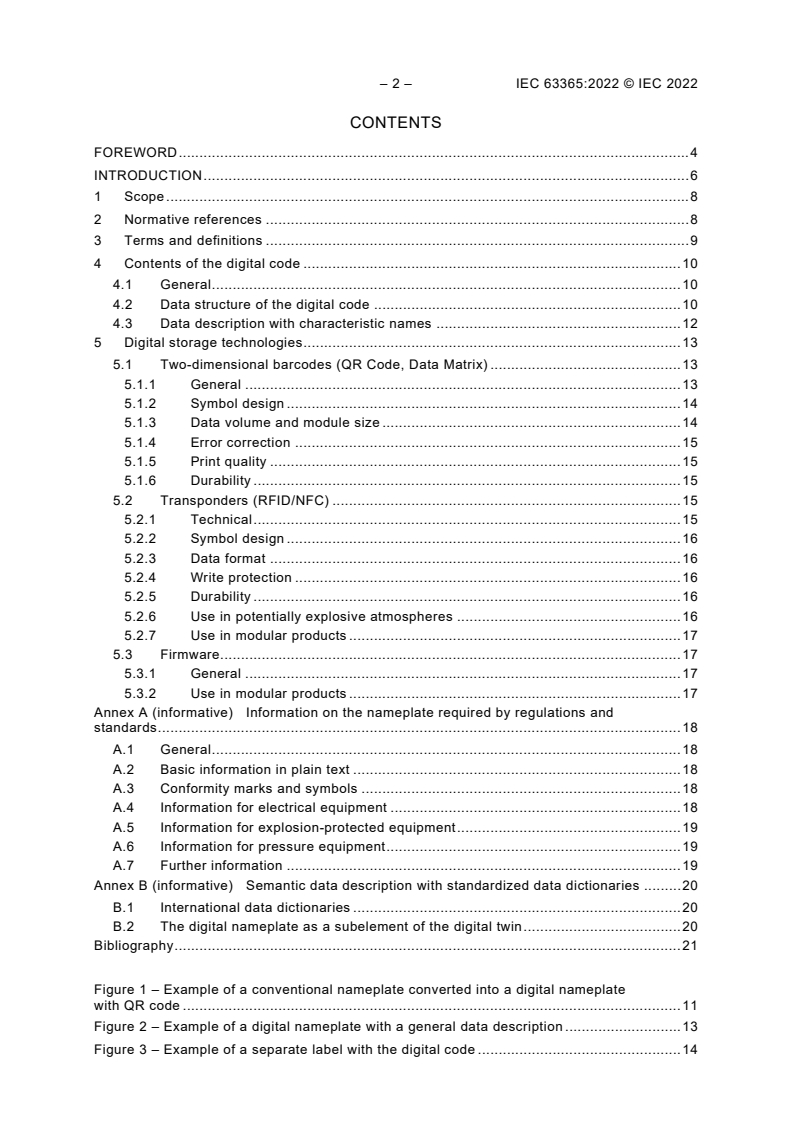
– 2 – IEC 63365:2022 © IEC 2022
CONTENTS
FOREWORD . 4
INTRODUCTION . 6
1 Scope . 8
2 Normative references . 8
3 Terms and definitions . 9
4 Contents of the digital code . 10
4.1 General . 10
4.2 Data structure of the digital code . 10
4.3 Data description with characteristic names . 12
5 Digital storage technologies . 13
5.1 Two-dimensional barcodes (QR Code, Data Matrix) . 13
5.1.1 General . 13
5.1.2 Symbol design . 14
5.1.3 Data volume and module size . 14
5.1.4 Error correction . 15
5.1.5 Print quality . 15
5.1.6 Durability . 15
5.2 Transponders (RFID/NFC) . 15
5.2.1 Technical . 15
5.2.2 Symbol design . 16
5.2.3 Data format . 16
5.2.4 Write protection . 16
5.2.5 Durability . 16
5.2.6 Use in potentially explosive atmospheres . 16
5.2.7 Use in modular products . 17
5.3 Firmware. 17
5.3.1 General . 17
5.3.2 Use in modular products . 17
Annex A (informative) Information on the nameplate required by regulations and
standards . 18
A.1 General . 18
A.2 Basic information in plain text . 18
A.3 Conformity marks and symbols . 18
A.4 Information for electrical equipment . 18
A.5 Information for explosion-protected equipment . 19
A.6 Information for pressure equipment . 19
A.7 Further information . 19
Annex B (informative) Semantic data description with standardized data dictionaries . 20
B.1 International data dictionaries . 20
B.2 The digital nameplate as a subelement of the digital twin . 20
Bibliography . 21
Figure 1 – Example of a conventional nameplate converted into a digital nameplate
with QR code . 11
Figure 2 – Example of a digital nameplate with a general data description . 13
Figure 3 – Example of a separate label with the digital code . 14
Figure 4 – Symbol design of the QR code of the digital nameplate . 14
Figure 5 – Marking of a RFID transponder as a digital nameplate . 16
Table 1 – Example of a nameplate with a general data description . 12
– 4 – IEC 63365:2022 © IEC 2022
INTERNATIONAL ELECTROTECHNICAL COMMISSION
____________
INDUSTRIAL PROCESS MEASUREMENT, CONTROL AND AUTOMATION –
DIGITAL NAMEPLATE
FOREWORD
1) The International Electrotechnical Commission (IEC) is a worldwide organization for standardization comprising
all national electrotechnical committees (IEC National Committees). The object of IEC is to promote international
co-operation on all questions concerning standardization in the electrical and electronic fields. To this end and
in addition to other activities, IEC publishes International Standards, Technical Specifications, Technical Reports,
Publicly Available Specifications (PAS) and Guides (hereafter referred to as “IEC Publication(s)”). Their
preparation is entrusted to technical committees; any IEC National Committee interested in the subject dealt with
may participate in this preparatory work. International, governmental and non-governmental organizations liaising
with the IEC also participate in this preparation. IEC collaborates closely with the International Organization for
Standardization (ISO) in accordance with conditions determined by agreement between the two organizations.
2) The formal decisions or agreements of IEC on technical matters express, as nearly as possible, an international
consensus of opinion on the relevant subjects since each technical committee has representation from all
interested IEC National Committees.
3) IEC Publications have the form of recommendations for international use and are accepted by IEC National
Committees in that sense. While all reasonable efforts are made to ensure that the technical content of IEC
Publications is accurate, IEC cannot be held responsible for the way in which they are used or for any
misinterpretation by any end user.
4) In order to promote international uniformity, IEC National Committees undertake to apply IEC Publications
transparently to the maximum extent possible in their national and regional publications. Any divergence between
any IEC Publication and the corresponding national or regional publication shall be clearly indicated in the latter.
5) IEC itself does not provide any attestation of conformity. Independent certification bodies provide conformity
assessment services and, in some areas, access to IEC marks of conformity. IEC is not responsible for any
services carried out by independent certification bodies.
6) All users should ensure that they have the latest edition of this publication.
7) No liability shall attach to IEC or its directors, employees, servants or agents including individual experts and
members of its technical committees and IEC National Committees for any personal injury, property damage or
other damage of any nature whatsoever, whether direct or indirect, or for costs (including legal fees) and
expenses arising out of the publication, use of, or reliance upon, this IEC Publication or any other IEC
Publications.
8) Attention is drawn to the Normative references cited in this publication. Use of the referenced publications is
indispensable for the correct application of this publication.
9) Attention is drawn to the possibility that some of the elements of this IEC Publication may be the subject of patent
rights. IEC shall not be held responsible for identifying any or all such patent rights.
IEC 63365 has been prepared by subcommittee 65E: Devices and integration in enterprise
systems, of IEC technical committee 65: Industrial Process Measurement, control and
automation. It is an International Standard.
The text of this International Standard is based on the following documents:
Draft Report on voting
65E/880/CDV 65E/931/RVC
Full information on the voting for its approval can be found in the report on voting indicated in
the above table.
The language used for the development of this International Standard is English.
This document was drafted in accordance with ISO/IEC Directives, Part 2, and developed in
accordance with ISO/IEC Directives, Part 1 and ISO/IEC Directives, IEC Supplement, available
at www.iec.ch/members_experts/refdocs. The main document types developed by IEC are
described in greater detail at www.iec.ch/publications.
The committee has decided that the contents of this document will remain unchanged until the
stability date indicated on the IEC website under webstore.iec.ch in the data related to the
specific document. At this date, the document will be
• reconfirmed,
• withdrawn,
• replaced by a revised edition, or
• amended.
IMPORTANT – The "colour inside" logo on the cover page of this document indicates that it
contains colours which are considered to be useful for the correct understanding of its
contents. Users should therefore print this document using a colour printer.
– 6 – IEC 63365:2022 © IEC 2022
INTRODUCTION
The primary purpose of a nameplate is to clearly identify the device and its manufacturer. Legal
marks or approval symbols indicate conformity with the regulations for placing the device on
the market and for safe use.
The project "Digital Nameplate" was started in response to the needs of manufacturers of
explosion-protected equipment and operators of electrical plants in explosion hazardous areas.
One objective is to ensure that all of the necessary information can be marked on the
equipment, particularly considering the extent of the information required in the field of
explosion protection. The requirements for marking products for the global markets have
become as extensive that it is often no longer possible to include all of the necessary
information on the nameplate, especially of smaller products (e.g. sensors). As an example, in
Europe, different EU Directives and harmonized standards can apply to the same product, e.g.
for electric safety, explosion safety, safety of machinery, pressure safety or food safety. If the
product is to be sold worldwide, additional markings and approval symbols are required, e.g.
IEC Ex marking, Ex marking for the North American market, UK CA marking for UK, EAC for
the Eurasian Economic Area, RCM for Australia or CCC for China.
Within the context of smart manufacturing, it is also anticipated that products will have to be
electronically identifiable in future. Equipment manufacturers can use machine-readable
marking in the production process to automatically control the material flow by using a barcode.
Operators can easily identify the product at the incoming inspection.Service engineers or the
responsible authorities can electronically check all the required data and information for the
application and safe use. The data from the machine-readable nameplate can be transmitted
directly to an ERP system (Enterprise Resource Planning system) for error-free stocktaking.
Operators and users have access to the device data in digital format.
One intention of the (offline) digital nameplate is to reduce the required space of the
conventional nameplate. In the long term it is expected that the digital nameplate can replace
the conventional text on the nameplate saving a lot of space, especially on small products.
This document describes alternative electronically-readable solutions to the current,
conventional, plain text marking on the nameplate or packaging. It describes marking
technologies that use 2D codes, transponders or the firmware of the products. In the case of a
2D code or transponder, the stored data can be read by commonly available scanning devices,
e.g. smartphones. If the marking is stored in the firmware of the product, the nameplate can be
shown, for example, on the product display or the data can be read via an electronic interface
remotely.
Furthermore, the IEC 61406-1 is in development for a unique product identification via an
Identification Link. That standard enables manufacturers to provide all product related data and
documents via an Internet address in an electronic format. Product documentation such as
technical information, operating instructions and product certificates can be downloaded. That
standard defines a specific 2D or RFID code, which contains only the Identification Link string
with limited characters. In IEC 63365, the Identification Link string is included as the first
property in the digital nameplate, followed by the detailed marking properties. If an Internet
connection to the manufacturer's website is available, additional product data (digital twin) and
documentation can be accessed.
This document is also intended to increase acceptance of digital nameplates among legislative
bodies. A long-term goal is to replace the conventional nameplate with an electronically
readable nameplate as far as possible. Regulators require marking to be applied to devices
permanently, clearly and legibly. This requirement could be met with digital marking as well.
Digital nameplates that are permanently affixed to the product and provide the necessary data
without the need for an Internet connection come very close to plain text marking. To ensure
greater acceptance, the nameplate shows a minimum amount of marking in plain text. During a
transition period, both, the plain text and the digital marking can be applied simultaneously at
the product. Today electronic marking is being increasingly implemented and accepted on the
international markets.
ISO/IEC 22603-1 was recently published and specifies a digital label representating the product
marking. But that standard provides the product marking via a link to a Webserver which
contains the relevant information and does not contain the marking directly in the digital code.
– 8 – IEC 63365:2022 © IEC 2022
INDUSTRIAL PROCESS MEASUREMENT, CONTROL AND AUTOMATION –
DIGITAL NAMEPLATE
1 Scope
This International standard applies to products used in the process measurement, control and
automation industry. It establishes a concept and requirements for the digital nameplate and
provides alternative electronically readable solutions (e.g. 2D codes, RFID or firmware) to
current conventional plain text marking on the nameplate or packaging of products.
The digital nameplate information is contained in the electronically readable medium affixed to
the product, the packaging or accompanying documents. The digital nameplate information is
available offline without Internet connection. After electronic reading, all digital nameplate
information is displayed in a human readable text format. The digital nameplate also includes
the Identification Link String according to IEC 61406-1 which provides additional online
information for the product.
This document does not specify the contents of the conventional nameplate, which are subject
to regional or national regulations and standards.
2 Normative references
The following documents are referred to in the text in such a way that some or all of their content
constitutes requirements of this document. For dated references, only the edition cited applies.
For undated references, the latest edition of the referenced document (including any
amendments) applies.
IEC 60079-14, Explosive atmospheres – Part 14: Electrical installations design, selection and
erection
IEC 61406-1, Identification link
ISO/IEC 15415:2011, Information technology – Automatic identification and data capture
techniques – Bar code symbol print quality test specification – Two-dimensional symbols
ISO/IEC 16022, Information technology – Automatic identification and data capture techniques
– Data Matrix bar code symbology specification
ISO/IEC 18004, Information technology – Automatic identification and data capture techniques
– QR Code bar code symbology specification
ISO/IEC 18092, Information technology – Telecommunications and information exchange
between systems – Near Field Communication – Interface and Protocol (NFCIP-1)
ISO/IEC 21471, Information technology – Automatic identification and data capture techniques
– Extended rectangular data matrix (DMRE) bar code symbology specification
ISO/IEC 21481, Information technology – Telecommunications and information exchange
between systems – Near field communication interface and protocol 2 (NFCIP-2)
ISO/IEC 29158, Information technology – Automatic identification and data capture techniques
– Direct Part Mark (DPM) Quality Guideline
ISO/IEC 29160, Information technology – Radio frequency identification for item management
– RFID Emblem
ISO 13849-1, Safety of machinery – Safety-related parts of control systems – Part 1: General
principles for design
ISO/IEC 14443-1, Cards and security devices for personal identification – Contactless proximity
objects – Part 1: Physical characteristics
ISO/IEC 14443-2, Cards and security devices for personal identification – Contactless proximity
objects – Part 2: Radio frequency power and signal interface
ISO/IEC 14443-3, Cards and security devices for personal identification – Contactless proximity
objects – Part 3: Initialization and anticollision
ISO/IEC 14443-4, Cards and security devices for personal identification – Contactless proximity
objects – Part 4: Transmission protocol
ISO/IEC 15693-1, Cards and security devices for personal identification – Contactless vicinity
objects – Part 1: Physical characteristics
ISO/IEC 15693-2, Cards and security devices for personal identification – Contactless vicinity
objects – Part 2: Air interface and initialization
ISO/IEC 15693-3, Cards and security devices for personal identification – Contactless vicinity
objects – Part 3: Anticollision and transmission protocol
3 Terms and definitions
For the purposes of this document, the terms and definitions given in IEC 60050-351 (IEV) and
the following apply.
ISO and IEC maintain terminology databases for use in standardization at the following
addresses:
• IEC Electropedia: available at https://www.electropedia.org/
• ISO Online browsing platform: available at https://www.iso.org/obp
3.1
conventional nameplate
nameplate containing all necessary product marking strings in plain text, which is human
readable
Note 1 to entry: A conventional nameplate string is composed of text and symbols.
3.2
digital nameplate
electronically readable product marking string encoded in an optically readable medium, a radio
frequency transponder or the product firmware
Note 1 to entry: In contrast to a conventional nameplate, a digital nameplate is not human readable.
EXAMPLE 1 2D symbols such as QR Code and DataMatrix are examples of optically readable media.
EXAMPLE 2 Radio frequency identification (RFID) transponders are examples of electronical readable media.
– 10 – IEC 63365:2022 © IEC 2022
3.3
digital nameplate string
alphanumeric string representing the information encoded in the digital nameplate
Note 1 to entry: A digital nameplate string can be read by a human using the appropriate scanner, reader or
engineering software.
3.4
electronic reader
hardware and software means to read electronically readable media
3.5
2D Code
2 dimensional barcode, which can be converted with commonly available readers into plain text
4 Contents of the digital code
4.1 General
The information according to Annex A can be added in a digital code to the nameplate.
The digital code
– can store all information required by regional or national regulations and
– can contain additional information provided by the manufacturer.
Marks and symbols cannot be converted into the digital code on the nameplate, but may be
provided in the firmware. All information provided in the digital code that is not required
specifically in plain text by regional or national regulations can be removed from the human
readable text of the nameplate.
For security reasons, a 2D reader that asks the user to activate a link to the URL is
recommended. In general, if the link is not activated, the embedded text is shown.
4.2 Data structure of the digital code
The information listed in Annex A can be converted into digital format. The data shall be
structured according to the following three categories:
– basic information;
– technical specification;
– certificates.
The first information of the digital nameplate shall be an Identification Link string as per
IEC 61406-1. This enables standard scanners to interpret the first line as a URL and, if an
Internet connection is available, to link to a product database.
An example of a conventional nameplate is shown in the upper part of Figure 1. This nameplate
represents an industrial level meter with several international certificates as an explosion
protected device. Due to the amount of information, this nameplate occupies a large area of
80 cm .
In the lower part of Figure 1, the corresponding digital nameplate is shown with the basic
information and the conformity symbols still visible in plain text. The complete marking is
converted into the digital code. The digital nameplate including QR Code occupies an area of
42,5 cm , which is approximately half of the size of the conventional nameplate above.
The scan of the QR Code using a smartphone with standard scanner software is also shown in
Figure 1. The complete text marking including basic information is visible on the screen and
can be stored or transfered as a text file.
Dimensions in millimetres
Figure 1 – Example of a conventional nameplate converted into a digital nameplate with
QR code
NOTE 1 The example in Figure 1 shows a digital nameplate, which enable scans with human readable data on the
display of the smartphone.
NOTE 2 The text file for the QR Code generator contains only the plain text without any control codes as seen in
the display of the smart phone. Carriage returns and line feeds are automatically created with the [Enter] key using
the text editor.
– 12 – IEC 63365:2022 © IEC 2022
4.3 Data description with characteristic names
The scanned digital code is human readable. For the correct interpretation of complex
nameplate data, the individual items of a nameplate can be described with characteristic names.
This requires more characters in the digital code and is illustrated for the example of an electric
motor in Table 1. The digital nameplate with QR Code containing a general data description
with characteristic names is shown in Figure 2.
Table 1 – Example of a nameplate with a general data description
Characteristic
Characteristic value Text for the 2D code Generator*
name
www.mustermann.com/IE3SN423475- https://www.mustermann.com/IE3SN423475-
0001 0001
Basic information
Manufacturer Max Mustermann AG Manufacturer:Max Mustermann AG
Address 10115 Berlin, Kirchstr. 1 Address:10115 Berlin, Kirchstr.1
Made in Germany Made inGermany
IE3-K11R160L2 GEx ec IIC T3 2D Type keyIE3-K11R160L2 G Ex ec IIC
Type key
DLTPMVIK T3 2DDLTPMVIK
3~Mot.No. 423475/0001 3~Mot.No.:423475/0001
Date of Prod. 23.01.2019 Date of Prod.:23.01.2019
Perform. Std. IEC/EN 60034-1 Perform. Std:IEC/EN 60034-1
IM Code IM B3 (IEC 60034-7) IM Code:IM B3 (IEC 60034-7)
Technical Specification
Protection IP65 Protection:IP65
Net weight 150 kg Net weight:150 kg
Therm.Class 155(F/B) Therm. Class.:155(F/B)
Supply 500VAC/Y/50 Hz Supply:500VAC/Y/50 Hz
Type of duty S1 Type of duty:S1
T-Class T2 T3 T-Class:T2T3
Output power 16 kW 12,5 kW Output power: 16 kW12,5 kW
Current 22,5 A 18,0 A Current:22,5 A18,0 A
cos phi 0,92 0,91 cos phi:0,920,91
Efficiency IE3 90,5 % 91,5 % Efficiency IE3:90,5 %91,5 %
r.p.m 2912/min 2942/min r.p.m:2912/min2942/min
Ia/In 5,8 7,3 Ia/In:5,87,3
tE-time 13 s 7 s tE-time:13 s7 s
RT 125°C RT:125°C125°C
Certificates
Conformity CE 1234 CE 1234
Cert.No. PTB99ATEX1105-127/128 Cert.No.:PTB99ATEX1105-127/128
Marking Ex II2G Ex eb IIC T2/T3 Gb Marking:Ex II2G Ex eb IIC T2/T3 Gb
Cert.No. PTB09ATEX1065 Cert.No.:PTB09ATEX1065
Marking Ex II2D Ex tb IIIC T125°C Db Marking:Ex II2D Ex tb IIIC T125°C Db
Grease (drive Grease (drive end): DE 6310 ZZ C3 DIN625
DE 6310 ZZ C3 DIN625
end)
Grease (Non- NE 6309 ZZ C3 DIN625 Grease (Non-drive end):NE 6309 ZZ C3 DIN625
drive end)
*2D code generators with control code capability are required (e.g. )
Dimensions in millimetres
Figure 2 – Example of a digital nameplate with a general data description
NOTE The example in Figure 2 shows a digital nameplate, which enables scans with human readable data on the
display of the smartphone. The information can be stored or transferred as a text file.
It may be useful to make these data machine readable and allocate the data to specific
databases. With the identification link in the digital nameplate an Internet connection to a
database of the product can be established, which may contain a semantic description of the
nameplate data with international data identifiers (e.g. IEC CDD). International data identifiers
enable data to be exchanged simply across industries, countries and languages (see Annex B).
5 Digital storage technologies
5.1 Two-dimensional barcodes (QR Code, Data Matrix)
5.1.1 General
Optically readable, two-dimensional barcodes (2D codes) may be used for digital product
marking. Several 2D codes may be applied to an object at the same time. The 2D codes may
be
– part of the nameplate (label, printed or lasered on the product) or
– affixed to the product by a separate label (see Figure 3).
– 14 – IEC 63365:2022 © IEC 2022
QR Codes according to ISO/IEC 18004 or Data Matrix according to ISO/IEC 16022 shall be
used as 2D codes. The QR Code is a square. A rectangular version is under development (Micro
QR Model R). The Data Matrix is available in square or rectangular form (Extended rectangular
data matrix (DMRE) according to ISO/IEC 21471). 2D codes shall be readable by commercially
available electronic readers (e.g. smartphones).
NOTE The quality requirements of the 2D code, e.g. module size, error correction, print quality and durability are
similar to IEC 61406-1.
Figure 3 – Example of a separate label with the digital code
5.1.2 Symbol design
The 2D code shall be enclosed in a rectangular frame with a spacing (quiet zone) between the
2D code and the frame. The quiet zone for QR Code according to ISO/IEC 18004 is 4 modules,
for Data Matrix code according to ISO/IEC 16022 is 1 module. The line width of the frame shall
not be less than 1 mm. The lower line of the frame is marked with the characters “IEC 63365”.
The characters shall not interfere with the quiet zone (see Figure 4).
Figure 4 – Symbol design of the QR code of the digital nameplate
5.1.3 Data volume and module size
The symbol size of a 2D code depends on the data volume and module size. The maximum
number of characters for a square type QR Code is 1134 alphanumeric data bits with an error
correction level of “M” according to ISO/IEC 18004. For a data matrix code the number of
alphanumeric data bits is limited to 1222 in version ECC 200 according to ISO/IEC 16022.
The module size shall be at least 0,25 mm. But it is recommended that the minimum module
size is at least 0,35 mm.
NOTE 1 These values are in accordance with IEC 61406-1.
NOTE 2 The QR Codes in Figure 1 and Figure 2 consist of approximately 100x100 modules, which represent
approximately 800-900 characters with error correction level “L”. A module size of 0,35 mm corresponds to a symbol
size of 3,5 cm x 3,5 cm. Taking into account a quiet zone of 1,5 mm (≥4 Modules) and a frame thickness of 1 mm,
the total symbol has a size of 4 cm x 4 cm. For nameplates with fewer characters, the symbol size can be smaller.
5.1.4 Error correction
For sufficient error correction, DataMatrix according to ISO/IEC 16022 shall only be used in
version ECC 200. QR code should be used with an error correction level of "M". Deviations from
this specification are only permitted if the size of the physical object to be marked makes this
necessary. A minimum error correction level of "L" shall be applied. For other symbologies, an
equivalent or better error correction level shall be used.
5.1.5 Print quality
A print quality of at least Grade "C" according to ISO/IEC 15415 shall be used for 2D barcodes.
For direct laser marking, a minimum quality of Grade 2 according to ISO/IEC 29158 shall be
observed.
Unless it is not applicable to the marking technology being used, the 2D symbol shall be applied
as a positive image, even if the background is dark.
5.1.6 Durability
The 2D code shall be applied to the product in such a way that it is retained and remains visible
under the environmental influences to be expected during the intended use of the product for
its entire expected useful life-time. This applies in particular to mechanical, thermal and
chemical resistance.
NOTE A classification of ambient and environmental conditions can be found in the IEC 60721 series.
5.2 Transponders (RFID/NFC)
5.2.1 Technical
There are active and passive transponders. Active transponders contain a battery and are less
suitable to long-term data storage. Only passive transponders, which are powered by the radio
signal, shall be used for digital marking. If the transponder is installed inside the product, it shall
be readable through the housing wall.
NOTE 1 Transponders communicate with writing/reading devices via radio signals. The data is stored in a solid-
state memory in the transponder. The writing/reading device can read data from and write data to the transponder
via the air interface of the transponder. The most commonly used systems are RFID (Radio-Frequency Identification)
according to ISO/IEC 18000 series and NFC (Near Field Communication) according to ISO/IEC 18092 and
ISO/IEC 21481, which is a subset of RFID technology.
There are transponders for various frequency ranges. NFC transponders that work with an
international carrier frequency of e.g. 13,56 MHz (HF) shall be used for electronic product
marking.
NOTE 2 UHF transponders can achieve longer ranges than HF transponders. Short range transponders (NFC/HF)
are better suited to the identification of individual products and generally used in the process industry for item
indentification. The NFC technology is a subset of the RFID technology and is supported by many smartphones and
other mobile scanners.
NOTE 3 NFC transponders can easily be used on metal objects if they have suitable ferrite shielding (ferrite films,
ferrite shells etc.), if spacer materials are used, or similar measures are taken.
This standard supports NFC systems according to ISO/IEC 18092 and ISO/IEC 21481.
The transponders shall meet either the HF standard according to ISO 15693-1, ISO 15693-2
and ISO 15693-3 in NFC type V format or the HF standard according to ISO 14443-1,
ISO 14443-2, ISO 14443-3 and ISO/IEC 14443-4 in NFC type II or type IV format.
– 16 – IEC 63365:2022 © IEC 2022
The technical specifications of RFID transponders, e.g. data format and durability conform to
IEC 61406-1.
5.2.2 Symbol design
Transponders shall be marked with the RFID emblem with a minimum size of 5 mm x 5 mm in
accordance with ISO/IEC 29160. Below the symbol the number of this standard is shown with
a letter size ≥ 1 mm.
Source: ISO/IEC 29160
Figure 5 – Marking of a RFID transponder as a digital nameplate
This marking shall also indicate the scanning position of the transponder, if installed inside the
equipment housing.
5.2.3 Data format
To enable NFC transponders to be read by usual commercial scanning devices, the data shall
be stored in an NDEF "Text" type record in UTF-8 coding.
NOTE 1 NDEF is short for NFC Data Exchange Format as defined by the NFC Forum.
NOTE 2 A memory size of at least 2 kByte is currently available for transponders for economic applications.
5.2.4 Write protection
To prevent the data on the transponder from being manipulated, the product manufacturer shall
provide the transponder with write protection ("Read only").
5.2.5 Durability
The transponder shall be attached to the product in such a way that it is retained and remains
readable under the environmental influences to be expected during the useful lifetime of the
product. This means that the transponder shall be able to withstand the specified environmental
conditions (e.g. IP degree of protection, thermal and chemical resistance) of the product or the
specifications for the marked product shall be reduced accordingly. A maximum useful life-time
of 20 years shall be assumed in accordance with ISO 13849-1. The transponder shall ensure
at least 100,000 read cycles.
NOTE A classification of ambient and environmental conditions can be found in the IEC 60721 series.
5.2.6 Use in potentially explosive atmospheres
IEC 60079-14 shall be observed when using transponders in explosion hazardous areas. This
standard describes the operating conditions for transponders. Passive transponders shall be
considered as simple electrical apparatus in accordance with IEC 60079-14 and may be used
under normal environmental conditions without certification in explosion hazardous areas.
Electrostatic charge of the transponder shall be prevented by appropriate design measures in
accordance with IEC 60079-14.
5.2.7 Use in modular products
Products often consist of several components that can be considered separately. This means
that each individual component may provide its own nameplate. In this case, only one
transponder that contains the marking for the entire product may be affixed, as is currently
shown on the conventional nameplate on the outside of the housing.
NOTE If a product would contain several transponders, a unique identification would no longer be ensured.
If necessary, the transponder shall be updated following repairs or component replacements.
5.3 Firmware
5.3.1 General
The firmware is another possibility to store the data of a digital nameplate on the respective
end product in the form of accessible regulatory information.
Regardless of the display and integration technology used, the integral data shall be
permanently stored in the firmware of the device.
It shall be ensured that the nameplate information cannot be changed by the user and that
manipulation is not possible (negligent changes). The digital nameplate can be updated by the
manufacturer if necessary.
NOTE The data can only be read when the product is under power, e.g. via an internal menu structure and integrated
display or via a communication interface (e.g. WEB interface, service interface, Bluetooth, I/O Link).
5.3.2 Use in modular products
Products often consist of several modular components, whereby the firmware is only found in
one component. In this case, the firmware shall show the data and serial number of the entire
product, as is currently the case with the conventional nameplate on the housing. If components
are delivered separately from the firmware or replaced, the nameplate specifications should be
transmitted from the factory in advance.
EXAMPLE A mechanical temperature sensor with housing and separate electronic insert with firmware.
– 18 – IEC 63365:2022 © IEC 2022
Annex A
(informative)
Information on the nameplate required by regulations and standards
A.1 General
Due to many regional or national regulations and standards, the nameplate shall visibly mark a
product in such a way that the product can be identified throughout the entire life cycle.
Generally the nameplate is undetachably affixed to the product or provided on the packaging
or in the accompanying documents. The inform
...