

IEC 62153-4-13:2009
(Main)Metallic communication cable test methods - Part 4-13: Electromagnetic compatibility (EMC) - Coupling attenuation of links and channels (laboratory conditions) - Absorbing clamp method
General Information
- Abstract
IEC 62153-4-13:2009(E) details the method of laboratory test to determine the coupling attenuation for links and channels used in analogue and digital communication systems.
This publication is to be read in conjunction with IEC 62153-4-5:2006.
- Status
- Published
- Publication Date
- 05-Aug-2009
- Technical Committee
- TC 46 - Cables, wires, waveguides, RF connectors, RF and microwave passive components and accessories
- Drafting Committee
- WG 5 - TC 46/WG 5
- Current Stage
- PPUB - Publication issued
- Start Date
- 06-Aug-2009
- Completion Date
- 31-Oct-2009
Buy Documents
IEC 62153-4-13:2009 - Metallic communication cable test methods - Part 4-13: Electromagnetic compatibility (EMC) - Coupling attenuation of links and channels (laboratory conditions) - Absorbing clamp method Released:8/6/2009
Overview
IEC 62153-4-13:2009 specifies a laboratory test method for determining the coupling attenuation of links and channels in metallic communication cables, focusing on electromagnetic compatibility (EMC) performance. Using the absorbing clamp method, this standard helps evaluate interference shielding capabilities in both analogue and digital communication systems. Accurate determination of coupling attenuation is essential for ensuring effective signal integrity and minimizing electromagnetic disturbances in high-performance cabling infrastructures.
The methodology outlined in IEC 62153-4-13 is designed for laboratory conditions and is applicable to screened and unscreened, balanced, and unbalanced cable assemblies. This standard is used in conjunction with IEC 62153-4-5, which details the absorbing clamp method for coupling or screening attenuation measurements.
Key Topics
IEC 62153-4-13 covers several critical aspects for testing metallic communication cables:
- Test Methodology: Defines the laboratory procedures for measuring coupling attenuation, including equipment setup, calibration, and measurement techniques.
- Equipment Requirements: Specifies essential components such as baluns, extension cables, absorbing clamps, and measuring receivers.
- Sample Preparation: Details procedures for the preparation of link and channel samples, including the use of appropriate extension cables and connectors.
- Test Set-Up: Outlines configuration steps for accurate and repeatable measurements, focusing on test sensitivity and minimization of interference.
- Results Evaluation: Provides guidance on data analysis, worst-case detection, and reporting of coupling attenuation results, ensuring compliance with EMC requirements.
- Report Generation: Details the requirements for comprehensive test documentation and the proper expression and evaluation of test results.
Applications
IEC 62153-4-13 serves a broad range of practical applications in the communication and electronics industries:
- Quality Control in Manufacturing: Empowers cable manufacturers to evaluate and optimize the EMC performance of their products before deployment.
- Cabling System Design: Assists system designers in selecting cables and connectors that meet necessary shielding and attenuation standards for reliable network performance.
- Compliance Verification: Enables regulatory and certification bodies to validate cable systems for adherence to international EMC standards.
- Research and Development: Supports engineers and researchers in developing new cable products and solutions with enhanced electromagnetic compatibility.
- Installation Assessment: Facilitates testing of installed links and channels to diagnose issues related to electromagnetic interference (EMI) and ensure optimal system operation.
Implementing the absorbing clamp method in controlled laboratory environments helps organizations troubleshoot, benchmark, and guarantee the EMC integrity of communication cables-whether for local area networks, data centers, or industrial automation systems.
Related Standards
IEC 62153-4-13 is part of a comprehensive set of standards for communication cable testing:
- IEC 62153-4-5: Metallic communication cables test methods – Electromagnetic compatibility (EMC) – Coupling or screening attenuation – Absorbing clamp method
- ISO/IEC 11801: Information technology – Generic cabling for customer premises
- IEC 61196-1: Coaxial communication cables – Part 1: Generic specification
- IEC 60050-726: International Electrotechnical Vocabulary – Transmission lines and waveguides
- ITU-T G.117 & O.9: Transmission aspects and measuring arrangements concerning unbalance and attenuation
Understanding and applying IEC 62153-4-13 in alignment with these related standards ensures a robust approach to EMC testing for communication cabling, supporting higher reliability and interoperability in global communication systems.
Buy Documents
IEC 62153-4-13:2009 - Metallic communication cable test methods - Part 4-13: Electromagnetic compatibility (EMC) - Coupling attenuation of links and channels (laboratory conditions) - Absorbing clamp method Released:8/6/2009
Get Certified
Connect with accredited certification bodies for this standard

ANCE
Mexican certification and testing association.

Intertek Slovenia
Intertek testing, inspection, and certification services in Slovenia.

LNE (Laboratoire National de Métrologie et d'Essais)
French national laboratory for metrology and testing.
Sponsored listings
Frequently Asked Questions
IEC 62153-4-13:2009 is a standard published by the International Electrotechnical Commission (IEC). Its full title is "Metallic communication cable test methods - Part 4-13: Electromagnetic compatibility (EMC) - Coupling attenuation of links and channels (laboratory conditions) - Absorbing clamp method". This standard covers: IEC 62153-4-13:2009(E) details the method of laboratory test to determine the coupling attenuation for links and channels used in analogue and digital communication systems. This publication is to be read in conjunction with IEC 62153-4-5:2006.
IEC 62153-4-13:2009(E) details the method of laboratory test to determine the coupling attenuation for links and channels used in analogue and digital communication systems. This publication is to be read in conjunction with IEC 62153-4-5:2006.
IEC 62153-4-13:2009 is classified under the following ICS (International Classification for Standards) categories: 33.100.10 - Emission; 33.120.10 - Coaxial cables. Waveguides. The ICS classification helps identify the subject area and facilitates finding related standards.
IEC 62153-4-13:2009 is available in PDF format for immediate download after purchase. The document can be added to your cart and obtained through the secure checkout process. Digital delivery ensures instant access to the complete standard document.
Standards Content (Sample)
IEC 62153-4-13 ®
Edition 1.0 2009-08
INTERNATIONAL
STANDARD
colour
inside
Metallic communication cable test methods –
Part 4-13: Electromagnetic compatibility (EMC) – Coupling attenuation of links
and channels (laboratory conditions) – Absorbing clamp method
All rights reserved. Unless otherwise specified, no part of this publication may be reproduced or utilized in any form
or by any means, electronic or mechanical, including photocopying and microfilm, without permission in writing from
either IEC or IEC's member National Committee in the country of the requester.
If you have any questions about IEC copyright or have an enquiry about obtaining additional rights to this publication,
please contact the address below or your local IEC member National Committee for further information.
IEC Central Office
3, rue de Varembé
CH-1211 Geneva 20
Switzerland
Email: inmail@iec.ch
Web: www.iec.ch
About the IEC
The International Electrotechnical Commission (IEC) is the leading global organization that prepares and publishes
International Standards for all electrical, electronic and related technologies.
About IEC publications
The technical content of IEC publications is kept under constant review by the IEC. Please make sure that you have the
latest edition, a corrigenda or an amendment might have been published.
ƒ Catalogue of IEC publications: www.iec.ch/searchpub
The IEC on-line Catalogue enables you to search by a variety of criteria (reference number, text, technical committee,…).
It also gives information on projects, withdrawn and replaced publications.
ƒ IEC Just Published: www.iec.ch/online_news/justpub
Stay up to date on all new IEC publications. Just Published details twice a month all new publications released. Available
on-line and also by email.
ƒ Electropedia: www.electropedia.org
The world's leading online dictionary of electronic and electrical terms containing more than 20 000 terms and definitions
in English and French, with equivalent terms in additional languages. Also known as the International Electrotechnical
Vocabulary online.
ƒ Customer Service Centre: www.iec.ch/webstore/custserv
If you wish to give us your feedback on this publication or need further assistance, please visit the Customer Service
Centre FAQ or contact us:
Email: csc@iec.ch
Tel.: +41 22 919 02 11
Fax: +41 22 919 03 00
IEC 62153-4-13 ®
Edition 1.0 2009-08
INTERNATIONAL
STANDARD
colour
inside
Metallic communication cable test methods –
Part 4-13: Electromagnetic compatibility (EMC) – Coupling attenuation of links
and channels (laboratory conditions) – Absorbing clamp method
INTERNATIONAL
ELECTROTECHNICAL
COMMISSION
PRICE CODE
P
ICS 33.100; 33.120.10 ISBN 978-2-88910-640-0
– 2 – 62153-4-13 © IEC:2009(E)
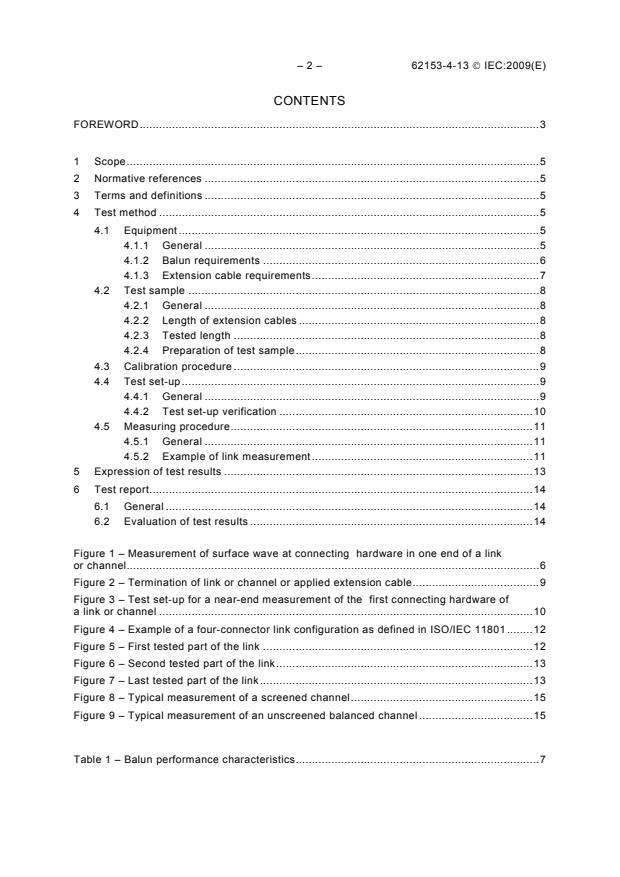
CONTENTS
FOREWORD.3
1 Scope.5
2 Normative references .5
3 Terms and definitions .5
4 Test method .5
4.1 Equipment.5
4.1.1 General .5
4.1.2 Balun requirements .6
4.1.3 Extension cable requirements.7
4.2 Test sample .8
4.2.1 General .8
4.2.2 Length of extension cables .8
4.2.3 Tested length .8
4.2.4 Preparation of test sample.8
4.3 Calibration procedure .9
4.4 Test set-up.9
4.4.1 General .9
4.4.2 Test set-up verification .10
4.5 Measuring procedure.11
4.5.1 General .11
4.5.2 Example of link measurement.11
5 Expression of test results .13
6 Test report.14
6.1 General .14
6.2 Evaluation of test results .14
Figure 1 – Measurement of surface wave at connecting hardware in one end of a link
or channel.6
Figure 2 – Termination of link or channel or applied extension cable.9
Figure 3 – Test set-up for a near-end measurement of the first connecting hardware of
a link or channel .10
Figure 4 – Example of a four-connector link configuration as defined in ISO/IEC 11801.12
Figure 5 – First tested part of the link .12
Figure 6 – Second tested part of the link.13
Figure 7 – Last tested part of the link.13
Figure 8 – Typical measurement of a screened channel.15
Figure 9 – Typical measurement of an unscreened balanced channel .15
Table 1 – Balun performance characteristics.7
62153-4-13 © IEC:2009(E) – 3 –
INTERNATIONAL ELECTROTECHNICAL COMMISSION
____________
METALLIC COMMUNICATION CABLE TEST METHODS –
Part 4-13: Electromagnetic compatibility (EMC) –
Coupling attenuation of links and channels
(laboratory conditions) – Absorbing clamp method
FOREWORD
1) The International Electrotechnical Commission (IEC) is a worldwide organization for standardization comprising
all national electrotechnical committees (IEC National Committees). The object of IEC is to promote
international co-operation on all questions concerning standardization in the electrical and electronic fields. To
this end and in addition to other activities, IEC publishes International Standards, Technical Specifications,
Technical Reports, Publicly Available Specifications (PAS) and Guides (hereafter referred to as “IEC
Publication(s)”). Their preparation is entrusted to technical committees; any IEC National Committee interested
in the subject dealt with may participate in this preparatory work. International, governmental and non-
governmental organizations liaising with the IEC also participate in this preparation. IEC collaborates closely
with the International Organization for Standardization (ISO) in accordance with conditions determined by
agreement between the two organizations.
2) The formal decisions or agreements of IEC on technical matters express, as nearly as possible, an international
consensus of opinion on the relevant subjects since each technical committee has representation from all
interested IEC National Committees.
3) IEC Publications have the form of recommendations for international use and are accepted by IEC National
Committees in that sense. While all reasonable efforts are made to ensure that the technical content of IEC
Publications is accurate, IEC cannot be held responsible for the way in which they are used or for any
misinterpretation by any end user.
4) In order to promote international uniformity, IEC National Committees undertake to apply IEC Publications
transparently to the maximum extent possible in their national and regional publications. Any divergence
between any IEC Publication and the corresponding national or regional publication shall be clearly indicated in
the latter.
5) IEC provides no marking procedure to indicate its approval and cannot be rendered responsible for any
equipment declared to be in conformity with an IEC Publication.
6) All users should ensure that they have the latest edition of this publication.
7) No liability shall attach to IEC or its directors, employees, servants or agents including individual experts and
members of its technical committees and IEC National Committees for any personal injury, property damage or
other damage of any nature whatsoever, whether direct or indirect, or for costs (including legal fees) and
expenses arising out of the publication, use of, or reliance upon, this IEC Publication or any other IEC
Publications.
8) Attention is drawn to the Normative references cited in this publication. Use of the referenced publications is
indispensable for the correct application of this publication.
9) Attention is drawn to the possibility that some of the elements of this IEC Publication may be the subject of
patent rights. IEC shall not be held responsible for identifying any or all such patent rights.
International Standard IEC 62153-4-13 has been prepared by IEC technical committee 46:
Cables, wires, waveguides, R.F. connectors, R.F. and microwave passive components and
accessories.
The text of this standard is based on the following documents:
CDV Report on voting
46/313/CDV 46/329/RVC
Full information on the voting for the approval of this standard can be found in the report on
voting indicated in the above table.
This publication is to be read in conjunction with IEC 62153-4-5 (2006).
– 4 – 62153-4-13 © IEC:2009(E)
This publication has been drafted in accordance with the ISO/IEC Directives, Part 2.
A list of all parts of the IEC 62153 series, under the general title: Metallic communication
cable test methods, can be found on the IEC website.
The committee has decided that the contents of this publication will remain unchanged until
the maintenance result date indicated on the IEC web site under "http://webstore.iec.ch" in
the data related to the specific publication. At this date, the publication will be
• reconfirmed,
• withdrawn,
• replaced by a revised edition, or
• amended.
A bilingual version may be issued at a later date.
IMPORTANT – The “colour inside” logo on the cover page of this publication indicates
that it contains colours which are considered to be useful for the correct understanding
of its contents. Users should therefore print this publication using a colour printer.
62153-4-13 © IEC:2009(E) – 5 –
METALLIC COMMUNICATION CABLE TEST METHODS –
Part 4-13: Electromagnetic compatibility (EMC) –
Coupling attenuation of links and channels
(laboratory conditions) – Absorbing clamp method
1 Scope
This part of IEC 62153 details the method of laboratory test to determine the coupling
attenuation for links and channels used in analogue and digital communication systems.
2 Normative references
The following referenced documents are indispensable for the application of this document.
For dated references, only the edition cited applies. For undated references, the latest edition
of the referenced document (including any amendments) applies.
IEC 60050-726, International Electrotechnical Vocabulary – Chapter 726: Transmission lines
and waveguides
IEC 61196-1, Coaxial communication cables – Part 1: Generic specification – General,
definitions and requirements
IEC 62153-4-5:2006, Metallic communication cables test methods – Part 4-5: Electromagnetic
compatibility (EMC) – Coupling or screening attenuation – Absorbing clamp method
ISO/IEC 11801, Information technology – Generic cabling for customer premises
ITU-T Recommendation G.117:1996, Transmission aspects of unbalance about earth
ITU-T Recommendation O.9:1999, Measuring arrangements to assess the degree of
unbalance about earth
3 Terms and definitions
For the purposes of this document, the terms and definitions given in IEC 60050-726 and
IEC 61196-1 apply.
In this document, connecting hardware is defined as a complete connecting device including
compensating or matching networks (if any), connectors and cable terminations.
4 Test method
4.1 Equipment
4.1.1 General
See 5.1.1 of IEC 62153-4-5 and Figure 1 below.
– 6 – 62153-4-13 © IEC:2009(E)
600 cm ± 10 cm
2 10
IEC 1475/09
Key
0 signal generator, output impedance Z 8 absorber (ferrite tube) of the clamp,
insertion loss > 10 dB
1 link or channel under test, nominal characteristic
impedance Z 9 absorber (or second clamp),
insertion loss > 10 dB
2 outer circuit of the link or channel under test,
impedance Z
10 termination of the far-end extension cable
connected to link or channel under test
3 absorbing clamp, impedance Z
11 shield of signal generator and balun if needed
4 measuring receiver
for high dynamic range
5 balun (if applicable)
12 reflector plate
6 current transformer
13 extension cable connected through mating
7 measuring receiver cable (use the same in
connector to link or channel under test, if
measurement and calibration)
applicable
14 connecting hardware in measured end of link or
channel
Figure 1 – Measurement of surface wave at connecting
hardware in one end of a link or channel
4.1.2 Balun requirements
For measurement of symmetrical cable assemblies, a means for generating symmetrical
signals shall be provided. If the generator is unbalanced, this may be performed by the use of
a balun or 180° power splitter.
The minimum requirements for this device are specified in Table 1.
The attenuation of the balun shall be kept as low as possible because it will limit the dynamic
range of the coupling attenuation or screening attenuation measurements.
62153-4-13 © IEC:2009(E) – 7 –
Table 1 – Balun performance characteristics
Parameter Value
a
Impedance, primary
50 Ω (unbalanced)
b
Impedance, secondary 100 Ω or 150 Ω (balanced)
d
Operational attenuation
≤ 10 dB
(including matching pads if used)
Return loss, bi-directional
≥ 6 dB
Power rating To accommodate the power of the generator and amplifier
(if applicable)
c
Output signal balance
≥ 50 dB from 30 MHz to 100 MHz
≥ 30 dB from 100 MHz to the highest measured frequency
a
Primary impedance may differ if necessary to accommodate analyzer outputs other than 50 Ω.
b
Balanced outputs of the test baluns shall be matched to the nominal impedance of the symmetrical patch cord /
cable pair. 100 Ω shall be used for termination of 120 Ω cabling.
c
Measured per ITU-T Recommendations G.117 and O.9.
d
The operational attenuation of a balun shall be mathematically deduced from 3 operational attenuation
measurements with 3 baluns back-to-back.
4.1.3 Extension cable requirements
An extension cable is only required if the channel or link under test does not include a cable,
which can be connected to the test set-up.
Unscreened extension cables shall be used for testing unscreened, balanced link or channels.
Screened, balanced extension cables shall be used for testing screened, balanced cable
assemblies. Unbalanced (coaxial) extension cable
...