

IEC 61076-3-104:2003
(Main)Connectors for electronic equipment - Part 3-104: Rectangular connectors - Detail specification for 8-way, shielded free and fixed connectors for data transmissions with frequencies up to 600 MHz minimum
General Information
- Abstract
Establishes uniform specifications, type testing requirements and quality assessment procedures for 8-way connectors, with up to 4 pairs, for frequencies up to 600 MHz minimum, and intended to be used at different locations within cabling for information and communications technology, home entertainment and multimedia. Contains a choice of all test methods and sequences, severity and preferred values for dimensions and characteristics.
- Status
- Published
- Publication Date
- 01-Apr-2003
- Technical Committee
- SC 48B - Electrical connectors
- Current Stage
- DELPUB - Deleted Publication
- Start Date
- 25-Jul-2006
- Completion Date
- 28-Aug-2026
Buy Documents
IEC 61076-3-104:2003 - Connectors for electronic equipment - Part 3-104: Rectangular connectors - Detail specification for 8-way, shielded free and fixed connectors for data transmissions with frequencies up to 600 MHz minimum Released:4/2/2003
Overview
IEC 61076-3-104:2003 is an international standard developed by the International Electrotechnical Commission (IEC). It specifies requirements for 8-way shielded free and fixed rectangular connectors designed for electronic equipment. These connectors are suitable for data transmissions at frequencies up to at least 600 MHz and are commonly used in cabling systems for information and communications technology (ICT), home entertainment, and multimedia applications. The standard establishes uniform specifications, dimensional requirements, type testing procedures, and quality assessment criteria, ensuring interoperability, reliability, and performance consistency across various manufacturers.
Key Topics
Connector Specifications
IEC 61076-3-104 provides detailed specifications for 8-way connectors, supporting up to 4 pairs per connector. Definitions include dimensions, types (free/plug and fixed/socket), and styles (panel, PCB, cable outlet). The variant system covers different combinations to meet application needs.Performance and Quality Assessment
- Specifies minimum performance at up to 600 MHz to ensure compatibility with high-speed data transmission requirements.
- Outlines rigorous type testing, including mechanical, electrical, and environmental testing based on referenced IEC test methods (IEC 60512, IEC 60068).
- Provides severity levels and preferred values for mechanical and electrical characteristics.
Interchangeability and Marking
- Ensures connectors from different manufacturers are mechanically and electrically compatible.
- Requires clear product marking with type designation for traceability and conformity.
- Promotes compatibility with lower-performance connecting hardware (as per ISO/IEC 11801 and IEC 60603-7) through adaptors if required.
Dimensional Control and Gauging
- Defines comprehensive gauges and tolerance criteria for plug and socket dimensions, using surface finish requirements per ISO 1302.
- Adopts clear dimensional tables and reference figures, enabling precise interface design and manufacturing control.
Applications
IEC 61076-3-104 connectors are widely implemented in environments where robust, high-frequency data communication is essential. Key application areas include:
Structured Cabling Systems:
Used at various points in ICT cabling, these connectors support Ethernet, telecommunications, and data networking in enterprise and residential premises.Home Entertainment and Multimedia Devices:
Ensures reliable high-speed signal transmission for audio/video equipment and digital home networks.Telecommunications and Network Equipment:
Suitable for switches, routers, patch panels, and network interface outlets requiring standardized, shielded connectors.Printed Circuit Board (PCB) Interfaces:
The standard includes variants suitable for direct mounting on PCBs, supporting compact device integration.
Manufacturers and system designers benefit from the standard by being able to specify, source, and implement components that are proven for interoperability and sustained high-frequency performance, ultimately reducing design complexity and ensuring long-term system compatibility.
Related Standards
For maximum compatibility and compliance, IEC 61076-3-104:2003 should be considered in conjunction with other internationally recognized standards, including:
- IEC 60512: Connectors for electronic equipment - Tests and measurements
- IEC 60603-7: Connectors for frequencies below 3 MHz for use with printed boards - 8-way connectors with common mating features
- ISO/IEC 11801: Information technology - Generic cabling for customer premises
- IEC 60068 Series: Environmental testing methods for electronic equipment
- IEC 61156 Series: Cables for digital communications
- IEC 61076-1: Generic specifications for connectors with assessed quality
Aligning with these related standards helps ensure end-to-end system integrity, environmental resilience, and broad interoperability in global ICT and multimedia infrastructure.
Keywords: IEC 61076-3-104, shielded connectors, rectangular connectors, 8-way connectors, high-frequency data, connector specifications, ICT cabling, multimedia connectors, interoperability, IEC standards, connector type testing, PCB connectors, cable interfaces.
Relations
- Effective Date
- 05-Sep-2023
- Effective Date
- 05-Sep-2023
Buy Documents
IEC 61076-3-104:2003 - Connectors for electronic equipment - Part 3-104: Rectangular connectors - Detail specification for 8-way, shielded free and fixed connectors for data transmissions with frequencies up to 600 MHz minimum Released:4/2/2003
Frequently Asked Questions
IEC 61076-3-104:2003 is a standard published by the International Electrotechnical Commission (IEC). Its full title is "Connectors for electronic equipment - Part 3-104: Rectangular connectors - Detail specification for 8-way, shielded free and fixed connectors for data transmissions with frequencies up to 600 MHz minimum". This standard covers: Establishes uniform specifications, type testing requirements and quality assessment procedures for 8-way connectors, with up to 4 pairs, for frequencies up to 600 MHz minimum, and intended to be used at different locations within cabling for information and communications technology, home entertainment and multimedia. Contains a choice of all test methods and sequences, severity and preferred values for dimensions and characteristics.
Establishes uniform specifications, type testing requirements and quality assessment procedures for 8-way connectors, with up to 4 pairs, for frequencies up to 600 MHz minimum, and intended to be used at different locations within cabling for information and communications technology, home entertainment and multimedia. Contains a choice of all test methods and sequences, severity and preferred values for dimensions and characteristics.
IEC 61076-3-104:2003 is classified under the following ICS (International Classification for Standards) categories: 31.220.10 - Plug-and-socket devices. Connectors. The ICS classification helps identify the subject area and facilitates finding related standards.
IEC 61076-3-104:2003 has the following relationships with other standards: It is inter standard links to IEC PAS 61076-3-104:2002, IEC 61076-3-104:2006. Understanding these relationships helps ensure you are using the most current and applicable version of the standard.
IEC 61076-3-104:2003 is available in PDF format for immediate download after purchase. The document can be added to your cart and obtained through the secure checkout process. Digital delivery ensures instant access to the complete standard document.
Standards Content (Sample)
INTERNATIONAL IEC
STANDARD
61076-3-104
First edition
2003-04
Connectors for electronic equipment –
Part 3-104:
Rectangular connectors –
Detail specification for 8-way, shielded free
and fixed connectors for data transmissions
with frequencies up to 600 MHz minimum
Reference number
Publication numbering
As from 1 January 1997 all IEC publications are issued with a designation in the
60000 series. For example, IEC 34-1 is now referred to as IEC 60034-1.
Consolidated editions
The IEC is now publishing consolidated versions of its publications. For example,
edition numbers 1.0, 1.1 and 1.2 refer, respectively, to the base publication, the
base publication incorporating amendment 1 and the base publication incorporating
amendments 1 and 2.
Further information on IEC publications
The technical content of IEC publications is kept under constant review by the IEC,
thus ensuring that the content reflects current technology. Information relating to
this publication, including its validity, is available in the IEC Catalogue of
publications (see below) in addition to new editions, amendments and corrigenda.
Information on the subjects under consideration and work in progress undertaken
by the technical committee which has prepared this publication, as well as the list
of publications issued, is also available from the following:
• IEC Web Site (www.iec.ch)
• Catalogue of IEC publications
The on-line catalogue on the IEC web site (http://www.iec.ch/searchpub/cur_fut.htm)
enables you to search by a variety of criteria including text searches, technical
committees and date of publication. On-line information is also available on
recently issued publications, withdrawn and replaced publications, as well as
corrigenda.
• IEC Just Published
This summary of recently issued publications (http://www.iec.ch/online_news/
justpub/jp_entry.htm) is also available by email. Please contact the Customer
Service Centre (see below) for further information.
• Customer Service Centre
If you have any questions regarding this publication or need further assistance,
please contact the Customer Service Centre:
Email: custserv@iec.ch
Tel: +41 22 919 02 11
Fax: +41 22 919 03 00
INTERNATIONAL IEC
STANDARD
61076-3-104
First edition
2003-04
Connectors for electronic equipment –
Part 3-104:
Rectangular connectors –
Detail specification for 8-way, shielded free
and fixed connectors for data transmissions
with frequencies up to 600 MHz minimum
IEC 2003 Copyright - all rights reserved
No part of this publication may be reproduced or utilized in any form or by any means, electronic or
mechanical, including photocopying and microfilm, without permission in writing from the publisher.
International Electrotechnical Commission, 3, rue de Varembé, PO Box 131, CH-1211 Geneva 20, Switzerland
Telephone: +41 22 919 02 11 Telefax: +41 22 919 03 00 E-mail: inmail@iec.ch Web: www.iec.ch
PRICE CODE
Commission Electrotechnique Internationale
XC
International Electrotechnical Commission
Международная Электротехническая Комиссия
For price, see current catalogue
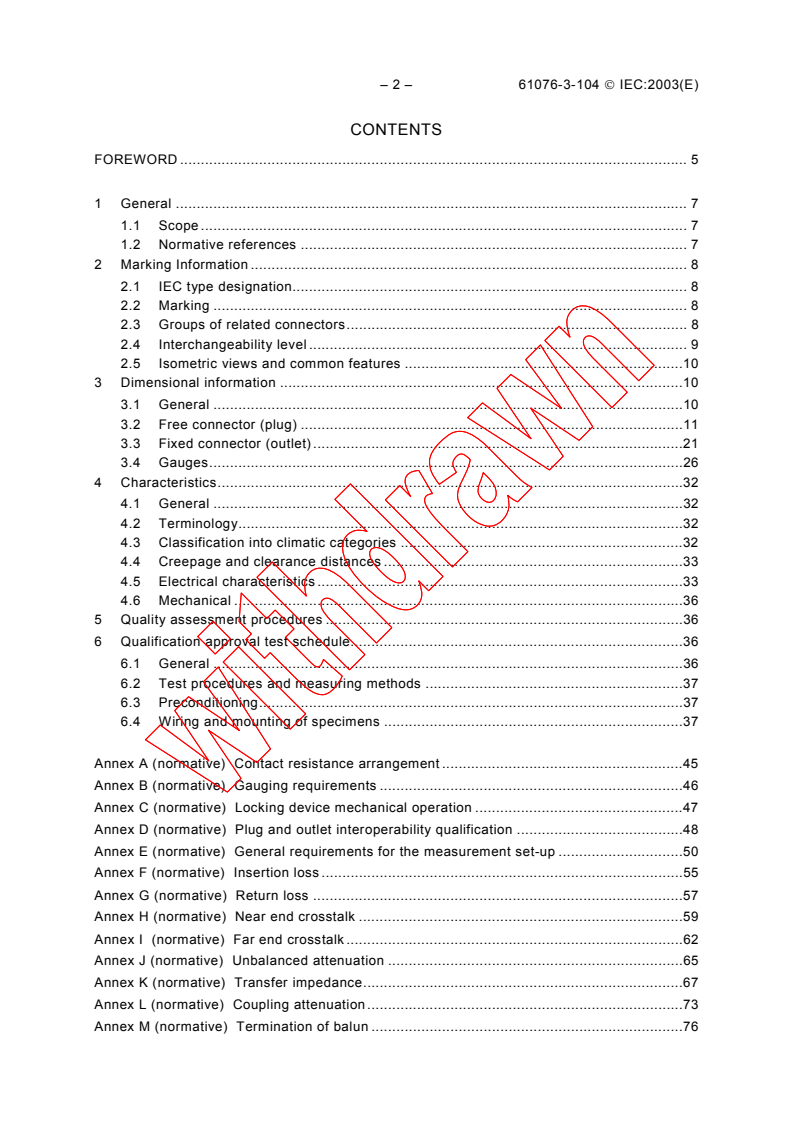
– 2 – 61076-3-104 IEC:2003(E)
CONTENTS
FOREWORD . 5
1 General . 7
1.1 Scope . 7
1.2 Normative references . 7
2 Marking Information . 8
2.1 IEC type designation. 8
2.2 Marking . 8
2.3 Groups of related connectors. 8
2.4 Interchangeability level . 9
2.5 Isometric views and common features .10
3 Dimensional information .10
3.1 General .10
3.2 Free connector (plug) .11
3.3 Fixed connector (outlet) .21
3.4 Gauges.26
4 Characteristics.32
4.1 General .32
4.2 Terminology.32
4.3 Classification into climatic categories .32
4.4 Creepage and clearance distances .33
4.5 Electrical characteristics .33
4.6 Mechanical .36
5 Quality assessment procedures .36
6 Qualification approval test schedule.36
6.1 General .36
6.2 Test procedures and measuring methods .37
6.3 Preconditioning.37
6.4 Wiring and mounting of specimens .37
Annex A (normative) Contact resistance arrangement .45
Annex B (normative) Gauging requirements .46
Annex C (normative) Locking device mechanical operation .47
Annex D (normative) Plug and outlet interoperability qualification .48
Annex E (normative) General requirements for the measurement set-up .50
Annex F (normative) Insertion loss .55
Annex G (normative) Return loss .57
Annex H (normative) Near end crosstalk .59
Annex I (normative) Far end crosstalk .62
Annex J (normative) Unbalanced attenuation .65
Annex K (normative) Transfer impedance.67
Annex L (normative) Coupling attenuation.73
Annex M (normative) Termination of balun .76
61076-3-104 IEC:2003(E) – 3 –
Figure 1 – IEC type designation . 9
Figure 2 – Fixed connector.10
Figure 3 – Free connector .10
Figure 4 – Variant 03, 4-pair plug.11
Figure 5 – Variant 04, 2-pair plug.11
Figure 6 – Variant 05, 1-pair plug.12
Figure 7 – Variant 03 drawing 1 .13
Figure 8 – Variant 03 drawing 2 .14
Figure 9 – Variant 03 drawing 3 .15
Figure 10 – Variant 04 drawing 1.16
Figure 11 – Variant 04 drawing 2.17
Figure 13 – Variant 05 drawing 2.19
Figure 14 – Variant 05 drawing 3.20
Figure 15 – Isometric view of variant 01 (cable outlet).21
Figure 16 – Variant 01 cable outlet drawing 1.22
Figure 17 – Variant 01 cable outlet drawing 2.24
Figure 18 – Variant 02 printed circuit board (PCB) outlet drawing.25
Figure 19 – Fixed connector location GO gauge.26
Figure 20 – Fixed connector location NO-GO gauge.27
Figure 21 – Fixed connector size GO gauge.27
Figure 22 – Fixed connector size NO-GO gauge .28
Figure 23 – Free connector location GO gauge .29
Figure 24 – Free connector location NO-GO gauge .29
Figure 25 – Free connector plug size GO gauge .30
Figure 26 – Free connector size NO-GO gauge.30
Figure 27 – Test panels.32
Figure 28 – Current-carrying capacity.33
Figure A.1 – Contact resistance arrangement.45
Figure D.1 – Precision test fixtures (covers).48
Figure E.1 – 180° hybrid used as a balun.51
Figure E.2 – Calibration of reference loads .52
Figure E.3 – Resistor load.53
Figure E.4 – Definition of reference planes.54
Figure F.1 – Calibration.55
Figure F.2 – Measuring set-up .56
Figure H.1 – NEXT measurement differential mode only terminations.59
Figure H.2 – NEXT measurement differential and common mode terminations .60
Figure I.1 – FEXT measurement differential mode only terminations .62
Figure I.2 – FEXT measurement differential and common mode terminations .63
Figure J.1 – LCL measurement .65
Figure K.1 – Preparation of test specimen.68
Figure K.2 – Triaxial test set-up .69
Figure K.3 – Impedance matching for R < 50 Ω .70
– 4 – 61076-3-104 IEC:2003(E)
Figure K.4 – Impedance matching for R > 50 Ω .71
Figure M.1 – Balanced attenuator for balun centre tap grounded.76
Figure M.2 – Balanced attenuator for balun centre tap open.76
Table 1 – Variant 03 drawing 1 dimensions .13
Table 2 – Variant 03 drawing 2 dimensions .14
Table 3 – Variant 03 drawing 3 dimensions .15
Table 4 – Variant 04 drawing 1 dimensions .16
Table 5 – Variant 04 drawing 2 dimensions .17
Table 6 – Variant 05 drawing 1 dimensions .18
Table 7 – Variant 05 drawing 2 dimensions .19
Table 8 – Variant 05 drawing 3 dimensions .20
Table 9 – Variant 01 drawing 1 dimensions .23
Table 10 – Variant 01 cable outlet drawing 2 dimensions .24
Table 11 – Variant 02 drawing dimensions .25
Table 12 – Fixed connector gauge dimensions.28
Table 13 – Free connector gauge dimensions .31
Table 14 – Test panel dimensions .31
Table 15 – Climatic categories – selected values .32
Table 16 – Creepage and clearance distances .33
Table 17 – Test group P.38
Table 18 – Test group AP.39
Table 19 – Test group BP.41
Table 20 – Test group CP .42
Table 21 – Test group DP .42
Table 22 – Test group EP.43
Table 23 – Test group FP.44
Table E.1 – Test balun performance characteristics .51
Table G.1 – Uncertainty band of return loss measurement at frequencies below 100 MHz.58
61076-3-104 IEC:2003(E) – 5 –
CONNECTORS FOR ELECTRONIC EQUIPMENT –
Part 3-104: Rectangular connectors –
Detail specification for 8-way, shielded free
and fixed connectors for data transmissions
with frequencies up to 600 MHz minimum
FOREWORD
1) The IEC (International Electrotechnical Commission) is a worldwide organization for standardization comprising
all national electrotechnical committees (IEC National Committees). The object of the IEC is to promote
international co-operation on all questions concerning standardization in the electrical and electronic fields. To
this end and in addition to other activities, the IEC publishes International Standards. Their preparation is
entrusted to technical committees; any IEC National Committee interested in the subject dealt with may
participate in this preparatory work. International, governmental and non-governmental organizations liaising
with the IEC also participate in this preparation. The IEC collaborates closely with the International
Organization for Standardization (ISO) in accordance with conditions determined by agreement between the
two organizations.
2) The formal decisions or agreements of the IEC on technical matters express, as nearly as possible, an
international consensus of opinion on the relevant subjects since each technical committee has representation
from all interested National Committees.
3) The documents produced have the form of recommendations for international use and are published in the form
of standards, technical specifications, technical reports or guides and they are accepted by the National
Committees in that sense.
4) In order to promote international unification, IEC National Committees undertake to apply IEC International
Standards transparently to the maximum extent possible in their national and regional standards. Any
divergence between the IEC Standard and the corresponding national or regional standard shall be clearly
indicated in the latter.
5) The IEC provides no marking procedure to indicate its approval and cannot be rendered responsible for any
equipment declared to be in conformity with one of its standards.
The International Electrotechnical commission (IEC) draws attention to the fact that it is claimed that compliance
with this document may involve the use of a patent concerning 8-way shielded free and fixed connectors for data
transmissions with frequencies up to 600 MHz minimum.
The IEC takes no position concerning the evidence, validity and scope of this patent right.
The holder of this patent right has assured the IEC that he is willing to negotiate licences under reasonable and
non-discriminatory terms and conditions with applicants throughout the world. In this respect, the statement of the
holder of this patent right is registered with IEC. Information may be obtained from
The Siemon Company
Siemon Business Park
76 Westbury Park Road
Watertown, CT 06795-0400
USA
Attention is drawn to the possibility that some of the elements of this document may be the subject of patent rights
other than those identified above. IEC shall not be held responsible for identifying any or all such patent rights.
International Standard IEC 61076-3-104 has been prepared by subcommittee 48B:
Connectors, of IEC technical committee 48: Electromechanical components and mechanical
structures for electronic equipment.
This standard cancels and replaces IEC/PAS 61076-3-104 published in 2002. This first edition
constitutes a technical revision.
The text of this standard is based on the following documents:
FDIS Report on voting
48B/1303/FDIS 48B/1335/RVD
Full information on the voting for the approval of this standard can be found in the report on
voting indicated in the above table.
– 6 – 61076-3-104 IEC:2003(E)
This publication has been drafted in accordance with the ISO/IEC Directives, Part 2.
The committee has decided that the contents of this publication will remain unchanged until 2004.
At this date, the publication will be
• reconfirmed;
• withdrawn;
• replaced by a revised edition, or
• amended.
A bilingual version of this publication may be issued at a later date.
61076-3-104 IEC:2003(E) – 7 –
CONNECTORS FOR ELECTRONIC EQUIPMENT –
Part 3-104: Rectangular connectors –
Detail specification for 8-way, shielded free
and fixed connectors for data transmissions
with frequencies up to 600 MHz minimum
1 General
1.1 Scope
This part of IEC 61076 establishes uniform specifications, type testing requirements and
quality assessment procedures for 8-way connectors, with up to 4 pairs, for frequencies up to
600 MHz minimum, and intended to be used at different locations within cabling for
information and communications technology, home entertainment and multimedia. It contains
a choice of all test methods and sequences, severity and preferred values for dimensions and
characteristics.
1.2 Normative references
The following referenced documents are indispensable for the application of this document.
For dated references, only the edition cited applies. For undated references, the latest edition
of the referenced document (including any amendments) applies.
IEC 60068-1, Environmental testing – Part 1: General and guidance
IEC 60068-2-6, Environmental testing – Part 2: Tests – Test Fc: Vibration (sinusoidal)
IEC 60169-16, Radio-frequency connectors. Part 16: R.F. coaxial connectors with inner
diameter of outer conductor 7 mm (0.276 in) with screw coupling – Characteristic impedance
50 ohms (75 ohms) (Type N)
IEC 60512 (all parts), Connectors for electronic equipment – Tests and measurements
IEC 60512-1-100:2001, Connectors for electronic equipment – Tests and measurements –
Part 1-100: General – Applicable publications
IEC 60603-7, Connectors for frequencies below 3 MHz for use with printed boards – Part 7:
Detail specification for connectors, 8-way, including fixed and free connectors with common
mating features, with assessed quality
IEC 60664-1, Insulation coordination for equipment within low-voltage systems – Part 1:
Principles, requirements and tests
IEC 61076-1:1995, Connectors with assessed quality, for use in d.c., low frequency analogue
applications and in digital high speed data application – Part 1: Generic specification –
Capability approval
IEC 61156 (all parts), Multicore and symmetrical pair/quad cables for digital communications
IEC 61196 (all parts), Radio-frequency cables
ISO/IEC 11801, Information technology – Generic cabling for customer premises
– 8 – 61076-3-104 IEC:2003(E)
ISO 1302, Geometrical Product Specifications (GPS) – Indication of surface texture in
technical product documentation
ITU-T G.117, Transmission aspects of unbalance about earth
ITU-T K.20, Resistibility of telecommunication equipment installed in a telecommunications
centre to overvoltages and overcurrents
ITU-T O.9, Measuring arrangements to assess the degree of unbalance about earth
CENELEC EN 50289-1-14, Basic reference standard for communication cables – Specifi-
cation – Part 1-14 Electrical test methods – Coupling attenuation or screening attenuation of
connecting hardware
2 Marking Information
2.1 IEC type designation
Connectors, connector bodies and connectors with pre-inserted contacts according to this
standard shall be designated by the following system.
Connectors conforming to this standard shall be identified by the following indications and in
the order given:
• the letters “IEC”;
• the number denoting this detail specification;
• the number of the detail specification (without dashes), being nine characters (e.g.
IEC 61076-3-104 B08 FS-G101-1 Shielded connector, fixed version B, having 8 female
contacts, solder termination, board mount));
• a letter denoting the style of the connector (the system shall be specified in the detail
specification.
2.2 Marking
Each connector and its associated package shall be marked in accordance with the
requirements specified in 2.6 of IEC 61076-1.
2.3 Groups of related connectors
Groups of connectors within a subfamily having common features. Typical examples are of
the same type and range but of a different style. A group of related connectors is covered by
a single detail specification.
– type: connectors within a particular subfamily such as a multicontact connector with one,
two or four pairs;
– range: the housing (shell) sizes and contacts arrangements within a type. For example a
housing containing one, two or four pairs;
– style: a particular connector within a type, for example fixed panel, PCB or free connector;
– variant: variations within a type, style or range.
61076-3-104 IEC:2003(E) – 9 –
2.4 Interchangeability level
These connectors shall be fully interchangeable and intermateable. The mechanical and
electrical characteristics shall be met whatever is the source of the connector. Moreover, it is
desirable that the mechanical and electrical compatibility with lower performance connecting
hardware as defined in ISO/IEC 11801 and IEC 60603-7 is ensured when connected to this
connector.
This can be achieved through the use of an adapter cord. Elements of connecting hardware,
for example plugs, sockets that terminate more than one cable are permitted.
The plug/socket interface may be constructed so as to permit the use of multiple modules, for
example 2 × 2 pairs or 4 × 1 pair plugs mated directly with a single 4 pairs socket.
IEC 61076 -3-104 LN N N
LN N L L N
Reference to this
standard
Number denoting
performance level (PL)
750 operations
Letters denoting connector
2 500 operations
type
Free Version A
Number denoting variant
01 Cable outlet
Fixed Version B
02 PCB outlet
03 Four pair plug
04 Two pair plug
Note: “L” stands for letter
05 1 pair plug
“N” stands for number
Number of contacts
Number denoting contact finish
1 Gold, gold-alloy
2 Palladium/nickel
Letter denoting type of contact
Female F
Male M
Letter denoting type of conductor
accommodation, or cable
Letter denoting type of termination
ATinsel wire
Screw terminal A
B Stranded wire
Crimp C
CSolid wire
Insulation displacement D
D Tinsel or stranded wire
Insulation piercing P
E Stranded or solid wire
Solder S
F Tinsel, stranded or solid wire
Compliant pin T
X Customer specific req. for cables
Figure 1 – IEC type designation
IEC 1013/03
– 10 – 61076-3-104 IEC:2003(E)
2.5 Isometric views and common features
2.5.1 Fixed connector
Pair 1 Pair 3
T R T R
R T R T
Pair 2 Pair 4 IEC 1014/03
Figure 2 – Fixed connector
2.5.2 Free connector
Pair 3 Pair 1
R T R T
T R T R
Pair 4 Pair 2 IEC 1015/03
Figure 3 – Free connector
3 Dimensional information
3.1 General
Original dimensions are in millimetres except where noted.
61076-3-104 IEC:2003(E) – 11 –
3.2 Free connector (plug)
3.2.1 Free connector isometric views
IEC 1016/03
Figure 4 – Variant 03, 4-pair plug
IEC 1017/03
Figure 5 – Variant 04, 2-pair plug
– 12 – 61076-3-104 IEC:2003(E)
IEC 1018/03
Figure 6 – Variant 05, 1-pair plug
61076-3-104 IEC:2003(E) – 13 –
3.2.2 Free connector dimensions
3.2.2.1 Variant 03, 4-pair plug drawings
P
See view A (Figure 8)
D
See section S-S
(Figure 8)
AC
T
S
W
AA
Z
AB F
W
W
K
See section W-W
X
S
(Figure 9)
L
Y
See section T-T
AD
T
(Figure 9)
IEC 1019/03
Figure 7 – Variant 03 drawing 1
Table 1 – Variant 03 drawing 1 dimensions
Dimensions in millimetres
Nominal Maximum Minimum
D 0,76 0,81 0,71
F 14,73 14,99 14,48
K 1,78 1,88 1,68
L 5,33 5,54 5,13
P 14,22 14,35 14,10
W 4,27 4,39 4,14
X 10,67 10,74 10,59
Y 11,86 11,91 11,81
Z 1,96 2,08 1,83
AA 2,59 2,72 2,46
AB 11,18 11,43 10,92
AC
45° 46° 44°
AD 5,08 5,21 4,95
Dimension D is the same as ES in Figure 11 and GS in Figure 14.
– 14 – 61076-3-104 IEC:2003(E)
DP
DR
DN
J
EC
EA
EB
DZ
DY
G
B H N
DX
C
DW
DV
View A
Section S-S
DU
DT
DS
IEC 1020/03
Figure 8 – Variant 03 drawing 2
Table 2 – Variant 03 drawing 2 dimensions
Dimensions in millimetres
Nominal Maximum Minimum
B 5,99 6,05 5,94
C
60° 61° 59°
G 11,68 11,81 11,56
H 2,29 2,36 2,21
J 2,08 2,21 1,96
N 4,70 4,83 4,57
DN
15° 18° 12°
DP 2,57 2,69 2,44
DR
45° 46° 44°
DS 45° 46° 44°
DT 0,64 0,76 0,51
DU 0,64 0,76 0,51
DV 2,29 2,41 2,16
DW 0,51 0,64 0,38
DX 3,25 3,38 3,12
DY 7° 8° 6°
DZ 30° 31° 29°
EA R 0,51 R 0,58 R 0,43
EB 8,13 8,26 8,00
EC 1,14 1,27 1,01
61076-3-104 IEC:2003(E) – 15 –
AY
BA
AZ
BB
E
U
T
A
V
M
Section W-W
AV
AW
IEC 1021/03
Section T-T
Figure 9 – Variant 03 drawing 3
Table 3 – Variant 03 drawing 3 dimensions
Dimensions in millimetres
Nominal Maximum Minimum
A 13,11 13,16 13,06
E 0,81 0,86 0,76
M 5,41 5,46 5,36
T 0,81 0,86 0,76
U 4,06 4,14 3,99
V 0,53 0,58 0,48
AV 6,20 6,25 6,15
AW 13,31 13,36 13,26
AY 3,05 3,12 2,97
AZ R 2,03 R 2,11 R 1,96
BA 2,26 2,34 2,19
BB 1,27 1,52 1,19
– 16 – 61076-3-104 IEC:2003(E)
3.2.2.2 Variant 04, 2-pair plug drawings
DL
DK
DJ
DA
2× DM
S
Z
See section Z-Z
4× DF
(Figure 11)
DC
DB
W W
See section W-W
(Figure 11)
Z
DD
DE
S
DG
See section S-S
DH
(Figure 8)
IEC 1022/03
Figure 10 – Variant 04 drawing 1
Table 4 – Variant 04 drawing 1 dimensions
Dimensions in millimetres
Nominal Maximum Minimum
DA 7,01 7,09 6,93
DB 11,18 11,43 10,92
DC 14,73 14,99 14,48
DD 5,08 5,21 4,95
DE 1,78 1,88 1,68
DF R 0,38 R 0,46 R 0,30
DG 10,67 10,74 10,59
DH 11,86 11,91 11,81
DJ 5,99 6,05 5,94
DK
60° 61° 59°
DL 6,20 6,25 6,15
DM 0,25 0,30 0,20
61076-3-104 IEC:2003(E) – 17 –
4× EE
4× ES
EF
ET
ER EG
2× EH EP
EK
EJ EN
3× DL
Section Z-Z
EU
DJ EL EM EJ DL
Section W-W
IEC 1023/03
Figure 11 – Variant 04 drawing 2
Table 5 – Variant 04 drawing 2 dimensions
Dimensions in millimetres
Nominal Maximum Minimum
EE 0,81 0,86 0,76
EF 1,57 1,65 1,50
EG 4,06 4,14 3,99
EH 0,53 0,58 0,48
EJ 5,41 5,46 5,36
EK 2,84 2,92 2,77
EL 5,64 5,69 5,61
EM 5,23 5,28 5,18
EN 3,35 3,43 3,28
EP 1,57 1,65 1,50
ER 4,27 4,39 4,14
ES 0,76 0,81 0,71
ET 45°× 0,25 45°× 0,33 45°× 0,18
EU R 2,03 R 2,16 R 1,91
Dimension ES is the same as D in Figure 7 and GS in Figure 14
– 18 – 61076-3-104 IEC:2003(E)
3.2.2.3 Variant 05, 1-pair plug drawings
FS
FV
FU FP
FR
FK
FD
See section R-R
R
(Figure 13) FL
See view G
(Figure 13)
Y
FF
FC
FM
FN
See view H
See section Y-Y
Y
(Figure 13)
(Figure 14)
FE
V V
R
FW
See section V-V
FB FG
(Figure 14)
FJ
FH
FA
IEC 1024/03
Figure 12 – Variant 05 drawing 1
Table 6 – Variant 05 drawing 1 dimensions
Dimensions in millimetres
Nominal Maximum Minimum
FA 7,01 7,09 6,93
FB 1,75 1,83 1,67
FC 7,37 7,45 7,29
FD 5,08 5,16 5,00
FE 1,78 1,86 1,70
FF R 0,38 R 0,46 R 0,30
FG 10,67 10,74 10,59
FH 12,01 12,07 11,96
FJ 13,72 13,80 13,64
FK
45° 46° 44°
FL 1,14 1,22 1,06
FM 5,72 5,80 5,64
FN R 0,23 R 0,31 R 0,15
FP 5,29 5,37 5,21
FR R 0,38 R 0,46 R 0,30
FS 6,20 6,28 6,12
FU 6,02 6,10 5,94
FV 60,00 61 59
FW 2,34 2,46 2,21
61076-3-104 IEC:2003(E) – 19 –
FZ
FT
GG
FX
FY
View H
View G
GF
GH
GA
GB
GE
GD
GC
Section R-R
IEC 1025/03
Figure 13 – Variant 05 drawing 2
Table 7 – Variant 05 drawing 2 dimensions
Dimensions in millimetres
Nominal Maximum Minimum
FT R 0,15 R 0,23 R 0,07
FX R 0,76 R 0,84 R 0,68
FY 0,18 0,26 0,10
FZ
25° 26° 24°
GA 0,51 0,59 0,43
GB R 0,51 R 0,59 R 0,43
GC
30° 31° 29°
GD 1,63 1,71 1,55
GE 3° 4° 2°
GF 1,02 1,10 0,94
GG
0,38° 0,46° 0,30°
GH 2,29 2,37 2,21
– 20 – 61076-3-104 IEC:2003(E)
3.2.2.4 1-pair plug drawing 3 (see Table 8 for dimensions)
2× GS
GJ
GK
GL
GT
GM
GR
FS
GU
Section Y-Y
GP
GV
FP GM
Section V-V
IEC 1026/03
Figure 14 – Variant 05 drawing 3
Table 8 – Variant 05 drawing 3 dimensions
Dimensions in millimetres
Nominal Maximum Minimum
GJ
45°× 0,25 45°× 0,33 45°× 0,18
GK 0,89 0,97 0,81
GL 2,41 2,54 2,29
GM 5,49 5,57 5,41
GP 3,35 3,43 3,28
GR 1,57 1,65 1,50
GS 0,76 0,81 0,71
GT 2,13 2,21 2,05
GU 2,84 2,92 2,77
GV R 2,03 R 2,11 R 1,96
NOTE Dimension GS is the same as D in Figure 7 and ES in Figure 11.
61076-3-104 IEC:2003(E) – 21 –
3.3 Fixed connector (outlet)
3.3.1 Isometric views
IEC 1027/03
Figure 15 – Isometric view of variant 01 (cable outlet)
– 22 – 61076-3-104 IEC:2003(E)
3.3.2 Variant 01 (cable outlet) drawings
BD
2× BF
AX
See sections Z-Z,
V-V, Y-Y, U-U
(Figure 17)
U
Z Z
BE
V V
Y
Y
U
See view A
(Figure 8)
BC
BM
BN
BP
BJ
CL
CE
BK
CF
BH
BG
BL
View B
See view B
BS
CC
BR
CD
BT
CB
BU
CH
CK
BY
CG
CJ
BX
BW
See view C View C
CA
BZ
IEC 1028/03
Figure 16 – Variant 01 cable outlet drawing 1
61076-3-104 IEC:2003(E) – 23 –
Table 9 – Variant 01 drawing 1 dimensions
Dimensions in millimetres
Nominal Maximum Minimum
AX 1,91 2,03 1,78
BC 14,48 14,61 14,35
BD 2,29 2,41 2,16
BE 19,05 19,30 18,80
BF 1,78 1,85 1,70
BG 1,65 1,78 1,52
BH 2,03 2,16 1,91
BJ 2,29 2,36 2,21
BK
70° 71° 67°
BL 63° 66° 60°
BM 11,73 11,79 11,68
BN 10,92 11,00 10,85
BP 6,60 6,73 6,48
BR 0,64 0,71 0,61
BS 20° 23° 17°
BT 4,57 4,70 4,45
BU 1,07 1,12 1,02
BW 1,78 1,85 0,00
BX 0,76 0,90 0,64
BY 1,02 1,14 0,89
BZ 5,16 5,28 5,03
CA 2,29 2,36 2,21
CB 0,61 0,69 0,53
CC 1,61 1,66 1,56
CD 4,24 4,29 4,19
CE
7° 8° 6°
CF 0,51 0,56 0,46
CG 0,51 0,58 0,43
CH 1,52 1,65 1,40
CJ
23° 28° 18°
CK 2,21 2,34 2,08
CL 1,19 1,24 1,14
– 24 – 61076-3-104 IEC:2003(E)
BR
BU
CK
BT
BU
CP
CL CL
CN
CM
Section Z-Z
View Z-Z
CR
CX
CY
CS
CT
CX
CW
CU
CZ
CV
CY
CW
Section V-V Section Y-Y
IEC 1029/03
Figure 17 – Variant 01 cable outlet drawing 2
Table 10 – Variant 01 cable outlet drawing 2 dimensions
Dimensions in millimetres
Nominal Maximum Minimum
CK 2,21 2,34 2,08
CL 1,78 1,88 1,68
CM 5,33 5,54 5,13
CN 12,45 12,57 12,32
CP 0,76 1,02 0,69
CR 13,18 13,26 13,10
CS 6,09 6,17 6,01
CT 5,33 5,41 5,25
CU 5,49 5,51 5,46
CV 6,26 6,34 6,18
CW 13,37 13,45 13,29
CX 13,21 13,29 13,13
CY 6,10 6,18 6,02
CZ 6,26 6,34 6,18
61076-3-104 IEC:2003(E) – 25 –
3.3.3 Variant 02, printed circuit board (PCB) outlet drawing
C
A
E
B
D
F
G
IEC 1030/03
Figure 18 – Variant 02 printed circuit board (PCB) outlet drawing
Table 11 – Variant 02 drawing dimensions
Dimensions in millimetres
Nominal Maximum Minimum
A 14,48 14,55 14,40
B 15,75 15,88 15,62
C 20,78 20,85 20,70
D 13,72 13,84 13,59
E 5,84 5,97 5,72
F 6,60 6,73 6,48
G 8,46 8,53 8,38
NOTE See Figure 16 for internal dimensions.
– 26 – 61076-3-104 IEC:2003(E)
3.4 Gauges
Gauges shall be made according to the following requirements:
Material: tool steel, hardened.
√ = Surface roughness, according to ISO 1302
Ra = 0,25 μm max. (10 μin max.)
A 0,01 mm (0,0004 in) wear tolerance shall be applied.
Clearance shall be provided for connector contacts.
Annex A and B have additional information about using the gauges.
3.4.1 Fixed connector (outlet) gauges (see Table 12 for dimensions)
3.4.1.1 Fixed connector location GO gauge
HA
HB
HD
HC
IEC 1031/03
Figure 19 – Fixed connector location GO gauge
61076-3-104 IEC:2003(E) – 27 –
3.4.1.2 Fixed connector location NO-GO gauge
HE
HF
HH
HG IEC 1032/03
Figure 20 – Fixed connector location NO-GO gauge
3.4.1.3 Fixed connector size GO gauge
HI
HJ
HK
HM
HL
IEC 1033/03
Figure 21 – Fixed connector size GO gauge
– 28 – 61076-3-104 IEC:2003(E)
3.4.1.4 Fixed connector size NO-GO gauge
HN
HO
HP
HR
HQ IEC 1034/03
Figure 22 – Fixed connector size NO-GO gauge
Table 12 – Fixed connector gauge dimensions
Dimensions in millimetres
Nominal Maximum Minimum
HA 10,16 10,211 10,109
HB 12,19 12,241 12,139
HC 1,603 1,6043 1,6017
HD 4,11 4,161 4,059
HE 10,16 10,211 10,109
HF 12,19 12,241 12,139
HG 1,395 1,3963 1,3937
HH 4,11 4,161 4,059
HI 10,16 10,211 10,109
HJ 5,281 5,2823 5,2797
HK 1,003 1,016 0,99
HL 6,043 6,094 5,992
HM 4,11 4,161 4,059
HN 10,16 10,211 10,109
HO 5,387 5,3883 5,3857
HP 1,003 1,016 0,99
HQ 6,043 6,094 5,992
HR 4,11 4,161 4,059
61076-3-104 IEC:2003(E) – 29 –
3.4.2 Free connector (plug) gauges (see Table 13 for dimensions)
3.4.2.1 Free connector location GO gauge
HS
X
HY HT
HX
HU
HW
HV
Section X-X
X
IEC 1035/03
Figure 23 – Free connector location GO gauge
3.4.2.2 Free connector location NO-GO gauge
HZ
X
IF IA
IE
IB
ID
Section X-X
IC
IEC 1036/03
X
Figure 24 – Free connector location NO-GO gauge
– 30 – 61076-3-104 IEC:2003(E)
3.4.2.3 Free connector plug size GO gauge
IG
IH
X
IL
IK
Section X-X
IJ
X
IEC 1037/03
Figure 25 – Free connector plug size GO gauge
3.4.2.4 Free connector size NO-GO gauge
IG
IH
X
IL
IK
Section X-X
IJ
X
IEC 1038/03
Figure 26 – Free connector size NO-GO gauge
61076-3-104 IEC:2003(E) – 31 –
Table 13 – Free connector gauge dimensions
Dimensions in millimetres
Nominal Maximum Minimum
HS 13,97 13,985 13,955
HT 5,26 5,273 5,247
HU 4,219 4,234 4,204
HV 1,547 1,5753 1,5727
HW 0,759 0,774 0,744
HX 0,638 0,653 0,623
HY 1,791 1,806 1,776
HZ 13,97 13,985 13,955
IA 5,26 5,273 5,247
IB 4,219 4,234 4,204
IC 1,755 1,7563 1,7537
ID 0,759 0,774 0,744
IE 0,638 0,653 0,623
IF 1,791 1,806 1,776
IG 9,53 9,545 9,515
IH 12,7 12,715 12,685
II 4,117 4,1183 4,1157
IJ 6,251 6,2523 6,2497
IK 0,762 0,777 0,747
IL 9,53 9,545 9,515
IM 12,7 12,715 12,685
IN 5,565 5,5800 5,5500
IO 4,117 4,1183 4,1157
IP 6,144 6,1453 6,1427
IQ 0,762 0,777 0,747
IR 0,866 0,881 0,851
IS 1,036 1,051 1,021
– 32 – 61076-3-104 IEC:2003(E)
3.4.3 Test panels (see Table 14 for dimensions)
Test panels for panel mounted fixed connectors shall be as defined below,
IT
IU
IV
IEC 1039/03
Figure 27 – Test panels
Table 14 – Test panel dimensions
Dimensions in millimetres
Nominal Maximum Minimum
IT 14,732 14,808 14,656
IU 1,524 1,6 1,448
IV 19,304 19,38 19,228
4 Characteristics
4.1 General
Compliance to the test schedules is intended to ensure the reliability of all performance
parameters, including transmission parameters. Stable and compliant contact resistance is a
good indication of the stability of transmission performance.
4.2 Terminology
The terminology used in and applicable to this standard is stated in 2.1 of IEC 61076-1.
IEC 60512-1 also contains applicable terms.
4.3 Classification into climatic categories
The lower and upper temperatures and the duration of the damp heat, steady state test
should, unless otherwise impractical, be selected from the preferred values stated in 2.2 of
IEC 61076-1. The connectors are classified into climatic categories in accordance with the
general rules given in IEC 60068-1. The following preferred temperature range and severity of
the damp heat steady state test has been selected.
Table 15 – Climatic categories – selected values
Lower temperature Upper temperature Damp heat steady state
Climatic category
days
°C °C
40/070/21 –40 70 21
61076-3-104 IEC:2003(E) – 33 –
4.4 Creepage and clearance distances
The permissible operating voltages depend on the application and on the applicable or
specified safety requirements.
Insulation co-ordination is not required for this connector; therefore, the creepage and
clearance distances in IEC 60664-1 are reduced and covered by overall performance
requirements.
Therefore, the creepage and clearance distances are given as operating characteristics of
mated connectors.
In practice, reductions in creepage or clearance distances may occur due to the conductive
pattern of the printed board or the wiring used, and shall duly be taken into account.
Table 16 – Creepage and clearance distances
Minimum distance between contacts and chassis Minimum distance between adjacent contacts
Type Creepage Clearance Creepage Clearance
mm in mm in mm in mm in
A, B 1,40 0,055 0,51 0,020 0,36 0,014 0,36 0,014
4.5 Electrical characteristics
4.5.1 Current-carrying capacity
The current-carrying capacity of connectors in accordance with the requirements of 2.4 of
IEC 61076-1 shall be greater or equal to 1 A at 20 °C.
2,5
2,0
1,5
1,0
0,5
0,0
0 10 20 30 40 50 60 70 80
Ambient temperature of connector °C
IEC 1040/03
Figure 28 – Current-carrying capacity
Current-carrying capacity A
– 34 – 61076-3-104 IEC:2003(E)
4.5.2 Voltage proof
Conditions:
IEC 60512, test 4a, method A
Mated connectors
All variants:
1 000 V d.c. or a.c. peak, contact-to-contact
1 500 V d.c. or a.c. peak, contact-to-test panel or shield
4.5.3 Initial contact and shield resistance
Conditions:
IEC 60512, test 2a
Mated connectors
All types: 20 mΩ max.
4.5.4 Input to output resistance
Conditions:
IEC 60512, test 2a
Mated connectors
All types: 200 mΩ max.
4.5.5 Input to output resistance unbalance
Conditions:
IEC 60512, test 2a
Mated connectors
All types: 50 mΩ max.
4.5.6 Insulation resistance
Conditions :
IEC 60512, test 3a, method A
Mated connectors
Test voltage: 100 V d.c.
All types: 500 MΩ min.
4.5.7 Insertion loss
Conditions:
Annex F, insertion loss
Mated connectors, all pairs of contacts
All types: ≤ 0,0162 × f rounded to superior 0,1 dB
Where f is frequency in MHz.
4.5.8 Return loss
Conditions:
Annex G, return loss
Mated connectors, all pairs of contacts
All types: 70 − 20 × lg (f) dB up to 600 MHz Not > 30 dB
Where f is frequency in MHz.
61076-3-104 IEC:2003(E) – 35 –
4.5.9 Propagation delay
Conditions:
IEC 60512, test 25d, propagation delay
Mated connectors, all pairs of contacts
All types: ≤ 2,5 ns
NOTE This characteristic does not need to be measured since it is achieved by design.
4.5.10 Delay skew
Conditi
...