

IEC 63248:2022
(Main)Conductors for overhead lines - Coated or cladded metallic wire for concentric lay stranded conductors
General Information
- Abstract
IEC 63248:2022 specifies the properties of wires in the diameter range of, but not limited to, 1,25 mm to 5,50 mm. This document is applicable to coated or cladded metallic wires before stranding used either as concentric lay overhead stranded conductors, or in the manufacture of cores for concentric lay overhead stranded conductors, for power transmission purposes.
The various wire types and their designations are listed in Table A.1. For calculation purposes the values listed in Annex B are used.
This first edition cancels and replaces the first edition of IEC 61232 published in 1993 and the first edition of IEC 60888 published in 1997. This edition constitutes a technical revision.
This edition includes the following significant technical changes with respect to the previous editions of IEC 61232 and IEC 60888:
a) wire designations have been modified and grouped;
b) wires with zinc coating class 2 were removed;
c) new wire designations have been added;
d) aluminium-clad FeNi36 wires have been added;
e) advanced zinc-aluminium alloy coated steel wires have been added.
- Status
- Published
- Publication Date
- 03-Mar-2022
- Technical Committee
- TC 7 - Overhead electrical conductors
- Drafting Committee
- PT 63248 - TC 7/PT 63248
- Current Stage
- PPUB - Publication issued
- Start Date
- 04-Mar-2022
- Completion Date
- 18-Mar-2022
Overview
IEC 63248:2022 specifies the requirements for coated or cladded metallic wires used in concentric lay stranded conductors for overhead power transmission lines. Developed by the International Electrotechnical Commission (IEC), this international standard applies to metallic wires with diameters generally ranging from 1.25 mm to 5.50 mm. These wires are intended for use before stranding, either as individual wires in overhead stranded conductors or in core manufacturing for such conductors. This edition replaces IEC 61232 (1993) and IEC 60888 (1997), representing a significant technical revision to address current industry needs.
Key Topics
Scope and Material Types
- Covers coated (zinc, zinc-aluminium alloy, advanced zinc-aluminium alloy) and cladded (aluminium-clad steel and aluminium-clad FeNi36) metallic wires.
- Wire types and their designations are systematically grouped and listed.
- Applies to wires prior to stranding for their use in power transmission conductor construction.
Material and Coating Requirements
- Outlines the properties required for steel, aluminium, zinc, zinc-aluminium alloys, and advanced zinc-aluminium alloy coatings.
- Specifies minimum material purities and compositional standards.
Mechanical and Physical Properties
- Details mandatory tests for diameter, tensile strength, stress at 1% extension, elongation, ductility, resistivity, and coefficient of linear expansion.
- Introduces new requirements for heat resistance, uniformity, and mass of coatings or cladding.
- Prohibits joints in finished coated or cladded wire, with limited exceptions for processing.
Quality Assurance
- Establishes sampling rates, acceptance/rejection criteria, and certificate of compliance requirements.
- Requires freedom from surface defects and confirms conformity via rigorous testing methods.
Significant Technical Changes
- Wire designations updated and grouped.
- Removal of wires with zinc coating class 2 due to low demand.
- Addition of new designations, aluminium-clad FeNi36 wires, and advanced zinc-aluminium alloy coated steel wires.
Applications
IEC 63248:2022 is essential for manufacturers, utilities, and engineering firms involved in the design, production, and maintenance of overhead power transmission lines. Key applications include:
- Overhead Stranded Conductors: Ensures wires used for electrical transmission exhibit reliable mechanical strength, electrical conductivity, and corrosion resistance.
- Core Manufacturing: Offers standardized requirements for wires used in the cores of concentric lay conductors, supporting structural integrity and electrical performance.
- International Projects: Provides harmonized specifications that support trade and interoperability in global infrastructure projects.
- Quality Control and Procurement: Serves as a reference for material acceptance, factory audits, and contractual compliance across the supply chain.
By adhering to IEC 63248:2022, organizations can improve the longevity and reliability of overhead conductors, minimize maintenance costs, and ensure compatibility with international technical standards.
Related Standards
For a comprehensive approach to overhead conductor wire manufacturing and testing, the following standards are relevant alongside IEC 63248:2022:
- IEC 60050 - International Electrotechnical Vocabulary (IEV)
- IEC 60468 - Method for measuring resistivity of metallic materials
- ISO 752 - Zinc ingots specifications
- ISO 6892-1 - Metallic materials – Tensile testing at room temperature
- ISO 7500-1 - Calibration of testing machines
- ISO 7800 - Simple torsion test for metallic wire
- ISO 7801 - Reverse bend test for metallic wire
- ISO 7802 - Wrapping test for metallic wire
- ISO 7989-2 - Non-ferrous metallic coatings on steel wire
These related standards provide essential test methods, definitions, and supporting requirements that ensure compliance with IEC 63248:2022 and best practices in conductor wire production.
Get Certified
Connect with accredited certification bodies for this standard

IMQ S.p.A. (Certification)
Italian electrical product certification.

SLG Prüf- und Zertifizierungs GmbH
German testing and certification body.

UL Solutions
Global safety science company with testing, inspection and certification.
Sponsored listings
Frequently Asked Questions
IEC 63248:2022 is a standard published by the International Electrotechnical Commission (IEC). Its full title is "Conductors for overhead lines - Coated or cladded metallic wire for concentric lay stranded conductors". This standard covers: IEC 63248:2022 specifies the properties of wires in the diameter range of, but not limited to, 1,25 mm to 5,50 mm. This document is applicable to coated or cladded metallic wires before stranding used either as concentric lay overhead stranded conductors, or in the manufacture of cores for concentric lay overhead stranded conductors, for power transmission purposes. The various wire types and their designations are listed in Table A.1. For calculation purposes the values listed in Annex B are used. This first edition cancels and replaces the first edition of IEC 61232 published in 1993 and the first edition of IEC 60888 published in 1997. This edition constitutes a technical revision. This edition includes the following significant technical changes with respect to the previous editions of IEC 61232 and IEC 60888: a) wire designations have been modified and grouped; b) wires with zinc coating class 2 were removed; c) new wire designations have been added; d) aluminium-clad FeNi36 wires have been added; e) advanced zinc-aluminium alloy coated steel wires have been added.
IEC 63248:2022 specifies the properties of wires in the diameter range of, but not limited to, 1,25 mm to 5,50 mm. This document is applicable to coated or cladded metallic wires before stranding used either as concentric lay overhead stranded conductors, or in the manufacture of cores for concentric lay overhead stranded conductors, for power transmission purposes. The various wire types and their designations are listed in Table A.1. For calculation purposes the values listed in Annex B are used. This first edition cancels and replaces the first edition of IEC 61232 published in 1993 and the first edition of IEC 60888 published in 1997. This edition constitutes a technical revision. This edition includes the following significant technical changes with respect to the previous editions of IEC 61232 and IEC 60888: a) wire designations have been modified and grouped; b) wires with zinc coating class 2 were removed; c) new wire designations have been added; d) aluminium-clad FeNi36 wires have been added; e) advanced zinc-aluminium alloy coated steel wires have been added.
IEC 63248:2022 is classified under the following ICS (International Classification for Standards) categories: 29.060.01 - Electrical wires and cables in general; 29.240.20 - Power transmission and distribution lines. The ICS classification helps identify the subject area and facilitates finding related standards.
IEC 63248:2022 is available in PDF format for immediate download after purchase. The document can be added to your cart and obtained through the secure checkout process. Digital delivery ensures instant access to the complete standard document.
Standards Content (Sample)
IEC 63248 ®
Edition 1.0 2022-03
INTERNATIONAL
STANDARD
NORME
INTERNATIONALE
colour
inside
Conductors for overhead lines – Coated or cladded metallic wire for concentric
lay stranded conductors
Conducteurs pour lignes aériennes – Fil métallique revêtu ou recouvert pour
conducteurs toronnés à couches concentriques
All rights reserved. Unless otherwise specified, no part of this publication may be reproduced or utilized in any form
or by any means, electronic or mechanical, including photocopying and microfilm, without permission in writing from
either IEC or IEC's member National Committee in the country of the requester. If you have any questions about IEC
copyright or have an enquiry about obtaining additional rights to this publication, please contact the address below or
your local IEC member National Committee for further information.
Droits de reproduction réservés. Sauf indication contraire, aucune partie de cette publication ne peut être reproduite
ni utilisée sous quelque forme que ce soit et par aucun procédé, électronique ou mécanique, y compris la photocopie
et les microfilms, sans l'accord écrit de l'IEC ou du Comité national de l'IEC du pays du demandeur. Si vous avez des
questions sur le copyright de l'IEC ou si vous désirez obtenir des droits supplémentaires sur cette publication, utilisez
les coordonnées ci-après ou contactez le Comité national de l'IEC de votre pays de résidence.
IEC Secretariat Tel.: +41 22 919 02 11
3, rue de Varembé info@iec.ch
CH-1211 Geneva 20 www.iec.ch
Switzerland
About the IEC
The International Electrotechnical Commission (IEC) is the leading global organization that prepares and publishes
International Standards for all electrical, electronic and related technologies.
About IEC publications
The technical content of IEC publications is kept under constant review by the IEC. Please make sure that you have the
latest edition, a corrigendum or an amendment might have been published.
IEC publications search - webstore.iec.ch/advsearchform IEC Products & Services Portal - products.iec.ch
The advanced search enables to find IEC publications by a Discover our powerful search engine and read freely all the
variety of criteria (reference number, text, technical publications previews. With a subscription you will always
committee, …). It also gives information on projects, replaced have access to up to date content tailored to your needs.
and withdrawn publications.
Electropedia - www.electropedia.org
IEC Just Published - webstore.iec.ch/justpublished
The world's leading online dictionary on electrotechnology,
Stay up to date on all new IEC publications. Just Published
containing more than 22 300 terminological entries in English
details all new publications released. Available online and
and French, with equivalent terms in 19 additional languages.
once a month by email.
Also known as the International Electrotechnical Vocabulary
(IEV) online.
IEC Customer Service Centre - webstore.iec.ch/csc
If you wish to give us your feedback on this publication or
need further assistance, please contact the Customer Service
Centre: sales@iec.ch.
A propos de l'IEC
La Commission Electrotechnique Internationale (IEC) est la première organisation mondiale qui élabore et publie des
Normes internationales pour tout ce qui a trait à l'électricité, à l'électronique et aux technologies apparentées.
A propos des publications IEC
Le contenu technique des publications IEC est constamment revu. Veuillez vous assurer que vous possédez l’édition la
plus récente, un corrigendum ou amendement peut avoir été publié.
Recherche de publications IEC - IEC Products & Services Portal - products.iec.ch
webstore.iec.ch/advsearchform Découvrez notre puissant moteur de recherche et consultez
La recherche avancée permet de trouver des publications IEC gratuitement tous les aperçus des publications. Avec un
en utilisant différents critères (numéro de référence, texte, abonnement, vous aurez toujours accès à un contenu à jour
comité d’études, …). Elle donne aussi des informations sur adapté à vos besoins.
les projets et les publications remplacées ou retirées.
Electropedia - www.electropedia.org
IEC Just Published - webstore.iec.ch/justpublished
Le premier dictionnaire d'électrotechnologie en ligne au
Restez informé sur les nouvelles publications IEC. Just
monde, avec plus de 22 300 articles terminologiques en
Published détaille les nouvelles publications parues.
anglais et en français, ainsi que les termes équivalents dans
Disponible en ligne et une fois par mois par email.
19 langues additionnelles. Egalement appelé Vocabulaire
Electrotechnique International (IEV) en ligne.
Service Clients - webstore.iec.ch/csc
Si vous désirez nous donner des commentaires sur cette
publication ou si vous avez des questions contactez-nous:
sales@iec.ch.
IEC 63248 ®
Edition 1.0 2022-03
INTERNATIONAL
STANDARD
NORME
INTERNATIONALE
colour
inside
Conductors for overhead lines – Coated or cladded metallic wire for concentric
lay stranded conductors
Conducteurs pour lignes aériennes – Fil métallique revêtu ou recouvert pour
conducteurs toronnés à couches concentriques
INTERNATIONAL
ELECTROTECHNICAL
COMMISSION
COMMISSION
ELECTROTECHNIQUE
INTERNATIONALE
ICS 29.060.01; 29.240.20 ISBN 978-2-8322-1080-7
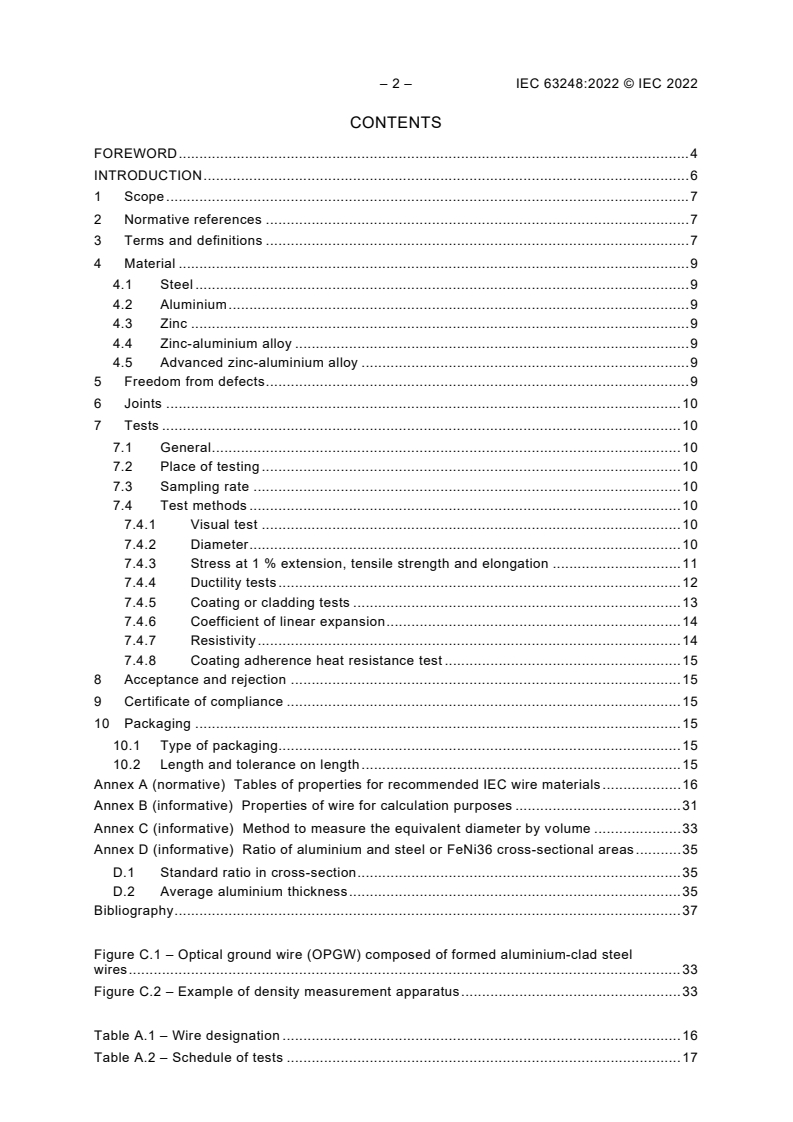
– 2 – IEC 63248:2022 © IEC 2022
CONTENTS
FOREWORD . 4
INTRODUCTION . 6
1 Scope . 7
2 Normative references . 7
3 Terms and definitions . 7
4 Material . 9
4.1 Steel . 9
4.2 Aluminium . 9
4.3 Zinc . 9
4.4 Zinc-aluminium alloy . 9
4.5 Advanced zinc-aluminium alloy . 9
5 Freedom from defects . 9
6 Joints . 10
7 Tests . 10
7.1 General . 10
7.2 Place of testing . 10
7.3 Sampling rate . 10
7.4 Test methods . 10
7.4.1 Visual test . 10
7.4.2 Diameter . 10
7.4.3 Stress at 1 % extension, tensile strength and elongation . 11
7.4.4 Ductility tests . 12
7.4.5 Coating or cladding tests . 13
7.4.6 Coefficient of linear expansion . 14
7.4.7 Resistivity . 14
7.4.8 Coating adherence heat resistance test . 15
8 Acceptance and rejection . 15
9 Certificate of compliance . 15
10 Packaging . 15
10.1 Type of packaging. 15
10.2 Length and tolerance on length . 15
Annex A (normative) Tables of properties for recommended IEC wire materials . 16
Annex B (informative) Properties of wire for calculation purposes . 31
Annex C (informative) Method to measure the equivalent diameter by volume . 33
Annex D (informative) Ratio of aluminium and steel or FeNi36 cross-sectional areas . 35
D.1 Standard ratio in cross-section . 35
D.2 Average aluminium thickness . 35
Bibliography . 37
Figure C.1 – Optical ground wire (OPGW) composed of formed aluminium-clad steel
wires . 33
Figure C.2 – Example of density measurement apparatus . 33
Table A.1 – Wire designation . 16
Table A.2 – Schedule of tests . 17
Table A.3 – Zinc-aluminium alloy ingot composition (group 4 and group 5) . 18
Table A.4 – Requirements for zinc and zinc-aluminium alloy coated steel wires
(group 1, group 4 and group 5) . 19
Table A.5 – Requirements for aluminium-clad FeNi36 wires (group 2) . 23
Table A.6 – Requirements for aluminium-clad steel wires (group 3) . 24
Table A.7 – Initial setting for determining stress at 1 % extension . 27
Table A.8 – Coating requirements for zinc and zinc-aluminium alloy coated wires . 28
Table A.9 – Cladding requirements for group 2 and group 3 wire . 29
Table A.10 – Coating heat resistance test for group 4 and group 5 wire . 29
Table A.11 – Temperatures for linear expansion test for group 2 wire . 29
Table A.12 – Minimum number of dips for zinc and zinc alloy coatings (group 1,
group 4, group 5) . 30
Table B.1 – Properties of wire for calculation purposes . 31
Table D.1 – Standard aluminium and steel or FeNi36 ratio in the cross section for
group 2 and group 3 wires . 35
Table D.2 – Average aluminium thickness . 36
– 4 – IEC 63248:2022 © IEC 2022
INTERNATIONAL ELECTROTECHNICAL COMMISSION
____________
CONDUCTORS FOR OVERHEAD LINES – COATED OR CLADDED
METALLIC WIRE FOR CONCENTRIC LAY STRANDED CONDUCTORS
FOREWORD
1) The International Electrotechnical Commission (IEC) is a worldwide organization for standardization comprising
all national electrotechnical committees (IEC National Committees). The object of IEC is to promote international
co-operation on all questions concerning standardization in the electrical and electronic fields. To this end and
in addition to other activities, IEC publishes International Standards, Technical Specifications, Technical Reports,
Publicly Available Specifications (PAS) and Guides (hereafter referred to as "IEC Publication(s)"). Their
preparation is entrusted to technical committees; any IEC National Committee interested in the subject dealt with
may participate in this preparatory work. International, governmental and non-governmental organizations liaising
with the IEC also participate in this preparation. IEC collaborates closely with the International Organization for
Standardization (ISO) in accordance with conditions determined by agreement between the two organizations.
2) The formal decisions or agreements of IEC on technical matters express, as nearly as possible, an international
consensus of opinion on the relevant subjects since each technical committee has representation from all
interested IEC National Committees.
3) IEC Publications have the form of recommendations for international use and are accepted by IEC National
Committees in that sense. While all reasonable efforts are made to ensure that the technical content of IEC
Publications is accurate, IEC cannot be held responsible for the way in which they are used or for any
misinterpretation by any end user.
4) In order to promote international uniformity, IEC National Committees undertake to apply IEC Publications
transparently to the maximum extent possible in their national and regional publications. Any divergence between
any IEC Publication and the corresponding national or regional publication shall be clearly indicated in the latter.
5) IEC itself does not provide any attestation of conformity. Independent certification bodies provide conformity
assessment services and, in some areas, access to IEC marks of conformity. IEC is not responsible for any
services carried out by independent certification bodies.
6) All users should ensure that they have the latest edition of this publication.
7) No liability shall attach to IEC or its directors, employees, servants or agents including individual experts and
members of its technical committees and IEC National Committees for any personal injury, property damage or
other damage of any nature whatsoever, whether direct or indirect, or for costs (including legal fees) and
expenses arising out of the publication, use of, or reliance upon, this IEC Publication or any other IEC
Publications.
8) Attention is drawn to the Normative references cited in this publication. Use of the referenced publications is
indispensable for the correct application of this publication.
9) Attention is drawn to the possibility that some of the elements of this IEC Publication may be the subject of patent
rights. IEC shall not be held responsible for identifying any or all such patent rights.
IEC 63248 has been prepared by IEC technical committee 7: Overhead electrical conductors.
It is an International Standard.
This first edition cancels and replaces the first edition of IEC 61232 published in 1993 and the
first edition of IEC 60888 published in 1987. This edition constitutes a technical revision.
This edition includes the following significant technical changes with respect to the previous
editions of IEC 61232 and IEC 60888:
a) wire designations have been modified and grouped;
b) wires with zinc coating class 2 were removed;
c) new wire designations have been added;
d) aluminium-clad FeNi36 wires have been added;
e) advanced zinc-aluminium alloy coated steel wires have been added.
The text of this International Standard is based on the following documents:
Draft Report on voting
7/715/FDIS 7/720/RVD
Full information on the voting for its approval can be found in the report on voting indicated in
the above table.
The language used for the development of this International Standard is English.
This document was drafted in accordance with ISO/IEC Directives, Part 2, and developed in
accordance with ISO/IEC Directives, Part 1 and ISO/IEC Directives, IEC Supplement, available
at www.iec.ch/members_experts/refdocs. The main document types developed by IEC are
described in greater detail at www.iec.ch/standardsdev/publications.
The committee has decided that the contents of this document will remain unchanged until the
stability date indicated on the IEC website under webstore.iec.ch in the data related to the
specific document. At this date, the document will be
• reconfirmed,
• withdrawn,
• replaced by a revised edition, or
• amended.
IMPORTANT – The "colour inside" logo on the cover page of this document indicates that it
contains colours which are considered to be useful for the correct understanding of its
contents. Users should therefore print this document using a colour printer.
– 6 – IEC 63248:2022 © IEC 2022
INTRODUCTION
The purpose of this document is to group together similar wire materials that share the same
general characteristics and therefore the same test procedures and requirements. Included in
this document are existing wire types from IEC 60888 and IEC 61232 as well as new wire
materials that are already in use around the world in new types of conductors.
Zinc coating class 2 according to IEC 60888 has not been included in this document, as the
demand for this class of zinc coating is extremely rare. Extra corrosion protection can be
provided by other means, including the use of zinc-aluminium alloy coatings.
CONDUCTORS FOR OVERHEAD LINES – COATED OR CLADDED
METALLIC WIRE FOR CONCENTRIC LAY STRANDED CONDUCTORS
1 Scope
This document specifies the properties of wires in the diameter range of, but not limited to,
1,25 mm to 5,50 mm. This document is applicable to coated or cladded metallic wires before
stranding used either as concentric lay overhead stranded conductors, or in the manufacture of
cores for concentric lay overhead stranded conductors, for power transmission purposes.
The various wire types and their designations are listed in Table A.1. For calculation purposes
the values listed in Annex B are used.
2 Normative references
The following documents are referred to in the text in such a way that some or all of their content
constitutes requirements of this document. For dated references, only the edition cited applies.
For undated references, the latest edition of the referenced document (including any
amendments) applies.
IEC 60050 (all parts), International Electro-technical Vocabulary (IEV) (available at
www.electropedia.org)
IEC 60468, Method of measurement of resistivity of metallic materials
ISO 752, Zinc ingots
ISO 6892-1, Metallic materials – Tensile testing – Part 1: Method of test at room temperature
ISO 7500-1, Metallic materials – Calibration and verification of static uniaxial testing machines
– Part 1: Tension/compression testing machines – Calibration and verification of the force-
measuring system
ISO 7800, Metallic materials – Wire – Simple torsion test
ISO 7801, Metallic materials – Wire – Reverse bend test
ISO 7802, Metallic materials – Wire – Wrapping test
ISO 7989-2, Steel wire and wire products – Non-ferrous metallic coatings on steel wire – Part 2:
Zinc or zinc-alloy coating
3 Terms and definitions
For the purposes of this document, the terms and definitions given in IEC 60050 (all parts) and
the following apply.
– 8 – IEC 63248:2022 © IEC 2022
ISO and IEC maintain terminological databases for use in standardization at the following
addresses:
• IEC Electropedia: available at https://www.electropedia.org/
• ISO Online browsing platform: available at http://www.iso.org/obp
3.1
cladded metallic wire
result of a process by which a metal is bonded under high pressure by co-rolling, co-extrusion,
or other, onto a wire creating a metallic bond between them
3.2
class
number attributed to aluminium-clad wires for the purpose of providing an approximate
conductivity value
3.3
coated metallic wire
result of a process by which a metal is deposited onto a wire by hot-dip or electrolytic process,
creating a chemical or metallic bond between them
3.4
equivalent diameter
diameter of a round wire, which would have the same cross sectional area as a given formed
wire
3.5
formed wire
drawn or rolled metal wire having a constant non-circular cross-section
3.6
group
designation given to wire types that share a common coating or cladding, or property, for a
similar purpose
3.7
FeNi36
grade of steel-nickel alloy designed to have a very low coefficient of thermal expansion
3.8
lot
group of production units of one type and size of wire, which was manufactured by the same
manufacturer during the same time period under similar conditions of production
Note 1 to entry: A lot can consist of part or all of a purchased quantity.
3.9
nominal
value of a measurable property to which tolerance is applied
Note 1 to entry: Nominal values are target values.
3.10
production unit
coil, reel, spool, or other package of wire that represents a single usable length
3.11
sample
specimen or specimens removed from a production unit or units and considered to have
properties representative of a lot
3.12
specimen
length of wire removed for test purposes
3.13
zinc-aluminium alloy
mixture of zinc and aluminium coating applied onto the wire for the purpose of protecting it
against corrosion
Note 1 to entry: Some of these alloys with particular mixture are called mischmetal.
3.14
advanced zinc-aluminium alloy
zinc-aluminium alloy reaching specific requirements as specified in ISO7989-2
Note 1 to entry: Examples of advanced zinc-aluminium alloys are Zn90 % + 10 % aluminium and Zn95 % + 5 %
aluminium with 0,2 % to 0,5 % magnesium.
4 Material
4.1 Steel
The base metal shall be steel produced by the open hearth, electric furnace, or basic oxygen
process and shall be of such composition that the finished wire shall have the properties and
characteristics given in this document.
4.2 Aluminium
The aluminium used for coating or cladding shall have a minimum purity of 99,5 % and be of
sufficient quality to meet the thickness and electrical resistance requirements of this document.
4.3 Zinc
The ingot of zinc used for coating shall meet the requirements of ZN-3 in accordance with
ISO 752.
The zinc coating shall be applied by either the hot-dip or electroplating method. Unless agreed
between the purchaser and the manufacturer, the method of coating shall be at the discretion
of the manufacturer.
4.4 Zinc-aluminium alloy
The ingot of zinc-aluminium alloy used for coating shall be in accordance with Table A.3.
4.5 Advanced zinc-aluminium alloy
The ingot of advanced zinc-aluminium alloy used for coating shall be in accordance with
Table A.3.
5 Freedom from defects
The wires shall be smooth and free from all imperfections such as cracks, roughness, grooves,
inclusions and other defects which can compromise the performance of the final product.
– 10 – IEC 63248:2022 © IEC 2022
6 Joints
No joints shall be made in the finished coated or cladded wire.
Joints may be made at any stage of processing prior to final cold drawing by the electric butt-
weld or flash-welding process.
Welding equipment and procedure shall be such that it can be demonstrated that the ultimate
tensile strength of a finished wire specimen containing the welded section shall be not less than
96 % of the specified minimum stress at 1 % extension.
A welded section shall not be required to meet the stress at 1 % extension, elongation, torsion,
bend, and wrap tests. All other requirements need to be met.
No joints are allowed after heat treatment on wires, which will be used in single-wire conductors.
7 Tests
7.1 General
Tests shall be made by the manufacturer on the wires to demonstrate their conformity to this
document. Tests shall be made in accordance with Table A.2.
Tests shall be performed between 10 °C and 30 °C.
7.2 Place of testing
Unless otherwise agreed between the purchaser and the manufacturer at time of ordering, all
tests shall be carried out at the manufacturer’s premises.
7.3 Sampling rate
The specimen for tests specified in 7.4 shall be taken by the manufacturer from samples of at
least 10 % of each lot.
Alternatively, if a quality assessment procedure is in place and implemented, the sampling rate
shall be subject to agreement between the manufacturer and purchaser.
7.4 Test methods
7.4.1 Visual test
The surface of the wire shall be visually examined to ensure that it is smooth and free from all
imperfections including, but not limited to, cracks, unevenness, holes and inclusion of impurities.
7.4.2 Diameter
7.4.2.1 Unit for diameter
The nominal diameter of a wire shall be expressed in millimetres to two decimal places.
7.4.2.2 Diameter from direct measurements
The diameter of a round wire shall be the mean of two measurements at right angle taken at
the same cross-section. The measurement apparatus shall have an accuracy of at least
0,001 mm.
When tested in accordance with 7.4.2.2, the diameter shall not vary from its nominal value by
more than the appropriate value indicated in Table A.4, Table A.5, or Table A.6.
7.4.2.3 Diameter from weight measurements
The equivalent diameter of a formed wire shall be obtained from weight measurements made
on a sample not less than 1,0 m in length, and with its density as defined in Table B.1.
The equivalent diameter, D, of the formed wire shall be calculated by Formula (1).
4A
D= (1)
πρL
where:
D is the equivalent diameter of the sample in mm;
A is the weight of the sample with length L in g;
L is the length of the sample in m;
ρ
is the density of the sample in g/cm .
When tested in accordance with 7.4.2.3 the equivalent diameter shall not vary from its nominal
value by more than the tolerance value indicated in Table A.4, Table A.5, or Table A.6.
7.4.2.4 Diameter from volume measurement
Alternatively the equivalent diameter of a formed wire shall be obtained from the volume and
weight measurements as described in Annex C.
When tested in accordance with 7.4.2.4 the equivalent diameter shall not vary from its nominal
value by more than the tolerance value indicated in Table A.4, Table A.5, or Table A.6.
7.4.3 Stress at 1 % extension, tensile strength and elongation
7.4.3.1 Sample preparation
The wire samples shall be free from bends or kinks other than the curvature resulting from the
usual coiling operation. They shall be straightened before being inserted in the grips of the
tensile testing equipment with a roller type wire straightening arrangement or by any other
means designed to exert the minimum effect upon the mechanical properties of the sample.
Samples for tests shall not be less than 450 mm long and shall be fitted in the testing machine
so as to leave a free length of minimum 300 mm between the grips.
7.4.3.2 Stress at 1 % extension and tensile strength
The test shall be performed in accordance with ISO 6892-1.
The force-measuring system of the testing machine shall be calibrated in accordance with
ISO 7500-1, class 1, or better.
The rate of separation of the jaws of the testing machine shall be between 25 mm/min and
100 mm/min.
In order to obtain a straight test piece and ensure the alignment of the test piece and grip
arrangement, a preliminary load corresponding with the initial stress in accordance with
Table A.7 shall be applied.
– 12 – IEC 63248:2022 © IEC 2022
This load shall be maintained while a 250 mm gauge is marked on the sample and a suitable
extensometer applied on a 250 mm gauge length (not necessarily corresponding with the
marked gauge length).
A correction of the extension, in accordance with Table A.7, should be carried out to take into
account the effect of the preliminary load.
This load shall then be increased uniformly until the extensometer indicates an extension of
2,5 mm in 250 mm (1 % extension).
At this point the tensile testing equipment may be stopped if necessary, and the load read. The
value of stress at 1 % extension is calculated by dividing this load by the area of the wire based
on wire diameter measurements according to 7.4.2. Following this operation, the extensometer
may be removed. The specimen shall then be loaded to rupture and its tensile strength
determined.
When tested in accordance with 7.4.3.2 the wire shall conform to the requirements specified in
Table A.4, Table A.5, or Table A.6.
7.4.3.3 Elongation after break
The test shall be performed in accordance with ISO 6892-1.
The gauge length to be applied is 250 mm.
When tested in accordance with 7.4.3.3 the wire shall conform to the requirements specified in
Table A.4, Table A.5, or Table A.6.
7.4.3.4 Elongation at break
The test shall be performed in accordance with ISO 6892-1.
The gauge length to be applied is 250 mm.
When tested in accordance with 7.4.3.4 the wire shall conform to the requirements specified in
Table A.5, or Table A.6.
7.4.4 Ductility tests
7.4.4.1 Torsion test
The test shall be performed in accordance with ISO 7800.
The free length between the grips will be 100 times the nominal diameter.
The number of torsions obtained shall not be less than the value given in Table A.4, Table A.5
or Table A.6.
7.4.4.2 Wrapping test
The test shall be performed in accordance with ISO 7802.
The specimen shall be wrapped 8 turns in a close spiral around a mandrel, at a rate not
exceeding 15 turns per minute.
The mandrel diameter shall be in accordance with the value given in Table A.4, Table A.5, or
Table A.6.
When tested in accordance with 7.4.4.2, the sample shall not completely break.
7.4.4.3 Reverse bend test
The test shall be performed in accordance with ISO 7801.
The minimum number of reverse bends to be achieved shall be agreed between purchaser and
manufacturer.
NOTE In order to have a reference on the minimum achievable reverse bends one can refer to ISO 2232 [4] ,
quality A.
7.4.5 Coating or cladding tests
7.4.5.1 Coating mass or cladding thickness test
7.4.5.1.1 Zinc or zinc-aluminium alloy coating mass
The mass of coating can be obtained by the gas volumetric method, or by the gravimetric
method tested in accordance with ISO 7989-2.
In case of dispute, the gravimetric method shall be accepted as the arbitration method.
The mass of coating shall not be less than the value given in Table A.8.
7.4.5.1.2 Aluminium cladding thickness
The thickness of aluminium cladding of a specimen shall be determined using an optical
microscope or by using suitable electrical indicating instruments operating on the permeameter
principle and properly calibrated on the actual diameter of the specimen.
The measurement by microscope shall be read to three decimal places and rounded to two
decimal places. For reference purposes, the measurement by microscope shall be used to
determine aluminium thickness on specimens taken from the end of the coils.
The thickness of the aluminium shall not be less than the value given in Table A.9.
The ratio of aluminium and steel or FeNi36 is described in Annex D.
7.4.5.2 Adherence of coating or cladding test
7.4.5.2.1 Zinc or zinc-aluminium alloy coating
The test shall be performed in accordance with ISO 7802.
The specimen shall be wrapped 8 turns in a close spiral around a mandrel, at a rate not
exceeding 15 turns per minute.
The mandrel diameter shall be in accordance with the value given in Table A.4.
The coating shall remain firmly adherent to the steel and shall not crack or flake to such an
extent that any coating can be removed by rubbing with the bare fingers.
___________
Numbers in square brackets refer to the Bibliography.
– 14 – IEC 63248:2022 © IEC 2022
7.4.5.2.2 Aluminium cladding
This test shall be performed in accordance with ISO 7802.
The specimen shall be wrapped 8 turns in a close spiral around a mandrel, at a rate not
exceeding 15 turns per minute.
The mandrel diameter shall be in accordance with the value given in Table A.5 or Table A.6.
The specimen shall show no separation of the aluminium from the steel when examined with
the naked eye or with normal corrective glasses.
7.4.5.3 Uniformity of zinc and zinc-aluminium coatings (or dipping test)
This test shall be performed in conformity with ISO 7989-2.
The minimum number of immersions (or dips) is specified in Table A.12.
7.4.6 Coefficient of linear expansion
The coefficient of linear expansion can be determined either by thermo mechanical analysis
(TMA) or by push-rod dilatometer.
NOTE Both test methods are described in ASTM E831 (TMA) [3] and ASTM E228 (push-rod dilatometer) [2].
The length of a specimen shall be measured at room temperature and at the appropriate
temperatures as specified in Table A.11.
The coefficient of linear expansion shall be calculated by Formula (2):
LL− LL−
tt10 tt12
and
α= α=
(2)
tt01− tt12−
(tt−⋅) L (t −⋅t) L
10 t0 21 t0
where:
-1;
α is the linear expansion coefficient between t and t in °C
t0-t1 0 1
-1;
α is the linear expansion coefficient between t and t in °C
t1-t2 1 2
t is the room temperature in °C;
t is the temperature according to Table A.11 in °C;
t is the temperature according to Table A.11 in °C:
L is the length of the sample at t in mm;
t0 0
L is the length of the sample at t in mm;
t1 1
L is the length of the sample at t in mm.
t2 2
The values to be used for calculation purposes are given in Table B.1.
7.4.7 Resistivity
The test shall be performed in accordance with IEC 60468.
For Group 2 and Group 3, the resistivity at 20 °C shall not be greater than the value indicated
in the resistivity column in Table A.5 or Table A.6.
7.4.8 Coating adherence heat resistance test
This test is applicable to Group 4 and Group 5 wires only.
A specimen shall be kept in an oven at the temperature and duration specified in Table A.10.
After heating the specimen will be cooled down to room temperature.
The specimen shall then be wrapped 8 turns in a close spiral around a mandrel, at a rate not
exceeding 15 turns per minute.
The mandrel diameter shall be in accordance with the value given in Table A.4, column "Ratio
of mandrel to wire diameter for coating adherence test".
The coating shall remain firmly adherent to the steel and shall not crack or flake to such an
extent that any coating can be removed by rubbing with the bare fingers.
8 Acceptance and rejection
Failure of a test specimen to comply with any one of the requirements of this document shall
constitute grounds for rejection of the lot represented by the specimen.
If any lot is so rejected, the manufacturer shall have the right to test all individual production
units in the lot once and submit those which meet requirements of acceptance.
9 Certificate of compliance
Unless otherwise agreed between purchaser and manufacturer, the manufacturer shall supply
the purchaser with a certificate giving the results of all the tests carried out on the samples.
10 Packaging
10.1 Type of packaging
The type of packaging shall be agreed between the purchaser and the manufacturer.
10.2 Length and tolerance on length
The lengths and tolerances on length shall be agreed between the purchaser and manufacturer.
– 16 – IEC 63248:2022 © IEC 2022
Annex A
(normative)
Tables of properties for recommended IEC wire materials
Table A.1 – Wire designation
Group Designation Wire designation
e,f
S1A Zinc-coated steel S1A
Group 1
Zinc-coated steel wires
ST1A Zinc-coated steel ST1A
S2A Zinc-coated steel S2A
S3A Zinc-coated steel S3A
ST6C Zinc-coated steel ST6C
S4A Zinc-coated steel S4A
S5A Zinc-coated steel S5A
S6A Zinc-coated steel S6A
S7A Zinc-coated steel S7A
S8A Zinc-coated steel S8A
a
ACI10SA Aluminium-clad FeNi36 steel class 10
Group 2
Aluminium-clad FeNi36
c
ACI14SA type A Aluminium-clad FeNi36 steel class 14 type A
wires
c
Aluminium-clad FeNi36 steel class 14 type B
ACI14SA type B
ACI17SA Aluminium-clad FeNi36 steel class 17
ACI24SA Aluminium-clad FeNi36 steel class 24
b d
Group 3 14SA type A Aluminium-clad steel class 14 type A
Aluminium-clad steel wires
d
Aluminium-clad steel class 14 type B
14SA type B
d
Aluminium-clad steel class 14 type C
14SA type C
d
20SA type A Aluminium-clad steel class 20 type A
d
Aluminium-clad steel class 20 type B
20SA type B
d
20SA type C Aluminium-clad steel class 20 type C
23SA Aluminium-clad steel class 23
25SA Aluminium-clad steel class 25
27SA Aluminium-clad steel class 27
30SA Aluminium-clad steel class 30
c
Aluminium-clad steel class 35 type A
35SA type A
c
35SA type B Aluminium-clad steel class 35 type B
40SA Aluminium-clad steel class 40
e,f
5MS1B Zinc-5 % aluminium coated steel 5MS1B
Group 4
Zinc-5 % aluminium
5MS2A Zinc-5 % aluminium coated steel 5MS2A
coated steel wires
5MS3A Zinc-5 % aluminium coated steel 5MS3A
5MS4A Zinc-5 % aluminium coated steel 5MS4A
5MS5A Zinc-5 % aluminium coated steel 5MS5A
5MS6A Zinc-5 % aluminium coated steel 5MS6A
5MS7A Zinc-5 % aluminium coated steel 5MS7A
5MS8A Zinc-5 % aluminium coated steel 5MS8A
Group Designation Wire designation
e,f
Advanced zinc-aluminium alloy coated steel
Group 5
ADMS2A
ADMS2A
Advanced zinc-aluminium
alloy coated steel wires
Advanced zinc-aluminium alloy coated steel
ADMS3A
ADMS3A
Advanced zinc-aluminium alloy coated steel
ADMS4A
ADMS4A
Advanced zinc-aluminium alloy coated steel
ADMS5A
ADMS5A
Advanced zinc-aluminium alloy coated steel
ADMS6A
ADMS6A
Advanced zinc-aluminium alloy coated steel
ADMS7A
ADMS7A
Advanced zinc-aluminium alloy coated steel
AMMS8A
ADMS8A
a
Group 2 wires are specified in the classes "ACI10SA", "ACI14SA", "ACI17SA", "ACI24SA" according to their
conductivity of 10 %, 14 %, 17 %, 24 % IACS (International Annealed Copper Standard).
b
Group 3 wires are specified in the classes "14SA", "20SA", "23SA", "25SA", "27SA", "30SA", "35SA" and
"40SA" according to their conductivity of 14 %, 20,3 %, 23 %, 25 %, 27 %, 30 %, 35 % and 40 % IACS
(International Annealed Copper Standard).
c
Wires of the class ACI14SA and 35SA are subdivided into two types, A and B, according to their tensile
strength.
d
Wires of the classes 14SA and 20SA are subdivided into three types, A, B and C, according to their tensile
strength.
e
For group 1, group 4 and group 5 the last letter (A, B, C) refers to the coating class.
f
The designated wires have been sorted according to increasing tensile strength.
Table A.2 – Schedule of tests
Subclause Group 1 Group 2 Group 3 Group 4
&
Group 5
Visual inspection 7.4.1 Y Y Y Y
Wire diameter 7.4.2 Y Y Y Y
Stress at 1 % extension 7.4.3.2 Y Y Y Y
Ultimate tensile strength 7.4.3.2 Y Y Y Y
b b
Elongation after break 7.4.3.3 Y Y Y Y
b b
Elongation at break 7.4.3.4 Y Y
Torsion 7.4.4.1 Y Y Y Y
Ductility Wrap 7.4.4.2 Y O O Y
Reverse bend 7.4.4.3 O O O O
Coating 7.4.5.1.1 Y Y
Thickness
Cladding 7.4.5.1.2 Y Y
Coating 7.4.5.2.1 Y Y
Adherence
Cladding 7.4.5.2.2 Y Y
Uniformity of coating 7.4.5.3 Y Y
a
7.4.6 O O O O
Linear expansion
Resistivity 7.4.7 O Y Y O
Coating heat resistance 7.4.8 O
– 18 – IEC 63248:2022 © IEC 2022
NOTE 1 "Y" indicates the test has to be performed in accordance with 7.3.
NOTE 2 "O" indicates the test is optional and has to be agreed between purchaser and manufacturer.
a
The linear expansion coefficient is a physical constant. Variation on obtained values will be due to the
measurement accuracy. Obtained values are for information only.
b
For group 2 and group 3, the wire shall comply with either the requirement of elongation after break or
elongation at break. Unless otherwise agreed upon between the manufacturer and the purchaser at the time of
purchase, it is at the option of the manufacturer to select the measurement method.
Table A.3 – Zinc-aluminium alloy ingot composition (group 4 and group 5)
Element Composition, %
95/5 Zn/Al 90/10 Zn/Al
Aluminium 4,2 to 6,2 9,4 to 10,6
Cerium and lanthanum, total 0,0 to 0,10 0,0 to 0,10
Iron 0,075 max 0,075 max
Silicon 0,015 max 0,015 max
Lead, cadmium 0,005 max 0,005 max
Tin 0,002 max 0,002 max
a,b
Others, each 0,02 max 0,02 max
a,b
Others, total 0,04 max 0,04 max
Zinc Remainder Remainder
NOTE The zinc-aluminium alloy ingot composition is based on ASTM B997 [1].
a
Magnesium may be specified by the buyer up to 0,75 % max.
b
Except magnesium.
Table A.4 – Requirements for zinc and zinc-aluminium alloy coated steel wires (group 1, group 4 and group 5)
Nominal diameter Diameter Min. stress at Min. ultimate Min. lot Min. elongation Ratio of Ratio of mandrel Min. number
tolerance 1 % extension tensile average after break mandrel diameter to wire of torsions
mm
strength tensile diameter to wire diameter for
a
diameter for coating
strength
Over Up to and
ductility adherence test
including
wrapping test
--- --- mm MPa MPa MPa % --- --- ---
S1A
1,24 2,25 ±0,03 1 170 1 340 3,0 1 4 18
2,25 2,75 ±0,04 1 140 1 310 3,0 1 4 16
2,75 3,00 ±0,05 1 140 1 310 3,5 1 4 16
3,00 3,50 ±0,05 1 100 1 290 3,5 1 4 14
3,50 4,75 ±0,06 1 100 1 290 4,0 1 5 12
4,75 5,50 ±0,07 1 100 1 290 4,0 1 5 12
ST1A
1,24 2,25 ±0,03 1 170 1 400 3,0 1 4 18
2,25 2,75 ±0,04 1 140 1 350 3,0 1 4 16
2,75 3,00 ±0,05 1 140 1 350 3,5 1 4 16
3,00 3,50 ±0,05 1 100 1 300 3,5 1 4 14
3,50 4,75 ±0,06 1 100 1 300 4,0 1 5 12
4,75 5,50 ±0,07 1 100 1 300 4,0 1 5 12
5MS1B
1,24 2,25 ±0,03 1 170 1 340 3,0 3 4 16
2,25 2,75 ±0,04 1 140 1 310 3,0 3 4 16
2,75 3,00 ±0,05 1 140 1 310 3,5 3 4 16
3,00 3,50 ±0,05 1 100 1 290 3,5 4 4 14
3,50 4,75 ±0,06 1 100 1 290 4,0 4 5 12
– 20 – IEC 63248:2022 © IEC 2022
Nominal diameter Diamet
...