

IEC 62444:2010
(Main)Cable glands for electrical installations
General Information
- Abstract
IEC 62444:2010 provides requirements and tests for the construction and performance of cable glands. This standard covers complete cable glands as supplied by the manufacturer or the supplier responsible for placing the product on the market. This standard does not cover cable glands for mineral insulated cables. This standard covers cable glands with IEC 60423 metric entry threads. This standard can be used as a guide for cable glands with other type of entry threads.
- Status
- Published
- Publication Date
- 18-Aug-2010
- Technical Committee
- SC 23A - Cable management systems
- Drafting Committee
- MT 18 - TC 23/SC 23A/MT 18
- Current Stage
- PPUB - Publication issued
- Start Date
- 19-Aug-2010
- Completion Date
- 15-Sep-2010
Overview
IEC 62444:2010 is an international standard developed by the International Electrotechnical Commission (IEC) that provides comprehensive requirements and test methods for cable glands used in electrical installations. Cable glands play a crucial role in safely introducing flexible cables and insulated conductors into electrical enclosures, providing sealing, retention, strain relief, and additional functions such as earthing or bonding.
This standard specifies the construction, performance, marking, and documentation for cable glands supplied by manufacturers or responsible suppliers. IEC 62444:2010 focuses on glands with IEC 60423 metric entry threads, while also serving as a useful guide for products with other entry thread types. It explicitly does not cover cable glands designed for mineral insulated cables.
Key Topics
IEC 62444:2010 covers several essential aspects in the design and testing of cable glands for electrical installations:
Scope and Purpose
- Applies to all complete cable glands as supplied, ensuring uniform performance and safety.
- Excludes glands for mineral insulated cables.
Classification
- By materials: metallic, non-metallic, and composite cable glands.
- By mechanical performance: such as cable retention, anchorage types, and impact resistance.
- By electrical properties: including equipotential bonding and protective earthing capability.
- By resistance to environmental factors: such as degree of protection (IP rating) and UV resistance.
- By sealing system: single-orifice and multi-orifice seals.
Design and Construction
- Must prevent damage to cables upon installation and use.
- Must provide at least an IP54 degree of protection.
- Must be suitable for temperature ranges from at least –20°C to 65°C, with provisions for higher ranges if declared.
Testing
- Specifies mechanical, electrical, and environmental test methods (e.g., retention and anchorage pull tests, impact resistance).
- Stresses testing under both standard and declared extreme conditions.
Marking and Documentation
- Requirements for clear, durable labeling, including manufacturer identification and product data.
- Documentation must contain crucial information such as sealing range, installation torque, entry thread specifications, and IP rating.
Applications
Cable glands conforming to IEC 62444:2010 are widely used in a variety of electrical installations where reliable cable entry systems are needed. Typical applications include:
- Industrial Control Panels: Where cable entry points require secure, environmentally protected connections.
- Commercial and Residential Buildings: For power distribution boxes and electrical enclosures.
- Automation Systems: Ensuring robust cable sealing and strain relief in harsh or outdoor environments.
- Infrastructure Projects: Supporting safe cable management in transportation, utilities, and communications.
- Hazardous Locations: Some cable glands may also be suitable for use in hazardous areas (further requirements as per the IEC 60079 series).
Related Standards
When implementing IEC 62444:2010, consider the following related international standards for a comprehensive approach to cable management and electrical safety:
- IEC 60423 - Metric threads for conduits and entry devices: Specifies the dimensions for the threads used in cable glands covered by IEC 62444.
- IEC 60529 - IP Code: Defines degrees of protection provided by enclosures against dust and water ingress.
- IEC 60695-2-11 - Fire Hazard Testing: Glow-wire flammability test methods for assessing end-product resistance.
- ISO 868 - Plastics Hardness Testing: Shore hardness requirements for materials.
- ISO 4287 - Surface Texture: Defines surface roughness for components.
- ISO 9227 - Corrosion Testing: Salt spray test methods, relevant for evaluating corrosion resistance.
IEC 62444:2010 supports consistent safety and quality in cable gland selection, installation, and inspection across the electrical industry, promoting reliability and facilitating compliance with international best practices for cable management.
Get Certified
Connect with accredited certification bodies for this standard

IMQ S.p.A. (Certification)
Italian electrical product certification.

SLG Prüf- und Zertifizierungs GmbH
German testing and certification body.

UL Solutions
Global safety science company with testing, inspection and certification.
Sponsored listings
Frequently Asked Questions
IEC 62444:2010 is a standard published by the International Electrotechnical Commission (IEC). Its full title is "Cable glands for electrical installations". This standard covers: IEC 62444:2010 provides requirements and tests for the construction and performance of cable glands. This standard covers complete cable glands as supplied by the manufacturer or the supplier responsible for placing the product on the market. This standard does not cover cable glands for mineral insulated cables. This standard covers cable glands with IEC 60423 metric entry threads. This standard can be used as a guide for cable glands with other type of entry threads.
IEC 62444:2010 provides requirements and tests for the construction and performance of cable glands. This standard covers complete cable glands as supplied by the manufacturer or the supplier responsible for placing the product on the market. This standard does not cover cable glands for mineral insulated cables. This standard covers cable glands with IEC 60423 metric entry threads. This standard can be used as a guide for cable glands with other type of entry threads.
IEC 62444:2010 is classified under the following ICS (International Classification for Standards) categories: 29.120.10 - Conduits for electrical purposes. The ICS classification helps identify the subject area and facilitates finding related standards.
IEC 62444:2010 is available in PDF format for immediate download after purchase. The document can be added to your cart and obtained through the secure checkout process. Digital delivery ensures instant access to the complete standard document.
Standards Content (Sample)
IEC 62444 ®
Edition 1.0 2010-08
INTERNATIONAL
STANDARD
NORME
INTERNATIONALE
Cable glands for electrical installations
Presse-étoupes pour installations électriques
All rights reserved. Unless otherwise specified, no part of this publication may be reproduced or utilized in any form or by
any means, electronic or mechanical, including photocopying and microfilm, without permission in writing from either IEC or
IEC's member National Committee in the country of the requester.
If you have any questions about IEC copyright or have an enquiry about obtaining additional rights to this publication,
please contact the address below or your local IEC member National Committee for further information.
Droits de reproduction réservés. Sauf indication contraire, aucune partie de cette publication ne peut être reproduite
ni utilisée sous quelque forme que ce soit et par aucun procédé, électronique ou mécanique, y compris la photocopie
et les microfilms, sans l'accord écrit de la CEI ou du Comité national de la CEI du pays du demandeur.
Si vous avez des questions sur le copyright de la CEI ou si vous désirez obtenir des droits supplémentaires sur cette
publication, utilisez les coordonnées ci-après ou contactez le Comité national de la CEI de votre pays de résidence.
IEC Central Office
3, rue de Varembé
CH-1211 Geneva 20
Switzerland
Email: inmail@iec.ch
Web: www.iec.ch
About the IEC
The International Electrotechnical Commission (IEC) is the leading global organization that prepares and publishes
International Standards for all electrical, electronic and related technologies.
About IEC publications
The technical content of IEC publications is kept under constant review by the IEC. Please make sure that you have the
latest edition, a corrigenda or an amendment might have been published.
ƒ Catalogue of IEC publications: www.iec.ch/searchpub
The IEC on-line Catalogue enables you to search by a variety of criteria (reference number, text, technical committee,…).
It also gives information on projects, withdrawn and replaced publications.
ƒ IEC Just Published: www.iec.ch/online_news/justpub
Stay up to date on all new IEC publications. Just Published details twice a month all new publications released. Available
on-line and also by email.
ƒ Electropedia: www.electropedia.org
The world's leading online dictionary of electronic and electrical terms containing more than 20 000 terms and definitions
in English and French, with equivalent terms in additional languages. Also known as the International Electrotechnical
Vocabulary online.
ƒ Customer Service Centre: www.iec.ch/webstore/custserv
If you wish to give us your feedback on this publication or need further assistance, please visit the Customer Service
Centre FAQ or contact us:
Email: csc@iec.ch
Tel.: +41 22 919 02 11
Fax: +41 22 919 03 00
A propos de la CEI
La Commission Electrotechnique Internationale (CEI) est la première organisation mondiale qui élabore et publie des
normes internationales pour tout ce qui a trait à l'électricité, à l'électronique et aux technologies apparentées.
A propos des publications CEI
Le contenu technique des publications de la CEI est constamment revu. Veuillez vous assurer que vous possédez
l’édition la plus récente, un corrigendum ou amendement peut avoir été publié.
ƒ Catalogue des publications de la CEI: www.iec.ch/searchpub/cur_fut-f.htm
Le Catalogue en-ligne de la CEI vous permet d’effectuer des recherches en utilisant différents critères (numéro de référence,
texte, comité d’études,…). Il donne aussi des informations sur les projets et les publications retirées ou remplacées.
ƒ Just Published CEI: www.iec.ch/online_news/justpub
Restez informé sur les nouvelles publications de la CEI. Just Published détaille deux fois par mois les nouvelles
publications parues. Disponible en-ligne et aussi par email.
ƒ Electropedia: www.electropedia.org
Le premier dictionnaire en ligne au monde de termes électroniques et électriques. Il contient plus de 20 000 termes et
définitions en anglais et en français, ainsi que les termes équivalents dans les langues additionnelles. Egalement appelé
Vocabulaire Electrotechnique International en ligne.
ƒ Service Clients: www.iec.ch/webstore/custserv/custserv_entry-f.htm
Si vous désirez nous donner des commentaires sur cette publication ou si vous avez des questions, visitez le FAQ du
Service clients ou contactez-nous:
Email: csc@iec.ch
Tél.: +41 22 919 02 11
Fax: +41 22 919 03 00
IEC 62444 ®
Edition 1.0 2010-08
INTERNATIONAL
STANDARD
NORME
INTERNATIONALE
Cable glands for electrical installations
Presse-étoupes pour installations électriques
INTERNATIONAL
ELECTROTECHNICAL
COMMISSION
COMMISSION
ELECTROTECHNIQUE
PRICE CODE
INTERNATIONALE
U
CODE PRIX
ICS 29.120.10 ISBN 978-2-88912-151-9
– 2 – 62444 © IEC:2010
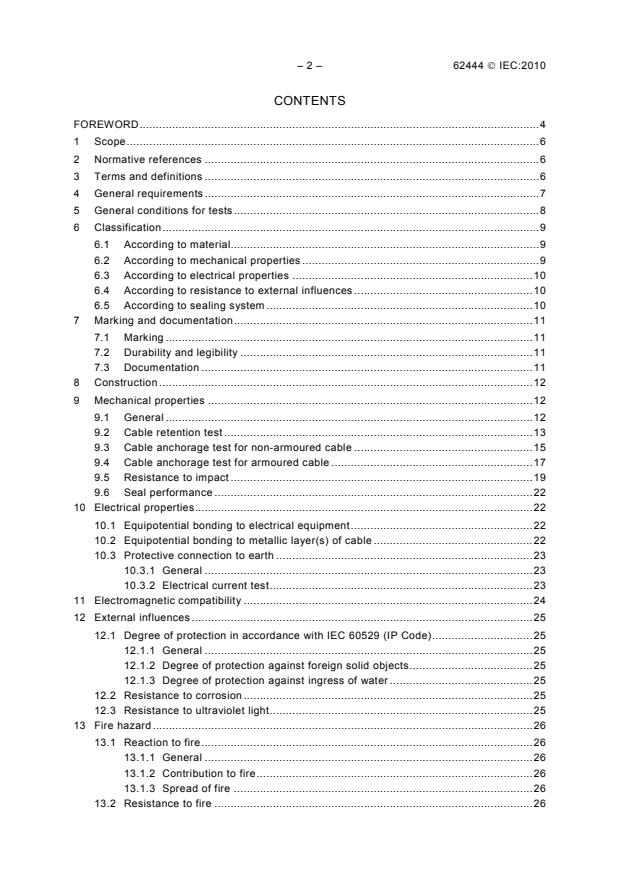
CONTENTS
FOREWORD.4
1 Scope.6
2 Normative references .6
3 Terms and definitions .6
4 General requirements .7
5 General conditions for tests.8
6 Classification.9
6.1 According to material.9
6.2 According to mechanical properties .9
6.3 According to electrical properties .10
6.4 According to resistance to external influences .10
6.5 According to sealing system .10
7 Marking and documentation.11
7.1 Marking .11
7.2 Durability and legibility .11
7.3 Documentation .11
8 Construction .12
9 Mechanical properties .12
9.1 General .12
9.2 Cable retention test .13
9.3 Cable anchorage test for non-armoured cable .15
9.4 Cable anchorage test for armoured cable .17
9.5 Resistance to impact .19
9.6 Seal performance .22
10 Electrical properties.22
10.1 Equipotential bonding to electrical equipment.22
10.2 Equipotential bonding to metallic layer(s) of cable .22
10.3 Protective connection to earth .23
10.3.1 General .23
10.3.2 Electrical current test.23
11 Electromagnetic compatibility .24
12 External influences .25
12.1 Degree of protection in accordance with IEC 60529 (IP Code).25
12.1.1 General .25
12.1.2 Degree of protection against foreign solid objects.25
12.1.3 Degree of protection against ingress of water .25
12.2 Resistance to corrosion .25
12.3 Resistance to ultraviolet light.25
13 Fire hazard.26
13.1 Reaction to fire.26
13.1.1 General .26
13.1.2 Contribution to fire.26
13.1.3 Spread of fire .26
13.2 Resistance to fire .26
62444 © IEC:2010 – 3 –
Annex A (normative) Particular requirements for cable glands for electrical
installations with NPT entry threads .27
Annex B (informative) Test sequence.28
Bibliography.29
Figure 1 – Typical arrangement for cable retention test.14
Figure 2 – Typical arrangement for cable anchorage pull test .16
Figure 3 – Typical arrangement for cable anchorage twist test.17
Figure 4 – Typical arrangement for cable anchorage test for armoured cable.18
Figure 5 – Typical arrangement for impact test .21
Figure 6 – Typical arrangement for electrical current tests .24
Table 1 – Clearance holes for cable glands for test purposes .9
Table 2 – Pull forces for cable retention and cable anchorage .15
Table 3 – Torque value for cable anchorage twist test .17
Table 4 – Impact values.20
Table 5 – Electrical current values .23
Table A.1 – Clearance holes for NPT cable glands for test purposes .27
– 4 – 62444 © IEC:2010
INTERNATIONAL ELECTROTECHNICAL COMMISSION
____________
CABLE GLANDS FOR ELECTRICAL INSTALLATIONS
FOREWORD
1) The International Electrotechnical Commission (IEC) is a worldwide organization for standardization comprising
all national electrotechnical committees (IEC National Committees). The object of IEC is to promote
international co-operation on all questions concerning standardization in the electrical and electronic fields. To
this end and in addition to other activities, IEC publishes International Standards, Technical Specifications,
Technical Reports, Publicly Available Specifications (PAS) and Guides (hereafter referred to as “IEC
Publication(s)”). Their preparation is entrusted to technical committees; any IEC National Committee interested
in the subject dealt with may participate in this preparatory work. International, governmental and non-
governmental organizations liaising with the IEC also participate in this preparation. IEC collaborates closely
with the International Organization for Standardization (ISO) in accordance with conditions determined by
agreement between the two organizations.
2) The formal decisions or agreements of IEC on technical matters express, as nearly as possible, an international
consensus of opinion on the relevant subjects since each technical committee has representation from all
interested IEC National Committees.
3) IEC Publications have the form of recommendations for international use and are accepted by IEC National
Committees in that sense. While all reasonable efforts are made to ensure that the technical content of IEC
Publications is accurate, IEC cannot be held responsible for the way in which they are used or for any
misinterpretation by any end user.
4) In order to promote international uniformity, IEC National Committees undertake to apply IEC Publications
transparently to the maximum extent possible in their national and regional publications. Any divergence
between any IEC Publication and the corresponding national or regional publication shall be clearly indicated in
the latter.
5) IEC itself does not provide any attestation of conformity. Independent certification bodies provide conformity
assessment services and, in some areas, access to IEC marks of conformity. IEC is not responsible for any
services carried out by independent certification bodies.
6) All users should ensure that they have the latest edition of this publication.
7) No liability shall attach to IEC or its directors, employees, servants or agents including individual experts and
members of its technical committees and IEC National Committees for any personal injury, property damage or
other damage of any nature whatsoever, whether direct or indirect, or for costs (including legal fees) and
expenses arising out of the publication, use of, or reliance upon, this IEC Publication or any other IEC
Publications.
8) Attention is drawn to the Normative references cited in this publication. Use of the referenced publications is
indispensable for the correct application of this publication.
9) Attention is drawn to the possibility that some of the elements of this IEC Publication may be the subject of
patent rights. IEC shall not be held responsible for identifying any or all such patent rights.
International Standard IEC 62444 has been prepared by subcommittee 23A: Cable
management systems, of IEC technical committee 23: Electrical accessories.
The text of this standard is based on the following documents:
FDIS Report on voting
23A/606/FDIS 23A/618/RVD
Full information on the voting for the approval of this standard can be found in the report on
voting indicated in the above table.
This publication has been drafted in accordance with the ISO/IEC Directives, Part 2.
NOTE The following print types are used:
− requirements: in roman type;
− test specifications: in italic type;
− notes: in small roman type.
62444 © IEC:2010 – 5 –
The committee has decided that the contents of this publication will remain unchanged until
the stability date indicated on the IEC web site under "http://webstore.iec.ch" in the data
related to the specific publication. At this date, the publication will be
• reconfirmed,
• withdrawn,
• replaced by a revised edition, or
• amended.
– 6 – 62444 © IEC:2010
CABLE GLANDS FOR ELECTRICAL INSTALLATIONS
1 Scope
This Standard provides requirements and tests for the construction and performance of cable
glands. This standard covers complete cable glands as supplied by the manufacturer or the
supplier responsible for placing the product on the market. This standard does not cover cable
glands for mineral insulated cables.
This standard covers cable glands with IEC 60423 metric entry threads.
This standard can be used as a guide for cable glands with other type of entry threads.
NOTE Certain cable glands may also be used “in Hazardous Areas.” Regard should then be taken of other or
additional requirements necessary for the enclosure to be installed in such conditions, for example as specified in
the IEC 60079 series.
2 Normative references
The following referenced documents are indispensable for the application of this document.
For dated references, only the edition cited applies. For undated references, the latest edition
of the referenced document (including any amendments) applies.
IEC 60423:2007, Conduit systems for cable management – Outside diameters of conduits for
electrical installations and threads for conduits and fittings
IEC 60529:1989, Degrees of protection provided by enclosures (IP Code)
Amendment 1 (1999)
IEC 60695-2-11:2000, Fire hazard testing – Part 2-11: Glowing/hot-wire based test methods –
Glow-wire flammability test method for end-products
ISO 868:2003, Plastics and ebonite – Determination of indentation hardness by means of
durometer (Shore hardness)
ISO 4287:1997, Geometrical product specifications (GPS) – Surface texture: Profile method –
Terms, definitions and surface texture parameters
ISO 9227:2006, Corrosion tests in artificial atmospheres – Salt spray tests
3 Terms and definitions
For the purposes of this document, the following definitions apply.
3.1
cable gland
a device designed to permit the entry of a cable, flexible cable or insulated conductor into an
enclosure, and which provides sealing and retention. It may also provide other functions such
as earthing, bonding, insulation, cable guarding, strain relief or a combination of these
___________
There is a consolidated edition 2.1 (2001) that includes IEC 60529 (1989) and its amendment 1 (1999).
62444 © IEC:2010 – 7 –
3.2
entry thread
the threaded portion of a cable gland which is intended to be attached to an enclosure or
equipment
3.3
cable gland size
the nominal diameter of the entry thread
3.4
cable retention
the minimum ability of a cable gland to limit the displacement of a fitted cable under static
load
3.5
cable anchorage
the ability of a cable gland to limit the displacement of a fitted cable under dynamic and
torque loads
3.6
series
cable glands of the same classification and design but with different dimensions
3.7
clearance hole
unthreaded opening in an enclosure or equipment intended to permit entry of a cable gland
3.8
metallic cable gland
cable gland which consists of metallic material only
NOTE Sealing systems are excluded from this definition.
3.9
non-metallic cable gland
cable gland which consists of non-metallic material only
NOTE Sealing systems are excluded from this definition.
3.10
composite cable gland
cable gland comprising both metallic and non-metallic materials
NOTE Sealing systems are excluded from this definition.
3.11
single-orifice seal
seal with one orifice suitable for the passage of a single cable
3.12
multi-orifice seal
seal with more than one orifice, each orifice being suitable for the passage of a separate
cable
4 General requirements
Cable glands shall be designed to provide in normal use all the functions declared by the
manufacturer or supplier.
– 8 – 62444 © IEC:2010
5 General conditions for tests
5.1 Tests according to this standard are type tests.
5.2 Unless otherwise specified, the tests shall be carried out on new cable glands
assembled and mounted in accordance with the manufacturer’s or supplier’s instructions, as
declared in 7.3.
There shall be no adjustment between or during the tests.
NOTE Remounting of the sample between tests is not considered to be adjustment.
5.3 Unless otherwise specified, the tests shall be carried out at an ambient temperature of
(20 ± 5) °C.
5.4 Non-metallic and composite cable glands as well as the sealing systems of metallic
cable glands shall be pre-conditioned in an oven at (70 ± 2) °C and maintained for
(168 ± 4) h. If the maximum temperature declared by the manufacturer is greater than 65 °C,
then the test temperature shall be the declared temperature +5 °C.
5.5 Prior to the tests, non-metallic and composite cable glands as well as the sealing
systems of metallic cable glands shall be conditioned at a temperature of (20 ± 5) ºC and a
relative humidity between 40 % and 60 % for a minimum of 24 h or longer as specified by the
manufacturer.
5.6 Unless otherwise specified, three samples shall be subjected to the relevant tests.
In the case of a series of cable glands, three samples of the largest and smallest and one
sample of all other sizes of the same series shall be subjected to the relevant tests.
In the case of a cable gland utilising alternative sealing arrangements, each sealing
arrangement as specified by the manufacturer or supplier shall be considered as a sample.
If a sample does not satisfy a test due to an assembly or manufacturing fault, that test and
any preceding one which may have influenced the results of the test shall be repeated on 3
new samples of the size that failed. The tests which follow shall be made in the required
sequence. All new samples shall fulfil the requirements.
5.7 Unless otherwise specified test mandrels shall consist of bars having a hardness of
65 Shore D ± 15 points in accordance with ISO 868 and a surface roughness less than or
equal to 7 µm R in accordance with ISO 4287. The test mandrel shall have a tolerance of
a
± 0,2 mm for test mandrels up to and including 16 mm in diameter and ± 0,3 mm for test
mandrels larger than 16 mm in diameter. The shape shall be circular or a profile simulating
the outer dimension of the cables as declared by the manufacturer or supplier.
5.8 Clearance holes for test purposes shall have the values as given in Table 1, unless
otherwise specified by the manufacturer or supplier.
NOTE Annex B shows test sequences which shall be used for guidance only.
62444 © IEC:2010 – 9 –
Table 1 – Clearance holes for cable glands for test purposes
Cable gland size Thread size Clearance hole diameter
mm
6 M 6 6 (0/ +0,2)
8 M 8 8 (0/ +0,2)
10 M 10 10 (0/ +0,2)
12 M 12 12 (0/ +0,2)
16 M 16 16 (0/ +0,2)
20 M 20 20 (0/ +0,2)
25 M 25 25 (0/ +0,2)
32 M 32 32 (0/ +0,3)
40 M 40 40 (0/ +0,3)
50 M 50 50 (0/ +0,4)
63 M 63 63 (0/ +0,4)
75 M 75 75 (0/ +0,5)
90 M 90 90 (0/ +0,5)
110 M 110 110 (0/ +0,5)
6 Classification
Cable glands shall be classified for test purposes in accordance with 6.1, 6.2 and 6.5 and
where appropriate, with 6.3 and 6.4.
6.1 According to material
6.1.1 Metallic cable glands
6.1.2 Non-metallic cable glands
6.1.3 Composite cable glands
6.2 According to mechanical properties
6.2.1 Non-armoured cable retention or anchorage
6.2.1.1 Anchorage Type A
6.2.1.2 Anchorage Type B
6.2.1.3 Retention only
6.2.2 Armoured cable anchorage
6.2.2.1 Anchorage Type C
6.2.2.2 Anchorage Type D
6.2.3 Impact category
– 10 – 62444 © IEC:2010
6.2.3.1 Category 1
6.2.3.2 Category 2
6.2.3.3 Category 3
6.2.3.4 Category 4
6.2.3.5 Category 5
6.2.3.6 Category 6
6.2.3.7 Category 7
6.2.3.8 Category 8
6.3 According to electrical properties
6.3.1 With electrical continuity characteristics
6.3.1.1 Equipotential bonding to enclosure
6.3.1.2 Equipotential bonding to metallic layer(s) of cable
NOTE A metallic layer may be provided for purposes such as earthing, screening, armouring or mechanical
protection.
6.3.1.3 Cable glands with connection to protective earth
6.3.1.3.1 Category A
6.3.1.3.2 Category B
6.3.1.3.3 Category C
6.4 According to resistance to external influences
6.4.1 Degree of protection in accordance with IEC 60529 (IP Code) with a minimum of IP54
6.4.2 Temperature range if different from that defined in Subclause 8.5
6.4.3 Resistance to ultraviolet light for non-metallic cable glands
6.4.3.1 Resistance to ultraviolet light not declared
6.4.3.2 Resistant to ultraviolet light
6.5 According to sealing system
6.5.1 With a single-orifice seal
6.5.2 With a multi-orifice seal
NOTE For cable glands used for armoured cable this standard only addresses single-orifice type sealing systems.
62444 © IEC:2010 – 11 –
7 Marking and documentation
7.1 Marking
The cable gland shall be legibly and durably marked in a visible place with the following:
– name, logo or registered mark of the manufacturer or supplier;
– identification of the product.
Where it is not possible to apply the marking directly onto the product, then the marking shall
be placed on the smallest supplied package.
Compliance is checked by inspection.
Marking on the product not made by pressing, moulding or engraving is tested in accordance
with 7.2.
7.2 Durability and legibility
The test is made by rubbing the marking by hand for 15 s with a piece of cotton cloth soaked
with water and again for 15 s with a piece of cotton cloth soaked in petroleum spirit.
NOTE Petroleum spirit is defined as the aliphatic solvent hexane with a content of aromatics of maximum 0,1 %
volume, a kauri-butanol value of 29, initial boiling point of 65 °C, a dry point of 69 °C and a specific gravity of
approximately 0,68 kg/l.
After this test, the marking shall be legible to normal or corrected vision without additional
magnification.
The marking shall remain legible after all the non-destructive tests of this standard. It shall not
be possible to remove labels easily and they shall not show curling.
Compliance is checked by inspection.
7.3 Documentation
The manufacturer or supplier shall provide in his literature all information necessary for the
proper use and safe installation, such as
– sealing range (maximum and minimum cable dimensions);
– installation torque, if any;
– entry thread length, if any;
– entry thread size and type;
– maximum clearance hole diameter;
– type of cable anchorage and anchorage range, if any;
– impact category;
– correct assembly of the cable gland for use as part of the protective earth conductor or
electrical connection;
– degree of protection in accordance with IEC 60529 (IP Code) if higher than IP 54;
– temperature range if different from Subclause 8.5;
– multi-orifice seals if any.
Compliance is checked by inspection.
– 12 – 62444 © IEC:2010
8 Construction
8.1 Those parts of a cable gland that are used for tightening or holding during installation
shall be suitable for gripping without damage to the cable gland or cable with commonly
available tools or following the manufacturer’s instructions. For sizes up to and including
M110, the entry thread, if any, shall be constructed in accordance with IEC 60423, Table 1.
Compliance is checked by measurement or manual test.
8.2 All external projecting edges and corners of cable gland components shall be smooth to
prevent danger of injury in handling the cable gland.
Compliance is checked by inspection and manual test.
8.3 Cable glands shall be constructed to avoid cable damage when installed in accordance
with the manufacturer’s or supplier’s instructions.
Compliance is checked by inspection.
8.4 Cable glands shall provide a minimum degree of IP54 in accordance with IEC 60529.
Compliance is checked in accordance with 12.1.
8.5 Cable glands shall be suitable for use within a temperature range from at least –20 °C to
at least 65 °C.
A temperature exceeding this range can be declared by the manufacturer or supplier.
Compliance is checked in accordance with pre-conditioning in 5.4 and the test in 9.5.
8.6 Metallic parts shall be resistant to or protected against corrosion.
Compliance is checked in accordance with 12.2.
8.7 Cable glands declared in accordance with 6.4.3.2 shall have adequate resistance to
ultra-violet light.
Compliance is checked in accordance with 12.3.
9 Mechanical properties
9.1 General
Cable glands declared in accordance with 6.2.1.3 shall provide minimum cable retention in
accordance with Table 2 column "Cable retention".
Compliance is checked in accordance with the test in 9.2.
Cable glands declared in accordance with 6.2.1.1 shall provide cable anchorage in
accordance with Table 2 "Type A".
Cable glands declared in accordance with 6.2.1.2 shall provide cable anchorage in
accordance with Table 2 "Type B".
Compliance is checked in accordance with the test in 9.3.
62444 © IEC:2010 – 13 –
Cable glands declared in accordance with 6.2.2.1 shall provide cable anchorage in
accordance with Table 2 "Type C". Cable glands declared in accordance with 6.2.2.2 shall
provide cable anchorage in accordance with Table 2 "Type D".
Compliance is checked in accordance with the test 9.4.
9.2 Cable retention test
For cable glands classified according to 6.2.1.3 and with a sealing system in accordance with
6.5.1, a test mandrel equivalent to the minimum value of the sealing range of the cable gland
as declared by the manufacturer or supplier is fixed to the cable gland.
For cable glands classified according to 6.2.1.3 and with a sealing system in accordance with
6.5.2, a test mandrel equivalent to the minimum value of the sealing range of the smallest
orifice of the cable gland is fixed into the smallest orifice of the cable gland and each
remaining orifice is plugged with a plug equivalent to the minimum value of its sealing range.
A circular test mandrel is loaded until the pull force is in accordance with the values given in
Table 2 column “Cable retention”.
For test mandrels which are not circular in shape, i.e. where non-circular cables are being
simulated, their cross-sectional area shall be determined, and the diameter of a circular cable
of the same cross-sectional area shall be calculated. The test values shall be appropriate to
the nearest circular test mandrel size.
For cable glands with sealing systems comprising two or more seals with different sizes, the
mandrel shall be stepped appropriately. The test values shall be appropriate to the largest
test mandrel diameter.
The test mandrel is marked when unloaded so that any displacement relative to the cable
gland can be easily detected.
The load is maintained for 5 min and at the end of this period the displacement shall not
exceed 3 mm when unloaded.
The test is repeated using new samples and a test mandrel equivalent to the maximum value
of the sealing range of the cable gland as declared by the manufacturer or supplier, with the
test value of the relevant maximum cable diameter specified in Table 2.
A typical arrangement for the cable retention test is shown in Figure 1.
– 14 – 62444 © IEC:2010
N
IEC 1972/10
Key
1 locknut
2 cable gland
3 mandrel
4 load
5 support
Figure 1 – Typical arrangement for cable retention test
62444 © IEC:2010 – 15 –
Table 2 – Pull forces for cable retention and cable anchorage
Cable diameter Cable Cable anchorage for Cable anchorage for
retention
non-armoured cable armoured cable
Type A Type B Type C Type D
mm N N N N N
5 – – - -
Up to 4
10 30 75 75 640
> 4 to 8
15 42 120 120 880
> 8 to 11
20 55 130 130 1 280
> 11 to 16
25 70 140 140 1 840
> 16 to 23
30 80 250 250 2 480
> 23 to 31
45 90 350 350 3 440
> 31 to 43
55 100 400 400 4 400
> 43 to 55
70 115 450 450 5 600
> 55
9.3 Cable anchorage test for non-armoured cable
Cable glands declared with cable anchorage in accordance with 6.2.1.1 and 6.2.1.2 shall
relieve the conductors from strain, including twisting.
Compliance is checked by the following tests.
For cable glands with a sealing system in accordance with 6.5.1, a test mandrel equivalent to
the minimum value of the anchorage range of the cable gland as declared by the
manufacturer or supplier is fixed to the sample.
For cable glands with a sealing system in accordance with 6.5.2, a test mandrel equivalent to
the minimum value of the anchorage range of the smallest orifice of the cable gland is fixed
into the smallest orifice of the sample, and each remaining orifice is plugged with a plug
equivalent to the minimum value of its sealing range.
The test mandrel is marked when unloaded so that any displacement relative to the cable
gland can be easily detected.
The test mandrel is pulled 50 times for a duration of 1 s without jerks in the direction of its
axis with the relevant pull force specified in Table 2.
At the end of this period the displacement shall not exceed 2 mm. This measurement is to be
carried out after unloading the force from the test mandrel.
A typical arrangement for the cable anchorage pull test is shown in Figure 2.
– 16 – 62444 © IEC:2010
9 9
IEC 1973/10
Key
1 crank arm
2 off centre pulley
3 pivot point
4 mandrel
5 cable gland
6 locknut
7 load retaining device
8 fulcrum point
9 load in N
Figure 2 – Typical arrangement for cable anchorage pull test
The sample with the test mandrel is then mounted onto the test arrangement for the cable
anchorage twist test as shown in Figure 3.
The test mandrel is marked when unloaded so that any displacement can be easily detected
and then is subjected for 1 min to the torque as shown in Table 3.
During this test the test mandrel shall not turn by more than an angle of 45°.
The pull and twist tests shall be repeated using a test mandrel equivalent to the maximum
value of the anchorage range of the cable gland as declared by the manufacturer or supplier
with the test value of the relevant maximum cable diameter specified in Tables 2 and 3.
62444 © IEC:2010 – 17 –
Table 3 – Torque value for cable anchorage twist test
Cable diameter Torque
mm Nm
0,10
> 4 to 8
> 8 to 11 0,15
0,35
> 11 to 16
0,60
> 16 to 23
0,80
> 23 to 31
> 31 to 43 0,90
1,00
> 43 to 55
1,20
> 55
10 10
IEC 1974/10
Key
1 bearings enabling easy rotation
2 device for securing test mandrel
3 test mandrel
4 sample
sample securing plate
(interchangeable )
6 rotating indicator
7 direction of rotation
8 fixed rotating indicator
9 radius
10 load in N
Figure 3 – Typical arrangement for cable anchorage twist test
9.4 Cable anchorage test for armoured cable
Two samples, each consisting of two cable glands, are assembled. In the first sample, the
cable glands are fitted, one at each end, to a cable 300 mm long, with the maximum over
armour diameter as declared by the manufacturer or supplier. In the second sample the cable
glands are fitted, one at each end, to a cable 300 mm long, with the minimum over armour
diameter as declared by the manufacturer or supplier.
– 18 – 62444 © IEC:2010
For each sample, one cable gland is fixed and the other cable gland is loaded in accordance
with the appropriate value given in Table 2.
The cable is marked so that any displacement relative to each cable gland can be easily
detected.
The load is maintained for 5 min and at the end of this period the displacement shall not
exceed 3 mm at either cable gland.
A typical arrangement for cable anchorage test for armoured cable is shown in Figure 4.
Following the test, the samples of cable glands classified in accordance with 6.3.1.2 shall
then be subjected to the test in accordance with 10.2. Following the test, the samples of cable
glands classified in accordance with 6.3.1.3 are then subjected to the test in accordance with
10.2 followed by the test in accordance with 10.3.2.
IEC 1975/10
Key
1 fixed cable gland
2 cable gland
3 load in N
Figure 4 – Typical arrangement for cable anchorage test for armoured cable
300 mm
62444 © IEC:2010 – 19 –
9.5 Resistance to impact
Cable glands shall be resistant to impact as classified according to 6.2.3.
Compliance is checked by the following test.
For cable glands with a sealing system in accordance with 6.5.1, a test mandrel equivalent to
the minimum value of the sealing range of the cable gland as declared by the manufacturer or
supplier is fixed to the sample and then the test is carried out at the minimum temperature in
accordance with 8.5 or lower if declared by the manufacturer.
For cable glands with a sealing system in accordance with 6.5.2, a test mandrel equivalent to
the minimum value of the sealing range of the smallest orifice of the cable gland is fixed into
the smallest orifice of the sample, and each remaining orifice is plugged with a plug
equivalent to the minimum value of its sealing range.
The test is carried out at the minimum temperature in accordance with 8.5 or lower if declared
by the manufacturer.
Prior to the impact test the samples shall be placed in a refrigerator for 8 h minimum.
The test temperature tolerance is ± 2 °C.
The testing can be done
– inside the refrigerator at the declared minimum temperature, or
– outside the refrigerator at ambient temperature (20 ± 5) °C if the cable gland previously
was cooled down to the declared minimum temperature in accordance with 8.5 minus 5 °C
and the impact is carried out within (15 ± 2) s after the cable gland was removed from the
refrigerator.
For example, if the declared temperature is –20 °C and the test is carried out outside the
refrigerator, then the cooling temperature shall be –25 °C.
The point of impact shall be the place considered to be weakest.
The sample shall be mounted on a steel base so that
– the direction of impact is perpendicular to the surface being tested if it is flat, or
perpendicular to the tangent of the surface at the point of impact if it is not flat;
– there is no movement of the cable gland support which could influence the test results.
The mass shall be fitted with an impact head of hardened steel in the form of a hemisphere of
25 mm diameter.
The base shall have a mass of at least 20 kg or be rigidly fixed or inserted into the floor.
A typical arrangement for the impact test is shown in Figure 5.
The sample is subjected to the impact energy as given in Table 4 according to the category
declared by the manufacturer of supplier.
– 20 – 62444 © IEC:2010
Table 4 – Impact values
Category 1 2 3 4 5 6 7 8
0,2 0,5 1,0 2,0 4,0 7,0 10,0 20,0
Energy
J
±10% ±10% ±10% ±5% ±5% ±5% ±5% ±5%
Mass
0,2 0,2 0,2 0,2 1,0 1,0 1,0 2,0
kg
Height
0,10 0,25 0,5 1,0 0,4 0,7 1,0 1,0
m
NOTE Mass and height may vary in degrees necessary to achieve the required energy.
After the test there shall be no sign of disintegration nor shall there be any cracks visible to
normal or corrected vision.
The sample shall then be subjected to the appropriate tests in accordance with 12.1 but
considering the classification according to 6.4.1 if declared by the manufacturer or supplier.
62444 © IEC:2010 – 21 –
IEC 1976/10
Key
1 lifting line
2 guide tube
3 guide tube support
4 height scale
5 impact column support
6 test mandrel
7 cable gland
8 base
9 cable gland support
10 mass with impact head
11 height H
Figure 5 – Typical arrangement for impact test
– 22 – 62444 © IEC:2010
9.6 Seal performance
For cable glands with a sealing system in accordance with 6.5.1, a test mandrel equivalent to
the maximum value of the sealing range of the cable gland as specified by the manufacturer
or supplier is fixed to the sample with the torque declared by the manufacturer or supplier.
For cable glands with a sealing system in accordance with 6.5.2, a test mandrel equivalent to
the maximum value of the sealing range of the smallest orifice of the sample is fixed, each
remaining orifice is plugged with a plug equivalent to the maximum value of its sealing range
and then the torque declared by the manufacturer or supplier is applied.
The sample shall then be subjected to the appropriate tests in accordance with 12.1, but
considering the classification according to 6.4.1 if declared by the manufacturer or supplier.
10 Electrical properties
10.1 Equipotential bonding to electrical equipment
Cable glands declared in accordance with 6.3.1.1 shall have adequate conductivity to the
electrical equipment.
The cable gland shall be mounted following the manufacturer’s instructions.
Compliance is checked on samples by measuring the resistance between the bonding
terminal or bonding contact of the cable gland and each of the accessible metal parts of the
cable gland in turn.
The resistance shall not exceed 0,1 Ω.
NOTE The cable gland may be assembled to a metallic plate and the resistance measured between the plate and
the cable gland.
10.2 Equipotential bonding to metallic layer(s) of cable
Cable glands declared in accordance with 6.3.1.2 shall ensure adequate electrical connection
with the metallic layer(s) of the cable.
This test is carried out after the test in 9.4. Two cable glands shall be assembled to a 300 mm
length of cable, one on each end.
The cable diameter shall be the smallest size of cable declared by the manufacturer or
supplier. If the smallest size of cable is not available the nearest available size can be used.
For each sample, one cable gland is fixed and the other cable gland is loaded in accordance
with the appropriate value given in Table 2. The load is maintained for 5 min and removed
accordingly.
Compliance is checked by measuring the resistance between the metallic layer(s) of the cable
fixed to the cable gland and the cable gland as close as possible to the connection or as
specified by the manufacturer or supplier.
The resistance shall not exceed 0,1 Ω.
62444 © IEC:2010 – 23 –
10.3 Protective connection to earth
10.3.1 General
Cable glands declared in accordance with 6.3.1.3 shall be capable of passing an earth fault
current.
Compliance is checked by the test of 10.3.2
10.3.2 Electrical current test
This test is carried out after the test in 9.4 and 10.2.
The assembled samples shall be connected with the high current source as shown in Figure 6
and subjected to the electrical current values given in Table 5 according to the category
declared by the manufacturer or supplier for a period of 1 s.
The samples shall be deemed to have passed the tests if
– they withstand the current for the specified period;
– the contact resistance between the armour close to the samples and the earthing
connections, measured with a source of at least 10 A, is equ
...