

IEC 60534-7:2010
(Main)Industrial-process control valves - Part 7: Control valve data sheet
General Information
- Abstract
IEC 60534-7:2010 provides a list of requirements that are necessary for the procurement of the majority of control valves for process systems. The list is arranged to assist the specification writer with a standardized presentation of data and also to be a basis for use with data processing facilities. A detailed set of instructions is included in order to ensure that the abbreviated terms are fully understood and that consistent data entries are always made. This second edition cancels and replaces the first edition published in 1989. This edition constitutes a technical revision The main changes with respect to the previous edition are:
- the standard has been updated to reflect digital electronic accessories and fieldbus protocols;
- to aid clarification, the explanation of terms and definitions contains the same subheading as the information required in the control valve data sheet;
- the column numbering system has been replaced with descriptive title headings.
- Status
- Published
- Publication Date
- 09-Nov-2010
- Technical Committee
- SC 65B - Measurement and control devices
- Drafting Committee
- WG 9 - TC 65/SC 65B/WG 9
- Current Stage
- PPUB - Publication issued
- Start Date
- 10-Nov-2010
- Completion Date
- 15-Oct-2010
Overview
IEC 60534-7:2010 is an international standard issued by the International Electrotechnical Commission (IEC) that defines the requirements and format for control valve data sheets used in industrial-process control systems. As Part 7 of the IEC 60534 series, this standard serves as a critical tool for specifying control valves essential for process automation.
The second edition of this standard updates and replaces the original 1989 version. It incorporates key technological advances such as digital electronic accessories, fieldbus protocols, and improved terminology clarification. The document aims to facilitate clear communication and consistency among valve manufacturers, users, and contractors by standardizing the presentation of valve data.
This standard is indispensable for engineers, specifiers, manufacturers, and procurement professionals involved in industrial control valve systems.
Key Topics
Standardized Data Presentation: IEC 60534-7 provides a detailed control valve data sheet template that systematically organizes specifications required for valve selection and ordering. This promotes the use of consistent terminology and formatting.
Scope of Data Sheet Use: The data sheet supports three levels of control valve specification:
- Preliminary valve specification for initial inquiries and quotations.
- Inquiry valve specification with more detailed process data.
- Order valve specification for complete and final valve procurement.
Comprehensive Instructions: The standard contains detailed instructions to ensure that all entries are consistent and clear, avoiding misinterpretation or incomplete specifications that could delay projects or increase costs.
Updated to Reflect Current Technologies: Integrates modern requirements to cover digital electronics and fieldbus communication, enhancing the relevance for contemporary automated systems.
General Requirements Sheet: An optional but useful companion sheet allows users to specify general or special project requirements, including applicable national and international standards.
Cross-References to Related IEC Standards: Referencing other key parts in the IEC 60534 series such as valve terminology, sizing equations, dimensions, noise considerations, and testing protocols.
Applications
The IEC 60534-7:2010 standard is applied within various industrial sectors where precise valve control is essential for process efficiency, safety, and reliability:
Chemical and Petrochemical Plants: Ensures exact valve specifications to regulate pressure, flow, and temperature critical in chemical reactions and refining units.
Oil and Gas Industry: Streamlines procurement and technical communication for valves operating in severe service conditions.
Power Generation Facilities: Supports valve specifications for steam, water, and gas control systems to optimize performance and comply with safety standards.
Water and Wastewater Treatment: Provides uniformity in specifying valves for fluid control systems, enhancing operational consistency.
Pharmaceutical Manufacturing: Facilitates accurate valve selection critical to precise process control and quality assurance.
By using the standardized data sheet specified in IEC 60534-7, stakeholders can reduce miscommunication, accelerate project timelines, and ensure interoperability between equipment and suppliers.
Related Standards
IEC 60534-7 functions within the broader context of the IEC 60534 series and related standards, including:
- IEC 60534-1:2005 – Control valve terminology and general considerations
- IEC 60534-2-1:1998 – Flow-capacity and sizing equations for fluid flow
- IEC 60534-2-5:2003 – Sizing equations for multistage control valves
- IEC 60534-3-x series – Valve dimension standards for various designs
- IEC 60534-4:2006 – Inspection and routine testing of control valves
- IEC 60534-5:2004 – Marking requirements for control valves
- IEC 60534-8 series – Noise considerations and measurement techniques for valves
- IEC 60529:2001 – Degrees of protection provided by enclosures (IP Code) relevant to valve instrumentation
Implementing IEC 60534-7 specifications alongside these complementary standards ensures comprehensive control valve reliability, safety, and performance in industrial process control systems.
Keywords: IEC 60534-7, control valve data sheet, industrial process control valves, control valve specification, digital electronic accessories, fieldbus protocols, valve procurement, valve sizing, valve terminology, industrial automation standards, process control systems, valve data standardization, IEC 60534 series.
Get Certified
Connect with accredited certification bodies for this standard

DVS-ZERT GmbH
German welding certification society.
Institut za varilstvo d.o.o. (Welding Institute)
Slovenia's leading welding institute since 1952. ISO 3834, EN 1090, pressure equipment certification, NDT personnel, welder qualification. Only IIW Au
CARES (UK Certification Authority for Reinforcing Steels)
UK certification for reinforcing steels and construction.
Sponsored listings
Frequently Asked Questions
IEC 60534-7:2010 is a standard published by the International Electrotechnical Commission (IEC). Its full title is "Industrial-process control valves - Part 7: Control valve data sheet". This standard covers: IEC 60534-7:2010 provides a list of requirements that are necessary for the procurement of the majority of control valves for process systems. The list is arranged to assist the specification writer with a standardized presentation of data and also to be a basis for use with data processing facilities. A detailed set of instructions is included in order to ensure that the abbreviated terms are fully understood and that consistent data entries are always made. This second edition cancels and replaces the first edition published in 1989. This edition constitutes a technical revision The main changes with respect to the previous edition are: - the standard has been updated to reflect digital electronic accessories and fieldbus protocols; - to aid clarification, the explanation of terms and definitions contains the same subheading as the information required in the control valve data sheet; - the column numbering system has been replaced with descriptive title headings.
IEC 60534-7:2010 provides a list of requirements that are necessary for the procurement of the majority of control valves for process systems. The list is arranged to assist the specification writer with a standardized presentation of data and also to be a basis for use with data processing facilities. A detailed set of instructions is included in order to ensure that the abbreviated terms are fully understood and that consistent data entries are always made. This second edition cancels and replaces the first edition published in 1989. This edition constitutes a technical revision The main changes with respect to the previous edition are: - the standard has been updated to reflect digital electronic accessories and fieldbus protocols; - to aid clarification, the explanation of terms and definitions contains the same subheading as the information required in the control valve data sheet; - the column numbering system has been replaced with descriptive title headings.
IEC 60534-7:2010 is classified under the following ICS (International Classification for Standards) categories: 01 - GENERALITIES. TERMINOLOGY. STANDARDIZATION. DOCUMENTATION; 23.060.40 - Pressure regulators; 25.040.40 - Industrial process measurement and control. The ICS classification helps identify the subject area and facilitates finding related standards.
IEC 60534-7:2010 is available in PDF format for immediate download after purchase. The document can be added to your cart and obtained through the secure checkout process. Digital delivery ensures instant access to the complete standard document.
Standards Content (Sample)
IEC 60534-7 ®
Edition 2.0 2010-11
INTERNATIONAL
STANDARD
NORME
INTERNATIONALE
Industrial-process control valves –
Part 7: Control valve data sheet
Vannes de régulation des processus industriels –
Partie 7: Grille de définition de vanne de régulation
All rights reserved. Unless otherwise specified, no part of this publication may be reproduced or utilized in any form or by
any means, electronic or mechanical, including photocopying and microfilm, without permission in writing from either IEC or
IEC's member National Committee in the country of the requester.
If you have any questions about IEC copyright or have an enquiry about obtaining additional rights to this publication,
please contact the address below or your local IEC member National Committee for further information.
Droits de reproduction réservés. Sauf indication contraire, aucune partie de cette publication ne peut être reproduite
ni utilisée sous quelque forme que ce soit et par aucun procédé, électronique ou mécanique, y compris la photocopie
et les microfilms, sans l'accord écrit de la CEI ou du Comité national de la CEI du pays du demandeur.
Si vous avez des questions sur le copyright de la CEI ou si vous désirez obtenir des droits supplémentaires sur cette
publication, utilisez les coordonnées ci-après ou contactez le Comité national de la CEI de votre pays de résidence.
IEC Central Office
3, rue de Varembé
CH-1211 Geneva 20
Switzerland
Email: inmail@iec.ch
Web: www.iec.ch
About the IEC
The International Electrotechnical Commission (IEC) is the leading global organization that prepares and publishes
International Standards for all electrical, electronic and related technologies.
About IEC publications
The technical content of IEC publications is kept under constant review by the IEC. Please make sure that you have the
latest edition, a corrigenda or an amendment might have been published.
§ Catalogue of IEC publications: www.iec.ch/searchpub
The IEC on-line Catalogue enables you to search by a variety of criteria (reference number, text, technical committee,…).
It also gives information on projects, withdrawn and replaced publications.
§ IEC Just Published: www.iec.ch/online_news/justpub
Stay up to date on all new IEC publications. Just Published details twice a month all new publications released. Available
on-line and also by email.
§ Electropedia: www.electropedia.org
The world's leading online dictionary of electronic and electrical terms containing more than 20 000 terms and definitions
in English and French, with equivalent terms in additional languages. Also known as the International Electrotechnical
Vocabulary online.
§ Customer Service Centre: www.iec.ch/webstore/custserv
If you wish to give us your feedback on this publication or need further assistance, please visit the Customer Service
Centre FAQ or contact us:
Email: csc@iec.ch
Tel.: +41 22 919 02 11
Fax: +41 22 919 03 00
A propos de la CEI
La Commission Electrotechnique Internationale (CEI) est la première organisation mondiale qui élabore et publie des
normes internationales pour tout ce qui a trait à l'électricité, à l'électronique et aux technologies apparentées.
A propos des publications CEI
Le contenu technique des publications de la CEI est constamment revu. Veuillez vous assurer que vous possédez
l’édition la plus récente, un corrigendum ou amendement peut avoir été publié.
§ Catalogue des publications de la CEI: www.iec.ch/searchpub/cur_fut-f.htm
Le Catalogue en-ligne de la CEI vous permet d’effectuer des recherches en utilisant différents critères (numéro de référence,
texte, comité d’études,…). Il donne aussi des informations sur les projets et les publications retirées ou remplacées.
§ Just Published CEI: www.iec.ch/online_news/justpub
Restez informé sur les nouvelles publications de la CEI. Just Published détaille deux fois par mois les nouvelles
publications parues. Disponible en-ligne et aussi par email.
§ Electropedia: www.electropedia.org
Le premier dictionnaire en ligne au monde de termes électroniques et électriques. Il contient plus de 20 000 termes et
définitions en anglais et en français, ainsi que les termes équivalents dans les langues additionnelles. Egalement appelé
Vocabulaire Electrotechnique International en ligne.
§ Service Clients: www.iec.ch/webstore/custserv/custserv_entry-f.htm
Si vous désirez nous donner des commentaires sur cette publication ou si vous avez des questions, visitez le FAQ du
Service clients ou contactez-nous:
Email: csc@iec.ch
Tél.: +41 22 919 02 11
Fax: +41 22 919 03 00
IEC 60534-7 ®
Edition 2.0 2010-11
INTERNATIONAL
STANDARD
NORME
INTERNATIONALE
Industrial-process control valves –
Part 7: Control valve data sheet
Vannes de régulation des processus industriels –
Partie 7: Grille de définition de vanne de régulation
INTERNATIONAL
ELECTROTECHNICAL
COMMISSION
COMMISSION
ELECTROTECHNIQUE
PRICE CODE
INTERNATIONALE
Q
CODE PRIX
ICS 23.060.40; 25.040.40 ISBN 978-2-88912-207-3
– 2 – 60534-7 Ó IEC:2010
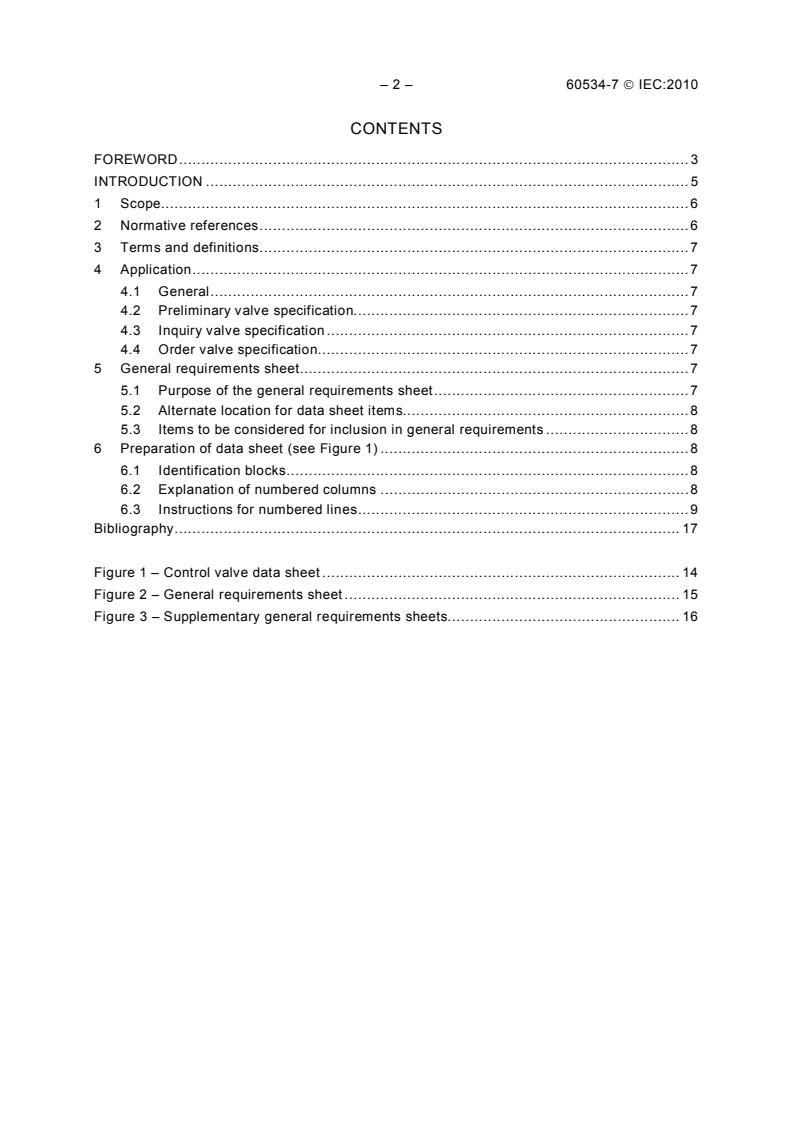
CONTENTS
FOREW ORD . 3
INTRODUCTION . 5
1 Sc o pe . 6
2 Normative references . 6
3 Terms and definitions . 7
4 Application . 7
4.1 Ge n eral . 7
4.2 Preliminary valve specification. 7
4.3 Inquiry valve specification . 7
4.4 Order valve specification. 7
5 General requirements sheet . 7
5.1 Purpose of the general requirements sheet . 7
5.2 Alternate location for data sheet items. 8
5.3 Items to be considered for inclusion in general requirements . 8
6 Preparation of data sheet (see Figure 1) . 8
6.1 Identification blocks . 8
6.2 Explanation of numbered columns . 8
6.3 Instructions for numbered lines . 9
Bibliography . 17
Figure 1 – Control valve data sheet . 14
Figure 2 – General requirements sheet . 15
Figure 3 – Supplementary general requirements sheets. 16
60534-7 Ó IEC:2010 – 3 –
INTERNATIONAL ELECTROTECHNICAL COMMISSION
____________
INDUSTRIAL-PROCESS CONTROL VALVES –
Part 7: Control valve data sheet
FOREWORD
1) The International Electrotechnical Commission (IEC) is a worldwide organization for standardization comprising
all national electrotechnical committees (IEC National Committees). The object of IEC is to promote
international co-operation on all questions concerning standardization in the electrical and electronic fields. To
this end and in addition to other activities, IEC publishes International Standards, Technical Specifications,
Technical Reports, Publicly Available Specifications (PAS) and Guides (hereafter referred to as “IEC
Publication(s)”). Their preparation is entrusted to technical committees; any IEC National Committee interested
in the subject dealt with may participate in this preparatory work. International, governmental and non-
governmental organizations liaising with the IEC also participate in this preparation. IEC collaborates closely
with the International Organization for Standardization (ISO) in accordance with conditions determined by
agreement between the two organizations.
2) The formal decisions or agreements of IEC on technical matters express, as nearly as possible, an international
consensus of opinion on the relevant subjects since each technical committee has representation from all
interested IEC National Committees.
3) IEC Publications have the form of recommendations for international use and are accepted by IEC National
Committees in that sense. While all reasonable efforts are made to ensure that the technical content of IEC
Publications is accurate, IEC cannot be held responsible for the way in which they are used or for any
misinterpretation by any end user.
4) In order to promote international uniformity, IEC National Committees undertake to apply IEC Publications
transparently to the maximum extent possible in their national and regional publications. Any divergence
between any IEC Publication and the corresponding national or regional publication shall be clearly indicated in
the latter.
5) IEC itself does not provide any attestation of conformity. Independent certification bodies provide conformity
assessment services and, in some areas, access to IEC marks of conformity. IEC is not responsible for any
services carried out by independent certification bodies.
6) All users should ensure that they have the latest edition of this publication.
7) No liability shall attach to IEC or its directors, employees, servants or agents including individual experts and
members of its technical committees and IEC National Committees for any personal injury, property damage or
other damage of any nature whatsoever, whether direct or indirect, or for costs (including legal fees) and
expenses arising out of the publication, use of, or reliance upon, this IEC Publication or any other IEC
Publications.
8) Attention is drawn to the Normative references cited in this publication. Use of the referenced publications is
indispensable for the correct application of this publication.
9) Attention is drawn to the possibility that some of the elements of this IEC Publication may be the subject of
patent rights. IEC shall not be held responsible for identifying any or all such patent rights.
International Standard IEC 60534-7 has been prepared by subcommittee 65B: Devices and
process analysis, of IEC technical committee 65: Industrial-process measurement, control and
automation.
This second edition cancels and replaces the first edition published in 1989. This edition
constitutes a technical revision.
The main changes with respect to the previous edition are listed below:
· the standard has been updated to reflect digital electronic accessories and fieldbus
protocols;
· to aid clarification, the explanation of terms and definitions contains the same
subheading as the information required in the control valve data sheet;
· the column numbering system has been replaced with descriptive title headings.
– 4 – 60534-7 Ó IEC:2010
The text of this standard is based on the following documents:
FDIS Report on voting
65B/756/FDIS 65B/771/RVD
Full information on the voting for the approval of this standard can be found in the report on
voting indicated in the above table.
This publication has been drafted in accordance with the ISO/IEC Directives, Part 2.
A list of all parts of the IEC 60534 series, published under the general title Industrial-process
control valves, can be found on the IEC website.
The committee has decided that the contents of this publication will remain unchanged until
the stability date indicated on the IEC web site under "http://webstore.iec.ch" in the data
related to the specific publication. At this date, the publication will be
• reconfirmed,
• withdrawn,
• replaced by a revised edition, or
• amended.
60534-7 Ó IEC:2010 – 5 –
INTRODUCTION
The writing of control valve specifications is an extremely important segment of the complete
design, purchase and manufacturing of any process control system.
If the wrong control valve is specified, due to either incomplete or erroneous specification, the
replacement of that valve becomes costly to both the user and the control valve manufacturer
and often results in undue project delay. Therefore, many of the important control valve users
and contractors have developed their own standard data sheets to eliminate as much
misunderstanding as possible regarding the valve specifications.
To avoid confusion between valve manufacturers, users and contractors, standardisation of
the datasheet is required.
The purpose of a standard control valve data sheet is to promote uniformity, both in content
and form. General use of this form by contractors, users and manufacturers offers many
advantages. For example:
· assisting in preparation of a complete specification by listing and providing space for
all principal descriptive options;
· promoting uniform terminology;
· facilitates quoting, purchasing, receiving, accounting and ordering procedures by
uniform display of information;
· providing a useful permanent record and information for checking;
· improving efficiency from initial concept to the final installation.
– 6 – 60534-7 Ó IEC:2010
INDUSTRIAL-PROCESS CONTROL VALVES –
Part 7: Control valve data sheet
1 Scope
This part of the IEC 60534 series provides a list of requirements that are normally necessary
for the procurement of the majority of control valves for process systems. No attempt is made
to include all possible requirements for any conceivable process.
The list is arranged in a format designed to assist the specification writer with a standardized
presentation of data and also to be a basis for use with data processing facilities.
A detailed set of instructions is included in order to ensure that the abbreviated terms are fully
understood and that consistent data entries are always made.
2 Normative references
The following referenced documents are indispensable for the application of this document.
For dated references, only the edition cited applies. For undated references, the latest edition
of the referenced document (including any amendments) applies.
IEC 60529:2001 Degrees of protection provided by enclosures (IP Code)
IEC 60534 (all parts), Industrial-process control valves
IEC 60534-1:2005, Industrial-process control valves – Part 1: Control valve terminology and
general considerations
IEC 60534-2-1:1998, Industrial-process control valves – Part 2-1: Flow-capacity – Sizing
equations for fluid flow under installed conditions
IEC 60534-2-4:2009, Industrial-process control valves – Part 2-4: Flow capacity – Inherent
flow characteristics and rangeability
IEC 60534-2-5:2003, Industrial-process control valves – Part 2-5: Flow-capacity – Sizing
equations for fluid flow through multistage control valves with interstage recovery
IEC 60534-3-1:2000, Industrial-process control valves – Part 3-1: Dimensions – Face-to-face
dimensions for flanged, two-way, globe-type, straight pattern and centre-to-face dimensions
for flanged, two-way, globe-type, angle pattern control valves
IEC 60534-3-2:2001, Industrial-process control valves – Part 3-2: Dimensions – Face-to-face
dimensions for rotary control valves except butterfly valves
IEC 60534-3-3:1998, Industrial-process control valves – Part 3-3: Dimensions – Dimensions
End-to-end dimensions for buttweld, two-way, globe-type, straight pattern control valves
IEC 60534-4:2006, Industrial-process control valves – Part 4: Inspection and routine testing
IEC 60534-5:2004, Industrial-process control valves – Part 5: Marking
60534-7 Ó IEC:2010 – 7 –
IEC 60534-8-1:2005, Industrial-process control valves – Part 8-1: Noise considerations –
Laboratory measurement of noise generated by aerodynamic flow through control valves
IEC 60534-8-3:2000, Industrial-process control valves – Part 8-3: Noise considerations –
Control valve aerodynamic noise prediction method
IEC 60534-8-4:2005, Industrial-process control valves – Part 8-4: Noise considerations –
Prediction of noise generated by hydrodynamic flow
3 Terms and definitions
For the purposes of this document, the terms and definitions given in the IEC 60534 series
apply.
4 Application
4.1 General
The control valve data sheet (Figure 1) below may be used for three different levels of control
valve selection.
4.2 Preliminary valve specification
For a preliminary inquiry and/or quotation, buyer and vendor may agree on a minimum level of
information. In this case, the buyer and manufacturer mark a few lines only in column 1 by a
dot, triangle or other symbol. This method minimizes efforts for both buyer and vendor.
4.3 Inquiry valve specification
In inquiry stage, some of the process data and also some of the general requirements will not
be fully known and specified. This may not allow the application of the IEC calculation
methods given in IEC 60534-2-1 and IEC 60534-2-5. Preliminary valve sizing methods may be
used at this stage. Since the main focus of the inquiry specification is to provide all data
required to work out a comparable technical and commercial quote, in most cases there is a
need to mark additional lines beyond those in 6.1. Also on the inquiry specification, the lines
in column 1 shall be marked by a dot, triangle or other symbol by the buyer and manufacturer.
4.4 Order valve specification
A complete ordering specification should ideally include all relevant information about the
valve, actuator and accessories concerned. In this case, the fully completed control valve
data sheet becomes a kind of passport, which allows an exact identification and can be used
for many purposes.
5 General requirements sheet
5.1 Purpose of the general requirements sheet
The purpose of the general requirements sheet (Figure 2), which is optional, is to provide a
means for the user to specify general or special requirements that are applicable to a valve or
group of valves. Examples are national and international standards, user company standards
and special project requirements. These general or special requirements shall be listed in the
table of contents section of page 1 of the general requirements sheet. Supplementary general
requirements sheets (Figure 3) may be used as necessary. It may also be necessary to cross-
reference the general requirements sheet(s) with the data sheets. If there is a conflict
between the general requirements sheet and the data sheet, then the latter shall overrule.
– 8 – 60534-7 Ó IEC:2010
NOTE For those countries that use 8,5 ´ 11 inch paper and where linefeed is limited to 1/6 inch, the general
requirements sheets can be shortened by deleting the appropriate length from the middle portion of the forms. The
data sheet can be shortened by deleting the “Remarks” section.
The use of computers permits an adjustable linefeed which allows the forms to be printed without the deletion of
any lines.
5.2 Alternate location for data sheet items
Any item on the data sheet (Figure 1) which cannot be adequately described in the available
space shall be covered on the general requirements sheet.
5.3 Items to be considered for inclusion in general requirements
Items not included on the data sheet may also be covered on the general requirements sheet.
The following is a partial list of areas that may need to be considered and to be stated on the
general requirements sheet:
a) terminology (see IEC 60534-1);
b) codes, standards and regulations;
c) valve sizing (see IEC 60534-2-1 and 60534-2-5);
d) noise (see IEC 60534-8-3, respectively IEC 60534-8-4);
e) inspection and routine testing (see IEC 60534-4);
f) non-destructive examination;
g) marking (see IEC 60534-5);
h) documentation;
i) material requirements;
j) face-to-face dimensions (see IEC 60534-3-1, IEC 60534-3-2 and IEC 60534-3-3)
k) final inspection requirements (see IEC 60534-4)
l) environmental considerations;
m) packaging;
n) accessories;
o) quality assurance requirements.
6 Preparation of data sheet (see Figure 1)
6.1 Identification blocks
The identification blocks at the top and bottom of this form are designed to permit the user or
contractor to add company name (upper left-hand corner), plant location, project number, tag
number, piping and instrumentation (P and I) drawing number, and other specific project data.
6.2 Explanation of numbered columns
The meaning of the numbered columns (1-5) under the heading is as follows:
(1) marking of lines for a preliminary valve specification or inquiry valve specification as
agreed between buyer and vendor (see 4.1 and 4.2);
(2) numbering of individual lines for identification purposes;
(3) marking of revisions (e.g. capital letters);
(4) main categories for which information is required;
(5) terms and definitions as explained below.
60534-7 Ó IEC:2010 – 9 –
6.3 Instructions for numbered lines
Line Explanation of terms and definitions
No.
1 Location of control valve concerned, for example, line No. 123 upstream of soaker.
2 Service/application, for example, feedwater to boiler.
3 a) Nature and degree of explosion hazard existing in this particular location.
Specify group, temperature and zone (e.g., Group IIC, T4, Zone 1) and refer to
appropriate standard.
b) Internal protection class according to IEC 60529.
4 Minimum and maximum ambient temperatures prevailing for the environment of the
installation which may arise due to service or weather conditions. State units.
5 Maximum sound pressure level (LpA) which the selected valve may be allowed to
produce under the specified service conditions.
6 Nominal pipe size (NPS/DN), schedule and/or wall thickness of upstream piping.
7 Nominal pipe size (NPS/DN), schedule and/or wall thickness of downstream piping.
8 a) Pipe Class (if any)
b) Pipe material and appropriate material standard.
9 The purpose of pipe insulation can be for thermal or acoustic reasons. The type
and thickness of insulation determines the acoustic attenuation.
10 Design pressure and maximum and minimum design temperature of the pipe (and
with this the design pressure and design temperature of the control valve also).
11 Pipe connection style, for example, flanges or butt weld ends for the upstream and
downstream connection of the control valve.
12 Description of process fluid concerned, for example, demineralized water or
superheated steam.
13 Physical state of the process fluid at upstream pressure and temperature.
14 Provide further information on the nature of the process fluid, such as
· non-Newtonian;
· entrained solids: Concentration, size, nature;
· polymerizing;
· erosive, abrasive;
· sticking;
· crystallizing, solidifying.
15-16 Minimum, normal and maximum flow rate as required by the process. It is
important to note that there is, dependent on the given application, a relationship
between the variables, i.e., the flow rate influences inlet and outlet pressures and
vice versa. Flow units: m /h, kg/h, t/h, etc.
NOTE Compressible fluid volumetric flow rates in cubic metres per hour, refer to either standard conditions,
which is an absolute pressure of 1 013,25 mbar and 288,6 °K, or normal conditions, which is an absolute
pressure of 1 013,25 mbar and 273 °K.
17-18 Absolute upstream and downstream pressures corresponding with minimum,
normal and maximum flow rates above. State units (bar, kPa, MPa, etc.).
19 Temperature at upstream condition (°C or K) with minimum, normal and maximum
flow rates above.
20 Density of process fluid at inlet pressure and inlet temperature with minimum,
normal and maximum flow rates above. For liquids and vapours, specify density in
3 3
kg /m. For gases, use either kg/m or molecular mass (M) as appropriate.
21 Vapour pressure at upstream temperature with minimum, normal and maximum
– 10 – 60534-7 Ó IEC:2010
Line Explanation of terms and definitions
No.
flow rates above. Specify as absolute pressure.
22 Thermodynamic critical pressure of process fluid. Specify as absolute pressure.
23 Kinematic or absolute (dynamic) viscosity of process fluid with minimum, normal
and maximum flow rates above. Specify units.
24 Ratio of specific heats for gases: g = c /c .
p v
25 Compressibility Factor Z at upstream pressure and temperature with minimum,
normal and maximum flow rates above: see individual charts or Nelson-Obert
compressibility chart.
26 Gas/vapour fraction of the fluid at the valve inlet in mass% with minimum, normal
and maximum flow rates above (applicable on 2-phase flow only).
27 For actuator sizing purposes, specify the valve inlet and outlet pressures, when the
valve is in the closed position, which will result in the maximum differential
pressure. State absolute pressures.
28 Minimum and maximum air (or other) supply pressures. State gauge pressures.
29 Position of control valve in case of loss of actuator motive power: valve open,
closed, or hold in last position.
30 Position of control valve in case of input signal loss: valve open, closed, or hold in
last position.
31 Calculated flow coefficient, K or C , with minimum, normal and maximum flow
v v
rates above.
NOTE If the flow coefficient calculations include the use of a piping geometry factor F , the value of
p
F can be identified on the data sheet. This may be accomplished by placing an asterisk after the flow
p
coefficient value and placing the corresponding F value in the Remarks section.
p
32 Valve X / Valve F (as appropriate) with the valve strokes corresponding to the
T L
calculated flow coefficients given in line 31. The valve manufacturer normally
provides this information.
33 Valve opening in percent of rated travel corresponding to the calculated flow
coefficients given in line 31.
34 Predicted sound pressure level (LpA) with minimum, normal and maximum flow
rates above. Method of noise prediction shall be in accordance to IEC 60534-8-3
or IEC 60534-8-4.
35 Valve manufacturer and model number.
36 Body type (straight pattern, angle or three-way)
37 Specify direction of flow through the body. FTO (flow-to-open) means that the
direction of flow coincides with the direction of valve closure movement to open the
valve. FTC (flow-to-close) means that the flow coincides with the direction of valve
closure movement to close the valve. These definitions are only applicable for
sliding stem valves and for eccentric rotary type valves. On other valve types, the
flow direction normally is specified by the valve manufacturer.
NOTE The descriptors FTO, FTC refer only to the direction of flow and do not necessarily indicate
the direction of fluid forces acting on the valve stem or shaft.
38 Pressure rating either as PN (Nominal Pressure) or Class. If a design pressure and
temperature instead of a pressure rating are given, this information shall be
identified as design conditions (e.g., design 90 bar/50 °C).
39 Nominal diameter of valve: DN 50 (NPS 2), DN 100 (NPS 4), DN 150 (NPS 6), etc.
60534-7 Ó IEC:2010 – 11 –
Line Explanation of terms and definitions
No.
40 End connection category (flanged, flangeless, welded or threaded). Specify type
within each category, for example, raised face flange or butt weld, in lines 41 and
42.
41 Type of end connection, for example flange facing according to EN 1092 or ANSI
RF or RTJ.
42 Dimensions and materials of valve connections or welded-on end extensions if
needed. Welded on extensions are usually used: (1) to accommodate different wall
thicknesses between the body inlet/outlet and the pipe, (2) to provide extensions of
the same material as the pipe to facilitate welding at the site, and/or (3) to prevent
overheating of the valve and its internal parts during the welding process at the
site.
43 Type of valve bonnet (if applicable).
44 (Blank) - Available for shaft/stem descriptions and connections.
45 Material and appropriate material standard (in case of lined valves state
body/lining material).
46 Description of trim, such as “parabolic plug”, “perforated plug”, “segmented ball”
etc. Add "P.B." for pressure balancing if appropriate.
47 Inherent flow characteristic of control valve concerned. Characteristics other than
linear or equal percentage should be defined, for example, mod.lin. = modified
linear.
48 Material and appropriate material standard for trim parts.
49 Material and appropriate material standard for trim parts.
50 Valve rated flow coefficient C (Cv/Kv) and inherent rangeability (as defined in
IEC 60534-2-4) of the selected control valve.
51 Style of seat (metal seat or soft seat).
52 Coating or hard facing material and extent of coating or hard facing: seating
surface only, closure member and seat ring surfaces. Also used for special
treatment of closure member materials, such as hardening, nitriding etc.
53 a) Torque (force) required to open the valve against internal friction and shut-off
pressure (Line 27).
b) Maximum allowed torque (force) allowed on the valve shaft (stem).
54 Leakage specification according to IEC 60534-4.
55 Valve stem packing type and material.
56 Specify, if valve has to be equipped with a steam jacket or not. If yes, specify
nominal pressure (PN) and material of the steam jacket
57 Actuator manufacturer and model number.
58 Type of pneumatic actuator.
59 Style of pneumatic actuator, for example spring return, double acting (without
spring).
60 Indicate size and diaphragm or piston area of selected pneumatic actuator. Unit
cm .
61 Nominal travel of valve and actuator. For sliding stem valves state units in
millimetres. For rotary valves state units in degrees.
– 12 – 60534-7 Ó IEC:2010
Line Explanation of terms and definitions
No.
62 Maximum allowable supply pressure to avoid damage to, and minimum operating
supply pressure to avoid malfunction of actuator and/or valve. State gauge pressures.
63 Range of pressures to the actuator within which the nominal travel is performed in both
directions, with no pressure in the valve, but including friction forces
NOTE The actuator operating range, i.e. when the valve is installed under actual process
conditions, will be different from the bench range.
64 a) state required min. and max. stroking time in seconds.
b) in high frequency applications, state frequency of valve opening/closing in
1/min.
65 Size and thread of air connection.
66 For non-pneumatic actuators, specify type and give other appropriate information.
67 Manufacturer to state the minimum and maximum actuator force (torque) with the
air supply limits given in line 28. Minimum and maximum actuator force shall be
within the limits given in line 53.
68 Type of handwheel and function.
69 If applicable, working direction and position of limit stops.
70 Positioner manufacturer and model number.
71 Type of instrument signal.
72 Lower and upper end of instrument signal span at which valve shall be open or
closed. State electrical units or gauge pressures.
73 Line blank.
74 Style of valve positioner.
NOTE Springless actuators (piston type) usually need a double acting positioner providing two
pneumatic output pressures acting on both sides of the piston.
75 Required positioner characteristic to produce requested control valve
characteristic. Digital positioners often allow a free programmable positioner
characteristic.
NOTE Normally the positioner characteristic is linear, but in some applications a special positioner
characteristics may be used to convert an inherent linear valve characteristic to a linear or equal
percentage one.
76 a) Size and thread of air connection
b) Thread of electrical connection
77 Positioner bypass and/or gauges, if needed.
78 Specify the type of protection mode (such as intrinsically safe or flameproof
enclosure). Classification of hazardous area shall be specified in line 3. ®
79 Specify the digital communication system (if any), such as HART , Foundation
ä ®
Fieldbus or Profibus .
80 Position indicator switch manufacturer and model number.
81 Switch type: mechanical, proximity or pneumatic.
—————————
HARTâ, Foundation Fieldbusä and Profibusâ are examples of suitable products available commercially. This
information is given for the convenience of users of this document and does not constitute an endorsement by
IEC of these products.
60534-7 Ó IEC:2010 – 13 –
Line Explanation of terms and definitions
No.
82 Switching position(s) related to valve travel.
83 State of circuits in position(s) defined in line 82. (N.O. means normally (not
operated) open, N.C. stands for normally closed)
84 Specify the type of protection mode (such as intrinsically safe or flameproof
enclosure). Classification of hazardous area shall be specified in line 3.
85 State if the position switches shall be external or internal (mounted into positioner).
86 Solenoid valve manufacturer and model number.
87 Body style of solenoid valve.
88 Position of control valve in case of electric power failure or emergency situations,
whether open, closed or hold in last position.
89 On digital operated solenoid valves state communication system.
90 Size and thread of air connection. State minimum port size required.
91 Electrical data for solenoid valve: supply voltage d.c./a.c., frequency and power
consumption.
92 Specify the type of protection mode (such as intrinsically safe or flameproof
enclosure). Classification of hazardous area to be specified in line 3.
93 (Blank) Provide further information, if appropriate, for example, cable gland
(M20´1,5).
94 Manufacturer of air supply regulator and model number.
95 Filter and gauge, if needed.
96 Manufacturer of electro-pneumatic or electro-hydraulic transducer and model
number.
97 Specify input and output signal span, if necessary.
98 Pneumatic amplifier manufacturer and model number.
99 Valve position feedback transmitter – electric, pneumatic or digital.
100 Air lockup valve manufacturer and model number.
101 Air trip valve manufacturer and model number.
102 Inside diameter and/or outside diameter of tubing, as appropriate, and state units.
Specify tubing material, for example, stainless steel.
103 Specify manufacturer, type and material of tubing fittings, if necessary.
104-108 Specify test certificates required, non-destructive examination standards and
acceptance criteria and parts to be included.
109-110 Specify further requirements, if necessary. Put special notes under Remarks, if
necessary.
111 Specify detailed hardware requirements on digital communication (refer to line 71,
89 and 99)
112 Specify detailed software compatibility requirements on digital communication.
NOTE Users of this standard may choose to create their own data sheet by deleting the selection boxes and the
corresponding information; however, line numbers and the general purpose of the lines should be retained.
– 14 – 60534-7 Ó IEC:2010
Tag No.
CONTROL VALVE DATA SHEET
Serial No.
1 2 3 4 5 1 2 3 4 5
TERMS & DEFINITIONS TERMS & DEFINITIONS
1 Location 57 MFR Model
2 Service 58 Pneumatic diaphragm piston
3 Haz. area class IP Code 59 Style sprg. return double act.
4 Ambient temp. min. max. 60 Size eff area cm²
5 Allowable sound pressure level dB(A) 61 Travel/angle
6 Upstr. pipe NPS/DN SCH t(mm) 62 Supply press. min. max. bar g
7 Downstr. pipe NPS/DN SCH t(mm) 63 Bench range bar g
8 Pipe class Material 64 Stroking time min max s frequency /min
9 Pipe insulation thermal acoustic 65 Air connection
10 Design: Press. bar g Temp. max min °C 66 Other actuator elect. hydraulic manual
11 Pipe connection upstr. downstr. 67 Act. force/torque min max unit
12 Process fluid 68 manual override no mechanic hydraulic
13 Upstream cond. liquid vapour gas 2phase 69 limit stops closed % travel open
14 Special fluid properties: 70 MFR Model
15 Min. Norm. Max. Unit 71
Input signal pneum. electric analog digital
16 Flow rate 72 Valve open at Valve closed at
17 Inlet press. P1 73
18 Outlet press. P2 74 Style single act. double act.
19 Temperature T1 75 Characteristic linear eq% modified
20 Inlet density r1 or M 76 Air connection Electr.connection
21 Vapour pressure Pv 77 Accessories bypass gauges
22 Critical pressure Pc 78 Protection mode
23 Viscosity 79
Digital comm. HART FF Profibus ………
24 Specific heat ratio g 1 80 MFR Model
25 Comp.fact. Z1 1 81
Switch type mech. proximity ……….
26 Gas/vapour mass fract. % 82
Switching pos. closed % travel open
27 Shutoff press. P1 P2 Unit 83 Switch acting N.O. N.C.
28 Air supply min. max. Unit 84 Protection mode
29 Power fail position open closed hold 85 Assembly external built-in
30 Signal fail position open closed hold 86 MFR Model
31 Calc. C Kv Cv 87 Valve type 2 way 3/2 way 5/2 way
32 Valve X F 1 88 De-energ.: control valve open closed hold
T L
33 Relative travel % 89 digital operated
34 Predicted LpA dB(A) 90 Air connection Port size
35 MFR Model 91 Electrical data V Hz W
36 Body type straight angle 3-way 92 Protection mode
37 93
Flow direction FTO FTC manuf.std.
38 Pressure rating 94 Air set MFR. Model
39 Nominal size 95 with filter with gauge
40 End conn. flgd. flgless. welded thrd. 96 I/P converter MFR. Model
41 Connection spec. 97 Input Signal Output Signal
42 End connections upstr. downstr. 98 Booster MFR. Model
43 99
Bonnet style standard extension bellows Pos. feedback electr. pneum. digital
44 100 Lockup relays MFR. Model
45 Body/bonnet mat. 101 Air trip valve MFR. Model
46 Trim Type 102 Air tubing Mat.
47 Characteristic linear eq. percent ……………. 103 Air fittings Mal.
48 Closure member mat. stem mat. 104
Test certificate(s) chem. and mech. test
49 Guide(cage) mat. seat mat. 105 NDE Examination surface volume
50 Rated C Kv Cv Inh.rangeability :1 106 Acceptance Std./Criteria
51 Seat style metallic soft seated 107 Parts to be tested body/bonnet
52 Trim coating/treatment 108
bolts/nuts trim
53 Breakaway force/torque max. allowed 109
54 Leakage specification IEC 60534-4 Class: 110
55 Packing adjustable self adj. Mat. 111 Dig. Communication:
56 Steam jacket: no yes; PN Mat. 112 Software drivers:
Remarks:
Project Dwg. ref. No.
Plant Mt. req. No.
Rev. Date Name Date Name P.O. No. Item No. Qty
Figure 1 – Control valve data sheet
SEL
ITEM
REV
VALVE BODY ASSEMBLY C/LpA PROCESS DATA RELEVANT FOR CONTROL SELECTION
MAIN
SEL
ITEM
REV
SPECIAL REQUIREMENTS OTHERS SOLENOID VALVE POS.IND.SWITCH POSITIONER ACTUATOR
MAIN
60534-7 Ó IEC:2010 – 15 –
Project
GENERAL REQUIREMENTS
FOR CONTROL VALVES
Plant
The purpose of this specification is to define general requirements for control valves. Those general requirements shall be
considered as part of the requirement for the equipment covered by the individual material requisitions and/or control
valve data sheets.
Table of contents
Requirements Page Requirements Page
Customer Spec. No.
P.O. No.
Rev. Date Name Date Name Mat. Req. No. Page of
Figure 2 – General requirements sheet
– 16 – 60534-7 Ó IEC:2010
Project
GENERAL REQUIREMENTS
FOR CONTROL VALVES
Plant
Customer Spec. No.
P.O. No.
Rev. Date Name Date Name Mat. Req. No. Page of
Figure 3 – Supplementary general requirements sheets
60534-7 Ó IEC:2010 – 17 –
Bibliography
EN 1092, Flanges and their joints – Circular flanges for pipes, valves, fittings and accessories, PN
designated – Part 1: Steel flanges
ASME B16.5, Flanges and flanged fittings: NPS 1/2 through NPS 24 metric/inch standard
___________
– 18 – 60534-7 Ó CEI:2010
SOMMAIRE
AVANT-PROPOS . 19
INTRODUCTION . 21
1 Domaine d'application . 22
2 Références normatives. 22
3 Termes et définitions . 23
4 Utilisation . 23
4.1 Généralités . 23
4.2 Spécification préliminaire d'une vanne. 23
4.3 Spécification de l'appel d'offre pour une vanne . 23
4.4 Spécification de la passation de commande pour une vanne. 23
5 Feuille d'exigences générales . 24
5.1 But de la feuille d'exigences générales . 24
5.2 Emplacement alternatif des éléments de la grille de définition. 24
5.3 Éléments à considérer pour être inclus dans les exigences générales . 24
6 Préparation de la grille de définition (voir Figure 1) . 25
6.1 Cases d'identification . 25
6.2 Explications sur les colonnes numérotées . 25
6.3 Instructions relatives aux lignes numérotées . 25
Bibliographie . 34
Figure 1 – Grille de définition de vanne de régulation . 31
Figure 2 – Feuille d'exigences générales .
...