

IEC 60352-8:2011
(Main)Solderless connections - Part 8: Compression mount connections - General requirements, test methods and practical guidance
General Information
- Abstract
IEC 60352-8:2011 Is applicable to compression mount connections with metallic spring contacts for use in telecommunication equipments and in other electronic devices employing similar techniques. Information on materials and data from industrial experience are included in addition to the test procedures to provide electrically stable connections under prescribed environmental conditions. The object of this part of IEC 60352 is to determine the suitability of compression mount connections under specified electrical, mechanical and atmospheric conditions and to provide a means of comparing test results when the tools used to make the connectors are of different designs or manufacture.
- Status
- Published
- Publication Date
- 09-Feb-2011
- Technical Committee
- SC 48B - Electrical connectors
- Drafting Committee
- WG 6 - TC 48/SC 48B/WG 6
- Current Stage
- PPUB - Publication issued
- Start Date
- 10-Feb-2011
- Completion Date
- 15-Mar-2011
Overview
IEC 60352-8:2011 is an international standard from the International Electrotechnical Commission (IEC) that covers solderless connections, specifically focusing on compression mount connections using metallic spring contacts. This standard applies primarily to telecommunications equipment and other electronic devices using similar connection techniques. It establishes general requirements, test methods, and practical guidance aimed at ensuring the reliability, electrical stability, and mechanical integrity of compression mount connections under specified electrical, mechanical, and environmental conditions.
The document not only provides test procedures but also includes insights on materials and industrial experience to assist manufacturers in creating robust and durable connections. IEC 60352-8:2011 helps compare test results, even when different mounting tools and connector designs are employed, facilitating consistency and quality control in production.
Key Topics
Scope and Applicability
The standard applies to compression mount connections with metallic spring contacts, covering materials, design features, connector bodies, printed wiring boards (PWBs), and mounting tools for reliable electronic connections.Requirements
Clear specifications address:- Materials of contacts and connectors to ensure electrical and mechanical performance.
- Design features that optimize compression mount contact geometries and surface finishes for reliability.
- Printed wiring board materials and finishes suited for compression mount techniques.
- Requirements for mounting tools and equipment to maintain quality and repeatability.
Test Procedures
IEC 60352-8 defines detailed test methods to evaluate:- Mechanical robustness (vibration, endurance).
- Electrical performance (contact resistance, current-carrying capacity).
- Climatic and environmental stability (corrosion resistance, temperature variations, humidity).
Two test schedules are specified:
- Basic test schedule for general conformity.
- Full test schedule for new components or designs that do not fully comply initially.
Practical Guidance
Guidance covers benefits such as ease of assembly, environmental advantages compared to soldered connections, and design considerations for connector housings and PWBs. The standard encourages reducing environmental impact by promoting proper material selection aligned with IEC Guide 109.
Applications
IEC 60352-8:2011 is crucial for industries engaged in manufacturing and quality assurance of:
Telecommunications Equipment
Ensuring reliable compression mount connections in telecom devices subjected to diverse environmental and mechanical stress factors.Consumer Electronics
Where solderless connections provide rapid assembly and maintenance advantages.Industrial Electronics and Control Systems
Facilitating durable connectivity that holds under industrial vibrations and temperature variations.Printed Wiring Board (PWB) Assembly
Guiding the design and material selection for PWBs to maximize compatibility and durability with compression mount connectors.
This standard supports manufacturers and engineers in optimizing connector designs, improving connection stability, and verifying product quality through standardized testing methods, thereby enhancing product longevity and user safety.
Related Standards
IEC 60352-8 references and complements several key standards, including:
IEC 60050(581):2008
International Electrotechnical Vocabulary – establishing definitions related to electromechanical components.IEC 60068-1:1988 and Amendment 1 (1992)
Environmental testing general principles – guidance for climatic and mechanical test conditions.IEC 60512 Series
Detailed tests and measurements for connectors in electric and electronic equipment, providing a broader context for connector reliability.IEC 61249-2-7:2002
Materials for printed boards – specification for reinforced base materials commonly used with compression mount technology.
Together, these standards form a comprehensive framework governing the materials, design, testing, and environmental requirements essential for reliable compression mount, solderless connections in modern electronic applications.
By following IEC 60352-8:2011, engineers and manufacturers can achieve consistent electrical connections that perform reliably under mechanical stress and environmental challenges, supporting innovation and quality in telecommunications and electronics industries. This standard plays a critical role in advancing solderless connection technologies with practical, test-proven guidance.
Frequently Asked Questions
IEC 60352-8:2011 is a standard published by the International Electrotechnical Commission (IEC). Its full title is "Solderless connections - Part 8: Compression mount connections - General requirements, test methods and practical guidance". This standard covers: IEC 60352-8:2011 Is applicable to compression mount connections with metallic spring contacts for use in telecommunication equipments and in other electronic devices employing similar techniques. Information on materials and data from industrial experience are included in addition to the test procedures to provide electrically stable connections under prescribed environmental conditions. The object of this part of IEC 60352 is to determine the suitability of compression mount connections under specified electrical, mechanical and atmospheric conditions and to provide a means of comparing test results when the tools used to make the connectors are of different designs or manufacture.
IEC 60352-8:2011 Is applicable to compression mount connections with metallic spring contacts for use in telecommunication equipments and in other electronic devices employing similar techniques. Information on materials and data from industrial experience are included in addition to the test procedures to provide electrically stable connections under prescribed environmental conditions. The object of this part of IEC 60352 is to determine the suitability of compression mount connections under specified electrical, mechanical and atmospheric conditions and to provide a means of comparing test results when the tools used to make the connectors are of different designs or manufacture.
IEC 60352-8:2011 is classified under the following ICS (International Classification for Standards) categories: 31.220.10 - Plug-and-socket devices. Connectors. The ICS classification helps identify the subject area and facilitates finding related standards.
IEC 60352-8:2011 is available in PDF format for immediate download after purchase. The document can be added to your cart and obtained through the secure checkout process. Digital delivery ensures instant access to the complete standard document.
Standards Content (Sample)
IEC 60352-8 ®
Edition 1.0 2011-02
INTERNATIONAL
STANDARD
NORME
INTERNATIONALE
colour
inside
Solderless connections –
Part 8: Compression mount connections – General requirements, test methods
and practical guidance
Connexions sans soudure –
Partie 8: Connexions par compression – Exigences générales, méthodes d’essai
et guide pratique
All rights reserved. Unless otherwise specified, no part of this publication may be reproduced or utilized in any form or by
any means, electronic or mechanical, including photocopying and microfilm, without permission in writing from either IEC or
IEC's member National Committee in the country of the requester.
If you have any questions about IEC copyright or have an enquiry about obtaining additional rights to this publication,
please contact the address below or your local IEC member National Committee for further information.
Droits de reproduction réservés. Sauf indication contraire, aucune partie de cette publication ne peut être reproduite
ni utilisée sous quelque forme que ce soit et par aucun procédé, électronique ou mécanique, y compris la photocopie
et les microfilms, sans l'accord écrit de la CEI ou du Comité national de la CEI du pays du demandeur.
Si vous avez des questions sur le copyright de la CEI ou si vous désirez obtenir des droits supplémentaires sur cette
publication, utilisez les coordonnées ci-après ou contactez le Comité national de la CEI de votre pays de résidence.
IEC Central Office
3, rue de Varembé
CH-1211 Geneva 20
Switzerland
Email: inmail@iec.ch
Web: www.iec.ch
About the IEC
The International Electrotechnical Commission (IEC) is the leading global organization that prepares and publishes
International Standards for all electrical, electronic and related technologies.
About IEC publications
The technical content of IEC publications is kept under constant review by the IEC. Please make sure that you have the
latest edition, a corrigenda or an amendment might have been published.
Catalogue of IEC publications: www.iec.ch/searchpub
The IEC on-line Catalogue enables you to search by a variety of criteria (reference number, text, technical committee,…).
It also gives information on projects, withdrawn and replaced publications.
IEC Just Published: www.iec.ch/online_news/justpub
Stay up to date on all new IEC publications. Just Published details twice a month all new publications released. Available
on-line and also by email.
Electropedia: www.electropedia.org
The world's leading online dictionary of electronic and electrical terms containing more than 20 000 terms and definitions
in English and French, with equivalent terms in additional languages. Also known as the International Electrotechnical
Vocabulary online.
Customer Service Centre: www.iec.ch/webstore/custserv
If you wish to give us your feedback on this publication or need further assistance, please visit the Customer Service
Centre FAQ or contact us:
Email: csc@iec.ch
Tel.: +41 22 919 02 11
Fax: +41 22 919 03 00
A propos de la CEI
La Commission Electrotechnique Internationale (CEI) est la première organisation mondiale qui élabore et publie des
normes internationales pour tout ce qui a trait à l'électricité, à l'électronique et aux technologies apparentées.
A propos des publications CEI
Le contenu technique des publications de la CEI est constamment revu. Veuillez vous assurer que vous possédez
l’édition la plus récente, un corrigendum ou amendement peut avoir été publié.
Catalogue des publications de la CEI: www.iec.ch/searchpub/cur_fut-f.htm
Le Catalogue en-ligne de la CEI vous permet d’effectuer des recherches en utilisant différents critères (numéro de référence,
texte, comité d’études,…). Il donne aussi des informations sur les projets et les publications retirées ou remplacées.
Just Published CEI: www.iec.ch/online_news/justpub
Restez informé sur les nouvelles publications de la CEI. Just Published détaille deux fois par mois les nouvelles
publications parues. Disponible en-ligne et aussi par email.
Electropedia: www.electropedia.org
Le premier dictionnaire en ligne au monde de termes électroniques et électriques. Il contient plus de 20 000 termes et
définitions en anglais et en français, ainsi que les termes équivalents dans les langues additionnelles. Egalement appelé
Vocabulaire Electrotechnique International en ligne.
Service Clients: www.iec.ch/webstore/custserv/custserv_entry-f.htm
Si vous désirez nous donner des commentaires sur cette publication ou si vous avez des questions, visitez le FAQ du
Service clients ou contactez-nous:
Email: csc@iec.ch
Tél.: +41 22 919 02 11
Fax: +41 22 919 03 00
IEC 60352-8 ®
Edition 1.0 2011-02
INTERNATIONAL
STANDARD
NORME
INTERNATIONALE
colour
inside
Solderless connections –
Part 8: Compression mount connections – General requirements, test methods
and practical guidance
Connexions sans soudure –
Partie 8: Connexions par compression – Exigences générales, méthodes d’essai
et guide pratique
INTERNATIONAL
ELECTROTECHNICAL
COMMISSION
COMMISSION
ELECTROTECHNIQUE
PRICE CODE
INTERNATIONALE
CODE PRIX S
ICS 31.220.10 ISBN 978-2-88912-363-6
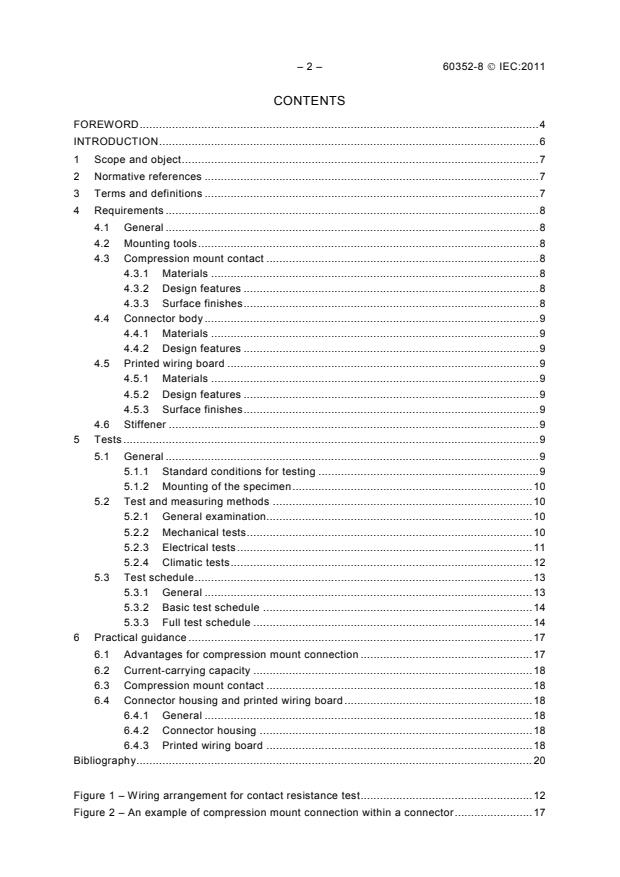
– 2 – 60352-8 IEC:2011
CONTENTS
FOREWORD . 4
INTRODUCTION . 6
1 Scope and object . 7
2 Normative references . 7
3 Terms and definitions . 7
4 Requirements . 8
4.1 General . 8
4.2 Mounting tools . 8
4.3 Compression mount contact . 8
4.3.1 Materials . 8
4.3.2 Design features . 8
4.3.3 Surface finishes . 8
4.4 Connector body . 9
4.4.1 Materials . 9
4.4.2 Design features . 9
4.5 Printed wiring board . 9
4.5.1 Materials . 9
4.5.2 Design features . 9
4.5.3 Surface finishes . 9
4.6 Stiffener . 9
5 Tests . 9
5.1 General . 9
5.1.1 Standard conditions for testing . 9
5.1.2 Mounting of the specimen . 10
5.2 Test and measuring methods . 10
5.2.1 General examination. 10
5.2.2 Mechanical tests . 10
5.2.3 Electrical tests . 11
5.2.4 Climatic tests . 12
5.3 Test schedule . 13
5.3.1 General . 13
5.3.2 Basic test schedule . 14
5.3.3 Full test schedule . 14
6 Practical guidance . 17
6.1 Advantages for compression mount connection . 17
6.2 Current-carrying capacity . 18
6.3 Compression mount contact . 18
6.4 Connector housing and printed wiring board . 18
6.4.1 General . 18
6.4.2 Connector housing . 18
6.4.3 Printed wiring board . 18
Bibliography . 20
Figure 1 – Wiring arrangement for contact resistance test . 12
Figure 2 – An example of compression mount connection within a connector . 17
60352-8 IEC:2011 – 3 –
Table 1 – Vibration, preferred test severities . 11
Table 2 – Group P – basic test . 14
Table 3 – Group A – corrosion test . 15
Table 4 – Group B – mechanical test . 15
Table 5 – Group C – climatic test . 16
Table 6 – Group D – current carrying capacity test . 16
– 4 – 60352-8 IEC:2011
INTERNATIONAL ELECTROTECHNICAL COMMISSION
____________
SOLDERLESS CONNECTIONS –
Part 8: Compression mount connections –
General requirements, test methods and practical guidance
FOREWORD
1) The International Electrotechnical Commission (IEC) is a worldwide organization for standardization comprising
all national electrotechnical committees (IEC National Committees). The object of IEC is to promote international
co-operation on all questions concerning standardization in the electrical and electronic fields. To this end and in
addition to other activities, IEC publishes International Standards, Technical Specifications, Technical Reports,
Publicly Available Specifications (PAS) and Guides (hereafter referred to as “IEC Publication(s)”). Their
preparation is entrusted to technical committees; any IEC National Committee interested in the subject dealt with
may participate in this preparatory work. International, governmental and non-governmental organizations liaising
with the IEC also participate in this preparation. IEC collaborates closely with the International Organization for
Standardization (ISO) in accordance with conditions determined by agreement between the two organizations.
2) The formal decisions or agreements of IEC on technical matters express, as nearly as possible, an international
consensus of opinion on the relevant subjects since each technical committee has representation from all
interested IEC National Committees.
3) IEC Publications have the form of recommendations for international use and are accepted by IEC National
Committees in that sense. While all reasonable efforts are made to ensure that the technical content of IEC
Publications is accurate, IEC cannot be held responsible for the way in which they are used or for any
misinterpretation by any end user.
4) In order to promote international uniformity, IEC National Committees undertake to apply IEC Publications
transparently to the maximum extent possible in their national and regional publications. Any divergence between
any IEC Publication and the corresponding national or regional publication shall be clearly indicated in the latter.
5) IEC itself does not provide any attestation of conformity. Independent certification bodies provide conformity
assessment services and, in some areas, access to IEC marks of conformity. IEC is not responsible for any
services carried out by independent certification bodies.
6) All users should ensure that they have the latest edition of this publication.
7) No liability shall attach to IEC or its directors, employees, servants or agents including individual experts and
members of its technical committees and IEC National Committees for any personal injury, property damage or
other damage of any nature whatsoever, whether direct or indirect, or for costs (including legal fees) and expenses
arising out of the publication, use of, or reliance upon, this IEC Publication or any other IEC Publications.
8) Attention is drawn to the Normative references cited in this publication. Use of the referenced publications is
indispensable for the correct application of this publication.
9) Attention is drawn to the possibility that some of the elements of this IEC Publication may be the subject of patent
rights. IEC shall not be held responsible for identifying any or all such patent rights.
International Standard IEC 60352-8 has been prepared by subcommittee 48B: Connectors, of
IEC technical committee 48: Electromechanical components and mechanical structures for
electronic equipment.
The text of this standard is based on the following documents:
FDIS Report on voting
48B/2223/FDIS 48B/2229/RVD
Full information on the voting for the approval of this standard can be found in the report on
voting indicated in the above table.
This publication has been drafted in accordance with the ISO/IEC Directives, Part 2.
A list of all parts of the IEC 60352 series, published under the general title Solderless
connections, can be found on the IEC website.
60352-8 IEC:2011 – 5 –
The committee has decided that the contents of this publication will remain unchanged until the
stability date indicated on the IEC web site under "http://webstore.iec.ch" in the data related to
the specific publication. At this date, the publication will be
• reconfirmed;
• withdrawn;
• replaced by a revised edition, or
• amended.
IMPORTANT – The 'colour inside' logo on the cover page of this publication indicates
that it contains colours which are considered to be useful for the correct understanding
of its contents. Users should therefore print this document using a colour printer.
– 6 – 60352-8 IEC:2011
INTRODUCTION
This part of IEC 60352 includes requirements, tests and practical guidance information.
Two test schedules are provided:
A basic test schedule applies to compression mount connections which conform to all of the
requirements given in Clause 4.
A full test schedule applies to compression mount connections which are part of a new
component and have already passed the basic test schedule or to connections of the same kind
which do not fully comply with the requirements of Clause 4.
Requirements given in Clause 4 are derived from experience with successful applications of
such compression mount connections.
IEC Guide 109 advocates the need to minimize the impact of a product on the natural
environment throughout the product life cycle.
It is understood that some of the materials permitted in this standard may have a negative
environmental impact.
As technological advances lead to acceptable alternatives for these materials, they will be
eliminated from the standard.
60352-8 IEC:2011 – 7 –
SOLDERLESS CONNECTIONS –
Part 8: Compression mount connections –
General requirements, test methods and practical guidance
1 Scope and object
This part of IEC 60352 is applicable to compression mount connections with metallic spring
contacts for use in telecommunication equipments and in other electronic devices employing
similar techniques.
Information on materials and data from industrial experience are included in addition to the test
procedures to provide electrically stable connections under prescribed environmental
conditions.
The object of this part of IEC 60352 is to determine the suitability of compression mount
connections under specified electrical, mechanical and atmospheric conditions and to provide a
means of comparing test results when the tools used to make the connectors are of different
designs or manufacture.
2 Normative references
The following referenced documents are indispensable for the application of this document. For
dated references, only the edition cited applies. For undated references, the latest edition of the
referenced document (including any amendments) applies.
IEC 60050(581):2008, International Electrotechnical Vocabulary (IEV) – Part 581:
Electromechanical components for electronic equipment
IEC 60068-1:1988, Environmental testing – Part 1: General and guidance
Amendment 1 (1992)
IEC 60512 (all parts), Connectors for electric equipment – Tests and measurements
IEC 60512-1, Connectors for electronic equipment – Tests and measurements – Part 1: General
IEC 60512-1-100, Connectors for electric equipment – Tests and measurements – Part 1-100:
General – Applicable publications
IEC 61249-2-7:2002, Materials for printed boards and other interconnecting structures –
Part 2-7: Reinforced base materials clad and unclad – Epoxide woven E-glass laminated sheet
of defined flammability (vertical burning test), copper-clad
3 Terms and definitions
For the purposes of this document, the terms and definitions given in IEC 60050(581) and
IEC 60512-1 as well as the following (additional) terms and definitions apply.
3.1
compression mount connection
solderless connection between a compression mount contact and a contact pad which is
established by a continuous compression force
– 8 – 60352-8 IEC:2011
3.2
compression mount contact
conductive element in a compression mount connector which makes contact with its
corresponding contact pad on a printed wiring board to provide an electrical path
3.3
contact pad (land)
conductive element on a printed wiring board which makes contact with its corresponding
compression mount contact of a connector to provide an electrical path
NOTE Usually the contact area on devices such as on semiconductors is called “land”.
3.4
stiffener
component used to provide resistance against warpage of a printed wiring board
3.5
locating pin
guiding element equipped with a connector body or a printed wiring board for accurate
positioning of the connector on the printed wiring board by mating with its corresponding locating
slot (or hole)
3.6
locating slot (or locating hole)
guiding element equipped with a printed wiring board or a connector body to accommodate a
locating pin
4 Requirements
4.1 General
The connections are made in accordance with the connector manufacturer’s instructions.
4.2 Mounting tools
Mounting tools for a compression mount connector on a printed wiring board shall be specified
in the detail specification.
When a screw driver is used, torque shall be specified in the detail specification. If any special
tools are required, tooling instructions shall be provided by the manufacturer.
4.3 Compression mount contact
4.3.1 Materials
Suitable contact materials satisfying the test and requirements of this standard shall be used.
4.3.2 Design features
Contact force of the compression mount connection shall be such that the connector meets all
the relevant requirements of this standard.
4.3.3 Surface finishes
Finishes used on metallic elements of the connector shall be such that the connector meets all
the relevant requirements of this standard.
60352-8 IEC:2011 – 9 –
4.4 Connector body
4.4.1 Materials
Suitable connector body materials satisfying the test and requirements of this standard shall be
used.
4.4.2 Design features
A connector body shall be provided with a locating pin(s), slot(s) or hole(s) that allows the
connector to be positioned on the printed wiring board accurately. Dimensions and location of
pin(s), slot(s) or hole(s) shall be specified in the detail specification.
4.5 Printed wiring board
4.5.1 Materials
The materials of a printed wiring board shall be in accordance with IEC 61249-2-7.
4.5.2 Design features
The thickness of a printed wiring board shall be specified in the detail specification. The
dimensions and layout of contact pads (lands) shall be specified in the detail specification. A
printed wiring board shall be provided with a locating slot(s), hole(s) or pin(s), and the
dimensions of those shall be specified in the detail specification.
4.5.3 Surface finishes
Contact pads (lands) of a printed wiring board shall be plated free from contamination and
corrosion visible to the unaided eye.
4.6 Stiffener
If required, stiffener shall be specified in the detail specification.
5 Tests
5.1 General
5.1.1 Standard conditions for testing
Unless otherwise specified, all tests shall be carried out under standard atmospheric conditions
for testing, as specified in IEC 60512-1.
The ambient temperature and the relative humidity at which the measurements are made shall
be stated in the test report.
In case of dispute about test results, the test shall be repeated at one of the referee conditions
of IEC 60068-1.
5.1.1.1 Preconditioning
Where specified, specimens shall be preconditioned under the standard atmospheric conditions
for a period of 24 h, as specified in IEC 60512-1.
5.1.1.2 Recovery
Where specified, the specimens shall be allowed to recover under the standard atmospheric
conditions for a period of 1 h to 2 h after conditioning.
– 10 – 60352-8 IEC:2011
5.1.2 Mounting of the specimen
The specimen shall consist of the connector including compression mount connections and a
printed wiring board, unless otherwise specified.
When mounting is required in a test, the connector shall be mounted using the normal mounting
method.
5.2 Test and measuring methods
5.2.1 General examination
5.2.1.1 Visual examination
The test shall be carried out in accordance with test 1a: Visual examination, IEC 60512-1-1. The
visual examination test shall be carried out with magnification approximately five times.
Specimens shall be examined to ensure that the applicable requirements given in 4.3 to 4.6
have been met.
5.2.1.2 Examination of dimension
The test shall be carried out in accordance with test 1b: Examination of dimension and mass,
IEC 60512-1-2.
Specimens shall be examined to ensure that the applicable requirements given in 4.3 to 4.6
have been met.
5.2.2 Mechanical tests
5.2.2.1 Mechanical operation
The test is to examine the successful mounting of compression mount contacts against
mechanical stress during the mounting process of the compression mount connectors on a
printed wiring board.
The test shall be carried out in accordance with test 9a: Mechanical operation, IEC 60512-5.
Mounting and un-mounting method shall be specified in the detail specification.
A printed wiring board used for the test shall have contact pads that can make contact with the
contacts of a connector under test.
Unless otherwise specified in the detail specification, mechanical operation shall be conducted
for three cycles.
The same printed wiring board shall be used throughout the whole test, and the connector shall
be always positioned at the same location on the printed wiring board.
NOTE This may be achieved e.g. by means of suitable locating slots or pins on the two mating parts (printed wiring
board and connector).
5.2.2.2 Vibration
The test shall be carried out in accordance with test 6d: Vibration, IEC 60512-6-4.
The specimen shall be firmly held on a vibration table.
A suitable test arrangement for testing shall be defined in the detail specification. Unless
otherwise specified in the detail specification, test severities given in Table 1 shall be applied.
60352-8 IEC:2011 – 11 –
Table 1 – Vibration, preferred test severities
Range of frequency 10 Hz to 55 Hz 10 Hz to 500 Hz 10 Hz to 2 000 Hz
Full duration 2,25 h 6 h 7,5 h
Displacement amplitude below the
0,35 mm 0,35 mm 1,5 mm
cross-over frequency
Acceleration amplitude above the
2 2
– 50 m/s 200 m/s
cross-over frequency
Directions Three axes Three axes Three axes
Number of sweep cycles per direction 10 10 10
During the test, contact disturbances shall be monitored in accordance with test 2e: Contact
disturbance, IEC 60512-2-5. Contact disturbance shall not exceed 1 µs, unless otherwise
specified in the detail specification.
5.2.2.3 Shock
The test shall be carried out in accordance with test 6c: Shock, IEC 60512-6-3.
The specimen shall be firmly held on a test table.
Unless otherwise specified in the detail specification the following test severities shall apply.
– Shock acceleration: 300 m/s²
– Duration of impact: 11 ms
– Wave form: Half-sine or saw-tooth
– Number of shocks: Three shocks in two directions along three axes
(total 18 shocks)
A suitable test arrangement shall be defined in the detail specification.
During the test, contact disturbances shall be monitored in accordance with test 2e: Contact
disturbance, IEC 60512-2-5. Contact disturbance shall not exceed 1 µs, unless otherwise
specified in the detail specification.
5.2.3 Electrical tests
5.2.3.1 Contact resistance
The test shall be carried out in accordance with test 2a: Contact resistance - millivolt level
method, IEC 60512-2-1.
Contact resistance shall be measured between measuring points as shown in Figure 1.
– 12 – 60352-8 IEC:2011
Connector body
Compression mount contact
mV
mA
Printed wiring board
Contact pad
IEC 295/11
Figure 1 – Wiring arrangement for contact resistance test
5.2.3.2 Current carrying capacity
The test shall be carried out in accordance with test 5b: Current carrying capacity,
IEC 60512-5-2.
Test condition shall be specified in the detail specification.
5.2.4 Climatic tests
5.2.4.1 Dry heat
The test shall be carried out in accordance with test 11i: Dry heat, IEC 60512-11-9.
The connectors shall be mounted on the printed wiring board and subjected to the test.
Unless otherwise specified, following conditions shall be applied.
– Dry heat, test temperature: 105 °C
– Duration of exposure: 300 h or 1 000 h
5.2.4.2 Flowing mixed gas corrosion
The test shall be carried out in accordance with test 11g: Flowing mixed gas corrosion test,
IEC 60512-11-7.
Unless otherwise specified, following conditions (Method 1) shall be applied.
–9
– Mixed gases: H S 100 ± 20 (10 vol/vol)
–9
SO 500 ± 100 (10 vol/vol)
– Duration of exposure: 10 days
The connectors shall be mounted on the printed wiring board and subjected to the test.
If necessary, intermediate measurements shall be specified in the detail specification.
5.2.4.3 Sand and dust
The test shall be carried out in accordance with test 11h: Sand and dust, IEC 60512-11-8.
60352-8 IEC:2011 – 13 –
Test conditions and contents of the test sand shall be specified in detail specification.
The connectors shall be mounted on the printed wiring board and subjected to the test.
After the test, sand and dust shall be removed from the specimens by shaking, wiping or
brushing to prevent the effects of moisture but no blower or suction devices shall be used to
remove the sand and dust that has ingressed into specimens.
5.2.4.4 Rapid change of temperature
The test shall be carried out in accordance with test 11d: Rapid change of temperature,
IEC 60512-6.
The connectors shall be mounted on the printed wiring board and subjected to the test.
Unless otherwise specified in the detail specification, the following conditions shall apply:
– Low temperature T : –55 °C (LCT)
A
– High temperature T : 85 °C (UCT)
B
– Duration of exposure: 30 min
– Number of cycles: 5
5.2.4.5 Damp heat, cyclic
The test shall be carried out in accordance with test 11m: Damp heat, cyclic, IEC 60512-11-12.
Test conditions shall be specified in detail specification.
The connectors shall be mounted on the printed wiring board and subjected to the test.
5.2.4.6 Damp heat, steady state
The test shall be carried out in accordance with test 11c: Damp heat, steady state,
IEC 60512-11-3.
During the test, the connector shall not be mounted on the printed wiring board. The printed
wiring board shall be kept in the standard atmospheric condition.
Unless otherwise specified, following conditions shall be applied.
– Temperature: 40 °C
– Relative humidity: 93 %
– Durations of exposure: 10 days
5.3 Test schedule
5.3.1 General
Where the requirements of the test sequence for a connector, employing these connections,
include all or part of the test requirements of this specification, duplication of testing shall be
excluded.
The basic test schedule is intended to apply to specific and basic requirements for compression
mount connections.
The full test schedule is intended to apply to connectors which have passed basic test.
– 14 – 60352-8 IEC:2011
Prior to testing, specimens shall be prepared. Each specimen shall consist of connector
including compression mount connection and printed wiring board.
Each termination shall consist of a compression mount contact and one contact pad (land),
unless otherwise specified by the detail specification.
Minimum 100 terminations are applied to the basic test.
After the basic test, those terminations shall be divided into four groups A to D. Minimum 20
terminations should be tested on each group. All terminations of each group shall undergo all the
tests specified for each group.
5.3.2 Basic test schedule
5.3.2.1 General
Where the basic test schedule is applicable, specimens shall be subjected to the Test group P
according to 5.3.2.1.
5.3.2.2 Test group P – Basic test
All specimens shall be subjected to the tests in Table 2.
A minimum of 10 specimens shall be used.
Table 2 – Group P – basic test
Measurement to be
Test
performed
Test
Requirements
phase
IEC 60512 Severity or IEC 60512
Title Title
Test No. condition of test Test No.
Unmounted
No defects that
connectors and Visual
1a would impair normal
printed wiring examination
operations
boards
General
P1
examination
Contacts
The dimensions
Examination of
1b shall comply with
Contact pads on
dimensions
detail specification
printed wiring board
Max voltage: 20 mV Contact In accordance with
P2 2a
in open circuit resistance detail specification
5.3.3 Full test schedule
5.3.3.1 General
Where the full test schedule is applicable, all specimens which passed basic test shall be
subjected to Groups A through D.
5.3.3.2 Test group A – Corrosion test
The number of specimens shall be specified in the detail specification.
60352-8 IEC:2011 – 15 –
Table 3 – Group A – corrosion test
Measurement to be
Test
performed
Test
Requirements
phase
IEC 60512 Severity or IEC 60512
Title Title
Test No. condition of test Test No.
In accordance with
9a
detail specification
Mechanical
A1
operation
Max voltage: 20 mV Contact 15 mΩ max. change
2a
in open circuit resistance from initial value
A2 Dry heat 11i 105 °C, 300 h
H S: 100 ± 20
–9
(10 vol/vol)
Flowing mixed
11g
SO : 500 ± 100
gas
–9
(10 vol/vol)
Durations: 10 days
A3
Max voltage: 20 mV Contact
15 mΩ max. change
2a
in open circuit resistance from initial value
Unmounted
No defects that would
General connectors and Visual
A4 1a impair normal
examination printed wiring examination
operations
boards
5.3.3.3 Test group B – Mechanical test
The number of specimens shall be specified in the detail specification.
Table 4 – Group B – mechanical test
Measurement to be
Test
performed
Test
Requirements
phase
IEC 60512 Severity or IEC 60512
Title Title
Test No. condition of test Test No.
In accordance with
9a
detail specification
Mechanical
B1
operation
Max voltage: 20 mV in Contact 15 mΩ max. change
2a
open circuit resistance from initial value
Sand and In accordance with
B2 11h
dust detail specification
Contact
B3 Vibration 6d see Table 1 2e
1 µs max.
disturbance
Shock acceleration
300 m/s²
Duration of impact
Contact
6c 11 ms 2e
1 µs max.
disturbance
B4 Shock
Three shocks in two
directions along 3
axes (total 18 shocks)
Max voltage: 20 mV in Contact
15 mΩ max. change
2a
open circuit resistance from initial value
Unmounted No defects that would
General Visual
B5 connectors and 1a impair normal
examination examination
printed wiring boards operations
– 16 – 60352-8 IEC:2011
5.3.3.4 Test group C – Climatic test
The number of specimens shall be specified in the detail specification.
Table 5 – Group C – climatic test
Measurement to be
Test
Test
performed
phas Requirements
IEC 60512 Severity or IEC 60512
e
Title Title
Test No. condition of test Test No.
In accordance with
9a
detail specification
Mechanical
C1
operation
Max voltage: 20 mV Contact
15 mΩ max. change
2a
in open circuit resistance
from initial value
In accordance with
C2 Sand and dust 11h
detail specification
Rapid change
C3 of 11d –55 / 85 / 5 cycles
temperature
11m 50 cycles
Damp heat,
C4
cyclic
Max voltage: 20 mV Contact
15 mΩ max. change
2a
in open circuit resistance
from initial value
Unmounted
No defects that would
General connectors and Visual
C5 1a impair normal
examination printed wiring examination
operations
boards
5.3.3.5 Test group D – Current carrying capacity test
The number of specimens shall be specified in the detail specification.
Table 6 – Group D – current carrying capacity test
Measurement to be
Test
performed
Test
Requirements
phase
IEC 60512 Severity or IEC 60512
Title Title
Test No. condition of test Test No.
11i 105 °C, 1 000 h
D1 Dry heat
Max voltage: 20 mV Contact
15 mΩ max. change
2a
in open circuit resistance from initial value
Electrical load
should be referred in
Current Temperature inside
detail specification
D2 carrying 5b the connector shall not
capacity exceed 100 °C.
Ambient
temperature 70 °C
60352-8 IEC:2011 – 17 –
6 Practical guidance
6.1 Advantages for compression mount connection
Compression mount connection is a solderless connection method that has a simple structure
with the compression mount contact and printed wiring boards or semiconductor devices.
The design advantages are as follows:
– replaceable for its end of life or for occasional repair;
– possibility of higher density connection arrangement on a printed wiring board than the other
existing solderless connections, because no through holes or any special process are
required.
Also the connection has a potential of less limitation of trace design on printed wring boards for
high speed transmission.
The advantages for high speed transmission are as follows:
– suitable trace design can be matched with characteristic impedance of a connector;
– stubs of transmission lines can be minimized, because no long terminals are required.
The design of the test board used in testing will have a significant effect on the measured
performance of the connector. Therefore, if comparing connectors of different design, the test
boards used should be as similar as practical. Any performance differences noted between
connector designs should take into consideration the possible effect of different test board
designs used.
Figure 2 shows an example of the implementation of a compression mount connection within a
connector, and the associated attachment to a printed wiring board.
Connector body
Contact pad
Locating pin
Printed wiring board
Locating hole
Compression mount
contact
IEC 296/11
Figure 2 – An example of compression mount connection within a connector
– 18 – 60352-8 IEC:2011
6.2 Current-carrying capacity
In a printed board the tracks used for power are major sources of heat generation due to electric
heating effects. Care shall be given to the following which influence current carrying capacity:
– contact material conductivity;
– track cross-section;
– contact surface finish;
– spacing of power lines;
– heat transference to the ground plane.
6.3 Compression mount contact
The contact force maintains the compression mount connection. A larger contact force may
attain a lower contact resistance, but the contact pad and the contact itself may be damaged.
The contact should be designed to get the appropriate contact force.
Minimum required design normal force is affected by many factors including plating system,
contact base metal ability to resist stress relaxation, and the ability of the connector body and
contact design to minimize the transfer of forces which would cause relative motion between the
contact and contact pads. Further, the minimum design normal force shall take into
consideration the potential loss of normal force over the life of the contact due to stress
relaxation. In the case of gold alloy plating systems, a typical end of life contact normal force
would be 10 cN. However, the actual required value may be more or less depending on other
design factors.
Material and finishes should be selected to ensure performance of connections. The small size
of contacts in compression mount connectors limits the level of normal force which can be
achieved. Therefore, the use of noble metal plating systems such as gold alloy over nickel or
palladium alloy over nickel is recommended.
6.4 Connector housing and printed wiring board
6.4.1 General
In the design of compression mount connection, care should be taken as follows:
– design a connector housing of enough strength against warpage by contact force;
– creepage and clearance distance of contact pads or lands.
6.4.2 Connector housing
A connector housing should be designed to cover the connection area for protection against a
corrosive atmosphere and dust. The closed gap of the housing and the printed wiring board are
expected to reduce invasion of the corrosive gas or the dust into the connectors.
The insulating materials of the connector housing should be with a low dielectric constant and a
low dissipation factor (tan δ) for the high-speed transmission characteristics of the connector.
The connector housing should be designed stiff enough to withstand the reaction force
generated by the contacts installed in the connector housing.
6.4.3 Printed wiring board
The contact pads (lands) and traces on the printed wiring board should be designed with care of
clearance distance. Usually contact pads (lands) are arranged on flat area of printed wiring
board. Therefore the clearance distance, insulation resistance and voltage proof should be
specified in the detail specification.
60352-8 IEC:2011 – 19 –
The stiffener may be used to prevent warpage of printed wiring board and should be used (when
required) according to the instruction of the connector manufacturer.
The dimensions of the contact pad should be chosen to accommodate a certain degree of
misalignment between a compression mount contact and a contact pad. Arrangement of contact
pads and holes needed should be specified by the connector manufacturer.
– 20 – 60352-8 IEC:2011
Bibliography
IEC Guide 109:1995, Environmental aspects – Inclusion in electrotechnical product standards
____________
– 22 – 60352-8 CEI:2011
SOMMAIRE
AVANT-PROPOS . 24
INTRODUCTION . 26
1 Domaine d'application et objet . 27
2 Références normatives . 27
3 Termes et définitions . 27
4 Exigences . 28
4.1 Généralités. 28
4.2 Outils de montage . 28
4.3 Contact à compression . 28
4.3.1 Matériaux . 28
4.3.2 Caractéristiques de conception . 29
4.3.3 Traitements de surface . 29
4.4 Corps du connecteur . 29
4.4.1 Matériaux . 29
4.4.2 Caractéristiques de conception . 29
4.5 Circuit imprimé . 29
4.5.1 Matériaux . 29
4.5.2 Caractéristiques de conception . 29
4.5.3 Traitements de surface .
...