

IEC TR 61850-90-30:2025
(Main)Communication networks and systems for power utility automation - Part 90-30: IEC 61850 Function Modelling in SCL
General Information
- Abstract
IEC TR 61850-90-30:2025, which is a Technical Report, describes extensions of the SCL Substation/Process Section allowing the creation of a comprehensive, IED and hardware independent specification of an IEC 61850 based power system.
It addresses how to:
• decompose functions in SCL
• show function classifications in SCL
• relate functions with the SCL Substation and Process Section
• relate functions to Logical Nodes and IEDs/Specification IEDs
• present information flow between functions in a hardware/implementation independent way
• position Functions in relation to "Application Schemes", "Distributed Functions", "Protection Schemes"
• consider the relationship to Basic Application Profiles (BAP) defined in IEC TR 61850-7-6
The document addresses the engineering process as far as it is related to the specification of Functions and their instantiation in IEC 61850 based power system. This includes the impact on the SCL Process Section during system configuration.
The engineering process related to the definition of Applications and their instantiation is addressed in the Basic Application Profile Document (BAP) in IEC TR 61850-7-6.
The System Configuration process is described in IEC 61850-6.
Modifications and extensions of SCL are done in a way to guarantee backwards compatibility.
In addition, this document introduces:
• Some further elements to SCL that improve the content and usefulness of SSD files and facilitate the handling of SCL files for engineering purposes,
• New variants of IED specific files: ISD file and FSD files,
• Evolution of the engineering rights management, to first improve the usage of SED and add a new concept of System Configuration Collaboration (SCC file) which allows collaboration on the same project with different engineers.
- Status
- Published
- Publication Date
- 10-Mar-2025
- Technical Committee
- TC 57 - Power systems management and associated information exchange
- Current Stage
- PPUB - Publication issued
- Start Date
- 11-Mar-2025
- Completion Date
- 29-Nov-2024
Buy Documents
iectr61850-90-30{ed1.0}en - IEC TR 61850-90-30:2025 - Communication networks and systems for power utility automation - Part 90-30: IEC 61850 Function Modelling in SCL Released:11. 03. 2025
Overview
IEC TR 61850-90-30:2025 (Communication networks and systems for power utility automation - Part 90-30) is a Technical Report that defines extensions to the SCL Substation/Process Section to enable comprehensive, hardware- and IED-independent specification of IEC 61850–based power systems. The document focuses on function modelling in SCL, enabling clear decomposition, classification and mapping of power-system functions, and describing information flow and engineering impacts while guaranteeing backward compatibility with existing SCL usage.
Key Topics
- Function decomposition and classification in SCL: model functions and their categories in a vendor-neutral way.
- Relationships: map functions to the SCL Substation and Process Section, to Logical Nodes (LNs), and to IEDs / Specification IEDs (S-IEDs).
- Information flow modelling: represent inter-function data and control flows in a hardware-independent manner, including SourceRef and ControlRef resolution.
- Application positioning: locate functions relative to Application Schemes, Distributed Functions and Protection Schemes.
- Alignment with Basic Application Profiles (BAP): show the relationship to BAPs defined in IEC TR 61850‑7‑6.
- Engineering process considerations: specify how function modelling affects SCL Process Section and overall system configuration.
- SCL extensions & new file types: additions to improve SSD content, plus new IED-specific file variants (ISD and FSD files).
- Collaboration and rights management: evolved engineering rights, improved SED usage, and a new System Configuration Collaboration (SCC) file concept to support multi-engineer projects.
- Backwards compatibility: SCL modifications are made to preserve compatibility with existing tools and files.
Applications
- Create hardware-independent functional specifications for substations and process systems using IEC 61850 and SCL.
- Document and exchange functional designs (e.g., breaker control, breaker failure, measurement, transformer applications) across vendors and engineering teams.
- Support system configuration, testing and simulation using S‑IED, ISD and FSD file types.
- Enable collaborative engineering workflows with SCC files and refined engineering rights.
- Facilitate tool vendors and integrators to implement richer SCL support for function-centric engineering.
Who should use this standard
- Substation automation and protection engineers
- System integrators and utility engineering teams
- IED and tool vendors implementing IEC 61850 and SCL support
- Project managers coordinating multi-engineer configurations and versioning
Related standards
- IEC 61850 series (core standard for communication and data modelling)
- IEC TR 61850‑7‑6 (Basic Application Profiles - BAP)
- IEC 61850‑6 (System configuration and SCL file handling)
Keywords: IEC TR 61850-90-30, IEC 61850, SCL, function modelling, power utility automation, IED, S-IED, FSD, ISD, SCC, Basic Application Profile.
Buy Documents
iectr61850-90-30{ed1.0}en - IEC TR 61850-90-30:2025 - Communication networks and systems for power utility automation - Part 90-30: IEC 61850 Function Modelling in SCL Released:11. 03. 2025
Get Certified
Connect with accredited certification bodies for this standard

ANCE
Mexican certification and testing association.

Intertek Slovenia
Intertek testing, inspection, and certification services in Slovenia.

LNE (Laboratoire National de Métrologie et d'Essais)
French national laboratory for metrology and testing.
Sponsored listings
Frequently Asked Questions
IEC TR 61850-90-30:2025 is a technical report published by the International Electrotechnical Commission (IEC). Its full title is "Communication networks and systems for power utility automation - Part 90-30: IEC 61850 Function Modelling in SCL". This standard covers: IEC TR 61850-90-30:2025, which is a Technical Report, describes extensions of the SCL Substation/Process Section allowing the creation of a comprehensive, IED and hardware independent specification of an IEC 61850 based power system. It addresses how to: • decompose functions in SCL • show function classifications in SCL • relate functions with the SCL Substation and Process Section • relate functions to Logical Nodes and IEDs/Specification IEDs • present information flow between functions in a hardware/implementation independent way • position Functions in relation to "Application Schemes", "Distributed Functions", "Protection Schemes" • consider the relationship to Basic Application Profiles (BAP) defined in IEC TR 61850-7-6 The document addresses the engineering process as far as it is related to the specification of Functions and their instantiation in IEC 61850 based power system. This includes the impact on the SCL Process Section during system configuration. The engineering process related to the definition of Applications and their instantiation is addressed in the Basic Application Profile Document (BAP) in IEC TR 61850-7-6. The System Configuration process is described in IEC 61850-6. Modifications and extensions of SCL are done in a way to guarantee backwards compatibility. In addition, this document introduces: • Some further elements to SCL that improve the content and usefulness of SSD files and facilitate the handling of SCL files for engineering purposes, • New variants of IED specific files: ISD file and FSD files, • Evolution of the engineering rights management, to first improve the usage of SED and add a new concept of System Configuration Collaboration (SCC file) which allows collaboration on the same project with different engineers.
IEC TR 61850-90-30:2025, which is a Technical Report, describes extensions of the SCL Substation/Process Section allowing the creation of a comprehensive, IED and hardware independent specification of an IEC 61850 based power system. It addresses how to: • decompose functions in SCL • show function classifications in SCL • relate functions with the SCL Substation and Process Section • relate functions to Logical Nodes and IEDs/Specification IEDs • present information flow between functions in a hardware/implementation independent way • position Functions in relation to "Application Schemes", "Distributed Functions", "Protection Schemes" • consider the relationship to Basic Application Profiles (BAP) defined in IEC TR 61850-7-6 The document addresses the engineering process as far as it is related to the specification of Functions and their instantiation in IEC 61850 based power system. This includes the impact on the SCL Process Section during system configuration. The engineering process related to the definition of Applications and their instantiation is addressed in the Basic Application Profile Document (BAP) in IEC TR 61850-7-6. The System Configuration process is described in IEC 61850-6. Modifications and extensions of SCL are done in a way to guarantee backwards compatibility. In addition, this document introduces: • Some further elements to SCL that improve the content and usefulness of SSD files and facilitate the handling of SCL files for engineering purposes, • New variants of IED specific files: ISD file and FSD files, • Evolution of the engineering rights management, to first improve the usage of SED and add a new concept of System Configuration Collaboration (SCC file) which allows collaboration on the same project with different engineers.
IEC TR 61850-90-30:2025 is classified under the following ICS (International Classification for Standards) categories: 33.200 - Telecontrol. Telemetering. The ICS classification helps identify the subject area and facilitates finding related standards.
IEC TR 61850-90-30:2025 is available in PDF format for immediate download after purchase. The document can be added to your cart and obtained through the secure checkout process. Digital delivery ensures instant access to the complete standard document.
Standards Content (Sample)
IEC TR 61850-90-30 ®
Edition 1.0 2025-03
TECHNICAL
REPORT
Communication networks and systems for power utility automation –
Part 90-30: IEC 61850 Function Modelling in SCL
All rights reserved. Unless otherwise specified, no part of this publication may be reproduced or utilized in any form
or by any means, electronic or mechanical, including photocopying and microfilm, without permission in writing from
either IEC or IEC's member National Committee in the country of the requester. If you have any questions about IEC
copyright or have an enquiry about obtaining additional rights to this publication, please contact the address below or
your local IEC member National Committee for further information.
IEC Secretariat Tel.: +41 22 919 02 11
3, rue de Varembé info@iec.ch
CH-1211 Geneva 20 www.iec.ch
Switzerland
About the IEC
The International Electrotechnical Commission (IEC) is the leading global organization that prepares and publishes
International Standards for all electrical, electronic and related technologies.
About IEC publications
The technical content of IEC publications is kept under constant review by the IEC. Please make sure that you have the
latest edition, a corrigendum or an amendment might have been published.
IEC publications search - webstore.iec.ch/advsearchform IEC Products & Services Portal - products.iec.ch
The advanced search enables to find IEC publications by a Discover our powerful search engine and read freely all the
variety of criteria (reference number, text, technical publications previews, graphical symbols and the glossary.
committee, …). It also gives information on projects, replaced With a subscription you will always have access to up to date
and withdrawn publications. content tailored to your needs.
IEC Just Published - webstore.iec.ch/justpublished
Electropedia - www.electropedia.org
Stay up to date on all new IEC publications. Just Published
The world's leading online dictionary on electrotechnology,
details all new publications released. Available online and once
containing more than 22 500 terminological entries in English
a month by email.
and French, with equivalent terms in 25 additional languages.
Also known as the International Electrotechnical Vocabulary
IEC Customer Service Centre - webstore.iec.ch/csc
(IEV) online.
If you wish to give us your feedback on this publication or need
further assistance, please contact the Customer Service
Centre: sales@iec.ch.
IEC TR 61850-90-30 ®
Edition 1.0 2025-03
TECHNICAL
REPORT
Communication networks and systems for power utility automation –
Part 90-30: IEC 61850 Function Modelling in SCL
INTERNATIONAL
ELECTROTECHNICAL
COMMISSION
ICS 33.200 ISBN 978-2-8327-0068-6
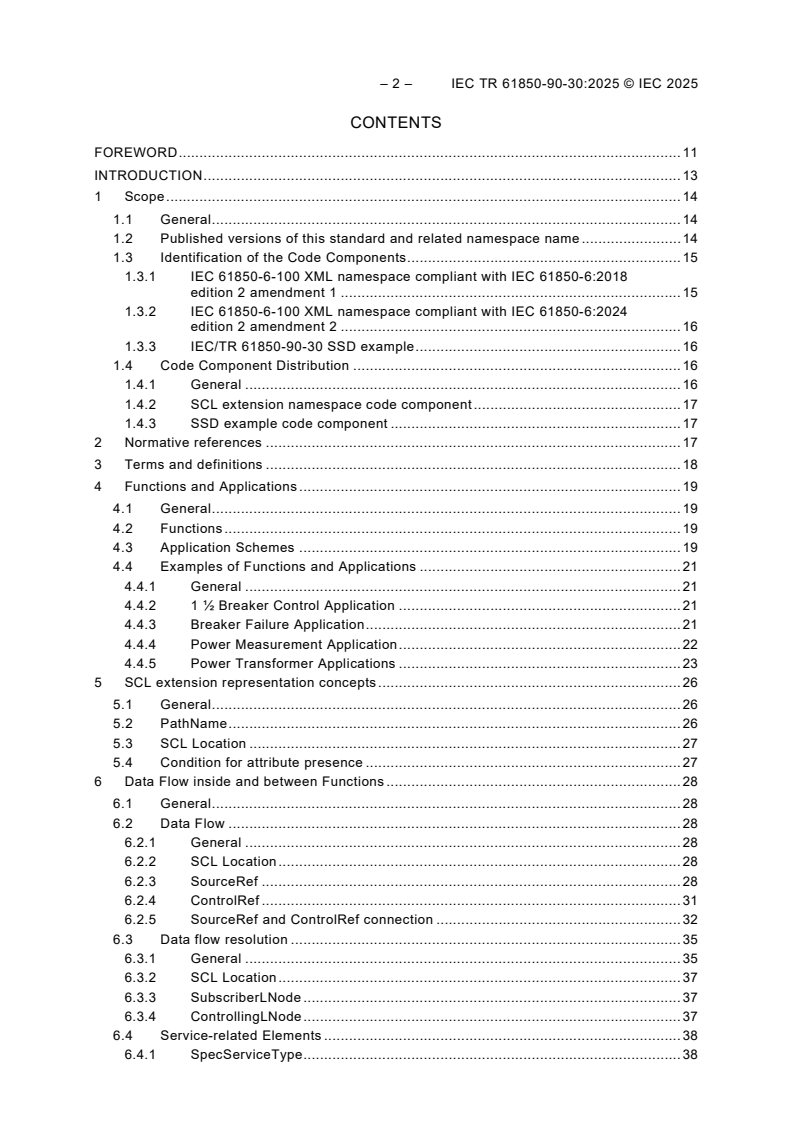
– 2 – IEC TR 61850-90-30:2025 © IEC 2025
CONTENTS
FOREWORD . 11
INTRODUCTION . 13
1 Scope . 14
1.1 General . 14
1.2 Published versions of this standard and related namespace name . 14
1.3 Identification of the Code Components . 15
1.3.1 IEC 61850-6-100 XML namespace compliant with IEC 61850-6:2018
edition 2 amendment 1 . 15
1.3.2 IEC 61850-6-100 XML namespace compliant with IEC 61850-6:2024
edition 2 amendment 2 . 16
1.3.3 IEC/TR 61850-90-30 SSD example . 16
1.4 Code Component Distribution . 16
1.4.1 General . 16
1.4.2 SCL extension namespace code component . 17
1.4.3 SSD example code component . 17
2 Normative references . 17
3 Terms and definitions . 18
4 Functions and Applications . 19
4.1 General . 19
4.2 Functions . 19
4.3 Application Schemes . 19
4.4 Examples of Functions and Applications . 21
4.4.1 General . 21
4.4.2 1 ½ Breaker Control Application . 21
4.4.3 Breaker Failure Application . 21
4.4.4 Power Measurement Application . 22
4.4.5 Power Transformer Applications . 23
5 SCL extension representation concepts . 26
5.1 General . 26
5.2 PathName . 26
5.3 SCL Location . 27
5.4 Condition for attribute presence . 27
6 Data Flow inside and between Functions . 28
6.1 General . 28
6.2 Data Flow . 28
6.2.1 General . 28
6.2.2 SCL Location . 28
6.2.3 SourceRef . 28
6.2.4 ControlRef . 31
6.2.5 SourceRef and ControlRef connection . 32
6.3 Data flow resolution . 35
6.3.1 General . 35
6.3.2 SCL Location . 37
6.3.3 SubscriberLNode . 37
6.3.4 ControllingLNode . 37
6.4 Service-related Elements . 38
6.4.1 SpecServiceType . 38
6.4.2 ServiceSpecifications . 40
7 LNode Data specification . 53
7.1 SCL Location . 53
7.2 General . 53
7.3 Specification of Data Objects and Attributes . 53
7.3.1 General . 53
7.3.2 DOS/SDS/DAS Definition . 53
7.4 LNode Mapping Documentation . 57
8 LNodeSpecNaming . 58
8.1 SCL Location . 58
8.2 Definition . 58
9 ProcessResource . 60
9.1 SCL Location . 60
9.2 Definition . 60
9.3 SCL representation . 67
9.3.1 General . 67
9.3.2 ProcessResources . 67
9.3.3 ProcessResource . 67
9.3.4 Resource . 68
10 PowerSystemRelation . 70
10.1 SCL Location . 70
10.2 Definition . 70
10.3 SCL representation . 72
10.3.1 General . 72
10.3.2 PowerSystemRelations . 72
10.3.3 PowerSystemRelation . 72
11 SCL elements reference and categorisation . 73
11.1 General . 73
11.2 Function Reference . 73
11.2.1 General . 73
11.2.2 FunctionRef . 73
11.2.3 FunctionCatRef. 74
11.3 FunctionCategory. 74
11.3.1 SCL Location . 74
11.3.2 General . 74
11.3.3 SCL representation . 75
11.4 Allocation Role . 76
11.4.1 SCL Location . 76
11.4.2 Definition . 76
11.4.3 Example 1 . 77
11.4.4 Example 2 . 79
11.4.5 Example 3 . 81
12 Variables . 82
12.1 SCL Location . 82
12.2 Definition . 82
12.3 SCL representation . 84
12.3.1 General . 84
12.3.2 Variable . 84
– 4 – IEC TR 61850-90-30:2025 © IEC 2025
12.3.3 VariableApplyTo . 85
13 Behavior description . 88
13.1 SCL Location . 88
13.2 Definition . 88
13.3 SCL representation . 89
13.3.1 General . 89
13.3.2 BehaviorDescription . 89
13.3.3 InputVar and OutputVar . 91
13.3.4 IEC 61131 BehaviorDescription use cases . 93
14 Process Echo . 95
14.1 SCL location . 95
14.2 Definition and rules . 95
14.3 Use cases . 96
14.3.1 Use case 1: circuit breaker position transmission . 96
14.3.2 Use case 2: measurement transmission . 97
15 Bay Type . 98
15.1 SCL location . 98
15.2 Definition . 98
16 Specification Workflow, tools and file types . 98
16.1 FSD . 98
16.1.1 Definition and rules . 98
16.1.2 SCL content . 99
16.1.3 FunctionTemplate . 99
16.1.4 Usage . 100
16.2 SSD Template . 101
16.3 S-IED . 101
16.3.1 General . 101
16.3.2 Logical Node and Function Allocation . 101
16.3.3 S-IED as formal Specification . 102
16.3.4 S-IEDs for Testing and Simulation . 102
16.3.5 S-IED identification inside an SCL file. 103
16.3.6 From Functional Specification to the S-IED . 103
16.3.7 ISD . 104
16.4 Process SCL files . 107
16.4.1 General . 107
16.4.2 Process ICD . 107
16.4.3 Process IID . 110
16.4.4 Instantiating a process ICD/IID in an SCD – Implementation rules . 112
16.4.5 Documenting the implementation of the IED to the specification . 114
16.5 Engineering Rights applied to functions . 131
16.5.1 Definition . 131
16.5.2 Rules from IEC 61850-6 . 131
16.5.3 The SCC file format . 132
16.5.4 The project ID . 133
16.5.5 The checkout ID . 134
16.5.6 Combining SCC and SED workflows . 143
16.5.7 Additional example adding SCL references . 144
16.5.8 Use cases . 146
16.5.9 Rules regarding engineering rights on process section elements . 150
16.6 Information flow between tools . 151
16.6.1 General . 151
16.6.2 Response of a process ICD to a system specification or IED
specification template . 151
16.6.3 Response of a process IID to a project SCD . 151
16.6.4 Response of a process IID to a project specific ISD/SSD . 152
16.6.5 Response of a process ICD to an SSD with allocation roles . 152
16.6.6 Global overview of tools and interfaces . 152
17 SclFileReferences extension . 153
17.1 General . 153
17.2 Use of the SclFileReference for FSD . 154
17.3 Use of SclFileReference for ASD . 154
17.4 Use of other references . 155
17.4.1 General . 155
17.4.2 SclFileReference for SSD in ISD . 155
17.4.3 SclFileReference for ISD in ICD . 156
17.4.4 SclFileReference for ISD in SCD . 156
17.4.5 SclFileReference for ISD in IID . 156
17.4.6 SclFileReference for ICD in IID . 156
17.4.7 SclFileReference for ICD in SCD . 156
17.4.8 SclFileReference for IID in SCD . 157
17.4.9 SclFileReference for SCD in IID. 157
17.4.10 SclFileReference for SSD in SCD . 157
17.4.11 SclFileReference for SCD in SED/SCC . 157
17.4.12 CheckoutID from SED/SCC in SCD/SED/SCC . 157
17.4.13 SclFileReference for SSD in ICD . 157
17.4.14 SclFileReference for IID in SSD . 158
17.4.15 SclFileReference for SSD in SSD . 158
18 UUIDs . 158
18.1 General . 158
18.2 Scenario 1: . 160
18.2.1 General . 160
18.2.2 Subscenario 1: zoom on ASD . 160
18.2.3 Subscenario 2: creating the project SSD . 162
18.2.4 Subscenario 3: creating the process ICD . 163
18.2.5 Subscenario 4: creating SCD . 164
18.3 Other examples . 165
18.3.1 General . 165
18.3.2 Scenario 2 . 166
18.3.3 Scenario 3 . 166
Annex A (informative) Predefined Function classifications . 167
A.1 Overview . 167
A.2 Basic Function Categories . 167
A.3 Protection . 167
A.4 Automation . 168
A.5 Extended Function Categories . 169
A.6 Function scope . 169
– 6 – IEC TR 61850-90-30:2025 © IEC 2025
Annex B (informative) Service section rules for ISD files service section rules for ISD
files . 170
Annex C (informative) Management of different Schema version . 180
C.1 General . 180
C.2 Upgrading rules from 2019B9 to 2019C1 . 180
C.3 Downgrading rules from 2019C1 to 2019B9 . 181
Annex D (informative) Example SCL File . 183
Bibliography . 184
Figure 1 – Breaker Failure Protection from IEC TR 61850-7-500 . 20
Figure 2 – Breaker Failure Application . 20
Figure 3 – 1 ½ Breaker Functions . 21
Figure 4 – Breaker Failure Application . 22
Figure 5 – Power Measurement Application . 23
Figure 6 – 3 Transformer Differential Protection . 24
Figure 7 – 3 Transformer Winding Overcurrent Protection . 25
Figure 8 – 3 Transformer Voltage Control . 26
Figure 9 – Absolute PathName Examples with Object Reference . 27
Figure 10 – Data Flow specification with SourceRefs inside a Function. 29
Figure 11 – Data Flow specification for data exchange between Functions . 29
Figure 12 – Example of a SourceRef and ControlRef connection . 33
Figure 13 – Example of open SourceRef and ControlRef . 33
Figure 14 – Example of a connected SourceRef and ControlRef (source and controlled
are set) . 34
Figure 15 – Example of an implemented SourceRef and ControlRef (extRefAddr and
extCtrlAddr are set) . 35
Figure 16 – SubscriberLNode and ControllingLNode definition example . 36
Figure 17 – SubscriberLNode and ControllingLNode selection example . 36
Figure 18 – SubscriberLNode and ControllingLNode resolution example . 36
Figure 19 – Example of service specification within a SourceRef element . 38
Figure 20 – Example of service specification within a SubscriberLN element . 39
Figure 21 – Example of a GooseParameters specification . 43
Figure 22 – Example for referencing a GooseParameters . 43
Figure 23 – Specification of a binary Wired oriented connection . 46
Figure 24 – Specification of a binary Wired oriented connection (visual representation) . 46
Figure 25 – Implementation of the LPDI/LPDO . 47
Figure 26 – Example of BinaryWiringParameters . 48
Figure 27 – Example of Wired Input and Output specification for XCBR . 49
Figure 28 – Example of the implementation of the XCBR wiring specification . 50
Figure 29 – Specification of an analogue Wired oriented connection . 51
Figure 30 – Specification of an analogue Wired oriented connection (visual
representation) . 51
Figure 31 – Implementation of an analogue Wired oriented connection specification . 52
Figure 32 – Example of AnalogueWiringParameters . 53
Figure 33 – Example of Control Model specification . 55
Figure 34 – Example of PTOC Setting Groups specification . 56
Figure 35 – Example of array values specification . 57
Figure 36 – Example LNodeSpecNaming . 59
Figure 37 – Application Template definition with ProcessResource . 61
Figure 38 – Application instance with ProcessResource resolution . 62
Figure 39 – CB interlocking equation . 63
Figure 40 – Application template . 63
Figure 41 – Example Application with ProcessResource . 64
Figure 42 – Using ProcessResource for SourceRef parameterization . 65
Figure 43 – ProcessResource resolution to set SourceRef source . 65
Figure 44 – Using ProcessResource with SubscriberLNode . 66
Figure 45 – ProcessResource resolution with SubscriberLNode . 67
Figure 46 – Example of ProcessResource usage for CBR usage . 69
Figure 47 – Example of ProcessResource usage for CT usage . 70
Figure 48 – Function and SubFunctions related to the Process Section . 71
Figure 49 – 1 1/2 breaker control and protection application . 72
Figure 50 – SCL support for Function classification (example) . 75
Figure 51 – Example of Function Classification in SCL . 76
Figure 52 – Example of Allocation roles with PIU . 78
Figure 53 – Example of Allocation roles without Bay Controller CB Interface . 79
Figure 54 – Allocation variant use case . 80
Figure 55 – Allocation Variant use case representation in XML . 81
Figure 56 – Auto recloser multiple allocation example . 82
Figure 57 – Variables in the Process Section . 83
Figure 58 – Example of variable to manage XCBR prefix . 83
Figure 59 – Example of variable to manage specification of functional name . 83
Figure 60 – Example of variable to manage DA value . 84
Figure 61 – Example of Variable setting directly the Circuit Breaker prefix . 86
Figure 62 – Example of Variable value set by an XPath expression. . 87
Figure 63 – Example of Variables used for Setting Group definition . 87
Figure 64 – Behavior description in a Bay . 89
Figure 65 – Behavior description location . 89
Figure 66 – Example of BehaviorDescription in a single LNode . 93
Figure 67 – Example of floating BehaviorDescription . 94
Figure 68 – Example P21 BehaviorDescription. 95
Figure 69 – Example of ProcessEcho for XCBR.Pos transmission . 97
Figure 70 – Example of ProcessEcho for measurement transmission . 98
Figure 71 – FSD usage in specification process . 100
Figure 72 – SSD Template . 101
Figure 73 – IED Allocation . 102
Figure 74 – Function Structure mapped to S-IEDs . 102
Figure 75 – Process IID workflow . 112
Figure 76 – Process ICD with ISD workflow . 113
– 8 – IEC TR 61850-90-30:2025 © IEC 2025
Figure 77 – Process ICD without ISD workflow . 113
Figure 78 – Process ICD with ISD from SSD template workflow . 113
Figure 79 – BehaviorDescription implementation documentation . 114
Figure 80 – Multiple LNodes instantiation by one LN . 115
Figure 81 – specification of binary inputs function . 116
Figure 82 – Process ICD content with mapping documentation . 117
Figure 83 – Single LNode implemented by multiple LN . 118
Figure 84 – SourceRef implementation in same LN documentation . 119
Figure 85 – SourceRef implementation in a GGIO documentation . 120
Figure 86 – SourceRef implementation in a TCTR documentation . 120
Figure 87 – Example of SourceRef mapping to real IED . 121
Figure 88 – Example of real IED used to implement SourceRef . 122
Figure 89 – Concept of mapping SourceRef to ExtRef . 123
Figure 90 – SourceRef definition based on DO . 124
Figure 91 – Using granularity for better SourceRef creation . 124
Figure 92 – SourceRef definition for same DO at DA level . 125
Figure 93 – SourceRef definition at DO level for reporting communication . 125
Figure 94 – 1 to 1 implementation of SourceRef. 126
Figure 95 – Using intAddr for mapping SourceRef to ExtRef . 127
Figure 96 – Match documentation between ExtRef and SourceRef . 127
Figure 97 – Choosing position ExtRef as mapping of SourceRef . 128
Figure 98 – Example of same intAddr . 129
Figure 99 – Using extRefAddr for SMV mapping . 129
Figure 100 – Use of extCtrlAddr example . 130
Figure 101 – Deviating DO/DA mapping documentation . 131
Figure 102 – SED exchange . 131
Figure 103 – Engineering rights rules from IEC 61850-6:2009+AMD2:2024 . 132
Figure 104 – SCC/SED concept . 132
Figure 105 – SCC concept . 133
Figure 106 – project UUID . 134
Figure 107 – SCC workflow example . 139
Figure 108 – use of UUIDs to handle SED flows . 141
Figure 109 – use of UUIDs to handle SCC flows . 142
Figure 110 – Handling of minRequestSCDFileVersion/Revision example . 143
Figure 111 – Combining SCC and SED workflows . 144
Figure 112 – Example of exchange between main/fork project and other system . 145
Figure 113 – Combined example SCC/SED . 146
Figure 114 – Use of SCC for extension engineering . 147
Figure 115 – Single line of project process example . 148
Figure 116 – Project execution flow . 148
Figure 117 – interaction between main and for projects . 149
Figure 118 – Use of SCC for exchange between main and fork project . 149
Figure 119 – example of project flow between engineering and commissioning . 150
Figure 120 – Example of SCC process . 150
Figure 121 – Response of a process ICD to a system specification or IED specification
template . 151
Figure 122 – Response of a process IID to a project SCD . 151
Figure 123 – Response of a process IID to an ISD/SSD . 152
Figure 124 – Response of a process ICD to an SSD with allocation roles . 152
Figure 125 – Global overview. 153
Figure 126 – Reference to FSD. 154
Figure 127 – Reference to ASD . 155
Figure 128 – Use of references . 155
Figure 129 – UUID example 1 . 159
Figure 130 – UUID example 2 . 159
Figure 131 – UUID example 3 . 160
Figure 132 – Scenario 1 . 160
Figure 133 – Zoom on ASD . 161
Figure 134 – Subscenario 1 . 162
Figure 135 – Zoom on SSD Template . 163
Figure 136 – Subscenario 2 . 163
Figure 137 – Zoom on ISD . 164
Figure 138 – Subscenario 3 . 164
Figure 139 – Zoom on SCD. 165
Figure 140 – Subscenario 4 . 165
Figure 141 – Scenario 2 . 166
Figure 142 – Scenario 3 . 166
Table 1 – Reference between published versions of the standard and related
namespace name. 15
Table 2 – Attributes of the IEC 61850-6-100:2019B9 XML namespace . 15
Table 3 – Attributes of the IEC 61850-6-100:2019C1 XML namespace.
...