

IEC 61204-3:2011
(Main)Low voltage power supplies, d.c. output - Part 3: Electromagnetic compatibility (EMC)
General Information
- Abstract
IEC 61204-3:2011 specifies electromagnetic compatibility (EMC) requirements for power supply units (PSUs) providing d.c. output(s) with or without auxiliary a.c. output(s), operating from a.c. or d.c. source voltages up to 600 V a.c. or 1 000 V d.c. The main changes with respect to the previous edition are listed below:
- Update of the scope to align with IEC 61204-7.
- Update of the normative references to the latest editions.
- Change of the definitions of environments to align with the latest editions of the applicable normative references.
- Revision of the applicability of tests to different power supply technologies.
- Revision of the emission limits and requirements to align with the latest editions of the applicable normative references.
- Revision of the immunity limits and requirements to align with the latest editions of the applicable normative references.
- Clarification of the different classes of PSU.
- Status
- Published
- Publication Date
- 21-Jun-2011
- Technical Committee
- SC 22E - Stabilized power supplies
- Drafting Committee
- MT 5 - TC 22/SC 22E/MT 5
- Current Stage
- DELPUB - Deleted Publication
- Start Date
- 28-Oct-2016
- Completion Date
- 28-Aug-2026
Overview
IEC 61204-3:2011 is an international standard published by the International Electrotechnical Commission (IEC) that specifies electromagnetic compatibility (EMC) requirements for low-voltage power supplies with DC output. This standard covers power supply units (PSUs) operating from AC or DC source voltages up to 600 V AC or 1000 V DC, including those with auxiliary AC outputs. It focuses on ensuring that PSUs do not emit excessive electromagnetic interference and are immune to specified electromagnetic disturbances, thereby promoting reliable operation and compliance with EMC regulations in diverse environments.
The second edition of IEC 61204-3 updates the scope, aligns normative references with the latest editions, revises emission and immunity limits, and clarifies classification of PSU types. It represents a technical revision improving applicability and relevance to modern power supply technologies.
Key Topics
Scope and Object: Defines the range of equipment covered, including PSUs with DC outputs, operating from input voltages up to the specified thresholds, and details exclusions and additional requirements.
EMC Requirements: Specifies emission limits for both low-frequency phenomena (≤9 kHz) and high-frequency disturbances affecting input and output ports. It includes detailed limits for conducted and radiated emissions to mitigate electromagnetic interference.
Immunity Criteria: Establishes performance criteria for PSUs to withstand various electromagnetic disturbances such as radio frequency interference, voltage fluctuations, and transient events in residential, commercial, light industrial, and industrial environments.
Test Applicability: Provides guidance on how different tests apply to various PSU technologies to ensure appropriate evaluation of EMC characteristics.
Classification of PSUs: Clarifies different PSU classes based on their EMC behavior, helping manufacturers and testers identify applicable requirements.
Measurement Techniques: Includes test setups for measuring disturbance power and emission levels, ensuring accurate and repeatable EMC assessments.
Supplementary Guidance: Annexes provide normative and informative guidance on classification, harmonic calculations, DC/DC converter considerations, and emission limits.
Applications
IEC 61204-3:2011 serves as a crucial standard for designers, manufacturers, testing laboratories, and regulatory bodies involved with low-voltage power supplies. Its practical applications include:
Design and Certification of PSUs: Ensures that power supplies meet EMC requirements to minimize interference with other electronic equipment and satisfy regional compliance mandates.
Quality Assurance and Testing: Provides test conditions and performance criteria to verify immunity and emission characteristics during development and production.
System Integration: Assists engineers integrating power supplies into systems by defining immunity levels and emission limits to maintain overall system electromagnetic compatibility.
Regulatory Compliance: Supports conformance with international EMC regulations, facilitating market access and reducing risks of non-compliance penalties.
Safety Improvements: Addresses EMC aspects related to safety, contributing to the reliable and safe operation of power supplies across various industries such as telecommunications, industrial automation, medical devices, and consumer electronics.
Related Standards
IEC 61204-3:2011 aligns with and complements other standards within the IEC 61204 series and related normative references, including:
IEC 61204-7: Defines general requirements for low-voltage power supplies and helps align the scope of IEC 61204-3 with updated definitions.
EMC Standards for Industrial and Commercial Equipment: Such as IEC 61000 series, which provide comprehensive immunity and emission test methods across a broad range of equipment.
Power Supply Safety Standards: Including IEC 60950 and IEC 62368, which address safety requirements that intersect with EMC for power supplies.
ISO/IEC Directives: Referenced for the drafting and normative procedures ensuring conformity and updates to the standard.
Adherence to IEC 61204-3 promotes standardization and interoperability in electrical and electronic environments, enabling power supplies to operate effectively without causing or suffering from electromagnetic disturbances. Organizations can consult the IEC online catalogue and Electropedia for further details and updates on this standard and related IEC publications.
Keywords: IEC 61204-3:2011, electromagnetic compatibility, EMC requirements, low-voltage power supplies, DC output power supplies, conducted emissions, radiated emissions, immunity testing, power supply units, IEC standards, IEC 61204 series, EMC testing, power supply design, EMC certification, international standards for power supplies.
Relations
- Effective Date
- 05-Sep-2023
- Effective Date
- 05-Sep-2023
- Effective Date
- 05-Sep-2023
Get Certified
Connect with accredited certification bodies for this standard

IMQ S.p.A. (Certification)
Italian electrical product certification.

SLG Prüf- und Zertifizierungs GmbH
German testing and certification body.

UL Solutions
Global safety science company with testing, inspection and certification.
Sponsored listings
Frequently Asked Questions
IEC 61204-3:2011 is a standard published by the International Electrotechnical Commission (IEC). Its full title is "Low voltage power supplies, d.c. output - Part 3: Electromagnetic compatibility (EMC)". This standard covers: IEC 61204-3:2011 specifies electromagnetic compatibility (EMC) requirements for power supply units (PSUs) providing d.c. output(s) with or without auxiliary a.c. output(s), operating from a.c. or d.c. source voltages up to 600 V a.c. or 1 000 V d.c. The main changes with respect to the previous edition are listed below: - Update of the scope to align with IEC 61204-7. - Update of the normative references to the latest editions. - Change of the definitions of environments to align with the latest editions of the applicable normative references. - Revision of the applicability of tests to different power supply technologies. - Revision of the emission limits and requirements to align with the latest editions of the applicable normative references. - Revision of the immunity limits and requirements to align with the latest editions of the applicable normative references. - Clarification of the different classes of PSU.
IEC 61204-3:2011 specifies electromagnetic compatibility (EMC) requirements for power supply units (PSUs) providing d.c. output(s) with or without auxiliary a.c. output(s), operating from a.c. or d.c. source voltages up to 600 V a.c. or 1 000 V d.c. The main changes with respect to the previous edition are listed below: - Update of the scope to align with IEC 61204-7. - Update of the normative references to the latest editions. - Change of the definitions of environments to align with the latest editions of the applicable normative references. - Revision of the applicability of tests to different power supply technologies. - Revision of the emission limits and requirements to align with the latest editions of the applicable normative references. - Revision of the immunity limits and requirements to align with the latest editions of the applicable normative references. - Clarification of the different classes of PSU.
IEC 61204-3:2011 is classified under the following ICS (International Classification for Standards) categories: 29.200 - Rectifiers. Convertors. Stabilized power supply; 33.100.01 - Electromagnetic compatibility in general. The ICS classification helps identify the subject area and facilitates finding related standards.
IEC 61204-3:2011 has the following relationships with other standards: It is inter standard links to IEC 61204-3:2000/COR1:2000, IEC 61204-3:2000, IEC 61204-3:2016. Understanding these relationships helps ensure you are using the most current and applicable version of the standard.
IEC 61204-3:2011 is available in PDF format for immediate download after purchase. The document can be added to your cart and obtained through the secure checkout process. Digital delivery ensures instant access to the complete standard document.
Standards Content (Sample)
IEC 61204-3 ®
Edition 2.0 2011-06
INTERNATIONAL
STANDARD
NORME
INTERNATIONALE
Low-voltage power supplies, d.c. output –
Part 3: Electromagnetic compatibility (EMC)
Alimentations basse tension, sortie continue –
Partie 3: Compatibilité électromagnétique (CEM)
All rights reserved. Unless otherwise specified, no part of this publication may be reproduced or utilized in any form or by
any means, electronic or mechanical, including photocopying and microfilm, without permission in writing from either IEC or
IEC's member National Committee in the country of the requester.
If you have any questions about IEC copyright or have an enquiry about obtaining additional rights to this publication,
please contact the address below or your local IEC member National Committee for further information.
Droits de reproduction réservés. Sauf indication contraire, aucune partie de cette publication ne peut être reproduite
ni utilisée sous quelque forme que ce soit et par aucun procédé, électronique ou mécanique, y compris la photocopie
et les microfilms, sans l'accord écrit de la CEI ou du Comité national de la CEI du pays du demandeur.
Si vous avez des questions sur le copyright de la CEI ou si vous désirez obtenir des droits supplémentaires sur cette
publication, utilisez les coordonnées ci-après ou contactez le Comité national de la CEI de votre pays de résidence.
IEC Central Office
3, rue de Varembé
CH-1211 Geneva 20
Switzerland
Email: inmail@iec.ch
Web: www.iec.ch
About the IEC
The International Electrotechnical Commission (IEC) is the leading global organization that prepares and publishes
International Standards for all electrical, electronic and related technologies.
About IEC publications
The technical content of IEC publications is kept under constant review by the IEC. Please make sure that you have the
latest edition, a corrigenda or an amendment might have been published.
Catalogue of IEC publications: www.iec.ch/searchpub
The IEC on-line Catalogue enables you to search by a variety of criteria (reference number, text, technical committee,…).
It also gives information on projects, withdrawn and replaced publications.
IEC Just Published: www.iec.ch/online_news/justpub
Stay up to date on all new IEC publications. Just Published details twice a month all new publications released. Available
on-line and also by email.
Electropedia: www.electropedia.org
The world's leading online dictionary of electronic and electrical terms containing more than 20 000 terms and definitions
in English and French, with equivalent terms in additional languages. Also known as the International Electrotechnical
Vocabulary online.
Customer Service Centre: www.iec.ch/webstore/custserv
If you wish to give us your feedback on this publication or need further assistance, please visit the Customer Service
Centre FAQ or contact us:
Email: csc@iec.ch
Tel.: +41 22 919 02 11
Fax: +41 22 919 03 00
A propos de la CEI
La Commission Electrotechnique Internationale (CEI) est la première organisation mondiale qui élabore et publie des
normes internationales pour tout ce qui a trait à l'électricité, à l'électronique et aux technologies apparentées.
A propos des publications CEI
Le contenu technique des publications de la CEI est constamment revu. Veuillez vous assurer que vous possédez
l’édition la plus récente, un corrigendum ou amendement peut avoir été publié.
Catalogue des publications de la CEI: www.iec.ch/searchpub/cur_fut-f.htm
Le Catalogue en-ligne de la CEI vous permet d’effectuer des recherches en utilisant différents critères (numéro de référence,
texte, comité d’études,…). Il donne aussi des informations sur les projets et les publications retirées ou remplacées.
Just Published CEI: www.iec.ch/online_news/justpub
Restez informé sur les nouvelles publications de la CEI. Just Published détaille deux fois par mois les nouvelles
publications parues. Disponible en-ligne et aussi par email.
Electropedia: www.electropedia.org
Le premier dictionnaire en ligne au monde de termes électroniques et électriques. Il contient plus de 20 000 termes et
définitions en anglais et en français, ainsi que les termes équivalents dans les langues additionnelles. Egalement appelé
Vocabulaire Electrotechnique International en ligne.
Service Clients: www.iec.ch/webstore/custserv/custserv_entry-f.htm
Si vous désirez nous donner des commentaires sur cette publication ou si vous avez des questions, visitez le FAQ du
Service clients ou contactez-nous:
Email: csc@iec.ch
Tél.: +41 22 919 02 11
Fax: +41 22 919 03 00
IEC 61204-3 ®
Edition 2.0 2011-06
INTERNATIONAL
STANDARD
NORME
INTERNATIONALE
Low-voltage power supplies, d.c. output –
Part 3: Electromagnetic compatibility (EMC)
Alimentations basse tension, sortie continue –
Partie 3: Compatibilité électromagnétique (CEM)
INTERNATIONAL
ELECTROTECHNICAL
COMMISSION
COMMISSION
ELECTROTECHNIQUE
PRICE CODE
INTERNATIONALE
CODE PRIX W
ICS 29.200; 33.100 ISBN 978-2-88912-510-4
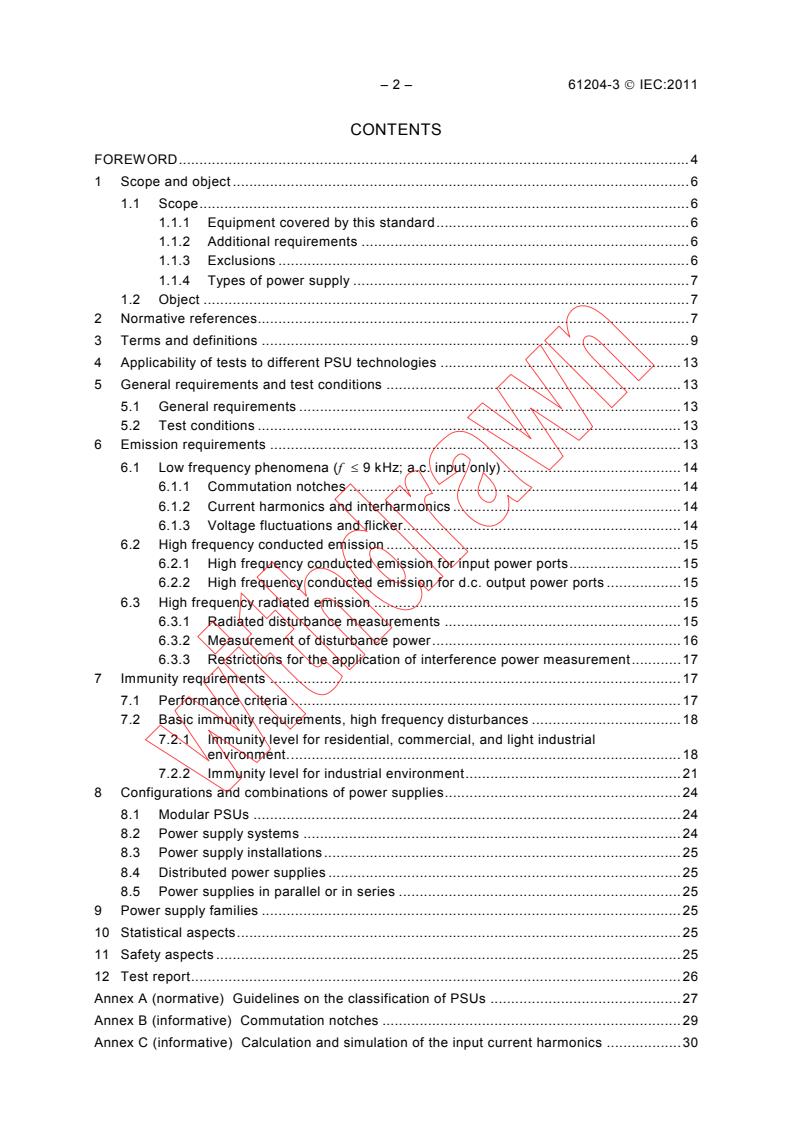
– 2 – 61204-3 IEC:2011
CONTENTS
FOREWORD . 4
1 Scope and object . 6
1.1 Scope . 6
1.1.1 Equipment covered by this standard . 6
1.1.2 Additional requirements . 6
1.1.3 Exclusions . 6
1.1.4 Types of power supply . 7
1.2 Object . 7
2 Normative references. 7
3 Terms and definitions . 9
4 Applicability of tests to different PSU technologies . 13
5 General requirements and test conditions . 13
5.1 General requirements . 13
5.2 Test conditions . 13
6 Emission requirements . 13
6.1 Low frequency phenomena (f ≤ 9 kHz; a.c. input only) . 14
6.1.1 Commutation notches . 14
6.1.2 Current harmonics and interharmonics . 14
6.1.3 Voltage fluctuations and flicker. 14
6.2 High frequency conducted emission . 15
6.2.1 High frequency conducted emission for input power ports . 15
6.2.2 High frequency conducted emission for d.c. output power ports . 15
6.3 High frequency radiated emission . 15
6.3.1 Radiated disturbance measurements . 15
6.3.2 Measurement of disturbance power . 16
6.3.3 Restrictions for the application of interference power measurement . 17
7 Immunity requirements . 17
7.1 Performance criteria . 17
7.2 Basic immunity requirements, high frequency disturbances . 18
7.2.1 Immunity level for residential, commercial, and light industrial
environment. . 18
7.2.2 Immunity level for industrial environment . 21
8 Configurations and combinations of power supplies . 24
8.1 Modular PSUs . 24
8.2 Power supply systems . 24
8.3 Power supply installations . 25
8.4 Distributed power supplies . 25
8.5 Power supplies in parallel or in series . 25
9 Power supply families . 25
10 Statistical aspects . 25
11 Safety aspects . 25
12 Test report . 26
Annex A (normative) Guidelines on the classification of PSUs . 27
Annex B (informative) Commutation notches . 29
Annex C (informative) Calculation and simulation of the input current harmonics . 30
61204-3 IEC:2011 – 3 –
Annex D (informative) Special considerations for d.c./d.c. converters . 31
Annex E (informative) Critical frequency for high frequency power measurement . 33
Annex F (normative) Guidelines on power supply families . 34
Annex G (informative) Summary of classification of environments and limits . 35
Annex H (normative) Emission limits . 37
Bibliography . 39
Figure 1 – Test set-up for the measurement of disturbance power . 17
Table 1 – Criteria to prove the performance of a PSU against EM disturbances . 18
Table 2 – Immunity – Enclosure port – Residential, commercial and light industrial
environment . 19
Table 3 – Immunity – Ports for signal lines and control lines . 19
Table 4 – Immunity – DC input and output power ports . 20
Table 5 – Immunity – AC input power ports – Residential, commercial and light
industrial environment . 21
Table 6 – Immunity – Enclosure port – Industrial environment . 22
Table 7 – Immunity – Ports for signal lines and control lines – Industrial environment . 22
Table 8 – Immunity – DC input and output power ports – Industrial environment . 23
Table 9 – Immunity – AC input power ports – Industrial environment . 24
Table A.1 – Classification of power supplies and the relevant EMC standards . 28
Table D.1 – Immunity – DC input power ports – Input category a. 31
Table D.2 – Immunity – DC input power ports – Input category b. 32
Table D.3 – Immunity – Enclosure port – Input categories a and b . 32
Table H.1 – Limits of mains terminal disturbance voltage (a.c. input port) . 37
Table H.2 – Limits of mains terminal disturbance voltage (d.c. input and d.c. output
power port) . 37
Table H.3 – Limits for electromagnetic radiation/interference power disturbance (all field
strength limits refer to quasi-peak measurements) . 38
Table H.4 – Disturbance power limits for the frequency range 30 to 300 MHz . 38
– 4 – 61204-3 IEC:2011
INTERNATIONAL ELECTROTECHNICAL COMMISSION
____________
LOW-VOLTAGE POWER SUPPLIES, D.C. OUTPUT –
Part 3: Electromagnetic compatibility (EMC)
FOREWORD
1) The International Electrotechnical Commission (IEC) is a worldwide organization for standardization comprising
all national electrotechnical committees (IEC National Committees). The object of IEC is to promote
international co-operation on all questions concerning standardization in the electrical and electronic fields. To
this end and in addition to other activities, IEC publishes International Standards, Technical Specifications,
Technical Reports, Publicly Available Specifications (PAS) and Guides (hereafter referred to as “IEC
Publication(s)”). Their preparation is entrusted to technical committees; any IEC National Committee interested
in the subject dealt with may participate in this preparatory work. International, governmental and non-
governmental organizations liaising with the IEC also participate in this preparation. IEC collaborates closely
with the International Organization for Standardization (ISO) in accordance with conditions determined by
agreement between the two organizations.
2) The formal decisions or agreements of IEC on technical matters express, as nearly as possible, an international
consensus of opinion on the relevant subjects since each technical committee has representation from all
interested IEC National Committees.
3) IEC Publications have the form of recommendations for international use and are accepted by IEC National
Committees in that sense. While all reasonable efforts are made to ensure that the technical content of IEC
Publications is accurate, IEC cannot be held responsible for the way in which they are used or for any
misinterpretation by any end user.
4) In order to promote international uniformity, IEC National Committees undertake to apply IEC Publications
transparently to the maximum extent possible in their national and regional publications. Any divergence
between any IEC Publication and the corresponding national or regional publication shall be clearly indicated in
the latter.
5) IEC itself does not provide any attestation of conformity. Independent certification bodies provide conformity
assessment services and, in some areas, access to IEC marks of conformity. IEC is not responsible for any
services carried out by independent certification bodies.
6) All users should ensure that they have the latest edition of this publication.
7) No liability shall attach to IEC or its directors, employees, servants or agents including individual experts and
members of its technical committees and IEC National Committees for any personal injury, property damage or
other damage of any nature whatsoever, whether direct or indirect, or for costs (including legal fees) and
expenses arising out of the publication, use of, or reliance upon, this IEC Publication or any other IEC
Publications.
8) Attention is drawn to the Normative references cited in this publication. Use of the referenced publications is
indispensable for the correct application of this publication.
9) Attention is drawn to the possibility that some of the elements of this IEC Publication may be the subject of
patent rights. IEC shall not be held responsible for identifying any or all such patent rights.
International Standard IEC 61204-3 has been prepared by subcommittee 22E: Stabilized power
supplies, of IEC technical committee 22: Power electronic systems and equipment.
IEC 61204-3 has the status of a product family standard.
This second edition cancels and replaces the first edition, published in 2000. It constitutes a
technical revision.
The main changes with respect to the previous edition are listed below.
• Update of the scope to align with IEC 61204-7.
• Update of the normative references to the latest editions.
• Change of the definitions of environments to align with the latest editions of the applicable
normative references.
• Revision of the applicability of tests to different power supply technologies.
61204-3 IEC:2011 – 5 –
• Revision of the emission limits and requirements to align with the latest editions of the
applicable normative references.
• Revision of the immunity limits and requirements to align with the latest editions of the
applicable normative references.
• Clarification of the different classes of PSU.
The text of this standard is based on the following documents:
FDIS Report on voting
22E/129/FDIS 22E/130/RVD
Full information on the voting for the approval of this standard can be found in the report on
voting indicated in the above table.
This publication has been drafted in accordance with the ISO/IEC Directives, Part 2.
A list of all parts of IEC 61240 series, under the general title Low voltage power supplies, d.c.
output, can be found on the IEC website.
The committee has decided that the contents of this publication will remain unchanged until the
stability date indicated on the IEC web site under "http://webstore.iec.ch" in the data related to
the specific publication. At this date, the publication will be
• reconfirmed,
• withdrawn,
• replaced by a revised edition, or
• amended.
– 6 – 61204-3 IEC:2011
LOW-VOLTAGE POWER SUPPLIES, D.C. OUTPUT –
Part 3: electromagnetic compatibility (EMC)
1 Scope and object
1.1 Scope
1.1.1 Equipment covered by this standard
This part of IEC 61204 specifies electromagnetic compatibility (EMC) requirements for power
supply units (PSUs) providing d.c. output(s) with or without auxiliary a.c. output(s), operating
from a.c. or d.c. source voltages up to 600 V a.c. or 1 000 V d.c. (see exceptions under 1.1.3.)
NOTE Ringing generators used in telecoms applications are covered by this standard.
This product standard covers both stand alone and component power supply units as defined in
this standard. It covers PSU units for use in or with IT equipment normally covered by
and/or IEC 60950-1:2005; PSU units for use in or with measurement,
IEC 60950-1:2001
control and laboratory equipment normally covered by IEC 61010-1; PSU units for use in or
with medical equipment – normally covered by IEC 60601-1; PSU units for use in or with audio,
video and similar electronic apparatus – normally covered by IEC 60065. It also covers d.c.
power and distribution equipment and d.c./d.c. converters.
Where no standard exist, use of this standard for other applications is not precluded.
1.1.2 Additional requirements
Requirements additional to those specified in this standard may be necessary for
– PSUs intended for operation in special environments (for example, extremes of
temperature; excessive dust, moisture or vibration; flammable gases; and corrosive or
explosive atmospheres);
– PSUs intended to be used in vehicles, on board ships or aircraft, or in tropical countries;
– PSUs intended for use where ingress of water is possible.
NOTE Attention is drawn to the fact that authorities in some countries impose additional requirements for health,
environmental and similar reasons.
1.1.3 Exclusions
This standard does not apply to
– motor-generator sets;
– uninterruptible power supplies (UPS) to IEC 62040-1-1;
– PSUs covered by IEC 61558-1 (i.e. power supply units incorporating safety isolating
transformers providing SELV or PELV output(s) in accordance with IEC 60364-4-41 and
PSUs for use with household and other consumer products, except those covered by
IEC 60065 and IEC 60950-1:2001 and/or IEC 60950-1:2005;
– transformers covered by IEC 61558-1;
– step-down converters covered by IEC 60146-1-1;
– PSUs and converters for use with or in products covered by IEC 61347-2-2.
___________
This publication has been withdrawn and replaced by the second edition issued in 2005.
61204-3 IEC:2011 – 7 –
1.1.4 Types of power supply
Two types of power supplies are covered by this standard:
a) stand alone (or end-product) power supplies
Power supplies intended for free-standing operation (individual apparatus).
This part of IEC 61204 is applicable to PSUs developed as a unit with a direct function and sold
on the market as a stand-alone unit.
b) component power supplies
These can be divided into two categories:
1) component power supplies considered as equivalent to stand alone power
supplies (apparatus).
This part of IEC 61204 is applicable to this category of component PSUs. These PSUs
are considered to be apparatus with respect to their EMC requirements, for example
those PSUs intended for use in installations or sold to the general public, cases where
no further EMC tests are anticipated. This does not include PSUs sold as spares for
repair which have been tested as part of an overall equipment.
2) component power supplies intended for a professional installer
This part of IEC 61204 is applicable to this category of power supplies only as an aid to
specify relevant EMC requirements in order that various end-product standards may be met.
These are component power supplies that are intended for incorporation into a final
product by a professional installer. These products may be sold to a professional
installer or placed on the market for specialized distribution and use. In neither case do
they perform in themselves a direct function for the user of an end-product. Further
EMC tests of the assembly are assumed.
NOTE After incorporation into a final product, the emission values can be altered (e.g. because of modified earth
connections).
1.2 Object
The object of this part of IEC 61204 is to define EMC limits and test methods for PSUs. It
includes limits for electromagnetic emissions which may cause interference to other electronic
equipment (e.g. radio receivers, measuring and computer devices), as well as electromagnetic
immunity limits for continuous and transient conducted and radiated disturbances including
electrostatic discharges.
This part of IEC 61204 defines the minimum electromagnetic compatibility requirements for
PSUs.
To comply with this part of IEC 61204, no additional EMC tests are required or necessary
beyond those stated here.
2 Normative references
The following referenced documents are indispensable for the application of this document. For
dated references, only the edition cited applies. For undated references, the latest edition of
the referenced document (including any amendments) applies.
IEC 60050-121, International Electrotechnical Vocabulary (IEV) – Part 121: Electromagnetism
IEC 60050-131, International Electrotechnical Vocabulary (IEV) – Part 131: Circuit theory
– 8 – 61204-3 IEC:2011
IEC 60050-151, International Electrotechnical Vocabulary (IEV) – Part 151: Electrical and
magnetic devices
IEC 60050-161, International Electrotechnical Vocabulary (IEV) – Part 161: Electromagnetic
compatibility
IEC 60050-551, International Electrotechnical Vocabulary (IEV) – Part 551: Power electronics
IEC 60065, Audio, video and similar electronic apparatus – Safety requirements
IEC 60146-1-1, Semiconductor converters – General requirements and line commutated
converters – Part 1-1: Specifications of basic requirements
IEC 60364-4-41, Low-voltage electrical installations – Part 4-41: Protection for safety –
Protection against electric shock
IEC 60601-1, Medical electrical equipment – Part 1: General requirements for basic safety and
essential performance
IEC 60950-1:2005, Information technology equipment – Safety – Part 1: General requirements
IEC 61000-3-2, Electromagnetic compatibility (EMC) – Part 3-2: Limits – Limits for harmonic
current emissions (equipment input current ≤16 A per phase)
IEC 61000-3-3, Electromagnetic compatibility (EMC) – Part 3-3: Limits – Limitation of voltage
changes, voltage fluctuations and flicker in public low-voltage supply systems, for equipment
with rated current ≤16 A per phase and not subject to conditional connection
IEC 61000-3-11 Electromagnetic compatibility (EMC) – Part 3-11: Limits – Limitation of voltage
changes, voltage fluctuations and flicker in public low-voltage supply systems – Equipment with
rated current ≤75 A and subject to conditional connection
IEC 61000-3-12 Electromagnetic compatibility (EMC) – Part 3-12: Limits – Limits for harmonic
currents produced by equipment connected to public low-voltage systems with input current
>16 A and ≤75 A per phase
IEC 61000-4-2, Electromagnetic compatibility (EMC) – Part 4-2: Testing and measurement
techniques – Electrostatic discharge immunity test
IEC 61000-4-3, Electromagnetic compatibility (EMC) – Part 4-3: Testing and measurement
techniques – Radiated, radio-frequency, electromagnetic field immunity test
IEC 61000-4-4, Electromagnetic compatibility (EMC) – Part 4-4: Testing and measurement
techniques – Electrical fast transient/burst immunity test
IEC 61000-4-5, Electromagnetic compatibility (EMC) – Part 4-5: Testing and measurement
techniques – Surge immunity test
IEC 61000-4-6, Electromagnetic compatibility (EMC) – Part 4-6: Testing and measurement
techniques – Immunity to conducted disturbances, induced by radio-frequency fields
IEC 61000-4-11, Electromagnetic compatibility (EMC) – Part 4-11: Testing and measuring
techniques – Voltage dips, short interruptions and voltage variations immunity tests
IEC 61000-6-3, Electromagnetic compatibility (EMC) – Part 6-3: Generic standards – Emission
standard for residential, commercial and light-industrial environments
61204-3 IEC:2011 – 9 –
IEC 61000-6-4, Electromagnetic compatibility (EMC) – Part 6-4: Generic standards – Emission
standard for industrial environments
IEC 61010-1, Safety requirements for electrical equipment for measurement, control, and
laboratory use – Part 1: General requirements
IEC 61204, Low-voltage power supply devices, d.c. output – Performance characteristics
IEC 61347-2-2, Lamp controlgear – Part 2-2: Particular requirements for d.c. or a.c. supplied
electronic step-down converters for filament lamps
IEC 61558-1, Safety of power transformers, power supplies, reactors and similar products –
Part 1: General requirements and tests
CISPR 11, Industrial, scientific and medical equipment – Radio-frequency disturbance
characteristics – Limits and methods of measurement
CISPR 14-1, Electromagnetic compatibility – Requirements for household appliances, electric
tools and similar apparatus – Part 1: Emission
CISPR 16-1 (all parts), Specification for radio disturbance and immunity measuring apparatus
and methods – Part 1: Radio disturbance and immunity measuring apparatus
CISPR 16-1-2:2004, Specification for radio disturbance and immunity measuring apparatus and
methods – Part 1-2: Radio disturbance and immunity measuring apparatus – Ancillary
equipment – Conducted disturbances
CISPR 16-1-3, Specification for radio disturbance and immunity measuring apparatus and
methods – Part 1-3: Radio disturbance and immunity measuring apparatus – Ancillary
equipment – Disturbance power
CISPR 16-2-1:2008, Specification for radio disturbance and immunity measuring apparatus and
methods – Part 2-1: Methods of measurement of disturbances and immunity – Conducted
disturbance measurements
CISPR 16-2-2, Specification for radio disturbance and immunity measuring apparatus and
methods – Part 2-2: Methods of measurement of disturbances and immunity – Measurement of
disturbance power
CISPR 16-2-3, Specification for radio disturbance and immunity measuring apparatus and
methods – Part 2-3: Methods of measurement of disturbances and immunity – Radiated
disturbance measurements
CISPR 22, Information technology equipment – Radio disturbance characteristics – Limits and
methods of measurement
3 Terms and definitions
For the purpose of this part of IEC 61204, the terms and definitions given in IEC 60050-121,
IEC 60050-151, IEC 60050-161, IEC 60050-551 and IEC 60146-1-1, as well as the following
apply.
___________
Future IEC 61204-2.
– 10 – 61204-3 IEC:2011
3.1
environment
3.1.1
residential, commercial and light industrial environment
environment encompassed by the generic standard IEC 61000-6-3. An indication of the
locations included by this environment is given in Annex G
3.1.2
industrial environment
environment encompassed by the generic standard IEC 61000-6-4. An indication of the
locations included by this environment is given in Annex G
3.2
protection distance
distance for an electronic or electrical apparatus beyond which the interference levels shall not
impair the use of other electronic or electrical equipment, for example broadcast radio and
television receivers
3.3
distributed power system
system of localized power converters supplied from a distributed power bus
3.4
port
particular interface of a product with the external electromagnetic environment.
[IEC 60050-131:2002, 131-02-21 modified]
Examples of ports:
Enclosure port
AC input power port DC output power port
DC input power port
PSU
Earth port Signal/control line port
IEC 1116/11
3.4.1
enclosure port
physical boundary of the PSU product through which and on which electromagnetic fields may
radiate or impinge
3.4.2
signal or control line port
low energy level input or output port providing diagnostic or control information
3.4.3
d.c. input power port
external d.c. energy source connection point
61204-3 IEC:2011 – 11 –
3.4.4
d.c. output power port
external connection point for providing output d.c. energy
3.4.5
a.c. input power port
external a.c. energy source connection point
3.5
power supply (PSU)
an electrical or electronic device which transforms energy from an input source into a single or
multiple output energy source
3.5.1
component power supply
modular PSU; sub-unit PSU
assemblies of electrical and/or electronic devices designed to provide or modify energy. They
are intended for incorporation into end-products by a professional installer. They are not
intended for free-standing applications
3.5.2
stand alone power supply
intended for use in laboratories, workshops and other areas in free-standing applications. They
are end-products, completely enclosed with full protection against electrostatic discharge and
contact with hazardous parts which are accessible to the end-user. Typical examples include
adjustable or fixed output bench-top units, plug-top units, free-standing and wall-mounted units
3.5.3
bench-top power supply
intended for laboratory or similar use. They are stand alone PSUs, sometimes with monitoring
and measuring facilities
3.5.4
open card power supply
frameless PSU
printed circuit board devoid of a metal mounting bracket. It is a component PSU intended for
use by a installer
3.5.5
open frame power supply
generally uses a printed circuit board mounted on a metal bracket for attachment to the
professional installer's equipment chassis. This bracket provides heat transfer for the cooling
of power semiconductors. Optionally, a cover may be used for safety reasons and/or to reduce
radiated interference
3.5.6
plug-in card power supply
intended to be plugged into a subrack. The design may be "open-card", "open-frame" or
"cased". A plug-in card PSU is generally intended for use by a professional installer
3.5.7
enclosed/cased power supply
fully enclosed/cased/housed PSU. The design uses the housing as a heat sink or employs
fan(s) for forced air cooling
– 12 – 61204-3 IEC:2011
3.5.8
plug-top (direct plug-in) power supply
power supply built into a mains voltage plug top
3.5.9
uninterruptible power supply
UPS
intended to provide a source of energy secure against mains failure. This type of product would
normally be free-standing
3.6
end-product
finished unit which is designed to stand alone, useable by an end-user and having a direct
function for the end-user. It is intended to be placed on the market and/or taken into service as
a single unit or as part of a system or installation
3.7
system
localized group of interconnected products which is easily relocatable. Typical examples of this
would be a computer, including mouse, keyboard, printer and monitor, or a hi-fi system, TV and
video recorder
3.8
installation
collection of interconnected products which is not easily relocatable. Typical examples of this
include an industrial process installation or a power plant control installation
3.9
non-professional
person or organization assumed to have little or no technical knowledge or facilities
3.10
professional installer
technically competent person or organization capable of correctly assembling/installing
components and subassemblies into an end-product, or end-products into a system or
installation, and, in so doing, fully complying with the technical and legal requirements of the
end-product, system or installation
3.11
full rated load
maximum continuous or average power a product is marked to supply
3.12
mains supply
3.12.1
industrial mains supply
source of electrical energy provided solely for industrial use
3.12.2
private mains supply
localized source of electrical energy (e.g. generator or UPS) which is not directly connected to
the public network
3.12.3
public mains supply
source of electrical energy provided for general public use in domestic, commercial or light
industrial environments
61204-3 IEC:2011 – 13 –
3.13
critical frequency of a PSU
the frequency, the wavelength of which is equal to four times the longest side length of the
PSU
3.14
residual voltage (of voltage dip)
the minimum value of r.m.s voltage recorded during a voltage dip or short interruption
NOTE The residual voltage may be expressed as a value in volts, or as a percentage or per unit value relative to
the reference voltage
4 Applicability of tests to different PSU technologies
Guidance on this issue is given in Annex A.
5 General requirements and test conditions
5.1 General requirements
The manufacturer of the PSU has a responsibility to provide information relating to the EMC
performance, application, intended environment and installation guidelines for the product.
5.2 Test conditions
The tests shall be performed using the manufacturer’s recommended wiring and installation
instructions. There will be no connections other than those specified by the manufacturer.
The configuration, orientation and electrical test conditions of the PSU shall be representative
of the worst case in-service conditions, if known. Otherwise, all measurements shall be
performed at rated nominal input voltage, full rated load and ambient temperature between
15 °C and 35 °C. The PSU shall be at its normal operating temperature.
The load is presumed not to generate any electromagnetic interference. Load resistors may be
cooled by a fan or cooling fluid.
All tests specified in this standard are type tests only.
The equipment shall meet the requirements when measured by the test methods specified.
No additional EMC tests are required or necessary beyond those stated in this standard.
Precautions shall be taken against the EUT (equipment under test) becoming dangerous or
unsafe as a result of the immunity tests specified in this standard.
6 Emission requirements
If the cable arrangements of the application are known, then those shall be used. If they are
not known, the arrangements shall be chosen in accordance with 6.2 and 6.3. The measuring
conditions shall be stated in the documentation.
– 14 – 61204-3 IEC:2011
6.1 Low frequency phenomena (f ≤ 9 kHz; a.c. input only)
6.1.1 Commutation notches
In this subclause, only PSUs with commutation of the primary current are covered. PSUs of
high power designed as line commutated converters may cause notches if connected to a high
impedance source. Measurements or calculations are not mandatory. Information and
recommendations are given in Annex B.
6.1.2 Current harmonics and interharmonics
The limits for PSUs connected to a public mains supply up to and including a rated input
current of 16 A are given in IEC 61000-3-2. This requirement is applicable to apparatus and
components considered as apparatus covered within the scope of IEC 61000-3-2.
Harmonic measurements, especially on PSUs, are sensitive to the voltage source. In many
cases, the public mains supply may not be a suitable source for this purpose.
Therefore, one of the following methods shall be used.
a) Using a public mains supply in accordance with IEC 61000-3-2:
– the limits for the harmonics of the voltage source shall be met with the PSU operating at
full rated load.
b) Using an artificial supply in accordance with IEC 61000-3-2.
c) Calculation or simulation if it takes into account:
– the voltage source as an ideal sine wave;
– the worst case internal impedance of the PSU in the frequency range from the line
frequency up to the 40th harmonic.
For recommendations: see Annex C. Interharmonics may occur under specific load conditions
which cannot be taken into account in this standard; this system aspect is the responsibility of
the user, installer.
NOTE Limits for harmonic currents produced by equipment connected to public low-voltage systems with input
current >16 A and ≤75 A per phase are given in IEC 61000-3-12.
6.1.3 Voltage fluctuations and flicker
The limits for PSUs connected to a public mains supply up to and including a rated input
current of 16 A are given in IEC 61000-3-3. This requirement is applicable to apparatus and
components considered as apparatus covered within the scope of IEC 61000-3-3, but it is not
mandatory for PSUs used in countries where there are no regulations requiring voltage
fluctuations and flicker limits.
For PSUs, only measurements or calculations for d (maximum relative voltage change) are
max
necessary.
NOTE It is recommended to measure the amplitude and the duration of the inrush current and to calculate the
r.m.s. value in the first period after switching-on. Most PSUs have inrush current less than 10 ms which means that
high inrush currents are still below the d limit.
max
Fluctuations of the PSU input current may be caused by a time varying load on the PSU. This
system aspect is the responsibility of the user, installer.
NOTE Limits for voltage fluctuations and flicker for PSUs connected to a public mains supply up to and including a
rated input current of ≤75 A are given in IEC 61000-3-11.
61204-3 IEC:2011 – 15 –
6.2 High frequency conducted emission
The required AMN (artificial mains network) is as defined in 4.3 of CISPR 16-1-2.
Measurements shall be performed in accordance with the method of CISPR 16-2-1
Disposition of the EUT and its connection to the AMN are as defined in 7.4.1 of CISPR 16-2-1
Other CISPR publications supply additional test details relevant to particular EUT as CISPR 11
for ISM application and CISPR 22 for ITE application.
6.2.1 High frequency conducted emission for input power ports
For a.c. input power ports, see Annex H, Table H.1
For d.c. input power ports, see Annex H, Table H.2
6.2.2 High frequency conducted emission for d.c. output power ports
For d.c. output power ports, see Annex H, Table H.2
6.3 High frequency radiated emission
Measurements shall be performed in accordance with the method of
– CISPR 16-2-3, "Radiated disturbance measurements"
or
– CISPR 16-2-2, "Measurements of disturbance power".
The manufacturer must justify the choice of the interference power measurement in the
documentation and test report, in case of dispute the test method of the manufacturer applies.
Limits are listed in Annex H, Table H.3
6.3.1 Radiated disturbance measurements
The tests of radiation disturbance shall be performed in accordance with CISPR 16-2-3.
Load cables of unknown length shall be arranged horizontally, equally separated from each
other and shall be 1 m in length.
The mains cable is arranged 1 m horizontally and then 0,8 m vertically to the ground where it is
connected to the power source. Cables are unshielded, unless the PSU is supplied with a
shielded cable.
Any other arrangement shall be justified and explained in the documentation.
The distance between the antenna and the PSU shall be 10 m if the limits of Table H.3 in
Annex H are applied.
At a measuring distance of 30 m, the limits are reduced by 10 dB.
At a measuring distance of 3 m, the limits are increased by 10 dB.
– 16 – 61204-3 IEC:2011
6.3.2 Measurement of disturbance power
The measuring receiver shall have a quasi-peak detector and shall be in accordance with the
requirements of CISPR 16-2-2. The absorbing clamp shall be designed and calibrated in
accordance with CISPR 16-1-3.
NOTE The clamps generally refer to a 10 m radiated field measurement.
For measurement set-up and procedure, see Figure 1.
The PSU and the cable to be tested shall be placed on a non-metallic support of 0,8 m height
and at least 0,8 m from all other metallic objects.
The cable under test is stretched in a straight line over a length of at least 5 m on a non-
metallic support allowing the absorbing clamp to be moved along the cable under test. The
clamp shall be placed around the cable in the correct orientation (current sensor on the side of
the PSU).
All other cables are either disconnected (if the correct operation of the equipment can be
maintained without the cables), or equipped with absorbing ferrite tubes (clamps) close to the
PSU.
Each cable of the PSU shall be tested in turn. Cables which are longer than 5 m are tested as
described above with 5 m of cable in the test set-up. The layout of the excess cable is not
critical.
Cables which, in normal application, are restricted in length to less than 5 m are tested as
follows:
Cables with a restricted length:
– ≤ 0,25 m are not measured at all;
– < s are lengthened to s;
– > s are measured over the total length.
where s is twice the length of the clamp.
The clamp shall be displaced along the cable under test, starting closest to the PSU up to a
maximum of 5 m. The maximum reading is converted into disturbance power, using the clamp
c
...