

IEC 61960-4:2020
(Main)Secondary cells and batteries containing alkaline or other non-acid electrolytes - Secondary lithium cells and batteries for portable applications - Part 4: Coin secondary lithium cells, and batteries made from them
General Information
- Abstract
IEC 61960-4:2020 specifies performance tests, designations, markings, dimensions and other requirements for coin secondary lithium cells and batteries for portable applications and backup power supply such as memory backup applications.
The objective of this document is to provide the purchasers and users of coin secondary lithium cells and batteries with a set of criteria with which they can assess the performance of coin secondary lithium cells and batteries offered by various manufacturers.
This document defines a minimum required level of performance and a standardized methodology by which testing is performed and the results of this testing reported to the user. Hence, users will be able to establish the viability of commercially available cells and batteries via the declared specification and thus be able to select the cell or battery best suited for their intended application.
This document covers coin secondary lithium cells and batteries with a range of chemistries. Each electrochemical couple has a characteristic voltage range over which, during discharge, it releases its electrical capacity, a characteristic nominal voltage and a characteristic end-of-discharge voltage. Users of coin secondary lithium cells and batteries are requested to consult the manufacturer for advice.
This document also provides guidelines for designers of equipment using lithium batteries.
- Status
- Published
- Publication Date
- 19-Apr-2020
- Technical Committee
- SC 21A - Secondary cells and batteries containing alkaline or other non-acid electrolytes
- Drafting Committee
- WG 3 - TC 21/SC 21A/WG 3
- Current Stage
- DELPUB - Deleted Publication
- Start Date
- 30-Jul-2024
- Completion Date
- 24-Jun-2022
Buy Documents
IEC 61960-4:2020 - Secondary cells and batteries containing alkaline or other non-acid electrolytes - Secondary lithium cells and batteries for portable applications - Part 4: Coin secondary lithium cells, and batteries made from them
Overview
IEC 61960-4:2020 is an international standard published by the International Electrotechnical Commission (IEC) that specifies the requirements for coin secondary lithium cells and batteries intended for portable applications. This standard focuses on secondary cells and batteries containing alkaline or other non-acid electrolytes, specifically those made from lithium chemistry. IEC 61960-4:2020 covers performance tests, designations, markings, dimensions, and other crucial parameters to ensure consistent quality and reliability across manufacturers.
The primary objective of this standard is to provide purchasers and users with clear evaluation criteria for assessing coin secondary lithium cells and batteries. Through standardized testing methodologies and reporting, users can ascertain the viability of commercially available products and select the most suitable batteries for their intended applications. Additionally, the standard includes design guidelines for equipment developers using lithium coin cells and batteries.
Key Topics
Scope and Applicability
IEC 61960-4:2020 applies to coin secondary lithium cells and batteries used in portable devices and backup power supplies, such as memory backup systems. It addresses various lithium chemistries and defines performance metrics tailored to coin-shaped cells where height is less than the diameter.Performance Testing
The standard mandates a series of tests including:- Charge and discharge performance
- Capacity recovery after long-term storage
- Endurance through cycling
- Internal resistance measurement (AC resistance)
Designations and Markings
Uniform designation and marking rules ensure easy identification and classification of coin lithium cells and batteries. This includes specifying nominal voltages, end-of-discharge voltages, and physical dimension tolerances.Dimensional Requirements
Detailed dimensional specifications, including height and diameter tolerances, allow for interchangeability and proper fitting in equipment.Standardized Reporting
The document defines minimum performance levels and standard test procedures, facilitating transparent communication of battery capabilities from manufacturers to users.Guidelines for Designers
Annex A in IEC 61960-4 offers practical design advice for integrating lithium coin cells into electronic devices to optimize safety, performance, and longevity.
Applications
The standard is vital for various sectors relying on compact, rechargeable lithium batteries with high reliability:
Portable Consumer Electronics
Devices such as watches, calculators, hearing aids, and fitness trackers extensively use coin secondary lithium cells where small size and dependable performance matter.Backup Power Supplies
Memory backup systems in computers, data loggers, and communication equipment benefit from coin lithium batteries specified under this standard to retain data during power interruptions.Medical Devices
Portable diagnostic and monitoring equipment ensures consistent operation using standard-compliant coin lithium cells.Wearable Technology
Lightweight and high-capacity coin batteries support the growing wearable tech industry.
Compliance with IEC 61960-4 helps manufacturers produce batteries that fulfill strict performance and safety requirements while enabling end users to select optimal power sources with confidence.
Related Standards
IEC 61960-4:2020 references other key international standards to maintain comprehensive quality and safety:
IEC 60050-482:2004 – Defines terminology related to primary and secondary cells and batteries, ensuring clarity and consistency in terms.
IEC 62133-2:2017 – Specifies safety requirements for portable sealed secondary cells and batteries containing lithium systems, complementing performance standards with essential safety protocols.
ISO/IEC Directives, Part 2 – Governs the drafting and formatting of international standards including IEC 61960-4.
Following these related standards along with IEC 61960-4 ensures a holistic approach to lithium coin battery standardization, encompassing performance, safety, and terminology.
By adhering to IEC 61960-4:2020, manufacturers, purchasers, and designers achieve reliable, performance-defined secondary lithium coin cells and batteries tailored for a vast array of portable electronic and backup applications worldwide.
Relations
- Effective Date
- 05-Sep-2023
- Effective Date
- 05-Sep-2023
Buy Documents
IEC 61960-4:2020 - Secondary cells and batteries containing alkaline or other non-acid electrolytes - Secondary lithium cells and batteries for portable applications - Part 4: Coin secondary lithium cells, and batteries made from them
Get Certified
Connect with accredited certification bodies for this standard

IMQ S.p.A. (Certification)
Italian electrical product certification.

SLG Prüf- und Zertifizierungs GmbH
German testing and certification body.

UL Solutions
Global safety science company with testing, inspection and certification.
Sponsored listings
Frequently Asked Questions
IEC 61960-4:2020 is a standard published by the International Electrotechnical Commission (IEC). Its full title is "Secondary cells and batteries containing alkaline or other non-acid electrolytes - Secondary lithium cells and batteries for portable applications - Part 4: Coin secondary lithium cells, and batteries made from them". This standard covers: IEC 61960-4:2020 specifies performance tests, designations, markings, dimensions and other requirements for coin secondary lithium cells and batteries for portable applications and backup power supply such as memory backup applications. The objective of this document is to provide the purchasers and users of coin secondary lithium cells and batteries with a set of criteria with which they can assess the performance of coin secondary lithium cells and batteries offered by various manufacturers. This document defines a minimum required level of performance and a standardized methodology by which testing is performed and the results of this testing reported to the user. Hence, users will be able to establish the viability of commercially available cells and batteries via the declared specification and thus be able to select the cell or battery best suited for their intended application. This document covers coin secondary lithium cells and batteries with a range of chemistries. Each electrochemical couple has a characteristic voltage range over which, during discharge, it releases its electrical capacity, a characteristic nominal voltage and a characteristic end-of-discharge voltage. Users of coin secondary lithium cells and batteries are requested to consult the manufacturer for advice. This document also provides guidelines for designers of equipment using lithium batteries.
IEC 61960-4:2020 specifies performance tests, designations, markings, dimensions and other requirements for coin secondary lithium cells and batteries for portable applications and backup power supply such as memory backup applications. The objective of this document is to provide the purchasers and users of coin secondary lithium cells and batteries with a set of criteria with which they can assess the performance of coin secondary lithium cells and batteries offered by various manufacturers. This document defines a minimum required level of performance and a standardized methodology by which testing is performed and the results of this testing reported to the user. Hence, users will be able to establish the viability of commercially available cells and batteries via the declared specification and thus be able to select the cell or battery best suited for their intended application. This document covers coin secondary lithium cells and batteries with a range of chemistries. Each electrochemical couple has a characteristic voltage range over which, during discharge, it releases its electrical capacity, a characteristic nominal voltage and a characteristic end-of-discharge voltage. Users of coin secondary lithium cells and batteries are requested to consult the manufacturer for advice. This document also provides guidelines for designers of equipment using lithium batteries.
IEC 61960-4:2020 is classified under the following ICS (International Classification for Standards) categories: 29.220.99 - Other cells and batteries. The ICS classification helps identify the subject area and facilitates finding related standards.
IEC 61960-4:2020 has the following relationships with other standards: It is inter standard links to IEC 61960:2011, IEC 61960-4:2024. Understanding these relationships helps ensure you are using the most current and applicable version of the standard.
IEC 61960-4:2020 is available in PDF format for immediate download after purchase. The document can be added to your cart and obtained through the secure checkout process. Digital delivery ensures instant access to the complete standard document.
Standards Content (Sample)
IEC 61960-4 ®
Edition 1.0 2020-04
INTERNATIONAL
STANDARD
NORME
INTERNATIONALE
Secondary cells and batteries containing alkaline or other non-acid electrolytes –
Secondary lithium cells and batteries for portable applications –
Part 4: Coin secondary lithium cells, and batteries made from them
Accumulateurs alcalins et autres accumulateurs à électrolyte non acide –
Accumulateurs au lithium pour applications portables –
Partie 4: Éléments et batteries d'accumulateurs boutons au lithium
All rights reserved. Unless otherwise specified, no part of this publication may be reproduced or utilized in any form
or by any means, electronic or mechanical, including photocopying and microfilm, without permission in writing from
either IEC or IEC's member National Committee in the country of the requester. If you have any questions about IEC
copyright or have an enquiry about obtaining additional rights to this publication, please contact the address below or
your local IEC member National Committee for further information.
Droits de reproduction réservés. Sauf indication contraire, aucune partie de cette publication ne peut être reproduite
ni utilisée sous quelque forme que ce soit et par aucun procédé, électronique ou mécanique, y compris la photocopie
et les microfilms, sans l'accord écrit de l'IEC ou du Comité national de l'IEC du pays du demandeur. Si vous avez des
questions sur le copyright de l'IEC ou si vous désirez obtenir des droits supplémentaires sur cette publication, utilisez
les coordonnées ci-après ou contactez le Comité national de l'IEC de votre pays de résidence.
IEC Central Office Tel.: +41 22 919 02 11
3, rue de Varembé info@iec.ch
CH-1211 Geneva 20 www.iec.ch
Switzerland
About the IEC
The International Electrotechnical Commission (IEC) is the leading global organization that prepares and publishes
International Standards for all electrical, electronic and related technologies.
About IEC publications
The technical content of IEC publications is kept under constant review by the IEC. Please make sure that you have the
latest edition, a corrigendum or an amendment might have been published.
IEC publications search - webstore.iec.ch/advsearchform Electropedia - www.electropedia.org
The advanced search enables to find IEC publications by a The world's leading online dictionary on electrotechnology,
variety of criteria (reference number, text, technical containing more than 22 000 terminological entries in English
committee,…). It also gives information on projects, replaced and French, with equivalent terms in 16 additional languages.
and withdrawn publications. Also known as the International Electrotechnical Vocabulary
(IEV) online.
IEC Just Published - webstore.iec.ch/justpublished
Stay up to date on all new IEC publications. Just Published IEC Glossary - std.iec.ch/glossary
details all new publications released. Available online and 67 000 electrotechnical terminology entries in English and
once a month by email. French extracted from the Terms and Definitions clause of
IEC publications issued since 2002. Some entries have been
IEC Customer Service Centre - webstore.iec.ch/csc collected from earlier publications of IEC TC 37, 77, 86 and
If you wish to give us your feedback on this publication or CISPR.
need further assistance, please contact the Customer Service
Centre: sales@iec.ch.
A propos de l'IEC
La Commission Electrotechnique Internationale (IEC) est la première organisation mondiale qui élabore et publie des
Normes internationales pour tout ce qui a trait à l'électricité, à l'électronique et aux technologies apparentées.
A propos des publications IEC
Le contenu technique des publications IEC est constamment revu. Veuillez vous assurer que vous possédez l’édition la
plus récente, un corrigendum ou amendement peut avoir été publié.
Recherche de publications IEC - Electropedia - www.electropedia.org
webstore.iec.ch/advsearchform Le premier dictionnaire d'électrotechnologie en ligne au
La recherche avancée permet de trouver des publications IEC monde, avec plus de 22 000 articles terminologiques en
en utilisant différents critères (numéro de référence, texte, anglais et en français, ainsi que les termes équivalents dans
comité d’études,…). Elle donne aussi des informations sur les 16 langues additionnelles. Egalement appelé Vocabulaire
projets et les publications remplacées ou retirées. Electrotechnique International (IEV) en ligne.
IEC Just Published - webstore.iec.ch/justpublished Glossaire IEC - std.iec.ch/glossary
Restez informé sur les nouvelles publications IEC. Just 67 000 entrées terminologiques électrotechniques, en anglais
Published détaille les nouvelles publications parues. et en français, extraites des articles Termes et Définitions des
Disponible en ligne et une fois par mois par email. publications IEC parues depuis 2002. Plus certaines entrées
antérieures extraites des publications des CE 37, 77, 86 et
Service Clients - webstore.iec.ch/csc CISPR de l'IEC.
Si vous désirez nous donner des commentaires sur cette
publication ou si vous avez des questions contactez-nous:
sales@iec.ch.
IEC 61960-4 ®
Edition 1.0 2020-04
INTERNATIONAL
STANDARD
NORME
INTERNATIONALE
Secondary cells and batteries containing alkaline or other non-acid electrolytes –
Secondary lithium cells and batteries for portable applications –
Part 4: Coin secondary lithium cells, and batteries made from them
Accumulateurs alcalins et autres accumulateurs à électrolyte non acide –
Accumulateurs au lithium pour applications portables –
Partie 4: Éléments et batteries d'accumulateurs boutons au lithium
INTERNATIONAL
ELECTROTECHNICAL
COMMISSION
COMMISSION
ELECTROTECHNIQUE
INTERNATIONALE
ICS 29.220.99 ISBN 978-2-8322-8069-0
– 2 – IEC 61960-4:2020 © IEC 2020
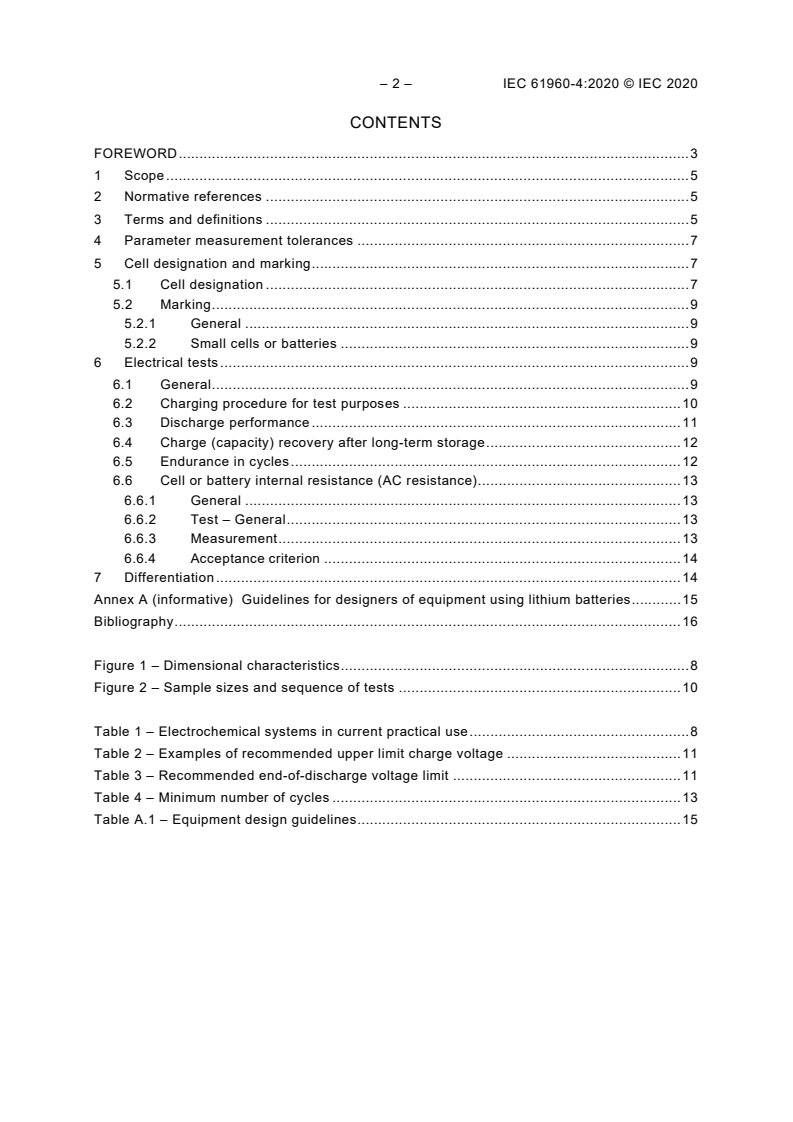
CONTENTS
FOREWORD . 3
1 Scope . 5
2 Normative references . 5
3 Terms and definitions . 5
4 Parameter measurement tolerances . 7
5 Cell designation and marking . 7
5.1 Cell designation . 7
5.2 Marking . 9
5.2.1 General . 9
5.2.2 Small cells or batteries . 9
6 Electrical tests . 9
6.1 General . 9
6.2 Charging procedure for test purposes . 10
6.3 Discharge performance . 11
6.4 Charge (capacity) recovery after long-term storage . 12
6.5 Endurance in cycles . 12
6.6 Cell or battery internal resistance (AC resistance) . 13
6.6.1 General . 13
6.6.2 Test – General . 13
6.6.3 Measurement . 13
6.6.4 Acceptance criterion . 14
7 Differentiation . 14
Annex A (informative) Guidelines for designers of equipment using lithium batteries . 15
Bibliography . 16
Figure 1 – Dimensional characteristics . 8
Figure 2 – Sample sizes and sequence of tests . 10
Table 1 – Electrochemical systems in current practical use . 8
Table 2 – Examples of recommended upper limit charge voltage . 11
Table 3 – Recommended end-of-discharge voltage limit . 11
Table 4 – Minimum number of cycles . 13
Table A.1 – Equipment design guidelines . 15
INTERNATIONAL ELECTROTECHNICAL COMMISSION
____________
SECONDARY CELLS AND BATTERIES CONTAINING ALKALINE OR
OTHER NON-ACID ELECTROLYTES – SECONDARY LITHIUM CELLS
AND BATTERIES FOR PORTABLE APPLICATIONS –
Part 4: Coin secondary lithium cells, and batteries made from them
FOREWORD
1) The International Electrotechnical Commission (IEC) is a worldwide organization for standardization comprising
all national electrotechnical committees (IEC National Committees). The object of IEC is to promote international
co-operation on all questions concerning standardization in the electrical and electronic fields. To this end and
in addition to other activities, IEC publishes International Standards, Technical Specifications, Technical Reports,
Publicly Available Specifications (PAS) and Guides (hereafter referred to as "IEC Publication(s)"). Their
preparation is entrusted to technical committees; any IEC National Committee interested in the subject dealt with
may participate in this preparatory work. International, governmental and non-governmental organizations liaising
with the IEC also participate in this preparation. IEC collaborates closely with the International Organization for
Standardization (ISO) in accordance with conditions determined by agreement between the two organizations.
2) The formal decisions or agreements of IEC on technical matters express, as nearly as possible, an international
consensus of opinion on the relevant subjects since each technical committee has representation from all
interested IEC National Committees.
3) IEC Publications have the form of recommendations for international use and are accepted by IEC National
Committees in that sense. While all reasonable efforts are made to ensure that the technical content of IEC
Publications is accurate, IEC cannot be held responsible for the way in which they are used or for any
misinterpretation by any end user.
4) In order to promote international uniformity, IEC National Committees undertake to apply IEC Publications
transparently to the maximum extent possible in their national and regional publications. Any divergence between
any IEC Publication and the corresponding national or regional publication shall be clearly indicated in the latter.
5) IEC itself does not provide any attestation of conformity. Independent certification bodies provide conformity
assessment services and, in some areas, access to IEC marks of conformity. IEC is not responsible for any
services carried out by independent certification bodies.
6) All users should ensure that they have the latest edition of this publication.
7) No liability shall attach to IEC or its directors, employees, servants or agents including individual experts and
members of its technical committees and IEC National Committees for any personal injury, property damage or
other damage of any nature whatsoever, whether direct or indirect, or for costs (including legal fees) and
expenses arising out of the publication, use of, or reliance upon, this IEC Publication or any other IEC Publications.
8) Attention is drawn to the Normative references cited in this publication. Use of the referenced publications is
indispensable for the correct application of this publication.
9) Attention is drawn to the possibility that some of the elements of this IEC Publication may be the subject of patent
rights. IEC shall not be held responsible for identifying any or all such patent rights.
International Standard IEC 61960-4 has been prepared by subcommittee 21A: Secondary cells
and batteries containing alkaline or other non-acid electrolytes, of IEC technical committee 21:
Secondary cells and batteries.
The text of this International Standard is based on the following documents:
FDIS Report on voting
21A/725/FDIS 21A/726/RVD
Full information on the voting for the approval of this International Standard can be found in the
report on voting indicated in the above table.
This document has been drafted in accordance with the ISO/IEC Directives, Part 2.
– 4 – IEC 61960-4:2020 © IEC 2020
A list of all parts in the IEC 61960 series, published under the general title Secondary cells and
batteries containing alkaline or other non-acid electrolytes – Secondary lithium cells and
batteries for portable applications, can be found on the IEC website.
The committee has decided that the contents of this document will remain unchanged until the
stability date indicated on the IEC website under "http://webstore.iec.ch" in the data related to
the specific document. At this date, the document will be
• reconfirmed,
• withdrawn,
• replaced by a revised edition, or
• amended.
SECONDARY CELLS AND BATTERIES CONTAINING ALKALINE OR
OTHER NON-ACID ELECTROLYTES – SECONDARY LITHIUM CELLS
AND BATTERIES FOR PORTABLE APPLICATIONS –
Part 4: Coin secondary lithium cells, and batteries made from them
1 Scope
This part of IEC 61960 specifies performance tests, designations, markings, dimensions and
other requirements for coin secondary lithium cells and batteries for portable applications and
backup power supply such as memory backup applications.
The objective of this document is to provide the purchasers and users of coin secondary lithium
cells and batteries with a set of criteria with which they can assess the performance of coin
secondary lithium cells and batteries offered by various manufacturers.
This document defines a minimum required level of performance and a standardized
methodology by which testing is performed and the results of this testing reported to the user.
Hence, users will be able to establish the viability of commercially available cells and batteries
via the declared specification and thus be able to select the cell or battery best suited for their
intended application.
This document covers coin secondary lithium cells and batteries with a range of chemistries.
Each electrochemical couple has a characteristic voltage range over which, during discharge,
it releases its electrical capacity, a characteristic nominal voltage and a characteristic end-of-
discharge voltage. Users of coin secondary lithium cells and batteries are requested to consult
the manufacturer for advice.
This document also provides guidelines for designers of equipment using lithium batteries (see
Annex A).
2 Normative references
The following documents are referred to in the text in such a way that some or all of their content
constitutes requirements of this document. For dated references, only the edition cited applies.
For undated references, the latest edition of the referenced document (including any
amendments) applies.
IEC 60050-482:2004, International Electrotechnical Vocabulary (IEV) – Part 482: Primary and
secondary cells and batteries
IEC 62133-2:2017, Secondary cells and batteries containing alkaline or other non-acid
electrolytes – Safety requirements for portable sealed secondary cells, and for batteries made
from them, for use in portable applications – Part 2: Lithium systems
3 Terms and definitions
For the purposes of this document, the terms and definitions given in IEC 60050-482 and the
following apply.
– 6 – IEC 61960-4:2020 © IEC 2020
ISO and IEC maintain terminological databases for use in standardization at the following
addresses:
• IEC Electropedia: available at http://www.electropedia.org/
• ISO Online browsing platform: available at http://www.iso.org/obp
3.1
charge recovery
capacity recovery
capacity that a cell or battery can deliver with subsequent recharge, after storage at a specific
temperature, for a specific time, as a percentage of the rated capacity
3.2
coin cell
coin battery
small round cell or battery where the overall height is less than the diameter, containing
non-aqueous electrolyte
3.3
end-of-discharge voltage
specified closed circuit voltage at which a discharge of a cell or battery is terminated
[SOURCE: IEC 60050-482:2004, 482-03-30, modified – The synonyms "final voltage", "cut-off
voltage", and "end-point voltage" have been omitted and the words "closed circuit" and "cell"
have been added to the definition.]
3.4
nominal voltage
suitable approximate value of voltage used to designate or identify a cell, or a battery
Note 1 to entry: The nominal voltages of coin secondary lithium cells are shown in Table 1.
[SOURCE: IEC 60050-482:2004, 482-03-31, modified – "electrochemical system" has been
omitted from the definition and the note has been added.]
3.5
rated capacity
quantity of electricity mAh (milliampere-hours) that a single cell or battery can deliver, when
charged, stored and discharged under specified conditions and declared by the manufacturer
3.6
secondary lithium battery
unit which incorporates one or more secondary lithium cells and which is ready for use
Note 1 to entry: This unit incorporates adequate housing and a terminal arrangement and may have electronic
control devices.
3.7
secondary lithium cell
secondary cell whose electrical energy is derived from oxidation and the reduction of lithium
Note 1 to entry: This cell is not ready for use in an application because it is not yet fitted with its final housing,
terminal arrangement and electronic control device.
4 Parameter measurement tolerances
The overall accuracy of controlled or measured values, relative to the specified or actual values,
shall be within the following tolerances:
a) ±1 % for voltage;
b) ±1 % for current;
c) ±1 % for capacity;
d) ±2 °C for temperature;
e) ±0,1 % for time;
f) ±0,1 mm for dimensions.
These tolerances comprise the combined accuracy of the measuring instruments, the
measurement techniques used, and all other sources of error in the test procedure.
The details of the instrumentation used shall be provided in any report of results.
5 Cell designation and marking
5.1 Cell designation
Cells shall be designated with the following form:
A A DDHH
1 2
where
A designates the positive electrode system in which:
C or U is lithium cobalt oxide
M is lithium manganese oxide
NB is niobium oxide
V is vanadium oxide
T is lithium titanium oxide
A designates the negative electrode system in which:
C is carbon
L is lithium aluminium alloy
S is lithium silicon oxide/alloy
T or TL is lithium titanium oxide
DD designates the diameter in mm
HH designates the height in 1/10 of mm
The requirements concerning code letters on electrochemical systems are given in Table 1.
– 8 – IEC 61960-4:2020 © IEC 2020
Table 1 – Electrochemical systems in current practical use
Nominal
voltage
Positive electrode Electrolyte Negative electrode
Code letters
(V)
Lithium cobalt oxide Carbon 3,7 UC
Lithium cobalt oxide Lithium titanium oxide 3,0 UT
Vanadium oxide Lithium aluminium alloy 3,0 VL
Lithium manganese oxide Lithium aluminium alloy 3,0 ML
Lithium manganese oxide Lithium silicon oxide/alloy 3,0 MS
Non-aqueous
Lithium cobalt oxide solution with Lithium titanium oxide 2,3 CTL
lithium salt
Niobium oxide Lithium aluminium alloy 2,0 NBL
Lithium manganese oxide Lithium titanium oxide 1,5 MT
Lithium titanium oxide Lithium-carbon compound 1,5 TC
Lithium titanium oxide Lithium aluminium alloy 1,5 TL
Lithium titanium oxide Lithium silicon oxide 1,5 TS
The above code letters are given as examples. Each positive electrode and negative electrode shall be designated with
one or two letters. Any code letter can be decided on by agreement between the manufacturer and user when there is a
same chemistry which has different nominal voltages.
Key
h overall height of the cell
d diameter of the cell
Figure 1 – Dimensional characteristics
Coin secondary lithium cells complying with this document shall be designated by the following
system consisting of code letters and numbers. For the electrochemical systems, the code
letters shall be expressed using two letters (a maximum of three letters), followed by diameter
and height expressed in that order. See Figure 1.
EXAMPLE ML 1220
Electrochemical systems code letters
Dimensions: d in millimetres
Dimensions: h in 1/10 of millimetres
NOTE Notwithstanding the above specification, other designations can be used according to an agreement between
manufacturer and user.
5.2 Marking
5.2.1 General
With the exception of small cells or batteries (see 5.2.2), each cell or battery shall be marked
with the following information:
a) cell designation, IEC or common;
b) the year and month or week of manufacture (may be given in code);
c) polarity of the positive (+) terminal;
d) nominal voltage;
e) name or trade mark of the manufacturer or supplier;
f) cautionary advice;
g) caution for ingestion of swallowable cells and batteries (see IEC 60086-4);
h) combination of "secondary (rechargeable)" and "Li", or "secondary (rechargeable)" and "Li-
ion".
5.2.2 Small cells or batteries
For cells or batteries that fit entirely within the ingestion gauge (Figure 3 in IEC 62133-2:2017),
the designation specified in 5.2.1 a) and the polarity specified in 5.2.1 c) shall be marked on
the cell or battery.
For cells or batteries with an internal AC resistance less than or equal to 3 Ω, intended to be
user replaceable or not contained in the equipment, the additional marking of 5.2.1 h) shall be
marked on the cell or battery.
All other information shown in 5.2.1 should be given in the specification sheet, or in the
instruction manual or on the immediate package instead of on the cell or battery.
6 Electrical tests
6.1 General
Only cell or battery samples which are less than two months (60 days) old from the date of
manufacture shall be used for the tests specified in this document.
Unless otherwise stated in this document, the following tests shall be done in an ambient
temperature of 20 °C ± 5 °C.
Tested cells or batteries should not exceed the upper limit charge voltage or end-of-discharge
voltage limit during the test.
Coin secondary lithium cells or batteries have different characteristics and features in terms of
voltage, discharge performance, capacity recovery after storage, and cycling depending on their
chemistries. Therefore, conditions specified by the manufacturer shall be used in order to make
the most of cell or battery characteristics.
The sample sizes and the sequence of the tests are described in Figure 2.
– 10 – IEC 61960-4:2020 © IEC 2020
Figure 2 – Sample sizes and sequence of tests
6.2 Charging procedure for test purposes
There are two different charging methods for the coin secondary lithium cells or batteries:
constant voltage charge and constant current charge. The charge method and conditions
specified by the manufacturer shall be used. When such information is not available, the charge
voltage shall be in accordance with Table 2.
Table 2 – Examples of recommended upper limit charge voltage
Recommended upper limit
Code letters
charge voltage
UC 4,25 V
UT 3,2 V
VL 3,55 V
ML 3,2 V
MS 3,3 V
CTL 2,7 V
NBL 2,5 V
MT 2,6 V
TC 3,15 V
TL 1,7 V
TS 3,0 V
6.3 Discharge performance
This test verifies the rated capacity of a cell or battery at 20 °C.
Step 1: The cell or battery shall be charged in accordance with 6.2.
Step 2: The cell or battery shall be stored in an ambient temperature of 20 °C ± 5 °C, for not
less than 1 h and not more than 4 h.
Step 3: The cell or battery shall be discharged, in an ambient temperature of 20 °C ± 5 °C, at a
constant current or constant resistance to the end-of-discharge voltage specified by the
manufacturer. When such information is not available, the recommended end-of-discharge
voltage limits are shown in Table 3.
Step 4: The capacity (mAh) delivered during step 3 shall be not less than the rated capacity
declared by the manufacturer.
Table 3 – Recommended end-of-discharge voltage limit
Recommended end-of-discharge
Code letters
voltage limit
UC 2,5 V
UT 2,0 V
VL 2,5 V
ML 2,0 V
MS 2,0 V
CTL 2,0 V
NBL 1,0 V
MT 1,0 V
TC 0,5 V
TL 0,8 V
TS 1,0 V
– 12 – IEC 61960-4:2020 © IEC 2020
6.4 Charge (capacity) recovery after long-term storage
This test verifies the capacity of a cell or battery after extended storage at 100 % state of charge,
followed by a subsequent charge.
Step 1: The cell or battery shall be charged in accordance with the specific conditions specified
by the manufacturer.
Step 2: The cell or battery shall be stored at 60 °C for 20 days.
Step 3: The cell or battery shall be stored, in an ambient temperature of 20 °C ± 5 °C, for not
less than 1 h and not more than 4 h.
Step 4: The cell or battery shall be discharged in an ambient temperature of 20 °C ± 5 °C, at
the discharge conditions specified by manufacturer, until its voltage is equal to the
manufacturer's specified end-of-discharge voltage. The cell or battery shall be charged before
discharge by the specific condition by the manufacturer.
Step 5: The capacity (mAh) delivered during step 4 shall be more than 50 % of its rated capacity.
6.5 Endurance in cycles
This test verifies the ability of charge-discharge cycle.
Step 1: The cell or battery shall be discharged, in an ambient temperature of 20 °C ± 5 °C, using
the method declared by the manufacturer.
Step 2: The cell or battery shall be continuously charged and discharged, in an ambient
temperature of 20 °C ± 5 °C.
The cell or battery shall be charged until its voltage is equal to the specified end-of-charge
voltage, or it shall be charged for the specified amount of time after its voltage is equal to the
specified end-of-charge voltage, using the method and conditions declared by the manufacturer.
The cell or battery shall be discharged in an ambient temperature of 20 °C ± 5 °C, until its
voltage is equal to the specified end-of-discharge voltage, or it shall be discharged for the
specified amount of time, using the method declared by the manufacturer.
The test shall be terminated when the discharge capacity reaches 50 % of its first cycle. The
result shall satisfy the minimum number of cycles in Table 4.
Table 4 – Minimum number of cycles
Code letters Minimum number of cycles
UC 100
UT 100
VL 5
ML 5
MS 50
CTL 100
NBL 5
MT 100
TC 100
TL 5
TS 50
The test procedure in 6.5 is a representative and unified accelerated method
to cover various electrochemical systems, and actual charge-discharge
conditions may be different depending on each application. The above
minimum numbers of cycles are values tested according to the procedure in
6.5. This accelerated test method might result in a fewer number of cycles
than in actual use.
6.6 Cell or battery internal resistance (AC resistance)
6.6.1 General
Internal AC resistance measurement is necessary to evaluate cell performance. When internal
AC resistance is smaller than 3 Ω, the safety standard of IEC 62133-2:2017, Annex D is
applicable.
6.6.2 Test – General
This test verifies the internal resistance of a secondary lithium cell or battery by the alternating
current (AC) method.
The internal resistance shall be measured at conditions (e.g. voltage, temperature) specified
by the manufacturer.
6.6.3 Measurement
The alternating RMS voltage, U , shall be measured while applying an alternating RMS current,
a
I , at the frequency of 1,0 kHz ± 0,1 kHz, to the cell or battery, for a period of 1 s to 5 s.
a
All voltage measurements shall be made at the terminals of the cell or battery independently of
the contacts used to carry current.
The internal AC resistance, R , is given by:
ac
U
a
R = (Ω)
ac
I
a
where
U is the alternating RMS voltage;
a
I is the alternating RMS current.
a
– 14 – IEC 61960-4:2020 © IEC 2020
The alternating current should be selected so that the peak voltage stays below 20 mV.
NOTE This method will in fact measure the impedance which, at the frequency specified, is approximately equal to
the resistance.
6.6.4 Acceptance criterion
The internal AC resistance of the cell or battery shall be not greater than the value of R ,
ac
declared by the manufacturer.
7 Differentiation
Technical consideration shall be taken to prevent coin secondary lithium cells and batteries
from being confused with primary lithium cells and batteries which are similar in appearance
and size. (For example, construction of an attached terminal in such a way that the terminal
cannot be replaced, affixing a note of caution, etc.)
The required information shall be marked on coin secondary lithium cells or batteries in
accordance with 5.2.
Annex A
(informative)
Guidelines for designers of equipment using lithium batteries
Table A.1 – Equipment design guidelines
Possible consequences if the
recommendations are not
Item Sub-item Recommendations
observed
(1) Battery holder and battery a) Battery compartments should Unless protection is provided
compartment be designed so that if a battery against battery reversal, damage
is reversed, open circuit is to equipment can occur from
achieved. Battery resultant electrolyte leakage,
compartments should be overheating, rupture, explosion or
clearly and permanently fire
marked to show the correct
orientation of batteries
b Battery compartments should Equipment might be damaged or
be designed so that batteries of might not operate
sizes other than that specified
cannot be inserted and make
contact
c) Battery compartments should Battery compartments might be
be designed to allow generated damaged when internal pressure
gases to escape of the battery becomes too high
due to gas generation
d) Battery compartments should
be designed to be waterproof
e) Battery compartments should
be designed to be explosion-
proof when tightly sealed
f) Battery compartments should Battery might be deformed and
be isolated from heat leak electrolyte due to excessive
generated by the equipment heat
g) Battery compartments should Children might remove batteries
be designed so that they from the compartment and
cannot easily be opened by swallow them
children
a) Material and shape of contacts Heat might generate at the
(2) Contacts and terminals
and terminals should be contact due to insufficient
selected so that effective connection
electric contact is maintained
b) Auxiliary circuit should be Equipment might be damaged or
designed to prevent reverse might not operate
installation of batteries
c) Contacts and terminals should Equipment might be damaged.
be designed to prevent reverse Battery might cause electrolyte
installation of batteries leakage, overheating, rupture,
explosion or fire
d) Direct soldering or welding to a Battery might leak, overheat,
battery should be avoided rupture, explode or catch fire
– 16 – IEC 61960-4:2020 © IEC 2020
Bibliography
IEC 60051 (all parts), Direct acting indicating analogue electrical measuring instruments and
their accessories
IEC 60086-1, Primary batteries – Part 1: General
IEC 60086-2, Primary batteries – Part 2: Physical and electrical specifications
IEC 60086-3, Primary batteries – Part 3: Watch batteries
IEC 60086-4:2019, Primary batteries – Part 4: Safety of lithium batteries
IEC 60485, Digital electronic d.c. voltmeters and d.c. electronic analogue-to-digital convertors
IEC 61434, Secondary cells and batteries containing alkaline or other non-acid electrolytes –
Guide to the designation of current in alkaline secondary cell and battery standards
IEC 61959, Secondary cells and batteries containing alkaline or other non-acid electrolytes –
Mechanical tests for sealed portable secondary cells and batteries
IEC 61960-3, Secondary cells and batteries containing alkaline or other non-acid electrolytes –
Secondary lithium cells and batteries for portable applications – Part 3 – Prismatic and
cylindrical lithium secondary cells, and batteries made from them
IEC 62133 (all parts), Secondary cells and batteries containing alkaline or other non-acid
electrolytes – Safety requirements for portable sealed secondary cells, and for batteries made
from them, for use in portable applications
IEC 62281, Safety of primary and secondary lithium cells and batteries during transport
IEC 62368-1, Audio/video, information and communication technology equipment – Part 1:
Safety requirements
___________
____________
Withdrawn publication
– 18 – IEC 61960-4:2020 © IEC 2020
SOMMAIRE
AVANT-PROPOS . 19
1 Domaine d'application . 21
2 Références normatives . 21
3 Termes et définitions . 22
4 Tolérances de mesure relatives aux paramètres . 23
5 Désignation et marquage des éléments . 23
5.1 Désignation des éléments . 23
5.2 Marquage . 25
5.2.1 Généralités . 25
5.2.2 Éléments ou batteries de petite taille . 25
6 Essais électriques . 25
6.1 Généralités . 25
6.2 Procédure de charge pour les besoins des essais . 26
6.3 Caractéristiques de décharge . 27
6.4 Récupération de charge (capacité) après un stockage de longue durée . 28
6.5 Endurance en cycles . 28
6.6 Résistance interne (résistance en courant alternatif) d'un élément ou d'une
batterie . 29
6.6.1 Généralités . 29
6.6.2 Essai – Généralités . 29
6.6.3 Mesurage . 29
6.6.4 Critère d'acceptation . 30
7 Différenciation . 30
Annexe A (informative) Lignes directrices pour les concepteurs d'équipements
utilisant des batteries au lithium . 31
Bibliographie . 32
Figure 1 – Caractéristiques dimensionnelles . 24
Figure 2 – Taille des échantillons et séquence d'essais . 26
Tableau 1 – Systèmes électrochimiques en utilisation pratique courante . 24
Tableau 2 – Exemples de limite supérieure de la tension de charge recommandée . 27
Tableau 3 – Limite recommandée de la tension de fin de décharge . 27
Tableau 4 – Nombre minimal de cycles . 29
Tableau A.1 – Lignes directrices pour la conception des équipements . 31
COMMISSION ÉLECTROTECHNIQUE INTERNATIONALE
____________
ACCUMULATEURS ALCALINS ET AUTRES ACCUMULATEURS
À ÉLECTROLYTE NON ACIDE – ACCUMULATEURS AU LITHIUM
POUR APPLICATIONS PORTABLES –
Partie 4: Éléments et batteries d'accumulateurs boutons au lithium
AVANT-PROPOS
1) La Commission Electrotechnique Internationale (IEC) est une organisation mondiale de normalisation composée
de l'ensemble des comités électrotechniques nationaux (Comités nationaux de l'IEC). L'IEC a pour objet de
favoriser la coopération internationale pour toutes les questions de normalisation dans les domaines de
l'électricité et de l'électronique. À cet effet, l'IEC – entre autres activités – publie des Normes internationales,
des Spécifications techniques, des Rapports techniques, des Spécifications accessibles au public (PAS) et des
Guides (ci-après dénommés "Publication(s) de l'IEC"). Leur élaboration est confiée à des comités d'études, aux
travaux desquels tout Comité national intéressé par le sujet traité peut participer. Les organisations
internationales, gouvernementales et non gouvernementales, en liaison avec l'IEC, participent également aux
travaux. L'IEC collabore étroitement avec l'Organisation Internationale de Normalisation (ISO), selon des
conditions fixées par accord entre les deux organisations.
2) Les décisions ou accords officiels de l'IEC concernant les questions techniques représentent, dans la mesure du
possible, un accord international sur les sujets étudiés, étant donné que les Comités nationaux de l'IEC intéressés
sont représentés dans chaque comité d'études.
3) Les Publications de l'IEC se présentent sous la forme de recommandations internationales et sont agréées
comme telles par les Comités nationaux de l'IEC. Tous les efforts raisonnables sont entrepris afin que l'IEC
s'assure de l'exactitude du contenu technique de ses publications; l'IEC ne peut pas être tenue responsable de
l'éventuelle mauvaise utilisation ou interprétation qui en est faite par un quelconque utilisateur final.
4) Dans le but d'encourager l'uniformité internationale, les Comités nationaux de l'IEC s'engagent, dans toute la
mesure possible, à appliquer de façon transparente les Publications de l'IEC dans leurs publications nationales
et régionales. Toutes divergences entre toutes Publications de l'IEC et toutes publications nationales ou
régionales correspondantes doivent être indiquées en termes clairs dans ces dernières.
5) L'IEC elle-même ne fournit aucune attestation de conformité. Des organismes de certification indépendants
fournissent des services d'évaluation de conformité et, dans certains secteurs, accèdent aux marques de
conformité de l'IEC. L'IEC n'est responsable d'aucun des services effectués par les organismes de certification
indépendants.
6) Tous les utilisateurs doivent s'assurer qu'ils sont en possession de la dernière édition de cette publication.
7) Aucune responsabilité ne doit être imputée à l'IEC, à ses administrateurs, employés, auxiliaires ou mandataires,
y compris ses experts particuliers et les membres de ses comités d'études et des Comités nationaux de l'IEC,
pour tout préjudice causé en cas de dommages corporels et matériels, ou de tout autre dommage de quelque
nature que ce soit, directe ou indirecte, ou pour supporter les coûts (y compris les frais de justice) et les dépenses
découlant de la publication ou de l'utilisation de cette Publication de l'IEC ou de toute autre Publication de l'IEC,
ou au crédit qui lui est accordé.
8) L'attention est attirée sur les références normatives citées dans cette publication. L'utilisation de publications
référencées est obligatoire pour une application correcte de la présente publication.
9) L'attention est attirée sur le fait que certains des éléments de la présente Publication de l'IEC peuvent faire l'objet
de droits de brevet. L'IEC ne saurait être tenue pour responsable de ne pas avoir identifié de tels droits de
brevets et de ne pas avoir signalé leur existence.
La Norme internationale IEC 61960-4 a été établie par le sous-comité 21A: Accumulateurs
alcalins et autres accumulateurs à électrolyte non acide, du comité d'études 21 de l'IEC:
Accumulateurs.
– 20 – IEC 61960-4:2020 © IEC 2020
Le texte de cette Norme internationale est issu des documents suivants:
FDIS Rapport de vote
21A/725/FDIS 21A/726/RVD
Le rapport de vote indiqué dans le tableau ci-dessus donne toute information sur le vote ayant
abouti à l'approbation de cette Norme internationale.
Ce document a été rédigé selon les Directives ISO/IEC, Partie 2.
Une liste de toutes les parties de la série IEC 61960, publiées sous le titre général
Accumulateurs alcalins et autres accumulateurs à électrolyte non acide – Accumulateurs au
lithium pour applications portables, peut être consultée sur le si
...