

IEC TR 63097:2017
(Main)Smart grid standardization roadmap
General Information
- Abstract
IEC/TR 63097:2017(E) provides standards users with guidelines to select a most appropriate set of standards and specifications. These standards and specifications are either existing or planned, and are provided by IEC or other bodies also fulfilling use cases.
It also aims at creating a common set of guiding principles that can be referenced by end-users and integrators who are responsible for the specification, design, and implementation of Smart Energy Systems.
As a living document, this roadmap will be subject to future changes, modifications and additions, and will be incorporated into future editions.
At the current stage, the focus remains the “Smart Grids”. This means that the full Smart Energy scope has not been addressed yet (i.e. the consideration necessary to include the interactions with other energies such as gas, and heat) and will be considered in a future edition of this document.
- Status
- Published
- Publication Date
- 13-Nov-2017
- Technical Committee
- SyC Smart Energy - Smart Energy
- Drafting Committee
- JWG 3 - SyC Smart Energy/JWG 3
- Current Stage
- PPUB - Publication issued
- Start Date
- 14-Nov-2017
- Completion Date
- 16-Nov-2017
Overview
IEC TR 63097:2017 - Smart grid standardization roadmap is a technical report from the International Electrotechnical Commission (IEC) that guides standards users in selecting the most appropriate set of standards and specifications for Smart Grids. It is a living roadmap that catalogs existing and planned IEC and external standards, provides a common set of guiding principles for specification, design and implementation of Smart Grid systems, and focuses initially on electrical Smart Grids (future editions will extend to other energies such as gas and heat).
Key topics and technical scope
- Standards selection guidance: Practical criteria and methods to choose relevant IEC and non‑IEC standards and technical specifications for Smart Grid projects.
- Architecture framework (SGAM): Uses the Smart Grid Architecture Model (SGAM) to map systems, domains and zones for consistent architectural views and interoperability planning.
- Use-case and system capability framework: Defines use-case mapping, system capabilities lists and how standards apply across functional scenarios.
- Standards mapping and toolkit: Includes the IEC Smart Grid Standards Map and references the Smart Grid Mapping Tool (smartgridstandardsmap.com) to visualize standards applicability.
- System breakdowns: Per‑system analyses (e.g., EMS/SCADA, DER management, ADMS, micro‑grids, e‑mobility, metering, marketplace systems) showing component, communication and information layers.
- Cross‑cutting technologies: Communication networks, data modelling, security & privacy (including authentication/authorization), clock reference, EMC/power quality, object identification, and functional safety.
- Interoperability and evolution: Interoperability layers, main expected evolutions (e.g., decentralized resources, storage, EV charging impacts), and roadmap for the next development phases.
Practical applications - who uses IEC TR 63097
- Utilities and system operators planning Smart Grid architecture and procurement.
- System integrators and solution designers evaluating which standards apply to components and interfaces.
- Manufacturers and device vendors seeking compliance and interoperability paths.
- Regulators and policy makers aligning requirements with international standards.
- Test labs and certification bodies using the roadmap to prioritize conformance and interoperability testing.
- Research and consulting organizations mapping technology trends and standard gaps.
Related standards (high‑level references)
Important families and referenced standards described in the report include:
- IEC 61850 (power utility automation communications)
- CIM family (IEC 61970 / 61968 / 62325 - Common Information Model)
- IEC 62056 (COSEM) (metering)
- IEC 62351 (security for power systems)
- IEC 61508 (functional safety)
These and many other IEC, ISO, ITU, IEEE and regional standards are indexed in the report’s annexes and the Standards Map.
IEC TR 63097 is an essential planning and reference tool for implementing interoperable, standards‑based Smart Grid solutions and for keeping up with the evolving Smart Grid standards landscape.
Get Certified
Connect with accredited certification bodies for this standard

IMQ S.p.A. (Certification)
Italian electrical product certification.

SLG Prüf- und Zertifizierungs GmbH
German testing and certification body.

UL Solutions
Global safety science company with testing, inspection and certification.
Sponsored listings
Frequently Asked Questions
IEC TR 63097:2017 is a technical report published by the International Electrotechnical Commission (IEC). Its full title is "Smart grid standardization roadmap". This standard covers: IEC/TR 63097:2017(E) provides standards users with guidelines to select a most appropriate set of standards and specifications. These standards and specifications are either existing or planned, and are provided by IEC or other bodies also fulfilling use cases. It also aims at creating a common set of guiding principles that can be referenced by end-users and integrators who are responsible for the specification, design, and implementation of Smart Energy Systems. As a living document, this roadmap will be subject to future changes, modifications and additions, and will be incorporated into future editions. At the current stage, the focus remains the “Smart Grids”. This means that the full Smart Energy scope has not been addressed yet (i.e. the consideration necessary to include the interactions with other energies such as gas, and heat) and will be considered in a future edition of this document.
IEC/TR 63097:2017(E) provides standards users with guidelines to select a most appropriate set of standards and specifications. These standards and specifications are either existing or planned, and are provided by IEC or other bodies also fulfilling use cases. It also aims at creating a common set of guiding principles that can be referenced by end-users and integrators who are responsible for the specification, design, and implementation of Smart Energy Systems. As a living document, this roadmap will be subject to future changes, modifications and additions, and will be incorporated into future editions. At the current stage, the focus remains the “Smart Grids”. This means that the full Smart Energy scope has not been addressed yet (i.e. the consideration necessary to include the interactions with other energies such as gas, and heat) and will be considered in a future edition of this document.
IEC TR 63097:2017 is classified under the following ICS (International Classification for Standards) categories: 29.240 - Power transmission and distribution networks. The ICS classification helps identify the subject area and facilitates finding related standards.
IEC TR 63097:2017 is available in PDF format for immediate download after purchase. The document can be added to your cart and obtained through the secure checkout process. Digital delivery ensures instant access to the complete standard document.
Standards Content (Sample)
IEC TR 63097 ®
Edition 1.0 2017-11
TECHNICAL
REPORT
colour
inside
Smart grid standardization roadmap
All rights reserved. Unless otherwise specified, no part of this publication may be reproduced or utilized in any form
or by any means, electronic or mechanical, including photocopying and microfilm, without permission in writing from
either IEC or IEC's member National Committee in the country of the requester. If you have any questions about IEC
copyright or have an enquiry about obtaining additional rights to this publication, please contact the address below or
your local IEC member National Committee for further information.
IEC Central Office Tel.: +41 22 919 02 11
3, rue de Varembé Fax: +41 22 919 03 00
CH-1211 Geneva 20 info@iec.ch
Switzerland www.iec.ch
About the IEC
The International Electrotechnical Commission (IEC) is the leading global organization that prepares and publishes
International Standards for all electrical, electronic and related technologies.
About IEC publications
The technical content of IEC publications is kept under constant review by the IEC. Please make sure that you have the
latest edition, a corrigenda or an amendment might have been published.
IEC Catalogue - webstore.iec.ch/catalogue Electropedia - www.electropedia.org
The stand-alone application for consulting the entire The world's leading online dictionary of electronic and
bibliographical information on IEC International Standards, electrical terms containing 20 000 terms and definitions in
Technical Specifications, Technical Reports and other English and French, with equivalent terms in 16 additional
documents. Available for PC, Mac OS, Android Tablets and languages. Also known as the International Electrotechnical
iPad. Vocabulary (IEV) online.
IEC publications search - www.iec.ch/searchpub IEC Glossary - std.iec.ch/glossary
The advanced search enables to find IEC publications by a 65 000 electrotechnical terminology entries in English and
variety of criteria (reference number, text, technical French extracted from the Terms and Definitions clause of
committee,…). It also gives information on projects, replaced IEC publications issued since 2002. Some entries have been
and withdrawn publications. collected from earlier publications of IEC TC 37, 77, 86 and
CISPR.
IEC Just Published - webstore.iec.ch/justpublished
Stay up to date on all new IEC publications. Just Published IEC Customer Service Centre - webstore.iec.ch/csc
details all new publications released. Available online and If you wish to give us your feedback on this publication or
also once a month by email. need further assistance, please contact the Customer Service
Centre: csc@iec.ch.
IEC TR 63097 ®
Edition 1.0 2017-11
TECHNICAL
REPORT
colour
inside
Smart grid standardization roadmap
INTERNATIONAL
ELECTROTECHNICAL
COMMISSION
ICS 29.240 ISBN 978-2-8322-4965-9
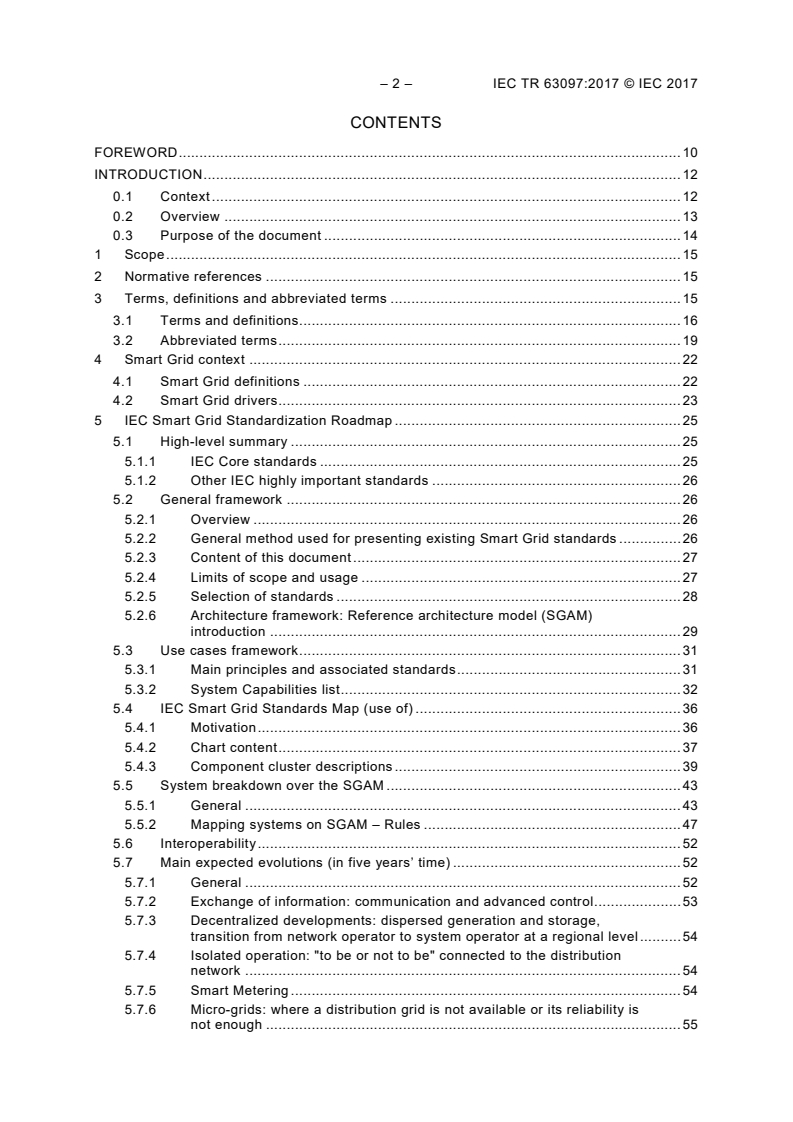
– 2 – IEC TR 63097:2017 © IEC 2017
CONTENTS
FOREWORD . 10
INTRODUCTION . 12
0.1 Context . 12
0.2 Overview . 13
0.3 Purpose of the document . 14
1 Scope . 15
2 Normative references . 15
3 Terms, definitions and abbreviated terms . 15
3.1 Terms and definitions. 16
3.2 Abbreviated terms . 19
4 Smart Grid context . 22
4.1 Smart Grid definitions . 22
4.2 Smart Grid drivers . 23
5 IEC Smart Grid Standardization Roadmap . 25
5.1 High-level summary . 25
5.1.1 IEC Core standards . 25
5.1.2 Other IEC highly important standards . 26
5.2 General framework . 26
5.2.1 Overview . 26
5.2.2 General method used for presenting existing Smart Grid standards . 26
5.2.3 Content of this document . 27
5.2.4 Limits of scope and usage . 27
5.2.5 Selection of standards . 28
5.2.6 Architecture framework: Reference architecture model (SGAM)
introduction . 29
5.3 Use cases framework . 31
5.3.1 Main principles and associated standards . 31
5.3.2 System Capabilities list . 32
5.4 IEC Smart Grid Standards Map (use of) . 36
5.4.1 Motivation . 36
5.4.2 Chart content . 37
5.4.3 Component cluster descriptions . 39
5.5 System breakdown over the SGAM . 43
5.5.1 General . 43
5.5.2 Mapping systems on SGAM – Rules . 47
5.6 Interoperability . 52
5.7 Main expected evolutions (in five years’ time) . 52
5.7.1 General . 52
5.7.2 Exchange of information: communication and advanced control . 53
5.7.3 Decentralized developments: dispersed generation and storage,
transition from network operator to system operator at a regional level . 54
5.7.4 Isolated operation: "to be or not to be" connected to the distribution
network . 54
5.7.5 Smart Metering . 54
5.7.6 Micro-grids: where a distribution grid is not available or its reliability is
not enough . 55
5.7.7 Electrical Vehicles: the act of charging and storage and the impact on
the distribution grids . 55
5.7.8 Managing the network and interfaces: supporting the Energy market
with flexibility in normal and abnormal situations . 55
5.7.9 Transmission networks: even smarter than they already are . 55
5.7.10 Blockchains: decentralized consensus . 56
5.8 Standards related to the electrotechnical aspects of Smart Grids . 56
5.8.1 Planning for Smart Grid . 56
5.8.2 Connecting and managing DER (Distributed Energy Resources) . 56
5.8.3 Integrating power electronics in the electrical grid . 59
5.8.4 Low voltage DC grids . 60
5.8.5 LV installation . 60
5.9 Per system standard breakdown . 61
5.9.1 Generation management system. 61
5.9.2 FACTS and HVDC systems for grids . 71
5.9.3 Energy management system . 79
5.9.4 Blackout prevention system . 87
5.9.5 Advanced distribution management system (ADMS) . 94
5.9.6 Distribution automation system . 105
5.9.7 Substation automation system . 113
5.9.8 DER management system . 123
5.9.9 Electrical energy storage management system . 134
5.9.10 Advanced metering infrastructure . 138
5.9.11 Metering-related back office system. 148
5.9.12 Marketplace system . 154
5.9.13 Demand response / load management system . 160
5.9.14 HBES/BACS system . 169
5.9.15 Industrial automation system . 177
5.9.16 E-mobility system . 184
5.9.17 Assets management and condition monitoring system . 190
5.9.18 Weather forecast system . 197
5.9.19 Micro-grid systems . 202
5.10 Cross-cutting technologies and systems . 208
5.10.1 Communication network. 208
5.10.2 Communication network management system . 223
5.10.3 Data modelling . 227
5.10.4 Security and privacy . 229
5.10.5 Authentication, Authorization, Accounting systems . 238
5.10.6 Clock reference system . 246
5.10.7 EMC and Power Quality . 250
5.10.8 Object identification, product classification, properties and
documentation . 256
5.10.9 Functional safety . 257
Annex A (informative) Standards . 259
A.1 IEC Standards table . 259
A.1.1 Available standards . 259
A.1.2 Coming IEC standards . 270
A.2 ISO and ISO/IEC standards . 273
A.2.1 Available standards . 273
– 4 – IEC TR 63097:2017 © IEC 2017
A.2.2 Coming standards. 275
A.3 ITU . 276
A.3.1 Available standards . 276
A.4 Other bodies . 279
A.4.2 Standards from IEEE . 285
A.4.3 Standards from CEN-CENELEC-ETSI . 287
A.4.4 Other bodies . 293
Annex B (informative) Overview of the core IEC standards . 296
B.1 IEC 61508 – Functional safety of electrical/electronic/programmable
electronic safety-related systems . 296
B.2 IEC 61850 – Communication networks and systems for power utility
automation . 296
B.2.1 Scope of application of IEC 61850 and history . 296
B.2.2 Key features of IEC 61850 . 298
B.2.3 IEC 61850 documentation structure . 298
B.2.4 Main parts . 299
B.2.5 Main principles . 300
B.2.6 IEC 61850-7-410 – Hydro power . 301
B.2.7 IEC 61850-7-420 – DER . 301
B.2.8 IEC 61400-25 – Wind turbine monitoring and controlling . 302
B.2.9 IEEE 1815-1 – Mapping IEC 61850 data objects over DNP3 . 303
B.3 The CIM family. 303
B.3.1 IEC 61970 – Common Information Model (CIM) . 303
B.3.2 IEC 61968 – Common Information Model (CIM) – Distribution
management . 305
B.3.3 IEC 62325 – Framework for energy market communications . 307
B.4 IEC 62056 – COSEM series . 307
B.4.1 General . 307
B.4.2 The basic principles followed in the IEC 62056 series . 307
B.4.3 Data model and communication channels . 310
B.4.4 The standards framework . 310
B.5 IEC 62351 – Security . 311
Annex C (informative) List of known Regional or National Smart Grids standard
roadmaps. 313
Bibliography . 314
Figure 1 – Smart Grid plane – domains and hierarchical zones . 29
Figure 2 – Grouping into interoperability layers . 30
Figure 3 – SGAM framework . 31
Figure 4 – Smart Grid Mapping Tool – www.smartgridstandardsmap.com . 38
Figure 5 – Systems mapping over the SGAM plane. 47
Figure 6 – Mapping principles of systems over the SGAM planes . 48
Figure 7 – Generation management system – Component layer . 69
Figure 8 – Generation management system – Communication layer . 70
Figure 9 – Generation management system – Information layer . 71
Figure 10 – FACTS and HVDC systems – Component layer . 77
Figure 11 – FACTS and HVDC systems – Communication layer . 78
Figure 12 – FACTS and HVDC systems – Information layer . 79
Figure 13 – EMS SCADA system – Component layer . 85
Figure 14 – EMS SCADA system – Communication layer . 86
Figure 15 – EMS SCADA system – Information layer . 87
Figure 16 – WAMPAC – Component layer . 92
Figure 17 – WAMPAC – Communication layer . 93
Figure 18 – WAMPAC – Information layer . 94
Figure 19 – DMS SCADA and GIS system – Component layer . 103
Figure 20 – DMS SCADA and GIS system – Communication layer . 104
Figure 21 – DMS SCADA and GIS system – Information layer . 105
Figure 22 – Distribution automation system – Component layer . 111
Figure 23 – Distribution automation system – Communication layer . 112
Figure 24 – Distribution automation system – Information layer . 113
Figure 25 – Smart Substation Automation with a process bus . 114
Figure 26 – Substation automation system – Component layer . 121
Figure 27 – Substation automation system – Communication layer . 122
Figure 28 – Substation automation system – Information layer . 123
Figure 29 – Example of a communications configuration for a DER plant . 127
Figure 30 – Illustration of electrical connection points (ECP) in a DER plant . 128
Figure 31 – DER management system – Component layer . 132
Figure 32 – DER management system- Communication layer . 133
Figure 33 – DER management system – Information layer . 134
Figure 34 – The smart metering reference architecture . 142
Figure 35 – Smart metering architecture (example) mapped to the SGAM component
layer . 146
Figure 36 – Smart metering architecture (example) mapped to the SGAM
communication layer . 147
Figure 37 – Smart metering architecture (example) mapped to the SGAM information
layer . 148
Figure 38 – Typical applications hosted by a metering-related back office system . 149
Figure 39 – Metering-related back office system – Component layer . 152
Figure 40 – Metering-related back office system – Communication layer . 153
Figure 41 – Metering-related back office system – Information layer . 154
Figure 42 – Marketplace system – Component layer . 158
Figure 43 – Marketplace system – Communication layer . 159
Figure 44 – Marketplace system – Information layer . 160
Figure 45 – SGUI representation . 162
Figure 46 – Demand response management system (example) – Component layer . 167
Figure 47 – Demand response management system (example) – Communication layer . 168
Figure 48 – Demand response management system (example) – Information layer . 169
Figure 49 – HBES/BACS system (example) – Component layer . 175
Figure 50 – HBES/BACS system (example) – Communication layer . 176
Figure 51 – HBES/BACS system (example) – Information layer . 177
Figure 52 – Industrial automation system (example) – Component layer . 182
Figure 53 – Industrial automation system (example) – Communication layer . 183
– 6 – IEC TR 63097:2017 © IEC 2017
Figure 54 – Industrial automation system (example) – Information layer . 184
Figure 55 – E-mobility system (example) – Component layer . 188
Figure 56 – E-mobility system (example) – Communication layer . 189
Figure 57 – E-mobility system (example) – Information layer . 190
Figure 58 – Assets management and Condition Monitoring System – Component layer . 195
Figure 59 – Assets management and Condition Monitoring System – Communication
layer . 196
Figure 60 – Assets management and Condition Monitoring System – Information layer . 197
Figure 61 – Weather forecast and observation system – Component layer . 200
Figure 62 – Weather forecast and observation system – Communication layer. 201
Figure 63 – Weather forecast and observation system – Information layer . 202
Figure 64 – Micro-grids – possible domains and systems breakdown . 204
Figure 65 – Mapping of communication networks on SGAM . 210
Figure 66 – Communication network management – Component layer . 225
Figure 67 – Communication network management – Communication layer . 226
Figure 68 – Communication network management – Information layer . 227
Figure 69 – Data modelling and harmonization work mapping . 228
Figure 70 – Smart Grid information security standards areas . 231
Figure 71 – Current Smart Grid information security standard landscape analysed . 232
Figure 72 – Security standard applicability . 233
Figure 73 – AAA Example in a substation automation use case . 239
Figure 74 – EAP Overview . 240
Figure 75 – Mapping of standards used in the AAA example on SGAM – Component
layer . 243
Figure 76 – Mapping of standards used in the AAA example on SGAM –
Communication layer . 245
Figure 77 – Mapping of standards used in the AAA example on SGAM – Information
layer . 246
Figure 78 – Clock reference system – Component layer . 249
Figure 79 – Clock reference system – Communication layer . 250
Figure 80 – Clock reference system – Information layer . 250
Figure B.1 – Scope of application of IEC 61850 . 297
Figure B.2 – IEC 61850 main parts . 299
Figure B.3 – Interface model of substation automation based on IEC 61850 . 301
Figure B.4 – Overview: Conceptual organization of IEC 61850-7-420 logical devices
and logical nodes (DER) . 302
Figure B.5 – Overview of advanced EMS architecture . 304
Figure B.6 – IEC 61968 compliant interface architecture . 306
Figure B.7 – The standards framework for smart metering . 311
Table 1 – Smart Grids – IEC core standards . 25
Table 2 – Smart Grids – Other IEC highly important standards . 26
Table 3 – Use cases approach – Available standards . 32
Table 4 – Use cases approach – Coming standards . 32
Table 5 – Summary list of System Capabilities . 33
Table 6 – IEC Smart Grid Standards Map clusters description . 39
Table 7 – IEC Smart Grid Standards Map – component description . 40
Table 8 – Smart Grids – list of the main systems . 44
Table 9 – Typical components used for system mapping on SGAM . 49
Table 10 – Typical links used for system mapping on SGAM . 49
Table 11 – Example in binding system standards and low OSI layer communication
standards . 50
Table 12 – Capabilities coverage example . 51
Table 13 – Connecting and managing DER – Available standards . 57
Table 14 – Connecting and managing DER – Coming standards . 59
Table 15 – LV installations available standards . 61
Table 16 – LV installations coming standards . 61
Table 17 – Generation management systems – Capabilities . 63
Table 18 – Generation management system – Available standards . 65
Table 19 – Generation management system – Coming standards . 68
Table 20 – FACTS and HVDC systems – System Capabilities . 74
Table 21 – FACTS – Available standards . 75
Table 22 – FACTS and HVDC systems – Coming standards . 76
Table 23 – EMS SCADA system – Capabilities . 82
Table 24 – EMS SCADA system – Available standards . 83
Table 25 – EMS SCADA system – Coming standards . 84
Table 26 – WAMPAC – System Capabilities . 88
Table 27 – WAMPAC – Available standards . 89
Table 28 – WAMPAC – Coming standards . 90
Table 29 – DMS SCADA and GIS system – Capabilities . 98
Table 30 – DMS SCADA and GIS system – Available standards . 100
Table 31 – DMS SCADA and GIS system – Coming standards . 101
Table 32 – Distribution automation system – System Capabilities . 107
Table 33 – Distribution automation system – Available standards . 108
Table 34 – Distribution automation system – Coming standards . 110
Table 35 – Substation automation system – Capabilities . 115
Table 36 – Substation automation system – Available standards . 117
Table 37 – Substation automation system – Coming standards . 119
Table 38 – DER management system – Capabilities . 125
Table 39 – DER management system – Available standards . 129
Table 40 – DER management system – Coming standards . 130
Table 41 – Electrical energy storage management system – Capabilities . 136
Table 42 – Electrical energy storage management system – Available standards. 137
Table 43 – Electrical energy storage management system – Coming standards . 138
Table 44 – Supported business processes and use cases . 140
Table 45 – AMI system – available standards for smart metering . 143
Table 46 – AMI system – Coming standards for smart metering . 145
Table 47 – Metering-related back office system – Capabilities . 150
– 8 – IEC TR 63097:2017 © IEC 2017
Table 48 – Metering-related back office system – Available standards . 151
Table 49 – Metering-related back office system – Coming standards . 151
Table 50 – Marketplace system – Capabilities . 155
Table 51 – Marketplace system – Available standards . 156
Table 52 – Marketplace system – Coming standards . 157
Table 53 – Demand response management system – Capabilities . 163
Table 54 – Demand response management system – Available standards . 164
Table 55 – Demand response management system– Coming standards . 166
Table 56 – HBES/BACS system – Capabilities . 171
Table 57 – HBES/BACS system – Available standards . 172
Table 58 – HBES/BACS system– Coming standards . 174
Table 59 – Industrial automation system – Use cases . 179
Table 60 – Industrial automation system – Available standards . 180
Table 61 – Industrial automation system – Coming standards . 181
Table 62 – E-mobility system – Available standards . 186
Table 63 – E-mobility system – Coming standards . 187
Table 64 – Assets management and Condition Monitoring System – Capabilities . 192
Table 65 – Assets management and Condition Monitoring System – Available
standards . 193
Table 66 – Assets management and Condition Monitoring System – Coming standards . 194
Table 67 – Weather forecast and observation system – Capabilities . 198
Table 68 – Weather forecast and observation system – Available standards . 198
Table 69 – Weather forecast and observation system – Coming standards . 199
Table 70 – Industrial automation system – Capabilities . 205
Table 71 – Micro-grid systems – Available standards . 206
Table 72 – Micro-grid systems – Coming standards . 207
Table 73 – Applicability statement of the communication technologies to the Smart
Grid sub-networks . 212
Table 74 – Communication – Available standards . 213
Table 75 – Communication – Coming standards . 221
Table 76 – Higher level communication protocols – Available standards . 222
Table 77 – Higher level communication protocols – Coming standards . 223
Table 78 – Communication network management – Available standards . 224
Table 79 – Data modelling – Available standards . 228
Table 80 – Data modelling – Coming standards . 229
Table 81 – Security – Available standards . 234
Table 82 – Security – Coming standards . 237
Table 83 – AAA systems – Capabilities . 241
Table 84 – AAA system – Available standards . 242
Table 85 – AAA system – Coming standards . 242
Table 86 – Clock reference system – System Capabilities . 247
Table 87 – Clock reference system – Available standards . 247
Table 88 – Clock reference system – Coming standards . 248
Table 89 – EMC – Power Quality – Available standards . 254
Table 90 – EMC – Power Quality – Coming standards . 255
Table 91 – Identification and classification of objects – Available standards . 257
Table 92 – Electronic product description – Available standards . 257
Table 93 – Identification and classification of objects – Coming standards . 257
Table 94 – Functional safety – Available standards . 258
Table B.1 – IEC 61970 main parts (available and coming) . 305
Table B.2 – IEC 61968 main parts (available and coming) . 306
Table B.3 – IEC 62325 main parts . 307
Table B.4 – IEC 62351 main parts . 312
– 10 – IEC TR 63097:2017 © IEC 2017
INTERNATIONAL ELECTROTECHNICAL COMMISSION
____________
SMART GRID STANDARDIZATION ROADMAP
FOREWORD
1) The International Electrotechnical Commission (IEC) is a worldwide organization for standardization comprising
all national electrotechnical committees (IEC National Committees). The object of IEC is to promote
international co-operation on all questions concerning standardization in the electrical and electronic fields. To
this end and in addition to other activities, IEC publishes International Standards, Technical Specifications,
Technical Reports, Publicly Available Specifications (PAS) and Guides (hereafter referred to as “IEC
Publication(s)”). Their preparation is entrusted to technical committees; any IEC National Committee interested
in the subject dealt with may participate in this preparatory work. International, governmental and non-
governmental organizations liaising with the IEC also participate in this preparation. IEC collaborates closely
with the International Organization for Standardization (ISO) in accordance with conditions determined by
agreement between the two organizations.
2) The formal decisions or agreements of IEC on technical matters express, as nearly as possible, an international
consensus of opinion on the relevant subjects since each technical committee has representation from all
interested IEC National Committees.
3) IEC Publications have the form of recommendations for international use and are accepted by IEC National
Committees in that sense. While all reasonable efforts are made to ensure that the technical content of IEC
Publications is accurate, IEC cannot be held responsible for the way in which they are used or for any
misinterpretation by any end user.
4) In order to promote international uniformity, IEC National Committees undertake to apply IEC Publications
transparently to the maximum extent possible in their national and regional publications. Any divergence
between any IEC Publication and the corresponding national or regional publication shall be clearly indicated in
the latter.
5) IEC itself does not provide any attestation of conformity. Independent certification bodies provide conformity
assessment services and, in some areas, access to IEC marks of conformity. IEC is not responsible for any
services carried out by independent certification bodies.
6) All users should ensure that they have the latest edition of this publication.
7) No liability shall attach to IEC or its directors, employees, servants or agents including individual experts and
members of its technical committees and IEC National Committees for any personal injury, property damage or
other damage of any nature whatsoever, whether direct or indirect, or for costs (including legal fees) and
expenses arising out of the publication, use of, or reliance upon, this IEC Publication or any other IEC
Publications.
8) Attention is drawn to the Normative references cited in this publication. Use of the referenced publications is
indispensable for the correct application of this publication.
9) Attention is drawn to the possibility that some of the elements of this IEC Publication may be the subject of
patent rights. IEC shall not be held responsible for identifying any or all such patent rights.
The main task of IEC technical committees is to prepare International Standards. However, a
technical committee may propose the publication of a Technical Report when it has collected
data of a different kind from that which is normally published as an International Standard, for
example "state of the art".
IEC TR 63097, which is a Technical Report, has been prepared by IEC Systems Committee:
Smart energy.
The text of this Technical Report is based on the following documents:
Enquiry draft Report on voting
SyCSmartEnergy/50/DTR SyCSmartEnergy/59/RVDTR
Full information on the voting for the approval of this Technical Report can be found in the
report on voting indicated in the above table.
This document has been drafted in accordance with the ISO/IEC Directives, Part 2.
The committee has decided that the contents of this document will remain unchanged until the
stability date indicated on the IEC website under "http://webstore.iec.ch" in the data related to
the specific document. At this date, the document will be
• reconfirmed,
• withdrawn,
• replaced by a revised edition, or
• amended.
A bilingual version of this publication may be issued at a later date.
IMPORTANT – The 'colour inside' logo on the cover page of this publication indicates
that it contains colours which a
...