

IEC 60068-2-78:2012
(Main)Environmental testing - Part 2-78: Tests - Test Cab: Damp heat, steady state
General Information
- Abstract
IEC 60068-2-78:2012 establishes a test method for determining the ability of components or equipment to withstand transportation, storage and use under conditions of high humidity. The object of this standard is to investigate the effect of high humidity at constant temperature without condensation on a specimen over a prescribed period. It is applicable to small equipment or components as well as large equipment, and can be applied to both heat-dissipating and non-heat-dissipating specimens. This second edition cancels and replaced the first edition, published in 2001 and constitutes a technical revision. This edition includes editorial and format changes with respect to the previous edition:
- The test chamber from IEC 60068-3-6 has been introduced.
- Status
- Published
- Publication Date
- 29-Oct-2012
- Technical Committee
- TC 104 - Environmental conditions, classification and methods of test
- Drafting Committee
- MT 16 - TC 104/MT 16
Buy Documents
IEC 60068-2-78:2012 - Environmental testing - Part 2-78: Tests - Test Cab: Damp heat, steady state Released:10/30/2012

IEC 60068-2-78:2012 RLV - Environmental testing - Part 2-78: Tests - Test Cab: Damp heat, steady state Released:10/30/2012
Overview
IEC 60068-2-78:2012 is an internationally recognized standard developed by the International Electrotechnical Commission (IEC) that specifies a test method for evaluating the resistance of electronic components and equipment to damp heat under steady-state conditions. This standard is essential for assessing product durability when exposed to high humidity environments at constant temperatures without condensation, simulating real-world transportation, storage, and operational conditions.
The standard applies to a wide range of specimens, including small components as well as large equipment, and is suitable for both heat-dissipating and non-heat-dissipating specimens. By replicating sustained high humidity exposure, IEC 60068-2-78 helps manufacturers and test laboratories ensure product reliability and longevity, minimizing failures related to moisture ingress.
Key Topics
Test Scope
The test examines how specimens withstand high humidity conditions at a steady temperature, preventing condensation-related damage. It focuses on moisture absorption and diffusion effects over a defined period.Test Conditions
The standard defines severity levels by temperature, relative humidity (RH), and duration. Typical temperature and RH combinations include:- 30 ± 2 °C at 85% or 93% RH
- 40 ± 2 °C at 85% or 93% RH
Test durations vary from 12 hours to up to 56 days, depending on product specifications.
Test Chamber Requirements
The humidity and temperature chamber must conform to IEC 60068-3-6, featuring:- Accurate and localized temperature and humidity sensors
- Prevention of condensation directly on specimens
- Controlled purity of humidifying water (conductivity ≤ 20 µS/cm)
- Suitable volume to allow uniform environmental conditions
- Avoidance of radiant heat exposure to specimens
Test Procedure
- Pre-conditioning specimens if required
- Introducing specimens into the chamber in their operating or specified state
- Gradually adjusting moisture levels without condensation
- Maintaining exposure for the specified duration
- Post-test recovery phase before final measurements
Measurements and Reporting
The standard mandates initial, optional intermediate, and final evaluations including visual, electrical, and mechanical checks. Test reports must comprehensively document test parameters, environment, specimen details, and results to ensure traceability and reproducibility.
Applications
IEC 60068-2-78:2012 is widely used across industries where electronics and electrical equipment face humid environments, such as:
Consumer Electronics
Ensuring reliability for devices exposed to humid climates or storage conditions.Automotive and Transportation
Testing components for moisture resistance during transit and operation.Industrial Equipment
Evaluation of machinery and control units operating in moisture-prone environments.Telecommunications
Qualification of outdoor or sealed equipment to withstand humidity stress.Medical Devices
Verifying device durability under controlled environmental stresses.
This standard supports quality assurance, product development, and compliance with environmental robustness requirements, thereby reducing warranty claims and enhancing customer satisfaction.
Related Standards
- IEC 60068-1: Environmental testing – General and guidance for preparing environmental tests including damp heat tests.
- IEC 60068-3-6: Environmental testing – Guidelines for performance confirmation of temperature and humidity test chambers.
- IEC Guide 104: Preparation of safety publications, including basic safety standards applicable to environmental testing.
- Other IEC 60068 series parts: Covering various environmental tests like vibration, temperature cycling, and cold testing.
Incorporating IEC 60068-2-78 within a comprehensive environmental testing program ensures robust performance verification of electrical and electronic components under humidity stress, integral to meeting international quality and safety standards.
Relations
- Effective Date
- 25-Aug-2026
- Effective Date
- 25-Aug-2026
- Effective Date
- 25-Aug-2026
- Effective Date
- 25-Aug-2026
- Effective Date
- 25-Aug-2026
- Effective Date
- 25-Aug-2026
- Revised
IEC 60068-2-78:2025 - Environmental testing - Part 2-78: Tests - Test Cab: Damp heat, steady state - Effective Date
- 05-Sep-2023
- Revises
IEC 60068-2-78:2001 - Environmental testing - Part 2-78: Tests - Test Cab: Damp heat, steady state - Effective Date
- 05-Sep-2023
Buy Documents
IEC 60068-2-78:2012 - Environmental testing - Part 2-78: Tests - Test Cab: Damp heat, steady state Released:10/30/2012
IEC 60068-2-78:2012 RLV - Environmental testing - Part 2-78: Tests - Test Cab: Damp heat, steady state Released:10/30/2012
Get Certified
Connect with accredited certification bodies for this standard

IMQ S.p.A. (Certification)
Italian electrical product certification.

SLG Prüf- und Zertifizierungs GmbH
German testing and certification body.

UL Solutions
Global safety science company with testing, inspection and certification.
Sponsored listings
Frequently Asked Questions
IEC 60068-2-78:2012 is a standard published by the International Electrotechnical Commission (IEC). Its full title is "Environmental testing - Part 2-78: Tests - Test Cab: Damp heat, steady state". This standard covers: IEC 60068-2-78:2012 establishes a test method for determining the ability of components or equipment to withstand transportation, storage and use under conditions of high humidity. The object of this standard is to investigate the effect of high humidity at constant temperature without condensation on a specimen over a prescribed period. It is applicable to small equipment or components as well as large equipment, and can be applied to both heat-dissipating and non-heat-dissipating specimens. This second edition cancels and replaced the first edition, published in 2001 and constitutes a technical revision. This edition includes editorial and format changes with respect to the previous edition: - The test chamber from IEC 60068-3-6 has been introduced.
IEC 60068-2-78:2012 establishes a test method for determining the ability of components or equipment to withstand transportation, storage and use under conditions of high humidity. The object of this standard is to investigate the effect of high humidity at constant temperature without condensation on a specimen over a prescribed period. It is applicable to small equipment or components as well as large equipment, and can be applied to both heat-dissipating and non-heat-dissipating specimens. This second edition cancels and replaced the first edition, published in 2001 and constitutes a technical revision. This edition includes editorial and format changes with respect to the previous edition: - The test chamber from IEC 60068-3-6 has been introduced.
IEC 60068-2-78:2012 is classified under the following ICS (International Classification for Standards) categories: 19.040 - Environmental testing; 29.020 - Electrical engineering in general; 29.140.30 - Fluorescent lamps. Discharge lamps. The ICS classification helps identify the subject area and facilitates finding related standards.
IEC 60068-2-78:2012 has the following relationships with other standards: It is inter standard links to EN ISO 9455-16:2019, EN ISO 13856-1:2013, EN ISO 9455-15:2017, EN ISO 10374:1997, EN ISO 13856-2:2013, EN ISO 9455-16:2013, IEC 60068-2-78:2025, IEC 60068-2-78:2001. Understanding these relationships helps ensure you are using the most current and applicable version of the standard.
IEC 60068-2-78:2012 is available in PDF format for immediate download after purchase. The document can be added to your cart and obtained through the secure checkout process. Digital delivery ensures instant access to the complete standard document.
Standards Content (Sample)
IEC 60068-2-78 ®
Edition 2.0 2012-10
INTERNATIONAL
STANDARD
NORME
INTERNATIONALE
BASIC SAFETY PUBLICATION
PUBLICATION FONDAMENTALE DE SÉCURITÉ
Environmental testing –
Part 2-78: Tests – Test Cab: Damp heat, steady state
Essais d’environnement –
Partie 2-78: Essais – Essai Cab: Chaleur humide, essai continu
All rights reserved. Unless otherwise specified, no part of this publication may be reproduced or utilized in any form
or by any means, electronic or mechanical, including photocopying and microfilm, without permission in writing from
either IEC or IEC's member National Committee in the country of the requester.
If you have any questions about IEC copyright or have an enquiry about obtaining additional rights to this publication,
please contact the address below or your local IEC member National Committee for further information.
Droits de reproduction réservés. Sauf indication contraire, aucune partie de cette publication ne peut être reproduite ni
utilisée sous quelque forme que ce soit et par aucun procédé, électronique ou mécanique, y compris la photocopie et les
microfilms, sans l'accord écrit de la CEI ou du Comité national de la CEI du pays du demandeur.
Si vous avez des questions sur le copyright de la CEI ou si vous désirez obtenir des droits supplémentaires sur cette
publication, utilisez les coordonnées ci-après ou contactez le Comité national de la CEI de votre pays de résidence.
IEC Central Office Tel.: +41 22 919 02 11
3, rue de Varembé Fax: +41 22 919 03 00
CH-1211 Geneva 20 info@iec.ch
Switzerland www.iec.ch
About the IEC
The International Electrotechnical Commission (IEC) is the leading global organization that prepares and publishes
International Standards for all electrical, electronic and related technologies.
About IEC publications
The technical content of IEC publications is kept under constant review by the IEC. Please make sure that you have the
latest edition, a corrigenda or an amendment might have been published.
Useful links:
IEC publications search - www.iec.ch/searchpub Electropedia - www.electropedia.org
The advanced search enables you to find IEC publications The world's leading online dictionary of electronic and
by a variety of criteria (reference number, text, technical electrical terms containing more than 30 000 terms and
committee,…). definitions in English and French, with equivalent terms in
It also gives information on projects, replaced and additional languages. Also known as the International
withdrawn publications. Electrotechnical Vocabulary (IEV) on-line.
IEC Just Published - webstore.iec.ch/justpublished Customer Service Centre - webstore.iec.ch/csc
Stay up to date on all new IEC publications. Just Published If you wish to give us your feedback on this publication
details all new publications released. Available on-line and or need further assistance, please contact the
also once a month by email. Customer Service Centre: csc@iec.ch.
A propos de la CEI
La Commission Electrotechnique Internationale (CEI) est la première organisation mondiale qui élabore et publie des
Normes internationales pour tout ce qui a trait à l'électricité, à l'électronique et aux technologies apparentées.
A propos des publications CEI
Le contenu technique des publications de la CEI est constamment revu. Veuillez vous assurer que vous possédez
l’édition la plus récente, un corrigendum ou amendement peut avoir été publié.
Liens utiles:
Recherche de publications CEI - www.iec.ch/searchpub Electropedia - www.electropedia.org
La recherche avancée vous permet de trouver des Le premier dictionnaire en ligne au monde de termes
publications CEI en utilisant différents critères (numéro de électroniques et électriques. Il contient plus de 30 000
référence, texte, comité d’études,…). termes et définitions en anglais et en français, ainsi que
Elle donne aussi des informations sur les projets et les les termes équivalents dans les langues additionnelles.
publications remplacées ou retirées. Egalement appelé Vocabulaire Electrotechnique
International (VEI) en ligne.
Just Published CEI - webstore.iec.ch/justpublished
Service Clients - webstore.iec.ch/csc
Restez informé sur les nouvelles publications de la CEI.
Just Published détaille les nouvelles publications parues. Si vous désirez nous donner des commentaires sur
Disponible en ligne et aussi une fois par mois par email. cette publication ou si vous avez des questions
contactez-nous: csc@iec.ch.
IEC 60068-2-78 ®
Edition 2.0 2012-10
INTERNATIONAL
STANDARD
NORME
INTERNATIONALE
BASIC SAFETY PUBLICATION
PUBLICATION FONDAMENTALE DE SÉCURITÉ
Environmental testing –
Part 2-78: Tests – Test Cab: Damp heat, steady state
Essais d’environnement –
Partie 2-78: Essais – Essai Cab: Chaleur humide, essai continu
INTERNATIONAL
ELECTROTECHNICAL
COMMISSION
COMMISSION
ELECTROTECHNIQUE
PRICE CODE
INTERNATIONALE
CODE PRIX J
ICS 19.040; 29.020 ISBN 978-2-83220-444-3
– 2 – 60068-2-78 IEC:2012
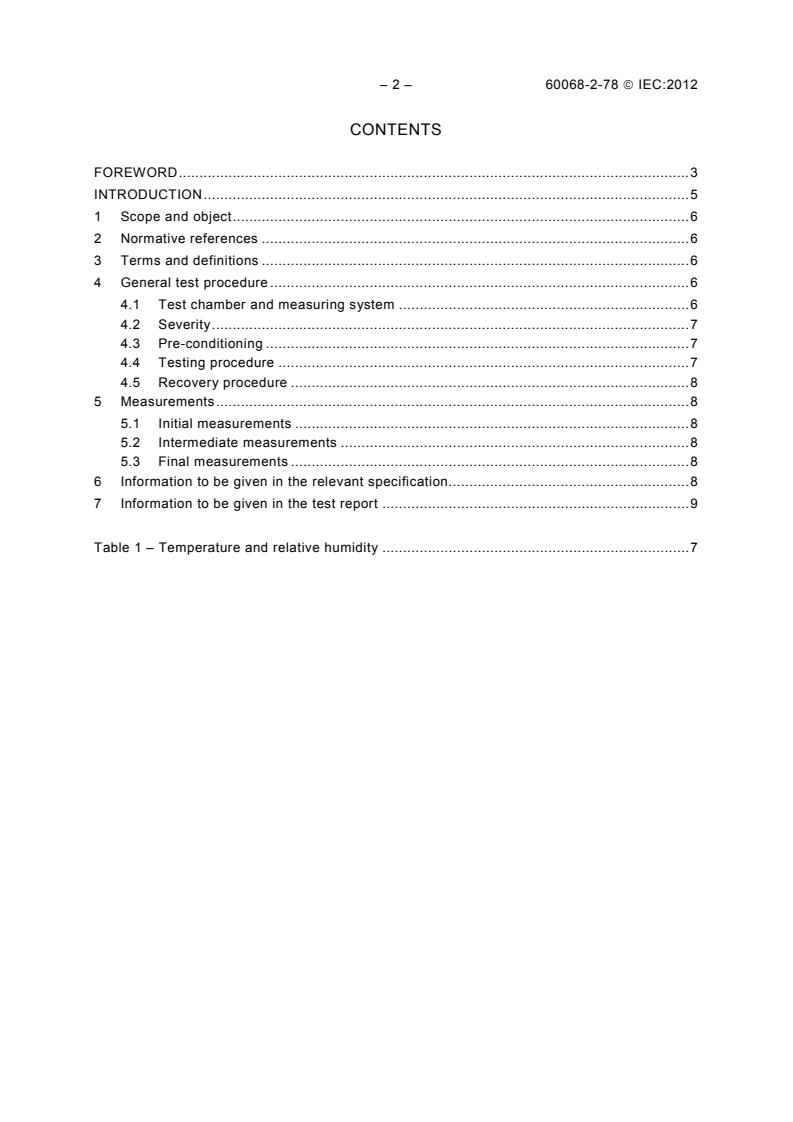
CONTENTS
FOREWORD . 3
INTRODUCTION . 5
1 Scope and object . 6
2 Normative references . 6
3 Terms and definitions . 6
4 General test procedure . 6
4.1 Test chamber and measuring system . 6
4.2 Severity . 7
4.3 Pre-conditioning . 7
4.4 Testing procedure . 7
4.5 Recovery procedure . 8
5 Measurements . 8
5.1 Initial measurements . 8
5.2 Intermediate measurements . 8
5.3 Final measurements . 8
6 Information to be given in the relevant specification. 8
7 Information to be given in the test report . 9
Table 1 – Temperature and relative humidity . 7
60068-2-78 IEC:2012 – 3 –
INTERNATIONAL ELECTROTECHNICAL COMMISSION
____________
ENVIRONMENTAL TESTING –
Part 2-78: Tests – Test Cab: Damp heat, steady state
FOREWORD
1) The International Electrotechnical Commission (IEC) is a worldwide organization for standardization comprising
all national electrotechnical committees (IEC National Committees). The object of IEC is to promote
international co-operation on all questions concerning standardization in the electrical and electronic fields. To
this end and in addition to other activities, IEC publishes International Standards, Technical Specifications,
Technical Reports, Publicly Available Specifications (PAS) and Guides (hereafter referred to as “IEC
Publication(s)”). Their preparation is entrusted to technical committees; any IEC National Committee interested
in the subject dealt with may participate in this preparatory work. International, governmental and non-
governmental organizations liaising with the IEC also participate in this preparation. IEC collaborates closely
with the International Organization for Standardization (ISO) in accordance with conditions determined by
agreement between the two organizations.
2) The formal decisions or agreements of IEC on technical matters express, as nearly as possible, an international
consensus of opinion on the relevant subjects since each technical committee has representation from all
interested IEC National Committees.
3) IEC Publications have the form of recommendations for international use and are accepted by IEC National
Committees in that sense. While all reasonable efforts are made to ensure that the technical content of IEC
Publications is accurate, IEC cannot be held responsible for the way in which they are used or for any
misinterpretation by any end user.
4) In order to promote international uniformity, IEC National Committees undertake to apply IEC Publications
transparently to the maximum extent possible in their national and regional publications. Any divergence
between any IEC Publication and the corresponding national or regional publication shall be clearly indicated in
the latter.
5) IEC itself does not provide any attestation of conformity. Independent certification bodies provide conformity
assessment services and, in some areas, access to IEC marks of conformity. IEC is not responsible for any
services carried out by independent certification bodies.
6) All users should ensure that they have the latest edition of this publication.
7) No liability shall attach to IEC or its directors, employees, servants or agents including individual experts and
members of its technical committees and IEC National Committees for any personal injury, property damage or
other damage of any nature whatsoever, whether direct or indirect, or for costs (including legal fees) and
expenses arising out of the publication, use of, or reliance upon, this IEC Publication or any other IEC
Publications.
8) Attention is drawn to the Normative references cited in this publication. Use of the referenced publications is
indispensable for the correct application of this publication.
9) Attention is drawn to the possibility that some of the elements of this IEC Publication may be the subject of
patent rights. IEC shall not be held responsible for identifying any or all such patent rights.
International Standard IEC 60068-2-78 has been prepared by technical committee 104:
Environmental conditions, classification, and methods of test.
This second edition cancels and replaced the first edition, published in 2001 and constitutes a
technical revision.
This edition includes editorial and format changes with respect to the previous edition:
– The test chamber from IEC 60068-3-6 has been introduced.
– 4 – 60068-2-78 IEC:2012
The text of this standard is based on the following documents:
FDIS Report on voting
104/582/FDIS 104/588/RVD
Full information on the voting for the approval of this standard can be found in the report on
voting indicated in the above table.
This publication has been drafted in accordance with the ISO/IEC Directives, Part 2.
It has the status of a basic safety publication in accordance with IEC Guide 104.
A list of all the parts in the IEC 60068 series, under the general title Environmental testing,
can be found on the IEC website.
The committee has decided that the contents of this publication will remain unchanged until
the stability date indicated on the IEC web site under "http://webstore.iec.ch" in the data
related to the specific publication. At this date, the publication will be
• reconfirmed,
• withdrawn,
• replaced by a revised edition, or
• amended.
60068-2-78 IEC:2012 – 5 –
INTRODUCTION
This part of IEC 60068 provides a test method of high humidity at constant temperature
without condensation on the specimen over a prescribed period. This test is performed to
evaluate the specimen as it is influenced by the absorption and diffusion of moisture and
moisture vapour.
– 6 – 60068-2-78 IEC:2012
ENVIRONMENTAL TESTING –
Part 2-78: Tests – Test Cab: Damp heat, steady state
1 Scope and object
This part of IEC 60068 establishes a test method for determining the ability of components or
equipment to withstand transportation, storage and use under conditions of high humidity.
The object of this standard is to investigate the effect of high humidity at constant temperature
without condensation on a specimen over a prescribed period.
It is applicable to small equipment or components as well as large equipment, and can be
applied to both heat-dissipating and non-heat-dissipating specimens.
2 Normative references
The following documents, in whole or in part, are normatively referenced in this document and
are indispensable for its application. For dated references, only the edition cited applies. For
undated references, the latest edition of the referenced document (including any
amendments) applies.
IEC 60068-1, Environmental testing – Part 1:General and guidance
IEC 60068-3-6, Environmental testing – Part 3-6: Supporting documentation and guidance –
Confirmation of the performance of temperature and humidity chambers
IEC Guide 104, The preparation of safety publications and the use of basic safety publications
and group safety publications
3 Terms and definitions
None.
4 General test procedure
4.1 Test chamber and measuring system
The temperature and humidity chamber shall be constructed and verified in accordance with
specifications IEC 60068-3-6.
The chamber and measuring system shall be such that
– sensing devices can be located in the working space to monitor the temperature and
humidity,
NOTE For heat-dissipating specimens, the temperature and humidity near the specimen may be influenced by
the effect of heat dissipation from the specimen.
– condensed water is drained from the chamber and not re-used unless purified,
– no condensed water from the walls and roof of the test chamber can fall on the
specimen(s),
60068-2-78 IEC:2012 – 7 –
– water utilized to maintain humidity levels has electrical conductivity of not more than
20 µS/cm,
– the specimen under test shall not be subjected to radiant heat from the chamber
conditioning devices,
– injected moisture, when applicable, is injected remotely from the specimen and without
being directly on it,
– the volume of the test chamber is at least five times the total volume of the specimen
under test,
– a mounting device, when used, has minimum influence on the heat and humidity
exchanges between specimen and surrounding conditions, unless otherwise specified in
the relevant specification.
4.2 Severity
The test severity is defined by a combination of temperature, relative humidity (RH) and total
test duration. Unless otherwise specified in the relevant specification, temperature and RH
severities may be selected from the following:
Table 1 – Temperature and relative humidity
Temperature Relative humidity
°C % RH
30 ± 2 93 ± 3
30 ± 2 85 ± 3
40 ± 2 93 ± 3
40 ± 2 85 ± 3
Preferred test durations are: 12 h, 16 h, 24 h; 2 days, 4 days, 10 days, 21 days or 56 days.
The total temperature tolerance of ± 2 K is intended to take account of absolute errors in the
measurement, slow changes of temperature and temperature variations of the working space.
However, in order to maintain the RH within the required tolerances, it is necessary to keep
the temperature difference between any two points in the working space at any moment within
narrower limits. The required humidity conditions will not be achieved if such temperature
differences exceed 1 K. It may also be necessary to keep short-term fluctuations within
± 0,5 K to maintain the required humidity.
4.3 Pre-conditioning
The relevant specification may call for pre-conditioning.
4.4 Testing procedure
The specimen shall be introduced into the chamber as required by the relevant specification.
The specimen shall be introduced in the unpacked, switched-off, ready-for-use state, or as
otherwise specified in the relevant specification.
In certain cases the relevant specification may allow the introduction of the specimen in the
chamber when this is already in the condition prescribed for the test; however, condensation
on the specimen shall always be avoided. This can be obtained for small specimens by pre-
heating them to the chamber temperature.
Adjust the temperature in the chamber to the prescribed severity. In order to avoid
condensation on the specimen, control the specimen temperature or allow the specimen to
reach the temperature first and then adjust the humidity in the chamber to the prescribed
severity.
– 8 – 60068-2-78 IEC:2012
Adjust the humidity to the prescribed severity within a period of time of not more than 2 h.
Expose the specimen to the test conditions and duration as specified in the relevant
specification. The duration is measured from the time the specified conditions are achieved.
The relevant specification shall define the operating conditions and the period (or periods) in
which they shall be carried out.
After conditioning at the prescribed severity and before the final measurement, the recovery
procedure shall be followed.
4.5 Recovery procedure
The relevant specification shall prescribe the recovery method and duration. Recovery
conditions are described in IEC 60068-1.
5 Measurements
5.1 Initial measurements
The specimen shall be visually inspected and electrically and mechanically checked, as
required by the relevant specification.
5.2 Intermediate measurements
The relevant specification may call for measurements during the test procedure while the
specimen is still in the chamber. If such measurements are required, the relevant specification
shall define the measurements and the period (periods) at which they shall be carried out. For
these measurements, the specimen shall not be removed from the chamber.
5.3 Final measurements
The specimen shall be visually inspected and electrically and mechanically checked, as
required by the relevant specification.
6 Information to be given in the relevant specification
The following det
...
IEC 60068-2-78 ®
Edition 2.0 2012-10
REDLINE VERSION
INTERNATIONAL
STANDARD
colour
inside
BASIC SAFETY PUBLICATION
Environmental testing –
Part 2-78: Tests – Test Cab: Damp heat, steady state
All rights reserved. Unless otherwise specified, no part of this publication may be reproduced or utilized in any form
or by any means, electronic or mechanical, including photocopying and microfilm, without permission in writing from
either IEC or IEC's member National Committee in the country of the requester. If you have any questions about IEC
copyright or have an enquiry about obtaining additional rights to this publication, please contact the address below or
your local IEC member National Committee for further information.
IEC Central Office Tel.: +41 22 919 02 11
3, rue de Varembé info@iec.ch
CH-1211 Geneva 20 www.iec.ch
Switzerland
About the IEC
The International Electrotechnical Commission (IEC) is the leading global organization that prepares and publishes
International Standards for all electrical, electronic and related technologies.
About IEC publications
The technical content of IEC publications is kept under constant review by the IEC. Please make sure that you have the
latest edition, a corrigenda or an amendment might have been published.
IEC Catalogue - webstore.iec.ch/catalogue Electropedia - www.electropedia.org
The stand-alone application for consulting the entire The world's leading online dictionary of electronic and
bibliographical information on IEC International Standards, electrical terms containing 21 000 terms and definitions in
Technical Specifications, Technical Reports and other English and French, with equivalent terms in 16 additional
documents. Available for PC, Mac OS, Android Tablets and languages. Also known as the International Electrotechnical
iPad. Vocabulary (IEV) online.
IEC publications search - webstore.iec.ch/advsearchform IEC Glossary - std.iec.ch/glossary
The advanced search enables to find IEC publications by a 67 000 electrotechnical terminology entries in English and
variety of criteria (reference number, text, technical French extracted from the Terms and Definitions clause of
committee,…). It also gives information on projects, replaced IEC publications issued since 2002. Some entries have been
and withdrawn publications. collected from earlier publications of IEC TC 37, 77, 86 and
CISPR.
IEC Just Published - webstore.iec.ch/justpublished
Stay up to date on all new IEC publications. Just Published IEC Customer Service Centre - webstore.iec.ch/csc
details all new publications released. Available online and If you wish to give us your feedback on this publication or
also once a month by email. need further assistance, please contact the Customer Service
Centre: sales@iec.ch.
IEC 60068-2-78 ®
Edition 2.0 2012-10
REDLINE VERSION
INTERNATIONAL
STANDARD
colour
inside
Environmental testing –
Part 2-78: Tests – Test Cab: Damp heat, steady state
INTERNATIONAL
ELECTROTECHNICAL
COMMISSION
ICS 19.040; 29.020 ISBN 978-2-8322-0444-3
IEC 60068-2-78 ®
Edition 2.0 2012-10
INTERNATIONAL
STANDARD
NORME
INTERNATIONALE
BASIC SAFETY PUBLICATION
PUBLICATION FONDAMENTALE DE SÉCURITÉ
Environmental testing –
Part 2-78: Tests – Test Cab: Damp heat, steady state
Essais d’environnement –
Partie 2-78: Essais – Essai Cab: Chaleur humide, essai continu
– 2 – 60068-2-78 IEC:2012
CONTENTS
FOREWORD . 3
INTRODUCTION . 5
1 Scope and object . 6
2 Normative references . 6
3 Terms and definitions . 6
4 General test procedure . 6
4.1 Test chamber and measuring system . 6
4.2 Severity . 7
4.3 Pre-conditioning . 7
4.4 Testing procedure . 7
4.5 Recovery procedure . 8
5 Measurements . 8
5.1 Initial measurements . 8
5.2 Intermediate measurements . 8
5.3 Final measurements . 8
6 Information to be given in the relevant specification. 8
7 Information to be given in the test report . 9
Table 1 – Temperature and relative humidity . 7
60068-2-78 IEC:2012 – 3 –
INTERNATIONAL ELECTROTECHNICAL COMMISSION
____________
ENVIRONMENTAL TESTING –
Part 2-78: Tests – Test Cab: Damp heat, steady state
FOREWORD
1) The International Electrotechnical Commission (IEC) is a worldwide organization for standardization comprising
all national electrotechnical committees (IEC National Committees). The object of IEC is to promote
international co-operation on all questions concerning standardization in the electrical and electronic fields. To
this end and in addition to other activities, IEC publishes International Standards, Technical Specifications,
Technical Reports, Publicly Available Specifications (PAS) and Guides (hereafter referred to as “IEC
Publication(s)”). Their preparation is entrusted to technical committees; any IEC National Committee interested
in the subject dealt with may participate in this preparatory work. International, governmental and non-
governmental organizations liaising with the IEC also participate in this preparation. IEC collaborates closely
with the International Organization for Standardization (ISO) in accordance with conditions determined by
agreement between the two organizations.
2) The formal decisions or agreements of IEC on technical matters express, as nearly as possible, an international
consensus of opinion on the relevant subjects since each technical committee has representation from all
interested IEC National Committees.
3) IEC Publications have the form of recommendations for international use and are accepted by IEC National
Committees in that sense. While all reasonable efforts are made to ensure that the technical content of IEC
Publications is accurate, IEC cannot be held responsible for the way in which they are used or for any
misinterpretation by any end user.
4) In order to promote international uniformity, IEC National Committees undertake to apply IEC Publications
transparently to the maximum extent possible in their national and regional publications. Any divergence
between any IEC Publication and the corresponding national or regional publication shall be clearly indicated in
the latter.
5) IEC itself does not provide any attestation of conformity. Independent certification bodies provide conformity
assessment services and, in some areas, access to IEC marks of conformity. IEC is not responsible for any
services carried out by independent certification bodies.
6) All users should ensure that they have the latest edition of this publication.
7) No liability shall attach to IEC or its directors, employees, servants or agents including individual experts and
members of its technical committees and IEC National Committees for any personal injury, property damage or
other damage of any nature whatsoever, whether direct or indirect, or for costs (including legal fees) and
expenses arising out of the publication, use of, or reliance upon, this IEC Publication or any other IEC
Publications.
8) Attention is drawn to the Normative references cited in this publication. Use of the referenced publications is
indispensable for the correct application of this publication.
9) Attention is drawn to the possibility that some of the elements of this IEC Publication may be the subject of
patent rights. IEC shall not be held responsible for identifying any or all such patent rights.
International Standard IEC 60068-2-78 has been prepared by technical committee 104:
Environmental conditions, classification, and methods of test.
This second edition cancels and replaced the first edition, published in 2001 and constitutes a
technical revision.
This edition includes editorial and format changes with respect to the previous edition:
– The test chamber from IEC 60068-3-6 has been introduced.
– 4 – 60068-2-78 IEC:2012
The text of this standard is based on the following documents:
FDIS Report on voting
104/582/FDIS 104/588/RVD
Full information on the voting for the approval of this standard can be found in the report on
voting indicated in the above table.
This publication has been drafted in accordance with the ISO/IEC Directives, Part 2.
It has the status of a basic safety publication in accordance with IEC Guide 104.
A list of all the parts in the IEC 60068 series, under the general title Environmental testing,
can be found on the IEC website.
The committee has decided that the contents of this publication will remain unchanged until
the stability date indicated on the IEC web site under "http://webstore.iec.ch" in the data
related to the specific publication. At this date, the publication will be
• reconfirmed,
• withdrawn,
• replaced by a revised edition, or
• amended.
60068-2-78 IEC:2012 – 5 –
INTRODUCTION
This part of IEC 60068 provides a test method of high humidity at constant temperature
without condensation on the specimen over a prescribed period. This test is performed to
evaluate the specimen as it is influenced by the absorption and diffusion of moisture and
moisture vapour.
– 6 – 60068-2-78 IEC:2012
ENVIRONMENTAL TESTING –
Part 2-78: Tests – Test Cab: Damp heat, steady state
1 Scope and object
This part of IEC 60068 establishes a test method for determining the ability of components or
equipment to withstand transportation, storage and use under conditions of high humidity.
The object of this standard is to investigate the effect of high humidity at constant temperature
without condensation on a specimen over a prescribed period.
It is applicable to small equipment or components as well as large equipment, and can be
applied to both heat-dissipating and non-heat-dissipating specimens.
2 Normative references
The following documents, in whole or in part, are normatively referenced in this document and
are indispensable for its application. For dated references, only the edition cited applies. For
undated references, the latest edition of the referenced document (including any
amendments) applies.
IEC 60068-1, Environmental testing – Part 1:General and guidance
IEC 60068-3-6, Environmental testing – Part 3-6: Supporting documentation and guidance –
Confirmation of the performance of temperature and humidity chambers
IEC Guide 104, The preparation of safety publications and the use of basic safety publications
and group safety publications
3 Terms and definitions
None.
4 General test procedure
4.1 Test chamber and measuring system
The temperature and humidity chamber shall be constructed and verified in accordance with
specifications IEC 60068-3-6.
The chamber and measuring system shall be such that
– sensing devices can be located in the working space to monitor the temperature and
humidity,
NOTE For heat-dissipating specimens, the temperature and humidity near the specimen may be influenced by
the effect of heat dissipation from the specimen.
– condensed water is drained from the chamber and not re-used unless purified,
– no condensed water from the walls and roof of the test chamber can fall on the
specimen(s),
60068-2-78 IEC:2012 – 7 –
– water utilized to maintain humidity levels has electrical conductivity of not more than
20 µS/cm,
– the specimen under test shall not be subjected to radiant heat from the chamber
conditioning devices,
– injected moisture, when applicable, is injected remotely from the specimen and without
being directly on it,
– the volume of the test chamber is at least five times the total volume of the specimen
under test,
– a mounting device, when used, has minimum influence on the heat and humidity
exchanges between specimen and surrounding conditions, unless otherwise specified in
the relevant specification.
4.2 Severity
The test severity is defined by a combination of temperature, relative humidity (RH) and total
test duration. Unless otherwise specified in the relevant specification, temperature and RH
severities may be selected from the following:
Table 1 – Temperature and relative humidity
Temperature Relative humidity
°C % RH
30 ± 2 93 ± 3
30 ± 2 85 ± 3
40 ± 2 93 ± 3
40 ± 2 85 ± 3
Preferred test durations are: 12 h, 16 h, 24 h; 2 days, 4 days, 10 days, 21 days or 56 days.
The total temperature tolerance of ± 2 K is intended to take account of absolute errors in the
measurement, slow changes of temperature and temperature variations of the working space.
However, in order to maintain the RH within the required tolerances, it is necessary to keep
the temperature difference between any two points in the working space at any moment within
narrower limits. The required humidity conditions will not be achieved if such temperature
differences exceed 1 K. It may also be necessary to keep short-term fluctuations within
± 0,5 K to maintain the required humidity.
4.3 Pre-conditioning
The relevant specification may call for pre-conditioning.
4.4 Testing procedure
The specimen shall be introduced into the chamber as required by the relevant specification.
The specimen shall be introduced in the unpacked, switched-off, ready-for-use state, or as
otherwise specified in the relevant specification.
In certain cases the relevant specification may allow the introduction of the specimen in the
chamber when this is already in the condition prescribed for the test; however, condensation
on the specimen shall always be avoided. This can be obtained for small specimens by pre-
heating them to the chamber temperature.
Adjust the temperature in the chamber to the prescribed severity. In order to avoid
condensation on the specimen, control the specimen temperature or allow the specimen to
reach the temperature first and then adjust the humidity in the chamber to the prescribed
severity.
– 8 – 60068-2-78 IEC:2012
Adjust the humidity to the prescribed severity within a period of time of not more than 2 h.
Expose the specimen to the test conditions and duration as specified in the relevant
specification. The duration is measured from the time the specified conditions are achieved.
The relevant specification shall define the operating conditions and the period (or periods) in
which they shall be carried out.
After conditioning at the prescribed severity and before the final measurement, the recovery
procedure shall be followed.
4.5 Recovery procedure
The relevant specification shall prescribe the recovery method and duration. Recovery
conditions are described in IEC 60068-1.
5 Measurements
5.1 Initial measurements
The specimen shall be visually inspected and electrically and mechanically checked, as
required by the relevant specification.
5.2 Intermediate measurements
The relevant specification may call for measurements during the test procedure while the
specimen is still in the chamber. If such measurements are required, the relevant specification
shall define the measurements and the period (periods) at which they shall be carried out. For
these measurements, the specimen shall not be removed from the chamber.
5.3 Final measurements
The specimen shall be visually inspected and electrically and mechanically checked, as
required by the relevant specification.
6 Information to be given in the relevant specification
The following details shall be given as far as they are applicable:
a) preconditioning;
b) initial measurements;
c) details of mounting or supports;
d) state of specimen (unpowered, powered, packaged, unpackaged, etc.);
e) type of specimen – heat dissipating or non-heat dissipating;
f) test severities and tolerances
1) temperature,
2) relative humidity,
3) duration;
g) intermediate measurements;
h) recovery conditions;
i) final measurements;
j) any deviation in procedure as agreed upon between customer and supplier.
60068-2-78 IEC:2012 – 9 –
7 Information to be given in the test report
As a minimum, the test report shall contain the following information. Items shown in
parentheses are examples.
a) Customer (name and address)
b) Test laboratory (name and address and details of
accreditation – if any)
c) Test dates (dates when test was run)
d) Type of test (Cab)
e) Purpose of test (development, qualification, etc.)
f) Test standard, edition (IEC 60068-2-78:edition used)
g) Relevant laboratory test procedure (code and object)
h) Test specimen description (drawing, photo, quantity, build status, etc.).
i) Test chamber identity (manufacturer, model number, unique
identification, etc.)
j) Performance of test apparatus (set point temperature control, air flow, etc.)
k) Uncertainties of measuring system (uncertainties data)
l) Calibration data (last and next due date)
m) Initial, intermediate and final (initial, intermediate and final
measurements measurements)
n) Required severities (from relevant specification)
o) Actual test conditions (measurement location, data, etc.)
p) Performance of test specimens (results of functional tests, etc.)
q) Observations during testing and (any pertinent observations)
actions taken
r) Summary of test (test summary)
s) Distribution (distribution list)
_____________
– 10 – 60068-2-78 CEI:2012
SOMMAIRE
AVANT-PROPOS . 11
INTRODUCTION . 13
1 Domaine d’application et objet . 14
2 Référence normatives . 14
3 Termes et définitions . 14
4 Procédure d’essai générales . 14
4.1 Chambre d'essai et système de mesure . 14
4.2 Sévérité . 15
4.3 Préconditionnement . 15
4.4 Procédure d’essai. 15
4.5 Modalités d’exécution de la reprise. 16
5 Mesures . 16
5.1 Mesures initiales . 16
5.2 Mesures intermédiaires . 16
5.3 Mesures finales . 16
6 Renseignements que doit fournir la spécification applicable . 16
7 Renseignements que doit fournir le rapport d’essai . 17
Tableau 1 – Température et humidité relative . 15
60068-2-78 CEI:2012 – 11 –
COMMISSION ÉLECTROTECHNIQUE INTERNATIONALE
____________
ESSAIS D’ENVIRONNEMENT –
Partie 2-78: Essais – Essai Cab: Chaleur humide, essai continu
AVANT-PROPOS
1) La Commission Electrotechnique Internationale (CEI) est une organisation mondiale de normalisation
composée de l'ensemble des comités électrotechniques nationaux (Comités nationaux de la CEI). La CEI a
pour objet de favoriser la coopération internationale pour toutes les questions de normalisation dans les
domaines de l'électricité et de l'électronique. A cet effet, la CEI – entre autres activités – publie des Normes
internationales, des Spécifications techniques, des Rapports techniques, des Spécifications accessibles au
public (PAS) et des Guides (ci-après dénommés "Publication(s) de la CEI"). Leur élaboration est confiée à des
comités d'études, aux travaux desquels tout Comité national intéressé par le sujet traité peut participer. Les
organisations internationales, gouvernementales et non gouvernementales, en liaison avec la CEI, participent
également aux travaux. La CEI collabore étroitement avec l'Organisation Internationale de Normalisation (ISO),
selon des conditions fixées par accord entre les deux organisations.
2) Les décisions ou accords officiels de la CEI concernant les questions techniques représentent, dans la mesure
du possible, un accord international sur les sujets étudiés, étant donné que les Comités nationaux de la CEI
intéressés sont représentés dans chaque comité d’études.
3) Les Publications de la CEI se présentent sous la forme de recommandations internationales et sont agréées
comme telles par les Comités nationaux de la CEI. Tous les efforts raisonnables sont entrepris afin que la CEI
s'assure de l'exactitude du contenu technique de ses publications; la CEI ne peut pas être tenue responsable
de l'éventuelle mauvaise utilisation ou interprétation qui en est faite par un quelconque utilisateur final.
4) Dans le but d'encourager l'uniformité internationale, les Comités nationaux de la CEI s'engagent, dans toute la
mesure possible, à appliquer de façon transparente les Publications de la CEI dans leurs publications
nationales et régionales. Toutes divergences entre toutes Publications de la CEI et toutes publications
nationales ou régionales correspondantes doivent être indiquées en termes clairs dans ces dernières.
5) La CEI elle-même ne fournit aucune attestation de conformité. Des organismes de certification indépendants
fournissent des services d'évaluation de conformité et, dans certains secteurs, accèdent aux marques de
conformité de la CEI. La CEI n'est responsable d'aucun des services effectués par les organismes de
certification indépendants.
6) Tous les utilisateurs doivent s'assurer qu'ils sont en possession de la dernière édition de cette publication.
7) Aucune responsabilité ne doit être imputée à la CEI, à ses administrateurs, employés, auxiliaires ou
mandataires, y compris ses experts particuliers et les membres de ses comités d'études et des Comités
nationaux de la CEI, pour tout préjudice causé en cas de dommages corporels et matériels, ou de tout autre
dommage de quelque nature que ce soit, directe ou indirecte, ou pour supporter les coûts (y compris les frais
de justice) et les dépenses découlant de la publication ou de l'utilisation de cette Publication de la CEI ou de
toute autre Publication de la CEI, ou au crédit qui lui est accordé.
8) L'attention est attirée sur les références normatives citées dans cette publication. L'utilisation de publications
référencées est obligatoire pour une application correcte de la présente publication.
9) L’attention est attirée sur le fait que certains des éléments de la présente Publication de la CEI peuvent faire
l’objet de droits de brevet. La CEI ne saurait être tenue pour responsable de ne pas avoir identifié de tels droits
de brevets et de ne pas avoir signalé leur existence.
La Norme internationale CEI 60068-2-78 a été établie par le comité d’études 104 de la CEI:
Conditions, classification et essais d’environnement.
Cette deuxième édition annule et remplace la première édition, publiée en 2001, et constitue
une révision technique.
Cette édition inclut des modifications éditoriales et de mise en page par rapport à l’édition
précédente:
– L’essai en chambre de la CEI 60038-3-6 est ajouté.
– 12 – 60068-2-78 CEI:2012
Le texte de cette norme est issu des documents suivants:
FDIS Rapport de vote
104/582/FDIS 104/588/RVD
Le rapport de vote indiqué dans le tableau ci-dessus donne toute information sur le vote ayant
abouti à l'approbation de cette norme.
Cette publication a été rédigée selon les Directives ISO/CEI, Partie 2.
Elle a le statut d’une publication fondamentale de sécurité conformément au Guide CEI 104.
Une liste de toutes les parties de la série CEI 60068, présentées sous le titre général Essais
d’environnement, peut être consultée sur le site web de la CEI.
Le comité a décidé que le contenu de cette publication ne sera pas modifié avant la date de
stabilité indiquée sur le site web de la CEI sous "http://webstore.iec.ch" dans les données
relatives à la publication recherchée. A cette date, la publication sera
• reconduite,
• supprimée,
• remplacée par une édition révisée, ou
• amendée.
60068-2-78 CEI:2012 – 13 –
INTRODUCTION
La présente partie de la CEI 60068 fournit une méthode d’essai de forte humidité à
température constante, sans condensation sur le spécimen, sur une période prescrite. Cet
essai est réalisé pour évaluer le spécimen lorsqu'il est influencé par l'absorption et la
diffusion d'humidité et de vapeur d'humidité.
– 14 – 60068-2-78 CEI:2012
ESSAIS D’ENVIRONNEMENT –
Partie 2-78: Essais – Essai Cab: Chaleur humide, essai continu
1 Domaine d’application et objet
La présente partie de la CEI 60068 établit une méthode d'essai en vue de déterminer la
capacité des composants ou des matériels à supporter le transport, le stockage et l'utilisation
dans des conditions de forte humidité.
L’objet de cette norme est de rechercher l'effet d'une forte humidité à température constante
sans condensation sur un spécimen, au cours d'une période prescrite.
Elle est applicable aussi bien à des petits matériels ou composants qu’à des matériels
volumineux, et peut être appliquée à la fois à des spécimens dissipateurs de chaleur et non
dissipateurs de chaleur.
2 Référence normatives
Les documents suivants sont cités en référence de manière normative, en intégralité ou en
partie, dans le présent document et sont indispensables pour son application. Pour les
références datées, seule l’édition citée s’applique. Pour les références non datées, la
dernière édition du document de référence s’applique (y compris les éventuels amendements).
CEI 60068-1, Essais d'environnement – Partie 1: Généralités et guide
CEI 60068-3-6, Essais d'environnement – Partie 3-6: Documentation d'accompagnement et
guide – Confirmation des performances des chambres d'essai en température et humidité
IEC Guide 104, The preparation of safety publications and the use of basic safety publications
and group safety publications
(disponible en anglais seul
...