

IEC 62619:2017
(Main)Secondary cells and batteries containing alkaline or other non-acid electrolytes - Safety requirements for secondary lithium cells and batteries, for use in industrial applications
General Information
- Abstract
IEC 62619:2017 specifies requirements and tests for the safe operation of secondary lithium cells and batteries used in industrial applications including stationary applications.
When there exists an IEC standard specifying test conditions and requirements for cells used in special applications and which is in conflict with this document, the former takes precedence (e.g., IEC 62660 series on road vehicles).
The following are some examples of applications that utilize cells and batteries under the scope of this document.
- Stationary applications: telecom, uninterruptible power supplies (UPS), electrical energy storage system, utility switching, emergency power, and similar applications.
- Motive applications: forklift truck, golf cart, auto guided vehicle (AGV), railway, and marine, excluding road vehicles.
Since this document covers batteries for various industrial applications, it includes those requirements, which are common and minimum to the various applications.
Electrical safety is included only as a part of the risk analysis of Clause 8. In regard to details for addressing electrical safety, the end use application standard requirements have to be considered.
This document applies to cells and batteries. If the battery is divided into smaller units, the smaller unit can be tested as the representative of the battery. The manufacturer clearly declares the tested unit. The manufacturer may add functions, which are present in the final battery to the tested unit.
- Status
- Published
- Publication Date
- 12-Feb-2017
- Technical Committee
- SC 21A - Secondary cells and batteries containing alkaline or other non-acid electrolytes
- Drafting Committee
- WG 5 - TC 21/SC 21A/WG 5
- Current Stage
- DELPUB - Deleted Publication
- Start Date
- 24-May-2022
- Completion Date
- 09-Nov-2018
Buy Documents
IEC 62619:2017 - Secondary cells and batteries containing alkaline or other non-acid electrolytes - Safety requirements for secondary lithium cells and batteries, for use in industrial applications Released:2/13/2017
Overview
IEC 62619:2017 is an international standard developed by the International Electrotechnical Commission (IEC) that specifies safety requirements for secondary lithium cells and batteries containing alkaline or other non-acid electrolytes. This standard is particularly focused on secondary lithium cells and batteries intended for use in various industrial applications, including stationary and motive purposes. It ensures the safe operation, handling, and testing of lithium battery systems, catering to industries requiring reliable power sources.
The scope of IEC 62619:2017 covers batteries used in applications such as telecom, uninterruptible power supplies (UPS), electrical energy storage systems, utility switching, emergency power, as well as motive applications like forklift trucks, golf carts, automated guided vehicles (AGVs), railways, and marine uses (excluding road vehicles).
Key Topics
- Safety Requirements: The standard defines minimum and common safety requirements across various industrial applications to minimize risks during battery use.
- Testing Procedures: IEC 62619 outlines rigorous test conditions and methods such as external short-circuit tests, impact tests, drop tests, thermal abuse, overcharge, and forced discharge tests to simulate realistic misuse and abuse scenarios.
- Battery System Safety: The standard includes guidelines for battery management systems (BMS) to ensure overcharge control, current regulation, thermal management, and risk mitigation of thermal runaway propagation.
- Operating Region: Specifies safe charging, discharging, and temperature ranges for batteries to avoid hazardous situations.
- Design and Assembly: Addresses considerations for assembling cells into modules or battery packs, emphasizing insulation, wiring, venting, and terminal contacts to prevent failures.
- Risk Analysis: Focuses on electrical safety as part of overall risk management, though detailed electrical safety measures are deferred to application-specific standards.
- Information and Markings: Sets out requirements for safety information, product markings, and declarations by manufacturers to ensure clear communication of tested units and safety instructions.
Applications
IEC 62619:2017 covers a wide range of industrial applications where secondary lithium cells and batteries are critical to operation and safety, including:
Stationary Applications
- Telecom infrastructure power backups
- Uninterruptible Power Supply (UPS) systems
- Electrical energy storage solutions for utilities
- Emergency power systems and utility switching devices
Motive Applications (excluding road vehicles)
- Forklift trucks and warehouse vehicles
- Golf carts and automated guided vehicles (AGVs)
- Railway battery systems for traction or auxiliary power
- Marine battery applications for onboard electrical power
This standard ensures consistent safety measures are applied for diverse industrial uses, providing a baseline for manufacturers and operators to implement robust battery safety management.
Related Standards
- IEC 62660 Series: Specifies safety and performance requirements for lithium cells used in road vehicles and takes precedence over IEC 62619 in case of conflicts for automotive applications.
- IEC 62133: International standard covering safety requirements for portable secondary cells and batteries containing alkaline or other non-acid electrolytes; complementary for certain battery types.
- ISO/IEC Directives: Provides guidelines followed for drafting and maintaining the IEC 62619 standard.
- Other IEC standards and technical reports provide test procedures, terminology, and detailed safety assessments that support or complement IEC 62619 requirements.
Keywords: IEC 62619, lithium battery safety, industrial lithium batteries, secondary lithium cells, battery safety requirements, battery testing standards, battery management system, IEC standard, lithium battery industrial applications, IEC standards for batteries.
Relations
- Effective Date
- 05-Sep-2023
Buy Documents
IEC 62619:2017 - Secondary cells and batteries containing alkaline or other non-acid electrolytes - Safety requirements for secondary lithium cells and batteries, for use in industrial applications Released:2/13/2017
Get Certified
Connect with accredited certification bodies for this standard

IMQ S.p.A. (Certification)
Italian electrical product certification.

SLG Prüf- und Zertifizierungs GmbH
German testing and certification body.

UL Solutions
Global safety science company with testing, inspection and certification.
Sponsored listings
Frequently Asked Questions
IEC 62619:2017 is a standard published by the International Electrotechnical Commission (IEC). Its full title is "Secondary cells and batteries containing alkaline or other non-acid electrolytes - Safety requirements for secondary lithium cells and batteries, for use in industrial applications". This standard covers: IEC 62619:2017 specifies requirements and tests for the safe operation of secondary lithium cells and batteries used in industrial applications including stationary applications. When there exists an IEC standard specifying test conditions and requirements for cells used in special applications and which is in conflict with this document, the former takes precedence (e.g., IEC 62660 series on road vehicles). The following are some examples of applications that utilize cells and batteries under the scope of this document. - Stationary applications: telecom, uninterruptible power supplies (UPS), electrical energy storage system, utility switching, emergency power, and similar applications. - Motive applications: forklift truck, golf cart, auto guided vehicle (AGV), railway, and marine, excluding road vehicles. Since this document covers batteries for various industrial applications, it includes those requirements, which are common and minimum to the various applications. Electrical safety is included only as a part of the risk analysis of Clause 8. In regard to details for addressing electrical safety, the end use application standard requirements have to be considered. This document applies to cells and batteries. If the battery is divided into smaller units, the smaller unit can be tested as the representative of the battery. The manufacturer clearly declares the tested unit. The manufacturer may add functions, which are present in the final battery to the tested unit.
IEC 62619:2017 specifies requirements and tests for the safe operation of secondary lithium cells and batteries used in industrial applications including stationary applications. When there exists an IEC standard specifying test conditions and requirements for cells used in special applications and which is in conflict with this document, the former takes precedence (e.g., IEC 62660 series on road vehicles). The following are some examples of applications that utilize cells and batteries under the scope of this document. - Stationary applications: telecom, uninterruptible power supplies (UPS), electrical energy storage system, utility switching, emergency power, and similar applications. - Motive applications: forklift truck, golf cart, auto guided vehicle (AGV), railway, and marine, excluding road vehicles. Since this document covers batteries for various industrial applications, it includes those requirements, which are common and minimum to the various applications. Electrical safety is included only as a part of the risk analysis of Clause 8. In regard to details for addressing electrical safety, the end use application standard requirements have to be considered. This document applies to cells and batteries. If the battery is divided into smaller units, the smaller unit can be tested as the representative of the battery. The manufacturer clearly declares the tested unit. The manufacturer may add functions, which are present in the final battery to the tested unit.
IEC 62619:2017 is classified under the following ICS (International Classification for Standards) categories: 29.220.30 - Alkaline secondary cells and batteries. The ICS classification helps identify the subject area and facilitates finding related standards.
IEC 62619:2017 has the following relationships with other standards: It is inter standard links to IEC 62619:2022. Understanding these relationships helps ensure you are using the most current and applicable version of the standard.
IEC 62619:2017 is available in PDF format for immediate download after purchase. The document can be added to your cart and obtained through the secure checkout process. Digital delivery ensures instant access to the complete standard document.
Standards Content (Sample)
IEC 62619 ®
Edition 1.0 2017-02
INTERNATIONAL
STANDARD
NORME
INTERNATIONALE
colour
inside
Secondary cells and batteries containing alkaline or other non-acid
electrolytes – Safety requirements for secondary lithium cells and batteries,
for use in industrial applications
Accumulateurs alcalins et autres accumulateurs à électrolyte non acide –
Exigences de sécurité pour les accumulateurs au lithium pour utilisation dans
des applications industrielles
All rights reserved. Unless otherwise specified, no part of this publication may be reproduced or utilized in any form
or by any means, electronic or mechanical, including photocopying and microfilm, without permission in writing from
either IEC or IEC's member National Committee in the country of the requester. If you have any questions about IEC
copyright or have an enquiry about obtaining additional rights to this publication, please contact the address below or
your local IEC member National Committee for further information.
Droits de reproduction réservés. Sauf indication contraire, aucune partie de cette publication ne peut être reproduite
ni utilisée sous quelque forme que ce soit et par aucun procédé, électronique ou mécanique, y compris la photocopie
et les microfilms, sans l'accord écrit de l'IEC ou du Comité national de l'IEC du pays du demandeur. Si vous avez des
questions sur le copyright de l'IEC ou si vous désirez obtenir des droits supplémentaires sur cette publication, utilisez
les coordonnées ci-après ou contactez le Comité national de l'IEC de votre pays de résidence.
IEC Central Office Tel.: +41 22 919 02 11
3, rue de Varembé Fax: +41 22 919 03 00
CH-1211 Geneva 20 info@iec.ch
Switzerland www.iec.ch
About the IEC
The International Electrotechnical Commission (IEC) is the leading global organization that prepares and publishes
International Standards for all electrical, electronic and related technologies.
About IEC publications
The technical content of IEC publications is kept under constant review by the IEC. Please make sure that you have the
latest edition, a corrigenda or an amendment might have been published.
IEC Catalogue - webstore.iec.ch/catalogue Electropedia - www.electropedia.org
The stand-alone application for consulting the entire The world's leading online dictionary of electronic and
bibliographical information on IEC International Standards, electrical terms containing 20 000 terms and definitions in
Technical Specifications, Technical Reports and other English and French, with equivalent terms in 16 additional
documents. Available for PC, Mac OS, Android Tablets and languages. Also known as the International Electrotechnical
iPad. Vocabulary (IEV) online.
IEC publications search - www.iec.ch/searchpub IEC Glossary - std.iec.ch/glossary
The advanced search enables to find IEC publications by a 65 000 electrotechnical terminology entries in English and
variety of criteria (reference number, text, technical French extracted from the Terms and Definitions clause of
committee,…). It also gives information on projects, replaced IEC publications issued since 2002. Some entries have been
and withdrawn publications. collected from earlier publications of IEC TC 37, 77, 86 and
CISPR.
IEC Just Published - webstore.iec.ch/justpublished
Stay up to date on all new IEC publications. Just Published IEC Customer Service Centre - webstore.iec.ch/csc
details all new publications released. Available online and If you wish to give us your feedback on this publication or
also once a month by email. need further assistance, please contact the Customer Service
Centre: csc@iec.ch.
A propos de l'IEC
La Commission Electrotechnique Internationale (IEC) est la première organisation mondiale qui élabore et publie des
Normes internationales pour tout ce qui a trait à l'électricité, à l'électronique et aux technologies apparentées.
A propos des publications IEC
Le contenu technique des publications IEC est constamment revu. Veuillez vous assurer que vous possédez l’édition la
plus récente, un corrigendum ou amendement peut avoir été publié.
Catalogue IEC - webstore.iec.ch/catalogue Electropedia - www.electropedia.org
Application autonome pour consulter tous les renseignements
Le premier dictionnaire en ligne de termes électroniques et
bibliographiques sur les Normes internationales,
électriques. Il contient 20 000 termes et définitions en anglais
Spécifications techniques, Rapports techniques et autres
et en français, ainsi que les termes équivalents dans 16
documents de l'IEC. Disponible pour PC, Mac OS, tablettes
langues additionnelles. Egalement appelé Vocabulaire
Android et iPad.
Electrotechnique International (IEV) en ligne.
Recherche de publications IEC - www.iec.ch/searchpub
Glossaire IEC - std.iec.ch/glossary
65 000 entrées terminologiques électrotechniques, en anglais
La recherche avancée permet de trouver des publications IEC
en utilisant différents critères (numéro de référence, texte, et en français, extraites des articles Termes et Définitions des
comité d’études,…). Elle donne aussi des informations sur les publications IEC parues depuis 2002. Plus certaines entrées
projets et les publications remplacées ou retirées. antérieures extraites des publications des CE 37, 77, 86 et
CISPR de l'IEC.
IEC Just Published - webstore.iec.ch/justpublished
Service Clients - webstore.iec.ch/csc
Restez informé sur les nouvelles publications IEC. Just
Published détaille les nouvelles publications parues. Si vous désirez nous donner des commentaires sur cette
Disponible en ligne et aussi une fois par mois par email. publication ou si vous avez des questions contactez-nous:
csc@iec.ch.
IEC 62619 ®
Edition 1.0 2017-02
INTERNATIONAL
STANDARD
NORME
INTERNATIONALE
colour
inside
Secondary cells and batteries containing alkaline or other non-acid
electrolytes – Safety requirements for secondary lithium cells and batteries,
for use in industrial applications
Accumulateurs alcalins et autres accumulateurs à électrolyte non acide –
Exigences de sécurité pour les accumulateurs au lithium pour utilisation dans
des applications industrielles
INTERNATIONAL
ELECTROTECHNICAL
COMMISSION
COMMISSION
ELECTROTECHNIQUE
INTERNATIONALE
ICS 29.220.30 ISBN 978-2-8322-3869-1
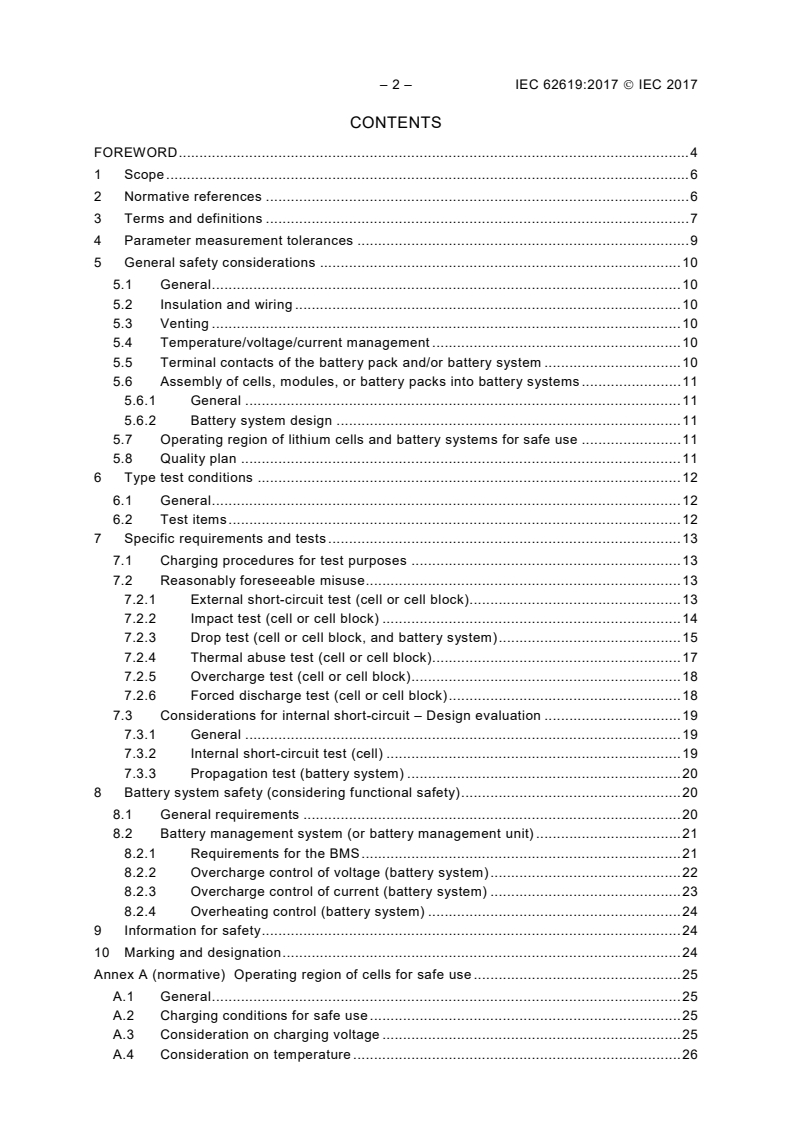
– 2 – IEC 62619:2017 IEC 2017
CONTENTS
FOREWORD . 4
1 Scope . 6
2 Normative references . 6
3 Terms and definitions . 7
4 Parameter measurement tolerances . 9
5 General safety considerations . 10
5.1 General . 10
5.2 Insulation and wiring . 10
5.3 Venting . 10
5.4 Temperature/voltage/current management . 10
5.5 Terminal contacts of the battery pack and/or battery system . 10
5.6 Assembly of cells, modules, or battery packs into battery systems . 11
5.6.1 General . 11
5.6.2 Battery system design . 11
5.7 Operating region of lithium cells and battery systems for safe use . 11
5.8 Quality plan . 11
6 Type test conditions . 12
6.1 General . 12
6.2 Test items . 12
7 Specific requirements and tests . 13
7.1 Charging procedures for test purposes . 13
7.2 Reasonably foreseeable misuse . 13
7.2.1 External short-circuit test (cell or cell block) . 13
7.2.2 Impact test (cell or cell block) . 14
7.2.3 Drop test (cell or cell block, and battery system) . 15
7.2.4 Thermal abuse test (cell or cell block) . 17
7.2.5 Overcharge test (cell or cell block) . 18
7.2.6 Forced discharge test (cell or cell block) . 18
7.3 Considerations for internal short-circuit – Design evaluation . 19
7.3.1 General . 19
7.3.2 Internal short-circuit test (cell) . 19
7.3.3 Propagation test (battery system) . 20
8 Battery system safety (considering functional safety) . 20
8.1 General requirements . 20
8.2 Battery management system (or battery management unit) . 21
8.2.1 Requirements for the BMS . 21
8.2.2 Overcharge control of voltage (battery system) . 22
8.2.3 Overcharge control of current (battery system) . 23
8.2.4 Overheating control (battery system) . 24
9 Information for safety . 24
10 Marking and designation . 24
Annex A (normative) Operating region of cells for safe use . 25
A.1 General . 25
A.2 Charging conditions for safe use . 25
A.3 Consideration on charging voltage . 25
A.4 Consideration on temperature . 26
A.5 High temperature range . 26
A.6 Low temperature range . 26
A.7 Discharging conditions for safe use . 26
A.8 Example of operating region . 27
Annex B (informative) Procedure of propagation test (see 7.3.3) . 28
B.1 General . 28
B.2 Test conditions . 28
B.3 Methods for initiating the thermal runaway can include . 28
Annex C (informative) Packaging . 29
Bibliography . 30
Figure 1 – Configuration of the impact test . 15
Figure 2 – Impact location . 17
Figure 3 – Configuration for the shortest edge drop test . 17
Figure 4 – Configuration for the corner drop test . 17
Figure 5 – Examples of BMS locations and battery system configurations . 22
Figure 6 – Example of the circuit configuration for overcharge control of voltage . 23
Figure A.1 – An example of operating region for charging of typical lithium-ion cells . 27
Figure A.2 – An example of operating region for discharging of typical lithium-ion cells . 27
Table 1 – Sample size for type tests . 13
Table 2 – Drop test method and condition . 16
– 4 – IEC 62619:2017 IEC 2017
INTERNATIONAL ELECTROTECHNICAL COMMISSION
____________
SECONDARY CELLS AND BATTERIES CONTAINING
ALKALINE OR OTHER NON-ACID ELECTROLYTES –
SAFETY REQUIREMENTS FOR SECONDARY LITHIUM CELLS
AND BATTERIES, FOR USE IN INDUSTRIAL APPLICATIONS
FOREWORD
1) The International Electrotechnical Commission (IEC) is a worldwide organization for standardization comprising
all national electrotechnical committees (IEC National Committees). The object of IEC is to promote
international co-operation on all questions concerning standardization in the electrical and electronic fields. To
this end and in addition to other activities, IEC publishes International Standards, Technical Specifications,
Technical Reports, Publicly Available Specifications (PAS) and Guides (hereafter referred to as “IEC
Publication(s)”). Their preparation is entrusted to technical committees; any IEC National Committee interested
in the subject dealt with may participate in this preparatory work. International, governmental and non-
governmental organizations liaising with the IEC also participate in this preparation. IEC collaborates closely
with the International Organization for Standardization (ISO) in accordance with conditions determined by
agreement between the two organizations.
2) The formal decisions or agreements of IEC on technical matters express, as nearly as possible, an international
consensus of opinion on the relevant subjects since each technical committee has representation from all
interested IEC National Committees.
3) IEC Publications have the form of recommendations for international use and are accepted by IEC National
Committees in that sense. While all reasonable efforts are made to ensure that the technical content of IEC
Publications is accurate, IEC cannot be held responsible for the way in which they are used or for any
misinterpretation by any end user.
4) In order to promote international uniformity, IEC National Committees undertake to apply IEC Publications
transparently to the maximum extent possible in their national and regional publications. Any divergence
between any IEC Publication and the corresponding national or regional publication shall be clearly indicated in
the latter.
5) IEC itself does not provide any attestation of conformity. Independent certification bodies provide conformity
assessment services and, in some areas, access to IEC marks of conformity. IEC is not responsible for any
services carried out by independent certification bodies.
6) All users should ensure that they have the latest edition of this publication.
7) No liability shall attach to IEC or its directors, employees, servants or agents including individual experts and
members of its technical committees and IEC National Committees for any personal injury, property damage or
other damage of any nature whatsoever, whether direct or indirect, or for costs (including legal fees) and
expenses arising out of the publication, use of, or reliance upon, this IEC Publication or any other IEC
Publications.
8) Attention is drawn to the Normative references cited in this publication. Use of the referenced publications is
indispensable for the correct application of this publication.
9) Attention is drawn to the possibility that some of the elements of this IEC Publication may be the subject of
patent rights. IEC shall not be held responsible for identifying any or all such patent rights.
International Standard IEC 62619 has been prepared by subcommittee 21A: Secondary cells
and batteries containing alkaline or other non-acid electrolytes, of IEC technical committee 21:
Secondary cells and batteries.
The text of this standard is based on the following documents:
FDIS Report on voting
21A/617/FDIS 21A/624/RVD
Full information on the voting for the approval of this standard can be found in the report on
voting indicated in the above table.
This publication has been drafted in accordance with the ISO/IEC Directives, Part 2.
The committee has decided that the contents of this publication will remain unchanged until
the stability date indicated on the IEC website under "http://webstore.iec.ch" in the data
related to the specific publication. At this date, the publication will be
• reconfirmed,
• withdrawn,
• replaced by a revised edition, or
• amended.
IMPORTANT – The 'colour inside' logo on the cover page of this publication indicates
that it contains colours which are considered to be useful for the correct
understanding of its contents. Users should therefore print this document using a
colour printer.
– 6 – IEC 62619:2017 IEC 2017
SECONDARY CELLS AND BATTERIES CONTAINING
ALKALINE OR OTHER NON-ACID ELECTROLYTES –
SAFETY REQUIREMENTS FOR SECONDARY LITHIUM CELLS
AND BATTERIES, FOR USE IN INDUSTRIAL APPLICATIONS
1 Scope
This document specifies requirements and tests for the safe operation of secondary lithium
cells and batteries used in industrial applications including stationary applications.
When there exists an IEC standard specifying test conditions and requirements for cells used
in special applications and which is in conflict with this document, the former takes
precedence (e.g., IEC 62660 series on road vehicles).
The following are some examples of applications that utilize cells and batteries under the
scope of this document.
• Stationary applications: telecom, uninterruptible power supplies (UPS), electrical energy
storage system, utility switching, emergency power, and similar applications.
• Motive applications: forklift truck, golf cart, auto guided vehicle (AGV), railway, and marine,
excluding road vehicles.
Since this document covers batteries for various industrial applications, it includes those
requirements, which are common and minimum to the various applications.
Electrical safety is included only as a part of the risk analysis of Clause 8. In regard to details
for addressing electrical safety, the end use application standard requirements have to be
considered.
This document applies to cells and batteries. If the battery is divided into smaller units, the
smaller unit can be tested as the representative of the battery. The manufacturer clearly
declares the tested unit. The manufacturer may add functions, which are present in the final
battery to the tested unit.
2 Normative references
The following documents are referred to in the text in such a way that some or all of their
content constitutes requirements of this document. For dated references, only the edition
cited applies. For undated references, the latest edition of the referenced document (including
any amendments) applies.
IEC 62133:2012, Secondary cells and batteries containing alkaline or other non-acid
electrolytes – Safety requirements for portable sealed secondary cells, and for batteries made
from them, for use in portable applications
IEC 62620:2014, Secondary cells and batteries containing alkaline or other non-acid
electrolytes – Secondary lithium cells and batteries for use in industrial applications
ISO/IEC Guide 51, Safety aspects – Guidelines for their inclusion in standards
3 Terms and definitions
For the purposes of this document, the terms and definitions given in ISO/IEC Guide 51, and
the following apply.
ISO and IEC maintain terminological databases for use in standardization at the following
addresses:
• IEC Electropedia: available at http://www.electropedia.org/
• ISO Online browsing platform: available at http://www.iso.org/obp
3.1
safety
freedom from unacceptable risk
3.2
risk
a combination of the probability of occurrence of harm and the severity of that harm
3.3
harm
physical injury or damage to the health of people or damage to property or to the environment
3.4
hazard
potential source of harm
3.5
intended use
use of a product, process or service in accordance with specifications, instructions and
information provided by the supplier
3.6
reasonably foreseeable misuse
use of a product, process or service in a way which is not intended by the supplier, but which
may result from readily predictable human behaviour
3.7
secondary lithium cell
cell
secondary cell where electrical energy is derived from the insertion/extraction reactions of
lithium ions or oxidation/reduction reaction of lithium between the negative electrode and the
positive electrode
Note 1 to entry: The cell typically has an electrolyte that consists of a lithium salt and organic solvent compound
in liquid, gel or solid form and has a metal or a laminate film casing. It is not ready for use in an application
because it is not yet fitted with its final housing, terminal arrangement and electronic control device.
3.8
cell block
group of cells connected together in parallel configuration with or without protective devices
(e.g. fuse or PTC) and monitoring circuitry
Note 1 to entry: It is not ready for use in an application because it is not yet fitted with its final housing, terminal
arrangement and electronic control device.
– 8 – IEC 62619:2017 IEC 2017
3.9
module
group of cells connected together either in a series and/or parallel configuration with or
without protective devices (e.g. fuse or PTC) and monitoring circuitry
3.10
battery pack
energy storage device, which is comprised of one or more cells or modules electrically
connected
Note 1 to entry: It has a monitoring circuitry which provides information (e.g. cell voltage) to a battery system.
Note 2 to entry: It may incorporate a protective housing and be provided with terminals or other interconnection
arrangement.
3.11
battery system
battery
system which comprises one or more cells, modules or battery packs
Note 1 to entry: It has a battery management system to cut off in case of overcharge, overcurrent, overdischarge,
and overheating.
Note 2 to entry: Overdischarge cut off is not mandatory if there is an agreement between the cell manufacturer
and the customer
Note 3 to entry: The battery system may have cooling or heating units.
3.12
battery management system
BMS
electronic system associated with a battery which has functions to cut off in case of
overcharge, overcurrent, overdischarge, and overheating
Note 1 to entry: It monitors and/or manages its state, calculates secondary data, reports that data and/or controls
its environment to influence the battery’s safety, performance and/or service life.
Note 2 to entry: Overdischarge cut off is not mandatory if there is an agreement between the cell manufacturer
and the customer.
Note 3 to entry: The function of the BMS can be assigned to the battery pack or to equipment that uses the
battery. (See Figure 5)
Note 4 to entry: The BMS can be divided and it can be found partially in the battery pack and partially on the
equipment that uses the battery. (See Figure 5)
Note 5 to entry: The BMS is sometimes also referred to as a BMU (battery management unit)
3.13
leakage
visible escape of liquid electrolyte
3.14
venting
release of excessive internal pressure from a cell, module, battery pack, or battery system in
a manner intended by design to preclude rupture or explosion
3.15
rupture
mechanical failure of a cell container or battery case induced by an internal or external cause,
resulting in exposure or spillage but not ejection of materials
3.16
explosion
failure that occurs when a cell container or battery case opens violently and solid components
are forcibly expelled
Note 1 to entry: Liquid, gas, and smoke are erupted.
3.17
fire
emission of flames from a cell, module, battery pack, or battery system
3.18
rated capacity
capacity value of a cell or battery determined under specified conditions and declared by the
manufacturer
Note 1 to entry: The rated capacity is the quantity of electricity C Ah (ampere-hours) declared by the
n
manufacturer which a single cell or battery can deliver during an n-hour period when charging, storing and
discharging under the conditions specified in IEC 62620:2014, 6.3.1.
[SOURCE: IEC 60050-482:2004, 482-03-15, modified – Addition of Note 1 to entry.]
3.19
upper limit charging voltage
the highest charging voltage in the cell operating region specified by the cell manufacturer
3.20
maximum charging current
the maximum charging current in the cell operating region which is specified by the cell
manufacturer
3.21
thermal runaway
uncontrolled intensive increase in the temperature of a cell driven by exothermic reaction
3.22
lower limit discharging voltage
the lowest discharging voltage specified by the cell manufacturer
4 Parameter measurement tolerances
The overall accuracy of controlled or measured values, relative to the specified or actual
parameters, shall be within these tolerances:
a) ±0,5 % for voltage;
b) ±1 % for current;
c) ±2 °C for temperature;
d) ±0,1 % for time;
e) ±1 % for mass;
f) ±1 % for dimensions.
These tolerances comprise the combined accuracy of the measuring instruments, the
measurement techniques used, and all other sources of error in the test procedure.
The details of the instrumentation used shall be provided in any report of results.
– 10 – IEC 62619:2017 IEC 2017
5 General safety considerations
5.1 General
The safety of lithium secondary cells and batteries requires the consideration of two sets of
applied conditions:
a) intended use;
b) reasonably foreseeable misuse.
Cells and batteries shall be so designed and constructed that they are safe under conditions
of both intended use and reasonably foreseeable misuse. It may also be expected that cells
and batteries subjected to intended use shall not only be safe but shall continue to be
functional in all respects.
It is expected that cells or batteries subjected to misuse may fail to function. However, even if
such a situation occurs, they shall not present any significant hazards.
Potential hazards which are the subject of this document are:
a) fire,
b) burst/explosion,
c) critical electrical short-circuit due to leakage of cell electrolyte,
d) venting which continuously vents out flammable gases,
e) rupture of the casing of cell, module, battery pack, and battery system with exposure of
internal components.
Conformity with 5.1 to 5.6 is checked by the tests of Clauses 6, 7, and 8, and in accordance
with the appropriate standard (see Clause 2).
5.2 Insulation and wiring
Wiring and its insulation shall be sufficient to withstand the maximum anticipated voltage,
current, temperature, altitude and humidity requirements. The design of wiring shall be such
that adequate clearances and creepage distances are maintained between conductors. The
mechanical integrity of the whole battery system (cell/module/BMS) and their connections
shall be sufficient to accommodate conditions of reasonably foreseeable misuse.
5.3 Venting
The casing of a cell, module, battery pack, and battery system shall incorporate a pressure
relief function that will preclude rupture or explosion. If encapsulation is used to support cells
within an outer case, the type of encapsulant and the method of encapsulation shall neither
cause the battery system to overheat during normal operation nor inhibit pressure relief.
5.4 Temperature/voltage/current management
The design of batteries shall be such that abnormal temperature-rise conditions are prevented.
Battery systems shall be designed within voltage, current, and temperature limits specified by
the cell manufacturer. Battery systems shall be provided with specifications and charging
instructions for equipment manufacturers so that associated chargers are designed to
maintain charging within the voltage, current and temperature limits specified.
NOTE Where applicable, means can be provided to limit current to safe levels during charge and discharge.
5.5 Terminal contacts of the battery pack and/or battery system
Terminals shall have clear polarity marking(s) on the external surface of the battery pack or
battery system.
NOTE Exception: Battery packs with keyed external connectors designed for connection to specific end products
need not be marked with polarity markings if the design of the external connector prevents reverse polarity
connections.
The size and shape of the terminal contacts shall ensure that they can carry the maximum
anticipated current. External terminal contact surfaces shall be formed from conductive
materials with good mechanical strength and corrosion resistance. Terminal contacts shall be
arranged so as to minimize the risk of short-circuits, for example to minimize the risk of short-
circuits by metal tools.
5.6 Assembly of cells, modules, or battery packs into battery systems
5.6.1 General
The assembly of cells, modules, or battery packs to constitute the battery system shall
respect the following rules in order to support adequate mitigation of risks into the battery
system:
• Each battery system shall have an independent control and protection method(s).
• The cell manufacturer shall provide recommendations about current, voltage and
temperature limits so that the battery system manufacturer/designer may ensure proper
design and assembly.
• Batteries that are designed for the selective discharging of a portion of their series
connected cells shall incorporate separate circuitry to prevent the cell reversal caused by
uneven discharging.
• Protective circuit components should be added as appropriate and consideration given to
the end-device application.
5.6.2 Battery system design
The voltage control function of the battery system design shall ensure that the voltage of each
cell or cell block shall not exceed the upper limit of the charging voltage specified by the
manufacturer of the cells, except in the case where the stationary application devices or
motive application devices provide an equivalent voltage control function.
The following should be considered at the battery system level and by the battery
manufacturer:
For the battery system which has series-connected plural single cells, modules or battery
packs, it is recommended that the voltages of any one of the single cells or cell blocks do not
exceed the upper limit of the charging voltage, specified by the cell manufacturer, by
monitoring the voltage of every single cell or cell block.
5.7 Operating region of lithium cells and battery systems for safe use
The cell manufacturer shall specify the cell operating region. The battery manufacturer shall
design the battery system to comply with the cell operating region. Determination of the cell
operating region is explained in Annex A.
5.8 Quality plan
The battery system manufacturer shall prepare and implement a quality plan that defines
procedures for the inspection of materials, components, cells, modules, battery packs, and
battery systems and which covers the whole process of producing each type of cell, module,
battery pack, and battery system (e.g. ISO 9001, etc.). Manufacturers should understand their
process capabilities and should institute the necessary process controls as they relate to
product safety.
– 12 – IEC 62619:2017 IEC 2017
6 Type test conditions
6.1 General
A battery system that is used outside of its operating region may exhibit hazards resulting
from the cells or batteries. Such risks have to be taken into consideration in order to prepare
a safe test plan.
The test facility should have a sufficient structural integrity and a fire suppression system to
sustain the conditions of overpressure and fire that may occur as a result of testing. The
facility should have a ventilation system to remove and capture gas which might be produced
during the tests. Consideration should be given to high voltage hazards when applicable.
Warning: THESE TESTS USE PROCEDURES WHICH MAY RESULT IN HARM IF ADEQUATE PRECAUTIONS
ARE NOT TAKEN. TESTS SHOULD ONLY BE PERFORMED BY QUALIFIED AND EXPERIENCED
TECHNICIANS USING ADEQUATE PROTECTION. TO PREVENT BURNS, CAUTION SHOULD BE
TAKEN FOR THOSE CELLS OR BATTERIES WHOSE CASINGS MAY EXCEED 75 °C AS A
RESULT OF TESTING.
6.2 Test items
Tests are made with the number of cells or batteries specified in Table 1, using cells or
batteries that are not more than six months old. Cells or batteries charged by the method
specified in 7.1 shall deliver the rated capacity or more when they are discharged at 25 °C ±
5 °C, at a constant current of 0,2 I A, down to a specified final voltage. This capacity
t
confirmation may be done in the manufacturer shipping inspection. In the case of a battery,
the capacity may be calculated on the basis of the cell capacity measurements during the
shipping inspection.
Unless otherwise specified, tests are carried out in an ambient temperature of 25 °C ± 5 °C.
NOTE Test conditions are for type tests only and do not imply that intended use includes operation under these
conditions. Similarly, the limit of six months is introduced for consistency and does not imply that cell and battery
system safety is reduced after six months
Table 1 – Sample size for type tests
Test items Test unit
Cell Battery system
Category Test
(see Note 1) (see Note 2)
7.2.1 External short-circuit test R -
7.2.2 Impact test R (see Note 3) -
7.2.3 Drop test R R
7.2.4 Thermal abuse test R -
Product safety test
7.2.5 Overcharge test R (see Note 4) -
(safety of cell and
battery system)
7.2.6 Forced discharge test R -
7.3 Consideration 7.3.2 Internal short- R* -
of internal short- circuit test
circuit (select one
7.3.3 Propagation - R
from the two
test
options)
8.2.2 Overcharge control of voltage - R
Functional safety test
(safety of battery 8.2.3 Overcharge control of current - R
system)
8.2.4 Overheating control - R
“R” = required (minimum of 1)
“R*” = required. As for the sample number, refer to IEC 62133:2012, 8.3.9.
“-” = unnecessary or not applicable
NOTE 1 The manufacturer can use “cell block(s)” instead of “cell(s)” at any test that specifies “cell(s)” as the
test unit in this document. The manufacturer clearly declares the test unit for each test.
NOTE 2 If a battery system is divided into smaller units, the unit can be tested as representative of the battery
system. The manufacturer can add functions which are present in the final battery system to the tested unit. The
manufacturer clearly declares the tested unit.
NOTE 3 Cylindrical cell or cell block: 1 direction, prismatic cell or cell block: 2 directions.
NOTE 4 The test is performed with those battery systems that are provided with only a single control or
protection for charging voltage control.
7 Specific requirements and tests
7.1 Charging procedures for test purposes
Prior to charging, the battery shall be discharged in an ambient temperature of 25 °C ± 5 °C,
at a constant current of 0,2 I A, down to a specified final voltage.
t
Unless otherwise stated in this document, cells or batteries shall be charged in an ambient
temperature of 25 °C ± 5 °C, in using the method specified by the manufacturer.
NOTE 1 Charging and discharging currents for the tests are based on the value of the rated capacity (C Ah).
n
These currents are expressed as a multiple of I A, where: I A = C Ah/1 h (see IEC 61434).
t t n
NOTE 2 The battery system which cannot be discharged at a constant current of 0,2 I A can be discharged at the
t
current specified by manufacturer .
7.2 Reasonably foreseeable misuse
7.2.1 External short-circuit test (cell or cell block)
a) Requirements
Short-circuit between the positive and negative terminals shall not cause a fire or
explosion
– 14 – IEC 62619:2017 IEC 2017
b) Test
Fully charged cells are stored in an ambient temperature of 25 °C ± 5 °C. Each cell is then
short-circuited by connecting the positive and negative terminals with a total external
resistance of 30 mΩ ± 10 mΩ.
The cells are to remain on test for 6 h or until the case temperature declines by 80 % of
the maximum temperature rise, whichever is the sooner.
c) Acceptance criteria
No fire, no explosion
7.2.2 Impact test (cell or cell block)
a) Requirements
An impact to the cell as mentioned below shall not cause fire or explosion.
b) Test
The cell or cell block shall be discharged at a constant current of 0,2 I A, to 50 % SOC.
t
The cell or cell block is placed on a flat concrete or metal floor. A type 316 stainless steel
bar with a diameter of 15,8 mm ± 0,1 mm and at least 60 mm in length or the longest
dimension of the cell, whichever is greater, is placed across the centre of the cell or cell
block. A 9,1 kg rigid mass is then dropped from a height of 610 mm ± 25 mm onto the bar
placed on the sample.
A cylindrical or prismatic cell is to be impacted with its longitudinal axis parallel to the flat
concrete or metal floor and perpendicular to the longitudinal axis of the 15,8 mm diameter
curved surface lying across the centre of the test sample. A prismatic cell is also to be
rotated 90 degrees around its longitudinal axis so that both the wide and narrow sides will
be subjected to the impact. Each sample is to be subjected to only a single impact with
separate samples to be used for each impact (see Figure 1).
NOTE In the case of a metal floor, external short circuit of cell or battery with the floor should be avoided by
appropriate measures.
c) Acceptance criteria
No fire, no explosion.
Load
Load
9,1 kg
9,1 kg Load
9,1 kg
Bar
Bar
Bar
Longitudinal
axis
Cylindrical cell Prismatic cell
Prismatic cell
IEC
IEC
IEC
1a) Cylindrical cell 1b) Direction 1 of 1c) Direction 2 of
prismatic cell prismatic cell
Load
9,1 kg
Load
Load
9,1 kg
9,1 kg
Bar
Bar
Bar
Longitudinal
axes
IEC
IEC IEC
1d) Several cylindrical 1e) Direction 1 of 1f) Direction 2 of
cells several prismatic cells several prismatic cells
NOTE The cell or cell block can be supported by some material which has no influence on the test to maintain the
position.
Figure 1 – Configuration of the impact test
7.2.3 Drop test (cell or cell block, and battery system)
7.2.3.1 General
The drop test is conducted on a cell or cell block, and battery system. The test method and
the height of the drop are determined by the test unit weight as shown in the Table 2.
– 16 – IEC 62619:2017 IEC 2017
Table 2 – Drop test method and condition
Mass of the test unit Test method Height of drop
Less than 7 kg Whole 100,0 cm
7 kg or more – less than 20 kg Whole 10,0 cm
20 kg or more – less than 50 kg Edge and corner 10,0 cm
50 kg or more – less than 100 kg Edge and corner 5,0 cm
100 kg or more Edge and corner 2,5 cm
NOTE If the battery system is divided into smaller units, the unit can be tested as the representative of the
battery system. The manufacturer can add functions which are present in the final battery system to the tested
unit. The manufacturer clearly declares the tested unit.
7.2.3.2 Whole drop test (cell or cell block, and battery system)
This test is applied when the mass of the test unit is less than 20 kg.
a) Requirements
Dropping the test unit shall not cause fire or explosion.
b) Test
Each fully charged test unit is dropped three times from a height shown in Table 2 onto a
flat concrete or metal floor.
In the case where the mass of the test unit is less than 7 kg, the test unit is dropped so as
to obtain impacts in random orientations. In the case where the mass of the test unit is 7
kg or more but less than 20 kg, the test shall be performed with the test unit dropped in
the bottom down direction. The bottom surface of the test unit is specified by the
manufacturer.
After the test, the test units shall be put on rest for a minimum of 1 h, and then a visual
inspection shall be performed.
NOTE In the case of a metal floor, external short circuit of cell or battery with the floor should be avoided by
appropriate measures.
c) Acceptance criteria
No fire, no explosion.
7.2.3.3 Edge and corner drop test (cell or cell block, and battery system)
This test is applied when the mass of the test unit is 20 kg or more.
a) Requirements
Dropping the test unit shall not cause fire or explosion.
b) Test
Each fully charged test unit is dropped two times from a height shown in Table 2 onto a
flat concrete or metal floor. The drop test conditions shall assure, with test arrangements
as shown in Figure 2, Figure 3 and Figure 4, reproducible impact points for the shortest
edge drop impact and the corner impacted. The two impacts, per impact type, shall be on
the same corner and on the same shortest edge. For the corner and edge drops, the test
unit shall be oriented in such a way that a straight line drawn through the corner/edge to
be struck and the test unit geometric centre is approximately perpendicular to the impact
surface.
...