

IEC 60317-36:1992
(Main)Specifications for particular types of winding wires - Part 36: Solderable polyesterimide enamelled round copper wire, class 180, with a bonding layer
General Information
- Abstract
This standard applies to microwave measuring apparatus and microwave measuring techniques.
- Status
- Published
- Publication Date
- 13-Jan-2000
- Technical Committee
- TC 55 - Winding wires
- Drafting Committee
- WG 1 - TC 55/WG 1
- Current Stage
- DELPUB - Deleted Publication
- Start Date
- 14-Oct-2013
- Completion Date
- 28-Aug-2026
Buy Documents



IEC 60317-36:1992+AMD1:1997+AMD2:1999 CSV - Specifications for particular types of winding wires - Part 36: Solderable polyesterimide enamelled round copper wire, class 180, with a bonding layer Released:1/14/2000
Overview
IEC 60317-36:1992 is an international standard that defines the requirements for solderable polyesterimide enamelled round copper wire, class 180, with a bonding layer. Published by the International Electrotechnical Commission (IEC), this standard is part of a larger series focused on insulated winding wires used in electrical equipment. Specifically, IEC 60317-36 covers enamelled copper wire with a dual coating: a polyesterimide resin underlayer and a thermoplastic bonding overlayer, offering solderability and enhanced mechanical properties for demanding electrical applications.
Key product features covered by this standard include thermal classification (class 180), solderability, dimensional requirements, abrasion resistance, bonding characteristics, and adherence under thermal and mechanical stress. The nominal conductor diameter range supported is 0.020 mm to 1.600 mm (Grades 1B and 2B).
Key Topics
- Material Requirements
- Dual enamel coating: polyesterimide resin base, thermoplastic bonding overlayer
- Chemical stability and integrity of modified resins
- Thermal Performance
- Minimum temperature index of 180°C
- Heat shock resistance at a minimum of 200°C
- Mechanical Properties
- Defined parameters for flexibility, springiness, elongation, and abrasion resistance
- Adherence strength under set loads and temperatures
- Solderability
- Specific solder bath temperature and immersion times for different wire diameters
- Requirements for smooth, residue-free tinned surfaces
- Dimensions and Test Methods
- Nominal conductor diameter range: 0.020 mm to 1.600 mm
- References to standardized test procedures (IEC 60317-0-1 and IEC 60851)
- Bonding Performance
- Heat or solvent-activated bonding capability suitable for coil applications
Applications
Solderable polyesterimide enamelled round copper wires with bonding layers are widely used in the manufacture of electrical windings for diverse types of devices where thermal performance, mechanical durability, and processability are critical. Typical applications include:
- Motors and Generators: Used for armature and field windings in industrial, automotive, and appliance electric motors.
- Transformers: Suitable for windings subject to rigorous thermal and electrical demands.
- Coil Assemblies: Essential for forming bonded, stable coils in relays, solenoids, and small electromagnets.
- Automotive and Aerospace: Applied in environments requiring high-temperature performance and reliability.
- Consumer Electronics: Enables compact coil designs with high electrical efficiency and ease of soldering.
By meeting IEC 60317-36 requirements, manufacturers and designers can ensure wire performance for both automated and manual winding processes, with predictable electrical, thermal, and bonding properties.
Related Standards
IEC 60317-36 is part of a comprehensive set of standards for winding wires and related testing. Other relevant standards include:
- IEC 60317-0-1: General requirements for enamelled round copper wire; provides baseline dimensional and testing specifications.
- IEC 60851: Methods of test for winding wires; details test procedures for properties such as elongation, springiness, flexibility, and breakdown voltage.
- IEC 60264: Specifies methods for the packaging of winding wires, ensuring compatibility with automated and manual processing equipment.
Manufacturers and end-users are encouraged to consult these related standards for comprehensive quality assurance and harmonization with international best practices.
By adhering to IEC 60317-36, stakeholders can confidently specify, produce, and utilize solderable polyesterimide enamelled copper wires with bonding layers for high-performance winding applications. This ensures personnel safety, equipment reliability, and compliance with global manufacturing standards.
Relations
- Effective Date
- 05-Sep-2023
- Effective Date
- 05-Sep-2023
- Effective Date
- 05-Sep-2023
Buy Documents
IEC 60317-36:1992+AMD1:1997+AMD2:1999 CSV - Specifications for particular types of winding wires - Part 36: Solderable polyesterimide enamelled round copper wire, class 180, with a bonding layer Released:1/14/2000
Get Certified
Connect with accredited certification bodies for this standard

IMQ S.p.A. (Certification)
Italian electrical product certification.

SLG Prüf- und Zertifizierungs GmbH
German testing and certification body.

UL Solutions
Global safety science company with testing, inspection and certification.
Sponsored listings
Frequently Asked Questions
IEC 60317-36:1992 is a standard published by the International Electrotechnical Commission (IEC). Its full title is "Specifications for particular types of winding wires - Part 36: Solderable polyesterimide enamelled round copper wire, class 180, with a bonding layer". This standard covers: This standard applies to microwave measuring apparatus and microwave measuring techniques.
This standard applies to microwave measuring apparatus and microwave measuring techniques.
IEC 60317-36:1992 is classified under the following ICS (International Classification for Standards) categories: 01.040.29 - Electrical engineering (Vocabularies); 29.060.10 - Wires. The ICS classification helps identify the subject area and facilitates finding related standards.
IEC 60317-36:1992 has the following relationships with other standards: It is inter standard links to IEC 60317-36:1992/AMD2:1999, IEC 60317-36:1992/AMD1:1997, IEC 60317-36:2013. Understanding these relationships helps ensure you are using the most current and applicable version of the standard.
IEC 60317-36:1992 is available in PDF format for immediate download after purchase. The document can be added to your cart and obtained through the secure checkout process. Digital delivery ensures instant access to the complete standard document.
Standards Content (Sample)
SLOVENSKI STANDARD
01-avgust-1995
Terminologija za mikrovalovne naprave
Terminology for microwave apparatus
Terminologie pour appareils à micro-ondes
Ta slovenski standard je istoveten z: IEC 60615
ICS:
01.040.29 Elektrotehnika (Slovarji) Electrical engineering
(Vocabularies)
29.020 Elektrotehnika na splošno Electrical engineering in
general
2003-01.Slovenski inštitut za standardizacijo. Razmnoževanje celote ali delov tega standarda ni dovoljeno.
CEI
NORME
IEC
INTERNATIONALE
INTERNATIONAL
Première édition
STAN DARD
First edition
1978-01
pour appareils à micro-ondes
Terminologie
Terminology for microwave apparatus
© CEI 1978 Droits de reproduction réservés — Copyright - all rights reserved
No part of this publication may be reproduced or utilized
Aucune partie de cette publication ne peut être reproduite ni
in any form or by any means, electronic or mechanical,
utilisée sous quelque forme que ce soit et par aucun procédé,
including photocopying and microfilm, without permission
électronique ou mécanique, y compris la photocopie et les
in writing from the publisher
microfilms, sans l'accord écrit de l'éditeur.
Suisse
Bureau central de la Commission Electrotechnique Internationale 3, rue de Varembé Genève
CODE PRIX
Commission Electrotechnique Internationale
S
PRICE CODE
International Electrotechnical Commission
IEC
Me»tayHapojuae aleKTpOTeXHH4eCHaR HOMHCCHA
Pour prix, voir catalogue en vigueur
• •
For price, see current catalogue
— 3 —
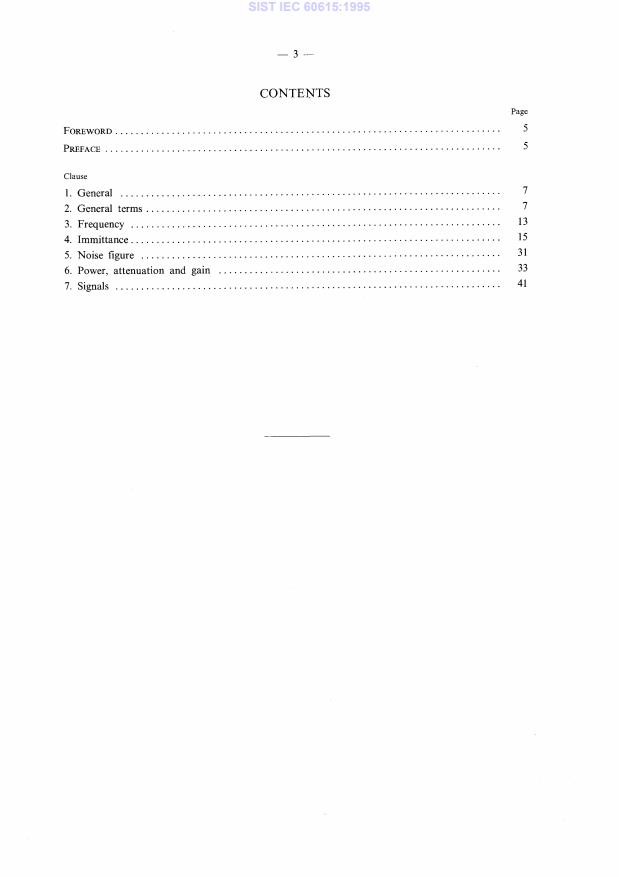
CONTENTS
Page
FOREWORD 5
PREFACE 5
Clause
1. General
2. General terms
3. Frequency
4. Immittance
5.
Noise figure
6. Power, attenuation and gain
7. Signals
INTERNATIONAL ELECTROTECHNICAL COMMISSION
TERMINOLOGY FOR MICROWAVE APPARATUS
FOREWORD
1) The formal decisions or agreements of the I E C on technical matters, prepared by Technical Committees on which all the
National Committees having a special interest therein are represented, express, as nearly as possible, an international
consensus of opinion on the subjects dealt with.
They have the form of recommendations for international use and they are accepted by the National Committees in that
2)
sense.
In order to promote international unification, the IEC expresses the wish that all National Committees should adopt the
3)
text of the 1 E C recommendation for their national rules in so far as national conditions will permit. Any divergence
between the IEC recommendation and the corresponding national rules should, as far as possible, be clearly indicated in
the latter.
PREFACE
This standard has been prepared by IEC Technical Committee No. 66, Electronic Measuring
Equipment.
A first draft was discussed at the meeting held in Baden-Baden in 1972. The draft, Document
66(Central Office)20, was submitted to the National Committees for approval under the Six
Months' Rule in September 1975.
The following countries voted explicitly in favour of publication:
Netherlands
Australia
Poland
Belgium
Denmark Spain
Finland Sweden
Turkey
France
Union of Soviet
Germany
Socialist Republics
Hungary
United Kingdom
Italy
Japan United States of America
This standard complements the definitions appearing in Chapter 62 of the International
Electrotechnical Vocabulary: Waveguides, published in 1961. This chapter, incidentally, is under
revision at the time of publication of the present standard.
7 —
TERMINOLOGY FOR MICROWAVE APPARATUS
1. General
1.1 Scope
This standard applies to microwave measuring apparatus and microwave measuring
techniques.
Note. —
The term microwaves is used to signify radio waves in the frequency range from about 1 GHz upwards.
(The low-frequency boundary of the microwave range is usually considered to be where lower-frequency
techniques and lumped circuit elements cannot generally be used efficiently. It is then necessary to apply
distributed line techniques and transmission line theory.)
1.2
Object
To establish the essential definitions related to microwave measuring techniques and
apparatus.
2. General terms
2.1 Anechoic chamber
A space bounded by absorbing wall coating, such that the walls can be considered as being
non-reflective for electromagnetic waves in a stated frequency range.
2.2 Cavity resonator
A space bounded by conductive coating to obtain resonance of a specific mode at a stated
frequency.
2.2.1
Echo box
A tunable cavity resonator used for the purpose of supplying a signal at a particular
frequency to adjust a radar receiver. This signal is available during the "ringing" time of the
resonator, after the transmitter pulse is turned off.
2.3 Circulator
A multiport device in which power to any port is transmitted to the next port according to
a given order of sequence.
Note. —
By reversing the biasing field the order of sequence is reversed. This property may be used to switch
electromagnetic energy.
2.4 Isolator
A passive two-port device having much greater attenuation in one direction of propagation
than in the other.
Note. —
The ratio (usually expressed in decibels) of the power entering the output port and the power delivered to
the input port is called isolation.
— 9 —
2.5
Corner reflector
A reflecting object consisting of two or three mutually intersecting flat conducting surfaces
and functioning by multiple reflection.
Note. Corner reflectors may be dihedral or trihedral. A 90° trihedral reflector may be used as a radar target, since
regardless of exact orientation the incident wave retraces its path.
2.6 Cut-off frequency of a waveguide mode
That frequency below which the propagation constant of a waveguide becomes real for a
specific mode, so that no significant propagation in that mode is possible.
2.7 Cut-off frequency of a waveguide
That frequency below which a travelling wave in the dominant mode cannot be
satisfactorily propagated.
2.8 Electrical length (in units of angle)
(in degrees) is defined as:
For an arbitrary device, the electrical length 1
l âfx(df)ix360
where:
dBr
df = rate of change of the phase difference (with frequency) between input and output of the device
dû0
d f = rate of change of the phase difference (with frequency) between two points in free space separated by one
wavelength
Note. — For devices having an electrical length less than 90°, a simpler definition may be used: the phase difference
(in degrees) between input and output signal of a two-port device at a specific frequency.
2.9 Guided wave
An electromagnetic wave which propagates along or between physical boundaries or
structures.
2.10 Group-delay
The slope of the phase/angular frequency transmission characteristic of a microwave device.
2.11
Gyrator
Non-reciprocal phase-shifter having a differential phase shift of it radians.
Note. — The use of the word gyrator to denote gyromagnetic devices in general is deprecated.
2.12 Waveguide transmission modes
2.12.1 Dominant mode
The mode with the lowest cut-off frequency.
— 11
2.12.2 Transverse electric (T.E. or H) mode
A mode in which the longitudinal component of the electric field is zero at all points and
the longitudinal component of the magnetic field is not zero.
2.12.3 Transverse magnetic (T. M. or E) mode
A mode in which the longitudinal component of the magnetic field is zero at all points and
the longitudinal component of the electric field is not zero.
2.12.4 (T. E. M. or E. H.)
Transverse electromagnetic mode
A mode in which the longitudinal components of both the electric and magnetic fields are
zero at all points.
2.12.5 Hybrid mode
A mode in which both the electric and magnetic fields have longitudinal components.
2.13 Balanced modulator
A modulator in which certain modulation components are suppressed by a balanced
arrangement of elements.
2.14
Linear modulator
A modulator in which, for a given magnitude of carrier, the modulated characteristic of the
output wave bears a substantially linear relation to that of the modulating wave.
2.15
Propagation constant
In a rectilinear uniform transmission line, at any given frequency, the propagation constant
of a unidirectional transmission mode of an electromagnetic field, which is a sinusoidal
function of time at that given frequency, is the logarithmic rate of change with respect to
distance of the complex amplitude of any arbitrary field component at any arbitrary point of
any arbitrary section of the line. The propagation constant is a complex quantity.
2.15.1
Attenuation constant
The real part of the propagation constant (usually expressed in nepers per unit length).
2.15.2 Phase constant
The imaginary part of the propagation constant (usually expressed in radians per unit
length).
2.16
Velocity concepts
2.16.1 Phase velocity of a transmission mode
The ratio between the angular frequency and the phase constant of a given transmission
mode.
— 13 —
2.16.2
Group velocity of a transmission mode
The reciprocal of the rate of change with respect to angular frequency of the phase
constant of a given transmission mode.
The group velocity coincides with the phase velocity if the phase constant is a linear function of the angular
Note. —
frequency.
2.17 Transmission line
A material structure forming a continuous path from one place to another, for directing
the transmission of electromagnetic energy along this path.
2.18 Waveguide
A transmission line comprising a conductive tube which may contain a material dielectric.
2.19 Dielectric waveguide
A transmission line in which the waves are guided by dielectric material without conductive
boundaries.
2.20 Cut-off wavelength
The cut-off wavelength of a waveguide mode is the free space wavelength which
corresponds to the cut-off frequency.
2.21 Waveguide wavelength
The wavelength of a propagation mode of a waveguide is the distance between two
7C. It is equal
transverse planes at which the phases of the same field components differ by 2
therefore to the ratio between the phase velocity and the frequency.
For a waveguide filled with uniform dielectric, the waveguide wavelength is given by the
formula:
^
^ g =
where: /Er 2
c
sr = relative dielectric constant
7 = free space wavelength and
= cut-off wavelength of the given mode in the same air-filled guide
For a waveguide with air dielectric, the wavelength is given by the formula:
^
where:
= free space wavelength and
= cut-off wavelength of the given mode in the same air-filled guide
3. Frequency
3.1 Frequency meter
3.1.1 Digital frequency meter
An instrument in which the measured frequency is indicated in the form of a number
digitally displayed.
— 15 —
3.1.2 Absorption frequency meter (wavemeter)
A cavity, calibrated in frequency and coupled to a transmission line, which, when tuned to
the frequency of the propagating wave, absorbs electromagnetic power from that transmission
line.
3.1.3 (wavemeter)
Transmission frequency meter
A cavity, calibrated in frequency and inserted in a transmission line, which, when tuned to
the frequency of the propagating wave, allows power to pass from the transmission line into
a detector.
3.2 Frequency multiplier
A device for delivering an output wave whose frequency is a multiple of the input
frequency.
3.3 Frequency divider
A device which divides the frequency of a continuous wave signal by an integral number.
3.4 Spectrum analyser
An instrument indicating the spectral amplitude distribution of the input signal over a
desired frequency range, generally by providing a visual display of the amplitude of each
frequency component in relation to its frequency in Cartesian form.
3.5
Transfer oscillator
A stable tunable oscillator whose frequency, either fundamental or harmonic can be made
precisely coherent with the fundamental of the unknown signal.
Using heterodyne techniques, time-variant frequency or phase deviations can be readily observed and
Note. —
measured.
4. Immittance
Term used to cover impedance and/or admittance.
4.1 Immittance charts
4.1.1
Smith chart
A coordinate system consisting of two families of orthogonal intersecting circles bounded
by an outer circle. The chart coordinates display the complete range of possible values of
normalized real and imaginary components of a passive immittance encountered along any
mismatched (electrically) uniform transmission line or waveguide under steady-state
conditions:
jX)/Z„
(R + or
(G + jB),'Yo
where:
Z0
= characteristic impedance
Y0 = characteristic admittance
17 —
The coordinates are arranged so that normalized immittances are graphically related to the
7C radians
phase displacement along the transmission line or waveguide. Angular rotation of 2
(360°) is linearly related to the travel of )L/2 along a transmission line or waveguide.
The radial scale gives reflection coefficient magnitude increasing linearly from zero at the
centre of the chart to unity at the rim.
In this definition only passive immitances are taken into account. It can, however, be extended for the
Note.
representation of immittances having a real part of a restricted negative value. In that case, the outer circle
gives a reflection-coefficient magnitude higher than unity.
4.1.2 Z-theta chart
This chart is similar to the Smith chart except that impedances are represented in polar
form:
I ZI = IR+JXI
O = arc tan X
R
4.2 Microwave multiport junction
A volume generally confined between conductive boundaries, where transmission lines are
coupled electrically and/or magnetically.
4.2.1 Directional coupler
A four-port reciprocal junction, ideally lossless and matched at each port, in which the
power fed into any one port is divided between only two of the other ports.
Ideally no power will be transmitted to the fourth port and none will be transmitted back to the first.
Note. —
4.2.2 Coupling factor (of a directional coupler)
The ratio (generally expressed in decibels) between the power fed into one port and the
power available at another.
In devices where the input power is very unequally divided between two other ports, the coupling factor is
Note. —
conventionally referred only to the less coupled port.
4.2.3 Directivity (of a directional coupler)
The ratio (generally expressed in decibels) of
lling wave propagates between two
the output power at one of the ports, when only a trave
other ports in one direction,
– to the output power at the same port, when the direction of the wave propagation between
the same two other ports is reversed.
4.2.4
Hybrid junction
A directional coupler in which the power fed into any one port is, in the ideal case,
equally divided between only two of the other ports.
If these two ports are properly terminated, no power will be transmitted to the fourth port. Furthermore, if
Note. —
power is fed into the fourth port none of it will be transmitted to the first port.
— 19 —
4.3 Immittance concepts
4.3.1
Characteristic impedance (of a lossless transmission line for a given mode)
A quantity obtained by multiplying the guide characteristic wave impedance by a suitable
factor. This factor may be chosen in one of three ways by analogy with the transmission line
equations :
Z = P/h
Z = Uz/P and
Z = U/I
where :
Z = characteristic impedance
P =
power carried by a travelling wave
U = voltage
I = current
Note. — For a transmission line operating in the T. E. M. mode, the voltage and current can be uniquely defined, and
the three equations are consistent. For a waveguide, special definitions for voltage and current must be
conventionally adopted, and it is then found that the three equations lead to three different values of
characteristic impedance.
4.3.2 Characteristic wave impedance
For a travelling electromagnetic wave of a given frequency, the ratio at a point of the
complex magnitude of the transverse electric vector to that of the transverse magnetic vector,
with the sign chosen so that the real part is positive.
It is a function of the waveguide mode concerned, for example:
Notes I.
for T. E. M. mode, Z =
for T. E. mode, Z = •
and for T. M. mode, Z =
where :
ï.^ = guide wavelength for the mode
= free-space wavelength
p = permeability
e = permittivity
2. It is constant at all points on a given wavefront (usually a plane cross-section of the waveguide).
4.3.3 Conjugate immittances
Two immittances having real parts which are equal, and imaginary parts which are equal in
magnitude but opposite in sign.
4.3.4 Source immittance
The immittance presented by a power source to the input port of a device.
4.3.5 Input immittance
The immittance presented by the device to the source.
— 21 —
4.3.6 Open-circuit immittance
For a transmission line or a two-port network, the input immittance when the load
impedance is infinite (load admittance is zero).
4.3.7 Short-circuit immittance
For a transmission line or two-port network, the input immittance when the load
impedance is zero (load admittance is infinite).
4.3.8 Output immittance
The immittance presented by the device to the load.
Load immittance (Termination immittance)
4.3.9
The immittance presented to the device by the load.
4.3.10 Transfer impedance
Between any two ports of a network, the ratio of a potential difference applied at one port
to the resultant current at the other port, all terminals being terminated in any specified
manner.
The transfer admittance is the reciprocal of the transfer impedance.
Note. —
4.4 immittance bridge
An instrument for the direct measurement of immittance.
The results are usually presented as real and imaginary parts but sometimes as magnitude and phase angle.
Note.
4.5 T-junction
A junction between a main waveguide and a perpendicular branch waveguide.
4.5.1 Series T-junction
A T-junction in which the impedances of the two arms of the main guide are substantially
additive when viewed from the side arm.
For rectangular waveguides of the same cross-section the side arm is perpendicular to the broad face.
Note.
4.5.2 Shunt T-junction
A T-junction in which the admittances of the two arms of the main guide are substantially
additive when viewed from the side arm.
For rectangular waveguides of the same cross-section the side arm is perpendicular to the narrow face.
Note. —
4.5.3 Hybrid T (Magic T)
A hybrid junction consisting of the combination of a series-T and a shunt-T, the side arms
being located at the same cross-section of the main waveguide.
4.6 Match – mismatch concepts
— 23
4.6.1
Conjugate match
The condition for maximum power transfer in which the input immittance of the load is
the complex conjugate of the output immittance of the device to which it is connected.
4.6.2 match)
Z o match (Y o
The condition in which the load immittance presented to the transmission line or
waveguide is equal to the characteristic immittance of the transmission line or waveguide.
4.6.3 Mismatch
The condition in which the immittance of a load does not match the immittance of the
source port to which it is connected.
4.6.4 Z o mismatch)
o mismatch (Y
The condition in which the load immittance presented to a transmission line or waveguide
is not equal to the characteristic immittance of the transmission line or waveguide.
4.7 Network analyser
An instrument for the analysis of microwave networks, which typically makes
measurements on transmission, reflection, input impedance, output impedance, time delay and
group delay.
4.8 Phase shifter
A device for varying the electrical length of a transmission line or waveguide.
4.9 Probe
A device generally in the form of a straight wire or loop for transferring electromagnetic
energy into or from a transmission line or cavity.
4.10 Q concepts
...
IEC 60317-36
Edition 1.2 2000-01
INTERNATIONAL
STANDARD
NORME
INTERNATIONALE
Specifications for particular types of winding wires –
Part 36: Solderable polyesterimide enamelled round copper wire, class 180,
with a bonding layer
Spécifications pour types particuliers de fils de bobinage –
Partie 36: Fil de section circulaire en cuivre émaillé avec polyesterimide
brasable, classe 180, avec une couche adhérente
All rights reserved. Unless otherwise specified, no part of this publication may be reproduced or utilized in any form or by
any means, electronic or mechanical, including photocopying and microfilm, without permission in writing from either IEC or
IEC's member National Committee in the country of the requester.
If you have any questions about IEC copyright or have an enquiry about obtaining additional rights to this publication,
please contact the address below or your local IEC member National Committee for further information.
Droits de reproduction réservés. Sauf indication contraire, aucune partie de cette publication ne peut être reproduite
ni utilisée sous quelque forme que ce soit et par aucun procédé, électronique ou mécanique, y compris la photocopie
et les microfilms, sans l'accord écrit de la CEI ou du Comité national de la CEI du pays du demandeur.
Si vous avez des questions sur le copyright de la CEI ou si vous désirez obtenir des droits supplémentaires sur cette
publication, utilisez les coordonnées ci-après ou contactez le Comité national de la CEI de votre pays de résidence.
IEC Central Office
3, rue de Varembé
CH-1211 Geneva 20
Switzerland
Email: inmail@iec.ch
Web: www.iec.ch
About the IEC
The International Electrotechnical Commission (IEC) is the leading global organization that prepares and publishes
International Standards for all electrical, electronic and related technologies.
About IEC publications
The technical content of IEC publications is kept under constant review by the IEC. Please make sure that you have the
latest edition, a corrigenda or an amendment might have been published.
ƒ Catalogue of IEC publications: www.iec.ch/searchpub
The IEC on-line Catalogue enables you to search by a variety of criteria (reference number, text, technical committee,…).
It also gives information on projects, withdrawn and replaced publications.
ƒ IEC Just Published: www.iec.ch/online_news/justpub
Stay up to date on all new IEC publications. Just Published details twice a month all new publications released. Available
on-line and also by email.
ƒ Electropedia: www.electropedia.org
The world's leading online dictionary of electronic and electrical terms containing more than 20 000 terms and definitions
in English and French, with equivalent terms in additional languages. Also known as the International Electrotechnical
Vocabulary online.
ƒ Customer Service Centre: www.iec.ch/webstore/custserv
If you wish to give us your feedback on this publication or need further assistance, please visit the Customer Service
Centre FAQ or contact us:
Email: csc@iec.ch
Tel.: +41 22 919 02 11
Fax: +41 22 919 03 00
A propos de la CEI
La Commission Electrotechnique Internationale (CEI) est la première organisation mondiale qui élabore et publie des
normes internationales pour tout ce qui a trait à l'électricité, à l'électronique et aux technologies apparentées.
A propos des publications CEI
Le contenu technique des publications de la CEI est constamment revu. Veuillez vous assurer que vous possédez
l’édition la plus récente, un corrigendum ou amendement peut avoir été publié.
ƒ Catalogue des publications de la CEI: www.iec.ch/searchpub/cur_fut-f.htm
Le Catalogue en-ligne de la CEI vous permet d’effectuer des recherches en utilisant différents critères (numéro de référence,
texte, comité d’études,…). Il donne aussi des informations sur les projets et les publications retirées ou remplacées.
ƒ Just Published CEI: www.iec.ch/online_news/justpub
Restez informé sur les nouvelles publications de la CEI. Just Published détaille deux fois par mois les nouvelles
publications parues. Disponible en-ligne et aussi par email.
ƒ Electropedia: www.electropedia.org
Le premier dictionnaire en ligne au monde de termes électroniques et électriques. Il contient plus de 20 000 termes et
définitions en anglais et en français, ainsi que les termes équivalents dans les langues additionnelles. Egalement appelé
Vocabulaire Electrotechnique International en ligne.
ƒ Service Clients: www.iec.ch/webstore/custserv/custserv_entry-f.htm
Si vous désirez nous donner des commentaires sur cette publication ou si vous avez des questions, visitez le FAQ du
Service clients ou contactez-nous:
Email: csc@iec.ch
Tél.: +41 22 919 02 11
Fax: +41 22 919 03 00
IEC 60317-36
Edition 1.2 2000-01
INTERNATIONAL
STANDARD
NORME
INTERNATIONALE
Specifications for particular types of winding wires –
Part 36: Solderable polyesterimide enamelled round copper wire, class 180,
with a bonding layer
Spécifications pour types particuliers de fils de bobinage –
Partie 36: Fil de section circulaire en cuivre émaillé avec polyesterimide
brasable, classe 180, avec une couche adhérente
INTERNATIONAL
ELECTROTECHNICAL
COMMISSION
COMMISSION
ELECTROTECHNIQUE
PRICE CODE
INTERNATIONALE
CD
CODE PRIX
ICS 29.060.10 ISBN 2-8318-5059-2
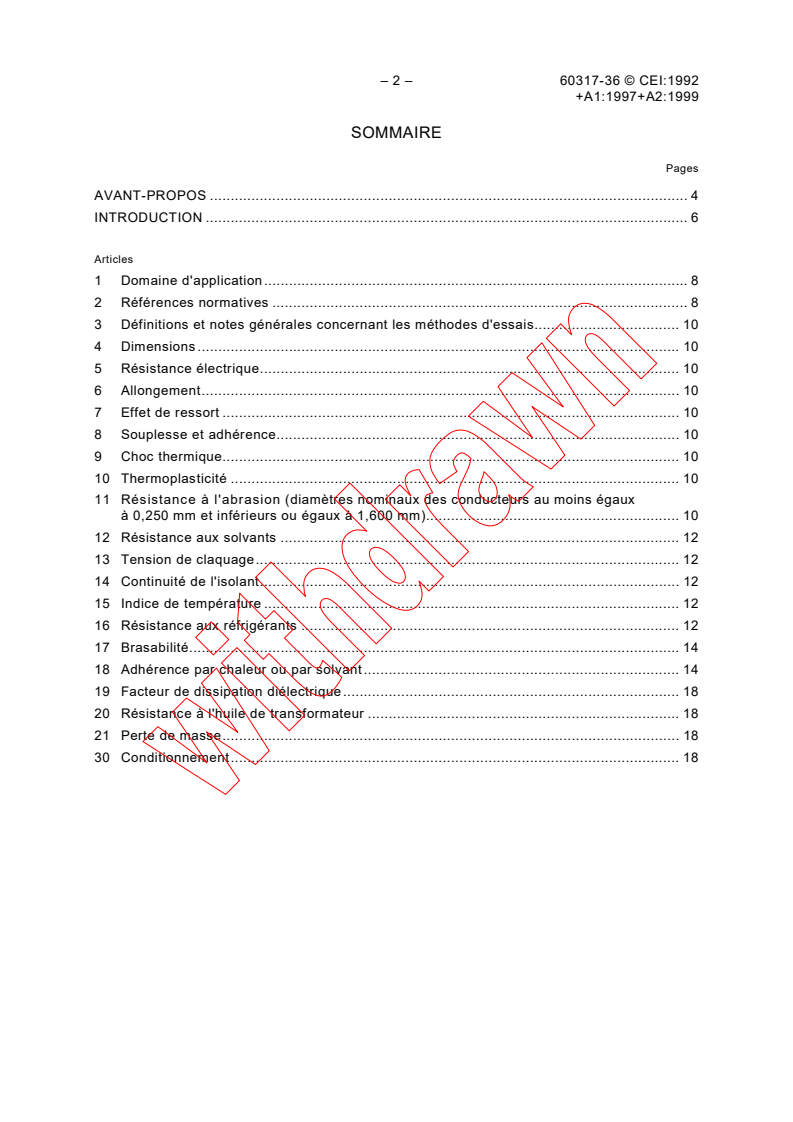
– 2 – 60317-36 © CEI:1992
+A1:1997+A2:1999
SOMMAIRE
Pages
AVANT-PROPOS . 4
INTRODUCTION .6
Articles
1 Domaine d'application. 8
2 Références normatives . 8
3 Définitions et notes générales concernant les méthodes d'essais. 10
4 Dimensions . 10
5 Résistance électrique. 10
6 Allongement. 10
7 Effet de ressort . 10
8 Souplesse et adhérence. 10
9 Choc thermique. 10
10 Thermoplasticité . 10
11 Résistance à l'abrasion (diamètres nominaux des conducteurs au moins égaux
à 0,250 mm et inférieurs ou égaux à 1,600 mm). 10
12 Résistance aux solvants . 12
13 Tension de claquage. 12
14 Continuité de l'isolant. 12
15 Indice de température . 12
16 Résistance aux réfrigérants . 12
17 Brasabilité. 14
18 Adhérence par chaleur ou par solvant. 14
19 Facteur de dissipation diélectrique. 18
20 Résistance à l'huile de transformateur . 18
21 Perte de masse. 18
30 Conditionnement. 18
60317-36 © IEC:1992 – 3 –
+A1:1997+A2:1999
CONTENTS
Page
FOREWORD . 5
INTRODUCTION .7
Clause
1 Scope . 9
2 Normative references. 9
3 Definitions and general notes on methods of test . 11
4 Dimensions . 11
5 Electrical resistance. 11
6 Elongation. 11
7 Springiness.11
8 Flexibility and adherence . 11
9 Heat shock.11
10 Cut-through. 11
11 Resistance to abrasion (nominal conductor diameters from 0,250 mm up to
and including 1,600 mm). 11
12 Resistance to solvents . 13
13 Breakdown voltage. 13
14 Continuity of insulation. 13
15 Temperature index. 13
16 Resistance to refrigerants . 13
17 Solderability. 15
18 Heat or solvent bonding . 15
19 Dielectric dissipation factor . 19
20 Resistance to transformer oil . 19
21 Loss of mass . 19
30 Packaging. 19
– 4 – 60317-36 © CEI:1992
+A1:1997+A2:1999
COMMISSION ÉLECTROTECHNIQUE INTERNATIONALE
___________
SPÉCIFICATIONS POUR TYPES PARTICULIERS
DE FILS DE BOBINAGE –
Partie 36: Fil de section circulaire en cuivre émaillé
avec polyesterimide brasable, classe 180,
avec une couche adhérente
AVANT-PROPOS
1) La CEI (Commission Électrotechnique Internationale) est une organisation mondiale de normalisation
composée de l'ensemble des comités électrotechniques nationaux (Comités nationaux de la CEI). La CEI a
pour objet de favoriser la coopération internationale pour toutes les questions de normalisation dans les
domaines de l'électricité et de l'électronique. A cet effet, la CEI, entre autres activités, publie des Normes
internationales. Leur élaboration est confiée à des comités d'études, aux travaux desquels tout Comité national
intéressé par le sujet traité peut participer. Les organisations internationales, gouvernementales et non
gouvernementales, en liaison avec la CEI, participent également aux travaux. La CEI collabore étroitement
avec l'Organisation Internationale de Normalisation (ISO), selon des conditions fixées par accord entre les
deux organisations.
2) Les décisions ou accords officiels de la CEI concernant les questions techniques représentent, dans la mesure
du possible, un accord international sur les sujets étudiés, étant donné que les Comités nationaux intéressés
sont représentés dans chaque comité d’études.
3) Les documents produits se présentent sous la forme de recommandations internationales. Ils sont publiés
comme normes, spécifications techniques, rapports techniques ou guides et agréés comme tels par les
Comités nationaux.
4) Dans le but d'encourager l'unification internationale, les Comités nationaux de la CEI s'engagent à appliquer de
façon transparente, dans toute la mesure possible, les Normes internationales de la CEI dans leurs normes
nationales et régionales. Toute divergence entre la norme de la CEI et la norme nationale ou régionale
correspondante doit être indiquée en termes clairs dans cette dernière.
5) La CEI n’a fixé aucune procédure concernant le marquage comme indication d’approbation et sa responsabilité
n’est pas engagée quand un matériel est déclaré conforme à l’une de ses normes.
6) L’attention est attirée sur le fait que certains des éléments de la présente Norme internationale peuvent faire
l’objet de droits de propriété intellectuelle ou de droits analogues. La CEI ne saurait être tenue pour
responsable de ne pas avoir identifié de tels droits de propriété et de ne pas avoir signalé leur existence.
La présente partie de la Norme internationale CEI 60317 a été établie par le comité
d'études 55 de la CEI: Fils de bobinage.
La présente version consolidée de la CEI 60317-36 comprend la première édition (1992)
[documents 55(BC)418 et 55(BC)435], son amendement 1 (1997) [documents 55/560/FDIS et
55/604/RVD] et son amendement 2 (1999) [documents 55/702/FDIS et 55/729/RVD].
Le contenu technique de cette version consolidée est donc identique à celui de l'édition de
base et à ses amendements; cette version a été préparée par commodité pour l'utilisateur.
Elle porte le numéro d'édition 1.2.
Une ligne verticale dans la marge indique les textes modifiés par les amendements 1 et 2.
60317-36 © IEC:1992 – 5 –
+A1:1997+A2:1999
INTERNATIONAL ELECTROTECHNICAL COMMISSION
___________
SPECIFICATIONS FOR PARTICULAR TYPES
OF WINDING WIRES –
Part 36: Solderable polyesterimide enamelled round copper wire,
class 180, with a bonding layer
FOREWORD
1) The IEC (International Electrotechnical Commission) is a worldwide organization for standardization comprising
all national electrotechnical committees (IEC National Committees). The object of the IEC is to promote
international co-operation on all questions concerning standardization in the electrical and electronic fields. To
this end and in addition to other activities, the IEC publishes International Standards. Their preparation is
entrusted to technical committees; any IEC National Committee interested in the subject dealt with may
participate in this preparatory work. International, governmental and non-governmental organizations liaising
with the IEC also participate in this preparation. The IEC collaborates closely with the International
Organization for Standardization (ISO) in accordance with conditions determined by agreement between the
two organizations.
2) The formal decisions or agreements of the IEC on technical matters express, as nearly as possible, an
international consensus of opinion on the relevant subjects since each technical committee has representation
from all interested National Committees.
3) The documents produced have the form of recommendations for international use and are published in the form
of standards, technical specifications, technical reports or guides and they are accepted by the National
Committees in that sense.
4) In order to promote international unification, IEC National Committees undertake to apply IEC International
Standards transparently to the maximum extent possible in their national and regional standards. Any
divergence between the IEC Standard and the corresponding national or regional standard shall be clearly
indicated in the latter.
5) The IEC provides no marking procedure to indicate its approval and cannot be rendered responsible for any
equipment declared to be in conformity with one of its standards.
6) Attention is drawn to the possibility that some of the elements of this International Standard may be the subject
of patent rights. The IEC shall not be held responsible for identifying any or all such patent rights.
This part of International Standard IEC 60317 has been prepared by IEC technical com-
mittee 55: Winding wires.
This consolidated version of IEC 60317-36 consists of the first edition (1992) [docu-
ments 55(CO)418 and 55(CO)435], its amendment 1 (1997) [documents 55/560/FDIS and
55/604/RVD] and its amendment 2 (1999) [documents 55/702/FDIS and 55/729/RVD].
The technical content is therefore identical to the base edition and its amendments and has
been prepared for user convenience.
It bears the edition number 1.2.
A vertical line in the margin shows the texts amended by amendments 1 and 2.
– 6 – 60317-36 © CEI:1992
+A1:1997+A2:1999
INTRODUCTION
La présente partie de la CEI 60317 constitue l'un des éléments d'une série de normes
traitant des fils isolés utilisés dans les enroulements des appareils électriques. Cette série
doit comporter trois groupes définissant respectivement:
1) les méthodes d'essai (CEI 60851);
2) les spécifications (CEI 60317);
3) le conditionnement (CEI 60264).
60317-36 © IEC:1992 – 7 –
+A1:1997+A2:1999
INTRODUCTION
This part of IEC 60317 forms an element of a series of standards which deals with insulated
wires used for windings in electrical equipment. The series has three groups describing:
1) methods of test (IEC 60851);
2) specifications (IEC 60317);
3) packaging (IEC 60264).
– 8 – 60317-36 © CEI:1992
+A1:1997+A2:1999
SPÉCIFI
...