

IEC 63048:2020
(Main)Mobile remotely controlled systems for nuclear and radiological applications - General requirements
General Information
- Abstract
IEC 63048:2020 defines the general requirements for Mobile Remotely Controlled Systems (MRCSs) for nuclear and radiological applications such as integrity inspections, repair of components, handling of radioactive materials, and monitoring of physical conditions and radiation dose intensity in specific areas.
This document applies to MRCSs that are used to support nuclear and radiological facilities. These general requirements encompass high-level performance requirements regarding sensors, monitoring devices, control devices, interfacing mechanisms, simulation methods, and verification methods thereof in a normal environment or extreme environmental conditions, such as high radiation, high temperature, and high humidity environments.
- Status
- Published
- Publication Date
- 03-Nov-2020
- Technical Committee
- TC 45 - Nuclear instrumentation
- Drafting Committee
- WG 18 - TC 45/WG 18
- Current Stage
- PPUB - Publication issued
- Start Date
- 04-Nov-2020
- Completion Date
- 27-Nov-2020
Overview
IEC 63048:2020, issued by the International Electrotechnical Commission (IEC), establishes the general requirements for Mobile Remotely Controlled Systems (MRCSs) used in nuclear and radiological applications. The standard supports facility operations where human access is difficult or hazardous, such as integrity inspections, repair of nuclear components, radioactive material handling, and monitoring of physical conditions including radiation dose intensity. By specifying high-level performance, safety, and operational criteria, IEC 63048 is central to ensuring the safe and reliable deployment of MRCSs in demanding environments.
Key Topics
1. Working Environments for MRCSs
- MRCSs operate in environments where human presence is restricted due to high radiation, temperature, humidity, toxic gases, underwater conditions, or confined spaces.
- Tasks performed include inspections, monitoring, repairs, decontamination, and accident response.
2. System Structure
- MRCSs consist of a master subsystem (under human control, in a safe area) and a slave subsystem (operational in hazardous zones).
- Effective communication and power supply between subsystems are emphasized.
3. Safety and Risk Management
- Safety measures and risk analysis are required to address potential hazards, including equipment malfunction, environmental risks, operator errors, and electromagnetic interference.
- The standard requires safety mechanisms to protect humans, the nuclear facility, and the MRCS itself.
4. Functional Requirements
- Performance specifications for sensors, monitoring devices, control mechanisms, and human-machine interfaces (HMI).
- Emphasis on reliable operation in extreme conditions, with features like redundancy, radiation hardening, waterproofing, and modular design to facilitate maintenance and reduce risk.
5. Operational and Testing Guidelines
- Clearly defined operational procedures and simulation methods for mission planning and risk mitigation.
- Validation and verification requirements for all functional and safety aspects to ensure consistent performance and compliance with regulatory expectations.
Applications
IEC 63048:2020 is indispensable in multiple nuclear and radiological contexts:
- Nuclear power plants: For inspections and maintenance of reactors, piping, and containment areas without exposing human workers to risks.
- Accident response: MRCSs perform mitigation, clean-up, or remote repairs following incidents in contaminated or high-radiation environments.
- Decommissioning and dismantling: Enables automated handling and removal of radioactive materials and equipment during facility shutdowns.
- Routine monitoring: Continuous assessment of physical and radiological conditions, ensuring readiness for both routine operations and emergency responses.
By adhering to this standard, organizations improve safety, enhance operational efficiency, comply with international best practices, and foster public and regulatory confidence in nuclear facility management.
Related Standards
For comprehensive system design and interoperability, IEC 63048:2020 aligns with and complements several other key international standards:
- IEC 61513: Nuclear power plants - Instrumentation and control for systems important to safety.
- ISO 8373: Robots and robotic devices - Vocabulary.
- IAEA Nuclear Security Series: Provides terminology and concepts for safety and risk management in nuclear applications.
- ISO/TC 299: Standards for robotics in non-nuclear fields (industrial, medical, etc.), which can offer useful cross-sector insights.
Key SEO Keywords
- IEC 63048:2020
- Mobile Remotely Controlled Systems (MRCS)
- Nuclear and radiological applications
- Robot safety standards
- Remote inspection nuclear
- Nuclear facility monitoring
- Radiological risk management
- International nuclear standards
- Remote robotic systems safety
Implementing IEC 63048:2020 aids organizations in developing, deploying, and maintaining MRCSs that meet international safety, performance, and interoperability requirements, contributing to safer and more efficient operation of nuclear and radiological facilities worldwide.
Get Certified
Connect with accredited certification bodies for this standard

DNV
DNV is an independent assurance and risk management provider.

Lloyd's Register
Lloyd's Register is a global professional services organisation specialising in engineering and technology.
DNV Energy Systems
Energy and renewable energy certification.
Sponsored listings
Frequently Asked Questions
IEC 63048:2020 is a standard published by the International Electrotechnical Commission (IEC). Its full title is "Mobile remotely controlled systems for nuclear and radiological applications - General requirements". This standard covers: IEC 63048:2020 defines the general requirements for Mobile Remotely Controlled Systems (MRCSs) for nuclear and radiological applications such as integrity inspections, repair of components, handling of radioactive materials, and monitoring of physical conditions and radiation dose intensity in specific areas. This document applies to MRCSs that are used to support nuclear and radiological facilities. These general requirements encompass high-level performance requirements regarding sensors, monitoring devices, control devices, interfacing mechanisms, simulation methods, and verification methods thereof in a normal environment or extreme environmental conditions, such as high radiation, high temperature, and high humidity environments.
IEC 63048:2020 defines the general requirements for Mobile Remotely Controlled Systems (MRCSs) for nuclear and radiological applications such as integrity inspections, repair of components, handling of radioactive materials, and monitoring of physical conditions and radiation dose intensity in specific areas. This document applies to MRCSs that are used to support nuclear and radiological facilities. These general requirements encompass high-level performance requirements regarding sensors, monitoring devices, control devices, interfacing mechanisms, simulation methods, and verification methods thereof in a normal environment or extreme environmental conditions, such as high radiation, high temperature, and high humidity environments.
IEC 63048:2020 is classified under the following ICS (International Classification for Standards) categories: 27.120.01 - Nuclear energy in general. The ICS classification helps identify the subject area and facilitates finding related standards.
IEC 63048:2020 is available in PDF format for immediate download after purchase. The document can be added to your cart and obtained through the secure checkout process. Digital delivery ensures instant access to the complete standard document.
Standards Content (Sample)
IEC 63048 ®
Edition 1.0 2020-11
INTERNATIONAL
STANDARD
NORME
INTERNATIONALE
colour
inside
Mobile remotely controlled systems for nuclear and radiological applications –
General requirements
Systèmes télécommandés mobiles pour applications nucléaires et
radiologiques – Exigences générales
All rights reserved. Unless otherwise specified, no part of this publication may be reproduced or utilized in any form
or by any means, electronic or mechanical, including photocopying and microfilm, without permission in writing from
either IEC or IEC's member National Committee in the country of the requester. If you have any questions about IEC
copyright or have an enquiry about obtaining additional rights to this publication, please contact the address below or
your local IEC member National Committee for further information.
Droits de reproduction réservés. Sauf indication contraire, aucune partie de cette publication ne peut être reproduite
ni utilisée sous quelque forme que ce soit et par aucun procédé, électronique ou mécanique, y compris la photocopie
et les microfilms, sans l'accord écrit de l'IEC ou du Comité national de l'IEC du pays du demandeur. Si vous avez des
questions sur le copyright de l'IEC ou si vous désirez obtenir des droits supplémentaires sur cette publication, utilisez
les coordonnées ci-après ou contactez le Comité national de l'IEC de votre pays de résidence.
IEC Central Office Tel.: +41 22 919 02 11
3, rue de Varembé info@iec.ch
CH-1211 Geneva 20 www.iec.ch
Switzerland
About the IEC
The International Electrotechnical Commission (IEC) is the leading global organization that prepares and publishes
International Standards for all electrical, electronic and related technologies.
About IEC publications
The technical content of IEC publications is kept under constant review by the IEC. Please make sure that you have the
latest edition, a corrigendum or an amendment might have been published.
IEC publications search - webstore.iec.ch/advsearchform Electropedia - www.electropedia.org
The advanced search enables to find IEC publications by a The world's leading online dictionary on electrotechnology,
variety of criteria (reference number, text, technical containing more than 22 000 terminological entries in English
committee,…). It also gives information on projects, replaced and French, with equivalent terms in 16 additional languages.
and withdrawn publications. Also known as the International Electrotechnical Vocabulary
(IEV) online.
IEC Just Published - webstore.iec.ch/justpublished
Stay up to date on all new IEC publications. Just Published IEC Glossary - std.iec.ch/glossary
details all new publications released. Available online and 67 000 electrotechnical terminology entries in English and
once a month by email. French extracted from the Terms and Definitions clause of
IEC publications issued since 2002. Some entries have been
IEC Customer Service Centre - webstore.iec.ch/csc collected from earlier publications of IEC TC 37, 77, 86 and
If you wish to give us your feedback on this publication or CISPR.
need further assistance, please contact the Customer Service
Centre: sales@iec.ch.
A propos de l'IEC
La Commission Electrotechnique Internationale (IEC) est la première organisation mondiale qui élabore et publie des
Normes internationales pour tout ce qui a trait à l'électricité, à l'électronique et aux technologies apparentées.
A propos des publications IEC
Le contenu technique des publications IEC est constamment revu. Veuillez vous assurer que vous possédez l’édition la
plus récente, un corrigendum ou amendement peut avoir été publié.
Recherche de publications IEC - Electropedia - www.electropedia.org
webstore.iec.ch/advsearchform Le premier dictionnaire d'électrotechnologie en ligne au
La recherche avancée permet de trouver des publications IEC monde, avec plus de 22 000 articles terminologiques en
en utilisant différents critères (numéro de référence, texte, anglais et en français, ainsi que les termes équivalents dans
comité d’études,…). Elle donne aussi des informations sur les 16 langues additionnelles. Egalement appelé Vocabulaire
projets et les publications remplacées ou retirées. Electrotechnique International (IEV) en ligne.
IEC Just Published - webstore.iec.ch/justpublished Glossaire IEC - std.iec.ch/glossary
Restez informé sur les nouvelles publications IEC. Just 67 000 entrées terminologiques électrotechniques, en anglais
Published détaille les nouvelles publications parues. et en français, extraites des articles Termes et Définitions des
Disponible en ligne et une fois par mois par email. publications IEC parues depuis 2002. Plus certaines entrées
antérieures extraites des publications des CE 37, 77, 86 et
Service Clients - webstore.iec.ch/csc CISPR de l'IEC.
Si vous désirez nous donner des commentaires sur cette
publication ou si vous avez des questions contactez-nous:
sales@iec.ch.
IEC 63048 ®
Edition 1.0 2020-11
INTERNATIONAL
STANDARD
NORME
INTERNATIONALE
colour
inside
Mobile remotely controlled systems for nuclear and radiological applications –
General requirements
Systèmes télécommandés mobiles pour applications nucléaires et
radiologiques – Exigences générales
INTERNATIONAL
ELECTROTECHNICAL
COMMISSION
COMMISSION
ELECTROTECHNIQUE
INTERNATIONALE
ICS 27.120.01 ISBN 978-2-8322-8988-4
– 2 – IEC 63048:2020 © IEC 2020
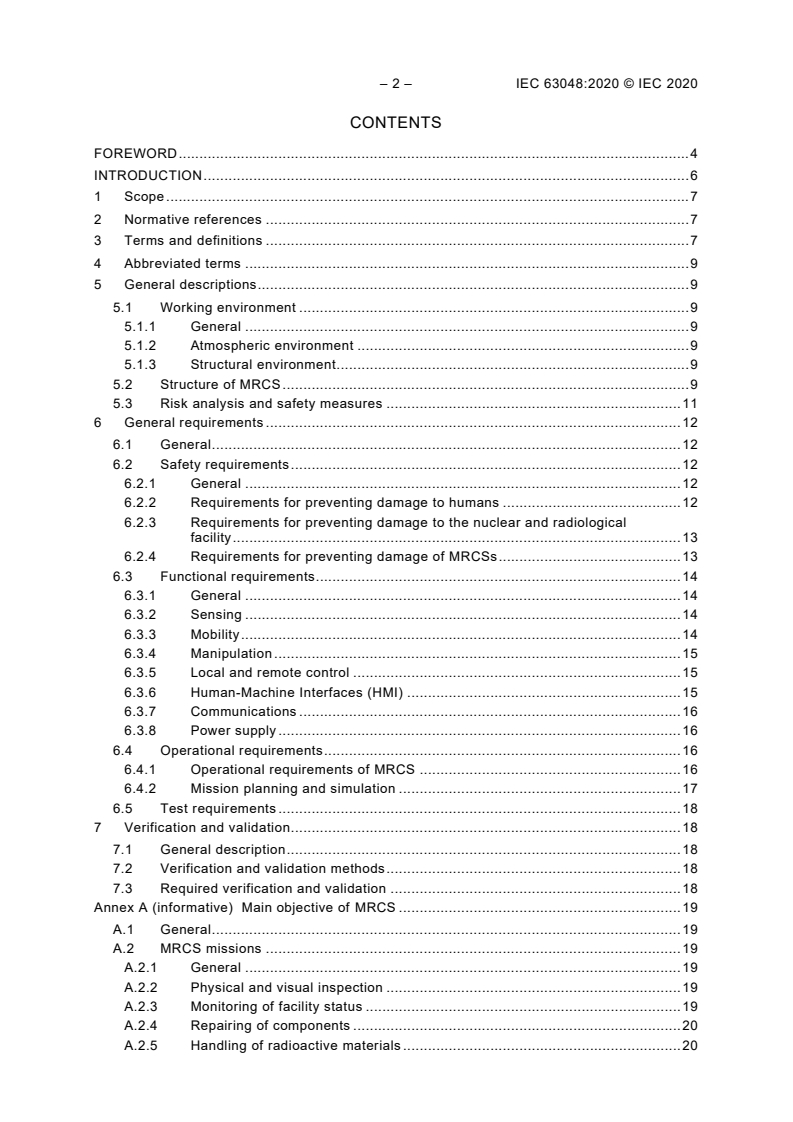
CONTENTS
FOREWORD . 4
INTRODUCTION . 6
1 Scope . 7
2 Normative references . 7
3 Terms and definitions . 7
4 Abbreviated terms . 9
5 General descriptions . 9
5.1 Working environment . 9
5.1.1 General . 9
5.1.2 Atmospheric environment . 9
5.1.3 Structural environment . 9
5.2 Structure of MRCS . 9
5.3 Risk analysis and safety measures . 11
6 General requirements . 12
6.1 General . 12
6.2 Safety requirements . 12
6.2.1 General . 12
6.2.2 Requirements for preventing damage to humans . 12
6.2.3 Requirements for preventing damage to the nuclear and radiological
facility . 13
6.2.4 Requirements for preventing damage of MRCSs . 13
6.3 Functional requirements . 14
6.3.1 General . 14
6.3.2 Sensing . 14
6.3.3 Mobility . 14
6.3.4 Manipulation . 15
6.3.5 Local and remote control . 15
6.3.6 Human-Machine Interfaces (HMI) . 15
6.3.7 Communications . 16
6.3.8 Power supply . 16
6.4 Operational requirements . 16
6.4.1 Operational requirements of MRCS . 16
6.4.2 Mission planning and simulation . 17
6.5 Test requirements . 18
7 Verification and validation . 18
7.1 General description . 18
7.2 Verification and validation methods . 18
7.3 Required verification and validation . 18
Annex A (informative) Main objective of MRCS . 19
A.1 General . 19
A.2 MRCS missions . 19
A.2.1 General . 19
A.2.2 Physical and visual inspection . 19
A.2.3 Monitoring of facility status . 19
A.2.4 Repairing of components . 20
A.2.5 Handling of radioactive materials . 20
A.2.6 Accident mitigation and recovery . 20
A.2.7 Dismantling and decommissioning of facilities . 20
Annex B (informative) Verification and validation methods of safety requirements and
countermeasures . 21
Bibliography . 25
Figure 1 – MRCS structure . 10
Figure 2 – MRCS functions . 11
Table B.1 – Verification and validation methods of safety requirements and
countermeasures . 22
– 4 – IEC 63048:2020 © IEC 2020
INTERNATIONAL ELECTROTECHNICAL COMMISSION
____________
MOBILE REMOTELY CONTROLLED SYSTEMS FOR NUCLEAR AND
RADIOLOGICAL APPLICATIONS – GENERAL REQUIREMENTS
FOREWORD
1) The International Electrotechnical Commission (IEC) is a worldwide organization for standardization comprising
all national electrotechnical committees (IEC National Committees). The object of IEC is to promote
international co-operation on all questions concerning standardization in the electrical and electronic fields. To
this end and in addition to other activities, IEC publishes International Standards, Technical Specifications,
Technical Reports, Publicly Available Specifications (PAS) and Guides (hereafter referred to as “IEC
Publication(s)”). Their preparation is entrusted to technical committees; any IEC National Committee interested
in the subject dealt with may participate in this preparatory work. International, governmental and non-
governmental organizations liaising with the IEC also participate in this preparation. IEC collaborates closely
with the International Organization for Standardization (ISO) in accordance with conditions determined by
agreement between the two organizations.
2) The formal decisions or agreements of IEC on technical matters express, as nearly as possible, an international
consensus of opinion on the relevant subjects since each technical committee has representation from all
interested IEC National Committees.
3) IEC Publications have the form of recommendations for international use and are accepted by IEC National
Committees in that sense. While all reasonable efforts are made to ensure that the technical content of IEC
Publications is accurate, IEC cannot be held responsible for the way in which they are used or for any
misinterpretation by any end user.
4) In order to promote international uniformity, IEC National Committees undertake to apply IEC Publications
transparently to the maximum extent possible in their national and regional publications. Any divergence
between any IEC Publication and the corresponding national or regional publication shall be clearly indicated in
the latter.
5) IEC itself does not provide any attestation of conformity. Independent certification bodies provide conformity
assessment services and, in some areas, access to IEC marks of conformity. IEC is not responsible for any
services carried out by independent certification bodies.
6) All users should ensure that they have the latest edition of this publication.
7) No liability shall attach to IEC or its directors, employees, servants or agents including individual experts and
members of its technical committees and IEC National Committees for any personal injury, property damage or
other damage of any nature whatsoever, whether direct or indirect, or for costs (including legal fees) and
expenses arising out of the publication, use of, or reliance upon, this IEC Publication or any other IEC
Publications.
8) Attention is drawn to the Normative references cited in this publication. Use of the referenced publications is
indispensable for the correct application of this publication.
9) Attention is drawn to the possibility that some of the elements of this IEC Publication may be the subject of
patent rights. IEC shall not be held responsible for identifying any or all such patent rights.
International Standard IEC 63048 has been prepared by IEC technical committee 45: Nuclear
instrumentation. The text of this International Standard is based on the following documents:
Draft Report on voting
45/904/FDIS 45/907/RVD
Full information on the voting for its approval can be found in the report on voting indicated in
the above table.
The language used for the development of this International Standard is English.
This document was drafted in accordance with ISO/IEC Directives, Part 2, and developed in
accordance with ISO/IEC Directives, Part 1 and ISO/IEC Directives, IEC Supplement,
available at www.iec.ch/members_experts/refdocs. The main document types developed by
IEC are described in greater detail at www.iec.ch/standardsdev/publications.
The committee has decided that the contents of this document will remain unchanged until the
stability date indicated on the IEC website under "http://webstore.iec.ch" in the data related to
the specific document. At this date, the document will be
• reconfirmed,
• withdrawn,
• replaced by a revised edition, or
• amended.
IMPORTANT – The 'colour inside' logo on the cover page of this publication indicates
that it contains colours which are considered to be useful for the correct
understanding of its contents. Users should therefore print this document using a
colour printer.
– 6 – IEC 63048:2020 © IEC 2020
INTRODUCTION
Mobile remotely controlled systems are used in areas that are difficult to access by human
workers, such as high-radiation, high-temperature, high-pressure, and submerged
environments.
International standards for applications other than nuclear applications, such as individual
protective equipment and industrial, service-related, and medical applications, are developed
within ISO TC 299.
There are a variety of mobile remotely controlled systems [14] intended for application in
various environmental conditions, namely: multifunctional mobile robot systems for the
inspection and maintenance of the primary cooling water system of a nuclear power plant;
shape-changing robots that serve as a remotely controlled inspection system in the primary
containment vessel of a nuclear power plant; robots that inspect the reactor head and floor,
underwater mobile robots that detect and remove loose parts within the reactor vessel;
underwater crawling and swimming robots that serve as a remotely controlled system for
feeder pipe inspection and maintenance of steam generators in an underwater environment;
operation control systems for non-destructive inspections, mobile robots intended for radiation
and chemicals reconnaissance and monitoring, as well as local distribution of gamma-
radiation sources located in inaccessible areas; and double-arm or heavy duty robots that are
used to dismantle nuclear power plants.
In this regard, it is necessary to develop technical standards that govern the design,
manufacturing, interoperability, and use of mobile remotely controlled systems for nuclear
applications that are suitable for various works such as the integrity inspection of nuclear
components, repair of nuclear components, on-site monitoring when any abnormality or
accident occurs in a nuclear facility, and nuclear decontamination and dismantling.
These technical standards concern the design, establishment, and performance of mobile
remotely controlled systems and can be used to implement various important tasks and
follow-up measures, such as monitoring nuclear-related activities.
To this end, general requirements for mobile remotely controlled systems have been provided
for nuclear and radiological applications.
Detailed specifications of these general requirements need to be designated by
manufacturers to provide support to the users of their products.
___________
Numbers in square brackets refer to the Bibliography.
MOBILE REMOTELY CONTROLLED SYSTEMS FOR NUCLEAR AND
RADIOLOGICAL APPLICATIONS – GENERAL REQUIREMENTS
1 Scope
This document defines the general requirements for Mobile Remotely Controlled Systems
(MRCSs) for nuclear and radiological applications such as integrity inspections, repair of
components, handling of radioactive materials, and monitoring of physical conditions and
radiation dose intensity in specific areas. (Refer to Annex A for more information regarding
the main purposes of the MRCS.)
MRCS is used in the concerned area where human access is difficult or impossible during
normal operation, transient and accidents, and recovery from an accident in nuclear facilities.
This document applies to MRCSs that are used to support nuclear and radiological facilities.
These general requirements encompass high-level performance requirements regarding
sensors, monitoring devices, control devices, interfacing mechanisms, simulation methods,
and verification methods thereof in a normal environment or extreme environmental conditions,
such as high radiation, high temperature, and high humidity environments.
In this document, the term “MRCS” used hereinafter refers to a mobile remotely controlled
system used for nuclear and radiological applications.
2 Normative references
There are no normative references in this document.
3 Terms and definitions
For the purposes of this document, the following terms and definitions are applied.
ISO and IEC maintain terminological databases for use in standardization at the following
addresses:
• IEC Electropedia: available at http://www.electropedia.org/
• ISO Online browsing platform: available at http://www.iso.org/obp
3.1
built-in control/diagnostics system
BCDS
specialized circuit of the on-board control system intended to check the state of MRCS
permanently
3.2
hazard
event having the potential to cause injury to plant personnel, damage to components,
equipment, structures or MRCSs. Hazards are divided into internal hazards and external
hazards
Note 1 to entry: Internal hazards are, for example, controller fail or power loss.
Note 2 to entry: External hazards are, for example, fire, flooding, earthquake and lightning.
Note 3 to entry: Damage to MRCSs is added to the source.
[SOURCE: IEC 61513:2011, 3.25, modified, – Note 3 to entry has been added.]
– 8 – IEC 63048:2020 © IEC 2020
3.3
mission
objective description of the fundamental task performed by a system
3.4
mobile remotely controlled system
MRCS
robotics in nuclear instrumentation that are mobile, remotely controlled by an operator, and
consisting of sub-systems, modules or assemblies
EXAMPLE 1 Subsystems, modules or assemblies are, for example, mechanical and electrical/electronical controls,
communications (between the operator and the robotic, and some robotic subsystems, modules or assemblies),
lighting and possibly audio subsystems, modules or assemblies, sampling and monitoring subsystems, modules or
assemblies, used for photographing the environment with video or still photos, sampling or monitoring the
contacted air or surfaces for radioactive materials, noxious gases and particulates such as asbestos, and
performing other designed activities, all controlled by the operator.
3.5
operator
person designated to start, monitor, and stop the intended operation of the MRCS
[SOURCE: ISO 8373:2012, 2.17, modified, – Robotic system has been replaced with MRCS.]
3.6
remote control
control of a device from a distant point
3.7
risk
potential that a given threat will exploit vulnerabilities of an asset or group of assets and
thereby cause harm to the organization
Note 1 to entry: It is measured in terms of a combination of the severity of impact from the environment,
probability of the exposure time to the radiation and the controllability for MRCS.
[SOURCE: IAEA Nuclear Security Series No. 17:2011, modified, – The second sentence in the
definition has been removed, and Note 1 to entry has been added.]
3.8
risk assessment
overall process of systematically identifying, estimating, analysing and evaluating risk
[SOURCE: IAEA Nuclear Security Series No. 17:2011]
3.9
robot
actuated mechanism programmable in two or more axes with a degree of autonomy, moving
within its environment, to perform intended tasks
[SOURCE: ISO 8373:2012, 2.6, modified – The notes have been removed.]
3.10
safety
protection of people and the environment against radiation risks, and the safety of facilities
and activities that give rise to radiation risks
Note 1 to entry: ‘Safety’ as used in the IAEA glossary and safety standards includes the safety of nuclear
installations, radiation safety, the safety of radioactive waste management and safety in the transport of radioactive
material; it does not include non-radiation-related aspects of safety.
[SOURCE: IAEA Safety Glossary: 2018, 3.1, modified, – The second sentence in the
definition has been removed, and Note 1 to entry has been added.]
3.11
scenario
possible sequence of interactions
[SOURCE: SG-CG/M490/E:2012-12, 3.10]
4 Abbreviated terms
BCDS Built-in Control/Diagnostics System
HMI Human-Machine Interface
MRCS Mobile Remotely Controlled System
5 General descriptions
5.1 Working environment
5.1.1 General
MRCSs shall be used to implement tasks in nuclear facilities where human access is difficult
or impossible. Working environments in nuclear facilities are identified according to operating
conditions and working areas, including, but not limited to, the following factors.
5.1.2 Atmospheric environment
• Radiation and radioactivity
• High temperature and high humidity
• Toxic and explosive gases
• Underwater or submerged environment
5.1.3 Structural environment
• Narrow and confine spaces limited to human access
• Areas of high altitude with a risk of falling
• Presence of obstacles with a risk of collision
• Sloped areas such as stairs
• Uneven paths, including gratings
• Areas where humanlike manipulations are needed, such as operations of doors and valves
These environmental factors should be applied to the mission of the MRCS, as described in
Annex A.
MRCSs shall perform given missions in various working environments with or without human
intervention.
The safety of the human operators, nuclear facilities and MRCSs should be confirmed for their
working environment.
5.2 Structure of MRCS
The MRCS or a human operator is a subject who conducts a given task, while a nuclear
facility is an object on which the task is performed.
– 10 – IEC 63048:2020 © IEC 2020
As a subject, the MRCS performs a given task related to an object either autonomously or in
cooperation with a human operator.
Any problems that may occur while performing the task should be addressed by the MRCS
and the human operator, and the final decision shall be made by the human operator.
Accordingly, when planning given tasks, a human operator should minimize the occurrence of
any unexpected problems, including by simulations.
The MRCS, as a subject which performs a given task, is structured as follows.
The MRCS is composed of two subsystems, as shown in Figure 1, the slave subsystem and
the master subsystem.
The slave subsystem is intended to operate in an area inaccessible to a human operator, or a
dangerous area, as shown in Figure 1.
The master subsystem is located in a safe area and used to supervise the slave subsystem by
human operator.
The two subsystems are located away from each other, and thus necessary information needs
to be exchanged between them through communications.
Figure 1 – MRCS structure
The functions of the slave subsystem, as shown in Figure 2, are as follows.
• The sensing function is to collect information necessary to perform a given task.
• The mobility function is to place the slave subsystem in the target area where the given
task is located.
• The manipulation function is to move a tool to the target position and place it in the
desired pose so as to handle the object.
• The local control function is to control the sensing, manipulation, and mobility functions
and exchange information with the master subsystem.
• The slave communication function is to receive control commands from the master
subsystem and transmit sensor information and the status of the slave subsystem to the
master subsystem.
• The slave power supply function is to provide power or energy sources to the slave
subsystem.
The functions of the master subsystem, as shown in Figure 2, are as follows.
• The human-machine interface (HMI) is to receive command inputs from the human
operator and provide the human operator with multimodal information regarding the
environmental conditions and status of the slave subsystem.
• The remote control function is to convert a command input from the human operator to an
appropriate form of control command suitable for the slave subsystem.
• The communication function is to transmit control commands to the slave subsystem and
receive data from the slave subsystem.
• The master power supply function is to provide power or energy sources to the master
subsystem.
Figure 2 – MRCS functions
5.3 Risk analysis and safety measures
To prevent or mitigate risks, necessary safety measures shall be prepared.
These risks may occur due to various factors, including but not limited to:
• Atmospheric environment, as mentioned in 5.1.2
• Structural environment, as mentioned in 5.1.3 (e.g., falling or rollover)
• Incorrect manipulation by the operator
• Defects or damaged electronic equipment that may cause an electric shock or fire
• Defects or malfunction of a control circuit that may cause machine malfunction
• Defects or failure of an electric circuit that may cause machine malfunction and power
disturbances
• Loss of circuit continuity due to a sliding contact or rolling contact that may cause a failure
of safety function or mechanical defects
• Electrical disturbances, such as interferences by electromagnetic fields, static electricity,
and radio frequencies, which may occur externally or internally causing equipment
malfunction
Here, safety measures refer to a combination of measures taken to address those risks, as
well as protection measures that need to be taken by the user.
These safety measures are considered in the system design and development phases to
mitigate the risks.
Appropriate safety measures shall be prepared based on the results of risk assessment.
– 12 – IEC 63048:2020 © IEC 2020
Safety protection and working procedures also need to be considered.
Safety protection includes the use of safety devices and recognition measures.
6 General requirements
6.1 General
The MRCS shall be designed and manufactured to meet the requirements for given missions
taking into consideration the environmental factors specified in 5.1.
These requirements consist of the safety, functional, operational and test requirements;
• Safety requirements (6.2)
• Functional requirements (6.3)
• Operational requirements (6.4)
• Test requirements (6.5)
6.2 Safety requirements
6.2.1 General
The MRCS shall be designed to safely complete the mission in the working environment
mentioned in 5.1. The safety of MRCS should be verified in three different aspects.
• MRCS should be designed to limit the level of risk that may cause health damage to
humans while all the time using MRCS, including the pre-processes (e.g., preparation,
installing, master and setting up the master station), the main processes (e.g., remote
operation of mobile base, remote controlling of manipulator), and the post-processes (e.g.,
retrieving, decontaminating, maintaining, and repairing the MRCS).
• MRCS should be designed to limit the level of risk to cause damage to the external
environment. MRCS should be safely returned without causing damage to the environment
during the mission.
• MRCS should be designed to protect itself from the dangers of the external environment.
MRCS should be safely returned without failure during the mission.
Depending on the working environment, the specific safety requirements should be
considered. Annex B provides a safety verification tool to ensure that the MRCS concerned
can be applied in a specific mission environment. The manufacturer shall provide
performance specifications and relevant information.
6.2.2 Requirements for preventing damage to humans
The MRCS shall be designed in such a way as to guarantee safety of humans all the time
while utilizing it. The level of risk imposed on humans while working on the MRCS shall be
reduced to a level below the allowable limit. If applicable, it is necessary to consider issues
that include, but are not limited to, the following items.
• MRCS should be designed to mitigate all possible risks, as identified in 5.1, to a level
below the allowable limit, if they have reached the level where humans could be harmed.
• MRCS should be designed to warn of the risks to humans, while preparing, installing,
operating, retrieving, decontaminating, inspecting, maintaining, repairing, or utilizing the
MRCS for other purposes.
• MRCS operating procedures should be clearly defined and documented. The possible
risks in each procedure and the way to mitigate those should be described.
• MRCS should be designed not to harm humans in case of collision or contact with it, due
to its physical properties (speed and force) or electrical properties.
• MRCSs should be designed to guarantee the safety in repairing or maintenance. A
modular design that allows the user to simply replace the failed module is desirable to
reduce the risk.
• MRCSs should be designed in such a way that they are not easily contaminated.
• The MRCS should be decontaminated after finishing a mission so that humans can access
the MRCS in order to maintain or repair it after the decontamination.
• MRCS should be designed to firmly fix all parts to prevent the separated parts which harm
humans.
6.2.3 Requirements for preventing damage to the nuclear and radiological facility
The level of potential risk to the nuclear and radiological facility while working on the MRCS
shall be reduced to a level below the allowable limit. If applicable, issues should be
considered, including but not limited to the following.
• The entire task should be performed so as not to damage the structures in case of
unexpected falling or rollover of the MRCS.
• The entire task should be performed so as not to damage the structures in case of
unexpected collision with the structures. The operating speed shall be limited enough to
reduce the possible risk.
• The entire task should be performed so as not to damage the structures in case of
intended contact. The contact stress exerted on the structure should be kept below the
allowable stress limit.
– The entire task should be performed so as not to generate foreign substance in order
to prevent damage to the structure or disturbing normal operation of nuclear facility.
Manipulation should be carefully done not to drop the handling object.
– Inspection should be conducted to find foreign objects.
– The foreign objects may be removed, if detected.
6.2.4 Requirements for preventing damage of MRCSs
The MRCS should complete the given mission safely without causing any damage until
returning to a pre-defined position. Its mission should be terminated if a failure occurs. The
MRCS should return to a pre-defined position for repairing, or it should halt safely at the
position in case it is impossible to return. The MRCS should be designed so as to provide
appropriate safety measures and to minimize degradation of performance, in consideration of
the working environment as specified in 5.1.
The level of risk to MRCS shall be reduced to a level below the allowable limit. The MRCS
shall be designed, manufactured, and operated while taking into consideration, but not limited
to, the following requirements.
• MRCS should be designed so as to provide redundancy and diversity to reduce the risk in
case of malfunction, performance degradation, and failure of the device.
• MRCS should be radiation tolerant or hardened, if necessary.
• Subsystem, module or assembly in MRCS should be waterproofed, if necessary.
• Subsystem, module or assembly in MRCS should be designed so as to prevent the
degradation due to dust, if necessary.
• Subsystem, module or assembly in MRCS should be designed so as to minimize inducing
vibration, and anti-vibration measures should be applied, if necessary.
• Subsystem, module or assembly in MRCS should be designed so as to guarantee the
mechanical strength and to reduce friction, if necessary.
– 14 – IEC 63048:2020 © IEC 2020
• Subsystem, module or assembly in MRCS should be designed so as to have suitable size
and shape for the given mission.
• The center of mass in MRCS should be well balanced not to flip over. Shape or center of
mass should be adjusted, if necessary.
• MRCS should be equipped with monitoring devices to detect possible risks.
6.3 Functional requirements
6.3.1 General
MRCS should implement appropriate functions to a given mission.
Accordingly, even though the functional requirements defined in this subclause are not
necessarily related to all types of MRCSs, each of the requirements may selectively apply to
the corresponding type of MRCS. This means that one may add phrases, such as “if
applicable” or “if necessary” to each of the requirements defined in this subclause.
6.3.2 Sensing
Sensing function may be selected depending on its mission among the following functions, but
not limited to them.
• MRCS should obtain proper sensing information required for moving and manipulating.
– Visual and acoustic information
– Distance from the object
– Self-position
– Direction and posture
– Contact or force
• MRCS should obtain proper sensing information required for identifying the characteristics
of the working environment
– Radiation dose rate, distribution of radioactive substances and energy spectrum
– Temperature, humidity, and pressure
– Gas leakage
– Fluid and water vapor leakage
– Sensing for non-destructive testing
6.3.3 Mobility
Mobility function may be selected depending on its mission among the following functions, but
not limited to them.
• The speed control function should be provided to minimize the risks caused by collisions.
• The emergency stop function should be provided to halt the mobile base in dangerous
situations.
• The safety stop function should be provided to halt the mobile base in abnormal situations.
• When the power supply is suddenly cut off, the system should safely hold the current pose.
• The obstacle avoidance function should be provided to detour or pass over the obstacle.
• The stabilizing function should be provided not to be flipped over in rough terrain such as
stair, slopes, or hump.
• The rolling function should be provided to restore itself from flipping pose.
• The rotation function should be provided so that it can move ahead the intended direction.
• The all-terrain function and suitable driving force should be provided not to be affected by
the ground conditions.
6.3.4 Manipulation
Manipulation function may be selected depending on its mission among the following
functions, but not limited to them.
• The emergency stop function should be provided to halt the manipulator in dangerous
situations.
• The safety stop function should be provided to halt the manipulator in abnormal situations.
• When the power supply is suddenly cut off, the system should safely hold the last pose.
• The restoring function should be provided to move to home position after resolving
abnormal situation.
• The motion control function should be provided to control the position and the speed
precisely.
• The collision avoidance function should be provided not to collide the obstacle.
• The shock absorbing function should be provided to minimize damage due to the impact.
• Suitable degree of freedom should be provided to perform a given mission.
• Appropriate handling payload should be provided to handle a target object.
6.3.5 Local and remote control
Local and remote control function may be selected depending on its mission among the
following functions, but not limited to them.
• The local control should provide the function to halt the slave subsystem in emergency
situations.
• The local control should provide the function to control the position or speed of the MRCS.
• The local control should provide the function to actuate the sensors and to process the
collected information.
• The local control should provide the function to suspend operation when the
communication between the master subsystem and the slave subsystem are disrupted for
a specific period of time.
• The local control should provide a BCDS to monitor the status of the MRCS and to
transmit an error message to the master subsystem when an error occurs.
• The local control should provide the function to inform the status of the slave subsystem to
the master subsystem.
• The local control and/or the remote control should provide the function to store the
moving/manipulation trajectory and/or the operation history of the MRCS.
• The remote control should provide the function to immediately stop the MRCS. The remote
control should provide the function to input user command and to output the collected
information from the slave subsystem.
• The remote control should provide the function to load the predefined mission plans.
• The remote control should provide the function to configure parameters.
6.3.6 Human-Machine Interfaces (HMI)
Human-Machine Interface (HMI) function may be selected depending on its mission among
the following functions, but not limited to them.
• The HMI should provide multimodal information so that the human operator can easily
recognize the status of the MRCS and the working environment.
– 16 – IEC 63048:2020 © IEC 2020
• The HMI should provide the function to input the command easy and intuitively.
• The HMI should provide the function to inform the error message to the human operator.
• The HMI should provide the function to warn of the danger in working environment or to
alarm on the abnormal status of the slave subsystem.
• The HMI should provide the function to show the moving/manipulation trajectory and/or the
operation history of the MRCS.
• The HMI should provide the function to display the guide trajectory of the slave subsystem
to the target position.
• The HMI should provide the function to display the power consumption, the battery level or
the remaining fuel.
• The HMI should provide the function to display the power consumption and the remaining
power capacity.
6.3.7 Communications
Communications function may be selected depending on its mission among the following
functions, but not limited to them.
• The communication period should be defined as frequently as to immediately be aware of
the changes in the working environment.
• The communication period should be defined as frequently as to immediately apply the
user command to the slave subsystem.
• The communication bandwidth should be ensured so as to send all the communication
data at each communication period, in the consideration of the control commands, the
sensor information, and audio/video data.
• The communication security should be ensured to minimize the effect of jamming and
cyber- attacks.
• The communication redundancy should be provided to ensure the diversity of the
emergency stops in preparation of the complete or partial loss of co
...