


IEC 60913:2013
(Main)Railway applications - Fixed installations - Electric traction overhead contact lines
General Information
- Abstract
IEC 60913:2013 applies to electric traction overhead contact line systems in heavy railways, light railways, trolley busses and industrial railways of public and private operators. It applies to new installations of overhead contact line systems and for the complete reconstruction of existing overhead contact line systems. It provides the requirements and tests for the design of overhead contact lines, requirements for structures and their structural calculations and verifications as well as the requirements and tests for the design of assemblies and individual parts. The main technical changes with regard to the previous edition deal with:
- fundamental design data,
- system requirements,
- structures,
- components requirements, and
- testing.
- Status
- Published
- Publication Date
- 05-Mar-2013
- Technical Committee
- TC 9 - Electrical equipment and systems for railways
- Drafting Committee
- MT 60913 - TC 9/MT 60913
- Current Stage
- DELPUB - Deleted Publication
- Start Date
- 08-Apr-2024
- Completion Date
- 31-Dec-2021
Overview
IEC 60913:2013 is an international standard published by the International Electrotechnical Commission (IEC) that specifies the requirements and tests for electric traction overhead contact line systems used in railway applications. The standard covers fixed installations for heavy railways, light railways, trolley buses, and industrial railways operated by both public and private entities. The standard is applicable to both new installations and the complete reconstruction of existing overhead contact line systems, ensuring safe, reliable, and efficient power supply for electric traction.
Key Topics
IEC 60913:2013 addresses a comprehensive range of critical topics for the design, construction, and testing of overhead contact line (OCL) systems. Key areas include:
Fundamental Design Data
Establishes design life, environmental conditions, vehicle characteristics, and electrical system criteria for OCL systems.System Requirements
Specifies requirements for electrical and mechanical design, including clearances, temperature limits, current collection quality, and tensioning.Structures
Covers structural design and verification, accounting for loads such as wind, ice, variable operation, and construction/maintenance actions. Provides guidelines for geotechnical investigations, foundation design, and corrosion protection.Component Requirements
Details requirements for individual assemblies and parts, such as supporting assemblies, contact wires, conductors, droppers, insulators, clamps, connectors, disconnectors, and surge protection devices.Testing
Outlines essential tests for components and systems, including type, sample, routine, and commissioning tests to verify conformity with specified requirements.Documentation
Defines the minimum documentation necessary for system specification, basic design, installation design, and ongoing maintenance.
Applications
IEC 60913:2013 is relevant for a wide range of railway and electric transportation applications:
Heavy and Light Railways
Ensures OCL systems are designed for durability and efficiency in both commuter and freight railway networks.Trolleybus Systems
Addresses unique aspects of overhead line design and current collection for trolleybuses, including integration with adjacent tram or light rail lines.Industrial Railways
Applies to specialized settings such as mining, port, or factory rail systems, supporting reliable overhead electrification.
Practical Value
Safety and Reliability
By establishing internationally recognized requirements and verification tests, IEC 60913:2013 enhances the safety and operational stability of electric railway systems.Interoperability
Ensures uniform technical criteria, facilitating efficient procurement, installation, and maintenance across different operators and regions.Adaptability
Allows for integration of new technologies and materials in OCL design while supporting the reconstruction and modernization of older systems.
Related Standards
IEC 60913:2013 is closely related to other important railway electrification and fixed installation standards, including:
- EN 50119: European standard for railway applications - Fixed installations - Electric traction overhead contact lines, forming the basis of many requirements in IEC 60913.
- IEC 61133: Testing of electric and magnetic compatibility for rolling stock and traction systems.
- IEC 60310: Traction transformers and inductors for rolling stock.
- IEC 61373: Shock and vibration tests for railway applications.
These standards, together with IEC 60913, form a robust framework for the safe and reliable operation of electric traction overhead contact line systems in rail and public transport sectors worldwide.
For more information, refer to the official IEC documentation and the latest updates on railway electrification standards.
Relations
- Effective Date
- 05-Sep-2023
Get Certified
Connect with accredited certification bodies for this standard

IRIS Certification (UNIFE)
International Railway Industry Standard certification.

TÜV SÜD Rail GmbH
TÜV SÜD railway certification services.

Bureau Veritas Railway Certification
Railway and transportation certification.
Sponsored listings
Frequently Asked Questions
IEC 60913:2013 is a standard published by the International Electrotechnical Commission (IEC). Its full title is "Railway applications - Fixed installations - Electric traction overhead contact lines". This standard covers: IEC 60913:2013 applies to electric traction overhead contact line systems in heavy railways, light railways, trolley busses and industrial railways of public and private operators. It applies to new installations of overhead contact line systems and for the complete reconstruction of existing overhead contact line systems. It provides the requirements and tests for the design of overhead contact lines, requirements for structures and their structural calculations and verifications as well as the requirements and tests for the design of assemblies and individual parts. The main technical changes with regard to the previous edition deal with: - fundamental design data, - system requirements, - structures, - components requirements, and - testing.
IEC 60913:2013 applies to electric traction overhead contact line systems in heavy railways, light railways, trolley busses and industrial railways of public and private operators. It applies to new installations of overhead contact line systems and for the complete reconstruction of existing overhead contact line systems. It provides the requirements and tests for the design of overhead contact lines, requirements for structures and their structural calculations and verifications as well as the requirements and tests for the design of assemblies and individual parts. The main technical changes with regard to the previous edition deal with: - fundamental design data, - system requirements, - structures, - components requirements, and - testing.
IEC 60913:2013 is classified under the following ICS (International Classification for Standards) categories: 45.060.01 - Railway rolling stock in general. The ICS classification helps identify the subject area and facilitates finding related standards.
IEC 60913:2013 has the following relationships with other standards: It is inter standard links to IEC 60913:2024. Understanding these relationships helps ensure you are using the most current and applicable version of the standard.
IEC 60913:2013 is available in PDF format for immediate download after purchase. The document can be added to your cart and obtained through the secure checkout process. Digital delivery ensures instant access to the complete standard document.
Standards Content (Sample)
IEC 60913 ®
Edition 2.0 2013-03
INTERNATIONAL
STANDARD
NORME
INTERNATIONALE
Railway applications – Fixed installations – Electric traction overhead contact
lines
Applications ferroviaires – Installations fixes – Lignes aériennes de contact pour
la traction électrique
All rights reserved. Unless otherwise specified, no part of this publication may be reproduced or utilized in any form
or by any means, electronic or mechanical, including photocopying and microfilm, without permission in writing from
either IEC or IEC's member National Committee in the country of the requester.
If you have any questions about IEC copyright or have an enquiry about obtaining additional rights to this publication,
please contact the address below or your local IEC member National Committee for further information.
Droits de reproduction réservés. Sauf indication contraire, aucune partie de cette publication ne peut être reproduite ni
utilisée sous quelque forme que ce soit et par aucun procédé, électronique ou mécanique, y compris la photocopie et les
microfilms, sans l'accord écrit de la CEI ou du Comité national de la CEI du pays du demandeur.
Si vous avez des questions sur le copyright de la CEI ou si vous désirez obtenir des droits supplémentaires sur cette
publication, utilisez les coordonnées ci-après ou contactez le Comité national de la CEI de votre pays de résidence.
IEC Central Office Tel.: +41 22 919 02 11
3, rue de Varembé Fax: +41 22 919 03 00
CH-1211 Geneva 20 info@iec.ch
Switzerland www.iec.ch
About the IEC
The International Electrotechnical Commission (IEC) is the leading global organization that prepares and publishes
International Standards for all electrical, electronic and related technologies.
About IEC publications
The technical content of IEC publications is kept under constant review by the IEC. Please make sure that you have the
latest edition, a corrigenda or an amendment might have been published.
Useful links:
IEC publications search - www.iec.ch/searchpub Electropedia - www.electropedia.org
The advanced search enables you to find IEC publications The world's leading online dictionary of electronic and
by a variety of criteria (reference number, text, technical electrical terms containing more than 30 000 terms and
committee,…). definitions in English and French, with equivalent terms in
It also gives information on projects, replaced and additional languages. Also known as the International
withdrawn publications. Electrotechnical Vocabulary (IEV) on-line.
IEC Just Published - webstore.iec.ch/justpublished Customer Service Centre - webstore.iec.ch/csc
Stay up to date on all new IEC publications. Just Published If you wish to give us your feedback on this publication
details all new publications released. Available on-line and or need further assistance, please contact the
also once a month by email. Customer Service Centre: csc@iec.ch.
A propos de la CEI
La Commission Electrotechnique Internationale (CEI) est la première organisation mondiale qui élabore et publie des
Normes internationales pour tout ce qui a trait à l'électricité, à l'électronique et aux technologies apparentées.
A propos des publications CEI
Le contenu technique des publications de la CEI est constamment revu. Veuillez vous assurer que vous possédez
l’édition la plus récente, un corrigendum ou amendement peut avoir été publié.
Liens utiles:
Recherche de publications CEI - www.iec.ch/searchpub Electropedia - www.electropedia.org
La recherche avancée vous permet de trouver des Le premier dictionnaire en ligne au monde de termes
publications CEI en utilisant différents critères (numéro de électroniques et électriques. Il contient plus de 30 000
référence, texte, comité d’études,…). termes et définitions en anglais et en français, ainsi que
Elle donne aussi des informations sur les projets et les les termes équivalents dans les langues additionnelles.
publications remplacées ou retirées. Egalement appelé Vocabulaire Electrotechnique
International (VEI) en ligne.
Just Published CEI - webstore.iec.ch/justpublished
Service Clients - webstore.iec.ch/csc
Restez informé sur les nouvelles publications de la CEI.
Just Published détaille les nouvelles publications parues. Si vous désirez nous donner des commentaires sur
Disponible en ligne et aussi une fois par mois par email. cette publication ou si vous avez des questions
contactez-nous: csc@iec.ch.
IEC 60913 ®
Edition 2.0 2013-03
INTERNATIONAL
STANDARD
NORME
INTERNATIONALE
Railway applications – Fixed installations – Electric traction overhead contact
lines
Applications ferroviaires – Installations fixes – Lignes aériennes de contact pour
la traction électrique
INTERNATIONAL
ELECTROTECHNICAL
COMMISSION
COMMISSION
ELECTROTECHNIQUE
PRICE CODE
INTERNATIONALE
CODE PRIX XD
ICS 45.060 ISBN 978-2-83220-638-6
– 2 – 60913 © IEC:2013
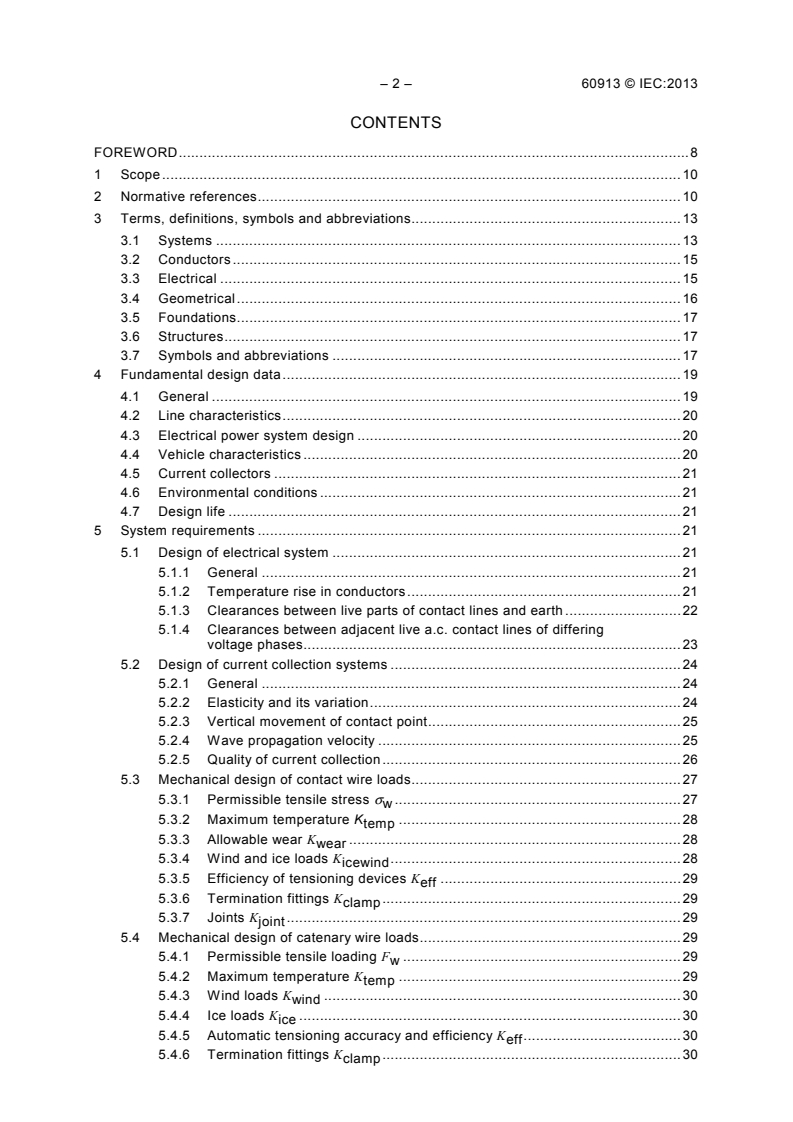
CONTENTS
FOREWORD . 8
1 Scope . 10
2 Normative references . 10
3 Terms, definitions, symbols and abbreviations. 13
3.1 Systems . 13
3.2 Conductors . 15
3.3 Electrical . 15
3.4 Geometrical . 16
3.5 Foundations . 17
3.6 Structures . 17
3.7 Symbols and abbreviations . 17
4 Fundamental design data . 19
4.1 General . 19
4.2 Line characteristics . 20
4.3 Electrical power system design . 20
4.4 Vehicle characteristics . 20
4.5 Current collectors . 21
4.6 Environmental conditions . 21
4.7 Design life . 21
5 System requirements . 21
5.1 Design of electrical system . 21
5.1.1 General . 21
5.1.2 Temperature rise in conductors . 21
5.1.3 Clearances between live parts of contact lines and earth . 22
5.1.4 Clearances between adjacent live a.c. contact lines of differing
voltage phases. 23
5.2 Design of current collection systems . 24
5.2.1 General . 24
5.2.2 Elasticity and its variation . 24
5.2.3 Vertical movement of contact point . 25
5.2.4 Wave propagation velocity . 25
5.2.5 Quality of current collection . 26
5.3 Mechanical design of contact wire loads. 27
5.3.1 Permissible tensile stress σ . 27
w
5.3.2 Maximum temperature K . 28
temp
5.3.3 Allowable wear K . 28
wear
5.3.4 Wind and ice loads K . 28
icewind
5.3.5 Efficiency of tensioning devices K . 29
eff
5.3.6 Termination fittings K . 29
clamp
5.3.7 Joints K . 29
joint
5.4 Mechanical design of catenary wire loads . 29
5.4.1 Permissible tensile loading F . 29
w
5.4.2 Maximum temperature K . 29
temp
5.4.3 Wind loads K . 30
wind
5.4.4 Ice loads K . 30
ice
5.4.5 Automatic tensioning accuracy and efficiency K . 30
eff
5.4.6 Termination fittings K . 30
clamp
60913 © IEC:2013 – 3 –
5.4.7 Additional vertical load K . 30
load
5.5 Mechanical design of other stranded conductors . 31
5.6 Mechanical design of solid wires . 31
5.7 Mechanical design of ropes of non-conducting materials . 31
5.7.1 General . 31
5.7.2 Permissible tensile loading F . 31
w
5.7.3 Wind loads K . 31
wind
5.7.4 Ice loads K . 31
ice
5.7.5 Termination clamps K . 31
clamp
5.7.6 Vertical loads K . 32
load
5.7.7 Minimum bending radius K . 32
radius
5.8 Suspension systems . 32
5.9 Tensioning systems . 32
5.10 Geometry of overhead equipment . 32
5.10.1 Horizontal deflection of contact wire . 32
5.10.2 Uplift . 33
5.10.3 Variation in contact wire height . 33
5.10.4 Minimum contact wire height . 33
5.10.5 Minimum design contact wire height . 34
5.10.6 Nominal contact wire height . 34
5.10.7 Maximum design contact wire height . 34
5.11 Contact line arrangement above turnouts and crossings . 35
5.12 Overlap arrangements . 35
5.13 Specific requirements for overhead contact lines for trolleybus systems . 36
5.13.1 General . 36
5.13.2 Line characteristics . 36
5.13.3 Vehicle characteristics . 37
5.13.4 Current collector system . 37
5.13.5 Static contact forces . 38
5.13.6 Trolleybus in the vicinity of tramways . 38
5.14 Tolerances and limits . 38
6 Structures . 39
6.1 Basis of design . 39
6.1.1 General . 39
6.1.2 Basic requirements . 39
6.1.3 Design with regard to structural limits . 40
6.1.4 Classification of actions . 40
6.1.5 Reliability levels . 41
6.1.6 Models for structural analysis and resistance . 41
6.1.7 Design values and verification methods . 41
6.2 Actions on overhead contact lines . 42
6.2.1 General . 42
6.2.2 Permanent loads . 43
6.2.3 Variable loads . 43
6.2.4 Wind loads . 43
6.2.5 Ice loads . 47
6.2.6 Combined wind and ice loads . 47
6.2.7 Temperature effects . 48
6.2.8 Construction and maintenance loads . 48
– 4 – 60913 © IEC:2013
6.2.9 Accidental loads. 48
6.2.10 Special actions . 48
6.3 Types of structures and related load cases . 49
6.3.1 Load cases and load combinations . 49
6.3.2 Type of structures and application of load cases . 50
6.3.3 Partial factors for actions . 52
6.4 Design of cross-span supports and structures . 53
6.4.1 Analysis of internal forces and moments . 53
6.4.2 Analysis of resistance . 54
6.4.3 Material partial factors . 54
6.4.4 Verification of resistance . 55
6.4.5 Verification of serviceability . 55
6.4.6 Material for structures . 55
6.4.7 Corrosion protection and finishes . 56
6.5 Foundations . 56
6.5.1 General . 56
6.5.2 Design of foundations . 56
6.5.3 Calculation of actions . 57
6.5.4 Geotechnical design . 57
6.5.5 Structural design . 59
6.5.6 Partial factors for foundations . 60
6.5.7 Verification of stability . 60
6.5.8 Calculation of displacements . 61
6.5.9 Materials for foundations . 61
6.5.10 Structural details . 62
6.5.11 Protection against corrosion and weathering . 62
6.5.12 Electrical design . 62
6.5.13 Installation of foundations . 63
7 Component requirements . 63
7.1 General . 63
7.1.1 Design life . 63
7.1.2 Component identification . 64
7.1.3 Corrosion and erosion . 64
7.2 Supporting assemblies . 64
7.3 Contact wire . 64
7.4 Other conductors and ropes . 64
7.5 Tensioning devices . 65
7.6 Mechanical midpoints . 65
7.6.1 General . 65
7.6.2 Catenary wire fixed points . 65
7.6.3 Contact wire fixed points . 65
7.7 Droppers . 66
7.7.1 Mechanical requirements . 66
7.7.2 Electrical requirements . 66
7.8 Clamps and line fittings . 66
7.8.1 Mechanical requirements . 66
7.8.2 Electrical requirements . 67
7.9 Electrical connectors . 67
7.10 Insulators . 67
60913 © IEC:2013 – 5 –
7.11 Sectioning devices . 67
7.11.1 Definition . 67
7.11.2 Mechanical requirements . 67
7.11.3 Electrical requirements . 68
7.12 Disconnectors and drives . 68
7.13 Protection devices . 68
7.13.1 Covers and obstacles . 68
7.13.2 Surge protection devices . 68
7.14 Specific components for trolleybus systems . 68
7.14.1 General . 68
7.14.2 Turnouts and crossings . 69
8 Testing . 69
8.1 General . 69
8.2 Support assemblies . 69
8.2.1 Type test . 69
8.2.2 Random sample test . 78
8.2.3 Routine test . 79
8.3 Contact wires . 79
8.4 Other conductors . 80
8.5 Tensioning devices . 80
8.5.1 Tests required . 80
8.5.2 Type tests for tensioning devices with balance weights . 80
8.5.3 Type tests for tensioning device without balance weight . 81
8.6 Mechanical midpoints . 81
8.7 Droppers . 82
8.7.1 Tests required . 82
8.7.2 Mechanical fatigue test . 82
8.7.3 Mechanical tests . 83
8.8 Clamps, splices and other fittings . 84
8.9 Electrical connectors . 84
8.9.1 General . 84
8.9.2 Mechanical fatigue tests . 84
8.10 Insulators . 85
8.11 Sectioning devices . 85
8.11.1 Type test . 85
8.11.2 Field test . 86
8.11.3 Sample tests . 86
8.11.4 Routine tests . 87
8.12 Disconnectors and drives . 87
8.13 Surge protection devices. 87
8.14 Specific components for trolleybus systems . 87
8.15 System test . 87
8.15.1 Demonstration of conformity . 87
8.15.2 Acceptance tests . 88
8.15.3 Commissioning tests . 88
9 Minimum documentation . 89
9.1 General . 89
9.2 System specification . 89
9.3 Basic design . 89
– 6 – 60913 © IEC:2013
9.4 Installation design . 89
9.5 Installation and maintenance . 89
Annex A (informative) Current-carrying capacity of conductors . 90
Annex B (informative) Structural details . 91
Annex C (informative) Geotechnical soil investigation and soil characteristics . 92
Annex D (informative) Information on uniformity of elasticity of OCL within a span
length . 94
Annex E (normative) Special national conditions . 95
Bibliography . 96
Figure 1 – Relationship between contact wire heights and pantograph operating position . 35
Figure 2 – Position of return wire in relation to right-of-way . 37
Figure 3 – Wind action on lattice steel structures . 46
Figure 4 – Definition of drag factors for double channel structure . 47
Figure 5 – Description of dimensions and minimum conductor lengths . 76
Figure 6 – Potential measuring points at a connecting clamp and a butt joining clamp . 77
Figure 7 – Potential measuring points at a T-type infeed terminal . 77
Figure 8 – Example of a tensioning device measurement test . 81
Figure 9 – Example of a dropper test cycle . 83
Figure 10 – Example of a dropper tension test assembly . 84
Figure 11 – Example of a test cycle for an electrical connection . 85
Table 1 – Temperature limits for material mechanical properties . 22
Table 2 – Electrical clearances . 23
Table 3 – Clearance between differing phases . 24
Table 4 – Contact force . 27
Table 5 – Factor K for contact wires . 28
temp
Table 6 – Factor K for contact wires . 28
icewind
Table 7 – Factor K for stranded conductors . 29
temp
Table 8 – Factor K for stranded conductors . 30
wind
Table 9 – Factor K for stranded conductors . 30
ice
Table 10 – Factor K for ropes of non-conducting materials . 32
radius
Table 11 – Contact wire gradients . 33
Table 12 – Important parameters to assist in the definition of tolerances and limits . 39
Table 13 – Recommended values for factor C for different structure types . 47
str
Table 14 – Summary of load cases to be considered for each type of structures . 52
Table 15 – Summary of partial factors for actions . 53
Table 16 – Recommended values for partial factors γ for steel material . 54
M
Table 17 – Recommended values for partial factors γ for concrete structures . 54
M
Table 18 – Recommended values for partial factors γ for foundations . 60
M
Table 19 – Tightening torques M for regularly used bolts . 71
t
Table 20 – Examples of bolt connections . 71
Table 21 – Assignment of the strength of bolt and nut . 72
60913 © IEC:2013 – 7 –
Table 22 – Conversion factor for tightening torques . 72
Table 23 – Minimum conductor lengths . 76
Table A.1 – Continuous current-carrying capacity of conductors and contact wires . 90
Table B.1 – Recommended dimensions of connections and edge distances of jointing
components . 91
Table C.1 – Geotechnical characteristic parameters of some standard soils according to
EN 50341-1:2001, Annex N for Europe . 93
Table D.1 – Uniformity u of elasticity . 94
Table E.1 – Typical tolerances of overhead contact line system . 95
– 8 – 60913 © IEC:2013
INTERNATIONAL ELECTROTECHNICAL COMMISSION
____________
RAILWAY APPLICATIONS – FIXED INSTALLATIONS –
ELECTRIC TRACTION OVERHEAD CONTACT LINES
FOREWORD
1) The International Electrotechnical Commission (IEC) is a worldwide organization for standardization comprising
all national electrotechnical committees (IEC National Committees). The object of IEC is to promote
international co-operation on all questions concerning standardization in the electrical and electronic fields. To
this end and in addition to other activities, IEC publishes International Standards, Technical Specifications,
Technical Reports, Publicly Available Specifications (PAS) and Guides (hereafter referred to as “IEC
Publication(s)”). Their preparation is entrusted to technical committees; any IEC National Committee interested
in the subject dealt with may participate in this preparatory work. International, governmental and non-
governmental organizations liaising with the IEC also participate in this preparation. IEC collaborates closely
with the International Organization for Standardization (ISO) in accordance with conditions determined by
agreement between the two organizations.
2) The formal decisions or agreements of IEC on technical matters express, as nearly as possible, an international
consensus of opinion on the relevant subjects since each technical committee has representation from all
interested IEC National Committees.
3) IEC Publications have the form of recommendations for international use and are accepted by IEC National
Committees in that sense. While all reasonable efforts are made to ensure that the technical content of IEC
Publications is accurate, IEC cannot be held responsible for the way in which they are used or for any
misinterpretation by any end user.
4) In order to promote international uniformity, IEC National Committees undertake to apply IEC Publications
transparently to the maximum extent possible in their national and regional publications. Any divergence
between any IEC Publication and the corresponding national or regional publication shall be clearly indicated in
the latter.
5) IEC itself does not provide any attestation of conformity. Independent certification bodies provide conformity
assessment services and, in some areas, access to IEC marks of conformity. IEC is not responsible for any
services carried out by independent certification bodies.
6) All users should ensure that they have the latest edition of this publication.
7) No liability shall attach to IEC or its directors, employees, servants or agents including individual experts and
members of its technical committees and IEC National Committees for any personal injury, property damage or
other damage of any nature whatsoever, whether direct or indirect, or for costs (including legal fees) and
expenses arising out of the publication, use of, or reliance upon, this IEC Publication or any other IEC
Publications.
8) Attention is drawn to the Normative references cited in this publication. Use of the referenced publications is
indispensable for the correct application of this publication.
9) Attention is drawn to the possibility that some of the elements of this IEC Publication may be the subject of
patent rights. IEC shall not be held responsible for identifying any or all such patent rights.
International Standard IEC 60913 has been prepared by IEC technical committee 9: Electrical
equipment and systems for railways.
This second edition cancels and replaces the first edition published in 1988. It constitutes a
technical revision of the initial standard based on European standard EN 50119.
The main technical changes with regard to the previous edition deal with:
– fundamental design data,
– system requirements,
– structures,
– components requirements,
– testing
for overhead contact line design.
60913 © IEC:2013 – 9 –
The text of this standard is based on the following documents:
FDIS Report on voting
9/1745/FDIS 9/1773/RVD
Full information on the voting for the approval of this standard can be found in the report on
voting indicated in the above table.
This publication has been drafted in accordance with the ISO/IEC Directives, Part 2.
The committee has decided that the contents of this publication will remain unchanged until the
stability date indicated on the IEC web site under "http://webstore.iec.ch" in the data related to
the specific publication. At this date, the publication will be
• reconfirmed,
• withdrawn,
• replaced by a revised edition, or
• amended.
– 10 – 60913 © IEC:2013
RAILWAY APPLICATIONS – FIXED INSTALLATIONS –
ELECTRIC TRACTION OVERHEAD CONTACT LINES
1 Scope
This International Standard applies to electric traction overhead contact line systems in heavy
railways, light railways, trolley busses and industrial railways of public and private operators.
It applies to new installations of overhead contact line systems and for the complete
reconstruction of existing overhead contact line systems.
This standard contains the requirements and tests for the design of overhead contact lines,
requirements for structures and their structural calculations and verifications as well as the
requirements and tests for the design of assemblies and individual parts.
This standard does not provide requirements for conductor rail systems where the conductor
rails are located adjacent to the running rails.
2 Normative references
The following documents, in whole or in part, are normatively referenced in this document and
are indispensable for its application. For dated references, only the edition cited applies. For
undated references, the latest edition of the referenced document (including any amendments)
applies.
NOTE Normative references are made to ISO and IEC standards. For some necessary references, ISO and IEC
standards do not exist. In these cases, references are made to European Standards which are normative for Europe
according to EN 50119. For non-European countries these references are only informative and listed in the
bibliography.
IEC 60050-811, International Electrotechnical Vocabulary (IEV) – Chapter 811: Electric traction
IEC 60071 (all parts), Insulation co-ordination
IEC 60099 (all parts), Surge arresters
IEC 60099-1, Surge arresters – Part 1: Non-linear resistor type gapped surge arresters for a.c.
systems
IEC 60099-4, Surge arresters – Part 4: Metal-oxide surge arresters without gaps for a.c.
systems
IEC 60168, Tests on indoor and outdoor post insulators of ceramic material or glass for
systems with nominal voltages greater than 1 000 V
IEC 60273, Characteristics of indoor and outdoor post insulators for systems with nominal
voltages greather than 1 000 V
IEC 60305, Insulators for overhead lines with a nominal voltage above 1 000 V – Ceramic or
glass insulator units for a.c. systems – Characteristics of insulator units of the cap and pin type
IEC 60383 (all parts), Insulators for overhead lines with nominal voltage above 1 000 V
60913 © IEC:2013 – 11 –
IEC 60433, Insulators for overhead lines with a nominal voltage above 1 000 V – Ceramic
insulators for a.c. systems – Characteristics of insulator units of the long rod type
IEC 60494 (all parts), Railway applications – Rolling stock – Pantographs – Characteristics and
tests
IEC 60494-1, Railway applications – Rolling stock – Pantographs – Characteristics and tests –
Part 1: Pantographs for mainline vehicles
IEC 60494-2, Railway applications – Rolling stock – Pantographs – Characteristics and tests –
Part 2: Pantographs for metros and light rail vehicles
IEC 60529, Degrees of protection provided by enclosures (IP Code)
IEC 60660, Insulators – Tests on indoor post insulators of organic material for systems with
nominal voltages greater than 1 000 V up to but not including 300 kV
IEC 60672-1, Ceramic and glass insulating materials – Part 1: Definitions and classification
IEC 60672-2, Ceramic and glass insulating materials – Part 2: Methods of test
IEC 60672-3, Ceramic and glass-insulating materials – Part 3: Specifications for individual
materials
IEC 60850, Railway applications – Supply voltages of traction systems
IEC 60889, Hard-drawn aluminium wire for overhead line conductors
IEC 60947-1, Low-voltage switchgear and controlgear – Part 1: General rules
IEC 61089, Round wire concentric lay overhead electrical stranded conductors
IEC 61109, Insulators for overhead lines – Composite suspension and tension insulators for
a.c. systems with a nominal voltage greater than 1 000 V – Definitions, test methods and
acceptance criteria
IEC 61232, Aluminium-clad steel wires for electrical purposes
IEC/TR 61245, Artificial pollution tests on high-voltage insulators to be used on d.c. systems
IEC 61284:1997, Overhead lines – Requirements and tests for fitting
IEC 61325, Insulators for overhead lines with a nominal voltage above 1 000 V – Ceramic or
glass insulator units for d.c. systems – Definitons, test methods and acceptance criteria
IEC 61773, Overhead lines – Testing of foundations for structures
IEC 61952, Insulators for overhead lines – Composite line post insulators for a.c. systems with
a nominal voltage greater than 1 000 V – Definitions, test methods and acceptance criteria
IEC 61992 (all parts), Railway applications – Fixed installations – DC switchgear
IEC 61992-1, Railway applications – Fixed installations – DC switchgear – Part 1: General
– 12 – 60913 © IEC:2013
IEC 61992-4, Railway applications – Fixed installations – DC switchgear – Part 4: Outdoor d.c.
disconnectors, switch-disconnectors and earthing switches
IEC 61992-5, Railway applications – Fixed installations – DC switchgear – Part 5: Surge
arresters and low-voltage limiters for specific use in d.c. systems
IEC 62128 (all parts), Railway applications – Fixed installations
IEC 62128-1:2003, Railway applications – Fixed installations – Part 1: Protective provisions
relating to electrical safety and earthing
IEC 62128-2:2003, Railway
...