

IEC 61000-4-5:2005
(Main)Electromagnetic compatibility (EMC) - Part 4-5: Testing and measurement techniques - Surge immunity test
General Information
- Abstract
IEC 61000-4-5:2005 relates to the immunity requirements, test methods, and range of recommended test levels for equipment to unidirectional surges caused by overvoltages from switching and lightning transients. Several test levels are defined which relate to different environment and installation conditions. These requirements are developed for and are applicable to electrical and electronic equipment. The object of this standard is to establish a common reference for evaluating the immunity of electrical and electronic equipment when subjected to surges. The test method documented in this part of IEC 61000 describes a consistent method to assess the immunity of an equipment or system against a defined phenomenon. This standard defines:
- a range of test levels;
- test equipment;
- test setups;
- test procedures.
The task of the described laboratory test is to find the reaction of the EUT under specified operational conditions, to surge voltages caused by switching and lightning effects at certain threat levels. It is not intended to test the capability of the EUT's insulation to withstand high-voltage stress. Direct injections of lightning currents, i.e, direct lightning strikes, are not considered in this standard. It has the status of a basic EMC publication in accordance with IEC Guide 107.
The contents of the corrigendum of October 2009 have been included in this copy.
- Status
- Published
- Publication Date
- 28-Nov-2005
- Technical Committee
- SC 77B - High frequency phenomena
- Drafting Committee
- WG 11 - TC 77/SC 77B/WG 11
- Current Stage
- DELPUB - Deleted Publication
- Start Date
- 15-May-2014
- Completion Date
- 28-Aug-2026
Buy Documents
IEC 61000-4-5:2005 - Electromagnetic compatibility (EMC) - Part 4-5: Testing and measurement techniques - Surge immunity test Released:11/29/2005
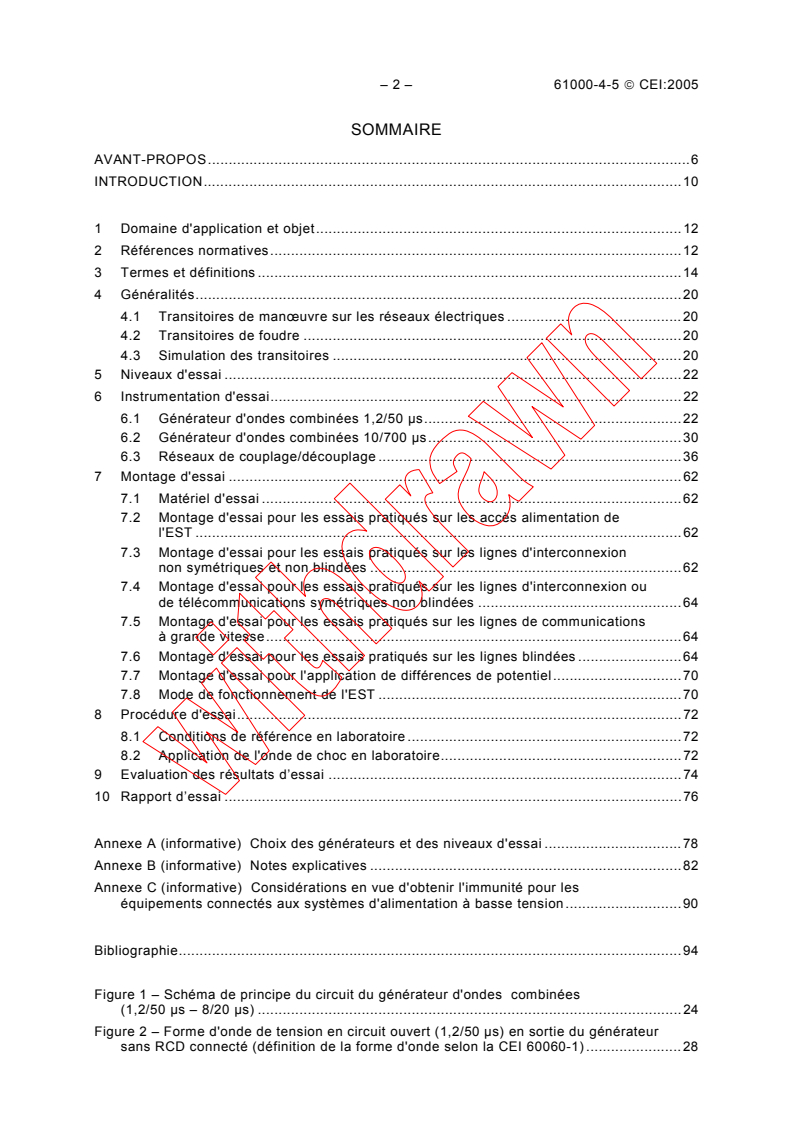
IEC 61000-4-5:2005 - Compatibilité électromagnétique (CEM) - Partie 4-5: Techniques d'essai et de mesure - Essai d'immunité aux ondes de choc Released:11/29/2005
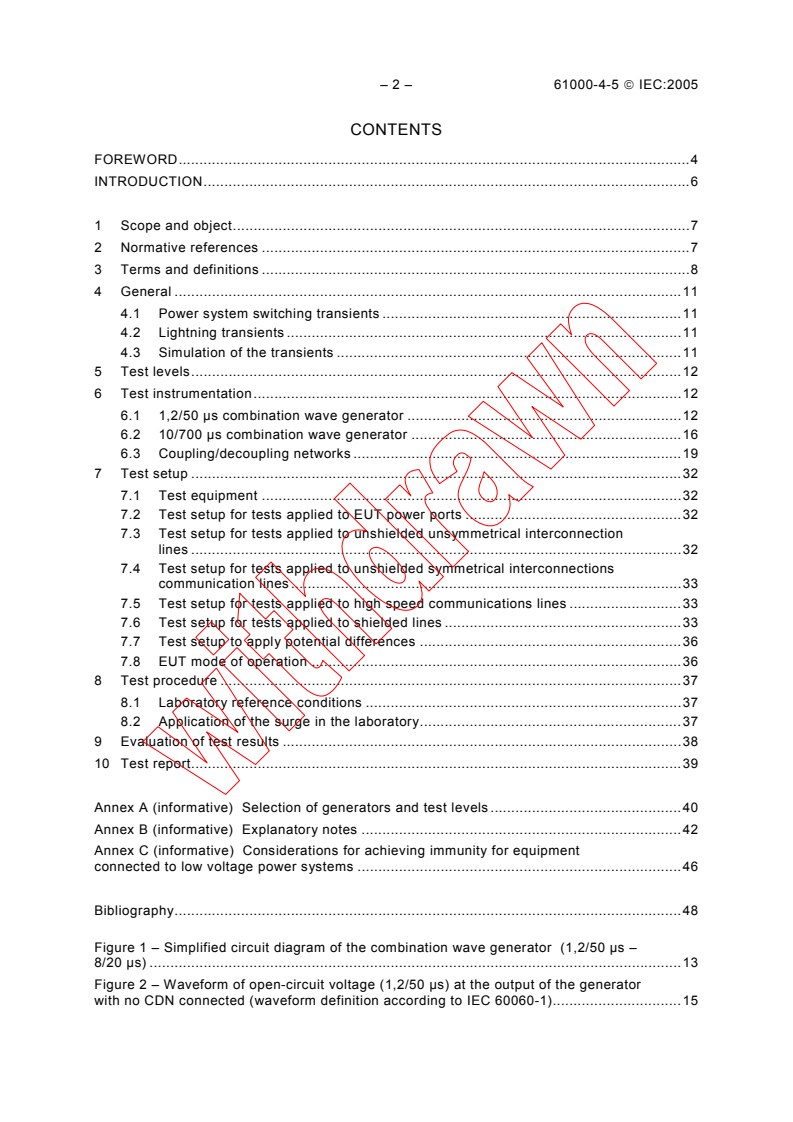
IEC 61000-4-5:2005 - Electromagnetic compatibility (EMC) - Part 4-5: Testing and measurement techniques - Surge immunity test Released:11/29/2005
Overview
IEC 61000-4-5:2005 is an international EMC (electromagnetic compatibility) standard that defines a reproducible laboratory surge immunity test method. It establishes common reference test levels, instrumentation and procedures to evaluate the immunity of electrical and electronic equipment to unidirectional surges caused by switching overvoltages and lightning transients. The standard is a basic EMC publication (IEC Guide 107) and is applicable across a wide range of equipment connected to power and signal lines.
Key topics and requirements
- Scope and objective: Defines immunity requirements and a consistent test method to assess equipment response to surge voltage/current transients. It explicitly excludes direct lightning-current injection and is not intended as an insulation withstand test.
- Test levels: Several defined surge severity levels relate to different environments and installation conditions so manufacturers and test labs can select appropriate levels for the Equipment Under Test (EUT).
- Waveforms: Specifies combination waveforms commonly used in surge testing (for example 1,2/50 µs open-circuit voltage and 8/20 µs short-circuit current; also 10/700 µs / 5/320 µs variants referenced to ITU K-series and IEC 60060-1 definitions).
- Test equipment: Requirements for combination wave generators and associated measurement instrumentation.
- Coupling/decoupling networks (CDNs): Detailed guidance on CDNs and coupling methods for applying surges to power ports, unshielded/symmetrical interconnection lines, high-speed communication lines and shielded cables.
- Test setups and procedures: Standardized configurations, laboratory reference conditions, EUT operation modes during testing, and criteria for evaluating and reporting test results.
- Documentation: Prescribed elements for the test report to ensure reproducibility and traceability.
Applications and users
IEC 61000-4-5 is used by:
- EMC test laboratories for formal surge immunity testing and certification.
- Product designers and compliance engineers to specify and verify immunity requirements during design and validation (power supplies, industrial control, communications equipment, consumer electronics, medical devices where applicable).
- Manufacturers seeking conformity to international EMC requirements and to select appropriate protection measures (surge arrestors, filtering, grounding, shielding).
- System integrators and utilities assessing equipment performance in environments exposed to switching and lightning-induced overvoltages.
Practical uses include pre-compliance testing, final product qualification, supplier verification, and comparative assessments of surge protection methods.
Related standards
- IEC 60060-1 (high-voltage test techniques) - waveform definitions.
- ITU K-series (for 10/700 µs waveforms).
- Other parts of IEC 61000 (Part 1, Part 2, Part 4 general testing methods) for broader EMC context.
Keywords: IEC 61000-4-5, surge immunity test, EMC, surge testing, combination wave generator, coupling/decoupling network, lightning transients, switching surges, test levels, EUT.
Relations
- Effective Date
- 25-Aug-2026
- Effective Date
- 25-Aug-2026
- Effective Date
- 25-Aug-2026
- Effective Date
- 05-Sep-2023
- Effective Date
- 05-Sep-2023
- Effective Date
- 05-Sep-2023
- Effective Date
- 05-Sep-2023
Buy Documents
IEC 61000-4-5:2005 - Electromagnetic compatibility (EMC) - Part 4-5: Testing and measurement techniques - Surge immunity test Released:11/29/2005
IEC 61000-4-5:2005 - Compatibilité électromagnétique (CEM) - Partie 4-5: Techniques d'essai et de mesure - Essai d'immunité aux ondes de choc Released:11/29/2005
IEC 61000-4-5:2005 - Electromagnetic compatibility (EMC) - Part 4-5: Testing and measurement techniques - Surge immunity test Released:11/29/2005
Get Certified
Connect with accredited certification bodies for this standard

ANCE
Mexican certification and testing association.

Intertek Slovenia
Intertek testing, inspection, and certification services in Slovenia.

LNE (Laboratoire National de Métrologie et d'Essais)
French national laboratory for metrology and testing.
Sponsored listings
Frequently Asked Questions
IEC 61000-4-5:2005 is a standard published by the International Electrotechnical Commission (IEC). Its full title is "Electromagnetic compatibility (EMC) - Part 4-5: Testing and measurement techniques - Surge immunity test". This standard covers: IEC 61000-4-5:2005 relates to the immunity requirements, test methods, and range of recommended test levels for equipment to unidirectional surges caused by overvoltages from switching and lightning transients. Several test levels are defined which relate to different environment and installation conditions. These requirements are developed for and are applicable to electrical and electronic equipment. The object of this standard is to establish a common reference for evaluating the immunity of electrical and electronic equipment when subjected to surges. The test method documented in this part of IEC 61000 describes a consistent method to assess the immunity of an equipment or system against a defined phenomenon. This standard defines: - a range of test levels; - test equipment; - test setups; - test procedures. The task of the described laboratory test is to find the reaction of the EUT under specified operational conditions, to surge voltages caused by switching and lightning effects at certain threat levels. It is not intended to test the capability of the EUT's insulation to withstand high-voltage stress. Direct injections of lightning currents, i.e, direct lightning strikes, are not considered in this standard. It has the status of a basic EMC publication in accordance with IEC Guide 107. The contents of the corrigendum of October 2009 have been included in this copy.
IEC 61000-4-5:2005 relates to the immunity requirements, test methods, and range of recommended test levels for equipment to unidirectional surges caused by overvoltages from switching and lightning transients. Several test levels are defined which relate to different environment and installation conditions. These requirements are developed for and are applicable to electrical and electronic equipment. The object of this standard is to establish a common reference for evaluating the immunity of electrical and electronic equipment when subjected to surges. The test method documented in this part of IEC 61000 describes a consistent method to assess the immunity of an equipment or system against a defined phenomenon. This standard defines: - a range of test levels; - test equipment; - test setups; - test procedures. The task of the described laboratory test is to find the reaction of the EUT under specified operational conditions, to surge voltages caused by switching and lightning effects at certain threat levels. It is not intended to test the capability of the EUT's insulation to withstand high-voltage stress. Direct injections of lightning currents, i.e, direct lightning strikes, are not considered in this standard. It has the status of a basic EMC publication in accordance with IEC Guide 107. The contents of the corrigendum of October 2009 have been included in this copy.
IEC 61000-4-5:2005 is classified under the following ICS (International Classification for Standards) categories: 33.100.20 - Immunity. The ICS classification helps identify the subject area and facilitates finding related standards.
IEC 61000-4-5:2005 has the following relationships with other standards: It is inter standard links to EN ISO 13856-2:2013, EN ISO 13856-1:2013, EN ISO 25197:2012, IEC 61000-4-5:2005/COR1:2009, IEC 61000-4-5:2014, IEC 61000-4-5:1995/AMD1:2000, IEC 61000-4-5:1995. Understanding these relationships helps ensure you are using the most current and applicable version of the standard.
IEC 61000-4-5:2005 is available in PDF format for immediate download after purchase. The document can be added to your cart and obtained through the secure checkout process. Digital delivery ensures instant access to the complete standard document.
Standards Content (Sample)
INTERNATIONAL IEC
STANDARD 61000-4-5
Second edition
2005-11
BASIC EMC PUBLICATION
Electromagnetic compatibility (EMC) –
Part 4-5:
Testing and measurement techniques –
Surge immunity test
This English-language version is derived from the original
bilingual publication by leaving out all French-language
pages. Missing page numbers correspond to the French-
language pages.
Reference number
Publication numbering
As from 1 January 1997 all IEC publications are issued with a designation in the
60000 series. For example, IEC 34-1 is now referred to as IEC 60034-1.
Consolidated editions
The IEC is now publishing consolidated versions of its publications. For example,
edition numbers 1.0, 1.1 and 1.2 refer, respectively, to the base publication, the
base publication incorporating amendment 1 and the base publication incorporating
amendments 1 and 2.
Further information on IEC publications
The technical content of IEC publications is kept under constant review by the IEC,
thus ensuring that the content reflects current technology. Information relating to
this publication, including its validity, is available in the IEC Catalogue of
publications (see below) in addition to new editions, amendments and corrigenda.
Information on the subjects under consideration and work in progress undertaken
by the technical committee which has prepared this publication, as well as the list
of publications issued, is also available from the following:
• IEC Web Site (www.iec.ch)
• Catalogue of IEC publications
The on-line catalogue on the IEC web site (www.iec.ch/searchpub) enables you to
search by a variety of criteria including text searches, technical committees
and date of publication. On-line information is also available on recently issued
publications, withdrawn and replaced publications, as well as corrigenda.
• IEC Just Published
This summary of recently issued publications (www.iec.ch/online_news/ justpub)
is also available by email. Please contact the Customer Service Centre (see
below) for further information.
• Customer Service Centre
If you have any questions regarding this publication or need further assistance,
please contact the Customer Service Centre:
Email: custserv@iec.ch
Tel: +41 22 919 02 11
Fax: +41 22 919 03 00
INTERNATIONAL IEC
STANDARD 61000-4-5
Second edition
2005-11
BASIC EMC PUBLICATION
Electromagnetic compatibility (EMC) –
Part 4-5:
Testing and measurement techniques –
Surge immunity test
IEC 2005 Copyright - all rights reserved
No part of this publication may be reproduced or utilized in any form or by any means, electronic or mechanical,
including photocopying and microfilm, without permission in writing from the publisher.
International Electrotechnical Commission, 3, rue de Varembé, PO Box 131, CH-1211 Geneva 20, Switzerland
Telephone: +41 22 919 02 11 Telefax: +41 22 919 03 00 E-mail: inmail@iec.ch Web: www.iec.ch
PRICE CODE
X
Commission Electrotechnique Internationale
International Electrotechnical Commission
МеждународнаяЭлектротехническаяКомиссия
For price, see current catalogue
61000-4-5 IEC:2005 – 3 –
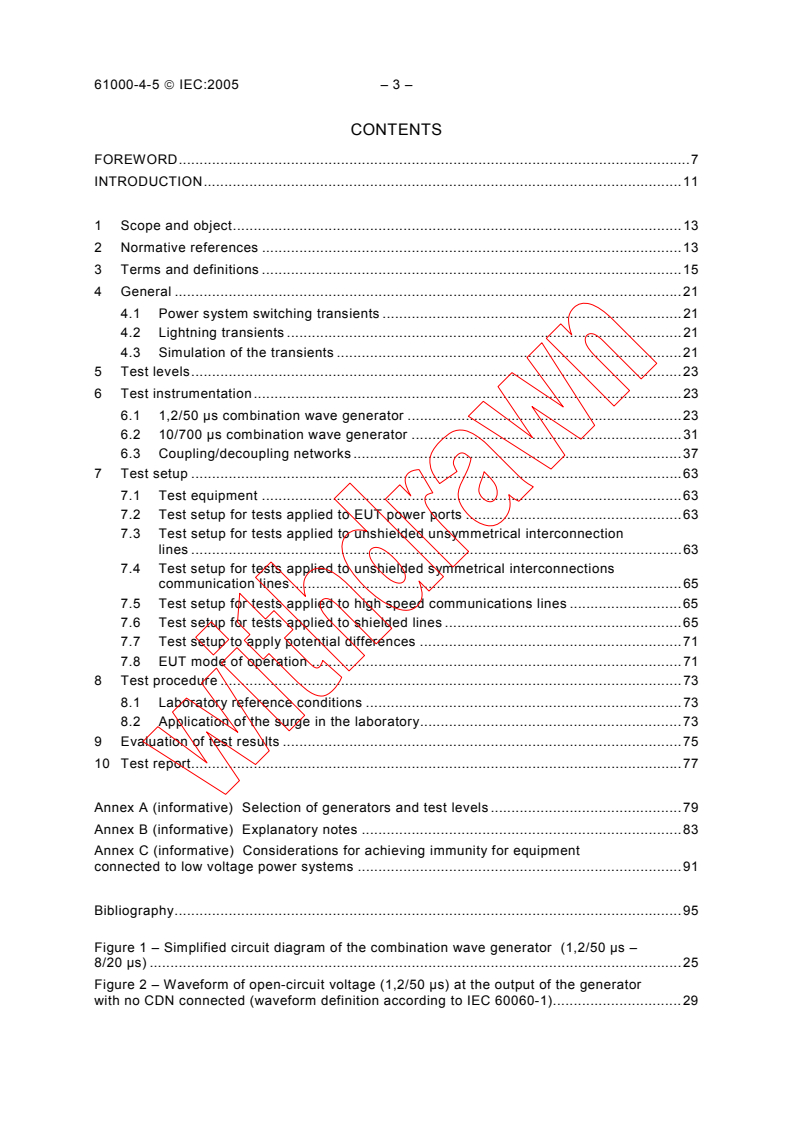
CONTENTS
FOREWORD.7
INTRODUCTION.11
1 Scope and object.13
2 Normative references .13
3 Terms and definitions .15
4 General .21
4.1 Power system switching transients .21
4.2 Lightning transients .21
4.3 Simulation of the transients .21
5 Test levels.23
6 Test instrumentation.23
6.1 1,2/50 µs combination wave generator .23
6.2 10/700 µs combination wave generator .31
6.3 Coupling/decoupling networks .37
7 Test setup .63
7.1 Test equipment .63
7.2 Test setup for tests applied to EUT power ports .63
7.3 Test setup for tests applied to unshielded unsymmetrical interconnection
lines .63
7.4 Test setup for tests applied to unshielded symmetrical interconnections
communication lines.65
7.5 Test setup for tests applied to high speed communications lines .65
7.6 Test setup for tests applied to shielded lines .65
7.7 Test setup to apply potential differences .71
7.8 EUT mode of operation .71
8 Test procedure .73
8.1 Laboratory reference conditions .73
8.2 Application of the surge in the laboratory.73
9 Evaluation of test results .75
10 Test report.77
Annex A (informative) Selection of generators and test levels .79
Annex B (informative) Explanatory notes .83
Annex C (informative) Considerations for achieving immunity for equipment
connected to low voltage power systems .91
Bibliography.95
Figure 1 – Simplified circuit diagram of the combination wave generator (1,2/50 µs –
8/20 µs) .25
Figure 2 – Waveform of open-circuit voltage (1,2/50 µs) at the output of the generator
with no CDN connected (waveform definition according to IEC 60060-1).29
61000-4-5 IEC:2005 – 5 –
Figure 3 – Waveform of short-circuit current (8/20 µs) at the output of the generator
with no CDN connected (waveform definition according to IEC 60060-1).29
Figure 4 – Simplified circuit diagram of the combination wave generator (10/700 µs –
5/320 µs) according to ITU K series standards.31
Figure 5 – Waveform of open-circuit voltage (10/700 µs) (waveform definition
according to IEC 60060-1) .33
Figure 6 – Waveform of the 5/320 µs short-circuit current waveform (definition
according to IEC 60060-1) .35
Figure 7 – Example of test setup for capacitive coupling on a.c./d.c. lines; line-to-line
coupling (according to 7.2).37
Figure 8 – Example of test setup for capacitive coupling on a.c./d.c. lines; line-to-
ground coupling (according to 7.2).39
Figure 9 – Example of test setup for capacitive coupling on a.c. lines (3 phases); line
L3 to line L1 coupling (according to 7.2) .41
Figure 10 – Example of test setup for capacitive coupling on a.c. lines (3 phases); line
L3 to ground coupling (according to 7.2) .43
Figure 11 – Example of test set up for unshielded unsymmetrical interconnection lines;
line-to-line and line-to-ground coupling (according to 7.3), coupling via capacitors .45
Figure 12 – Example of test setup for unshielded unsymmetrical interconnection lines;
line-to-line and line-to-ground coupling (according to 7.3), coupling via arrestors.47
Figure 13 – Example of test setup for unshielded unsymmetrical interconnection lines;
line-to-line and line-to-ground coupling (according to 7.3), coupling via a clamping
circuit.49
Figure 14 – Example of test setup for unshielded symmetrical interconnection lines
(communication lines); lines-to-ground coupling (according to 7.4), coupling via
arrestors .51
Figure 15 – Example of a coupling/decoupling network for symmetrical high speed
communication lines using the 1,2/50 µs surge .53
Figure 16 – Example of test setup for tests applied to shielded lines (according to 7.6)
and to apply potential differences (according to 7.7) .67
Figure 17 – Example of test setup for tests applied to shielded lines grounded only at
one end (according to 7.6) and to apply potential differences (according to 7.7) .69
Figure 18 – Coupling method and test setup for tests applied to shielded lines and to
apply potential differences, especially in configurations with multiple shielded cable
wiring.71
Table 1 – Test levels.23
Table 2 – Definitions of the waveform parameters 1,2/50 µs – 8/20 µs.27
Table 3 – Relationship between peak open-circuit voltage and peak short-circuit
current .27
Table 4 – Definitions of the waveform parameters 10/700 µs – 5/320 µs .35
Table 5 – Relationship between peak open-circuit voltage and peak short-circuit current.35
Table 6 – Voltage waveform specification at the EUT port of the coupling/decoupling
network.57
Table 7 – Current waveform specification at the EUT port of the coupling/decoupling
network.57
Table A.1 – Selection of the test levels (depending on the installation conditions) .81
61000-4-5 IEC:2005 – 7 –
COMMISSION ÉLECTROTECHNIQUE INTERNATIONALE
____________
ELECTROMAGNETIC COMPATIBILITY (EMC) –
Part 4-5 : Testing and measurement techniques –
Surge immunity test
FOREWORD
1) The International Electrotechnical Commission (IEC) is a worldwide organization for standardization comprising
all national electrotechnical committees (IEC National Committees). The object of IEC is to promote
international co-operation on all questions concerning standardization in the electrical and electronic fields. To
this end and in addition to other activities, IEC publishes International Standards, Technical Specifications,
Technical Reports, Publicly Available Specifications (PAS) and Guides (hereafter referred to as “IEC
Publication(s)”). Their preparation is entrusted to technical committees; any IEC National Committee interested
in the subject dealt with may participate in this preparatory work. International, governmental and non-
governmental organizations liaising with the IEC also participate in this preparation. IEC collaborates closely
with the International Organization for Standardization (ISO) in accordance with conditions determined by
agreement between the two organizations.
2) The formal decisions or agreements of IEC on technical matters express, as nearly as possible, an international
consensus of opinion on the relevant subjects since each technical committee has representation from all
interested IEC National Committees.
3) IEC Publications have the form of recommendations for international use and are accepted by IEC National
Committees in that sense. While all reasonable efforts are made to ensure that the technical content of IEC
Publications is accurate, IEC cannot be held responsible for the way in which they are used or for any
misinterpretation by any end user.
4) In order to promote international uniformity, IEC National Committees undertake to apply IEC Publications
transparently to the maximum extent possible in their national and regional publications. Any divergence
between any IEC Publication and the corresponding national or regional publication shall be clearly indicated in
the latter.
5) IEC provides no marking procedure to indicate its approval and cannot be rendered responsible for any
equipment declared to be in conformity with an IEC Publication.
6) All users should ensure that they have the latest edition of this publication.
7) No liability shall attach to IEC or its directors, employees, servants or agents including individual experts and
members of its technical committees and IEC National Committees for any personal injury, property damage or
other damage of any nature whatsoever, whether direct or indirect, or for costs (including legal fees) and
expenses arising out of the publication, use of, or reliance upon, this IEC Publication or any other IEC
Publications.
8) Attention is drawn to the Normative references cited in this publication. Use of the referenced publications is
indispensable for the correct application of this publication.
9) Attention is drawn to the possibility that some of the elements of this IEC Publication may be the subject of
patent rights. IEC shall not be held responsible for identifying any or all such patent rights.
International Standard IEC 61000-4-5 has been prepared by subcommittee 77B: High
frequency phenomena, of IEC technical Committee 77: Electromagnetic compatibility.
It forms Part 4-5 of IEC 61000. It has the status of a basic EMC publication in accordance
with IEC Guide 107, Electromagnetic compatibility – Guide to the drafting of electromagnetic
compatibility publications.
This second edition cancels and replaces the first edition published in 1995 and its
amendment 1 (2000), and constitutes a technical revision. Particularly, the clauses dedicated
to coupling/decoupling networks and to test setups are more detailed.
61000-4-5 IEC:2005 – 9 –
The text of this standard is based on the following documents:
FDIS Report on voting
77B/467/FDIS 77B/486/RVD
Full information on the voting for the approval of this standard can be found in the report on
voting indicated in the above table.
This publication has been drafted in accordance with the ISO/IEC Directives, Part 2.
The committee has decided that the contents of this publication will remain unchanged until
the maintenance result date indicated on the IEC web site under "http://webstore.iec.ch" in
the data related to the specific publication. At this date, the publication will be
• reconfirmed;
• withdrawn;
• replaced by a revised edition, or
• amended.
61000-4-5 IEC:2005 – 11 –
INTRODUCTION
IEC 61000 is published in separate parts according to the following structure:
Part 1: General
General considerations (introduction, fundamental principles)
Definitions, terminology
Part 2: Environment
Description of the environment
Classification of the environment
Compatibility levels
Part 3: Limits
Emission limits
Immunity limits (in so far as they do not fall under the responsibility of the product
committees)
Part 4: Testing and measurement techniques
Measurement techniques
Testing techniques
Part 5: Installation and mitigation guidelines
Installation guidelines
Mitigation methods and devices
Part 6: Generic standards
Part 9: Miscellaneous
Each part is further subdivided into several parts, published either as international standards
or as technical specifications or technical reports, some of which have already been published
as sections. Others will be published with the part number followed by a dash and a second
number identifying the subdivision (example: 61000-6-1).
This part is an International Standard which gives immunity requirements and test procedures
related to surge voltages and surge currents.
61000-4-5 IEC:2005 – 13 –
ELECTROMAGNETIC COMPATIBILITY (EMC) –
Part 4-5 : Testing and measurement techniques –
Surge immunity test
1 Scope and object
This part of IEC 61000 relates to the immunity requirements, test methods, and range of
recommended test levels for equipment to unidirectional surges caused by overvoltages from
switching and lightning transients. Several test levels are defined which relate to different
environment and installation conditions. These requirements are developed for and are
applicable to electrical and electronic equipment.
The object of this standard is to establish a common reference for evaluating the immunity of
electrical and electronic equipment when subjected to surges. The test method documented in
this part of IEC 61000 describes a consistent method to assess the immunity of an equipment
or system against a defined phenomenon.
NOTE As described in IEC Guide 107, this is a basic EMC publication for use by product committees of the IEC.
As also stated in Guide 107, the IEC product committees are responsible for determining whether this immunity
test standard should be applied or not, and if applied, they are responsible for determining the appropriate test
levels and performance criteria. TC 77 and its sub-committees are prepared to co-operate with product committees
in the evaluation of the value of particular immunity tests for their products.
This standard defines:
– a range of test levels;
– test equipment;
– test setups;
– test procedures.
The task of the described laboratory test is to find the reaction of the EUT under specified
operational conditions, to surge voltages caused by switching and lightning effects at certain
threat levels.
It is not intended to test the capability of the EUT's insulation to withstand high-voltage stress.
Direct injections of lightning currents, i.e, direct lightning strikes, are not considered in this
standard.
2 Normative references
The following referenced documents are indispensable for the application of this document.
For dated references, only the edition cited applies. For undated references, the latest edition
of the referenced document (including any amendments) applies.
IEC 60050(161), International Electrotechnical Vocabulary (IEV) – Chapter 161: Electro-
magnetic compatibility
61000-4-5 IEC:2005 – 15 –
IEC 60060-1, High-voltage test techniques – Part 1: General definitions and test requirements
IEC 60469-1, Pulse techniques and apparatus – Part 1: Pulse terms and definitions
3 Terms and definitions
For the purposes of this document, the terms and definitions in IEC 60050(161) and the
following apply.
3.1
avalanche device
diode, gas tube arrestor, or other component that is designed to break down and conduct at a
specified voltage
3.2
calibration
set of operations which establishes, by reference to standards, the relationship which exists,
under specified conditions, between an indication and a result of a measurement
[IEV 311-01-09]
NOTE 1 This term is based on the "uncertainty" approach.
NOTE 2 The relationship between the indications and the results of measurement can be expressed, in principle,
by a calibration diagram.
3.3
clamping device
diode, varistor or other component that is designed to prevent an applied voltage from
exceeding a specified value
3.4
combination wave generator
generator with 1,2/50 µs or 10/700 µs open-circuit voltage waveform and respectively 8/20 µs
or 5/320 µs short-circuit current waveform
3.5
coupling network
electrical circuit for the purpose of transferring energy from one circuit to another
3.6
decoupling network
electrical circuit for the purpose of preventing surges applied to the EUT from affecting other
devices, equipment or systems which are not under test
3.7
duration
absolute value of the interval during which a specified waveform or feature exists or continues
[IEC 60469-1]
61000-4-5 IEC:2005 – 17 –
3.8
effective output impedance (of a surge generator)
ratio of the peak open-circuit voltage to the peak short-circuit current
3.9
electrical installation
assembly of associated electrical equipment having co-ordinated characteristics to fulfil
purposes
[IEV 826-10-01]
3.10
EUT
equipment under test
3.11
front time
surge voltage
the front time T of a surge voltage is a virtual parameter defined as 1,67 times the interval T
between the instants when the impulse is 30 % and 90 % of the peak value (see Figures 2
and 5)
surge current
the front time T of a surge current is a virtual parameter defined as 1,25 times the interval T
between the instants when the impulse is 10 % and 90 % of the peak value (see Figures 3
and 6)
[IEC 60060-1, 24.3 modified]
3.12
ground (reference)
part of the Earth considered as conductive, the electrical potential of which is conventionally
taken as zero, being outside the zone of influence of any earthing (grounding) arrangement
[IEV 195-01-01]
3.13
high-speed communication lines
input/output lines which operate at transmission frequencies above 100 kHz
3.14
immunity
ability of a device, equipment or system to perform without degradation in the presence of an
electromagnetic disturbance
[IEV 161-01 -20]
3.15
interconnection lines
I/O lines (input/output lines) and communication lines
3.16
primary protection
means by which the majority of stressful energy is prevented from propagating beyond a
designated interface
61000-4-5 IEC:2005 – 19 –
3.17
rise time
interval of time between the instants at which the instantaneous value of a pulse first reaches
the specified lower and upper limits.
[IEV 161-02-05]
NOTE Unless otherwise specified, the lower and upper values are fixed at 10 % and 90 % of the pulse magnitude.
3.18
secondary protection
means by which the let-through energy from primary protection is suppressed. It may be a
special device or an inherent characteristic of the EUT
3.19
surge
transient wave of electrical current, voltage, or power propagating along a line or a circuit and
characterized by a rapid increase followed by a slower decrease
[IEV 161-08-11 modified]
3.20
symmetrical lines
pair of symmetrically driven conductors with a conversion loss from differential to common
mode of greater than 20 dB
3.21
system
set of interdependent elements constituted to achieve a given objective by performing a
specified function
[IEV 351-11-01 modified]
NOTE The system is considered to be separated from the environment and other external systems by an
imaginary surface which cuts the links between them and the considered system. Through these links, the system
is affected by the environment, is acted upon by the external systems, or acts itself on the environment or the
external systems.
3.22
time to half-value
T
interval of time between the instant of virtual origin O and the instant when the voltage or
current has decreased to half the peak value
[IEC 60060-1, 18.1.6 modified]
NOTE The time to half-value T of a surge is a virtual parameter.
3.23
transient
pertaining to or designating a phenomenon or a quantity which varies between two
consecutive steady states during a time interval short compared to the time scale of interest
[IEV 161-02-01]
3.24
verification
set of operations which is used to check the test equipment system (e.g. the test generator
and the interconnecting cables) to demonstrate that the test system is functioning within the
specifications given in Clause 6
61000-4-5 IEC:2005 – 21 –
NOTE 1 The methods used for verification may be different from those used for calibration.
NOTE 2 The procedure of 6.1.2 and 6.2.2 is meant to ensure the correct operation of the test generator, and
other items making up the test setup so that the intended waveform is delivered to the EUT.
NOTE 3 For the purposes of this basic EMC standard this definition is different of the definition given in IEV 311-
01-13.
3.25
virtual Origin
O
for the surge voltage waveform, it is the instant at which a straight line drawn through the
30 % and 90 % amplitude values crosses the time axis. For the surge current waveform, it is
the instant at which a straight line drawn through the 10 % and 90 % amplitude values
crosses the time axis
4 General
4.1 Power system switching transients
Power system switching transients can be separated into transients associated with
a) major power system switching disturbances, such as capacitor bank switching;
b) minor local switching activity or load changes in the power distribution system;
c) resonating circuits associated with switching devices, such as thyristors;
d) various system faults, such as short circuits and arcing faults to the grounding system of
the installation.
4.2 Lightning transients
The major mechanisms by which lightning produces surge voltages are the following:
a) direct lightning stroke to an external (outdoor) circuit injecting high currents producing
voltages by either flowing through ground resistance or flowing through the impedance of
the external circuit;
b) an indirect lightning stroke (i.e. a stroke between or within clouds or to nearby objects
which produces electromagnetic fields) that induces voltages/currents on the conductors
outside and/or inside a building;
c) lightning ground current flow resulting from nearby direct-to-earth discharges coupling into
the common ground paths of the grounding system of the installation.
The rapid change of voltage and flow of current which can occur as a result of the operation
of a lightning protection device can induce electromagnetic disturbances into adjacent
equipment.
4.3 Simulation of the transients
The characteristics of the test generator are such that it simulates the above-mentioned
phenomena as closely as possible.
If the source of interference is in the same circuit, for example in the power supply network
(direct coupling), the generator may simulate a low impedance source at the ports of the
equipment under test.
61000-4-5 IEC:2005 – 23 –
If the source of interference is not in the same circuit as the victim equipment (indirect
coupling), then the generator may simulate a higher impedance source.
5 Test levels
The preferred range of test levels is given in Table 1.
Table 1 – Test levels
Open-circuit test voltage ±10 %
Level
kV
1 0,5
2 1,0
3 2,0
4 4,0
X Special
NOTE X can be any level, above, below or in between the other levels. This
level can be specified in the product standard.
The test levels shall be selected according to the installation conditions; classes of installation
are given in Clause B.3.
All voltages of the lower test levels shall be satisfied (see 8.2).
For selection of the test levels for the different interfaces, refer to Annex A.
6 Test instrumentation
Two types of combination wave generator are specified. Each has its own particular
applications, depending on the type of port to be tested (see Clause 7). The 10/700 µs
combination wave generator is used to test ports intended for connection to symmetrical
communication lines. The 1,2/50 µs combination wave generator is used in all other cases,
and in particular, for testing ports intended for power lines and short-distance signal
connections.
6.1 1,2/50 µs combination wave generator
It is the intention of this standard that the output waveforms meet specifications at the point
where they are to be applied to the EUT. Waveforms are specified as open-circuit voltage and
short-circuit current and therefore are measured without the EUT connected. In the case of an
a.c. or d.c. powered product where the surge is applied to the a.c. or d.c. supply lines, the
output must be as specified in Tables 6 and 7. In the case where the surge is to be applied
directly from the generator output terminals, the waveforms shall be as specified in Table 2. It
is not intended that the waveforms meet specifications both at the generator output and at the
output of coupling/decoupling networks simultaneously, but only as applied to the EUT. The
waveform specifications are to be met without an EUT connected.
This generator is intended to generate a surge having: an open-circuit voltage front time of
1,2 µs; an open-circuit voltage time to half value of 50 µs; a short-circuit current front time of
8 µs; and a short-circuit current time to half value of 20 µs.
61000-4-5 IEC:2005 – 25 –
A simplified circuit diagram of the generator is given in Figure 1. The values for the different
components R , R , R , L , and C are selected so that the generator delivers a 1,2/50 µs
S1 S2 m r c
voltage surge (at open-circuit conditions) and a 8/20 µs current surge into a short circuit.
R R L
c m r
U R R
C s1 s2
c
IEC 2322/05
U High-voltage source
R Charging resistor
c
C Energy storage capacitor
c
R Pulse duration shaping resistors
s
R Impedance matching resistor
m
L Rise time shaping inductor
r
Figure 1 – Simplified circuit diagram of the combination wave generator
(1,2/50 µs – 8/20 µs)
For convenience, the ratio of peak open-circuit output voltage to peak short-circuit current of a
combination wave generator may be considered the effective output impedance. For this
generator, the ratio defines an effective output impedance of 2 Ω.
NOTE The waveform of the voltage and current is a function of the EUT input impedance. This impedance may
change during surges to equipment due either to proper operation of the installed protection devices, or to flash
over or component breakdown if the protection devices are absent or inoperative. Therefore, the 1,2/50 µs voltage
and the 8/20 µs current waves have to be available from the same generator output as required by the load.
6.1.1 Characteristics and performance of the generator
Polarity positive and negative
Phase shifting in a range between 0° to 360° relative to the
phase angle of the a.c. line voltage to the
equipment under test, with a tolerance of ±10°
Repetition rate 1 per minute or faster
Open-circuit peak output voltage adjustable from 0,5 kV to the required test
level
Waveform of the surge voltage see Table 2 and Figure 2
Output voltage setting tolerance see Table 3
Short-circuit peak output current depends on peak voltage setting (see Tables 2
and 3)
Waveform of the surge current see Table 2 and Figure 3
Short-circuit output current tolerance see Table 3
Effective output impedance 2 Ω ± 10 %
61000-4-5 IEC:2005 – 27 –
Table 2 – Definitions of the waveform parameters 1,2/50 µs – 8/20 µs
In accordance with IEC 60060-1 In accordance with IEC 60469-1
Definitions
Rise time Duration time
Front time Time to half value
(10 % – 90 %) (50 % – 50 %)
µs µs
µs µs
Open-circuit
1,2 ± 30 % 50 ± 20 % 1 ± 30 % 50 ± 20 %
voltage
Short-circuit
8 ± 20 % 20 ± 20 % 6,4 ± 20 % 16 ± 20 %
current
NOTE In existing IEC publications, the waveforms 1,2/50 µs and 8/20 µs are generally defined according to
IEC 60060-1 as shown in Figures 2 and 3. Other IEC recommendations are based on waveform definitions
according to IEC 60469-1 as shown in Table 2.
Both definitions are valid for this part of IEC 61000 and describe just one single generator.
Table 3 – Relationship between peak open-circuit voltage and peak short-circuit current
Open-circuit peak voltage ±10 % Short-circuit peak current ±10 %
0,5 kV 0,25 kA
1,0 kV 0,5 kA
2,0 kV 1,0 kA
4,0 kV 2,0 kA
The peak short-circuit current shall be as shown in Table 3 when the peak open circuit voltage
is as specified.
A generator with floating output shall be used.
61000-4-5 IEC:2005 – 29 –
U
1,0
B
0,9
0,5
T
0,3 A
0,1
0,0
t
O T
30 % max.
T
IEC 2323/05
Front time: T = 1,67 × T = 1,2 µs ± 30 %
Time to half-value: T = 50 µs ± 20 %.
NOTE The open circuit voltage waveform at the output of the coupling/decoupling network may have a
considerable undershoot, in principle as the curve shown in Figure 3.
Figure 2 – Waveform of open-circuit voltage (1,2/50 µs) at the output of the generator
with no CDN connected (waveform definition according to IEC 60060-1)
I
1,0
B
0,9
0,5
T
0,1
C
0,0
t
O
1 T
30 % max.
T
IEC 2324/05
Front time: T = 1,25 × T = 8 µs ± 20 %
Time to half-value: T = 20 µs ± 20 %
NOTE The 30 % undershoot specification applies only at the generator output. At the output of the
coupling/decoupling network there is no limitation on undershoot or overshoot.
Figure 3 – Waveform of short-circuit current (8/20 µs) at the output of the generator with
no CDN connected (waveform definition according to IEC 60060-1)
61000-4-5 IEC:2005 – 31 –
6.1.2 Calibration of the generator
In order to compare the test results from different generators, the generator shall be
calibrated periodically. For this purpose, the following procedure is necessary to measure the
most essential characteristics of the generator.
The generator output shall be connected to a measuring system with a sufficient bandwidth
and voltage capability to monitor the characteristics of the waveforms.
The characteristics of the generator shall be measured under open-circuit conditions (load
greater than or equal to 10 kΩ) and under short-circuit conditions (load smaller than or equal
to 0,1 Ω) at the same charge voltage.
All waveform definitions as well as the performance parameters stated in 6.1.1 and 6.1.2
respectively shall be met at the output of the generator.
NOTE 1 When an additional internal or external resistor is added to the generator output to increase the effective
source impedance from 2 Ω to e.g. 42 Ω according to the requirements of the test setup, the front time and the time
to half value of test pulses at the output of the coupling network may be significantly changed.
NOTE 2 The characteristics of the combination wave generator in this clause can be used for verification.
6.2 10/700 µs combination wave generator
This generator is intended to generate a surge having: an open-circuit voltage front time of
10 µs; and an open-circuit voltage time to half value of 700 µs.
The simplified circuit diagram of the generator is given in Figure 4. The values for the different
components are selected so that the generator delivers a 10/700 µs surge.
S
R
R
R m2
c m1
U R
C C
c s s
IEC 2325/05
U High-voltage source
R Charging resistor
c
C Energy storage capacitor
c
R Pulse duration shaping resistor
s
R Impedance matching resistors
m
C Rise time shaping capacitor
s
S Switch closed when using external matching resistors
Figure 4 – Simplified circuit diagram of the combination wave generator
(10/700 µs – 5/320 µs) according to ITU K series standards
61000-4-5 IEC:2005 – 33 –
6.2.1 Characteristics and performances of the generator
Polarity positive and negative
Repetition rate 1 per minute or faster
Open-circuit peak output voltage adjustable from 0,5 kV to the required
test level
Waveform of the surge voltage see Table 4 and Figure 5
Output voltage setting tolerance see Table 5
Short-circuit peak output current depends on peak voltage setting (see
Tables 4 and 5)
Short-circuit output current tolerance see Table 5
Effective output impedance 40 Ω ± 10 % for generator output only.
NOTE The effective output impedance typically consists of internal 15 Ω (Rm1) and 25 Ω (Rm2) resistors. The
Rm2 resistors may be bypassed, paralleled or shorted and replaced with external coupling resistors when used for
multiple coupling – see Figure 14.
U
1,0
B
0,9
0,5
T
A
0,3
0,1
0,0
O T t
T IEC 2326/05
Front time: T = 1,67 × T = 10 µs ± 30 %
Time to half-value: T = 700 µs ± 20 %.
Figure 5 – Waveform of open-circuit voltage (10/700 µs)
(waveform definition according to IEC 60060-1)
61000-4-5 IEC:2005 – 35 –
I/I
max
1,0
0,9
T
0,5
0,1
0,0
t
O T
T
IEC 2327/05
Front time: T = 1,25 × T = 5 µs ± 20 %
Time to half-value: T = 320 µs ± 20 %.
NOTE In IEC 60060-1 the specification of the waveform is defined as 5/320 µs, while in IEC 60469-1 it is defined
as 4/300 µs. Moreover this waveform is measured with the switch S1 in Figure 4 opened.
Figure 6 – Waveform of the 5/320 µs short-circuit current waveform
(definition according to IEC 60060-1)
Table 4 – Definitions of the waveform parameters 10/700 µs – 5/320 µs
In accordance with ITU-T K series In accordance with
and IEC 60060-1 IEC 60469-1
Definitions Front time Time to half-value Rise time Duration time
(10 % – 90 %) (50 % – 50 %)
µs µs µs µs
Open-circuit voltage 10 ± 30 % 700 ± 20 % 6,5 ± 30 % 700 ± 20 %
Short-circuit current 5 ± 20 % 320 ± 20 % 4 ± 20 % 300 ± 20 %
NOTE In existing IEC and ITU-T publications, the waveform 10/700 µs is generally defined according to
IEC 60060-1 as shown in Figures 5 and 6. Other IEC recommendations are based on waveform definitions
according to IEC 60469-1 as shown in Table 4.
Both definitions are valid for this section of IEC 61000-4 and describe just one single generator.
Table 5 – Relationship between peak open-circuit voltage and peak short-circuit current
Open-circuit peak voltage ±10 % Short-circuit peak current ±10 %
0,5 kV 12,5 A
1,0 kV 25 A
2,0 kV 50 A
4,0 kV 100 A
NOTE The short-circuit peak current is measured with switch S1 of Figure 4 open.
61000-4-5 IEC:2005 – 37 –
The peak short-circuit current shall be as shown in Table 5 when the peak open-circuit
voltage is as specified.
6.2.2 Calibration of the generator
In order to compare the test results from different generators, the generator shall be
calibrated periodically. For this purpose, the following procedure is necessary to measure the
most essential characteristics of the generator.
The generator output shall be connected to a measuring system with a sufficient bandwidth
and voltage capability to monitor the characteristics of the waveforms.
The characteristics of the generator shall be measured under open-circuit conditions (load
greater than or equal to 10 kΩ) and under short-circuit conditions (load smaller than or equal
to 0,1 Ω) at the same charge voltage.
All waveform definitions as well as the performance parameters stated in 6.2.1 and 6.2.2
respectively shall be met at the output of the generator.
NOTE The characteristics of the combination wave generator in this clause can be used for verification.
6.3 Coupling/decoupling networks
Each coupling/decoupling network (CDN) consists of a decoupling network and a coupling
element as shown in the examples of Figures 7 through 15.
Combination wave
generator
Decoupling network
C = 18 µF
L
L
AC (DC)
power supply
N EUT
network
PE
Earth reference
IEC 2328/05
Figure 7 – Example of test setup for capacitive coupling on a.c./d.c. lines;
line-to-line coupling (according to 7.2)
61000-4-5 IEC:2005 – 39 –
Combination wave
generator
R = 10 Ω
C = 9 µF
Decoupling network
L
L
AC (DC)
power supply
N EUT
network
PE
Earth reference
IEC 2329/05
Figure 8 – Example of test setup for capacitive coupling on a.c./d.c. lines;
line-to-ground coupling (according to 7.2)
61000-4-5 IEC:2005 – 41 –
Combination wave
generator
C = 18 µF
S2
23 4
S1
Decoupling network
L
L1
L2
AC
power supply
L3
EUT
network
N
PE
Earth reference
IEC 2330/05
Figure 9 – Example of test setup for capacitive coupling on a.c. lines (3 phases);
line L3 to line L1 coupling (according to 7.2)
61000-4-5 IEC:2005 – 43 –
Combination wave
generator
R = 10 Ω
C = 9 µF
S2
1 23 4
Decoupling network
L
L1
L2
AC
power supply
L3 EUT
network
N
PE
Earth reference
IEC 2331/05
Switch S2 is used to select individual lines for test.
Figure 10 – Example of test setup for capacitive coupling on a.c. lines (3 phases);
line L3 to ground coupling (according to 7.2)
61000-4-5 IEC:2005 – 45 –
Combination wave
generator
R = 40 Ω
C = 0,5 µF
S2
1 23 4
S1
Auxiliary Protection 4
Decoupling network
equipment equipment
R
L
L
EUT
Earth reference
IEC 2332/05
1) Switch S1
- line to ground: position 0
- line to line: positions 1 to 4
2) Switch S2
- during the test positions 1 to 4, but not in the same position with switch S1
3) L = 20 mH, R represents the resistive part of L
L
Figure 11 – Example of test set up for unshielded unsymmetrical interconnection lines;
...
NORME CEI
INTERNATIONALE 61000-4-5
Deuxième édition
2005-11
PUBLICATION FONDAMENTALE EN CEM
Compatibilité électromagnétique (CEM) –
Partie 4-5:
Techniques d'essai et de mesure –
Essai d’immunité aux ondes de choc
Cette version française découle de la publication d’origine
bilingue dont les pages anglaises ont été supprimées.
Les numéros de page manquants sont ceux des pages
supprimées.
Numéro de référence
CEI 61000-4-5:2005(F)
Numérotation des publications
Depuis le 1er janvier 1997, les publications de la CEI sont numérotées à partir de
60000. Ainsi, la CEI 34-1 devient la CEI 60034-1.
Editions consolidées
Les versions consolidées de certaines publications de la CEI incorporant les
amendements sont disponibles. Par exemple, les numéros d’édition 1.0, 1.1 et 1.2
indiquent respectivement la publication de base, la publication de base incorporant
l’amendement 1, et la publication de base incorporant les amendements 1 et 2
Informations supplémentaires sur les publications de la CEI
Le contenu technique des publications de la CEI est constamment revu par la CEI
afin qu'il reflète l'état actuel de la technique. Des renseignements relatifs à cette
publication, y compris sa validité, sont disponibles dans le Catalogue des
publications de la CEI (voir ci-dessous) en plus des nouvelles éditions, amende-
ments et corrigenda. Des informations sur les sujets à l’étude et l’avancement des
travaux entrepris par le comité d’études qui a élaboré cette publication, ainsi que la
liste des publications parues, sont également disponibles par l’intermédiaire de:
• Site web de la CEI (www.iec.ch)
• Catalogue des publications de la CEI
Le catalogue en ligne sur le site web de la CEI (www.iec.ch/searchpub) vous permet
de faire des recherches en utilisant de nombreux critères, comprenant des
recherches textuelles, par comité d’études ou date de publication. Des informations
en ligne sont également disponibles sur les nouvelles publications, les publications
remplacées ou retirées, ainsi que sur les corrigenda.
• IEC Just Published
Ce résumé des dernières publications parues (www.iec.ch/online_news/justpub)
est aussi disponible par courrier électronique. Veuillez prendre contact avec le
Service client (voir ci-dessous) pour plus d’informations.
• Service clients
Si vous avez des questions au sujet de cette publication ou avez besoin de
renseignements supplémentaires, prenez contact avec le Service clients:
Email: custserv@iec.ch
Tél: +41 22 919 02 11
Fax: +41 22 919 03 00
NORME CEI
INTERNATIONALE 61000-4-5
Deuxième édition
2005-11
PUBLICATION FONDAMENTALE EN CEM
Compatibilité électromagnétique (CEM) –
Partie 4-5:
Techniques d'essai et de mesure –
Essai d’immunité aux ondes de choc
IEC 2005 Droits de reproduction réservés
Aucune partie de cette publication ne peut être reproduite ni utilisée sous quelque forme que ce soit et par aucun
procédé, électronique ou mécanique, y compris la photocopie et les microfilms, sans l'accord écrit de l'éditeur.
International Electrotechnical Commission, 3, rue de Varembé, PO Box 131, CH-1211 Geneva 20, Switzerland
Telephone: +41 22 919 02 11 Telefax: +41 22 919 03 00 E-mail: inmail@iec.ch Web: www.iec.ch
CODE PRIX
X
Commission Electrotechnique Internationale
International Electrotechnical Commission
МеждународнаяЭлектротехническаяКомиссия
Pour prix, voir catalogue en vigueur
– 2 – 61000-4-5 CEI:2005
SOMMAIRE
AVANT-PROPOS.6
INTRODUCTION.10
1 Domaine d'application et objet.12
2 Références normatives.12
3 Termes et définitions .14
4 Généralités.20
4.1 Transitoires de manœuvre sur les réseaux électriques .20
4.2 Transitoires de foudre .20
4.3 Simulation des transitoires .20
5 Niveaux d'essai .22
6 Instrumentation d'essai.22
6.1 Générateur d'ondes combinées 1,2/50 µs.22
6.2 Générateur d'ondes combinées 10/700 µs.30
6.3 Réseaux de couplage/découplage .36
7 Montage d'essai .62
7.1 Matériel d'essai .62
7.2 Montage d'essai pour les essais pratiqués sur les accès alimentation de
l'EST .62
7.3 Montage d'essai pour les essais pratiqués sur les lignes d'interconnexion
non symétriques et non blindées .62
7.4 Montage d'essai pour les essais pratiqués sur les lignes d'interconnexion ou
de télécommunications symétriques non blindées .64
7.5 Montage d'essai pour les essais pratiqués sur les lignes de communications
à grande vitesse.64
7.6 Montage d'essai pour les essais pratiqués sur les lignes blindées .64
7.7 Montage d'essai pour l'application de différences de potentiel.70
7.8 Mode de fonctionnement de l'EST .70
8 Procédure d'essai.72
8.1 Conditions de référence en laboratoire .72
8.2 Application de l'onde de choc en laboratoire.72
9 Evaluation des résultats d’essai .74
10 Rapport d’essai .76
Annexe A (informative) Choix des générateurs et des niveaux d'essai .78
Annexe B (informative) Notes explicatives .82
Annexe C (informative) Considérations en vue d'obtenir l'immunité pour les
équipements connectés aux systèmes d'alimentation à basse tension.90
Bibliographie.94
Figure 1 – Schéma de principe du circuit du générateur d'ondes combinées
(1,2/50 µs – 8/20 µs) .24
Figure 2 – Forme d'onde de tension en circuit ouvert (1,2/50 µs) en sortie du générateur
sans RCD connecté (définition de la forme d'onde selon la CEI 60060-1) .28
– 4 – 61000-4-5 CEI:2005
Figure 3 – Forme d'onde en courant de court-circuit (8/20 µs) en sortie du générateur
sans RCD connecté (définition de la forme d'onde selon la CEI 60060-1) .28
Figure 4 – Schéma de principe du circuit du générateur d'ondes combinées (10/700 µs
– 5/320 µs) conformément aux normes de la série K de l'UIT .30
Figure 5 – Forme d'onde de tension en circuit ouvert (10/700 µs) (définition de la forme
d'onde selon la CEI 60060-1) .32
Figure 6 – Forme d'onde de courant de court-circuit 5/320 µs (définition selon la
CEI 60060-1).34
Figure 7 – Exemple de montage d'essai de ligne à couplage capacitif sur lignes à
c.a./c.c.; couplage entre fils (conformément à 7.2).36
Figure 8 – Exemple de montage d'essai de ligne à couplage capacitif sur lignes à
c.a./c.c.; couplage entre un fil et la terre (conformément à 7.2.38
Figure 9 – Exemple de montage d'essai à couplage capacitif sur lignes à c.a.
(triphasé); couplage entre la phase L3 et la phase L1 (conformément à 7.2) .40
Figure 10 – Exemple de montage d'essai à couplage capacitif sur lignes à c.a.
(triphasé); couplage entre la phase L3 et la terre (conformément à 7.2) .42
Figure 11 – Exemple de montage d'essai pour lignes d'interconnexion non blindées;
couplage entre fils de ligne ou entre un fil et la terre (conformément à 7.3),
couplage par condensateurs.44
Figure 12 – Exemple de montage d'essai pour lignes d'interconnexion non symétriques
et non blindées; couplage entre fils de ligne ou entre un fil et la terre
(conformément à 7.3), couplage par parafoudres.46
Figure 13 – Exemple de montage d'essai pour lignes d'interconnexion non symétriques
et non blindées; couplage entre fils de ligne ou entre un fil et la terre
(conformément à 7.3), couplage par circuit de clampage .48
Figure 14 – Exemple de montage d'essai pour lignes non blindées utilisées de façon
symétrique (lignes de communications); couplage entre fils de ligne et la terre
(conformément à 7.4), couplage par parafoudres.50
Figure 15 – Exemple de réseau de couplage/découplage pour lignes de
communications symétriques à grande vitesse utilisant l'onde de choc 1,2/50 µs .52
Figure 16 – Exemple de montage d'essai pour les essais pratiqués sur les lignes
blindées (conformément à 7.6) et pour appliquer des différences de potentiel
(conformément à 7.7) .66
Figure 17 – Exemple de montage d'essai pour les essais pratiqués sur les lignes
blindées mises à la terre à une seule extrémité (conformément à 7.6) et pour
appliquer les différences de potentiel (conformément à 7.7) .68
Figure 18 – Méthode de couplage et installation d'essai pour essais appliqués aux
lignes blindées et pour appliquer les différences de potentiel, spécialement dans
des configurations avec câblage par câbles blindés multiples.70
Tableau 1 – Niveaux d'essai .22
Tableau 2 – Définitions des paramètres des formes d'ondes 1,2/50 µs – 8/20 µs .26
Tableau 3 – Relations entre tension de crête en circuit ouvert et courant crête de
court-circuit .26
Tableau 4 – Définitions des paramètres des formes d'ondes 10/700 µs – 5/320 µs .34
Tableau 5 – Relations entre tension de crête en circuit ouvert et courant crête de
court-circuit .34
Tableau 6 – Spécification de la forme d'onde de la tension à l'accès EST du réseau de
couplage/découplage.56
Tableau 7– Spécification de la forme d'onde du courant du réseau de
couplage/découplage.56
Tableau A.1 – Choix des niveaux d'essai (en fonction des conditions d'installation).80
– 6 – 61000-4-5 CEI:2005
COMMISSION ÉLECTROTECHNIQUE INTERNATIONALE
___________
COMPATIBILITÉ ÉLECTROMAGNÉTIQUE (CEM) –
Partie 4-5: Techniques d'essai et de mesure –
Essai d'immunité aux ondes de choc
AVANT-PROPOS
1) La Commission Electrotechnique Internationale (CEI) est une organisation mondiale de normalisation
composée de l'ensemble des comités électrotechniques nationaux (Comités nationaux de la CEI). La CEI a
pour objet de favoriser la coopération internationale pour toutes les questions de normalisation dans les
domaines de l'électricité et de l'électronique. A cet effet, la CEI – entre autres activités – publie des Normes
internationales, des Spécifications techniques, des Rapports techniques, des Spécifications accessibles au
public (PAS) et des Guides (ci-après dénommés "Publication(s) de la CEI"). Leur élaboration est confiée à des
comités d'études, aux travaux desquels tout Comité national intéressé par le sujet traité peut participer. Les
organisations internationales, gouvernementales et non gouvernementales, en liaison avec la CEI, participent
également aux travaux. La CEI collabore étroitement avec l'Organisation Internationale de Normalisation (ISO),
selon des conditions fixées par accord entre les deux organisations.
2) Les décisions ou accords officiels de la CEI concernant les questions techniques représentent, dans la mesure
du possible, un accord international sur les sujets étudiés, étant donné que les Comités nationaux de la CEI
intéressés sont représentés dans chaque comité d’études.
3) Les Publications de la CEI se présentent sous la forme de recommandations internationales et sont agréées
comme telles par les Comités nationaux de la CEI. Tous les efforts raisonnables sont entrepris afin que la CEI
s'assure de l'exactitude du contenu technique de ses publications; la CEI ne peut pas être tenue responsable
de l'éventuelle mauvaise utilisation ou interprétation qui en est faite par un quelconque utilisateur final.
4) Dans le but d'encourager l'uniformité internationale, les Comités nationaux de la CEI s'engagent, dans toute la
mesure possible, à appliquer de façon transparente les Publications de la CEI dans leurs publications
nationales et régionales. Toutes divergences entre toutes Publications de la CEI et toutes publications
nationales ou régionales correspondantes doivent être indiquées en termes clairs dans ces dernières.
5) La CEI n’a prévu aucune procédure de marquage valant indication d’approbation et n'engage pas sa
responsabilité pour les équipements déclarés conformes à une de ses Publications.
6) Tous les utilisateurs doivent s'assurer qu'ils sont en possession de la dernière édition de cette publication.
7) Aucune responsabilité ne doit être imputée à la CEI, à ses administrateurs, employés, auxiliaires ou
mandataires, y compris ses experts particuliers et les membres de ses comités d'études et des Comités
nationaux de la CEI, pour tout préjudice causé en cas de dommages corporels et matériels, ou de tout autre
dommage de quelque nature que ce soit, directe ou indirecte, ou pour supporter les coûts (y compris les frais
de justice) et les dépenses découlant de la publication ou de l'utilisation de cette Publication de la CEI ou de
toute autre Publication de la CEI, ou au crédit qui lui est accordé.
8) L'attention est attirée sur les références normatives citées dans cette publication. L'utilisation de publications
référencées est obligatoire pour une application correcte de la présente publication.
9) L’attention est attirée sur le fait que certains des éléments de la présente Publication de la CEI peuvent faire
l’objet de droits de propriété intellectuelle ou de droits analogues. La CEI ne saurait être tenue pour
responsable de ne pas avoir identifié de tels droits de propriété et de ne pas avoir signalé leur existence.
La Norme internationale CEI 61000-4-5 a été préparée par le sous-comité 77B: Phénomènes
haute fréquence, du comité d'études 77 de la CEI: Compatibilité électromagnétique.
Elle constitue la partie 4-5 de la norme CEI 61000. Elle a le statut de publication fonda-
mentale en CEM en accord avec le Guide 107 de la CEI, Compatibilité électromagnétique –
Guide pour la rédaction des publications sur la compatibilité électromagnétique.
Cette seconde édition annule et remplace la première édition publiée en 1995 et son
amendement 1 (2000), et constitue une révision technique. Notamment, les articles dédiés
aux réseaux de couplage/découplage et installations d'essai sont plus détaillées.
– 8 – 61000-4-5 CEI:2005
Le texte de cette norme est issu des documents suivants:
FDIS Rapport de vote
77B/467/FDIS 77B/486/RVD
Le rapport de vote indiqué dans le tableau ci-dessus donne toute information sur le vote ayant
abouti à l'approbation de cette norme.
Cette publication a été rédigée selon les Directives ISO/CEI, Partie 2.
Le comité a décidé que le contenu de cette publication ne sera pas modifié avant la date de
maintenance indiquée sur le site web de la CEI sous «http://webstore.iec.ch» dans les
données relatives à la publication recherchée. A cette date, la publication sera
• reconduite;
• supprimée;
• remplacée par une édition révisée, ou
• amendée.
– 10 – 61000-4-5 CEI:2005
INTRODUCTION
La présente norme fait partie de la série de normes CEI 61000, selon la répartition suivante:
Partie 1: Généralités
Considérations générales (introduction, principes fondamentaux)
Définitions, terminologie
Partie 2: Environnement
Description de l'environnement
Classification de l'environnement
Niveaux de compatibilité
Partie 3: Limites
Limites d'émission
Limites d'immunité (dans la mesure où elles ne relèvent pas des comités de produit)
Partie 4: Techniques d'essai et de mesure
Techniques de mesure
Techniques d'essai
Partie 5: Guide d'installation et d'atténuation
Guide d'installation
Méthodes et dispositifs d'atténuation
Partie 6: Normes génériques
Partie 9: Divers
Chaque partie est à son tour subdivisée en plusieurs parties, publiées soit comme normes
internationales soit comme spécifications techniques ou rapports techniques, dont certaines
ont déjà été publiées comme sections. D’autres seront publiées avec le numéro de partie,
suivi d’un tiret et complété d’un second numéro identifiant la subdivision (exemple: 61000-6-1).
La présente partie constitue une norme internationale qui traite des exigences en matière
d'immunité et des procédures d'essai relatives aux ondes de choc de tension ou aux ondes de
choc de courant.
– 12 – 61000-4-5 CEI:2005
COMPATIBILITÉ ÉLECTROMAGNÉTIQUE (CEM) –
Partie 4-5: Techniques d'essai et de mesure –
Essai d'immunité aux ondes de choc
1 Domaine d'application et objet
La présente partie de la CEI 61000 se rapporte aux exigences d'immunité pour les matériels,
aux méthodes d'essai et à la gamme des niveaux d'essai recommandés, vis-à-vis des ondes
de choc unidirectionnelles provoquées par des surtensions dues aux transitoires de foudre et
de manœuvres. Elle définit plusieurs niveaux d'essai se rapportant à différentes conditions
d'environnement et d'installation. Ces exigences sont développées pour les matériels
électrique et électronique et leur sont applicables.
Cette norme a pour objet d'établir une référence commune dans le but d'évaluer l’immunité
des matériels électriques et électroniques, quand ils sont soumis à des ondes de choc. La
méthode d'essai documentée dans cette partie de la CEI 61000 décrit une méthode logique
en vue d'évaluer l'immunité d'un équipement ou d'un système vis-à-vis d'un phénomène
donné.
NOTE Comme décrit dans le Guide 107 de la CEI, c’est une publication fondamentale en CEM pour utilisation par
les comités de produits de la CEI. Comme indiqué également dans le Guide 107, les comités de produits de la CEI
sont responsables de déterminer s’il convient d’appliquer ou non cette norme d’essai d’immunité et, si c’est le cas,
ils sont responsables de déterminer les niveaux d’essai et les critères de performance appropriés. Le comité
d’études 77 et ses sous-comités sont prêts à coopérer avec les comités de produits à l’évaluation de la valeur des
essais d’immunité particuliers pour leurs produits.
Cette norme définit:
– une gamme de niveaux d'essai;
– le matériel d'essai;
– les montages d'essai;
– les procédures d'essai.
L'essai de laboratoire décrit ici a pour but de déterminer la réaction de l'EST, dans des conditions
opérationnelles spécifiées, aux surtensions d'origine atmosphérique ou dues à des manœuvres,
pour certains niveaux de menace.
Il n'est pas destiné à évaluer la capacité de l'isolation à supporter des tensions élevées. Les
injections directes de courants de foudre, par exemple les coups de foudre directs, ne sont
pas prises en compte par cette norme.
2 Références normatives
Les documents de référence suivants sont indispensables pour l'application du présent
document. Pour les références datées, seule l'édition citée s'applique. Pour les références
non datées, la dernière édition du document de référence s'applique (y compris les éventuels
amendements).
CEI 60050(161), Vocabulaire Electrotechnique International (VEI) – Chapitre 161:
Compatibilité électromagnétique
– 14 – 61000-4-5 CEI:2005
CEI 60060-1, Techniques des essais à haute tension – Première partie: Définitions et
prescriptions générales relatives aux essais
CEI 60469-1, Techniques des impulsions et appareils – Première partie: Termes et définitions
concernant les impulsions
3 Termes et définitions
Pour les besoins du présent document, les termes et définitions suivants ainsi que ceux de la
CEI 60050(161) s'appliquent.
3.1
dispositif à avalanche
diode au silicium, parafoudre à gaz, ou autre composant qui est conçu pour claquer et
conduire à une tension spécifiée
3.2
étalonnage
ensemble des opérations établissant, en référence à des étalons, la relation qui existe, dans
les conditions spécifiées, entre une indication et un résultat de mesure
[VEI 311-01-09]
NOTE 1 Cette définition est conçue dans l'approche « incertitude ».
NOTE 2 La relation entre les indications et les résultats de mesures peut être donnée, en principe, dans un
diagramme d'étalonnage.
3.3
dispositif de clampage
diode au silicium, varistance ou autre composant qui est conçu pour empêcher la tension
appliquée de dépasser une certaine valeur
3.4
générateur d'ondes combinées
générateur avec respectivement une forme d'onde de tension en circuit ouvert de type
1,2/50 µs ou 10/700 µs, et une forme d'onde de courant de court-circuit de type 8/20 µs ou
5/320 µs
3.5
réseau de couplage
circuit électrique destiné à transférer de l'énergie d'un circuit à un autre
3.6
réseau de découplage
circuit électrique dont le but est d'empêcher les ondes de choc appliquées à l'EST d'influencer
d'autres appareils, matériels ou systèmes qui ne font pas partie de l'essai
3.7
durée
valeur absolue de l'intervalle de temps pendant lequel un élément particulier ou une forme
d'onde spécifiés se produisent ou se maintiennent
[CEI 60469-1]
– 16 – 61000-4-5 CEI:2005
3.8
impédance effective de sortie (d'un générateur d'onde de choc)
rapport de la tension de crête en circuit ouvert au courant de court-circuit de crête
3.9
installation électrique
ensemble de matériels électriques associés ayant des caractéristiques coordonnées en vue
d’une application donnée
[VEI 826-10-01]
3.10
EST
matériel soumis à l'essai
3.11
durée du front
tension de choc
la durée de front T d'une tension de choc est un paramètre conventionnel défini comme 1,67
fois l'intervalle de temps T compris entre les instants où la tension atteint 30 % et 90 % de la
valeur de crête (voir Figures 2 et 5)
courant de choc
la durée de front T d'un courant de choc est un paramètre conventionnel défini comme 1,25
fois l'intervalle de temps T compris entre les instants où le courant atteint 10 % et 90 % de la
valeur de crête (voir Figures 3 et 6)
[CEI 60060-1, 24.3 modifiée]
3.12
terre de référence
partie de la Terre considérée comme conductrice, dont le potentiel électrique est pris, par
convention, égal à zéro, étant hors de la zone d'influence de toute installation de mise à la terre
[VEI 195-01-01]
3.13
lignes de communications rapides
lignes d'entrées/sorties qui fonctionnent à des fréquences de transmission supérieures à
100 kHz
3.14
immunité
aptitude d'un dispositif, d'un appareil ou d'un système à fonctionner sans dégradation en
présence de perturbations électromagnétiques
[VEI 161-01-20]
3.15
lignes d'interconnexion
lignes d'E/S (lignes d'entrées/sorties) et lignes de communications
3.16
protection primaire
moyens par lesquels la majeure partie de l'énergie perturbatrice est empêchée de se
propager au-delà d'une interface désignée
– 18 – 61000-4-5 CEI:2005
3.17
temps de montée
durée de l'intervalle de temps entre les instants auxquels la valeur instantanée d'une
impulsion atteint pour la première fois une valeur inférieure puis une valeur supérieure
donnée
[VEI 161-02-05]
NOTE Sauf spécification contraire, les valeurs inférieure et supérieure sont fixées à 10 % et 90 % de la hauteur
de l'impulsion.
3.18
protection secondaire
moyens par lesquels le résidu d'énergie ayant traversé la protection primaire est éliminé.
Ils peuvent être faits d'un dispositif spécial ou constituer une caractéristique inhérente à l'EST
3.19
onde de choc
onde transitoire de courant, tension ou puissance électrique se propageant le long d'une ligne
ou dans un circuit et comportant une montée rapide suivie d'une décroissance plus lente
[VEI 161-08-11, modifiée]
3.20
lignes symétriques
paire de conducteurs pilotés symétriquement et avec une perte de conversion de mode
différentiel à mode commun supérieure à 20 dB
3.21
système
ensemble d'éléments associés pour atteindre un but déterminé au moyen d'un fonctionnement
spécifié
[VEI 351-11-01, modifiée]
NOTE Un système est considéré comme séparé du milieu ambiant et d'autres systèmes extérieurs par une
surface imaginaire qui coupe les liaisons entre eux et le système considéré. Par ces liaisons le système subit les
actions d'ambiance ou celles de systèmes extérieurs, ou bien agit lui-même sur le milieu ambiant ou les systèmes
extérieurs.
3.22
durée jusqu'à la mi-valeur T
intervalle de temps compris entre l'origine virtuelle O et l'instant où la tension est tombée à
la moitié de la valeur crête.
[CEI 60060-1, 18.1.6 modifiée]
NOTE La durée jusqu'à mi-valeur T d'une onde de choc est un paramètre virtuel.
3.23
transitoire
se dit d'un phénomène ou d'une grandeur qui varie entre deux régimes établis consécutifs dans
un intervalle de temps relativement court à l'échelle des temps considérée
[VEI 161-02-01]
3.24
vérification
ensemble des opérations utilisées pour vérifier le système de test (par exemple le générateur
d'essai et les câbles d'interconnexion) et pour démontrer que le système de test fonctionne à
l'intérieur des spécifications données à l'Article 6
– 20 – 61000-4-5 CEI:2005
NOTE 1 Les méthodes utilisées pour la vérification peuvent être différentes de celles utilisées pour l'étalonnage.
NOTE 2 La procédure de 6.1.2 et 6.2.2 est destinée à assurer le fonctionnement correct du générateur d'essai et
des autres dispositifs constituant l'installation d'essai, de telle sorte que la forme d'onde prévue soit délivrée à
l'EST.
NOTE 3 Pour les besoins de la présente norme fondamentale en CEM, cette définition est différente de celle
donnée dans le VEI 311-01-13.
3.25
origine virtuelle
O
pour la forme d'onde de choc en tension, c'est l'instant auquel une ligne droite tirée entre les
valeurs d'amplitude à 30 % et 90 %, traverse l'axe des temps. Pour la forme d'onde de choc
en courant, c'est l'instant auquel une ligne droite tirée entre les valeurs d'amplitude à 10 % et
90 %, traverse l'axe des temps
4 Généralités
4.1 Transitoires de manœuvre sur les réseaux électriques
Les transitoires de manœuvres sur les réseaux peuvent être séparés en transitoires
provenant:
a) de perturbations résultant de manœuvres sur de grands réseaux électriques, telles que
celles produites par la manœuvre de batteries de condensateurs;
b) d'une activité de manœuvre de moindre importance ou de changements de charge
pratiqués dans le réseau de distribution électrique;
c) de circuits résonants associés à des composants de commutation, tels que les thyristors;
d) de divers défauts du réseau, tels que les courts-circuits et les amorçages vers le dispositif de
mise à la terre de l'installation.
4.2 Transitoires de foudre
Les principaux mécanismes par lesquels la foudre produit des tensions de choc sont les
suivants:
a) un coup de foudre direct sur une ligne extérieure produisant l'injection de courants forts
transformés en tensions lors de leur écoulement au travers de la résistance de terre ou au
travers de l'impédance présentée par la ligne extérieure;
b) un coup de foudre indirect (une décharge entre les nuages ou en leur sein, ou encore, sur
des objets proches qui engendre des champs électromagnétiques) induisant des
tensions/courants sur les conducteurs des lignes situées à l'extérieur et/ou à l'intérieur
d'un bâtiment;
c) l'écoulement à la terre d'un courant de foudre résultant de la proximité de décharges
directes et se couplant au réseau commun du dispositif de mise à la terre de l'installation.
La variation rapide de la tension et la circulation du courant pouvant résulter de l'amorçage
d'une protection sont susceptibles d'influencer les lignes intérieures.
4.3 Simulation des transitoires
Les caractéristiques du générateur d'essai sont telles qu'il simule les phénomènes
mentionnés ci-dessus aussi fidèlement que possible.
Si la source de perturbation est dans le même circuit, par exemple dans le réseau
d'alimentation (couplage direct), le générateur peut simuler une source à basse impédance
aux points d'accès du matériel soumis à l'essai.
– 22 – 61000-4-5 CEI:2005
Si la source de perturbation n'est pas dans le même circuit que l'équipement victime
(couplage indirect), alors le générateur peut simuler une source d'impédance plus élevée.
5 Niveaux d'essai
La gamme préférentielle des niveaux d'essai est indiquée dans le Tableau 1.
Tableau 1 – Niveaux d'essai
Tension d'essai ±10 %
en circuit ouvert
Niveau
kV
1 0,5
2 1,0
3 2,0
4 4,0
X Spécial
NOTE X peut être n'importe quel niveau, au-dessus, en dessous ou
entre les autres niveaux. Ce niveau peut être spécifié dans la norme
de produit.
Les niveaux d'essai doivent être choisis en fonction des conditions d'installation; les classes
d'installation sont données à l’Article B.3.
Toutes les tensions des niveaux d'essai inférieurs doivent être satisfaites (voir 8.2).
Pour le choix des niveaux d'essai aux différentes interfaces, se reporter à l'Annexe A.
6 Instrumentation d'essai
Deux types de générateurs d'ondes combinées sont spécifiés. Chacun a ses applications
particulières propres, qui dépendent du type d'accès à tester (voir Article 7). Le générateur
d'ondes combinées 10/700 µs est utilisé pour tester des accès prévus pour être connectés à
des lignes de communications symétriques. Le générateur d'ondes combinées 1,2/50 µs est
utilisé dans tous les autres cas et en particulier, pour tester des accès prévus pour des lignes
de puissance et pour des connexions de signaux courtes.
6.1 Générateur d'ondes combinées 1,2/50 µs
Il est prévu pour cette norme que les formes d'onde de sortie satisfassent aux spécifications
au point où elles sont appliquées à l'EST. Les formes d'onde sont spécifiées en tant que
tension en circuit ouvert et courant de court-circuit et par conséquent, sont mesurées sans
que l'EST soit connecté. Dans le cas d'un produit alimenté en alternatif ou en continu et où
l'onde de choc est appliquée sur les lignes d'alimentation alternative ou continue, la sortie
doit être comme spécifié aux Tableaux 6 et 7. Dans le cas où l'onde de choc est à appliquer
directement à partir des bornes de sortie du générateur, les formes d'ondes doivent être
comme spécifié au Tableau 2. Il n'est pas prévu que les formes d'onde satisfassent aux
spécifications à la fois en sortie du générateur et en sortie des réseaux de
couplage/découplage de manière simultanée. Les spécifications des formes d'onde sont à
respecter sans EST connecté.
Ce générateur est prévu pour générer une onde de choc ayant: une durée de front de la
tension en circuit ouvert de 1,2 µs; une durée jusqu'à mi-valeur de la tension en circuit ouvert
de 50 µs; une durée de front du courant de court-circuit de 8 µs; et une durée jusqu'à mi-
valeur du courant de court-circuit de 20 µs.
– 24 – 61000-4-5 CEI:2005
Un schéma de principe du circuit du générateur est donné à la Figure 1. Les valeurs des
différents composants R , R , R , L et C sont choisies de façon que le générateur délivre
S1 S2 m r c
une tension de choc de 1,2/50 µs (en circuit ouvert) et un courant de choc 8/20 µs en court-
circuit.
R R L
c m r
R R
U C
s1 s2
c
IEC 2322/05
U Source haute tension
R Résistance de charge
c
C Condensateur de stockage d'énergie
c
R Résistances déterminant la durée de l'impulsion
s
R Résistance d'adaptation d'impédance
m
L Inductance déterminant le temps de montée
r
Figure 1 – Schéma de principe du circuit du générateur d'ondes
combinées (1,2/50 µs – 8/20 µs)
Par souci de commodité, le rapport de la tension crête de sortie en circuit ouvert au courant
crête de court-circuit, peut être considéré comme l'impédance de sortie effective. Pour ce
générateur, le rapport définit une impédance de sortie effective de 2 Ω.
NOTE La forme d'onde de la tension ou du courant est une fonction de l'impédance d'entrée de l'EST. Cette
impédance peut changer au moment des chocs et résulte, soit du fonctionnement approprié des dispositifs de
protection mis en place, soit encore du contournement ou de l'amorçage d'un composant, quand les protections
sont absentes ou non opérantes. Par conséquent, il faut que les ondes de tension 1,2/50 µs et de courant 8/20 µs
soient délivrées par la même sortie du générateur aussi rapidement que la charge le nécessite.
6.1.1 Caractéristiques et performances du générateur
Polarité positive et négative
Décalage de phase dans une gamme de 0° à 360° par rapport à la
phase du secteur au niveau de l'EST, avec une
tolérance de ±10°
Fréquence de répétition une fois par minute ou plus rapide
Tension de sortie crête en circuit ouvert ajustable de 0,5 kV au niveau prescrit
Forme d'onde de la tension de choc voir le Tableau 2 et la Figure 2
Tolérance sur la tension de sortie
en circuit ouvert voir le Tableau 3
Courant de sortie crête de court-circuit dépend du réglage de la tension crête (voir les
Tableaux 2 et 3)
Forme d'onde du courant de choc voir le Tableau 2 et la Figure 3
Tolérance sur le courant de sortie
de court-circuit voir le Tableau 3
Impédance de sortie effective 2 Ω ± 10 %
– 26 – 61000-4-5 CEI:2005
Tableau 2 – Définitions des paramètres des formes d'ondes 1,2/50 µs – 8/20 µs
En conformité avec la CEI 60060-1 En conformité avec la CEI 60469-1
Temps
Durée jusqu'à Durée
Définitions
Durée du front de montée
la mi-valeur (50 % – 50 %)
(10 % – 90 %)
µs µs µs µs
Tension en circuit
1,2 ± 30 % 50 ± 20 % 1 ± 30 % 50 ± 20 %
ouvert
Courant de court-circuit
8 ± 20 % 20 ± 20 % 6,4 ± 20 % 16 ± 20 %
NOTE Dans les publications CEI existantes, les formes d'onde 1,2/50 µs et 8/20 µs sont généralement définies
conformément à la CEI 60060-1, comme le montrent les Figures 2 et 3. D'autres recommandations de la CEI sont
établies à partir des définitions des formes d'onde de la CEI 60469-1 mentionnées au Tableau 2.
Les deux définitions sont applicables à cette partie de la CEI 61000-4 et concernent un générateur unique.
Tableau 3 – Relations entre tension de crête en circuit ouvert
et courant crête de court-circuit
Tension de crête en circuit ouvert ±10 % Courant crête de court-circuit ±10 %
0,5 kV 0,25 kA
1,0 kV 0,5 kA
2,0 kV 1,0 kA
4,0 kV 2,0 kA
Le courant crête de court-circuit doit être tel que montré au Tableau 3 quand la tension de
crête en circuit ouvert est telle qu'elle est spécifiée.
On doit utiliser un générateur à sortie flottante.
– 28 – 61000-4-5 CEI:2005
U
1,0
B
0,9
0,5
T
0,3 A
0,1
0,0
t
O T
30 % max.
T
IEC 2323/05
Durée du front: T = 1,67 × T = 1,2 µs ± 30 %
Durée jusqu'à la mi-valeur: T = 50 µs ± 20 %
NOTE La forme d'onde de tension en circuit ouvert peut présenter une relaxation considérable en sortie du
réseau de couplage/découplage, en principe telle que la courbe de la Figure 3 le montre.
Figure 2 – Forme d'onde de tension en circuit ouvert (1,2/50 µs) en sortie du générateur
sans RCD connecté (définition de la forme d'onde selon la CEI 60060-1)
I
1,0
B
0,9
0,5
T
0,1
C
0,0
t
O
T
30 % max.
T
IEC 2324/05
Durée du front: T = 1,25 × T = 8 µs ± 20 %
Durée jusqu'à la mi-valeur: T = 20 µs ± 20 %
NOTE La spécification de relaxation de 30 % ne s'applique qu'à la sortie du générateur. En sortie du réseau de
couplage/découplage, il n'y a pas de limitation de dépassement ou de relaxation.
Figure 3 – Forme d'onde en courant de court-circuit (8/20 µs) en sortie du générateur
sans RCD connecté (définition de la forme d'onde selon la CEI 60060-1)
– 30 – 61000-4-5 CEI:2005
6.1.2 Etalonnage du générateur
Afin de rendre comparables les résultats d'essais effectués à partir de différents générateurs,
le générateur utilisé doit être étalonné périodiquement. A cet effet, il est nécessaire d'en
mesurer les caractéristiques essentielles selon la procédure suivante.
La sortie du générateur doit être connectée à un système de mesure d'une largeur de bande
suffisante et d'une capacité en tension permettant le contrôle des caractéristiques des formes
d'onde.
Les caractéristiques du générateur doivent être mesurées en circuit ouvert (impédance de
charge supérieure ou égale à 10 kΩ) et en court-circuit (impédance de charge inférieure ou
égale à 0,1 Ω) pour la même tension de charge.
Toutes les formes d'onde ainsi que les paramètres de performance indiqués respectivement
en 6.1.1 et 6.1.2 doivent être satisfaits en sortie du générateur.
NOTE 1 Quand une résistance additionnelle interne ou externe est ajoutée à la sortie du générateur pour
augmenter l'impédance effective de source de 2 Ω à 42 Ω conformément aux exigences du dispositif d'essai, la
durée de l'impulsion d'essai en sortie du réseau de couplage pourrait être modifiée de manière significative.
NOTE 2 Les caractéristiques du générateur d'ondes combinées de cet article peuvent être utilisées pour la
vérification.
6.2 Générateur d'ondes combinées 10/700 µs
Ce générateur est prévu pour générer une onde de choc ayant: une durée de front de la
tension en circuit ouvert de 10 µs; et une durée jusqu'à mi-valeur de la tension en circuit
ouvert de 700 µs.
Le schéma de principe du générateur est donné à la Figure 4. Les valeurs des divers
composants R , C , R , R , C et R sont définies de façon que le générateur délivre une
c c s m1 s m2
onde de choc de 10/700 µs.
S
R
R
R m2
c m1
U C R C
s
c s
IEC 2325/05
U Source haute tension
R Résistance de charge
c
C Condensateur de stockage d'énergie
c
R Résistance déterminant la durée de l'impulsion
s
R Résistances d'adaptation d'impédance
m
C Condensateur fixant le temps de montée
s
S Interrupteur fermé lors de l'utilisation de résistances d'adaptation extérieures
Figure 4 – Schéma de principe du circuit du générateur d'ondes combinées
(10/700 µs – 5/320 µs) conformément aux normes de la série K de l'UIT
– 32 – 61000-4-5 CEI:2005
6.2.1 Caractéristiques et performances du générateur
Polarité positive et négative
Fréquence de répétition une fois par minute ou plus rapide
Tension de sortie en circuit ouvert ajustable de 0,5 kV au niveau prescrit
Forme d'onde de la tension voir le Tableau 4 et la Figure 5
Tolérance sur la tension de sortie
en circuit ouvert voir le Tableau 5
Courant crête de sortie de court-circuit dépend du réglage de la tension crête (voir les
Tableaux 4 et 5)
Tolérance sur le courant de sortie
de court-circuit voir le Tableau 5
Impédance de sortie effective 40 Ω ± 10 % pour la sortie du générateur
seulement
NOTE L'impédance de sortie effective consiste typiquement en des résistances internes de 15 Ω (R ) et 25 Ω
m1
(R ). Les résistances R peuvent être omises, mises en parallèle ou court-circuitées et remplacées par des
m2 m2
résistances de couplage extérieures quand elles sont utilisées pour des couplages multiples – voir Figure 14.
U
1,0
B
0,9
0,5
T
A
0,3
0,1
0,0
O T t
T IEC 2326/05
Durée du front: T = 1,67 × T = 10 µs ± 30 %
Durée jusqu'à la mi-valeur: T = 700 µs ± 20 %
Figure 5 – Forme d'onde de tension en circuit ouvert (10/700 µs)
(définition de la forme d'onde selon la CEI 60060-1)
– 34 – 61000-4-5 CEI:2005
I/I
max
1,0
0,9
T
0,5
0,1
0,0
t
O T
T
IEC 2327/05
Durée du front: T = 1,25 × T = 5 µs ± 20 %
Durée jusqu'à la mi-valeur: T = 320 µs ± 20 %
NOTE Dans la CEI 60060-1, la spécification de la forme d'onde est définie comme étant 5/320 µs, alors que dans
la CEI 60469-4, elle est définie comme étant 4/300 µs. De plus cette forme d'onde est mesurée, le commutateur S1
de la Figure 4 étant ouvert.
Figure 6 – Forme d'onde de courant de court-circuit 5/320 µs
(définition selon la CEI 60060-1)
Tableau 4 – Définitions des paramètres des formes d'ondes 10/700 µs – 5/320 µs
En conformité avec les séries K de En conformité avec
l'UIT-T et la CEI 60060-1 la CEI 60469-1
Temps
Définitions
Durée jusqu'à Durée
Durée du front de montée
la mi-valeur (50 % – 50 %)
(10 % – 90 %)
µs µs µs µs
Tension en circuit ouvert 10 ± 30 % 700 ± 20 % 6,5 ± 30 % 700 ± 20 %
Courant de court-circuit 5 ± 20 % 320 ± 20 % 4 ± 20 % 300 ± 20 %
NOTE Dans les publications existantes de la CEI et de l'UIT-T, la forme d'onde 10/700 µs est généralement
définie conformément à la CEI 60060-1, comme le montrent les Figures 5 et 6. D'autres recommandations de la
CEI sont établies à partir des définitions des formes d'on
...
IEC 61000-4-5
Edition 2.0 2005-11
INTERNATIONAL
STANDARD
NORME
INTERNATIONALE
BASIC EMC PUBLICATION
PUBLICATION FONDAMENTALE EN CEM
Electromagnetic compatibility (EMC) –
Part 4-5: Testing and measurement techniques – Surge immunity test
Compatibilité électromagnétique (CEM) –
Partie 4-5: Techniques d'essai et de mesure – Essai d'immunité aux ondes
de choc
All rights reserved. Unless otherwise specified, no part of this publication may be reproduced or utilized in any form or by
any means, electronic or mechanical, including photocopying and microfilm, without permission in writing from either IEC or
IEC's member National Committee in the country of the requester.
If you have any questions about IEC copyright or have an enquiry about obtaining additional rights to this publication,
please contact the address below or your local IEC member National Committee for further information.
Droits de reproduction réservés. Sauf indication contraire, aucune partie de cette publication ne peut être reproduite
ni utilisée sous quelque forme que ce soit et par aucun procédé, électronique ou mécanique, y compris la photocopie
et les microfilms, sans l'accord écrit de la CEI ou du Comité national de la CEI du pays du demandeur.
Si vous avez des questions sur le copyright de la CEI ou si vous désirez obtenir des droits supplémentaires sur cette
publication, utilisez les coordonnées ci-après ou contactez le Comité national de la CEI de votre pays de résidence.
IEC Central Office
3, rue de Varembé
CH-1211 Geneva 20
Switzerland
Email: inmail@iec.ch
Web: www.iec.ch
About the IEC
The International Electrotechnical Commission (IEC) is the leading global organization that prepares and publishes
International Standards for all electrical, electronic and related technologies.
About IEC publications
The technical content of IEC publications is kept under constant review by the IEC. Please make sure that you have the
latest edition, a corrigenda or an amendment might have been published.
ƒ Catalogue of IEC publications: www.iec.ch/searchpub
The IEC on-line Catalogue enables you to search by a variety of criteria (reference number, text, technical committee,…).
It also gives information on projects, withdrawn and replaced publications.
ƒ IEC Just Published: www.iec.ch/online_news/justpub
Stay up to date on all new IEC publications. Just Published details twice a month all new publications released. Available
on-line and also by email.
ƒ Electropedia: www.electropedia.org
The world's leading online dictionary of electronic and electrical terms containing more than 20 000 terms and definitions
in English and French, with equivalent terms in additional languages. Also known as the International Electrotechnical
Vocabulary online.
ƒ Customer Service Centre: www.iec.ch/webstore/custserv
If you wish to give us your feedback on this publication or need further assistance, please visit the Customer Service
Centre FAQ or contact us:
Email: csc@iec.ch
Tel.: +41 22 919 02 11
Fax: +41 22 919 03 00
A propos de la CEI
La Commission Electrotechnique Internationale (CEI) est la première organisation mondiale qui élabore et publie des
normes internationales pour tout ce qui a trait à l'électricité, à l'électronique et aux technologies apparentées.
A propos des publications CEI
Le contenu technique des publications de la CEI est constamment revu. Veuillez vous assurer que vous possédez
l’édition la plus récente, un corrigendum ou amendement peut avoir été publié.
ƒ Catalogue des publications de la CEI: www.iec.ch/searchpub/cur_fut-f.htm
Le Catalogue en-ligne de la CEI vous permet d’effectuer des recherches en utilisant différents critères (numéro de référence,
texte, comité d’études,…). Il donne aussi des informations sur les projets et les publications retirées ou remplacées.
ƒ Just Published CEI: www.iec.ch/online_news/justpub
Restez informé sur les nouvelles publications de la CEI. Just Published détaille deux fois par mois les nouvelles
publications parues. Disponible en-ligne et aussi par email.
ƒ Electropedia: www.electropedia.org
Le premier dictionnaire en ligne au monde de termes électroniques et électriques. Il contient plus de 20 000 termes et
définitions en anglais et en français, ainsi que les termes équivalents dans les langues additionnelles. Egalement appelé
Vocabulaire Electrotechnique International en ligne.
ƒ Service Clients: www.iec.ch/webstore/custserv/custserv_entry-f.htm
Si vous désirez nous donner des commentaires sur cette publication ou si vous avez des questions, visitez le FAQ du
Service clients ou contactez-nous:
Email: csc@iec.ch
Tél.: +41 22 919 02 11
Fax: +41 22 919 03 00
IEC 61000-4-5
Edition 2.0 2005-11
INTERNATIONAL
STANDARD
NORME
INTERNATIONALE
BASIC EMC PUBLICATION
PUBLICATION FONDAMENTALE EN CEM
Electromagnetic compatibility (EMC) –
Part 4-5: Testing and measurement techniques – Surge immunity test
Compatibilité électromagnétique (CEM) –
Partie 4-5: Techniques d'essai et de mesure – Essai d'immunité aux ondes
de choc
INTERNATIONAL
ELECTROTECHNICAL
COMMISSION
COMMISSION
ELECTROTECHNIQUE
PRICE CODE
INTERNATIONALE
X
CODE PRIX
ICS 33.100.20 ISBN 2-8318-8371-7
– 2 – 61000-4-5 © IEC:2005
CONTENTS
FOREWORD.4
INTRODUCTION.6
1 Scope and object.7
2 Normative references .7
3 Terms and definitions .8
4 General .11
4.1 Power system switching transients .11
4.2 Lightning transients .11
4.3 Simulation of the transients .11
5 Test levels.12
6 Test instrumentation.12
6.1 1,2/50 µs combination wave generator .12
6.2 10/700 µs combination wave generator .16
6.3 Coupling/decoupling networks .19
7 Test setup .32
7.1 Test equipment .32
7.2 Test setup for tests applied to EUT power ports .32
7.3 Test setup for tests applied to unshielded unsymmetrical interconnection
lines .32
7.4 Test setup for tests applied to unshielded symmetrical interconnections
communication lines.33
7.5 Test setup for tests applied to high speed communications lines .33
7.6 Test setup for tests applied to shielded lines .33
7.7 Test setup to apply potential differences .36
7.8 EUT mode of operation .36
8 Test procedure .37
8.1 Laboratory reference conditions .37
8.2 Application of the surge in the laboratory.37
9 Evaluation of test results .38
10 Test report.39
Annex A (informative) Selection of generators and test levels .40
Annex B (informative) Explanatory notes .42
Annex C (informative) Considerations for achieving immunity for equipment
connected to low voltage power systems .46
Bibliography.48
Figure 1 – Simplified circuit diagram of the combination wave generator (1,2/50 µs –
8/20 µs) .13
Figure 2 – Waveform of open-circuit voltage (1,2/50 µs) at the output of the generator
with no CDN connected (waveform definition according to IEC 60060-1).15
61000-4-5 © IEC:2005 – 3 –
Figure 3 – Waveform of short-circuit current (8/20 µs) at the output of the generator
with no CDN connected (waveform definition according to IEC 60060-1).15
Figure 4 – Simplified circuit diagram of the combination wave generator (10/700 µs –
5/320 µs) according to ITU K series standards.16
Figure 5 – Waveform of open-circuit voltage (10/700 µs) (waveform definition
according to IEC 60060-1) .17
Figure 6 – Waveform of the 5/320 µs short-circuit current waveform (definition
according to IEC 60060-1) .18
Figure 7 – Example of test setup for capacitive coupling on a.c./d.c. lines; line-to-line
coupling (according to 7.2).19
Figure 8 – Example of test setup for capacitive coupling on a.c./d.c. lines; line-to-
ground coupling (according to 7.2).20
Figure 9 – Example of test setup for capacitive coupling on a.c. lines (3 phases); line
L3 to line L1 coupling (according to 7.2) .21
Figure 10 – Example of test setup for capacitive coupling on a.c. lines (3 phases); line
L3 to ground coupling (according to 7.2) .22
Figure 11 – Example of test set up for unshielded unsymmetrical interconnection lines;
line-to-line and line-to-ground coupling (according to 7.3), coupling via capacitors .23
Figure 12 – Example of test setup for unshielded unsymmetrical interconnection lines;
line-to-line and line-to-ground coupling (according to 7.3), coupling via arrestors.24
Figure 13 – Example of test setup for unshielded unsymmetrical interconnection lines;
line-to-line and line-to-ground coupling (according to 7.3), coupling via a clamping
circuit.25
Figure 14 – Example of test setup for unshielded symmetrical interconnection lines
(communication lines); lines-to-ground coupling (according to 7.4), coupling via
arrestors .26
Figure 15 – Example of a coupling/decoupling network for symmetrical high speed
communication lines using the 1,2/50 μs surge .27
Figure 16 – Example of test setup for tests applied to shielded lines (according to 7.6)
and to apply potential differences (according to 7.7) .34
Figure 17 – Example of test setup for tests applied to shielded lines grounded only at
one end (according to 7.6) and to apply potential differences (according to 7.7) .35
Figure 18 – Coupling method and test setup for tests applied to shielded lines and to
apply potential differences, especially in configurations with multiple shielded cable
wiring.
levels.12
Table 1 – Test
Table 2 – Definitions of the waveform parameters 1,2/50 μs – 8/20 µs.14
Table 3 – Relationship between peak open-circuit voltage and peak short-circuit
current .14
Table 4 – Definitions of the waveform parameters 10/700 μs – 5/320 µs .18
Table 5 – Relationship between peak open-circuit voltage and peak short-circuit current.18
Table 6 – Voltage waveform specification at the EUT port of the coupling/decoupling
network.29
Table 7 – Current waveform specification at the EUT port of the coupling/decoupling
network.29
Table A.1 – Selection of the test levels (depending on the installation conditions) .41
– 4 – 61000-4-5 © IEC:2005
COMMISSION ÉLECTROTECHNIQUE INTERNATIONALE
____________
ELECTROMAGNETIC COMPATIBILITY (EMC) –
Part 4-5 : Testing and measurement techniques –
Surge immunity test
FOREWORD
1) The International Electrotechnical Commission (IEC) is a worldwide organization for standardization comprising
all national electrotechnical committees (IEC National Committees). The object of IEC is to promote
international co-operation on all questions concerning standardization in the electrical and electronic fields. To
this end and in addition to other activities, IEC publishes International Standards, Technical Specifications,
Technical Reports, Publicly Available Specifications (PAS) and Guides (hereafter referred to as “IEC
Publication(s)”). Their preparation is entrusted to technical committees; any IEC National Committee interested
in the subject dealt with may participate in this preparatory work. International, governmental and non-
governmental organizations liaising with the IEC also participate in this preparation. IEC collaborates closely
with the International Organization for Standardization (ISO) in accordance with conditions determined by
agreement between the two organizations.
2) The formal decisions or agreements of IEC on technical matters express, as nearly as possible, an international
consensus of opinion on the relevant subjects since each technical committee has representation from all
interested IEC National Committees.
3) IEC Publications have the form of recommendations for international use and are accepted by IEC National
Committees in that sense. While all reasonable efforts are made to ensure that the technical content of IEC
Publications is accurate, IEC cannot be held responsible for the way in which they are used or for any
misinterpretation by any end user.
4) In order to promote international uniformity, IEC National Committees undertake to apply IEC Publications
transparently to the maximum extent possible in their national and regional publications. Any divergence
between any IEC Publication and the corresponding national or regional publication shall be clearly indicated in
the latter.
5) IEC itself does not provide any attestation of conformity. Independent certification bodies provide conformity
assessment services and, in some areas, access to IEC marks of conformity. IEC is not responsible for any
services carried out by independent certification bodies.
6) All users should ensure that they have the latest edition of this publication.
7) No liability shall attach to IEC or its directors, employees, servants or agents including individual experts and
members of its technical committees and IEC National Committees for any personal injury, property damage or
other damage of any nature whatsoever, whether direct or indirect, or for costs (including legal fees) and
expenses arising out of the publication, use of, or reliance upon, this IEC Publication or any other IEC
Publications.
8) Attention is drawn to the Normative references cited in this publication. Use of the referenced publications is
indispensable for the correct application of this publication.
9) Attention is drawn to the possibility that some of the elements of this IEC Publication may be the subject of
patent rights. IEC shall not be held responsible for identifying any or all such patent rights.
International Standard IEC 61000-4-5 has been prepared by subcommittee 77B: High
frequency phenomena, of IEC technical Committee 77: Electromagnetic compatibility.
It forms Part 4-5 of IEC 61000. It has the status of a basic EMC publication in accordance
with IEC Guide 107, Electromagnetic compatibility – Guide to the drafting of electromagnetic
compatibility publications.
This second edition cancels and replaces the first edition published in 1995 and its
amendment 1 (2000), and constitutes a technical revision. Particularly, the clauses dedicated
to coupling/decoupling networks and to test setups are more detailed.
61000-4-5 © IEC:2005 – 5 –
The text of this standard is based on the following documents:
FDIS Report on voting
77B/467/FDIS 77B/486/RVD
Full information on the voting for the approval of this standard can be found in the report on
voting indicated in the above table.
This publication has been drafted in accordance with the ISO/IEC Directives, Part 2.
The committee has decided that the contents of this publication will remain unchanged until
the maintenance result date indicated on the IEC web site under "http://webstore.iec.ch" in
the data related to the specific publication. At this date, the publication will be
• reconfirmed;
• withdrawn;
• replaced by a revised edition, or
• amended.
The contents of the corrigendum of October 2009 have been included in this copy.
– 6 – 61000-4-5 © IEC:2005
INTRODUCTION
IEC 61000 is published in separate parts according to the following structure:
Part 1: General
General considerations (introduction, fundamental principles)
Definitions, terminology
Part 2: Environment
Description of the environment
Classification of the environment
Compatibility levels
Part 3: Limits
Emission limits
Immunity limits (in so far as they do not fall under the responsibility of the product
committees)
Part 4: Testing and measurement techniques
Measurement techniques
Testing techniques
Part 5: Installation and mitigation guidelines
Installation guidelines
Mitigation methods and devices
Part 6: Generic standards
Part 9: Miscellaneous
Each part is further subdivided into several parts, published either as international standards
or as technical specifications or technical reports, some of which have already been published
as sections. Others will be published with the part number followed by a dash and a second
number identifying the subdivision (example: 61000-6-1).
This part is an International Standard which gives immunity requirements and test procedures
related to surge voltages and surge currents.
61000-4-5 © IEC:2005 – 7 –
ELECTROMAGNETIC COMPATIBILITY (EMC) –
Part 4-5 : Testing and measurement techniques –
Surge immunity test
1 Scope and object
This part of IEC 61000 relates to the immunity requirements, test methods, and range of
recommended test levels for equipment to unidirectional surges caused by overvoltages from
switching and lightning transients. Several test levels are defined which relate to different
environment and installation conditions. These requirements are developed for and are
applicable to electrical and electronic equipment.
The object of this standard is to establish a common reference for evaluating the immunity of
electrical and electronic equipment when subjected to surges. The test method documented in
this part of IEC 61000 describes a consistent method to assess the immunity of an equipment
or system against a defined phenomenon.
NOTE As described in IEC Guide 107, this is a basic EMC publication for use by product committees of the IEC.
As also stated in Guide 107, the IEC product committees are responsible for determining whether this immunity
test standard should be applied or not, and if applied, they are responsible for determining the appropriate test
levels and performance criteria. TC 77 and its sub-committees are prepared to co-operate with product committees
in the evaluation of the value of particular immunity tests for their products.
This standard defines:
– a range of test levels;
– test equipment;
– test setups;
– test procedures.
The task of the described laboratory test is to find the reaction of the EUT under specified
operational conditions, to surge voltages caused by switching and lightning effects at certain
threat levels.
It is not intended to test the capability of the EUT's insulation to withstand high-voltage stress.
Direct injections of lightning currents, i.e, direct lightning strikes, are not considered in this
standard.
2 Normative references
The following referenced documents are indispensable for the application of this document.
For dated references, only the edition cited applies. For undated references, the latest edition
of the referenced document (including any amendments) applies.
IEC 60050(161), International Electrotechnical Vocabulary (IEV) – Chapter 161: Electro-
magnetic compatibility
IEC 60060-1, High-voltage test techniques – Part 1: General definitions and test requirements
IEC 60469-1, Pulse techniques and apparatus – Part 1: Pulse terms and definitions
– 8 – 61000-4-5 © IEC:2005
3 Terms and definitions
For the purposes of this document, the terms and definitions in IEC 60050(161) and the
following apply.
3.1
avalanche device
diode, gas tube arrestor, or other component that is designed to break down and conduct at a
specified voltage
3.2
calibration
set of operations which establishes, by reference to standards, the relationship which exists,
under specified conditions, between an indication and a result of a measurement
[IEV 311-01-09]
NOTE 1 This term is based on the "uncertainty" approach.
NOTE 2 The relationship between the indications and the results of measurement can be expressed, in principle,
by a calibration diagram.
3.3
clamping device
diode, varistor or other component that is designed to prevent an applied voltage from
exceeding a specified value
3.4
combination wave generator
generator with 1,2/50 µs or 10/700 µs open-circuit voltage waveform and respectively 8/20 µs
or 5/320 µs short-circuit current waveform
3.5
coupling network
electrical circuit for the purpose of transferring energy from one circuit to another
3.6
decoupling network
electrical circuit for the purpose of preventing surges applied to the EUT from affecting other
devices, equipment or systems which are not under test
3.7
duration
absolute value of the interval during which a specified waveform or feature exists or continues
[IEC 60469-1]
3.8
effective output impedance (of a surge generator)
ratio of the peak open-circuit voltage to the peak short-circuit current
3.9
electrical installation
assembly of associated electrical equipment having co-ordinated characteristics to fulfil
purposes
[IEV 826-10-01]
61000-4-5 © IEC:2005 – 9 –
3.10
EUT
equipment under test
3.11
front time
surge voltage
the front time T of a surge voltage is a virtual parameter defined as 1,67 times the interval T
between the instants when the impulse is 30 % and 90 % of the peak value (see Figures 2
and 5)
surge current
the front time T of a surge current is a virtual parameter defined as 1,25 times the interval T
between the instants when the impulse is 10 % and 90 % of the peak value (see Figures 3
and 6)
[IEC 60060-1, 24.3 modified]
3.12
ground (reference)
part of the Earth considered as conductive, the electrical potential of which is conventionally
taken as zero, being outside the zone of influence of any earthing (grounding) arrangement
[IEV 195-01-01]
3.13
high-speed communication lines
input/output lines which operate at transmission frequencies above 100 kHz
3.14
immunity
ability of a device, equipment or system to perform without degradation in the presence of an
electromagnetic disturbance
[IEV 161-01 -20]
3.15
interconnection lines
I/O lines (input/output lines) and communication lines
3.16
primary protection
means by which the majority of stressful energy is prevented from propagating beyond a
designated interface
3.17
rise time
interval of time between the instants at which the instantaneous value of a pulse first reaches
the specified lower and upper limits.
[IEV 161-02-05]
NOTE Unless otherwise specified, the lower and upper values are fixed at 10 % and 90 % of the pulse magnitude.
3.18
secondary protection
means by which the let-through energy from primary protection is suppressed. It may be a
special device or an inherent characteristic of the EUT
– 10 – 61000-4-5 © IEC:2005
3.19
surge
transient wave of electrical current, voltage, or power propagating along a line or a circuit and
characterized by a rapid increase followed by a slower decrease
[IEV 161-08-11 modified]
3.20
symmetrical lines
pair of symmetrically driven conductors with a conversion loss from differential to common
mode of greater than 20 dB
3.21
system
set of interdependent elements constituted to achieve a given objective by performing a
specified function
[IEV 351-11-01 modified]
NOTE The system is considered to be separated from the environment and other external systems by an
imaginary surface which cuts the links between them and the considered system. Through these links, the system
is affected by the environment, is acted upon by the external systems, or acts itself on the environment or the
external systems.
3.22
time to half-value
T
interval of time between the instant of virtual origin O and the instant when the voltage or
current has decreased to half the peak value
[IEC 60060-1, 18.1.6 modified]
NOTE The time to half-value T of a surge is a virtual parameter.
3.23
transient
pertaining to or designating a phenomenon or a quantity which varies between two
consecutive steady states during a time interval short compared to the time scale of interest
[IEV 161-02-01]
3.24
verification
set of operations which is used to check the test equipment system (e.g. the test generator
and the interconnecting cables) to demonstrate that the test system is functioning within the
specifications given in Clause 6
NOTE 1 The methods used for verification may be different from those used for calibration.
NOTE 2 The procedure of 6.1.2 and 6.2.2 is meant to ensure the correct operation of the test generator, and
other items making up the test setup so that the intended waveform is delivered to the EUT.
NOTE 3 For the purposes of this basic EMC standard this definition is different of the definition given in IEV 311-
01-13.
3.25
virtual Origin
O
for the surge voltage waveform, it is the instant at which a straight line drawn through the
30 % and 90 % amplitude values crosses the time axis. For the surge current waveform, it is
the instant at which a straight line drawn through the 10 % and 90 % amplitude values
crosses the time axis
61000-4-5 © IEC:2005 – 11 –
4 General
4.1 Power system switching transients
Power system switching transients can be separated into transients associated with
a) major power system switching disturbances, such as capacitor bank switching;
b) minor local switching activity or load changes in the power distribution system;
c) resonating circuits associated with switching devices, such as thyristors;
d) various system faults, such as short circuits and arcing faults to the grounding system of
the installation.
4.2 Lightning transients
The major mechanisms by which lightning produces surge voltages are the following:
a) direct lightning stroke to an external (outdoor) circuit injecting high currents producing
voltages by either flowing through ground resistance or flowing through the impedance of
the external circuit;
b) an indirect lightning stroke (i.e. a stroke between or within clouds or to nearby objects
which produces electromagnetic fields) that induces voltages/currents on the conductors
outside and/or inside a building;
c) lightning ground current flow resulting from nearby direct-to-earth discharges coupling into
the common ground paths of the grounding system of the installation.
The rapid change of voltage and flow of current which can occur as a result of the operation
of a lightning protection device can induce electromagnetic disturbances into adjacent
equipment.
4.3 Simulation of the transients
The characteristics of the test generator are such that it simulates the above-mentioned
phenomena as closely as possible.
If the source of interference is in the same circuit, for example in the power supply network
(direct coupling), the generator may simulate a low impedance source at the ports of the
equipment under test.
If the source of interference is not in the same circuit as the victim equipment (indirect
coupling), then the generator may simulate a higher impedance source.
– 12 – 61000-4-5 © IEC:2005
5 Test levels
The preferred range of test levels is given in Table 1.
Table 1 – Test levels
Open-circuit test voltage ±10 %
Level
kV
1 0,5
2 1,0
3 2,0
4 4,0
X Special
NOTE X can be any level, above, below or in between the other levels. This
level can be specified in the product standard.
The test levels shall be selected according to the installation conditions; classes of installation
are given in Clause B.3.
All voltages of the lower test levels shall be satisfied (see 8.2).
For selection of the test levels for the different interfaces, refer to Annex A.
6 Test instrumentation
Two types of combination wave generator are specified. Each has its own particular
applications, depending on the type of port to be tested (see Clause 7). The 10/700 µs
combination wave generator is used to test ports intended for connection to symmetrical
communication lines. The 1,2/50 µs combination wave generator is used in all other cases,
and in particular, for testing ports intended for power lines and short-distance signal
connections.
6.1 1,2/50 µs combination wave generator
It is the intention of this standard that the output waveforms meet specifications at the point
where they are to be applied to the EUT. Waveforms are specified as open-circuit voltage and
short-circuit current and therefore are measured without the EUT connected. In the case of an
a.c. or d.c. powered product where the surge is applied to the a.c. or d.c. supply lines, the
output must be as specified in Tables 6 and 7. In the case where the surge is to be applied
directly from the generator output terminals, the waveforms shall be as specified in Table 2. It
is not intended that the waveforms meet specifications both at the generator output and at the
output of coupling/decoupling networks simultaneously, but only as applied to the EUT. The
waveform specifications are to be met without an EUT connected.
This generator is intended to generate a surge having: an open-circuit voltage front time of
1,2 µs; an open-circuit voltage time to half value of 50 µs; a short-circuit current front time of
8 µs; and a short-circuit current time to half value of 20 µs.
61000-4-5 © IEC:2005 – 13 –
A simplified circuit diagram of the generator is given in Figure 1. The values for the different
components R , R , R , L , and C are selected so that the generator delivers a 1,2/50 µs
S1 S2 m r c
voltage surge (at open-circuit conditions) and a 8/20 µs current surge into a short circuit.
R R L
c m r
U R R
C s1 s2
c
IEC 2322/05
U High-voltage source
R Charging resistor
c
C Energy storage capacitor
c
R Pulse duration shaping resistors
s
R Impedance matching resistor
m
L Rise time shaping inductor
r
Figure 1 – Simplified circuit diagram of the combination wave generator
(1,2/50 µs – 8/20 µs)
For convenience, the ratio of peak open-circuit output voltage to peak short-circuit current of a
combination wave generator may be considered the effective output impedance. For this
generator, the ratio defines an effective output impedance of 2 Ω.
NOTE The waveform of the voltage and current is a function of the EUT input impedance. This impedance may
change during surges to equipment due either to proper operation of the installed protection devices, or to flash
over or component breakdown if the protection devices are absent or inoperative. Therefore, the 1,2/50 µs voltage
and the 8/20 µs current waves have to be available from the same generator output as required by the load.
6.1.1 Characteristics and performance of the generator
Polarity positive and negative
Phase shifting in a range between 0° to 360° relative to the
phase angle of the a.c. line voltage to the
equipment under test, with a tolerance of ±10°
Repetition rate 1 per minute or faster
Open-circuit peak output voltage adjustable from 0,5 kV to the required test
level
Waveform of the surge voltage see Table 2 and Figure 2
Output voltage setting tolerance see Table 3
Short-circuit peak output current depends on peak voltage setting (see Tables 2
and 3)
Waveform of the surge current see Table 2 and Figure 3
Short-circuit output current tolerance see Table 3
Effective output impedance 2 Ω ± 10 %
– 14 – 61000-4-5 © IEC:2005
Table 2 – Definitions of the waveform parameters 1,2/50 μs – 8/20 µs
In accordance with IEC 60060-1 In accordance with IEC 60469-1
Definitions
Rise time Duration time
Front time Time to half value
(10 % – 90 %) (50 % – 50 %)
μs μs
µs µs
Open-circuit
1,2 ± 30 % 50 ± 20 % 1 ± 30 % 50 ± 20 %
voltage
Short-circuit
8 ± 20 % 20 ± 20 % 6,4 ± 20 % 16 ± 20 %
current
NOTE In existing IEC publications, the waveforms 1,2/50 μs and 8/20 μs are generally defined according to
IEC 60060-1 as shown in Figures 2 and 3. Other IEC recommendations are based on waveform definitions
according to IEC 60469-1 as shown in Table 2.
Both definitions are valid for this part of IEC 61000 and describe just one single generator.
Table 3 – Relationship between peak open-circuit voltage and peak short-circuit current
Open-circuit peak voltage ±10 % Short-circuit peak current ±10 %
0,5 kV 0,25 kA
1,0 kV 0,5 kA
2,0 kV 1,0 kA
4,0 kV 2,0 kA
The peak short-circuit current shall be as shown in Table 3 when the peak open circuit voltage
is as specified.
A generator with floating output shall be used.
61000-4-5 © IEC:2005 – 15 –
U
1,0
B
0,9
0,5
T
0,3 A
0,1
0,0
t
O T
30 % max.
T
IEC 2323/05
Front time: T = 1,67 × T = 1,2 µs ± 30 %
Time to half-value: T = 50 µs ± 20 %.
NOTE The open circuit voltage waveform at the output of the coupling/decoupling network may have a
considerable undershoot, in principle as the curve shown in Figure 3.
Figure 2 – Waveform of open-circuit voltage (1,2/50 µs) at the output of the generator
with no CDN connected (waveform definition according to IEC 60060-1)
I
1,0
B
0,9
0,5
T
0,1
C
0,0
t
O
1 T
30 % max.
T
IEC 2324/05
Front time: T = 1,25 × T = 8 µs ± 20 %
Time to half-value: T = 20 µs ± 20 %
NOTE The 30 % undershoot specification applies only at the generator output. At the output of the
coupling/decoupling network there is no limitation on undershoot or overshoot.
Figure 3 – Waveform of short-circuit current (8/20 µs) at the output of the generator with
no CDN connected (waveform definition according to IEC 60060-1)
– 16 – 61000-4-5 © IEC:2005
6.1.2 Calibration of the generator
In order to compare the test results from different generators, the generator shall be
calibrated periodically. For this purpose, the following procedure is necessary to measure the
most essential characteristics of the generator.
The generator output shall be connected to a measuring system with a sufficient bandwidth
and voltage capability to monitor the characteristics of the waveforms.
The characteristics of the generator shall be measured under open-circuit conditions (load
greater than or equal to 10 kΩ) and under short-circuit conditions (load smaller than or equal
to 0,1 Ω) at the same charge voltage.
All waveform definitions as well as the performance parameters stated in 6.1.1 and 6.1.2
respectively shall be met at the output of the generator.
NOTE 1 When an additional internal or external resistor is added to the generator output to increase the effective
source impedance from 2 Ω to e.g. 42 Ω according to the requirements of the test setup, the front time and the time
to half value of test pulses at the output of the coupling network may be significantly changed.
NOTE 2 The characteristics of the combination wave generator in this clause can be used for verification.
6.2 10/700 µs combination wave generator
This generator is intended to generate a surge having: an open-circuit voltage front time of
10 μs; and an open-circuit voltage time to half value of 700 μs.
The simplified circuit diagram of the generator is given in Figure 4. The values for the different
components are selected so that the generator delivers a 10/700 µs surge.
S
R
R
R m2
c m1
U R
C C
c s s
IEC 2325/05
U High-voltage source
R Charging resistor
c
C Energy storage capacitor
c
R Pulse duration shaping resistor
s
R Impedance matching resistors
m
C Rise time shaping capacitor
s
S Switch closed when using external matching resistors
Figure 4 – Simplified circuit diagram of the combination wave generator
(10/700 µs – 5/320 µs) according to ITU K series standards
61000-4-5 © IEC:2005 – 17 –
6.2.1 Characteristics and performances of the generator
Polarity positive and negative
Repetition rate 1 per minute or faster
Open-circuit peak output voltage adjustable from 0,5 kV to the required
test level
Waveform of the surge voltage see Table 4 and Figure 5
Output voltage setting tolerance see Table 5
Short-circuit peak output current depends on peak voltage setting (see
Tables 4 and 5)
Short-circuit output current tolerance see Table 5
Effective output impedance 40 Ω ± 10 % for generator output only.
NOTE The effective output impedance typically consists of internal 15 Ω (Rm1) and 25 Ω (Rm2) resistors. The
Rm2 resistors may be bypassed, paralleled or shorted and replaced with external coupling resistors when used for
multiple coupling – see Figure 14.
U
1,0
B
0,9
0,5
T
A
0,3
0,1
0,0
O T t
T IEC 2326/05
Front time: T = 1,67 × T = 10 µs ± 30 %
Time to half-value: T = 700 µs ± 20 %.
Figure 5 – Waveform of open-circuit voltage (10/700 µs)
(waveform definition according to IEC 60060-1)
– 18 – 61000-4-5 © IEC:2005
I/I
max
1,0
0,9
T
0,5
0,1
0,0
t
O T
T
IEC 2327/05
Front time: T = 1,25 × T = 5 µs ± 20 %
Time to half-value: T = 320 µs ± 20 %.
NOTE In IEC 60060-1 the specification of the waveform is defined as 5/320 μs, while in IEC 60469-1 it is defined
as 4/300 µs. Moreover this waveform is measured with the switch S1 in Figure 4 opened.
Figure 6 – Waveform of the 5/320 µs short-circuit current waveform
(definition according to IEC 60060-1)
Table 4 – Definitions of the waveform parameters 10/700 μs – 5/320 µs
In accordance with ITU-T K series In accordance with
and IEC 60060-1 IEC 60469-1
Definitions Front time Time to half-value Rise time Duration time
(10 % – 90 %) (50 % – 50 %)
µs µs µs µs
Open-circuit voltage 10 ± 30 % 700 ± 20 % 6,5 ± 30 % 700 ± 20 %
Short-circuit current 5 ± 20 % 320 ± 20 % 4 ± 20 % 300 ± 20 %
NOTE In existing IEC and ITU-T publications, the waveform 10/700 µs is generally defined according to
IEC 60060-1 as shown in Figures 5 and 6. Other IEC recommendations are based on waveform definitions
according to IEC 60469-1 as shown in Table 4.
Both definitions are valid for this section of IEC 61000-4 and describe just one single generator.
Table 5 – Relationship between peak open-circuit voltage and peak short-circuit current
Open-circuit peak voltage ±10 % Short-circuit peak current ±10 %
0,5 kV 12,5 A
1,0 kV 25 A
2,0 kV 50 A
4,0 kV 100 A
NOTE The short-circuit peak current is measured with switch S1 of Figure 4 open.
61000-4-5 © IEC:2005 – 19 –
The peak short-circuit current shall be as shown in Table 5 when the peak open-circuit
voltage is as specified.
6.2.2 Calibration of the generator
In order to compare the test results from different generators, the generator shall be
calibrated periodically. For this purpose, the following procedure is necessary to measure the
most essential characteristics of the generator.
The generator output shall be connected to a measuring system with a sufficient bandwidth
and voltage capability to monitor the characteristics of the waveforms.
The characteristics of the generator shall be measured under open-circuit conditions (load
greater than or equal to 10 kΩ) and under short-circuit conditions (load smaller than or equal
to 0,1 Ω) at the same charge voltage.
All waveform definitions as well as the performance parameters stated in 6.2.1 and 6.2.2
respectively shall be met at the output of the generator.
NOTE The characteristics of the combination wave generator in this clause can be used for verification.
6.3 Coupling/decoupling networks
Each coupling/decoupling network (CDN) consists of a decoupling network and a coupling
element as shown in the examples of Figures 7 through 15.
Combination wave
generator
Decoupling network
C = 18 μF
L
L
AC (DC)
power supply
N EUT
network
PE
Earth reference
IEC 2328/05
Figure 7 – Example of test setup for capacitive coupling on a.c./d.c. lines;
line-to-line coupling (according to 7.2)
---------------------
...