

IEC 60204-33:2009
(Main)Safety of machinery - Electrical equipment of machines - Part 33: Requirements for semiconductor fabrication equipment
General Information
- Abstract
IEC 60204-33:2009 applies to electrical and electronic equipment associated with semiconductor fabrication equipment for the manufacture, measurement, assembly, and test of semiconductors. It is applicable to the electrical equipment or parts of the electrical equipment that operate with nominal supply voltages not exceeding 1 000 V for alternating current (a.c.) and not exceeding 1 500 V for direct current (d.c.), and with nominal supply frequencies not exceeding 200 Hz. For higher voltages or frequencies, special requirements IEC 60204 applies to electrical and electronic equipment associated with semiconductor fabrication equipment for the manufacture, measurement, assembly, and test of semiconductors.
- Status
- Published
- Publication Date
- 09-Dec-2009
- Technical Committee
- TC 44 - Safety of machinery - Electrotechnical aspects
- Drafting Committee
- MT 60204-33 - TC 44/MT 60204-33
- Current Stage
- PPUB - Publication issued
- Start Date
- 10-Dec-2009
- Completion Date
- 15-Dec-2009
Overview
IEC 60204-33:2009, developed by the International Electrotechnical Commission (IEC), specifies safety requirements for the electrical and electronic equipment of semiconductor fabrication machinery. The standard targets electrical systems involved in the manufacture, measurement, assembly, and testing of semiconductors, ensuring that these systems are designed and maintained for safe operation. IEC 60204-33 is crucial for organizations involved in the design, installation, and operation of semiconductor equipment, as it helps minimize risks related to electrical hazards and ensures compliance with international best practices.
This standard applies to equipment operating with nominal supply voltages up to 1,000 V AC or 1,500 V DC and supply frequencies up to 200 Hz. For equipment operating above these thresholds, additional IEC standards may apply.
Key Topics
IEC 60204-33:2009 encompasses several essential areas for ensuring machinery safety in semiconductor environments:
- General Requirements: Guidelines for safe equipment selection, installation, and environmental considerations such as contaminants, vibration, and physical conditions relevant to semiconductor fabrication.
- Incoming Supply and Disconnecting Devices: Requirements for supply conductor terminations, protective earthing, supply disconnecting devices, and protection against unauthorized connections.
- Protection Against Electric Shock: Measures to prevent direct and indirect contact, including enclosures, insulation, automatic disconnection, protective extra-low voltage (PELV), and special provisions for skilled personnel.
- Equipment Protection: Overcurrent and overvoltage protection, earth fault and residual current protection, phase sequence, temperature regulation, and safeguards for electronic components.
- Control Circuits and Safety Functions: Specification for control circuits, Emergency Off (EMO), emergency stop devices, protective interlocks, and safe suspension of safety functions when required.
- Operator Interfaces and Controlgear: Standards regarding interface devices, push-buttons, indicator lights, rotary controls, and the design and mounting of enclosures and control panels.
- Wiring and Cabling: Best practices for conductor and cable selection, insulation, voltage drop, flexible cabling, wiring inside and outside enclosures, and protection against physical and environmental stressors.
- Marking and Documentation: Requirements for warning signs, nameplates, clear identification of conductors, and reference designations. Technical documentation guidelines support installation, maintenance, and troubleshooting.
- Testing: Outlined tests to verify protective bonding, touch current, dielectric strength, interlock function, enclosure strength, and environmental protection of equipment.
Applications
IEC 60204-33:2009 is directly applicable to manufacturers, system integrators, and operators of semiconductor fabrication equipment, including:
- Wafer processing machines
- Assembly and packaging systems
- Semiconductor test equipment
- Cleanroom machinery used in the semiconductor industry
Adhering to IEC 60204-33 helps:
- Minimize the risk of electrical accidents and equipment failures
- Ensure a safe operating environment for personnel in high-tech manufacturing facilities
- Comply with regulatory requirements in international markets
- Facilitate the integration of machinery from different suppliers through harmonized safety practices
Related Standards
For enhanced safety and compliance, consider these related standards:
- IEC 60204-1: Safety of machinery - Electrical equipment of machines - General requirements
- IEC 61010 Series: Safety requirements for electrical equipment for measurement, control, and laboratory use
- ISO 13849-1: Safety of machinery - Safety-related parts of control systems
- IEC 61326: Electrical equipment for measurement, control, and laboratory use - EMC requirements
By referencing IEC 60204-33:2009 alongside these standards, organizations can establish a comprehensive electrical safety framework for semiconductor fabrication equipment, improving reliability and global acceptance.
Keywords: IEC 60204-33, electrical safety, semiconductor fabrication equipment, machinery safety, international standards, electrical equipment, safe operation, equipment protection, control circuits.
Get Certified
Connect with accredited certification bodies for this standard

DVS-ZERT GmbH
German welding certification society.

IMQ S.p.A. (Certification)
Italian electrical product certification.

SLG Prüf- und Zertifizierungs GmbH
German testing and certification body.
Sponsored listings
Frequently Asked Questions
IEC 60204-33:2009 is a standard published by the International Electrotechnical Commission (IEC). Its full title is "Safety of machinery - Electrical equipment of machines - Part 33: Requirements for semiconductor fabrication equipment". This standard covers: IEC 60204-33:2009 applies to electrical and electronic equipment associated with semiconductor fabrication equipment for the manufacture, measurement, assembly, and test of semiconductors. It is applicable to the electrical equipment or parts of the electrical equipment that operate with nominal supply voltages not exceeding 1 000 V for alternating current (a.c.) and not exceeding 1 500 V for direct current (d.c.), and with nominal supply frequencies not exceeding 200 Hz. For higher voltages or frequencies, special requirements IEC 60204 applies to electrical and electronic equipment associated with semiconductor fabrication equipment for the manufacture, measurement, assembly, and test of semiconductors.
IEC 60204-33:2009 applies to electrical and electronic equipment associated with semiconductor fabrication equipment for the manufacture, measurement, assembly, and test of semiconductors. It is applicable to the electrical equipment or parts of the electrical equipment that operate with nominal supply voltages not exceeding 1 000 V for alternating current (a.c.) and not exceeding 1 500 V for direct current (d.c.), and with nominal supply frequencies not exceeding 200 Hz. For higher voltages or frequencies, special requirements IEC 60204 applies to electrical and electronic equipment associated with semiconductor fabrication equipment for the manufacture, measurement, assembly, and test of semiconductors.
IEC 60204-33:2009 is classified under the following ICS (International Classification for Standards) categories: 13.110 - Safety of machinery; 25.040.30 - Industrial robots. Manipulators; 29.020 - Electrical engineering in general. The ICS classification helps identify the subject area and facilitates finding related standards.
IEC 60204-33:2009 is available in PDF format for immediate download after purchase. The document can be added to your cart and obtained through the secure checkout process. Digital delivery ensures instant access to the complete standard document.
Standards Content (Sample)
IEC 60204-33 ®
Edition 1.0 2009-12
INTERNATIONAL
STANDARD
NORME
INTERNATIONALE
Safety of machinery – Electrical equipment of machines –
Part 33: Requirements for semiconductor fabrication equipment
Sécurité des machines – Equipement électrique des machines –
Partie 33: Exigences pour les équipements de fabrication des semi-conducteurs
All rights reserved. Unless otherwise specified, no part of this publication may be reproduced or utilized in any form or by
any means, electronic or mechanical, including photocopying and microfilm, without permission in writing from either IEC or
IEC's member National Committee in the country of the requester.
If you have any questions about IEC copyright or have an enquiry about obtaining additional rights to this publication,
please contact the address below or your local IEC member National Committee for further information.
Droits de reproduction réservés. Sauf indication contraire, aucune partie de cette publication ne peut être reproduite
ni utilisée sous quelque forme que ce soit et par aucun procédé, électronique ou mécanique, y compris la photocopie
et les microfilms, sans l'accord écrit de la CEI ou du Comité national de la CEI du pays du demandeur.
Si vous avez des questions sur le copyright de la CEI ou si vous désirez obtenir des droits supplémentaires sur cette
publication, utilisez les coordonnées ci-après ou contactez le Comité national de la CEI de votre pays de résidence.
IEC Central Office
3, rue de Varembé
CH-1211 Geneva 20
Switzerland
Email: 0Hinmail@iec.ch
Web: 1Hwww.iec.ch
About the IEC
The International Electrotechnical Commission (IEC) is the leading global organization that prepares and publishes
International Standards for all electrical, electronic and related technologies.
About IEC publications
The technical content of IEC publications is kept under constant review by the IEC. Please make sure that you have the
latest edition, a corrigenda or an amendment might have been published.
ƒ Catalogue of IEC publications: 2Hwww.iec.ch/searchpub
The IEC on-line Catalogue enables you to search by a variety of criteria (reference number, text, technical committee,…).
It also gives information on projects, withdrawn and replaced publications.
ƒ IEC Just Published: 3Hwww.iec.ch/online_news/justpub
Stay up to date on all new IEC publications. Just Published details twice a month all new publications released. Available
on-line and also by email.
ƒ Electropedia: 4Hwww.electropedia.org
The world's leading online dictionary of electronic and electrical terms containing more than 20 000 terms and definitions
in English and French, with equivalent terms in additional languages. Also known as the International Electrotechnical
Vocabulary online.
ƒ Customer Service Centre: 5Hwww.iec.ch/webstore/custserv
If you wish to give us your feedback on this publication or need further assistance, please visit the Customer Service
Centre FAQ or contact us:
Email: 6Hcsc@iec.ch
Tel.: +41 22 919 02 11
Fax: +41 22 919 03 00
A propos de la CEI
La Commission Electrotechnique Internationale (CEI) est la première organisation mondiale qui élabore et publie des
normes internationales pour tout ce qui a trait à l'électricité, à l'électronique et aux technologies apparentées.
A propos des publications CEI
Le contenu technique des publications de la CEI est constamment revu. Veuillez vous assurer que vous possédez
l’édition la plus récente, un corrigendum ou amendement peut avoir été publié.
ƒ Catalogue des publications de la CEI: 7Hwww.iec.ch/searchpub/cur_fut-f.htm
Le Catalogue en-ligne de la CEI vous permet d’effectuer des recherches en utilisant différents critères (numéro de référence,
texte, comité d’études,…). Il donne aussi des informations sur les projets et les publications retirées ou remplacées.
ƒ Just Published CEI: 8Hwww.iec.ch/online_news/justpub
Restez informé sur les nouvelles publications de la CEI. Just Published détaille deux fois par mois les nouvelles
publications parues. Disponible en-ligne et aussi par email.
ƒ Electropedia: 9Hwww.electropedia.org
Le premier dictionnaire en ligne au monde de termes électroniques et électriques. Il contient plus de 20 000 termes et
définitions en anglais et en français, ainsi que les termes équivalents dans les langues additionnelles. Egalement appelé
Vocabulaire Electrotechnique International en ligne.
ƒ Service Clients: 10Hwww.iec.ch/webstore/custserv/custserv_entry-f.htm
Si vous désirez nous donner des commentaires sur cette publication ou si vous avez des questions, visitez le FAQ du
Service clients ou contactez-nous:
Email: 11Hcsc@iec.ch
Tél.: +41 22 919 02 11
Fax: +41 22 919 03 00
IEC 60204-33 ®
Edition 1.0 2009-12
INTERNATIONAL
STANDARD
NORME
INTERNATIONALE
Safety of machinery – Electrical equipment of machines –
Part 33: Requirements for semiconductor fabrication equipment
Sécurité des machines – Equipement électrique des machines –
Partie 33: Exigences pour les équipements de fabrication des semi-conducteurs
INTERNATIONAL
ELECTROTECHNICAL
COMMISSION
COMMISSION
ELECTROTECHNIQUE
PRICE CODE
INTERNATIONALE
XF
CODE PRIX
ICS 13.110; 25.040.30; 29.020 ISBN 978-2-88910-070-5
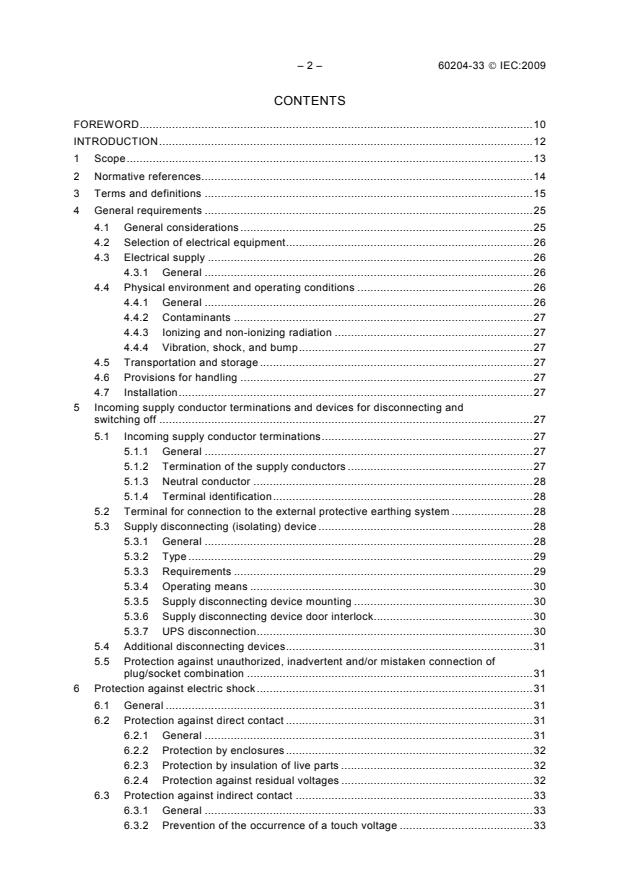
– 2 – 60204-33 © IEC:2009
CONTENTS
FOREWORD.2H10
INTRODUCTION.3H12
1 Scope.4H13
2 Normative references.5H14
3 Terms and definitions .6H15
4 General requirements .7H25
4.1 General considerations .8H25
4.2 Selection of electrical equipment.9H26
4.3 Electrical supply .10H26
4.3.1 General .11H26
4.4 Physical environment and operating conditions .12H26
4.4.1 General .13H26
4.4.2 Contaminants .14H27
4.4.3 Ionizing and non-ionizing radiation .15H27
4.4.4 Vibration, shock, and bump.16H27
4.5 Transportation and storage .17H27
4.6 Provisions for handling .18H27
4.7 Installation.19H27
5 Incoming supply conductor terminations and devices for disconnecting and
switching off .20H27
5.1 Incoming supply conductor terminations.21H27
5.1.1 General .22H27
5.1.2 Termination of the supply conductors .23H27
5.1.3 Neutral conductor .24H28
5.1.4 Terminal identification.25H28
5.2 Terminal for connection to the external protective earthing system .26H28
5.3 Supply disconnecting (isolating) device .27H28
5.3.1 General .28H28
5.3.2 Type .29H29
5.3.3 Requirements .30H29
5.3.4 Operating means .31H30
5.3.5 Supply disconnecting device mounting .32H30
5.3.6 Supply disconnecting device door interlock.33H30
5.3.7 UPS disconnection.34H30
5.4 Additional disconnecting devices.35H31
5.5 Protection against unauthorized, inadvertent and/or mistaken connection of
plug/socket combination .36H31
6 Protection against electric shock.37H31
6.1 General .38H31
6.2 Protection against direct contact .39H31
6.2.1 General .40H31
6.2.2 Protection by enclosures .41H32
6.2.3 Protection by insulation of live parts .42H32
6.2.4 Protection against residual voltages .43H32
6.3 Protection against indirect contact .44H33
6.3.1 General .45H33
6.3.2 Prevention of the occurrence of a touch voltage .46H33
60204-33 © IEC:2009 – 3 –
6.3.3 Protection by automatic disconnection of supply.47H34
6.4 Protection by the use of PELV.48H35
6.4.1 General requirements .49H35
6.4.2 Sources for PELV .50H35
6.4.3 Design to minimise risks of live working .51H36
6.5 Protection of skilled persons and instructed persons against inadvertent
contact with hazardous-live-parts .52H36
6.5.1 General .53H36
6.5.2 Obstacles .54H36
6.5.3 Probe holes .55H36
7 Protection of equipment .56H36
7.1 General .57H36
7.2 Overcurrent protection .58H37
7.2.1 General .59H37
7.2.2 Supply conductors .60H37
7.2.3 Neutral conductor protection .61H37
7.2.4 Socket outlets and their associated conductors .62H37
7.2.5 Lighting circuits.63H37
7.2.6 Transformers .64H37
7.2.7 Location of overcurrent protective devices.65H37
7.2.8 Overcurrent protective devices.66H38
7.2.9 Rating and setting of overcurrent protective devices.67H38
7.3 Protection of motors against overheating .68H39
7.3.1 General .69H39
7.3.2 Overload protection.70H40
7.3.3 Over-temperature protection .71H40
7.4 Motor overspeed protection.72H40
7.5 Abnormal temperature detection .73H40
7.6 Protection against supply interruption or voltage reduction and subsequent
restoration .74H41
7.7 Earth fault/residual current protection.75H41
7.8 Phase sequence protection.76H41
7.9 Protection against overvoltages due to lightning and to switching surges .77H41
7.10 Electrolytic capacitors .78H41
8 Equipotential bonding .79H42
8.1 General .80H42
8.2 Protective bonding circuit.81H44
8.2.1 General .82H44
8.2.2 Protective conductors .83H45
8.2.3 Continuity of the protective bonding circuit .84H45
8.2.4 Exclusion of switching devices from the protective bonding circuit .85H46
8.2.5 Protective conductor connecting points .86H46
8.2.6 Mobile machines.87H46
8.2.7 Limitation of touch current on cord and plug connected equipment .88H47
8.3 Functional bonding .89H47
8.4 Measures to limit the effects of high leakage current .90H47
9 Control circuits, emergency off (EMO), and protective interlock circuits .91H47
9.1 Control circuits .92H47
9.1.1 Control circuit supply .93H47
– 4 – 60204-33 © IEC:2009
9.1.2 DC circuits derived from an a.c. supply .94H47
9.1.3 Start functions .95H47
9.1.4 Stop functions.96H48
9.1.5 Operating modes .97H48
9.1.6 Multiple control stations .98H48
9.2 Emergency Off (EMO) .99H48
9.2.1 General .100H48
9.2.2 Circuits to be de-energized .101H49
9.2.3 Requirements for EMO circuits.102H49
9.3 Operations other than emergency off .103H49
9.3.1 General .104H49
9.3.2 Start .105H49
9.3.3 Stop.106H50
9.3.4 Other control functions.107H50
9.3.5 Cableless control .108H51
9.4 Protective interlocks .109H51
9.4.1 General .110H51
9.4.2 Protective interlock circuit design .111H51
9.5 Suspension of safety functions and/or protective measures.112H53
10 Operator interfaces.113H53
10.1 General .114H53
10.1.1 General device requirements .115H53
10.1.2 Location and mounting.116H53
10.1.3 Degree of protection .117H53
10.1.4 Portable and pendant control stations .118H54
10.2 Push-buttons .119H54
10.2.1 Colours.120H54
10.2.2 Markings.121H55
10.3 Indicator lights .122H55
10.3.1 General .123H55
10.3.2 Colours.124H55
10.3.3 Flashing lights and displays .125H56
10.4 Illuminated push-buttons.126H56
10.5 Rotary control devices .127H56
10.6 Start devices .128H56
10.7 Emergency off devices.129H56
10.8 Emergency stop devices .130H57
10.9 Enabling control device.131H57
11 Controlgear: location, mounting, and enclosures .132H57
11.1 General requirements .133H57
11.2 Location and mounting.134H58
11.2.1 Accessibility and maintenance.135H58
11.2.2 Physical separation or grouping .136H59
11.2.3 Heating effects .137H59
11.3 Degrees of protection .138H59
11.4 Enclosures for electrical equipment.139H59
11.4.1 General .140H59
11.4.2 Fasteners .141H59
11.4.3 Windows.142H59
60204-33 © IEC:2009 – 5 –
11.4.4 Doors .143H59
11.4.5 Openings .144H59
11.4.6 High surface temperatures .145H60
11.4.7 Containment of molten material or burning insulation.146H60
11.4.8 Enclosures that can be fully entered.147H60
11.4.9 Clearance for access to electrical equipment.148H60
12 Conductors and cables .149H62
12.1 General requirements .150H62
12.2 Insulation.151H62
12.2.1 General .152H62
12.2.2 Fire propagation and fume emissions.153H62
12.2.3 Printed circuit boards .154H62
12.3 Current-carrying capacity.155H63
12.4 Conductor and cable voltage drop.156H63
12.5 Flexible cables.157H63
12.5.1 General .158H63
12.5.2 Flexible cables inside enclosures or ducts.159H63
12.5.3 Mechanical rating in cable handling systems .160H63
13 Wiring practices.161H64
13.1 Connections and routing .162H64
13.1.1 General requirements .163H64
13.1.2 Conductor and cable runs .164H65
13.1.3 Conductors of different circuits.165H65
13.1.4 Conductors smaller than 50 mm .166H65
13.1.5 Temperature exposure of conductors .167H65
13.1.6 Terminal temperatures.168H65
13.2 Multi-outlet assemblies .169H65
13.3 Plug/socket combinations .170H66
13.4 Identification of conductors .171H66
13.4.1 General requirements .172H66
13.4.2 Identification of the protective conductor .173H66
13.4.3 Identification of the neutral conductor by colour.174H67
13.4.4 Identification by colour .175H67
13.4.5 Wiring inside enclosures .176H67
13.5 Wiring outside enclosures.177H68
13.5.1 General requirements .178H68
13.5.2 Plug/socket combinations external to electrical enclosures.179H68
13.5.3 Cables and conductors external to the electrical enclosure.180H68
13.5.4 Ducts .181H69
13.5.5 Pendant control stations .182H69
13.5.6 Strain relief.183H69
13.5.7 Protection of flexible cables .184H69
13.5.8 Clearance between cables and moving parts.185H69
13.5.9 Clearance between flexible conduit and moving parts.186H69
13.5.10 Interconnection of electrical equipment .187H69
13.5.11 Dismantling for shipment .188H70
13.6 Ducts, connection boxes and other boxes .189H70
13.6.1 General .190H70
13.6.2 Cable trunking systems.191H70
– 6 – 60204-33 © IEC:2009
13.6.3 Fabrication equipment compartments and cable trunking systems .192H71
13.6.4 Connection boxes and other boxes.193H71
14 Electric motors and associated equipment .194H71
14.1 General requirements .195H71
14.2 Remotely installed motors.196H71
14.3 Motor dimensions .197H71
14.4 Motor mounting and compartments .198H72
15 Accessories and lighting .199H72
15.1 Accessories.200H72
15.2 Local lighting of the fabrication equipment.201H72
15.2.1 General .202H72
15.2.2 Supply .203H72
15.2.3 Protection .204H73
15.2.4 Fittings .205H73
16 Marking, warning signs and reference designations.206H73
16.1 General .207H73
16.2 Electric shock hazard warning signs.208H73
16.3 Functional identification .209H73
16.4 Equipment nameplate .210H73
16.5 Reference designations .211H74
17 Technical documentation .212H74
17.1 General .213H74
17.2 Information to be provided .214H74
17.3 Requirements applicable to all documentation.215H75
17.4 Installation documents .216H75
17.4.1 General .217H75
17.4.2 Supply cables .218H75
17.4.3 Overcurrent protection devices.219H75
17.4.4 Ducts, cable trays, or cable supports.220H76
17.4.5 Diagrams.221H76
17.5 Overview diagrams and function diagrams .222H76
17.6 Circuit diagrams .223H76
17.7 Operating documentation.224H77
17.8 Maintenance documentation .225H77
17.8.1 General .226H77
17.8.2 Identification of replacement parts.227H77
18 Testing .228H77
18.1 General .229H77
18.1.1 Test schedule .230H77
18.1.2 Test conditions .231H77
18.2 Earthing continuity and continuity of the protective bonding circuit test .232H78
18.2.1 General .233H78
18.2.2 Test equipment.234H78
18.2.3 Procedure 1.235H78
18.2.4 Procedure 2.236H78
18.2.5 Acceptable results .237H79
18.3 Touch current test for cord and plug connected electrical equipment .238H79
18.3.1 Application.239H79
18.3.2 Test equipment.240H79
60204-33 © IEC:2009 – 7 –
18.3.3 Procedure.241H79
18.3.4 Acceptable results .242H79
18.4 Dielectric test .243H79
18.4.1 Test equipment.244H79
18.4.2 Procedure.245H80
18.4.3 Acceptable results .246H80
18.5 Strain relief test .247H80
18.5.1 General .248H80
18.5.2 Test equipment.249H80
18.5.3 Procedure 1.250H80
18.5.4 Acceptable results for procedure 1 .251H80
18.5.5 Procedure 2.252H81
18.5.6 Acceptable results for procedure 2 .253H81
18.6 Power supply output short circuit test .254H81
18.6.1 Test equipment.255H81
18.6.2 Procedure.256H81
18.6.3 Acceptable results .257H81
18.7 Protective interlock circuit function test .258H81
18.7.1 Procedure.259H81
18.7.2 Acceptable results .260H81
18.8 Capacitor stored energy discharge test (see 6.2.4).261H81
18.8.1 Test equipment.262H81
18.8.2 Procedure.263H82
18.8.3 Acceptable results .264H82
18.9 Temperature test .265H82
18.9.1 Test equipment.266H82
18.9.2 Procedure.267H82
18.9.3 Acceptable results .268H82
18.10 Strength of electrical enclosures test; 30 N steady force test .269H83
18.10.1 General .270H83
18.10.2 Test equipment.271H83
18.10.3 Procedure .272H83
18.10.4 Acceptable results .273H83
18.11 Strength of electrical enclosures test; 250N steady force test .274H83
18.11.1 General .275H83
18.11.2 Test equipment.276H83
18.11.3 Procedure .277H83
18.11.4 Acceptable results .278H83
18.12 Finger probe test.279H84
18.12.1 General .280H84
18.12.2 Test equipment.281H84
18.12.3 Procedure .282H84
18.12.4 Acceptable results .283H84
18.13 Wire flexing test.284H84
18.14 Insulation resistance tests.285H84
18.15 EMO functional test.286H84
18.15.1 General .287H84
18.15.2 Actuation .288H84
18.15.3 EMO button reset .289H85
– 8 – 60204-33 © IEC:2009
18.15.4 EMO circuit reset.290H85
18.16 Input current test.291H85
18.16.1 Test equipment.292H85
18.16.2 Procedure .293H85
18.16.3 Acceptable results .294H85
18.17 Other safety circuit tests .295H85
18.18 Motor temperature test.296H85
18.18.1 Application .297H85
18.18.2 Test equipment.298H85
18.18.3 Procedure .299H85
18.18.4 Acceptable results .300H86
Annex A (normative) Basic protection (protection against indirect contact) in TN-
systems .301H87
Annex B (normative) Protection against indirect contact in TT-systems (Derived from
IEC 60364-4-41:2005 and IEC 60364-6:2006).302H91
Annex C (normative) Conductor ampacity, and creepage and clearance distances .303H93
Annex D (normative) Standard test fingers .304H102
Annex E (informative) Types of system earthing (Derived from IEC 60364-1: 2005) .305H104
Bibliography .306H120
Figure 1 – Example of equipotential bonding for electrical equipment.307H43
Figure 2 – Clearance in front of enclosures .308H61
Figure A.1 – Typical arrangement for fault loop impedance measurement .309H90
Figure D.1 – Rigid test finger.310H102
Figure D.2 – Jointed test finger .311H103
Figure E.1 – TN-S system with separate neutral conductor and protective conductor
throughout the system.312H105
Figure E.2 – TN-S system with separate earthed line conductor and protective
conductor throughout the system.313H106
Figure E.3 – TN-S system with earthed protective conductor and no distributed neutral
conductor throughout the system.314H106
Figure E.4 – TN-C-S system 3-phase, 4-wire, where the PEN is separated into PE and
N elsewhere in the installation .315H107
Figure E.5 – TN-C-S system 3-phase, 4-wire where the PEN is separated into PE and
N at the origin of the installation .316H108
Figure E.6 – TN-C-S system – single-phase, 2-wire where the PEN is separated into PE
and N at the origin of the installation.
...