

IEC 61499-1:2012
(Main)Function blocks - Part 1: Architecture
General Information
- Abstract
IEC 61499-1:2012 defines a generic architecture and presents guidelines for the use of function blocks in distributed industrial-process measurement and control systems (IPMCSs). This architecture is presented in terms of implementable reference models, textual syntax and graphical representations. The models given in this standard are intended to be generic, domain independent and extensible to the definition and use of function blocks in other standards or for particular applications or application domains. It is intended that specifications written according to the rules given in this standard be concise, implementable, complete, unambiguous, and consistent. This second edition cancels and replaces the first edition published in 2005 an constitutes a technical revision. It includes the significant technical changes with respect to the previous edition related to: Execution control, Temporary variables, Service sequences, the syntax for mapping of FB instances, the Syntax for definition of segment types, the Function block types for interoperation with programmable controllers and the READ/WRITE management commands.
- Status
- Published
- Publication Date
- 06-Nov-2012
- Technical Committee
- SC 65B - Measurement and control devices
- Drafting Committee
- WG 15 - TC 65/SC 65B/WG 15
- Current Stage
- PPUB - Publication issued
- Start Date
- 07-Nov-2012
- Completion Date
- 15-Dec-2012
Overview
IEC 61499-1:2012 is an internationally recognized standard developed by the International Electrotechnical Commission (IEC) that defines the architecture for function blocks used in distributed industrial-process measurement and control systems (IPMCSs). This second edition, published in 2012, supersedes the original 2005 edition and incorporates significant technical revisions. It provides a robust framework for modeling function blocks relevant to modern industrial automation, ensuring concise, complete, implementable, consistent, and unambiguous specifications.
The standard introduces generic reference models, textual syntax, and graphical representations to facilitate the design and deployment of function blocks across diverse application domains. Its domain-independence and extensibility allow it to be integrated with other standards or specialized use cases, strengthening interoperability and system scalability.
Key Topics
Reference Models: IEC 61499-1 outlines system, device, resource, application, function block, distribution, and management models that form the building blocks for industrial automation systems. These models help clearly define system components and their interactions.
Function Block Characteristics: Detailed specifications for basic, composite, and adapter function blocks are provided, including execution models, interface definitions, behavior during runtime, and event-driven mechanisms.
Execution Control and Behavior: The standard updates execution control features, temporary variables handling, and defines execution timing models to ensure reliable and predictable block operations in real-time industrial environments.
Interoperation with Programmable Controllers: New function block types and syntax enhancements address seamless integration with programmable logic controllers (PLCs) and other automation devices.
Management and Service Sequences: The management model supports lifecycle control, fault handling, and service command sequences (READ/WRITE), enhancing system robustness and maintainability.
Textual and Graphical Syntax: IEC 61499-1 specifies a standardized textual syntax and graphical notation for defining function blocks, making it easier for engineers and system designers to develop and understand complex automation applications.
Applications
IEC 61499-1:2012 serves as a foundational architecture to implement distributed control systems in various industrial sectors including manufacturing, process automation, energy management, and building automation. Its modular function block approach enables:
Distributed Control Systems (DCS): Efficiently managing control functions distributed across multiple devices and resources for scalability and fault tolerance.
Industrial Internet of Things (IIoT): Providing modular, interoperable building blocks that simplify integration of industrial devices for enhanced connectivity and automation.
Process Measurement and Control: Offering precise control models suitable for complex processes such as chemical processing, pharmaceuticals, and power plants requiring reliable, event-driven operation.
Programmable Automation Controllers (PACs): Facilitating sophisticated control strategies through reusable function block components that conform to international standards.
Embedded Control Systems: Allowing flexible design and execution of control logic within embedded platforms, ensuring consistency across diverse hardware and software environments.
Related Standards
IEC 61131-3: The widely adopted standard for programmable controller programming languages. IEC 61499-1 complements this by focusing on distributed and event-driven architectures rather than sequential control.
IEC 61499-2: Provides specific guidelines for formal descriptions and implementation of the function block execution environment following IEC 61499-1.
IEC 61131 Series: Other parts in this series address functions blocks, programming languages, and communications for industrial automation, often used alongside IEC 61499.
IEC 61804: Focuses on function block standards in process control, which can be integrated with IEC 61499 architectures.
Practical Benefits
Adopting IEC 61499-1:2012 architecture in industrial automation provides:
Enhanced Modularity and Reusability: Clear definitions allow developers to create reusable components.
Scalability in Distributed Systems: Supports flexible deployment across devices and networks.
Improved Interoperability: Standardized syntax and interface definitions facilitate multi-vendor integration.
Robust Control and Fault Management: Integrated management models improve system reliability and maintainability.
Future-Proof Architecture: Extensible design supports evolving industrial application requirements and integration with emerging technologies.
IEC 61499-1:2012 remains a cornerstone standard for engineers and organizations aiming to design flexible, interoperable, and scalable distributed industrial control systems using function block methodology. For detailed technical information and to ensure compliance, refer to the official IEC documentation and authorized distributors.
Relations
- Effective Date
- 05-Sep-2023
Get Certified
Connect with accredited certification bodies for this standard

BSI Group
BSI (British Standards Institution) is the business standards company that helps organizations make excellence a habit.

DVS-ZERT GmbH
German welding certification society.
CARES (UK Certification Authority for Reinforcing Steels)
UK certification for reinforcing steels and construction.
Sponsored listings
Frequently Asked Questions
IEC 61499-1:2012 is a standard published by the International Electrotechnical Commission (IEC). Its full title is "Function blocks - Part 1: Architecture". This standard covers: IEC 61499-1:2012 defines a generic architecture and presents guidelines for the use of function blocks in distributed industrial-process measurement and control systems (IPMCSs). This architecture is presented in terms of implementable reference models, textual syntax and graphical representations. The models given in this standard are intended to be generic, domain independent and extensible to the definition and use of function blocks in other standards or for particular applications or application domains. It is intended that specifications written according to the rules given in this standard be concise, implementable, complete, unambiguous, and consistent. This second edition cancels and replaces the first edition published in 2005 an constitutes a technical revision. It includes the significant technical changes with respect to the previous edition related to: Execution control, Temporary variables, Service sequences, the syntax for mapping of FB instances, the Syntax for definition of segment types, the Function block types for interoperation with programmable controllers and the READ/WRITE management commands.
IEC 61499-1:2012 defines a generic architecture and presents guidelines for the use of function blocks in distributed industrial-process measurement and control systems (IPMCSs). This architecture is presented in terms of implementable reference models, textual syntax and graphical representations. The models given in this standard are intended to be generic, domain independent and extensible to the definition and use of function blocks in other standards or for particular applications or application domains. It is intended that specifications written according to the rules given in this standard be concise, implementable, complete, unambiguous, and consistent. This second edition cancels and replaces the first edition published in 2005 an constitutes a technical revision. It includes the significant technical changes with respect to the previous edition related to: Execution control, Temporary variables, Service sequences, the syntax for mapping of FB instances, the Syntax for definition of segment types, the Function block types for interoperation with programmable controllers and the READ/WRITE management commands.
IEC 61499-1:2012 is classified under the following ICS (International Classification for Standards) categories: 25.040.40 - Industrial process measurement and control; 35.240.50 - IT applications in industry. The ICS classification helps identify the subject area and facilitates finding related standards.
IEC 61499-1:2012 has the following relationships with other standards: It is inter standard links to IEC 61499-1:2005. Understanding these relationships helps ensure you are using the most current and applicable version of the standard.
IEC 61499-1:2012 is available in PDF format for immediate download after purchase. The document can be added to your cart and obtained through the secure checkout process. Digital delivery ensures instant access to the complete standard document.
Standards Content (Sample)
IEC 61499-1 ®
Edition 2.0 2012-11
INTERNATIONAL
STANDARD
NORME
INTERNATIONALE
colour
inside
Function blocks –
Part 1: Architecture
Blocs fonctionnels –
Partie 1: Architecture
All rights reserved. Unless otherwise specified, no part of this publication may be reproduced or utilized in any form
or by any means, electronic or mechanical, including photocopying and microfilm, without permission in writing from
either IEC or IEC's member National Committee in the country of the requester.
If you have any questions about IEC copyright or have an enquiry about obtaining additional rights to this publication,
please contact the address below or your local IEC member National Committee for further information.
Droits de reproduction réservés. Sauf indication contraire, aucune partie de cette publication ne peut être reproduite ni
utilisée sous quelque forme que ce soit et par aucun procédé, électronique ou mécanique, y compris la photocopie et les
microfilms, sans l'accord écrit de la CEI ou du Comité national de la CEI du pays du demandeur.
Si vous avez des questions sur le copyright de la CEI ou si vous désirez obtenir des droits supplémentaires sur cette
publication, utilisez les coordonnées ci-après ou contactez le Comité national de la CEI de votre pays de résidence.
IEC Central Office Tel.: +41 22 919 02 11
3, rue de Varembé Fax: +41 22 919 03 00
CH-1211 Geneva 20 info@iec.ch
Switzerland www.iec.ch
About the IEC
The International Electrotechnical Commission (IEC) is the leading global organization that prepares and publishes
International Standards for all electrical, electronic and related technologies.
About IEC publications
The technical content of IEC publications is kept under constant review by the IEC. Please make sure that you have the
latest edition, a corrigenda or an amendment might have been published.
Useful links:
IEC publications search - www.iec.ch/searchpub Electropedia - www.electropedia.org
The advanced search enables you to find IEC publications The world's leading online dictionary of electronic and
by a variety of criteria (reference number, text, technical electrical terms containing more than 30 000 terms and
committee,…). definitions in English and French, with equivalent terms in
It also gives information on projects, replaced and additional languages. Also known as the International
withdrawn publications. Electrotechnical Vocabulary (IEV) on-line.
IEC Just Published - webstore.iec.ch/justpublished Customer Service Centre - webstore.iec.ch/csc
Stay up to date on all new IEC publications. Just Published If you wish to give us your feedback on this publication
details all new publications released. Available on-line and or need further assistance, please contact the
also once a month by email. Customer Service Centre: csc@iec.ch.
A propos de la CEI
La Commission Electrotechnique Internationale (CEI) est la première organisation mondiale qui élabore et publie des
Normes internationales pour tout ce qui a trait à l'électricité, à l'électronique et aux technologies apparentées.
A propos des publications CEI
Le contenu technique des publications de la CEI est constamment revu. Veuillez vous assurer que vous possédez
l’édition la plus récente, un corrigendum ou amendement peut avoir été publié.
Liens utiles:
Recherche de publications CEI - www.iec.ch/searchpub Electropedia - www.electropedia.org
La recherche avancée vous permet de trouver des Le premier dictionnaire en ligne au monde de termes
publications CEI en utilisant différents critères (numéro de électroniques et électriques. Il contient plus de 30 000
référence, texte, comité d’études,…). termes et définitions en anglais et en français, ainsi que
Elle donne aussi des informations sur les projets et les les termes équivalents dans les langues additionnelles.
publications remplacées ou retirées. Egalement appelé Vocabulaire Electrotechnique
International (VEI) en ligne.
Just Published CEI - webstore.iec.ch/justpublished
Service Clients - webstore.iec.ch/csc
Restez informé sur les nouvelles publications de la CEI.
Just Published détaille les nouvelles publications parues. Si vous désirez nous donner des commentaires sur
Disponible en ligne et aussi une fois par mois par email. cette publication ou si vous avez des questions
contactez-nous: csc@iec.ch.
IEC 61499-1 ®
Edition 2.0 2012-11
INTERNATIONAL
STANDARD
NORME
INTERNATIONALE
colour
inside
Function blocks –
Part 1: Architecture
Blocs fonctionnels –
Partie 1: Architecture
INTERNATIONAL
ELECTROTECHNICAL
COMMISSION
COMMISSION
ELECTROTECHNIQUE
PRICE CODE
INTERNATIONALE
CODE PRIX XF
ICS 25.040; 35.240.50 ISBN 978-2-83220-481-8
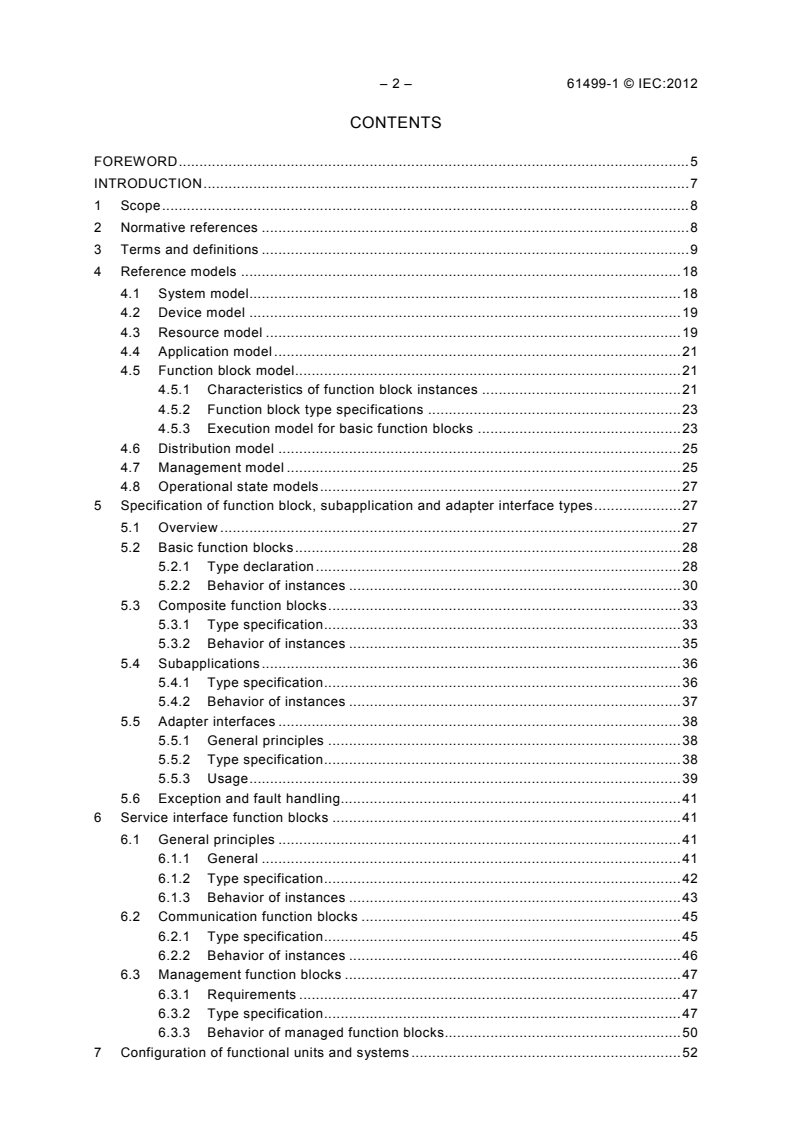
– 2 – 61499-1 © IEC:2012
CONTENTS
FOREWORD . 5
INTRODUCTION . 7
1 Scope . 8
2 Normative references . 8
3 Terms and definitions . 9
4 Reference models . 18
4.1 System model. 18
4.2 Device model . 19
4.3 Resource model . 19
4.4 Application model . 21
4.5 Function block model. 21
4.5.1 Characteristics of function block instances . 21
4.5.2 Function block type specifications . 23
4.5.3 Execution model for basic function blocks . 23
4.6 Distribution model . 25
4.7 Management model . 25
4.8 Operational state models . 27
Specification of function block, subapplication and adapter interface types . 27
5.1 Overview . 27
5.2 Basic function blocks . 28
5.2.1 Type declaration . 28
5.2.2 Behavior of instances . 30
5.3 Composite function blocks . 33
5.3.1 Type specification . 33
5.3.2 Behavior of instances . 35
5.4 Subapplications . 36
5.4.1 Type specification . 36
5.4.2 Behavior of instances . 37
5.5 Adapter interfaces . 38
5.5.1 General principles . 38
5.5.2 Type specification . 38
5.5.3 Usage . 39
5.6 Exception and fault handling. 41
Service interface function blocks . 41
6.1 General principles . 41
6.1.1 General . 41
6.1.2 Type specification . 42
6.1.3 Behavior of instances . 43
6.2 Communication function blocks . 45
6.2.1 Type specification . 45
6.2.2 Behavior of instances . 46
6.3 Management function blocks . 47
6.3.1 Requirements . 47
6.3.2 Type specification . 47
6.3.3 Behavior of managed function blocks. 50
7 Configuration of functional units and systems . 52
61499-1 © IEC:2012 – 3 –
7.1 Principles of configuration . 52
7.2 Functional specification of resource, device and segment types . 52
7.2.1 Functional specification of resource types . 52
7.2.2 Functional specification of device types . 53
7.2.3 Functional specification of segment types . 53
7.3 Configuration requirements . 53
7.3.1 Configuration of systems . 53
7.3.2 Specification of applications . 54
7.3.3 Configuration of devices and resources . 54
7.3.4 Configuration of network segments and links . 55
Annex A (normative) Event function blocks . 56
Annex B (normative) Textual syntax . 63
Annex C (informative) Object models . 74
Annex D (informative) Relationship to IEC 61131-3 . 82
Annex E (informative) Information exchange . 92
Annex F (normative) Textual specifications . 100
Annex G (informative) Attributes . 113
Bibliography . 117
Figure 1 – System model . 18
Figure 2 – Device model . 19
Figure 3 – Resource model . 20
Figure 4 – Application model . 21
Figure 5 – Characteristics of function blocks . 22
Figure 6 – Execution model . 24
Figure 7 – Execution timing . 24
Figure 8 – Distribution and management models . 26
Figure 9 – Function block and subapplication types . 28
Figure 10 – Basic function block type declaration . 29
Figure 11 – ECC example . 30
Figure 12 – ECC operation state machine . 32
Figure 13 – Composite function block PI_REAL example . 34
Figure 14 – Basic function block PID_CALC example . 35
Figure 15 – Subapplication PI_REAL_APPL example . 37
Figure 16 – Adapter interfaces – Conceptual model . 38
Figure 17 – Adapter type declaration – graphical example . 39
Figure 18 – Illustration of provider and acceptor function block type declarations. 40
Figure 19 – Illustration of adapter connections . 41
Figure 20 – Example service interface function blocks . 43
Figure 21 – Example service sequence diagrams . 44
Figure 22 – Generic management function block type . 47
Figure 23 – Service primitive sequences for unsuccessful service . 48
Figure 24 – Operational state machine of a managed function block . 51
Figure A.1 – Event split and merge . 62
– 4 – 61499-1 © IEC:2012
Figure C.1 – ESS overview . 74
Figure C.2 – Library elements . 75
Figure C.3 – Declarations . 76
Figure C.4 – Function block network declarations . 77
Figure C.5 – Function block type declarations . 79
Figure C.6 – IPMCS overview . 79
Figure C.7 – Function block types and instances . 81
Figure D.1 – Example of a “simple” function block type . 82
Figure D.2 – Function block type READ . 85
Figure D.3 – Function block type UREAD . 87
Figure D.4 – Function block type WRITE . 88
Figure D.5 – Function block type TASK . 90
Figure E.1 – Type specifications for unidirectional transactions . 93
Figure E.2 – Connection establishment for unidirectional transactions . 93
Figure E.3 – Normal unidirectional data transfer . 93
Figure E.4 – Connection release in unidirectional data transfer . 94
Figure E.5 – Type specifications for bidirectional transactions . 94
Figure E.6 – Connection establishment for bidirectional transaction . 95
Figure E.7 – Bidirectional data transfer . 95
Figure E.8 – Connection release in bidirectional data transfer . 95
Table 1 – States and transitions of ECC operation state machine . 32
Table 2 – Standard inputs and outputs for service interface function blocks . 42
Table 3 – Service primitive semantics . 45
Table 4 – Variable semantics for communication function blocks . 46
Table 5 – Service primitive semantics for communication function blocks . 46
Table 6 – CMD input values and semantics . 48
Table 7 – STATUS output values and semantics . 48
Table 8 – Command syntax . 49
Table 9 – Semantics of actions in Figure 24 . 52
Table A.1 – Event function blocks . 57
Table C.1 – ESS class descriptions . 75
Table C.2 – Syntactic productions for library elements . 75
Table C.3 – Syntactic productions for declarations . 77
Table C.4 – IPMCS classes . 80
Table D.1 – Semantics of STATUS values . 83
Table D.2 – Source code of function block type READ . 86
Table D.3 – Source code of function block type UREAD . 87
Table D.4 – Source code of function block type WRITE . 89
Table D.5 – Source code of function block type TASK . 90
Table D.6 – IEC 61499 interoperability features . 91
Table E.1 – COMPACT encoding of fixed length data types . 99
Table G.1 – Elements of attribute definitions . 114
61499-1 © IEC:2012 – 5 –
INTERNATIONAL ELECTROTECHNICAL COMMISSION
____________
FUNCTION BLOCKS –
Part 1: Architecture
FOREWORD
1) The International Electrotechnical Commission (IEC) is a worldwide organization for standardization comprising
all national electrotechnical committees (IEC National Committees). The object of IEC is to promote
international co-operation on all questions concerning standardization in the electrical and electronic fields. To
this end and in addition to other activities, IEC publishes International Standards, Technical Specifications,
Technical Reports, Publicly Available Specifications (PAS) and Guides (hereafter referred to as “IEC
Publication(s)”). Their preparation is entrusted to technical committees; any IEC National Committee interested
in the subject dealt with may participate in this preparatory work. International, governmental and non-
governmental organizations liaising with the IEC also participate in this preparation. IEC collaborates closely
with the International Organization for Standardization (ISO) in accordance with conditions determined by
agreement between the two organizations.
2) The formal decisions or agreements of IEC on technical matters express, as nearly as possible, an international
consensus of opinion on the relevant subjects since each technical committee has representation from all
interested IEC National Committees.
3) IEC Publications have the form of recommendations for international use and are accepted by IEC National
Committees in that sense. While all reasonable efforts are made to ensure that the technical content of IEC
Publications is accurate, IEC cannot be held responsible for the way in which they are used or for any
misinterpretation by any end user.
4) In order to promote international uniformity, IEC National Committees undertake to apply IEC Publications
transparently to the maximum extent possible in their national and regional publications. Any divergence
between any IEC Publication and the corresponding national or regional publication shall be clearly indicated in
the latter.
5) IEC itself does not provide any attestation of conformity. Independent certification bodies provide conformity
assessment services and, in some areas, access to IEC marks of conformity. IEC is not responsible for any
services carried out by independent certification bodies.
6) All users should ensure that they have the latest edition of this publication.
7) No liability shall attach to IEC or its directors, employees, servants or agents including individual experts and
members of its technical committees and IEC National Committees for any personal injury, property damage or
other damage of any nature whatsoever, whether direct or indirect, or for costs (including legal fees) and
expenses arising out of the publication, use of, or reliance upon, this IEC Publication or any other IEC
Publications.
8) Attention is drawn to the Normative references cited in this publication. Use of the referenced publications is
indispensable for the correct application of this publication.
9) Attention is drawn to the possibility that some of the elements of this IEC Publication may be the subject of
patent rights. IEC shall not be held responsible for identifying any or all such patent rights.
International Standard IEC 61499-1 has been prepared by subcommittee 65B: Measurement
and control devices, of IEC technical committee 65: Industrial-process measurement, control
and automation.
This second edition cancels and replaces the first edition published in 2005. This edition
constitutes a technical revision.
This edition includes the following significant technical changes with respect to the previous
edition:
• Execution control in basic function blocks (5.2) has been clarified and extended:
– Dynamic and static parts of the EC transition condition are clearly delineated by using
the ec_transition_event[guard_condition] syntax of the Unified Modeling
Language (UML) (5.2.1.3, B.2.1).
– The terminology "crossing of an EC transition" (3.10) is used preferentially to "clearing"
to avoid the misinterpretation that the entire transition condition corresponds to a
Boolean variable that can be "cleared."
– 6 – 61499-1 © IEC:2012
– Operation of the ECC state machine in 5.2.2.2 has been clarified and made more
rigorous.
– Event and data outputs of adapter instances (plugs and sockets) can be used in EC
transition conditions, and event inputs of adapter instances can be used as EC action
outputs.
• Temporary variables (3.97) can be declared (B.2.1) and used in algorithms of basic
function blocks.
• Service sequences (6.1.3) can now be defined for basic and composite function block
types and adapter types, as well as service interface types.
• The syntax for mapping of FB instances from applications to resources has been simplified
(Clause B.3).
• Syntax for definition of segment types (7.2.3) for network segments of system
configurations has been added (Clause B.3).
• Function block types for interoperation with programmable controllers are defined
(Clause D.6).
• The READ/WRITE management commands (Table 8) now apply only to parameters.
The text of this part of IEC 61499 is based on the following documents:
FDIS Report on voting
65B/845/FDIS 65B/855/RVD
Full information on the voting for the approval of this standard can be found in the report on
voting indicated in the above table (when voting is completed).
This publication has been drafted in accordance with the ISO/IEC Directives, Part 2.
A list of all parts of the IEC 61499 series can be found, under the general title Function
blocks, on the IEC website.
Terms used throughout this International Standard that have been defined in Clause 3 appear
in italics.
The committee has decided that the contents of this publication will remain unchanged until
the stability date indicated on the IEC web site under "http://webstore.iec.ch" in the data
related to the specific publication. At this date, the publication will be
• reconfirmed,
• withdrawn,
• replaced by a revised edition, or
• amended.
IMPORTANT – The 'colour inside' logo on the cover page of this publication indicates
that it contains colours which are considered to be useful for the correct
understanding of its contents. Users should therefore print this document using a
colour printer.
61499-1 © IEC:2012 – 7 –
INTRODUCTION
IEC 61499 consists of the following parts, under the general title Function blocks:
• Part 1 (this document) contains:
– general requirements, including scope, normative references, definitions, and
reference models;
– rules for the declaration of function block types, and rules for the behavior of instances
of the types so declared;
– rules for the use of function blocks in the configuration of distributed industrial-process
measurement and control systems (IPMCSs);
– rules for the use of function blocks in meeting the communication requirements of
distributed IPMCSs;
– rules for the use of function blocks in the management of applications, resources and
devices in distributed IPMCSs.
• Part 2 defines requirements for software tools to support the following systems
engineering tasks:
– the specification of function block types;
– the functional specification of resource types and device types;
– the specification, analysis, and validation of distributed IPMCSs;
– the configuration, implementation, operation, and maintenance of distributed IPMCSs;
– the exchange of information among software tools.
• Part 3 (Tutorial information) has been withdrawn due to the widespread current availability
nd
of tutorial and educational materials regarding IEC 61499. However, an updated 2
Edition of Part 3 may be developed in the future.
• Part 4 defines rules for the development of compliance profiles which specify the features
of IEC 61499-1 and IEC 61499-2 to be implemented in order to promote the following
attributes of IEC 61499-based systems, devices and software tools:
– interoperability of devices from multiple suppliers;
– portability of software between software tools of multiple suppliers; and
– configurability of devices from multiple vendors by software tools of multiple suppliers.
– 8 – 61499-1 © IEC:2012
FUNCTION BLOCKS –
Part 1: Architecture
1 Scope
This part of IEC 61499 defines a generic architecture and presents guidelines for the use of
function blocks in distributed industrial-process measurement and control systems (IPMCSs).
This architecture is presented in terms of implementable reference models, textual syntax and
graphical representations. These models, representations and syntax can be used for:
• the specification and standardization of function block types;
• the functional specification and standardization of system elements;
• the implementation independent specification, analysis, and validation of distributed
IPMCSs;
• the configuration, implementation, operation, and maintenance of distributed IPMCSs;
• the exchange of information among software tools for the performance of the above
functions.
This part of IEC 61499 does not restrict or specify the functional capabilities of IPMCSs or
their system elements, except as such capabilities are represented using the elements
defined herein. IEC 61499-4 addresses the extent to which the elements defined in this
standard may be restricted by the functional capabilities of compliant systems, subsystems,
and devices.
Part of the purpose of this standard is to provide reference models for the use of function
blocks in other standards dealing with the support of the system life cycle, including system
planning, design, implementation, validation, operation and maintenance. The models given in
this standard are intended to be generic, domain independent and extensible to the definition
and use of function blocks in other standards or for particular applications or application
domains. It is intended that specifications written according to the rules given in this standard
be concise, implementable, complete, unambiguous, and consistent.
NOTE 1 The provisions of this standard alone are not sufficient to ensure interoperability among devices of
different vendors. Standards complying with this part of IEC 61499 can specify additional provisions to ensure such
interoperability.
NOTE 2 Standards complying with this part of IEC 61499 can specify additional provisions to enable the
performance of system, device, resource and application management functions.
2 Normative references
The following documents, in whole or in part, are normatively referenced in this document and
are indispensable for its application. For dated references, only the edition cited applies. For
undated references, the latest edition of the referenced document (including any
amendments) applies.
IEC 61131-1, Programmable controllers – Part 1: General
IEC 61131-3:2003, Programmable controllers – Part 3: Programming languages
IEC/ISO 7498-1:1994, Information technology – Open systems interconnection – Basic
reference model: The basic model
61499-1 © IEC:2012 – 9 –
ISO/IEC 8824-1:2008, Information technology – Abstract Syntax Notation One (ASN.1):
Specification of basic notation
ISO/IEC 10646:2003, Information technology – Universal Multiple-Octet Coded Character
Set (UCS)
3 Terms and definitions
For the purposes of this document, the following terms and definitions apply.
NOTE Terms defined in Clause 3 are italicized where they appear in definitions and Notes to entry of other terms
as well as throughout the body of the document.
3.1
acceptor
function block instance which provides a socket adapter of a defined adapter interface type
3.2
adapter connection
connection from a plug adapter to a socket adapter of the same adapter interface type, which
carries the flows of data and events defined by the adapter interface type
3.3
adapter interface type
type which consists of the definition of a set of event inputs, event outputs, data inputs, and
data outputs, and whose instances are plug adapters and socket adapters
3.4
algorithm
finite set of well-defined rules for the solution of a problem in a finite number of operations
3.5
application
software functional unit that is specific to the solution of a problem in industrial-process
measurement and control
Note 1 to entry: An application can be distributed among resources, and might communicate with other
applications.
3.6
attribute
property or characteristic of an entity, for instance, the version identifier of a function block
type specification
3.7
basic function block type
function block type that cannot be decomposed into other function blocks and that utilizes an
execution control chart (ECC) to control the execution of its algorithms
3.8
bidirectional transaction
transaction in which a request and possibly data are conveyed from an requester to a
responder, and in which a response and possibly data are conveyed from the responder back
to the requester
– 10 – 61499-1 © IEC:2012
3.9
character
member of a set of elements that is used for the representation, organization, or control of
data
3.10
crossing
clearing
operation by means of which control is passed from the predecessor EC
state of an EC transition to its successor EC state
Note 1 to entry: This operation consists of de-activation of the predecessor EC state, followed by activation of the
successor EC state.
3.11
communication connection
connection that utilizes the communication mapping function of one or more resources for the
conveyance of information
3.12
communication function block
service interface function block that represents the interface between an application and the
communication mapping function of a resource
3.13
communication function block type
function block type whose instances are communication function blocks
3.14
component function block
function block instance which is used in the specification of an algorithm of a composite
function block type
Note 1 to entry: A component function block can be of basic, composite or service interface type.
3.15
component subapplication
subapplication instance that is used in the specification of a subapplication type
3.16
composite function block type
function block type whose algorithms and the control of their execution are expressed entirely
in terms of interconnected component function blocks, events, and variables
3.17
concurrent
pertaining to algorithms that are executed during a common period of time during which they
may have to alternately share common resources
3.18
configuration (of a system or device)
selecting functional units, assigning their locations and defining their interconnections
3.19
configuration parameter
parameter related to the configuration of a system, device or resource
61499-1 © IEC:2012 – 11 –
3.20
confirm primitive
service primitive which represents an interaction in which a resource indicates completion of
some algorithm previously invoked by an interaction represented by a request primitive
3.21
connection
association established between functional units for conveying information
3.22
critical region
operation or sequence of operations which is executed under the exclusive control of a
locking object which is associated with the data on which the operations are performed
3.23
data
reinterpretable representation of information in a formalized manner suitable for
communication, interpretation or processing
3.24
data connection
association between two function blocks for the conveyance of data
3.25
data input
interface of a function block which receives data from a data connection
3.26
data output
interface of a function block which supplies data to a data connection
3.27
data type
set of values together with a set of permitted operations
3.28
declaration
mechanism for establishing the definition of an entity
Note 1 to entry: A declaration can involve attaching an identifier to the entity, and allocating attributes such as
data types and algorithms to it.
3.29
device
independent physical entity capable of performing one or more specified functions in a
particular context and delimited by its interfaces
Note 1 to entry: A programmable controller system as defined in IEC 61131-1 is a device.
3.30
device management application
application whose primary function is the management of multiple resources within a device
3.31
entity
particular thing, such as a person, place, process, object, concept, association, or event
– 12 – 61499-1 © IEC:2012
3.32
event
instantaneous occurrence that is significant to scheduling the execution of an algorithm
Note 1 to entry: The execution of an algorithm may make use of variables associated with an event.
3.33
event connection
association among function blocks for the conveyance of events
3.34
event input
interface of a function block which can receive events from an event connection
3.35
event output
interface of a function block which can issue events to an event connection
3.36
exception
event that causes suspension of normal execution
3.37
execution
process of carrying out a sequence of operations specified by an algorithm
Note 1 to entry: The sequence of operations to be executed may vary from one invocation of a function block
instance to another, depending on the rules specified by the function block's algorithm and the current values of
variables in the function block's data structure.
3.38
execution control action
EC action
element associated with an execution control state, which identifies an algorithm to be
executed, an event to be issued, or both
Note 1 to entry: Timing of algorithm execution and event issuance are addressed in 5.2.2.
3.39
execution control chart
ECC
graphical or textual representation of the causal relationships among events at the event
inputs and event outputs of a function block and the execution of the function block's
algorithms, using execution control states, execution control transitions, and execution control
actions
3.40
execution control initial state
EC initial state
execution control state that is active upon initialization of an execution control chart
3.41
execution control state
EC state
situation in which the behavior of a basic function block with respect to its variables is
determined by the algorithms associated with a specified set of execution control actions
61499-1 © IEC:2012 – 13 –
3.42
execution control transition
EC transition
means by which control passes from a predecessor execution control state to a successor
execution control state
3.43
fault
abnormal condition that may cause a reduction in, or loss of, the capability of a functional unit
to perform a required function
3.44
function
specific purpose of an entity or its characteristic action
3.45
function block
function block instance
software functional unit comprising an individual, named copy of a data structure upon which
associated operations may be performed as specified by a corresponding function block type
Note 1 to entry: Typical operations of a function block include modification of the values of the data in its
associated data structure.
Note 2 to entry: The function block instance and its corresponding function block type defined in IEC 61131-3 are
programming language elements with a different set of features.
3.46
function block network
network whose nodes are function blocks or subapplications and their parameters and whose
branches are data connections and event connections
Note 1 to entry: This is a generalization of the function block diagram defined in IEC 61131-3.
3.47
function block type
type whose instances are function blocks
Note 1 to entry: Function block types include basic function block types, composite function block types, and
service interface function block types
3.48
functional unit
entity of hardware or software, or both, capable of accomplishing a specified purpose
3.49
hardware
physical equipment, as opposed to programs, procedures, rules and associated
documentation
3.50
identifier
one or more characters used to name an entity
3.51
implementation
development phase in which the hardware and software of a system become operational
– 14 – 61499-1 © IEC:2012
3.52
indication primitive
service primitive which represents an interaction in which a resource either
a) indicates that it has, on its own initiative, invoked some algorithm; or
b) indicates that an algorithm has been invoked by a peer application
3.53
information
meaning that is currently assigned to data by means of the conventions applied to that data
3.54
input variable
variable whose value is supplied by a data input, and which may be used in one or more
operations of a function block
Note 1 to entry: An input parameter of a function block, as defined in IEC 61131-3, is an input variable.
3.55
instance
functional unit comprising an individual, named entity with the attributes of a defined type
3.56
instance name
identifier associated with and designating an instance
3.57
instantiation
creation of an instance of a specified type
3.58
interface
shared boundary between two functional units, defined by functional characteristics, signal
characteristics, or other characteristics, as appropriate
3.59
internal operation
operation associated with an algorithm of a function block, with its
execution control, or with the functional capabilities of the associated resource
3.60
internal variable
variable whose value is used or modified by one or more operations of a function block, but is
not supplied by a data input or to a data output
3.61
invocation
process of initiating the execution of the sequence of operations specified in an algorithm
3.62
link
design element describing the connection between a device and a network segment
3.63
literal
lexical unit that directly represents a value
61499-1 © IEC:2012 – 15 –
3.64
management function block
function block whose primary function is the management of applications within a resource
3.65
management resource
resource whose primary function is the management of other resources
3.66
mapping
set of features or attributes having defined correspondence with the members of another set
3.67
message
ordered series of characters intended to convey information
3.68
message sink
part of a communication system in which messages are considered to be received
3.69
message source
part of a communication system from which messages are considered to originate
3.70
model
mathematical or physical representation of a system or a process
3.71
multitasking
mode of operation that provides for the concu
...