

IEC 60652:2021
(Main)Overhead line structures - Loading tests
General Information
- Abstract
IEC 60652:2021 specifies the methods and procedures of testing supports for overhead lines. It applies to the testing of supports and structures of overhead lines. There is no restriction on the type of material used in the fabrication of the supports which may include, but not be limited to, metallic alloys, concrete, timber, laminated wood and composite materials. If required by the client, this document can also be applied to the testing of telecommunication supports, railway/tramway overhead electrification supports, electrical substation gantries, street lighting columns, wind turbine towers, ski-lift supports, etc. Tests on reduced scale models of supports are not covered by this document. This third edition cancels and replaces the second edition published in 2002. This edition constitutes a technical revision. This edition includes the following significant technical changes with respect to the previous edition:
a) Title modified;
b) Added reference to CIGRE Brochure 399;
c) In Clause 7, added test limitation for wind speed and direction during testing;
d) In paragraph 10.5, added load increments for destruction tests;
e) In paragraph 10.7, added a requirement for an agreement between client and testing station when testing supports made of creep-sensitive materials;
f) In Clause 17, added requirements for sampling procedure to be provided in the test report.
- Status
- Published
- Publication Date
- 29-Jul-2021
- Technical Committee
- TC 11 - Overhead lines
- Drafting Committee
- MT 1 - TC 11/MT 1
- Current Stage
- PPUB - Publication issued
- Start Date
- 30-Jul-2021
- Completion Date
- 30-Jul-2021
Buy Documents
IEC 60652:2021 RLV - Overhead line structures - Loading tests Released:7/30/2021

IEC 60652:2021 - Overhead line structures - Loading tests Released:7/30/2021
Overview
IEC 60652:2021 - Loading tests on overhead line structures specifies methods and procedures for testing supports and structures for overhead lines. The standard applies principally to supports for voltages above 45 kV but can be used as a reference for lower-voltage supports. It covers full-scale testing of supports made from any material (metal alloys, concrete, timber, laminated wood, composites, etc.). Reduced-scale model tests are excluded. This third edition (2021) is a technical revision that updates test limits, destruction test increments, and reporting requirements.
Key topics and technical requirements
- Test categories
- Design tests: full-scale prototype testing to verify design methods, validate standards, or R&D. Typically carried out to at least the design load or to failure.
- Sample tests: batch quality checks taken from serial production, usually to a specified percentage of design load (commonly 100%).
- Test station acceptability
- Option for accreditation per ISO/IEC 17025:2017.
- Safety layout, collapse-mitigation measures, trained personnel and validated procedures required.
- Load application and destruction tests
- Procedures for combined loads, load increments, tolerances and permitted holding periods.
- New requirements in 2021 include specified load increments for destruction tests (Clause 10.5).
- Environmental and material considerations
- Added limitations for wind speed and direction during testing (Clause 7).
- Requirement for client/testing-station agreement when testing creep‑sensitive materials (Clause 10.7).
- Measurements and instrumentation
- Load, angle, deflection and strain measurement requirements are specified (Clause 11).
- Reporting and traceability
- Test report requirements include a sampling procedure description (Clause 17) and full traceability records.
Applications and who would use this standard
IEC 60652:2021 is used to ensure the structural performance and safety of overhead line supports. Typical users include:
- Utilities and transmission system operators validating towers and poles
- Design engineers and manufacturers of supports (towers, poles, gantries)
- Accredited test laboratories and certification bodies
- Railway/tramway electrification engineers, telecom infrastructure teams, wind-turbine tower manufacturers, street-lighting and ski-lift support suppliers when testing similar structures
Practical uses: prototype validation, production acceptance testing, failure-mode analysis, and verification of fabrication and material quality.
Related standards
- ISO/IEC 17025:2017 - competence of testing laboratories (referenced for test station accreditation)
- CIGRE Brochure 399 - referenced in the 2021 edition for improved tower testing methodology
Keywords: IEC 60652:2021, overhead line structures, loading tests, support testing, design tests, sample tests, ISO/IEC 17025, CIGRE Brochure 399, destruction tests, test report.
Relations
- Effective Date
- 05-Sep-2023
Buy Documents
IEC 60652:2021 RLV - Overhead line structures - Loading tests Released:7/30/2021
IEC 60652:2021 - Overhead line structures - Loading tests Released:7/30/2021
Get Certified
Connect with accredited certification bodies for this standard

IMQ S.p.A. (Certification)
Italian electrical product certification.

SLG Prüf- und Zertifizierungs GmbH
German testing and certification body.

UL Solutions
Global safety science company with testing, inspection and certification.
Sponsored listings
Frequently Asked Questions
IEC 60652:2021 is a standard published by the International Electrotechnical Commission (IEC). Its full title is "Overhead line structures - Loading tests". This standard covers: IEC 60652:2021 specifies the methods and procedures of testing supports for overhead lines. It applies to the testing of supports and structures of overhead lines. There is no restriction on the type of material used in the fabrication of the supports which may include, but not be limited to, metallic alloys, concrete, timber, laminated wood and composite materials. If required by the client, this document can also be applied to the testing of telecommunication supports, railway/tramway overhead electrification supports, electrical substation gantries, street lighting columns, wind turbine towers, ski-lift supports, etc. Tests on reduced scale models of supports are not covered by this document. This third edition cancels and replaces the second edition published in 2002. This edition constitutes a technical revision. This edition includes the following significant technical changes with respect to the previous edition: a) Title modified; b) Added reference to CIGRE Brochure 399; c) In Clause 7, added test limitation for wind speed and direction during testing; d) In paragraph 10.5, added load increments for destruction tests; e) In paragraph 10.7, added a requirement for an agreement between client and testing station when testing supports made of creep-sensitive materials; f) In Clause 17, added requirements for sampling procedure to be provided in the test report.
IEC 60652:2021 specifies the methods and procedures of testing supports for overhead lines. It applies to the testing of supports and structures of overhead lines. There is no restriction on the type of material used in the fabrication of the supports which may include, but not be limited to, metallic alloys, concrete, timber, laminated wood and composite materials. If required by the client, this document can also be applied to the testing of telecommunication supports, railway/tramway overhead electrification supports, electrical substation gantries, street lighting columns, wind turbine towers, ski-lift supports, etc. Tests on reduced scale models of supports are not covered by this document. This third edition cancels and replaces the second edition published in 2002. This edition constitutes a technical revision. This edition includes the following significant technical changes with respect to the previous edition: a) Title modified; b) Added reference to CIGRE Brochure 399; c) In Clause 7, added test limitation for wind speed and direction during testing; d) In paragraph 10.5, added load increments for destruction tests; e) In paragraph 10.7, added a requirement for an agreement between client and testing station when testing supports made of creep-sensitive materials; f) In Clause 17, added requirements for sampling procedure to be provided in the test report.
IEC 60652:2021 is classified under the following ICS (International Classification for Standards) categories: 29.240.20 - Power transmission and distribution lines. The ICS classification helps identify the subject area and facilitates finding related standards.
IEC 60652:2021 has the following relationships with other standards: It is inter standard links to IEC 60652:2002. Understanding these relationships helps ensure you are using the most current and applicable version of the standard.
IEC 60652:2021 is available in PDF format for immediate download after purchase. The document can be added to your cart and obtained through the secure checkout process. Digital delivery ensures instant access to the complete standard document.
Standards Content (Sample)
IEC 60652 ®
Edition 3.0 2021-07
REDLINE VERSION
INTERNATIONAL
STANDARD
colour
inside
Loading Tests on Overhead line structures – Loading tests
All rights reserved. Unless otherwise specified, no part of this publication may be reproduced or utilized in any form
or by any means, electronic or mechanical, including photocopying and microfilm, without permission in writing from
either IEC or IEC's member National Committee in the country of the requester. If you have any questions about IEC
copyright or have an enquiry about obtaining additional rights to this publication, please contact the address below or
your local IEC member National Committee for further information.
IEC Central Office Tel.: +41 22 919 02 11
3, rue de Varembé info@iec.ch
CH-1211 Geneva 20 www.iec.ch
Switzerland
About the IEC
The International Electrotechnical Commission (IEC) is the leading global organization that prepares and publishes
International Standards for all electrical, electronic and related technologies.
About IEC publications
The technical content of IEC publications is kept under constant review by the IEC. Please make sure that you have the
latest edition, a corrigendum or an amendment might have been published.
IEC publications search - webstore.iec.ch/advsearchform IEC online collection - oc.iec.ch
The advanced search enables to find IEC publications by a Discover our powerful search engine and read freely all the
variety of criteria (reference number, text, technical publications previews. With a subscription you will always
committee, …). It also gives information on projects, replaced have access to up to date content tailored to your needs.
and withdrawn publications.
Electropedia - www.electropedia.org
IEC Just Published - webstore.iec.ch/justpublished
The world's leading online dictionary on electrotechnology,
Stay up to date on all new IEC publications. Just Published
containing more than 22 000 terminological entries in English
details all new publications released. Available online and
and French, with equivalent terms in 18 additional languages.
once a month by email.
Also known as the International Electrotechnical Vocabulary
(IEV) online.
IEC Customer Service Centre - webstore.iec.ch/csc
If you wish to give us your feedback on this publication or
need further assistance, please contact the Customer Service
Centre: sales@iec.ch.
IEC 60652 ®
Edition 3.0 2021-07
REDLINE VERSION
INTERNATIONAL
STANDARD
colour
inside
Loading Tests on Overhead line structures – Loading tests
INTERNATIONAL
ELECTROTECHNICAL
COMMISSION
ICS 29.240.20 ISBN 978-2-8322-4371-8
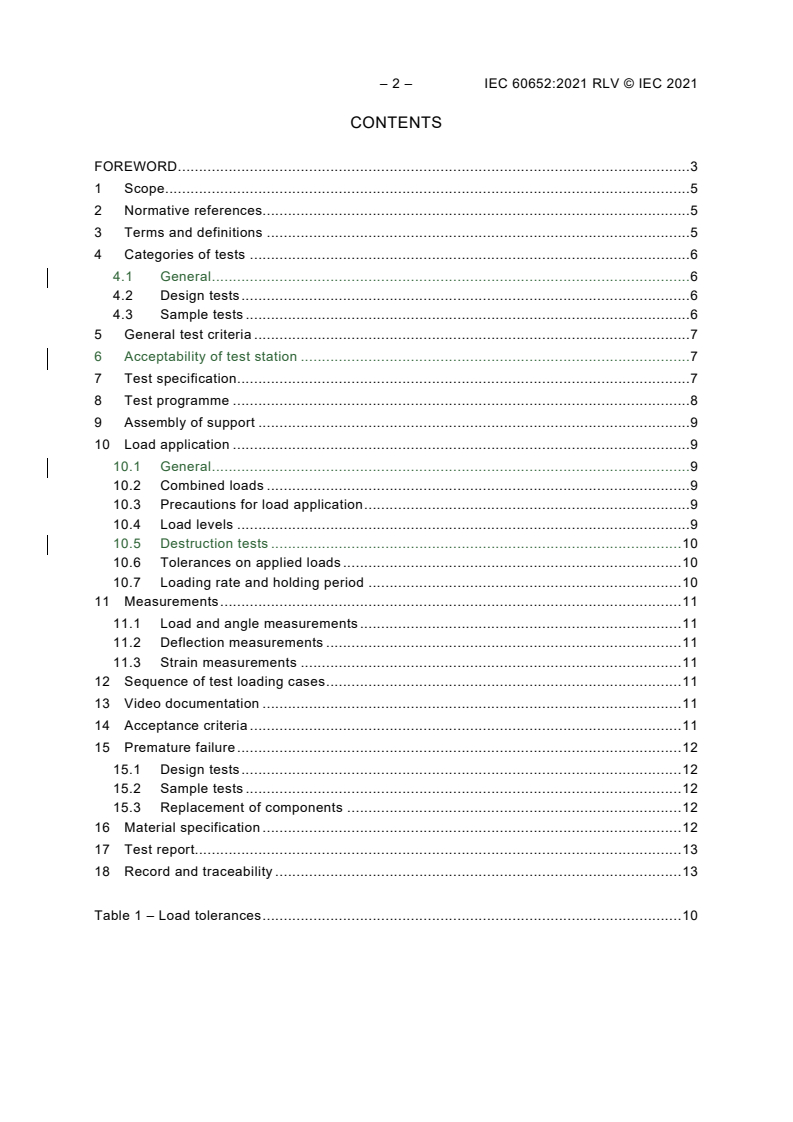
– 2 – IEC 60652:2021 RLV © IEC 2021
CONTENTS
FOREWORD . 3
1 Scope . 5
2 Normative references. 5
3 Terms and definitions . 5
4 Categories of tests . 6
4.1 General . 6
4.2 Design tests . 6
4.3 Sample tests . 6
5 General test criteria . 7
6 Acceptability of test station . 7
7 Test specification . 7
8 Test programme . 8
9 Assembly of support . 9
10 Load application . 9
10.1 General . 9
10.2 Combined loads . 9
10.3 Precautions for load application . 9
10.4 Load levels . 9
10.5 Destruction tests . 10
10.6 Tolerances on applied loads . 10
10.7 Loading rate and holding period . 10
11 Measurements . 11
11.1 Load and angle measurements . 11
11.2 Deflection measurements . 11
11.3 Strain measurements . 11
12 Sequence of test loading cases . 11
13 Video documentation . 11
14 Acceptance criteria . 11
15 Premature failure . 12
15.1 Design tests . 12
15.2 Sample tests . 12
15.3 Replacement of components . 12
16 Material specification . 12
17 Test report. 13
18 Record and traceability . 13
Table 1 – Load tolerances . 10
INTERNATIONAL ELECTROTECHNICAL COMMISSION
____________
LOADING TESTS ON OVERHEAD LINE STRUCTURES – LOADING TESTS
FOREWORD
1) The International Electrotechnical Commission (IEC) is a worldwide organization for standardization comprising
all national electrotechnical committees (IEC National Committees). The object of IEC is to promote international
co-operation on all questions concerning standardization in the electrical and electronic fields. To this end and
in addition to other activities, IEC publishes International Standards, Technical Specifications, Technical Reports,
Publicly Available Specifications (PAS) and Guides (hereafter referred to as “IEC Publication(s)”). Their
preparation is entrusted to technical committees; any IEC National Committee interested in the subject dealt with
may participate in this preparatory work. International, governmental and non-governmental organizations liaising
with the IEC also participate in this preparation. IEC collaborates closely with the International Organization for
Standardization (ISO) in accordance with conditions determined by agreement between the two organizations.
2) The formal decisions or agreements of IEC on technical matters express, as nearly as possible, an international
consensus of opinion on the relevant subjects since each technical committee has representation from all
interested IEC National Committees.
3) IEC Publications have the form of recommendations for international use and are accepted by IEC National
Committees in that sense. While all reasonable efforts are made to ensure that the technical content of IEC
Publications is accurate, IEC cannot be held responsible for the way in which they are used or for any
misinterpretation by any end user.
4) In order to promote international uniformity, IEC National Committees undertake to apply IEC Publications
transparently to the maximum extent possible in their national and regional publications. Any divergence between
any IEC Publication and the corresponding national or regional publication shall be clearly indicated in the latter.
5) IEC itself does not provide any attestation of conformity. Independent certification bodies provide conformity
assessment services and, in some areas, access to IEC marks of conformity. IEC is not responsible for any
services carried out by independent certification bodies.
6) All users should ensure that they have the latest edition of this publication.
7) No liability shall attach to IEC or its directors, employees, servants or agents including individual experts and
members of its technical committees and IEC National Committees for any personal injury, property damage or
other damage of any nature whatsoever, whether direct or indirect, or for costs (including legal fees) and
expenses arising out of the publication, use of, or reliance upon, this IEC Publication or any other IEC
Publications.
8) Attention is drawn to the Normative references cited in this publication. Use of the referenced publications is
indispensable for the correct application of this publication.
9) Attention is drawn to the possibility that some of the elements of this IEC Publication may be the subject of patent
rights. IEC shall not be held responsible for identifying any or all such patent rights.
This redline version of the official IEC Standard allows the user to identify the changes made to
the previous edition IEC 60652:2002. A vertical bar appears in the margin wherever a change has
been made. Additions are in green text, deletions are in strikethrough red text.
– 4 – IEC 60652:2021 RLV © IEC 2021
IEC 60652 has been prepared by IEC technical committee 11: Overhead lines. It is an
International Standard.
This third edition cancels and replaces the second edition published in 2002. This edition
constitutes a technical revision.
This edition includes the following significant technical changes with respect to the previous
edition:
a) Title modified;
b) Added reference to CIGRE Brochure 399;
c) In Clause 7, added test limitation for wind speed and direction during testing;
d) In paragraph 10.5, added load increments for destruction tests;
e) In paragraph 10.7, added a requirement for an agreement between client and testing station
when testing supports made of creep-sensitive materials;
f) In Clause 17, added requirements for sampling procedure to be provided in the test report.
The text of this International Standard is based on the following documents:
FDIS Report on voting
11/276/FDIS 11/277/RVD
Full information on the voting for its approval can be found in the report on voting indicated in
the above table.
The language used for the development of this International Standard is English.
This document was drafted in accordance with ISO/IEC Directives, Part 2, and developed in
accordance with ISO/IEC Directives, Part 1 and ISO/IEC Directives, IEC Supplement, available
at www.iec.ch/members_experts/refdocs. The main document types developed by IEC are
described in greater detail at www.iec.ch/standardsdev/publications.
The committee has decided that the contents of this document will remain unchanged until the
stability date indicated on the IEC website under webstore.iec.ch in the data related to the
specific document. At this date, the document will be
• reconfirmed,
• withdrawn,
• replaced by a revised edition, or
• amended.
IMPORTANT – The 'colour inside' logo on the cover page of this publication indicates that it
contains colours which are considered to be useful for the correct understanding of its
contents. Users should therefore print this document using a colour printer.
LOADING TESTS ON OVERHEAD LINE STRUCTURES – LOADING TESTS
1 Scope
This document codifies specifies the methods and procedures of testing supports for overhead
lines.
It applies to the testing of supports and structures of overhead lines for voltages above 45 kV;
it can also serve as reference to the testing of lower voltage supports.
There is no restriction on the type of material used in the fabrication of the supports which may
include, but not be limited to, metallic alloys, concrete, timber, laminated wood and composite
materials. If required by the client, this document may can also be applied to the testing of
telecommunication supports, railway/tramway overhead electrification supports, electrical
substation gantries, street lighting columns, wind turbine towers, ski-lift supports, etc.
Tests on reduced scale models of supports are not covered by this document.
2 Normative references
The following documents are referred to in the text in such a way that some or all of their content
constitutes requirements of this document. For dated references, only the edition cited applies.
For undated references, the latest edition of the referenced document (including any
amendments) applies.
IEC 60050-466:1990, International Electrotechnical Vocabulary (IEV) – Part 466: Overhead
lines
IEC 60050-466:1990/AMD1:2020
ISO/IEC 17025:19992017, General requirements for the competence of testing and calibration
laboratories
CIGRE Brochure 399:2009, Improvement on the Tower Testing Methodology
3 Terms and definitions
For the purposes of this document, the terms and definitions given in IEC 60050-466:1990 and
the following apply.
3.1
client
organization which contracts with the testing station and provides the test specification
3.2
design load
load for which the support has been designed
3.3
failure load
point limit state loads value at which the support cannot carry any additional load as determined
during the destruction test of the support
NOTE It is also known as the limit state failure load and is determined during a destruction test on the support.
– 6 – IEC 60652:2021 RLV © IEC 2021
3.4
realignment
process used for restoring the original ‘vertical’ position of the tower after being permanently
deformed due to an intermediate loading case testing
Note 1 to entry: This process usually requires release of bolts in connections, pulling back the tower to its original
position, and finally re-tightening bolts. This procedure is not recommended.
3.5
test report
document summarizing all the relevant aspects of the tests
4 Categories of tests
4.1 General
The objective of support tests is to verify the design method and inherent assumptions, the
method of member detailing and the quality of fabrication, manufacture and material.
With respect to the purpose of the test, the level of instrumentation and the method of execution,
this document refers to two categories of tests:
a) design tests;
b) sample tests.
4.2 Design tests
Design tests are normally carried out on full scale prototype supports, with one or more of the
following objectives:
a) as part of a research and/or development programme in the design of an innovative support;
b) to verify compliance of the support design with the specifications (also known as type tests
on a prototype support);
c) to develop and/or validate a new design standard or methodology;
d) to develop and/or validate new fabrication processes.
When tests are carried out to verify design parameters, the test support shall be identical as far
as possible to the serial production supports (see Clause 5, first paragraph). Tests on full scale
sections or part of the support may also be undertaken.
Design tests shall be carried out to at least the design load or to failure, especially when testing
according to 4.2b) and/or 4.2c).
4.3 Sample tests
These are intended for use either prior to or during the fabrication of the production of a batch
of supports to act as a check on the quality of the fabrication, or on the materials being used.
The support may shall be taken at random from the serial production supports during
manufacture. The test constitutes the acceptance of the production.
Sample tests are taken to a specific percentage of the design load (usually 100 %), as stipulated
in the test specification.
5 General test criteria
For a design test (according to 4.2b) or 4.2c)), the material(s) and the manufacturing processes
used in the fabrication of the prototype support shall be to the same specifications as those
used during the serial fabrication of the production supports. These specifications shall include
the member sectional properties, connection details, e.g. bolt or weld sizes, material grades
and fabrication processes. Prior to the commencement of the prototype support fabrication,
agreement shall be made with regard to the surface coating of the support.
Agreement shall also be made with respect to the organization responsible for the checking of
the support prior to the testing.
If a sample test is required on a production support, the components may shall be chosen at
random from the batch.
Whether it is for the design test (according to 4.2b)) or the sample test, the support shall
successfully withstand the loads specified by the client.
6 Acceptability of test station
If required by the client, the testing station shall be accredited by an external organization to
perform this type of test according to the procedures of quality assurance defined by
ISO/IEC 17025:2017.
The following minimum requirements shall be fulfilled by the test station:
• the layout of the station is generally safe (e.g. in case of structure collapse the control
building and the observation area are not located in the danger zone)
• the station has adequate provision to limit the severity of the collapse of the tower in the
event of a failure (e.g. back-stays or others)
• all personnel is provided with adequate personal safety equipment, have received proper
training, and all procedures has been validated from the safety point of view
• all lifting equipment has been regularly maintained, tested and certified
• the station pad is clear of loose material during the test
• the rigging equipment is well maintained (e.g. pulley blocks greased), tested and certified
• the load application devices (e.g. winches, hydraulic rams) do not impart dynamic effects
when operated
• the equipment employed for the mechanical testing of the steel is calibrated
• the load measuring devices are calibrated against an instrument which itself is calibrated
by a recognized independent calibration organization.
7 Test specification
The client shall prepare and transmit to the testing station, at an agreed time prior to the delivery
of the support, the following appropriate information:
• Workshop and/or erection drawings of the support.
• The mass of each section of the support.
• Precautions to be observed during the unloading and unpacking.
• Requirements for the support assembly or disassembly, including if necessary details for
lifting the support from the horizontal.
• Bolt tightening requirements.
– 8 – IEC 60652:2021 RLV © IEC 2021
• The tensions for any guys.
• Nominal force to be applied during slip-joining of sections and/or slip-joint length and their
respective tolerances.
• Foundation setting tolerances and verticality tolerances of the support.
• The category of the test (design or sample).
• The exact position of the load application points for each loading case.
• The design loads to be applied on the support for each loading case.
• (The point of application of the wind loads to be applied on the tower body shall be agreed
between the designer and the test station.)
• The loading cases to be used for tower testing as selected from the tower design load cases
as well as the detailed tower forces at attachment points and tower body to be applied on
the support for each loading case.
• All reactions induced on the foundations of the test support for each loading case to be
tested.
• If the support is to be realigned between individual tests.
• The location of the deflection measuring points for each loading case.
• The position and the orientation of strain gauges, if applicable.
• The areas of the test support to be filmed during the test.
• Limitation of wind speed and wind direction during the test, if applicable.
8 Test programme
The test programme shall be submitted to the client at an agreed date before the test. This
document shall be approved by the client and returned to the testing station within an agreed
period.
The test programme shall include but not be limited to the following information:
• The expected test date.
• A description of the proposed foundations for the test support.
• The method of load application.
• A drawing of the test rigging arrangement and attachment details.
• The position of the dynamometers and/or load cells and the position of angle transducers in
the case of resultant load applications.
• The position of deflection measurement points.
• The position and orientation of strain gauges if appropriate.
• The tolerances (loads, resultant angles, deflections, strain gauges).
• Details of applied loads as per rigging scheme for each test load case, load increment and
holding period.
• Holding period for the final level.
• Loading rate for elastic-plastic materials and creep-sensitive materials. This requirement is
not important or required for steel towers, but could be for some support types such as
reinforced concrete structures subjected to permanent bending or to fibre reinforced
structures.
• The category of the test (design or sample).
9 Assembly of support
The test support shall be erected on a footing that simulates the design assumption.
Footing(s) on which the test report to be erected shall simulate the design assumption.
The testing station shall proceed with the assembly of the support in accordance with the
instructions provided by the client.
In the case where the testing station encounters a difficulty in the assembly or erection of the
support, the client shall be informed and shall decide on the modifications required.
If requested by the client, a report of assembly shall be provided by the testing station. This
report may include a video of the different phases of the assembly and any particular difficulty
encountered.
10 Load application
10.1 General
Loading cases (loads, directions, and load application points) are stated by the client in the test
specification.
10.2 Combined loads
If, for practical purposes, certain loads (e.g. due to wind on the support) have to be combined,
the value of the resultant, its direction, and its application point shall be shown in the test
programme.
10.3 Precautions for load application
The dynamometer/load cells shall be located in the test rigging as close as practical to the load
application point on the support. When this cannot be ensured and/or multi-sheave rigging
blocks are applied between load cells and load attachment point, allowance shall be made for
the friction resistance in the rigging ropes and blocks (refer to Annexes C and D of CIGRE
Brochure 399:2009, for further information) as agreed between the test station and the client.
Similarly, it is recommended that the test rigging should shall be arranged so as to minimize
any load eccentricity. Fittings of the planned insulator strings shall preferably be used for the
load application.
The testing station shall minimize the influence of any contact between the test rigging and the
support; where this is not practical, this shall be drawn to the client’s attention.
Unless otherwise agreed, it is recommended that the difference between the required load and
the measured load at any individual load application point and at any time during the test should
not exceed 5 %.
Loads shall be applied in such a way as to avoid any dynamic effect. However, joint slippage
during the support test shall be accepted.
10.4 Load levels
The test loads shall be applied in increments to 50 %, 75 %, 90 %, 95 % and 100 % of the
specified loads.
If required by the client, additional load levels may be considered.
– 10 – IEC 60652:2021 RLV © IEC 2021
10.5 Destruction tests
If required by the client, destruction tests shall be performed. These tests are to be applied for
normal load cases or anti-cascading loads respectively. For load steps above 100 % of the
specified loads, only horizontal loads shall be increased further. For load cases considering ice,
both horizontal and vertical loads shall be increased further.
For destruction tests (i.e. for each load level above 100 % of the specified loads), it is suggested
that a 5 % load increment be applied for each load step and the load step duration complying
with 10.6.
10.6 Tolerances on applied loads
For each load level, the applied load measurements shall be considered acceptable if they are
within the limits shown in Table 1.
Table 1 – Load tolerances
Load level Acceptable range
% %
50 49 to 51
75 74 to 76
90 89 to 91
95 94 to 96
100 100 to102
Load level Acceptable range for Acceptable range for the
individual load components average of all loads
% % %
50 48 to 53 48 to 53
75 73 to 78 73 to 78
90 88 to 93 88 to 93
95 93 to 98 94 to 96
100 100 to 105 100 to 102
10.7 Loading rate and holding period
For each load increment, the time taken for the load application depends upon the facilities of
the testing station and the time needed for the loads to be adjusted in accordance with 9.4 10.5.
For the final 100 % level, the loads shall be maintained for a minimum of 1 min and for a
maximum of 5 min. The holding period chosen for the final level shall be included in the test
programme.
For the final 100 % level, the loads shall be maintained for a contractual period of time, usually
1 min (this is the minimum holding period criteria for accepting the test and any longer duration
can be agreed upon between the testing station operator and the client prior to testing. Without
previous agreement, the holding period criteria shall be the default value of 1 min). In addition
to the above holding period criteria, an extended holding period, usually of 4 min beyond the
contractual value, can be requested by the client for engineering purposes, but any failure
during this extended period shall not be a criterion for rejecting the test. In order to avoid
possible disputes regarding acceptance or rejection of testing results, it is recommended that
the contractual duration for acceptance of the tests as well as the extended duration be clearly
defined prior to testing.
Before start counting the holding period, the loads shall be in balance. Balance means that the
applied loads are stable.
For supports made of creep-sensitive materials, different loading rates and holding periods may
apply be applied subject to client and testing operator agreement.
11 Measurements
11.1 Load and angle measurements
The accuracy of the dynamometers and/or load cells and/or angle transducers shall be such
that errors in measurement are not greater than 1 % at full scale (including the effect of the test
rigging). The accuracy specified assumes a standard deviation of 3 σ.
All dynamometers and/or load cells and/or angle transducers shall be calibrated before and
after every test series. The calibration instruments shall be certified at least once a year. The
client can specify that at least three load cells shall be calibrated in his presence. This
specification requires the client to be present at the station in due time before the test.
All applied loads and/or resultant angles shall be recorded.
11.2 Deflection measurements
At each load level and when the support is stable, support deflection shall be measured in
accordance with the test specification. The accuracy of measurements shall be 25 10 mm. The
accuracy specified assumes a standard deviation of 3 σ.
11.3 Strain measurements
If requested by the client, strain measurement shall be obtained in accordance with accepted
industry standards. The testing station shall provide the accuracy of measurement of the strain
gauges and/or the instrumented members and synchronize the measurements with applied
loads.
12 Sequence of test loading cases
The sequence of test loading cases shall be determined by the client and stated in the test
specification. It is recommended to choose first those tests having the least influence on the
results of the successive tests. If agreed by the client, the testing station may adjust the test
sequence to simplify the test operations or to reduce the cost of the test.
13 Video documentation
It is recommended that the entire test should be video recorded and the video cross-referenced
with the measurements.
14 Acceptance criteria
The performance of the support shall be considered acceptable if it resists the specified design
loads (at 100 %) for the contractual duration period agreed upon in 10.6 (default value of 1 min)
without failure of any components or assemblies even though a longer holding period may have
been specified.
– 12 – IEC 60652:2021 RLV © IEC 2021
Permanent local deformations such as bowing or twisting of secondary members and
components are acceptable. Ovalization of holes and permanent deformation of bolts shall be
accepted as long as the support meets the above contractual duration period.
Additionally, the requirement of Clause 16 shall be fulfilled.
15 Premature failure
15.1 Design tests
In the event of failure at less than 95 % of the specified design load, the failed component(s)
may shall be replaced by other component(s). The modified structure shall be retested to resist
100 % of the specified design loads.
In the event of failure between 95 % and less than 100 % of the specified design loads, with
the exception of the final load case (frequently the destruction load case), the support shall be
modified and retested. If failure occurs in the final load case, the client may elect not to retest
the modified support.
In the event of failure at 100 % of the specified design loads but at less than 1 min into before
the contractual holding period defined in 10.6 is reached, the client may accept the support
without modification.
15.2 Sample tests
In the event of a failure at less than 100 % of the specified design load, the failed component(s)
shall be replaced by identical components and the support retested. In the event of a
subsequent failure, the client may reject the batch of supports from which the test support has
been drawn.
In the event of a failure at 100 % of the specified design load but at less than 1 min into the
contractual holding period defined in 10.6, the client may accept the batch of supports from
which the test support has been drawn.
15.3 Replacement of components
The partial or complete replacement or modification of elements, assemblies and complete
sections of the support is the responsibility of the client. In case one or a few members are
replaced during testing, previous successful tests do not need to be repeated.
16 Material specification
The selection of materials, manufacturing tolerances and engineering properties
(i.e. geometrical and mechanical characteristics) for the support are the responsibility of the
client.
The materials used for the fabrication of a prototype support shall be representative of the
materials used in serial production structures and within the specified industry standards.
On completion of the test series, it is recommended to take samples from the prototype support
and perform tensile tests in order to verify the compliance of the material with the specifications.
The number and location of samples are the responsibility of the client. Minimum five samples
shall be taken from the most highly stressed members.
If the components of the support do not fulfil the requirements of the applicable industry
standards, the client may declare the test invalid and reject the support.
17 Test report
The testing station shall document all relevant test information and data.
The test report shall include the following data:
a) Indication of the applicable standard for testing supports (IEC 60652:2021).
b) Designation, type, and description of the support.
c) Name of the support manufacturer.
d) Name of the support designer.
e) Name of the client.
f) Dates and location of testing.
g) Sampling method for selection of the structure to be tested.
h) Names of the persons present during the tests.
i) List of workshop and/or erection drawings of the test support, including any modifications.
j) Methods and measurements of the joints assembly.
k) Description of all anomalies and difficulties met during the assembly as well as corrective
measures adopted by the client.
l) Rigging drawing used to apply the test loads.
m) Brief description of the test facility including the number, location, range and calibration
charts or tables of every load and angle transducer or other load measuring devices, as well
as the accuracy of the equipment used to measure the test loads.
n) Loads required at the various points on the support and at each load level.
o) Holding period for the final level.
p) Calibration records.
q) Deflection measurements.
r) Strain gauge measurements if appropriate.
s) In case of failure:
• maximum loads applied to the support prior to failure;
• a description of the failure;
• when required by the client, engineering properties of the failed component(s);
• if required by the client, a video film of the failure.
t) Summary results.
u) Photographs showing the whole support before, during and after tests and, where appro-
priate, details of any failure.
v) Local meteorological data during the tests series (e.g. wind speed and direction,
temperature, etc.).
w) If required by the client, observations of noticeable permanent deformations during the
dismantling.
x) When applicable, the number of the certificate of quality assurance of the station according
to ISO/IEC 17025:2017.
y) If required by the client, the engineering properties of component samples taken from the
support.
18 Record and traceability
The testing station shall keep a record of all relevant information for a time period of at least
10 years or as required by the client. Relevant information includes the test report, calibration
– 14 – IEC 60652:2021 RLV © IEC 2021
and test data, deflection and load time histories, rigging drawings and available video and still
images.
The disposition or storage of the test support is the responsibility of the client.
____________
IEC 60652 ®
Edition 3.0 2021-07
INTERNATIONAL
STANDARD
NORME
INTERNATIONALE
Overhead line structures – Loading tests
Structures des lignes aériennes – Essais mécaniques
– 2 – IEC 60652:2021 © IEC 2021
CONTENTS
FOREWORD . 3
1 Scope . 5
2 Normative references. 5
3 Terms and definitions . 5
4 Categories of tests . 6
4.1 General . 6
4.2 Design tests . 6
4.3 Sample tests . 6
5 General test criteria . 7
6 Acceptability of test station . 7
7 Test specification . 7
8 Test programme . 8
9 Assembly of support . 8
10 Load application . 9
10.1 General . 9
10.2 Combined loads . 9
10.3 Precautions for load application . 9
10.4 Load levels . 9
10.5 Destruction tests . 9
10.6 Tolerances on applied loads . 10
10.7 Loading rate and holding period . 10
11 Measurements . 10
11.1 Load and angle measurements . 10
11.2 Deflection measurements . 10
11.3 Strain measurements . 11
12 Sequence of test loading cases . 11
13 Video documentation . 11
14 Acceptance criteria . 11
15 Premature failure . 11
15.1 Design tests . 11
15.2 Sample tests . 11
15.3 Replacement of components . 12
16 Material specification . 12
17 Test report. 12
18 Record and traceability . 13
Table 1 – Load tolerances . 10
INTERNATIONAL ELECTROTECHNICAL COMMISSION
____________
OVERHEAD LINE STRUCTURES – LOADING TESTS
FOREWORD
1) The International Electrotechnical Commission (IEC) is a worldwide organization for standardization comprising
all national electrotechnical committees (IEC National Committees). The object of IEC is to promote international
co-operation on all questions concerning standardization in the electrical and electronic fields. To this end and
in addition to other activities, IEC publishes International Standards, Technical Specifications, Technical Reports,
Publicly Available Specifications (PAS) and Guides (hereafter referred to as “IEC Publication(s)”). Their
preparation is entrusted to technical committees; any IEC National Committee interested in the subject dealt with
may participate in this preparatory work. International, governmental and non-governmental organizations liaising
with the IEC also participate in this preparation. IEC collaborates closely with the International Organization for
Standardization (ISO) in accordance with conditions determined by agreement between the two organizations.
2) The formal decisions or agreements of IEC on technical matters express, as nearly as possible, an international
consensus of opinion on the relevant subjects since each technical committee has representation from all
interested IEC National Committees.
3) IEC Publications have the form of recommendations for international use and are accepted by IEC National
Committees in that sense. While all reasonable efforts are made to ensure that the technical content of IEC
Publications is accurate, IEC cannot be held responsible for the way in which they are used or for any
misinterpretation by any end user.
4) In order to promote international uniformity, IEC National Committees undertake to apply IEC Publications
transparently to the maximum extent possible in their national and regional publications. Any divergence between
any IEC Publication and the corresponding national or regional publication shall be clearly indicated in the latter.
5) IEC itself does not provide any attestation of conformity. Independent certification bodies provide conformity
assessment services and, in some areas, access to IEC marks of conformity. IEC is not responsible for any
services carried out by independent certification bodies.
6) All users should ensure that they have the latest edition of this publication.
7) No liability shall attach to IEC or its directors, employees, servants or agents including individual experts and
members of its technical committees and IEC National Committees for any personal injury, property damage or
...
IEC 60652 ®
Edition 3.0 2021-07
INTERNATIONAL
STANDARD
NORME
INTERNATIONALE
Overhead line structures – Loading tests
Structures des lignes aériennes – Essais mécaniques
All rights reserved. Unless otherwise specified, no part of this publication may be reproduced or utilized in any form
or by any means, electronic or mechanical, including photocopying and microfilm, without permission in writing from
either IEC or IEC's member National Committee in the country of the requester. If you have any questions about IEC
copyright or have an enquiry about obtaining additional rights to this publication, please contact the address below or
your local IEC member National Committee for further information.
Droits de reproduction réservés. Sauf indication contraire, aucune partie de cette publication ne peut être reproduite
ni utilisée sous quelque forme que ce soit et par aucun procédé, électronique ou mécanique, y compris la photocopie
et les microfilms, sans l'accord écrit de l'IEC ou du Comité national de l'IEC du pays du demandeur. Si vous avez des
questions sur le copyright de l'IEC ou si vous désirez obtenir des droits supplémentaires sur cette publication, utilisez
les coordonnées ci-après ou contactez le Comité national de l'IEC de votre pays de résidence.
IEC Central Office Tel.: +41 22 919 02 11
3, rue de Varembé info@iec.ch
CH-1211 Geneva 20 www.iec.ch
Switzerland
About the IEC
The International Electrotechnical Commission (IEC) is the leading global organization that prepares and publishes
International Standards for all electrical, electronic and related technologies.
About IEC publications
The technical content of IEC publications is kept under constant review by the IEC. Please make sure that you have the
latest edition, a corrigendum or an amendment might have been published.
IEC publications search - webstore.iec.ch/advsearchform IEC online collection - oc.iec.ch
The advanced search enables to find IEC publications by a Discover our powerful search engine and read freely all the
variety of criteria (reference number, text, technical publications previews. With a subscription you will always
committee, …). It also gives information on projects, replaced have access to up to date content tailored to your needs.
and withdrawn publications.
Electropedia - www.electropedia.org
IEC Just Published - webstore.iec.ch/justpublished
The world's leading online dictionary on electrotechnology,
Stay up to date on all new IEC publications. Just Published
containing more than 22 000 terminological entries in English
details all new publications released. Available online and
and French, with equivalent terms in 18 additional languages.
once a month by email.
Also known as the International Electrotechnical Vocabulary
(IEV) online.
IEC Customer Service Centre - webstore.iec.ch/csc
If you wish to give us your feedback on this publication or
need further assistance, please contact the Customer Service
Centre: sales@iec.ch.
A propos de l'IEC
La Commission Electrotechnique Internationale (IEC) est la première organisation mondiale qui élabore et publie des
Normes internationales pour tout ce qui a trait à l'électricité, à l'électronique et aux technologies apparentées.
A propos des publications IEC
Le contenu technique des publications IEC est constamment revu. Veuillez vous assurer que vous possédez l’édition la
plus récente, un corrigendum ou amendement peut avoir été publié.
Recherche de publications IEC - IEC online collection - oc.iec.ch
webstore.iec.ch/advsearchform Découvrez notre puissant moteur de recherche et consultez
La recherche avancée permet de trouver des publications IEC gratuitement tous les aperçus des publications. Avec un
en utilisant différents critères (numéro de référence, texte, abonnement, vous aurez toujours accès à un contenu à jour
comité d’études, …). Elle donne aussi des informations sur adapté à vos besoins.
les projets et les publications remplacées ou retirées.
Electropedia - www.electropedia.org
IEC Just Published - webstore.iec.ch/justpublished
Le premier dictionnaire d'électrotechnologie en ligne au
Restez informé sur les nouvelles publications IEC. Just
monde, avec plus de 22 000 articles terminologiques en
Published détaille les nouvelles publications parues.
anglais et en français, ainsi que les termes équivalents dans
Disponible en ligne et une fois par mois par email.
16 langues additionnelles. Egalement appelé Vocabulaire
Electrotechnique International (IEV) en ligne.
Service Clients - webstore.iec.ch/csc
Si vous désirez nous donner des commentaires sur cette
publication ou si vous avez des questions contactez-nous:
sales@iec.ch.
IEC 60652 ®
Edition 3.0 2021-07
INTERNATIONAL
STANDARD
NORME
INTERNATIONALE
Overhead line structures – Loading tests
Structures des lignes aériennes – Essais mécaniques
INTERNATIONAL
ELECTROTECHNICAL
COMMISSION
COMMISSION
ELECTROTECHNIQUE
INTERNATIONALE
ICS 29.240.20 ISBN 978-2-8322-9958-6
– 2 – IEC 60652:2021 © IEC 2021
CONTENTS
FOREWORD . 3
1 Scope . 5
2 Normative references. 5
3 Terms and definitions . 5
4 Categories of tests . 6
4.1 General . 6
4.2 Design tests . 6
4.3 Sample tests . 6
5 General test criteria . 7
6 Acceptability of test station . 7
7 Test specification . 7
8 Test programme . 8
9 Assembly of support . 8
10 Load application . 9
10.1 General . 9
10.2 Combined loads . 9
10.3 Precautions for load application . 9
10.4 Load levels . 9
10.5 Destruction tests . 9
10.6 Tolerances on applied loads . 10
10.7 Loading rate and holding period . 10
11 Measurements . 10
11.1 Load and angle measurements . 10
11.2 Deflection measurements . 10
11.3 Strain measurements . 11
12 Sequence of test loading cases . 11
13 Video documentation . 11
14 Acceptance criteria . 11
15 Premature failure . 11
15.1 Design tests . 11
15.2 Sample tests . 11
15.3 Replacement of components . 12
16 Material specification . 12
17 Test report. 12
18 Record and traceability . 13
Table 1 – Load tolerances . 10
INTERNATIONAL ELECTROTECHNICAL COMMISSION
____________
OVERHEAD LINE STRUCTURES – LOADING TESTS
FOREWORD
1) The International Electrotechnical Commission (IEC) is a worldwide organization for standardization comprising
all national electrotechnical committees (IEC National Committees). The object of IEC is to promote international
co-operation on all questions concerning standardization in the electrical and electronic fields. To this end and
in addition to other activities, IEC publishes International Standards, Technical Specifications, Technical Reports,
Publicly Available Specifications (PAS) and Guides (hereafter referred to as “IEC Publication(s)”). Their
preparation is entrusted to technical committees; any IEC National Committee interested in the subject dealt with
may participate in this preparatory work. International, governmental and non-governmental organizations liaising
with the IEC also participate in this preparation. IEC collaborates closely with the International Organization for
Standardization (ISO) in accordance with conditions determined by agreement between the two organizations.
2) The formal decisions or agreements of IEC on technical matters express, as nearly as possible, an international
consensus of opinion on the relevant subjects since each technical committee has representation from all
interested IEC National Committees.
3) IEC Publications have the form of recommendations for international use and are accepted by IEC National
Committees in that sense. While all reasonable efforts are made to ensure that the technical content of IEC
Publications is accurate, IEC cannot be held responsible for the way in which they are used or for any
misinterpretation by any end user.
4) In order to promote international uniformity, IEC National Committees undertake to apply IEC Publications
transparently to the maximum extent possible in their national and regional publications. Any divergence between
any IEC Publication and the corresponding national or regional publication shall be clearly indicated in the latter.
5) IEC itself does not provide any attestation of conformity. Independent certification bodies provide conformity
assessment services and, in some areas, access to IEC marks of conformity. IEC is not responsible for any
services carried out by independent certification bodies.
6) All users should ensure that they have the latest edition of this publication.
7) No liability shall attach to IEC or its directors, employees, servants or agents including individual experts and
members of its technical committees and IEC National Committees for any personal injury, property damage or
other damage of any nature whatsoever, whether direct or indirect, or for costs (including legal fees) and
expenses arising out of the publication, use of, or reliance upon, this IEC Publication or any other IEC
Publications.
8) Attention is drawn to the Normative references cited in this publication. Use of the referenced publications is
indispensable for the correct application of this publication.
9) Attention is drawn to the possibility that some of the elements of this IEC Publication may be the subject of patent
rights. IEC shall not be held responsible for identifying any or all such patent rights.
IEC 60652 has been prepared by IEC technical committee 11: Overhead lines. It is an
International Standard.
This third edition cancels and replaces the second edition published in 2002. This edition
constitutes a technical revision.
This edition includes the following significant technical changes with respect to the previous
edition:
a) Title modified;
b) Added reference to CIGRE Brochure 399;
c) In Clause 7, added test limitation for wind speed and direction during testing;
d) In paragraph 10.5, added load increments for destruction tests;
e) In paragraph 10.7, added a requirement for an agreement between client and testing station
when testing supports made of creep-sensitive materials;
f) In Clause 17, added requirements for sampling procedure to be provided in the test report.
– 4 – IEC 60652:2021 © IEC 2021
The text of this International Standard is based on the following documents:
FDIS Report on voting
11/276/FDIS 11/277/RVD
Full information on the voting for its approval can be found in the report on voting indicated in
the above table.
The language used for the development of this International Standard is English.
This document was drafted in accordance with ISO/IEC Directives, Part 2, and developed in
accordance with ISO/IEC Directives, Part 1 and ISO/IEC Directives, IEC Supplement, available
at www.iec.ch/members_experts/refdocs. The main document types developed by IEC are
described in greater detail at www.iec.ch/standardsdev/publications.
The committee has decided that the contents of this document will remain unchanged until the
stability date indicated on the IEC website under webstore.iec.ch in the data related to the
specific document. At this date, the document will be
• reconfirmed,
• withdrawn,
• replaced by a revised edition, or
• amended.
OVERHEAD LINE STRUCTURES – LOADING TESTS
1 Scope
This document specifies the methods and procedures of testing supports for overhead lines.
It applies to the testing of supports and structures of overhead lines.
There is no restriction on the type of material used in the fabrication of the supports which may
include, but not be limited to, metallic alloys, concrete, timber, laminated wood and composite
materials. If required by the client, this document can also be applied to the testing of
telecommunication supports, railway/tramway overhead electrification supports, electrical
substation gantries, street lighting columns, wind turbine towers, ski-lift supports, etc.
Tests on reduced scale models of supports are not covered by this document.
2 Normative references
The following documents are referred to in the text in such a way that some or all of their content
constitutes requirements of this document. For dated references, only the edition cited applies.
For undated references, the latest edition of the referenced document (including any
amendments) applies.
IEC 60050-466:1990, International Electrotechnical Vocabulary (IEV) – Part 466: Overhead
lines
IEC 60050-466:1990/AMD1:2020
ISO/IEC 17025:2017, General requirements for the competence of testing and calibration
laboratories
CIGRE Brochure 399:2009, Improvement on the Tower Testing Methodology
3 Terms and definitions
For the purposes of this document, the terms and definitions given in IEC 60050-466:1990 and
the following apply.
3.1
client
organization which contracts with the testing station and provides the test specification
3.2
design load
load for which the support has been designed
3.3
failure load
limit state loads value at which the support cannot carry any additional load as determined
during the destruction test of the support
– 6 – IEC 60652:2021 © IEC 2021
3.4
realignment
process used for restoring the original ‘vertical’ position of the tower after being permanently
deformed due to an intermediate loading case testing
Note 1 to entry: This process usually requires release of bolts in connections, pulling back the tower to its original
position, and finally re-tightening bolts. This procedure is not recommended.
3.5
test report
document summarizing all the relevant aspects of the tests
4 Categories of tests
4.1 General
The objective of support tests is to verify the design method and inherent assumptions, the
method of member detailing and the quality of fabrication, manufacture and material.
With respect to the purpose of the test, the level of instrumentation and the method of execution,
this document refers to two categories of tests:
a) design tests;
b) sample tests.
4.2 Design tests
Design tests are normally carried out on full scale prototype supports, with one or more of the
following objectives:
a) as part of a research and/or development programme in the design of an innovative support;
b) to verify compliance of the support design with the specifications (also known as type tests
on a prototype support);
c) to develop and/or validate a new design standard or methodology;
d) to develop and/or validate new fabrication processes.
When tests are carried out to verify design parameters, the test support shall be identical as far
as possible to the serial production supports (see Clause 5, first paragraph). Tests on full scale
sections or part of the support may also be undertaken.
Design tests shall be carried out to at least the design load or to failure, especially when testing
according to 4.2b) and/or 4.2c).
4.3 Sample tests
These are intended for use either prior to or during the fabrication of the production of a batch
of supports to act as a check on the quality of the fabrication, or on the materials being used.
The support shall be taken at random from the serial production supports during manufacture.
The test constitutes the acceptance of the production.
Sample tests are taken to a specific percentage of the design load (usually 100 %), as stipulated
in the test specification.
5 General test criteria
For a design test (according to 4.2b) or 4.2c)), the material(s) and the manufacturing processes
used in the fabrication of the prototype support shall be to the same specifications as those
used during the serial fabrication of the supports. These specifications shall include the member
sectional properties, connection details, e.g. bolt or weld sizes, material grades and fabrication
processes. Prior to the commencement of the prototype support fabrication, agreement shall
be made with regard to the surface coating of the support.
Agreement shall also be made with respect to the organization responsible for the checking of
the support prior to the testing.
If a sample test is required on a production support, the components shall be chosen at random
from the batch.
Whether it is for the design test (according to 4.2b)) or the sample test, the support shall
successfully withstand the loads specified by the client.
6 Acceptability of test station
If required by the client, the testing station shall be accredited by an external organization to
perform this type of test according to the procedures of quality assurance defined by
ISO/IEC 17025:2017.
The following minimum requirements shall be fulfilled by the test station:
• the layout of the station is generally safe (e.g. in case of structure collapse the control
building and the observation area are not located in the danger zone)
• the station has adequate provision to limit the severity of the collapse of the tower in the
event of a failure (e.g. back-stays or others)
• all personnel is provided with adequate personal safety equipment, have received proper
training, and all procedures has been validated from the safety point of view
• all lifting equipment has been regularly maintained, tested and certified
• the station pad is clear of loose material during the test
• the rigging equipment is well maintained (e.g. pulley blocks greased), tested and certified
• the load application devices (e.g. winches, hydraulic rams) do not impart dynamic effects
when operated
• the equipment employed for the mechanical testing of the steel is calibrated
• the load measuring devices are calibrated against an instrument which itself is calibrated
by a recognized independent calibration organization.
7 Test specification
The client shall prepare and transmit to the testing station, at an agreed time prior to the delivery
of the support, the following appropriate information:
• Workshop and/or erection drawings of the support.
• The mass of each section of the support.
• Precautions to be observed during the unloading and unpacking.
• Requirements for the support assembly or disassembly, including if necessary details for
lifting the support from the horizontal.
• Bolt tightening requirements.
– 8 – IEC 60652:2021 © IEC 2021
• The tensions for any guys.
• Nominal force to be applied during slip-joining of sections and/or slip-joint length and their
respective tolerances.
• Foundation setting tolerances and verticality tolerances of the support.
• The category of the test (design or sample).
• The exact position of the load application points for each loading case.
• (The point of application of the wind loads to be applied on the tower body shall be agreed
between the designer and the test station.)
• The loading cases to be used for tower testing as selected from the tower design load cases
as well as the detailed tower forces at attachment points and tower body to be applied on
the support for each loading case.
• All reactions induced on the foundations of the test support for each loading case to be
tested.
• The location of the deflection measuring points for each loading case.
• The position and the orientation of strain gauges, if applicable.
• The areas of the test support to be filmed during the test.
• Limitation of wind speed and wind direction during the test, if applicable.
8 Test programme
The test programme shall be submitted to the client at an agreed date before the test. This
document shall be approved by the client and returned to the testing station within an agreed
period.
The test programme shall include but not be limited to the following information:
• The expected test date.
• A description of the proposed foundations for the test support.
• The method of load application.
• A drawing of the test rigging arrangement and attachment details.
• The position of the dynamometers and/or load cells and the position of angle transducers in
the case of resultant load applications.
• The position of deflection measurement points.
• The position and orientation of strain gauges if appropriate.
• The tolerances (loads, resultant angles, deflections, strain gauges).
• Details of applied loads as per rigging scheme for each test load case, load increment and
holding period.
• Holding period for the final level.
• Loading rate for elastic-plastic materials and creep-sensitive materials. This requirement is
not important or required for steel towers, but could be for some support types such as
reinforced concrete structures subjected to permanent bending or to fibre reinforced
structures.
• The category of the test (design or sample).
9 Assembly of support
Footing(s) on which the test report to be erected shall simulate the design assumption.
The testing station shall proceed with the assembly of the support in accordance with the
instructions provided by the client.
In the case where the testing station encounters a difficulty in the assembly or erection of the
support, the client shall be informed and shall decide on the modifications required.
If requested by the client, a report of assembly shall be provided by the testing station. This
report may include a video of the different phases of the assembly and any particular difficulty
encountered.
10 Load application
10.1 General
Loading cases (loads, directions, and load application points) are stated by the client in the test
specification.
10.2 Combined loads
If, for practical purposes, certain loads (e.g. due to wind on the support) have to be combined,
the value of the resultant, its direction, and its application point shall be shown in the test
programme.
10.3 Precautions for load application
The dynamometer/load cells shall be located in the test rigging as close as practical to the load
application point on the support. When this cannot be ensured and/or multi-sheave rigging
blocks are applied between load cells and load attachment point, allowance shall be made for
the friction resistance in the rigging ropes and blocks (refer to Annexes C and D of CIGRE
Brochure 399:2009, for further information) as agreed between the test station and the client.
Similarly, it is recommended that the test rigging shall be arranged so as to minimize any load
eccentricity. Fittings of the planned insulator strings shall preferably be used for the load
application.
The testing station shall minimize the influence of any contact between the test rigging and the
support; where this is not practical, this shall be drawn to the client’s attention.
Loads shall be applied in such a way as to avoid any dynamic effect. However, joint slippage
during the support test shall be accepted.
10.4 Load levels
The test loads shall be applied in increments to 50 %, 75 %, 90 %, 95 % and 100 % of the
specified loads.
If required by the client, additional load levels may be considered.
10.5 Destruction tests
If required by the client, destruction tests shall be performed. These tests are to be applied for
normal load cases or anti-cascading loads respectively. For load steps above 100 % of the
specified loads, only horizontal loads shall be increased further. For load cases considering ice,
both horizontal and vertical loads shall be increased further.
For destruction tests (i.e. for each load level above 100 % of the specified loads), it is suggested
that a 5 % load increment be applied for each load step and the load step duration complying
with 10.6.
– 10 – IEC 60652:2021 © IEC 2021
10.6 Tolerances on applied loads
For each load level, the applied load measurements shall be considered acceptable if they are
within the limits shown in Table 1.
Table 1 – Load tolerances
Load level Acceptable range for Acceptable range for the
individual load components average of all loads
% % %
50 48 to 53 48 to 53
75 73 to 78 73 to 78
90 88 to 93 88 to 93
95 93 to 98 94 to 96
100 100 to 105 100 to 102
10.7 Loading rate and holding period
For each load increment, the time taken for the load application depends upon the facilities of
the testing station and the time needed for the loads to be adjusted in accordance with 10.5.
For the final 100 % level, the loads shall be maintained for a contractual period of time, usually
1 min (this is the minimum holding period criteria for accepting the test and any longer duration
can be agreed upon between the testing station operator and the client prior to testing. Without
previous agreement, the holding period criteria shall be the default value of 1 min). In addition
to the above holding period criteria, an extended holding period, usually of 4 min beyond the
contractual value, can be requested by the client for engineering purposes, but any failure
during this extended period shall not be a criterion for rejecting the test. In order to avoid
possible disputes regarding acceptance or rejection of testing results, it is recommended that
the contractual duration for acceptance of the tests as well as the extended duration be clearly
defined prior to testing.
Before start counting the holding period, the loads shall be in balance. Balance means that the
applied loads are stable.
For supports made of creep-sensitive materials, different loading rates and holding periods may
be applied subject to client and testing operator agreement.
11 Measurements
11.1 Load and angle measurements
The accuracy of the dynamometers and/or load cells and/or angle transducers shall be such
that errors in measurement are not greater than 1 % at full scale.
All dynamometers and/or load cells and/or angle transducers shall be calibrated before and
after every test series. The client can specify that at least three load cells shall be calibrated in
his presence. This specification requires the client to be present at the station in due time before
the test.
All applied loads and/or resultant angles shall be recorded.
11.2 Deflection measurements
At each load level and when the support is stable, support deflection shall be measured in
accordance with the test specification. The accuracy of measurements shall be 10 mm.
11.3 Strain measurements
If requested by the client, strain measurement shall be obtained in accordance with accepted
industry standards. The testing station shall provide the accuracy of measurement of the strain
gauges and/or the instrumented members and synchronize the measurements with applied
loads.
12 Sequence of test loading cases
The sequence of test loading cases shall be determined by the client and stated in the test
specification. It is recommended to choose first those tests having the least influence on the
results of the successive tests. If agreed by the client, the testing station may adjust the test
sequence to simplify the test operations or to reduce the cost of the test.
13 Video documentation
It is recommended that the entire test should be video recorded and the video cross-referenced
with the measurements.
14 Acceptance criteria
The performance of the support shall be considered acceptable if it resists the specified design
loads (at 100 %) for the contractual duration period agreed upon in 10.6 (default value of 1 min)
without failure of any components or assemblies.
Permanent local deformations such as bowing or twisting of secondary members and
components are acceptable. Ovalization of holes and permanent deformation of bolts shall be
accepted as long as the support meets the above contractual duration period.
Additionally, the requirement of Clause 16 shall be fulfilled.
15 Premature failure
15.1 Design tests
In the event of failure at less than 95 % of the specified design load, the failed component(s)
shall be replaced by other component(s). The modified structure shall be retested to resist
100 % of the specified design loads.
In the event of failure between 95 % and less than 100 % of the specified design loads, with
the exception of the final load case (frequently the destruction load case), the support shall be
modified and retested. If failure occurs in the final load case, the client may elect not to retest
the modified support.
In the event of failure at 100 % of the specified design loads but before the contractual holding
period defined in 10.6 is reached, the client may accept the support without modification.
15.2 Sample tests
In the event of a failure at less than 100 % of the specified design load, the failed component(s)
shall be replaced by identical components and the support retested. In the event of a
subsequent failure, the client may reject the batch of supports from which the test support has
been drawn.
– 12 – IEC 60652:2021 © IEC 2021
In the event of a failure at 100 % of the specified design load but at less than the contractual
holding period defined in 10.6, the client may accept the batch of supports from which the test
support has been drawn.
15.3 Replacement of components
The partial or complete replacement or modification of elements, assemblies and complete
sections of the support is the responsibility of the client. In case one or a few members are
replaced during testing, previous successful tests do not need to be repeated.
16 Material specification
The selection of materials, manufacturing tolerances and engineering properties
(i.e. geometrical and mechanical characteristics) for the support are the responsibility of the
client.
The materials used for the fabrication of a prototype support shall be representative of the
materials used in serial production structures and within the specified industry standards.
On completion of the test series, it is recommended to take samples from the prototype support
and perform tensile tests in order to verify the compliance of the material with the specifications.
The number and location of samples are the responsibility of the client. Minimum five samples
shall be taken from the most highly stressed members.
If the components of the support do not fulfil the requirements of the applicable industry
standards, the client may declare the test invalid and reject the support.
17 Test report
The testing station shall document all relevant test information and data.
The test report shall include the following data:
a) Indication of the applicable standard for testing supports (IEC 60652:2021).
b) Designation, type, and description of the support.
c) Name of the support manufacturer.
d) Name of the support designer.
e) Name of the client.
f) Dates and location of testing.
g) Sampling method for selection of the structure to be tested.
h) Names of the persons present during the tests.
i) List of workshop and/or erection drawings of the test support, including any modifications.
j) Methods and measurements of the joints assembly.
k) Description of all anomalies and difficulties met during the assembly as well as corrective
measures adopted by the client.
l) Rigging drawing used to apply the test loads.
m) Brief description of the test facility including the number, location, range and calibration
charts or tables of every load and angle transducer or other load measuring devices, as well
as the accuracy of the equipment used to measure the test loads.
n) Loads required at the various points on the support and at each load level.
o) Holding period for the final level.
p) Calibration records.
q) Deflection measurements.
r) Strain gauge measurements if appropriate.
s) In case of failure:
• maximum loads applied to the support prior to failure;
• a description of the failure;
• when required by the client, engineering properties of the failed component(s);
• if required by the client, a video film of the failure.
t) Summary results.
u) Photographs showing the whole support before, during and after tests and, where appro-
priate, details of any failure.
v) Local meteorological data during the tests series (e.g. wind speed and direction,
temperature, etc.).
w) If required by the client, observations of noticeable permanent deformations during the
dismantling.
x) When applicable, the number of the certificate of quality assurance of the station according
to ISO/IEC 17025:2017.
y) If required by the client, the engineering properties of component samples taken from the
support.
18 Record and traceability
The testing station shall keep a record of all relevant information for a time period of at least
10 years or as required by the client. Relevant information includes the test report, calibration
and test data, deflection and load time histories, rigging drawings and available video and still
images.
The disposition or storage of the test support is the responsibility of the client.
____________
– 14 – IEC 60652:2021 © IEC 2021
SOMMAIRE
AVANT-PROPOS . 15
1 Domaine d'application . 17
2 Références normatives . 17
3 Termes et définitions . 17
4 Catégories d'essais . 18
4.1 Généralités . 18
4.2 Essais de conception . 18
4.3 Essais sur échantillon . 18
5 Critères d'essai généraux . 19
6 Acceptabilité de la station d'essais . 19
7 Spécification d'essai . 20
8 Programme d'essais . 20
9 Assemblage du support . 21
10 Application de la charge. 21
10.1 Généralités . 21
10.2 Charges combinées. 21
10.3 Précautions pour l'application de la charge . 21
10.4 Niveaux de charges . 22
10.5 Essais destructifs . 22
10.6 Tolérances sur les charges appliquées . 22
10.7 Vitesse d'application de la charge et période de maintien . 22
11 Mesurages . 23
11.1 Mesurage des efforts et des angles . 23
11.2 Mesurage des déplacements . 23
11.3 Mesurage des contraintes . 23
12 Séquence d'exécution des cas de charge d'essai . 23
13 Documentation vidéo . 23
14 Critères d'acceptation . 23
15 Rupture prématurée . 24
15.1 Essais de conception . 24
15.2 Essais sur échantillon . 24
15.3 Remplacement de composants . 24
16 Spécification du matériau . 24
17 Rapport d'essai . 25
18 Archivage et traçabilité . 26
Tableau 1 – Tolérances sur les charges . 22
COMMISSION ÉLECTROTECHNIQUE INTERNATIONALE
____________
STRUCTURES DES LIGNES AÉRIENNES – ESSAIS MÉCANIQUES
AVANT-PROPOS
1) La Commission Electrotechnique Internationale (IEC) est une organisation mondiale de normalisation composée
de l'ensemble des comités électrotechniques nationaux (Comités nationaux de l’IEC). L'IEC a pour objet de
favoriser la coopération internationale pour toutes les questions de normalisation dans les domaines de
l'électricité et de l'électronique. A cet effet, l'IEC – entre autres activités – publie des Normes internationales,
des Spécifications techniques, des Rapports techniques, des Spécifications accessibles au public (PAS) et des
Guides (ci-après dénommés "Publication(s) de l'IEC"). Leur élaboration est confiée à des comités d'études, aux
travaux desquels tout Comité national intéressé par le sujet traité peut participer. Les organisations
internationales, gouvernementales et non gouvernementales, en liaison avec l'IEC, participent également aux
travaux. L'IEC collabore étroitement avec l'Organisation Internationale de Normalisation (ISO), selon des
conditions fixées par accord entre les deux organisations.
2) Les décisions ou accords officiels de l'IEC concernant les questions techniques représentent, dans la mesure du
possible, un accord international sur les sujets étudiés, étant donné que les Comités nationaux de l'IEC intéressés
sont représentés dans chaque comité d'études.
3) Les Publications de l'IEC se présentent sous la forme de recommandations internationales et sont agréées
comme telles par les Comités nationaux de l'IEC. Tous les efforts raisonnables sont entrepris afin que l'IEC
s'assure de l'exactitude du contenu technique de ses publications; l'IEC ne peut pas être tenue responsable de
l'éventuelle mauvaise utilisation ou interprétation qui en est faite par un quelconque utilisateur final.
4) Dans le but d'encourager l'uniformité internationale, les Comités nationaux de l'IEC s'engagent, dans toute la
mesure possible, à appliquer de façon transparente les Publications de l'IEC dans leurs publications nationales
et régionales. Toutes divergences entre toutes Publications de l'IEC et toutes publications nationales ou
régionales correspondantes doivent être indiquées en termes clairs dans ces dernières.
5) L'IEC elle-même ne fournit aucune attestation de conformité. Des organismes de certification indépendants
fournissent des services d'évalua
...