

IEC TR 62869:2013
(Main)Activities and considerations related to wireless power transfer (WPT) for audio, video and multimedia systems and equipment
General Information
- Abstract
IEC/TR 62869:2013(E) addresses activities and considerations related to wireless power transfer for audio, video and multimedia systems and equipment. It combines public information, contributions by experts and completed IEC TC 100 WPT survey responses and reviews global market conditions. The TR describes a range of WPT technical approaches with the aid of a system reference model, outlines the impacts on WPT of applicable regulation and surveys standards development organization (SDO) and private industry consortium-led activities in support of WPT technical standards development. The TR concludes with observations and recommendations for potential future technical standards development activities that lie within scope of IEC TC 100.
- Status
- Published
- Publication Date
- 08-Jul-2013
- Technical Committee
- TA 15 - Wireless Power Transfer
- Drafting Committee
- WG 1 - TC 100/TA 15/WG 1
- Current Stage
- PPUB - Publication issued
- Start Date
- 09-Jul-2013
- Completion Date
- 31-Oct-2013
Overview
IEC TR 62869:2013 is a technical report published by the International Electrotechnical Commission (IEC) that addresses activities and considerations related to wireless power transfer (WPT) for audio, video, and multimedia systems and equipment. This report provides a comprehensive review of the state of WPT technology, market landscape, regulatory considerations, and standards development activities. The aim is to offer a holistic overview that supports future advancements and standardization within the consumer electronics sector.
Wireless power transfer enables the delivery of electrical energy without direct physical contacts like wires or connectors. With the increasing demand for seamless charging solutions in consumer electronics, especially audio-visual and multimedia devices, WPT is becoming integral to market innovation and user convenience.
Key Topics
WPT Technologies:
The technical report details several WPT methods, including:- Electromagnetic induction
- Magnetic resonance
- Capacitive coupling
- Microwave power transfer and energy harvesting
System Reference Model: The document introduces a high-level system reference model to compare different WPT approaches, consisting of one or more sources and sinks that interact via a coil subsystem.
Regulatory Framework:
- Addresses regulations on spectrum use, safety, RF (radio frequency) emissions, and electromagnetic compatibility.
- Discusses compliance requirements and safety limits relevant to the global market.
Market Analysis:
- Evaluates global market conditions including current technologies, segmentation, size, and geographic reach.
- Identifies various consumer electronics applications and the diversity of device power requirements.
Standards Development Activities:
- Summarizes ongoing initiatives by international, regional, and private organizations.
- Highlights efforts by industry consortia and standards development organizations (SDOs) to harmonize WPT standards.
Applications
IEC TR 62869:2013 highlights a wide range of practical applications for WPT in consumer electronics:
- Mobile Devices:
- Smartphones, tablets, and laptops benefit from wireless charging, supporting user expectations for convenience and device mobility.
- Audio and Video Equipment:
- Integration of WPT in headphones, speakers, remote controls, and portable projectors eliminates the need for frequent battery replacements and cables.
- Professional and Public Spaces:
- Offices, educational institutions, retail environments, and transportation hubs can incorporate WPT to provide on-demand power for multiple device types, enhancing the user experience.
- Beyond Consumer Electronics:
- Although focused on multimedia systems, WPT principles apply to broader contexts such as electric vehicles and industrial automation.
The report identifies key drivers for WPT adoption:
- Reduction in electronic waste by minimizing disposable batteries and chargers.
- Increased device availability and reliability through ubiquitous charging infrastructure.
- Enhanced end-user safety and mobility.
Related Standards
A variety of international standards and industry initiatives are referenced within the report, including:
- Wireless Power Consortium (WPC): Develops interoperability standards such as Qi for wireless charging.
- Power Matters Alliance (PMA) and Alliance for Wireless Power (A4WP): Define alternative approaches to interoperable wireless power.
- IEC TC 100: Oversees standardization for audio, video, and multimedia systems.
- Regulatory and SDO Contributions:
- ETSI (European Telecommunications Standards Institute)
- ARIB (Association of Radio Industries and Businesses)
- ISO/IEC JTC 1
- UL (Underwriters Laboratories)
These organizations contribute globally to the harmonization and advancement of WPT standards, ensuring safe, reliable, and interoperable wireless power solutions for the evolving consumer electronics marketplace.
In summary, IEC TR 62869:2013 serves as a foundational resource for stakeholders in the wireless power transfer ecosystem, offering practical insights into technology trends, regulatory compliance, and international standardization efforts critical for future growth.
Get Certified
Connect with accredited certification bodies for this standard

IMQ S.p.A. (Certification)
Italian electrical product certification.

SLG Prüf- und Zertifizierungs GmbH
German testing and certification body.

UL Solutions
Global safety science company with testing, inspection and certification.
Sponsored listings
Frequently Asked Questions
IEC TR 62869:2013 is a technical report published by the International Electrotechnical Commission (IEC). Its full title is "Activities and considerations related to wireless power transfer (WPT) for audio, video and multimedia systems and equipment". This standard covers: IEC/TR 62869:2013(E) addresses activities and considerations related to wireless power transfer for audio, video and multimedia systems and equipment. It combines public information, contributions by experts and completed IEC TC 100 WPT survey responses and reviews global market conditions. The TR describes a range of WPT technical approaches with the aid of a system reference model, outlines the impacts on WPT of applicable regulation and surveys standards development organization (SDO) and private industry consortium-led activities in support of WPT technical standards development. The TR concludes with observations and recommendations for potential future technical standards development activities that lie within scope of IEC TC 100.
IEC/TR 62869:2013(E) addresses activities and considerations related to wireless power transfer for audio, video and multimedia systems and equipment. It combines public information, contributions by experts and completed IEC TC 100 WPT survey responses and reviews global market conditions. The TR describes a range of WPT technical approaches with the aid of a system reference model, outlines the impacts on WPT of applicable regulation and surveys standards development organization (SDO) and private industry consortium-led activities in support of WPT technical standards development. The TR concludes with observations and recommendations for potential future technical standards development activities that lie within scope of IEC TC 100.
IEC TR 62869:2013 is classified under the following ICS (International Classification for Standards) categories: 29.240.99 - Other equipment related to power transmission and distribution networks; 33.160.01 - Audio, video and audiovisual systems in general. The ICS classification helps identify the subject area and facilitates finding related standards.
IEC TR 62869:2013 is available in PDF format for immediate download after purchase. The document can be added to your cart and obtained through the secure checkout process. Digital delivery ensures instant access to the complete standard document.
Standards Content (Sample)
IEC/TR 62869 ®
Edition 1.0 2013-07
TECHNICAL
REPORT
colour
inside
Activities and considerations related to wireless power transfer (WPT) for audio,
video and multimedia systems and equipment
IEC/TR 62869:2013(E)
All rights reserved. Unless otherwise specified, no part of this publication may be reproduced or utilized in any form
or by any means, electronic or mechanical, including photocopying and microfilm, without permission in writing from
either IEC or IEC's member National Committee in the country of the requester.
If you have any questions about IEC copyright or have an enquiry about obtaining additional rights to this publication,
please contact the address below or your local IEC member National Committee for further information.
IEC Central Office Tel.: +41 22 919 02 11
3, rue de Varembé Fax: +41 22 919 03 00
CH-1211 Geneva 20 info@iec.ch
Switzerland www.iec.ch
About the IEC
The International Electrotechnical Commission (IEC) is the leading global organization that prepares and publishes
International Standards for all electrical, electronic and related technologies.
About IEC publications
The technical content of IEC publications is kept under constant review by the IEC. Please make sure that you have the
latest edition, a corrigenda or an amendment might have been published.
Useful links:
IEC publications search - www.iec.ch/searchpub Electropedia - www.electropedia.org
The advanced search enables you to find IEC publications The world's leading online dictionary of electronic and
by a variety of criteria (reference number, text, technical electrical terms containing more than 30 000 terms and
committee,…). definitions in English and French, with equivalent terms in
It also gives information on projects, replaced and additional languages. Also known as the International
withdrawn publications. Electrotechnical Vocabulary (IEV) on-line.
IEC Just Published - webstore.iec.ch/justpublished Customer Service Centre - webstore.iec.ch/csc
Stay up to date on all new IEC publications. Just Published If you wish to give us your feedback on this publication
details all new publications released. Available on-line and or need further assistance, please contact the
also once a month by email. Customer Service Centre: csc@iec.ch.
IEC/TR 62869 ®
Edition 1.0 2013-07
TECHNICAL
REPORT
colour
inside
Activities and considerations related to wireless power transfer (WPT) for audio,
video and multimedia systems and equipment
INTERNATIONAL
ELECTROTECHNICAL
COMMISSION
PRICE CODE
XA
ICS 29.240.99; 33.160.01 ISBN 978-2-8322-0926-4
– 2 – TR 62869 IEC:2013(E)
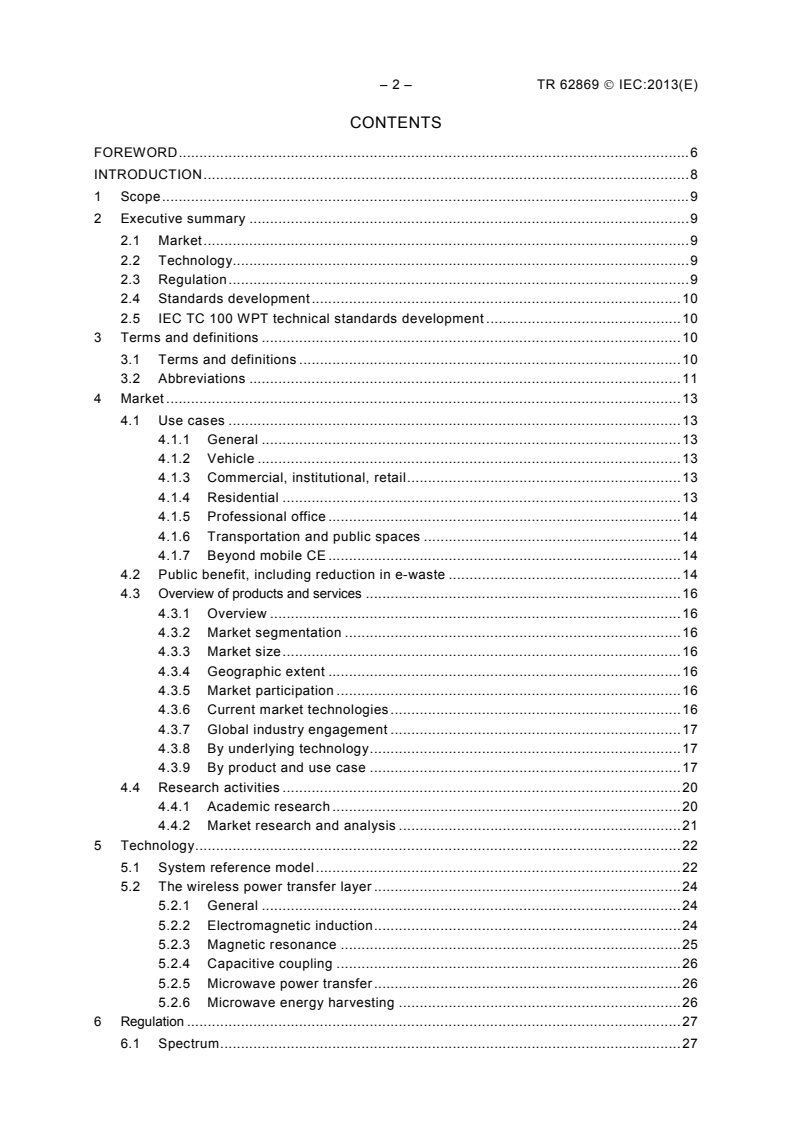
CONTENTS
FOREWORD . 6
INTRODUCTION . 8
1 Scope . 9
2 Executive summary . 9
2.1 Market . 9
2.2 Technology. 9
2.3 Regulation . 9
2.4 Standards development . 10
2.5 IEC TC 100 WPT technical standards development . 10
3 Terms and definitions . 10
3.1 Terms and definitions . 10
3.2 Abbreviations . 11
4 Market . 13
4.1 Use cases . 13
4.1.1 General . 13
4.1.2 Vehicle . 13
4.1.3 Commercial, institutional, retail . 13
4.1.4 Residential . 13
4.1.5 Professional office . 14
4.1.6 Transportation and public spaces . 14
4.1.7 Beyond mobile CE . 14
4.2 Public benefit, including reduction in e-waste . 14
4.3 Overview of products and services . 16
4.3.1 Overview . 16
4.3.2 Market segmentation . 16
4.3.3 Market size . 16
4.3.4 Geographic extent . 16
4.3.5 Market participation . 16
4.3.6 Current market technologies . 16
4.3.7 Global industry engagement . 17
4.3.8 By underlying technology . 17
4.3.9 By product and use case . 17
4.4 Research activities . 20
4.4.1 Academic research . 20
4.4.2 Market research and analysis . 21
5 Technology . 22
5.1 System reference model . 22
5.2 The wireless power transfer layer . 24
5.2.1 General . 24
5.2.2 Electromagnetic induction . 24
5.2.3 Magnetic resonance . 25
5.2.4 Capacitive coupling . 26
5.2.5 Microwave power transfer . 26
5.2.6 Microwave energy harvesting . 26
6 Regulation . 27
6.1 Spectrum . 27
TR 62869 IEC:2013(E) – 3 –
6.2 RF emissions . 28
6.3 Safety. 28
6.3.1 General . 28
6.3.2 RF exposure . 28
6.3.3 Heating . 30
6.3.4 Electrical safety . 30
6.4 Compliance . 30
6.4.1 Identified regulations and standards . 30
6.4.2 Measurement methods . 32
6.5 Impact of regulation . 32
7 Technical standards development . 32
7.1 General . 32
7.2 Global survey industrial consortia . 33
7.2.1 General . 33
7.2.2 A4WP – Alliance for Wireless Power. 33
7.2.3 CE4A – Consumer Electronics for Automotive . 33
7.2.4 DE – Digital Europe . 33
7.2.5 KWPF – Korea Wireless Power Forum . 33
7.2.6 MFAN – Magnetic Field Area Network Forum . 34
7.2.7 NFC Forum . 34
7.2.8 PMA – Power Matters Alliance . 34
7.2.9 WPC – Wireless Power Consortium . 34
7.3 Global survey governmental and standards development organizations . 35
7.3.1 General . 35
7.3.2 APT – Asia Pacific Telecommunity . 36
7.3.3 ARIB – Association of Radio Industries and Businesses . 37
7.3.4 BWF – Broadband Wireless Forum . 37
7.3.5 CCSA – China Communications Standards Association . 39
7.3.6 CEA – Consumer Electronics Association . 40
7.3.7 CJK – China, Japan and Korea Standards Coordination . 40
7.3.8 ETSI – European Telecommunications Standards Institute . 40
7.3.9 GSC – Global Standards Collaboration . 41
7.3.10 IEC TC 100. 41
7.3.11 ISO/IEC JTC 1 . 42
7.3.12 ITU-R . 42
7.3.13 TTA – Telecommunications Technology Association . 42
7.3.14 UL – Underwriters Laboratories . 43
8 Review of WPT opportunities and challenges . 43
8.1 General . 43
8.2 Market . 43
8.2.1 Interoperability . 43
8.2.2 Use cases . 44
8.3 Technology and technical standards development . 44
8.3.1 Competing WPT technologies . 44
8.3.2 Parallel efforts . 44
8.3.3 Interoperability and multi-protocol support . 44
9 Role for IEC TC 100 . 44
9.1 General . 44
9.2 Market . 44
– 4 – TR 62869 IEC:2013(E)
9.2.1 Increase awareness and impact . 44
9.2.2 Nomenclature harmonization . 45
9.3 Technology. 45
9.3.1 Technology taxonomy, use case and use case category
harmonization . 45
9.3.2 WPT classification . 45
9.4 Regulation . 45
9.4.1 General . 45
9.4.2 Product categorization . 45
9.4.3 Spectrum . 45
9.4.4 RF emissions (EMI/EMC), RF exposure and regulatory engineering . 45
9.5 Technical standards development . 46
9.5.1 Framework of WPT standards . 46
9.5.2 Interoperability . 46
9.5.3 Minimum performance testing and certification . 47
10 Summary and conclusions . 47
Bibliography . 49
Figure 1 – Automotive CE WPT products and concepts . 18
Figure 2 – CE WPT products and concepts . 19
Figure 3 – Professional office WPT products and concepts . 19
Figure 4 – Embedded WPT concepts for public spaces . 20
Figure 5 – WPT system reference model for single source single device . 23
Figure 6 – Electromagnetic induction . 25
Figure 7 – Magnetic resonance . 25
Figure 8 – Electric field inductive coupling . 26
Figure 9 – Microwave power transfer . 26
Figure 10 – Radio-exposure protection guidelines details (Japan) . 30
Figure 11 – Regulatory, technical standards and implementation pipelines . 36
Figure 12 – Relationship between key Japan WPT technical standards stakeholders . 38
Table 1 – Academic-type research . 20
Table 2 – Market planning and analysis . 21
Table 3 – Operating frequencies and power limits . 27
Table 4 – GB8702-88 (China) basic restrictions . 29
Table 5 – GB 9175-88 (China) maximum permitted exposure . 29
Table 6 – Identified regulations and standards . 31
Table 7 – Alliance for Wireless Power (A4WP) . 33
Table 8 – Consumer Electronics for Automotive (CE4A) . 33
Table 9 – Digital Europe (DE) . 33
Table 10 – Korea Wireless Power Forum (KWPF) . 34
Table 11 – Magnetic Field Area Network Forum (MFAN) . 34
Table 12 – NFC Forum . 34
Table 13 – Power Matters Alliance (PMA) . 34
Table 14 – Wireless Power Consortium (WPC) . 35
TR 62869 IEC:2013(E) – 5 –
Table 15 – Asia Pacific Telecommunity (APT) . 37
Table 16 – Association of Radio Industries and Businesses (ARIB) . 37
Table 17 – Broadband Wireless Forum (BWF) . 39
Table 18 – China Communications Standards Association (CCSA) . 39
Table 19 – Consumer Electronics Association (CEA) . 40
Table 20 – China, Japan and Korea Standards Coordination (CJK) . 40
Table 21 – European Telecommunications Standards Institute (ETSI). 41
Table 22 – Global Standards Collaboration (GSC) . 41
Table 23 – IEC TC 100 . 41
Table 24 – ISO/IEC JTC 1. 42
Table 25 – ITU-R . 42
Table 26 – Telecommunications Technologies Association (TTA) . 43
Table 27 – Underwriters Laboratories (UL) . 43
– 6 – TR 62869 IEC:2013(E)
INTERNATIONAL ELECTROTECHNICAL COMMISSION
____________
ACTIVITIES AND CONSIDERATIONS RELATED
TO WIRELESS POWER TRANSFER (WPT) FOR AUDIO,
VIDEO AND MULTIMEDIA SYSTEMS AND EQUIPMENT
FOREWORD
1) The International Electrotechnical Commission (IEC) is a worldwide organization for standardization comprising
all national electrotechnical committees (IEC National Committees). The object of IEC is to promote
international co-operation on all questions concerning standardization in the electrical and electronic fields. To
this end and in addition to other activities, IEC publishes International Standards, Technical Specifications,
Technical Reports, Publicly Available Specifications (PAS) and Guides (hereafter referred to as “IEC
Publication(s)”). Their preparation is entrusted to technical committees; any IEC National Committee interested
in the subject dealt with may participate in this preparatory work. International, governmental and non-
governmental organizations liaising with the IEC also participate in this preparation. IEC collaborates closely
with the International Organization for Standardization (ISO) in accordance with conditions determined by
agreement between the two organizations.
2) The formal decisions or agreements of IEC on technical matters express, as nearly as possible, an international
consensus of opinion on the relevant subjects since each technical committee has representation from all
interested IEC National Committees.
3) IEC Publications have the form of recommendations for international use and are accepted by IEC National
Committees in that sense. While all reasonable efforts are made to ensure that the technical content of IEC
Publications is accurate, IEC cannot be held responsible for the way in which they are used or for any
misinterpretation by any end user.
4) In order to promote international uniformity, IEC National Committees undertake to apply IEC Publications
transparently to the maximum extent possible in their national and regional publications. Any divergence
between any IEC Publication and the corresponding national or regional publication shall be clearly indicated in
the latter.
5) IEC itself does not provide any attestation of conformity. Independent certification bodies provide conformity
assessment services and, in some areas, access to IEC marks of conformity. IEC is not responsible for any
services carried out by independent certification bodies.
6) All users should ensure that they have the latest edition of this publication.
7) No liability shall attach to IEC or its directors, employees, servants or agents including individual experts and
members of its technical committees and IEC National Committees for any personal injury, property damage or
other damage of any nature whatsoever, whether direct or indirect, or for costs (including legal fees) and
expenses arising out of the publication, use of, or reliance upon, this IEC Publication or any other IEC
Publications.
8) Attention is drawn to the Normative references cited in this publication. Use of the referenced publications is
indispensable for the correct application of this publication.
9) Attention is drawn to the possibility that some of the elements of this IEC Publication may be the subject of
patent rights. IEC shall not be held responsible for identifying any or all such patent rights.
The main task of IEC technical committees is to prepare International Standards. However, a
technical committee may propose the publication of a technical report when it has collected
data of a different kind from that which is normally published as an International Standard, for
example "state of the art".
IEC 62869, which is a technical report, has been prepared by IEC technical committee 100:
Audio, video and multimedia systems and equipment.
The text of this technical report is based on the following documents:
Enquiry draft Report on voting
100/2134/DTR 100/2166/RVC
Full information on the voting for the approval of this technical report can be found in the
report on voting indicated in the above table.
This publication has been drafted in accordance with the ISO/IEC Directives, Part 2.
TR 62869 IEC:2013(E) – 7 –
The committee has decided that the contents of this publication will remain unchanged until
the stability date indicated on the IEC web site under "http://webstore.iec.ch" in the data
related to the specific publication. At this date, the publication will be
• reconfirmed,
• withdrawn,
• replaced by a revised edition, or
• amended.
A bilingual version of this publication may be issued at a later date.
IMPORTANT – The 'colour inside' logo on the cover page of this publication indicates
that it contains colours which are considered to be useful for the correct
understanding of its contents. Users should therefore print this document using a
colour printer.
– 8 – TR 62869 IEC:2013(E)
INTRODUCTION
IEC TC 100 established a Stage 0 project on wireless power transfer (WPT) to develop a
technical report on WPT technical standardization in relation to audio, video and multimedia
systems and equipment. A survey was developed to investigate the global positioning of the
technology and its uptake. Twelve National Committees provided responses. Four National
Committees (China, Japan, Korea, USA) provided responses to all questions. The key
research undertaken and information gathered from the survey responses included: a) terms
and definitions used for WPT by IEC TC 100 members; b) regulations, national laws, public
policies and industry practices related to WPT; c) status of activities and discussions in
various organizations relating to regulatory activities, standards projects, and market research;
d) potential topics to be addressed in IEC TC 100 TR: and e) potential role for IEC TC 100 in
the domain of WPT technical standards development.
This Technical Report combines survey results with Stage 0 project expert group contributions
and extensive public information to develop and present a holistic understanding of WPT and,
in so doing, respond to the Stage 0 TR objectives. This understanding is developed through a
progression of four interrelated topics.
• Clause 4 considers the overall WPT market, including use cases, public benefit, academic
research activities, and an overview of WPT products and services.
• Clause 5 discusses leading commercial WPT technical approaches and briefly surveys
additional WPT technologies by reviewing a system reference model. The system
reference model can be understood at a very high level as consisting of the lowest layer of
a power handling layer, where upper layers implement signalling and systems interfaces.
• Clause 6 presents the major elements of the applicable international and regional
regulatory frameworks, one of whose key outputs is product categorization. Product
categorization, in turn, is closely related to the topic of spectrum. Key regulatory drivers
for WPT products and services as well as technical standards development include RF
emissions, RF exposure and compliance.
• Clause 7 reviews global industrial consortium and standards development organization
(SDO) activities, and critically discusses WPT technical standard development challenges
and opportunities.
With market, technology, regulatory and standards development foundations established, the
TR concludes in Clauses 8-10 with observations and recommendations about the potential for
future WPT technical standards development within the scope of IEC TC 100.
TR 62869 IEC:2013(E) – 9 –
ACTIVITIES AND CONSIDERATIONS RELATED
TO WIRELESS POWER TRANSFER (WPT) FOR AUDIO,
VIDEO AND MULTIMEDIA SYSTEMS AND EQUIPMENT
1 Scope
This technical report addresses activities and considerations related to wireless power
transfer for audio, video and multimedia systems and equipment. It combines public
information, contributions by experts and completed IEC TC 100 WPT survey responses and
reviews global market conditions. The TR describes a range of WPT technical approaches
with the aid of a system reference model, outlines the impacts on WPT of applicable
regulation and surveys standards development organization (SDO) and private industry
consortium-led activities in support of WPT technical standards development. The TR
concludes with observations and recommendations for potential future technical standards
development activities that lie within scope of IEC TC 100.
2 Executive summary
2.1 Market
A variety of metrics indicate that the commercial market is in its early phases. Annual revenue
projections range from a current level of a few hundred millions to some billions of dollars (US)
by the 2016-2018 timeframe. Geographic coverage spans major markets in Asia, Europe and
North America, and is expected to mirror the larger CE market. Market participants range from
small, focused start-ups to the largest integrated global CE market leaders. Currently, market
share, or market “excitement” may be characterized as being split amongst a few small
companies, each with a proprietary solution, and a broader range of companies who have
coalesced around private industry consortia, each of which is seeking to promote a particular
technical approach.
2.2 Technology
Commercial application of WPT technology has its origins in the pioneering work of Nikola
Tesla in the early 1900s and is already well-established in several industrial and specialized
application areas, such as power supply to “people mover” systems in airports, material
handling systems in manufacturing and warehousing, and “mission critical” control systems
that isolate power supply from environmental disruption. Within the scope of IEC TC 100, a
system reference model consists of one or more WPT “sources” and one or more WPT “sinks”
that interact through a “coil subsystem.” This reference model captures commonalities and
differences across the wide range of approaches already in the market, those expected to
come to market in the near term and long-term prospective market entrants. The WPT
technology environment today consists of multiple, largely non-interoperable approaches.
2.3 Regulation
The development of the WPT market is subject to applicable regulations. These serve the
purpose of protecting people and services in the areas of safety, efficient use of spectrum,
harmful interference and electromagnetic compatibility and immunity. WPT regulatory
categorization sets the overall framework. Designs are subject to different regulations
depending at least on WPT spectrum selection and signalling method. Categorization, in turn,
drives RF exposure limits and highlights the importance of methods for demonstration of
compliance. Currently, individual markets and regions have similar, but not uniform
approaches. Policy development opportunities and challenges relate primarily to global
harmonization as a means to promote technology innovation and market development.
– 10 – TR 62869 IEC:2013(E)
2.4 Standards development
WPT technical standards development is an asynchronous global undertaking. Active
programmes are underway at the international body level, the regional coordination level, the
regional and national SDO level as well as within numerous global and regional private
industrial consortia. While private industrial consortia typically focus on a single technical
approach, the typical SDO WPT technical standards development programme allows parallel
development of multiple technologies. Indeed, a multiplicity of WPT technical approaches are
on parallel paths towards either de facto or formally approved WPT technical standards. In
terms of productization in the medium term, it appears that multiple protocol support may
substitute for true interoperability between competing technologies and standards.
2.5 IEC TC 100 WPT technical standards development
In terms of revenue, the largest market for WPT in the foreseeable future lies in the CE
market, including audio, visual and multimedia systems and equipment. The WPT technology
environment currently consists of multiple, non-interoperable technology approaches. This
condition is perhaps not surprising given the range of identified use cases and power
requirements (< 1W – 100W) relating to equipment within the scope of IEC TC 100. Thus,
technical standards development within IEC TC 100 may be built around the concept of a
framework of WPT standards. In such a concept, individual technical approaches enjoy the
benefit of a globally harmonized standard. Technology selection proceeds through market-
based mechanisms.
3 Terms and definitions
3.1 Terms and definitions
For the purposes of this document, the following terms and definitions apply.
3.1.1
capacitive coupling
method for wireless power transfer by means of capacitance between insulated electrodes
Note 1 to entry: Capacitive coupling is also referred to as "electric field coupling".
3.1.2
electromagnetic induction
class of methods used for wireless power transfer whose central principles are Faraday’s Law
and Lenz’s Law
3.1.3
magnetic resonance
subset of electromagnetic induction methods utilizing non-radiative, near-field or mid-field
resonance coupling between two electromagnetic resonators where the coupling coefficient
between primary or source coil and secondary or receiving coil is low (k much less than 1)
Note 1 to entry: Magnetic resonance is also referred to as "loosely-coupled magnetic resonance", "highly
resonant magnetic induction" and "magnetic resonant coupling".
3.1.4
tightly-coupled
subset of electromagnetic induction methods utilizing close physical proximity and optimal
alignment between power providing and power receiving coils, where the coupling coefficient
between primary or source coil and secondary or receiving coil is close to the achievable
maximum (k very close to 1)
TR 62869 IEC:2013(E) – 11 –
3.1.5
wireless power transfer
method of non-contact energy delivery over time from one or more sources to one or more
receiving units
3.2 Abbreviations
For the purposes of this document, the following abbreviations apply.
A4WP Alliance for Wireless Power
ACK/NACK acknowledge/negative acknowledge
ANSI American National Standards Institute
API application programming interface
APT Asia Pacific Telecommunity
ARIB Association of Radio Industries and Businesses
AWG APT Wireless Group
CATR China Academy of Telecommunications Research
BWF Broadband Wireless Forum
CCSA China Communications Standards Association
CE consumer electronics
CE4A Consumer Electronics for Automotive
CEA Consumer Electronics Association
CEC California Energy Commission
CENELEC European Committee for Electrotechnical Standardization
CPT contactless power transfer
CS control and signaling
DE Digital Europe
DG Drafting Group
DTBC device to be charged
EC European Commission
EMC electromagnetic compatibility
EMI electromagnetic interference
EPA Environmental Protection Agency (USA)
EPS external power supply
ETSI European Telecommunications Standards Institute
EU European Union
EV electric vehicle
FCC Federal Communications Commission
GSMA GSM Association
ICNIRP International Commission on Non-Ionizing Radiation Protection
IEC International Electrotechnical Commission
ISM industrial, scientific and medical
ISO International Standards Organization
ITU International Telecommunication Union
ITU-R ITU Radiocommunication Sector
ITU-T ITU Telecommunication Sector
JEITA Japan Electronics and Information Technology Industries Association
JSAE Society of Automotive Engineers of Japan
– 12 – TR 62869 IEC:2013(E)
KATS Korea Agency for Technology and Standards
KCC Korea Communications Commission
KDB Knowledge Database (USA FCC)
KETI Korea Electronics Technology Institute
KWPF Korea Wireless Power Forum
METI Ministry of Economy, Trade and Industry, Japan
MFAN Magnetic Field Area Network Forum, Korea
MHLW Ministry of Health, Labour and Welfare, Japan
MIC Ministry of Internal Affairs and Communications, Japan
MKE Ministry of Knowledge Economy, Korea
MLIT Ministry of Land, Infrastructure, Transport and Tourism, Japan
MOU memorandum of understanding
MRM Electronic Manufacturers Recycling Management Company
NA not applicable
NFC near-field communication
NWIP new work item proposal
OEM original equipment manufacturer
PBA permit but ask
PCG Project Coordination Group
PID proportional integral differential
PMA power matters alliance
PT power transfer
RMS root mean square
RoHS restriction of hazardous substances
SAR specific absorption rate
SDO standards development organization
SIG special interest group
SoC system on chip
TA technical area
TCAM Telecommunications Conformity Assessment and Market Surveillance
Committee
TIA Telecommunications Industry Association
TMC Telecomms Metrology Center
TR technical report
TTA Telecommunications Technology Association
UL Underwriters’ Laboratories
USA United States of America
WCS wirless charging system
WEEE Waste Electrical and Electronic Equipment Directive
WG working group
WPC Wireless Power Consortium
WPT wireless power transfer
YRP Yokosuka Resarch Park
TR 62869 IEC:2013(E) – 13 –
4 Market
4.1 Use cases
4.1.1 General
A broad range of WPT applications or use cases are unified under the vision of ubiquitous
power. The breadth of applications is quantified in terms of device characteristic power
requirement. These range from the < 1 W (e.g., cellular telephone headset), to < 10 W (e.g.,
feature phone or smartphone), to < 20 W (e.g., tablet or notebook) to < 50 W (laptop), and so
on, up to kW levels (e.g., electric vehicles). As it relates to battery-powered, mobile, handheld
CE devices for audio, video and multimedia equipment, ubiquitous power simply means that
increases in device functionality and a resulting need for greater power are growing faster
than advances in power storage capacity. The result is that devices require more frequent
recharging. Ubiquitous power means that users can reliably recharge anywhere, anytime
without the constant burden of carrying and deploying battery charging accessories and
equipment.
The vision of anywhere, anytime recharging depends upon WPT integration in the physical
environment. A multiplicity of independent market analysis firms, private industrial consortia,
SDOs and related task groups and academic studies have surveyed or analysed user battery
charging requirements and behaviour. Such endeavours, in combination with net utility
analyses, resulted in categorization of WPT use cases into those described below in
subclauses 4.1.1 to 4.1.6.
A common requirement across use cases is that WPT not disrupt normal device performance
and not negatively impact the nominal functionality of the infrastructure where it is installed
(e.g., a table with integrated WPT still functions well as a table, a car operates as a normal
car, etc.)
4.1.2 Vehicle
As distinct from electric vehicle (EV) charging, automotive CE-type WPT refers to the ability to
charge occupants’ CE devices during operation of the automobile. Such capabilities may be
implemented either on a retro-fit or embedded basis. Target vehicles include personal cars,
SUVs, minivans, trucks, vans, buses, trams and shared cars.
4.1.3 Commercial, institutional, retail
Commercial, institutional, and retail may take a form comparable to that of the stereotypical
café occupant who utilizes complimentary local area network connectivity. Concretely, a
cloud-based service operating in conjunction with a CE device-based discovery mechanism to
learn of charging locations could lead the user to a café table or kiosk with embedded WPT
capability. Additional examples include WPT-enabled hotel rooms, restaurant table tops and
shopping mall kiosks. In these environments, the CE device owner chooses from what is
made available by those managing those environments.
4.1.4 Residential
For the typical user, the home or private residence usually represents the primary charging
location. This use case requires a variety of WPT sources for the home offering consumers a
choice of appearance and cost. Examples may include WPT embedded in bedside stands,
entry hall WPT-enabled dishes or bowls, and more purely functional WPT-enabled chargers
for the study or garage. A key element in this use case is that the individual consumer
controls his or her own WPT sources or “infrastructure” and the selection appropriate to their
WPT device(s).
– 14 – TR 62869 IEC:2013(E)
4.1.5 Professional office
For the typical professional or office worker, the office environment both drives demand for
and offers the opportunity to meet the need for frequent CE battery recharging. WPT sources
such as desktop pads or other desktop accessories are suitable. This use case is mainly
characterized by the opportunity for embedded WPT capability in the individual office furniture
including desks, conference tables, break-room counters, and so on. In such an environment
the property manager or owner controls the WPT selection and the CE owner is a subscriber
or user of that capability.
4.1.6 Transportation and public spaces
Transportation and public space use cases include those scenarios where WPT is made
available even while in transit, such as during a bus, railway or plane ride, or otherwise while
waiting for transportation, such as in an airport lounge, train station or other waiting area.
Sponsored wired charging kiosks are one of the most crowded areas in airport lounges.
4.1.7 Beyond mobile CE
The CE market consists of more than simply battery-powered, mobile handheld devices. A
WPT feature offers the opportunity to develop new form factors and configurations for
televisions, displays, multimedia equipment and related devices, including tuners, equalizers
and media storage devices. Wirelessly powered flat panel TVs and large displays, for
example, may be more easily and flexibly positioned on the wall.
Although well beyond the scope of IEC TC 100, it is noted that WPT is under consideration for
non-CE devices, such as medical devices. Concretely, as societies around the world
experience aging populations, long-term health management increasingly utilizes patient
monitoring of chronic conditions. Whether in the hospital or home setting, for hygienic and
ergonomic reasons, these devices are ideally completely sealed, lightweight and portable.
WPT addresses the challenge of recharging such devices. A further extension beyond CE
devices includes wirelessly powered home and office appliances. By using wirelessly powered
consumer appliances such as refrigerators, washing machines, air conditioners, cleaners and
so on, flexibility of usage of home and office space is expanded.
Another area of interest is in the charging of electric vehicles (EV). Although adapted to much
higher power levels (kW), candidate technologies for EV WPT are similar to those considered
for mobile CE. Real-time wireless power transfer to running cars on the road has been
proposed and prototyped. IEC TC 69 addresses EV WPT.
More “exotic” applications range from WPT between integrated circuits in complex, miniature
machines, to human implantable medical and prosthetic devi
...