

IEC 60952-1:2013
(Main)Aircraft batteries - Part 1: General test requirements and performance levels
General Information
- Abstract
IEC 60952-1:2013 defines test procedures for the evaluation, comparison and qualification of batteries and states minimum performance and environmental levels for airworthiness. Where specific tests are defined with no pass/fail requirement (to establish performance capability), the manufacturer's declared values, from qualification testing, will be used to establish minimum requirements for ongoing maintenance of approval for that design of battery. This third edition cancels and replaces the second edition published in 2004. This edition constitutes a technical revision. This edition includes additional test requirements to meet the needs of the regulatory airworthiness authorities for both product performance and qualification.
- Status
- Published
- Publication Date
- 08-Jul-2013
- Technical Committee
- SC 21A - Secondary cells and batteries containing alkaline or other non-acid electrolytes
- Drafting Committee
- MT 60952 - TC 21/MT 60952
- Current Stage
- PPUB - Publication issued
- Start Date
- 09-Jul-2013
- Completion Date
- 15-Aug-2013
Overview
IEC 60952-1:2013 is an international standard issued by the International Electrotechnical Commission (IEC) that specifies general test requirements and performance levels for aircraft batteries. This standard outlines comprehensive test procedures essential for evaluating, qualifying, and comparing aircraft batteries to ensure airworthiness. Developed to meet regulatory needs, it sets minimum performance and environmental criteria, providing a technical benchmark for manufacturers and maintenance organizations.
The third edition of IEC 60952-1 replaces the 2004 second edition, updating and expanding test requirements to align with current aviation safety standards and regulatory expectations. The standard applies to various battery types used in aircraft and serves as a fundamental reference for design approval, ongoing quality assurance, and performance verification.
Key Topics
IEC 60952-1:2013 covers a wide range of battery testing and performance evaluation areas, including:
- Test Procedures and Conditions: Defines standard test conditions such as temperature, vibration, acceleration, and shock relevant to aircraft operational environments.
- Electrical Performance Tests: Includes capacity tests at different current rates and temperatures, rapid discharge capacity, charge retention, and charge acceptance-all crucial for verifying battery functionality under flight conditions.
- Safety and Environmental Testing: Encompasses tests for insulation resistance, dielectric strength, vibration, operational shock, crash safety, explosion containment, and flammability.
- Durability and Endurance: Features cyclic endurance, overcharge endurance, deep discharge, and induced destructive overcharge tests to simulate real-world battery usage and potential failure modes.
- Physical and Chemical Resistance: Assesses resistance to humidity, salt spray, contaminant fluids, electrolyte leakage, and fungus, ensuring battery longevity in varied conditions.
- Quality Assurance and Approval: Specifies quality control protocols, approval procedures, and maintenance of design approval to ensure consistent compliance and airworthiness certification.
- Additional Requirements: Includes component qualification (vent valves, cell containers), battery airtightness, handle strength, hazardous materials considerations, and instructions for continued airworthiness.
Applications
IEC 60952-1:2013 is widely applicable in the aerospace industry, especially for:
- Aircraft Manufacturers: To develop battery designs that meet international safety and performance standards.
- Battery Manufacturers: To qualify and certify their products in compliance with aviation regulatory requirements.
- Maintenance and Repair Organizations: To verify battery performance, maintain approval status, and ensure operational safety throughout the battery lifecycle.
- Regulatory Authorities: To use as a benchmark for certification and airworthiness assessments of aircraft batteries.
- Design Engineers: To establish minimum design criteria and ensure interoperability and safety in aircraft electrical systems.
By adhering to IEC 60952-1, stakeholders can enhance flight safety, ensure reliable power supply for aircraft systems, prolong battery service life, and mitigate risks associated with battery failure.
Related Standards
IEC 60952-1:2013 complements a suite of other IEC and aviation-related standards that collectively govern aviation electrical components and safety, such as:
- IEC 60952-2: Pertains to specific battery types or additional specialized requirements.
- DO-311 / RTCA DO-311: Addresses rechargeable lithium battery systems certification for aircraft.
- ISO 9001: Quality management systems standard referenced for quality assurance aspects.
- FAA and EASA Regulations: Includes regulatory airworthiness standards that require compliance with IEC testing protocols.
- IEC 60068 Series: Environmental testing for electronic equipment, supporting environmental simulations outside the battery-specific scope.
Together, these standards create an integrated framework ensuring aircraft batteries perform reliably under the extreme conditions experienced during flight, providing safety and trust in aviation power systems.
Keywords: Aircraft batteries standard, IEC 60952-1, aircraft battery testing, battery qualification, aviation battery performance, electrical test procedures, safety standards for aircraft batteries, aerospace battery certification, battery environmental testing, airworthiness battery standards.
Relations
- Revises
IEC 60952-1:2004 - Aircraft batteries - Part 1: General test requirements and performance levels - Effective Date
- 05-Sep-2023
Get Certified
Connect with accredited certification bodies for this standard

BUREAU VERITAS Certification Germany
Bureau Veritas certification in Germany.

Element Materials Technology
Materials testing and product certification.

IMQ S.p.A. (Certification)
Italian electrical product certification.
Sponsored listings
Frequently Asked Questions
IEC 60952-1:2013 is a standard published by the International Electrotechnical Commission (IEC). Its full title is "Aircraft batteries - Part 1: General test requirements and performance levels". This standard covers: IEC 60952-1:2013 defines test procedures for the evaluation, comparison and qualification of batteries and states minimum performance and environmental levels for airworthiness. Where specific tests are defined with no pass/fail requirement (to establish performance capability), the manufacturer's declared values, from qualification testing, will be used to establish minimum requirements for ongoing maintenance of approval for that design of battery. This third edition cancels and replaces the second edition published in 2004. This edition constitutes a technical revision. This edition includes additional test requirements to meet the needs of the regulatory airworthiness authorities for both product performance and qualification.
IEC 60952-1:2013 defines test procedures for the evaluation, comparison and qualification of batteries and states minimum performance and environmental levels for airworthiness. Where specific tests are defined with no pass/fail requirement (to establish performance capability), the manufacturer's declared values, from qualification testing, will be used to establish minimum requirements for ongoing maintenance of approval for that design of battery. This third edition cancels and replaces the second edition published in 2004. This edition constitutes a technical revision. This edition includes additional test requirements to meet the needs of the regulatory airworthiness authorities for both product performance and qualification.
IEC 60952-1:2013 is classified under the following ICS (International Classification for Standards) categories: 29.220.20 - Acid secondary cells and batteries; 49.060 - Aerospace electric equipment and systems. The ICS classification helps identify the subject area and facilitates finding related standards.
IEC 60952-1:2013 has the following relationships with other standards: It is inter standard links to IEC 60952-1:2004. Understanding these relationships helps ensure you are using the most current and applicable version of the standard.
IEC 60952-1:2013 is available in PDF format for immediate download after purchase. The document can be added to your cart and obtained through the secure checkout process. Digital delivery ensures instant access to the complete standard document.
Standards Content (Sample)
IEC 60952-1 ®
Edition 3.0 2013-07
INTERNATIONAL
STANDARD
NORME
INTERNATIONALE
Aircraft batteries –
Part 1: General test requirements and performance levels
Batteries d’aéronefs –
Partie 1: Exigences générales d’essais et niveaux de performances
All rights reserved. Unless otherwise specified, no part of this publication may be reproduced or utilized in any form
or by any means, electronic or mechanical, including photocopying and microfilm, without permission in writing from
either IEC or IEC's member National Committee in the country of the requester.
If you have any questions about IEC copyright or have an enquiry about obtaining additional rights to this publication,
please contact the address below or your local IEC member National Committee for further information.
Droits de reproduction réservés. Sauf indication contraire, aucune partie de cette publication ne peut être reproduite ni
utilisée sous quelque forme que ce soit et par aucun procédé, électronique ou mécanique, y compris la photocopie et les
microfilms, sans l'accord écrit de la CEI ou du Comité national de la CEI du pays du demandeur.
Si vous avez des questions sur le copyright de la CEI ou si vous désirez obtenir des droits supplémentaires sur cette
publication, utilisez les coordonnées ci-après ou contactez le Comité national de la CEI de votre pays de résidence.
IEC Central Office Tel.: +41 22 919 02 11
3, rue de Varembé Fax: +41 22 919 03 00
CH-1211 Geneva 20 info@iec.ch
Switzerland www.iec.ch
About the IEC
The International Electrotechnical Commission (IEC) is the leading global organization that prepares and publishes
International Standards for all electrical, electronic and related technologies.
About IEC publications
The technical content of IEC publications is kept under constant review by the IEC. Please make sure that you have the
latest edition, a corrigenda or an amendment might have been published.
Useful links:
IEC publications search - www.iec.ch/searchpub Electropedia - www.electropedia.org
The advanced search enables you to find IEC publications The world's leading online dictionary of electronic and
by a variety of criteria (reference number, text, technical electrical terms containing more than 30 000 terms and
committee,…). definitions in English and French, with equivalent terms in
It also gives information on projects, replaced and additional languages. Also known as the International
withdrawn publications. Electrotechnical Vocabulary (IEV) on-line.
IEC Just Published - webstore.iec.ch/justpublished Customer Service Centre - webstore.iec.ch/csc
Stay up to date on all new IEC publications. Just Published If you wish to give us your feedback on this publication
details all new publications released. Available on-line and or need further assistance, please contact the
also once a month by email. Customer Service Centre: csc@iec.ch.
A propos de la CEI
La Commission Electrotechnique Internationale (CEI) est la première organisation mondiale qui élabore et publie des
Normes internationales pour tout ce qui a trait à l'électricité, à l'électronique et aux technologies apparentées.
A propos des publications CEI
Le contenu technique des publications de la CEI est constamment revu. Veuillez vous assurer que vous possédez
l’édition la plus récente, un corrigendum ou amendement peut avoir été publié.
Liens utiles:
Recherche de publications CEI - www.iec.ch/searchpub Electropedia - www.electropedia.org
La recherche avancée vous permet de trouver des Le premier dictionnaire en ligne au monde de termes
publications CEI en utilisant différents critères (numéro de électroniques et électriques. Il contient plus de 30 000
référence, texte, comité d’études,…). termes et définitions en anglais et en français, ainsi que
Elle donne aussi des informations sur les projets et les les termes équivalents dans les langues additionnelles.
publications remplacées ou retirées. Egalement appelé Vocabulaire Electrotechnique
International (VEI) en ligne.
Just Published CEI - webstore.iec.ch/justpublished
Service Clients - webstore.iec.ch/csc
Restez informé sur les nouvelles publications de la CEI.
Just Published détaille les nouvelles publications parues. Si vous désirez nous donner des commentaires sur
Disponible en ligne et aussi une fois par mois par email. cette publication ou si vous avez des questions
contactez-nous: csc@iec.ch.
IEC 60952-1 ®
Edition 3.0 2013-07
INTERNATIONAL
STANDARD
NORME
INTERNATIONALE
Aircraft batteries –
Part 1: General test requirements and performance levels
Batteries d’aéronefs –
Partie 1: Exigences générales d’essais et niveaux de performances
INTERNATIONAL
ELECTROTECHNICAL
COMMISSION
COMMISSION
ELECTROTECHNIQUE
PRICE CODE
INTERNATIONALE
CODE PRIX W
ICS 29.220.20; 49.060 ISBN 978-2-8322-0946-2
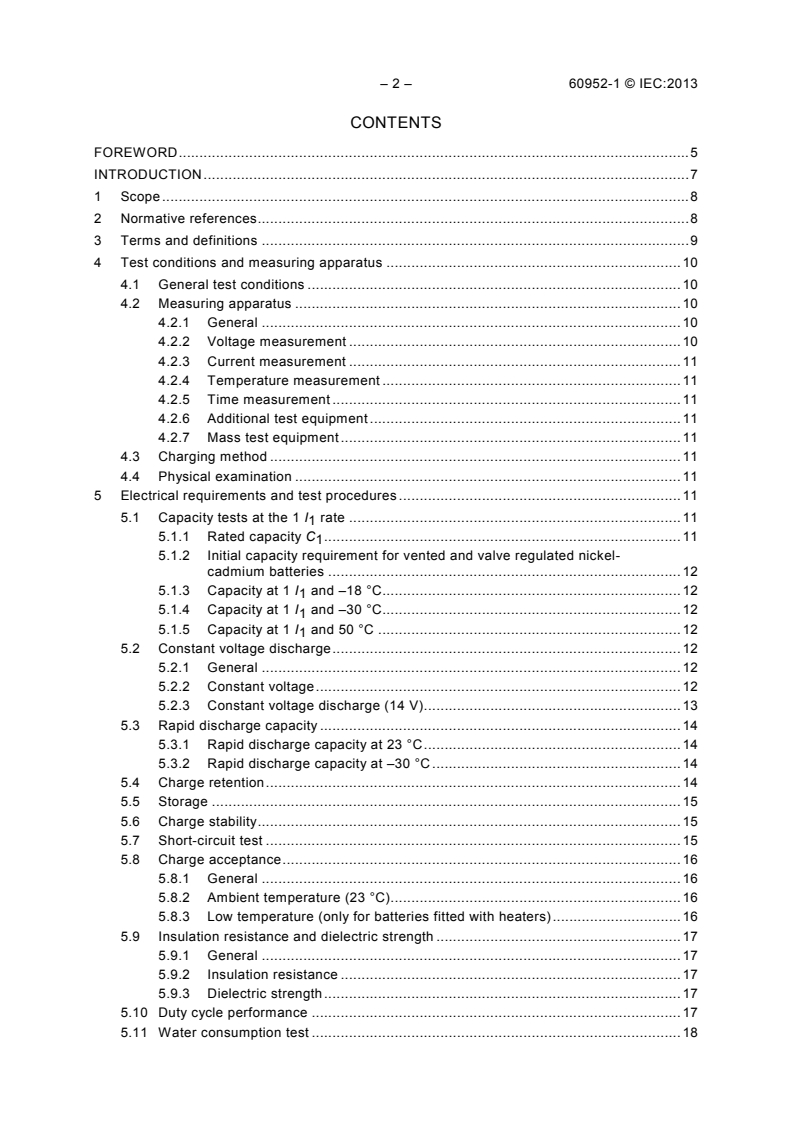
– 2 – 60952-1 © IEC:2013
CONTENTS
FOREWORD . 5
INTRODUCTION . 7
1 Scope . 8
2 Normative references . 8
3 Terms and definitions . 9
4 Test conditions and measuring apparatus . 10
4.1 General test conditions . 10
4.2 Measuring apparatus . 10
4.2.1 General . 10
4.2.2 Voltage measurement . 10
4.2.3 Current measurement . 11
4.2.4 Temperature measurement . 11
4.2.5 Time measurement . 11
4.2.6 Additional test equipment . 11
4.2.7 Mass test equipment . 11
4.3 Charging method . 11
4.4 Physical examination . 11
5 Electrical requirements and test procedures . 11
5.1 Capacity tests at the 1 I rate . 11
5.1.1 Rated capacity C . 11
5.1.2 Initial capacity requirement for vented and valve regulated nickel-
cadmium batteries . 12
5.1.3 Capacity at 1 I and –18 °C . 12
5.1.4 Capacity at 1 I and –30 °C . 12
5.1.5 Capacity at 1 I and 50 °C . 12
5.2 Constant voltage discharge . 12
5.2.1 General . 12
5.2.2 Constant voltage . 12
5.2.3 Constant voltage discharge (14 V) . 13
5.3 Rapid discharge capacity . 14
5.3.1 Rapid discharge capacity at 23 °C . 14
5.3.2 Rapid discharge capacity at –30 °C . 14
5.4 Charge retention . 14
5.5 Storage . 15
5.6 Charge stability . 15
5.7 Short-circuit test . 15
5.8 Charge acceptance . 16
5.8.1 General . 16
5.8.2 Ambient temperature (23 °C). 16
5.8.3 Low temperature (only for batteries fitted with heaters) . 16
5.9 Insulation resistance and dielectric strength . 17
5.9.1 General . 17
5.9.2 Insulation resistance . 17
5.9.3 Dielectric strength . 17
5.10 Duty cycle performance . 17
5.11 Water consumption test . 18
60952-1 © IEC:2013 – 3 –
5.12 Overcharge endurance . 19
5.13 Cyclic endurance . 19
5.14 Deep discharge test . 19
5.15 Induced destructive overcharge . 20
5.16 Electrical emissions . 20
6 Environmental requirements. 20
6.1 Vibration . 20
6.1.1 General . 20
6.1.2 Battery mounting . 21
6.1.3 Declaration . 21
6.1.4 Vibration requirements . 21
6.2 Acceleration . 22
6.3 Operational shock and crash safety . 23
6.3.1 Operational shock . 23
6.3.2 Crash safety . 23
6.3.3 Declaration . 23
6.4 Explosion containment . 23
6.5 Gas emission . 24
6.6 Altitude pressure . 24
6.7 Temperature variation (shock) . 25
6.8 Fungus resistance . 25
6.8.1 General . 25
6.8.2 General method . 25
6.9 Humidity . 26
6.10 Fluid contamination. 26
6.10.1 General . 26
6.10.2 Spray test . 26
6.10.3 Immersion test . 27
6.11 Salt spray . 27
6.12 Physical integrity at high temperature (85 °C) . 28
6.13 Flammability . 28
6.13.1 General . 28
6.13.2 Flame resistant test . 28
6.13.3 Fire resistance . 29
6.13.4 Fire proof test . 29
6.14 Electrolyte resistance . 29
6.15 Temperature sensors . 30
6.16 Component qualification tests . 30
6.16.1 General . 30
6.16.2 Vent valve test . 30
6.16.3 Cell container test . 31
6.16.4 Battery electrolyte containment test . 32
6.17 Battery airtightness test (where applicable) . 33
6.18 Strength of connector receptacle – Connector types C and Q . 33
6.19 Handle strength test. 34
6.20 Hazardous materials . 34
6.21 Instructions for continued airworthiness . 34
6.22 Limitations . 34
6.23 Electronics . 34
– 4 – 60952-1 © IEC:2013
6.24 Impact resistance (non-metallic battery container) . 34
6.25 Special test requirements . 35
7 Quality assurance requirements . 35
7.1 General quality assurance requirements . 35
7.2 Approval requirements . 35
7.2.1 General requirements . 35
7.2.2 Order of testing . 35
7.2.3 Maintenance of approval . 36
7.2.4 Declaration of design and performance . 36
7.2.5 Qualification approval . 36
7.2.6 Quality conformance . 36
Bibliography . 39
Figure 1 – Vibration orientation . 21
Table 1 – Acceleration conditions . 22
Table 2 – Impact resistance requirements . 35
Table 3 – Approval test schedule . 38
60952-1 © IEC:2013 – 5 –
INTERNATIONAL ELECTROTECHNICAL COMMISSION
____________
AIRCRAFT BATTERIES –
Part 1: General test requirements and performance levels
FOREWORD
1) The International Electrotechnical Commission (IEC) is a worldwide organization for standardization comprising
all national electrotechnical committees (IEC National Committees). The object of IEC is to promote
international co-operation on all questions concerning standardization in the electrical and electronic fields. To
this end and in addition to other activities, IEC publishes International Standards, Technical Specifications,
Technical Reports, Publicly Available Specifications (PAS) and Guides (hereafter referred to as “IEC
Publication(s)”). Their preparation is entrusted to technical committees; any IEC National Committee interested
in the subject dealt with may participate in this preparatory work. International, governmental and non-
governmental organizations liaising with the IEC also participate in this preparation. IEC collaborates closely
with the International Organization for Standardization (ISO) in accordance with conditions determined by
agreement between the two organizations.
2) The formal decisions or agreements of IEC on technical matters express, as nearly as possible, an international
consensus of opinion on the relevant subjects since each technical committee has representation from all
interested IEC National Committees.
3) IEC Publications have the form of recommendations for international use and are accepted by IEC National
Committees in that sense. While all reasonable efforts are made to ensure that the technical content of IEC
Publications is accurate, IEC cannot be held responsible for the way in which they are used or for any
misinterpretation by any end user.
4) In order to promote international uniformity, IEC National Committees undertake to apply IEC Publications
transparently to the maximum extent possible in their national and regional publications. Any divergence
between any IEC Publication and the corresponding national or regional publication shall be clearly indicated in
the latter.
5) IEC itself does not provide any attestation of conformity. Independent certification bodies provide conformity
assessment services and, in some areas, access to IEC marks of conformity. IEC is not responsible for any
services carried out by independent certification bodies.
6) All users should ensure that they have the latest edition of this publication.
7) No liability shall attach to IEC or its directors, employees, servants or agents including individual experts and
members of its technical committees and IEC National Committees for any personal injury, property damage or
other damage of any nature whatsoever, whether direct or indirect, or for costs (including legal fees) and
expenses arising out of the publication, use of, or reliance upon, this IEC Publication or any other IEC
Publications.
8) Attention is drawn to the Normative references cited in this publication. Use of the referenced publications is
indispensable for the correct application of this publication.
9) Attention is drawn to the possibility that some of the elements of this IEC Publication may be the subject of
patent rights. IEC shall not be held responsible for identifying any or all such patent rights.
International Standard IEC 60952-1 has been prepared by IEC technical committee 21:
Secondary cells and batteries.
This third edition cancels and replaces the second edition published in 2004. This edition
constitutes a technical revision.
This edition includes the following significant technical changes with respect to the previous
edition: additional test requirements to meet the needs of the regulatory airworthiness
authorities for both product performance and qualification.
The text of this standard is based on the following documents:
FDIS Report on voting
21/803/FDIS 21/814/RVD
Full information on the voting for the approval of this standard can be found in the report on
voting indicated in the above table.
– 6 – 60952-1 © IEC:2013
This publication has been drafted in accordance with the ISO/IEC Directives, Part 2.
A list of all the parts in the IEC 60952 series, published under the general title Aircraft batteries
can be found on the IEC website.
The committee has decided that the contents of this publication will remain unchanged until the
stability date indicated on the IEC web site under "http://webstore.iec.ch" in the data related to
the specific publication. At this date, the publication will be
• reconfirmed,
• withdrawn,
• replaced by a revised edition, or
• amended.
60952-1 © IEC:2013 – 7 –
INTRODUCTION
The IEC 60952 series defines minimum environmental and performance requirements for
establishing a qualification standard for airworthiness of lead-acid and nickel-cadmium aircraft
batteries, which contain corrosive electrolytes.
The series defines test procedures for determining battery performance. The electrical test
results may be used to establish airworthiness in a particular application. For all tests, the
manufacturer declares the minimum performance for each battery type.
The requirements of IEC 60952 for aircraft batteries are divided into three parts:
– Part 1 defines test procedures for the evaluation, comparison and qualification of batteries
and states minimum environmental performance levels for airworthiness.
– Part 2 defines the design requirements for aircraft batteries as well as their format (shape
and size) and the range of aircraft interface connectors that are used.
– Part 3 defines the product specification which is used to define specific requirements for an
application and a declaration of design and performance (DDP), which details the
performance of a battery format when tested to Part 1.
– 8 – 60952-1 © IEC:2013
AIRCRAFT BATTERIES –
Part 1: General test requirements and performance levels
1 Scope
This part of the IEC 60952 series defines test procedures for the evaluation, comparison and
qualification of batteries and states minimum performance and environmental levels for
airworthiness. Where specific tests are defined with no pass/fail requirement (to establish
performance capability), the manufacturer’s declared values, from qualification testing, will be
used to establish minimum requirements for ongoing maintenance of approval for that design
of battery.
To provide representative examples, this standard utilises voltage and current values based
upon an aircraft electrical system nominally rated at 28 V d.c. Additionally, the nominal values
for cell voltage are assumed to be 1,2 V per cell for nickel-cadmium batteries and 2,0 V per cell
for lead-acid batteries.
The specific topics addressed in this part of IEC 60952 serve to establish acceptable quality
standards required to qualify a battery as airworthy.
In cases where the requirements for a specific application exceed those detailed in this
standard, the purchaser will detail said requirements in the product specification and the
method of establishing compliance.
It is recognised that additional data may be required by other organisations (national standards
bodies, AECMA, SAE etc.). The present standard can be used as a framework to devise tests
for generation of the required data.
2 Normative references
The following documents, in whole or in part, are normatively referenced in this document and
are indispensable for its application. For dated references, only the edition cited applies. For
undated references, the latest edition of the referenced document (including any amendments)
applies.
IEC 60051-1, Direct acting indicating analogue electrical measuring instruments and their
accessories – Part 1: Definitions and general requirements common to all parts
IEC 60051-2, Direct acting indicating analogue electrical measuring instruments and their
accessories – Part 2: Special requirements for ammeters and voltmeters
IEC 60485, Digital electronic d.c. voltmeters and d.c. electronic analogue-to-digital convertors
IEC 60952-2:2013, Aircraft batteries – Part 2: Design and construction requirements
IEC 60952-3:2013, Aircraft batteries – Part 3: Product specification and declaration of design
and performance (DDP)
___________
Withdrawn.
The first edition (1993) was published under the title Aircraft batteries – Part 3: External electric connectors
60952-1 © IEC:2013 – 9 –
ISO 2859 (all parts), Sampling procedures for inspection by attributes
ISO 7137, Aircraft – Environmental conditions and test procedures for airborne equipment
RTCA DO-160:2010, Environmental Conditions and Test Procedures for Airborne Equipment
U.S. Federal Test Method, Standard No. 191A / Federal Test Method 5906: 1978, Flammability
(Horizontal Test)
SAE AIR 1377A-80, Aerospace Information Report – Fire Test Equipment for Flexible Hose and
Tube Assemblies
SAE AS 1055B:1978, Aerospace Standard – Fire Testing of Flexible Hose, Tube Assemblies,
Coils, Fittings and Similar System Components
3 Terms and definitions
For the purposes of this document, the following terms and definitions apply.
3.1
current value
value of current in ampere (A) used to charge and discharge cells and batteries, expressed as
a multiple of the capacity
EXAMPLE For example, a current of 20 A used to charge a cell with a rated capacity C (Ah) of 100 Ah would be
expressed as C/5 or 0,2 C (A).
Note 1 to entry: IEC 61434 is equally applicable to both nickel-cadmium and lead-acid and therefore the reference
current (I ) can be expressed as
t
(I )A = C Ah/1 h
t n
where C is the rated capacity declared by the manufacturer in ampere hours and n is the timebase in hours for
n
which the rated capacity is declared.
3.2
1 I rate
current which the battery delivers to give not less than its rated C capacity in 1 h
Note 1 to entry: This is the basis on which all other current ratings are defined.
3.3
rated capacity
C
minimum capacity, obtained from a charged battery when discharged at the 1 I rate to the end
point voltage (see 3.6)
Note 1 to entry: Rated capacity is expressed in Ah.
3.4
constant voltage current
I
pr
discharge current, which the battery delivers at the conclusion of a 15 s power discharge,
controlled so as to maintain a constant terminal voltage of half the nominal voltage
3.5
charged battery
battery that has been fully charged in accordance with the battery manufacturer’s instructions
or as defined in the product specification
– 10 – 60952-1 © IEC:2013
3.6
end point voltage
EPV
unless otherwise stated, during discharge the battery end point voltage (EPV) corresponding to
a mean voltage per cell of 1,00 V for nickel-cadmium or 1,67 V for lead-acid batteries
Note 1 to entry: This note applies to the French language only.
3.7
serviced battery
battery that has been fully prepared and maintained in accordance with the manufacturer’s
instructions or as defined in the product specification
3.8
airworthiness
compliance of a battery or part thereof with all conditions and regulations required by the
appropriate governmental authorities for their safe operation and performance
3.9
product specification
separate document which details the specific requirements which a battery is expected to meet
for a particular aircraft application
4 Test conditions and measuring apparatus
4.1 General test conditions
If specific test conditions are not defined for a test, the test shall be carried out under the
following general test condition:
– air pressure: 85 kPa to 106 kPa (850 mbar to 1 060 mbar),
– temperature: 23 °C ± 2 °C,
– relative humidity (RH): not to exceed 70 %.
If definite tolerances have not been specified, a deviation of not more than ±5 % from the given
non-electrical values will be permitted.
When using this standard to evaluate products designed to operate on an aircraft electrical
system other than the nominal 28 V d.c., or whose chemical properties are such that the
individual cell voltage differs from that stated above, test values shall be adjusted accordingly.
4.2 Measuring apparatus
4.2.1 General
The measuring method used for the tests shall be selected to suit the magnitude of the
parameters to be measured. The apparatus shall be regularly calibrated and shall have at least
the degree of accuracy given below.
4.2.2 Voltage measurement
The instruments used for measuring voltage shall be voltmeters having an accuracy of
class 0,5 or better, as defined in IEC 60051-1 and IEC 60051-2. Digital systems shall comply
with IEC 60485. The resistance of the voltmeters shall be at least 5 000 Ω/V. To establish the
battery voltage, the measurements shall be taken at the battery interface connector.
60952-1 © IEC:2013 – 11 –
4.2.3 Current measurement
The instruments used for current measurement shall be ammeters having an accuracy of
class 0,5 or better, as defined in IEC 60051-1 and IEC 60051-2. Digital systems shall comply
with IEC 60485. This accuracy class shall be maintained for the assembly of ammeter, shunt
and leads.
4.2.4 Temperature measurement
The instruments used for temperature measurement shall have an accuracy of ± 1 °C or better.
4.2.5 Time measurement
The instruments used for time measurement shall be to an accuracy of 0,5 % or better.
4.2.6 Additional test equipment
Equipment used shall have a measurement accuracy of 5 % unless otherwise stated.
4.2.7 Mass test equipment
Equipment used shall have a measurement accuracy of 0,5 % unless otherwise stated.
4.3 Charging method
The battery shall be serviced and charged in accordance with the manufacturer’s instructions
or using the dedicated charger or as required in the product specification.
4.4 Physical examination
Prior to the commencement of the electrical and environmental testing, each battery being
tested shall be inspected to ensure that it complies with the relevant product specification as
defined in IEC 60952-3, or to the manufacturer’s drawing as follows:
a) mass and dimensions;
b) minimum marking as detailed in 15.3 of IEC 60952-2:2013;
c) correct warning labels;
d) correct interface connectors;
e) damage to case, lid and interface connectors;
f) no signs of corrosion;
g) no signs of electrolyte leakage;
h) general standards of workmanship.
5 Electrical requirements and test procedures
5.1 Capacity tests at the 1 I rate
5.1.1 Rated capacity C
Test method – The battery shall be commissioned and charged in accordance with 4.3. After
standing for not less than 20 h and not more than 24 h at an ambient temperature of
23 °C ± 2 °C, it shall be discharged at the 1 I rate to its EPV, maintaining the ambient
temperature at 23 °C ± 2 °C during discharge.
Requirements – The battery shall deliver a capacity of not less than 100 % C (discharge time
1 h).
– 12 – 60952-1 © IEC:2013
5.1.2 Initial capacity requirement for vented and valve regulated nickel-cadmium
batteries
To meet the rated capacity requirement each cell shall produce a voltage of not less than 1,0 V
at the end of 60 min of discharge at 1 I at an ambient temperature of 23 °C ± 5 °C.
5.1.3 Capacity at 1 I and –18 °C
Test method – The battery shall be commissioned and charged in accordance with 4.3. After
standing for not less than 20 h and not more than 24 h at an ambient temperature of
−18 °C ± 2 °C, it shall be discharged at the 1 I rate to its EPV, maintaining the ambient
temperature at –18 °C ± 2 °C during discharge.
Requirements – The capacity shall be recorded and shall not be less than the value declared
by the manufacturer or stated in the product specification.
and –30 °C
5.1.4 Capacity at 1 I
Test method – The battery shall be commissioned and charged in accordance with 4.3. After
standing for not less than 20 h and not more than 24 h at an ambient temperature of
−30 °C ± 2 °C, it shall be discharged at the 1 I rate to its EPV, maintaining the ambient
temperature at –30 °C ± 2 °C during discharge.
Requirements – The capacity shall be recorded and shall not be less than the value declared
by the manufacturer or stated in the product specification.
5.1.5 Capacity at 1 I and 50 °C
Test method – The battery shall be commissioned and charged in accordance with 4.3. After
standing for not less than 20 h and not more than 24 h at an ambient temperature of
50 °C ± 2 °C, it shall be discharged at the 1 I rate to its EPV, maintaining the ambient
temperature at 50 °C ± 2 °C during discharge.
Requirements – The capacity shall be recorded and shall not be less than the value declared
by the manufacturer or stated in the product specification.
5.2 Constant voltage discharge
5.2.1 General
Either of the following test methods shall be carried out as agreed by the approving authority.
The discharge current capability of the test equipment shall exceed 50 I .
5.2.2 Constant voltage
5.2.2.1 General
Subject the battery to a constant voltage discharge equal to the number of cells multiplied by
half their nominal voltage at the following temperatures.
5.2.2.2 Constant voltage current at 23 °C
Test method – The battery shall be serviced and charged in accordance with 4.3. After
standing for not less than 20 h and not more than 24 h at 23 °C ± 2 °C, it shall be discharged at
a rate so as to maintain a constant terminal voltage corresponding to half the nominal voltage
for not less than 15 s. The discharge load shall be automatically controlled to enable a plot of
current against time to be recorded throughout the test.
60952-1 © IEC:2013 – 13 –
Requirements – The current at 15 s shall be designated I and the current at 0,3 s shall be
PR
designated I . The values obtained shall be reported and shall not be less than the values
PP
declared by the manufacturer or as stated in the product specification.
5.2.2.3 Constant voltage current at –18 °C
Test method – The battery shall be serviced and charged in accordance with 4.3. After
standing for not less than 20 h and not more than 24h at –18 °C ± 2 °C, it shall be discharged
at a rate so as to maintain a constant terminal voltage corresponding to half the nominal
voltage for not less than 15 s. The discharge load shall be automatically controlled to enable a
plot of current against time to be recorded throughout the test.
Requirements – The current at 0,3 s and 15 s shall be reported and shall not be less than the
value declared by the manufacturer or as stated in the product specification.
5.2.2.4 Constant voltage current at –30 °C
Test method – The battery shall be serviced and charged in accordance with 4.3. After
standing for not less than 20 h and not more than 24 h at –30 °C ± 2 °C, the battery shall be
discharged at a rate so as to maintain a constant terminal voltage corresponding to half the
nominal voltage for not less than 15 s. The discharge load shall be automatically controlled to
enable a plot of current against time to be recorded throughout the test.
Requirements – The current at 0,3 s and 15 s shall be reported and shall not be less than the
value declared by the manufacturer or as stated in the product specification.
5.2.3 Constant voltage discharge (14 V)
5.2.3.1 General
Subject the battery to a constant voltage (14,0 V) discharge at the following temperatures.
The testing equipment for high rate discharge at 14 V shall be capable of recording data with a
resolution of 0,1 s intervals.
5.2.3.2 Constant voltage current at 23 °C
Test method – The battery shall be serviced and charged in accordance with 4.3. After
standing for not less than 20 h and not more than 24 h at 23 °C ± 2 °C, it shall be discharged at
a rate so as to maintain a constant terminal voltage of 14,0 V for not less than 60 s.
Throughout the test, a plot of current against time shall be recorded.
Requirements – The current at 0,3 s, 5 s, 15 s and 30 s together with the average current for
the 60 s of the test shall not be less than the value declared by the manufacturer or as stated
in the product specification.
5.2.3.3 Constant voltage current at – 18 °C
Test method – The battery shall be serviced and charged in accordance with 4.3. After
standing for not less than 20 h and not more than 24 h at –18 °C ± 2 °C, it shall be discharged
at a rate so as to maintain a constant terminal voltage of 14,0 V for not less than 60 s.
Throughout the test, a plot of current against time shall be recorded.
Requirements – The current at 0,3 s, 5 s, 15 s and 30 s together with the average current for
the 60 s shall not be less than the value declared by the manufacturer or as stated in the
product specification.
– 14 – 60952-1 © IEC:2013
5.2.3.4 Constant voltage current at –30 °C
Test method – The battery shall be serviced and charged in accordance with 4.3. After
standing for not less than 20 h and not more than 24 h at –30 °C ± 2 °C, it shall be discharged
at a rate so as to maintain a constant terminal voltage of 14,0 V for not less than 60 s.
Requirements – Throughout the test, a plot of current against time shall be recorded; the
current at 0,3 s, 5 s, 15 s and 30 s together with the average current for the 60 s shall not be
less than the value declared by the manufacturer or as stated in the product specification.
5.3 Rapid discharge capacity
5.3.1 Rapid discharge capacity at 23 °C
Test method – The battery shall be serviced and charged in accordance with 4.3. After
standing for not less than 20 h and not more than 24 h at an ambient temperature of
23 °C ± 2 °C, it shall be discharged at a 10 I rate to its EPV.
Requirements – The capacity shall be recorded and shall not be less than the value declared
by the manufacturer or as stated in the product specification.
5.3.2 Rapid discharge capacity at –30 °C
Test method – The battery shall be serviced and charged in accordance with 4.3. After
standing for not less than 20 h and not more than 24 h at an ambient temperature of
rate to an end
−30 °C ± 2 °C, a serviced and charged battery shall be discharged at a 10 I
voltage corresponding to a mean voltage per cell of 0,5 V for nickel-cadmium or 0,83 V for
lead-acid, maintaining the ambient temperature at –30 °C ± 2 °C during discharge.
Requirements – The capacity shall be recorded and shall not be less than the value declared
by the manufacturer or as stated in the product specification.
5.4 Charge retention
Test method – The battery shall be subjected to 2 separate tests, one at each of the 2
different temperatures defined, each to be undertaken sequentially.
Test temperature:
a) 23 °C ± 5 °C,
b) 50 °C ± 2 °C.
The battery shall be serviced and charged in accordance with 4.3. It shall be discharged
according to 5.1.1 and the discharge duration shall be recorded (capacity 1).
It shall be recharged and, with the battery cover on, stored in an open circuit condition at the
temperature defined above for a period of 28 days, after which it shall be removed from the
thermal storage, allowed to stabilise to a temperature of 23 °C ± 5 °C and then discharged at
rate to its EPV (capacity 2).
the 1 I
Requirements – The capacity (capacity 2) and the percentage reduction of capacity
(calculated from capacities 1 and 2) shall be recorded and shall comply with the value declared
by the manufacturer or as stated in the product specification.
60952-1 © IEC:2013 – 15 –
5.5 Storage
Test method – A new battery, as supplied by the manufacturer, shall be stored in temperate
conditions (20 °C ± 15 °C; humidity less than 70 %) for 24 months. Different storage periods
may be specified either by the manufacturer or stated in the product specification.
Requirements – After storage, the battery shall be serviced and charged in accordance with
4.3. It shall then satisfy the test sequence in Table 3 for test battery in group V.
5.6 Charge stability
Test method – The battery shall be serviced and charged in accordance with 4.3. To facilitate
temperature measurements of the battery, a thermocouple shall be connected to either an
inter-cell or monobloc connector, near to the centre of the battery, fitted with any necessary
instrumentation and placed in a chamber at 50 °C ± 2 °C for not less than 20 h and not more
than 24 h, prior to commencement of the test. The battery shall remain in the chamber for the
duration of this test and the airflow, across the working section of the chamber, shall be at a
minimum speed of 0,45 m per second.
Discharge the battery at a 6 I rate for 5 min and immediately recharge, using either a constant
voltage charge of 28,5 V ± 0,1 V or a dedicated charger for a period of 10 h as defined by the
manufacturer or as stated in the product specification.
Record the charging current every second for the first 5 min and thereafter record both current
and temperature at intervals of 10 min. The voltage shall be recorded throughout the charge
period.
On completion of charge stand on open circuit for 1 h, discharge the battery at the 1 I rate to
its EPV. The battery shall be examined at th
...