

IEC 60721-3-2:2018
(Main)Classification of environmental conditions - Part 3-2: Classification of groups of environmental parameters and their severities - Transportation and handling
General Information
- Abstract
IEC 60721-3-2:2018 classifies the groups of environmental parameters and their severities to which a product is subjected while being transported and handled. The most commonly used methods of transportation and handling have been taken into account, including the following:
- road transport: cars, trucks;
- rail transport: trains, trams;
- water transport, inland and maritime: ships;
- air transport: aircraft, jet, propeller, helicopter;
- handling equipment: cranes, transport lifts, cableways, persons;
- conveyors;
- hand trollies.
This third edition cancels and replaces the second edition, published in 1997, and constitutes a technical revision. This edition includes the following significant technical changes with respect to the previous edition:
a. Clause 1: reworded and added handling.
b. Clause 2: updated normative references.
c. Clause 3: updated definitions.
d. Clause 4: reworded and simplified.
e. Clause 5: revised and updated. Several classes have been replaced by completely new classes based on the use of new information obtained from referenced Technical Reports.
f. Table 1 through Table 5: updated.
g. Table 6 added.
h. Old annexes A to C removed except Clause A.3 that is incorporated in Clause 5.
i. New Annex A.
The contents of the corrigenda of November 2018, June 2022 and May 2024 have been included in this copy.
- Status
- Published
- Publication Date
- 22-Feb-2018
- Technical Committee
- TC 104 - Environmental conditions, classification and methods of test
- Drafting Committee
- MT 19 - TC 104/MT 19
- Current Stage
- PPUB - Publication issued
- Start Date
- 23-Feb-2018
- Completion Date
- 23-Feb-2018
Buy Documents
IEC 60721-3-2:2018 RLV - Classification of environmental conditions - Part 3-2: Classification of groups of environmental parameters and their severities - Transportation and handling Released:2/23/2018
IEC 60721-3-2:2018 - Classification of environmental conditions - Part 3-2: Classification of groups of environmental parameters and their severities - Transportation and Handling Released:2/23/2018
Overview - IEC 60721-3-2:2018 (Transportation and Handling)
IEC 60721-3-2:2018 is the third-edition international standard that classifies the groups of environmental parameters and their severities a product is exposed to during transportation and handling. It applies to transport by road, rail, water (inland and maritime), air and common handling equipment (cranes, lifts, conveyors, hand trollies, persons). The standard covers packaged and unpackaged items and focuses on severe conditions that could harm products. This edition updates definitions, normative references and many classes, and adds a new Annex A; corrigenda through 2024 are included.
Key topics and technical requirements
- Classification groups: Climatic (K), Biological (B), Chemically active substances (C), Mechanically active substances (S) and Mechanical conditions (M).
- Severity levels: Defined maximum/limit values (short-term extremes) used to specify the severity a product may encounter during transport and handling.
- Weather protection: Distinguishes weather-protected vs non-weather-protected conditions and applies classes accordingly.
- Tables and annexes: Updated class tables and informative annexes provide guidance for selecting appropriate classes and interpreting tropical-area effects and chemical agents.
- Combined conditions: Emphasizes that combinations (e.g., high humidity + chemical exposure or vibration + temperature change) may increase stress and must be considered.
- Selection guidance: Users are advised to select the lowest class that covers expected conditions and to specify durations/frequencies when applicable (see IEC 60721-3-0 and IEC 60721-1 for related methods).
Practical applications and who uses this standard
- Product designers and mechanical/electrical engineers - define environmental requirements for transport robustness and design protective measures.
- Packaging and logistics engineers - specify packaging, cushioning, and protective enclosures to meet transport classes.
- Test labs and QA - develop environmental test plans and acceptance criteria for transport/handling simulation (shock, vibration, climatic exposure).
- Procurement and suppliers - include clear transport/handling environmental classes in contracts and technical specifications.
- Certification bodies and compliance teams - reference the IEC 60721 series when assessing product suitability for global distribution.
Related standards and references
- IEC 60721-1 (Environmental parameters and severities)
- IEC 60721-3-0 (Introduction and class usage guidance)
- IEC 60721-3-1 (Storage conditions)
- Relevant IEC Technical Reports (e.g., TR 62130 series) for further environmental data and test guidance
Using IEC 60721-3-2:2018 helps organizations standardize transport-related environmental requirements, reduce product damage in transit, and create consistent test and procurement specifications for global supply chains.
Relations
- Referred By
EN 17690-1:2023 - Components for BAC control loop - Sensors - Part 1: Room temperature sensors - Effective Date
- 25-Aug-2026
- Effective Date
- 27-Oct-2023
- Effective Date
- 05-Sep-2023
- Effective Date
- 05-Sep-2023
- Effective Date
- 05-Sep-2023
Buy Documents
IEC 60721-3-2:2018 RLV - Classification of environmental conditions - Part 3-2: Classification of groups of environmental parameters and their severities - Transportation and handling Released:2/23/2018
IEC 60721-3-2:2018 - Classification of environmental conditions - Part 3-2: Classification of groups of environmental parameters and their severities - Transportation and Handling Released:2/23/2018
Get Certified
Connect with accredited certification bodies for this standard

IMP NDT d.o.o.
Non-destructive testing services. Radiography, ultrasonic, magnetic particle, penetrant, visual inspection.
Inštitut za kovinske materiale in tehnologije
Institute of Metals and Technology. Materials testing, metallurgical analysis, NDT.
Q Techna d.o.o.
NDT and quality assurance specialist. 30+ years experience. NDT personnel certification per ISO 9712, nuclear and thermal power plant inspections, QA/
Sponsored listings
Frequently Asked Questions
IEC 60721-3-2:2018 is a standard published by the International Electrotechnical Commission (IEC). Its full title is "Classification of environmental conditions - Part 3-2: Classification of groups of environmental parameters and their severities - Transportation and handling". This standard covers: IEC 60721-3-2:2018 classifies the groups of environmental parameters and their severities to which a product is subjected while being transported and handled. The most commonly used methods of transportation and handling have been taken into account, including the following: - road transport: cars, trucks; - rail transport: trains, trams; - water transport, inland and maritime: ships; - air transport: aircraft, jet, propeller, helicopter; - handling equipment: cranes, transport lifts, cableways, persons; - conveyors; - hand trollies. This third edition cancels and replaces the second edition, published in 1997, and constitutes a technical revision. This edition includes the following significant technical changes with respect to the previous edition: a. Clause 1: reworded and added handling. b. Clause 2: updated normative references. c. Clause 3: updated definitions. d. Clause 4: reworded and simplified. e. Clause 5: revised and updated. Several classes have been replaced by completely new classes based on the use of new information obtained from referenced Technical Reports. f. Table 1 through Table 5: updated. g. Table 6 added. h. Old annexes A to C removed except Clause A.3 that is incorporated in Clause 5. i. New Annex A. The contents of the corrigenda of November 2018, June 2022 and May 2024 have been included in this copy.
IEC 60721-3-2:2018 classifies the groups of environmental parameters and their severities to which a product is subjected while being transported and handled. The most commonly used methods of transportation and handling have been taken into account, including the following: - road transport: cars, trucks; - rail transport: trains, trams; - water transport, inland and maritime: ships; - air transport: aircraft, jet, propeller, helicopter; - handling equipment: cranes, transport lifts, cableways, persons; - conveyors; - hand trollies. This third edition cancels and replaces the second edition, published in 1997, and constitutes a technical revision. This edition includes the following significant technical changes with respect to the previous edition: a. Clause 1: reworded and added handling. b. Clause 2: updated normative references. c. Clause 3: updated definitions. d. Clause 4: reworded and simplified. e. Clause 5: revised and updated. Several classes have been replaced by completely new classes based on the use of new information obtained from referenced Technical Reports. f. Table 1 through Table 5: updated. g. Table 6 added. h. Old annexes A to C removed except Clause A.3 that is incorporated in Clause 5. i. New Annex A. The contents of the corrigenda of November 2018, June 2022 and May 2024 have been included in this copy.
IEC 60721-3-2:2018 is classified under the following ICS (International Classification for Standards) categories: 19.040 - Environmental testing. The ICS classification helps identify the subject area and facilitates finding related standards.
IEC 60721-3-2:2018 has the following relationships with other standards: It is inter standard links to EN 17690-1:2023, IEC 60721-3-2:2018/COR3:2024, IEC 60721-3-2:2018/COR2:2022, IEC 60721-3-2:2018/COR1:2018, IEC 60721-3-2:1997. Understanding these relationships helps ensure you are using the most current and applicable version of the standard.
IEC 60721-3-2:2018 is available in PDF format for immediate download after purchase. The document can be added to your cart and obtained through the secure checkout process. Digital delivery ensures instant access to the complete standard document.
Standards Content (Sample)
IEC 60721-3-2 ®
Edition 3.0 2018-02
REDLINE VERSION
INTERNATIONAL
STANDARD
colour
inside
Classification of environmental conditions –
Part 3-2: Classification of groups of environmental parameters and their
severities – Transportation and handling
All rights reserved. Unless otherwise specified, no part of this publication may be reproduced or utilized in any form
or by any means, electronic or mechanical, including photocopying and microfilm, without permission in writing from
either IEC or IEC's member National Committee in the country of the requester. If you have any questions about IEC
copyright or have an enquiry about obtaining additional rights to this publication, please contact the address below or
your local IEC member National Committee for further information.
IEC Central Office Tel.: +41 22 919 02 11
3, rue de Varembé info@iec.ch
CH-1211 Geneva 20 www.iec.ch
Switzerland
About the IEC
The International Electrotechnical Commission (IEC) is the leading global organization that prepares and publishes
International Standards for all electrical, electronic and related technologies.
About IEC publications
The technical content of IEC publications is kept under constant review by the IEC. Please make sure that you have the
latest edition, a corrigenda or an amendment might have been published.
IEC Catalogue - webstore.iec.ch/catalogue Electropedia - www.electropedia.org
The stand-alone application for consulting the entire The world's leading online dictionary of electronic and
bibliographical information on IEC International Standards, electrical terms containing 21 000 terms and definitions in
Technical Specifications, Technical Reports and other English and French, with equivalent terms in 16 additional
documents. Available for PC, Mac OS, Android Tablets and languages. Also known as the International Electrotechnical
iPad. Vocabulary (IEV) online.
IEC publications search - webstore.iec.ch/advsearchform IEC Glossary - std.iec.ch/glossary
The advanced search enables to find IEC publications by a 67 000 electrotechnical terminology entries in English and
variety of criteria (reference number, text, technical French extracted from the Terms and Definitions clause of
committee,…). It also gives information on projects, replaced IEC publications issued since 2002. Some entries have been
and withdrawn publications. collected from earlier publications of IEC TC 37, 77, 86 and
CISPR.
IEC Just Published - webstore.iec.ch/justpublished
Stay up to date on all new IEC publications. Just Published IEC Customer Service Centre - webstore.iec.ch/csc
details all new publications released. Available online and If you wish to give us your feedback on this publication or
also once a month by email. need further assistance, please contact the Customer Service
Centre: sales@iec.ch.
IEC 60721-3-2 ®
Edition 3.0 2018-02
REDLINE VERSION
INTERNATIONAL
STANDARD
colour
inside
Classification of environmental conditions –
Part 3-2: Classification of groups of environmental parameters and their
severities – Transportation and handling
INTERNATIONAL
ELECTROTECHNICAL
COMMISSION
ICS 19.040 ISBN 978-2-8322-5321-2
– 2 – IEC 60721-3-2:2018 RLV © IEC 2018
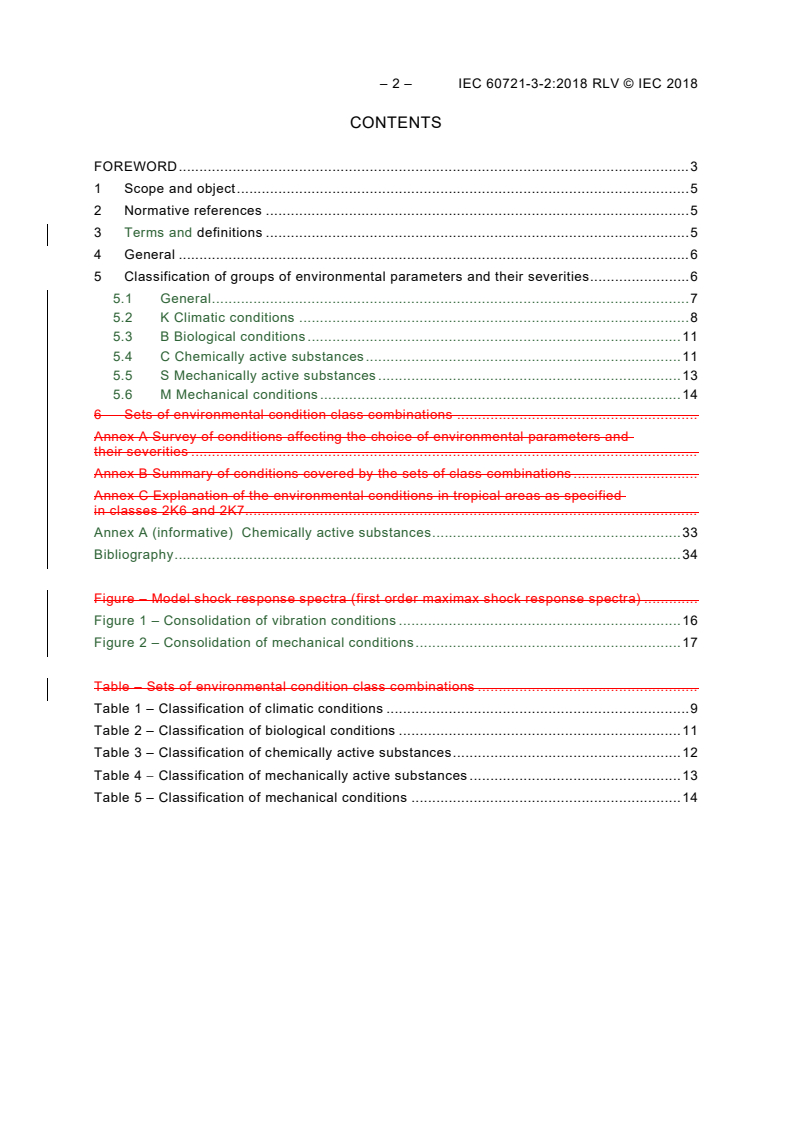
CONTENTS
FOREWORD . 3
1 Scope and object . 5
2 Normative references . 5
3 Terms and definitions . 5
4 General . 6
5 Classification of groups of environmental parameters and their severities . 6
5.1 General . 7
5.2 K Climatic conditions . 8
5.3 B Biological conditions . 11
5.4 C Chemically active substances . 11
5.5 S Mechanically active substances . 13
5.6 M Mechanical conditions . 14
6 Sets of environmental condition class combinations .
Annex A Survey of conditions affecting the choice of environmental parameters and
their severities .
Annex B Summary of conditions covered by the sets of class combinations .
Annex C Explanation of the environmental conditions in tropical areas as specified
in classes 2K6 and 2K7.
Annex A (informative) Chemically active substances . 33
Bibliography . 34
Figure – Model shock response spectra (first order maximax shock response spectra) .
Figure 1 – Consolidation of vibration conditions . 16
Figure 2 – Consolidation of mechanical conditions . 17
Table – Sets of environmental condition class combinations .
Table 1 – Classification of climatic conditions . 9
Table 2 – Classification of biological conditions . 11
Table 3 – Classification of chemically active substances . 12
Table 4 − Classification of mechanically active substances . 13
Table 5 – Classification of mechanical conditions . 14
– 3 – IEC 60721-3-2:2018 RLV © IEC 2018
INTERNATIONAL ELECTROTECHNICAL COMMISSION
____________
CLASSIFICATION OF ENVIRONMENTAL CONDITIONS –
Part 3-2: Classification of groups of environmental parameters
and their severities –
Transportation and handling
FOREWORD
1) The International Electrotechnical Commission (IEC) is a worldwide organization for standardization comprising
all national electrotechnical committees (IEC National Committees). The object of IEC is to promote
international co-operation on all questions concerning standardization in the electrical and electronic fields. To
this end and in addition to other activities, IEC publishes International Standards, Technical Specifications,
Technical Reports, Publicly Available Specifications (PAS) and Guides (hereafter referred to as “IEC
Publication(s)”). Their preparation is entrusted to technical committees; any IEC National Committee interested
in the subject dealt with may participate in this preparatory work. International, governmental and non-
governmental organizations liaising with the IEC also participate in this preparation. IEC collaborates closely
with the International Organization for Standardization (ISO) in accordance with conditions determined by
agreement between the two organizations.
2) The formal decisions or agreements of IEC on technical matters express, as nearly as possible, an international
consensus of opinion on the relevant subjects since each technical committee has representation from all
interested IEC National Committees.
3) IEC Publications have the form of recommendations for international use and are accepted by IEC National
Committees in that sense. While all reasonable efforts are made to ensure that the technical content of IEC
Publications is accurate, IEC cannot be held responsible for the way in which they are used or for any
misinterpretation by any end user.
4) In order to promote international uniformity, IEC National Committees undertake to apply IEC Publications
transparently to the maximum extent possible in their national and regional publications. Any divergence
between any IEC Publication and the corresponding national or regional publication shall be clearly indicated in
the latter.
5) IEC itself does not provide any attestation of conformity. Independent certification bodies provide conformity
assessment services and, in some areas, access to IEC marks of conformity. IEC is not responsible for any
services carried out by independent certification bodies.
6) All users should ensure that they have the latest edition of this publication.
7) No liability shall attach to IEC or its directors, employees, servants or agents including individual experts and
members of its technical committees and IEC National Committees for any personal injury, property damage or
other damage of any nature whatsoever, whether direct or indirect, or for costs (including legal fees) and
expenses arising out of the publication, use of, or reliance upon, this IEC Publication or any other IEC
Publications.
8) Attention is drawn to the Normative references cited in this publication. Use of the referenced publications is
indispensable for the correct application of this publication.
9) Attention is drawn to the possibility that some of the elements of this IEC Publication may be the subject of
patent rights. IEC shall not be held responsible for identifying any or all such patent rights.
This redline version of the official IEC Standard allows the user to identify the changes
made to the previous edition. A vertical bar appears in the margin wherever a change
has been made. Additions are in green text, deletions are in strikethrough red text.
– 4 – IEC 60721-3-2:2018 RLV © IEC 2018
International Standard IEC 60721-3-2 has been prepared by IEC technical committee 104:
Environmental conditions, classification, and methods of test.
This third edition cancels and replaces the second edition, published in 1997, and constitutes
a technical revision.
This edition includes the following significant technical changes with respect to the previous
edition:
a) Clause 1: reworded and added handling.
b) Clause 2: updated normative references.
c) Clause 3: updated definitions.
d) Clause 4: reworded and simplified.
e) Clause 5: revised and updated. Several classes have been replaced by completely new
classes based on the use of new information obtained from referenced Technical Reports.
f) Table 1 through Table 5: updated.
g) Table 6 deleted.
h) Old annexes A to C removed except Clause A.3 that is incorporated in Clause 0.
i) New Annex A.
The text of this International Standard is based on the following documents:
FDIS Report on voting
104/773/FDIS 104/783/RVD
Full information on the voting for the approval of this International Standard can be found in
the report on voting indicated in the above table.
This document has been drafted in accordance with the ISO/IEC Directives, Part 2.
A list of all parts in the IEC 60721 series, published under the general title Classification of
environmental conditions, can be found on the IEC website.
The committee has decided that the contents of this document will remain unchanged until the
stability date indicated on the IEC website under "http://webstore.iec.ch" in the data related to
the specific document. At this date, the document will be
• reconfirmed,
• withdrawn,
• replaced by a revised edition, or
• amended.
IMPORTANT – The 'colour inside' logo on the cover page of this publication indicates
that it contains colours which are considered to be useful for the correct
understanding of its contents. Users should therefore print this document using a
colour printer.
The contents of the corrigenda 1 (2018-11), 2 (2022-06) and 3 (2024-05) have been included in
this copy.
– 5 – IEC 60721-3-2:2018 RLV © IEC 2018
CLASSIFICATION OF ENVIRONMENTAL CONDITIONS –
Part 3-2: Classification of groups of environmental parameters
and their severities –
Transportation and handling
1 Scope and object
This part of IEC 60721 classifies the groups of environmental parameters and their severities
to which a product is subjected while being transported from one place to another after being
made ready for dispatch from the manufacturing factory and handled.
The most commonly used methods of transportation and handling have been taken into
account, including the following:
– road transport: cars, lorries, trucks, animals, conveyors;
– rail transport: trains, trams, conveyors;
– water transport, inland and maritime: ships, hovercraft, conveyors;
– air transport: aircraft, conveyors, jet, propeller, helicopter;
– vertical transport handling equipment: cranes, transport lifts, cableways, persons;
– conveyors;
– hand trollies.
The environmental conditions specified in this document are those met by the product being
transported that the product can be exposed to while transported and handled. If the product
is packaged, the environmental conditions apply to the package containing the product. Only
severe conditions, which may be harmful to products, are included. If the product is
unpackaged, the environmental conditions apply to the product.
Conditions for storage are given in IEC 60721-3-1.
The object of this standard is to classify groups of environmental parameters and their
severities to which a product will be exposed when being transported on ground, water and in
air, including loading and unloading.
A limited number of classes of environmental conditions are given, covering a broad field
of application. The user of this standard should select the lowest classes necessary covering
each of the conditions of the intended transportation. Some guidance for this is given in
annex A.
2 Normative references
The following documents are referred to in the text in such a way that some or all of their
content constitutes requirements of this document. For dated references, only the edition
cited applies. For undated references, the latest edition of the referenced document (including
any amendments) applies.
IEC 60721-1, Classification of environmental conditions − Part 1: Environmental parameters
and their severities
– 6 – IEC 60721-3-2:2018 RLV © IEC 2018
IEC 721-1: 1990, Classification of environmental conditions − Part 1: Environmental
parameters and their severities
Amendment 1 (1992)
Amendment 2 (1995)
IEC 721-2-1: 1982, Classification of environmental conditions − Part 2: Environmental
conditions appearing in nature − Temperature and humidity
Amendment 1 (1987)
IEC 721-3-0: 1984, Classification of environmental conditions − Part 3: Classification of
groups of environmental parameters and their severities − Introduction
Amendment 1 (1987)
3 Terms and definitions
For the purposes of this document, the terms and definitions given in IEC 60721-1 and the
following apply.
ISO and IEC maintain terminological databases for use in standardization at the following
addresses:
• IEC Electropedia: available at http://www.electropedia.org/
• ISO Online browsing platform: available at http://www.iso.org/obp
3.1
weather-protected
The product, packed or unpacked, is contained within an enclosure which affords some
protection from the environment, ranging from a temperature controlled container to a
waterproof cover placed over the product. Ventilation ranges from controlled air flow to the
raising of part of a waterproof cover to allow for natural air flow.
protected from the influences of meteorological conditions
3.2
non-weather-protected
The product, packed or unpacked, is not protected in any way from the environment.
not protected from the influences of meteorological conditions
4 General
Reference to IEC 721-3-0 is strongly recommended in order to avoid misuse of the classes
defined in other sections of IEC 721-3.
The severities specified are those which will have a low probability of being exceeded. All
specified values are maximum or limit values. These values may be reached, but do not occur
permanently. Depending on the situation, there may be different frequencies of occurrence
related to a certain period of time. Such frequencies of occurrence have not yet been included
in this standard, but should be considered for any environmental parameter. They should
additionally be specified, if applicable.
Information on the duration and frequency of occurrence is given, as clause 6, in amendment
1 to IEC 721-3-0.
Attention is drawn to the fact that combinations of the environmental parameters given may
increase the effect on a product. This applies especially to the presence of high relative
humidity in addition to biological conditions, or to conditions of chemically or mechanically
active substances.
– 7 – IEC 60721-3-2:2018 RLV © IEC 2018
A product may be subjected to a range of environmental conditions during its lifetime. These
conditions have been separated into classes described in IEC 60721-3-0. The classes given
may be used for defining the maximum short-term environmental stresses on a product.
However, they do not provide information regarding the long-term or total lifetime
environmental stresses a product may experience. This means that no reliability or lifetime
assessment is possible based on these classes alone. Refer to IEC 60721-2 (all parts) and
applicable technical reports (IEC TR 62130, IEC TR 62131-2, IEC TR 62131-3,
IEC TR 62131-4 and IEC TR 62131-5) for further information on actual environmental
conditions.
A product may be simultaneously exposed to a number of environmental parameters. For
example, solar radiation and temperature, temperature and humidity, as well as vibration and
temperature change. Combinations of the environmental parameters given may increase the
stress effect on a product. Therefore, combined conditions should be considered in the design
and evaluation of a product.
Products should be designed to survive and operate in different environments. Basically, they
will be affected by environmental influences in two ways:
– by the effects of short-term extreme environmental conditions which may directly cause
malfunction or destroy the product;
– by the effect of long-term subjection to non-extreme environmental stresses which may
slowly degrade the product and finally cause malfunction or destruction of the product.
Short-term extreme environmental conditions may occur at any time in a product's life. A
product may be unaffected by an extreme condition when it is new but fail when it is subjected
to the same condition after being used for a long period of time due to the effect of ageing.
The order in which the environmental conditions are applied may affect the results of an
evaluation.
It is important for the product specification, when referring to a certain class in
IEC 60721-3 (all parts), to define whether the product is required to be capable of operating or
only to survive without permanent damage when being exposed to the conditions described by
the class.
The environmental classes may be used as a basis for the selection of design and test
severities with respect to the consequence of failure. Information contained in
IEC 60721-3 (all parts) may be used as a means to help establish expected requirements for
use, storage, transportation, etc., and in the development of relevant specifications. The
selected severities used for testing should attempt to produce the effects of the actual
environment.
EXAMPLE 1 A high temperature test on a heat dissipating product is designed to simulate the thermal effect of
subjecting a product to conditions of high air temperature, solar radiation and other possible heat sources
dependent on the application.
EXAMPLE 2 In a mechanical shock test, the product can be subjected to mechanical shocks of simple pulse
shapes (e.g., half-sine), while the actual conditions cannot be described by such simple pulses.
It is recognized that extreme or special environmental conditions may exist which require
consideration of severities that are not addressed by this document.
5 Classification of groups of environmental parameters and their severities
5.1 General
A limited number of classes for climatic conditions (K), special climatic conditions (Z),
biological conditions (B), chemically active substances (C), mechanically active substances
(S) and mechanical conditions (M) are specified.
– 8 – IEC 60721-3-2:2018 RLV © IEC 2018
See also clause 6.
The basis of these classes is explained in clause A.2 of annex A.
Climatic conditions in tropical areas as specified in classes 2K6 and 2K7 are explained in
annex C.
The combination of the lowest classes 2K1/2B1/2C1/2S1/2M1 forms the conditions to which a
product will be subjected when being transported under very restricted conditions. The
combination of the highest classes 2K5/2B3/2C3/2S3/2M3 covers transportation under a very
wide variety of conditions including very severe conditions.
A class with higher digit conditions normally includes all classes with lower digits.
For certain parameters it has not yet been possible to give quantitative values of severities.
A summary of the conditions covered by the classes is given in clause A.3 of annex A.
This classification allows for a number of possible combinations of environmental conditions
which bear upon products wherever stored. It represents the real situation concerning
world-wide conditions of storage due to local influences of open-air climate, etc. For certain
environmental parameters, it has not yet been possible to specify quantitative severities.
For a given location or product, reference should be made to the total set of classes as
defined in 5.2 through 5.6, for example:
2K2/2B1/2C2/2S2/2M3
2K13/2B3/2C2/2S6/2M5
5.2 K Climatic conditions
NOTE The classes defined in previous versions of this document have been replaced with new classes as a result
of recent efforts at collecting information regarding climatic conditions. Those results are contained in Technical
Reports referenced in this document.
When selecting appropriate classes, attention should be paid to the fact that the climatic
conditions in weather-protected locations may depend on the open-air (non-weather-
protected) conditions, especially air temperature and solar radiation, and the type of
transportation enclosure.
The following conditions are specified in Table 1.
2K10 applies to fully air conditioned enclosed transportation. Air temperature and humidity
control is used continuously to maintain the required conditions.
2K11 applies to weather-protected transportation with limited temperature control and no
humidity control.
2K12 applies to weather-protected transportation without temperature and humidity
controls in unventilated enclosures in arid, temperate, tropical and cold climates.
Polar climate is excluded. The product may be transported in heated, pressurized
aircraft holds.
2K13 applies to non-weather-protected transportation in temperate, tropical, and cold
climates. Arid and polar climates are excluded.
2K14 applies to transportation in non-weather-protected transportation worldwide
(including arid and polar climates). This also includes transportation in unpressurized
aircraft holds. The product may be subjected to sea waves when being transported
on open decks of ships.
– 9 – IEC 60721-3-2:2018 RLV © IEC 2018
Table 1 – Classification of climatic conditions
Environmental Unit Class
6) 6)
parameter 2K1 2K2 2K3 2K4 2K5 2K5H 2K5L 2K6 2K7
a) Low air temperature °C +5 +5
−25 −25 −40 −65 −25 −65 −20
b) High air temperature, °C No +60 +70 +70 +85 +85 +70 +70 +85
air in unventilated
1)
enclosures
c) High air temperature, °C +40 +40 +40 +40 +55 +55 +40 +40 +55
air in ventilated
enclosures or outdoor
2)
air
d) Change of °C No −25/+25 −25/+30 −40/+30 −65/+30 −25/+30 −65/+30 +5/+30 −20/+30
3)
temperature, air/air
e) Change of °C No No +40/+5 +40/+5 +55/+5 +55/+5 +40/+5 +40/+5 +55/+5
3)
temperature, air/water
f) Relative humidity, not % 75 75 95 95 95 95 95 95 95
combined with rapid
°C +30 +30 +40 +45 +50 +50 +45 +45 +50
temperature changes
g) Relative humidity, % No No 95 95 95 95 95 95 95
combined with rapid
temperture changes:
°C −25/+30 −40/+30 −65/+30 −25/+30 −65/+30 +5/+30 −20/+30
air/air at high relative
3)
humidity
h) Absolute humidity, g/m No No 60 60 80 80 60 60 80
combined with rapid
temperature changes:
°C +70/+15 +70/+15 +85/+15 +85/+15 +70/+15 +70/+15 +85/+15
air/air at high water
4)
content
i) Low air pressure kPa 70 70 70 70 30 30 30 30 30
j) Change of air pressure kPa/min No No No No 6 6 6 6 6
k) Movement of m/s No No 20 20 30 30 30 30 30
surrounding medium, air
l) Precipitation, rain mm/min No No 6 6 15 15 6 15 15
m) Radiation, solar W/m 700 700 1120 1120 1120 1120 1120 1120 1120
n) Radiation, heat W/m No No 600 600 600 600 600 600 600
o) Water from sources m/s No No 1 1 3 3 3 3 3
5)
other than rain
p) Wetness None No No Conditions of wet surfaces
1) The high temperature of the surface of a product may be influenced by both the surrounding air temperature
given here and the solar radiation through a window or other opening.
2) The high temperature of the surface of a product is influenced by the surrounding air temperature given here
and the solar radiation defined below.
3) A direct transfer of the product between the two temperatures given is presumed.
4) The product is assumed to be subjected to a rapid decrease of temperature only (no rapid increase). The
figures of water content apply to temperatures down to the dew-point; at lower temperatures the relative humidity
is assumed to be approximately 100 %.
5) The figure indicates the velocity of water and not the height of water accumulated.
6) Further information on classes 2K6 (tropical damp) and 2K7 (tropical dry) is given in annex C.
– 10 – IEC 60721-3-2:2018 RLV © IEC 2018
Classification
Non-weather-
Environmental parameter Unit Weather-protected
protected
2K10 2K11 2K12 2K13 2K14
6)
a) Low air temperature °C +20 +5 −45 −45 −50
6) 9) 9)
b) High air temperature °C +25 +40 +70 +45 +50
1)
c) Low relative humidity % 20 5 4 4 4
1)
d) High relative humidity % 75 85 100 100 100
1) 3
e) Low absolute humidity g/m 4 1 0,05 0,02 0,003
1) 3
f) High absolute humidity g/m 15 25 29 35 35
2)
g) Rate of change of temperature °C/min 0,1 0,5 1,0 1,0 1,0
3)
h) Low air pressure kPa 70 70 70 70 30
3)
i) High air pressure kPa 106 106 106 106 106
8)
j) Solar radiation W/m No No 1090 1090
k) Heat radiation Not specified None None None None None
7) 7)
4)
l) Movement of surrounding air m/s 0,5 1,0 1,0
m) Condensation Not specified No No Yes Yes Yes
n) Precipitation (rain, snow, hail, etc.) Not specified No No No Yes Yes
o) Rain intensity mm/min None None None 3,3 3,3
7) 7)
p) Driving rain m/s None None None
q) Snow load kg/m None None None 100 100
5)
r) Low rain temperature °C None None None +5 +5
Dripping
10) 10)
s) Water from sources other than rain Not specified No No
Water
t) Formation of ice and frost (including Not specified No No Yes Yes Yes
freeze-thaw)
u) Temperature shock Not specified No No Yes Yes Yes
1)
The low and high relative humidity levels are limited by the low and high absolute humidity, so that, for
example, for environmental parameters a) and c), or b) and d), the severities given in Table 1 do not occur
simultaneously.
2)
Averaged over a period of time of 5 min.
3)
The value of 70 kPa represents a limit for open-air conditions, normally at an altitude of 3 000 m. In some
geographical areas, open-air conditions may occur at higher altitudes. Conditions in mines are not
considered.
4)
A cooling system based on non-assisted convection may be disturbed by adverse movement of surrounding
air.
5)
This rain temperature should be considered together with high air temperature b) and solar radiation j). The
cooling effect of the rain has to be considered in connection with the surface temperature of the product.
6)
These are air-conditioned locations with a tolerance of ±2 °C on stated temperature value.
7)
If applicable, a special value should be selected based on expected transportation mode (e.g., lorry, open
decks of ships).
8)
Thermal effect of solar radiation is included in the temperature.
9)
Thermal effect of solar radiation is not included in the temperature.
10)
Sources of water other than rain are encompassed by driving rain.
– 11 – IEC 60721-3-2:2018 RLV © IEC 2018
5.3 B Biological conditions
No quantitative severity has been specified for the following conditions. The specified
parameters of Table 2 are typical, but may not be complete.
2B1 applies to transportation in areas without risks from mould growth and attack by
animals, or in compartments with environmental controls in place to prevent mould
growth and attack by animals.
2B2 applies to transportation in areas where mould growth and attacks of animals, except
termites, may occur.
2B3 applies to transportation in areas where attacks by termites may additionally occur.
Table 2 – Classification of biological conditions
Environmental Unit Class
parameter
2B1 2B2 2B3
a) Flora None No Presence of mould, fungus, etc.
b) Fauna None No Presence of rodents or other animals harmful to
products:
excluding termites including termites
Class
Biological parameter
2B1 2B2 2B3
Presence of mould, fungus, etc.
Presence of rodents and other animals
None Negligible
harmful to products
excluding termites including termites
5.4 C Chemically active substances
The contamination of the natural atmosphere is mainly caused by chemical emissions from
industrial activities, motor-driven vehicles, and heating systems. A further chemical influence
is caused by aerosols of sea and road salts. Contamination may affect the product’s function
and materials. The parameters shown in Table 3 are estimates based on information available
at the time of publication. It is recommended that reference be made to local or regional
information specific to an area of interest when establishing requirements.
See Annex A for additional information.
2C1 applies to transportation and handling in rural and some urban areas with low
industrial activity and moderate traffic, and areas where there is either no salt mist or
there are protections in place to protect the product from salt mist. This also applies
to handling indoors.
2C2 applies to transportation and handling in areas with normal levels of contaminants as
experienced in urban areas with industrial activity scattered over the whole area, or
with heavy traffic. This includes transportation in areas where salt mist is present
including maritime transport of containers but not transport on open decks of ships.
2C3 applies to transportation and handling in areas that are in the immediate vicinity of
industrial sources with chemical emissions, and transportation on open decks of
ships.
– 12 – IEC 60721-3-2:2018 RLV © IEC 2018
Table 3 – Classification of chemically active substances
Environmental Unit Class
parameter
2C1 2C2 2C3
a) Sea salts None No Conditions of salt mist Conditions of salt water
b) Sulphur dioxide mg/m 0,1 1,0 (0,3) 10 (5,0)
3 3
cm /m 0,037 0,37 (0,11) 3,7 (1,85)
c) Hydrogen sulphide mg/m 0,01 0,5 (0,1) 10 (3,0)
3 3
cm /m 0,0071 0,36 (0,071) 7,1 (2,1)
d) Nitrogen oxides mg/m 0,1 1,0 (0,5) 10 (3,0)
(expressed in the
3 3
cm /m 0,052 0,52 (0,26) 5,2 (1,56)
equivalent values of
nitrogen dioxides)
e) Ozone mg/m 0,01 0,1 (0,05) 0,3 (0,1)
3 3
cm /m 0,005 0,05 (0,025) 0,15 (0,05)
f) Hydrogen chloride mg/m 0,1 0,5 (0,1) 5,0 (1,0)
3 3
cm /m 0,066 0,33 (0,066) 3,3 (0,66)
g) Hydrogen fluoride mg/m 0,003 0,03 (0,01) 2,0 (0,1)
3 3
cm /m 0,0036 0,036 (0,012) 2,4 (0,12)
h) Ammonia mg/m 0,3 3,0 (1,0) 35 (10)
3 3
cm /m 0,42 4,2 (1,4) 49 (14)
NOTES
1 The figures given are maximum values, occurring over a 30 min period per day.
2 The figures within brackets are the expected long-term mean values.
3 3 3
3 The values given in cm /m have been calculated from the values given in mg/m and refer to 20 °C and
101,3 kPa.
4 The table uses rounded values.
Class
Environmental 2C1 2C2 2C3
1)
Unit
parameter
Maximum Maximum Maximum
Mean value Mean value
2) 2)
value value value
a) Salt mist to None No Yes Yes
include sea and
road salts
b) Saltwater None No No Yes
c) Sulphur dioxide mg/m 0,1 0,3 1,0 5,0 10
3 3
cm /m 0,037 0,11 0,37 1,85 3,7
d) Hydrogen mg/m 0,01 0,1 0,5 3,0 10
sulphide
3 3
cm /m 0,0071 0,071 0,36 2,1 7,1
e) Hydrogen mg/m 0,1 0,1 0,5 1,0 5,0
chloride
3 3
cm /m 0,066 0,066 0,33 0,66 3,3
f) Hydrogen fluoride mg/m 0,003 0,01 0,03 0,1 2,0
3 3
cm /m 0,0036 0,012 0,036 0,12 2,4
g) Ammonia mg/m 0,3 1,0 3,0 10 35
3 3
cm /m 0,42 1,4 4,2 14 49
h) Ozone mg/m 0,01 0,05 0,1 0,1 0,3
3 3
cm /m 0,005 0,025 0,05 0,05 0,15
– 13 – IEC 60721-3-2:2018 RLV © IEC 2018
i) Nitrogen oxides mg/m 0,1 0,5 1,0 3,0 9,0
(expressed in
3 3
cm /m 0,052 0,26 0,52 1,56 4,68
equivalent values of
nitrogen dioxide)
1) 3 3 3
The values given in cm /m have been calculated from the values given in mg/m referenced to a temperature
of 20 °C and a pressure of 101,3 kPa. The table uses rounded values.
2)
Mean values are expected long-term values. Maximum values are limit or peak values occurring over a period
of time that is typically not more than 30 min per day.
5.5 S Mechanically active substances
NOTE The classes defined in previous versions of this document have been replaced with new classes as a result
of recent efforts at collecting information regarding mechanically active substances.
Dust and sand are classified together, as the effects caused by these environmental
conditions are similar. These conditions are specified in Table 4.
2S1 applies to transportation and handling where precautions have been taken to
minimize the presence of dust and sand.
2S5 applies to transportation and handling with limited precautions to minimize the
presence of dust and sand such as enclosed transport.
2S6 applies to non-enclosed transportation and handling in close proximity to dust and
sand sources without special precautions to minimize the presence of dust and sand.
2S7 applies to transportation and handling in areas with driven dust and sand.
Table 4 − Classification of mechanically active substances
Environmental Unit Class
parameter
2S1 2S2 2S3
a) Sand in air g/m No 0,1 10
b) Dust sedimentation mg/(m ⋅h) No 3,0 3,0
Class
Environmental parameter Unit
2S1 2S5 2S6 2S7
a) Sand in air mg/m None 30 300 1 000
b) Dust in air mg/m None 0,2 5,0 15
c) Dust (sedimentation rate) mg/(m ⋅h) None 15 40 80
1)
If applicable, a special value should be selected based on expected transportation mode.
– 14 – IEC 60721-3-2:2018 RLV © IEC 2018
5.6 M Mechanical conditions
NOTE The classes defined in previous versions of this document have been replaced with new classes as a result
of recent efforts at collecting information regarding mechanical conditions. Those results are contained in
Technical Reports referenced in this document.
Mechanical conditions described in this document encompass those conditions that may exist
during transportation and handling. The conditions do not represent test severities. Vibration
and mechanical shock environments are depicted in Figures 1 and 2, respectively, and
described in Table 5.
2M4 applies to handling, transport by rail, river, sea, air (jet aircraft only) and road
transport using good vehicles on good roads. This category includes transport of
goods within ISO containers.
2M5 includes those conditions described by 2M4 plus road transport using poor vehicles
and/or on poor roads as well as handling using trolleys with no suspension.
2M6 includes those conditions described by 2M4 and 2M5, plus transport by air in
propeller aircraft and helicopter.
Table 5 – Classification of mechanical conditions
The mechanical conditions given apply to items placed on the floor of the transport
compartment.
Unit Class
Environmental
parameter
2M1 2M2 2M3
a) Stationary vibration
1)
sinusoidal :
displacement amplitude mm 3,5 3,5 7,5
acceleration amplitude m/s 10 15 10 15 20 40
frequency range Hz 2-9 9-200 200-500 2-9 9-200 200-500 2-8 8-200 200-500
b) Stationary vibration,
1)
random :
2 3
acceleration spectral m /s 1 0,3 1 0,3 3 1
density
frequency range Hz 10-200 200-2000 10-200 200-2000 10-20 0 200-2000
c) Non-stationary vibration
2)
including shock :
Shock response spectrum
type I,
m/s 100 100 300
peak acceleration â
Shock response spectrum
type II,
m/s No 300 1000
peak acceleration â
d) Free fall:
mass less than 20 kg m 0,25 1,2 1,5
mass 20 kg to 100 kg m 0,25 1,0 1,2
mass more than 100 kg m 0,1 0,25 0,5
e) Toppling:
mass less than 20 kg None Toppling around any of the edges
mass 20 kg to 100 kg None No Toppling around any of the edges
mass more than 100 kg None No No Toppling around any of
the edges
f) Rolling, pitching:
3)
angle degree No ±35 ±35
period s No 8 8
g) Steady-state acceleration m/s 20 20 20
– 15 – IEC 60721-3-2:2018 RLV © IEC 2018
h) Static load kPa 5 10 10
1)
The frequency range may be limited to 200 Hz for transportation on parts of the vehicle with high internal
damping.
2)
See figure 1.
3)
An angle of 35° only occurs temporarily, but angles up to 22,5° can be reached for long periods of time.
Class
Environmental
Unit
parameter
2M4 2M5 2M6
a) Stationary
vibration, random:
2 2 2)
acceleration power (m/s ) /Hz 10 1,0 0,5 30 3,0 1 10 5
spectral density
1)
frequency range Hz 2 to 3 10 to 20 50 to 2 000 2 to 3 10 to 20 50 to 2 000 5 to 200 500 to 2 000
b) Non-stationary
vibration including
3)
shock:
4)
Shock 1
Figure 2 Curve 4 Figure 2 Curve 3 Figure 2 Curve 3
(equivalent to a half sine (equivalent to a half sine (equivalent to a half sine
2 2 2
pulse of 100 m/s and pulse of 300 m/s and pulse of 300 m/s and
11 ms duration) 11 ms duration) 11 ms duration)
Figure 2 Curve 2 Figure 2 Curve 1 Figure 2 Curve 1
(equivalent to a half sine (equivalent to a half sine (equivalent to a half sine
4)
Shock 2
2 2 2
pulse of 300 m/s and 6 ms pulse of 1 000 m/s and pulse of 1 000 m/s and
duration) 6 ms duration) 6 ms duration)
c) Free fall:
mass less than m 0,25 1,2 1,5
20 kg
mass 20 kg to
m 0,25 1,0 1,2
100 kg
mass more than
m 0,1 0,25 0,5
100 kg
d) Toppling:
mass less than None Toppling around any of the Toppling around any of the Toppling around any of the
20 kg edges edges edges
mass 20 kg to None No Toppling around any of the Toppling around any of the
100 kg edges edges
mass more than
None No No Toppling around any of the
100 kg
edges
e) Rolling, pitching:
5)
angle Degrees No ±35 ±35
period None No 8 8
f) Steady-state
m/s 20 20 20
acceleration
g) Static load kPa 5 10 10
– 16 – IEC 60721-3-2:2018 RLV © IEC 2018
1)
When transport only occurs by rail, river, sea and road, the upper frequency considered may be reduced to 500 Hz for
products that are not sensitive to vibration excitations above 500 Hz.
2)
The low frequency stationary vibration random component arises from the influence of land vehicle suspension systems.
The component is included for design purposes but is not always included in vibration test specifications.
3)
For land vehicles, these shocks can occur simultaneously with the stationary vibration random conditions.
4)
Both shocks would normally be used to encompass different aspects of the shock environment.
5)
An angle of 35° may only occur temporarily. An angle of up to 22,5° can be reached for long periods of time.
Stationary vibration, random
2M6
2M5
2M4
0,1
1 10 100 1 000 10 000
Frequency (Hz)
IEC
Figure 1 – Consolidation of vibration conditions
2 2
Acceleration power spectral density ((m/s ) /Hz)
– 17 – IEC 60721-3-2:2018 RLV © IEC 2018
Figure 2 – Consolidation of mechanical conditions
– 18 – IEC 60721-3-2:2018 RLV © IEC 2018
6 Sets of environmental condition class combinations
As indicated in clause 5, the classification allows a number of possible combinations of
environmental conditions bearing on products wherever used. The number of possibilities,
and thus the flexibility, is therefore very great. In practice, however, this flexibility is not
always an advantage when, for instance, environmental condition specifications for a certain
location are drawn up by different parties, invariably producing small but disturbing
divergencies.
In order to limit the possibilities to general cases, standard sets of class combinations may be
selected from table 6. For a given location or product, reference may then be made to this
standard, for example IE22. Only when conditions are not considered to be covered by this
specification, is reference made to each class as indicated in clause 5. Alternatively, if some
severities of parameters deviate from that or those of the class combination, this should be
expressed by the addition to the set designation of the following phrase: “but .
(parameter) . (severity and unit)”, for example IE22 but sand 10 g/m .
Annex B gives a summary of conditions covered by the sets of class combinations.
Table 6 − Sets of environmental class combinations
Condition Set of class combinations
IE21 IE22 IE23 IE24
Climatic 2K2 2K3 2K4 2K5
Biological 2B2 2B2 2B2 2B2
Chemically active substances 2C2 2C2 2C2 2C2
Mechanically active substances 2S2 2S2 2S2 2S3
1)
Mechanical 2M1 2M1 2M2 2M3
1)
The conditions of footnote 1 of table 5 are valid.
– 19 – IEC 60721-3-2:2018 RLV © IEC 2018
Example of durations for half-sine pulse:
Spectrum type I: duration 11 ms
Spectrum type II: duration 6 ms
Figure 1 − Model shock response spectra
(first order maximax shock response spectra)
For explanation see note 6 relating to table 1 of IEC 721-1
– 20 – IEC 60721-3-2:2018 RLV © IEC 2018
Annex A
(informative)
Survey of conditions affecting the choice of environmental
parameters and their severities
A.1 General
In this annex the basis of the classes is explained. A survey of conditions affecting the choice
of environmental parameters and their severities is given, together with a summary of the
conditions
...
IEC 60721-3-2 ®
Edition 3.0 2018-02
INTERNATIONAL
STANDARD
NORME
INTERNATIONALE
colour
inside
Classification of environmental conditions –
Part 3-2: Classification of groups of environmental parameters and their
severities – Transportation and handling
Classification des conditions d’environnement –
Partie 3-2: Classification des groupements des agents d’environnement et de
leurs sévérités – Transport et manutention
All rights reserved. Unless otherwise specified, no part of this publication may be reproduced or utilized in any form
or by any means, electronic or mechanical, including photocopying and microfilm, without permission in writing from
either IEC or IEC's member National Committee in the country of the requester. If you have any questions about IEC
copyright or have an enquiry about obtaining additional rights to this publication, please contact the address below or
your local IEC member National Committee for further information.
Droits de reproduction réservés. Sauf indication contraire, aucune partie de cette publication ne peut être reproduite
ni utilisée sous quelque forme que ce soit et par aucun procédé, électronique ou mécanique, y compris la photocopie
et les microfilms, sans l'accord écrit de l'IEC ou du Comité national de l'IEC du pays du demandeur. Si vous avez des
questions sur le copyright de l'IEC ou si vous désirez obtenir des droits supplémentaires sur cette publication, utilisez
les coordonnées ci-après ou contactez le Comité national de l'IEC de votre pays de résidence.
IEC Central Office Tel.: +41 22 919 02 11
3, rue de Varembé info@iec.ch
CH-1211 Geneva 20 www.iec.ch
Switzerland
About the IEC
The International Electrotechnical Commission (IEC) is the leading global organization that prepares and publishes
International Standards for all electrical, electronic and related technologies.
About IEC publications
The technical content of IEC publications is kept under constant review by the IEC. Please make sure that you have the
latest edition, a corrigenda or an amendment might have been published.
IEC Catalogue - webstore.iec.ch/catalogue Electropedia - www.electropedia.org
The stand-alone application for consulting the entire The world's leading online dictionary of electronic and
bibliographical information on IEC International Standards, electrical terms containing 21 000 terms and definitions in
Technical Specifications, Technical Reports and other English and French, with equivalent terms in 16 additional
documents. Available for PC, Mac OS, Android Tablets and languages. Also known as the International Electrotechnical
iPad. Vocabulary (IEV) online.
IEC publications search - webstore.iec.ch/advsearchform IEC Glossary - std.iec.ch/glossary
The advanced search enables to find IEC publications by a 67 000 electrotechnical terminology entries in English and
variety of criteria (reference number, text, technical French extracted from the Terms and Definitions clause of
committee,…). It also gives information on projects, replaced IEC publications issued since 2002. Some entries have been
and withdrawn publications. collected from earlier publications of IEC TC 37, 77, 86 and
CISPR.
IEC Just Published - webstore.iec.ch/justpublished
Stay up to date on all new IEC publications. Just Published IEC Customer Service Centre - webstore.iec.ch/csc
details all new publications released. Available online and If you wish to give us your feedback on this publication or
also once a month by email. need further assistance, please contact the Customer Service
Centre: sales@iec.ch.
A propos de l'IEC
La Commission Electrotechnique Internationale (IEC) est la première organisation mondiale qui élabore et publie des
Normes internationales pour tout ce qui a trait à l'électricité, à l'électronique et aux technologies apparentées.
A propos des publications IEC
Le contenu technique des publications IEC est constamment revu. Veuillez vous assurer que vous possédez l’édition la
plus récente, un corrigendum ou amendement peut avoir été publié.
Catalogue IEC - webstore.iec.ch/catalogue Electropedia - www.electropedia.org
Application autonome pour consulter tous les renseignements
Le premier dictionnaire en ligne de termes électroniques et
bibliographiques sur les Normes internationales,
électriques. Il contient 21 000 termes et définitions en anglais
Spécifications techniques, Rapports techniques et autres
et en français, ainsi que les termes équivalents dans 16
documents de l'IEC. Disponible pour PC, Mac OS, tablettes
langues additionnelles. Egalement appelé Vocabulaire
Android et iPad.
Electrotechnique International (IEV) en ligne.
Recherche de publications IEC -
Glossaire IEC - std.iec.ch/glossary
webstore.iec.ch/advsearchform
67 000 entrées terminologiques électrotechniques, en anglais
La recherche avancée permet de trouver des publications IEC et en français, extraites des articles Termes et Définitions des
en utilisant différents critères (numéro de référence, texte, publications IEC parues depuis 2002. Plus certaines entrées
comité d’études,…). Elle donne aussi des informations sur les antérieures extraites des publications des CE 37, 77, 86 et
projets et les publications remplacées ou retirées. CISPR de l'IEC.
IEC Just Published - webstore.iec.ch/justpublished Service Clients - webstore.iec.ch/csc
Restez informé sur les nouvelles publications IEC. Just Si vous désirez nous donner des commentaires sur cette
Published détaille les nouvelles publications parues. publication ou si vous avez des questions contactez-nous:
Disponible en ligne et aussi une fois par mois par email. sales@iec.ch.
IEC 60721-3-2 ®
Edition 3.0 2018-02
INTERNATIONAL
STANDARD
NORME
INTERNATIONALE
colour
inside
Classification of environmental conditions –
Part 3-2: Classification of groups of environmental parameters and their
severities – Transportation and handling
Classification des conditions d’environnement –
Partie 3-2: Classification des groupements des agents d’environnement et de
leurs sévérités – Transport et manutention
INTERNATIONAL
ELECTROTECHNICAL
COMMISSION
COMMISSION
ELECTROTECHNIQUE
INTERNATIONALE
ICS 19.040 ISBN 978-2-8322-5374-8
– 2 – IEC 60721-3-2:2018 © IEC 2018
CONTENTS
FOREWORD . 3
1 Scope and object . 5
2 Normative references . 5
3 Terms and definitions. 5
4 General . 6
5 Classification of groups of environmental parameters and their severities . 7
5.1 General . 7
5.2 K Climatic conditions . 7
5.3 B Biological conditions . 9
5.4 C Chemically active substances . 9
5.5 S Mechanically active substances . 10
5.6 M Mechanical conditions . 11
Annex A (informative) Chemically active substances . 15
Bibliography . 16
Figure 1 – Consolidation of vibration conditions . 13
Figure 2 – Consolidation of mechanical conditions . 14
Table 1 – Classification of climatic conditions . 8
Table 2 – Classification of biological conditions . 9
Table 3 – Classification of chemically active substances . 10
Table 4 − Classification of mechanically active substances . 11
Table 5 – Classification of mechanical conditions . 11
– 3 – IEC 60721-3-2:2018 © IEC 2018
INTERNATIONAL ELECTROTECHNICAL COMMISSION
____________
CLASSIFICATION OF ENVIRONMENTAL CONDITIONS –
Part 3-2: Classification of groups of environmental parameters
and their severities –
Transportation and handling
FOREWORD
1) The International Electrotechnical Commission (IEC) is a worldwide organization for standardization comprising
all national electrotechnical committees (IEC National Committees). The object of IEC is to promote
international co-operation on all questions concerning standardization in the electrical and electronic fields. To
this end and in addition to other activities, IEC publishes International Standards, Technical Specifications,
Technical Reports, Publicly Available Specifications (PAS) and Guides (hereafter referred to as “IEC
Publication(s)”). Their preparation is entrusted to technical committees; any IEC National Committee interested
in the subject dealt with may participate in this preparatory work. International, governmental and non-
governmental organizations liaising with the IEC also participate in this preparation. IEC collaborates closely
with the International Organization for Standardization (ISO) in accordance with conditions determined by
agreement between the two organizations.
2) The formal decisions or agreements of IEC on technical matters express, as nearly as possible, an international
consensus of opinion on the relevant subjects since each technical committee has representation from all
interested IEC National Committees.
3) IEC Publications have the form of recommendations for international use and are accepted by IEC National
Committees in that sense. While all reasonable efforts are made to ensure that the technical content of IEC
Publications is accurate, IEC cannot be held responsible for the way in which they are used or for any
misinterpretation by any end user.
4) In order to promote international uniformity, IEC National Committees undertake to apply IEC Publications
transparently to the maximum extent possible in their national and regional publications. Any divergence
between any IEC Publication and the corresponding national or regional publication shall be clearly indicated in
the latter.
5) IEC itself does not provide any attestation of conformity. Independent certification bodies provide conformity
assessment services and, in some areas, access to IEC marks of conformity. IEC is not responsible for any
services carried out by independent certification bodies.
6) All users should ensure that they have the latest edition of this publication.
7) No liability shall attach to IEC or its directors, employees, servants or agents including individual experts and
members of its technical committees and IEC National Committees for any personal injury, property damage or
other damage of any nature whatsoever, whether direct or indirect, or for costs (including legal fees) and
expenses arising out of the publication, use of, or reliance upon, this IEC Publication or any other IEC
Publications.
8) Attention is drawn to the Normative references cited in this publication. Use of the referenced publications is
indispensable for the correct application of this publication.
9) Attention is drawn to the possibility that some of the elements of this IEC Publication may be the subject of
patent rights. IEC shall not be held responsible for identifying any or all such patent rights.
International Standard IEC 60721-3-2 has been prepared by IEC technical committee 104:
Environmental conditions, classification, and methods of test.
This third edition cancels and replaces the second edition, published in 1997, and constitutes a
technical revision.
This edition includes the following significant technical changes with respect to the previous
edition:
a) Clause 1: reworded and added handling.
b) Clause 2: updated normative references.
c) Clause 3: updated definitions.
d) Clause 4: reworded and simplified.
– 4 – IEC 60721-3-2:2018 © IEC 2018
e) Clause 5: revised and updated. Several classes have been replaced by completely new
classes based on the use of new information obtained from referenced Technical Reports.
f) Table 1 through Table 5: updated.
g) Table 6 deleted.
h) Old annexes A to C removed except Clause A.3 that is incorporated in Clause 5.
i) New Annex A.
The text of this International Standard is based on the following documents:
FDIS Report on voting
104/773/FDIS 104/783/RVD
Full information on the voting for the approval of this International Standard can be found in
the report on voting indicated in the above table.
This document has been drafted in accordance with the ISO/IEC Directives, Part 2.
A list of all parts in the IEC 60721 series, published under the general title Classification of
environmental conditions, can be found on the IEC website.
The committee has decided that the contents of this document will remain unchanged until
the stability date indicated on the IEC website under "http://webstore.iec.ch" in the data
related to the specific document. At this date, the document will be
reconfirmed,
withdrawn,
replaced by a revised edition, or
amended.
The contents of the corrigendum of November 2018 have been included in this copy.
IMPORTANT – The 'colour inside' logo on the cover page of this publication indicates
that it contains colours which are considered to be useful for the correct
understanding of its contents. Users should therefore print this document using a
colour printer.
– 5 – IEC 60721-3-2:2018 © IEC 2018
CLASSIFICATION OF ENVIRONMENTAL CONDITIONS –
Part 3-2: Classification of groups of environmental parameters
and their severities –
Transportation and handling
1 Scope and object
This part of IEC 60721 classifies the groups of environmental parameters and their severities
to which a product is subjected while being transported and handled.
The most commonly used methods of transportation and handling have been taken into
account, including the following:
– road transport: cars, trucks;
– rail transport: trains, trams;
– water transport, inland and maritime: ships;
– air transport: aircraft, jet, propeller, helicopter;
– handling equipment: cranes, transport lifts, cableways, persons;
– conveyors;
– hand trollies.
The environmental conditions specified in this document are those that the product can be
exposed to while transported and handled. If the product is packaged, the environmental
conditions apply to the package containing the product. If the product is unpackaged, the
environmental conditions apply to the product.
Conditions for storage are given in IEC 60721-3-1.
2 Normative references
The following documents are referred to in the text in such a way that some or all of their
content constitutes requirements of this document. For dated references, only the edition cited
applies. For undated references, the latest edition of the referenced document (including any
amendments) applies.
IEC 60721-1, Classification of environmental conditions − Part 1: Environmental parameters
and their severities
3 Terms and definitions
For the purposes of this document, the terms and definitions given in IEC 60721-1 and the
following apply.
ISO and IEC maintain terminological databases for use in standardization at the following
addresses:
• IEC Electropedia: available at http://www.electropedia.org/
• ISO Online browsing platform: available at http://www.iso.org/obp
– 6 – IEC 60721-3-2:2018 © IEC 2018
3.1
weather-protected
protected from the influences of meteorological conditions
3.2
non-weather-protected
not protected from the influences of meteorological conditions
4 General
A product may be subjected to a range of environmental conditions during its lifetime. These
conditions have been separated into classes described in IEC 60721-3-0. The classes given
may be used for defining the maximum short-term environmental stresses on a product.
However, they do not provide information regarding the long-term or total lifetime
environmental stresses a product may experience. This means that no reliability or lifetime
assessment is possible based on these classes alone. Refer to IEC 60721-2 (all parts) and
applicable technical reports (IEC TR 62130, IEC TR 62131-2, IEC TR 62131-3,
IEC TR 62131-4 and IEC TR 62131-5) for further information on actual environmental
conditions.
A product may be simultaneously exposed to a number of environmental parameters. For
example, solar radiation and temperature, temperature and humidity, as well as vibration and
temperature change. Combinations of the environmental parameters given may increase the
stress effect on a product. Therefore, combined conditions should be considered in the design
and evaluation of a product.
Products should be designed to survive and operate in different environments. Basically, they
will be affected by environmental influences in two ways:
– by the effects of short-term extreme environmental conditions which may directly cause
malfunction or destroy the product;
– by the effect of long-term subjection to non-extreme environmental stresses which may
slowly degrade the product and finally cause malfunction or destruction of the product.
Short-term extreme environmental conditions may occur at any time in a product's life. A
product may be unaffected by an extreme condition when it is new but fail when it is subjected
to the same condition after being used for a long period of time due to the effect of ageing. The
order in which the environmental conditions are applied may affect the results of an evaluation.
It is important for the product specification, when referring to a certain class in
IEC 60721-3 (all parts), to define whether the product is required to be capable of operating or
only to survive without permanent damage when being exposed to the conditions described by
the class.
The environmental classes may be used as a basis for the selection of design and test
severities with respect to the consequence of failure. Information contained in
IEC 60721-3 (all parts) may be used as a means to help establish expected requirements for
use, storage, transportation, etc., and in the development of relevant specifications. The
selected severities used for testing should attempt to produce the effects of the actual
environment.
EXAMPLE 1 A high temperature test on a heat dissipating product is designed to simulate the thermal effect of
subjecting a product to conditions of high air temperature, solar radiation and other possible heat sources
dependent on the application.
EXAMPLE 2 In a mechanical shock test, the product can be subjected to mechanical shocks of simple pulse
shapes (e.g., half-sine), while the actual conditions cannot be described by such simple pulses.
It is recognized that extreme or special environmental conditions may exist which require
consideration of severities that are not addressed by this document.
– 7 – IEC 60721-3-2:2018 © IEC 2018
5 Classification of groups of environmental parameters and their severities
5.1 General
A number of classes for climatic conditions (K), special climatic conditions (Z), biological
conditions (B), chemically active substances (C), mechanically active substances (S), and
mechanical conditions (M) are specified.
This classification allows for a number of possible combinations of environmental conditions
which bear upon products wherever stored. It represents the real situation concerning
world-wide conditions of storage due to local influences of open-air climate, etc. For certain
environmental parameters, it has not yet been possible to specify quantitative severities.
For a given location or product, reference should be made to the total set of classes as defined
in 5.2 through 5.6, for example:
2K13/2B3/2C2/2S6/2M5
5.2 K Climatic conditions
NOTE The classes defined in previous versions of this document have been replaced with new classes as a result
of recent efforts at collecting information regarding climatic conditions. Those results are contained in Technical
Reports referenced in this document.
When selecting appropriate classes, attention should be paid to the fact that the climatic
conditions in weather-protected locations may depend on the open-air (non-weather-protected)
conditions, especially air temperature and solar radiation, and the type of transportation
enclosure.
The following conditions are specified in Table 1.
2K10 applies to fully air conditioned enclosed transportation. Air temperature and humidity
control is used continuously to maintain the required conditions.
2K11 applies to weather-protected transportation with limited temperature control and no
humidity control.
2K12 applies to weather-protected transportation without temperature and humidity controls
in unventilated enclosures in arid, temperate, tropical and cold climates. Polar climate
is excluded. The product may be transported in heated, pressurized aircraft holds.
2K13 applies to non-weather-protected transportation in temperate, tropical, and cold
climates. Arid and polar climates are excluded.
2K14 applies to transportation in non-weather-protected transportation worldwide (including
arid and polar climates). This also includes transportation in unpressurized aircraft
holds. The product may be subjected to sea waves when being transported on open
decks of ships.
– 8 – IEC 60721-3-2:2018 © IEC 2018
Table 1 – Classification of climatic conditions
Classification
Non-weather-
Environmental parameter Unit Weather-protected
protected
2K10 2K11 2K12 2K13 2K14
6)
a) Low air temperature °C +20 +5 −45 −45 −50
6) 9) 9)
b) High air temperature °C +25 +40 +70 +45 +50
1)
c) Low relative humidity % 20 5 4 4 4
1)
d) High relative humidity % 75 85 100 100 100
1) 3
e) Low absolute humidity g/m 4 1 0,5 0,02 0,003
1) 3
f) High absolute humidity g/m 15 25 29 35 35
2)
g) Rate of change of temperature °C/min 0,1 0,5 1,0 1,0 1,0
3)
h) Low air pressure kPa 70 70 70 70 30
3)
i) High air pressure kPa 106 106 106 106 106
8)
j) Solar radiation W/m No No 1090 1090
k) Heat radiation Not specified None None None None None
7) 7)
4)
l) Movement of surrounding air m/s 0,5 1,0 1,0
m) Condensation Not specified No No Yes Yes Yes
n) Precipitation (rain, snow, hail, etc.) Not specified No No No Yes Yes
o) Rain intensity mm/min None None None 3,3 3,3
7) 7)
p) Driving rain m/s None None None
q) Snow load kg/m None None None 100 100
5)
r) Low rain temperature °C None None None +5 +5
Dripping 10) 10)
s) Water from sources other than rain Not specified No No
Water
t) Formation of ice and frost (including Not specified No No Yes Yes Yes
freeze-thaw)
u) Temperature shock Not specified No No Yes Yes Yes
1)
The low and high relative humidity levels are limited by the low and high absolute humidity, so that, for
example, for environmental parameters a) and c), or b) and d), the severities given in Table 1 do not occur
simultaneously.
2)
Averaged over a period of time of 5 min.
3)
The value of 70 kPa represents a limit for open-air conditions, normally at an altitude of 3 000 m. In some
geographical areas, open-air conditions may occur at higher altitudes. Conditions in mines are not
considered.
4)
A cooling system based on non-assisted convection may be disturbed by adverse movement of surrounding
air.
5)
This rain temperature should be considered together with high air temperature b) and solar radiation j). The
cooling effect of the rain has to be considered in connection with the surface temperature of the product.
6)
These are air-conditioned locations with a tolerance of ±2 °C on stated temperature value.
7)
If applicable, a special value should be selected based on expected transportation mode (e.g., lorry, open
decks of ships).
8)
Thermal effect of solar radiation is included in the temperature.
9)
Thermal effect of solar radiation is not included in the temperature.
10)
Sources of water other than rain are encompassed by driving rain.
– 9 – IEC 60721-3-2:2018 © IEC 2018
5.3 B Biological conditions
No quantitative severity has been specified for the following conditions. The specified
parameters of Table 2 are typical, but may not be complete.
2B1 applies to transportation in areas without risks from mould growth and attack by
animals, or in compartments with environmental controls in place to prevent mould
growth and attack by animals.
2B2 applies to transportation in areas where mould growth and attacks of animals, except
termites, may occur.
2B3 applies to transportation in areas where attacks by termites may additionally occur.
Table 2 – Classification of biological conditions
Class
Biological parameter
2B1 2B2 2B3
Presence of mould, fungus, etc.
Presence of rodents and other animals
None Negligible
harmful to products
excluding termites including termites
5.4 C Chemically active substances
The contamination of the natural atmosphere is mainly caused by chemical emissions from
industrial activities, motor-driven vehicles, and heating systems. A further chemical influence is
caused by aerosols of sea and road salts. Contamination may affect the product’s function and
materials. The parameters shown in Table 3 are estimates based on information available at
the time of publication. It is recommended that reference be made to local or regional
information specific to an area of interest when establishing requirements.
See Annex A for additional information.
2C1 applies to transportation and handling in rural and some urban areas with low
industrial activity and moderate traffic, and areas where there is either no salt mist or
there are protections in place to protect the product from salt mist. This also applies to
handling indoors.
2C2 applies to transportation and handling in areas with normal levels of contaminants as
experienced in urban areas with industrial activity scattered over the whole area, or
with heavy traffic. This includes transportation in areas where salt mist is present
including maritime transport of containers but not transport on open decks of ships.
2C3 applies to transportation and handling in areas that are in the immediate vicinity of
industrial sources with chemical emissions, and transportation on open decks of
ships.
– 10 – IEC 60721-3-2:2018 © IEC 2018
Table 3 – Classification of chemically active substances
Class
Environmental 2C1 2C2 2C3
1)
Unit
parameter
Maximum Maximum Maximum
Mean value Mean value
2) 2)
value value value
a) Salt mist to None No Yes Yes
include sea and
road salts
b) Saltwater None No No Yes
c) Sulphur dioxide mg/m 0,1 0,3 1,0 5,0 10
3 3
cm /m 0,037 0,11 0,37 1,85 3,7
d) Hydrogen mg/m 0,01 0,1 0,5 3,0 10
sulphide
3 3
cm /m 0,0071 0,071 0,36 2,1 7,1
e) Hydrogen mg/m 0,1 0,1 0,5 1,0 5,0
chloride
3 3
cm /m 0,066 0,066 0,33 0,66 3,3
f) Hydrogen fluoride mg/m 0,003 0,01 0,03 0,1 2,0
3 3
cm /m 0,0036 0,012 0,036 0,12 2,4
g) Ammonia mg/m 0,3 1,0 3,0 10 35
3 3
cm /m 0,42 1,4 4,2 14 49
h) Ozone mg/m 0,01 0,05 0,1 0,1 0,3
3 3
cm /m 0,005 0,025 0,05 0,05 0,15
i) Nitrogen oxides mg/m 0,1 0,5 1,0 3,0 9,0
(expressed in
3 3
cm /m 0,052 0,26 0,52 1,56 4,68
equivalent values of
nitrogen dioxide)
1) 3 3 3
The values given in cm /m have been calculated from the values given in mg/m referenced to a temperature
of 20 °C and a pressure of 101,3 kPa. The table uses rounded values.
2)
Mean values are expected long-term values. Maximum values are limit or peak values occurring over a period
of time that is typically not more than 30 min per day.
5.5 S Mechanically active substances
NOTE The classes defined in previous versions of this document have been replaced with new classes as a result
of recent efforts at collecting information regarding mechanically active substances.
Dust and sand are classified together, as the effects caused by these environmental conditions
are similar. These conditions are specified in Table 4.
2S1 applies to transportation and handling where precautions have been taken to minimize
the presence of dust and sand.
2S5 applies to transportation and handling with limited precautions to minimize the
presence of dust and sand such as enclosed transport.
2S6 applies to non-enclosed transportation and handling in close proximity to dust and
sand sources without special precautions to minimize the presence of dust and sand.
2S7 applies to transportation and handling in areas with driven dust and sand.
– 11 – IEC 60721-3-2:2018 © IEC 2018
Table 4 − Classification of mechanically active substances
Class
Environmental parameter Unit
2S1 2S5 2S6 2S7
a) Sand in air mg/m None 30 300 1 000
b) Dust in air mg/m None 0,2 5,0 15
c) Dust (sedimentation rate) None 15 40 80
mg/(m ⋅h)
1)
If applicable, a special value should be selected based on expected transportation mode.
5.6 M Mechanical conditions
NOTE The classes defined in previous versions of this document have been replaced with new classes as a result
of recent efforts at collecting information regarding mechanical conditions. Those results are contained in Technical
Reports referenced in this document.
Mechanical conditions described in this document encompass those conditions that may exist
during transportation and handling. The conditions do not represent test severities. Vibration
and mechanical shock environments are depicted in Figures 1 and 2, respectively, and
described in Table 5.
2M4 applies to handling, transport by rail, river, sea, air (jet aircraft only) and road
transport using good vehicles on good roads. This category includes transport of
goods within ISO containers.
2M5 includes those conditions described by 2M4 plus road transport using poor vehicles
and/or on poor roads as well as handling using trolleys with no suspension.
2M6 includes those conditions described by 2M4 and 2M5, plus transport by air in propeller
aircraft and helicopter.
Table 5 – Classification of mechanical conditions
Class
Environmental
Unit
parameter
2M4 2M5 2M6
a) Stationary
vibration,
random:
2 2 2)
acceleration (m/s ) / 10 1,0 0,5 30 3,0 1 10 5
power spectral Hz
density
frequency range Hz 2 to 3 10 to 50 to 2 to 10 to 500 to 5 to 200 500 to 2 000
1)
20 2 000 3 20 2 000
b) Non- Figure 2 Curve 4 Figure 2 Curve 3 Figure 2 Curve 3
stationary
(equivalent to a half sine (equivalent to a half sine (equivalent to a half sine
vibration
2 2 2
pulse of 100 m/s and pulse of 300 m/s and pulse of 300 m/s and
including
11 ms duration) 11 ms duration) 11 ms duration)
3)
shock:
4)
Shock 1
4)
Shock 2 Figure 2 Curve 2 Figure 2 Curve 1 Figure 2 Curve 1
(equivalent to a half sine (equivalent to a half sine (equivalent to a half sine
2 2 2
pulse of 300 m/s and 6 ms pulse of 1 000 m/s and pulse of 1 000 m/s and
duration) 6 ms duration) 6 ms duration)
– 12 – IEC 60721-3-2:2018 © IEC 2018
Class
Environmental
Unit
parameter
2M4 2M5 2M6
c) Free fall:
mass less than m 0,25 1,2 1,5
20 kg
mass 20 kg to m 0,25 1,0 1,2
100 kg
mass more than m 0,1 0,25 0,5
100 kg
d) Toppling:
None Toppling around any of Toppling around any of the
mass less than
20 kg the edges edges
Toppling around any of the
mass 20 kg to edges Toppling around any of the
100 kg Toppling around any of edges
the edges
mass more than No Toppling around any of the
100 kg edges
No
No
e) Rolling, degrees No ±35 ±35
pitching:
5)
angle period No 8 8
f) Steady-state m/s 20 20 20
acceleration
g) Static load kPa 5 10 10
1)
When transport only occurs by rail, river, sea and road, the upper frequency considered may be reduced to
500 Hz for products that are not sensitive to vibration excitations above 500 Hz.
2)
The low frequency stationary vibration random component arises from the influence of land vehicle suspension
systems. The component is included for design purposes but is not always included in vibration test
specifications.
3)
For land vehicles, these shocks can occur simultaneously with the stationary vibration random conditions.
4)
Both shocks would normally be used to encompass different aspects of the shock environment.
5)
An angle of 35° may only occur temporarily. An angle of up to 22,5° can be reached for long periods of time.
– 13 – IEC 60721-3-2:2018 © IEC 2018
Stationary vibration, random
2M6
2M5
2M4
0,1
1 10 100 1 000 10 000
Frequency (Hz)
IEC
Figure 1 – Consolidation of vibration conditions
2 2
Acceleration power spectral density ((m/s ) /Hz)
– 14 – IEC 60721-3-2:2018 © IEC 2018
10 000 Non-stationary vibration including shock
Shock response spectrum
Q = 10
2M5 / 2M6 (curve1)
1 000
2M4 (curve2)
2M5 / 2M6 (curve3)
2M4 (curve4)
1 10 100 1 000 10 000 100 000
Resonator frequency (Hz)
IEC
Velocity change (m/s) 5 2 1 0,5 0,2 0,1
10 000
Shock response spectrum
Q = 10
1 000 2M5 / 2M6 (curve1)
2M4 (curve2)
2M5 / 2M6 (curve3)
2M4 (curve4)
Non-stationary vibration including shock
1 10 100 1 000 10 000 100 000
Resonator frequency (Hz)
IEC
Figure 2 – Consolidation of mechanical conditions
2 2
Peak acceleration response of resonator (m/s ) Peak acceleration response of resonator (m/s )
– 15 – IEC 60721-3-2:2018 © IEC 2018
Annex A
(informative)
Chemically active substances
The values given in this classification have been taken from surveys over several years.
Maximum values are given, because direct influence of higher concentrations over a short
period of time normally causes more damage to material which cannot regenerate. Mean
values are given additionally, because their influence may be important for the long-term effect
on internal parts of the products.
In practice, not all contaminants (parameters) classified in this document are present
simultaneously. Furthermore, the probability is low that the concentrations of those
contaminants actually present increase simultaneously and homogeneously. Depending on the
local situation, there are often higher values of one contaminant only. The values specified for
class 2C1 will normally be experienced in rural areas and areas with low industrial activity. The
values specified for class 2C2 are experienced in urban areas. Therefore the severity of each
of these two classes shall be considered as the requirements for the combined effect of all
parameters stated. The severities of class 2C3, however, cannot be combined as the
requirement for the combined effect of all parameters stated in order to avoid any
uneconomical overdesign. For that class, it is possible to select only the severities of those
single parameters which might be relevant in the case of application. If single parameters of
class 2C3 are selected for the description of the chemically active substances present at a
location, the severities of class 2C2 are valid for all other parameters which are not specially
named.
Chemically active liquids and chemically active solids other than sea salts or road salts are not
considered in this document.
– 16 – IEC 60721-3-2:2018 © IEC 2018
Bibliography
IEC 60721-2 (all parts), Classification of environmental conditions – Part 2: Environmental
conditions appearing in nature
IEC 60721-2-1, Classification of environmental conditions – Part 2-1: Environmental conditions
appearing in nature – Temperature and humidity
IEC 60721-2-2, Classification of environmental conditions – Part 2-2: Environmental conditions
appearing in nature – Precipitation and wind
IEC 60721-2-3, Classification of environmental conditions – Part 2-3: Environmental conditions
appearing in nature – Air pressure
IEC 60721-2-4, Classification of environmental conditions – Part 2-4: Environmental conditions
appearing in nature – Solar radiation and temperature
IEC 60721-2-5, Classification of environmental conditions – Part 2: Environmental conditions
appearing in nature – Section 5: Dust, sand, salt mist
IEC 60721-2-9, Classification of environmental conditions – Part 2-9: Environmental conditions
appearing in nature – Measured shock and vibration data – Storage, transportation and in-use
IEC 60721-3 (all parts), Classification of environmental conditions – Part 3: Classification of
groups of environmental parameters and their severities
IEC 60721-3-0, Classification of environmental conditions – Part 3: Classification of groups of
environmental parameters and their severities – Introduction
IEC 60721-3-1, Classification of environmental conditions – Part 3 Classification of groups of
environmental parameters and their severities – Section 1: Storage
IEC TR 62130, Climatic field data including validation
IEC TR 62131-2, Environmental conditions – Vibration and shock of electrotechnical equipment
– Part 2: Equipment transported in fixed wing jet aircraft
IEC TR 62131-3, Environmental conditions – Vibration and shock of electrotechnical equipment
– Part 3: Equipment transported in rail vehicles
IEC TR 62131-4, Environmental conditions – Vibration and shock of electrotechnical equipment
– Part 4: Equipment transported in road vehicles
IEC TR 62131-5, Environmental conditions – Vibration and shock of electrotechnical equipment
– Part 5: Equipment during storage and handling
___________
– 18 – IEC 60721-3-2:2018 © IEC 2018
SOMMAIRE
AVANT-PROPOS . 19
1 Domaine d’application et objet . 21
2 Références normatives . 21
3 Termes et définitions . 21
4 Généralités . 22
5 Classification des groupements des agents d’environnement et de leurs sévérités . 23
5.1 Généralités . 23
5.2 Conditions climatiques K . 23
5.3 Conditions biologiques B . 25
5.4 Substances chimiquement actives C . 25
5.5 Substances mécaniquement actives S . 26
5.6 Conditions mécaniques M. 27
Annexe A (informative) Substances chimiquement actives . 31
Bibliographie . 32
Figure 1 – Consolidation des conditions de vibration . 29
Figure 2 – Consolidation des conditions mécaniques . 30
Tableau 1 – Classification des conditions climatiques . 24
Tableau 2 – Classification des conditions biologiques . 25
Tableau 3 – Classification des substances chimiquement actives . 26
Tableau 4 – Classification des substances mécaniquement actives . 27
Tableau 5 – Classification des conditions mécaniques . 27
COMMISSION ÉLECTROTECHNIQUE INTERNATIONALE
____________
CLASSIFICATION DES CONDITIONS D’ENVIRONNEMENT –
Partie 3-2: Classification des groupements des agents d’environnement
et de leurs sévérités –
Transport et manutention
AVANT-PROPOS
1) La Commission Electrotechnique Internationale (IEC) est une organisation mondiale de normalisation composée
de l'ensemble des comités électrotechniques nationaux (Comités nationaux de l’IEC). L’IEC a pour objet de
favoriser la coopération internationale pour toutes les questions de normalisation dans les domaines de
l'électricité et de l'électronique. A cet effet, l’IEC – entre autres activités – publie des Normes internationales,
des Spécifications techniques, des Rapports techniques, des Spécifications accessibles au public (PAS) et des
Guides (ci-après dénommés "Publication(s) de l’IEC"). Leur élaboration est confiée à des comités d'études, aux
travaux desquels tout Comité national intéressé par le sujet traité peut participer. Les organisations
internationales, gouvernementales et non gouvernementales, en liaison avec l’IEC, participent également aux
travaux. L’IEC collabore étroitement avec l'Organisation Internationale de Normalisation (ISO), selon des
conditions fixées par accord entre les deux organisations.
2) Les décisions ou accords officiels de l’IEC concernant les questions techniques représentent, dans la mesure
du possible, un accord international sur les sujets étudiés, étant donné que les Comités nationaux de l’IEC
intéressés sont représentés dans chaque comité d’études.
3) Les Publications de l’IEC se présentent sous la forme de recommandations internationales et sont agréées
comme telles par les Comités nationaux de l’IEC. Tous les efforts raisonnables sont entrepris afin que l’IEC
s'assure de l'exactitude du contenu technique de ses publications; l’IEC ne peut pas être tenue responsable de
l'éventuelle mauvaise utilisation ou interprétation qui en est faite par un quelconque utilisateur final.
4) Dans le but d'encourager l'uniformité internationale, les Comités nationaux de l’IEC s'engagent, dans toute la
mesure possible, à appliquer de façon transparente les Publication
...