

IEC 60204-1:2005
(Main)Safety of machinery - Electrical equipment of machines - Part 1: General requirements
General Information
- Abstract
applies to the application of electrical, electronic and programmable electronic equipment and systems to machines not portable by hand while working, including a group of machines working together in a co-ordinated manner
- Status
- Published
- Publication Date
- 10-Feb-2009
- Technical Committee
- TC 44 - Safety of machinery - Electrotechnical aspects
- Drafting Committee
- MT 60204-1 - TC 44/MT 60204-1
- Current Stage
- DELPUB - Deleted Publication
- Start Date
- 13-Oct-2016
- Completion Date
- 28-Aug-2026
Buy Documents
IEC 60204-1:2005 - Safety of machinery - Electrical equipment of machines - Part 1: General requirements Released:10/25/2005
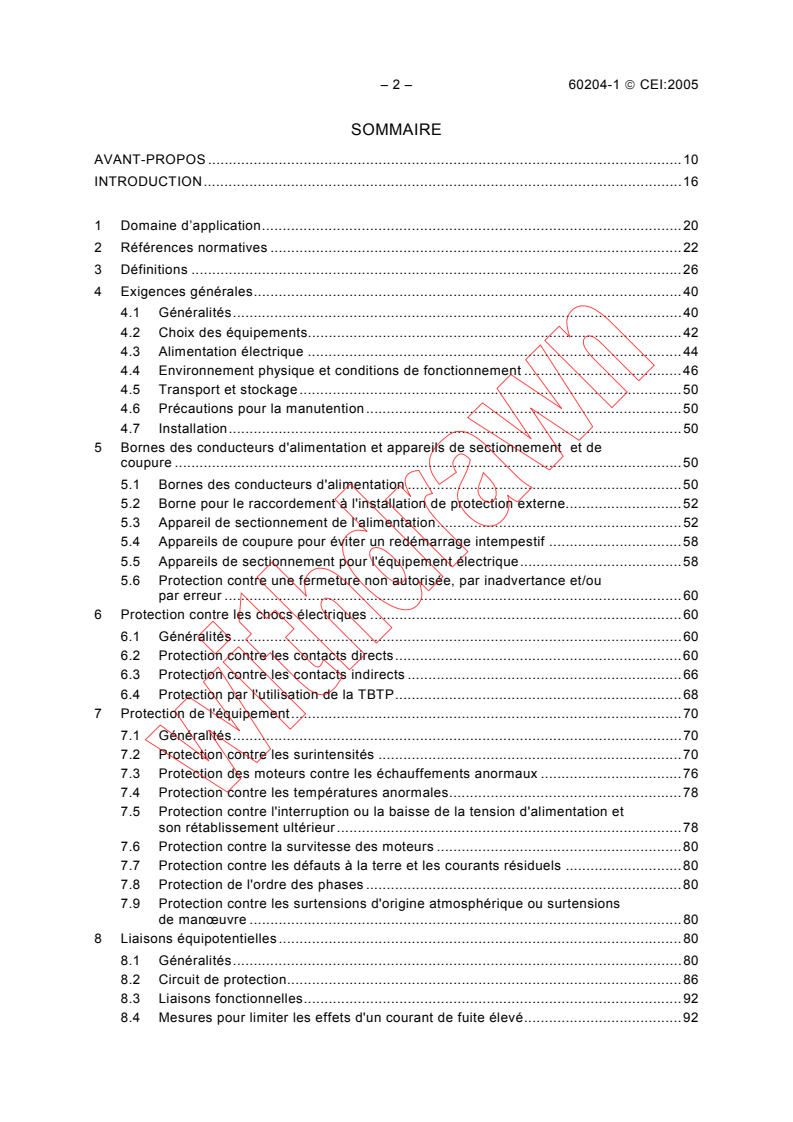
IEC 60204-1:2005 - Sécurité des machines - Equipement électrique des machines - Partie 1: Regles générales Released:10/25/2005
IEC 60204-1:2005+AMD1:2008 CSV - Safety of machinery - Electrical equipment of machines - Part 1: General requirements Released:2/11/2009
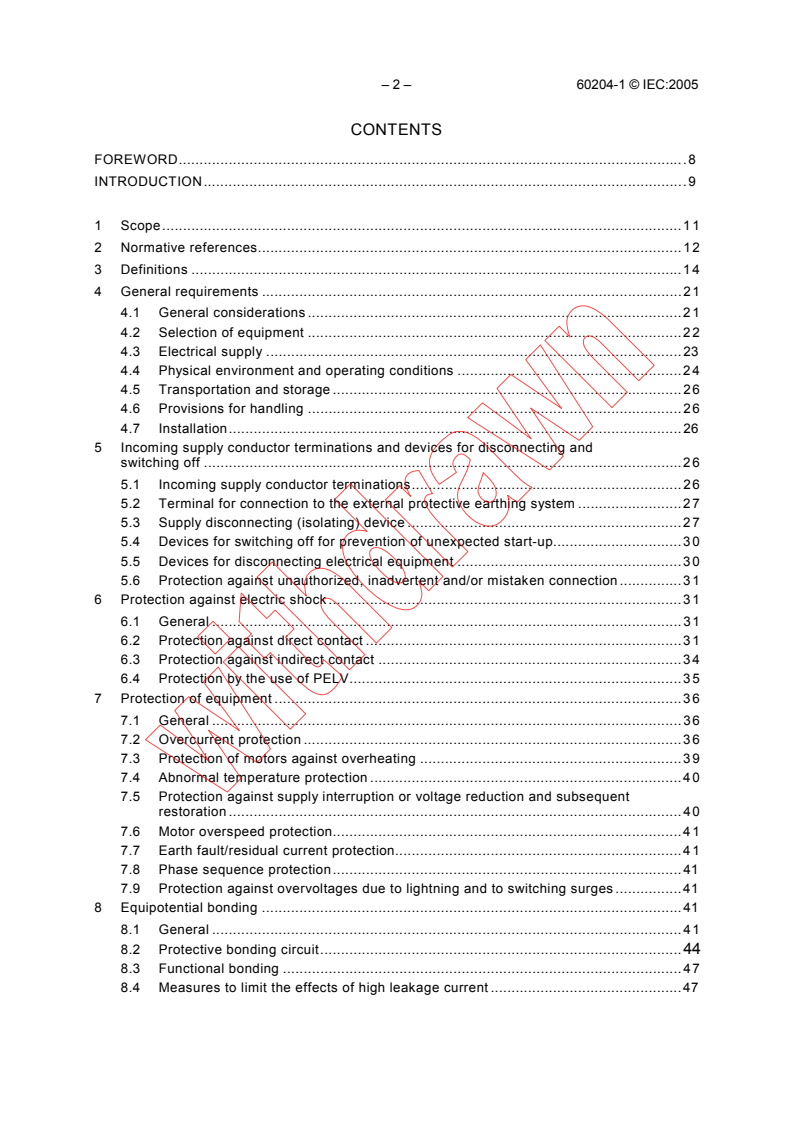
IEC 60204-1:2005 - Safety of machinery - Electrical equipment of machines - Part 1: General requirements Released:10/25/2005
Overview
IEC 60204-1:2005 - Safety of machinery - Electrical equipment of machines - Part 1: General requirements defines general electrical safety and design requirements for the electrical, electronic and programmable electronic equipment and systems of machines that are not portable by hand while working. It covers single machines and groups of machines operating in coordination and sets out principles for safe supply, control, protection, wiring, documentation and verification of machine electrical equipment.
Key Topics
The standard organizes technical requirements across the machine electrical lifecycle. Major topics include:
- Scope and definitions - applicability to non-hand-portable machines and coordinated machine groups.
- Incoming supply and disconnecting devices - requirements for supply terminations, isolating devices and prevention of unexpected startup.
- Protection against electric shock - direct and indirect contact methods, PELV options and protective earthing.
- Equipotential bonding - protective and functional bonding practices to limit touch and leakage currents.
- Control circuits and functions - safe control circuit design, interlocks, emergency stop, enabling devices and failure-mode behavior.
- Operator interface - requirements for push-buttons, indicators, start/stop and emergency controls.
- Controlgear location and enclosures - mounting, access, degrees of protection and enclosure design.
- Conductors, cables and wiring practices - conductor selection, insulation, current-carrying capacity, voltage drop, identification and routing.
- Electric motors and associated equipment - selection, mounting, protection and braking considerations.
- Marking, documentation and verification - required circuit diagrams, manuals, test procedures and verification tests.
- Informative annexes - examples, enquiry forms, conductor sizing guidance and verification methods.
Applications and Who Uses It
IEC 60204-1 is essential for:
- Machine manufacturers (OEMs) designing safe electrical systems for industrial machines
- Electrical and control engineers specifying wiring, protection and controlgear
- Functional safety and machine safety professionals ensuring compliance with electrical safety principles
- Maintenance and commissioning teams performing verification, tests and documentation handover
- Regulatory bodies and certification bodies assessing conformity to recognized electrical safety requirements
Practical uses include designing machine control panels, selecting protective devices, establishing bonding and earthing schemes, preparing installation and maintenance documentation, and performing verification testing.
Related standards
- Other parts of the IEC 60204 series and national/adopted versions provide complementary guidance.
- Normative references listed in the standard point to specific electrical and safety standards used for detailed testing and component selection.
Keywords: IEC 60204-1, electrical equipment of machines, machine safety, electrical safety, control circuits, equipotential bonding, wiring practices, verification.
Relations
- Effective Date
- 16-Sep-2026
- Effective Date
- 25-Aug-2026
- Effective Date
- 25-Aug-2026
- Effective Date
- 25-Aug-2026
- Effective Date
- 25-Aug-2026
- Effective Date
- 25-Aug-2026
- Effective Date
- 25-Aug-2026
- Effective Date
- 25-Aug-2026
- Effective Date
- 25-Aug-2026
- Effective Date
- 25-Aug-2026
- Effective Date
- 25-Aug-2026
- Effective Date
- 25-Aug-2026
- Effective Date
- 25-Aug-2026
- Effective Date
- 25-Aug-2026
- Effective Date
- 25-Aug-2026
Buy Documents
IEC 60204-1:2005 - Safety of machinery - Electrical equipment of machines - Part 1: General requirements Released:10/25/2005
IEC 60204-1:2005 - Sécurité des machines - Equipement électrique des machines - Partie 1: Regles générales Released:10/25/2005
IEC 60204-1:2005+AMD1:2008 CSV - Safety of machinery - Electrical equipment of machines - Part 1: General requirements Released:2/11/2009
IEC 60204-1:2005 - Safety of machinery - Electrical equipment of machines - Part 1: General requirements Released:10/25/2005
Get Certified
Connect with accredited certification bodies for this standard

IMQ S.p.A. (Certification)
Italian electrical product certification.

SLG Prüf- und Zertifizierungs GmbH
German testing and certification body.

UL Solutions
Global safety science company with testing, inspection and certification.
Sponsored listings
Frequently Asked Questions
IEC 60204-1:2005 is a standard published by the International Electrotechnical Commission (IEC). Its full title is "Safety of machinery - Electrical equipment of machines - Part 1: General requirements". This standard covers: applies to the application of electrical, electronic and programmable electronic equipment and systems to machines not portable by hand while working, including a group of machines working together in a co-ordinated manner
applies to the application of electrical, electronic and programmable electronic equipment and systems to machines not portable by hand while working, including a group of machines working together in a co-ordinated manner
IEC 60204-1:2005 is classified under the following ICS (International Classification for Standards) categories: 29.020 - Electrical engineering in general. The ICS classification helps identify the subject area and facilitates finding related standards.
IEC 60204-1:2005 has the following relationships with other standards: It is inter standard links to EN ISO 16924:2026, EN ISO 13856-2:2013, EN ISO 11111-1:2009, EN ISO 16230-1:2015, EN ISO 22827-1:2005, EN ISO 19085-6:2017, EN ISO 8230-1:2008, EN ISO 11553-2:2008, EN ISO 10218-1:2011, EN ISO 16924:2018, EN ISO 13856-1:2013, EN ISO 19225:2017, EN ISO 11111-5:2005, EN ISO 10218-2:2011, EN ISO 19085-8:2018. Understanding these relationships helps ensure you are using the most current and applicable version of the standard.
IEC 60204-1:2005 is available in PDF format for immediate download after purchase. The document can be added to your cart and obtained through the secure checkout process. Digital delivery ensures instant access to the complete standard document.
Standards Content (Sample)
INTERNATIONAL IEC
STANDARD 60204-1
Fifth edition
2005-10
Safety of machinery –
Electrical equipment of machines –
Part 1:
General requirements
This English-language version is derived from the original
bilingual publication by leaving out all French-language
pages. Missing page numbers correspond to the French-
language pages.
Reference number
Publication numbering
As from 1 January 1997 all IEC publications are issued with a designation in the
60000 series. For example, IEC 34-1 is now referred to as IEC 60034-1.
Consolidated editions
The IEC is now publishing consolidated versions of its publications. For example,
edition numbers 1.0, 1.1 and 1.2 refer, respectively, to the base publication, the
base publication incorporating amendment 1 and the base publication incorporating
amendments 1 and 2.
Further information on IEC publications
The technical content of IEC publications is kept under constant review by the IEC,
thus ensuring that the content reflects current technology. Information relating to
this publication, including its validity, is available in the IEC Catalogue of
publications (see below) in addition to new editions, amendments and corrigenda.
Information on the subjects under consideration and work in progress undertaken
by the technical committee which has prepared this publication, as well as the list
of publications issued, is also available from the following:
• IEC Web Site (www.iec.ch)
• Catalogue of IEC publications
The on-line catalogue on the IEC web site (www.iec.ch/searchpub) enables you to
search by a variety of criteria including text searches, technical committees
and date of publication. On-line information is also available on recently issued
publications, withdrawn and replaced publications, as well as corrigenda.
• IEC Just Published
This summary of recently issued publications (www.iec.ch/online_news/ justpub)
is also available by email. Please contact the Customer Service Centre (see
below) for further information.
• Customer Service Centre
If you have any questions regarding this publication or need further assistance,
please contact the Customer Service Centre:
Email: custserv@iec.ch
Tel: +41 22 919 02 11
Fax: +41 22 919 03 00
INTERNATIONAL IEC
STANDARD 60204-1
Fifth edition
2005-10
Safety of machinery –
Electrical equipment of machines –
Part 1:
General requirements
IEC 2005 Copyright - all rights reserved
No part of this publication may be reproduced or utilized in any form or by any means, electronic or mechanical,
including photocopying and microfilm, without permission in writing from the publisher.
International Electrotechnical Commission, 3, rue de Varembé, PO Box 131, CH-1211 Geneva 20, Switzerland
Telephone: +41 22 919 02 11 Telefax: +41 22 919 03 00 E-mail: inmail@iec.ch Web: www.iec.ch
PRICE CODE
XF
Commission Electrotechnique Internationale
International Electrotechnical Commission
МеждународнаяЭлектротехническаяКомиссия
For price, see current catalogue
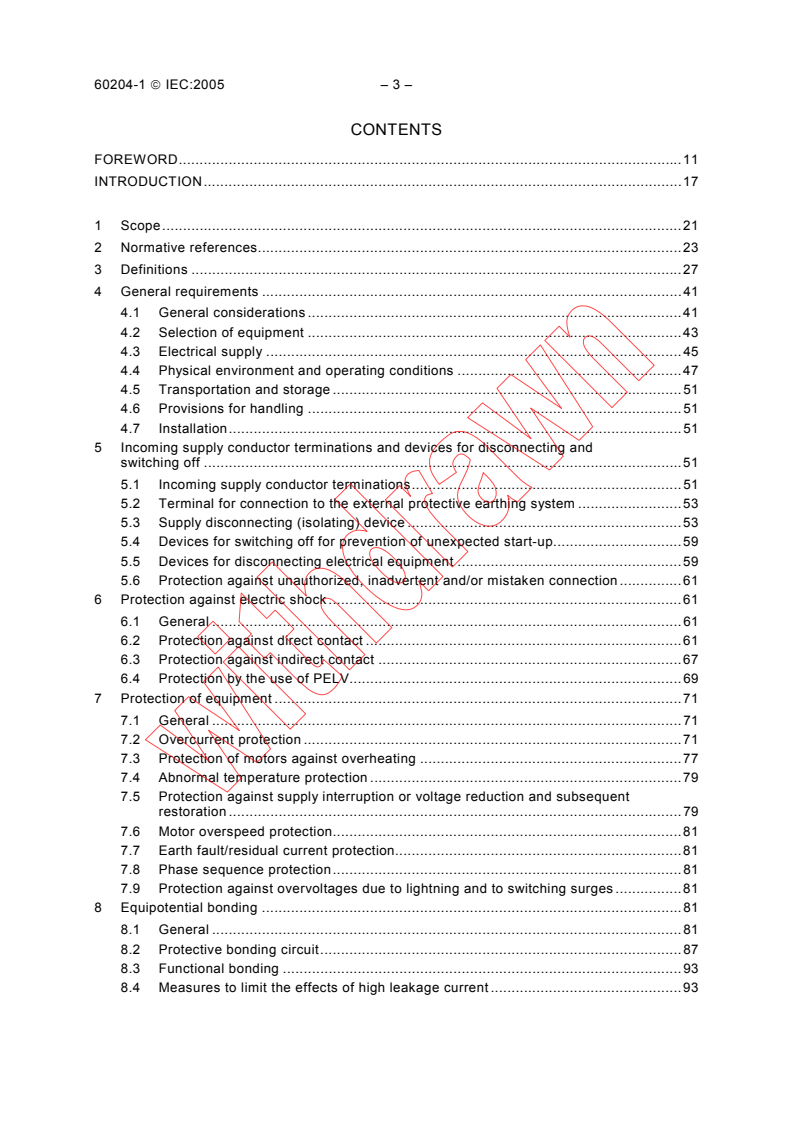
60204-1 IEC:2005 – 3 –
CONTENTS
FOREWORD.11
INTRODUCTION.17
1 Scope.21
2 Normative references.23
3 Definitions .27
4 General requirements .41
4.1 General considerations .41
4.2 Selection of equipment .43
4.3 Electrical supply .45
4.4 Physical environment and operating conditions .47
4.5 Transportation and storage .51
4.6 Provisions for handling .51
4.7 Installation.51
5 Incoming supply conductor terminations and devices for disconnecting and
switching off .51
5.1 Incoming supply conductor terminations.51
5.2 Terminal for connection to the external protective earthing system .53
5.3 Supply disconnecting (isolating) device .53
5.4 Devices for switching off for prevention of unexpected start-up.59
5.5 Devices for disconnecting electrical equipment .59
5.6 Protection against unauthorized, inadvertent and/or mistaken connection.61
6 Protection against electric shock.61
6.1 General .61
6.2 Protection against direct contact .61
6.3 Protection against indirect contact .67
6.4 Protection by the use of PELV.69
7 Protection of equipment .71
7.1 General .71
7.2 Overcurrent protection .71
7.3 Protection of motors against overheating .77
7.4 Abnormal temperature protection .79
7.5 Protection against supply interruption or voltage reduction and subsequent
restoration .79
7.6 Motor overspeed protection.81
7.7 Earth fault/residual current protection.81
7.8 Phase sequence protection.81
7.9 Protection against overvoltages due to lightning and to switching surges .81
8 Equipotential bonding .81
8.1 General .81
8.2 Protective bonding circuit.87
8.3 Functional bonding .93
8.4 Measures to limit the effects of high leakage current .93
60204-1 IEC:2005 – 5 –
9 Control circuits and control functions.93
9.1 Control circuits .93
9.2 Control functions .95
9.3 Protective interlocks . 105
9.4 Control functions in the event of failure . 107
10 Operator interface and machine-mounted control devices. 115
10.1 General . 115
10.2 Push-buttons . 117
10.3 Indicator lights and displays . 121
10.4 Illuminated push-buttons. 123
10.5 Rotary control devices . 123
10.6 Start devices . 123
10.7 Emergency stop devices . 123
10.8 Emergency switching off devices . 125
10.9 Enabling control device. 127
11 Controlgear: location, mounting, and enclosures . 127
11.1 General requirements . 127
11.2 Location and mounting. 127
11.3 Degrees of protection . 131
11.4 Enclosures, doors and openings . 131
11.5 Access to controlgear . 133
12 Conductors and cables . 135
12.1 General requirements . 135
12.2 Conductors. 135
12.3 Insulation. 137
12.4 Current-carrying capacity in normal service. 137
12.5 Conductor and cable voltage drop. 139
12.6 Flexible cables. 141
12.7 Conductor wires, conductor bars and slip-ring assemblies. 143
13 Wiring practices. 147
13.1 Connections and routing . 147
13.2 Identification of conductors . 149
13.3 Wiring inside enclosures. 153
13.4 Wiring outside enclosures. 153
13.5 Ducts, connection boxes and other boxes . 159
14 Electric motors and associated equipment . 163
14.1 General requirements . 163
14.2 Motor enclosures . 165
14.3 Motor dimensions . 165
14.4 Motor mounting and compartments . 165
14.5 Criteria for motor selection. 165
14.6 Protective devices for mechanical brakes. 167
15 Accessories and lighting . 167
15.1 Accessories. 167
15.2 Local lighting of the machine and equipment . 167
60204-1 IEC:2005 – 7 –
16 Marking, warning signs and reference designations. 169
16.1 General . 169
16.2 Warning signs . 171
16.3 Functional identification . 171
16.4 Marking of equipment . 171
16.5 Reference designations . 173
17 Technical documentation . 173
17.1 General . 173
17.2 Information to be provided . 173
17.3 Requirements applicable to all documentation. 175
17.4 Installation documents . 175
17.5 Overview diagrams and function diagrams . 177
17.6 Circuit diagrams . 177
17.7 Operating manual . 179
17.8 Maintenance manual. 179
17.9 Parts list . 179
18 Verification .179
18.1 General . 179
18.2 Verification of conditions for protection by automatic disconnection of supply . 181
18.3 Insulation resistance tests . 187
18.4 Voltage tests . 189
18.5 Protection against residual voltages . 189
18.6 Functional tests . 189
18.7 Retesting. 189
Annex A (normative) Protection against indirect contact in TN-systems. 191
Annex B (informative) Enquiry form for the electrical equipment of machines . 199
Annex C (informative) Examples of machines covered by this part of IEC 60204. 207
Annex D (informative) Current-carrying capacity and overcurrent protection of
conductors and cables in the electrical equipment of machines. 211
Annex E (informative) Explanation of emergency operation functions. 223
Annex F (informative) Guide for the use of this part of IEC 60204 . 225
Annex G (informative) Comparison of typical conductor cross-sectional areas . 229
Bibliography . 233
Index . 237
Figure 1 – Block diagram of a typical machine .19
Figure 2 – Example of equipotential bonding for electrical equipment of a machine .85
Figure 3 – Method a) . 113
Figure 4 – Method b) . 113
Figure A.1 – Typical arrangement for fault loop impedance measurement . 197
Figure D.1 – Methods of conductor and cable installation independent of number of
conductors/cables . 213
Figure D.2 – Parameters of conductors and protective devices . 217
60204-1 IEC:2005 – 9 –
Table 1 – Minimum cross-sectional area of the external protective copper conductor .53
Table 2 – Colour-coding for push-button actuators and their meanings . 119
Table 3 – Symbols for push-buttons . 119
Table 4 – Colours for indicator lights and their meanings with respect to the condition of
the machine . 121
Table 5 – Minimum cross-sectional areas of copper conductors. 135
Table 6 – Examples of current-carrying capacity (I ) of PVC insulated copper
z
conductors or cables under steady-state conditions in an ambient air temperature of
+40 °C for different methods of installation . 139
Table 7 – Derating factors for cables wound on drums. 143
Table 8 – Minimum permitted bending radii for the forced guiding of flexible cables . 157
Table 9 – Application of the test methods for TN-systems. 185
Table 10 – Examples of maximum cable length from each protective device to its load . 187
Table A.1 – Maximum disconnecting times for TN systems . 191
Table D.1 – Correction factors. 211
Table D.2 – Derating factors from I for grouping . 215
z
Table D.3 – Derating factors from I for multicore cables up to 10 mm . 215
z
Table D.4 – Classification of conductors. 217
Table D.5 – Maximum allowable conductor temperatures under normal and short-circuit
conditions . 219
Table F.1 – Application options . 227
Table G.1 – Comparison of conductor sizes. 229
60204-1 IEC:2005 – 11 –
INTERNATIONAL ELECTROTECHNICAL COMMISSION
___________
SAFETY OF MACHINERY –
ELECTRICAL EQUIPMENT OF MACHINES –
Part 1: General requirements
FOREWORD
1) The International Electrotechnical Commission (IEC) is a worldwide organization for standardization comprising
all national electrotechnical committees (IEC National Committees). The object of IEC is to promote
international co-operation on all questions concerning standardization in the electrical and electronic fields. To
this end and in addition to other activities, IEC publishes International Standards, Technical Specifications,
Technical Reports, Publicly Available Specifications (PAS) and Guides (hereafter referred to as “IEC
Publication(s)”). Their preparation is entrusted to technical committees; any IEC National Committee interested
in the subject dealt with may participate in this preparatory work. International, governmental and non-
governmental organizations liaising with the IEC also participate in this preparation. IEC collaborates closely
with the International Organization for Standardization (ISO) in accordance with conditions determined by
agreement between the two organizations.
2) The formal decisions or agreements of IEC on technical matters express, as nearly as possible, an international
consensus of opinion on the relevant subjects since each technical committee has representation from all
interested IEC National Committees.
3) IEC Publications have the form of recommendations for international use and are accepted by IEC National
Committees in that sense. While all reasonable efforts are made to ensure that the technical content of IEC
Publications is accurate, IEC cannot be held responsible for the way in which they are used or for any
misinterpretation by any end user.
4) In order to promote international uniformity, IEC National Committees undertake to apply IEC Publications
transparently to the maximum extent possible in their national and regional publications. Any divergence
between any IEC Publication and the corresponding national or regional publication shall be clearly indicated in
the latter.
5) IEC provides no marking procedure to indicate its approval and cannot be rendered responsible for any
equipment declared to be in conformity with an IEC Publication.
6) All users should ensure that they have the latest edition of this publication.
7) No liability shall attach to IEC or its directors, employees, servants or agents including individual experts and
members of its technical committees and IEC National Committees for any personal injury, property damage or
other damage of any nature whatsoever, whether direct or indirect, or for costs (including legal fees) and
expenses arising out of the publication, use of, or reliance upon, this IEC Publication or any other IEC
Publications.
8) Attention is drawn to the Normative references cited in this publication. Use of the referenced publications is
indispensable for the correct application of this publication.
9) Attention is drawn to the possibility that some of the elements of this IEC Publication may be the subject of
patent rights. IEC shall not be held responsible for identifying any or all such patent rights.
International Standard IEC 60204-1 has been prepared by technical committee 44: Safety of
machinery – Electrotechnical aspects.
This fifth edition cancels and replaces the fourth edition issued in 1997 and Ammendment 1
(1999). This edition constitutes a technical revision. It incorporates material from the fourth
edition, amended to provide general requirements for machines, including mobile machines
and complex (for example large) machine installations.
60204-1 IEC:2005 – 13 –
The text of this standard is based on the following documents:
FDIS Report on voting
44/494/FDIS 44/502/RVD
Full information on the voting for the approval of this standard can be found in the report on
voting indicated in the above table.
This publication has been drafted in accordance with the ISO/IEC Directives, Part 2.
The following differences exist in some countries:
4.3.1: The voltage characteristics of electricity supplied by public distribution systems in
Europe are given in EN 50160:1999.
5.1: Exception is not allowed (USA).
5.1: TN-C systems are not permitted in low-voltage installations in buildings (Norway).
5.2: Terminals for the connection of the protective earthing conductors may be
identified by the colour green, the letters “G” or “GR” or “GRD” or “GND”, or the
word “ground” or “grounding”, or with the graphical symbol IEC 60417-5019
(DB: 2002-10) or any combination (USA).
6.3.3 b), 13.4.5 b), 18.2.1: TT power systems are not allowed (USA).
7.2.3: Disconnection of the neutral conductor is mandatory in a TN-S system (France and
Norway).
7.2.3: Third paragraph: distribution of a neutral conductor with an IT system is not
allowed (USA and Norway).
9.1.2: Maximum nominal a.c. control circuit voltage is 120 V (USA).
12.2: Only stranded conductors are allowed on machines, except for 0,2 mm solid
conductors within enclosures (USA).
12.2: The smallest power circuit conductor allowed on machines is 0,82 mm (AWG 18)
in multiconductor cables or in enclosures (USA).
Table 5: Cross-sectional area is specified in ANSI/NFPA 79 using American Wire Gauge
(AWG) (USA). See Annex G.
13.2.2: For the protective conductor, the colour identification GREEN (with or without
YELLOW stripes) is used as equivalent to the bicolour combination GREEN-AND-
YELLOW (USA and Canada).
13.2.3: The colour identification WHITE or GREY is used for earthed neutral conductors
instead of the colour identification BLUE (USA and Canada).
15.2.2: First paragraph: Maximum value between conductors 150 V (USA).
15.2.2: 2nd paragraph, 5th bullet: The full load current rating of lighting circuits does not
exceed 15 A (USA).
16.4: Nameplate marking requirements (USA).
60204-1 IEC:2005 – 15 –
IEC 60204 consists of the following parts, under the general title Safety of machinery –
Electrical equipment of machines:
Part 1: General requirements
Part 11: Requirements for HV equipment for voltages above 1 000 V a.c. or 1 500 V d.c.
and not exceeding 36 kV
Part 31: Particular safety and EMC requirements for sewing machines, units and systems
Part 32: Requirements for hoisting machines
Part 33: Particular requirements for semiconductor manufacturing equipment
The committee has decided that the contents of this publication will remain unchanged until the
maintenance result date indicated on the IEC web site under "http://webstore.iec.ch" in the data
related to the specific publication. At this date, the publication will be
• reconfirmed;
• withdrawn;
• replaced by a revised edition, or
• amended.
___________
Under consideration.
60204-1 IEC:2005 – 17 –
INTRODUCTION
This part of IEC 60204 provides requirements and recommendations relating to the electrical
equipment of machines so as to promote:
– safety of persons and property;
– consistency of control response;
– ease of maintenance.
More guidance on the use of this part of IEC 60204 is given in Annex F.
Figure 1 has been provided as an aid to the understanding of the inter-relationship of the
various elements of a machine and its associated equipment. Figure 1 is a block diagram of a
typical machine and associated equipment showing the various elements of the electrical
equipment addressed in this part of IEC 60204. Numbers in parentheses ( ) refer to Clauses
and Subclauses in this part of IEC 60204. It is understood in Figure 1 that all of the elements
taken together including the safeguards, tooling/fixturing, software, and the documentation,
constitute the machine, and that one or more machines working together with usually at least
one level of supervisory control constitute a manufacturing cell or system.
60204-1 IEC:2005 – 19 –
Warning signs, item designation
Physical
(Clause 16)
System/cell
environment
controller
Technical documentation
(4.4)
(Clause 17)
Supply disconnecting device
(5.3)
Protection against electrical shock
(Clause 6)
Protection of equipment
(Clause 7)
Power supply
(4.3)
Earth (PE) terminal
Data link
(5.2)
Protective bonding circuit
(8.2)
Control circuits and control functions
PE
(Clause 9)
Emergency stop function
(9.2.5.4)
(External protective
conductor connection)
Controlgear
(Clause 11)
Accessories and lighting
(Clause 15)
Conductors and
cables
Emergency
(Clause 12) stop device
(10.7)
Wiring
practices
(Clause 13)
Operator control
Programmable
Motor
station
controller
Testing
control equipment
(Clause 10)
(Clause 18)
Input/output
Safeguards and
interface
warning devices
Motors
(Clause 14) and
Actuators and
transducers
sensors
Processing equipment
IEC 1388/05
Figure 1 – Block diagram of a typical machine
60204-1 IEC:2005 – 21 –
SAFETY OF MACHINERY –
ELECTRICAL EQUIPMENT OF MACHINES –
Part 1: General requirements
1 Scope
This part of IEC 60204 applies to the application of electrical, electronic and programmable
electronic equipment and systems to machines not portable by hand while working, including a
group of machines working together in a co-ordinated manner.
NOTE 1 This part of IEC 60204 is an application standard and is not intended to limit or inhibit technological
advancement.
NOTE 2 In this part of IEC 60204, the term electrical includes electrical, electronic and programmable electronic
matters (i.e. electrical equipment means electrical, electronic and programmable electronic equipment).
NOTE 3 In the context of this part of IEC 60204, the term person refers to any individual and includes those
persons who are assigned and instructed by the user or his agent(s) in the use and care of the machine in question.
The equipment covered by this part of IEC 60204 commences at the point of connection of the
supply to the electrical equipment of the machine (see 5.1).
NOTE 4 The requirements for the electrical supply installation in buildings are given in the IEC 60364 series.
This part of IEC 60204 is applicable to the electrical equipment or parts of the electrical
equipment that operate with nominal supply voltages not exceeding 1 000 V for alternating
current (a.c.) and not exceeding 1 500 V for direct current (d.c.), and with nominal supply
frequencies not exceeding 200 Hz.
NOTE 5 For higher voltages, see IEC 60204-11.
This part of IEC 60204 does not cover all the requirements (for example guarding, interlocking,
or control) that are needed or required by other standards or regulations in order to protect
persons from hazards other than electrical hazards. Each type of machine has unique
requirements to be accommodated to provide adequate safety.
This part specifically includes, but is not limited to, the electrical equipment of machines as
defined in 3.35.
NOTE 6 Annex C lists examples of machines whose electrical equipment can be covered by this part of IEC 60204.
This part of IEC 60204 does not specify additional and special requirements that can apply to
the electrical equipment of machines that, for example:
– are intended for use in open air (i.e. outside buildings or other protective structures);
– use, process, or produce potentially explosive material (for example paint or sawdust);
– are intended for use in potentially explosive and/or flammable atmospheres;
– have special risks when producing or using certain materials;
– are intended for use in mines;
60204-1 IEC:2005 – 23 –
– are sewing machines, units, and systems (which are covered by IEC 60204-31);
– are hoisting machines (which are covered by IEC 60204-32).
Power circuits where electrical energy is directly used as a working tool are excluded from this
part of IEC 60204.
2 Normative references
The following referenced documents are indispensable for the application of this part of
IEC 60204. For dated references, only the edition cited applies. For undated references, the
latest edition of the referenced document (including any amendments) applies.
IEC 60034-1, Rotating electrical machines – Part 1: Rating and performance
IEC 60034-5, Rotating electrical machines – Part 5: Degrees of protection provided by the
integral design of rotating electrical machines (IP code) – Classification
IEC 60034-11, Rotating electrical machines – Part 11: Thermal protection
IEC 60072-1, Dimensions and output series for rotating electrical machines – Part 1: Frame
numbers 56 to 400 and flange numbers 55 to 1 080
IEC 60072-2, Dimensions and output series for rotating electrical machines – Part 2: Frame
numbers 355 to 1 000 and flange numbers 1 180 to 2 360
IEC 60073:2002, Basic and safety principles for man-machine interface, marking and
identification – Coding principles for indicators and actuators
IEC 60309-1:1999, Plugs, socket-outlets, and couplers for industrial purposes – Part 1:
General requirements
IEC 60364-4-41:2001, Electrical installations of buildings – Part 4-41: Protection for safety –
Protection against electric shock
IEC 60364-4-43:2001, Electrical installations of buildings – Part 4-43: Protection for safety –
Protection against overcurrent
IEC 60364-5-52:2001, Electrical installations of buildings – Part 5-52: Selection and erection of
electrical equipment – Wiring systems
IEC 60364-5-53:2002, Electrical installations of buildings – Part 5-53: Selection and erection of
electrical equipment – Isolation, switching and control
IEC 60364-5-54:2002, Electrical installations of buildings – Part 5-54: Selection and erection of
electrical equipment – Earthing arrangements, protective conductors and protective bonding
conductors
IEC 60364-6-61:2001, Electrical installations of buildings – Part 6-61: Verification – Initial
verification
IEC 60417-DB:2002 , Graphical symbols for use on equipment
___________
“DB” refers to the IEC on-line database.
60204-1 IEC:2005 – 25 –
IEC 60439-1:1999, Low-voltage switchgear and controlgear assemblies – Part 1: Type-tested
and partially type-tested assemblies
IEC 60445:1999, Basic and safety principles for man-machine interface, marking and
identification – Identification of equipment terminals and of terminations of certain designated
conductors, including general rules for an alphanumeric system
IEC 60446:1999, Basic and safety principles for man-machine interface, marking and
identification – Identification of conductors by colours or numerals
IEC 60447:2004, Basic and safety principles for man-machine interface, marking and
identification – Man-machine interface (MMI) – Actuating principles
IEC 60529:1999, Degrees of protection provided by enclosures (IP Code)
Amendment 1 (2001)
IEC 60617-DB:2001 , Graphical symbols for diagrams
IEC 60621-3:1979, Electrical installations for outdoor sites under heavy conditions (including
open-cast mines and quarries) – Part 3: General requirements for equipment and ancillaries
IEC 60664-1:1992, Insulation co-ordination for equipment within low-voltage systems – Part 1:
Principles, requirements and tests
IEC 60947-1:2004, Low-voltage switchgear and controlgear – Part 1: General rules
IEC 60947-2:2003, Low-voltage switchgear and controlgear – Part 2: Circuit-breakers
IEC 60947-3:1999, Low-voltage switchgear and controlgear – Part 3: Switches, disconnectors,
switch-disconnectors, and fuse combination units
IEC 60947-5-1:2003, Low-voltage switchgear and controlgear – Part 5-1: Control circuit
devices and switching elements – Electromechanical control circuit devices
IEC 60947-7-1:2002, Low-voltage switchgear and controlgear – Part 7-1: Ancillary equipment –
Terminal blocks for copper conductors
IEC 61082-1:1991, Preparation of documents used in electrotechnology – Part 1: General
requirements
IEC 61082-2:1993, Preparation of documents used in electrotechnology – Part 2: Function-
oriented diagrams
IEC 61082-3:1993, Preparation of documents used in electrotechnology – Part 3: Connection
diagrams, tables and lists
IEC 61082-4:1996, Preparation of documents used in electrotechnology – Part 4: Location and
installation documents
IEC 61140:2001, Protection against electric shock – Common aspects for installation and
equipment
IEC 61310 (all parts), Safety of machinery – Indication, marking and actuation
IEC 61346 (all parts), Industrial systems, installations and equipment and industrial products –
Structuring principles and reference designations
___________
“DB” refers to the IEC on-line database.
60204-1 IEC:2005 – 27 –
IEC 61557-3:1997, Electrical safety in low voltage distribution systems up to 1000 V a.c. and
1500 V d.c. – Equipment for testing, measuring or monitoring of protective measures – Part 3:
Loop impedance
IEC 61558-1:1997, Safety of power transformers, power supply units and similar – Part 1:
General requirements and tests
Amendment 1 (1998)
IEC 61558-2-6, Safety of power transformers, power supply units and similar – Part 2-6:
Particular requirements for safety isolating transformers for general use
IEC 61984:2001, Connectors – Safety requirements and tests
IEC 62023:2000, Structuring of technical information and documentation
IEC 62027:2000, Preparation of parts lists
IEC 62061:2005, Safety of machinery – Functional safety of safety-related electrical, electronic
and programmable electronic control systems
IEC 62079:2001, Preparation of instructions – Structuring, content and presentation
ISO 7000:2004, Graphical symbols for use on equipment – Index and synopsis
ISO 12100-1:2003, Safety of machinery – Basic concepts, general principles for design – Part
1: Basic terminology, methodology
ISO 12100-2:2003, Safety of machinery – Basic concepts, general principles for design –
Part 2: Technical principles
ISO 13849-1:1999, Safety of machinery – Safety-related parts of control systems – Part 1:
General principles for design
ISO 13849-2:2003, Safety of machinery – Safety-related parts of control systems – Part 2:
Validation
ISO 13850:1996, Safety of machinery – Emergency stop – Principles for design
3 Terms and definitions
For the purposes of this document, the following terms and definitions apply.
3.1
actuator
part of a device to which an external manual action is to be applied
NOTE 1 The actuator may take the form of a handle, knob, push-button, roller, plunger, etc.
NOTE 2 There are some actuating means that do not require an external actuating force, but only an action.
NOTE 3 See also 3.34.
3.2
ambient temperature
temperature of the air or other medium where the equipment is to be used
3.3
barrier
part providing protection against direct contact from any usual direction of access
60204-1 IEC:2005 – 29 –
3.4
cable tray
cable support consisting of a continuous base and raised edges and no covering
NOTE A cable tray may be perforated or non-perforated.
[IEV 826-15-08]
3.5
cable trunking system
system of closed enclosures comprising a base with a removable cover intended for the
complete surrounding of insulated conductors, cables, cords and for the accommodation of
other electrical equipment
3.6
concurrent
acting in conjunction; used to describe a situation wherein two or more control devices exist in
an actuated condition at the same time (but not necessarily synchronously)
3.7
conduit
part of a closed wiring system of circular or non-circular cross-section for insulated conductors
and/or cables in electrical installations, allowing them to be drawn in and/or replaced
NOTE Conduits should be sufficiently close-jointed so that the insulated conductors and/or cables can only be
drawn in and not inserted laterally.
[IEV 826-06-03]
3.8
control circuit (of a machine)
circuit used for the control, including monitoring, of a machine and the electrical equipment
3.9
control device
device connected into the control circuit and used for controlling the operation of the machine
(for example position sensor, manual control switch, relay, contactor, magnetically operated
valve)
3.10
controlgear
switching devices and their combination with associated control, measuring, protective, and
regulating equipment, also assemblies of such devices and equipment with associated
interconnections, accessories, enclosures, and supporting structures, intended in principle for
the control of electrical energy consuming equipment
[IEV 441-11-03, modified]
3.11
controlled stop
stopping of machine motion with electrical power to the machine actuators maintained during
the stopping process
3.12
direct contact
contact of persons or livestock with live parts
[IEV 826-12-03]
60204-1 IEC:2005 – 31 –
3.13
direct opening action (of a contact element)
achievement of contact separation as the direct result of a specified movement of the switch
actuator through non-resilient members (for example not dependent upon springs)
[IEC 60947-5-1, K.2.2]
3.14
duct
enclosed channel designed expressly for holding and protecting electrical conductors, cables,
and busbars
NOTE Conduits (see 3.7), cable trunking systems (see 3.5) and underfloor channels are types of duct.
3.15
electrical operating area
room or location for electrical equipment to which access is intended to be restricted to skilled
or instructed persons, by the opening of a door or the removal of a barrier without the use of a
key or tool, and which is clearly marked by appropriate warning signs
3.16
electronic equipment
part of the electrical equipment containing circuitry dependent for its operation on electronic
devices and components
3.17
emergency stop device
manually actuated control device used to initiate an emergency stop function
[ISO 13850, 3.2]
NOTE See Annex E.
3.18
emergency switching off device
manually actuated control device used to switch off the supply of electrical energy to all or a
part of an installation where a risk of electric shock or another risk of electrical origin is
involved
NOTE See Annex E.
3.19
enclosed electrical operating area
room or location for electrical equipment to which access is intended to be restricted to skilled
or instructed persons by the opening of a door or the removal of a barrier by the use of a key or
tool and which is clearly marked by appropriate warning signs
3.20
enclosure
part providing protection o
...
NORME CEI
INTERNATIONALE 60204-1
Cinquième édition
2005-10
Sécurité des machines –
Equipement électrique des machines –
Partie 1:
Règles générales
Cette version française découle de la publication d’origine
bilingue dont les pages anglaises ont été supprimées.
Les numéros de page manquants sont ceux des pages
supprimées.
Numéro de référence
CEI 60204-1:2005(F)
Numérotation des publications
Depuis le 1er janvier 1997, les publications de la CEI sont numérotées à partir de
60000. Ainsi, la CEI 34-1 devient la CEI 60034-1.
Editions consolidées
Les versions consolidées de certaines publications de la CEI incorporant les
amendements sont disponibles. Par exemple, les numéros d’édition 1.0, 1.1 et 1.2
indiquent respectivement la publication de base, la publication de base incorporant
l’amendement 1, et la publication de base incorporant les amendements 1 et 2
Informations supplémentaires sur les publications de la CEI
Le contenu technique des publications de la CEI est constamment revu par la CEI
afin qu'il reflète l'état actuel de la technique. Des renseignements relatifs à cette
publication, y compris sa validité, sont disponibles dans le Catalogue des
publications de la CEI (voir ci-dessous) en plus des nouvelles éditions, amende-
ments et corrigenda. Des informations sur les sujets à l’étude et l’avancement des
travaux entrepris par le comité d’études qui a élaboré cette publication, ainsi que la
liste des publications parues, sont également disponibles par l’intermédiaire de:
• Site web de la CEI (www.iec.ch)
• Catalogue des publications de la CEI
Le catalogue en ligne sur le site web de la CEI (www.iec.ch/searchpub) vous permet
de faire des recherches en utilisant de nombreux critères, comprenant des
recherches textuelles, par comité d’études ou date de publication. Des informations
en ligne sont également disponibles sur les nouvelles publications, les publications
remplacées ou retirées, ainsi que sur les corrigenda.
• IEC Just Published
Ce résumé des dernières publications parues (www.iec.ch/online_news/justpub)
est aussi disponible par courrier électronique. Veuillez prendre contact avec le
Service client (voir ci-dessous) pour plus d’informations.
• Service clients
Si vous avez des questions au sujet de cette publication ou avez besoin de
renseignements supplémentaires, prenez contact avec le Service clients:
Email: custserv@iec.ch
Tél: +41 22 919 02 11
Fax: +41 22 919 03 00
NORME CEI
INTERNATIONALE 60204-1
Cinquième édition
2005-10
Sécurité des machines –
Equipement électrique des machines –
Partie 1:
Règles générales
IEC 2005 Droits de reproduction réservés
Aucune partie de cette publication ne peut être reproduite ni utilisée sous quelque forme que ce soit et par aucun
procédé, électronique ou mécanique, y compris la photocopie et les microfilms, sans l'accord écrit de l'éditeur.
International Electrotechnical Commission, 3, rue de Varembé, PO Box 131, CH-1211 Geneva 20, Switzerland
Telephone: +41 22 919 02 11 Telefax: +41 22 919 03 00 E-mail: inmail@iec.ch Web: www.iec.ch
CODE PRIX
XF
Commission Electrotechnique Internationale
International Electrotechnical Commission
МеждународнаяЭлектротехническаяКомиссия
Pour prix, voir catalogue en vigueur
– 2 – 60204-1 CEI:2005
SOMMAIRE
AVANT-PROPOS .10
INTRODUCTION.16
1 Domaine d’application.20
2 Références normatives .22
3 Définitions .26
4 Exigences générales.40
4.1 Généralités.40
4.2 Choix des équipements.42
4.3 Alimentation électrique .44
4.4 Environnement physique et conditions de fonctionnement .46
4.5 Transport et stockage.50
4.6 Précautions pour la manutention.50
4.7 Installation.50
5 Bornes des conducteurs d'alimentation et appareils de sectionnement et de
coupure .50
5.1 Bornes des conducteurs d'alimentation .50
5.2 Borne pour le raccordement à l'installation de protection externe.52
5.3 Appareil de sectionnement de l’alimentation.52
5.4 Appareils de coupure pour éviter un redémarrage intempestif .58
5.5 Appareils de sectionnement pour l'équipement électrique.58
5.6 Protection contre une fermeture non autorisée, par inadvertance et/ou
par erreur .60
6 Protection contre les chocs électriques .60
6.1 Généralités.60
6.2 Protection contre les contacts directs.60
6.3 Protection contre les contacts indirects .66
6.4 Protection par l'utilisation de la TBTP.68
7 Protection de l'équipement.70
7.1 Généralités.70
7.2 Protection contre les surintensités .70
7.3 Protection des moteurs contre les échauffements anormaux .76
7.4 Protection contre les températures anormales.78
7.5 Protection contre l'interruption ou la baisse de la tension d'alimentation et
son rétablissement ultérieur.78
7.6 Protection contre la survitesse des moteurs .80
7.7 Protection contre les défauts à la terre et les courants résiduels .80
7.8 Protection de l'ordre des phases .80
7.9 Protection contre les surtensions d'origine atmosphérique ou surtensions
de manœuvre .80
8 Liaisons équipotentielles .80
8.1 Généralités.80
8.2 Circuit de protection.86
8.3 Liaisons fonctionnelles.92
8.4 Mesures pour limiter les effets d'un courant de fuite élevé.92
– 4 – 60204-1 CEI:2005
9 Circuits de commande et fonctions de commande.92
9.1 Circuits de commande .92
9.2 Fonctions de commande.94
9.3 Verrouillages de protection . 104
9.4 Fonctions de commande en cas de défaillance . 106
10 Interface opérateur et appareils de commande montés sur la machine . 114
10.1 Généralités. 114
10.2 Boutons-poussoirs . 116
10.3 Voyants lumineux de signalisation et dispositifs d'affichage. 120
10.4 Boutons-poussoirs lumineux . 122
10.5 Appareils de commande rotatifs. 122
10.6 Appareils de mise en marche. 122
10.7 Appareils d’arrêt d’urgence . 122
10.8 Appareils de coupure d’urgence. 124
10.9 Dispositif de commande de validation . 126
11 Appareillage de commande: emplacement, montage et enveloppes. 126
11.1 Exigences générales. 126
11.2 Emplacement et montage . 126
11.3 Degrés de protection . 130
11.4 Enveloppes, portes et ouvertures. 130
11.5 Accès à l'appareillage de commande . 132
12 Conducteurs et câbles . 134
12.1 Exigences générales. 134
12.2 Conducteurs . 134
12.3 Isolant . 136
12.4 Courant admissible en fonctionnement normal . 136
12.5 Chute de tension dans les câbles et conducteurs . 138
12.6 Câbles souples . 140
12.7 Câbles conducteurs, barres conductrices et assemblages glissants . 142
13 Pratiques du câblage . 146
13.1 Raccordement et cheminement. 146
13.2 Identification des conducteurs. 148
13.3 Câblage à l'intérieur des enveloppes. 152
13.4 Câblage à l'extérieur des enveloppes. 152
13.5 Canalisations, boîtes de raccordements et autres boîtiers . 158
14 Moteurs électriques et équipements associés. 162
14.1 Exigences générales. 162
14.2 Enveloppes des moteurs. 164
14.3 Dimensions des moteurs. 164
14.4 Montage des moteurs et compartiments moteurs . 164
14.5 Critère de choix des moteurs . 164
14.6 Dispositifs de protection pour les freins mécaniques . 166
15 Matériels accessoires et éclairage . 166
15.1 Matériels accessoires . 166
15.2 Eclairage local de la machine et de l'équipement . 166
– 6 – 60204-1 CEI:2005
16 Marquages, signaux d'avertissement et désignations de référence . 168
16.1 Généralités. 168
16.2 Signaux d'avertissement . 170
16.3 Identification fonctionnelle . 170
16.4 Marquage de l'équipement. 170
16.5 Désignations de référence . 172
17 Documentation technique. 172
17.1 Généralités. 172
17.2 Informations à fournir. 172
17.3 Exigences applicables à toute documentation . 174
17.4 Documents d'installation . 174
17.5 Schémas d'ensemble et schémas fonctionnels. 176
17.6 Schémas des circuits. 176
17.7 Manuel de fonctionnement . 178
17.8 Manuel de maintenance. 178
17.9 Nomenclature des pièces détachées. 178
18 Vérification .178
18.1 Généralités. 178
18.2 Vérification des conditions de protection par coupure automatique de
l'alimentation . 180
18.3 Essais de résistance d'isolement . 186
18.4 Essais de tension . 188
18.5 Protection contre les tensions résiduelles. 188
18.6 Essais de fonctionnement . 188
18.7 Nouveaux essais . 188
Annexe A (normative) Protection contre les contacts indirects dans les schémas TN . 190
Annexe B (informative) Questionnaire concernant l'équipement électrique des machines . 198
Annexe C (informative) Exemples de machines couvertes par la présente partie de la
CEI 60204. 206
Annexe D (informative) Courant admissible et protection contre les surintensités des
conducteurs et câbles dans les équipements électriques des machines . 210
Annexe E (informative) Explication sur les fonctions de manœuvre d'urgence. 222
Annexe F (informative) Guide pour l'utilisation de la présente partie de la CEI 60204 . 224
Annexe G (informative) Comparaison des sections usuelles de conducteurs. 228
Bibliographie . 232
Index . 236
Figure 1 – Schéma d'ensemble d’une machine type.18
Figure 2 – Exemple de liaisons équipotentielles pour l'équipement électrique d'une machine 84
Figure 3 – Méthode a) . 112
Figure 4 – Méthode b) . 112
Figure A.1 – Disposition usuelle pour la mesure de l'impédance de boucle de défaut . 196
Figure D.1 – Méthodes d'installation des conducteurs et câbles indépendamment du
nombre de conducteurs/câbles. 212
Figure D.2 – Paramètres des conducteurs et dispositifs de protection. 216
– 8 – 60204-1 CEI:2005
Tableau 1 – Section minimale du conducteur de protection externe en cuivre .52
Tableau 2 – Code de couleurs pour organes de commande à bouton-poussoir et leur
signification. 118
Tableau 3 – Symboles pour boutons-poussoirs. 118
Tableau 4 – Couleurs des voyants lumineux de signalisation et leur signification suivant
la condition de la machine . 120
Tableau 5 – Sections minimales des conducteurs en cuivre. 134
Tableau 6 – Exemples de courants admissibles (I ) pour conducteurs ou câbles en
z
cuivre isolés au PVC, en régime permanent, pour une température ambiante de +40 °C,
pour différentes méthodes d'installation. 138
Tableau 7 – Facteurs de réduction pour des câbles enroulés sur tambours. 142
Tableau 8 – Rayon minimal de courbure permis pour le guidage forcé de câbles souples. 156
Tableau 9 –Application des méthodes d'essai aux schémas TN . 184
Tableau 10 – Longueurs de câbles maximales autorisées entre chaque appareil de
protection et sa charge. 186
Tableau A.1 – Temps de coupure maximal en schéma TN. 190
Tableau D.1 – Facteurs de réduction . 210
Tableau D.2 – Facteurs de réduction de I pour groupage . 214
z
Tableau D.3 – Facteurs de réduction de I pour les câbles multiconducteurs
z
jusqu'à 10 mm . 214
Tableau D.4 – Classification des conducteurs. 216
Tableau D.5 – Températures maximales admissibles du conducteur en conditions
normales et conditions de court-circuit . 218
Tableau F.1 – Options d'utilisation. 226
Tableau G.1 – Comparaison des dimensions de conducteurs . 228
– 10 – 60204-1 CEI:2005
COMMISSION ÉLECTROTECHNIQUE INTERNATIONALE
___________
SÉCURITÉ DES MACHINES –
ÉQUIPEMENT ÉLECTRIQUE DES MACHINES –
Partie 1: Règles générales
AVANT-PROPOS
1) La Commission Electrotechnique Internationale (CEI) est une organisation mondiale de normalisation composée
de l'ensemble des comités électrotechniques nationaux (Comités nationaux de la CEI). La CEI a pour objet de
favoriser la coopération internationale pour toutes les questions de normalisation dans les domaines de
l'électricité et de l'électronique. A cet effet, la CEI – entre autres activités – publie des Normes internationales,
des Spécifications techniques, des Rapports techniques, des Spécifications accessibles au public (PAS) et des
Guides (ci-après dénommés "Publication(s) de la CEI"). Leur élaboration est confiée à des comités d'études,
aux travaux desquels tout Comité national intéressé par le sujet traité peut participer. Les organisations
internationales, gouvernementales et non gouvernementales, en liaison avec la CEI, participent également aux
travaux. La CEI collabore étroitement avec l'Organisation Internationale de Normalisation (ISO), selon des
conditions fixées par accord entre les deux organisations.
2) Les décisions ou accords officiels de la CEI concernant les questions techniques représentent, dans la mesure
du possible, un accord international sur les sujets étudiés, étant donné que les Comités nationaux de la CEI
intéressés sont représentés dans chaque comité d’études.
3) Les Publications de la CEI se présentent sous la forme de recommandations internationales et sont agréées
comme telles par les Comités nationaux de la CEI. Tous les efforts raisonnables sont entrepris afin que la CEI
s'assure de l'exactitude du contenu technique de ses publications; la CEI ne peut pas être tenue responsable de
l'éventuelle mauvaise utilisation ou interprétation qui en est faite par un quelconque utilisateur final.
4) Dans le but d'encourager l'uniformité internationale, les Comités nationaux de la CEI s'engagent, dans toute la
mesure possible, à appliquer de façon transparente les Publications de la CEI dans leurs publications
nationales et régionales. Toutes divergences entre toutes Publications de la CEI et toutes publications
nationales ou régionales correspondantes doivent être indiquées en termes clairs dans ces dernières.
5) La CEI n’a prévu aucune procédure de marquage valant indication d’approbation et n'engage pas sa
responsabilité pour les équipements déclarés conformes à une de ses Publications.
6) Tous les utilisateurs doivent s'assurer qu'ils sont en possession de la dernière édition de cette publication.
7) Aucune responsabilité ne doit être imputée à la CEI, à ses administrateurs, employés, auxiliaires ou
mandataires, y compris ses experts particuliers et les membres de ses comités d'études et des Comités
nationaux de la CEI, pour tout préjudice causé en cas de dommages corporels et matériels, ou de tout autre
dommage de quelque nature que ce soit, directe ou indirecte, ou pour supporter les coûts (y compris les frais
de justice) et les dépenses découlant de la publication ou de l'utilisation de cette Publication de la CEI ou de
toute autre Publication de la CEI, ou au crédit qui lui est accordé.
8) L'attention est attirée sur les références normatives citées dans cette publication. L'utilisation de publications
référencées est obligatoire pour une application correcte de la présente publication.
9) L’attention est attirée sur le fait que certains des éléments de la présente Publication de la CEI peuvent faire
l’objet de droits de propriété intellectuelle ou de droits analogues. La CEI ne saurait être tenue pour
responsable de ne pas avoir identifié de tels droits de propriété et de ne pas avoir signalé leur existence.
La Norme internationale CEI 60204-1 a été établie par le comité d’études 44: Sécurité des
machines – Aspects électrotechniques.
Cette cinquième édition annule et remplace la quatrième édition parue en 1997 et l’amende-
ment 1 (1999). Cette édition constitue une révision technique. Elle reprend des éléments de la
quatrième édition modifiée afin de fournir les exigences générales pour les machines, y
compris les machines mobiles et les installations de machines complexes (par exemple les
machines importantes).
– 12 – 60204-1 CEI:2005
Le texte de la présente partie de la CEI 60204 est basé sur les documents suivants:
FDIS Rapport de vote
44/494/FDIS 44/502/RVD
Le rapport de vote indiqué dans le tableau ci-dessus donne toute information sur le vote ayant
abouti à l'approbation de cette norme.
Cette publication a été rédigée selon les Directives ISO/CEI, Partie 2.
Dans certains pays, les différences suivantes existent:
4.3.1: Les caractéristiques de tensions fournies par le réseau de distribution public sont
données dans l'EN 50160:1999.
5.1: Exception non permise (USA).
5.1: Les schémas TN-C ne sont pas admis dans les installations à basse tension dans
les bâtiments (Norvège).
5.2: Les bornes pour le raccordement des conducteurs de mise à la terre pour des
raisons de protection peuvent être identifiées par la couleur verte, les lettres “G” ou
“GR”, “GRD” ou “GND”, ou les mots “ground” ou "grounding" ou le symbole
graphique CEI 60417-5019 (DB: 2002-10) ou toute combinaison (USA).
6.3.3 b), 13.4.5 b), 18.2.1: Les schémas TT de puissance ne sont pas autorisés (USA).
7.2.3: La coupure du conducteur neutre est obligatoire en schéma TN-S (France et
Norvège).
7.2.3: Troisième alinéa: la distribution d'un conducteur neutre dans un schéma IT n'est
pas autorisée (USA et Norvège).
9.1.2: La tension nominale maximale d'un circuit de commande en alternatif est de
120 V (USA).
12.2: Seuls les conducteurs à âme câblée sont admis sur les machines, mais les
conducteurs massifs de section 0,2 mm sont autorisés dans les enveloppes
(USA).
12.2: Le conducteur de circuit de puissance le plus faible autorisé sur les machines est
de 0,82 mm (AWG 18) pour des conducteurs multifilaires ou dans les enveloppes
(USA).
Tableau 5: La section est spécifiée dans l'ANSI/NFPA 79 en dimensions américaines (AWG)
(USA). Voir Annexe G.
13.2.2: Pour le conducteur de protection, la couleur VERTE (avec ou sans bandes
JAUNES) est utilisée comme équivalent à la combinaison bicolore VERT-et-JAUNE
(USA et Canada).
13.2.3: La couleur BLANCHE ou GRISE est utilisée pour repérer les conducteurs neutre
mis à la terre au lieu du BLEU (USA et Canada).
15.2.2: Premier alinéa: Valeur maximale entre conducteurs 150 V (USA).
15.2.2: Deuxième alinéa, 5ème tiret: la caractéristique de courant en pleine charge des
circuits d'éclairage ne dépasse pas 15 A (USA).
16.4: Exigences de marquage de plaque signalétique (USA).
– 14 – 60204-1 CEI:2005
La CEI 60204 comprend les parties suivantes, sous le titre général Sécurité des machines –
Equipement électrique des machines:
Partie 1: Règles générales
Partie 11: Prescriptions pour les équipements HT fonctionnant à des tensions supérieures à
1 000 V c.a. ou 1 500 V c.c. et ne dépassant pas 36 kV
Partie 31: Règles particulières de sécurité et de CEM pour machines à coudre, unités et
systèmes de couture
Partie 32: Prescriptions pour les appareils de levage
Part 33: Particular requirements for semiconductor manufacturing equipment
Le comité a décidé que le contenu de cette publication ne sera pas modifié avant la date de
maintenance indiquée sur le site web de la CEI sous «http://webstore.iec.ch» dans les données
relatives à la publication recherchée. A cette date, la publication sera
• reconduite;
• supprimée;
• remplacée par une édition révisée, ou
• amendée.
___________
A l’étude.
– 16 – 60204-1 CEI:2005
INTRODUCTION
La présente partie de la CEI 60204 fournit les exigences et recommandations relatives à
l'équipement électrique des machines en vue d'améliorer:
– la sécurité des personnes et des biens;
– la cohérence de réponse des commandes;
– la facilité de la maintenance.
Des informations complémentaires sur l'utilisation de la présente partie de la CEI 60204 sont
données dans l'Annexe F.
La Figure 1 est fournie en tant qu'aide pour la compréhension des relations entre les différents
éléments d'une machine et ses équipements associés. La Figure 1 est un schéma d'ensemble
d'une machine type et de ses équipements associés montrant les divers éléments de
l'équipement électrique explicités dans la présente partie de la CEI 60204. Les chiffres entre
parenthèses ( ) renvoient aux Articles et Paragraphes du présent document. Il est entendu
dans la Figure 1 que la totalité des éléments pris ensemble y compris les moyens de
protection, outillages/auxiliaires, logiciels et la documentation constituent la machine et que
celle-ci ou plusieurs machines fonctionnant ensemble avec habituellement au moins un niveau
de supervision constituent une cellule ou un système de production.
– 18 – 60204-1 CEI:2005
Signaux d'avertissement,
Environnement
désignation de l'élément
Contôleur de
physique
(Article 16) système/cellule
(4.4)
Documentation technique
(Article 17)
Appareil de sectionnement de l'alimentation
(5.3)
Protection contre les chocs électriques
(Article 6)
Protection de l'équipement
(Article 7)
Alimentation
Borne de terre (PE)
électrique
(5.2)
Liaison de
(4.3)
Circuit de protection données
(8.2)
Circuits de commande et fonctions de
commande
PE
(Article 9)
Fonction d'arrêt d'urgence
(Raccordement du (9.2.5.4)
conducteur de
Appareillage de commande
protection externe)
(Article 11)
Matériels accessoires et éclairage
(Article 15)
Conducteurs et
Appareil
câbles d'arrêt d'urgence
(Article 12) (10.7)
Pratiques du
câblage
Poste de commande
Automate
Equipement de
(Article 13)
opérateur
programmable
commande moteur
(Article 10)
Vérification
(Article 18)
Protecteurs de
Interface
sécurité et
entrée/sortie
appareils
d'avertissement
Moteurs
(Article 14) et
Organes de commande
transducteurs
et capteurs
Matériel de traitement
IEC 1388/05
Figure 1 – Schéma d'ensemble d’une machine type
– 20 – 60204-1 CEI:2005
SÉCURITÉ DES MACHINES –
ÉQUIPEMENT ÉLECTRIQUE DES MACHINES –
Partie 1: Règles générales
1 Domaine d’application
La présente partie de la CEI 60204 s'applique aux équipements et systèmes électriques,
électroniques et électroniques programmables des machines non portables à la main en
fonctionnement y compris un groupe de machines fonctionnant ensemble d'une manière
coordonnée.
NOTE 1 La présente partie de la CEI 60204 est une norme d'application et n'est pas destinée à limiter ou inhiber
les progrès technologiques.
NOTE 2 Dans le texte de la présente partie de la CEI 60204, le terme électrique signifie électrique, électronique et
électronique programmable (c’est-à-dire qu'un équipement électrique signifie un équipement électrique,
électronique et électronique programmable).
NOTE 3 Dans le cadre de la présente partie de la CEI 60204, le terme personne s'applique à n'importe quel
individu et indique les personnes désignées et averties par l'utilisateur ou son ou ses agent(s) pour l'utilisation ou la
maintenance de la machine concernée.
L'équipement couvert dans la présente partie de la CEI 60204 commence au point de
connexion de l'alimentation à l'équipement électrique de la machine (voir 5.1).
NOTE 4 Les exigences concernant l’installation de l’alimentation électrique dans les bâtiments sont données dans
la série CEI 60364.
La présente partie de la CEI 60204 est applicable à l’équipement électrique ou aux parties de
l’équipement électrique qui fonctionnent sous une tension d'alimentation nominale n'excédant
pas 1 000 V en courant alternatif ou 1 500 V en courant continu et pour des fréquences
nominales d'alimentation n'excédant pas 200 Hz.
NOTE 5 Pour des tensions supérieures, voir la CEI 60204-11.
Cette partie de la CEI 60204 ne couvre pas toutes les exigences (par exemple la protection, le
verrouillage ou la commande) qui sont nécessaires ou prescrites par d'autres normes ou
réglementations destinées à protéger les personnes de risques autres que les risques
électriques. Chaque type de machine a des exigences propres qu’il faut prendre en compte
pour fournir la sécurité appropriée.
Cette partie inclut spécifiquement, mais n'est pas limitée à, l'équipement électrique des
machines telles que définies en 3.35.
NOTE 6 L'Annexe C donne une liste d'exemples de machines dont l'équipement électrique peut être couvert par la
présente partie de la CEI 60204.
Cette partie de la CEI 60204 ne spécifie pas les exigences complémentaires et particulières
pouvant s'appliquer à l'équipement électrique des machines qui, par exemple:
– sont destinées à être utilisées à l'air libre (c’est-à-dire à l'extérieur de bâtiments ou d'autres
structures de protection);
– utilisent, préparent ou produisent des matériaux potentiellement explosifs (par exemple de
la peinture ou de la sciure);
– sont destinées à être utilisées dans des ambiances potentiellement inflammables et/ou
explosives;
– présentent des risques particuliers lors de la fabrication ou de l'utilisation de certains
matériaux;
– sont destinées à être utilisées dans les mines;
– 22 – 60204-1 CEI:2005
– sont des machines, unités ou systèmes de couture (couverts par la CEI 60204-31);
– sont des appareils de levage (couverts par la CEI 60204-32).
Les circuits de puissance, dans lesquels l'énergie électrique est utilisée directement comme
outil de travail, sont exclus de cette partie de la CEI 60204.
2 Références normatives
Les documents de référence suivants sont indispensables pour l'application de la présente
partie de la CEI 60204. Pour les références datées, seule l'édition citée s'applique. Pour les
références non datées, la dernière édition du document de référence s'applique (y compris les
éventuels amendements).
CEI 60034-1, Machines électriques tournantes – Onzième Partie: Caractéristiques assignées et
caractéristiques de fonctionnement
CEI 60034-5, Machines électriques tournantes – Partie 5: Degrés de protection procurés par la
conception intégrale des machines électriques tournantes (code IP) – Classification
CEI 60034-11, Machines électriques tournantes – Onzième Partie: Protection thermique
CEI 60072-1, Dimensions et séries de puissances des machines électriques tournantes – Partie
1: Désignation des carcasses entre 56 et 400 et des brides entre 55 et 1 080
CEI 60072-2, Dimensions et séries de puissances des machines électriques tournantes – Partie
2: Désignation des carcasses entre 355 et 1 000 et des brides entre 1 180 et 2 360
CEI 60073:2002, Principes fondamentaux et de sécurité pour l'interface homme-machine, le
marquage et l'identification – Principes de codage pour les indicateurs et les organes de
commande
CEI 60309-1:1999, Prises de courant pour usages industriels – Partie 1: Règles générales
CEI 60364-4-41:2001, Installations électriques des bâtiments – Partie 4-41: Protection pour
assurer la sécurité – Protection contre les chocs électriques
CEI 60364-4-43:2001, Installations électriques des bâtiments – Partie 4-43: Protection pour
assurer la sécurité – Protection contre les surintensités
CEI 60364-5-52:2001, Installations électriques des bâtiments – Partie 5-52: Choix et mise en
œuvre des matériels électriques – Canalisations
CEI 60364-5-53:2002, Installations électriques des bâtiments – Partie 5-53: Choix et mise en
œuvre des matériels électriques – Sectionnement, coupure et commande
CEI 60364-5-54:2002, Installations électriques des bâtiments – Partie 5-54: Choix et mise en
oeuvre des matériels électriques – Mises à la terre, conducteurs de protection et conducteurs
d'équipotentialité de protection
CEI 60364-6-61:2001, Installations électriques des bâtiments – Partie 6-61: Vérification –
Vérification à la mise en service
CEI 60417-DB:2002 , Symboles graphiques utilisables sur le matériel
___________
“DB” se réfère à la base de données “on-line” de la CEI.
– 24 – 60204-1 CEI:2005
CEI 60439-1:1999, Ensembles d'appareillage à basse tension – Partie 1: Ensembles de série
et ensembles dérivés de série
CEI 60445:1999, Principes fondamentaux et de sécurité pour les interfaces homme-machines,
le marquage et l'identification – Identification des bornes de matériels et des extrémités de
certains conducteurs désignés et règles générales pour un système alphanumérique
CEI 60446:1999, Principes fondamentaux et de sécurité pour les interfaces homme-machines,
le marquage et l'identification – Identification des conducteurs par des couleurs ou par des
repères numériques
CEI 60447:2004, Principes fondamentaux et de sécurité pour l'interface homme-machine, le
marquage et l'identification – Principes de manoeuvre
CEI 60529:1999, Degrés de protection procurés par les enveloppes (Code IP)
Amendement 1 (2001)
CEI 60617-DB:2004 , Symboles graphiques pour schémas
CEI 60261-3:1979, Installations électriques pour chantiers extérieurs soumis à des conditions
sévères (y compris mines à ciel ouvert et carrières) – Troisième partie: Prescriptions générales
relatives au matériel électrique
CEI 60664-1:1992, Coordination de l'isolement des matériels dans les systèmes (réseaux) à
basse tension – Partie 1: Principes, prescriptions et essais
CEI 60947-1:2004, Appareillage à basse tension – Partie 1: Règles générales
CEI 60947-2:2003, Appareillage à basse tension – Partie 2: Disjoncteurs
CEI 60947-3:1999, Appareillage à basse tension – Partie 3: Interrupteurs, sectionneurs,
interrupteurs-sectionneurs et combinés-fusibles
CEI 60947-5-1:2003, Appareillage à basse tension – Partie 5-1: Appareils et éléments de
commutation pour circuits de commande – Appareils électromécaniques pour circuits de
commande
CEI 60947-7-1:2002, Appareillage à basse tension – Partie 7-1: Matériels accessoires – Blocs
de jonction pour conducteurs en cuivre
CEI 61082-1:1991, Etablissement des documents utilisés en électrotechnique – Partie 1:
Règles générales
CEI 61082-2:1993, Etablissement des documents utilisés en électrotechnique – Partie 2:
Schémas adaptés à la fonction
CEI 61082-3:1993, Etablissement des documents utilisés en électrotechnique – Partie 3:
Schémas, tableaux et listes des connexions
CEI 61082-4:1996, Etablissement des documents utilisés en électrotechnique – Partie 4:
Documents d'implantation et d'installation
CEI 61140:2001, Protection contre les chocs électriques – Aspects communs aux installations
et aux matériels
CEI 61310 (toutes les parties), Sécurité des machines – Indication, marquage et manœuvre
CEI 61346 (toutes les parties), Systèmes industriels, installations et appareils, et produits
industriels – Principes de structuration et désignations de référence
___________
“DB” se réfère à la base de données “on-line” de la CEI.
– 26 – 60204-1 CEI:2005
CEI 61557-3:1997, Sécurité électrique dans les réseaux de distribution basse tension de
1000 V c.a. et 1500 V c.c. – Dispositifs de contrôle, de mesure ou de surveillance de mesures
de protection – Partie 3: Impédance de boucle
CEI 61558-1:1997, Sécurité des transformateurs, blocs d'alimentation et analogues – Partie 1:
Règles générales et essais
Amendement 1 (1998)
CEI 61558-2-6, Sécurité des transformateurs, blocs d'alimentation et analogues – Partie 2-6:
Règles particulières pour les transformateurs de sécurité pour usage général
CEI 61984:2001, Connecteurs – Exigences de sécurité et essais
CEI 62023:2000, Structuration des informations et de la documentation techniques
CEI 62027:2000, Etablissement des nomenclatures de composants
CEI 62061:2005, Sécurité des machines – Sécurité fonctionnelle des systèmes de commande
électriques, électroniques et électroniques programmables relatifs à la sécurité
CEI 62079:2001, Etablissement des instructions – Structure, contenu et présentation
ISO 7000:2004, Symboles graphiques utilisables sur le matériel – Index et tableau synoptique
ISO 12100-1:2003, Sécurité des machines – Notions fondamentales, principes généraux de
conception – Partie 1: Terminologie de base, méthodologie
ISO 12100-2:2003, Sécurité des machines – Notions fondamentales, principes généraux de
conception – Partie 2: Principes techniques
ISO 13849-1:1999, Sécurité des machines – Parties des systèmes de commande relatives à la
sécurité – Partie 1: Principes généraux de conception
ISO 13849-2:2003, Sécurité des machines – Parties des systèmes de commande relatifs à la
sécurité – Partie 2: Validation
ISO 13850:1996, Sécurité des machines – Arrêt d'urgence – Principes de conception
3 Termes et définitions
Pour les besoins du présent document, les termes et définitions suivants s’appliquent.
3.1
organe de commande
partie d'un appareil sur laquelle une action manuelle externe doit être appliquée
NOTE 1 L'organe de commande peut prendre la forme d’une poignée, d’un bouton, d’un bouton-poussoir, d’une
roulette, d’un plongeur, etc.
NOTE 2 Certains organes n'exigent pas d'effort extérieur, mais seulement une action.
NOTE 3 Voir aussi 3.34.
3.2
température ambiante
température de l'air ou du milieu à l'emplacement où le matériel doit être utilisé
3.3
barrière
élément assurant la protection contre les contacts directs dans toute direction habituelle
d'accès
– 28 – 60204-1 CEI:2005
3.4
chemin de câbles
support de câbles constitué d'une base continue, munie de rebords et ne comportant pas de
couvercle
NOTE Un chemin de câbles peut être perforé ou non.
[VEI 826-15-08]
3.5
système de goulottes
ensemble d'enveloppes fermées, munies d'un fond avec un couvercle amovible, destiné à la
protection complète des conducteurs isolés, des câbles ou cordons ainsi qu'au logement
d'autres matériels électriques
3.6
concomitant
agissant ensemble; utilisé pour décrire une situation dans laquelle deux ou plusieurs appareils
de commande sont actifs en même temps (mais pas nécessairement en synchronisme)
3.7
conduit
enveloppe fermée, de section droite circulaire ou non, destin
...
IEC 60204-1 ®
Edition 5.1 2009-02
INTERNATIONAL
STANDARD
NORME
INTERNATIONALE
Safety of machinery – Electrical equipment of machines –
Part 1: General requirements
Sécurité des machines – Equipement électrique des machines –
Partie 1: Règles générales
All rights reserved. Unless otherwise specified, no part of this publication may be reproduced or utilized in any form or by
any means, electronic or mechanical, including photocopying and microfilm, without permission in writing from either IEC or
IEC's member National Committee in the country of the requester.
If you have any questions about IEC copyright or have an enquiry about obtaining additional rights to this publication,
please contact the address below or your local IEC member National Committee for further information.
Droits de reproduction réservés. Sauf indication contraire, aucune partie de cette publication ne peut être reproduite
ni utilisée sous quelque forme que ce soit et par aucun procédé, électronique ou mécanique, y compris la photocopie
et les microfilms, sans l'accord écrit de la CEI ou du Comité national de la CEI du pays du demandeur.
Si vous avez des questions sur le copyright de la CEI ou si vous désirez obtenir des droits supplémentaires sur cette
publication, utilisez les coordonnées ci-après ou contactez le Comité national de la CEI de votre pays de résidence.
IEC Central Office
3, rue de Varembé
CH-1211 Geneva 20
Switzerland
Email: inmail@iec.ch
Web: www.iec.ch
About the IEC
The International Electrotechnical Commission (IEC) is the leading global organization that prepares and publishes
International Standards for all electrical, electronic and related technologies.
About IEC publications
The technical content of IEC publications is kept under constant review by the IEC. Please make sure that you have the
latest edition, a corrigenda or an amendment might have been published.
ƒ Catalogue of IEC publications: www.iec.ch/searchpub
The IEC on-line Catalogue enables you to search by a variety of criteria (reference number, text, technical committee,…).
It also gives information on projects, withdrawn and replaced publications.
ƒ IEC Just Published: www.iec.ch/online_news/justpub
Stay up to date on all new IEC publications. Just Published details twice a month all new publications released. Available
on-line and also by email.
ƒ Electropedia: www.electropedia.org
The world's leading online dictionary of electronic and electrical terms containing more than 20 000 terms and definitions
in English and French, with equivalent terms in additional languages. Also known as the International Electrotechnical
Vocabulary online.
ƒ Customer Service Centre: www.iec.ch/webstore/custserv
If you wish to give us your feedback on this publication or need further assistance, please visit the Customer Service
Centre FAQ or contact us:
Email: csc@iec.ch
Tel.: +41 22 919 02 11
Fax: +41 22 919 03 00
A propos de la CEI
La Commission Electrotechnique Internationale (CEI) est la première organisation mondiale qui élabore et publie des
normes internationales pour tout ce qui a trait à l'électricité, à l'électronique et aux technologies apparentées.
A propos des publications CEI
Le contenu technique des publications de la CEI est constamment revu. Veuillez vous assurer que vous possédez
l’édition la plus récente, un corrigendum ou amendement peut avoir été publié.
ƒ Catalogue des publications de la CEI: www.iec.ch/searchpub/cur_fut-f.htm
Le Catalogue en-ligne de la CEI vous permet d’effectuer des recherches en utilisant différents critères (numéro de référence,
texte, comité d’études,…). Il donne aussi des informations sur les projets et les publications retirées ou remplacées.
ƒ Just Published CEI: www.iec.ch/online_news/justpub
Restez informé sur les nouvelles publications de la CEI. Just Published détaille deux fois par mois les nouvelles
publications parues. Disponible en-ligne et aussi par email.
ƒ Electropedia: www.electropedia.org
Le premier dictionnaire en ligne au monde de termes électroniques et électriques. Il contient plus de 20 000 termes et
définitions en anglais et en français, ainsi que les termes équivalents dans les langues additionnelles. Egalement appelé
Vocabulaire Electrotechnique International en ligne.
ƒ Service Clients: www.iec.ch/webstore/custserv/custserv_entry-f.htm
Si vous désirez nous donner des commentaires sur cette publication ou si vous avez des questions, visitez le FAQ du
Service clients ou contactez-nous:
Email: csc@iec.ch
Tél.: +41 22 919 02 11
Fax: +41 22 919 03 00
IEC 60204-1 ®
Edition 5.1 2009-02
INTERNATIONAL
STANDARD
NORME
INTERNATIONALE
Safety of machinery – Electrical equipment of machines –
Part 1: General requirements
Sécurité des machines – Equipement électrique des machines –
Partie 1: Règles générales
INTERNATIONAL
ELECTROTECHNICAL
COMMISSION
COMMISSION
ELECTROTECHNIQUE
PRICE CODE
INTERNATIONALE
CR
CODE PRIX
ICS 29.020 ISBN 978-2-88910-069-9
– 2 – 60204-1 © IEC:2005+A1:2008
CONTENTS
FOREWORD.6
INTRODUCTION.9
1 Scope.11
2 Normative references.12
3 Definitions .14
4 General requirements .21
4.1 General considerations .21
4.2 Selection of equipment .22
4.3 Electrical supply .23
4.4 Physical environment and operating conditions .24
4.5 Transportation and storage .26
4.6 Provisions for handling .26
4.7 Installation.26
5 Incoming supply conductor terminations and devices for disconnecting and
switching off .26
5.1 Incoming supply conductor terminations.26
5.2 Terminal for connection to the external protective earthing system .27
5.3 Supply disconnecting (isolating) device .27
5.4 Devices for switching off for prevention of unexpected start-up.30
5.5 Devices for disconnecting electrical equipment .30
5.6 Protection against unauthorized, inadvertent and/or mistaken connection.31
6 Protection against electric shock.31
6.1 General .31
6.2 Protection against direct contact .31
6.3 Protection against indirect contact .34
6.4 Protection by the use of PELV.35
7 Protection of equipment .36
7.1 General .36
7.2 Overcurrent protection .36
7.3 Protection of motors against overheating .39
7.4 Abnormal temperature protection .40
7.5 Protection against supply interruption or voltage reduction and subsequent
restoration .40
7.6 Motor overspeed protection.41
7.7 Earth fault/residual current protection.41
7.8 Phase sequence protection.41
7.9 Protection against overvoltages due to lightning and to switching surges .41
8 Equipotential bonding .41
8.1 General .41
8.2 Protective bonding circuit.44
8.3 Functional bonding .47
8.4 Measures to limit the effects of high leakage current .47
60204-1 © IEC:2005+A1:2008 – 3 –
9 Control circuits and control functions.47
9.1 Control circuits .47
9.2 Control functions .48
9.3 Protective interlocks .53
9.4 Control functions in the event of failure .54
10 Operator interface and machine-mounted control devices.58
10.1 General .58
10.2 Push-buttons .59
10.3 Indicator lights and displays .61
10.4 Illuminated push-buttons.62
10.5 Rotary control devices .62
10.6 Start devices .62
10.7 Emergency stop devices .62
10.8 Emergency switching off devices .63
10.9 Enabling control device.64
11 Controlgear: location, mounting, and enclosures .64
11.1 General requirements .64
11.2 Location and mounting.64
11.3 Degrees of protection .66
11.4 Enclosures, doors and openings .66
11.5 Access to controlgear .67
12 Conductors and cables .68
12.1 General requirements .68
12.2 Conductors.68
12.3 Insulation.69
12.4 Current-carrying capacity in normal service.69
12.5 Conductor and cable voltage drop.70
12.6 Flexible cables.71
12.7 Conductor wires, conductor bars and slip-ring assemblies.72
13 Wiring practices.74
13.1 Connections and routing .74
13.2 Identification of conductors .75
13.3 Wiring inside enclosures.77
13.4 Wiring outside enclosures.77
13.5 Ducts, connection boxes and other boxes .80
14 Electric motors and associated equipment .82
14.1 General requirements .82
14.2 Motor enclosures .83
14.3 Motor dimensions .83
14.4 Motor mounting and compartments .83
14.5 Criteria for motor selection.83
14.6 Protective devices for mechanical brakes.84
15 Accessories and lighting .84
15.1 Accessories.84
15.2 Local lighting of the machine and equipment .84
– 4 – 60204-1 © IEC:2005+A1:2008
16 Marking, warning signs and reference designations.85
16.1 General .85
16.2 Warning signs .86
16.3 Functional identification .86
16.4 Marking of equipment .86
16.5 Reference designations .87
17 Technical documentation .87
17.1 General .87
17.2 Information to be provided .87
17.3 Requirements applicable to all documentation.88
17.4 Installation documents .88
17.5 Overview diagrams and function diagrams .89
17.6 Circuit diagrams .89
17.7 Operating manual .90
17.8 Maintenance manual.90
17.9 Parts list .90
18 Verification .90
18.1 General .90
18.2 Verification of conditions for protection by automatic disconnection of supply .91
18.3 Insulation resistance tests .94
18.4 Voltage tests .95
18.5 Protection against residual voltages .95
18.6 Functional tests .95
18.7 Retesting.95
Annex A (normative) Protection against indirect contact in TN-systems.96
Annex B (informative) Enquiry form for the electrical equipment of machines . 100
Annex C (informative) Examples of machines covered by this part of IEC 60204. 104
Annex D (informative) Current-carrying capacity and overcurrent protection of
conductors and cables in the electrical equipment of machines. 106
Annex E (informative) Explanation of emergency operation functions. 112
Annex F (informative) Guide for the use of this part of IEC 60204 . 113
Annex G (informative) Comparison of typical conductor cross-sectional areas . 115
Bibliography . 117
Index . 119
Figure 1 – Block diagram of a typical machine .10
Figure 2 – Example of equipotential bonding for electrical equipment of a machine .43
Figure 3 – Method a) .57
Figure 4 – Method b) .57
Figure A.1 – Typical arrangement for fault loop impedance measurement .99
Figure D.1 – Methods of conductor and cable installation independent of number of
conductors/cables . 107
Figure D.2 – Parameters of conductors and protective devices . 109
60204-1 © IEC:2005+A1:2008 – 5 –
Table 1 – Minimum cross-sectional area of the external protective copper conductor .27
Table 2 – Colour-coding for push-button actuators and their meanings .60
Table 3 – Symbols for push-buttons .60
Table 4 – Colours for indicator lights and their meanings with respect to the condition of
the machine .61
Table 5 – Minimum cross-sectional areas of copper conductors.68
Table 6 – Examples of current-carrying capacity (I ) of PVC insulated copper
z
conductors or cables under steady-state conditions in an ambient air temperature of
+40 °C for different methods of installation .70
Table 7 – Derating factors for cables wound on drums.72
Table 8 – Minimum permitted bending radii for the forced guiding of flexible cables .79
Table 9 – Application of the test methods for TN-systems.93
Table 10 – Examples of maximum cable length from each protective device to its load .94
Table A.1 – Maximum disconnecting times for TN systems .96
Table D.1 – Correction factors. 106
Table D.2 – Derating factors from I for grouping . 108
z
Table D.3 – Derating factors from I for multicore cables up to 10 mm . 108
z
Table D.4 – Classification of conductors. 109
Table D.5 – Maximum allowable conductor temperatures under normal and short-circuit
conditions . 110
Table F.1 – Application options .114
Table G.1 – Comparison of conductor sizes. 115
– 6 – 60204-1 © IEC:2005+A1:2008
INTERNATIONAL ELECTROTECHNICAL COMMISSION
___________
SAFETY OF MACHINERY –
ELECTRICAL EQUIPMENT OF MACHINES –
Part 1: General requirements
FOREWORD
1) The International Electrotechnical Commission (IEC) is a worldwide organization for standardization comprising
all national electrotechnical committees (IEC National Committees). The object of IEC is to promote
international co-operation on all questions concerning standardization in the electrical and electronic fields. To
this end and in addition to other activities, IEC publishes International Standards, Technical Specifications,
Technical Reports, Publicly Available Specifications (PAS) and Guides (hereafter referred to as “IEC
Publication(s)”). Their preparation is entrusted to technical committees; any IEC National Committee interested
in the subject dealt with may participate in this preparatory work. International, governmental and non-
governmental organizations liaising with the IEC also participate in this preparation. IEC collaborates closely
with the International Organization for Standardization (ISO) in accordance with conditions determined by
agreement between the two organizations.
2) The formal decisions or agreements of IEC on technical matters express, as nearly as possible, an international
consensus of opinion on the relevant subjects since each technical committee has representation from all
interested IEC National Committees.
3) IEC Publications have the form of recommendations for international use and are accepted by IEC National
Committees in that sense. While all reasonable efforts are made to ensure that the technical content of IEC
Publications is accurate, IEC cannot be held responsible for the way in which they are used or for any
misinterpretation by any end user.
4) In order to promote international uniformity, IEC National Committees undertake to apply IEC Publications
transparently to the maximum extent possible in their national and regional publications. Any divergence
between any IEC Publication and the corresponding national or regional publication shall be clearly indicated in
the latter.
5) IEC provides no marking procedure to indicate its approval and cannot be rendered responsible for any
equipment declared to be in conformity with an IEC Publication.
6) All users should ensure that they have the latest edition of this publication.
7) No liability shall attach to IEC or its directors, employees, servants or agents including individual experts and
members of its technical committees and IEC National Committees for any personal injury, property damage or
other damage of any nature whatsoever, whether direct or indirect, or for costs (including legal fees) and
expenses arising out of the publication, use of, or reliance upon, this IEC Publication or any other IEC
Publications.
8) Attention is drawn to the Normative references cited in this publication. Use of the referenced publications is
indispensable for the correct application of this publication.
9) Attention is drawn to the possibility that some of the elements of this IEC Publication may be the subject of
patent rights. IEC shall not be held responsible for identifying any or all such patent rights.
International Standard IEC 60204-1 has been prepared by technical committee 44: Safety of
machinery – Electrotechnical aspects.
This edition constitutes a technical revision. It incorporates material from the fourth edition,
amended to provide general requirements for machines, including mobile machines and
complex (for example large) machine installations.
This consolidated version of IEC 60204-1 consists of the fifth edition (2005) [documents
44/494/FDIS and 44/502/RVD] and its amendment 1 (2008) [documents 44/575/CDV and
44/580/RVC].
The technical content is therefore identical to the base edition and its amendment and has
been prepared for user convenience.
It bears the edition number 5.1.
60204-1 © IEC:2005+A1:2008 – 7 –
A vertical line in the margin shows where the base publication has been modified by
amendment 1.
This publication has been drafted in accordance with the ISO/IEC Directives, Part 2.
The following differences exist in some countries:
4.3.1: The voltage characteristics of electricity supplied by public distribution systems in
Europe are given in EN 50160:1999.
5.1: Exception is not allowed (USA).
5.1: TN-C systems are not permitted in low-voltage installations in buildings (Norway).
5.2: Terminals for the connection of the protective earthing conductors may be
identified by the colour green, the letters “G” or “GR” or “GRD” or “GND”, or the
word “ground” or “grounding”, or with the graphical symbol IEC 60417-5019
(DB: 2002-10) or any combination (USA).
6.3.3 b), 13.4.5 b), 18.2.1: TT power systems are not allowed (USA).
7.2.3: Disconnection of the neutral conductor is mandatory in a TN-S system (France and
Norway).
7.2.3: Third paragraph: distribution of a neutral conductor with an IT system is not
allowed (USA and Norway).
9.1.2: Maximum nominal a.c. control circuit voltage is 120 V (USA).
12.2: Only stranded conductors are allowed on machines, except for 0,2 mm solid
conductors within enclosures (USA).
12.2: The smallest power circuit conductor allowed on machines is 0,82 mm (AWG 18)
in multiconductor cables or in enclosures (USA).
Table 5: Cross-sectional area is specified in ANSI/NFPA 79 using American Wire Gauge
(AWG) (USA). See Annex G.
13.2.2: For the protective conductor, the colour identification GREEN (with or without
YELLOW stripes) is used as equivalent to the bicolour combination GREEN-AND-
YELLOW (USA and Canada).
13.2.3: The colour identification WHITE or GREY is used for earthed neutral conductors
instead of the colour identification BLUE (USA and Canada).
15.2.2: First paragraph: Maximum value between conductors 150 V (USA).
15.2.2: 2nd paragraph, 5th bullet: The full load current rating of lighting circuits does not
exceed 15 A (USA).
16.4: Nameplate marking requirements (USA).
IEC 60204 consists of the following parts, under the general title Safety of machinery –
Electrical equipment of machines:
Part 1: General requirements
Part 11: Requirements for HV equipment for voltages above 1 000 V a.c. or 1 500 V d.c.
and not exceeding 36 kV
Part 31: Particular safety and EMC requirements for sewing machines, units and systems
Part 32: Requirements for hoisting machines
Part 33: Particular requirements for semiconductor manufacturing equipment
___________
Under consideration.
– 8 – 60204-1 © IEC:2005+A1:2008
The committee has decided that the contents of the base publication and its amendments will
remain unchanged until the maintenance result date indicated on the IEC web site under
"http://webstore.iec.ch" in the data related to the specific publication. At this date,
the publication will be
• reconfirmed,
• withdrawn,
• replaced by a revised edition, or
• amended.
60204-1 © IEC:2005+A1:2008 – 9 –
INTRODUCTION
This part of IEC 60204 provides requirements and recommendations relating to the electrical
equipment of machines so as to promote:
– safety of persons and property;
– consistency of control response;
– ease of maintenance.
More guidance on the use of this part of IEC 60204 is given in Annex F.
Figure 1 has been provided as an aid to the understanding of the inter-relationship of the
various elements of a machine and its associated equipment. Figure 1 is a block diagram of a
typical machine and associated equipment showing the various elements of the electrical
equipment addressed in this part of IEC 60204. Numbers in parentheses ( ) refer to Clauses
and Subclauses in this part of IEC 60204. It is understood in Figure 1 that all of the elements
taken together including the safeguards, tooling/fixturing, software, and the documentation,
constitute the machine, and that one or more machines working together with usually at least
one level of supervisory control constitute a manufacturing cell or system.
– 10 – 60204-1 © IEC:2005+A1:2008
Warning signs, item designation
Physical
(Clause 16)
System/cell
environment
controller
Technical documentation
(4.4)
(Clause 17)
Supply disconnecting device
(5.3)
Protection against electrical shock
(Clause 6)
Protection of equipment
(Clause 7)
Power supply
(4.3)
Earth (PE) terminal
Data link
(5.2)
Protective bonding circuit
(8.2)
Control circuits and control functions
PE
(Clause 9)
Emergency stop function
(9.2.5.4)
(External protective
conductor connection)
Controlgear
(Clause 11)
Accessories and lighting
(Clause 15)
Conductors and
cables
Emergency
(Clause 12) stop device
(10.7)
Wiring
practices
(Clause 13)
Operator control
Programmable
Motor
station
controller
Testing
control equipment
(Clause 10)
(Clause 18)
Input/output
Safeguards and
interface
warning devices
Motors
(Clause 14) and
Actuators and
transducers
sensors
Processing equipment
IEC 1388/05
Figure 1 – Block diagram of a typical machine
60204-1 © IEC:2005+A1:2008 – 11 –
SAFETY OF MACHINERY –
ELECTRICAL EQUIPMENT OF MACHINES –
Part 1: General requirements
1 Scope
This part of IEC 60204 applies to the application of electrical, electronic and programmable
electronic equipment and systems to machines not portable by hand while working, including a
group of machines working together in a co-ordinated manner.
NOTE 1 This part of IEC 60204 is an application standard and is not intended to limit or inhibit technological
advancement.
NOTE 2 In this part of IEC 60204, the term electrical includes electrical, electronic and programmable electronic
matters (i.e. electrical equipment means electrical, electronic and programmable electronic equipment).
NOTE 3 In the context of this part of IEC 60204, the term person refers to any individual and includes those
persons who are assigned and instructed by the user or his agent(s) in the use and care of the machine in question.
The equipment covered by this part of IEC 60204 commences at the point of connection of the
supply to the electrical equipment of the machine (see 5.1).
NOTE 4 The requirements for the electrical supply installation in buildings are given in the IEC 60364 series.
This part of IEC 60204 is applicable to the electrical equipment or parts of the electrical
equipment that operate with nominal supply voltages not exceeding 1 000 V for alternating
current (a.c.) and not exceeding 1 500 V for direct current (d.c.), and with nominal supply
frequencies not exceeding 200 Hz.
NOTE 5 For higher voltages, see IEC 60204-11.
This part of IEC 60204 does not cover all the requirements (for example guarding, interlocking,
or control) that are needed or required by other standards or regulations in order to protect
persons from hazards other than electrical hazards. Each type of machine has unique
requirements to be accommodated to provide adequate safety.
This part specifically includes, but is not limited to, the electrical equipment of machines as
defined in 3.35.
NOTE 6 Annex C lists examples of machines whose electrical equipment can be covered by this part of IEC 60204.
This part of IEC 60204 does not specify additional and special requirements that can apply to
the electrical equipment of machines that, for example:
– are intended for use in open air (i.e. outside buildings or other protective structures);
– use, process, or produce potentially explosive material (for example paint or sawdust);
– are intended for use in potentially explosive and/or flammable atmospheres;
– have special risks when producing or using certain materials;
– are intended for use in mines;
– 12 – 60204-1 © IEC:2005+A1:2008
– are sewing machines, units, and systems (which are covered by IEC 60204-31);
– are hoisting machines (which are covered by IEC 60204-32).
Power circuits where electrical energy is directly used as a working tool are excluded from this
part of IEC 60204.
2 Normative references
The following referenced documents are indispensable for the application of this part of
IEC 60204. For dated references, only the edition cited applies. For undated references, the
latest edition of the referenced document (including any amendments) applies.
IEC 60034-1, Rotating electrical machines – Part 1: Rating and performance
IEC 60034-5, Rotating electrical machines – Part 5: Degrees of protection provided by the
integral design of rotating electrical machines (IP code) – Classification
IEC 60034-11, Rotating electrical machines – Part 11: Thermal protection
IEC 60072-1, Dimensions and output series for rotating electrical machines – Part 1: Frame
numbers 56 to 400 and flange numbers 55 to 1 080
IEC 60072-2, Dimensions and output series for rotating electrical machines – Part 2: Frame
numbers 355 to 1 000 and flange numbers 1 180 to 2 360
IEC 60073:2002, Basic and safety principles for man-machine interface, marking and
identification – Coding principles for indicators and actuators
IEC 60309-1:1999, Plugs, socket-outlets, and couplers for industrial purposes – Part 1:
General requirements
IEC 60364-4-41:2005, Low-voltage electrical installations – Part 4-41: Protection for safety –
Protection against electric shock
IEC 60364-4-43:2001, Electrical installations of buildings – Part 4-43: Protection for safety –
Protection against overcurrent
IEC 60364-5-52:2001, Electrical installations of buildings – Part 5-52: Selection and erection of
electrical equipment – Wiring systems
IEC 60364-5-53:2002, Electrical installations of buildings – Part 5-53: Selection and erection of
electrical equipment – Isolation, switching and control
IEC 60364-5-54:2002, Electrical installations of buildings – Part 5-54: Selection and erection of
electrical equipment – Earthing arrangements, protective conductors and protective bonding
conductors
IEC 60364-6-61:2001, Electrical installations of buildings – Part 6-61: Verification – Initial
verification
IEC 60417-DB:2002 , Graphical symbols for use on equipment
___________
“DB” refers to the IEC on-line database.
60204-1 © IEC:2005+A1:2008 – 13 –
IEC 60439-1:1999, Low-voltage switchgear and controlgear assemblies – Part 1: Type-tested
and partially type-tested assemblies
IEC 60445:1999, Basic and safety principles for man-machine interface, marking and
identification – Identification of equipment terminals and of terminations of certain designated
conductors, including general rules for an alphanumeric system
IEC 60446:1999, Basic and safety principles for man-machine interface, marking and
identification – Identification of conductors by colours or numerals
IEC 60447:2004, Basic and safety principles for man-machine interface, marking and
identification – Man-machine interface (MMI) – Actuating principles
IEC 60529:1999, Degrees of protection provided by enclosures (IP Code)
Amendment 1 (2001)
IEC 60617-DB:2001 , Graphical symbols for diagrams
IEC 60621-3:1979, Electrical installations for outdoor sites under heavy conditions (including
open-cast mines and quarries) – Part 3: General requirements for equipment and ancillaries
IEC 60664-1:1992, Insulation co-ordination for equipment within low-voltage systems – Part 1:
Principles, requirements and tests
IEC 60947-1:2004, Low-voltage switchgear and controlgear – Part 1: General rules
IEC 60947-2:2003, Low-voltage switchgear and controlgear – Part 2: Circuit-breakers
IEC 60947-3:1999, Low-voltage switchgear and controlgear – Part 3: Switches, disconnectors,
switch-disconnectors, and fuse combination units
IEC 60947-5-1:2003, Low-voltage switchgear and controlgear – Part 5-1: Control circuit
devices and switching elements – Electromechanical control circuit devices
IEC 60947-7-1:2002, Low-voltage switchgear and controlgear – Part 7-1: Ancillary equipment –
Terminal blocks for copper conductors
IEC 61082-1:1991, Preparation of documents used in electrotechnology – Part 1: General
requirements
IEC 61082-2:1993, Preparation of documents used in electrotechnology – Part 2: Function-
oriented diagrams
IEC 61082-3:1993, Preparation of documents used in electrotechnology – Part 3: Connection
diagrams, tables and lists
IEC 61082-4:1996, Preparation of documents used in electrotechnology – Part 4: Location and
installation documents
IEC 61140:2001, Protection against electric shock – Common aspects for installation and
equipment
IEC 61310 (all parts), Safety of machinery – Indication, marking and actuation
IEC 61346 (all parts), Industrial systems, installations and equipment and industrial products –
Structuring principles and reference designations
___________
“DB” refers to the IEC on-line database.
– 14 – 60204-1 © IEC:2005+A1:2008
IEC 61557-3:1997, Electrical safety in low voltage distribution systems up to 1000 V a.c. and
1500 V d.c. – Equipment for testing, measuring or monitoring of protective measures – Part 3:
Loop impedance
IEC 61558-1:1997, Safety of power transformers, power supply units and similar – Part 1:
General requirements and tests
Amendment 1 (1998)
IEC 61558-2-6, Safety of power transformers, power supply units and similar – Part 2-6:
Particular requirements for safety isolating transformers for general use
IEC 61984:2001, Connectors – Safety requirements and tests
IEC 62023:2000, Structuring of technical information and documentation
IEC 62027:2000, Preparation of parts lists
IEC 62061:2005, Safety of machinery – Functional safety of safety-related electrical, electronic
and programmable electronic control systems
IEC 62079:2001, Preparation of instructions – Structuring, content and presentation
ISO 7000:2004, Graphical symbols for use on equipment – Index and synopsis
ISO 12100-1:2003, Safety of machinery – Basic concepts, general principles for design – Part
1: Basic terminology, methodology
ISO 12100-2:2003, Safety of machinery – Basic concepts, general principles for design –
Part 2: Technical principles
ISO 13849-1:2006, Safety of machinery – Safety-related parts of control systems – Part 1:
General principles for design
ISO 13849-2:2003, Safety of machinery – Safety-related parts of control systems – Part 2:
Validation
ISO 13850:2006, Safety of machinery – Emergency stop – Principles for design
3 Terms and definitions
For the purposes of this document, the following terms and definitions apply.
3.1
actuator
part of a device to which an external manual action is to be applied
NOTE 1 The actuator may take the form of a handle, knob, push-button, roller, plunger, etc.
NOTE 2 There are some actuating means that do not require an external actuating force, but only an action.
NOTE 3 See also 3.34.
3.2
ambient temperature
temperature of the air or other medium where the equipment is to be used
3.3
barrier
part providing protection against direct contact from any usual direction of access
60204-1 © IEC:2005+A1:2008 – 15 –
3.4
cable tray
cable support consisting of a continuous base and raised edges and no covering
NOTE A cable tray may be perforated or non-perforated.
[IEV 826-15-08]
3.5
cable trunking system
system of closed enclosures comprising a base with a removable cover intended for the
complete surrounding of insulated conductors, cables, cords and for the accommodation of
other electrical equipment
3.6
concurrent
acting in conjunction; used to describe a situation wherein two or more control devices exist in
an actuated condition at the same time (but not necessarily synchronously)
3.7
conduit
part of a closed wiring system of circular or non-circular cross-section for insulated conductors
and/or cables in electrical installations, allowing them to be drawn in and/or replaced
NOTE Conduits should be sufficiently close-jointed so that the insulated conductors and/or cables can only be
drawn in and not inserted laterally.
[IEV 826-06-03]
3.8
control circuit (of a machine)
circuit used for the control, including monitoring, of a machine and the electrical equipment
3.9
control device
device connected into the control circuit and used for controlling the operation of the machine
(for example position sensor, manual control switch, relay, contactor, magnetically operated
valve)
3.10
controlgear
switching devices and their combination with associated control, measuring, protective, and
regulating equipment, also assemblies of such devices and equipment with associated
interconnections, accessories, enclosures, and supporting structures, intended in principle for
the control of electrical energy consuming equipment
[IEV 441-11-03,
...
IEC 60204-1
Edition 5.0 2005-10
INTERNATIONAL
STANDARD
NORME
INTERNATIONALE
Safety of machinery – Electrical equipment of machines –
Part 1: General requirements
Sécurité des machines – Equipement électrique des machines –
Partie 1: Règles générales
All rights reserved. Unless otherwise specified, no part of this publication may be reproduced or utilized in any form or by
any means, electronic or mechanical, including photocopying and microfilm, without permission in writing from either IEC or
IEC's member National Committee in the country of the requester.
If you have any questions about IEC copyright or have an enquiry about obtaining additional rights to this publication,
please contact the address below or your local IEC member National Committee for further information.
Droits de reproduction réservés. Sauf indication contraire, aucune partie de cette publication ne peut être reproduite
ni utilisée sous quelque forme que ce soit et par aucun procédé, électronique ou mécanique, y compris la photocopie
et les microfilms, sans l'accord écrit de la CEI ou du Comité national de la CEI du pays du demandeur.
Si vous avez des questions sur le copyright de la CEI ou si vous désirez obtenir des droits supplémentaires sur cette
publication, utilisez les coordonnées ci-après ou contactez le Comité national de la CEI de votre pays de résidence.
IEC Central Office
3, rue de Varembé
CH-1211 Geneva 20
Switzerland
Email: inmail@iec.ch
Web: www.iec.ch
About the IEC
The International Electrotechnical Commission (IEC) is the leading global organization that prepares and publishes
International Standards for all electrical, electronic and related technologies.
About IEC publications
The technical content of IEC publications is kept under constant review by the IEC. Please make sure that you have the
latest edition, a corrigenda or an amendment might have been published.
ƒ Catalogue of IEC publications: www.iec.ch/searchpub
The IEC on-line Catalogue enables you to search by a variety of criteria (reference number, text, technical committee,…).
It also gives information on projects, withdrawn and replaced publications.
ƒ IEC Just Published: www.iec.ch/online_news/justpub
Stay up to date on all new IEC publications. Just Published details twice a month all new publications released. Available
on-line and also by email.
ƒ Electropedia: www.electropedia.org
The world's leading online dictionary of electronic and electrical terms containing more than 20 000 terms and definitions
in English and French, with equivalent terms in additional languages. Also known as the International Electrotechnical
Vocabulary online.
ƒ Customer Service Centre: www.iec.ch/webstore/custserv
If you wish to give us your feedback on this publication or need further assistance, please visit the Customer Service
Centre FAQ or contact us:
Email: csc@iec.ch
Tel.: +41 22 919 02 11
Fax: +41 22 919 03 00
A propos de la CEI
La Commission Electrotechnique Internationale (CEI) est la première organisation mondiale qui élabore et publie des
normes internationales pour tout ce qui a trait à l'électricité, à l'électronique et aux technologies apparentées.
A propos des publications CEI
Le contenu technique des publications de la CEI est constamment revu. Veuillez vous assurer que vous possédez
l’édition la plus récente, un corrigendum ou amendement peut avoir été publié.
ƒ Catalogue des publications de la CEI: www.iec.ch/searchpub/cur_fut-f.htm
Le Catalogue en-ligne de la CEI vous permet d’effectuer des recherches en utilisant différents critères (numéro de référence,
texte, comité d’études,…). Il donne aussi des informations sur les projets et les publications retirées ou remplacées.
ƒ Just Published CEI: www.iec.ch/online_news/justpub
Restez informé sur les nouvelles publications de la CEI. Just Published détaille deux fois par mois les nouvelles
publications parues. Disponible en-ligne et aussi par email.
ƒ Electropedia: www.electropedia.org
Le premier dictionnaire en ligne au monde de termes électroniques et électriques. Il contient plus de 20 000 termes et
définitions en anglais et en français, ainsi que les termes équivalents dans les langues additionnelles. Egalement appelé
Vocabulaire Electrotechnique International en ligne.
ƒ Service Clients: www.iec.ch/webstore/custserv/custserv_entry-f.htm
Si vous désirez nous donner des commentaires sur cette publication ou si vous avez des questions, visitez le FAQ du
Service clients ou contactez-nous:
Email: csc@iec.ch
Tél.: +41 22 919 02 11
Fax: +41 22 919 03 00
IEC 60204-1
Edition 5.0 2005-10
INTERNATIONAL
STANDARD
NORME
INTERNATIONALE
Safety of machinery – Electrical equipment of machines –
Part 1: General requirements
Sécurité des machines – Equipement électrique des machines –
Partie 1: Règles générales
INTERNATIONAL
ELECTROTECHNICAL
COMMISSION
COMMISSION
ELECTROTECHNIQUE
PRICE CODE
INTERNATIONALE
XF
CODE PRIX
ICS 29.020 ISBN 2-8318-8203-6
60204-1 IEC:2005 – 3 – – 2 – 60204-1 © IEC:2005
CONTENTS
FOREWORD.8
INTRODUCTION.9
1 Scope.11
2 Normative references.12
3 Definitions .14
4 General requirements .21
4.1 General considerations .21
4.2 Selection of equipment .22
4.3 Electrical supply .23
4.4 Physical environment and operating conditions .24
4.5 Transportation and storage .26
4.6 Provisions for handling .26
4.7 Installation.26
5 Incoming supply conductor terminations and devices for disconnecting and
switching off .26
5.1 Incoming supply conductor terminations.26
5.2 Terminal for connection to the external protective earthing system .27
5.3 Supply disconnecting (isolating) device .27
5.4 Devices for switching off for prevention of unexpected start-up.30
5.5 Devices for disconnecting electrical equipment .30
5.6 Protection against unauthorized, inadvertent and/or mistaken connection.31
6 Protection against electric shock.31
6.1 General .31
6.2 Protection against direct contact .31
6.3 Protection against indirect contact .34
6.4 Protection by the use of PELV.35
7 Protection of equipment .36
7.1 General .36
7.2 Overcurrent protection .36
7.3 Protection of motors against overheating .39
7.4 Abnormal temperature protection .40
7.5 Protection against supply interruption or voltage reduction and subsequent
restoration .40
7.6 Motor overspeed protection.41
7.7 Earth fault/residual current protection.41
7.8 Phase sequence protection.41
7.9 Protection against overvoltages due to lightning and to switching surges .41
8 Equipotential bonding .41
8.1 General .41
8.2 Protective bonding circuit.44
8.3 Functional bonding .47
8.4 Measures to limit the effects of high leakage current .47
60204-1 © IEC:200560204-1 IEC:2005 – 5 – – 3 –
9 Control circuits and control functions.47
9.1 Control circuits .47
9.2 Control functions .48
9.3 Protective interlocks .53
9.4 Control functions in the event of failure . 54
10 Operator interface and machine-mounted control devices.58
10.1 General .58
10.2 Push-buttons .59
10.3 Indicator lights and displays .6 1
10.4 Illuminated push-buttons.62
10.5 Rotary control devices .62
10.6 Start devices .62
10.7 Emergency stop devices .62
10.8 Emergency switching off devices .63
10.9 Enabling control device.64
11 Controlgear: location, mounting, and enclosures .64
11.1 General requirements .64
11.2 Location and mounting.64
11.3 Degrees of protection .66
11.4 Enclosures, doors and openings .66
11.5 Access to controlgear .67
12 Conductors and cables .68
12.1 General requirements .68
12.2 Conductors.68
12.3 Insulation.69
12.4 Current-carrying capacity in normal service.69
12.5 Conductor and cable voltage drop. 70
12.6 Flexible cables.7 1
12.7 Conductor wires, conductor bars and slip-ring assemblies.72
13 Wiring practices.74
13.1 Connections and routing .74
13.2 Identification of conductors .75
13.3 Wiring inside enclosures.77
13.4 Wiring outside enclosures.77
13.5 Ducts, connection boxes and other boxes .80
14 Electric motors and associated equipment .82
14.1 General requirements .82
14.2 Motor enclosures .83
14.3 Motor dimensions .83
14.4 Motor mounting and compartments .83
14.5 Criteria for motor selection.83
14.6 Protective devices for mechanical brakes.84
15 Accessories and lighting . 84
15.1 Accessories.84
15.2 Local lighting of the machine and equipment .84
60204-1 IEC:2005 – 7 – – 4 – 60204-1 © IEC:2005
16 Marking, warning signs and reference designations.85
16.1 General . 85
16.2 Warning signs .86
16.3 Functional identification .86
16.4 Marking of equipment .86
16.5 Reference designations .87
17 Technical documentation .87
17.1 General .87
17.2 Information to be provided . 87
17.3 Requirements applicable to all documentation.88
17.4 Installation documents .88
17.5 Overview diagrams and function diagrams .89
17.6 Circuit diagrams .89
17.7 Operating manual .90
17.8 Maintenance manual.90
17.9 Parts list .90
18 Verification .90
18.1 General .90
18.2 Verification of conditions for protection by automatic disconnection of supply .91
18.3 Insulation resistance tests .94
18.4 Voltage tests .95
18.5 Protection against residual voltages .95
18.6 Functional tests .95
18.7 Retesting.95
Annex A (normative) Protection against indirect contact in TN-systems.96
Annex B (informative) Enquiry form for the electrical equipment of machines .100
Annex C (informative) Examples of machines covered by this part of IEC 60204.104
Annex D (informative) Current-carrying capacity and overcurrent protection of
conductors and cables in the electrical equipment of machines.106
Annex E (informative) Explanation of emergency operation functions.112
Annex F (informative) Guide for the use of this part of IEC 60204 .113
Annex G (informative) Comparison of typical conductor cross-sectional areas .115
Bibliography .117
Index .119
Figure 1 – Block diagram of a typical machine .10
Figure 2 – Example of equipotential bonding for electrical equipment of a machine .43
Figure 3 – Method a) .57
Figure 4 – Method b) .57
Figure A.1 – Typical arrangement for fault loop impedance measurement .99
Figure D.1 – Methods of conductor and cable installation independent of number of
conductors/cables . 107
Figure D.2 – Parameters of conductors and protective devices .109
60204-1 © IEC:200560204-1 IEC:2005 – 9 – – 5 –
Table 1 – Minimum cross-sectional area of the external protective copper conductor .27
Table 2 – Colour-coding for push-button actuators and their meanings .60
Table 3 – Symbols for push-buttons .60
Table 4 – Colours for indicator lights and their meanings with respect to the condition of
the machine .6 1
Table 5 – Minimum cross-sectional areas of copper conductors.68
Table 6 – Examples of current-carrying capacity (I ) of PVC insulated copper
z
conductors or cables under steady-state conditions in an ambient air temperature of
+40 °C for different methods of installation .70
Table 7 – Derating factors for cables wound on drums.72
Table 8 – Minimum permitted bending radii for the forced guiding of flexible cables .79
Table 9 – Application of the test methods for TN-systems.93
Table 10 – Examples of maximum cable length from each protective device to its load .94
Table A.1 – Maximum disconnecting times for TN systems .96
Table D.1 – Correction factors.106
Table D.2 – Derating factors from I for grouping .108
z
Table D.3 – Derating factors from I for multicore cables up to 10 mm .108
z
Table D.4 – Classification of conductors.109
Table D.5 – Maximum allowable conductor temperatures under normal and short-circuit
conditions .110
Table F.1 – Application options .114
Table G.1 – Comparison of conductor sizes.115
60204-1 IEC:2005 – 11 – – 6 – 60204-1 © IEC:2005
INTERNATIONAL ELECTROTECHNICAL COMMISSION
___________
SAFETY OF MACHINERY –
ELECTRICAL EQUIPMENT OF MACHINES –
Part 1: General requirements
FOREWORD
1) The International Electrotechnical Commission (IEC) is a worldwide organization for standardization comprising
all national electrotechnical committees (IEC National Committees). The object of IEC is to promote
international co-operation on all questions concerning standardization in the electrical and electronic fields. To
this end and in addition to other activities, IEC publishes International Standards, Technical Specifications,
Technical Reports, Publicly Available Specifications (PAS) and Guides (hereafter referred to as “IEC
Publication(s)”). Their preparation is entrusted to technical committees; any IEC National Committee interested
in the subject dealt with may participate in this preparatory work. International, governmental and non-
governmental organizations liaising with the IEC also participate in this preparation. IEC collaborates closely
with the International Organization for Standardization (ISO) in accordance with conditions determined by
agreement between the two organizations.
2) The formal decisions or agreements of IEC on technical matters express, as nearly as possible, an international
consensus of opinion on the relevant subjects since each technical committee has representation from all
interested IEC National Committees.
3) IEC Publications have the form of recommendations for international use and are accepted by IEC National
Committees in that sense. While all reasonable efforts are made to ensure that the technical content of IEC
Publications is accurate, IEC cannot be held responsible for the way in which they are used or for any
misinterpretation by any end user.
4) In order to promote international uniformity, IEC National Committees undertake to apply IEC Publications
transparently to the maximum extent possible in their national and regional publications. Any divergence
between any IEC Publication and the corresponding national or regional publication shall be clearly indicated in
the latter.
5) IEC provides no marking procedure to indicate its approval and cannot be rendered responsible for any
equipment declared to be in conformity with an IEC Publication.
6) All users should ensure that they have the latest edition of this publication.
7) No liability shall attach to IEC or its directors, employees, servants or agents including individual experts and
members of its technical committees and IEC National Committees for any personal injury, property damage or
other damage of any nature whatsoever, whether direct or indirect, or for costs (including legal fees) and
expenses arising out of the publication, use of, or reliance upon, this IEC Publication or any other IEC
Publications.
8) Attention is drawn to the Normative references cited in this publication. Use of the referenced publications is
indispensable for the correct application of this publication.
9) Attention is drawn to the possibility that some of the elements of this IEC Publication may be the subject of
patent rights. IEC shall not be held responsible for identifying any or all such patent rights.
International Standard IEC 60204-1 has been prepared by technical committee 44: Safety of
machinery – Electrotechnical aspects.
This fifth edition cancels and replaces the fourth edition issued in 1997 and Ammendment 1
(1999). This edition constitutes a technical revision. It incorporates material from the fourth
edition, amended to provide general requirements for machines, including mobile machines
and complex (for example large) machine installations.
60204-1 © IEC:200560204-1 IEC:2005 – 13 – – 7 –
The text of this standard is based on the following documents:
FDIS Report on voting
44/494/FDIS 44/502/RVD
Full information on the voting for the approval of this standard can be found in the report on
voting indicated in the above table.
This publication has been drafted in accordance with the ISO/IEC Directives, Part 2.
The following differences exist in some countries:
4.3.1: The voltage characteristics of electricity supplied by public distribution systems in
Europe are given in EN 50160:1999.
5.1: Exception is not allowed (USA).
5.1: TN-C systems are not permitted in low-voltage installations in buildings (Norway).
5.2: Terminals for the connection of the protective earthing conductors may be
identified by the colour green, the letters “G” or “GR” or “GRD” or “GND”, or the
word “ground” or “grounding”, or with the graphical symbol IEC 60417-5019
(DB: 2002-10) or any combination (USA).
6.3.3 b), 13.4.5 b), 18.2.1: TT power systems are not allowed (USA).
7.2.3: Disconnection of the neutral conductor is mandatory in a TN-S system (France and
Norway).
7.2.3: Third paragraph: distribution of a neutral conductor with an IT system is not
allowed (USA and Norway).
9.1.2: Maximum nominal a.c. control circuit voltage is 120 V (USA).
12.2: Only stranded conductors are allowed on machines, except for 0,2 mm solid
conductors within enclosures (USA).
12.2: The smallest power circuit conductor allowed on machines is 0,82 mm (AWG 18)
in multiconductor cables or in enclosures (USA).
Table 5: Cross-sectional area is specified in ANSI/NFPA 79 using American Wire Gauge
(AWG) (USA). See Annex G.
13.2.2: For the protective conductor, the colour identification GREEN (with or without
YELLOW stripes) is used as equivalent to the bicolour combination GREEN-AND-
YELLOW (USA and Canada).
13.2.3: The colour identification WHITE or GREY is used for earthed neutral conductors
instead of the colour identification BLUE (USA and Canada).
15.2.2: First paragraph: Maximum value between conductors 150 V (USA).
15.2.2: 2nd paragraph, 5th bullet: The full load current rating of lighting circuits does not
exceed 15 A (USA).
16.4: Nameplate marking requirements (USA).
60204-1 IEC:2005 – 15 – – 8 – 60204-1 © IEC:2005
IEC 60204 consists of the following parts, under the general title Safety of machinery –
Electrical equipment of machines:
Part 1: General requirements
Part 11: Requirements for HV equipment for voltages above 1 000 V a.c. or 1 500 V d.c.
and not exceeding 36 kV
Part 31: Particular safety and EMC requirements for sewing machines, units and systems
Part 32: Requirements for hoisting machines
Part 33: Particular requirements for semiconductor manufacturing equipment
The committee has decided that the contents of this publication will remain unchanged until the
maintenance result date indicated on the IEC web site under "http://webstore.iec.ch" in the data
related to the specific publication. At this date, the publication will be
• reconfirmed;
• withdrawn;
• replaced by a revised edition, or
• amended.
___________
Under consideration.
60204-1 © IEC:200560204-1 IEC:2005 – 17 – – 9 –
INTRODUCTION
This part of IEC 60204 provides requirements and recommendations relating to the electrical
equipment of machines so as to promote:
– safety of persons and property;
– consistency of control response;
– ease of maintenance.
More guidance on the use of this part of IEC 60204 is given in Annex F.
Figure 1 has been provided as an aid to the understanding of the inter-relationship of the
various elements of a machine and its associated equipment. Figure 1 is a block diagram of a
typical machine and associated equipment showing the various elements of the electrical
equipment addressed in this part of IEC 60204. Numbers in parentheses ( ) refer to Clauses
and Subclauses in this part of IEC 60204. It is understood in Figure 1 that all of the elements
taken together including the safeguards, tooling/fixturing, software, and the documentation,
constitute the machine, and that one or more machines working together with usually at least
one level of supervisory control constitute a manufacturing cell or system.
60204-1 IEC:2005 – 19 – – 10 – 60204-1 © IEC:2005
Warning signs, item designation
Physical
(Clause 16)
System/cell
environment
controller
Technical documentation
(4.4)
(Clause 17)
Supply disconnecting device
(5.3)
Protection against electrical shock
(Clause 6)
Protection of equipment
(Clause 7)
Power supply
(4.3)
Earth (PE) terminal
Data link
(5.2)
Protective bonding circuit
(8.2)
Control circuits and control functions
PE
(Clause 9)
Emergency stop function
(9.2.5.4)
(External protective
conductor connection)
Controlgear
(Clause 11)
Accessories and lighting
(Clause 15)
Conductors and
cables
Emergency
(Clause 12) stop device
(10.7)
Wiring
practices
(Clause 13)
Operator control
Programmable
Motor
station
controller
Testing
control equipment
(Clause 10)
(Clause 18)
Input/output
Safeguards and
interface
warning devices
Motors
(Clause 14) and
Actuators and
transducers
sensors
Processing equipment
IEC 1388/05
Figure 1 – Block diagram of a typical machine
60204-1 © IEC:200560204-1 IEC:2005 – 21 – – 11 –
SAFETY OF MACHINERY –
ELECTRICAL EQUIPMENT OF MACHINES –
Part 1: General requirements
1 Scope
This part of IEC 60204 applies to the application of electrical, electronic and programmable
electronic equipment and systems to machines not portable by hand while working, including a
group of machines working together in a co-ordinated manner.
NOTE 1 This part of IEC 60204 is an application standard and is not intended to limit or inhibit technological
advancement.
NOTE 2 In this part of IEC 60204, the term electrical includes electrical, electronic and programmable electronic
matters (i.e. electrical equipment means electrical, electronic and programmable electronic equipment).
NOTE 3 In the context of this part of IEC 60204, the term person refers to any individual and includes those
persons who are assigned and instructed by the user or his agent(s) in the use and care of the machine in question.
The equipment covered by this part of IEC 60204 commences at the point of connection of the
supply to the electrical equipment of the machine (see 5.1).
NOTE 4 The requirements for the electrical supply installation in buildings are given in the IEC 60364 series.
This part of IEC 60204 is applicable to the electrical equipment or parts of the electrical
equipment that operate with nominal supply voltages not exceeding 1 000 V for alternating
current (a.c.) and not exceeding 1 500 V for direct current (d.c.), and with nominal supply
frequencies not exceeding 200 Hz.
NOTE 5 For higher voltages, see IEC 60204-11.
This part of IEC 60204 does not cover all the requirements (for example guarding, interlocking,
or control) that are needed or required by other standards or regulations in order to protect
persons from hazards other than electrical hazards. Each type of machine has unique
requirements to be accommodated to provide adequate safety.
This part specifically includes, but is not limited to, the electrical equipment of machines as
defined in 3.35.
NOTE 6 Annex C lists examples of machines whose electrical equipment can be covered by this part of IEC 60204.
This part of IEC 60204 does not specify additional and special requirements that can apply to
the electrical equipment of machines that, for example:
– are intended for use in open air (i.e. outside buildings or other protective structures);
– use, process, or produce potentially explosive material (for example paint or sawdust);
– are intended for use in potentially explosive and/or flammable atmospheres;
– have special risks when producing or using certain materials;
– are intended for use in mines;
60204-1 IEC:2005 – 23 – – 12 – 60204-1 © IEC:2005
– are sewing machines, units, and systems (which are covered by IEC 60204-31);
– are hoisting machines (which are covered by IEC 60204-32).
Power circuits where electrical energy is directly used as a working tool are excluded from this
part of IEC 60204.
2 Normative references
The following referenced documents are indispensable for the application of this part of
IEC 60204. For dated references, only the edition cited applies. For undated references, the
latest edition of the referenced document (including any amendments) applies.
IEC 60034-1, Rotating electrical machines – Part 1: Rating and performance
IEC 60034-5, Rotating electrical machines – Part 5: Degrees of protection provided by the
integral design of rotating electrical machines (IP code) – Classification
IEC 60034-11, Rotating electrical machines – Part 11: Thermal protection
IEC 60072-1, Dimensions and output series for rotating electrical machines – Part 1: Frame
numbers 56 to 400 and flange numbers 55 to 1 080
IEC 60072-2, Dimensions and output series for rotating electrical machines – Part 2: Frame
numbers 355 to 1 000 and flange numbers 1 180 to 2 360
IEC 60073:2002, Basic and safety principles for man-machine interface, marking and
identification – Coding principles for indicators and actuators
IEC 60309-1:1999, Plugs, socket-outlets, and couplers for industrial purposes – Part 1:
General requirements
IEC 60364-4-41:2001, Electrical installations of buildings – Part 4-41: Protection for safety –
Protection against electric shock
IEC 60364-4-43:2001, Electrical installations of buildings – Part 4-43: Protection for safety –
Protection against overcurrent
IEC 60364-5-52:2001, Electrical installations of buildings – Part 5-52: Selection and erection of
electrical equipment – Wiring systems
IEC 60364-5-53:2002, Electrical installations of buildings – Part 5-53: Selection and erection of
electrical equipment – Isolation, switching and control
IEC 60364-5-54:2002, Electrical installations of buildings – Part 5-54: Selection and erection of
electrical equipment – Earthing arrangements, protective conductors and protective bonding
conductors
IEC 60364-6-61:2001, Electrical installations of buildings – Part 6-61: Verification – Initial
verification
IEC 60417-DB:2002 , Graphical symbols for use on equipment
___________
“DB” refers to the IEC on-line database.
60204-1 © IEC:200560204-1 IEC:2005 – 25 – – 13 –
IEC 60439-1:1999, Low-voltage switchgear and controlgear assemblies – Part 1: Type-tested
and partially type-tested assemblies
IEC 60445:1999, Basic and safety principles for man-machine interface, marking and
identification – Identification of equipment terminals and of terminations of certain designated
conductors, including general rules for an alphanumeric system
IEC 60446:1999, Basic and safety principles for man-machine interface, marking and
identification – Identification of conductors by colours or numerals
IEC 60447:2004, Basic and safety principles for man-machine interface, marking and
identification – Man-machine interface (MMI) – Actuating principles
IEC 60529:1999, Degrees of protection provided by enclosures (IP Code)
Amendment 1 (2001)
IEC 60617-DB:2001 , Graphical symbols for diagrams
IEC 60621-3:1979, Electrical installations for outdoor sites under heavy conditions (including
open-cast mines and quarries) – Part 3: General requirements for equipment and ancillaries
IEC 60664-1:1992, Insulation co-ordination for equipment within low-voltage systems – Part 1:
Principles, requirements and tests
IEC 60947-1:2004, Low-voltage switchgear and controlgear – Part 1: General rules
IEC 60947-2:2003, Low-voltage switchgear and controlgear – Part 2: Circuit-breakers
IEC 60947-3:1999, Low-voltage switchgear and controlgear – Part 3: Switches, disconnectors,
switch-disconnectors, and fuse combination units
IEC 60947-5-1:2003, Low-voltage switchgear and controlgear – Part 5-1: Control circuit
devices and switching elements – Electromechanical control circuit devices
IEC 60947-7-1:2002, Low-voltage switchgear and controlgear – Part 7-1: Ancillary equipment –
Terminal blocks for copper conductors
IEC 61082-1:1991, Preparation of documents used in electrotechnology – Part 1: General
requirements
IEC 61082-2:1993, Preparation of documents used in electrotechnology – Part 2: Function-
oriented diagrams
IEC 61082-3:1993, Preparation of documents used in electrotechnology – Part 3: Connection
diagrams, tables and lists
IEC 61082-4:1996, Preparation of documents used in electrotechnology – Part 4: Location and
installation documents
IEC 61140:2001, Protection against electric shock – Common aspects for installation and
equipment
IEC 61310 (all parts), Safety of machinery – Indication, marking and actuation
IEC 61346 (all parts), Industrial systems, installations and equipment and industrial products –
Structuring principles and reference designations
___________
“DB” refers to the IEC on-line database.
60204-1 IEC:2005 – 27 – – 14 – 60204-1 © IEC:2005
IEC 61557-3:1997, Electrical safety in low voltage distribution systems up to 1000 V a.c. and
1500 V d.c. – Equipment for testing, measuring or monitoring of protective measures – Part 3:
Loop impedance
IEC 61558-1:1997, Safety of power transformers, power supply units and similar – Part 1:
General requirements and tests
Amendment 1 (1998)
IEC 61558-2-6, Safety of power transformers, power supply units and similar – Part 2-6:
Particular requirements for safety isolating transformers for general use
IEC 61984:2001, Connectors – Safety requirements and tests
IEC 62023:2000, Structuring of technical information and documentation
IEC 62027:2000, Preparation of parts lists
IEC 62061:2005, Safety of machinery – Functional safety of safety-related electrical, electronic
and programmable electronic control systems
IEC 62079:2001, Preparation of instructions – Structuring, content and presentation
ISO 7000:2004, Graphical symbols for use on equipment – Index and synopsis
ISO 12100-1:2003, Safety of machinery – Basic concepts, general principles for design – Part
1: Basic terminology, methodology
ISO 12100-2:2003, Safety of machinery – Basic concepts, general principles for design –
Part 2: Technical principles
ISO 13849-1:1999, Safety of machinery – Safety-related parts of control systems – Part 1:
General principles for design
ISO 13849-2:2003, Safety of machinery – Safety-related parts of control systems – Part 2:
Validation
ISO 13850:1996, Safety of machinery – Emergency stop – Principles for design
3 Terms and definitions
For the purposes of this document, the following terms and definitions apply.
3.1
actuator
part of a device to which an external manual action is to be applied
NOTE 1 The actuator may take the form of a handle, knob, push-button, roller, plunger, etc.
NOTE 2 There are some actuating means that do not require an external actuating force, but only an action.
NOTE 3 See also 3.34.
3.2
ambient temperature
temperature of the air or other medium where the equipment is to be used
3.3
barrier
part providing protection against direct contact from any usual direction of access
60204-1 © IEC:200560204-1 IEC:2005 – 29 – – 15 –
3.4
cable tray
cable support consisting of a continuous base and raised edges and no covering
NOTE A cable tray may be perforated or non-perforated.
[IEV 826-15-08]
3.5
cable trunking system
system of closed enclosures comprising a base with a removable cover intended for the
complete surrounding of insulated conductors, cables, cords and for the accommodation of
other electrical equipment
3.6
concurrent
acting in conjunction; used to describe a situation wherein two or more control devices exist in
an actuated condition at the same time (but not necessarily synchronously)
3.7
conduit
part of a closed wiring system of circular or non-circular cross-section for insulated conductors
and/or cables in electrical installations, allowing them to be drawn in and/or replaced
NOTE Conduits should be sufficiently close-jointed so that the insulated conductors and/or cables can only be
drawn in and not inserted laterally.
[IEV 826-06-03]
3.8
control circuit (of a machine)
circuit used for the control, including monitoring, of a machine and the electrical equipment
3.9
control device
device connected into the control circuit and used for controlling the operation of the machine
(for example position sensor, manual control switch, relay, contactor, magnetically operated
valve)
3.10
controlgear
switching devices and their combination with associated control, measuring, protective, and
regulating equipment, also assemblies of such devices and equipment with associated
interconnections, accessories, enclosures, and supporting structures, intended in principle for
the control of electrical energy consuming equipment
[IEV 441-11-03, modified]
3.11
controlled stop
stopping of machine motion with electrical power to the machine actuators maintained during
the stopping process
3.12
direct contact
contact of persons or livestock with live parts
[IEV 826-12-03]
...