

IEC 63437:2025
(Main)Off grid and unreliable grid refrigerating appliances for domestic and light commercial use - Characteristics and test methods - Performance requirements and energy consumption
General Information
- Abstract
IEC 63437:2025 specifies the essential characteristics of off grid and unreliable grid refrigerating appliances for domestic and similar use or light commercial use, cooled by internal natural or forced air convection. It defines input voltage supply signals for appliances designed for unreliable grid and off grid conditions.
An unreliable grid condition can be the result of disturbances on the electricity supply, such as power outages, or issues with power quality, such as voltage spikes and surges, that could cause performance challenges to refrigerating appliances. An off grid supply, in this context, for example is generated by a solar panel or a stand-alone solar home system that is not connected to the power grid. This document simulates the power characteristics in off grid and unreliable grid conditions but does not specify requirements or test procedures to assess performance of generators, solar panels, solar home system or any other system generating a supply signal.
The supply signals defined in this document can also be used for evaluation of the performance of other refrigerating appliances such as medical or laboratory appliances, professional storage refrigerators or freezers, refrigerated display cabinets, beverage coolers or ice cream freezers.
This document specifies the test methods for measuring the functional performance characteristics and requirements. This document does not apply to refrigerating appliances designed for a good quality and stable electricity grid and refrigerating appliances utilising fuelled absorption cooling technology.
This document is applicable to any refrigerating appliance for domestic or light commercial use that has a rated performance to properly operate off grid or under unreliable grid operating conditions resisting power interruptions and supply variations. Off grid and unreliable grid refrigerating appliances are appliances intended to for use with standalone or intermittent or distorted electrical mains. Electrical mains supply is assumed to be alternating current (AC) for unreliable grid or direct current (DC) for off grid. This document is also applicable to hybrid refrigerating appliances.
- Status
- Published
- Publication Date
- 20-Nov-2025
- Technical Committee
- SC 59M - Performance of electrical household and similar cooling and freezing appliances
- Drafting Committee
- WG 6 - TC 59/SC 59M/WG 6
- Current Stage
- PPUB - Publication issued
- Start Date
- 21-Nov-2025
- Completion Date
- 19-Dec-2025
Buy Documents
IEC 63437:2025 - Off grid and unreliable grid refrigerating appliances for domestic and light commercial use - Characteristics and test methods - Performance requirements and energy consumption Released:11/21/2025
IEC 63437:2025 - Appareils de réfrigération hors réseau et sur réseau peu fiable pour un usage domestique et commercial léger - Caractéristiques et méthodes d'essai - Exigences d'aptitude a la fonction et consommation d'énergie Released:11/21/2025
IEC 63437:2025 - Off grid and unreliable grid refrigerating appliances for domestic and light commercial use - Characteristics and test methods - Performance requirements and energy consumption Released:11/21/2025
Overview - IEC 63437:2025 (Off‑grid & Unreliable‑grid Refrigerating Appliances)
IEC 63437:2025 defines the characteristics, test methods, performance requirements and energy‑consumption measurements for refrigerating appliances intended to operate under off‑grid or unreliable grid electrical supply conditions. It covers domestic and light‑commercial refrigerators and freezers cooled by internal natural or forced air convection, including hybrid units. The standard specifies simulated AC (unreliable grid) and DC (off‑grid) supply signals for test purposes, and provides test procedures to evaluate functional performance under supply interruptions, voltage variations and intermittent supplies. It does not set requirements for generators, solar panels or other power sources themselves.
Key topics and technical requirements
- Scope and applicability: Appliances for domestic and light‑commercial use designed to operate with standalone, intermittent or distorted mains (AC for unreliable grid, DC for off‑grid), excluding appliances intended only for stable grid supply and absorption‑type coolers.
- Supply signal definitions: Simulated input voltage profiles for unreliable grid (AC) and off‑grid (DC/solar) conditions used to reproduce realistic disturbances, outages and daily solar patterns.
- Performance and energy tests: Standardized methods for measuring:
- Energy consumption and electrical input under intermittent supplies
- Pull‑down performance and maximum current
- Water cooling and water freezing tests
- Holdover (thermal retention) and solar class tests
- Under/over‑voltage, voltage‑withstand and polarity check tests
- Test environment and instrumentation: Requirements for ambient conditions, sensor placement, accuracy of measurements, test room configuration, and pre‑test conditioning (including battery‑supported solar appliances).
- Reporting and marking: Data to record and report, rating‑plate information and identification of frozen compartments.
Practical applications and who uses IEC 63437:2025
- Manufacturers and product development teams: Validate design robustness and energy performance of refrigerators/ freezers for off‑grid or weak‑grid markets.
- Test laboratories and certification bodies: Implement harmonized test methods and reproducible supply simulations for type‑approval and performance claims.
- Procurement agencies, NGOs and developers of rural electrification projects: Compare products for solar home systems, microgrids and unreliable grid regions.
- Healthcare and commercial buyers: Evaluate medical, laboratory, beverage or display refrigeration units intended for intermittent supplies or remote sites.
- Standards committees and regulators: Reference for performance criteria and test protocols in policy and procurement specifications.
Related standards and interoperability
IEC 63437 complements other international standards for household refrigerating appliances and electrical safety by focusing specifically on off‑grid/unreliable‑grid performance and energy consumption. It can be used alongside appliance safety and general refrigeration test standards when developing product specifications or certification schemes.
Keywords: IEC 63437:2025, off‑grid refrigerating appliances, unreliable grid, energy consumption, test methods, solar refrigeration, hybrid refrigerators, performance requirements.
Buy Documents
IEC 63437:2025 - Off grid and unreliable grid refrigerating appliances for domestic and light commercial use - Characteristics and test methods - Performance requirements and energy consumption Released:11/21/2025
IEC 63437:2025 - Appareils de réfrigération hors réseau et sur réseau peu fiable pour un usage domestique et commercial léger - Caractéristiques et méthodes d'essai - Exigences d'aptitude a la fonction et consommation d'énergie Released:11/21/2025
IEC 63437:2025 - Off grid and unreliable grid refrigerating appliances for domestic and light commercial use - Characteristics and test methods - Performance requirements and energy consumption Released:11/21/2025
Frequently Asked Questions
IEC 63437:2025 is a standard published by the International Electrotechnical Commission (IEC). Its full title is "Off grid and unreliable grid refrigerating appliances for domestic and light commercial use - Characteristics and test methods - Performance requirements and energy consumption". This standard covers: IEC 63437:2025 specifies the essential characteristics of off grid and unreliable grid refrigerating appliances for domestic and similar use or light commercial use, cooled by internal natural or forced air convection. It defines input voltage supply signals for appliances designed for unreliable grid and off grid conditions. An unreliable grid condition can be the result of disturbances on the electricity supply, such as power outages, or issues with power quality, such as voltage spikes and surges, that could cause performance challenges to refrigerating appliances. An off grid supply, in this context, for example is generated by a solar panel or a stand-alone solar home system that is not connected to the power grid. This document simulates the power characteristics in off grid and unreliable grid conditions but does not specify requirements or test procedures to assess performance of generators, solar panels, solar home system or any other system generating a supply signal. The supply signals defined in this document can also be used for evaluation of the performance of other refrigerating appliances such as medical or laboratory appliances, professional storage refrigerators or freezers, refrigerated display cabinets, beverage coolers or ice cream freezers. This document specifies the test methods for measuring the functional performance characteristics and requirements. This document does not apply to refrigerating appliances designed for a good quality and stable electricity grid and refrigerating appliances utilising fuelled absorption cooling technology. This document is applicable to any refrigerating appliance for domestic or light commercial use that has a rated performance to properly operate off grid or under unreliable grid operating conditions resisting power interruptions and supply variations. Off grid and unreliable grid refrigerating appliances are appliances intended to for use with standalone or intermittent or distorted electrical mains. Electrical mains supply is assumed to be alternating current (AC) for unreliable grid or direct current (DC) for off grid. This document is also applicable to hybrid refrigerating appliances.
IEC 63437:2025 specifies the essential characteristics of off grid and unreliable grid refrigerating appliances for domestic and similar use or light commercial use, cooled by internal natural or forced air convection. It defines input voltage supply signals for appliances designed for unreliable grid and off grid conditions. An unreliable grid condition can be the result of disturbances on the electricity supply, such as power outages, or issues with power quality, such as voltage spikes and surges, that could cause performance challenges to refrigerating appliances. An off grid supply, in this context, for example is generated by a solar panel or a stand-alone solar home system that is not connected to the power grid. This document simulates the power characteristics in off grid and unreliable grid conditions but does not specify requirements or test procedures to assess performance of generators, solar panels, solar home system or any other system generating a supply signal. The supply signals defined in this document can also be used for evaluation of the performance of other refrigerating appliances such as medical or laboratory appliances, professional storage refrigerators or freezers, refrigerated display cabinets, beverage coolers or ice cream freezers. This document specifies the test methods for measuring the functional performance characteristics and requirements. This document does not apply to refrigerating appliances designed for a good quality and stable electricity grid and refrigerating appliances utilising fuelled absorption cooling technology. This document is applicable to any refrigerating appliance for domestic or light commercial use that has a rated performance to properly operate off grid or under unreliable grid operating conditions resisting power interruptions and supply variations. Off grid and unreliable grid refrigerating appliances are appliances intended to for use with standalone or intermittent or distorted electrical mains. Electrical mains supply is assumed to be alternating current (AC) for unreliable grid or direct current (DC) for off grid. This document is also applicable to hybrid refrigerating appliances.
IEC 63437:2025 is classified under the following ICS (International Classification for Standards) categories: 97.030 - Domestic electrical appliances in general. The ICS classification helps identify the subject area and facilitates finding related standards.
IEC 63437:2025 is available in PDF format for immediate download after purchase. The document can be added to your cart and obtained through the secure checkout process. Digital delivery ensures instant access to the complete standard document.
Standards Content (Sample)
IEC 63437 ®
Edition 1.0 2025-11
INTERNATIONAL
STANDARD
Off grid and unreliable grid refrigerating appliances for domestic and light
commercial use - Characteristics and test methods - Performance requirements
and energy consumption
ICS 97.030 ISBN 978-2-8327-0880-4
All rights reserved. Unless otherwise specified, no part of this publication may be reproduced or utilized in any form or
by any means, electronic or mechanical, including photocopying and microfilm, without permission in writing from either
IEC or IEC's member National Committee in the country of the requester. If you have any questions about IEC copyright
or have an enquiry about obtaining additional rights to this publication, please contact the address below or your local
IEC member National Committee for further information.
IEC Secretariat Tel.: +41 22 919 02 11
3, rue de Varembé info@iec.ch
CH-1211 Geneva 20 www.iec.ch
Switzerland
About the IEC
The International Electrotechnical Commission (IEC) is the leading global organization that prepares and publishes
International Standards for all electrical, electronic and related technologies.
About IEC publications
The technical content of IEC publications is kept under constant review by the IEC. Please make sure that you have the
latest edition, a corrigendum or an amendment might have been published.
IEC publications search - IEC Products & Services Portal - products.iec.ch
webstore.iec.ch/advsearchform Discover our powerful search engine and read freely all the
The advanced search enables to find IEC publications by a
publications previews, graphical symbols and the glossary.
variety of criteria (reference number, text, technical With a subscription you will always have access to up to date
committee, …). It also gives information on projects, content tailored to your needs.
replaced and withdrawn publications.
Electropedia - www.electropedia.org
IEC Just Published - webstore.iec.ch/justpublished The world's leading online dictionary on electrotechnology,
Stay up to date on all new IEC publications. Just Published containing more than 22 500 terminological entries in English
details all new publications released. Available online and and French, with equivalent terms in 25 additional languages.
once a month by email. Also known as the International Electrotechnical Vocabulary
(IEV) online.
IEC Customer Service Centre - webstore.iec.ch/csc
If you wish to give us your feedback on this publication or
need further assistance, please contact the Customer
Service Centre: sales@iec.ch.
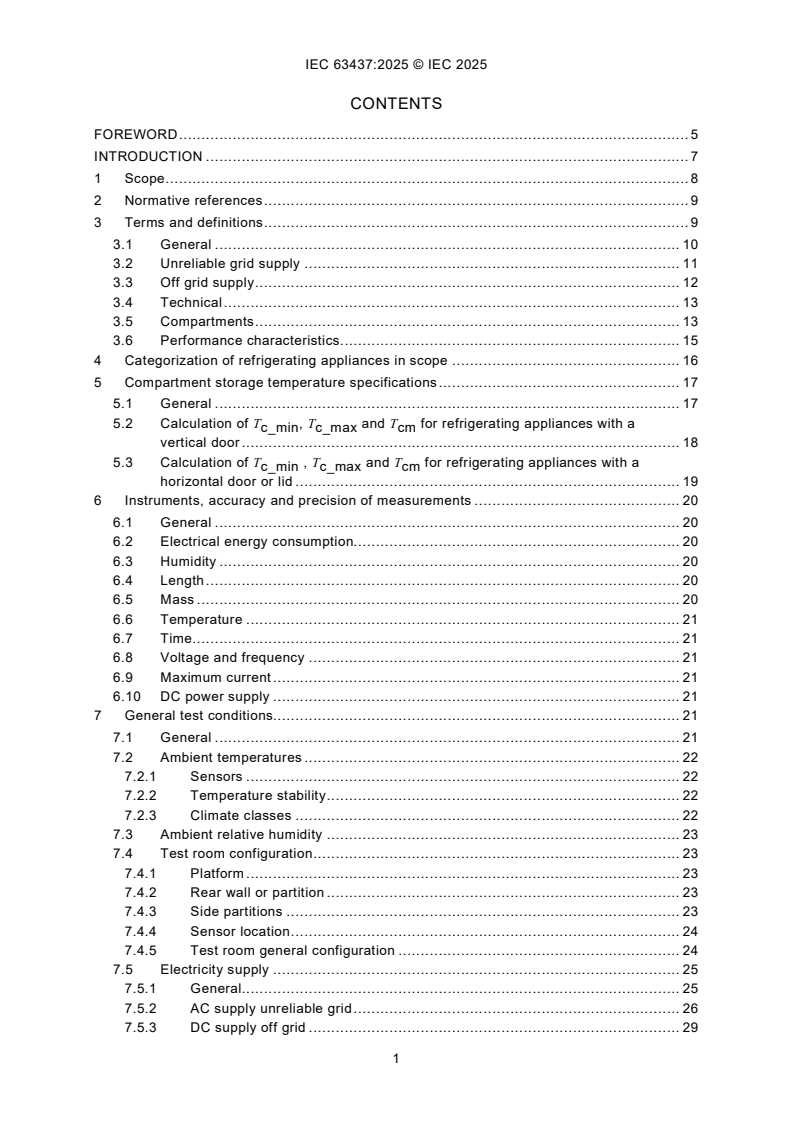
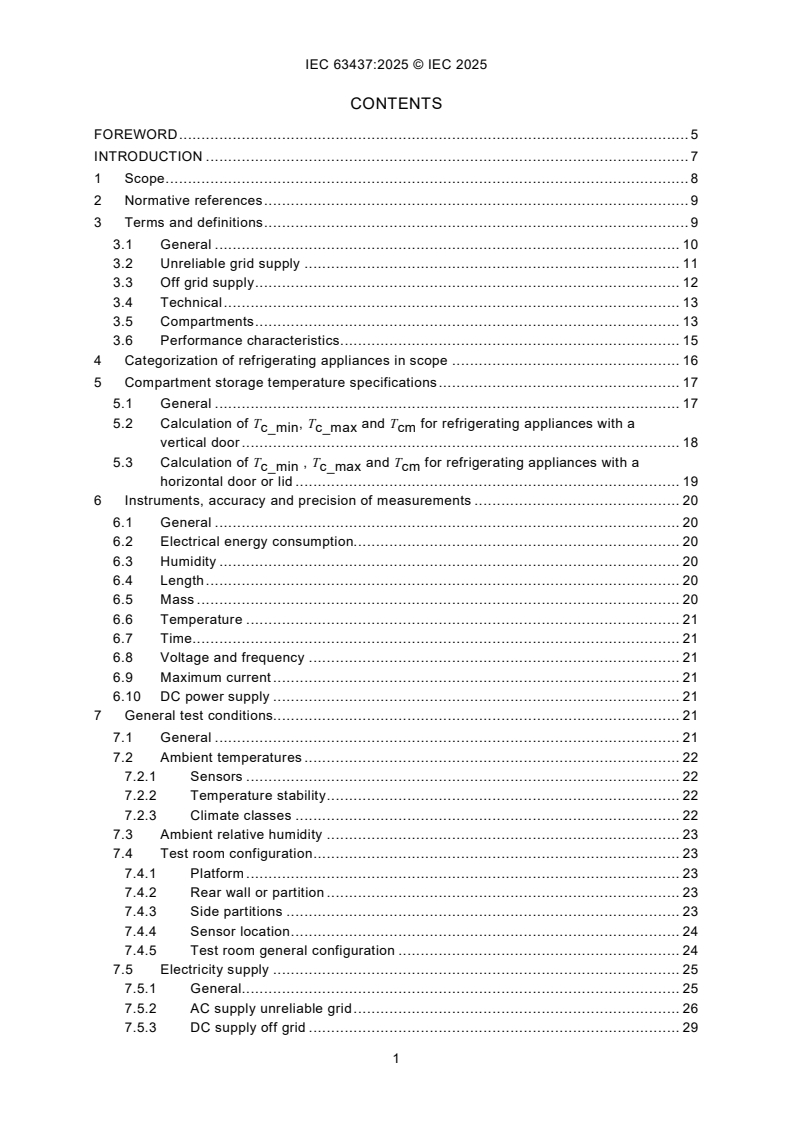
CONTENTS
FOREWORD . 5
INTRODUCTION . 7
1 Scope . 8
2 Normative references . 9
3 Terms and definitions . 9
3.1 General . 10
3.2 Unreliable grid supply . 11
3.3 Off grid supply . 12
3.4 Technical . 13
3.5 Compartments . 13
3.6 Performance characteristics . 15
4 Categorization of refrigerating appliances in scope . 16
5 Compartment storage temperature specifications . 17
5.1 General . 17
5.2 Calculation of T , T and T for refrigerating appliances with a
c_min c_max cm
vertical door . 18
5.3 Calculation of T , T and T for refrigerating appliances with a
c_min c_max cm
horizontal door or lid . 19
6 Instruments, accuracy and precision of measurements . 20
6.1 General . 20
6.2 Electrical energy consumption. 20
6.3 Humidity . 20
6.4 Length . 20
6.5 Mass . 20
6.6 Temperature . 21
6.7 Time . 21
6.8 Voltage and frequency . 21
6.9 Maximum current . 21
6.10 DC power supply . 21
7 General test conditions. 21
7.1 General . 21
7.2 Ambient temperatures . 22
7.2.1 Sensors . 22
7.2.2 Temperature stability . 22
7.2.3 Climate classes . 22
7.3 Ambient relative humidity . 23
7.4 Test room configuration . 23
7.4.1 Platform . 23
7.4.2 Rear wall or partition . 23
7.4.3 Side partitions . 23
7.4.4 Sensor location . 24
7.4.5 Test room general configuration . 24
7.5 Electricity supply . 25
7.5.1 General. 25
7.5.2 AC supply unreliable grid . 26
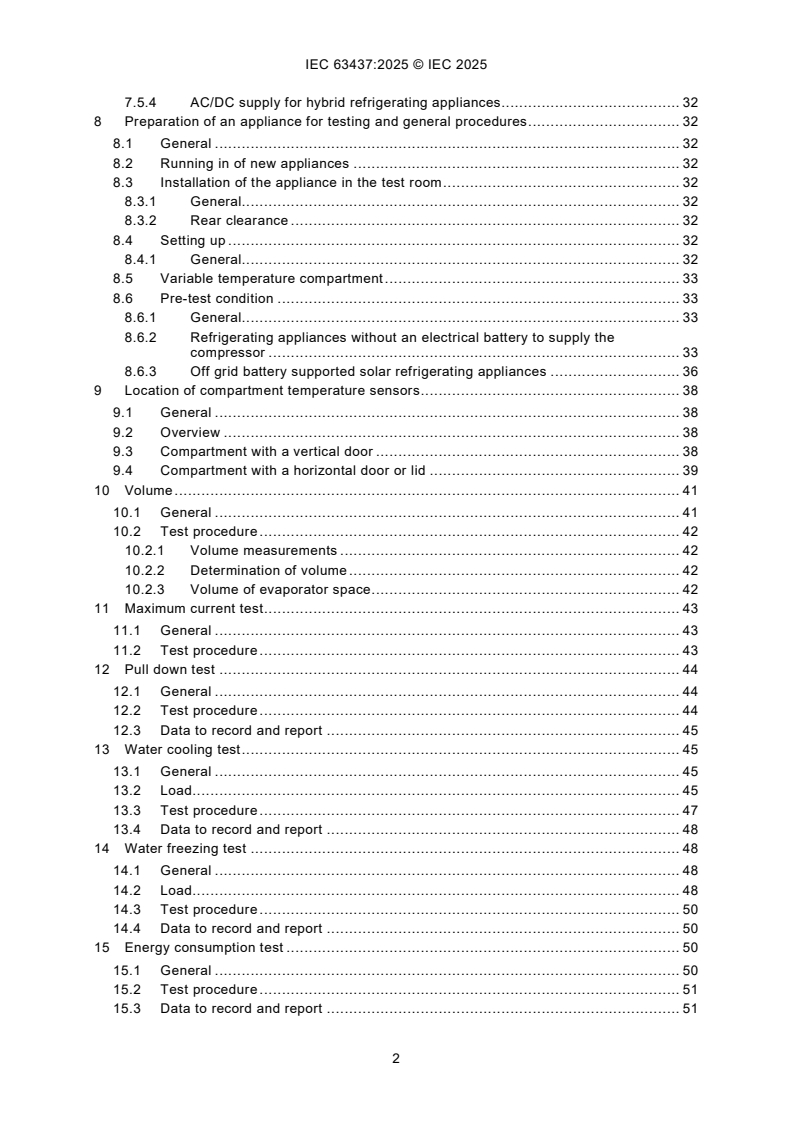
7.5.3 DC supply off grid . 29
7.5.4 AC/DC supply for hybrid refrigerating appliances . 32
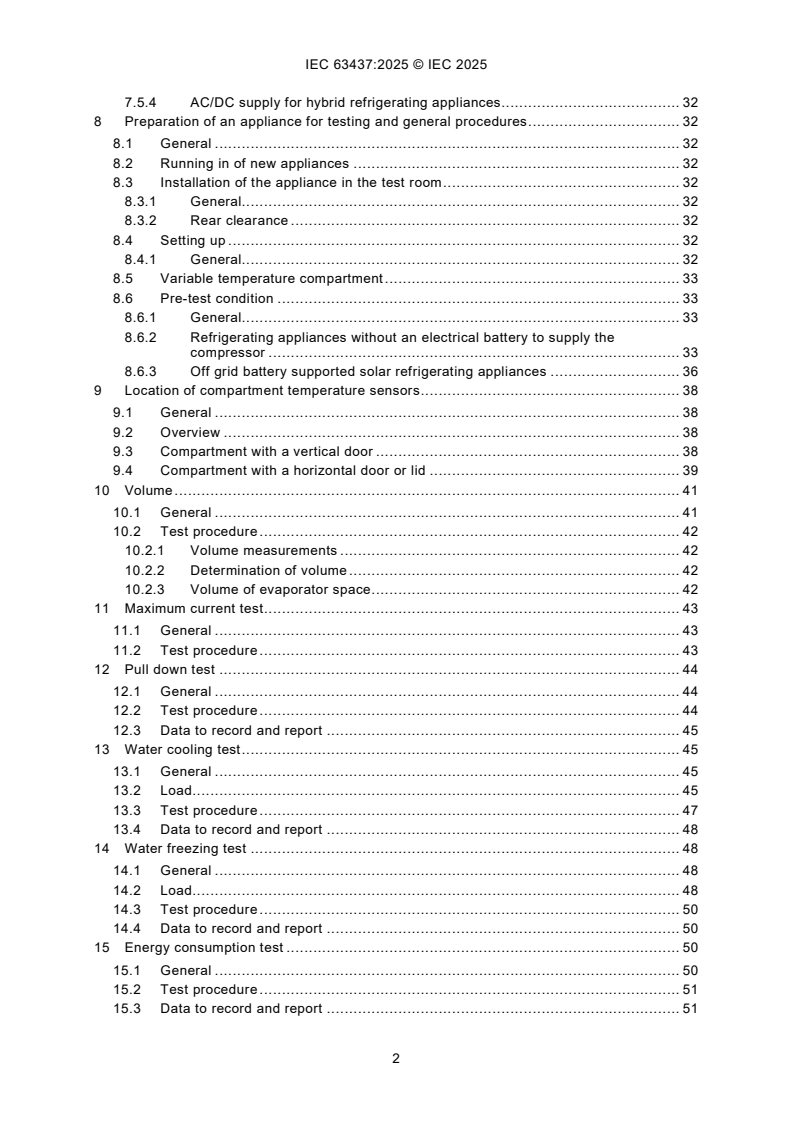
8 Preparation of an appliance for testing and general procedures . 32
8.1 General . 32
8.2 Running in of new appliances . 32
8.3 Installation of the appliance in the test room . 32
8.3.1 General. 32
8.3.2 Rear clearance . 32
8.4 Setting up . 32
8.4.1 General. 32
8.5 Variable temperature compartment . 33
8.6 Pre-test condition . 33
8.6.1 General. 33
8.6.2 Refrigerating appliances without an electrical battery to supply the
compressor . 33
8.6.3 Off grid battery supported solar refrigerating appliances . 36
9 Location of compartment temperature sensors . 38
9.1 General . 38
9.2 Overview . 38
9.3 Compartment with a vertical door . 38
9.4 Compartment with a horizontal door or lid . 39
10 Volume . 41
10.1 General . 41
10.2 Test procedure . 42
10.2.1 Volume measurements . 42
10.2.2 Determination of volume . 42
10.2.3 Volume of evaporator space . 42
11 Maximum current test . 43
11.1 General . 43
11.2 Test procedure . 43
12 Pull down test . 44
12.1 General . 44
12.2 Test procedure . 44
12.3 Data to record and report . 45
13 Water cooling test . 45
13.1 General . 45
13.2 Load . 45
13.3 Test procedure . 47
13.4 Data to record and report . 48
14 Water freezing test . 48
14.1 General . 48
14.2 Load . 48
14.3 Test procedure . 50
14.4 Data to record and report . 50
15 Energy consumption test . 50
15.1 General . 50
15.2 Test procedure . 51
15.3 Data to record and report . 51
16 High ambient storage and energy consumption test (only valid for ST and T
appliances) . 52
16.1 General . 52
16.2 Test procedure . 52
16.3 Data to record and report . 52
17 Low ambient storage test . 52
17.1 General . 52
17.2 Test procedure . 52
17.3 Data to record and report . 53
18 Holdover test . 53
18.1 General . 53
18.2 Test procedure: . 53
18.3 Data to record and report . 54
19 Solar class test . 54
19.1 General . 54
19.2 Test procedure . 54
19.3 Data to record and report . 55
20 Under and over voltage test . 55
20.1 General . 55
20.2 Test procedure . 55
20.3 Data to record and report for the under and for the over voltage test . 56
21 Voltage withstand test . 56
21.1 General . 56
21.2 Test procedure . 57
21.3 Data to record and report . 57
22 Polarity check test . 57
22.1 General . 57
22.2 Test procedure . 57
22.3 Data to record and report . 57
23 Summary of compartment load, electrical battery state and thermal store
conditions . 57
24 Marking . 58
24.1 Rating plate information . 58
24.2 Identification of frozen compartments . 59
24.3 Load limit lines . 59
Annex A (informative) Background information and arguments for the standard . 61
A.1 Background . 61
A.2 Rationale . 62
Annex B (informative) Test points solar classes . 63
Annex C (informative) Recommendations for future standard updates . 66
Bibliography . 67
Figure 1 – Example calculation of T and T for refrigerating appliances with
c_min c_max
a vertical door . 19
Figure 2 – Example calculation of T and T for refrigerating appliances with
c_min c_max
a horizontal door or lid . 20
Figure 3 – Verification of parameters to be kept constant . 22
Figure 4 – Partitions to restrict air circulation and ambient temperatures sensor
positions . 25
Figure 5 – AC supply signals . 28
Figure 6 – Daily solar class supply signals . 30
Figure 7 – Daily functional supply signal . 31
Figure 8 – Pre-test condition A – Example 1: applying an intermittent supply class 4
supply signal . 34
Figure 9 – Pre-test condition A– Example 2: applying an intermittent supply class 5
supply signal . 34
Figure 10 – Pre-test condition B for holdover test – Example 1 . 35
Figure 11 – Pre-test condition B for holdover test – Example 2 . 35
Figure 12 – Pre-test condition C – Example 1: applying an intermittent supply class 4
supply signal . 36
Figure 13 – Pre-test condition C – Example 2: applying an intermittent supply class 5
supply signal . 37
Figure 14 – Pre-test condition D for holdover test – Example 1. 37
Figure 15 – Pre-test condition D for holdover test – Example 2. 38
Figure 16 – Location of temperature sensors vertical door refrigerating appliances . 39
Figure 17 – Location of temperature sensors horizontal door or lid refrigerating
appliances . 41
Figure 18 – Basic view of top mounted freezer appliance . 43
Figure 19 – Load and position of the water and M-containers on each shelf for
appliances with a vertical door and on the dummy shelf for horizontal appliances with a
dummy shelf (water cooling test) . 46
Figure 20 – Load and position of the M-containers on the shelve (water freezing test) . 49
Figure 21 – Star identification symbols for frozen compartments . 59
Figure 22 – Marking of load limit . 60
Table 1 – Unreliable grid refrigerating appliance categories and their configuration
codes . 17
Table 2 – Off grid refrigerating appliance categories and their configuration codes . 17
Table 3 – Compartment temperature specification. 18
Table 4 – Climate classes . 22
Table 5 – Ambient test conditions. 23
Table 6 – AC unreliable grid supply signals . 27
Table 7 – Intermittent AC voltage supply class . 27
Table 8 – AC voltage distorted supply class . 28
Table 9 – AC voltage withstand supply class . 29
Table 10 – DC off grid supply signals . 29
Table 11 – Current of the functional supply . 30
Table 12 – Functional supply signal . 31
Table 13 – Intermittent DC voltage supply class. 32
Table 14 – Testing days energy consumption test . 51
Table 15 – Testing days solar class test . 55
Table 16 – Compartment load, electrical battery condition and thermal store state at
the start of each test . 58
Table B.1 – Coordinates of the irradiance graphs for the various solar classes . 64
INTERNATIONAL ELECTROTECHNICAL COMMISSION
____________
Off grid and unreliable grid refrigerating appliances for domestic and light
commercial use - Characteristics and test methods - Performance
requirements and energy consumption
FOREWORD
1) The International Electrotechnical Commission (IEC) is a worldwide organization for standardization comprising
all national electrotechnical committees (IEC National Committees). The object of IEC is to promote international
co-operation on all questions concerning standardization in the electrical and electronic fields. To this end and
in addition to other activities, IEC publishes International Standards, Technical Specifications, Technical Reports,
Publicly Available Specifications (PAS) and Guides (hereafter referred to as "IEC Publication(s)"). Their
preparation is entrusted to technical committees; any IEC National Committee interested in the subject dealt with
may participate in this preparatory work. International, governmental and non-governmental organizations liaising
with the IEC also participate in this preparation. IEC collaborates closely with the International Organization for
Standardization (ISO) in accordance with conditions determined by agreement between the two organizations.
2) The formal decisions or agreements of IEC on technical matters express, as nearly as possible, an international
consensus of opinion on the relevant subjects since each technical committee has representation from all
interested IEC National Committees.
3) IEC Publications have the form of recommendations for international use and are accepted by IEC National
Committees in that sense. While all reasonable efforts are made to ensure that the technical content of IEC
Publications is accurate, IEC cannot be held responsible for the way in which they are used or for any
misinterpretation by any end user.
4) In order to promote international uniformity, IEC National Committees undertake to apply IEC Publications
transparently to the maximum extent possible in their national and regional publications. Any divergence between
any IEC Publication and the corresponding national or regional publication shall be clearly indicated in the latter.
5) IEC itself does not provide any attestation of conformity. Independent certification bodies provide conformity
assessment services and, in some areas, access to IEC marks of conformity. IEC is not responsible for any
services carried out by independent certification bodies.
6) All users should ensure that they have the latest edition of this publication.
7) No liability shall attach to IEC or its directors, employees, servants or agents including individual experts and
members of its technical committees and IEC National Committees for any personal injury, property damage or
other damage of any nature whatsoever, whether direct or indirect, or for costs (including legal fees) and
expenses arising out of the publication, use of, or reliance upon, this IEC Publication or any other IEC
Publications.
8) Attention is drawn to the Normative references cited in this publication. Use of the referenced publications is
indispensable for the correct application of this publication.
9) IEC draws attention to the possibility that the implementation of this document may involve the use of (a)
patent(s). IEC takes no position concerning the evidence, validity or applicability of any claimed patent rights in
respect thereof. As of the date of publication of this document, IEC had not received notice of (a) patent(s), which
may be required to implement this document. However, implementers are cautioned that this may not represent
the latest information, which may be obtained from the patent database available at https://patents.iec.ch. IEC
shall not be held responsible for identifying any or all such patent rights.
IEC 63437 has been prepared by subcommittee 59M: Performance of electrical household and
similar cooling and freezing appliances, of IEC technical committee 59: Performance of
household and similar electrical appliances. It is an International Standard.
The text of this International Standard is based on the following documents:
Draft Report on voting
59M/193/FDIS 59M/195/RVD
Full information on the voting for its approval can be found in the report on voting indicated in
the above table.
The language used for the development of this International Standard is English.
This document was drafted in accordance with ISO/IEC Directives, Part 2, and developed in
accordance with ISO/IEC Directives, Part 1 and ISO/IEC Directives, IEC Supplement, available
at www.iec.ch/members_experts/refdocs. The main document types developed by IEC are
described in greater detail at www.iec.ch/publications.
The following print types are used:
– requirements: in roman type;
– notes: in small roman type;
– words in bold are defined in Clause 3.
The committee has decided that the contents of this document will remain unchanged until the
stability date indicated on the IEC website under webstore.iec.ch in the data related to the
specific document. At this date, the document will be
– reconfirmed,
– withdrawn, or
– revised.
INTRODUCTION
Background information and arguments for this document are provided in Annex A. Annex C
provides recommendations for future updates of this document.
1 Scope
This document specifies the essential characteristics of off grid and unreliable grid
refrigerating appliances for domestic and similar use or light commercial use, cooled by
internal natural or forced air convection. It defines input voltage supply signals for appliances
designed for unreliable grid and off grid conditions.
An unreliable grid condition can be the result of disturbances on the electricity supply, such
as power outages, or issues with power quality, such as voltage spikes and surges, that could
cause performance challenges to refrigerating appliances. An off grid supply, in this context,
for example is generated by a solar panel or a stand-alone solar home system that is not
connected to the power grid. This document simulates the power characteristics in off grid and
unreliable grid conditions but does not specify requirements or test procedures to assess
performance of generators, solar panels, solar home system or any other system generating a
supply signal.
The supply signals defined in this document can also be used for evaluation of the performance
of other refrigerating appliances such as medical or laboratory appliances, professional
storage refrigerators or freezers, refrigerated display cabinets, beverage coolers or ice cream
freezers.
This document specifies the test methods for measuring the functional performance
characteristics and requirements. This document does not apply to refrigerating appliances
designed for a good quality and stable electricity grid and refrigerating appliances utilising
fuelled absorption cooling technology.
This document is applicable to any refrigerating appliance for domestic or light commercial
use that has a rated performance to properly operate off grid or under unreliable grid
operating conditions resisting power interruptions and supply variations. Off grid and
unreliable grid refrigerating appliances are appliances intended to for use with standalone
or intermittent or distorted electrical mains. Electrical mains supply is assumed to be alternating
current (AC) for unreliable grid or direct current (DC) for off grid. This document is also
applicable to hybrid refrigerating appliances.
The test procedures primary focus on the performance of the overall refrigerating appliances
and not on the specific performance of auxiliary components such as electrical batteries,
inverters or rectifiers or any device intended to improve the power quality but external to the
appliance itself. In case a refrigerating appliance is supplied with control unit, an electrical
battery, a voltage protector, an inverter or a rectifier in the original product packaging, these
components are considered as a component of the refrigerating appliance and are connected
during testing.
The tests defined in this document aim to assess the fundamental design and functional
operation of the refrigerating appliance as well as its resilience to given power quality issues.
Unreliable grid (UG) refrigerating appliance categories which are within the scope of this
document are as follows:
a) UG : AC voltage supplied refrigerating appliances designed for proper operation
intermittent
during intermittent power outages, containing an internal thermal store and/or electrical
battery;
b) UG : AC voltage refrigerating appliances designed for operation when connected
distorted
to a distorted grid supply (for example voltage sags or voltage surges);
c) UG : AC voltage refrigerating appliances designed for operation with
intermittent+distorted
intermittent grid/power outages and distorted grid supply (combination of a) and b).
Off grid (OG) refrigerating appliance categories which are within the scope of this document
are as follows:
– OG : DC voltage supplied solar direct drive refrigerating appliances, designed for
SDD
direct connection to a photovoltaic solar panel, containing an internal thermal store with
an optional electrical battery to supply auxiliaries such as a controller, lighting or fans. The
compressor of the appliance is directly supplied by the solar panel;
– OG : DC voltage supplied, electrical battery supported solar refrigerating
battery supported
appliance designed for direct connection to a photovoltaic solar panel, incorporating an
electrical battery to supply the compressor when there is insufficient solar power. These
appliances can also have internal thermal store. The electrical battery is charged by the
solar panel only. The battery will be part of the appliance or will be supplied in the same
packaging of the appliance;
– OG : DC voltage supplied refrigerating appliance designed for proper operation
intermittent
during power outages, containing an internal thermal store or electrical battery, or both;
– OG : Continuous DC voltage supplied refrigerating appliances, without any
continuous
internal thermal store and electrical battery.
This document also defines solar classes, consisting of different irradiance patterns and
unreliable grid protection codes, describing various power outages and voltage
disturbances of the electricity grid. These classes can also be applied for products outside the
scope of this standard.
Refrigerating appliances that are out of scope in this document include AC refrigerating
appliances designed for reliable, good quality continuous supply. These refrigerating
appliances are covered by IEC 62552-1 [7] , IEC 62552-2 [8] and IEC 62552-3 [9] for domestic
refrigerating appliances.
This document does not define requirements for production sampling or conformity assessment
or certification.
2 Normative references
The following documents are referred to in the text in such a way that some or all of their content
constitutes requirements of this document. For dated references, only the edition cited applies.
For undated references, the latest edition of the referenced document (including any
amendments) applies.
ISO 7000:2019, Graphical symbols for use on equipment - Registered symbols
3 Terms and definitions
For the purposes of this document, the following terms and definitions apply.
ISO and IEC maintain terminology databases for use in standardization at the following
addresses:
– IEC Electropedia: available at https://www.electropedia.org/
– ISO Online browsing platform: available at https://www.iso.org/obp
___________
Numbers in square brackets refer to the Bibliography.
3.1 General
3.1.1
refrigerating appliance
insulated cabinet with one or more compartments that are controlled at frozen or unfrozen
compartment temperatures and are of suitable size and equipped for household or small
commercial use, cooled by a natural or forced convection air flow inside the compartment
typically using vapour compression or thermo-electric refrigeration technology
3.1.2
refrigerator
refrigerating appliance intended for the storage of foodstuff, with at least one fresh food
compartment
3.1.3
refrigerator-freezer
refrigerating appliance having at least one unfrozen compartment and at least one frozen
compartment
3.1.4
freezer
refrigerating appliance with only frozen compartments and at least one frozen
compartment
3.1.5
light commercial use
commercial activity generally consisting of sales of chilled foodstuff or beverages
3.1.6
variable temperature compartment
compartment intended for use as two or more alternative compartment types (e.g. a
compartment that can be either an unfrozen compartment or a frozen compartment) and
which is capable of being set by a user to continuously maintain the operating temperature
range applicable for each compartment type claimed at the rated climate class conditions
3.1.7
continuous supply refrigerating appliance
refrigerating appliance designed for continuous (24/7) AC or DC power supply, generally
without an integrated thermal store or electrical battery
3.1.8
solar direct drive refrigerating appliance
SDD refrigerating appliance
DC supply refrigerating appliance designed for direct connection with a defined photovoltaic
solar panel, generally containing an integrated thermal store to allow autonomous operation
during the night or during cloudy days
Note 1 to entry: Some SDD appliances can have a small electrical battery to supply auxiliaries such as a
controller, lighting or fans.
3.1.9
battery supported solar refrigerating appliance
DC supply refrigerating appliance designed for direct connection with a defined photovoltaic
solar panel, containing an integrated electrical battery that is charged by the solar panel only,
to allow autonomous operation of the compressor during the night
3.1.10
hybrid refrigerating appliance
refrigerating appliance with the option to operate on an AC or DC voltage supply
Note 1 to entry: These appliances are generally equipped with two input sockets: an AC input voltage socket and
a DC voltage input socket.
3.1.11
intermittent supply refrigerating appliance
refrigerating appliance designed to tolerate intermittent power supply, generally containing an
integrated thermal store or electrical battery allowing autonomous operation during periods
when electrical mains supply is not available
Note 1 to entry: For AC voltage refrigerating appliances lack of electrical supply is generally caused by power
outages, while for DC voltage refrigerating appliance a depleted battery can be the cause, for example.
3.1.12
distorted supply refrigerating appliance
refrigerating appliance designed to tolerate disturbed (continuous or intermittent) power
supply operation
3.1.13
foodstuff
food and beverages intended for consumption
3.1.14
rated
value declared by the manufacturer (e.g. volume, energy consumption, usage)
3.1.15
auxiliary
electrical component of the refrigerating appliance, excluding the compressor
EXAMPLE Examples of auxiliary components are lighting, supply voltage protectors, fans, electrical heaters or
control boards.
3.2 Unreliable grid supply
3.2.1
unreliable grid
AC voltage electricity supply subject to power outages or power quality disturbances, that are
outside the default specifications of a proper functioning public supply electricity grid
3.2.2
intermittent grid
electricity supply facing power outages
3.2.3
distorted grid
electricity supply facing disturbances in voltage level
3.2.4
unreliable grid nominal test voltage
voltage supply applied for testing unreliable grid refrigerating appliances at non-disturbed
supply conditions
3.2.5
power outage
unexpected interruption in the electricity supply, causing a loss of power to end users
3.2.6
voltage sag
sudden decrease of the electricity supply voltage
3.2.7
voltage surge
sudden increase of the electrical supply voltage
3.2.8
intermittent supply class
classification system for the different levels of intermittent power supply, defining the maximum
power outage time per day or lack of battery supply for which an intermittent supply
refrigerating appliance is designed to withstand
3.2.9
distorted supply class
classification system for the different levels of voltage distortion, specifying the minimum and
maximum voltage for which an unreliable grid refrigerating appliance is designed to
withstand without causing any damage to appliance and while still ensuring proper operation
3.2.10
withstand supply class
classification system for the range of supply voltage levels that a refrigerating appliance can
tolerate without permanent damage
Note 1 to entry: Proper functioning of the refrigerating appliance is not required during this test, but fuses should
not be blown.
3.2.11
unreliable grid class protection code
classification system for the electrical protection of unreliable grid refrigerating appliances,
defining the level of protection against power outages and voltage distortions
Note 1 to entry: The unreliable grid protection code (UGP-code) consists of three digits: UGP-code-XYZ, where
"X" represents the intermittent supply class, "Y" represents the distorted supply class, and "Z" represents the
voltage withstand supply class
3.2.12
voltage protector
automatic device that switches off the power supply of a refrigerating appliance when the supply
voltage exceeds or falls below acceptable levels
3.3 Off grid supply
3.3.1
off grid
area that is not connected to the electricity distribution network
Note 1 to entry: In this document, off grid supply refers to DC voltage supply.
3.3.2
off grid nominal test voltage
nominal direct current voltage level that a refrigerating appliance is designed to operate with
Note 1 to entry: The DC voltage supply should be used for testing continuous and intermittent supply
refrigerating appliances. For appliances directly connected to solar panels, the nominal voltage value should
correspond to the maximum power point voltage (Vmpp) of the connected solar panel.
3.3.3
solar class
classification system that categorizes different irradiance patterns based on various horizontal
irradiance levels
3.3.4
minimum supply time
minimum number of hours per day during which a refrigerating appliance needs electrical
supply in order to maintain its defined compartment target temperatures when operating at the
rated highest ambient temperature
3.3.5
functional supply
test signal for measuring minimum supply time
Note 1 to entry: For refrigerating appliances that can be directly connected to a solar panel, such as solar direct
drive refrigerating appliances, the supply should be set to the maximum power point voltage (Vmpp) of a solar
panel to ensure for maximum power output. For this supply, the current shall not exceed the maximum output current
of the solar panel.
3.4 Technical
3.4.1
thermal store
component used for storing and releasing thermal cooling energy
Note 1 to entry: The component stores cooling energy when electrical supply is available and releases cooling
energy when electrical supply is low or unavailable. The thermal store can be charged by various sources, including
solar panels, other DC sources such as an electrical battery, or AC sources such as the electricity grid.
3.4.2
electrical battery
component used for storing and releasing electrical energy.
Note 1 to entry: The electrical battery stores energy when electric
...
IEC 63437 ®
Edition 1.0 2025-11
NORME
INTERNATIONALE
Appareils de réfrigération hors réseau et sur réseau peu fiable pour un usage
domestique et commercial léger - Caractéristiques et méthodes d'essai -
Exigences d'aptitude à la fonction et consommation d'énergie
ICS 97.030 ISBN 978-2-8327-0880-4
Droits de reproduction réservés. Sauf indication contraire, aucune partie de cette publication ne peut être reproduite ni
utilisée sous quelque forme que ce soit et par aucun procédé, électronique ou mécanique, y compris la photocopie et
les microfilms, sans l'accord écrit de l'IEC ou du Comité national de l'IEC du pays du demandeur. Si vous avez des
questions sur le copyright de l'IEC ou si vous désirez obtenir des droits supplémentaires sur cette publication, utilisez
les coordonnées ci-après ou contactez le Comité national de l'IEC de votre pays de résidence.
IEC Secretariat Tel.: +41 22 919 02 11
3, rue de Varembé info@iec.ch
CH-1211 Geneva 20 www.iec.ch
Switzerland
A propos de l'IEC
La Commission Electrotechnique Internationale (IEC) est la première organisation mondiale qui élabore et publie des
Normes internationales pour tout ce qui a trait à l'électricité, à l'électronique et aux technologies apparentées.
A propos des publications IEC
Le contenu technique des publications IEC est constamment revu. Veuillez vous assurer que vous possédez l’édition la
plus récente, un corrigendum ou amendement peut avoir été publié.
Recherche de publications IEC - IEC Products & Services Portal - products.iec.ch
webstore.iec.ch/advsearchform Découvrez notre puissant moteur de recherche et consultez
La recherche avancée permet de trouver des publications gratuitement tous les aperçus des publications, symboles
IEC en utilisant différents critères (numéro de référence, graphiques et le glossaire. Avec un abonnement, vous aurez
texte, comité d’études, …). Elle donne aussi des toujours accès à un contenu à jour adapté à vos besoins.
informations sur les projets et les publications remplacées
ou retirées. Electropedia - www.electropedia.org
Le premier dictionnaire d'électrotechnologie en ligne au
IEC Just Published - webstore.iec.ch/justpublished monde, avec plus de 22 500 articles terminologiques en
Restez informé sur les nouvelles publications IEC. Just anglais et en français, ainsi que les termes équivalents
Published détaille les nouvelles publications parues. dans 25 langues additionnelles. Egalement appelé
Disponible en ligne et une fois par mois par email. Vocabulaire Electrotechnique International (IEV) en ligne.
Service Clients - webstore.iec.ch/csc
Si vous désirez nous donner des commentaires sur cette
publication ou si vous avez des questions contactez-
nous: sales@iec.ch.
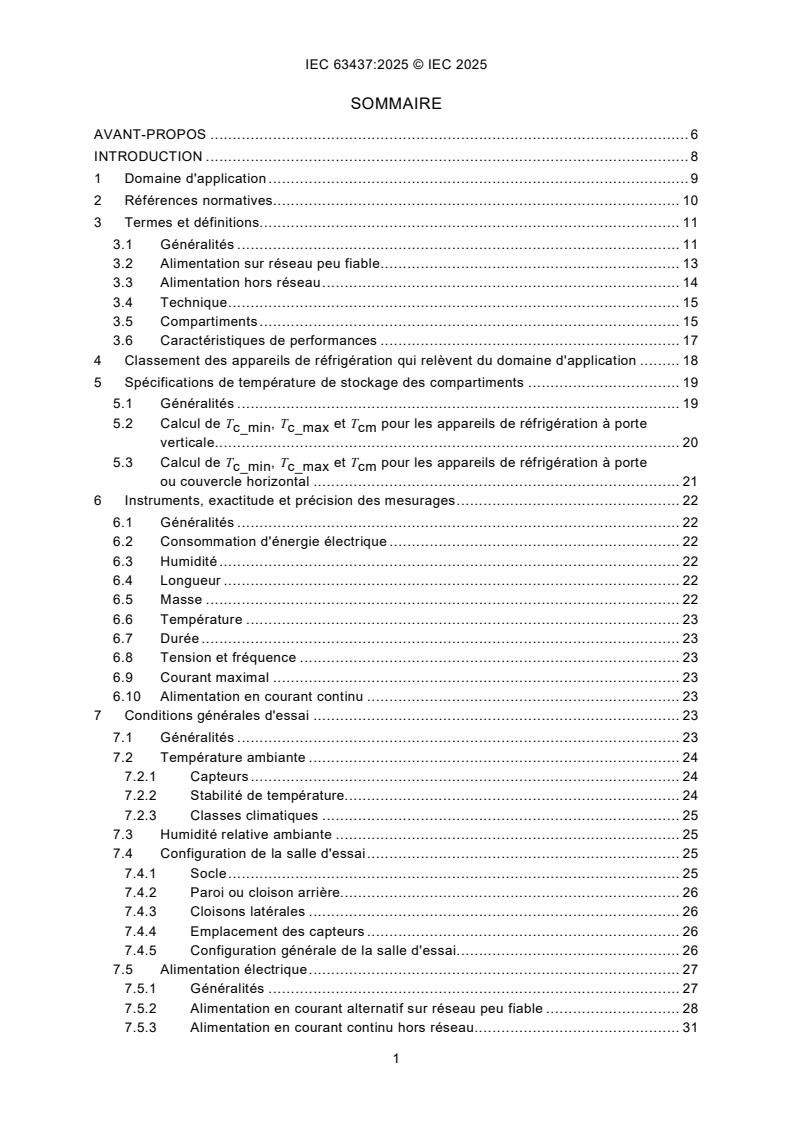
SOMMAIRE
AVANT-PROPOS . 6
INTRODUCTION . 8
1 Domaine d'application . 9
2 Références normatives . 10
3 Termes et définitions. 11
3.1 Généralités . 11
3.2 Alimentation sur réseau peu fiable . 13
3.3 Alimentation hors réseau . 14
3.4 Technique . 15
3.5 Compartiments . 15
3.6 Caractéristiques de performances . 17
4 Classement des appareils de réfrigération qui relèvent du domaine d'application . 18
5 Spécifications de température de stockage des compartiments . 19
5.1 Généralités . 19
5.2 Calcul de T , T et T pour les appareils de réfrigération à porte
c_min c_max cm
verticale. 20
5.3 Calcul de T , T et T pour les appareils de réfrigération à porte
c_min c_max cm
ou couvercle horizontal . 21
6 Instruments, exactitude et précision des mesurages . 22
6.1 Généralités . 22
6.2 Consommation d'énergie électrique . 22
6.3 Humidité . 22
6.4 Longueur . 22
6.5 Masse . 22
6.6 Température . 23
6.7 Durée . 23
6.8 Tension et fréquence . 23
6.9 Courant maximal . 23
6.10 Alimentation en courant continu . 23
7 Conditions générales d'essai . 23
7.1 Généralités . 23
7.2 Température ambiante . 24
7.2.1 Capteurs . 24
7.2.2 Stabilité de température. 24
7.2.3 Classes climatiques . 25
7.3 Humidité relative ambiante . 25
7.4 Configuration de la salle d'essai . 25
7.4.1 Socle . 25
7.4.2 Paroi ou cloison arrière. 26
7.4.3 Cloisons latérales . 26
7.4.4 Emplacement des capteurs . 26
7.4.5 Configuration générale de la salle d'essai . 26
7.5 Alimentation électrique . 27
7.5.1 Généralités . 27
7.5.2 Alimentation en courant alternatif sur réseau peu fiable . 28
7.5.3 Alimentation en courant continu hors réseau . 31
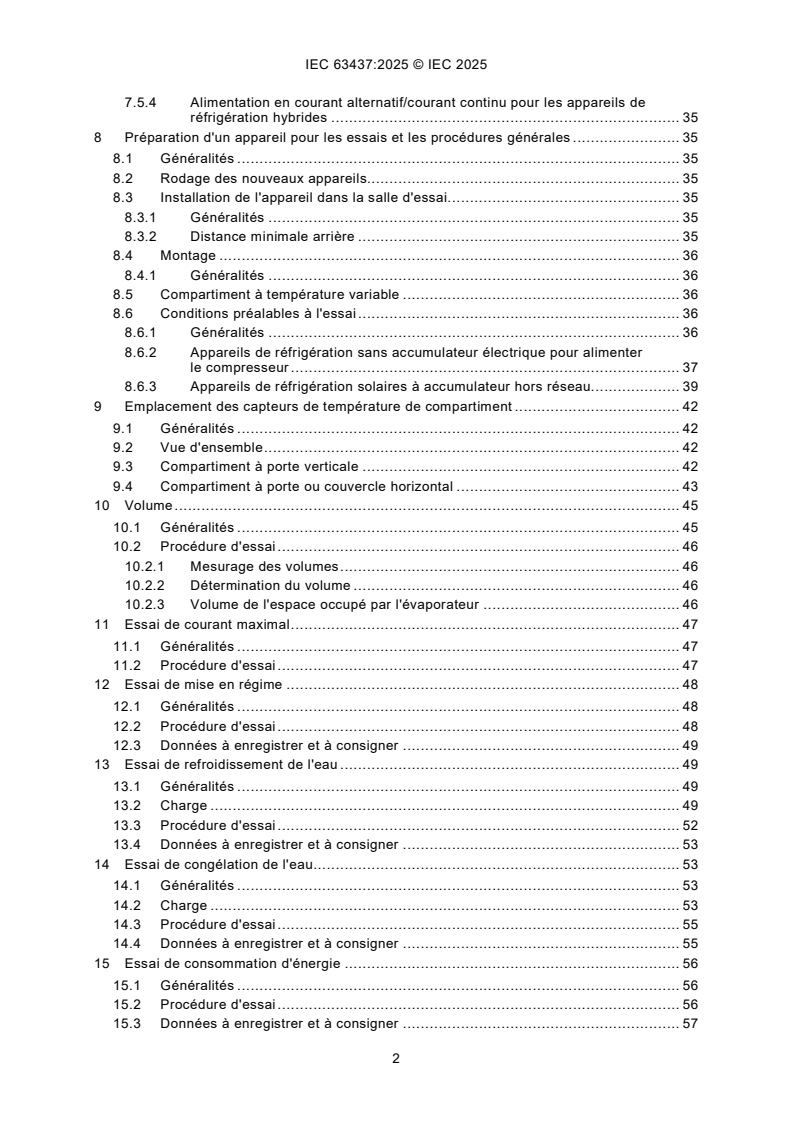
7.5.4 Alimentation en courant alternatif/courant continu pour les appareils de
réfrigération hybrides . 35
8 Préparation d'un appareil pour les essais et les procédures générales . 35
8.1 Généralités . 35
8.2 Rodage des nouveaux appareils. 35
8.3 Installation de l'appareil dans la salle d'essai . 35
8.3.1 Généralités . 35
8.3.2 Distance minimale arrière . 35
8.4 Montage . 36
8.4.1 Généralités . 36
8.5 Compartiment à température variable . 36
8.6 Conditions préalables à l'essai . 36
8.6.1 Généralités . 36
8.6.2 Appareils de réfrigération sans accumulateur électrique pour alimenter
le compresseur . 37
8.6.3 Appareils de réfrigération solaires à accumulateur hors réseau. 39
9 Emplacement des capteurs de température de compartiment . 42
9.1 Généralités . 42
9.2 Vue d'ensemble . 42
9.3 Compartiment à porte verticale . 42
9.4 Compartiment à porte ou couvercle horizontal . 43
10 Volume . 45
10.1 Généralités . 45
10.2 Procédure d'essai . 46
10.2.1 Mesurage des volumes . 46
10.2.2 Détermination du volume . 46
10.2.3 Volume de l'espace occupé par l'évaporateur . 46
11 Essai de courant maximal . 47
11.1 Généralités . 47
11.2 Procédure d'essai . 47
12 Essai de mise en régime . 48
12.1 Généralités . 48
12.2 Procédure d'essai . 48
12.3 Données à enregistrer et à consigner . 49
13 Essai de refroidissement de l'eau . 49
13.1 Généralités . 49
13.2 Charge . 49
13.3 Procédure d'essai . 52
13.4 Données à enregistrer et à consigner . 53
14 Essai de congélation de l'eau . 53
14.1 Généralités . 53
14.2 Charge . 53
14.3 Procédure d'essai . 55
14.4 Données à enregistrer et à consigner . 55
15 Essai de consommation d'énergie . 56
15.1 Généralités . 56
15.2 Procédure d'essai . 56
15.3 Données à enregistrer et à consigner . 57
16 Essai de stockage à température ambiante et consommation énergétique élevée
(uniquement valable pour les appareils ST et T) . 57
16.1 Généralités . 57
16.2 Procédure d'essai . 57
16.3 Données à enregistrer et à consigner . 57
17 Essai d'entreposage à température ambiante basse . 57
17.1 Généralités . 57
17.2 Procédure d'essai . 58
17.3 Données à enregistrer et à consigner . 58
18 Essai de maintien de la température . 58
18.1 Généralités . 58
18.2 Procédure d'essai . 58
18.3 Données à enregistrer et à consigner . 59
19 Essai de classe solaire . 60
19.1 Généralités . 60
19.2 Procédure d'essai . 60
19.3 Données à enregistrer et à consigner . 61
20 Essai de sous-tension et de surtension . 61
20.1 Généralités . 61
20.2 Procédure d'essai . 61
20.3 Données à enregistrer et à consigner pour l'essai de sous-tension et de
surtension . 62
21 Essai de tenue en tension . 62
21.1 Généralités . 62
21.2 Procédure d'essai . 62
21.3 Données à enregistrer et à consigner . 62
22 Essai de vérification de la polarité . 63
22.1 Généralités . 63
22.2 Procédure d'essai . 63
22.3 Données à enregistrer et à consigner . 63
23 Récapitulatif des conditions de charge des compartiments, d'état de
l'accumulateur électrique et d'état de l'accumulateur de chaleur . 63
24 Marquage . 64
24.1 Informations sur la plaque signalétique . 64
24.2 Identification des compartiments congelés . 65
24.3 Lignes de limite de chargement . 65
Annexe A (informative) Informations contextuelles et arguments relatifs à la présente
norme . 67
A.1 Contexte . 67
A.2 Justification . 68
Annexe B (informative) Points d'essai des classes solaires . 70
Annexe C (informative) Recommandations pour les futures mises à jour de la norme . 73
Bibliographie . 74
Figure 1 – Exemple de calcul de T et T pour les appareils de réfrigération
c_min c_max
à porte verticale . 21
Figure 2 – Exemple de calcul de T et T pour les appareils de réfrigération
c_min c_max
à porte ou couvercle horizontal . 22
Figure 3 – Vérification des paramètres à maintenir constants . 24
Figure 4 – Cloisons destinées à limiter la circulation de l'air et position des capteurs de
température ambiante . 27
Figure 5 – Signaux d'alimentation en courant alternatif . 30
Figure 6 – Signaux d'alimentation journaliers par classe solaire . 33
Figure 7 – Signal d'alimentation fonctionnelle journalier . 34
Figure 8 – Condition préalable à l'essai A, exemple 1 appliquant un signal
d'alimentation intermittente de classe 4 . 37
Figure 9 – Condition préalable à l'essai A, exemple 2 appliquant un signal
d'alimentation intermittente de classe 5 . 38
Figure 10 – Condition préalable à l'essai B pour l'essai de maintien de la température
– Exemple 1 . 38
Figure 11 – Condition préalable à l'essai B pour l'essai de maintien de la température
– Exemple 2 . 39
Figure 12 – Condition préalable à l'essai C, exemple 1 appliquant un signal
d'alimentation intermittente de classe 4 . 40
Figure 13 – Condition préalable à l'essai C, exemple 2 appliquant un signal
d'alimentation intermittente de classe 5 . 40
Figure 14 – Condition préalable à l'essai D pour l'essai de maintien de la température
– Exemple 1 . 41
Figure 15 – Condition préalable à l'essai D pour l'essai de maintien de la température
– Exemple 2 . 41
Figure 16 – Emplacement des capteurs de température pour les appareils de
réfrigération à porte verticale . 42
Figure 17 – Emplacement des capteurs de température pour les appareils de
réfrigération à porte ou couvercle horizontal . 45
Figure 18 – Vue de base d'un congélateur monté sur le dessus. 47
Figure 19 – Charge et position des bacs d'eau et des bacs M sur chaque étagère pour
les appareils à porte verticale, et sur la fausse étagère pour les appareils horizontaux
avec une fausse étagère (essai de refroidissement de l'eau) . 51
Figure 20 – Charge et position des bacs M sur l'étagère (essai de congélation de l'eau) . 54
Figure 21 – Symboles d'identification par étoiles des compartiments congelés . 65
Figure 22 – Marquage de la limite de chargement . 66
Tableau 1 – Catégories d'appareils de réfrigération sur réseau peu fiable et codes de
configuration associés . 19
Tableau 2 – Catégories d'appareils de réfrigération hors réseau et codes de
configuration associés . 19
Tableau 3 – Spécification de température des compartiments . 20
Tableau 4 – Classes climatiques . 25
Tableau 5 – Conditions ambiantes d'essai. 25
Tableau 6 – Signaux d'alimentation en courant alternatif sur réseau peu fiable . 29
Tableau 7 – Classe d'alimentation intermittente en courant alternatif . 30
Tableau 8 – Classe d'alimentation distordue en courant alternatif . 31
Tableau 9 – Classe d'alimentation de tenue en courant alternatif . 31
Tableau 10 – Signaux d'alimentation en courant continu hors réseau . 32
Tableau 11 – Courant de l'alimentation fonctionnelle . 33
Tableau 12 – Signal d'alimentation fonctionnelle . 34
Tableau 13 – Classe d'alimentation intermittente en courant continu . 35
Tableau 14 – Jours d'essai de l'essai de consommation d'énergie . 56
Tableau 15 – Jours d'essai de l'essai de classe solaire . 60
Tableau 16 – Charge des compartiments, état de l'accumulateur électrique et état de
l'accumulateur de chaleur au début de chaque essai . 64
Tableau B.1 – Coordonnées des graphiques d'irradiance pour les différentes classes
solaires . 71
COMMISSION ÉLECTROTECHNIQUE INTERNATIONALE
____________
Appareils de réfrigération hors réseau et sur réseau peu fiable pour un
usage domestique et commercial léger - Caractéristiques et méthodes
d'essai - Exigences d'aptitude à la fonction et consommation d'énergie
AVANT-PROPOS
1) La Commission Électrotechnique Internationale (IEC) est une organisation mondiale de normalisation composée
de l'ensemble des comités électrotechniques nationaux (Comités nationaux de l'IEC). L'IEC a pour objet de
favoriser la coopération internationale pour toutes les questions de normalisation dans les domaines de
l'électricité et de l'électronique. À cet effet, l'IEC – entre autres activités – publie des Normes internationales,
des Spécifications techniques, des Rapports techniques, des Spécifications accessibles au public (PAS) et des
Guides (ci-après dénommés "Publication(s) de l'IEC"). Leur élaboration est confiée à des comités d'études, aux
travaux desquels tout Comité national intéressé par le sujet traité peut participer. Les organisations
internationales, gouvernementales et non gouvernementales, en liaison avec l'IEC, participent également aux
travaux. L'IEC collabore étroitement avec l'Organisation Internationale de Normalisation (ISO), selon des
conditions fixées par accord entre les deux organisations.
2) Les décisions ou accords officiels de l'IEC concernant les questions techniques représentent, dans la mesure du
possible, un accord international sur les sujets étudiés, étant donné que les Comités nationaux de l'IEC intéressés
sont représentés dans chaque comité d'études.
3) Les Publications de l'IEC se présentent sous la forme de recommandations internationales et sont agréées
comme telles par les Comités nationaux de l'IEC. Tous les efforts raisonnables sont entrepris afin que l'IEC
s'assure de l'exactitude du contenu technique de ses publications; l'IEC ne peut pas être tenue responsable de
l'éventuelle mauvaise utilisation ou interprétation qui en est faite par un quelconque utilisateur final.
4) Dans le but d'encourager l'uniformité internationale, les Comités nationaux de l'IEC s'engagent, dans toute la
mesure possible, à appliquer de façon transparente les Publications de l'IEC dans leurs publications nationales
et régionales. Toutes divergences entre toutes Publications de l'IEC et toutes publications nationales ou
régionales correspondantes doivent être indiquées en termes clairs dans ces dernières.
5) L'IEC elle-même ne fournit aucune attestation de conformité. Des organismes de certification indépendants
fournissent des services d'évaluation de conformité et, dans certains secteurs, accèdent aux marques de
conformité de l'IEC. L'IEC n'est responsable d'aucun des services effectués par les organismes de certification
indépendants.
6) Tous les utilisateurs doivent s'assurer qu'ils sont en possession de la dernière édition de cette publication.
7) Aucune responsabilité ne doit être imputée à l'IEC, à ses administrateurs, employés, auxiliaires ou mandataires,
y compris ses experts particuliers et les membres de ses comités d'études et des Comités nationaux de l'IEC,
pour tout préjudice causé en cas de dommages corporels et matériels, ou de tout autre dommage de quelque
nature que ce soit, directe ou indirecte, ou pour supporter les coûts (y compris les frais de justice) et les dépenses
découlant de la publication ou de l'utilisation de cette Publication de l'IEC ou de toute autre Publication de l'IEC,
ou au crédit qui lui est accordé.
8) L'attention est attirée sur les références normatives citées dans cette publication. L'utilisation de publications
référencées est obligatoire pour une application correcte de la présente publication.
9) L'IEC attire l'attention sur le fait que la mise en application du présent document peut entraîner l'utilisation d'un
ou de plusieurs brevets. L'IEC ne prend pas position quant à la preuve, à la validité et à l'applicabilité de tout
droit de brevet revendiqué à cet égard. À la date de publication du présent document, l'IEC n'avait pas reçu
notification qu'un ou plusieurs brevets pouvaient être nécessaires à sa mise en application. Toutefois, il y a lieu
d'avertir les responsables de la mise en application du présent document que des informations plus récentes
sont susceptibles de figurer dans la base de données de brevets, disponible à l'adresse https://patents.iec.ch.
L'IEC ne saurait être tenue pour responsable de ne pas avoir identifié de tels droits de brevets.
L'IEC 63437 a été établie par le sous-comité 59M: Aptitude à la fonction des appareils
électrodomestiques de refroidissement et analogues et appareils de réfrigération, du comité
d'études 59 de l'IEC: Aptitude à la fonction des appareils électrodomestiques. Il s'agit d'une
Norme internationale.
Le texte de cette Norme internationale est issu des documents suivants:
Projet Rapport de vote
59M/193/FDIS 59M/195/RVD
Le rapport de vote indiqué dans le tableau ci-dessus donne toute information sur le vote ayant
abouti à son approbation.
La langue employée pour l'élaboration de cette Norme internationale est l'anglais.
Ce document a été rédigé selon les Directives ISO/IEC, Partie 2, il a été développé selon les
Directives ISO/IEC, Partie 1 et les Directives ISO/IEC, Supplément IEC, disponibles sous
www.iec.ch/members_experts/refdocs. Les principaux types de documents développés par
l'IEC sont décrits plus en détail sous www.iec.ch/publications.
Les caractères d'imprimerie suivants sont utilisés:
– exigences: caractères romains;
– notes: petits caractères romains;
– les mots en gras sont définis à l'Article 3.
Le comité a décidé que le contenu de ce document ne sera pas modifié avant la date de stabilité
indiquée sur le site web de l'IEC sous webstore.iec.ch dans les données relatives au document
recherché. À cette date, le document sera
– reconduit,
– supprimé, ou
– révisé.
INTRODUCTION
L'Annexe A fournit des informations contextuelles et des arguments relatifs au présent
document. L'Annexe C fournit des recommandations pour les futures mises à jour du présent
document.
1 Domaine d'application
Le présent document spécifie les caractéristiques essentielles des appareils de réfrigération
hors réseau et sur réseau peu fiable pour un usage domestique ou analogue ou un usage
commercial léger, qui sont refroidis par convection interne de l'air, naturelle ou forcée. Il définit
les signaux d'alimentation en tension d'entrée des appareils conçus pour des conditions de
réseau peu fiable et hors réseau.
Une condition de réseau peu fiable peut être le résultat de perturbations de l'alimentation
électrique, telles que des coupures de courant, ou de problèmes de qualité de l'alimentation,
tels que des pointes de tension ou des surcharges, qui sont susceptibles d'altérer l'aptitude à
la fonction des appareils de réfrigération. Dans ce contexte, une alimentation hors réseau est
par exemple produite par un panneau solaire ou par un système solaire domestique autonome
qui n'est pas connecté au réseau électrique. Le présent document simule les caractéristiques
d'alimentation hors réseau et sur réseau peu fiable, mais ne spécifie pas d'exigences ni de
procédures d'essai pour évaluer l'aptitude à la fonction des générateurs, panneaux solaires,
systèmes solaires domestiques ou autres systèmes générant un signal d'alimentation.
Les signaux d'alimentation définis dans le présent document peuvent également être utilisés
pour évaluer l'aptitude à la fonction d'autres appareils de réfrigération, tels que des appareils
médicaux ou de laboratoire, des réfrigérateurs ou congélateurs professionnels, des meubles
frigorifiques de vente, des meubles frigorifiques pour boissons ou des congélateurs pour
crème glacée.
Le présent document spécifie les méthodes d'essai permettant de mesurer les caractéristiques
de performances et exigences fonctionnelles. Le présent document ne s'applique pas aux
appareils de réfrigération conçus pour des réseaux d'électricité stables et de bonne qualité
ni aux appareils de réfrigération utilisant la technologie de refroidissement par absorption
alimentée.
Le présent document s'applique aux appareils de réfrigération destinés à un usage
domestique ou à un usage commercial léger qui présentent des caractéristiques assignées
d'aptitude à la fonction qui leur permettent de fonctionner correctement hors réseau ou sur un
réseau peu fiable et de résister aux coupures de courant et aux variations d'alimentation. Les
appareils de réfrigération hors réseau et sur réseau peu fiable sont des appareils destinés
à être utilisés avec un réseau électrique autonome ou intermittent ou distordu. Il est pris pour
hypothèse que l'alimentation du réseau électrique est en courant alternatif dans le cas d'un
réseau peu fiable et en courant continu hors réseau. Le présent document s'applique
également aux appareils de réfrigération hybrides.
Les procédures d'essai mettent principalement l'accent sur l'aptitude à la fonction des
appareils de réfrigération dans leur ensemble, et non sur l'aptitude à la fonction spécifique
de composants auxiliaires tels que les accumulateurs électriques, onduleurs, redresseurs ou
autres dispositifs destinés à améliorer la qualité de l'alimentation, mais extérieurs à l'appareil
lui-même. Si un appareil de réfrigération est livré avec une unité de commande, un
accumulateur électrique, un protecteur de tension, un onduleur ou un redresseur placé
dans son emballage d'origine, ces composants sont considérés comme faisant partie de
l'appareil de réfrigération et sont connectés pendant les essais.
Les essais définis dans le présent document visent à évaluer la conception et le fonctionnement
de base d'un appareil de réfrigération ainsi que sa résilience vis-à-vis de problèmes de qualité
de l'alimentation donnés.
Les catégories d'appareils de réfrigération sur réseau peu fiable (UG, Unreliable Grid)
relevant du domaine d'application du présent document sont les suivantes:
a) UG : appareils de réfrigération alimentés en courant alternatif conçus pour
intermittent
fonctionner correctement pendant les coupures de courant intermittentes et comportant
un accumulateur de chaleur et/ou un accumulateur électrique internes;
b) UG : appareils de réfrigération à courant alternatif conçus pour fonctionner
distorted
lorsqu'ils sont connectés à une alimentation sur réseau distordu (par exemple, creux de
tension ou surcharges);
c) UG : appareils de réfrigération à courant alternatif conçus pour
intermittent+distorted
fonctionner sur réseau intermittent/en cas de coupure de courant et sur réseau distordu
(combinaison de a) et b)).
Les catégories d'appareils de réfrigération hors réseau (OG, Off Grid) relevant du domaine
d'application du présent document sont les suivantes:
– OG : appareils de réfrigération à énergie solaire directe alimentés en courant continu
SDD
conçus pour une connexion directe à un panneau solaire photovoltaïque et comportant un
accumulateur de chaleur interne avec un accumulateur électrique facultatif pour
alimenter des auxiliaires tels qu'un régulateur, un éclairage ou des ventilateurs. Le
compresseur de l'appareil est directement alimenté par le panneau solaire;
– OG : appareils de réfrigération solaires à accumulateur électrique
battery supported
alimentés en courant continu conçus pour une connexion directe à un panneau solaire
photovoltaïque et comportant un accumulateur électrique pour alimenter le compresseur
en cas d'énergie solaire insuffisante. Ces appareils peuvent également comporter un
accumulateur de chaleur interne. L'accumulateur électrique est chargé uniquement par
le panneau solaire. L'accumulateur fait partie de l'appareil ou est fourni dans le même
emballage que ce dernier;
– OG : appareils de réfrigération alimentés en courant continu conçus pour
intermittent
fonctionner correctement pendant les coupures de courant et comportant un
accumulateur de chaleur ou un accumulateur électrique interne, ou les deux;
– OG : appareils de réfrigération alimentés en continu en courant continu sans
continuous
accumulateur de chaleur ni accumulateur électrique interne.
Le présent document définit également les classes solaires, qui se composent de différents
modèles d'irradiance, et les codes de protection de réseau peu fiable, qui décrivent les
différentes coupures de courant et perturbations de tension du réseau d'électricité. Ces
classes peuvent également s'appliquer aux produits qui ne relèvent pas du domaine
d'application de la présente norme.
Les appareils de réfrigération qui ne relèvent pas du domaine d'application du présent
document comprennent les appareils de réfrigération à courant alternatif conçus pour une
alimentation continue fiable et de bonne qualité. Ces appareils de réfrigération sont couverts
par l'IEC 62552-1 [7] , l'IEC 62552-2 [8] et l'IEC 62552-3 [9] relatives aux appareils de
réfrigération domestiques.
Le présent document ne définit pas d'exigences en matière d'échantillonnage de production ou
d'évaluation ou de certification de la conformité.
2 Références normatives
Les documents suivants sont cités dans le texte de sorte qu'ils constituent, pour tout ou partie
de leur contenu, des exigences du présent document. Pour les références datées, seule
l'édition citée s'applique. Pour les références non datées, la dernière édition du document de
référence s'applique (y compris les éventuels amendements).
ISO 7000:2019, Symboles graphiques utilisables sur le matériel - Symboles enregistrés
___________
Les chiffres entre crochets renvoient à la Bibliographie.
3 Termes et définitions
Pour les besoins du présent document, les termes et définitions suivants s'appliquent.
L'ISO et l'IEC tiennent à jour des bases de données terminologiques destinées à être utilisées
en normalisation, consultables aux adresses suivantes:
– IEC Electropedia: disponible à l'adresse https://www.electropedia.org/
– ISO Online browsing platform: disponible à l'adresse https://www.iso.org/obp
3.1 Généralités
3.1.1
appareil de réfrigération
meuble calorifugé comprenant un ou plusieurs compartiments contrôlés à des températures
de compartiment congelé ou non congelé, de dimension adaptée et dont l'aménagement est
approprié à l'usage domestique ou commercial léger, refroidi par un flux d'air à convection
naturelle ou forcée à l'intérieur du compartiment, généralement par une technologie de
compression de vapeur ou de réfrigération thermoélectrique
3.1.2
réfrigérateur
appareil de réfrigération destiné au stockage de denrées alimentaires, avec au moins un
compartiment d'entreposage des denrées fraîches
3.1.3
réfrigérateur-congélateur
appareil de réfrigération équipé d'au moins un compartiment non congelé et d'au moins un
compartiment congelé
3.1.4
congélateur
appareil de réfrigération équipé uniquement de compartiments congelés et d'au moins un
compartiment congelé
3.1.5
usage commercial léger
activité commerciale consistant généralement à vendre des denrées alimentaires ou des
boissons réfrigérées
3.1.6
compartiment à température variable
compartiment destiné à faire office de deux types ou plus de compartiments alternatifs (un
compartiment qui peut être un compartiment non congelé ou un compartiment congelé,
par exemple) et qui peut être réglé par un utilisateur de manière à maintenir en permanence la
plage de températures d'exploitation applicable pour chaque type de compartiment déclaré,
dans les conditions de la classe climatique assignée
3.1.7
appareil de réfrigération à alimentation continue
appareil de réfrigération conçu pour une alimentation continue (24 h/24 et 7 j/7) en courant
alternatif ou en courant continu, généralement sans accumulateur de chaleur ou
accumulateur électrique intégré
3.1.8
appareil de réfrigération à énergie solaire directe
appareil de réfrigération SDD
appareil de réfrigération alimenté en courant continu conçu pour une connexion directe à un
panneau solaire photovoltaïque défini, comportant généralement un accumulateur de
chaleur intégré pour permettre un fonctionnement autonome pendant la nuit ou les journées
nuageuses
Note 1 à l'article: Certains appareils SDD peuvent être équipés d'un petit accumulateur électrique pour alimenter
des auxiliaires tels qu'un régulateur, un éclairage ou des ventilateurs.
Note 2 à l'article: L'abréviation "SDD" est dérivée du terme anglais développé correspondant "solar direct drive".
3.1.9
appareil de réfrigération solaire à accumulateur
appareil de réfrigération alimenté en courant continu conçu pour une connexion directe à un
panneau solaire photovoltaïque défini, comportant un accumulateur électrique intégré qui est
chargé uniquement par le panneau solaire, pour permettre le fonctionnement autonome du
compresseur pendant la nuit
3.1.10
appareil de réfrigération hybride
appareil de réfrigération qui a la possibilité de fonctionner avec une alimentation en courant
alternatif ou en courant continu
Note 1 à l'article: Ces appareils sont généralement équipés de deux prises d'entrée: une prise d'entrée en courant
alternatif et une prise d'entrée en courant continu.
3.1.11
appareil de réfrigération à alimentation intermittente
appareil de réfrigération conçu pour tolérer une alimentation intermittente, comportant
généralement un accumulateur de chaleur ou un accumulateur électrique intégré,
permettant un fonctionnement autonome pendant les périodes d'indisponibilité de l'alimentation
du réseau électrique
Note 1 à l'article: Pour les appareils de réfrigération à courant alternatif, l'absence d'alimentation électrique est
généralement due à des coupures de courant, alors que pour les appareils de réfrigération à courant continu, un
accumulateur déchargé peut en être la cause, par exemple.
3.1.12
appareil de réfrigération à alimentation distordue
appareil de réfrigération conçu pour tolérer une alimentation distordue (continue ou
intermittente)
3.1.13
denrée alimentaire
nourriture et boissons destinées à la consommation
3.1.14
assigné
valeur déclarée par le fabricant (volume, consommation d'énergie, usage, par exemple)
3.1.15
auxiliaire
composant électrique de l'appareil de réfrigération, à l'exclusion du compresseur
EXEMPLE L'éclairage, les protecteurs de tension d'alimentation, les ventilateurs, les éléments chauffants
électriques ou les tableaux de commande sont des exemples de composants auxiliaires.
3.2 Alimentation sur réseau peu fiable
3.2.1
réseau peu fiable
alimentation électrique en courant alternatif qui subit des coupures de courant ou des
perturbations de la qualité de l'alimentation, qui ne respectent pas les spécifications par défaut
d'un réseau public d'alimentation en électricité fonctionnant correctement
3.2.2
réseau intermittent
alimentation électrique qui subit des coupures de courant
3.2.3
réseau distordu
alimentation électrique qui subit des perturbations du niveau de tension
3.2.4
tension nominale d'essai sur réseau peu fiable
alimentation utilisée pour soumettre à l'essai des appareils d
...
IEC 63437 ®
Edition 1.0 2025-11
INTERNATIONAL
STANDARD
NORME
INTERNATIONALE
Off grid and unreliable grid refrigerating appliances for domestic and light
commercial use - Characteristics and test methods - Performance requirements
and energy consumption
Appareils de réfrigération hors réseau et sur réseau peu fiable pour un usage
domestique et commercial léger - Caractéristiques et méthodes d'essai -
Exigences d'aptitude à la fonction et consommation d'énergie
ICS 97.030 ISBN 978-2-8327-0880-4
All rights reserved. Unless otherwise specified, no part of this publication may be reproduced or utilized in any form or
by any means, electronic or mechanical, including photocopying and microfilm, without permission in writing from either
IEC or IEC's member National Committee in the country of the requester. If you have any questions about IEC copyright
or have an enquiry about obtaining additional rights to this publication, please contact the address below or your local
IEC member National Committee for further information.
Droits de reproduction réservés. Sauf indication contraire, aucune partie de cette publication ne peut être reproduite ni
utilisée sous quelque forme que ce soit et par aucun procédé, électronique ou mécanique, y compris la photocopie et
les microfilms, sans l'accord écrit de l'IEC ou du Comité national de l'IEC du pays du demandeur. Si vous avez des
questions sur le copyright de l'IEC ou si vous désirez obtenir des droits supplémentaires sur cette publication, utilisez
les coordonnées ci-après ou contactez le Comité national de l'IEC de votre pays de résidence.
IEC Secretariat Tel.: +41 22 919 02 11
3, rue de Varembé info@iec.ch
CH-1211 Geneva 20 www.iec.ch
Switzerland
About the IEC
The International Electrotechnical Commission (IEC) is the leading global organization that prepares and publishes
International Standards for all electrical, electronic and related technologies.
About IEC publications
The technical content of IEC publications is kept under constant review by the IEC. Please make sure that you have the
latest edition, a corrigendum or an amendment might have been published.
IEC publications search - IEC Products & Services Portal - products.iec.ch
webstore.iec.ch/advsearchform Discover our powerful search engine and read freely all the
The advanced search enables to find IEC publications by a publications previews, graphical symbols and the glossary.
variety of criteria (reference number, text, technical With a subscription you will always have access to up to date
committee, …). It also gives information on projects, content tailored to your needs.
replaced and withdrawn publications.
Electropedia - www.electropedia.org
IEC Just Published - webstore.iec.ch/justpublished The world's leading online dictionary on electrotechnology,
Stay up to date on all new IEC publications. Just Published containing more than 22 500 terminological entries in English
details all new publications released. Available online and and French, with equivalent terms in 25 additional languages.
once a month by email. Also known as the International Electrotechnical Vocabulary
(IEV) online.
IEC Customer Service Centre - webstore.iec.ch/csc
If you wish to give us your feedback on this publication or
need further assistance, please contact the Customer
Service Centre: sales@iec.ch.
A propos de l'IEC
La Commission Electrotechnique Internationale (IEC) est la première organisation mondiale qui élabore et publie des
Normes internationales pour tout ce qui a trait à l'électricité, à l'électronique et aux technologies apparentées.
A propos des publications IEC
Le contenu technique des publications IEC est constamment revu. Veuillez vous assurer que vous possédez l’édition la
plus récente, un corrigendum ou amendement peut avoir été publié.
Recherche de publications IEC - IEC Products & Services Portal - products.iec.ch
webstore.iec.ch/advsearchform Découvrez notre puissant moteur de recherche et consultez
La recherche avancée permet de trouver des publications gratuitement tous les aperçus des publications, symboles
IEC en utilisant différents critères (numéro de référence, graphiques et le glossaire. Avec un abonnement, vous aurez
texte, comité d’études, …). Elle donne aussi des toujours accès à un contenu à jour adapté à vos besoins.
informations sur les projets et les publications remplacées
ou retirées. Electropedia - www.electropedia.org
Le premier dictionnaire d'électrotechnologie en ligne au
IEC Just Published - webstore.iec.ch/justpublished monde, avec plus de 22 500 articles terminologiques en
Restez informé sur les nouvelles publications IEC. Just anglais et en français, ainsi que les termes équivalents
Published détaille les nouvelles publications parues. dans 25 langues additionnelles. Egalement appelé
Disponible en ligne et une fois par mois par email. Vocabulaire Electrotechnique International (IEV) en ligne.
Service Clients - webstore.iec.ch/csc
Si vous désirez nous donner des commentaires sur cette
publication ou si vous avez des questions contactez-
nous: sales@iec.ch.
CONTENTS
FOREWORD . 5
INTRODUCTION . 7
1 Scope . 8
2 Normative references . 9
3 Terms and definitions . 9
3.1 General . 10
3.2 Unreliable grid supply . 11
3.3 Off grid supply . 12
3.4 Technical . 13
3.5 Compartments . 13
3.6 Performance characteristics . 15
4 Categorization of refrigerating appliances in scope . 16
5 Compartment storage temperature specifications . 17
5.1 General . 17
5.2 Calculation of T , T and T for refrigerating appliances with a
c_min c_max cm
vertical door . 18
5.3 Calculation of T , T and T for refrigerating appliances with a
c_min c_max cm
horizontal door or lid . 19
6 Instruments, accuracy and precision of measurements . 20
6.1 General . 20
6.2 Electrical energy consumption. 20
6.3 Humidity . 20
6.4 Length . 20
6.5 Mass . 20
6.6 Temperature . 21
6.7 Time . 21
6.8 Voltage and frequency . 21
6.9 Maximum current . 21
6.10 DC power supply . 21
7 General test conditions. 21
7.1 General . 21
7.2 Ambient temperatures . 22
7.2.1 Sensors . 22
7.2.2 Temperature stability . 22
7.2.3 Climate classes . 22
7.3 Ambient relative humidity . 23
7.4 Test room configuration . 23
7.4.1 Platform . 23
7.4.2 Rear wall or partition . 23
7.4.3 Side partitions . 23
7.4.4 Sensor location . 24
7.4.5 Test room general configuration . 24
7.5 Electricity supply . 25
7.5.1 General. 25
7.5.2 AC supply unreliable grid . 26
7.5.3 DC supply off grid . 29
7.5.4 AC/DC supply for hybrid refrigerating appliances . 32
8 Preparation of an appliance for testing and general procedures . 32
8.1 General . 32
8.2 Running in of new appliances . 32
8.3 Installation of the appliance in the test room . 32
8.3.1 General. 32
8.3.2 Rear clearance . 32
8.4 Setting up . 32
8.4.1 General. 32
8.5 Variable temperature compartment . 33
8.6 Pre-test condition . 33
8.6.1 General. 33
8.6.2 Refrigerating appliances without an electrical battery to supply the
compressor . 33
8.6.3 Off grid battery supported solar refrigerating appliances . 36
9 Location of compartment temperature sensors . 38
9.1 General . 38
9.2 Overview . 38
9.3 Compartment with a vertical door . 38
9.4 Compartment with a horizontal door or lid . 39
10 Volume . 41
10.1 General . 41
10.2 Test procedure . 42
10.2.1 Volume measurements . 42
10.2.2 Determination of volume . 42
10.2.3 Volume of evaporator space . 42
11 Maximum current test . 43
11.1 General . 43
11.2 Test procedure . 43
12 Pull down test . 44
12.1 General . 44
12.2 Test procedure . 44
12.3 Data to record and report . 45
13 Water cooling test . 45
13.1 General . 45
13.2 Load . 45
13.3 Test procedure . 47
13.4 Data to record and report . 48
14 Water freezing test . 48
14.1 General . 48
14.2 Load . 48
14.3 Test procedure . 50
14.4 Data to record and report . 50
15 Energy consumption test . 50
15.1 General . 50
15.2 Test procedure . 51
15.3 Data to record and report . 51
16 High ambient storage and energy consumption test (only valid for ST and T
appliances) . 52
16.1 General . 52
16.2 Test procedure . 52
16.3 Data to record and report . 52
17 Low ambient storage test . 52
17.1 General . 52
17.2 Test procedure . 52
17.3 Data to record and report . 53
18 Holdover test . 53
18.1 General . 53
18.2 Test procedure: . 53
18.3 Data to record and report . 54
19 Solar class test . 54
19.1 General . 54
19.2 Test procedure . 54
19.3 Data to record and report . 55
20 Under and over voltage test . 55
20.1 General . 55
20.2 Test procedure . 55
20.3 Data to record and report for the under and for the over voltage test . 56
21 Voltage withstand test . 56
21.1 General . 56
21.2 Test procedure . 57
21.3 Data to record and report . 57
22 Polarity check test . 57
22.1 General . 57
22.2 Test procedure . 57
22.3 Data to record and report . 57
23 Summary of compartment load, electrical battery state and thermal store
conditions . 57
24 Marking . 58
24.1 Rating plate information . 58
24.2 Identification of frozen compartments . 59
24.3 Load limit lines . 59
Annex A (informative) Background information and arguments for the standard . 61
A.1 Background . 61
A.2 Rationale . 62
Annex B (informative) Test points solar classes . 63
Annex C (informative) Recommendations for future standard updates . 66
Bibliography . 67
Figure 1 – Example calculation of T and T for refrigerating appliances with
c_min c_max
a vertical door . 19
Figure 2 – Example calculation of T and T for refrigerating appliances with
c_min c_max
a horizontal door or lid . 20
Figure 3 – Verification of parameters to be kept constant . 22
Figure 4 – Partitions to restrict air circulation and ambient temperatures sensor
positions . 25
Figure 5 – AC supply signals . 28
Figure 6 – Daily solar class supply signals . 30
Figure 7 – Daily functional supply signal . 31
Figure 8 – Pre-test condition A – Example 1: applying an intermittent supply class 4
supply signal . 34
Figure 9 – Pre-test condition A– Example 2: applying an intermittent supply class 5
supply signal . 34
Figure 10 – Pre-test condition B for holdover test – Example 1 . 35
Figure 11 – Pre-test condition B for holdover test – Example 2 . 35
Figure 12 – Pre-test condition C – Example 1: applying an intermittent supply class 4
supply signal . 36
Figure 13 – Pre-test condition C – Example 2: applying an intermittent supply class 5
supply signal . 37
Figure 14 – Pre-test condition D for holdover test – Example 1. 37
Figure 15 – Pre-test condition D for holdover test – Example 2. 38
Figure 16 – Location of temperature sensors vertical door refrigerating appliances . 39
Figure 17 – Location of temperature sensors horizontal door or lid refrigerating
appliances . 41
Figure 18 – Basic view of top mounted freezer appliance . 43
Figure 19 – Load and position of the water and M-containers on each shelf for
appliances with a vertical door and on the dummy shelf for horizontal appliances with a
dummy shelf (water cooling test) . 46
Figure 20 – Load and position of the M-containers on the shelve (water freezing test) . 49
Figure 21 – Star identification symbols for frozen compartments . 59
Figure 22 – Marking of load limit . 60
Table 1 – Unreliable grid refrigerating appliance categories and their configuration
codes . 17
Table 2 – Off grid refrigerating appliance categories and their configuration codes . 17
Table 3 – Compartment temperature specification. 18
Table 4 – Climate classes . 22
Table 5 – Ambient test conditions. 23
Table 6 – AC unreliable grid supply signals . 27
Table 7 – Intermittent AC voltage supply class . 27
Table 8 – AC voltage distorted supply class . 28
Table 9 – AC voltage withstand supply class . 29
Table 10 – DC off grid supply signals . 29
Table 11 – Current of the functional supply . 30
Table 12 – Functional supply signal . 31
Table 13 – Intermittent DC voltage supply class. 32
Table 14 – Testing days energy consumption test . 51
Table 15 – Testing days solar class test . 55
Table 16 – Compartment load, electrical battery condition and thermal store state at
the start of each test . 58
Table B.1 – Coordinates of the irradiance graphs for the various solar classes . 64
INTERNATIONAL ELECTROTECHNICAL COMMISSION
____________
Off grid and unreliable grid refrigerating appliances for domestic and light
commercial use - Characteristics and test methods - Performance
requirements and energy consumption
FOREWORD
1) The International Electrotechnical Commission (IEC) is a worldwide organization for standardization comprising
all national electrotechnical committees (IEC National Committees). The object of IEC is to promote international
co-operation on all questions concerning standardization in the electrical and electronic fields. To this end and
in addition to other activities, IEC publishes International Standards, Technical Specifications, Technical Reports,
Publicly Available Specifications (PAS) and Guides (hereafter referred to as "IEC Publication(s)"). Their
preparation is entrusted to technical committees; any IEC National Committee interested in the subject dealt with
may participate in this preparatory work. International, governmental and non-governmental organizations liaising
with the IEC also participate in this preparation. IEC collaborates closely with the International Organization for
Standardization (ISO) in accordance with conditions determined by agreement between the two organizations.
2) The formal decisions or agreements of IEC on technical matters express, as nearly as possible, an international
consensus of opinion on the relevant subjects since each technical committee has representation from all
interested IEC National Committees.
3) IEC Publications have the form of recommendations for international use and are accepted by IEC National
Committees in that sense. While all reasonable efforts are made to ensure that the technical content of IEC
Publications is accurate, IEC cannot be held responsible for the way in which they are used or for any
misinterpretation by any end user.
4) In order to promote international uniformity, IEC National Committees undertake to apply IEC Publications
transparently to the maximum extent possible in their national and regional publications. Any divergence between
any IEC Publication and the corresponding national or regional publication shall be clearly indicated in the latter.
5) IEC itself does not provide any attestation of conformity. Independent certification bodies provide conformity
assessment services and, in some areas, access to IEC marks of conformity. IEC is not responsible for any
services carried out by independent certification bodies.
6) All users should ensure that they have the latest edition of this publication.
7) No liability shall attach to IEC or its directors, employees, servants or agents including individual experts and
members of its technical committees and IEC National Committees for any personal injury, property damage or
other damage of any nature whatsoever, whether direct or indirect, or for costs (including legal fees) and
expenses arising out of the publication, use of, or reliance upon, this IEC Publication or any other IEC
Publications.
8) Attention is drawn to the Normative references cited in this publication. Use of the referenced publications is
indispensable for the correct application of this publication.
9) IEC draws attention to the possibility that the implementation of this document may involve the use of (a)
patent(s). IEC takes no position concerning the evidence, validity or applicability of any claimed patent rights in
respect thereof. As of the date of publication of this document, IEC had not received notice of (a) patent(s), which
may be required to implement this document. However, implementers are cautioned that this may not represent
the latest information, which may be obtained from the patent database available at https://patents.iec.ch. IEC
shall not be held responsible for identifying any or all such patent rights.
IEC 63437 has been prepared by subcommittee 59M: Performance of electrical household and
similar cooling and freezing appliances, of IEC technical committee 59: Performance of
household and similar electrical appliances. It is an International Standard.
The text of this International Standard is based on the following documents:
Draft Report on voting
59M/193/FDIS 59M/195/RVD
Full information on the voting for its approval can be found in the report on voting indicated in
the above table.
The language used for the development of this International Standard is English.
This document was drafted in accordance with ISO/IEC Directives, Part 2, and developed in
accordance with ISO/IEC Directives, Part 1 and ISO/IEC Directives, IEC Supplement, available
at www.iec.ch/members_experts/refdocs. The main document types developed by IEC are
described in greater detail at www.iec.ch/publications.
The following print types are used:
– requirements: in roman type;
– notes: in small roman type;
– words in bold are defined in Clause 3.
The committee has decided that the contents of this document will remain unchanged until the
stability date indicated on the IEC website under webstore.iec.ch in the data related to the
specific document. At this date, the document will be
– reconfirmed,
– withdrawn, or
– revised.
INTRODUCTION
Background information and arguments for this document are provided in Annex A. Annex C
provides recommendations for future updates of this document.
1 Scope
This document specifies the essential characteristics of off grid and unreliable grid
refrigerating appliances for domestic and similar use or light commercial use, cooled by
internal natural or forced air convection. It defines input voltage supply signals for appliances
designed for unreliable grid and off grid conditions.
An unreliable grid condition can be the result of disturbances on the electricity supply, such
as power outages, or issues with power quality, such as voltage spikes and surges, that could
cause performance challenges to refrigerating appliances. An off grid supply, in this context,
for example is generated by a solar panel or a stand-alone solar home system that is not
connected to the power grid. This document simulates the power characteristics in off grid and
unreliable grid conditions but does not specify requirements or test procedures to assess
performance of generators, solar panels, solar home system or any other system generating a
supply signal.
The supply signals defined in this document can also be used for evaluation of the performance
of other refrigerating appliances such as medical or laboratory appliances, professional
storage refrigerators or freezers, refrigerated display cabinets, beverage coolers or ice cream
freezers.
This document specifies the test methods for measuring the functional performance
characteristics and requirements. This document does not apply to refrigerating appliances
designed for a good quality and stable electricity grid and refrigerating appliances utilising
fuelled absorption cooling technology.
This document is applicable to any refrigerating appliance for domestic or light commercial
use that has a rated performance to properly operate off grid or under unreliable grid
operating conditions resisting power interruptions and supply variations. Off grid and
unreliable grid refrigerating appliances are appliances intended to for use with standalone
or intermittent or distorted electrical mains. Electrical mains supply is assumed to be alternating
current (AC) for unreliable grid or direct current (DC) for off grid. This document is also
applicable to hybrid refrigerating appliances.
The test procedures primary focus on the performance of the overall refrigerating appliances
and not on the specific performance of auxiliary components such as electrical batteries,
inverters or rectifiers or any device intended to improve the power quality but external to the
appliance itself. In case a refrigerating appliance is supplied with control unit, an electrical
battery, a voltage protector, an inverter or a rectifier in the original product packaging, these
components are considered as a component of the refrigerating appliance and are connected
during testing.
The tests defined in this document aim to assess the fundamental design and functional
operation of the refrigerating appliance as well as its resilience to given power quality issues.
Unreliable grid (UG) refrigerating appliance categories which are within the scope of this
document are as follows:
a) UG : AC voltage supplied refrigerating appliances designed for proper operation
intermittent
during intermittent power outages, containing an internal thermal store and/or electrical
battery;
b) UG : AC voltage refrigerating appliances designed for operation when connected
distorted
to a distorted grid supply (for example voltage sags or voltage surges);
c) UG : AC voltage refrigerating appliances designed for operation with
intermittent+distorted
intermittent grid/power outages and distorted grid supply (combination of a) and b).
Off grid (OG) refrigerating appliance categories which are within the scope of this document
are as follows:
– OG : DC voltage supplied solar direct drive refrigerating appliances, designed for
SDD
direct connection to a photovoltaic solar panel, containing an internal thermal store with
an optional electrical battery to supply auxiliaries such as a controller, lighting or fans. The
compressor of the appliance is directly supplied by the solar panel;
– OG : DC voltage supplied, electrical battery supported solar refrigerating
battery supported
appliance designed for direct connection to a photovoltaic solar panel, incorporating an
electrical battery to supply the compressor when there is insufficient solar power. These
appliances can also have internal thermal store. The electrical battery is charged by the
solar panel only. The battery will be part of the appliance or will be supplied in the same
packaging of the appliance;
– OG : DC voltage supplied refrigerating appliance designed for proper operation
intermittent
during power outages, containing an internal thermal store or electrical battery, or both;
– OG : Continuous DC voltage supplied refrigerating appliances, without any
continuous
internal thermal store and electrical battery.
This document also defines solar classes, consisting of different irradiance patterns and
unreliable grid protection codes, describing various power outages and voltage
disturbances of the electricity grid. These classes can also be applied for products outside the
scope of this standard.
Refrigerating appliances that are out of scope in this document include AC refrigerating
appliances designed for reliable, good quality continuous supply. These refrigerating
appliances are covered by IEC 62552-1 [7] , IEC 62552-2 [8] and IEC 62552-3 [9] for domestic
refrigerating appliances.
This document does not define requirements for production sampling or conformity assessment
or certification.
2 Normative references
The following documents are referred to in the text in such a way that some or all of their content
constitutes requirements of this document. For dated references, only the edition cited applies.
For undated references, the latest edition of the referenced document (including any
amendments) applies.
ISO 7000:2019, Graphical symbols for use on equipment - Registered symbols
3 Terms and definitions
For the purposes of this document, the following terms and definitions apply.
ISO and IEC maintain terminology databases for use in standardization at the following
addresses:
– IEC Electropedia: available at https://www.electropedia.org/
– ISO Online browsing platform: available at https://www.iso.org/obp
___________
Numbers in square brackets refer to the Bibliography.
3.1 General
3.1.1
refrigerating appliance
insulated cabinet with one or more compartments that are controlled at frozen or unfrozen
compartment temperatures and are of suitable size and equipped for household or small
commercial use, cooled by a natural or forced convection air flow inside the compartment
typically using vapour compression or thermo-electric refrigeration technology
3.1.2
refrigerator
refrigerating appliance intended for the storage of foodstuff, with at least one fresh food
compartment
3.1.3
refrigerator-freezer
refrigerating appliance having at least one unfrozen compartment and at least one frozen
compartment
3.1.4
freezer
refrigerating appliance with only frozen compartments and at least one frozen
compartment
3.1.5
light commercial use
commercial activity generally consisting of sales of chilled foodstuff or beverages
3.1.6
variable temperature compartment
compartment intended for use as two or more alternative compartment types (e.g. a
compartment that can be either an unfrozen compartment or a frozen compartment) and
which is capable of being set by a user to continuously maintain the operating temperature
range applicable for each compartment type claimed at the rated climate class conditions
3.1.7
continuous supply refrigerating appliance
refrigerating appliance designed for continuous (24/7) AC or DC power supply, generally
without an integrated thermal store or electrical battery
3.1.8
solar direct drive refrigerating appliance
SDD refrigerating appliance
DC supply refrigerating appliance designed for direct connection with a defined photovoltaic
solar panel, generally containing an integrated thermal store to allow autonomous operation
during the night or during cloudy days
Note 1 to entry: Some SDD appliances can have a small electrical battery to supply auxiliaries such as a
controller, lighting or fans.
3.1.9
battery supported solar refrigerating appliance
DC supply refrigerating appliance designed for direct connection with a defined photovoltaic
solar panel, containing an integrated electrical battery that is charged by the solar panel only,
to allow autonomous operation of the compressor during the night
3.1.10
hybrid refrigerating appliance
refrigerating appliance with the option to operate on an AC or DC voltage supply
Note 1 to entry: These appliances are generally equipped with two input sockets: an AC input voltage socket and
a DC voltage input socket.
3.1.11
intermittent supply refrigerating appliance
refrigerating appliance designed to tolerate intermittent power supply, generally containing an
integrated thermal store or electrical battery allowing autonomous operation during periods
when electrical mains supply is not available
Note 1 to entry: For AC voltage refrigerating appliances lack of electrical supply is generally caused by power
outages, while for DC voltage refrigerating appliance a depleted battery can be the cause, for example.
3.1.12
distorted supply refrigerating appliance
refrigerating appliance designed to tolerate disturbed (continuous or intermittent) power
supply operation
3.1.13
foodstuff
food and beverages intended for consumption
3.1.14
rated
value declared by the manufacturer (e.g. volume, energy consumption, usage)
3.1.15
auxiliary
electrical component of the refrigerating appliance, excluding the compressor
EXAMPLE Examples of auxiliary components are lighting, supply voltage protectors, fans, electrical heaters or
control boards.
3.2 Unreliable grid supply
3.2.1
unreliable grid
AC voltage electricity supply subject to power outages or power quality disturbances, that are
outside the default specifications of a proper functioning public supply electricity grid
3.2.2
intermittent grid
electricity supply facing power outages
3.2.3
distorted grid
electricity supply facing disturbances in voltage level
3.2.4
unreliable grid nominal test voltage
voltage supply applied for testing unreliable grid refrigerating appliances at non-disturbed
supply conditions
3.2.5
power outage
unexpected interruption in the electricity supply, causing a loss of power to end users
3.2.6
voltage sag
sudden decrease of the electricity supply voltage
3.2.7
voltage surge
sudden increase of the electrical supply voltage
3.2.8
intermittent supply class
classification system for the different levels of intermittent power supply, defining the maximum
power outage time per day or lack of battery supply for which an intermittent supply
refrigerating appliance is designed to withstand
3.2.9
distorted supply class
classification system for the different levels of voltage distortion, specifying the minimum and
maximum voltage for which an unreliable grid refrigerating appliance is designed to
withstand without causing any damage to appliance and while still ensuring proper operation
3.2.10
withstand supply class
classification system for the range of supply voltage levels that a refrigerating appliance can
tolerate without permanent damage
Note 1 to entry: Proper functioning of the refrigerating appliance is not required during this test, but fuses should
not be blown.
3.2.11
unreliable grid class protection code
classification system for the electrical protection of unrelia
...