

IEC 62032:2005
(Main)Guide for the application, specification, and testing of phase-shifting transformers
General Information
- Abstract
Covers the application, specification, theory of operation, and factory and field testing of single phase and three-phase oil-immersed phase-shifting transformers (PSTs). Provides guidance to those specifying, designing, and using PSTs.
- Status
- Published
- Publication Date
- 01-Mar-2005
- Technical Committee
- TC 14 - Power transformers
- Current Stage
- DELPUB - Deleted Publication
- Start Date
- 21-Jun-2012
- Completion Date
- 28-Aug-2026
Overview
IEC 62032:2005 (also published as IEEE C57.135) is a dual‑logo international guide for the application, specification and testing of phase‑shifting transformers (PSTs). It covers single‑phase and three‑phase oil‑immersed PSTs and provides guidance for those specifying, designing, manufacturing, testing and operating PSTs in power transmission systems.
Key Topics
The standard addresses technical and practical aspects including:
- Application and theory of PSTs - basic operating principles, advanced/retard phase angles and power transfer behavior under load.
- Types and configurations - single‑phase and three‑phase arrangements and multi‑PST installations.
- On‑load tap changer (OLTC) features - special OLTC functions for phase control and associated requirements.
- Design criteria and construction - mechanical and liquid‑insulation considerations for oil‑immersed PSTs.
- Service conditions and protection - normal and unusual service cases, loading at non‑rated conditions and protection needs.
- Rating data and markings - polarity, angular displacement, impedance, and nameplate information required for specification.
- Short‑circuit characteristics - requirements and design implications for fault conditions.
- Control systems - control equipment, functional requirements and test code for PST control systems.
- Testing - factory and field tests including special tests specific to PSTs; tolerances and test acceptance criteria.
- Procurement guidance - bid document checklist and required technical information for specification and purchase.
- Annexes covering bibliography and differences in graphical symbols (see IEC 60617 mention in the standard).
Applications
IEC 62032 is intended for practical use in:
- Controlling active power flow on AC transmission lines by adjusting phase angle.
- Managing interconnector and tie‑line transfers, reducing loop flows and improving system stability.
- Utility procurement, specification and acceptance testing of PST units.
- Manufacturer design and quality assurance for oil‑immersed PSTs.
- Commissioning and field testing teams validating performance and control systems.
Who Should Use This Standard
- Transmission system planners and utility engineers
- Transformer and PST manufacturers and design engineers
- Protection and control engineers specifying OLTC and control logic
- Test laboratories and commissioning teams performing factory and field tests
- Procurement specialists drafting bid documents and technical specifications
Related Standards
- IEC 60617 (graphical symbols) - differences are noted in Annex B of IEC 62032.
- Work of IEC Technical Committee 14 (Power transformers) - for complementary transformer standards and guidance.
Keywords: IEC 62032 PST, phase‑shifting transformer, PST testing, on‑load tap changer, power flow control, oil‑immersed PST, specification guide.
Relations
- Revised
IEC 62032:2012 - Guide for the Application, Specification and Testing of Phase-Shifting Transformers - Effective Date
- 05-Sep-2023
Get Certified
Connect with accredited certification bodies for this standard

IMQ S.p.A. (Certification)
Italian electrical product certification.

SLG Prüf- und Zertifizierungs GmbH
German testing and certification body.

UL Solutions
Global safety science company with testing, inspection and certification.
Sponsored listings
Frequently Asked Questions
IEC 62032:2005 is a standard published by the International Electrotechnical Commission (IEC). Its full title is "Guide for the application, specification, and testing of phase-shifting transformers". This standard covers: Covers the application, specification, theory of operation, and factory and field testing of single phase and three-phase oil-immersed phase-shifting transformers (PSTs). Provides guidance to those specifying, designing, and using PSTs.
Covers the application, specification, theory of operation, and factory and field testing of single phase and three-phase oil-immersed phase-shifting transformers (PSTs). Provides guidance to those specifying, designing, and using PSTs.
IEC 62032:2005 is classified under the following ICS (International Classification for Standards) categories: 29.180 - Transformers. Reactors. The ICS classification helps identify the subject area and facilitates finding related standards.
IEC 62032:2005 has the following relationships with other standards: It is inter standard links to IEC 62032:2012. Understanding these relationships helps ensure you are using the most current and applicable version of the standard.
IEC 62032:2005 is available in PDF format for immediate download after purchase. The document can be added to your cart and obtained through the secure checkout process. Digital delivery ensures instant access to the complete standard document.
Standards Content (Sample)
INTERNATIONAL IEC
STANDARD 62032
First edition
2005-03
IEEE
™
C57.135
Guide for the application, specification,
and testing of phase-shifting transformers
Reference number
IEC 62032(E):2005
IEEE Std. C57.135(E):2001
Publication numbering
As from 1 January 1997 all IEC publications are issued with a designation in the
60000 series. For example, IEC 34-1 is now referred to as IEC 60034-1.
Consolidated editions
The IEC is now publishing consolidated versions of its publications. For example,
edition numbers 1.0, 1.1 and 1.2 refer, respectively, to the base publication, the
base publication incorporating amendment 1 and the base publication incorporating
amendments 1 and 2.
Further information on IEC publications
The technical content of IEC publications is kept under constant review by the IEC,
thus ensuring that the content reflects current technology. Information relating to
this publication, including its validity, is available in the IEC Catalogue of
publications (see below) in addition to new editions, amendments and corrigenda.
Information on the subjects under consideration and work in progress undertaken
by the technical committee which has prepared this publication, as well as the list
of publications issued, is also available from the following:
• IEC Web Site (www.iec.ch)
• Catalogue of IEC publications
The on-line catalogue on the IEC web site (www.iec.ch/searchpub) enables you to
search by a variety of criteria including text searches, technical committees
and date of publication. On-line information is also available on recently issued
publications, withdrawn and replaced publications, as well as corrigenda.
• IEC Just Published
This summary of recently issued publications (www.iec.ch/online_news/ justpub)
is also available by email. Please contact the Customer Service Centre (see
below) for further information.
• Customer Service Centre
If you have any questions regarding this publication or need further assistance,
please contact the Customer Service Centre:
Email: custserv@iec.ch
Tel: +41 22 919 02 11
Fax: +41 22 919 03 00
INTERNATIONAL IEC
STANDARD 62032
First edition
2005-03
IEEE
™
C57.135
Guide for the application, specification,
and testing of phase-shifting transformers
Copyright © IEEE 2005 ⎯ All rights reserved
IEEE is a registered trademark in the U.S. Patent & Trademark Office, owned by the Institute of Electrical and Electronics Engineers, Inc.
No part of this publication may be reproduced or utilized in any form or by any means, electronic or
mechanical, including photocopying and microfilm, without permission in writing from the publisher.
International Electrotechnical Commission, 3, rue de Varembé, PO Box 131, CH-1211 Geneva 20, Switzerland
Telephone: +41 22 919 02 11 Telefax: +41 22 919 03 00 E-mail: inmail@iec.ch Web: www.iec.ch
The Institute of Electrical and Electronics Engineers, Inc, 3 Park Avenue, New York, NY 10016-5997, USA
Telephone: +1 732 562 3800 Telefax: +1 732 562 1571 E-mail: stds-info@ieee.org Web: www.standards.ieee.org
Commission Electrotechnique Internationale
International Electrotechnical Commission
Международная Электротехническая Комиссия
– 2 –
IEEE C57.135-2001(E)
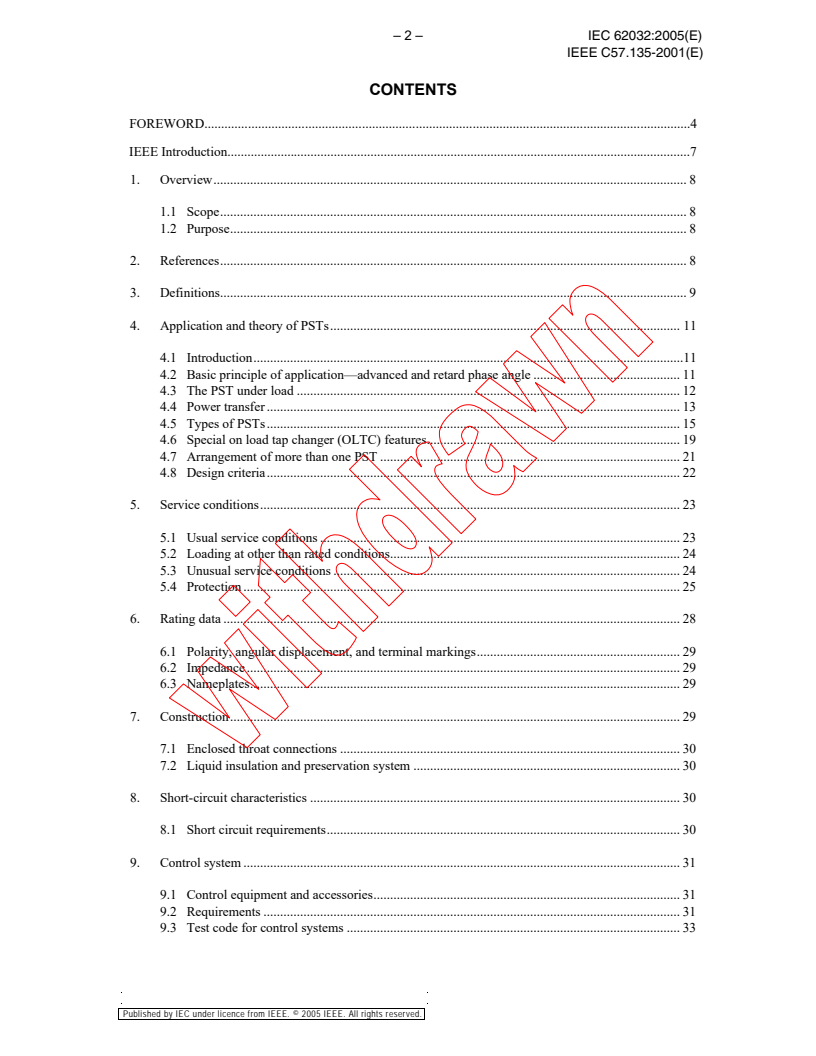
CONTENTS
FOREWORD.4
IEEE Introduction.7
1. Overview. 8
1.1 Scope. 8
1.2 Purpose. 8
2. References. 8
3. Definitions. 9
4. Application and theory of PSTs. 11
4.1 Introduction.11
4.2 Basic principle of application—advanced and retard phase angl e . 11
4.3 The PST under load . 12
4.4 Power transfer . 13
4.5 Types of PSTs. 15
4.6 Special on load tap changer (OLTC) features. 19
4.7 Arrangement of more than one PST . 21
4.8 Design criteria. 22
5. Service conditions. 23
5.1 Usual service conditions . 23
5.2 Loading at other than rated conditions. 24
5.3 Unusual service conditions . 24
5.4 Protection . 25
6. Rating data . 28
6.1 Polarity, angular displacement, and terminal markings. 29
6.2 Impedance. 29
6.3 Nameplates. 29
7. Construction. 29
7.1 Enclosed throat connections . 30
7.2 Liquid insulation and preservation system . 30
8. Short-circuit characteristics . 30
8.1 Short circuit requirements. 30
9. Control system . 31
9.1 Control equipment and accessories. 31
9.2 Requirements . 31
9.3 Test code for control systems . 33
Published by IEC under licence from IEEE. © 2005 IEEE. All rights reserved.
– 3 –
IEEE C57.135-2001(E)
10. Testing of PSTs. 34
10.1 General. 34
10.2 Special tests for PSTs. 35
11. Tolerances. 35
11.1 General. 35
11.2 Tolerances for ratio of series and main units. 36
11.3 Tolerance for phase angle and impedance. 36
12. Bid document checklist. 36
12.1 Nontechnical information . 36
12.2 Technical information. 36
12.3 Special requirements or conditions. 37
12.4 Additional information. 38
Annex A (informative) Bibliography. 39
Annex B (informative) Differences of graphical symbols for diagrams between IEC 60617-DB:2001
and IEEE C57.135:2001 . 41
Annex C (informative) List of Participants. 42
Published by IEC under licence from IEEE. © 2005 IEEE. All rights reserved.
– 4 –
IEEE C57.135-2001(E)
INTERNATIONAL ELECTROTECHNICAL COMMISSION
___________
GUIDE FOR THE APPLICATION, SPECIFICATION,
AND TESTING OF PHASE-SHIFTING TRANSFORMERS
FOREWORD
1) The International Electrotechnical Commission (IEC) is a worldwide organization for standardization
comprising all national electrotechnical committees (IEC National Committees). The object of IEC is to
promote international co-operation on all questions concerning standardization in the electrical and
electronic fields. To this end and in addition to other activities, IEC publishes International Standards,
Technical Specifications, Technical Reports, Publicly Available Specifications (PAS) and Guides (hereafter
referred to as “IEC Publication(s)”). Their preparation is entrusted to technical committees; any IEC National
Committee interested in the subject dealt with may participate in this preparatory work. International,
governmental and non-governmental organizations liaising with the IEC also participate in this preparation.
IEC collaborates closely with the International Organization for Standardization (ISO) in accordance with
conditions determined by agreement between the two organizations.
2) The formal decisions or agreements of IEC on technical matters express, as nearly as possible, an
international consensus of opinion on the relevant subjects since each technical committee has
representation from all interested IEC National Committees.
3) IEC Publications have the form of recommendations for international use and are accepted by IEC National
Committees in that sense. While all reasonable efforts are made to ensure that the technical content of IEC
Publications is accurate, IEC cannot be held responsible for the way in which they are used or for any
misinterpretation by any end user.
4) In order to promote international uniformity, IEC National Committees undertake to apply IEC Publications
transparently to the maximum extent possible in their national and regional publications. Any divergence
between any IEC Publication and the corresponding national or regional publication shall be clearly
indicated in the latter.
5) IEC provides no marking procedure to indicate its approval and cannot be rendered responsible for any
equipment declared to be in conformity with an IEC Publication.
6) Attention is drawn to the possibility that some of the elements of this IEC Publication may be the subject of
patent rights. IEC shall not be held responsible for identifying any or all such patent rights.
International Standard IEC/IEEE 62032 has been processed through IEC Technical
Committee 14: Power transformers.
The text of this standard is based on the following documents:
IEEE Std FDIS Report on voting
C57.135 (2001) 14/491/FDIS 14/494/RVD
Full information on the voting for the approval of this standard can be found in the report on
voting indicated in the above table.
Attention is drawn to the fact that a certain number of graphical symbols used in this IEEE
publication differ from the IEC graphical symbols laid down in IEC 60617.
Consequently, an Annex B has been created outlining the differences in the graphical
symbols for diagrams between IEEE C57.135:2001 and IEC 60617. This annex is not
exhaustive and only mentions the equivalences of the most important symbols used.
Once the IEC/IEEE publication has been revised, Annex B will be deleted and the graphical
symbols will be put in line with IEC 60617.
The committee has decided that the contents of this publication will remain unchanged until
2006.
Published by IEC under licence from IEEE. © 2005 IEEE. All rights reserved.
– 5 –
IEEE C57.135-2001(E)
IEC/IEEE Dual Logo International Standards
This Dual Logo International Standard is the result of an agreement between the IEC and the Institute of
Electrical and Electronics Engineers, Inc. (IEEE). The original IEEE Standard was submitted to the IEC for
consideration under the agreement, and the resulting IEC/IEEE Dual Logo International Standard has been
published in accordance with the ISO/IEC Directives.
IEEE Standards documents are developed within the IEEE Societies and the Standards Coordinating
Committees of the IEEE Standards Association (IEEE-SA) Standards Board. The IEEE develops its standards
through a consensus development process, approved by the American National Standards Institute, which
brings together volunteers representing varied viewpoints and interests to achieve the final product. Volunteers
are not necessarily members of the Institute and serve without compensation. While the IEEE administers the
process and establishes rules to promote fairness in the consensus development process, the IEEE does not
independently evaluate, test, or verify the accuracy of any of the information contained in its standards.
Use of an IEC/IEEE Dual Logo International Standard is wholly voluntary. The IEC and IEEE disclaim liability for
any personal injury, property or other damage, of any nature whatsoever, whether special, indirect,
consequential, or compensatory, directly or indirectly resulting from the publication, use of, or reliance upon
this, or any other IEC or IEEE Standard document.
The IEC and IEEE do not warrant or represent the accuracy or content of the material contained herein, and
expressly disclaim any express or implied warranty, including any implied warranty of merchantability or fitness
for a specific purpose, or that the use of the material contained herein is free from patent infringement.
IEC/IEEE Dual Logo International Standards documents are supplied “AS IS”.
The existence of an IEC/IEEE Dual Logo International Standard does not imply that there are no other ways to
produce, test, measure, purchase, market, or provide other goods and services related to the scope of the
IEC/IEEE Dual Logo International Standard. Furthermore, the viewpoint expressed at the time a standard is
approved and issued is subject to change brought about through developments in the state of the art and
comments received from users of the standard.
Every IEEE Standard is subjected to review at least every five years for revision or reaffirmation. When a
document is more than five years old and has not been reaffirmed, it is reasonable to conclude that its contents,
although still of some value, do not wholly reflect the present state of the art. Users are cautioned to check to
determine that they have the latest edition of any IEEE Standard.
In publishing and making this document available, the IEC and IEEE are not suggesting or rendering
professional or other services for, or on behalf of, any person or entity. Neither the IEC nor IEEE is undertaking
to perform any duty owed by any other person or entity to another. Any person utilizing this, and any other
IEC/IEEE Dual Logo International Standards or IEEE Standards document, should rely upon the advice of a
competent professional in determining the exercise of reasonable care in any given circumstances.
Interpretations – Occasionally questions may arise regarding the meaning of portions of standards as they relate
to specific applications. When the need for interpretations is brought to the attention of IEEE, the Institute will
initiate action to prepare appropriate responses. Since IEEE Standards represent a consensus of concerned
interests, it is important to ensure that any interpretation has also received the concurrence of a balance of
interests. For this reason, IEEE and the members of its societies and Standards Coordinating Committees are
not able to provide an instant response to interpretation requests except in those cases where the matter has
previously received formal consideration.
Comments for revision of IEC/IEEE Dual Logo International Standards are welcome from any interested party,
regardless of membership affiliation with the IEC or IEEE. Suggestions for changes in documents should be in
the form of a proposed change of text, together with appropriate supporting comments. Comments on standards
and requests for interpretations should be addressed to:
Secretary, IEEE-SA Standards Board, 445 Hoes Lane, P.O. Box 1331, Piscataway, NJ 08855-1331, USA and/or
General Secretary, IEC, 3, rue de Varembé, PO Box 131, 1211 Geneva 20, Switzerland.
Authorization to photocopy portions of any individual standard for internal or personal use is granted by the
Institute of Electrical and Electronics Engineers, Inc., provided that the appropriate fee is paid to Copyright
Clearance Center. To arrange for payment of licensing fee, please contact Copyright Clearance Center,
Customer Service, 222 Rosewood Drive, Danvers, MA 01923 USA; +1 978 750 8400. Permission to photocopy
portions of any individual standard for educational classroom use can also be obtained through the Copyright
Clearance Center.
NOTE – Attention is called to the possibility that implementation of this standard may require use of subject
matter covered by patent rights. By publication of this standard, no position is taken with respect to the
existence or validity of any patent rights in connection therewith. The IEEE shall not be responsible for
identifying patents for which a license may be required by an IEEE standard or for conducting inquiries into the
legal validity or scope of those patents that are brought to its attention.
Published by IEC under licence from IEEE. © 2005 IEEE. All rights reserved.
– 6 –
IEEE C57.135-2001(E)
IEEE Guide for the Application,
Specification, and Testing of
Phase-Shifting Transformers
Sponsor
Transformers Committee
of the
IEEE Power Engineering Society
Approved 1 August 2002
American National Standards Institute
Approved 6 December 2001
IEEE-SA Standards Board
Abstract: Theory, application of phase-shifting transformers, and the difference of specification
and testing to standard system transformers are described. Various types of phase-shifting
transformers and how to select the optimal design to achieve required control of power flow are
covered. An understanding of the terminology, types, construction, and testing specifical to phase-
shifting transformers is provided.
Keywords: advance phase angle, dual-core design, main transformer, power transfer, phase-
shifting transformer, retard phase angle, series transformer, single-core design, special tests
Published by IEC under licence from IEEE. © 2005 IEEE. All rights reserved.
– 7 –
IEEE C57.135-2001(E)
IEEE Introduction
This guide describes the application, specification, and testing of phase-shifting transformers. It is intended
for the following:
— Organizations responsible for the application and specification of phase-shifting transformers for
electric transmission systems to control power flow.
— Organizations responsible for testing phase-shifting transformers.
This guide is designed to help organizations
— Understand the various types of phase-shifting transformers and how to apply them to obtain
required control of power flow.
— Prepare specifications for the purchase of phase-shifting transformers.
— Standardize tests and test methods for phase-shifting transformers.
This guide is intended to satisfy the following objectives:
— Promote consistency within organizations for the application and specification of phase-shifting
transformers.
— Provide an understanding of the terminology, types, construction, and testing relating specifically to
phase-shifting transformers.
— Promote the standardization of testing procedures for phase-shifting transformers.
Published by IEC under licence from IEEE. © 2005 IEEE. All rights reserved.
– 8 –
IEEE C57.135-2001(E)
GUIDE FOR THE APPLICATION, SPECIFICATION,
AND TESTING OF PHASE-SHIFTING TRANSFORMERS
1. Overview
1.1 Scope
This guide covers the application, specification, theory of operation, and factory and field testing of single-
phase and three-phase oil-immersed phase-shifting transformers (PSTs).
This guide is limited to matters particular to PSTs and does not include matters relating to general
requirements for power transformers covered in existing standards, recommended practices, or guides.
1.2 Purpose
The terminology, function, application, theory of operation and protection, and design of PSTs are not
covered by existing transformer standards and guides. The purpose of this document is to provide guidance
to those specifying, designing, and using PSTs.
2. References
This standard shall be used in conjunction with the following publications. When the following standards are
superseded by an approved revision, the revision shall apply.
NOTE The user’s attention is drawn to the fact that the publications referenced below have no precise equivalent among
publications issued by IEC. Normally, it is the practice of the IEC to include equivalent IEC standards for standards published
by other organizations at the regional or national levels. However, following comments made by national committees on
14/491/FDIS, it has been determined that as no IEC publications exist that are exactly equivalent to IEEE standards, it would
be misleading to provide references to similar IEC publications. This standard therefore includes references in this clause to
IEEE standards only.
1, 2
IEEE Std 693-1997, IEEE Recommended Practices for Seismic Design of Substations.
IEEE Std 1313.1-1996, IEEE Standard for Insulation Coordination—Definitions, Principles, and Rules.
IEEE Std C37.90.1 -2002, IEEE Standard Surge Withstand Capability (SWC) Tests for Protective Relays
and Relay Systems.
The IEEE standards or products referred to in Clause 2 are trademarks owned by the Institute of Electrical and Electronics Engineers,
Incorporated.
IEEE publications are available from the Institute of Electrical and Electronics Engineers, 445 Hoes Lane, P.O. Box 1331, Piscataway,
NJ 08855-1331, USA (http://standards.ieee.org/).
Published by IEC under licence from IEEE. © 2005 IEEE. All rights reserved.
– 9 –
IEEE C57.135-20IEEE C57.135-200101(E)(E)
IEEE Std C57.12.00-2000, IEEE Standard General Requirements for Liquid-Immersed Distribution,
Power, and Regulating Transformers.
IEEE Std C57.12.10-1988, American National Standard for Transformers 230 kV and Below 833/958
through 8333/10 417 kVA, Single-Phase, and 750/862 through 60 000/80 000/100 000 kVA, Three-Phase
without Load Tap Changing; and 3750/4687 Through 60 000/80 000/100 000 kVA with Load Tap Chang-
ing—Safety Requirements.
IEEE Std C57.12.70-2000, IEEE Standard Terminal Markings and Connections for Distribution and Power
Transformers.
IEEE Std C57.12.80 -2002, IEEE Standard Terminology for Power and Distribution Transformers.
IEEE Std C57.12.90 -1993, IEEE Standard Test Code for Liquid-Immersed Distribution, Power, and
Regulating Transformers, and IEEE Guide for Short Circuit Testing of Distribution and Power Transformers.
IEEE Std C57.19.00-1991 (Reaff 1997), IEEE Standard General Requirements and Test Procedures for
Outdoor Power Apparatus Bushings.
IEEE Std C57.19.01-1991 (Reaff 1997), IEEE Standard Performance Characteristics and Dimensions for
Outdoor Apparatus Bushings.
IEEE Std C57.19.100-1995 (Reaff 1997), IEEE Guide for Application of Power Apparatus Bushings.
IEEE Std C57.91-1995, IEEE Guide for Loading Mineral-Oil-Immersed Overhead and Pad-Mounted
Distribution Transformers Rated 500 kVA and Less with 65 °C or 55 C° Average Winding Rise.
IEEE Std C57.93 -1995 (Reaff 2001), IEEE Guide for Installation of Liquid-Immersed Transformers.
IEEE Std C57.131-1995, IEEE Standard Requirements for Load Tap Changers.
3. Definitions
All definitions, except as specifically covered in this guide shall be in accordance with IEEE C57.12.80-1978
and The Authoritative Dictionary of IEEE Standards Terms, Seventh Edition [B10].
3.1 advance phase angle: The phase angle expressed in degrees that results when the load (L) terminal
voltage leads the source (S) terminal voltage.
3.2 excitation-regulating winding: A two-core phase-shifting transformer (PST) design in which the main
unit has one winding operating as an autotransformer that performs both functions listed under excitation
and regulating winding of a two-core PST.
3.3 excitation winding: The winding of a phase-shifting transformer (PST) that draws power from the
source to energize the PST.
3.4 excited winding of a two-core phase-shifting transformer (PST): The winding of the series unit that
is excited from the regulating winding of the main unit.
The numbers in brackets correspond to those of the bibliography in Annex A.
Published by IEC under licence from IEEE. © 2005 IEEE. All rights reserved.
– 10 –
IEEE C57.135-2001(E)
3.5 L terminal: The L terminal is used to measure the voltage phase-shift angle when compared to the S
terminal of the phase-shifting transformer (PST).
3.6 main unit of a two-core phase-shifting transformer (PST) : The core and coils that furnish excitation
to the series unit.
3.7 phase-shifting transformer (PST): A transformer that advances or retards the voltage phase-angle rela-
tionship of one circuit with respect to another.
3.8 primary circuit of a phase-shifting transformer (PST): The circuit on the input side of a single-core
PST or of the main unit of a two-core PST. This circuit is composed of the excitation winding.
3.9 rated kVA of a phase-shifting transformer (PST): The apparent power at rated voltage for which the
PST is designed.
3.10 rated phase angle of a phase-shifting transformer (PST): The phase angle measured between the S
and L terminals at maximum advance and/or retard tap position under no-load condition.
3.11 rated voltage of a phase-shifting transformer (PST): The phase-to-phase voltage to which operating
and performance characteristics are referred. The voltage ratings are to be defined at no-load and based on
turn ratios.
3.12 regulated circuit of a phase-shifting transformer (PST): The circuit on the output side of the PST in
which it is desired to control the voltage, or the phase relation, or both.
NOTE—In the regulated circuit the voltage may be held constant or may vary with or without relation to the phase
angle, depending on the type of PST.
3.13 regulating winding: The winding of a single-core phase-shifting transformer (PST) or of the main unit
of a two-core PST in which taps are changed to vary the phase angle.
3.14 retard phase angle: The phase angle expressed in degrees that results when the L terminal voltage lags
the S terminal voltage.
3.15 series unit of a two-core phase-shifting transformer (PST): The core and coil unit that has one
winding connected in series in the line circuit.
3.16 series winding of a two-core phase-shifting transformer (PST): The winding of the series unit that is
connected in series in the line circuit.
3.17 single-core design: A single-core phase-shifting transformer (PST) consists of a single unit in which
all windings are mounted on a single core.
3.18 S terminal: The S terminal is the terminal that is used as the fixed reference point when measuring the
voltage phase angle of a phase-shifting transformer (PST).
3.19 two-core design: A two-core phase-shifting transformer (PST) consists of a series unit and a main unit.
The series and the main unit can be either in one tank or in separate tanks.
Published by IEC under licence from IEEE. © 2005 IEEE. All rights reserved.
– 11 –
IEEE C57.135-2001(E)
4. Application and theory of PSTs
4.1 Introduction
The development of large, high-voltage power grids has enabled power consumers to enjoy the benefits of
more reliable and efficient service and has allowed generation sources to be, in some cases, located long
distances from large load centers. While large interconnected grids strengthen a power system’s reliability,
complications can arise with the control of steady-state power flow along certain segments of the system.
These complications can be attributed to several factors, including the impedance of parallel paths in the
power grid, variation in power generation output, variation in loads, and load center phase angles.
4.2 Basic principle of application—advanced and retard phase angle
PSTs are used to control the power flow in electrical power systems. When power flows between two
systems, there is a voltage drop and a phase angle shift between the source and the load that depends upon
the magnitude and power factor of the load current. If the systems are connected together in two or more
parallel paths so that a loop exists, any difference in the impedances will cause unbalanced line loading.
Figure 1 shows an example with the load-side power factor assumed to be 1 and the system resistances being
negligible with respect to their reactances. An arbitrary power flow distribution can be obtained by inserting
a PST into one of the branches. Dependent upon whether the PST is installed in the branch with the higher or
lower impedance, an advanced or a retard phase angle is needed. Advanced means that the L terminal
voltage (VL) leads the S terminal voltage (VS); retard means that the L terminal voltage (VL) lags the S
terminal voltage (VS).
System 1, Z , I
1 1
I
V System 2, Z , I
S
2 2
V
L
V *
L
DV
Z ~ jX
i i
I*Z I*Z
1 1 2 2 I*Z DV I*Z
1 1 2 2
V
S
V DVV V
L
S V V V V V * L
L S L S L
V *
L
I*Z < I*Z I*Z > I*Z
1 1 2 2 1 1 2 2
Advanced: V * leadsV Retard: V * lagsV
L S L S
Figure 1—Load-side power factor of 1
I×ΔZ – V = I×ΔI ⇒ VI= × Z – I × Z (1)
2 2 1 1 2 2 1 1
Published by IEC under licence from IEEE. © 2005 IEEE. All rights reserved.
– 12 –
IEEE C57.135-2001(E)
A numerical example should illustrate this. If it is required that both systems are loaded with 50% of the
total transferred power 2S, and the impedances are assumed to be z = 0.02 and z = .30, related to S, the
1 2
necessary additional voltage becomes ΔV = .30 – 0.02 = .28. Hence, a load phase angle (advanced) of about
15.6° is necessary. The total angle between source and load becomes 1.1°. In the case of z = 0.30 and
z = 0.02, the same load phase angle (retard) would be needed but the total phase angle between source and
load would become 16.7°. If no measures were taken, the load distribution between system 1 and 2 would be
0.9375 to 0.0625 instead of 0.5 to 0.5.
A second important application is the use of a PST to control the power flow between two large independent
grids. An advanced phase-shifting angle is necessary to achieve a flow of active power from system 1 to
system 2 (Figure 2).
Figure 2—Advanced phase-shifting angle
4.3 The PST under load
So far an ideal PST, i.e., a transformer with an impedance z = 0, has been dealt with. To demonstrate load
T
conditions, an equivalent circuit is used, as shown in Figure 3, with an ideal PST with z = 0 and an
T
additional transformer with a turns ratio of 1:1 and an impedance z = R + jX .
T T T
Where
*
V is load voltage (no-load),
L
V is load voltage (loaded),
L
V is source voltage (advanced),
S(a)
V is source voltage (retard),
S(r)
I is load current,
L
cosϕ is load power factor,
L
z is transformer impedance,
T
β is transformer load angle,
α is phase-shift angle,
+ advanced
– retard.
Published by IEC under licence from IEEE. © 2005 IEEE. All rights reserved.
– 13 –
IEEE C57.135-2001(E)
Figure 3—Demonstration of load conditions
The phasor diagram of the PST can be drawn. Starting with the load voltage V and calculating the ohmic
L
*
and reactive voltage drop in the 1:1 transformer, the load voltage V at its primary side can be obtained. The
L
load phase angle β can be calculated by using Equation (2).
I × X × cosϕ – I × R × sinϕ z × cosϕ
L L L L T L
β = arctan ------------------------------------------------------------------------------------------- ≅ arctan ----------------------------------------- (2)
V +I × X × sinϕ +I × R × cosϕ 100 +z × sinϕ
L L L L L T L
* *
The phase-shifting unit adds ±α and so, finally, the load phase angles of the transformer α and α
(a) (r)
respectively are obtained.
α* = α – β is phase-shift angle (loaded) advance (3)
(a)
*
α = –(α + β) is phase-shift angle (loaded) retard (4)
(r)
*
To obtain an advanced phase angle α under load, the no-load phase angle α has to be chosen properly
(a)
∗
under consideration of the phase angle β of the PST. On the other hand, the retard phase angle α is
(r)
increased under load. This has an impact on transformer and tap-changer as dealt with in 4.8.4.
4.4 Power transfer
A PST has two separate effects on power flow. First, the no-load phase angle creates an additional voltage
that drives additional current through the line. Second, by the PST, an additional impedance is added to the
circuit. These two effects may work against each other. Therefore, a minimum phase angle is usually
required to compensate for the additional voltage drop across the PST’s impedance in the advanced position.
To ease the following considerations, the impedance of the PST has been assumed to be constant over the
whole regulating range, a tolerable approximation for two-core designs (the impedance of single-core
designs is commonly zero at zero degree phase shift).
With the denotations used in Figure 3 and
P is power transferred when α = 0 (preload)
Q is reactive power transferred when α = 0 (preload)
Published by IEC under licence from IEEE. © 2005 IEEE. All rights reserved.
– 14 –
IEEE C57.135-2001(E)
the power components at the source side become
V
S
∗ ∗
P()α = P cosα – Q sinα + --------*sinα (5)
0 0
X
T
V
S
∗ ∗
Q()α = P sinα +Q cosα+1--------()– cosα (6)
0 0 o
X
T
Figure 4 explains the effect of the introduction of the phase-shift angle α. In the equation, the first two terms
reflect the effect of the phase angle on the original power flow as easily as can be derived from Figure 4. The
last term represents the additional power flow generated by the additional voltage ΔV across the impedance
jX of the PST. Taking into consideration that the real component of ΔV(– ΔV cos(α/2) drives a current with a
*
positive imaginary component, and the imaginary component of ΔV(ΔV sin(α/2)) a current with a positive
* *
real component and that ΔV= 2 V sin(α/2), the last terms in Equation (3) and Equation (4) respectively can
s
be confirmed without difficulties.
Figure 4—Effect of phase-shift angle α
Figure 5 shows the variation of the additional power flow (assumption: P = Q = 0, Z ≈ jX , V /X = 1 )
0 0 T T s T
with the PST angle α.
Figure 6 shows as an example the variation of the power flow at the source side with the phase angle α,
depending on different preload conditions. The maximum additional transferred power has been assumed to
be 1.
It can be seen how the power flow is influenced when the no-load phase angle of the PST is changed from
zero to maximum leading phase shift. The highest increase of active power for the same phase shift appears
when a negative reactive power flow exists, i.e., with high capacitive load. An inductive load (positive
reactive power) decreases the effect of the PST.
The reactive power flow is also influenced by the preload condition. The active power has the major impact
on the influence of the PST angle.
Published by IEC under licence from IEEE. © 2005 IEEE. All rights reserved.
– 15 –
IEEE C57.135-2001(E)
Figure 5—Variation of additional power flow with the PST angle α
Figure 6—Variation of power flow with the phase-shift angle α
depending on different preload conditions
4.5 Types of PSTs
4.5.1 Introduction
The basic principle to obtain a phase shift is to connect a segment of one phase into another phase. Figure 7a
shows an elementary arrangement; the phasor diagrams are drawn for no-load condition. A PST is used with
the exciting winding delta-connected. The regulating winding of phase V –V is connected to phase V and
2 3 1
Published by IEC under licence from IEEE. © 2005 IEEE. All rights reserved.
– 16 –
IEEE C57.135-2001(E)
so on. The scheme has been plotted for subtractive polarity of the windings and the tap position has been
chosen so that the transformer produces an advanced phase angle. Under no-load condition the regulation is
symmetrical, i.e., the absolute values of source and load voltage are the same.
Figure 7a—Phasor diagrams for no-load condition
ΔV
V =V +---------- (7)
S1 10
ΔV
V = V – ---------- (8)
L1 10
V = V – V (9)
Δ 20 30
With consideration of these equations, the phasor diagram can be drawn and absolute values can be
determined.
V==V V (10)
S1 L1 1
α
∗
V = V cos --- (11)
10 1
α
∗ ∗
ΔV = V 2 sin --- (12)
1 1
α
∗
∗ ∗
V = V 3 = V 3 cos --- (13)
Δ 10 1
I ==I I (14)
S1 L1 1
∗
ΔV α α
∗
∗ ∗
I = I cos ---= I sin --- (15)
Δ L1 ---------- L1 -------
2 2
V
Δ 3
Published by IEC under licence from IEEE. © 2005 IEEE. All rights reserved.
– 17 –
IEEE C57.135-2001(E)
The rated throughput power of the PST is shown in Equation (7).
∗ ∗
P = 3 V I (16)
s 1 L1
=
whereas the rated design power which determines the size of the unit becomes:
α
∗ ∗ ∗ ∗
P = 3 ΔV I = P 2 sin --- (17)
T s
=1 =L1
In practice many solutions are possible to the design of a PST. The user’s electric power system
requirements and the manufacturer’s preference generally determine the design. The major factors
determining the type of PSTs are given below:
Performance factors
— The power rating and phase-shift angle requirements
— The voltages
— The connected system’s short-circuit capability
Design factors
— Type of construction (core form or shell form)
— Layer or disc winding design
— Shipping limitations
— Load tap changer (LTC) performance specification
These factors decide whether a single-core or a two-core type has to be chosen. These two types are
described in more detail in the following clauses.
4.5.2 Single-core design
With the design outlined in Figure 7a, symmetrical conditions are obtained. The LTC can also be equipped
with a reversing change-over selector. This solution permits changing from an advanced phase angle to a
retard phase angle. With the single-core design, it is generally accepted practice to supply two sets of three
single pole tap changers: one set connected to the S terminals, and the second set connected to the L
terminals. As a simplified solution, it is also possible to use only one-half of the tapped winding. But in that
case the load voltage increases with respect to the source voltage with increasing phase angle (Figure 7b).
Figure 7b—PST with half tap winding
Published by IEC under licence from IEEE. © 2005 IEEE. All rights reserved.
– 18 –
IEEE C57.135-2001(E)
In the case of a small rated switching capacity (step voltage × through current), a solution with one two-
phase LTC per phase is possible, using an LTC assembly according to Figure 8.
Figure 8—PST with small switching capacity
As a further example, Figure 9 shows the connection diagram and the phasor diagram of a delta-hexagonal
PST. These transformers have LTCs with linear regulation, i.e., without a change-over selector.
Figure 9—Connection diagram and the phasor diagram of
a delta-hexagonal PST
The single-core design is less complex and has fewer kVA parts than two-core designs, but has some
disadvantages as follows:
— The LTC and the tapped winding are in the line end of the windings and are directly exposed to the
system short-circuit currents and overvoltages.
— Voltage per tap and current are determined by the phase angle requirement and rating of the PST and
cannot be adjusted to obtain optimum switching conditions. If one of these parameters exceeds its
limit, the solution would not be possible although the required switching capability may still be
given.
There are numerous other possibilities, e.g., designs with de-energized operation.
Published by IEC under licence from IEEE. © 2005 IEEE. All rights reserved.
– 19 –
IEEE C57.135-2001(E)
4.5.3 Two-core design
The most commonly used circuit for two-core designs is shown in Figure 10. This configuration consists of a
series unit and a main unit. For smaller ratings and lower voltages, two-core PSTs may be built into one
single tank, while large ratings and high voltage PSTs require a two-tank design.
The advantage of a two-core design is the flexibility in selecting the step voltage and the current of the
regulating winding. They can be optimized in line with the voltage and current ratings of the LTC. Since
LTCs have limited current ratings and step voltages per phase as well as limited switching capacity, they are
the main limiting feature for the maximum possible rating of PSTs. More than one LTC per phase may have
to be utilized for very large ratings.
Furthermore, three-pole LTCs can be used. If the rated switching capacity is too high, three single-pole
LTCs have to be used. The LTC insulation level to ground is indepen
...