

IEC 62058-21:2008
(Main)Electricity metering equipment (AC) - Acceptance inspection - Part 21: Particular requirements for electromechanical meters for active energy (classes 0,5, 1 and 2)
General Information
- Abstract
IEC 62058-21:2008 specifies particular requirements for acceptance inspection of newly manufactured direct connected or transformer operated electromechanical meters for active energy (classes 0,5, 1 and 2) delivered in lots in quantities above 50. The method of acceptance of smaller lots should be agreed upon by the manufacturer and the customer.
This publication is of high relevance for Smart Grid.
- Status
- Published
- Publication Date
- 17-Sep-2008
- Technical Committee
- TC 13 - Electrical energy measurement and control
- Drafting Committee
- WG 11 - TC 13/WG 11
- Current Stage
- PPUB - Publication issued
- Start Date
- 18-Sep-2008
- Completion Date
- 30-Sep-2008
Buy Documents
IEC 62058-21:2008 - Electricity metering equipment (AC) - Acceptance inspection - Part 21: Particular requirements for electromechanical meters for active energy (classes 0,5, 1 and 2) Released:9/18/2008
Overview
IEC 62058-21:2008, published by the International Electrotechnical Commission (IEC), establishes specific requirements for the acceptance inspection of newly manufactured electromechanical meters for active energy (classes 0.5, 1, and 2), used in AC electricity metering. This standard applies to both direct connected and transformer operated meters, primarily delivered in lots exceeding 50 units. For smaller lots, acceptance inspection methods are to be agreed upon between manufacturer and customer.
IEC 62058-21:2008 is a key reference for ensuring the quality and accuracy of electromechanical energy meters, supporting reliable measurement and billing in electrical systems. Its implementation is especially relevant in the context of smart grids, where precise energy measurement and efficient meter quality assurance are critical.
Key Topics
Scope and Applicability
- Applies to electromechanical meters for active energy in accuracy classes 0.5, 1, and 2
- Covers both direct connected and transformer operated types
- Designed for lot acceptance inspections for batches over 50 units
Inspection Procedures
- Defines detailed acceptance inspection procedures, including visual examination, preliminary tests, and pre-conditioning of meters
- Specifies electrical tests (e.g., AC voltage test, no-load condition, starting, and accuracy tests) to verify performance and conformity to specifications
Measurement Uncertainty
- Addresses requirements for measurement uncertainty during inspection
- Provides rules for correcting percentage error limits if uncertainties exceed specified thresholds
Acceptance Criteria
- Outlines acceptance and rejection criteria based on quantitative testing and statistical sampling plans, referencing methods in IEC 62058-11
- Sets protocols for handling non-acceptance and disposal of defective lots
Documentation
- Requires comprehensive test records and evaluation using standardized inspection sheets
Applications
The practical value of IEC 62058-21:2008 lies in assuring meter quality, reliability, and accuracy before deployment, benefiting various stakeholders:
Utilities and Power Companies
- Enables large-scale acceptance inspection of energy meters prior to grid installation
- Supports consistent, fair, and accurate billing for consumers
- Forms part of the quality assurance framework in smart grid rollouts and upgrades
Manufacturers
- Provides standardized procedures to demonstrate product conformity to customers
- Facilitates clear contractual agreements on acceptance tests and performance criteria
Regulatory Agencies
- Assists in regulatory compliance and market surveillance by providing a harmonized approach for meter inspection
Meter Testing Laboratories
- Offers a recognized reference for lab-based verification of meter performance, contributing to traceable and reliable results
Smart Grid Projects
- Ensures the metering infrastructure supports the operational reliability and advanced functionalities expected in modern smart grids
Related Standards
To ensure a comprehensive approach to electricity metering equipment acceptance and performance, reference should be made to related IEC standards:
- IEC 62058-11: General acceptance inspection methods for electricity metering equipment.
- IEC 62052-11: General requirements, tests, and test conditions for AC metering equipment.
- IEC 62053-11: Particular requirements for electromechanical meters for active energy (classes 0.5, 1, and 2).
Conclusion
IEC 62058-21:2008 plays a crucial role in the assurance of accuracy and performance of electromechanical active energy meters. By adhering to its inspection methods and acceptance criteria, industry stakeholders can ensure that only high-quality, reliable meters are deployed in power distribution networks - a foundation for trustworthy energy measurement in both conventional and smart grid contexts.
For further information and access to the most current versions, visit the IEC Webstore.
Buy Documents
IEC 62058-21:2008 - Electricity metering equipment (AC) - Acceptance inspection - Part 21: Particular requirements for electromechanical meters for active energy (classes 0,5, 1 and 2) Released:9/18/2008
Get Certified
Connect with accredited certification bodies for this standard

DIBt (Deutsches Institut für Bautechnik)
German Institute for Building Technology.
DIN CERTCO
DIN Group product certification.

Aboma Certification B.V.
Specialized in construction, metal, and transport sectors.
Sponsored listings
Frequently Asked Questions
IEC 62058-21:2008 is a standard published by the International Electrotechnical Commission (IEC). Its full title is "Electricity metering equipment (AC) - Acceptance inspection - Part 21: Particular requirements for electromechanical meters for active energy (classes 0,5, 1 and 2)". This standard covers: IEC 62058-21:2008 specifies particular requirements for acceptance inspection of newly manufactured direct connected or transformer operated electromechanical meters for active energy (classes 0,5, 1 and 2) delivered in lots in quantities above 50. The method of acceptance of smaller lots should be agreed upon by the manufacturer and the customer. This publication is of high relevance for Smart Grid.
IEC 62058-21:2008 specifies particular requirements for acceptance inspection of newly manufactured direct connected or transformer operated electromechanical meters for active energy (classes 0,5, 1 and 2) delivered in lots in quantities above 50. The method of acceptance of smaller lots should be agreed upon by the manufacturer and the customer. This publication is of high relevance for Smart Grid.
IEC 62058-21:2008 is classified under the following ICS (International Classification for Standards) categories: 17.220.20 - Measurement of electrical and magnetic quantities; 91.140.50 - Electricity supply systems. The ICS classification helps identify the subject area and facilitates finding related standards.
IEC 62058-21:2008 is available in PDF format for immediate download after purchase. The document can be added to your cart and obtained through the secure checkout process. Digital delivery ensures instant access to the complete standard document.
Standards Content (Sample)
IEC 62058-21
Edition 1.0 2008-09
INTERNATIONAL
STANDARD
NORME
INTERNATIONALE
Electricity metering equipment (AC) – Acceptance inspection –
Part 21: Particular requirements for electromechanical meters for active energy
(classes 0,5, 1 and 2)
Equipement de comptage de l’électricité (c.a.) – Contrôle de réception –
Partie 21: Exigences particulières pour compteurs électromécaniques d'énergie
active (classes 0,5, 1 et 2)
All rights reserved. Unless otherwise specified, no part of this publication may be reproduced or utilized in any form or by
any means, electronic or mechanical, including photocopying and microfilm, without permission in writing from either IEC or
IEC's member National Committee in the country of the requester.
If you have any questions about IEC copyright or have an enquiry about obtaining additional rights to this publication,
please contact the address below or your local IEC member National Committee for further information.
Droits de reproduction réservés. Sauf indication contraire, aucune partie de cette publication ne peut être reproduite
ni utilisée sous quelque forme que ce soit et par aucun procédé, électronique ou mécanique, y compris la photocopie
et les microfilms, sans l'accord écrit de la CEI ou du Comité national de la CEI du pays du demandeur.
Si vous avez des questions sur le copyright de la CEI ou si vous désirez obtenir des droits supplémentaires sur cette
publication, utilisez les coordonnées ci-après ou contactez le Comité national de la CEI de votre pays de résidence.
IEC Central Office
3, rue de Varembé
CH-1211 Geneva 20
Switzerland
Email: inmail@iec.ch
Web: www.iec.ch
About the IEC
The International Electrotechnical Commission (IEC) is the leading global organization that prepares and publishes
International Standards for all electrical, electronic and related technologies.
About IEC publications
The technical content of IEC publications is kept under constant review by the IEC. Please make sure that you have the
latest edition, a corrigenda or an amendment might have been published.
ƒ Catalogue of IEC publications: www.iec.ch/searchpub
The IEC on-line Catalogue enables you to search by a variety of criteria (reference number, text, technical committee,…).
It also gives information on projects, withdrawn and replaced publications.
ƒ IEC Just Published: www.iec.ch/online_news/justpub
Stay up to date on all new IEC publications. Just Published details twice a month all new publications released. Available
on-line and also by email.
ƒ Electropedia: www.electropedia.org
The world's leading online dictionary of electronic and electrical terms containing more than 20 000 terms and definitions
in English and French, with equivalent terms in additional languages. Also known as the International Electrotechnical
Vocabulary online.
ƒ Customer Service Centre: www.iec.ch/webstore/custserv
If you wish to give us your feedback on this publication or need further assistance, please visit the Customer Service
Centre FAQ or contact us:
Email: csc@iec.ch
Tel.: +41 22 919 02 11
Fax: +41 22 919 03 00
A propos de la CEI
La Commission Electrotechnique Internationale (CEI) est la première organisation mondiale qui élabore et publie des
normes internationales pour tout ce qui a trait à l'électricité, à l'électronique et aux technologies apparentées.
A propos des publications CEI
Le contenu technique des publications de la CEI est constamment revu. Veuillez vous assurer que vous possédez
l’édition la plus récente, un corrigendum ou amendement peut avoir été publié.
ƒ Catalogue des publications de la CEI: www.iec.ch/searchpub/cur_fut-f.htm
Le Catalogue en-ligne de la CEI vous permet d’effectuer des recherches en utilisant différents critères (numéro de référence,
texte, comité d’études,…). Il donne aussi des informations sur les projets et les publications retirées ou remplacées.
ƒ Just Published CEI: www.iec.ch/online_news/justpub
Restez informé sur les nouvelles publications de la CEI. Just Published détaille deux fois par mois les nouvelles
publications parues. Disponible en-ligne et aussi par email.
ƒ Electropedia: www.electropedia.org
Le premier dictionnaire en ligne au monde de termes électroniques et électriques. Il contient plus de 20 000 termes et
définitions en anglais et en français, ainsi que les termes équivalents dans les langues additionnelles. Egalement appelé
Vocabulaire Electrotechnique International en ligne.
ƒ Service Clients: www.iec.ch/webstore/custserv/custserv_entry-f.htm
Si vous désirez nous donner des commentaires sur cette publication ou si vous avez des questions, visitez le FAQ du
Service clients ou contactez-nous:
Email: csc@iec.ch
Tél.: +41 22 919 02 11
Fax: +41 22 919 03 00
IEC 62058-21
Edition 1.0 2008-09
INTERNATIONAL
STANDARD
NORME
INTERNATIONALE
Electricity metering equipment (AC) – Acceptance inspection –
Part 21: Particular requirements for electromechanical meters for active energy
(classes 0,5, 1 and 2)
Equipement de comptage de l’électricité (c.a.) – Contrôle de réception –
Partie 21: Exigences particulières pour compteurs électromécaniques d'énergie
active (classes 0,5, 1 et 2)
INTERNATIONAL
ELECTROTECHNICAL
COMMISSION
COMMISSION
ELECTROTECHNIQUE
PRICE CODE
INTERNATIONALE
N
CODE PRIX
ICS 17.220; 91.140.50 ISBN 2-8318-9991-5
– 2 – 62058-21 © IEC:2008
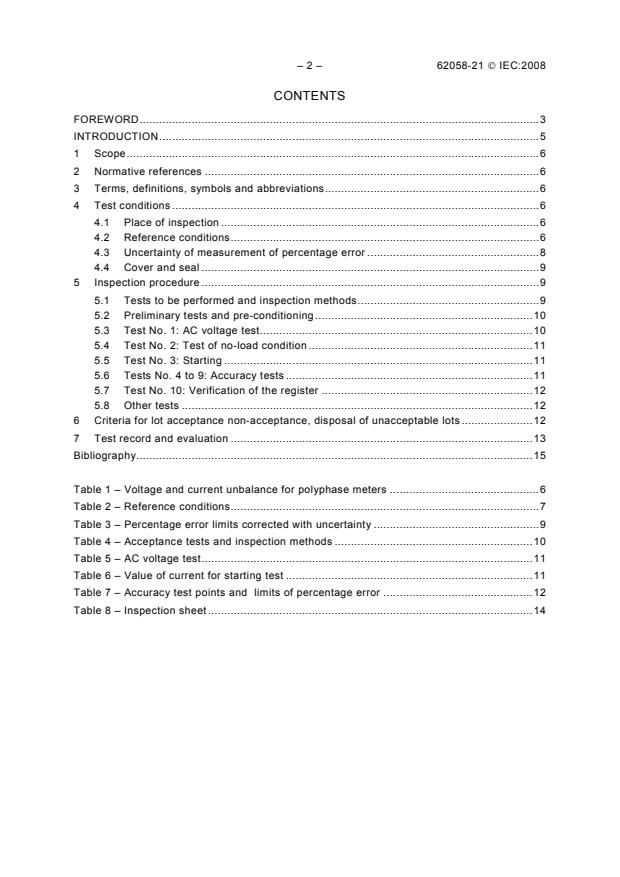
CONTENTS
FOREWORD.3
INTRODUCTION.5
1 Scope.6
2 Normative references .6
3 Terms, definitions, symbols and abbreviations.6
4 Test conditions .6
4.1 Place of inspection .6
4.2 Reference conditions.6
4.3 Uncertainty of measurement of percentage error .8
4.4 Cover and seal .9
5 Inspection procedure .9
5.1 Tests to be performed and inspection methods.9
5.2 Preliminary tests and pre-conditioning.10
5.3 Test No. 1: AC voltage test.10
5.4 Test No. 2: Test of no-load condition .11
5.5 Test No. 3: Starting .11
5.6 Tests No. 4 to 9: Accuracy tests .11
5.7 Test No. 10: Verification of the register .12
5.8 Other tests .12
6 Criteria for lot acceptance non-acceptance, disposal of unacceptable lots .12
7 Test record and evaluation .13
Bibliography.15
Table 1 – Voltage and current unbalance for polyphase meters .6
Table 2 – Reference conditions.7
Table 3 – Percentage error limits corrected with uncertainty .9
Table 4 – Acceptance tests and inspection methods .10
Table 5 – AC voltage test.11
Table 6 – Value of current for starting test .11
Table 7 – Accuracy test points and limits of percentage error .12
Table 8 – Inspection sheet.14
62058-21 © IEC:2008 – 3 –
INTERNATIONAL ELECTROTECHNICAL COMMISSION
____________
ELECTRICITY METERING EQUIPMENT (AC) –
ACCEPTANCE INSPECTION –
Part 21: Particular requirements for electromechanical meters
for active energy (classes 0,5, 1 and 2)
FOREWORD
1) The International Electrotechnical Commission (IEC) is a worldwide organization for standardization comprising
all national electrotechnical committees (IEC National Committees). The object of IEC is to promote
international co-operation on all questions concerning standardization in the electrical and electronic fields. To
this end and in addition to other activities, IEC publishes International Standards, Technical Specifications,
Technical Reports, Publicly Available Specifications (PAS) and Guides (hereafter referred to as “IEC
Publication(s)”). Their preparation is entrusted to technical committees; any IEC National Committee interested
in the subject dealt with may participate in this preparatory work. International, governmental and non-
governmental organizations liaising with the IEC also participate in this preparation. IEC collaborates closely
with the International Organization for Standardization (ISO) in accordance with conditions determined by
agreement between the two organizations.
2) The formal decisions or agreements of IEC on technical matters express, as nearly as possible, an international
consensus of opinion on the relevant subjects since each technical committee has representation from all
interested IEC National Committees.
3) IEC Publications have the form of recommendations for international use and are accepted by IEC National
Committees in that sense. While all reasonable efforts are made to ensure that the technical content of IEC
Publications is accurate, IEC cannot be held responsible for the way in which they are used or for any
misinterpretation by any end user.
4) In order to promote international uniformity, IEC National Committees undertake to apply IEC Publications
transparently to the maximum extent possible in their national and regional publications. Any divergence
between any IEC Publication and the corresponding national or regional publication shall be clearly indicated in
the latter.
5) IEC provides no marking procedure to indicate its approval and cannot be rendered responsible for any
equipment declared to be in conformity with an IEC Publication.
6) All users should ensure that they have the latest edition of this publication.
7) No liability shall attach to IEC or its directors, employees, servants or agents including individual experts and
members of its technical committees and IEC National Committees for any personal injury, property damage or
other damage of any nature whatsoever, whether direct or indirect, or for costs (including legal fees) and
expenses arising out of the publication, use of, or reliance upon, this IEC Publication or any other IEC
Publications.
8) Attention is drawn to the Normative references cited in this publication. Use of the referenced publications is
indispensable for the correct application of this publication.
9) Attention is drawn to the possibility that some of the elements of this IEC Publication may be the subject of
patent rights. IEC shall not be held responsible for identifying any or all such patent rights.
International Standard IEC 62058-21 has been prepared by IEC technical committee 13:
Electrical energy measurement, tariff- and load control.
The text of this standard is based on the following documents:
FDIS Report on voting
13/1431/FDIS 13/1439/RVD
Full information on the voting for the approval of this standard can be found in the report on
voting indicated in the above table.
A list of all parts of IEC 62058 series, published under the general title Electricity metering
equipment (AC) – Acceptance inspection, can be found on the IEC website.
This publication has been drafted in accordance with the ISO/IEC Directives, Part 2.
– 4 – 62058-21 © IEC:2008
The committee has decided that the contents of this publication will remain unchanged until
the maintenance result date indicated on the IEC web site under "http://webstore.iec.ch" in
the data related to the specific publication. At this date, the publication will be
• reconfirmed,
• withdrawn,
• replaced by a revised edition, or
• amended.
62058-21 © IEC:2008 – 5 –
INTRODUCTION
This standard together with IEC 62058-11 cancels and replaces IEC 60514, Acceptance
inspection of class 2 alternating-current watt-hour meters, which was a Technical Report.
– 6 – 62058-21 © IEC:2008
ELECTRICITY METERING EQUIPMENT (AC) –
ACCEPTANCE INSPECTION –
Part 21: Particular requirements for electromechanical meters
for active energy (classes 0,5, 1 and 2)
1 Scope
This part of IEC 62058 specifies particular requirements for acceptance inspection of newly
manufactured direct connected or transformer operated electromechanical meters for active
energy (classes 0,5, 1 and 2) delivered in lots in quantities above 50. The method of
acceptance of smaller lots should be agreed upon by the manufacturer and the customer.
The process described herein is primarily intended for acceptance inspection between the
manufacturer and the purchaser.
NOTE It can also be used for other purposes, for example to support initial verification.
2 Normative references
The following referenced documents are indispensable for the application of this document.
For dated references, only the edition cited applies. For undated references, the latest edition
of the referenced document (including any amendments) applies.
IEC 62058-11:2008, Electricity metering equipment (a.c.) – Acceptance inspection – Part 11:
General acceptance inspection methods
ISO/IEC GUIDE 98: 1995, Guide to the Expression of Uncertainty in Measurement
3 Terms, definitions, symbols and abbreviations
For the purposes of this document, the terms, definitions, symbols and abbreviations of
IEC 62058-11 apply.
4 Test conditions
4.1 Place of inspection
Subclause 5.15 of IEC 62058-11 applies.
4.2 Reference conditions
The tests shall be carried out under the following conditions:
Table 1 – Voltage and current unbalance for polyphase meters
Class of meter
Condition
0,5 1 2
Each of the voltages between phase and neutral and between any two
phases shall not differ from the average corresponding voltage by more ± 0,5 % ± 1 % ± 1 %
than
62058-21 © IEC:2008 – 7 –
Class of meter
Condition
0,5 1 2
Each of the currents in the conductors shall not differ from the average
± 1 % ± 2 % ± 2 %
current by more than
The phase displacements of each of these currents from the
corresponding phase-to-neutral voltage, irrespective of the phase angle, 2°
shall not differ from each other by more than
Table 2 – Reference conditions
Permissible tolerances
for meters of class
Influence quantity Reference value
0,5 1 2
Reference temperature or, in its
Ambient temperature
a ± 1 °C ± 2 °C ± 2 °C
absence, 23 °C
Voltage Reference voltage ± 0,5 % ± 1,0 % ± 1,0 %
Frequency Reference frequency
± 0,2 % ± 0,3 % ± 0,5 %
Phase sequence L1 – L2 – L3 -
Voltage unbalance All phases connected -
Distortion factor less than
Wave-form Sinusoidal voltages and currents
2 % 2 % 3 %
Continuous magnetic
Equal to zero -
induction of external origin
Induction value which causes a
b
variation of error not greater than
Magnetic induction of
± 0,1 % ± 0,2 % ± 0,3 %
external origin at the Magnetic induction equal to zero
reference frequency
but should in any case be smaller than
b
0,05 mT
Operation of accessories No operation of accessories -
c
Working position Vertical working position ± 0,5 °
Conducted disturbances,
induced by radio frequency Equal to zero < 1 V
fields, 150 kHz to 80 MHz
a
If the tests are made at a temperature other than the reference temperature, including permissible tolerances, the
results shall be corrected by applying the appropriate temperature coefficient of the meter.
b
The test consists of
1) for a single-phase meter, determining the errors first with the meter normally connected to the mains and then
after inverting the connections to the current circuits as well as to the voltage circuits. Half of the difference
between the two errors is the value of the variation of error. Because of the unknown phase of the external
field, the test should be made at 0,1 I resp. 0,05 I at unity power factor and 0,2 I resp. 0,1 I at 0,5 power
b n b n
factor;
2) for a three-phase meter, making three measurements at 0,1 I resp. 0,05 I at unity power factor, after each of
b n
which the connection to the current circuits and to the voltage circuits are changed over 120° while the phase
sequence is not altered. The greatest difference between each of the errors so determined and their average
value is the value of the variation of error.
c
Determination of the vertical working position (see IEC 62053-11, 5.1).
The construction and assembly of the meter should be such that the correct vertical position is ensured (in both
the front-to-back and left-to-right vertical planes) when
– the base of the meter is supported against a vertical wall, and
– a reference edge (such as the lower edge of the terminal block) or a reference line marked on the meter case
is horizontal.
– 8 – 62058-21 © IEC:2008
4.3 Uncertainty of measurement of percentage error
The measuring process shall be such that the uncertainty of the measurement of the
th
percentage error should not exceed 1/5 of the limit of percentage error for the given test
point at reference conditions.
For determining the uncertainty of measurement, see ISO/IEC GUIDE 98.
If the uncertainty exceeds this limit, then inspection by variables cannot be used. Only
inspection by attributes will be possible, and the limits of percentage error shall be corrected
using the following formula:
e (I,cos ϕ) = 6 / 5 • e(I,cos ϕ) −U
corr
where:
• e(I,cos ϕ) is the limit of percentage error for the given test point at reference conditions;
• U is the measurement uncertainty.
EXAMPLE If, for a given test point, the limit of percentage error at reference conditions is
e(I,cos ϕ) = ± 2 % ; and
U = 0,5 %; then
e (I,cos ϕ) = ±(6 / 5 • 2,0 − 0,5) = ±1,9% .
corr
Instead of the original limit, this corrected limit applies.
Table 3 gives percentage error limits corrected with uncertainty of measurement, using the
formula above.
62058-21 © IEC:2008 – 9 –
Table 3 – Percentage error limits corrected with uncertainty
Percentage Uncertainty of measurement of percentage error, %
error
limit % 0,6 0,5 0,45 0,4 0,35 0,3 0,25 0,2 0,15 0,1
± 3,0
± 3,0 ± 3,0 ± 3,0 ± 3,0 ± 3,0 ± 3,0 ± 3,0 ± 3,0 ± 3,0 ± 3,0
± 2,5 ± 2,4 ± 2,5 ± 2,5 ± 2,5 ± 2,5 ± 2,5 ± 2,5 ± 2,5 ± 2,5 ± 2,5
± 2,0 ± 1,8 ± 1,9 ± 1,95 ± 2,0 ± 2,0 ± 2,0 ± 2,0 ± 2,0 ± 2,0 ± 2,0
± 1,5 ± 1,2 ± 1,3 ± 1,35 ± 1,4 ± 1,45 ± 1,5 ± 1,5 ± 1,5 ± 1,5 ± 1,5
± 1,0 ± 0,6 ± 0,7 ± 0,75 ± 0,8 ± 0,85 ± 0,9 ± 0,95 ± 1,0 ± 1,0 ± 1,0
± 0,6 ± 0,12 ± 0,22 ± 0,27 ± 0,32 ± 0,37 ± 0,42 ± 0,47 ± 0,52 ± 0,57 ± 0,6
± 0,5 0 ± 0,1 ± 0,15 ± 0,2 ± 0,25 ± 0,3 ± 0,35 ± 0,4 ± 0,45 ± 0,5
± 0,4 0 0 ± 0,03 ± 0,08 ± 0,13 ± 0,18 ± 0,23 ± 0,28 ± 0,33 ± 0,38
± 0,3 0 0 0 0 ± 0,01 ± 0,06 ± 0,11 ± 0,16 ± 0,21 ± 0,26
± 0,2 0 0 0 0 0 0 0 ± 0,04 ± 0,09 ± 0,14
NOTE In any case, the uncertainty should not exceed half of the percentage error limit.
4.4 Cover and seal
The meters shall be inspected and tested with their covers on and manufacturer's seal
unbroken.
NOTE If testing of mechanical aspects is required, the conditions should be agreed between the manufacturers
and the purchaser.
5 Inspection procedure
5.1 Tests to be performed and inspection methods
Table 4 specifies the characteristics to be inspected, the classification of nonconformities, and
the inspection method(s) that can be applied, with reference to the sampling plans given in
IEC 62058-11.
– 10 – 62058-21 © IEC:2008
Table 4 – Acceptance tests and inspection methods
Classification of IEC 62058-11
a
Test No. Test Inspection methods available
nonconformities sampling plan
Lot-by-lot inspection by attributes,
single sampling, Ac = 0 Table 6
or
AC voltage
1 Critical
test
Isolated lot inspection by attributes,
Table 18
procedure A, Ac = 0
Lot-by-lot inspection by attributes,
single sampling, AQL = 1,0 Table 2
or
Lot-by-lot inspection by attributes,
double sampling, AQL = 1,0 Table 7
or
2 No-load Non-critical
Isolated lot inspection by attributes,
single or double sampling,
Table 17
Procedure A, LQ = 5,0
or
Isolated lot inspection by attributes,
single or double sampling, Table 20
Procedure B, LQ = 5,0
3 Starting Non-critical As for test No.2
As for test No. 2, in addition
Lot-by-lot inspection by variables,
“s” method, AQL = 1,0 Table 24
4…9 Accuracy Non-critical
or
Lot-by-lot inspection by variables,
Table 26
“σ” method, AQL = 1,0
Meter
10 Critical As for test No. 1
constant
- Other tests See 5.8 -
a
100 % inspection can always be used, see Clause 6 of IEC 62058-11.
If, for the different tests, the sampling plans give different sample sizes, then the number of
samples shall be equal to the largest sample size. The smaller sample shall be chosen from
the larger sample randomly.
5.2 Preliminary tests and pre-conditioning
The meters selected for inspection shall be visually examined in order to verify that they
belong to the same type, that their specified markings are correct and that none of them
shows signs of damage. The meters shall be in conformity with the type approval and they
shall have the same voltage and current charactesristics.
Before the tests, the meters shall be energized at reference voltage and loaded with the
current specified below, at unity power factor, to reach thermal stability.
The value of the current shall be 0,1 I for direct connected meters or 0,1 I for transformer
b n
operated meters respectively.
The tests shall be performed in the order below.
5.3 Test No. 1: AC voltage test
The a.c. voltage test shall be carried out in accordance with Table 5.
62058-21 © IEC:2008 – 11 –
The test voltage shall be substantially sinusoidal, having a frequency between 45 Hz and
65 Hz, and applied for 2 s. The power source shall be capable of supplying at least 500 VA.
The rise time and the fall time of the test voltage shall be ≤ 2 s. The auxiliary circuits with
reference voltage equal to or below 40 V shall be connected to earth.
During this test, no flashover, disruptive discharge or puncture shall occur.
Table 5 – AC voltage test
Test voltage r.m.s for meters of
insulation class
Points of application of the test voltage
I II
1,6 kV 3,2 kV Between on the one hand, all the current and voltage circuits as well as the
auxiliary circuits whose reference voltage is over 40 V, connected together,
and, on the other hand, earth.
If the manufacturer provides evidence that the test has been already performed on each item
before acceptance inspection, then this test does not have to be performed.
5.4 Test No. 2: Test of no-load condition
When the meter is energized at reference voltage, at unity power factor and with the test
current applied, and connected as shown in the diagram of connections, the rotor shall not
make a complete revolution.
For drum-type registers, these conditions shall apply with only one drum moving.
The value of the test current shall be 0,001 I , in case of direct connected meters or 0,001 I
b n
in case of transformer operated meters.
NOTE Unlike during type testing, the test is done with a small current, because the test conditions are different.
5.5 Test No. 3: Starting
When the meter is energized at reference voltage, (and in case of polyphase meters, with
balanced load) and connected as shown in the diagram of connections, the rotor shall start
and make more than one revolution at the current given in Table 6.
For meters with drum-type registers, the test shall be made with not more than two drums
moving.
Table 6 – Value of current for starting test
Class of meter Power factor
Meters for
0,5 1 2
Direct connection -- 1
0,004 I 0,005 I
b b
Connection through current transformers 0,002 I 0,002 I 0,003 I 1
n n n
5.6 Tests No. 4 to 9: Accuracy tests
The accuracy tests for single phase or polyphase meters shall be carried out at the test points
specified in Table 7, in the order shown in the table, without waiting for thermal equilibrium to
be attained between the measurements.
– 12 – 62058-21 © IEC:2008
Table 7 – Accuracy test points and limits of percentage error
Limits of percentage
Value of current for error
Load
for meters of class
Applicable
Test Power (in case of
for meter
Trans-
No. factor polyphase
Direct
type
former
meters)
connected 0,5 S 1 2
operated
meters
meters
Single- and
0,05 I 0,02 I
4 1 Balanced ± 1,0 ± 1,5 ± 2,5
b n
polyphase
Single- and
I I
5 1 Balanced ± 0,5 ± 1,0 ± 2,0
b n
polyphase
Single- and
I I
6 0,5 Balanced ± 0,8 ± 1,0 ± 2,0
b n
polyphase
Single
I I
7 1 Polyphase
a ± 1,5 ± 2,0 ± 3,0
b n
phase
Single
I I
8 1 Polyphase
b ± 1,5 ± 2,0 ± 3,0
b n
phase
Single- and
I I
9 1 Balanced ± 0,5 ± 1,0 ± 2,0
max max
polyphase
a
The meter shall be supplied with three phase symmetrical voltage. The current shall be applied to
any of the phases.
b
The meter shall be supplied with three phase symmetrical voltage. The current shall be applied to a
phase different from the phase in test 7.
5.7 Test No. 10: Verification of the register
This test shall be performed by measuring a sufficient amount of energy, to verify that the
accuracy of incrementing the register reading is better than ±1,0 %.
The test shall be done for each meter on at least one tariff register.
5.8 Other tests
The manufacturer and the customer may agree to perform testing of any additional
functionality and mechanical aspects.
The inspection methods – 100 % testing, inspection by attributes or inspection by variables –
and the acceptance conditions shall be agreed by the manufacturer and the customer.
Some examples for mechanical testing are given below:
• meshing of the register;
• soldered and welded seams;
• tightness of screws;
• swarf, filings and metal dust especially in the air-gap(s) of the brake magnet(s);
• any other item which is deemed desirable.
6 Criteria for lot acceptance non-acceptance, disposal of unacceptable lots
See IEC 62058-11, 5.18 and the relevant clauses for each inspection scheme.
62058-21 © IEC:2008 – 13 –
7 Test record and evaluation
The test results of the sample shall be recorded and evaluated in the inspection sheet given
in Table 8 below.
NOTE Tests agreed between the manufacturer and the purchaser may be added.
For larger sample sizes, several inspection sheets may be necessary. The results shall be
evaluated on the last sheet. In this case, in the line “Result” write “Continued on next
inspection sheet”. The cell “Lot number” can be used for numbering the inspection sheets
including test results of a lot.
For double sampling plans, two sets of inspection sheets may be
...