

IEC 61754-36:2025
(Main)Fibre optic interconnecting devices and passive components – Fibre optic connector interfaces – Part 36: Type SAC connector family
General Information
- Abstract
IEC 61754-36:2025 defines the standard mechanical interface dimensions for the type SAC family of connectors.
- Status
- Published
- Publication Date
- 15-May-2025
- Technical Committee
- SC 86B - Fibre optic interconnecting devices and passive components
- Current Stage
- PPUB - Publication issued
- Start Date
- 16-May-2025
- Completion Date
- 13-Jun-2025

Overview
IEC 61754-36:2025 is an international standard published by the International Electrotechnical Commission (IEC) that defines the mechanical interface dimensions for the type SAC family of fibre optic connectors. This standard ensures interoperability and consistency for fibre optic interconnecting devices and passive components, specifically focusing on the SAC connector family. The SAC connectors use miniature duplex plug/adaptor/plug configurations designed for high-performance fibre optic communication systems.
The document provides comprehensive mechanical specifications, including dimensional, interface, and alignment characteristics for connectors, adaptors, and receptacles within the SAC family. It covers various interface types such as duplex and quadruplex connectors and includes physical contact (PC) and angled physical contact (APC) variants.
Key Topics
Connector Family Characteristics
- Miniature duplex connector design
- 1.25 mm nominal ferrule diameter
- Spring-loaded cylindrical ferrules for reliable fibre alignment
- Push-pull coupling mechanism on both ends for secure connection
- Optical alignment via rigid or resilient bore sleeves
Defined Interfaces
- Duplex plug connector interface-physical contact (PC)
- Duplex adaptor interface
- Duplex angled physical contact (APC) plug connector interface with an 8° angle
- Duplex active device receptacle interface
- Quadruplex adaptor interface, compatible with SC simplex connector footprints
- Quadruplex active device receptacle interface
Intermateability and Mechanical Dimensions
- Standardized connector, adaptor, and receptacle dimensions ensure broad interoperability
- Detailed figures and tables illustrate connector plug and adaptor configurations
- Latching mechanisms and fibre core locations specified for stability and precision
Normative References for Compatibility
- IEC 61754-1 for general connector interface guidance
- IEC 61755 series for connector optical performance parameters
Applications
The IEC 61754-36:2025 SAC connector family standard is essential for manufacturers, designers, and network engineers working with fibre optic interconnecting devices. Its practical applications include:
Telecommunications Infrastructure
Ensuring mechanical compatibility and reliable optical connections in high-density fibre optic networksData Centers and High-Speed Networks
Utilizing miniature duplex connectors for space-saving, high-performance optical interconnectionsActive Optical Devices
Seamless integration with active device receptacles specified within the standard for optical transceivers and modulesFibre Optic Equipment Manufacturing
Designing connectors, adaptors, and panels compliant with international mechanical standards to guarantee interoperability and ease of installationTest and Measurement Equipment
Providing standard mechanical references for the development of connector testing tools and optical interface gauges
By adhering to IEC 61754-36, organizations can enhance product compatibility, reduce installation errors, and improve overall network reliability.
Related Standards
IEC 61754-36 forms part of the broader IEC 61754 series, focusing on fibre optic connector interfaces. Complementary and related standards include:
- IEC 61754-1 – General guidance and definitions for fibre optic connector interfaces
- IEC 61754-4 – SC connector family, relevant for quadruplex adaptor footprint in SAC connectors
- IEC 61755-3-1 and IEC 61755-3-2 – Optical parameters for physical contact (PC) and angled physical contact (APC) connectors
- IEC 61754 series – Comprehensive standards covering multiple fibre optic connector types and interfaces
Familiarity with these related standards ensures comprehensive understanding and effective implementation of IEC 61754-36.
For the most accurate and up-to-date information, obtain IEC 61754-36:2025 from authorized IEC distributors and consult the IEC Products & Services Portal.
Get Certified
Connect with accredited certification bodies for this standard

ANCE
Mexican certification and testing association.

Intertek Slovenia
Intertek testing, inspection, and certification services in Slovenia.

LNE (Laboratoire National de Métrologie et d'Essais)
French national laboratory for metrology and testing.
Sponsored listings
Frequently Asked Questions
IEC 61754-36:2025 is a standard published by the International Electrotechnical Commission (IEC). Its full title is "Fibre optic interconnecting devices and passive components – Fibre optic connector interfaces – Part 36: Type SAC connector family". This standard covers: IEC 61754-36:2025 defines the standard mechanical interface dimensions for the type SAC family of connectors.
IEC 61754-36:2025 defines the standard mechanical interface dimensions for the type SAC family of connectors.
IEC 61754-36:2025 is classified under the following ICS (International Classification for Standards) categories: 33.180.20 - Fibre optic interconnecting devices. The ICS classification helps identify the subject area and facilitates finding related standards.
IEC 61754-36:2025 is available in PDF format for immediate download after purchase. The document can be added to your cart and obtained through the secure checkout process. Digital delivery ensures instant access to the complete standard document.
Standards Content (Sample)
IEC 61754-36 ®
Edition 1.0 2025-05
INTERNATIONAL
STANDARD
NORME
INTERNATIONALE
Fibre optic interconnecting devices and passive components – Fibre optic
connector interfaces –
Part 36: Type SAC connector family
Dispositifs d’interconnexion et composants passifs fibroniques – Interfaces de
connecteurs fibroniques –
Partie 36: Famille de connecteurs de type SAC
ICS 33.180.20 ISBN 978-2-8327-0434-9
All rights reserved. Unless otherwise specified, no part of this publication may be reproduced or utilized in any form or
by any means, electronic or mechanical, including photocopying and microfilm, without permission in writing from either
IEC or IEC's member National Committee in the country of the requester. If you have any questions about IEC copyright
or have an enquiry about obtaining additional rights to this publication, please contact the address below or your local
IEC member National Committee for further information.
Droits de reproduction réservés. Sauf indication contraire, aucune partie de cette publication ne peut être reproduite ni
utilisée sous quelque forme que ce soit et par aucun procédé, électronique ou mécanique, y compris la photocopie et
les microfilms, sans l'accord écrit de l'IEC ou du Comité national de l'IEC du pays du demandeur. Si vous avez des
questions sur le copyright de l'IEC ou si vous désirez obtenir des droits supplémentaires sur cette publication, utilisez
les coordonnées ci-après ou contactez le Comité national de l'IEC de votre pays de résidence.
IEC Secretariat Tel.: +41 22 919 02 11
3, rue de Varembé info@iec.ch
CH-1211 Geneva 20 www.iec.ch
Switzerland
About the IEC
The International Electrotechnical Commission (IEC) is the leading global organization that prepares and publishes
International Standards for all electrical, electronic and related technologies.
About IEC publications
The technical content of IEC publications is kept under constant review by the IEC. Please make sure that you have the
latest edition, a corrigendum or an amendment might have been published.
IEC publications search - IEC Products & Services Portal - products.iec.ch
webstore.iec.ch/advsearchform Discover our powerful search engine and read freely all the
The advanced search enables to find IEC publications by a publications previews, graphical symbols and the glossary.
variety of criteria (reference number, text, technical With a subscription you will always have access to up to date
committee, …). It also gives information on projects, content tailored to your needs.
replaced and withdrawn publications.
Electropedia - www.electropedia.org
IEC Just Published - webstore.iec.ch/justpublished The world's leading online dictionary on electrotechnology,
Stay up to date on all new IEC publications. Just Published containing more than 22 500 terminological entries in English
details all new publications released. Available online and and French, with equivalent terms in 25 additional languages.
once a month by email. Also known as the International Electrotechnical Vocabulary
(IEV) online.
IEC Customer Service Centre - webstore.iec.ch/csc
If you wish to give us your feedback on this publication or
need further assistance, please contact the Customer
Service Centre: sales@iec.ch.
A propos de l'IEC
La Commission Electrotechnique Internationale (IEC) est la première organisation mondiale qui élabore et publie des
Normes internationales pour tout ce qui a trait à l'électricité, à l'électronique et aux technologies apparentées.
A propos des publications IEC
Le contenu technique des publications IEC est constamment revu. Veuillez vous assurer que vous possédez l’édition la
plus récente, un corrigendum ou amendement peut avoir été publié.
Recherche de publications IEC - IEC Products & Services Portal - products.iec.ch
webstore.iec.ch/advsearchform Découvrez notre puissant moteur de recherche et consultez
La recherche avancée permet de trouver des publications gratuitement tous les aperçus des publications, symboles
IEC en utilisant différents critères (numéro de référence, graphiques et le glossaire. Avec un abonnement, vous aurez
texte, comité d’études, …). Elle donne aussi des toujours accès à un contenu à jour adapté à vos besoins.
informations sur les projets et les publications remplacées
ou retirées. Electropedia - www.electropedia.org
Le premier dictionnaire d'électrotechnologie en ligne au
IEC Just Published - webstore.iec.ch/justpublished monde, avec plus de 22 500 articles terminologiques en
Restez informé sur les nouvelles publications IEC. Just anglais et en français, ainsi que les termes équivalents
Published détaille les nouvelles publications parues. dans 25 langues additionnelles. Egalement appelé
Disponible en ligne et une fois par mois par email. Vocabulaire Electrotechnique International (IEV) en ligne.
Service Clients - webstore.iec.ch/csc
Si vous désirez nous donner des commentaires sur cette
publication ou si vous avez des questions contactez-
nous: sales@iec.ch.
– 2 – IEC 61754-36:2025 © IEC 2025
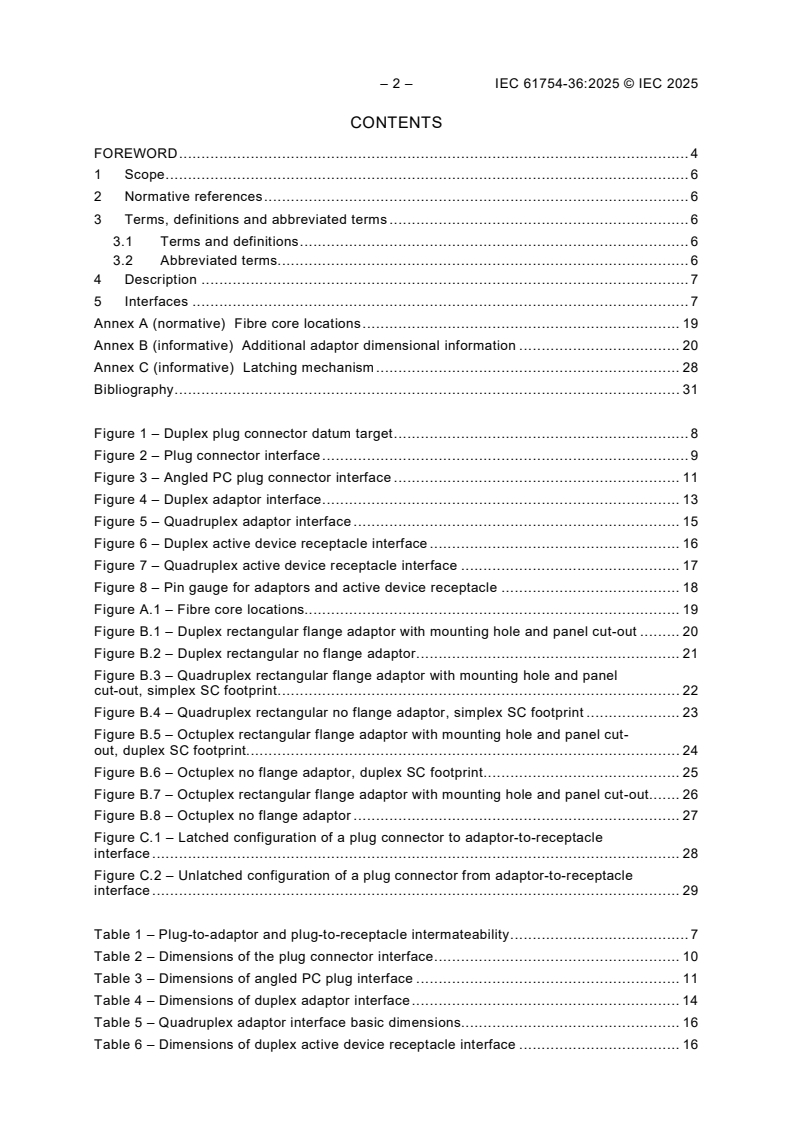
CONTENTS
FOREWORD . 4
1 Scope . 6
2 Normative references . 6
3 Terms, definitions and abbreviated terms . 6
3.1 Terms and definitions . 6
3.2 Abbreviated terms. 6
4 Description . 7
5 Interfaces . 7
Annex A (normative) Fibre core locations . 19
Annex B (informative) Additional adaptor dimensional information . 20
Annex C (informative) Latching mechanism . 28
Bibliography . 31
Figure 1 – Duplex plug connector datum target . 8
Figure 2 – Plug connector interface . 9
Figure 3 – Angled PC plug connector interface . 11
Figure 4 – Duplex adaptor interface . 13
Figure 5 – Quadruplex adaptor interface . 15
Figure 6 – Duplex active device receptacle interface . 16
Figure 7 – Quadruplex active device receptacle interface . 17
Figure 8 – Pin gauge for adaptors and active device receptacle . 18
Figure A.1 – Fibre core locations. 19
Figure B.1 – Duplex rectangular flange adaptor with mounting hole and panel cut-out . 20
Figure B.2 – Duplex rectangular no flange adaptor . 21
Figure B.3 – Quadruplex rectangular flange adaptor with mounting hole and panel
cut-out, simplex SC footprint . 22
Figure B.4 – Quadruplex rectangular no flange adaptor, simplex SC footprint . 23
Figure B.5 – Octuplex rectangular flange adaptor with mounting hole and panel cut-
out, duplex SC footprint. 24
Figure B.6 – Octuplex no flange adaptor, duplex SC footprint. 25
Figure B.7 – Octuplex rectangular flange adaptor with mounting hole and panel cut-out. 26
Figure B.8 – Octuplex no flange adaptor . 27
Figure C.1 – Latched configuration of a plug connector to adaptor-to-receptacle
interface . 28
Figure C.2 – Unlatched configuration of a plug connector from adaptor-to-receptacle
interface . 29
Table 1 – Plug-to-adaptor and plug-to-receptacle intermateability . 7
Table 2 – Dimensions of the plug connector interface . 10
Table 3 – Dimensions of angled PC plug interface . 11
Table 4 – Dimensions of duplex adaptor interface . 14
Table 5 – Quadruplex adaptor interface basic dimensions. 16
Table 6 – Dimensions of duplex active device receptacle interface . 16
Table 7 – Dimensions of quadruplex active device receptacle interface . 18
Table 8 – Pin gauge dimensions . 18
Table B.1 – Dimensions of duplex adaptor . 21
Table B.2 – Dimensions of quadruplex flange adaptor, simplex SC footprint . 23
Table B.3 – Dimensions of octuplex adaptor, duplex SC footprint . 25
Table B.4 – Dimensions of octuplex flange adaptor . 27
Table C.1 – Dimensions of a plug connector with adaptor-to-receptacle interface for
latched and unlatched configurations . 30
– 4 – IEC 61754-36:2025 © IEC 2025
INTERNATIONAL ELECTROTECHNICAL COMMISSION
____________
FIBRE OPTIC INTERCONNECTING DEVICES AND PASSIVE
COMPONENTS – FIBRE OPTIC CONNECTOR INTERFACES –
Part 36: Type SAC connector family
FOREWORD
1) The International Electrotechnical Commission (IEC) is a worldwide organization for standardization comprising
all national electrotechnical committees (IEC National Committees). The object of IEC is to promote international
co-operation on all questions concerning standardization in the electrical and electronic fields. To this end and
in addition to other activities, IEC publishes International Standards, Technical Specifications, Technical Reports,
Publicly Available Specifications (PAS) and Guides (hereafter referred to as “IEC Publication(s)”). Their
preparation is entrusted to technical committees; any IEC National Committee interested in the subject dealt with
may participate in this preparatory work. International, governmental and non-governmental organizations liaising
with the IEC also participate in this preparation. IEC collaborates closely with the International Organization for
Standardization (ISO) in accordance with conditions determined by agreement between the two organizations.
2) The formal decisions or agreements of IEC on technical matters express, as nearly as possible, an international
consensus of opinion on the relevant subjects since each technical committee has representation from all
interested IEC National Committees.
3) IEC Publications have the form of recommendations for international use and are accepted by IEC National
Committees in that sense. While all reasonable efforts are made to ensure that the technical content of IEC
Publications is accurate, IEC cannot be held responsible for the way in which they are used or for any
misinterpretation by any end user.
4) In order to promote international uniformity, IEC National Committees undertake to apply IEC Publications
transparently to the maximum extent possible in their national and regional publications. Any divergence between
any IEC Publication and the corresponding national or regional publication shall be clearly indicated in the latter.
5) IEC itself does not provide any attestation of conformity. Independent certification bodies provide conformity
assessment services and, in some areas, access to IEC marks of conformity. IEC is not responsible for any
services carried out by independent certification bodies.
6) All users should ensure that they have the latest edition of this publication.
7) No liability shall attach to IEC or its directors, employees, servants or agents including individual experts and
members of its technical committees and IEC National Committees for any personal injury, property damage or
other damage of any nature whatsoever, whether direct or indirect, or for costs (including legal fees) and
expenses arising out of the publication, use of, or reliance upon, this IEC Publication or any other IEC
Publications.
8) Attention is drawn to the Normative references cited in this publication. Use of the referenced publications is
indispensable for the correct application of this publication.
9) IEC draws attention to the possibility that the implementation of this document may involve the use of (a)
patent(s). IEC takes no position concerning the evidence, validity or applicability of any claimed patent rights in
respect thereof. As of the date of publication of this document, IEC had received notice of (a) patent(s), which
may be required to implement this document. However, implementers are cautioned that this may not represent
the latest information, which may be obtained from the patent database available at https://patents.iec.ch. IEC
shall not be held responsible for identifying any or all such patent rights.
IEC 61754-36 has been prepared by subcommittee 86B: Fibre optic interconnecting devices
and passive components, of IEC technical committee 86: Fibre optics. It is an International
Standard.
The text of this International Standard is based on the following documents:
Draft Report on voting
86B/5028/FDIS 86B/5065/RVD
Full information on the voting for its approval can be found in the report on voting indicated in
the above table.
The language used for the development of this International Standard is English.
This document was drafted in accordance with ISO/IEC Directives, Part 2, and developed in
accordance with ISO/IEC Directives, Part 1 and ISO/IEC Directives, IEC Supplement, available
at www.iec.ch/members_experts/refdocs. The main document types developed by IEC are
described in greater detail at www.iec.ch/publications.
A list of all parts in the IEC 61754 series, published under the general title Fibre optic
interconnecting devices and passive components – Fibre optic connector interfaces, can be
found on the IEC website.
The committee has decided that the contents of this document will remain unchanged until the
stability date indicated on the IEC website under webstore.iec.ch in the data related to the
specific document. At this date, the document will be
• reconfirmed,
• withdrawn, or
• revised.
– 6 – IEC 61754-36:2025 © IEC 2025
FIBRE OPTIC INTERCONNECTING DEVICES AND PASSIVE
COMPONENTS – FIBRE OPTIC CONNECTOR INTERFACES –
Part 36: Type SAC connector family
1 Scope
This part of IEC 61754 defines the standard mechanical interface dimensions for the type SAC
family of connectors.
2 Normative references
The following documents are referred to in the text in such a way that some or all of their content
constitutes requirements of this document. For dated references, only the edition cited applies.
For undated references, the latest edition of the referenced document (including any
amendments) applies.
IEC 61754-1, Fibre optic interconnecting devices and passive components – Fibre optic
connector interfaces – Part 1: General and guidance
IEC 61755-3-1, Fibre optic interconnecting devices and passive components – Connector
optical interfaces – Part 3-1: Connector parameters of dispersion unshifted single-mode
physically contacting fibres – Non-angled 2,5 mm and 1,25 mm diameter cylindrical full zirconia
ferrules
IEC 61755-3-2, Fibre optic interconnecting devices and passive components – Connector
optical interfaces – Part 3-2: Connector parameters of dispersion unshifted single-mode
physically contacting fibres – Angled 2,5 mm and 1,25 mm diameter cylindrical full zirconia
ferrules
3 Terms, definitions and abbreviated terms
3.1 Terms and definitions
For the purposes of this document, the terms and definitions given in IEC 61754-1 apply.
ISO and IEC maintain terminology databases for use in standardization at the following
addresses:
• IEC Electropedia: available at https://www.electropedia.org/
• ISO Online browsing platform: available at https://www.iso.org/obp
3.2 Abbreviated terms
APC angled physical contact
PC physical contact
4 Description
The parent connector for type SAC connector family is a miniature duplex connector set of
plug/adaptor/plug configuration which is characterized as follows.
• The ferrule nominal diameter is 1,25 mm.
• The connector plug includes two cylindrical, spring-loaded ferrules.
• The connector has a push-pull coupling mechanism at both small sides.
• The optical alignment mechanism of the connectors is a rigid bore sleeve or a resilient
sleeve.
5 Interfaces
This document contains the following standard interfaces:
• interface 36-1: duplex plug connector interface – physical contact (PC);
• interface 36-2: duplex adaptor interface;
• interface 36-3: duplex plug connector interface – angled physical contact (APC), 8°;
• interface 36-4: duplex active device receptacle interface;
• interface 36-5: quadruplex adaptor interface;
NOTE 1 This interface is designed to fit the SC simplex connector adaptor footprint as specified in the
IEC 61754-4 series.
• interface 36-6: quadruplex active device receptacle interface.
NOTE 2 All future variants connecting more than two duplex plug connectors on each side will use the minimum
specified pitch.
NOTE 3 The adaptor interfaces specified in this document define only half of the adaptor. The other half can be
configured to have either key aligned or opposed to each half.
The intermateability between plugs, adaptors, and receptacles is given in Table 1.
Duplex plug connector reference planes are shown in Figure 1.
End-face geometry on PC and APC interfaces shall be in accordance with IEC 61755-3-1 and
IEC 61755-3-2, respectively.
Table 1 – Plug-to-adaptor and plug-to-receptacle intermateability
Plug interfaces Adaptor interfaces Active device receptacle interfaces
36-2 36-5 36-4 36-6
36-1 Mate Mate Mate Mate
a a
36-3 Mate Mate
Mate Mate
a
Receptacle and plug shall have similar polished end-faces. APC receptacle will mate with APC plug and PC
receptacle will mate with PC plug.
– 8 – IEC 61754-36:2025 © IEC 2025
Figure 1 – Duplex plug connector datum target
Oriented fibre core locations shall be as specified in Annex A.
Refer to Annex B for additional adaptor dimensional information.
Refer to Annex C for latching mechanism.
The plug optical interface dimensions are shown in Figure 2 as well as in Table 2. The
dimensions of angled PC plug optical interface are shown in Figure 3 and Table 3.
Figure 2 – Plug connector interface
– 10 – IEC 61754-36:2025 © IEC 2025
Table 2 – Dimensions of the plug connector interface
Dimensions
Reference Units Notes
Minimum Maximum
A 9,41 9,51 mm
B 0,7 0,9 mm
C 5,98 6,08 mm
D 0,7 0,9 mm
E 2,88 2,98 mm
F 2,4 2,5 mm
G 2,55 2,65 mm
H 3,7 3,8 mm
I 1,42 1,52 mm Radius
J 3,1 mm Basic dimension
K 6,95 7,05 mm
L 9,81 10,01 mm
M 1,40 1,60 mm
N 1,45 1,55 mm Diameter
O 9,18 9,28 mm
P 7,66 7,76 mm
Q 7,13 7,23 mm
R 6,01 6,41 mm
S 1,248 5 1,249 5 mm Diameter
a b
5,69 5,94 mm
T
U 4,23 4,43 mm
V 2,28 2,38 mm
W 0,95 1,15 mm
X 0,98 1,38 mm
Y 0,92 1,02 mm
Z 0,75 0,85 mm
AA 23 27 Degrees
AB 7,36 7,46 mm
AC 0,75 0,85 mm
AD 2,95 3,05 mm
AE 43 47 Degrees
AF 6,43 – mm
AG 10,31 10,51 mm
AH 1,08 1,18 mm
AI 0,65 0,85 mm
AJ 0,70 0,80 mm Diameter
AX 1,08 1,18 mm
Dimensions
Reference Units Notes
Minimum Maximum
BF 11 13 Degrees
BZ 45 Degrees Degrees, typical
CA 0,35 0,45 mm
NOTE These dimensional requirements apply to the finished ferrule, after all polishing procedures have been
completed.
a
Coupling sleeve shall be movable toward right and left direction. These dimensions are given when the
coupling sleeve is moved to its left-most direction position.
b
Dimension T is given for a plug interface when it is not mated. The ferrule is movable by a certain axial
compression force, with direct contacting interface, and therefore the dimension T is variable. The ferrule
compression force shall be 5,0 N to 6,0 N when the position of optical datum target, dimension T is moved to
the range of 5,19 mm to 5,39 mm. Forces are for buffered fibre only; different cord constructions can result in
higher forces, see IEC 60794-2-50.
Figure 3 – Angled PC plug connector interface
Table 3 – Dimensions of angled PC plug interface
Dimensions
Reference Units Notes
Minimum Maximum
BR 90 Degrees Basic dimension
BS 5 12 mm Radius
BT 8 Degrees Basic dimension
BT
8 Degrees Basic dimension
BT
8 Degrees Basic dimension
– 12 – IEC 61754-36:2025 © IEC 2025
Oriented fibre core locations for PC and APC connectors shall be as specified in Annex A.
Duplex adaptor interface is shown in Figure 4. The dimensions of duplex adaptor interface are
given in Table 4.
NOTE 4 Only half of the adaptor is defined and it is symmetric around DT.
a) Duplex adaptor front view and adaptor hook interface
NOTE Section A-A is defined in Figure 4 a)
b) Side cross section view, top and bottom groove guide section view
Figure 4 – Duplex adaptor interface
Each of the units in the duplex adaptor shall comply with all dimensions in Figure 4. The
dimensions apply to the other variants as well.
– 14 – IEC 61754-36:2025 © IEC 2025
Table 4 – Dimensions of duplex adaptor interface
Dimensions
Reference Units Notes
Minimum Maximum
A 9,56 9,66 mm
B 0,7 0,9 mm
D 0,7 0,9 mm
G 2,15 2,35 mm
H 3,85 3,95 mm
I 1,34 1,44 mm Radius
J 3,10 mm Basic dimension
M 1,65 1,85 mm
N 1,70 1,80 mm Diameter
a
7,56 7,76 mm
P
a
6,01 6,41 mm
R
b c
– – mm Diameter
S
T 5,24 5,44 mm
X 0,35 0,55 mm
AD – 4 mm Maximum
AH 1,88 1,98 mm
AI 0,9 1,10 mm
AJ 0,95 1,05 mm Diameter
AK 7,7 11,2 mm
AL 7,6 7,7 mm
AM 3,05 3,90 mm
AN 3,0 3,90 mm
AO 28 32 Degrees
AP 8 12 Degrees
AQ 17,15 24.75 mm
AR 7,17 7,27 mm
AS 1,4 1,5 mm Diameter
a
9,26 9,36 mm
AT
AU 10,86 - mm Minimum
AV 0,75 0,85 mm
AW 0,75 1,17 mm
AX 1,88 1,98 mm
AY 7,7 10,7 mm
AZ 7,6 7,7 mm
BA 3,05 3,90 mm
Dimensions
Reference Units Notes
Minimum Maximum
BE 75 77 Degrees
BJ 8 12 Degrees
BU 5,14 5,24 mm
NOTE Additional information for different port configurations, panel cut-out and outside dimensions can be found
in Annex B.
a
The dimension will become greater than the specified dimension when a plug is coupled to or removed from the
adaptor.
b
The connector alignment feature is a resilient sleeve, and the sleeve may be either fixed or floating. For a floating
sleeve, a pin gauge inserted in the sleeve shall be capable of moving freely into the position such that it is
coincident with datum SL. Dimension S defines the inner diameter of the alignment feature.
c
The connector alignment feature is a resilient (split) alignment sleeve. The feature shall accept a pin gauge to the
centre of the adaptor with a force of 1,0 N to 2,5 N under the condition that another pin gauge is inserted into the
feature from the other side until both pin gauges butt against each other. The pin gauge shall be 1,249 0 mm as
shown in Figure 8 and Table 8.
The dimensions of quadruplex adaptor interface are shown in Figure 5 as well as in Table 5.
Figure 5 – Quadruplex adaptor interface
The connector alignment feature is a resilient (split) alignment sleeve. The feature shall accept
a pin gauge to the centre of the adaptor with a force of 1,0 N to 2,5 N under the condition that
another pin gauge is inserted into the feature from the other side until both pin gauges butt
against each other. The pin gauge shall be 1,249 0 mm as shown in Figure 8 and Table 8.
Each of the units in the duplex adaptor shall comply with all dimensions in Figure 4. The
dimensions apply to the other variants as well.
– 16 – IEC 61754-36:2025 © IEC 2025
Table 5 – Quadruplex adaptor interface basic dimensions
Dimensions
mm
Reference Notes
Minimum Maximum
BI 3,9 Basic dimension
BK 7,75 7,85
NOTE Additional information for different port configurations, panel cut-out and outside dimensions can be found
in Annex B.
Dimensions for duplex active device receptacle interface are shown in Figure 6 and Table 6.
Figure 6 – Duplex active device receptacle interface
The sleeve may be fixed or floating. For a fixed sleeve, the positional tolerance applies. For a
floating sleeve, pin gauge inserted in the sleeve shall be capable of moving freely into a position
that it is coincident with datum SL. The pin gauge shall be 1,249 0 mm as shown in Figure 8
and Table 8.
Each of the units in the duplex receptacle shall comply with all dimensions of Figure 6. The
dimensions apply to the other variants as well.
Table 6 – Dimensions of duplex active device receptacle interface
Dimensions
Reference mm Notes
Minimum Maximum
A 9,56 9,66
B 0,7 0,9
D 0,7 0,9
G 2,15 2,35
H 3,85 3,95
I 1,34 1,44 Radius
J 3,10 Basic dimension
a b
S – – Diameter
AN 3,0 3,90
Dimensions
Reference mm Notes
Minimum Maximum
AS 1,4 1,5 Diameter
BY 14,2 – Minimum
NOTE 1 The connector alignment feature is a rigid bore sleeve or resilient alignment sleeve. Dimension S defines
the inner diameter of the alignment feature.
NOTE 2 Drawings and dimensions provided consist of those minimum features that are functionally critical during
the mating and unmating sequences of the plug with its adaptor-to-receptacle counterpart component. Plugs not
compliant to the provided dimensions here can cause intermateability problems.
a
The connector alignment feature is a resilient sleeve, and the sleeve may be either fixed or floating. For a
floating sleeve, a pin gauge inserted in the sleeve shall be capable of moving freely into the position such that
it is coincident with datum SL. Dimension S defines the inner diameter of the alignment feature.
b
The connector alignment feature is a resilient (split) alignment sleeve. The feature shall accept a pin gauge to
the centre of the adaptor with a force of 1,0 N to 2,5 N under the condition that another pin gauge is inserted
into the feature from the other side until both pin gauges butt against each other. The pin gauge shall be
1,249 0 mm as shown in Figure 8 and Table 8.
Dimensions for quadruplex active device receptacle interface are shown in Figure 7 and Table 7.
Figure 7 – Quadruplex active device receptacle interface
The sleeve may be fixed or floating. For a fixed sleeve, the positional tolerance applies. For a
floating sleeve, pin gauge inserted in the sleeve shall be capable of moving freely into a position
that it is coincident with datum SL.
Each of the units in the duplex receptacle shall comply with all dimensions of Figure 6. The
dimensions apply to the other variants as well.
– 18 – IEC 61754-36:2025 © IEC 2025
Table 7 – Dimensions of quadruplex active device receptacle interface
Dimensions
mm
Reference Notes
Minimum Maximum
a b
– – Diameter
S
BY 14,2 – Minimum
BI 3,9 Basic dimension
BK 7,75 7,85
NOTE 1 The connector alignment feature is a rigid bore sleeve or resilient alignment sleeve. Dimension S defines
the inner diameter of the alignment feature.
NOTE 2 Drawings and dimensions provided consist of those minimum features that are functionally critical during
the mating and unmating sequences of the plug with its adaptor-to-receptacle counterpart component. Plugs not
compliant to the provided dimensions here can cause intermateability problems.
a
The connector alignment feature is a resilient sleeve, and the sleeve may be either fixed or floating. For a
floating sleeve, a pin gauge inserted in the sleeve shall be capable of moving freely into the position such that
it is coincident with datum SL. Dimension S defines the inner diameter of the alignment feature.
b The connector alignment feature is a resilient (split) alignment sleeve. The feature shall accept a pin gauge to
the centre of the adaptor with a force of 1,0 N to 2,5 N under the condition that another pin gauge is inserted
into the feature from the other side until both pin gauges butt against each other. The pin gauge shall be
1,249 0 mm as shown in Figure 8 and Table 8.
The pin gauge for adaptors and active device receptacle is shown in Figure 8. The pin gauge
dimensions are given in Table 8.
Figure 8 – Pin gauge for adaptors and active device receptacle
Table 8 – Pin gauge dimensions
BW diameter BX
Pin gauge type mm mm Remarks
Minimum Maximum Minimum Maximum
Resilient
1,249 1,248 8 1,249 2 4,2 15
a
sleeve
a
Surface roughness should be less than 0,2 µm Ra; cylindricity shall be less than 0,5 µm.
Additional adaptor dimensional information is given in Annex B.
Annex A
(normative)
Fibre core locations
The fibre core locations (keyholes) shall be oriented outwards and opposite to the other fibre,
as shown in Figure A.1. This definition is applicable for non-angled (PC) and angled (APC)
ferrules with oriented fibre cores.
NOTE The definition is slightly different in IEC 61755-3-1 and IEC 61755-3-2, where the fibre core location is
specified as oriented toward the guide key.
a) Expanded front view b) Oriented fibre core locations, not-to-scale
Figure A.1 – Fibre core locations
– 20 – IEC 61754-36:2025 © IEC 2025
Annex B
(informative)
Additional adaptor dimensional information
The dimensions of duplex rectangular flange adaptor are shown in Figure B.1 as well as in
Table B.1. The dimensions of duplex rectangular no flange adaptor are shown in Figure B.2.
a) Duplex rectangular flange adaptor
b) Mounting hole dimensions and panel cut-out
Figure B.1 – Duplex rectangular flange adaptor with mounting hole and panel cut-out
Figure B.2 – Duplex rectangular no flange adaptor
Table B.1 – Dimensions of duplex adaptor
Dimensions
Reference mm Notes
Minimum Maximum
DA 2,75 2,85
DB 21,95 22,05 Flange optional
DC 31,95 32,05
DD 15,8 15,9
DE 12,85 12,95
DF 1,7 2,0
DG 15,0 15,4
DH 17,95 18,05 Flange optional
DI 13,0 13,5
DJ 17,75 18,25
DK 2,4 2,6 Holes optional
DL 6,05 6,25
DM – 14,65
DN 5,55 5,65
NOTE The maximum panel thickness is 1,6 mm (reference only).
The dimensions of quadruplex rectangular flange adaptor, simplex SC footprint, are shown in
Figure B.3 as well as in Table B.2. The dimensions of quadruplex rectangular no flange adaptor,
simplex SC footprint, are shown in Figure B.4.
– 22 – IEC 61754-36:2025 © IEC 2025
a) Quadruplex rectangular flange adaptor
b) Mounting hole dimensions and panel cut-out
Figure B.3 – Quadruplex rectangular flange adaptor with mounting hole
and panel cut-out, simplex SC footprint
Figure B.4 – Quadruplex rectangular no flange adaptor, simplex SC footprint
Table B.2 – Dimensions of quadruplex flange adaptor, simplex SC footprint
Dimensions
Reference mm Notes
Minimum Maximum
DA 2,75 2,85
DB 21,95 22,05 Flange optional
DC 31,95 32,05
DD 15,8 15,9
DE 12,85 12,95
DF 1,7 2,0
DG 15,0 15,4
DH 17,95 18,05 Flange optional
DI 13,0 13,5
DJ 17,75 18,25
DK 2,4 2,6 Holes optional
DM – 14,65
EJ 9,5 10,0
EN – 9,5
NOTE The maximum panel thickness is 1,6 mm (reference only).
The dimensions of octuplex rectangular flange adaptor, duplex SC footprint, are shown in
Figure B.5 as well as in Table B.3. The dimensions of octuplex rectangular no flange adaptor,
duplex SC footprint, are shown in Figure B.6.
– 24 – IEC 61754-36:2025 © IEC 2025
a) Octuplex rectangular flange adaptor
b) Mounting hole dimensions and panel cut-out
Figure B.5 – Octuplex rectangular flange adaptor with mounting hole
and panel cut-out, duplex SC footprint
Figure B.6 – Octuplex no flange adaptor, duplex SC footprint
Table B.3 – Dimensions of octuplex adaptor, duplex SC footprint
Dimensions
Reference mm Notes
Minimum Maximum
DA 2,75 2,85
FB 34,65 34,75 Flange optional
DC 31,95 32,05
DD 15,8 15,9
FE 25,75 25,85
DF 1,7 2,0
FG 27,9 28,2
FH 30,65 30,75 Flange optional
FI 26,0 26,5
FJ 30,45 30,95
DK 2,4 2,6 Holes optional
EJ 9,5 10,0
EN 9,3 9,5
FM – 28,55
NOTE The maximum panel thickness is 1,6 mm (reference only).
The dimensions of octuplex rectangular flange adaptor are shown in Figure B.7 as well as in
Table B.4. The dimensions of octuplex no flange adaptor are shown in Figure B.8.
– 26 – IEC 61754-36:2025 © IEC 2025
a) Octuplex rectangular flange adaptor
b) Mounting hole dimensions and panel cut-out
Figure B.7 – Octuplex rectangular flange adaptor with mounting hole and panel cut-out
Figure B.8 – Octuplex no flange adaptor
Table B.4 – Dimensions of octuplex flange adaptor
Dimensions
Reference mm Notes
Minimum Maximum
DA 2,75 2,85
GB 26,5 26,6 Flange optional
DC 31,95 32,05
DD 15,8 15,9
GE 17,35 17,45
DF 1,7 2,0
GG 19,65 19,75
GH 21,75 21,85 Flange optional
DK 2,4 2,6 Holes optional
GJ 17,6 18,1
GK 21,55 22,05
GL 13,2 13,7
GM – 19,55
FN 12,81 13,21
NOTE The maximum panel thickness is 1,6 mm (reference only).
– 28 – IEC 61754-36:2025 © IEC 2025
Annex C
(informative)
Latching mechanism
The latched configuration of plug connector to adaptor-to-receptacle interface is shown in
Figure C.1.
Figure C.1 – Latched configuration of a plug connector
to adaptor-to-receptacle interface
The unlatched configuration of plug connector from adaptor-to-receptacle interface is shown in
Figure C.2.
Figure C.2 – Unlatched configuration of a plug connector
from adaptor-to-receptacle interface
The dimensions of a plug connector with adaptor-to-receptacle interface for latched and
unlatched configurations are shown in Table C.1.
– 30 – IEC 61754-36:2025 © IEC 2025
Table C.1 – Dimensions of a plug connector with adaptor-to-receptacle interface
for latched and unlatched configurations
Dimensions
Reference mm Notes
Minimum Maximum
HA 1,15 Basic dimension
a
5,69 5,89
T
b
– 5,44
T'
Y 0,92 1,02
a
Dimension T is given for a plug interface when it is not mated. The ferrule is movable by a certain axial
compression force, with direct contacting interface, and therefore the dimension T is variable. The ferrule
compression force should be 5,0 N to 6,0 N when the position of optical datum target, dimension T is moved
to the range of 5,19 mm to 5,39 mm. Forces are for buffered fibre only; different cord constructions can result
in higher forces, see IEC 60794-2-50.
b
Dimension T' defines distance from optical datum target to mechanical datum target with respect to adaptor-
to-receptacle installed by plug connector. T' will vary when adaptor-to-receptacle hook is interacting with the
latching-to-unlatching outer housing and front housing from plug connector, and it will not exceed the maximum
value when plug connector is engaged with adaptor-to-receptacle hook.
Bibliography
IEC 60794-2-50, Optical fibre cables – Part 2-50: Indoor cables – Family specification for
simplex and duplex cables for use in terminated cable assemblies
IEC 61754-4 (all parts), Fibre optic interconnecting devices and passive components – Fibre
optic connector interfaces
___________
– 32 – IEC 61754-36:2025 © IEC 2025
SOMMAIRE
AVANT-PROPOS . 34
1 Domaine d’application . 36
2 Références normatives . 36
3 Termes, définitions et termes abrégés . 36
3.1 Termes et définitions. 36
3.2 Abréviations . 36
4 Description . 37
5 Interfaces . 37
Annexe A (normative) Emplacement des cœurs de fibre . 49
Annexe B (informative) Informations dimensionnelles supplémentaires sur les
raccords . 50
Annexe C (informative) Mécanisme de verrouillage . 58
Bibliographie . 61
Figure 1 – Cible de référence de connecteur mâle duplex . 38
Figure 2 – Interface de connecteur mâle . 39
Figure 3 – Interface de connecteur mâle, PC avec angle . 41
Figure 4 – Interface de raccord duplex . 43
Figure 5 – Interface de raccord quadruplex . 45
Figure 6 – Interface d’embase de dispositif actif duplex . 46
Figure 7 – Interface d’embase de dispositif actif quadruplex . 47
Figure 8 – Broche calibrée pour les raccords et l’embase de dispositif actif . 48
Figure A.1 – Emplacements des cœurs de fibre . 49
Figure B.1 – Raccord duplex à bride rectangulaire avec trou de montage et découpe
du panneau. 50
Figure B.2 – Raccord rectangulaire duplex sans bride . 51
Figure B.3 – Raccord à bride rectangulaire quadruplex avec trou de montage et
découpe du panneau-, en considérant l’encombrement d’un connecteur SC simplex . 52
Figure B.4 – Raccord quadruplex rectangulaire sans bride, en considérant
l’encombrement d’un connecteur SC simplex. 53
Figure B.5 – Raccord rectangulaire octuplex à bride avec trou de montage et découpe
du panneau, en considérant l’encombrement d’un connecteur SC duplex . 54
Figure B.6 – Raccord octuplex sans bride, en considérant l’encombrement d’un
connecteur SC duplex . 55
Figure B.7 – Raccord rectangulaire octuplex à bride avec trou de montage et découpe
du panneau. 56
Figure B.8 – Raccord octuplex sans bride . 57
Figure C.1 – Configuration verrouillée d’un connecteur mâle sur une interface
raccord/embase . 58
Figure C.2 – Configuration déverrouillée d’un connecteur mâle par rapport à l’interface
raccord/embase . 59
Tableau 1 – Compatibilité d’accouplement fiche-raccord et fiche-embase . 37
Tableau 2 – Dimensions des interfaces de connecteurs mâles . 40
Tableau 3 – Dimensions de l’interface de fiche PC avec angle . 41
Tableau 4 – Dimensions de l’interface de raccord duplex . 44
Tableau 5 – Dimensions de base de l’interface de raccord quadruplex . 46
Tableau 6 – Dimensions de l’interface d’embase de dispositif actif duplex . 46
Tableau 7 – Dimensions de l’interface d’embase de dispositif actif quadruplex . 48
Tableau 8 – Dimensions de la broche calibrée . 48
Tableau B.1 – Dimensions d’un raccord duplex. 51
Tableau B.2 – Dimensions d’un raccord quadruplex à bride, en considérant
l’enco
...