

IEC 63093-10:2022
(Main)Ferrite cores - Guidelines on dimensions and the limits of surface irregularities - Part 10: PM-cores and associated parts
General Information
- Abstract
IEC 63093-10:2022 specifies the dimensions that are of importance for mechanical interchangeability for a preferred range of PM-cores made of magnetic oxides, the main dimensions for coil formers to be used with these cores and the locations of their pins on a modular printed wiring grid in relation to the base outlines of cores. It also specifies the effective parameter values to be used in calculations and gives guidelines on allowable limits of surface irregularities applicable to the PM-cores.
- Status
- Published
- Publication Date
- 20-Apr-2022
- Technical Committee
- TC 51 - Magnetic components, ferrite and magnetic powder materials
- Drafting Committee
- WG 1 - TC 51/WG 1
- Current Stage
- DELPUB - Deleted Publication
- Start Date
- 06-Feb-2026
- Completion Date
- 26-Jan-2024
Overview
IEC 63093-10:2022 is an international standard published by the International Electrotechnical Commission (IEC) that provides guidelines on dimensions and surface irregularities limits for PM-cores and associated parts made of magnetic oxides. This document is part 10 of the IEC 63093 series, focusing specifically on PM-cores - a type of ferrite core widely used in magnetic components.
The standard specifies critical mechanical dimensions to ensure interchangeability, defines main coil former dimensions, and establishes pin locations on a modular printed wiring grid relative to core bases. Additionally, it provides effective parameter values for magnetic calculations and outlines acceptable limits for surface irregularities-essential for maintaining performance and ensuring component reliability.
Key Topics
- Mechanical interchangeability: The document focuses on dimensions that facilitate product compatibility and exchangeability within the industry.
- Principal dimensions of PM-cores: Includes base outlines, thickness, and other core measurements critical for mechanical and electromagnetic compatibility.
- Coil formers’ dimensions: Defines the main sizes and configurations of coil formers compatible with PM-cores.
- Pin placement and sizes: Provides the exact locations and diameters of pins on coil formers to align with the modular printed wiring grid, optimizing assembly processes.
- Effective parameter values: Specifies magnetic parameters to be used in design calculations, based on recognized methods like IEC 60205.
- Surface irregularities guidelines: Details acceptable limits for various surface defects such as chips, cracks, pores, and flash to prevent performance degradation and ensure quality.
- Derived standards: Annexes discuss the use of derived standards for more detailed specifications while retaining compliance with this core document.
- Gauging and mounting hardware: Provides examples and recommended dimensions for verification tools and mounting equipment.
Applications
IEC 63093-10:2022 is essential for:
- Manufacturers of ferrite PM-cores who require consistent dimensional specifications to produce interchangeable and high-quality cores.
- Design engineers in electronic and electromechanical industries developing magnetic components such as transformers, inductors, and filters.
- Quality assurance teams tasked with inspecting and verifying the mechanical consistency and surface quality of ferrite cores.
- Coil winding and assembly operations that depend on standardized pin layout and coil former sizes to streamline manufacturing.
- Research and development focused on improving magnetic performance while maintaining physical compatibility across different parts and products.
Incorporating this standard helps ensure magnetic cores meet stringent mechanical tolerance and surface finish requirements, boosting reliability and performance in diverse electronic devices.
Related Standards
- IEC 60205: Calculation of the effective parameters of magnetic piece parts, referenced for magnetic property evaluations.
- IEC 60401-1: Terms and nomenclature for magnetically soft ferrite cores, defines key terminology used throughout IEC 63093 series.
- IEC 63093-1:2020: General guidelines on ferrite core dimensions and surface irregularities, setting foundational requirements applicable to all parts of the IEC 63093 series.
- Other parts of IEC 63093 series: Address specific types of ferrite cores and their dimensional guidelines to complement Part 10’s focus on PM-cores.
Benefits of Compliance
- Ensures mechanical interchangeability across different manufacturers and component suppliers.
- Facilitates accurate and consistent coil winding thanks to standardized coil former dimensions and pin locations.
- Maintains magnetic performance integrity by controlling surface irregularities affecting core behavior.
- Enhances assembly efficiency by aligning components with modular printed wiring grids.
- Supports global standardization, enabling easier international trade and cooperation.
For engineers and manufacturers working with ferrite PM-cores, IEC 63093-10:2022 represents a vital technical resource that combines dimensional precision with quality control measures to advance the reliability and compatibility of magnetic components worldwide.
Relations
- Effective Date
- 22-Dec-2023
Get Certified
Connect with accredited certification bodies for this standard

IMQ S.p.A. (Certification)
Italian electrical product certification.

SLG Prüf- und Zertifizierungs GmbH
German testing and certification body.

UL Solutions
Global safety science company with testing, inspection and certification.
Sponsored listings
Frequently Asked Questions
IEC 63093-10:2022 is a standard published by the International Electrotechnical Commission (IEC). Its full title is "Ferrite cores - Guidelines on dimensions and the limits of surface irregularities - Part 10: PM-cores and associated parts". This standard covers: IEC 63093-10:2022 specifies the dimensions that are of importance for mechanical interchangeability for a preferred range of PM-cores made of magnetic oxides, the main dimensions for coil formers to be used with these cores and the locations of their pins on a modular printed wiring grid in relation to the base outlines of cores. It also specifies the effective parameter values to be used in calculations and gives guidelines on allowable limits of surface irregularities applicable to the PM-cores.
IEC 63093-10:2022 specifies the dimensions that are of importance for mechanical interchangeability for a preferred range of PM-cores made of magnetic oxides, the main dimensions for coil formers to be used with these cores and the locations of their pins on a modular printed wiring grid in relation to the base outlines of cores. It also specifies the effective parameter values to be used in calculations and gives guidelines on allowable limits of surface irregularities applicable to the PM-cores.
IEC 63093-10:2022 is classified under the following ICS (International Classification for Standards) categories: 29.100.10 - Magnetic components. The ICS classification helps identify the subject area and facilitates finding related standards.
IEC 63093-10:2022 has the following relationships with other standards: It is inter standard links to IEC 63093-10:2026. Understanding these relationships helps ensure you are using the most current and applicable version of the standard.
IEC 63093-10:2022 is available in PDF format for immediate download after purchase. The document can be added to your cart and obtained through the secure checkout process. Digital delivery ensures instant access to the complete standard document.
Standards Content (Sample)
IEC 63093-10 ®
Edition 1.0 2022-04
INTERNATIONAL
STANDARD
NORME
INTERNATIONALE
Ferrite cores – Guidelines on dimensions and the limits of surface
irregularities –
Part 10: PM-cores and associated parts
Noyaux ferrites – Lignes directrices relatives aux dimensions et aux limites des
irrégularités de surface –
Partie 10: Noyaux PM et parties associées
All rights reserved. Unless otherwise specified, no part of this publication may be reproduced or utilized in any form
or by any means, electronic or mechanical, including photocopying and microfilm, without permission in writing from
either IEC or IEC's member National Committee in the country of the requester. If you have any questions about IEC
copyright or have an enquiry about obtaining additional rights to this publication, please contact the address below or
your local IEC member National Committee for further information.
Droits de reproduction réservés. Sauf indication contraire, aucune partie de cette publication ne peut être reproduite
ni utilisée sous quelque forme que ce soit et par aucun procédé, électronique ou mécanique, y compris la photocopie
et les microfilms, sans l'accord écrit de l'IEC ou du Comité national de l'IEC du pays du demandeur. Si vous avez des
questions sur le copyright de l'IEC ou si vous désirez obtenir des droits supplémentaires sur cette publication, utilisez
les coordonnées ci-après ou contactez le Comité national de l'IEC de votre pays de résidence.
IEC Secretariat Tel.: +41 22 919 02 11
3, rue de Varembé info@iec.ch
CH-1211 Geneva 20 www.iec.ch
Switzerland
About the IEC
The International Electrotechnical Commission (IEC) is the leading global organization that prepares and publishes
International Standards for all electrical, electronic and related technologies.
About IEC publications
The technical content of IEC publications is kept under constant review by the IEC. Please make sure that you have the
latest edition, a corrigendum or an amendment might have been published.
IEC publications search - webstore.iec.ch/advsearchform IEC Products & Services Portal - products.iec.ch
The advanced search enables to find IEC publications by a Discover our powerful search engine and read freely all the
variety of criteria (reference number, text, technical publications previews. With a subscription you will always
committee, …). It also gives information on projects, replaced have access to up to date content tailored to your needs.
and withdrawn publications.
Electropedia - www.electropedia.org
IEC Just Published - webstore.iec.ch/justpublished
The world's leading online dictionary on electrotechnology,
Stay up to date on all new IEC publications. Just Published
containing more than 22 300 terminological entries in English
details all new publications released. Available online and
and French, with equivalent terms in 19 additional languages.
once a month by email.
Also known as the International Electrotechnical Vocabulary
(IEV) online.
IEC Customer Service Centre - webstore.iec.ch/csc
If you wish to give us your feedback on this publication or
need further assistance, please contact the Customer Service
Centre: sales@iec.ch.
A propos de l'IEC
La Commission Electrotechnique Internationale (IEC) est la première organisation mondiale qui élabore et publie des
Normes internationales pour tout ce qui a trait à l'électricité, à l'électronique et aux technologies apparentées.
A propos des publications IEC
Le contenu technique des publications IEC est constamment revu. Veuillez vous assurer que vous possédez l’édition la
plus récente, un corrigendum ou amendement peut avoir été publié.
Recherche de publications IEC - IEC Products & Services Portal - products.iec.ch
webstore.iec.ch/advsearchform Découvrez notre puissant moteur de recherche et consultez
La recherche avancée permet de trouver des publications IEC gratuitement tous les aperçus des publications. Avec un
en utilisant différents critères (numéro de référence, texte, abonnement, vous aurez toujours accès à un contenu à jour
comité d’études, …). Elle donne aussi des informations sur adapté à vos besoins.
les projets et les publications remplacées ou retirées.
Electropedia - www.electropedia.org
IEC Just Published - webstore.iec.ch/justpublished
Le premier dictionnaire d'électrotechnologie en ligne au
Restez informé sur les nouvelles publications IEC. Just
monde, avec plus de 22 300 articles terminologiques en
Published détaille les nouvelles publications parues.
anglais et en français, ainsi que les termes équivalents dans
Disponible en ligne et une fois par mois par email.
19 langues additionnelles. Egalement appelé Vocabulaire
Electrotechnique International (IEV) en ligne.
Service Clients - webstore.iec.ch/csc
Si vous désirez nous donner des commentaires sur cette
publication ou si vous avez des questions contactez-nous:
sales@iec.ch.
IEC 63093-10 ®
Edition 1.0 2022-04
INTERNATIONAL
STANDARD
NORME
INTERNATIONALE
Ferrite cores – Guidelines on dimensions and the limits of surface
irregularities –
Part 10: PM-cores and associated parts
Noyaux ferrites – Lignes directrices relatives aux dimensions et aux limites des
irrégularités de surface –
Partie 10: Noyaux PM et parties associées
INTERNATIONAL
ELECTROTECHNICAL
COMMISSION
COMMISSION
ELECTROTECHNIQUE
INTERNATIONALE
ICS 29.100.10 ISBN 978-2-8322-1100-6
– 2 – IEC 63093-10:2022 © IEC 2022
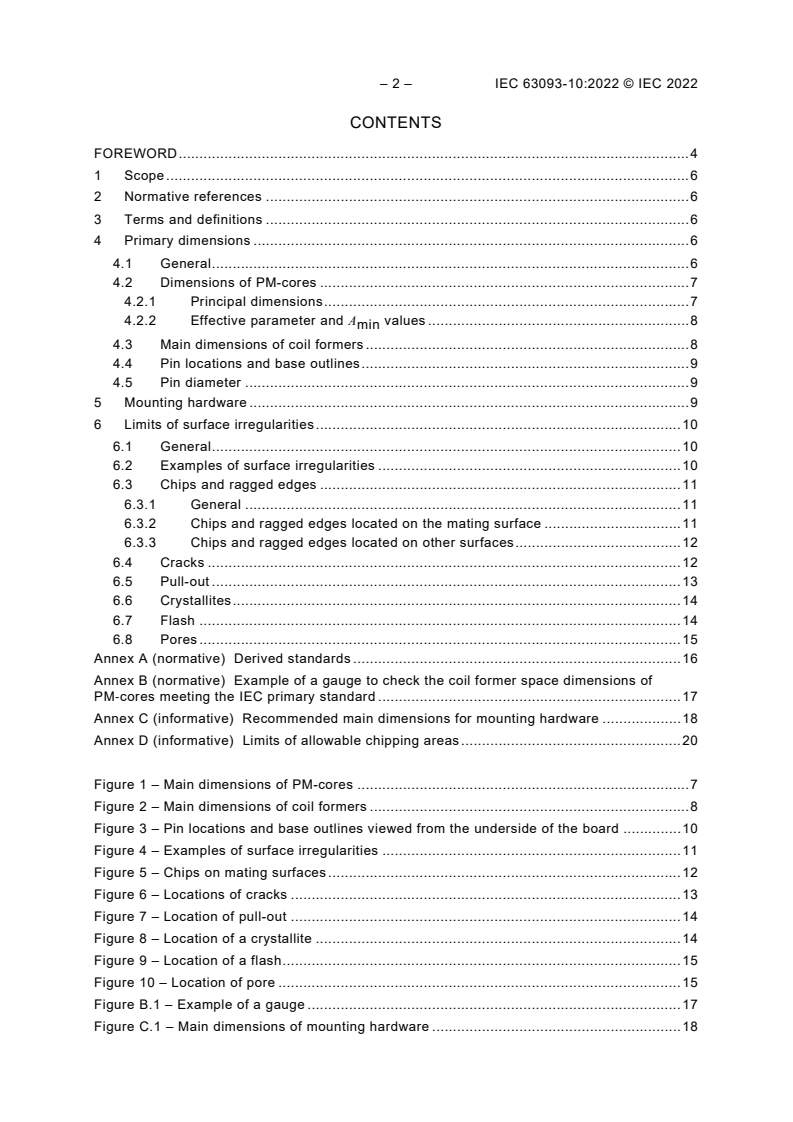
CONTENTS
FOREWORD . 4
1 Scope . 6
2 Normative references . 6
3 Terms and definitions . 6
4 Primary dimensions . 6
4.1 General . 6
4.2 Dimensions of PM-cores . 7
4.2.1 Principal dimensions . 7
4.2.2 Effective parameter and A values . 8
min
4.3 Main dimensions of coil formers . 8
4.4 Pin locations and base outlines . 9
4.5 Pin diameter . 9
5 Mounting hardware . 9
6 Limits of surface irregularities . 10
6.1 General . 10
6.2 Examples of surface irregularities . 10
6.3 Chips and ragged edges . 11
6.3.1 General . 11
6.3.2 Chips and ragged edges located on the mating surface . 11
6.3.3 Chips and ragged edges located on other surfaces . 12
6.4 Cracks . 12
6.5 Pull-out . 13
6.6 Crystallites . 14
6.7 Flash . 14
6.8 Pores . 15
Annex A (normative) Derived standards . 16
Annex B (normative) Example of a gauge to check the coil former space dimensions of
PM‑cores meeting the IEC primary standard . 17
Annex C (informative) Recommended main dimensions for mounting hardware . 18
Annex D (informative) Limits of allowable chipping areas . 20
Figure 1 – Main dimensions of PM-cores . 7
Figure 2 – Main dimensions of coil formers . 8
Figure 3 – Pin locations and base outlines viewed from the underside of the board . 10
Figure 4 – Examples of surface irregularities . 11
Figure 5 – Chips on mating surfaces . 12
Figure 6 – Locations of cracks . 13
Figure 7 – Location of pull-out . 14
Figure 8 – Location of a crystallite . 14
Figure 9 – Location of a flash . 15
Figure 10 – Location of pore . 15
Figure B.1 – Example of a gauge . 17
Figure C.1 – Main dimensions of mounting hardware . 18
Table 1 – Main dimensions of PM-cores . 7
Table 2 – Effective parameter and A values . 8
min
Table 3 – Main dimensions of coil formers . 9
Table 4 – Limits for cracks . 13
Table B.1 – Example of a gauge . 17
Table C.1 – Main dimensions of U-bolt . 18
Table C.2 – Main dimensions of base plate . 19
Table D.1 – Limits of allowable chipping areas. 20
– 4 – IEC 63093-10:2022 © IEC 2022
INTERNATIONAL ELECTROTECHNICAL COMMISSION
____________
FERRITE CORES – GUIDELINES ON DIMENSIONS
AND THE LIMITS OF SURFACE IRREGULARITIES –
Part 10: PM-cores and associated parts
FOREWORD
1) The International Electrotechnical Commission (IEC) is a worldwide organization for standardization comprising
all national electrotechnical committees (IEC National Committees). The object of IEC is to promote international
co-operation on all questions concerning standardization in the electrical and electronic fields. To this end and
in addition to other activities, IEC publishes International Standards, Technical Specifications, Technical Reports,
Publicly Available Specifications (PAS) and Guides (hereafter referred to as “IEC Publication(s)”). Their
preparation is entrusted to technical committees; any IEC National Committee interested in the subject dealt with
may participate in this preparatory work. International, governmental and non-governmental organizations liaising
with the IEC also participate in this preparation. IEC collaborates closely with the International Organization for
Standardization (ISO) in accordance with conditions determined by agreement between the two organizations.
2) The formal decisions or agreements of IEC on technical matters express, as nearly as possible, an international
consensus of opinion on the relevant subjects since each technical committee has representation from all
interested IEC National Committees.
3) IEC Publications have the form of recommendations for international use and are accepted by IEC National
Committees in that sense. While all reasonable efforts are made to ensure that the technical content of IEC
Publications is accurate, IEC cannot be held responsible for the way in which they are used or for any
misinterpretation by any end user.
4) In order to promote international uniformity, IEC National Committees undertake to apply IEC Publications
transparently to the maximum extent possible in their national and regional publications. Any divergence between
any IEC Publication and the corresponding national or regional publication shall be clearly indicated in the latter.
5) IEC itself does not provide any attestation of conformity. Independent certification bodies provide conformity
assessment services and, in some areas, access to IEC marks of conformity. IEC is not responsible for any
services carried out by independent certification bodies.
6) All users should ensure that they have the latest edition of this publication.
7) No liability shall attach to IEC or its directors, employees, servants or agents including individual experts and
members of its technical committees and IEC National Committees for any personal injury, property damage or
other damage of any nature whatsoever, whether direct or indirect, or for costs (including legal fees) and
expenses arising out of the publication, use of, or reliance upon, this IEC Publication or any other IEC
Publications.
8) Attention is drawn to the Normative references cited in this publication. Use of the referenced publications is
indispensable for the correct application of this publication.
9) Attention is drawn to the possibility that some of the elements of this IEC Publication may be the subject of patent
rights. IEC shall not be held responsible for identifying any or all such patent rights.
IEC 63093-10 has been prepared by IEC technical committee 51: Magnetic components, ferrite
and magnetic powder materials. It is an International Standard.
This first edition cancels and replaces the first edition IEC 61247 published in 1995. This edition
constitutes a technical revision.
This edition includes the following significant technical changes with respect to the first edition
of IEC 61247:
a) the calculations of the effective parameter values have been updated according to
IEC 60205;
b) added the limits of surface irregularities.
The text of this International Standard is based on the following documents:
Draft Report on voting
51/1388/CDV 51/1408/RVC
Full information on the voting for its approval can be found in the report on voting indicated in
the above table.
The language used for the development of this International Standard is English.
This document was drafted in accordance with ISO/IEC Directives, Part 2, and developed in
accordance with ISO/IEC Directives, Part 1 and ISO/IEC Directives, IEC Supplement, available
at www.iec.ch/members_experts/refdocs. The main document types developed by IEC are
described in greater detail at www.iec.ch/standardsdev/publications.
A list of all parts in the IEC 63093 series, published under the general title Ferrite cores –
Guidelines on dimensions and the limits of surface irregularities, can be found on the IEC
website.
The committee has decided that the contents of this document will remain unchanged until the
stability date indicated on the IEC website under webstore.iec.ch in the data related to the
specific document. At this date, the document will be
• reconfirmed,
• withdrawn,
• replaced by a revised edition, or
• amended.
– 6 – IEC 63093-10:2022 © IEC 2022
FERRITE CORES – GUIDELINES ON DIMENSIONS
AND THE LIMITS OF SURFACE IRREGULARITIES –
Part 10: PM-cores and associated parts
1 Scope
This part of IEC 63093 specifies the dimensions that are of importance for mechanical
interchangeability for a preferred range of PM-cores made of magnetic oxides, the main
dimensions for coil formers to be used with these cores and the locations of their pins on a
modular printed wiring grid in relation to the base outlines of cores. It also specifies the effective
parameter values to be used in calculations and gives guidelines on allowable limits of surface
irregularities applicable to the PM-cores.
The use of derived standards which give more detailed specifications of component parts whilst
still permitting compliance with this document is discussed in Annex A.
2 Normative references
The following documents are referred to in the text in such a way that some or all of their content
constitutes requirements of this document. For dated references, only the edition cited applies.
For undated references, the latest edition of the referenced document (including any
amendments) applies.
IEC 60205, Calculation of the effective parameters of magnetic piece parts
IEC 60401-1, Terms and nomenclature for cores made of magnetically soft ferrites – Part 1:
Terms used for physical irregularities and reference of dimensions
IEC 63093-1:2020, Ferrite cores – Guidelines on dimensions and the limits of surface
irregularities – Part 1: General specification
3 Terms and definitions
For the purposes of this document, the terms and definitions given in IEC 60401-1 and
IEC 63093-1 apply.
ISO and IEC maintain terminological databases for use in standardization at the following
addresses:
• IEC Electropedia: available at http://www.electropedia.org/
• ISO Online browsing platform: available at http://www.iso.org/obp
4 Primary dimensions
4.1 General
Compliance with the following requirements ensures mechanical interchangeability of complete
assemblies and wound coil formers.
4.2 Dimensions of PM-cores
4.2.1 Principal dimensions
The principal dimensions of PM-cores shall be as given in Figure 1 and Table 1.
Figure 1 – Main dimensions of PM-cores
Table 1 – Main dimensions of PM-cores
Size
Dimension
PM 50/39 PM 62/49 PM 74/59 PM 87/70 PM 114/93
K max. 50,0 62,0 74,0 87,0 114,0
mm min. 48,3 60,0 71,5 84,0 109,5
E max. 40,3 50,3 59,3 69,2 91,7
mm min. 39,0 48,8 57,5 67,1 88,0
F
max. 20,0 25,5 29,5 31,7 43,0
mm min. 19,4 24,7 28,5 30,7 41,6
H max. 5,7 5,7 5,7 8,8 5,8
mm min. 5,4 5,4 5,4 8,5 5,4
2B max. 39,0 49,0 59,0 70,0 93,0
mm min. 38,6 48,6 58,4 69,2 92,0
2D max. 27,2 34,2 41,5 48,8 64,6
mm min. 26,4 33,4 40,7 48,0 63,0
C max. 23,0 28,5 33,0 36,0 45,0
mm min. 22,0 27,5 32,0 35,0 44,0
α max. 125 125 125 95 95
degree min. 115 115 115 85 85
J max. 7,8 10,5 13,5 8,3 11,5
mm min. 6,8 9,5 12,5 7,3 10,5
G max. 23,4 29,0 34,0 40,0 52,0
mm min. 22,4 28,0 33,0 39,0 51,0
t max. 1,6 1,6 2,9 3,9 4,4
mm min. 1,2 1,2 2,5 3,5 4,0
I max. 5,0 5,0 5,0 5,5 6,3
mm min. 4,0 4,0 4,0 4,5 5,3
The dimensions of the cores can be checked by means of gauges. By way of example, a possible standard for
these gauges is given in Annex B. In order to facilitate production it can be necessary to use gauges having
dimensions differing from those given in Annex B, although no relaxation of the requirements for the dimensions
of the cores given in 4.2.1 is thereby permitted.
– 8 – IEC 63093-10:2022 © IEC 2022
4.2.2 Effective parameter and A values
min
The effective parameter and A values for PM-cores whose dimensions comply with 4.2.1
min
shall be as given in Table 2. The definitions of effective parameters and their calculations shall
be as given in IEC 60205.
Table 2 – Effective parameter and A values
min
a
Size C C l A V
A
1 2 e e e
min
−1 −3 −3 2 3 2
mm
mm ×10 mm mm mm mm
PM 50/39 0,280 49 0,856 46 91,9 327 30 100 281
PM 62/49 0,219 52 0,415 09 116 529 61 000 470
PM 74/59 0,186 88 0,250 48 139 746 104 000 630
PM 87/70 0,186 10 0,217 24 159 857 137 000 700
PM 114/93 0,132 85 0,082 050 215 1 620 348 000 1 380
a
A is located at the centre pole only.
min
4.3 Main dimensions of coil formers
The main dimensions of coil formers shall be as given in Figure 2 and Table 3.
Figure 2 – Main dimensions of coil formers
Table 3 – Main dimensions of coil formers
Size
Dimension
PM 50/39 PM 62/49 PM 74/59 PM 87/70 PM 114/93
e
max. 38,6 48,5 57,2 66,4 87,3
mm min. 38,2 48,1 56,7 65,8 86,0
e
max. 23,4 28,7 32,7 35,2 48,2
mm min. 23,0 28,3 32,3 34,7 47,0
f max. 20,4 26,1 30,3 32,7 44,6
mm min. 20,2 25,8 29,9 32,1 43,8
2d max. 26,0 33,0 40,0 47,3 62,5
mm min. 25,6 32,5 39,3 46,5 61,3
s
max. 1,25 1,35 1,35 1,55 2,30
mm min. 0,95 1,05 1,05 1,25 2,00
s
max. 1,65 1,65 1,75 1,95 2,50
mm min. 1,35 1,35 1,45 1,65 2,20
4.4 Pin locations and base outlines
When coil formers are provided with pins intended for use in conjunction with a printed wiring
board, they shall be inserted in the thicker flange (s ), and their location, numbering and
relationship to the core base outline shall be as shown in Figure 3, in which the bases are
viewed from the pin side, that is, from the underside of the printed wiring board. The module,
designated m, shown in the grid plan should be 2,50 mm.
NOTE The largest core PM 114/93 is not intended to be mounted on terminal pins because of its weight. In this
case pins are usually fitted within the cut out of the core.
4.5 Pin diameter
Coil former terminations (pins) shall be accepted by a gauge having 1,2 mm holes on specified
positions.
5 Mounting hardware
No mounting hardware is specified here, however an example is as given in Annex C.
NOTE Components using PM-cores with fully wound coil formers will normally require mechanical support in
addition to their printed wiring board mounting. Details are given in Annex C of an assembly consisting of a 3 mm
diameter circular section U-bolt with threaded ends which can be used in conjunction with a 0,6 mm thick base plate.
Both components are made from non-magnetic materials. The largest core PM 114/93 has a mass approaching 2 kg
before winding. lt is not possible, therefore, to recommend any simple mounting method and users are expected to
design specific mounting hardware according to their application.
– 10 – IEC 63093-10:2022 © IEC 2022
Key
m module in the grid plan
NOTE 1 The earth point is the holes for U-bolt fixing.
NOTE 2 The location of pin no.1 is identified by a corresponding mark on the upper flange s in Figure 2.
Figure 3 – Pin locations and base outlines viewed from the underside of the board
6 Limits of surface irregularities
6.1 General
Surface irregularities are defined in IEC 63093-1.
6.2 Examples of surface irregularities
Figure 4 shows different examples of surface irregularities on a PM-core.
Figure 4 – Examples of surface irregularities
6.3 Chips and ragged edges
6.3.1 General
The minimum chipping area is taken to be 0,5 mm , so as to be distinguishable to the naked
eye.
The maximum chipping area is taken to be 50 mm in order not to reduce the commercial value
because of its appearance.
6.3.2 Chips and ragged edges located on the mating surface
The areas of the chips located on the mating surface (see C1, C1’, C1’’, R1 and R1’ irregularities
in Figure 5) shall not exceed the following limits:
– the cumulative area of the chips located on the mating surface shall be less than 4 % of the
total mating surface;
– the cumulative area of the chips located on the centre pole mating surface shall be less than
2 % of the total mating surface;
– the cumulative area of the chips located on the mating surface of one outer leg shall be less
than 1 % of the total mating surface.
The total length of the ragged edges shall be less than 25 % of the perimeter of the relevant
mating surface.
– 12 – IEC 63093-10:2022 © IEC 2022
Key
C1, C1′, C1″: chips
C2: chips
R1, R1′: ragged edges
Figure 5 – Chips on mating surfaces
Examples of allowable chipping areas for a given core are summarized in Annex D.
6.3.3 Chips and ragged edges located on other surfaces
For chips and ragged edges located on other surfaces:
– the allowable chipping areas are doubled as compared to the limits for the whole mating
surfaces;
– the rule for the ragged edges is the same as for the mating surfaces;
– chips and ragged edges are not acceptable on the inner edges of the wire slot area.
The area and length reference of irregularities for visual inspection are given IEC 63093-1:2020,
Table 1.
6.4 Cracks
Figure 6 shows examples of cracks locations on PM-cores:
– a single crack which intersects the perimeter of the relevant surface at two points is not
acceptable (see S1 in Figure 6);
– the number of cracks located on the same surface shall not exceed three;
– the limits of cracks at various locations shown in Figure 6 are given in Table 4.
NOTE S1 to S9: types of cracks (for limits for cracks, see Table 4).
Figure 6 – Locations of cracks
Table 4 – Limits for cracks
a
Location Limits for single crack Limits for multiple cracks
Type
S1 Any place Not acceptable Not acceptable
S2 Outer wall 20 % × W 40 % × W
S3 Mating surface of outer legs 20 % × W 40 % × W
S4 Mating surface of centre pole 20% × F 40 % × F
S5 Bottom surface 25 % × T 50 % × T
S6 Back wall 25 % × T 50 % × T
S7 Centre-pole wall 20% × F 40 % × F
S8 Back surface 25 % × W 50 % × W
S9 Back surface 20 % × W 40 % × W
For F, T, W, see Figure 6.
a
See Figure 6.
6.5 Pull-out
Figure 7 shows an example of a pull-out location on the PM-core.
The cumulative area of the pull-outs on the bottom surface of the core shall be less than 25 %
of the total respective surface area.
– 14 – IEC 63093-10:2022 © IEC 2022
Figure 7 – Location of pull-out
6.6 Crystallites
Figure 8 shows an example of a crystallite location on the PM-core:
– the single area of the crystallites located on any surface shall be less than 2 % of the
respective surface area;
– the cumulative area of the crystallites located on any surface shall be less than 4 % of the
respective surface area.
Figure 8 – Location of a crystallite
6.7 Flash
Figure 9 shows an example of a flash location on the PM-core:
– there shall be no flash extending from the core into the wire slot;
– with chamfering around the back surface, the flash height shall not exceed the back surface
of the core;
– without chamfering around the back surface, flash is not acceptable.
Figure 9 – Location of a flash
6.8 Pores
Figure 10 shows an example of pore location on the PM-core:
– the number of pores located on the same surface shall not exceed 2; the total number of
pores located on all surfaces shall not exceed 5;
– a hole with an area larger than 1 mm on any surface is not acceptable.
Figure 10 – Location of pore
– 16 – IEC 63093-10:2022 © IEC 2022
Annex A
(normative)
Derived standards
The primary standard given in the main text establishes values for the main dimensions of core
assemblies and coil formers and enables full interchangeability to be achieved for components
complying with this document.
Parties interested in producing or using PM-cores can find it desirable to lay down local
standards for everyday use, which show the dimensions and tolerances in greater detail than
Clause 4, and which correspond to the state of the art in that area. These are known as derived
standards. When doing so, any other type of PM-core meeting the IEC primary standard should
not be excluded, which would also satisfy the performance specification valid for a specific case.
lt should be noted that whilst a component complying with a derived standard will comply with
the requirements of Clause 4 for the primary standard and therefore permit core assemblies
and coil formers to be freely interchanged, the parts thereof may not necessarily be
interchangeable.
When requirements would lead to the establishing of a national standard, the relevant national
standardization body should insert a note in such a national standard that:
a) it is in accordance with the dimensional requirements of this standard, but that more details
are given in order to promote its practical use;
b) other solutions are possible within the framework of this IEC standard, and should not be
excluded if the resulting cores and coil formers are functionally interchangeable with those
according to the national standard.
Annex B
(normative)
Example of a gauge to check the coil former space dimensions
of PM‑cores meeting the IEC primary standard
An example of the coil former space dimensions of PM-cores shown in Figure B.1 and Table B.1.
Figure B.1 – Example of a gauge
Table B.1 – Example of a gauge
Size
Dimension
PM 50/39 PM 62/49 PM 74/59 PM 87/70 PM 114/93
d
min. 38,985 48,785 57,485 67,085 87,985
mm max. 38,995 48,795 57,495 67,095 87,995
d
min. 20,005 25,505 29,505 31,705 43,005
mm max. 20,015 25,515 29,515 31,715 43,015
h
min. 26,385 33,385
...