

IEC 62793:2016
(Main)Protection against lightning - Thunderstorm warning systems
General Information
- Abstract
IEC 62793:2016 describes the characteristics of thunderstorm warning systems and evaluation of the usefulness of lightning real time data and/or storm electrification data in order to implement lightning hazard preventive measures. This standard provides the basic requirements for sensors and networks collecting accurate data of the relevant parameters, giving real-time information of lightning tracks and range. It describes the application of the data collected by these sensors and networks in the form of warnings and historical data. This standard applies to the use of information from thunderstorm warning systems (systems or equipment providing real-time information) on atmospheric electric activity in order to monitor preventive measures.
This bilingual version (2018-11) corresponds to the monolingual English version, published in 2016-05.
The French version of this standard has not been voted upon.
- Status
- Published
- Publication Date
- 11-May-2016
- Technical Committee
- TC 81 - Lightning protection
- Drafting Committee
- WG 13 - TC 81/WG 13
- Current Stage
- DELPUB - Deleted Publication
- Start Date
- 21-Sep-2020
- Completion Date
- 05-Apr-2019
Buy Documents

IEC 62793:2016 - Protection against lightning - Thunderstorm warning systems Released:5/12/2016
IEC 62793:2016 - Protection against lightning - Thunderstorm warning systems Released:11/27/2018
Overview
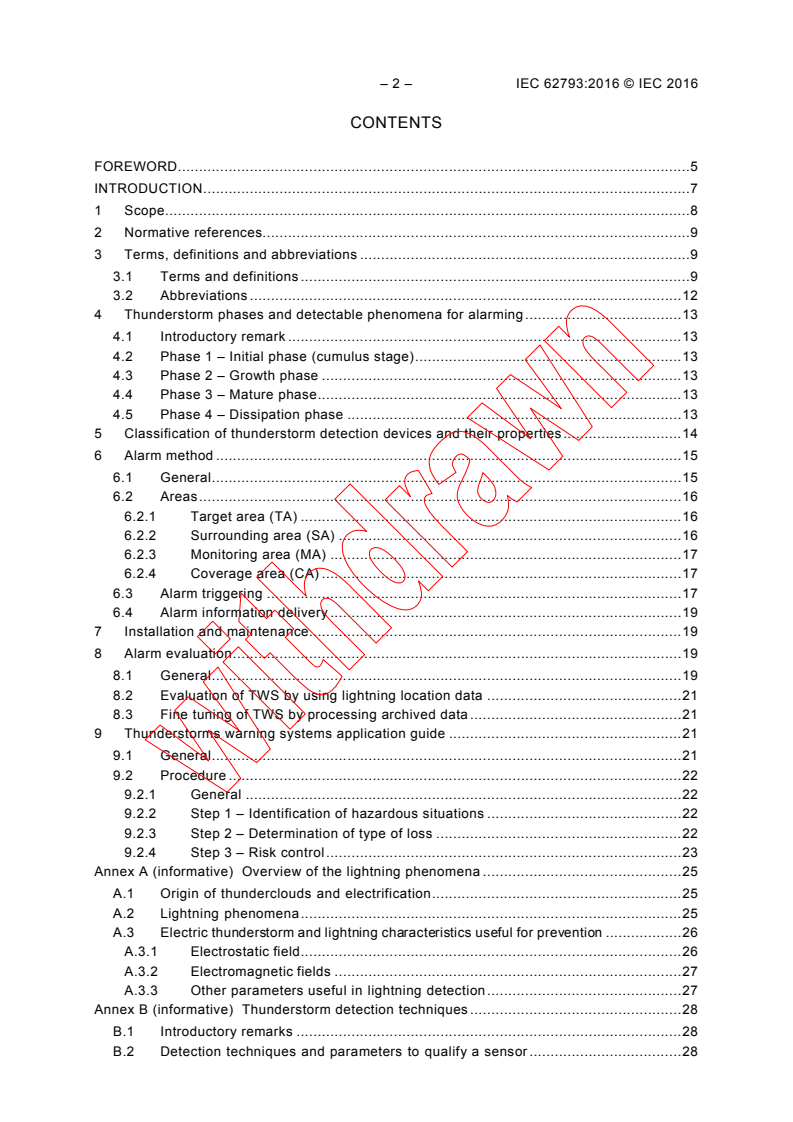
IEC 62793:2016 - Protection against lightning - Thunderstorm warning systems - defines the characteristics, capabilities and application of thunderstorm warning systems (TWS) that supply real‑time lightning and storm electrification data. The standard sets basic requirements for lightning sensors, sensor networks and data products used to implement lightning hazard preventive measures, including real‑time warnings and archived lightning tracks and range information. This bilingual version (2018‑11) corresponds to the monolingual English edition published in 2016‑05.
Key topics and technical requirements
- Sensor and network requirements: minimum characteristics for sensors and networks that collect accurate lightning‑relevant parameters and provide real‑time data.
- Detection classes and techniques: classification of detector types (multiple detection techniques and location methods) and their measurable properties.
- Thunderstorm phases & detectable phenomena: identification of cloud stages (cumulus, growth, mature, dissipation) and related electrical signatures useful for alarms.
- Alarm method & areas: definitions of Target Area (TA), Surrounding Area (SA), Monitoring Area (MA) and Coverage Area (CA), plus rules for alarm triggering and message delivery.
- Installation, maintenance & testing: guidance on siting, commissioning, maintenance and laboratory/field tests for detectors and systems.
- Alarm evaluation & tuning: methods to evaluate system usefulness using real‑time and archived lightning location data, contingency analysis and parameter fine‑tuning.
- Application guidance: a practical three‑step procedure for identifying hazardous situations, determining types of loss (people, goods, services, environment) and selecting risk controls.
- Informative annexes: technical background on lightning phenomena, detector evaluation, application examples (telecom towers, golf courses, wind turbines) and recommended preventive actions.
Practical applications and users
IEC 62793 is intended for organizations that design, procure, operate or rely on thunderstorm warning systems:
- Infrastructure operators: power utilities, telecom and broadcasting towers, wind farms, and airports.
- Public safety & event managers: parks, sports facilities, outdoor events and construction sites.
- Meteorological and lightning service providers: developers of lightning detection networks and real‑time warning platforms.
- System integrators & manufacturers: sensor vendors, control system designers and maintenance teams. Practical uses include automated work stoppage protocols, early evacuation alerts, protective switching for sensitive equipment, and post‑event forensic analysis using archived lightning tracks.
Related standards
For comprehensive lightning protection programs, IEC 62793 should be used alongside other IEC and national standards covering lightning protection design, lightning location systems, and surge protection to ensure coordinated hazard mitigation and conformity with regulatory requirements.
Keywords: IEC 62793, thunderstorm warning systems, lightning detection, real‑time lightning data, lightning sensors, lightning hazard prevention, lightning warning systems.
Relations
- Effective Date
- 05-Sep-2023
Buy Documents
IEC 62793:2016 - Protection against lightning - Thunderstorm warning systems Released:5/12/2016
IEC 62793:2016 - Protection against lightning - Thunderstorm warning systems Released:11/27/2018
Get Certified
Connect with accredited certification bodies for this standard

DIBt (Deutsches Institut für Bautechnik)
German Institute for Building Technology.
DIN CERTCO
DIN Group product certification.

IMQ S.p.A. (Certification)
Italian electrical product certification.
Sponsored listings
Frequently Asked Questions
IEC 62793:2016 is a standard published by the International Electrotechnical Commission (IEC). Its full title is "Protection against lightning - Thunderstorm warning systems". This standard covers: IEC 62793:2016 describes the characteristics of thunderstorm warning systems and evaluation of the usefulness of lightning real time data and/or storm electrification data in order to implement lightning hazard preventive measures. This standard provides the basic requirements for sensors and networks collecting accurate data of the relevant parameters, giving real-time information of lightning tracks and range. It describes the application of the data collected by these sensors and networks in the form of warnings and historical data. This standard applies to the use of information from thunderstorm warning systems (systems or equipment providing real-time information) on atmospheric electric activity in order to monitor preventive measures. This bilingual version (2018-11) corresponds to the monolingual English version, published in 2016-05. The French version of this standard has not been voted upon.
IEC 62793:2016 describes the characteristics of thunderstorm warning systems and evaluation of the usefulness of lightning real time data and/or storm electrification data in order to implement lightning hazard preventive measures. This standard provides the basic requirements for sensors and networks collecting accurate data of the relevant parameters, giving real-time information of lightning tracks and range. It describes the application of the data collected by these sensors and networks in the form of warnings and historical data. This standard applies to the use of information from thunderstorm warning systems (systems or equipment providing real-time information) on atmospheric electric activity in order to monitor preventive measures. This bilingual version (2018-11) corresponds to the monolingual English version, published in 2016-05. The French version of this standard has not been voted upon.
IEC 62793:2016 is classified under the following ICS (International Classification for Standards) categories: 01 - GENERALITIES. TERMINOLOGY. STANDARDIZATION. DOCUMENTATION; 29.020 - Electrical engineering in general; 91.120.40 - Lightning protection. The ICS classification helps identify the subject area and facilitates finding related standards.
IEC 62793:2016 has the following relationships with other standards: It is inter standard links to IEC 62793:2020. Understanding these relationships helps ensure you are using the most current and applicable version of the standard.
IEC 62793:2016 is available in PDF format for immediate download after purchase. The document can be added to your cart and obtained through the secure checkout process. Digital delivery ensures instant access to the complete standard document.
Standards Content (Sample)
IEC 62793 ®
Edition 1.0 2016-05
INTERNATIONAL
STANDARD
colour
inside
Protection against lightning – Thunderstorm warning systems
All rights reserved. Unless otherwise specified, no part of this publication may be reproduced or utilized in any form
or by any means, electronic or mechanical, including photocopying and microfilm, without permission in writing from
either IEC or IEC's member National Committee in the country of the requester. If you have any questions about IEC
copyright or have an enquiry about obtaining additional rights to this publication, please contact the address below or
your local IEC member National Committee for further information.
IEC Central Office Tel.: +41 22 919 02 11
3, rue de Varembé Fax: +41 22 919 03 00
CH-1211 Geneva 20 info@iec.ch
Switzerland www.iec.ch
About the IEC
The International Electrotechnical Commission (IEC) is the leading global organization that prepares and publishes
International Standards for all electrical, electronic and related technologies.
About IEC publications
The technical content of IEC publications is kept under constant review by the IEC. Please make sure that you have the
latest edition, a corrigenda or an amendment might have been published.
IEC Catalogue - webstore.iec.ch/catalogue Electropedia - www.electropedia.org
The stand-alone application for consulting the entire The world's leading online dictionary of electronic and
bibliographical information on IEC International Standards, electrical terms containing 20 000 terms and definitions in
Technical Specifications, Technical Reports and other English and French, with equivalent terms in 15 additional
documents. Available for PC, Mac OS, Android Tablets and languages. Also known as the International Electrotechnical
iPad. Vocabulary (IEV) online.
IEC publications search - www.iec.ch/searchpub IEC Glossary - std.iec.ch/glossary
The advanced search enables to find IEC publications by a 65 000 electrotechnical terminology entries in English and
variety of criteria (reference number, text, technical French extracted from the Terms and Definitions clause of
committee,…). It also gives information on projects, replaced IEC publications issued since 2002. Some entries have been
and withdrawn publications. collected from earlier publications of IEC TC 37, 77, 86 and
CISPR.
IEC Just Published - webstore.iec.ch/justpublished
Stay up to date on all new IEC publications. Just Published IEC Customer Service Centre - webstore.iec.ch/csc
details all new publications released. Available online and If you wish to give us your feedback on this publication or
also once a month by email. need further assistance, please contact the Customer Service
Centre: csc@iec.ch.
IEC 62793 ®
Edition 1.0 2016-05
INTERNATIONAL
STANDARD
colour
inside
Protection against lightning – Thunderstorm warning systems
INTERNATIONAL
ELECTROTECHNICAL
COMMISSION
ICS 29.020; 91.120.40 ISBN 978-2-8322-3352-8
– 2 – IEC 62793:2016 © IEC 2016
CONTENTS
FOREWORD . 5
INTRODUCTION . 7
1 Scope . 8
2 Normative references. 9
3 Terms, definitions and abbreviations . 9
3.1 Terms and definitions . 9
3.2 Abbreviations . 12
4 Thunderstorm phases and detectable phenomena for alarming . 13
4.1 Introductory remark . 13
4.2 Phase 1 – Initial phase (cumulus stage) . 13
4.3 Phase 2 – Growth phase . 13
4.4 Phase 3 – Mature phase . 13
4.5 Phase 4 – Dissipation phase . 13
5 Classification of thunderstorm detection devices and their properties . 14
6 Alarm method . 15
6.1 General . 15
6.2 Areas . 16
6.2.1 Target area (TA) . 16
6.2.2 Surrounding area (SA) . 16
6.2.3 Monitoring area (MA) . 17
6.2.4 Coverage area (CA) . 17
6.3 Alarm triggering . 17
6.4 Alarm information delivery . 19
7 Installation and maintenance . 19
8 Alarm evaluation . 19
8.1 General . 19
8.2 Evaluation of TWS by using lightning location data . 21
8.3 Fine tuning of TWS by processing archived data . 21
9 Thunderstorms warning systems application guide . 21
9.1 General . 21
9.2 Procedure . 22
9.2.1 General . 22
9.2.2 Step 1 – Identification of hazardous situations . 22
9.2.3 Step 2 – Determination of type of loss . 22
9.2.4 Step 3 – Risk control . 23
Annex A (informative) Overview of the lightning phenomena . 25
A.1 Origin of thunderclouds and electrification . 25
A.2 Lightning phenomena . 25
A.3 Electric thunderstorm and lightning characteristics useful for prevention . 26
A.3.1 Electrostatic field . 26
A.3.2 Electromagnetic fields . 27
A.3.3 Other parameters useful in lightning detection . 27
Annex B (informative) Thunderstorm detection techniques . 28
B.1 Introductory remarks . 28
B.2 Detection techniques and parameters to qualify a sensor . 28
B.2.1 General . 28
B.2.2 Class A . 28
B.2.3 Class B . 29
B.2.4 Class C . 29
B.2.5 Class D . 29
B.3 Location techniques . 29
B.3.1 General . 29
B.3.2 Multi-sensor location techniques . 29
B.3.3 Single sensor techniques . 30
B.4 Thunderstorm detectors evaluation . 31
B.5 Choosing a thunderstorm detection system . 31
Annex C (informative) Examples of application of thunderstorm warning systems . 32
C.1 Example n° 1 – Telecommunication tower . 32
C.1.1 Step 1: Identification of hazardous situations . 32
C.1.2 Step 2: Determination of type of loss . 32
C.1.3 Step 3: Risk control . 33
C.2 Example n° 2 – Golf course . 33
C.2.1 Step 1: Identification of hazardous situations . 33
C.2.2 Step 2: Determination of type of loss . 34
C.2.3 Step 3: Risk control . 35
Annex D (informative) Catalogue of possible recommended preventive actions to be
taken . 36
Annex E (informative) Example of TWS evaluation on a wind turbine site . 38
Annex F (informative) How to test thunderstorm detectors . 40
F.1 General . 40
F.2 Laboratory tests . 40
F.2.1 General . 40
F.2.2 Resistance to UV radiation tests (for non-metallic sensor housing) . 40
F.2.3 Resistance tests to corrosion (for metallic parts of sensor) . 41
F.2.4 Mechanical tests . 41
F.2.5 Index of protection confirmation (IP Code) . 42
F.2.6 Electric tests . 42
F.2.7 Marking test . 43
F.2.8 Electromagnetic compatibility (EMC) . 43
F.3 Optional tests on an open air platform under natural lightning conditions . 43
Bibliography . 47
Figure 1 – Examples of different target area shapes . 16
Figure 2 – Example of the distribution of the coverage area (CA), the monitoring area
(MA), the target area (TA), and surrounding area (SA) . 17
Figure 3 – Example of an alarm . 18
Figure A.1 – Standard lightning classifications . 26
Figure D.1 – Procedure flow chart . 37
Figure E.1 – Lightning activity around the site for a period of eight years . 38
Figure F.1 – Difference in electric field measurement during one thunderstorm event . 45
Table 1 – Lightning detector properties . 15
– 4 – IEC 62793:2016 © IEC 2016
Table 2 – Contingency table . 20
Table 3 – Identification of hazardous situations . 22
Table 4 – Loss concerning people . 23
Table 5 – Loss concerning goods . 23
Table 6 – Loss concerning services . 23
Table 7 – Loss concerning environment. 23
Table 8 – Risk control . 24
Table C.1 – Identification of hazardous situations . 32
Table C.2 – Loss concerning goods . 32
Table C.3 – Loss concerning services . 33
Table C.4 – Loss concerning environment . 33
Table C.5 – Risk control . 33
Table C.6 – Identification of hazardous situations . 34
Table C.7 – Loss concerning people . 34
Table C.8 – Loss concerning goods . 34
Table C.9 – Loss concerning services . 34
Table C.10 – Loss concerning environment . 35
Table C.11 – Risk control . 35
Table E.1 – Results of TWS evaluation based on archived lightning data for an 8-year
period (2000 to 2007), when some of the key parameters (size of MA, trigger
parameters and dwell time) were varied . 39
INTERNATIONAL ELECTROTECHNICAL COMMISSION
____________
PROTECTION AGAINST LIGHTNING –
THUNDERSTORM WARNING SYSTEMS
FOREWORD
1) The International Electrotechnical Commission (IEC) is a worldwide organization for standardization comprising
all national electrotechnical committees (IEC National Committees). The object of IEC is to promote
international co-operation on all questions concerning standardization in the electrical and electronic fields. To
this end and in addition to other activities, IEC publishes International Standards, Technical Specifications,
Technical Reports, Publicly Available Specifications (PAS) and Guides (hereafter referred to as “IEC
Publication(s)”). Their preparation is entrusted to technical committees; any IEC National Committee interested
in the subject dealt with may participate in this preparatory work. International, governmental and non-
governmental organizations liaising with the IEC also participate in this preparation. IEC collaborates closely
with the International Organization for Standardization (ISO) in accordance with conditions determined by
agreement between the two organizations.
2) The formal decisions or agreements of IEC on technical matters express, as nearly as possible, an international
consensus of opinion on the relevant subjects since each technical committee has representation from all
interested IEC National Committees.
3) IEC Publications have the form of recommendations for international use and are accepted by IEC National
Committees in that sense. While all reasonable efforts are made to ensure that the technical content of IEC
Publications is accurate, IEC cannot be held responsible for the way in which they are used or for any
misinterpretation by any end user.
4) In order to promote international uniformity, IEC National Committees undertake to apply IEC Publications
transparently to the maximum extent possible in their national and regional publications. Any divergence
between any IEC Publication and the corresponding national or regional publication shall be clearly indicated in
the latter.
5) IEC itself does not provide any attestation of conformity. Independent certification bodies provide conformity
assessment services and, in some areas, access to IEC marks of conformity. IEC is not responsible for any
services carried out by independent certification bodies.
6) All users should ensure that they have the latest edition of this publication.
7) No liability shall attach to IEC or its directors, employees, servants or agents including individual experts and
members of its technical committees and IEC National Committees for any personal injury, property damage or
other damage of any nature whatsoever, whether direct or indirect, or for costs (including legal fees) and
expenses arising out of the publication, use of, or reliance upon, this IEC Publication or any other IEC
Publications.
8) Attention is drawn to the Normative references cited in this publication. Use of the referenced publications is
indispensable for the correct application of this publication.
9) Attention is drawn to the possibility that some of the elements of this IEC Publication may be the subject of
patent rights. IEC shall not be held responsible for identifying any or all such patent rights.
International Standard IEC 62793 has been prepared by IEC technical committee 81:
Lightning protection.
The text of this standard is based on the following documents:
FDIS Report on voting
81/508/FDIS 81/519/RVD
Full information on the voting for the approval of this standard can be found in the report on
voting indicated in the above table.
This publication has been drafted in accordance with the ISO/IEC Directives, Part 2.
– 6 – IEC 62793:2016 © IEC 2016
The committee has decided that the contents of this publication will remain unchanged until
the stability date indicated on the IEC website under "http://webstore.iec.ch" in the data
related to the specific publication. At this date, the publication will be
• reconfirmed,
• withdrawn,
• replaced by a revised edition, or
• amended.
A bilingual version of this publication may be issued at a later date.
IMPORTANT – The 'colour inside' logo on the cover page of this publication indicates
that it contains colours which are considered to be useful for the correct
understanding of its contents. Users should therefore print this document using a
colour printer.
INTRODUCTION
Natural atmospheric electric activity and, in particular, cloud-to-ground lightning poses a
serious threat to living beings and property. Every year severe injuries and even deaths of
humans are caused as a result of direct or indirect lightning strikes.
Lightning:
• may affect sport, cultural and political events attracting large concentrations of people;
events may have to be suspended and people evacuated in the case of a risk of
thunderstorm;
• may affect industrial activities by creating power outages and unplanned interruptions of
production processes;
• may interrupt all kinds of traffic (people, energy, information, etc.);
• has led to a steady increase in the number of accidents per year due to the wider use of
electric components that are sensitive to the effects of lightning (in industry, transportation
and communication);
• may be a hazard for activities with an environmental risk, for example handling of sensitive,
inflammable, explosive or chemical products;
• may be a cause of fire.
During the last decades, technical systems including systems devoted to real-time monitoring
of natural atmospheric electric activity and lightning, have experienced an extraordinary
development. These systems can provide high quality and valuable information in real-time of
the thunderstorm occurrence, making it possible to achieve information which can be
extremely valuable if coordinated with a detailed plan of action.
Although this information allows the user to adopt anticipated temporary preventive measures,
it should be noted that all the measures to be taken based on monitoring information are the
responsibility of the system user according to the relevant regulations. The effectiveness will
depend largely on the risk involved and the planned decisions to be taken. This International
Standard gives an informative list of possible actions.
Lightning and thunderstorms, as with many natural phenomena, are subject to statistical
uncertainty. It is not possible therefore to achieve precise information on when and where
lightning will strike.
Other lightning protection standards do not cover the use of thunderstorm warning systems.
– 8 – IEC 62793:2016 © IEC 2016
PROTECTION AGAINST LIGHTNING –
THUNDERSTORM WARNING SYSTEMS
1 Scope
This International Standard describes the characteristics of thunderstorm warning systems
and evaluation of the usefulness of lightning real time data and/or storm electrification data in
order to implement lightning hazard preventive measures.
This standard provides the basic requirements for sensors and networks collecting accurate
data of the relevant parameters, giving real-time information of lightning tracks and range. It
describes the application of the data collected by these sensors and networks in the form of
warnings and historical data.
This standard applies to the use of information from thunderstorm warning systems (systems
or equipment providing real-time information) on atmospheric electric activity in order to
monitor preventive measures.
This standard includes:
• a general description of available lightning and storm electrification hazard warning
systems;
• a classification of thunderstorm detection devices and properties;
• guidelines for alarming methods;
• a procedure to determine the usefulness of thunderstorm information;
• some informative examples of possible preventive actions.
The following aspects are outside the scope of this standard:
a) lightning protection systems; such systems are covered by the IEC 62305 series;
b) other thunderstorm related phenomena such as rain, hail, wind;
c) satellite and radar thunderstorm detection techniques.
A non-exhaustive list of situations to which this standard could be applicable is given below:
• people in open areas involved in activities such as maintenance, labour, sports,
competitions, agriculture and fisheries or situations where large crowds gather;
• wind farms, large solar power systems, power lines;
• occupational health and safety prevention;
• sensitive equipment such as computer systems, emergency systems, alarms and safety
equipment;
• operational and industrial processes;
• storage, processing and transportation of hazardous substances (e.g. flammable,
radioactive, toxic and explosive substances);
• determined environments or activities with special danger of electrostatic discharges (e.g.
space and flight vehicle operations);
• operations in which the continuity of the basic services is very important (e.g.
telecommunications, the generation, transport and distribution of energy, sanitary services
and emergency services);
• infrastructures: ports, airports, railroads, motorways and cableways;
• civil defense of the environment: forest fires, land slide and floods;
• wide networks (e.g. power lines, telecommunication lines) may also benefit from having
early detection of thunderstorms.
2 Normative references
The following documents, in whole or in part, are normatively referenced in this document and
are indispensable for its application. For dated references, only the edition cited applies. For
undated references, the latest edition of the referenced document (including any
amendments) applies.
IEC 62305 (all parts), Protection against lightning
3 Terms, definitions and abbreviations
3.1 Terms and definitions
For the purposes of this document, the following terms and definitions apply.
3.1.1
alarm
information indicating that the target or the surrounding area is likely to be affected by
thunderstorms and the accompanying lightning related events
3.1.2
cloud-to-ground lightning
CG
electric discharge of atmospheric origin that is comprised of one or more cloud-to-ground
lightning strokes that propagate from cloud to ground or vice versa and lead to a net transfer
of charge between cloud and ground
3.1.3
coverage area
CA
area where a given warning equipment has a sufficient detection efficiency and/or accuracy to
give a warning
3.1.4
detection efficiency
DE
percentage of cloud-to-ground discharges (flashes or strokes) that are detected and located
by a sensor or a network
Note 1 to entry: As cloud-to-ground flashes are often composed of several strokes, there is a difference between
flash detection efficiency and stroke detection efficiency. A flash is reported (detected) if at least one stroke (first
or subsequent) is detected and therefore flash detection efficiency is always equal or higher than stroke detection
efficiency.
3.1.5
dwell time
DT
time that an alarm is sustained after all warning criteria are no longer met
3.1.6
effective alarm
EA
alarm where a lightning related event occurs in the surrounding area during the total alarm
duration
– 10 – IEC 62793:2016 © IEC 2016
3.1.7
time to clear
TTC
time between the occurrence of the last lightning related event in the monitoring area and the
time when the alarm is released
3.1.8
failure to warn
FTW
occurrence of a lightning related event in the surrounding area for which no alarm occurred
3.1.9
failure to warn ratio
FTWR
ratio of failure to warn with respect to the total number of situations with lightning related
events affecting the surrounding area
3.1.10
false alarm
FA
alarm not followed by lightning-related events within the surrounding area
3.1.11
false alarm ratio
false alarm rate
FAR
ratio of false alarms to the total number of alarms
3.1.12
field strength meter
FSM
device for continuous monitoring of the atmospheric electrostatic field associated with
thunderstorms
EXAMPLE: Field mill.
3.1.13
cloud lightning
IC
discharge occurring within or among thunderclouds or between thunderclouds and air and
which does not have a ground termination
3.1.14
lead time
LT
time between the start of an alarm and the effective occurrence of the first lightning related
event in the target area
3.1.15
lightning flash
electric discharge of atmospheric origin consisting of one or more strokes
Note 1 to entry: This discharge may occur within or between clouds, between the clouds and air and between a
cloud and the ground.
3.1.16
lightning related event
LRE
CG lightning flash to or near the structure to be protected, or to or near a line connected to
the structure to be protected
3.1.17
lightning stroke
single electric discharge in a lightning flash to earth
3.1.18
median location accuracy
LA
median value of the distances between real stroke locations and the stroke locations given by
the lightning location system
3.1.19
monitoring area
MA
geographic area where the lightning activity is monitored in order to provide a valid warning
for the target area
3.1.20
physical damage
damage to a structure (or to its contents) due to mechanical, thermal, chemical or explosive
effects of lightning
3.1.21
preventive actions
actions of a temporary nature, taken on the basis of the preventive information and framed
within the emergency plans of each organization which covers all that is required
3.1.22
point of strike
point where a lightning flash strikes the earth or protruding objects (e.g. structure, lightning
protection system, line, tree)
Note 1 to entry: A lightning flash may have more than one point of strike.
3.1.23
surrounding area
SA
geographic area in which a lightning related event (LRE) causes a potential danger and which
surrounds and includes the target area (TA)
Note 1 to entry: Any lightning related event occurring in the surrounding area is potentially dangerous. This area
is used when evaluating a thunderstorm warning system to determine the false alarm ratio and other performance
parameters.
3.1.24
target area
TA
geographic area where a warning is needed in order to facilitate decision-making and to
activate preventive actions before a lightning related event occurs in that area
3.1.25
thunderstorm
local storm produced by atmospheric activity and accompanied by lightning and thunder
3.1.26
thunderstorm detector
equipment capable of evaluating one or more parameters associated with the electrical
characteristics of the thunderstorm
Note 1 to entry: Thunderstorm detectors may consist of a single detector or of a network of connected detectors.
– 12 – IEC 62793:2016 © IEC 2016
3.1.27
thunderstorm warning system
TWS
system composed of thunderstorm detectors able to monitor the thunderstorm activity in the
monitoring area and means of processing the acquired data to provide a valid alarm (warning)
related to the lightning related events for a defined target area
Note 1 to entry: Some countries refer to TWS as ‘lightning warning systems’.
3.1.28
total alarm duration
TAD
time between triggering and the end of an alarm
3.1.29
percentage of alarms delivered
POD
x
percentage of alarms delivered with a lead time of more than or equal to x minutes
EXAMPLE: POD is the percentage of alarms delivered with a lead time of more than or equal to 10 min.
3.2 Abbreviations
CA Coverage area
CG Cloud to ground
DC Direct current
DE Detection efficiency
DT Dwell time
EA Effective alarm
EMC Electromagnetic compatibility
EMI Electromagnetic interference
FA False alarm
FAR False alarm ratio
FSM Field strength meter
FTW Failure to warn
FTWR Failure to warn ratio
HV High voltage
IC Intercloud, intracloud or cloud to air discharges
IP Index of protection
LA Location accuracy
LF Low frequencies
LLS Lightning location system
LPS Lightning protective system
LT Lead time
LRE Lightning related event
MA Monitoring area
MCS Mesoscale convective systems
MDF Magnetic duration finder
OI Optical imaging
POD Percentage of alarms delivered
x
RFI Radio frequency interferometry
RFM RF signal strength measurement
RF Radio frequency
SA Surrounding area
TA Target area
TAD Total alarm duration
TOA Time of arrival
TTC Time to clear
TWS Thunderstorm warning system
UV Ultraviolet
VHF Very high frequencies
VLF Very low frequencies
4 Thunderstorm phases and detectable phenomena for alarming
4.1 Introductory remark
Four distinct stages can be identified during the thunderstorm life time cycle regarding
detectable phenomena:
1) initial phase;
2) growth phase;
3) mature phase;
4) dissipation phase.
4.2 Phase 1 – Initial phase (cumulus stage)
This is the phase of cloud electrification by means of electric charge separation within the
cloud. The charges are distributed in regions within the cloud and produce a measurable
electrostatic field at ground level. It is considered the first detectable phenomenon before a
thunderstorm.
NOTE Electrostatic fields can produce potential dangers such as electrostatic discharges even in the case of no
lightning activity.
4.3 Phase 2 – Growth phase
This phase, sometimes also called the development phase, is characterized by the
occurrence of the first lightning discharge (IC or CG). The first intra-cloud (IC) flashes appear
after a certain development of the charge regions in the cloud. However, in some situations
there is no clear time delay between the first IC flash and the first CG flash.
NOTE IC flashes typically represent the majority of the total lightning activity generated by a thunderstorm.
Significant variation in the IC/CG rate is observed for individual storms.
4.4 Phase 3 – Mature phase
This stage is characterized by the presence of both CG and IC flashes.
4.5 Phase 4 – Dissipation phase
This phase is characterized by the decaying of both IC and CG flash rates and the reduction
of the electrostatic field to the fair weather level.
– 14 – IEC 62793:2016 © IEC 2016
5 Classification of thunderstorm detection devices and their properties
Portable devices (a device where the sensor is not fixed) are outside the scope of this
standard (calibration and testing for these devices may not be sufficient to provide efficient
warning).
Thunderstorm detectors are classified in accordance with the detectable thunderstorm phases
depending on the detectable phenomena. However, a thunderstorm detector can detect one
or several phenomena.
There are several ways to look at the means to detect thunderstorms in general, and lightning
strikes in particular. One way is to look at the phase of the thunderstorm for which a detector
is designed to operate. Another way is to compare the frequency range of the electromagnetic
radiation emitted by a lightning strike with the frequency range detectable by a sensor. A third
way is to look at techniques that a sensor uses to detect a lightning strike and to calculate its
position.
For the classification of thunderstorm or lightning strike detectors the following classes are
defined:
• class A: detect a thunderstorm over its entire lifecycle (phases 1 through 4);
• class B: detect IC and CG flashes (phases 2 through 4);
• class C: detect CG flashes only (phases 3 and 4);
• class D: detect CG flashes (phase 3) and other electromagnetic sources with very limited
efficiency.
The classes are explained in more detail in Annex B. The classes are not related to the
efficiency of the system.
The frequency ranges that are used in lightning detection are as follows:
• DC: static and quasi static electric fields;
• VLF: very low frequencies (3 kHz to 30 kHz);
• LF: low frequencies (30 kHz to 300 kHz);
• VHF: very high frequencies (30 MHz to 300 MHz).
All these phenomena to be measured result in different sensor and location techniques.
Those techniques may be distinguished as follows:
• MDF: magnetic direction finder;
• TOA: time of arrival;
• RFI: radio frequency interferometry;
• FSM: field strength meter;
• RF: radio frequency signal strength measurements.
This list is not exhaustive.
These detection techniques are described in some detail in Clause B.2.
Table 1 shows the connection between the frequency range in which a detector may operate
and the phases, classes and typical ranges of operation for those detectors.
Table 1 – Lightning detector properties
Typical
Physical
Main Secondary sensor
Technique detectable Frequency Phase(s) Application
class class range
phenomenon
km
FSM Electrification DC 1, 2, 3, 4 A 20 Short range early
process warning systems
MDF Electric charges VLF 2, 3 C B No limit Low detection efficiency
motion and location accuracy –
very long range
detection
MDF, TOA Electromagnetic LF 2, 3 C B 600 to Long range – high
radiation (lightning 900 location accuracy for CG
current) detection. A fraction of
IC processes are also
detected
TOA Breakdown and VHF 2, 3 B C 200 Medium range – high
leader processes location accuracy for
(IC/CG) both CG and IC
RFI Breakdown and VHF 2, 3 B C 300 Medium range – high
leader processes location accuracy for
(IC/CG) both CG and IC
RF Electromagnetic LF 3 D 100 Meteorological interest
radiation (lightning
current)
NOTE The main class is the class for which the detector is designed. The secondary class is the class or the
classes for which the sensor is also appropriate.
TWS may also be classified based on their detection range (typically from a few km to 500 km
or more).
More information on the properties and guidance in choosing a sensor for a certain purpose is
given in Annex B.
6 Alarm method
6.1 General
In order to let the user take all possible preventive actions, a thunderstorm warning system
(TWS) shall provide an alarm for a target area where the lightning related event (LRE)
represents a threat. The identification of the lightning related event (LRE) is deduced from the
description of dangerous situations provided in Clause 9. An alarm derives from monitoring
the lightning activity, either or both CG and IC but also other parameters such as the
electrostatic field in the monitoring area (MA). Combinations with additional meteorological
observations are usually employed (e.g. meteorological radar). For detection systems able to
provide mapping information (lightning detection networks, radars, etc.) it is possible to track
potentially dangerous thunderstorm cells thus improving the performance of TWS. Information
about TWS is given in Annex B.
The set-up of an alarm includes three steps:
• areas definitions;
• alarm triggering criteria;
• alarm information delivery.
All three steps should be documented. Guidelines to set up an alarm are presented in this
Clause 6 and some examples are included in Annex E.
– 16 – IEC 62793:2016 © IEC 2016
6.2 Areas
6.2.1 Target area (TA)
A precise description of the area should include the physical extension where the warning is
needed. The target area can be limited to a single point (Figure 1a)), for example tower on
which workers are operating, limited size factory or can be extended (e.g. large buildings,
wind farms, golf courses: Figure 1b)). It is however recommended to use larger areas for
safety reasons. In many cases, it may appear simpler to limit the lightning related event (LRE)
to the occurrence of CG flashes and therefore adapt the size and shape of the target area in
order to take into account all possible induced effects. For example, a system sensitive to
overvoltages on the power line can be set up or the occurrence of CG flashes in a target area
encompassing not only the site but also the power line and its vicinity (Figure 1c)). Therefore,
each CG flash occurring in this target area will be treated as a lightning related event (LRE)
able to cause the overvoltage. Thus, the target area also depends on the type of lightning
related event (LRE) and the effects that it could cause (see Clause 7).
TA
TA
TA
IEC IEC IEC
a) Single point b) Arbitrary shape c) Including services
Figure 1 – Examples of different target area shapes
6.2.2 Surrounding area (SA)
In the process of evaluating a TWS it is advisable to introduce a surrounding area (SA)
encompassing the target area as shown in Figure 2 in order to confirm the efficiency of the
alarm. Where the target area receives a warning even though it does not see an LRE, the
occurrence of an LRE in the close neighborhood of the target area (as defined by the
surrounding area) indicates that the risk is high and this situation should not be treated as a
false alarm (FA). On the other hand, a target area receiving a warning with no LRE being
recorded, clearly indicates a malfunction of the equipment and should be treated as a false
alarm (FA). Moreover, the introduction of the surrounding area (SA) allows for taking into
account the limited location accuracy (LA) of the validation data set.
CA
MA
SA
TA
IEC
Figure 2 – Example of the distribution of the coverage area (CA),
the monitoring area (MA), the target area (TA), and surrounding area (SA)
6.2.3 Monitoring area (MA)
The size and the shape of the monitoring area should be adjusted according to the type of the
TWS (see Annex B), its capabilities (see Annex B, e.g. detection efficiency and location
accuracy), the shape of the target area, the objectives and the performance of the alarm
system.
6.2.4 Coverage area (CA)
Once the monitoring area (MA) is defined, the detection system should have a coverage area
(CA) that includes the monitoring area (MA). When the coverage area (CA) does not cover the
whole monitoring area (MA) necessary to elaborate a reliable warning on the target area, it
will be essential to juxtapose several elementary systems. The detection efficiency (DE)
and/or the location accuracy (LA) of the detection system within the range of the monitoring
area (MA) should be known and their influence on the alarm performance should be
considered.
Generally, for detection networks, MA = CA.
6.3 Alarm triggering
In general, an alarm is triggered when the monitored information provided by the TWS is
detected within the monitoring area (MA). The criteria of triggering should be defined and
depends on the characteristics of the TWS and its performance within the monitoring area
(MA) (e.g. one or several CG flashes, one or several IC flashes, a certain electrostatic field
level, electrostatic field polarity and combinations of some criteria).
An example of a timing of a
...
IEC 62793 ®
Edition 1.0 2016-05
INTERNATIONAL
STANDARD
NORME
INTERNATIONALE
colour
inside
Protection against lightning – Thunderstorm warning systems
Protection contre la foudre – Systèmes d'alerte aux orages
All rights reserved. Unless otherwise specified, no part of this publication may be reproduced or utilized in any form
or by any means, electronic or mechanical, including photocopying and microfilm, without permission in writing from
either IEC or IEC's member National Committee in the country of the requester. If you have any questions about IEC
copyright or have an enquiry about obtaining additional rights to this publication, please contact the address below or
your local IEC member National Committee for further information.
Droits de reproduction réservés. Sauf indication contraire, aucune partie de cette publication ne peut être reproduite
ni utilisée sous quelque forme que ce soit et par aucun procédé, électronique ou mécanique, y compris la photocopie
et les microfilms, sans l'accord écrit de l'IEC ou du Comité national de l'IEC du pays du demandeur. Si vous avez des
questions sur le copyright de l'IEC ou si vous désirez obtenir des droits supplémentaires sur cette publication, utilisez
les coordonnées ci-après ou contactez le Comité national de l'IEC de votre pays de résidence.
IEC Central Office Tel.: +41 22 919 02 11
3, rue de Varembé info@iec.ch
CH-1211 Geneva 20 www.iec.ch
Switzerland
About the IEC
The International Electrotechnical Commission (IEC) is the leading global organization that prepares and publishes
International Standards for all electrical, electronic and related technologies.
About IEC publications
The technical content of IEC publications is kept under constant review by the IEC. Please make sure that you have the
latest edition, a corrigenda or an amendment might have been published.
IEC Catalogue - webstore.iec.ch/catalogue Electropedia - www.electropedia.org
The stand-alone application for consulting the entire The world's leading online dictionary of electronic and
bibliographical information on IEC International Standards, electrical terms containing 21 000 terms and definitions in
Technical Specifications, Technical Reports and other English and French, with equivalent terms in 16 additional
documents. Available for PC, Mac OS, Android Tablets and languages. Also known as the International Electrotechnical
iPad. Vocabulary (IEV) online.
IEC publications search - webstore.iec.ch/advsearchform IEC Glossary - std.iec.ch/glossary
The advanced search enables to find IEC publications by a 67 000 electrotechnical terminology entries in English and
variety of criteria (reference number, text, technical French extracted from the Terms and Definitions clause of
committee,…). It also gives information on projects, replaced IEC publications issued since 2002. Some entries have been
and withdrawn publications. collected from earlier publications of IEC TC 37, 77, 86 and
CISPR.
IEC Just Published - webstore.iec.ch/justpublished
Stay up to date on all new IEC publications. Just Published IEC Customer Service Centre - webstore.iec.ch/csc
details all new publications released. Available online and If you wish to give us your feedback on this publication or
also once a month by email. need further assistance, please contact the Customer Service
Centre: sales@iec.ch.
A propos de l'IEC
La Commission Electrotechnique Internationale (IEC) est la première organisation mondiale qui élabore et publie des
Normes internationales pour tout ce qui a trait à l'électricité, à l'électronique et aux technologies apparentées.
A propos des publications IEC
Le contenu technique des publications IEC est constamment revu. Veuillez vous assurer que vous possédez l’édition la
plus récente, un corrigendum ou amendement peut avoir été publié.
Catalogue IEC - webstore.iec.ch/catalogue Electropedia - www.electropedia.org
Application autonome pour consulter tous les renseignements
Le premier dictionnaire en ligne de termes électroniques et
bibliographiques sur les Normes internationales,
électriques. Il contient 21 000 termes et définitions en anglais
Spécifications techniques, Rapports techniques et autres
et en français, ainsi que les termes équivalents dans 16
documents de l'IEC. Disponible pour PC, Mac OS, tablettes
langues additionnelles. Egalement appelé Vocabulaire
Android et iPad.
Electrotechnique International (IEV) en ligne.
Recherche de publications IEC -
Glossaire IEC - std.iec.ch/glossary
webstore.iec.ch/advsearchform
67 000 entrées terminologiques électrotechniques, en anglais
La recherche avancée permet de trouver des publications IEC et en français, extraites des articles Termes et Définitions des
en utilisant différents critères (numéro de référence, texte, publications IEC parues depuis 2002. Plus certaines entrées
comité d’études,…). Elle donne aussi des informations sur les antérieures extraites des publications des CE 37, 77, 86 et
projets et les publications remplacées ou retirées. CISPR de l'IEC.
IEC Just Published - webstore.iec.ch/justpublished Service Clients - webstore.iec.ch/csc
Restez informé sur les nouvelles publications IEC. Just Si vous désirez nous donner des commentaires sur cette
Published détaille les nouvelles publications parues. publication ou si vous avez des questions contactez-nous:
Disponible en ligne et aussi une fois par mois par email. sales@iec.ch.
IEC 62793 ®
Edition 1.0 2016-05
INTERNATIONAL
STANDARD
NORME
INTERNATIONALE
colour
inside
Protection against lightning – Thunderstorm warning systems
Protection contre la foudre – Systèmes d'alerte aux orages
INTERNATIONAL
ELECTROTECHNICAL
COMMISSION
COMMISSION
ELECTROTECHNIQUE
INTERNATIONALE
ICS 29.020; 91.120.40 ISBN 978-2-8322-6231-3
– 2 – IEC 62793:2016 © IEC 2016
CONTENTS
FOREWORD . 5
INTRODUCTION . 7
1 Scope . 8
2 Normative references . 9
3 Terms, definitions and abbreviations . 9
3.1 Terms and definitions . 9
3.2 Abbreviations . 12
4 Thunderstorm phases and detectable phenomena for alarming. 13
4.1 Introductory remark . 13
4.2 Phase 1 – Initial phase (cumulus stage) . 13
4.3 Phase 2 – Growth phase . 13
4.4 Phase 3 – Mature phase . 13
4.5 Phase 4 – Dissipation phase . 13
5 Classification of thunderstorm detection devices and their properties . 14
6 Alarm method . 15
6.1 General . 15
6.2 Areas . 16
6.2.1 Target area (TA) . 16
6.2.2 Surrounding area (SA) . 16
6.2.3 Monitoring area (MA) . 17
6.2.4 Coverage area (CA) . 17
6.3 Alarm triggering . 17
6.4 Alarm information delivery. 19
7 Installation and maintenance . 19
8 Alarm evaluation . 19
8.1 General . 19
8.2 Evaluation of TWS by using lightning location data . 21
8.3 Fine tuning of TWS by processing archived data . 21
9 Thunderstorms warning systems application guide . 21
9.1 General . 21
9.2 Procedure . 22
9.2.1 General . 22
9.2.2 Step 1 – Identification of hazardous situations . 22
9.2.3 Step 2 – Determination of type of loss . 22
9.2.4 Step 3 – Risk control . 23
Annex A (informative) Overview of the lightning phenomena . 25
A.1 Origin of thunderclouds and electrification . 25
A.2 Lightning phenomena . 25
A.3 Electric thunderstorm and lightning characteristics useful for prevention . 26
A.3.1 Electrostatic field . 26
A.3.2 Electromagnetic fields . 27
A.3.3 Other parameters useful in lightning detection . 27
Annex B (informative) Thunderstorm detection techniques . 28
B.1 Introductory remarks . 28
B.2 Detection techniques and parameters to qualify a sensor . 28
B.2.1 General . 28
B.2.2 Class A . 28
B.2.3 Class B . 29
B.2.4 Class C. 29
B.2.5 Class D. 29
B.3 Location techniques . 29
B.3.1 General . 29
B.3.2 Multi-sensor location techniques . 29
B.3.3 Single sensor techniques . 30
B.4 Thunderstorm detectors evaluation . 31
B.5 Choosing a thunderstorm detection system . 31
Annex C (informative) Examples of application of thunderstorm warning systems . 32
C.1 Example n° 1 – Telecommunication tower . 32
C.1.1 Step 1: Identification of hazardous situations . 32
C.1.2 Step 2: Determination of type of loss . 32
C.1.3 Step 3: Risk control . 33
C.2 Example n° 2 – Golf course. 33
C.2.1 Step 1: Identification of hazardous situations . 33
C.2.2 Step 2: Determination of type of loss . 34
C.2.3 Step 3: Risk control . 35
Annex D (informative) Catalogue of possible recommended preventive actions to be
taken . 36
Annex E (informative) Example of TWS evaluation on a wind turbine site . 38
Annex F (informative) How to test thunderstorm detectors . 40
F.1 General . 40
F.2 Laboratory tests . 40
F.2.1 General . 40
F.2.2 Resistance to UV radiation tests (for non-metallic sensor housing) . 40
F.2.3 Resistance tests to corrosion (for metallic parts of sensor) . 41
F.2.4 Mechanical tests . 41
F.2.5 Index of protection confirmation (IP Code) . 42
F.2.6 Electric tests . 42
F.2.7 Marking test . 43
F.2.8 Electromagnetic compatibility (EMC) . 43
F.3 Optional tests on an open air platform under natural lightning conditions . 43
Bibliography . 47
Figure 1 – Examples of different target area shapes . 16
Figure 2 – Example of the distribution of the coverage area (CA), the monitoring area
(MA), the target area (TA), and surrounding area (SA) . 17
Figure 3 – Example of an alarm . 18
Figure A.1 – Standard lightning classifications . 26
Figure D.1 – Procedure flow chart . 37
Figure E.1 – Lightning activity around the site for a period of eight years . 38
Figure F.1 – Difference in electric field measurement during one thunderstorm event . 45
Table 1 – Lightning detector properties . 15
– 4 – IEC 62793:2016 © IEC 2016
Table 2 – Contingency table . 20
Table 3 – Identification of hazardous situations . 22
Table 4 – Loss concerning people . 23
Table 5 – Loss concerning goods . 23
Table 6 – Loss concerning services . 23
Table 7 – Loss concerning environment . 23
Table 8 – Risk control . 24
Table C.1 – Identification of hazardous situations . 32
Table C.2 – Loss concerning goods . 32
Table C.3 – Loss concerning services . 33
Table C.4 – Loss concerning environment . 33
Table C.5 – Risk control . 33
Table C.6 – Identification of hazardous situations . 34
Table C.7 – Loss concerning people . 34
Table C.8 – Loss concerning goods . 34
Table C.9 – Loss concerning services . 34
Table C.10 – Loss concerning environment . 35
Table C.11 – Risk control . 35
Table E.1 – Results of TWS evaluation based on archived lightning data for an 8-year
period (2000 to 2007), when some of the key parameters (size of MA, trigger
parameters and dwell time) were varied . 39
INTERNATIONAL ELECTROTECHNICAL COMMISSION
____________
PROTECTION AGAINST LIGHTNING –
THUNDERSTORM WARNING SYSTEMS
FOREWORD
1) The International Electrotechnical Commission (IEC) is a worldwide organization for standardization comprising
all national electrotechnical committees (IEC National Committees). The object of IEC is to promote
international co-operation on all questions concerning standardization in the electrical and electronic fields. To
this end and in addition to other activities, IEC publishes International Standards, Technical Specifications,
Technical Reports, Publicly Available Specifications (PAS) and Guides (hereafter referred to as “IEC
Publication(s)”). Their preparation is entrusted to technical committees; any IEC National Committee interested
in the subject dealt with may participate in this preparatory work. International, governmental and non-
governmental organizations liaising with the IEC also participate in this preparation. IEC collaborates closely
with the International Organization for Standardization (ISO) in accordance with conditions determined by
agreement between the two organizations.
2) The formal decisions or agreements of IEC on technical matters express, as nearly as possible, an international
consensus of opinion on the relevant subjects since each technical committee has representation from all
interested IEC National Committees.
3) IEC Publications have the form of recommendations for international use and are accepted by IEC National
Committees in that sense. While all reasonable efforts are made to ensure that the technical content of IEC
Publications is accurate, IEC cannot be held responsible for the way in which they are used or for any
misinterpretation by any end user.
4) In order to promote international uniformity, IEC National Committees undertake to apply IEC Publications
transparently to the maximum extent possible in their national and regional publications. Any divergence
between any IEC Publication and the corresponding national or regional publication shall be clearly indicated in
the latter.
5) IEC itself does not provide any attestation of conformity. Independent certification bodies provide conformity
assessment services and, in some areas, access to IEC marks of conformity. IEC is not responsible for any
services carried out by independent certification bodies.
6) All users should ensure that they have the latest edition of this publication.
7) No liability shall attach to IEC or its directors, employees, servants or agents including individual experts and
members of its technical committees and IEC National Committees for any personal injury, property damage or
other damage of any nature whatsoever, whether direct or indirect, or for costs (including legal fees) and
expenses arising out of the publication, use of, or reliance upon, this IEC Publication or any other IEC
Publications.
8) Attention is drawn to the Normative references cited in this publication. Use of the referenced publications is
indispensable for the correct application of this publication.
9) Attention is drawn to the possibility that some of the elements of this IEC Publication may be the subject of
patent rights. IEC shall not be held responsible for identifying any or all such patent rights.
International Standard IEC 62793 has been prepared by IEC technical committee 81:
Lightning protection.
This bilingual version (2018-11) corresponds to the monolingual English version, published in
2016-05.
The text of this standard is based on the following documents:
FDIS Report on voting
81/508/FDIS 81/519/RVD
Full information on the voting for the approval of this standard can be found in the report on
voting indicated in the above table.
The French version of this standard has not been voted upon.
– 6 – IEC 62793:2016 © IEC 2016
This publication has been drafted in accordance with the ISO/IEC Directives, Part 2.
The committee has decided that the contents of this publication will remain unchanged until
the stability date indicated on the IEC website under "http://webstore.iec.ch" in the data
related to the specific publication. At this date, the publication will be
• reconfirmed,
• withdrawn,
• replaced by a revised edition, or
• amended.
IMPORTANT – The 'colour inside' logo on the cover page of this publication indicates
that it contains colours which are considered to be useful for the correct
understanding of its contents. Users should therefore print this document using a
colour printer.
INTRODUCTION
Natural atmospheric electric activity and, in particular, cloud-to-ground lightning poses a
serious threat to living beings and property. Every year severe injuries and even deaths of
humans are caused as a result of direct or indirect lightning strikes.
Lightning:
• may affect sport, cultural and political events attracting large concentrations of people;
events may have to be suspended and people evacuated in the case of a risk of
thunderstorm;
• may affect industrial activities by creating power outages and unplanned interruptions of
production processes;
• may interrupt all kinds of traffic (people, energy, information, etc.);
• has led to a steady increase in the number of accidents per year due to the wider use of
electric components that are sensitive to the effects of lightning (in industry, transportation
and communication);
• may be a hazard for activities with an environmental risk, for example handling of sensitive,
inflammable, explosive or chemical products;
• may be a cause of fire.
During the last decades, technical systems including systems devoted to real-time monitoring
of natural atmospheric electric activity and lightning, have experienced an extraordinary
development. These systems can provide high quality and valuable information in real-time of
the thunderstorm occurrence, making it possible to achieve information which can be
extremely valuable if coordinated with a detailed plan of action.
Although this information allows the user to adopt anticipated temporary preventive measures,
it should be noted that all the measures to be taken based on monitoring information are the
responsibility of the system user according to the relevant regulations. The effectiveness will
depend largely on the risk involved and the planned decisions to be taken. This International
Standard gives an informative list of possible actions.
Lightning and thunderstorms, as with many natural phenomena, are subject to statistical
uncertainty. It is not possible therefore to achieve precise information on when and where
lightning will strike.
Other lightning protection standards do not cover the use of thunderstorm warning systems.
– 8 – IEC 62793:2016 © IEC 2016
PROTECTION AGAINST LIGHTNING –
THUNDERSTORM WARNING SYSTEMS
1 Scope
This International Standard describes the characteristics of thunderstorm warning systems
and evaluation of the usefulness of lightning real time data and/or storm electrification data in
order to implement lightning hazard preventive measures.
This standard provides the basic requirements for sensors and networks collecting accurate
data of the relevant parameters, giving real-time information of lightning tracks and range. It
describes the application of the data collected by these sensors and networks in the form of
warnings and historical data.
This standard applies to the use of information from thunderstorm warning systems (systems
or equipment providing real-time information) on atmospheric electric activity in order to
monitor preventive measures.
This standard includes:
• a general description of available lightning and storm electrification hazard warning
systems;
• a classification of thunderstorm detection devices and properties;
• guidelines for alarming methods;
• a procedure to determine the usefulness of thunderstorm information;
• some informative examples of possible preventive actions.
The following aspects are outside the scope of this standard:
a) lightning protection systems; such systems are covered by the IEC 62305 series;
b) other thunderstorm related phenomena such as rain, hail, wind;
c) satellite and radar thunderstorm detection techniques.
A non-exhaustive list of situations to which this standard could be applicable is given below:
• people in open areas involved in activities such as maintenance, labour, sports,
competitions, agriculture and fisheries or situations where large crowds gather;
• wind farms, large solar power systems, power lines;
• occupational health and safety prevention;
• sensitive equipment such as computer systems, emergency systems, alarms and safety
equipment;
• operational and industrial processes;
• storage, processing and transportation of hazardous substances (e.g. flammable,
radioactive, toxic and explosive substances);
• determined environments or activities with special danger of electrostatic discharges (e.g.
space and flight vehicle operations);
• operations in which the continuity of the basic services is very important (e.g.
telecommunications, the generation, transport and distribution of energy, sanitary services
and emergency services);
• infrastructures: ports, airports, railroads, motorways and cableways;
• civil defense of the environment: forest fires, land slide and floods;
• wide networks (e.g. power lines, telecommunication lines) may also benefit from having
early detection of thunderstorms.
2 Normative references
The following documents, in whole or in part, are normatively referenced in this document and
are indispensable for its application. For dated references, only the edition cited applies. For
undated references, the latest edition of the referenced document (including any
amendments) applies.
IEC 62305 (all parts), Protection against lightning
3 Terms, definitions and abbreviations
3.1 Terms and definitions
For the purposes of this document, the following terms and definitions apply.
3.1.1
alarm
information indicating that the target or the surrounding area is likely to be affected by
thunderstorms and the accompanying lightning related events
3.1.2
cloud-to-ground lightning
CG
electric discharge of atmospheric origin that is comprised of one or more cloud-to-ground
lightning strokes that propagate from cloud to ground or vice versa and lead to a net transfer
of charge between cloud and ground
3.1.3
coverage area
CA
area where a given warning equipment has a sufficient detection efficiency and/or accuracy to
give a warning
3.1.4
detection efficiency
DE
percentage of cloud-to-ground discharges (flashes or strokes) that are detected and located
by a sensor or a network
Note 1 to entry: As cloud-to-ground flashes are often composed of several strokes, there is a difference between
flash detection efficiency and stroke detection efficiency. A flash is reported (detected) if at least one stroke (first
or subsequent) is detected and therefore flash detection efficiency is always equal or higher than stroke detection
efficiency.
3.1.5
dwell time
DT
time that an alarm is sustained after all warning criteria are no longer met
3.1.6
effective alarm
EA
alarm where a lightning related event occurs in the surrounding area during the total alarm
duration
– 10 – IEC 62793:2016 © IEC 2016
3.1.7
time to clear
TTC
time between the occurrence of the last lightning related event in the monitoring area and the
time when the alarm is released
3.1.8
failure to warn
FTW
occurrence of a lightning related event in the surrounding area for which no alarm occurred
3.1.9
failure to warn ratio
FTWR
ratio of failure to warn with respect to the total number of situations with lightning related
events affecting the surrounding area
3.1.10
false alarm
FA
alarm not followed by lightning-related events within the surrounding area
3.1.11
false alarm ratio
false alarm rate
FAR
ratio of false alarms to the total number of alarms
3.1.12
field strength meter
FSM
device for continuous monitoring of the atmospheric electrostatic field associated with
thunderstorms
EXAMPLE: Field mill.
3.1.13
cloud lightning
IC
discharge occurring within or among thunderclouds or between thunderclouds and air and
which does not have a ground termination
3.1.14
lead time
LT
time between the start of an alarm and the effective occurrence of the first lightning related
event in the target area
3.1.15
lightning flash
electric discharge of atmospheric origin consisting of one or more strokes
Note 1 to entry: This discharge may occur within or between clouds, between the clouds and air and between a
cloud and the ground.
3.1.16
lightning related event
LRE
CG lightning flash to or near the structure to be protected, or to or near a line connected to
the structure to be protected
3.1.17
lightning stroke
single electric discharge in a lightning flash to earth
3.1.18
median location accuracy
LA
median value of the distances between real stroke locations and the stroke locations given by
the lightning location system
3.1.19
monitoring area
MA
geographic area where the lightning activity is monitored in order to provide a valid warning
for the target area
3.1.20
physical damage
damage to a structure (or to its contents) due to mechanical, thermal, chemical or explosive
effects of lightning
3.1.21
preventive actions
actions of a temporary nature, taken on the basis of the preventive information and framed
within the emergency plans of each organization which covers all that is required
3.1.22
point of strike
point where a lightning flash strikes the earth or protruding objects (e.g. structure, lightning
protection system, line, tree)
Note 1 to entry: A lightning flash may have more than one point of strike.
3.1.23
surrounding area
SA
geographic area in which a lightning related event (LRE) causes a potential danger and which
surrounds and includes the target area (TA)
Note 1 to entry: Any lightning related event occurring in the surrounding area is potentially dangerous. This area
is used when evaluating a thunderstorm warning system to determine the false alarm ratio and other performance
parameters.
3.1.24
target area
TA
geographic area where a warning is needed in order to facilitate decision-making and to
activate preventive actions before a lightning related event occurs in that area
3.1.25
thunderstorm
local storm produced by atmospheric activity and accompanied by lightning and thunder
3.1.26
thunderstorm detector
equipment capable of evaluating one or more parameters associated with the electrical
characteristics of the thunderstorm
Note 1 to entry: Thunderstorm detectors may consist of a single detector or of a network of connected detectors.
– 12 – IEC 62793:2016 © IEC 2016
3.1.27
thunderstorm warning system
TWS
system composed of thunderstorm detectors able to monitor the thunderstorm activity in the
monitoring area and means of processing the acquired data to provide a valid alarm (warning)
related to the lightning related events for a defined target area
Note 1 to entry: Some countries refer to TWS as ‘lightning warning systems’.
3.1.28
total alarm duration
TAD
time between triggering and the end of an alarm
3.1.29
percentage of alarms delivered
POD
x
percentage of alarms delivered with a lead time of more than or equal to x minutes
EXAMPLE: POD is the percentage of alarms delivered with a lead time of more than or equal to 10 min.
3.2 Abbreviations
CA Coverage area
CG Cloud to ground
DC Direct current
DE Detection efficiency
DT Dwell time
EA Effective alarm
EMC Electromagnetic compatibility
EMI Electromagnetic interference
FA False alarm
FAR False alarm ratio
FSM Field strength meter
FTW Failure to warn
FTWR Failure to warn ratio
HV High voltage
IC Intercloud, intracloud or cloud to air discharges
IP Index of protection
LA Location accuracy
LF Low frequencies
LLS Lightning location system
LPS Lightning protective system
LT Lead time
LRE Lightning related event
MA Monitoring area
MCS Mesoscale convective systems
MDF Magnetic duration finder
OI Optical imaging
POD Percentage of alarms delivered
x
RFI Radio frequency interferometry
RFM RF signal strength measurement
RF Radio frequency
SA Surrounding area
TA Target area
TAD Total alarm duration
TOA Time of arrival
TTC Time to clear
TWS Thunderstorm warning system
UV Ultraviolet
VHF Very high frequencies
VLF Very low frequencies
4 Thunderstorm phases and detectable phenomena for alarming
4.1 Introductory remark
Four distinct stages can be identified during the thunderstorm life time cycle regarding
detectable phenomena:
1) initial phase;
2) growth phase;
3) mature phase;
4) dissipation phase.
4.2 Phase 1 – Initial phase (cumulus stage)
This is the phase of cloud electrification by means of electric charge separation within the
cloud. The charges are distributed in regions within the cloud and produce a measurable
electrostatic field at ground level. It is considered the first detectable phenomenon before a
thunderstorm.
NOTE Electrostatic fields can produce potential dangers such as electrostatic discharges even in the case of no
lightning activity.
4.3 Phase 2 – Growth phase
This phase, sometimes also called the development phase, is characterized by the
occurrence of the first lightning discharge (IC or CG). The first intra-cloud (IC) flashes appear
after a certain development of the charge regions in the cloud. However, in some situations
there is no clear time delay between the first IC flash and the first CG flash.
NOTE IC flashes typically represent the majority of the total lightning activity generated by a thunderstorm.
Significant variation in the IC/CG rate is observed for individual storms.
4.4 Phase 3 – Mature phase
This stage is characterized by the presence of both CG and IC flashes.
4.5 Phase 4 – Dissipation phase
This phase is characterized by the decaying of both IC and CG flash rates and the reduction
of the electrostatic field to the fair weather level.
– 14 – IEC 62793:2016 © IEC 2016
5 Classification of thunderstorm detection devices and their properties
Portable devices (a device where the sensor is not fixed) are outside the scope of this
standard (calibration and testing for these devices may not be sufficient to provide efficient
warning).
Thunderstorm detectors are classified in accordance with the detectable thunderstorm phases
depending on the detectable phenomena. However, a thunderstorm detector can detect one
or several phenomena.
There are several ways to look at the means to detect thunderstorms in general, and lightning
strikes in particular. One way is to look at the phase of the thunderstorm for which a detector
is designed to operate. Another way is to compare the frequency range of the electromagnetic
radiation emitted by a lightning strike with the frequency range detectable by a sensor. A third
way is to look at techniques that a sensor uses to detect a lightning strike and to calculate its
position.
For the classification of thunderstorm or lightning strike detectors the following classes are
defined:
• class A: detect a thunderstorm over its entire lifecycle (phases 1 through 4);
• class B: detect IC and CG flashes (phases 2 through 4);
• class C: detect CG flashes only (phases 3 and 4);
• class D: detect CG flashes (phase 3) and other electromagnetic sources with very limited
efficiency.
The classes are explained in more detail in Annex B. The classes are not related to the
efficiency of the system.
The frequency ranges that are used in lightning detection are as follows:
• DC: static and quasi static electric fields;
• VLF: very low frequencies (3 kHz to 30 kHz);
• LF: low frequencies (30 kHz to 300 kHz);
• VHF: very high frequencies (30 MHz to 300 MHz).
All these phenomena to be measured result in different sensor and location techniques.
Those techniques may be distinguished as follows:
• MDF: magnetic direction finder;
• TOA: time of arrival;
• RFI: radio frequency interferometry;
• FSM: field strength meter;
• RF: radio frequency signal strength measurements.
This list is not exhaustive.
These detection techniques are described in some detail in Clause B.2.
Table 1 shows the connection between the frequency range in which a detector may operate
and the phases, classes and typical ranges of operation for those detectors.
Table 1 – Lightning detector properties
Typical
Physical
Main Secondary sensor
Technique detectable Frequency Phase(s) Application
class class range
phenomenon
km
FSM Electrification DC 1, 2, 3, 4 A 20 Short range early
process warning systems
MDF Electric charges VLF 2, 3 C B No limit Low detection efficiency
motion and location accuracy –
very long range
detection
MDF, TOA Electromagnetic LF 2, 3 C B 600 to Long range – high
radiation (lightning 900 location accuracy for CG
current) detection. A fraction of
IC processes are also
detected
TOA Breakdown and VHF 2, 3 B C 200 Medium range – high
leader processes location accuracy for
(IC/CG) both CG and IC
RFI Breakdown and VHF 2, 3 B C 300 Medium range – high
leader processes location accuracy for
(IC/CG) both CG and IC
RF Electromagnetic LF 3 D 100 Meteorological interest
radiation (lightning
current)
NOTE The main class is the class for which the detector is designed. The secondary class is the class or the
classes for which the sensor is also appropriate.
TWS may also be classified based on their detection range (typically from a few km to 500 km
or more).
More information on the properties and guidance in choosing a sensor for a certain purpose is
given in Annex B.
6 Alarm method
6.1 General
In order to let the user take all possible preventive actions, a thunderstorm warning system
(TWS) shall provide an alarm for a target area where the lightning related event (LRE)
represents a threat. The identification of the lightning related event (LRE) is deduced from the
description of dangerous situations provided in Clause 9. An alarm derives from monitoring
the lightning activity, either or both CG and IC but also other parameters such as the
electrostatic field in the monitoring area (MA). Combinations with additional meteorological
observations are usually employed (e.g. meteorological radar). For detection systems able to
provide mapping information (lightning detection networks, radars, etc.) it is possible to track
potentially dangerous thunderstorm cells thus improving the performance of TWS. Information
about TWS is given in Annex B.
The set-up of an alarm includes three steps:
• areas definitions;
• alarm triggering criteria;
• alarm information delivery.
All three steps should be documented. Guidelines to set up an alarm are presented in this
Clause 6 and some examples are included in Annex E.
– 16 – IEC 62793:2016 © IEC 2016
6.2 Areas
6.2.1 Target area (TA)
A precise description of the area should include the physical extension where the warning is
needed. The target area can be limited to a single point (Figure 1a)), for example tower on
which workers are operating, limited size factory or can be extended (e.g. large buildings,
wind farms, golf courses: Figure 1b)). It is however recommended to use larger areas for
safety reasons. In many cases, it may appear simpler to limit the lightning related event (LRE)
to the occurrence of CG flashes and therefore adapt the size and shape of the target area in
order to take into account all possible induced effects. For example, a system sensitive to
overvoltages on the power line can be set up or the occurrence of CG flashes in a target area
encompassing not only the site but also the power line and its vicinity (Figure 1c)). Therefore,
each CG flash occurring in this target area will be treated as a lightning related event (LRE)
able to cause the overvoltage. Thus, the target area
...