

IEC 61000-4-30:2025
(Main)Electromagnetic compatibility (EMC) - Part 4-30: Testing and measurement techniques - Power quality measurement methods
General Information
- Abstract
CORRECTED VERSION 2026-07
IEC 61000-4-30:2025 defines the methods for measurement and interpretation of results for power quality parameters in AC power supply systems with a declared fundamental frequency of 50 Hz or 60 Hz. Measurement methods are described for each relevant parameter in terms that give reliable and repeatable results, regardless of the method’s implementation. This document addresses measurement methods for in-situ measurements. This document covers two classes of measurement methods (Class A and Class S). The classes of measurement are specified in Clause 4.
NOTE 1 In this document, “A” stands for “advanced” and “S” stands for “surveys”.
Measurement of parameters covered by this document is limited to conducted phenomena in power systems. The power quality parameters considered in this document are power frequency, magnitude of the supply voltage, flicker, supply voltage dips and swells, voltage interruptions, transient voltages, supply voltage unbalance, voltage harmonics and interharmonics, rapid voltage changes, mains communicating system (MCS) voltages, magnitude of current, harmonic currents, interharmonic currents and current unbalance. Emissions in the 2 kHz to 150 kHz range are considered in Annex C and Annex D. Depending on the purpose of the measurement, all or a subset of the phenomena on this list can be measured.
NOTE 2 Test methods for verifying compliance with this document can be found in IEC 62586-2.
NOTE 3 The effects of transducers inserted between the power system and the instrument are acknowledged but not addressed in detail in this document. Guidance about effects of transducers can be found IEC TR 61869-103.
This fourth edition cancels and replaces the third edition published in 2015. This edition constitutes a technical revision.This edition includes the following significant technical changes with respect to the previous edition:
a) IEC 61000-4-30:2015/AMD1:2021 and IEC 61000-4-30:2015/COR1:2016 were included.
b) The measurement method for rapid voltage changes (RVC) has been corrected and extended.
c) The measurement method for voltage events has been updated and extended.
d) Annex C was divided into 2 parts:
1) Annex C: The measurement method from IEC 61000-4-7:2002 and IEC 61000‑4‑7:2002/AMD1:2008, Annex B for conducted emissions in the 2 kHz to 9 kHz range has been separate
2) Annex D: A new measurement method for conducted emissions in the 9 kHz to 150 kHz range has been added.
e) Annex D (underdeviation and overdeviation parameters) was removed.
f) Annex E (Class B) was removed.
The content of the corrigendum 1 (2026-07) has been included in this copy.
- Status
- Published
- Publication Date
- 23-Oct-2025
- Technical Committee
- SC 77A - EMC - Low frequency phenomena
- Drafting Committee
- WG 9 - TC 77/SC 77A/WG 9
- Current Stage
- PPUB - Publication issued
- Start Date
- 24-Oct-2025
- Completion Date
- 07-Nov-2025
Buy Documents
IEC 61000-4-30:2025 - Electromagnetic compatibility (EMC) - Part 4-30: Testing and measurement techniques - Power quality measurement methods
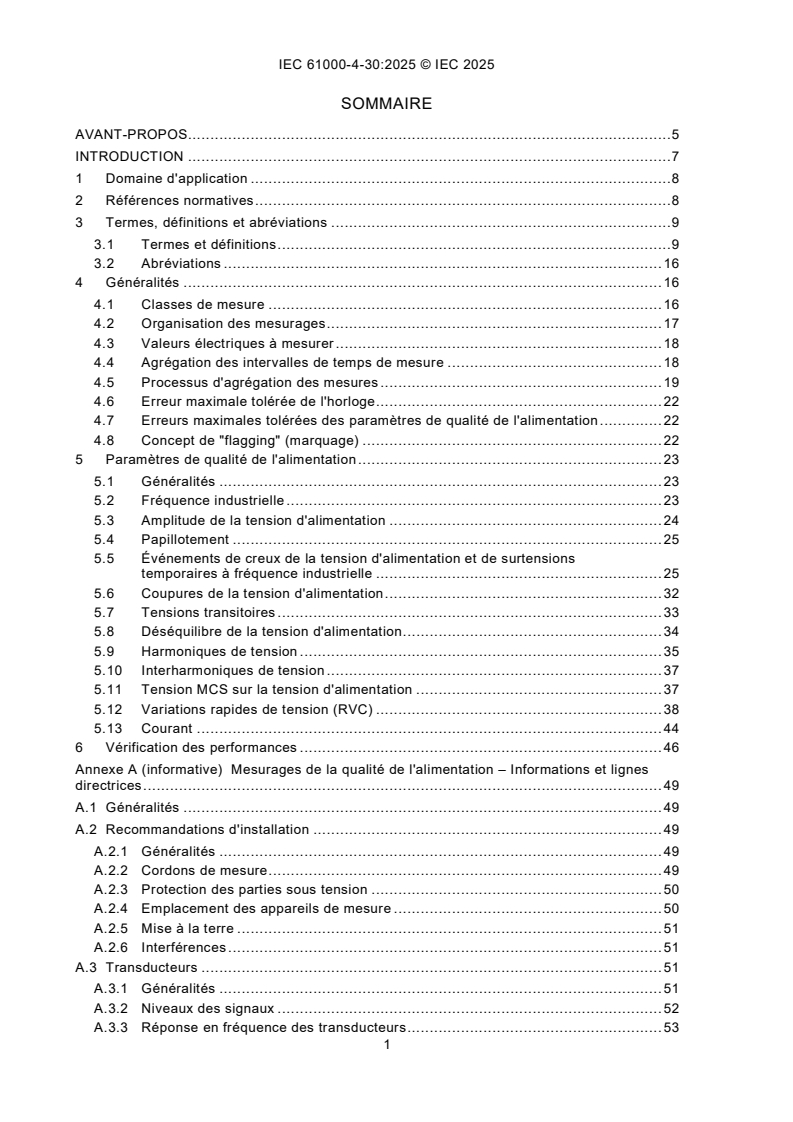
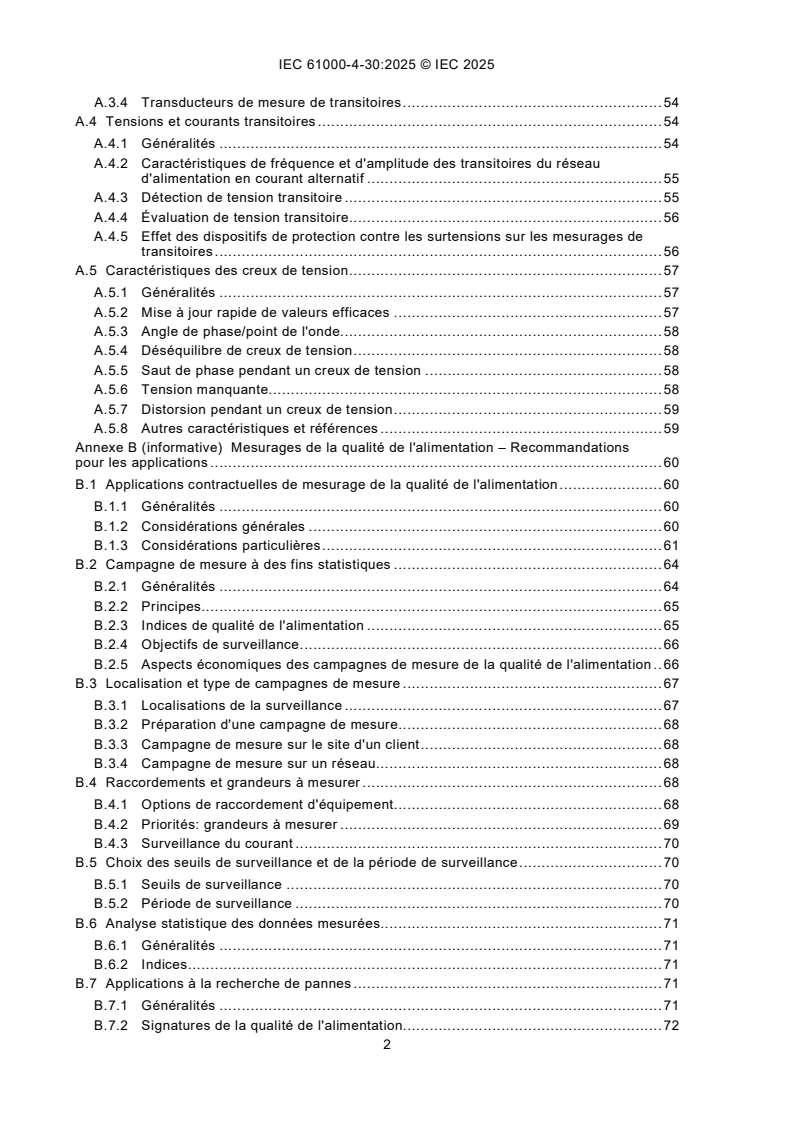
IEC 61000-4-30:2025 - Compatibilité électromagnétique (CEM) - Partie 4-30: Techniques d'essai et de mesure - Méthodes de mesure de la qualité de l'alimentation
IEC 61000-4-30:2025 - Electromagnetic compatibility (EMC) - Part 4-30: Testing and measurement techniques - Power quality measurement methods
Overview - IEC 61000-4-30:2025 (Power quality measurement methods)
IEC 61000-4-30:2025 is the fourth edition of the international standard that specifies testing and measurement techniques for power quality (PQ) in AC power supply systems with a declared fundamental frequency of 50 Hz or 60 Hz. It defines robust, repeatable in‑situ measurement methods and result interpretation for a wide range of conducted power quality phenomena. The standard establishes two measurement classes - Class A (advanced) and Class S (surveys) (see Clause 4) to meet different accuracy and application needs.
Key topics and technical requirements
- Measurement scope: power frequency, supply voltage magnitude, flicker, voltage dips and swells, interruptions, transient voltages, voltage unbalance, voltage harmonics and interharmonics, rapid voltage changes (RVC), mains communicating system (MCS) voltages, current magnitude and harmonic/interharmonic currents, and current unbalance.
- Conducted emissions: Annex C covers 2 kHz–9 kHz; Annex D adds a new method for 9 kHz–150 kHz measurements.
- Measurement classes: requirements for Class A (advanced, high accuracy) and Class S (survey, statistical) are specified to ensure repeatability regardless of implementation.
- Aggregation and timing: defined aggregation algorithms and time intervals (e.g., 150/180-cycle, 10 min, 2 h) plus maximum permissible time clock error and parameter measurement errors.
- Event detection & evaluation: corrected and extended methods for rapid voltage changes (RVC) and updated procedures for voltage events (dips/swells/interruptions).
- Performance verification & annex guidance: clauses on verification, installation guidance, transducer considerations (refer to IEC TR 61869-103), and test methods cross-referenced in IEC 62586-2.
Practical applications - who uses IEC 61000-4-30
- Utility companies and grid operators for network monitoring and compliance reporting.
- Power quality engineers and consultants for site surveys, contractual monitoring and troubleshooting.
- Test labs and manufacturers of power quality analysers and meters to design and verify instruments to Class A / Class S requirements.
- Asset managers and large industrial consumers assessing supply quality, disturbance causes, and mitigation effectiveness.
- Regulators and standards bodies defining service quality metrics and enforcement procedures.
Related standards and guidance
- IEC 62586-2 - test methods for verifying compliance with IEC 61000-4-30.
- IEC TR 61869-103 - guidance on effects of transducers on measurements.
- IEC 61000‑4‑7 references for harmonic measurement techniques (integrated via Annex C).
IEC 61000-4-30:2025 is essential for anyone implementing reliable, repeatable power quality monitoring programs, specifying measurement equipment, or interpreting PQ data for contractual, regulatory, or operational decision-making.
Relations
- Effective Date
- 29-May-2026
- Effective Date
- 05-Sep-2023
- Effective Date
- 05-Sep-2023
- Effective Date
- 05-Sep-2023
Buy Documents
IEC 61000-4-30:2025 - Electromagnetic compatibility (EMC) - Part 4-30: Testing and measurement techniques - Power quality measurement methods
IEC 61000-4-30:2025 - Compatibilité électromagnétique (CEM) - Partie 4-30: Techniques d'essai et de mesure - Méthodes de mesure de la qualité de l'alimentation
IEC 61000-4-30:2025 - Electromagnetic compatibility (EMC) - Part 4-30: Testing and measurement techniques - Power quality measurement methods
Get Certified
Connect with accredited certification bodies for this standard

ANCE
Mexican certification and testing association.

Intertek Slovenia
Intertek testing, inspection, and certification services in Slovenia.

LNE (Laboratoire National de Métrologie et d'Essais)
French national laboratory for metrology and testing.
Sponsored listings
Frequently Asked Questions
IEC 61000-4-30:2025 is a standard published by the International Electrotechnical Commission (IEC). Its full title is "Electromagnetic compatibility (EMC) - Part 4-30: Testing and measurement techniques - Power quality measurement methods". This standard covers: CORRECTED VERSION 2026-07 IEC 61000-4-30:2025 defines the methods for measurement and interpretation of results for power quality parameters in AC power supply systems with a declared fundamental frequency of 50 Hz or 60 Hz. Measurement methods are described for each relevant parameter in terms that give reliable and repeatable results, regardless of the method’s implementation. This document addresses measurement methods for in-situ measurements. This document covers two classes of measurement methods (Class A and Class S). The classes of measurement are specified in Clause 4. NOTE 1 In this document, “A” stands for “advanced” and “S” stands for “surveys”. Measurement of parameters covered by this document is limited to conducted phenomena in power systems. The power quality parameters considered in this document are power frequency, magnitude of the supply voltage, flicker, supply voltage dips and swells, voltage interruptions, transient voltages, supply voltage unbalance, voltage harmonics and interharmonics, rapid voltage changes, mains communicating system (MCS) voltages, magnitude of current, harmonic currents, interharmonic currents and current unbalance. Emissions in the 2 kHz to 150 kHz range are considered in Annex C and Annex D. Depending on the purpose of the measurement, all or a subset of the phenomena on this list can be measured. NOTE 2 Test methods for verifying compliance with this document can be found in IEC 62586-2. NOTE 3 The effects of transducers inserted between the power system and the instrument are acknowledged but not addressed in detail in this document. Guidance about effects of transducers can be found IEC TR 61869-103. This fourth edition cancels and replaces the third edition published in 2015. This edition constitutes a technical revision.This edition includes the following significant technical changes with respect to the previous edition: a) IEC 61000-4-30:2015/AMD1:2021 and IEC 61000-4-30:2015/COR1:2016 were included. b) The measurement method for rapid voltage changes (RVC) has been corrected and extended. c) The measurement method for voltage events has been updated and extended. d) Annex C was divided into 2 parts: 1) Annex C: The measurement method from IEC 61000-4-7:2002 and IEC 61000‑4‑7:2002/AMD1:2008, Annex B for conducted emissions in the 2 kHz to 9 kHz range has been separate 2) Annex D: A new measurement method for conducted emissions in the 9 kHz to 150 kHz range has been added. e) Annex D (underdeviation and overdeviation parameters) was removed. f) Annex E (Class B) was removed. The content of the corrigendum 1 (2026-07) has been included in this copy.
CORRECTED VERSION 2026-07 IEC 61000-4-30:2025 defines the methods for measurement and interpretation of results for power quality parameters in AC power supply systems with a declared fundamental frequency of 50 Hz or 60 Hz. Measurement methods are described for each relevant parameter in terms that give reliable and repeatable results, regardless of the method’s implementation. This document addresses measurement methods for in-situ measurements. This document covers two classes of measurement methods (Class A and Class S). The classes of measurement are specified in Clause 4. NOTE 1 In this document, “A” stands for “advanced” and “S” stands for “surveys”. Measurement of parameters covered by this document is limited to conducted phenomena in power systems. The power quality parameters considered in this document are power frequency, magnitude of the supply voltage, flicker, supply voltage dips and swells, voltage interruptions, transient voltages, supply voltage unbalance, voltage harmonics and interharmonics, rapid voltage changes, mains communicating system (MCS) voltages, magnitude of current, harmonic currents, interharmonic currents and current unbalance. Emissions in the 2 kHz to 150 kHz range are considered in Annex C and Annex D. Depending on the purpose of the measurement, all or a subset of the phenomena on this list can be measured. NOTE 2 Test methods for verifying compliance with this document can be found in IEC 62586-2. NOTE 3 The effects of transducers inserted between the power system and the instrument are acknowledged but not addressed in detail in this document. Guidance about effects of transducers can be found IEC TR 61869-103. This fourth edition cancels and replaces the third edition published in 2015. This edition constitutes a technical revision.This edition includes the following significant technical changes with respect to the previous edition: a) IEC 61000-4-30:2015/AMD1:2021 and IEC 61000-4-30:2015/COR1:2016 were included. b) The measurement method for rapid voltage changes (RVC) has been corrected and extended. c) The measurement method for voltage events has been updated and extended. d) Annex C was divided into 2 parts: 1) Annex C: The measurement method from IEC 61000-4-7:2002 and IEC 61000‑4‑7:2002/AMD1:2008, Annex B for conducted emissions in the 2 kHz to 9 kHz range has been separate 2) Annex D: A new measurement method for conducted emissions in the 9 kHz to 150 kHz range has been added. e) Annex D (underdeviation and overdeviation parameters) was removed. f) Annex E (Class B) was removed. The content of the corrigendum 1 (2026-07) has been included in this copy.
IEC 61000-4-30:2025 is classified under the following ICS (International Classification for Standards) categories: 33.100.99 - Other aspects related to EMC. The ICS classification helps identify the subject area and facilitates finding related standards.
IEC 61000-4-30:2025 has the following relationships with other standards: It is inter standard links to IEC 61000-4-30:2025/COR1:2026, IEC 61000-4-30:2015, IEC 61000-4-30:2015/AMD1:2021, IEC 61000-4-30:2015/COR1:2016. Understanding these relationships helps ensure you are using the most current and applicable version of the standard.
IEC 61000-4-30:2025 is available in PDF format for immediate download after purchase. The document can be added to your cart and obtained through the secure checkout process. Digital delivery ensures instant access to the complete standard document.
Standards Content (Sample)
IEC 61000-4-30 ®
Edition 4.0 2025-10
INTERNATIONAL
STANDARD
Electromagnetic compatibility (EMC) -
Part 4-30: Testing and measurement techniques - Power quality measurement
methods
ICS 33.100.99 ISBN 978-2-8327-0783-8
All rights reserved. Unless otherwise specified, no part of this publication may be reproduced or utilized in any form or
by any means, electronic or mechanical, including photocopying and microfilm, without permission in writing from either
IEC or IEC's member National Committee in the country of the requester. If you have any questions about IEC copyright
or have an enquiry about obtaining additional rights to this publication, please contact the address below or your local
IEC member National Committee for further information.
IEC Secretariat Tel.: +41 22 919 02 11
3, rue de Varembé info@iec.ch
CH-1211 Geneva 20 www.iec.ch
Switzerland
About the IEC
The International Electrotechnical Commission (IEC) is the leading global organization that prepares and publishes
International Standards for all electrical, electronic and related technologies.
About IEC publications
The technical content of IEC publications is kept under constant review by the IEC. Please make sure that you have the
latest edition, a corrigendum or an amendment might have been published.
IEC publications search - IEC Products & Services Portal - products.iec.ch
webstore.iec.ch/advsearchform Discover our powerful search engine and read freely all the
The advanced search enables to find IEC publications by a
publications previews, graphical symbols and the glossary.
variety of criteria (reference number, text, technical With a subscription you will always have access to up to date
committee, …). It also gives information on projects, content tailored to your needs.
replaced and withdrawn publications.
Electropedia - www.electropedia.org
IEC Just Published - webstore.iec.ch/justpublished The world's leading online dictionary on electrotechnology,
Stay up to date on all new IEC publications. Just Published containing more than 22 500 terminological entries in English
details all new publications released. Available online and and French, with equivalent terms in 25 additional languages.
once a month by email. Also known as the International Electrotechnical Vocabulary
(IEV) online.
IEC Customer Service Centre - webstore.iec.ch/csc
If you wish to give us your feedback on this publication or
need further assistance, please contact the Customer
Service Centre: sales@iec.ch.
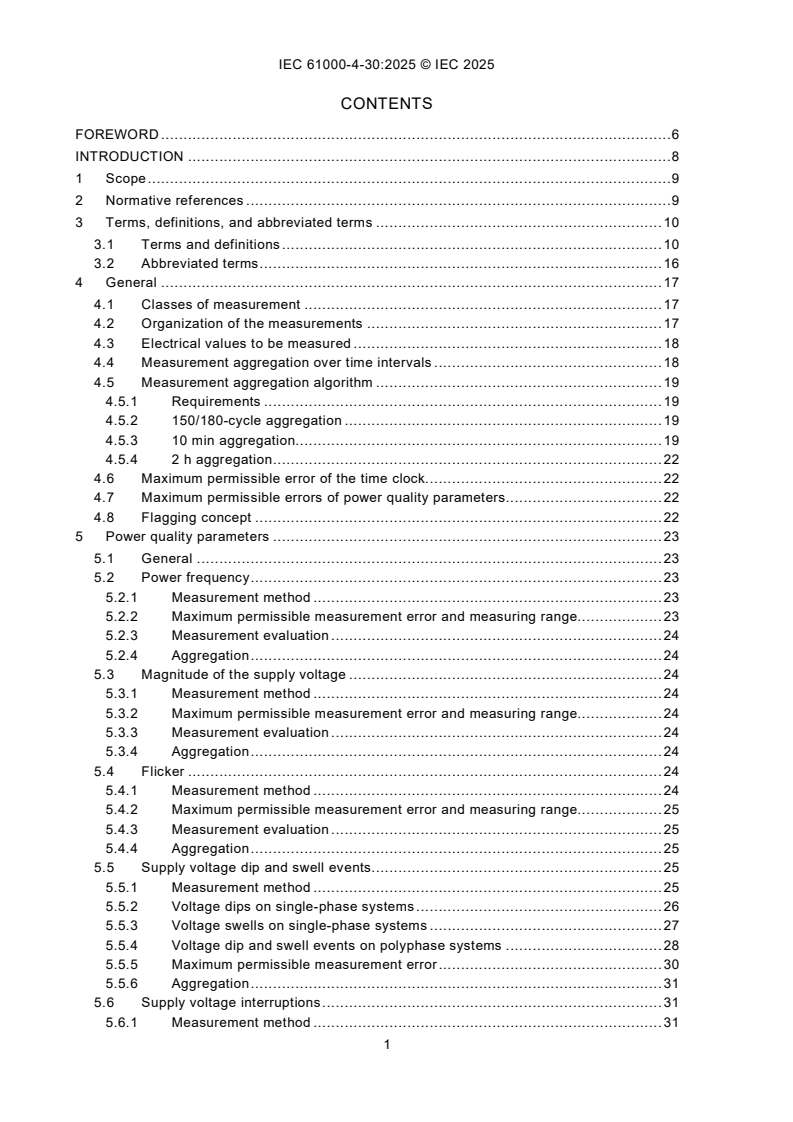
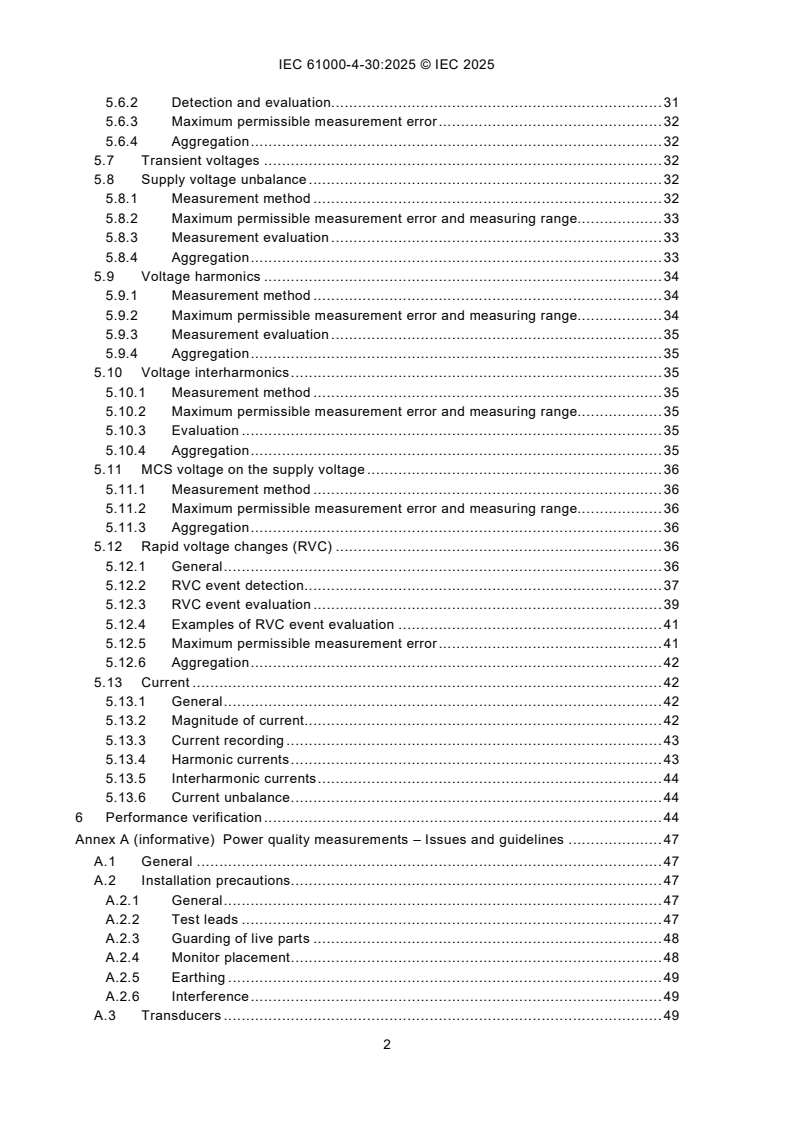
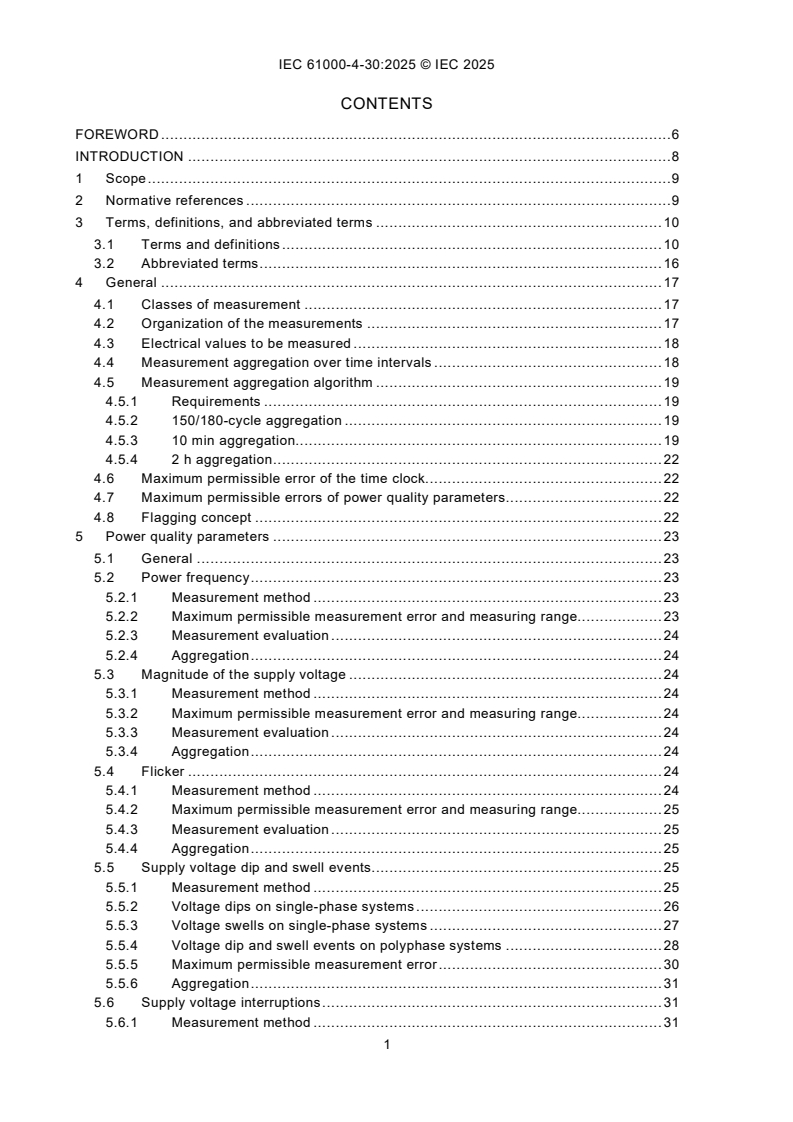
CONTENTS
FOREWORD . 6
INTRODUCTION . 8
1 Scope . 9
2 Normative references . 9
3 Terms, definitions, and abbreviated terms . 10
3.1 Terms and definitions . 10
3.2 Abbreviated terms . 16
4 General . 17
4.1 Classes of measurement . 17
4.2 Organization of the measurements . 17
4.3 Electrical values to be measured . 18
4.4 Measurement aggregation over time intervals . 18
4.5 Measurement aggregation algorithm . 19
4.5.1 Requirements . 19
4.5.2 150/180-cycle aggregation . 19
4.5.3 10 min aggregation. 19
4.5.4 2 h aggregation . 22
4.6 Maximum permissible error of the time clock. 22
4.7 Maximum permissible errors of power quality parameters . 22
4.8 Flagging concept . 22
5 Power quality parameters . 23
5.1 General . 23
5.2 Power frequency . 23
5.2.1 Measurement method . 23
5.2.2 Maximum permissible measurement error and measuring range. 23
5.2.3 Measurement evaluation . 24
5.2.4 Aggregation . 24
5.3 Magnitude of the supply voltage . 24
5.3.1 Measurement method . 24
5.3.2 Maximum permissible measurement error and measuring range. 24
5.3.3 Measurement evaluation . 24
5.3.4 Aggregation . 24
5.4 Flicker . 24
5.4.1 Measurement method . 24
5.4.2 Maximum permissible measurement error and measuring range. 25
5.4.3 Measurement evaluation . 25
5.4.4 Aggregation . 25
5.5 Supply voltage dip and swell events . 25
5.5.1 Measurement method . 25
5.5.2 Voltage dips on single-phase systems . 26
5.5.3 Voltage swells on single-phase systems . 27
5.5.4 Voltage dip and swell events on polyphase systems . 28
5.5.5 Maximum permissible measurement error . 30
5.5.6 Aggregation . 31
5.6 Supply voltage interruptions . 31
5.6.1 Measurement method . 31
5.6.2 Detection and evaluation. 31
5.6.3 Maximum permissible measurement error . 32
5.6.4 Aggregation . 32
5.7 Transient voltages . 32
5.8 Supply voltage unbalance . 32
5.8.1 Measurement method . 32
5.8.2 Maximum permissible measurement error and measuring range. 33
5.8.3 Measurement evaluation . 33
5.8.4 Aggregation . 33
5.9 Voltage harmonics . 34
5.9.1 Measurement method . 34
5.9.2 Maximum permissible measurement error and measuring range. 34
5.9.3 Measurement evaluation . 35
5.9.4 Aggregation . 35
5.10 Voltage interharmonics . 35
5.10.1 Measurement method . 35
5.10.2 Maximum permissible measurement error and measuring range. 35
5.10.3 Evaluation . 35
5.10.4 Aggregation . 35
5.11 MCS voltage on the supply voltage . 36
5.11.1 Measurement method . 36
5.11.2 Maximum permissible measurement error and measuring range. 36
5.11.3 Aggregation . 36
5.12 Rapid voltage changes (RVC) . 36
5.12.1 General . 36
5.12.2 RVC event detection . 37
5.12.3 RVC event evaluation . 39
5.12.4 Examples of RVC event evaluation . 41
5.12.5 Maximum permissible measurement error . 41
5.12.6 Aggregation . 42
5.13 Current . 42
5.13.1 General . 42
5.13.2 Magnitude of current. 42
5.13.3 Current recording . 43
5.13.4 Harmonic currents . 43
5.13.5 Interharmonic currents . 44
5.13.6 Current unbalance . 44
6 Performance verification . 44
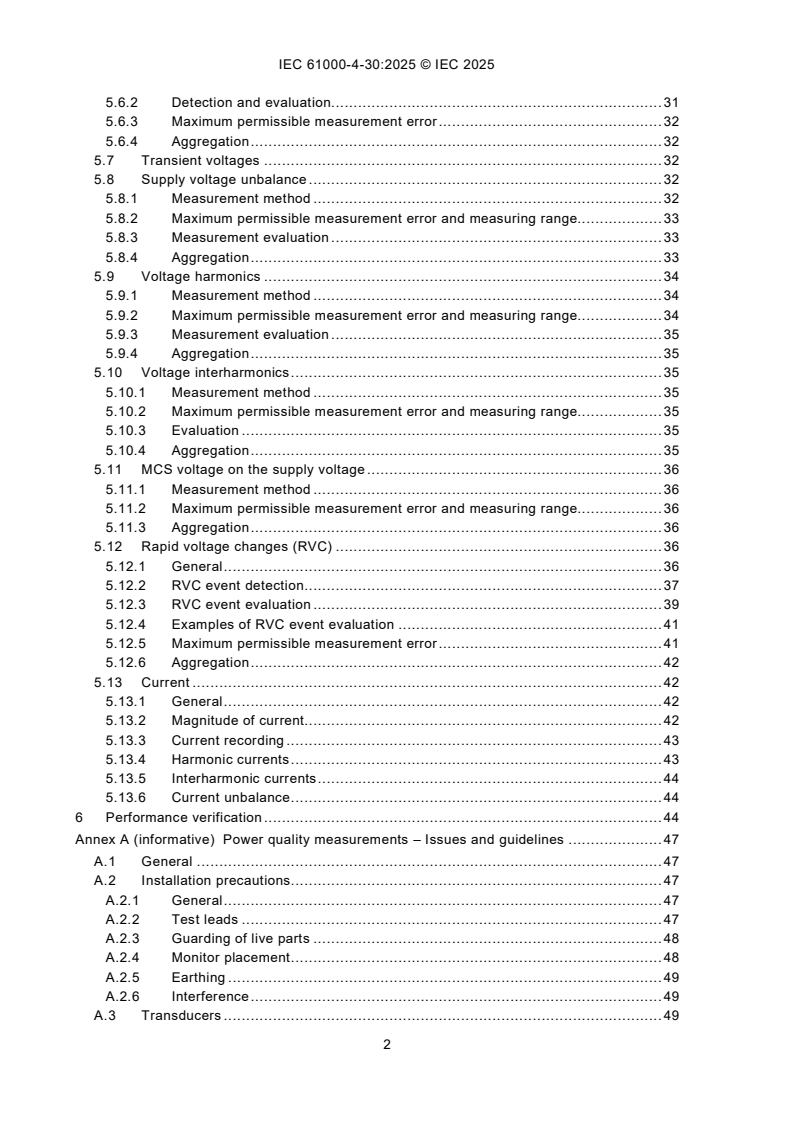
Annex A (informative) Power quality measurements – Issues and guidelines . 47
A.1 General . 47
A.2 Installation precautions . 47
A.2.1 General . 47
A.2.2 Test leads . 47
A.2.3 Guarding of live parts . 48
A.2.4 Monitor placement . 48
A.2.5 Earthing . 49
A.2.6 Interference . 49
A.3 Transducers . 49
A.3.1 General . 49
A.3.2 Signal levels . 50
A.3.3 Frequency response of transducers . 51
A.3.4 Transducers for measuring transients . 51
A.4 Transient voltages and currents. 52
A.4.1 General . 52
A.4.2 Frequency and amplitude characteristics of AC mains transients . 52
A.4.3 Transient voltage detection . 53
A.4.4 Transient voltage evaluation . 54
A.4.5 Effect of surge protective devices on transient measurements . 54
A.5 Voltage dip characteristics . 54
A.5.1 General . 54
A.5.2 Rapidly updated RMS values . 55
A.5.3 Phase angle/point-on-wave . 55
A.5.4 Voltage dip unbalance . 55
A.5.5 Phase shift during voltage dip. 56
A.5.6 Missing voltage . 56
A.5.7 Distortion during voltage dip . 56
A.5.8 Other characteristics and references . 56
Annex B (informative) Power quality measurement – Guidance for applications . 57
B.1 Contractual applications of power quality measurements. 57
B.1.1 General . 57
B.1.2 General considerations . 57
B.1.3 Specific considerations . 58
B.2 Statistical survey applications . 61
B.2.1 General . 61
B.2.2 Considerations . 61
B.2.3 Power quality indices . 62
B.2.4 Monitoring objectives . 62
B.2.5 Economic aspects of power quality surveys . 62
B.3 Locations and types of surveys . 63
B.3.1 Monitoring locations . 63
B.3.2 Pre-monitoring site surveys . 64
B.3.3 Customer side site survey . 64
B.3.4 Network side survey . 64
B.4 Connections and quantities to measure . 64
B.4.1 Equipment connection options . 64
B.4.2 Priorities: quantities to measure . 65
B.4.3 Current monitoring . 65
B.5 Selecting the monitoring thresholds and monitoring period . 66
B.5.1 Monitoring thresholds . 66
B.5.2 Monitoring period . 66
B.6 Statistical analysis of the measured data . 67
B.6.1 General . 67
B.6.2 Indices . 67
B.7 Trouble-shooting applications. 67
B.7.1 General . 67
B.7.2 Power quality signatures . 67
B.7.3 Waveform data format . 68
Annex C (informative) Functional design and specification for measurements in the 2 kHz
to 9 kHz range for Class A and Class S equipment . 69
C.1 General . 69
C.2 Voltage disturbances in the 2 kHz to 9 kHz range . 69
C.2.1 Measurement method . 69
C.2.2 Maximum permissible measurement error . 69
C.2.3 Aggregation . 70
Annex D (informative) Functional design and specifications for measurements in the
9 kHz to 150 kHz range . 71
D.1 General . 71
D.2 Background . 71
D.3 Comparability requirements . 72
D.4 Method overview . 72
D.5 Signal input stage . 74
D.5.1 General . 74
D.5.2 Input filtering . 74
D.5.3 Frequency response . 74
D.5.4 Transducer compensation . 74
D.5.5 Measuring range . 75
D.5.6 Overload detection . 75
D.6 Fourier transform stage . 76
D.6.1 General . 76
D.6.2 DFT window design . 77
D.6.3 Application of the DFT . 79
D.6.4 Selectivity and power bandwidth . 80
D.7 Detector stage . 80
D.7.1 General . 80
D.7.2 RMS detector. 81
D.7.3 Peak detector . 81
D.7.4 Quasi-peak detector . 81
D.7.5 Average detector . 83
D.7.6 RMS-average detector . 83
D.8 Indicator stage . 84
D.9 Adjustment of time constants . 86
D.10 Accuracy requirements . 87
D.10.1 General . 87
D.10.2 Accuracy requirements for measuring steady-state sinusoidal signals. 87
D.10.3 Accuracy requirements for measuring impulsive signals . 87
D.11 Aggregation. 91
D.11.1 General . 91
D.11.2 Aggregation time intervals . 91
D.11.3 Aggregation methods . 91
D.12 Integration of signal levels over frequency . 92
Bibliography . 93
Figure 1 – Measurement chain . 17
Figure 2 – Synchronization of aggregation intervals for Class A . 20
Figure 3 – Synchronization of aggregation intervals for Class S: parameters for which
gaps are not permitted . 21
Figure 4 – Synchronization of aggregation intervals for Class S: parameters for which
gaps are permitted (see 4.5.2) . 21
Figure 5 – Example of the MPE of a supply voltage unbalance measurement . 33
Figure 6 – RVC event: example of a change in RMS voltage that results in an RVC event . 41
Figure 7 – Not an RVC event: example of a change in RMS voltage that does not result in
an RVC event because the dip threshold is exceeded. 41
Figure A.1 – Frequency spectrum of typical representative transient test waveforms . 53
Figure D.1 – Block diagram of the 9 kHz to 150 kHz measurement method . 73
Figure D.2 – Quasi-peak detector equivalent circuit . 81
Figure D.3 – Indicator response to a 160 ms impulse pulse width when represented by a
nd
2 order Linkwitz-Riley low-pass filter tuned to the frequency f = 0,9947 Hz . 86
c
Figure D.4 – Impulses with an amplitude of 5,51 V and a width of 2,45 µs to assess
instrument compliance at 100 Hz . 90
Table 1 – Summary of requirements (see subclauses for actual requirements) . 45
Table D.1 – Band A IF filter impulse response zero-crossing times . 78
Table D.2 – Adjusted time constants for the quasi-peak detector . 86
Table D.3 – Sinusoidal signal accuracy requirements from 9 kHz to 150 kHz . 87
Table D.4 – Impulsive signal accuracy requirements from 9 kHz to 150 kHz. 88
Table D.5 – Reference quasi-peak response to spectrally flat impulses . 89
INTERNATIONAL ELECTROTECHNICAL COMMISSION
____________
Electromagnetic compatibility (EMC) -
Part 4-30: Testing and measurement techniques -
Power quality measurement methods
FOREWORD
1) The International Electrotechnical Commission (IEC) is a worldwide organization for standardization comprising all
national electrotechnical committees (IEC National Committees). The object of IEC is to promote international co-
operation on all questions concerning standardization in the electrical and electronic fields. To this end and in addition
to other activities, IEC publishes International Standards, Technical Specifications, Technical Reports, Publicly
Available Specifications (PAS) and Guides (hereafter referred to as "IEC Publication(s)"). Their preparation is
entrusted to technical committees; any IEC National Committee interested in the subject dealt with may participate
in this preparatory work. International, governmental and non-governmental organizations liaising with the IEC also
participate in this preparation. IEC collaborates closely with the International Organization for Standardization (ISO)
in accordance with conditions determined by agreement between the two organizations.
2) The formal decisions or agreements of IEC on technical matters express, as nearly as possible, an international
consensus of opinion on the relevant subjects since each technical committee has representation from all interested
IEC National Committees.
3) IEC Publications have the form of recommendations for international use and are accepted by IEC National
Committees in that sense. While all reasonable efforts are made to ensure that the technical content of IEC
Publications is accurate, IEC cannot be held responsible for the way in which they are used or for any
misinterpretation by any end user.
4) In order to promote international uniformity, IEC National Committees undertake to apply IEC Publications
transparently to the maximum extent possible in their national and regional publications. Any divergence between
any IEC Publication and the corresponding national or regional publication shall be clearly indicated in the latter.
5) IEC itself does not provide any attestation of conformity. Independent certification bodies provide conformity
assessment services and, in some areas, access to IEC marks of conformity. IEC is not responsible for any services
carried out by independent certification bodies.
6) All users should ensure that they have the latest edition of this publication.
7) No liability shall attach to IEC or its directors, employees, servants or agents including individual experts and
members of its technical committees and IEC National Committees for any personal injury, property damage or other
damage of any nature whatsoever, whether direct or indirect, or for costs (including legal fees) and expenses arising
out of the publication, use of, or reliance upon, this IEC Publication or any other IEC Publications.
8) Attention is drawn to the Normative references cited in this publication. Use of the referenced publications is
indispensable for the correct application of this publication.
9) IEC draws attention to the possibility that the implementation of this document may involve the use of (a) patent(s).
IEC takes no position concerning the evidence, validity or applicability of any claimed patent rights in respect thereof.
As of the date of publication of this document, IEC had not received notice of (a) patent(s), which may be required
to implement this document. However, implementers are cautioned that this may not represent the latest information,
which may be obtained from the patent database available at https://patents.iec.ch. IEC shall not be held responsible
for identifying any or all such patent rights.
IEC 61000 4-30 has been prepared by subcommittee 77A: EMC – Low- frequency phenomena, of
IEC technical committee 77: Electromagnetic compatibility. It is an International Standard.
It forms part 4-30 of IEC 61000. It has the status of a basic EMC publication in accordance with
IEC Guide 107.
This fourth edition cancels and replaces the third edition published in 2015. This edition constitutes
a technical revision.
This edition includes the following significant technical changes with respect to the previous
edition:
a) IEC 61000-4-30:2015/AMD1:2021 and IEC 61000-4-30:2015/COR1:2016 were included.
b) The measurement method for rapid voltage changes (RVC) has been corrected and extended.
c) The measurement method for voltage events has been updated and extended.
d) Annex C was divided into 2 parts:
1) Annex C: The measurement method from IEC 61000-4-7:2002 and
IEC 61000-4-7:2002/AMD1:2008, Annex B for conducted emissions in the 2 kHz to 9 kHz
range has been separated.
2) Annex D: A new measurement method for conducted emissions in the 9 kHz to 150 kHz
range has been added.
e) Annex D (underdeviation and overdeviation parameters) was removed.
f) Annex E (Class B) was removed.
The text of this International Standard is based on the following documents:
Draft Report on voting
77A/1253/FDIS 77A/1268/RVD
Full information on the voting for its approval can be found in the report on voting indicated in the
above table.
The language used for the development of this International Standard is English.
This document was drafted in accordance with ISO/IEC Directives, Part 2, and developed in
accordance with ISO/IEC Directives, Part 1 and ISO/IEC Directives, IEC Supplement, available at
www.iec.ch/members_experts/refdocs. The main document types developed by IEC are described
in greater detail at www.iec.ch/publications.
A list of all parts in the IEC 61000 series, published under the general title Electromagnetic
compatibility (EMC), can be found on the IEC website.
The committee has decided that the contents of this document will remain unchanged until the
stability date indicated on the IEC website under webstore.iec.ch in the data related to the specific
document. At this date, the document will be
– reconfirmed,
– withdrawn, or
– revised.
INTRODUCTION
IEC 61000 is published in separate parts according to the following structure:
Part 1: General
– General considerations (introduction, fundamental principles)
– Definitions, terminology
Part 2: Environment
– Description of the environment
– Classification of the environment
– Compatibility levels
Part 3: Limits
– Emission limits
– Immunity limits (in so far as they do not fall under the responsibility of the product committees)
Part 4: Testing and measurement techniques
– Measurement techniques
– Testing techniques
Part 5: Installation and mitigation guidelines
– Installation guidelines
– Mitigation methods and devices
Part 6: Generic standards
Part 9: Miscellaneous
Each part is further subdivided into several parts, published either as International Standards or
as Technical Specifications or Technical Reports, some of which have already been published as
sections. Others will be published with the part number followed by a dash and completed by a
second number identifying the subdivision (example: IEC 61000-6-1).
1 Scope
This part of IEC 61000-4 defines the methods for measurement and interpretation of results for
power quality parameters in AC power supply systems with a declared fundamental frequency of
50 Hz or 60 Hz.
Measurement methods are described for each relevant parameter in terms that give reliable and
repeatable results, regardless of the method's implementation. This document addresses
measurement methods for in-situ measurements.
This document covers two classes of measurement methods (Class A and Class S). The classes
of measurement are specified in Clause 4.
NOTE 1 In this document, "A" stands for "advanced" and "S" stands for "surveys".
Measurement of parameters covered by this document is limited to conducted phenomena in power
systems. The power quality parameters considered in this document are power frequency,
magnitude of the supply voltage, flicker, supply voltage dips and swells, voltage interruptions,
transient voltages, supply voltage unbalance, voltage harmonics and interharmonics, rapid voltage
changes, mains communicating system (MCS) voltages, magnitude of current, harmonic currents,
interharmonic currents and current unbalance.
Emissions in the 2 kHz to 150 kHz range are considered in Annex C and Annex D.
Depending on the purpose of the measurement, all or a subset of the phenomena on this list can
be measured.
NOTE 2 Test methods for verifying compliance with this document can be found in IEC 62586-2.
NOTE 3 The effects of transducers inserted between the power system and the instrument are acknowledged but not
addressed in detail in this document. Guidance about effects of transducers can be found IEC TR 61869-103.
2 Normative references
The following documents are referred to in the text in such a way that some or all of their content
constitutes requirements of this document. For dated references, only the edition cited applies.
For undated references, the latest edition of the referenced document (including any amendments)
applies.
IEC 60050-161:1990, International Electrotechnical Vocabulary (IEV) - Part 161: Electromagnetic
compatibility
IEC 60050-161:1990/AMD9:2019
IEC 61000-2-4:2024, Electromagnetic compatibility (EMC) - Part 2-4: Environment - Compatibility
levels in power distribution systems in industrial locations for low-frequency conducted
disturbances
IEC 61000-4-7:2002, Electromagnetic compatibility (EMC) - Part 4-7: Testing and measurement
techniques - General guide on harmonics and interharmonics measurements and instrumentation,
for power supply systems and equipment connected thereto
IEC 61000-4-7:2002/AMD1:2008
IEC 61000-4-15:2010, Electromagnetic compatibility (EMC) - Part 4-15: Testing and measurement
techniques - Flickermeter - Functional and design specifications
IEC 62586-2, Power quality measurement in power supply systems - Part 2: Functional tests and
uncertainty requirements
3 Terms, definitions, and abbreviated terms
3.1 Terms and definitions
For the purposes of this document, the terms and definitions given in IEC 60050-161 and the
following apply.
ISO and IEC maintain terminology databases for use in standardization at the following addresses:
– IEC Electropedia: available at https://www.electropedia.org/
– ISO Online browsing platform: available at https://www.iso.org/obp
3.1.1
channel
individual measurement path through an instrument
Note 1 to entry: "Channel" and "phase" are not the same. A voltage channel is by definition the difference in potential
between two conductors. Phase refers to a single conductor. On polyphase systems, a channel can be between any two
phases, or between any phase and neutral, or between any phase and earth, or between neutral and earth.
3.1.2
declared input voltage
U
din
value obtained from the declared supply voltage by a transducer ratio
Note 1 to entry: This quantity can be expressed as a phase-to-phase or as a phase-to-neutral value.
3.1.3
declared supply voltage
U
c
nominal voltage U of the system
n
Note 1 to entry: If by agreement between the supplier and the customer a voltage different from the nominal voltage is
applied to the terminals, then this voltage is the declared supply voltage U .
c
3.1.4
dip threshold
voltage magnitude specified for the purpose of detecting the start and the end of a voltage dip
3.1.5
flagged data
for any measurement time interval in which interruptions, dips or swells occur, marked
measurement results of all other parameters made during this time interval
Note 1 to entry: For some applications, this 'marked' or 'flagged' data can be excluded from further analysis, for
example. See 4.8 for further explanation.
3.1.6
flicker
impression of unsteadiness of visual sensation induced by a light stimulus whose luminance or
spectral distribution fluctuates with time
[SOURCE: IEC 60050-161:1990, 161-08-13]
3.1.6.1
P
st
short-term flicker severity
Note 1 to entry: Unless otherwise specified, the P evaluation time is 10 min. For the purpose of power quality surveys
st
and studies, other time intervals may be used, and should be defined in the index. For example a 1 min interval should
be written as P .
st,1m
[SOURCE: IEC 61000-4-15:2010, 3.2]
3.1.6.2
P
lt
long-term flicker severity
N
P
∑
3 st
i
i=1
P =
lt
N
where P (i = 1, 2, 3, .) are consecutive readings of the short-term severity P
st
st
i
Note 1 to entry: Unless otherwise specified, P is calculated over discrete T periods. Each time a T period has
lt long long
expired, a new P calculation is started.
lt
[SOURCE: IEC 61000-4-15:2010, 3.2]
3.1.7
fundamental component
component whose frequency is the fundamental frequency
3.1.8
fundamental frequency
frequency in the spectrum obtained from a Fourier transform of a time function, to which all the
frequencies of the spectrum are referred
Note 1 to entry: In case of any remaining risk of ambiguity, the fundamental frequency can be derived from the number
of poles and speed of rotation of the synchronous generator(s) feeding the system.
3.1.9
harmonic component
any of the components having a harmonic frequency
Note 1 to entry: Its value is normally expressed as an RMS value. For brevity, such component may be referred to
simply as a harmonic.
[SOURCE: IEC 61000-2-2:2002, 3.2.4, modified – the second part of the definition has been made
into a note.]
3.1.10
harmonic frequency
frequency which is an integer multiple of the fundamental frequency
Note 1 to entry: The ratio of the harmonic frequency to the fundamental frequency is the harmonic order (recommended
notation: h).
[SOURCE: IEC 61000-2-2:2002, 3.2.3, modified – the second part of the definition has been made
into a note.]
3.1.11
hysteresis
difference in magnitude between the start and end thresholds
Note 1 to entry: This definition of hysteresis is relevant to PQ measurement parameters and is different from the
IEC 60050 definition which is relevant to iron core saturation.
Note 2 to entry: The purpose of hysteresis in the context of PQ measurements is to avoid counting multiple events
when the magnitude of the parameter oscillates about the threshold level.
3.1.12
influence quantity
quantity which is not the subject of the measurement and whose change affects the relationship
between the indication and the result of the measurement
Note 1 to entry: Influence quantities can originate from the measured system, the measuring equipment or the
environment.
[SOURCE: IEC 60050-311:2001, 311-06-01, modified – Notes 1 and 3 have been removed.]
3.1.13
interharmonic component
spectral component with a frequency between two consecutive harmonic frequencies
Note 1 to entry: The definition is derived from IEC 61000-4-7.
Note 2 to entry: Its value is normally expressed as an RMS value. For brevity, such a component can be referred to
simply as an interharmonic.
3.1.14
interharmonic frequency
any frequency which is not an integer multiple of the fundamental frequency
Note 1 to entry: By extension from harmonic order, the interharmonic order is the ratio of an interharmonic frequency
to the fundamental frequency. This ratio is not an integer (recommended notation m).
Note 2 to entry: In the case where m < 1 the term subharmonic frequency can be used.
[SOURCE: IEC 61000-2-2:2002, 3.2.5]
3.1.15
interruption
reduction of the voltage at a point in the electrical system below the interruption threshold
3.1.16
interruption threshold
voltage magnitude specified for the purpose of detecting the start and the end of a voltage
interruption
3.1.17
mains communicating system
MCS
electrical system using mains power lines to transmit information signals, either on the power
supply system or within installations of network users
Note 1 to entry: MCS is also called "ripple control signal" in certain applications.
3.1.18
maximum permissible measurement error
maximum permissible error
limit of error
MPE
extreme value of measurement error, with respect to a known reference quantity value, permitted
by specifications or regulations for a given measurement, measuring instrument, or measuring
system
Note 1 to entry: Usually, the term "maximum permissible errors" or "limits of error" is used where there are two extreme
values.
Note 2 to entry: For the application of this document, "specifications or regulations" means: the provisions contained
in this document and the relevant product standards.
[SOURCE: ISO/IEC Guide 99:2007, 4.26, modified – note 2 deleted and new note 2 added.]
3.1.19
base maximum permissible error
base MPE
extreme value permitted for the error of indication of a product implementing the measurement
methods of this document, when the measured power quality parameter is varied within the rated
operating conditions, and when specific power-system influence quantities, specified in product
standards, are varied within the specified influence quantity range, and when the product is
otherwise operated at reference conditions
Note 1 to entry: For the application of this document, the relevant power-system influence quantities are power
frequency, magnitude of supply voltage, magnitude of current, harmonics and interharmonics.
[SOURCE: OIML R 46-1/R46-2:2012, 2.2.19, modified – definition and notes have been modified.]
3.1.20
maximum swell magnitude voltage
U
max
maximum value of U recorded during a voltage swell
rms(½)
Note 1 to entry: The maximum swell magnitude voltage is expressed as a value in volts, or as a percentage or per unit
value of the declared input voltage.
3.1.21
nominal voltage
U
n
...
IEC 61000-4-30 ®
Edition 4.0 2025-10
NORME
INTERNATIONALE
Compatibilité électromagnétique (CEM) -
Partie 4-30: Techniques d'essai et de mesure - Méthodes de mesure de la qualité
de l'alimentation
ICS 33.100.99 ISBN 978-2-8327-0783-8
Droits de reproduction réservés. Sauf indication contraire, aucune partie de cette publication ne peut être reproduite ni
utilisée sous quelque forme que ce soit et par aucun procédé, électronique ou mécanique, y compris la photocopie et
les microfilms, sans l'accord écrit de l'IEC ou du Comité national de l'IEC du pays du demandeur. Si vous avez des
questions sur le copyright de l'IEC ou si vous désirez obtenir des droits supplémentaires sur cette publication, utilisez
les coordonnées ci-après ou contactez le Comité national de l'IEC de votre pays de résidence.
IEC Secretariat Tel.: +41 22 919 02 11
3, rue de Varembé info@iec.ch
CH-1211 Geneva 20 www.iec.ch
Switzerland
A propos de l'IEC
La Commission Electrotechnique Internationale (IEC) est la première organisation mondiale qui élabore et publie des
Normes internationales pour tout ce qui a trait à l'électricité, à l'électronique et aux technologies apparentées.
A propos des publications IEC
Le contenu technique des publications IEC est constamment revu. Veuillez vous assurer que vous possédez l’édition la
plus récente, un corrigendum ou amendement peut avoir été publié.
Recherche de publications IEC - IEC Products & Services Portal - products.iec.ch
webstore.iec.ch/advsearchform Découvrez notre puissant moteur de recherche et consultez
La recherche avancée permet de trouver des publications gratuitement tous les aperçus des publications, symboles
IEC en utilisant différents critères (numéro de référence, graphiques et le glossaire. Avec un abonnement, vous aurez
texte, comité d’études, …). Elle donne aussi des toujours accès à un contenu à jour adapté à vos besoins.
informations sur les projets et les publications remplacées
ou retirées. Electropedia - www.electropedia.org
Le premier dictionnaire d'électrotechnologie en ligne au
IEC Just Published - webstore.iec.ch/justpublished monde, avec plus de 22 500 articles terminologiques en
Restez informé sur les nouvelles publications IEC. Just anglais et en français, ainsi que les termes équivalents
Published détaille les nouvelles publications parues. dans 25 langues additionnelles. Egalement appelé
Disponible en ligne et une fois par mois par email. Vocabulaire Electrotechnique International (IEV) en ligne.
Service Clients - webstore.iec.ch/csc
Si vous désirez nous donner des commentaires sur cette
publication ou si vous avez des questions contactez-
nous: sales@iec.ch.
SOMMAIRE
AVANT-PROPOS . 5
INTRODUCTION . 7
1 Domaine d'application . 8
2 Références normatives . 8
3 Termes, définitions et abréviations . 9
3.1 Termes et définitions . 9
3.2 Abréviations . 16
4 Généralités . 16
4.1 Classes de mesure . 16
4.2 Organisation des mesurages . 17
4.3 Valeurs électriques à mesurer . 18
4.4 Agrégation des intervalles de temps de mesure . 18
4.5 Processus d'agrégation des mesures . 19
4.6 Erreur maximale tolérée de l'horloge . 22
4.7 Erreurs maximales tolérées des paramètres de qualité de l'alimentation . 22
4.8 Concept de "flagging" (marquage) . 22
5 Paramètres de qualité de l'alimentation . 23
5.1 Généralités . 23
5.2 Fréquence industrielle . 23
5.3 Amplitude de la tension d'alimentation . 24
5.4 Papillotement . 25
5.5 Événements de creux de la tension d'alimentation et de surtensions
temporaires à fréquence industrielle . 25
5.6 Coupures de la tension d'alimentation . 32
5.7 Tensions transitoires . 33
5.8 Déséquilibre de la tension d'alimentation . 34
5.9 Harmoniques de tension . 35
5.10 Interharmoniques de tension . 37
5.11 Tension MCS sur la tension d'alimentation . 37
5.12 Variations rapides de tension (RVC) . 38
5.13 Courant . 44
6 Vérification des performances . 46
Annexe A (informative) Mesurages de la qualité de l'alimentation – Informations et lignes
directrices . 49
A.1 Généralités . 49
A.2 Recommandations d'installation . 49
A.2.1 Généralités . 49
A.2.2 Cordons de mesure . 49
A.2.3 Protection des parties sous tension . 50
A.2.4 Emplacement des appareils de mesure . 50
A.2.5 Mise à la terre . 51
A.2.6 Interférences . 51
A.3 Transducteurs . 51
A.3.1 Généralités . 51
A.3.2 Niveaux des signaux . 52
A.3.3 Réponse en fréquence des transducteurs . 53
A.3.4 Transducteurs de mesure de transitoires . 54
A.4 Tensions et courants transitoires . 54
A.4.1 Généralités . 54
A.4.2 Caractéristiques de fréquence et d'amplitude des transitoires du réseau
d'alimentation en courant alternatif . 55
A.4.3 Détection de tension transitoire . 55
A.4.4 Évaluation de tension transitoire . 56
A.4.5 Effet des dispositifs de protection contre les surtensions sur les mesurages de
transitoires . 56
A.5 Caractéristiques des creux de tension . 57
A.5.1 Généralités . 57
A.5.2 Mise à jour rapide de valeurs efficaces . 57
A.5.3 Angle de phase/point de l'onde. 58
A.5.4 Déséquilibre de creux de tension . 58
A.5.5 Saut de phase pendant un creux de tension . 58
A.5.6 Tension manquante. 58
A.5.7 Distorsion pendant un creux de tension . 59
A.5.8 Autres caractéristiques et références . 59
Annexe B (informative) Mesurages de la qualité de l'alimentation – Recommandations
pour les applications . 60
B.1 Applications contractuelles de mesurage de la qualité de l'alimentation . 60
B.1.1 Généralités . 60
B.1.2 Considérations générales . 60
B.1.3 Considérations particulières . 61
B.2 Campagne de mesure à des fins statistiques . 64
B.2.1 Généralités . 64
B.2.2 Principes . 65
B.2.3 Indices de qualité de l'alimentation . 65
B.2.4 Objectifs de surveillance . 66
B.2.5 Aspects économiques des campagnes de mesure de la qualité de l'alimentation . 66
B.3 Localisation et type de campagnes de mesure . 67
B.3.1 Localisations de la surveillance . 67
B.3.2 Préparation d'une campagne de mesure . 68
B.3.3 Campagne de mesure sur le site d'un client . 68
B.3.4 Campagne de mesure sur un réseau . 68
B.4 Raccordements et grandeurs à mesurer . 68
B.4.1 Options de raccordement d'équipement . 68
B.4.2 Priorités: grandeurs à mesurer . 69
B.4.3 Surveillance du courant . 70
B.5 Choix des seuils de surveillance et de la période de surveillance . 70
B.5.1 Seuils de surveillance . 70
B.5.2 Période de surveillance . 70
B.6 Analyse statistique des données mesurées. 71
B.6.1 Généralités . 71
B.6.2 Indices . 71
B.7 Applications à la recherche de pannes . 71
B.7.1 Généralités . 71
B.7.2 Signatures de la qualité de l'alimentation. 72
B.7.3 Format des données de forme d'onde . 72
Annexe C (informative) Conception et spécification fonctionnelles des mesurages dans la
plage de 2 kHz à 9 kHz pour les équipements de la classe A et de la classe S . 74
C.1 Généralités . 74
C.2 Perturbations de tension dans la plage de 2 kHz à 9 kHz . 74
C.2.1 Méthode de mesure . 74
C.2.2 Erreur maximale tolérée . 74
C.2.3 Agrégation . 75
Annexe D (informative) Conception et spécifications fonctionnelles des mesurages dans
la plage de 9 kHz à 150 kHz . 76
D.1 Généralités . 76
D.2 Contexte . 76
D.3 Exigences de comparabilité . 77
D.4 Vue d'ensemble de la méthode . 77
D.5 Étage d'entrée du signal . 79
D.5.1 Généralités . 79
D.5.2 Filtrage d'entrée . 79
D.5.3 Réponse en fréquence . 79
D.5.4 Compensation du transducteur . 80
D.5.5 Étendue de mesure . 80
D.5.6 Détection de surcharge. 80
D.6 Étage de la transformée de Fourier . 81
D.6.1 Généralités . 81
D.6.2 Conception de la fenêtre DFT. 82
D.6.3 Application de la DFT . 85
D.6.4 Sélectivité et largeur de bande de puissance . 85
D.7 Étage du détecteur . 86
D.7.1 Généralités . 86
D.7.2 Détecteur de valeur efficace. 87
D.7.3 Détecteur de crête . 87
D.7.4 Détecteur de quasi-crête . 87
D.7.5 Détecteur de valeur moyenne . 89
D.7.6 Détecteur de valeur moyenne efficace . 89
D.8 Étage de l'indicateur. 91
D.9 Ajustement des constantes de temps . 92
D.10 Exigences d'exactitude . 93
D.10.1 Généralités . 93
D.10.2 Exigences d'exactitude pour le mesurage des signaux sinusoïdaux en régime
établi . 93
D.10.3 Exigences d'exactitude pour le mesurage des signaux impulsionnels . 94
D.11 Agrégation . 97
D.11.1 Généralités . 97
D.11.2 Intervalles de temps d'agrégation . 97
D.11.3 Méthodes d'agrégation . 98
D.12 Intégration des niveaux des signaux sur la fréquence . 99
Bibliographie . 100
Figure 1 – Chaîne de mesure . 17
Figure 2 – Synchronisation des intervalles d'agrégation pour la classe A . 20
Figure 3 – Synchronisation des intervalles d'agrégation pour la classe S: paramètres pour
lesquels les discontinuités ne sont pas autorisées. 21
Figure 4 – Synchronisation des intervalles d'agrégation pour la classe S: paramètres pour
lesquels les discontinuités sont autorisées (voir le 4.5.2) . 21
Figure 5 – Exemple d'EMT d'une mesure du déséquilibre de la tension d'alimentation . 35
Figure 6 – Événement RVC: exemple de variation de la tension efficace qui se traduit par
un événement RVC . 43
Figure 7 – Pas d'événement RVC: exemple de variation de la tension efficace qui ne se
traduit pas par un événement RVC, le seuil de creux ayant été dépassé . 43
Figure A.1 – Spectre de fréquence de formes d'onde d'essai généralement
représentatives. 55
Figure D.1 – Schéma fonctionnel de la méthode de mesure de 9 kHz à 150 kHz . 78
Figure D.2 – Circuit équivalent du détecteur de quasi-crête. 87
Figure D.3 – Réponse de l'indicateur à une largeur d'impulsion de 160 ms représentée
e
par un filtre passe-bas Linkwitz-Riley du 2 ordre syntonisé à la fréquence f = 0,9947 Hz . 92
c
Figure D.4 – Impulsions d'une amplitude de 5,51 V et d'une largeur de 2,45 μs pour
évaluer la conformité de l'appareil à 100 Hz . 97
Tableau 1 – Récapitulatif des exigences (voir les paragraphes pour les exigences réelles) . 47
Tableau D.1 – Temps de passage par zéro de la réponse impulsionnelle du filtre FI de
bande A . 83
Tableau D.2 – Constantes de temps ajustées pour le détecteur de quasi-crête . 93
Tableau D.3 – Exigences d'exactitude des signaux sinusoïdaux de 9 kHz à 150 kHz . 94
Tableau D.4 – Exigences d'exactitude des signaux impulsionnels de 9 kHz à 150 kHz . 94
Tableau D.5 – Réponse de quasi-crête de référence aux impulsions spectralement plates . 95
COMMISSION ÉLECTROTECHNIQUE INTERNATIONALE
____________
Compatibilité électromagnétique (CEM) -
Partie 4-30: Techniques d'essai et de mesure -
Méthodes de mesure de la qualité de l'alimentation
AVANT-PROPOS
1) La Commission Électrotechnique Internationale (IEC) est une organisation mondiale de normalisation composée de
l'ensemble des comités électrotechniques nationaux (Comités nationaux de l'IEC). L'IEC a pour objet de favoriser la
coopération internationale pour toutes les questions de normalisation dans les domaines de l'électricité et de
l'électronique. À cet effet, l'IEC – entre autres activités – publie des Normes internationales, des Spécifications
techniques, des Rapports techniques, des Spécifications accessibles au public (PAS) et des Guides (ci-après
dénommés "Publication(s) de l'IEC"). Leur élaboration est confiée à des comités d'études, aux travaux desquels tout
Comité national intéressé par le sujet traité peut participer. Les organisations internationales, gouvernementales et
non gouvernementales, en liaison avec l'IEC, participent également aux travaux. L'IEC collabore étroitement avec
l'Organisation Internationale de Normalisation (ISO), selon des conditions fixées par accord entre les deux
organisations.
2) Les décisions ou accords officiels de l'IEC concernant les questions techniques représentent, dans la mesure du
possible, un accord international sur les sujets étudiés, étant donné que les Comités nationaux de l'IEC intéressés
sont représentés dans chaque comité d'études.
3) Les Publications de l'IEC se présentent sous la forme de recommandations internationales et sont agréées comme
telles par les Comités nationaux de l'IEC. Tous les efforts raisonnables sont entrepris afin que l'IEC s'assure de
l'exactitude du contenu technique de ses publications; l'IEC ne peut pas être tenue responsable de l'éventuelle
mauvaise utilisation ou interprétation qui en est faite par un quelconque utilisateur final.
4) Dans le but d'encourager l'uniformité internationale, les Comités nationaux de l'IEC s'engagent, dans toute la mesure
possible, à appliquer de façon transparente les Publications de l'IEC dans leurs publications nationales et régionales.
Toutes divergences entre toutes Publications de l'IEC et toutes publications nationales ou régionales
correspondantes doivent être indiquées en termes clairs dans ces dernières.
5) L'IEC elle-même ne fournit aucune attestation de conformité. Des organismes de certification indépendants
fournissent des services d'évaluation de conformité et, dans certains secteurs, accèdent aux marques de conformité
de l'IEC. L'IEC n'est responsable d'aucun des services effectués par les organismes de certification indépendants.
6) Tous les utilisateurs doivent s'assurer qu'ils sont en possession de la dernière édition de cette publication.
7) Aucune responsabilité ne doit être imputée à l'IEC, à ses administrateurs, employés, auxiliaires ou mandataires, y
compris ses experts particuliers et les membres de ses comités d'études et des Comités nationaux de l'IEC, pour
tout préjudice causé en cas de dommages corporels et matériels, ou de tout autre dommage de quelque nature que
ce soit, directe ou indirecte, ou pour supporter les coûts (y compris les frais de justice) et les dépenses découlant
de la publication ou de l'utilisation de cette Publication de l'IEC ou de toute autre Publication de l'IEC, ou au crédit
qui lui est accordé.
8) L'attention est attirée sur les références normatives citées dans cette publication. L'utilisation de publications
référencées est obligatoire pour une application correcte de la présente publication.
9) L'IEC attire l'attention sur le fait que la mise en application du présent document peut entraîner l'utilisation d'un ou
de plusieurs brevets. L'IEC ne prend pas position quant à la preuve, à la validité et à l'applicabilité de tout droit de
brevet revendiqué à cet égard. À la date de publication du présent document, l'IEC n'avait pas reçu notification qu'un
ou plusieurs brevets pouvaient être nécessaires à sa mise en application. Toutefois, il y a lieu d'avertir les
responsables de la mise en application du présent document que des informations plus récentes sont susceptibles
de figurer dans la base de données de brevets, disponible à l'adresse https://patents.iec.ch. L'IEC ne saurait être
tenue pour responsable de ne pas avoir identifié de tels droits de brevets.
L'IEC 61000-4-30 a été établie par le sous-comité 77A: CEM – Phénomènes basse fréquence, du
comité d'études 77 de l'IEC: Compatibilité électromagnétique. Il s'agit d'une Norme internationale.
Le présent rapport constitue la Partie 4-30 de l'IEC 61000. Elle a le statut d'une publication
fondamentale en CEM conformément au Guide 107 de l'IEC.
Cette quatrième édition annule et remplace la troisième édition parue en 2015. Cette édition
constitue une révision technique.
Cette édition inclut les modifications techniques majeures suivantes par rapport à l'édition
précédente:
a) l'IEC 61000-4-30:2015/AMD1:2021 et l'IEC 61000-4-30:2015/COR1:2016 ont été prises en
compte;
b) la méthode de mesure des variations rapides de tension (RVC) a été corrigée et étendue;
c) la méthode de mesure des événements de tension a été mise à jour et étendue;
d) l'Annexe C a été divisée en 2 parties:
1) Annexe C: la méthode de mesure de l'IEC 61000-4-7:2002 et de
l'IEC 61000-4-7:2002/AMD1:2008, Annexe B pour les émissions conduites dans la plage
de 2 kHz à 9 kHz a été séparée;
2) Annexe D: une nouvelle méthode de mesure des émissions conduites dans la plage de
9 kHz à 150 kHz a été ajoutée;
e) l'Annexe D (paramètres de valeur basse et valeur haute) a été supprimée;
f) l'Annexe E (classe B) a été supprimée.
Le texte de cette Norme internationale est issu des documents suivants:
Projet Rapport de vote
77A/1253/FDIS 77A/1268/RVD
Le rapport de vote indiqué dans le tableau ci-dessus donne toute information sur le vote ayant
abouti à son approbation.
La langue employée pour l'élaboration de cette Norme internationale est l'anglais.
Ce document a été rédigé selon les Directives ISO/IEC, Partie 2, il a été développé selon les
Directives ISO/IEC, Partie 1 et les Directives ISO/IEC, Supplément IEC, disponibles sous
www.iec.ch/members_experts/refdocs. Les principaux types de documents développés par l'IEC
sont décrits plus en détail sous www.iec.ch/publications.
Une liste de toutes les parties de la série IEC 61000, publiées sous le titre général Compatibilité
électromagnétique (CEM), se trouve sur le site web de l'IEC.
Le comité a décidé que le contenu de ce document ne sera pas modifié avant la date de stabilité
indiquée sur le site web de l'IEC sous webstore.iec.ch dans les données relatives au document
recherché. À cette date, le document sera
– reconduit,
– supprimé, ou
– révisé.
INTRODUCTION
L'IEC 61000 est publiée en plusieurs parties selon la structure suivante:
Partie 1: Généralités
– Considérations générales (introduction, principes fondamentaux)
– Définitions, terminologie
Partie 2: Environnement
– Description de l'environnement
– Classification de l'environnement
– Niveaux de compatibilité
Partie 3: Limites
– Limites d'émission
– Limites d'immunité (dans la mesure où elles ne relèvent pas de la responsabilité des comités
de produits)
Partie 4: Techniques d'essai et de mesure
– Techniques de mesure
– Techniques d'essai
Partie 5: Guides d'installation et d'atténuation
– Lignes directrices d'installation
– Méthodes et dispositifs d'atténuation
Partie 6: Normes génériques
Partie 9: Divers
Chaque partie est à son tour subdivisée en plusieurs parties, publiées soit comme Normes
internationales soit comme Spécifications techniques ou Rapports techniques, dont certaines ont
déjà été publiées en tant que sections. D'autres seront publiées avec le numéro de la partie, suivi
d'un tiret et complété d'un second numéro qui identifie la subdivision (exemple: IEC 61000-6-1).
1 Domaine d'application
La présente partie de l'IEC 61000-4 définit les méthodes de mesure des paramètres de qualité de
l'alimentation des réseaux d'énergie électrique en courant alternatif à une fréquence fondamentale
déclarée de 50 Hz ou 60 Hz et la façon d'interpréter les résultats.
Les méthodes de mesure sont décrites pour chaque paramètre applicable en des termes qui
fournissent des résultats fiables et répétables, indépendamment de la mise en œuvre de la
méthode. Le présent document porte sur les méthodes de mesure destinées aux mesurages in
situ.
Le présent document couvre deux classes de méthodes de mesure (classe A et classe S). Les
classes de mesure sont spécifiées à l'Article 4.
NOTE 1 Dans le présent document, "A" signifie "advanced" et "S" signifie "surveys".
Le mesurage des paramètres couverts par le présent document se limite aux phénomènes conduits
sur les réseaux d'énergie électrique. Les paramètres de qualité de l'alimentation pris en compte
dans le présent document sont la fréquence industrielle, l'amplitude de la tension d'alimentation,
le papillotement, les creux de la tension d'alimentation et les surtensions temporaires à fréquence
industrielle, les coupures de tension, les tensions transitoires, le déséquilibre de tension
d'alimentation, les harmoniques et interharmoniques de tension, les variations rapides de tension,
les tensions des systèmes de communication par le réseau d'alimentation (MCS), l'amplitude du
courant, les courants harmoniques, les courants interharmoniques et le déséquilibre de courant.
Les émissions dans la plage comprise entre 2 kHz et 150 kHz sont prises en compte à l'Annexe C
et à l'Annexe D.
En fonction de l'objet du mesurage, celui-ci peut porter soit sur une partie des phénomènes de
cette liste soit sur l'ensemble.
NOTE 2 Les méthodes d'essai concernant la vérification de la conformité au présent document peuvent être consultées
dans l'IEC 62586-2.
NOTE 3 Les effets des transducteurs lorsqu'ils sont placés entre le réseau et l'appareil de mesure sont pris en compte,
mais non traités en détail dans le présent document. Des recommandations concernant les effets des transducteurs
peuvent être consultées dans l'IEC TR 61869-103.
2 Références normatives
Les documents suivants sont cités dans le texte de sorte qu'ils constituent, pour tout ou partie de
leur contenu, des exigences du présent document et sont indispensables pour son application.
Pour les références datées, seule l'édition citée s'applique. Pour les références non datées, la
dernière édition du document de référence s'applique (y compris les éventuels amendements).
IEC 60050-161:1990, Vocabulaire Électrotechnique International (IEV) - Partie 161: Compatibilité
électromagnétique
IEC 60050-161:1990/AMD9:2019
IEC 61000-2-4:2024, Compatibilité électromagnétique (CEM) - Partie 2-4: Environnement -
Niveaux de compatibilité dans les réseaux de distribution d'électricité sur des sites industriels pour
les perturbations conduites à basse fréquence
IEC 61000-4-7:2002, Compatibilité électromagnétique (CEM) - Partie 4-7: Techniques d'essai et
de mesure - Guide général relatif aux mesures d'harmoniques et d'interharmoniques, ainsi qu'à
l'appareillage de mesure, applicable aux réseaux d'alimentation et aux appareils qui y sont
raccordés
IEC 61000-4-7:2002/AMD1:2008
IEC 61000-4-15:2010, Compatibilité électromagnétique (CEM) - Partie 4-15: Techniques d'essai
et de mesure - Flickermètre - Spécifications fonctionnelles et de conception
IEC 62586-2, Mesure de la qualité de l'alimentation dans les réseaux d'alimentation -
Partie 2: Essais fonctionnels et exigences d'incertitude
3 Termes, définitions et abréviations
3.1 Termes et définitions
Pour les besoins du présent document, les termes et définitions de l'IEC 60050-161 ainsi que les
suivants s'appliquent.
L'ISO et l'IEC tiennent à jour des bases de données terminologiques destinées à être utilisées en
normalisation, consultables aux adresses suivantes:
– IEC Electropedia: disponible à l'adresse https://www.electropedia.org/
– ISO Online browsing platform: disponible à l'adresse https://www.iso.org/obp
3.1.1
voie (de mesure)
ensemble des dispositifs de mesure associés à une mesure individuelle
Note 1 à l'article: "Voie" et "phase" n'ont pas la même signification. Une voie de mesure de tension correspond par
définition à une différence de potentiel entre deux conducteurs. Une phase correspond à un simple conducteur. Dans
les réseaux polyphasés, une voie de mesure peut être entre deux phases ou entre une phase et le neutre, ou entre une
phase et la terre, ou entre le neutre et la terre.
3.1.2
tension d'entrée déclarée
U
din
valeur obtenue à partir de la tension d'alimentation déclarée d'un rapport de transformation
Note 1 à l'article: Cette grandeur peut être comme une valeur entre phases ou une valeur entre phase et neutre.
3.1.3
tension d'alimentation déclarée
U
c
du réseau
tension nominale U
n
Note 1 à l'article: Si, par suite d'un accord entre l'opérateur de réseau et le client, la tension d'alimentation appliquée
à ses bornes diffère de la tension nominale, alors cette tension correspond à la tension d'alimentation déclarée U .
c
3.1.4
seuil de creux
valeur de tension spécifiée pour permettre de détecter le début et la fin d'un creux de tension
3.1.5
données marquées
pendant tout intervalle de mesure au cours duquel se produisent des coupures, des creux de
tension ou des surtensions temporaires à fréquence industrielle, résultats marqués des mesurages
de tous les autres paramètres réalisés pendant cet intervalle de temps
Note 1 à l'article: Dans certaines applications, ces données marquées peuvent être exclues par une analyse plus
approfondie, par exemple. Voir le 4.8 pour des explications supplémentaires.
3.1.6
papillotement
flicker
impression d'instabilité de la sensation visuelle due à un stimulus lumineux dont la luminance ou
la répartition spectrale fluctuent dans le temps
[SOURCE: IEC 60050-161:1990, 161-08-13]
3.1.6.1
P
st
sévérité du flicker à court terme
Note 1 à l'article: Sauf spécification contraire, le temps d'évaluation de P est de 10 min. Pour les études de qualité
st
de tension, d'autres intervalles de temps peuvent Ítre utilisés, et il convient qu'il soient définis dans l'index. Il convient
d'écrire par exemple, un intervalle de 1 min sous la forme P .
st,1m
[SOURCE: IEC 61000-4-15:2010, 3.2]
3.1.6.2
P
lt
sévérité du flicker à long terme
N
P
∑
3 st
i
i=1
P =
lt
N
où P (i = 1, 2, 3, .) sont des lectures consécutives de la sévérité à court terme P .
st st
i
Note 1 à l'article: Sauf spécification contraire, P est calculé sur des périodes T discrètes. À la fin de chaque période
lt long
, un nouveau calcul de P débute.
T
long lt
[SOURCE: IEC 61000-4-15:2010, 3.2]
3.1.7
composante fondamentale
composante dont la fréquence est la fréquence fondamentale
3.1.8
fréquence fondamentale
fréquence du spectre, obtenue à partir d'une transformée de Fourier sur une fonction temporelle,
par rapport à laquelle sont référencées toutes les fréquences du spectre
Note 1 à l'article: S'il subsiste un risque d'ambiguïté, la fréquence fondamentale peut être déterminée à partir du
nombre de pôles et de la vitesse de rotation du ou des générateurs synchrones qui alimentent le réseau.
3.1.9
composante harmonique
n'importe laquelle des composantes ayant une fréquence harmonique
Note 1 à l'article: Sa valeur est normalement exprimée en valeur efficace. De façon concise, une telle composante peut
être simplement dénommée "harmonique".
[SOURCE: IEC 61000-2-2:2002, 3.2.4, modifié – La deuxième partie de la définition a été
transformée en note.]
3.1.10
fréquence harmonique
fréquence qui est un multiple entier de la fréquence fondamentale
Note 1 à l'article: Le rapport de la fréquence harmonique à la fréquence fondamentale est nommé rang harmonique
(notation recommandée: h).
[SOURCE: IEC 61000-2-2:2002, 3.2.3, modifié – La deuxième partie de la définition a été
transformée en note.]
3.1.11
hystérésis
différence d'amplitude entre les valeurs aller et retour de seuils
Note 1 à l'article: Cette définition de l'hystérésis est relative aux paramètres de mesure de la qualité de l'alimentation
(PQ, Power Quality) et est différente de celle de l'IEC 60050 qui concerne la saturation des noyaux métalliques.
Note 2 à l'article: Le but de l'hystérésis dans le contexte de mesure de la qualité de l'alimentation est d'éviter de
compter de multiples événements lorsque l'amplitude du paramètre oscille près de la valeur de seuil.
3.1.12
grandeur d'influence
grandeur qui n'est pas l'objet de la mesure et dont la variation affecte la relation entre l'indication
et la mesure
Note 1 à l'article: Les grandeurs d'influence peuvent provenir du système de mesure, de l'appareil de mesure ou de
l'environnement.
[SOURCE: IEC 60050-311:2001, 311-06-01, modifié – Les Notes 1 et 3 ont été supprimées.]
3.1.13
composante interharmonique
composante spectrale qui a une fréquence entre deux fréquences harmoniques consécutives
Note 1 à l'article: La définition est dérivée de l'IEC 61000-4-7.
Note 2 à l'article: Sa valeur est normalement exprimée en valeur efficace. Par souci de concision, cette composante
peut être simplement désignée comme un interharmonique.
3.1.14
fréquence interharmonique
toute fréquence qui n'est pas un multiple entier de la fréquence fondamentale
Note 1 à l'article: Par extension du rang harmonique, le rang interharmonique est le rapport de la fréquence
interharmonique à la fréquence fondamentale. Ce rapport n'est pas un entier (notation recommandée: m).
Note 2 à l'article: Dans le cas où m < 1, le terme fréquence sous-harmonique peut être également utilisé.
[SOURCE: IEC 61000-2-2:2002, 3.2.5]
3.1.15
coupure
réduction de la tension en un point du réseau d'énergie électrique au-dessous du seuil de coupure
3.1.16
seuil de coupure
valeur de tension spécifiée pour permettre de détecter le début et la fin d'une coupure
3.1.17
système de communication par le réseau d'alimentation
MCS
système électrique qui utilise les lignes d'alimentation du réseau pour transmettre des signaux
d'informations, soit sur le réseau d'alimentation électrique soit à l'intérieur des installations des
utilisateurs du réseau
Note 1 à l'article: Le MCS est également appelé "signal de télécommande centralisée" dans certaines applications.
Note 2 à l'article: L'abréviation "MCS" est dérivée du terme anglais développé correspondant "mains communicating
system".
3.1.18
erreur maximale tolérée
limite d'erreur
EMT
valeur extrême de l'erreur de mesure, par rapport à une valeur de référence connue, qui est tolérée
par les spécifications ou règlements pour un mesurage, un instrument de mesure ou un système
de mesure donné
Note 1 à l'article: Les termes "erreurs maximales tolérées" ou "limites d'erreur" sont généralement utilisés lorsqu'il y a
deux valeurs extrêmes.
Note 2 à l'article: Pour l'application du présent document, les termes "spécifications ou règlements" désignent les
dispositions contenues dans le présent document et les normes de produits applicables.
[SOURCE: Guide 99:2007 de l'ISO/IEC, 4.26, modifié – La Note 2 a été supprimée et une nouvelle
Note 2 a été ajoutée.]
3.1.19
erreur maximale tolérée de base
EMT de base
valeur extrême admise de l'erreur d'indication d'un produit qui met en œuvre les méthodes de
mesure du présent document, lorsque le paramètre de qualité de l'alimentation mesuré varie dans
les conditions assignées de fonctionnement, et lorsque les grandeurs d'influence spécifiques du
réseau spécifiées dans les normes de produits varient dans la plage de grandeurs d'influence
spécifiée, et lorsque le produit fonctionne par ailleurs aux conditions de référence
Note 1 à l'article: Pour l'application du présent document, les grandeurs d'influence pertinentes du réseau sont la
fréquence industrielle, l'amplitude de la tension d'alimentation, l'amplitude du courant, les harmoniques et les
interharmoniques.
[SOURCE: OIML R 46-1/R46-2:2012, 2.2.19, modifié – La définition et les notes ont été modifiées.]
3.1.20
amplitude maximale de la surtension
U
max
valeur maximale de U enregistrée au cours d'une surtension temporaire à fréquence
eff(½)
industrielle
Note 1 à l'article: L'amplitude maximale de la surtension est exprimée sous la forme d'une valeur en volts, ou d'un
pourcentage ou par unité de la tension d'entrée déclarée.
3.1.21
tension nominale
U
n
tension par laquelle un réseau d'alimentation est désigné ou identifié
3.1.22
qualité de l'alimentation
caractéristiques de l'électricité en un point donné d'un réseau d'énergie électrique, évaluées par
rapport à un ensemble de paramètres techniques de référence
Note 1 à l'article: Ces paramètres peuvent, dans certains cas, tenir compte de la compatibilité entre l'électricité fournie
par un réseau et les charges connectées à ce réseau.
3.1.23
valeur efficace
pour une grandeur fonction du temps, racine carrée positive de la valeur moyenne du carré de la
grandeur prise sur un intervalle de temps donné
Note 1 à l'article: La valeur efficace d'une grandeur périodique est généralement prise sur un intervalle d'intégration
dont l'étendue est le produit de la période par un entier naturel.
ˆ ˆ
Note 2 à l'article: Pour une grandeur sinusoïdale ( at=A⋅+cos(ωt ϑ ), la valeur efficace est AA= /2 .
()
0 eff
Note 3 à l'article: La valeur efficace d'une grandeur peut être notée en ajoutant l'indice eff au symbole de la grandeur.
Note 4 à l'article: En électrotechnique, les valeurs efficaces d'un courant électrique i(t) et d'une tension électrique u(t)
sont généralement notées respectivement I et U.
Note 5 à l'article: L'abréviation anglaise RMS était anciennement écrite par r.m.s. ou rms, mais ces notations sont
maintenant déconseillées.
[SOURCE: IEC 60050-103:2009/AMD1:2017, 103-02-03]
3.1.24
tension efficace rafraîchie par demi-période
U
eff(½)
valeur de la tension efficace mesurée sur 1 période,
...
IEC 61000-4-30 ®
Edition 4.0 2025-10
INTERNATIONAL
STANDARD
NORME
INTERNATIONALE
Electromagnetic compatibility (EMC) -
Part 4-30: Testing and measurement techniques - Power quality measurement
methods
Compatibilité électromagnétique (CEM) -
Partie 4-30: Techniques d'essai et de mesure - Méthodes de mesure de la qualité
de l'alimentation
ICS 33.100.99 ISBN 978-2-8327-0783-8
All rights reserved. Unless otherwise specified, no part of this publication may be reproduced or utilized in any form or
by any means, electronic or mechanical, including photocopying and microfilm, without permission in writing from either
IEC or IEC's member National Committee in the country of the requester. If you have any questions about IEC copyright
or have an enquiry about obtaining additional rights to this publication, please contact the address below or your local
IEC member National Committee for further information.
Droits de reproduction réservés. Sauf indication contraire, aucune partie de cette publication ne peut être reproduite ni
utilisée sous quelque forme que ce soit et par aucun procédé, électronique ou mécanique, y compris la photocopie et
les microfilms, sans l'accord écrit de l'IEC ou du Comité national de l'IEC du pays du demandeur. Si vous avez des
questions sur le copyright de l'IEC ou si vous désirez obtenir des droits supplémentaires sur cette publication, utilisez
les coordonnées ci-après ou contactez le Comité national de l'IEC de votre pays de résidence.
IEC Secretariat Tel.: +41 22 919 02 11
3, rue de Varembé info@iec.ch
CH-1211 Geneva 20 www.iec.ch
Switzerland
About the IEC
The International Electrotechnical Commission (IEC) is the leading global organization that prepares and publishes
International Standards for all electrical, electronic and related technologies.
About IEC publications
The technical content of IEC publications is kept under constant review by the IEC. Please make sure that you have the
latest edition, a corrigendum or an amendment might have been published.
IEC publications search - IEC Products & Services Portal - products.iec.ch
webstore.iec.ch/advsearchform Discover our powerful search engine and read freely all the
The advanced search enables to find IEC publications by a publications previews, graphical symbols and the glossary.
variety of criteria (reference number, text, technical With a subscription you will always have access to up to date
committee, …). It also gives information on projects, content tailored to your needs.
replaced and withdrawn publications.
Electropedia - www.electropedia.org
IEC Just Published - webstore.iec.ch/justpublished The world's leading online dictionary on electrotechnology,
Stay up to date on all new IEC publications. Just Published containing more than 22 500 terminological entries in English
details all new publications released. Available online and and French, with equivalent terms in 25 additional languages.
once a month by email. Also known as the International Electrotechnical Vocabulary
(IEV) online.
IEC Customer Service Centre - webstore.iec.ch/csc
If you wish to give us your feedback on this publication or
need further assistance, please contact the Customer
Service Centre: sales@iec.ch.
A propos de l'IEC
La Commission Electrotechnique Internationale (IEC) est la première organisation mondiale qui élabore et publie des
Normes internationales pour tout ce qui a trait à l'électricité, à l'électronique et aux technologies apparentées.
A propos des publications IEC
Le contenu technique des publications IEC est constamment revu. Veuillez vous assurer que vous possédez l’édition la
plus récente, un corrigendum ou amendement peut avoir été publié.
Recherche de publications IEC - IEC Products & Services Portal - products.iec.ch
webstore.iec.ch/advsearchform Découvrez notre puissant moteur de recherche et consultez
La recherche avancée permet de trouver des publications gratuitement tous les aperçus des publications, symboles
IEC en utilisant différents critères (numéro de référence, graphiques et le glossaire. Avec un abonnement, vous aurez
texte, comité d’études, …). Elle donne aussi des toujours accès à un contenu à jour adapté à vos besoins.
informations sur les projets et les publications remplacées
ou retirées. Electropedia - www.electropedia.org
Le premier dictionnaire d'électrotechnologie en ligne au
IEC Just Published - webstore.iec.ch/justpublished monde, avec plus de 22 500 articles terminologiques en
Restez informé sur les nouvelles publications IEC. Just anglais et en français, ainsi que les termes équivalents
Published détaille les nouvelles publications parues. dans 25 langues additionnelles. Egalement appelé
Disponible en ligne et une fois par mois par email. Vocabulaire Electrotechnique International (IEV) en ligne.
Service Clients - webstore.iec.ch/csc
Si vous désirez nous donner des commentaires sur cette
publication ou si vous avez des questions contactez-
nous: sales@iec.ch.
CONTENTS
FOREWORD . 6
INTRODUCTION . 8
1 Scope . 9
2 Normative references . 9
3 Terms, definitions, and abbreviated terms . 10
3.1 Terms and definitions . 10
3.2 Abbreviated terms . 16
4 General . 17
4.1 Classes of measurement . 17
4.2 Organization of the measurements . 17
4.3 Electrical values to be measured . 18
4.4 Measurement aggregation over time intervals . 18
4.5 Measurement aggregation algorithm . 19
4.5.1 Requirements . 19
4.5.2 150/180-cycle aggregation . 19
4.5.3 10 min aggregation. 19
4.5.4 2 h aggregation . 22
4.6 Maximum permissible error of the time clock. 22
4.7 Maximum permissible errors of power quality parameters . 22
4.8 Flagging concept . 22
5 Power quality parameters . 23
5.1 General . 23
5.2 Power frequency . 23
5.2.1 Measurement method . 23
5.2.2 Maximum permissible measurement error and measuring range. 23
5.2.3 Measurement evaluation . 24
5.2.4 Aggregation . 24
5.3 Magnitude of the supply voltage . 24
5.3.1 Measurement method . 24
5.3.2 Maximum permissible measurement error and measuring range. 24
5.3.3 Measurement evaluation . 24
5.3.4 Aggregation . 24
5.4 Flicker . 24
5.4.1 Measurement method . 24
5.4.2 Maximum permissible measurement error and measuring range. 25
5.4.3 Measurement evaluation . 25
5.4.4 Aggregation . 25
5.5 Supply voltage dip and swell events . 25
5.5.1 Measurement method . 25
5.5.2 Voltage dips on single-phase systems . 26
5.5.3 Voltage swells on single-phase systems . 27
5.5.4 Voltage dip and swell events on polyphase systems . 28
5.5.5 Maximum permissible measurement error . 30
5.5.6 Aggregation . 31
5.6 Supply voltage interruptions . 31
5.6.1 Measurement method . 31
5.6.2 Detection and evaluation. 31
5.6.3 Maximum permissible measurement error . 32
5.6.4 Aggregation . 32
5.7 Transient voltages . 32
5.8 Supply voltage unbalance . 32
5.8.1 Measurement method . 32
5.8.2 Maximum permissible measurement error and measuring range. 33
5.8.3 Measurement evaluation . 33
5.8.4 Aggregation . 33
5.9 Voltage harmonics . 34
5.9.1 Measurement method . 34
5.9.2 Maximum permissible measurement error and measuring range. 34
5.9.3 Measurement evaluation . 35
5.9.4 Aggregation . 35
5.10 Voltage interharmonics . 35
5.10.1 Measurement method . 35
5.10.2 Maximum permissible measurement error and measuring range. 35
5.10.3 Evaluation . 35
5.10.4 Aggregation . 35
5.11 MCS voltage on the supply voltage . 36
5.11.1 Measurement method . 36
5.11.2 Maximum permissible measurement error and measuring range. 36
5.11.3 Aggregation . 36
5.12 Rapid voltage changes (RVC) . 36
5.12.1 General . 36
5.12.2 RVC event detection . 37
5.12.3 RVC event evaluation . 39
5.12.4 Examples of RVC event evaluation . 41
5.12.5 Maximum permissible measurement error . 41
5.12.6 Aggregation . 42
5.13 Current . 42
5.13.1 General . 42
5.13.2 Magnitude of current. 42
5.13.3 Current recording . 43
5.13.4 Harmonic currents . 43
5.13.5 Interharmonic currents . 44
5.13.6 Current unbalance . 44
6 Performance verification . 44
Annex A (informative) Power quality measurements – Issues and guidelines . 47
A.1 General . 47
A.2 Installation precautions . 47
A.2.1 General . 47
A.2.2 Test leads . 47
A.2.3 Guarding of live parts . 48
A.2.4 Monitor placement . 48
A.2.5 Earthing . 49
A.2.6 Interference . 49
A.3 Transducers . 49
A.3.1 General . 49
A.3.2 Signal levels . 50
A.3.3 Frequency response of transducers . 51
A.3.4 Transducers for measuring transients . 51
A.4 Transient voltages and currents. 52
A.4.1 General . 52
A.4.2 Frequency and amplitude characteristics of AC mains transients . 52
A.4.3 Transient voltage detection . 53
A.4.4 Transient voltage evaluation . 54
A.4.5 Effect of surge protective devices on transient measurements . 54
A.5 Voltage dip characteristics . 54
A.5.1 General . 54
A.5.2 Rapidly updated RMS values . 55
A.5.3 Phase angle/point-on-wave . 55
A.5.4 Voltage dip unbalance . 55
A.5.5 Phase shift during voltage dip. 56
A.5.6 Missing voltage . 56
A.5.7 Distortion during voltage dip . 56
A.5.8 Other characteristics and references . 56
Annex B (informative) Power quality measurement – Guidance for applications . 57
B.1 Contractual applications of power quality measurements. 57
B.1.1 General . 57
B.1.2 General considerations . 57
B.1.3 Specific considerations . 58
B.2 Statistical survey applications . 61
B.2.1 General . 61
B.2.2 Considerations . 61
B.2.3 Power quality indices . 62
B.2.4 Monitoring objectives . 62
B.2.5 Economic aspects of power quality surveys . 62
B.3 Locations and types of surveys . 63
B.3.1 Monitoring locations . 63
B.3.2 Pre-monitoring site surveys . 64
B.3.3 Customer side site survey . 64
B.3.4 Network side survey . 64
B.4 Connections and quantities to measure . 64
B.4.1 Equipment connection options . 64
B.4.2 Priorities: quantities to measure . 65
B.4.3 Current monitoring . 65
B.5 Selecting the monitoring thresholds and monitoring period . 66
B.5.1 Monitoring thresholds . 66
B.5.2 Monitoring period . 66
B.6 Statistical analysis of the measured data . 67
B.6.1 General . 67
B.6.2 Indices . 67
B.7 Trouble-shooting applications. 67
B.7.1 General . 67
B.7.2 Power quality signatures . 67
B.7.3 Waveform data format . 68
Annex C (informative) Functional design and specification for measurements in the 2 kHz
to 9 kHz range for Class A and Class S equipment . 69
C.1 General . 69
C.2 Voltage disturbances in the 2 kHz to 9 kHz range . 69
C.2.1 Measurement method . 69
C.2.2 Maximum permissible measurement error . 69
C.2.3 Aggregation . 70
Annex D (informative) Functional design and specifications for measurements in the
9 kHz to 150 kHz range . 71
D.1 General . 71
D.2 Background . 71
D.3 Comparability requirements . 72
D.4 Method overview . 72
D.5 Signal input stage . 74
D.5.1 General . 74
D.5.2 Input filtering . 74
D.5.3 Frequency response . 74
D.5.4 Transducer compensation . 74
D.5.5 Measuring range . 75
D.5.6 Overload detection . 75
D.6 Fourier transform stage . 76
D.6.1 General . 76
D.6.2 DFT window design . 77
D.6.3 Application of the DFT . 79
D.6.4 Selectivity and power bandwidth . 80
D.7 Detector stage . 80
D.7.1 General . 80
D.7.2 RMS detector. 81
D.7.3 Peak detector . 81
D.7.4 Quasi-peak detector . 81
D.7.5 Average detector . 83
D.7.6 RMS-average detector . 83
D.8 Indicator stage . 84
D.9 Adjustment of time constants . 86
D.10 Accuracy requirements . 87
D.10.1 General . 87
D.10.2 Accuracy requirements for measuring steady-state sinusoidal signals. 87
D.10.3 Accuracy requirements for measuring impulsive signals . 87
D.11 Aggregation. 91
D.11.1 General . 91
D.11.2 Aggregation time intervals . 91
D.11.3 Aggregation methods . 91
D.12 Integration of signal levels over frequency . 92
Bibliography . 93
Figure 1 – Measurement chain . 17
Figure 2 – Synchronization of aggregation intervals for Class A . 20
Figure 3 – Synchronization of aggregation intervals for Class S: parameters for which
gaps are not permitted . 21
Figure 4 – Synchronization of aggregation intervals for Class S: parameters for which
gaps are permitted (see 4.5.2) . 21
Figure 5 – Example of the MPE of a supply voltage unbalance measurement . 33
Figure 6 – RVC event: example of a change in RMS voltage that results in an RVC event . 41
Figure 7 – Not an RVC event: example of a change in RMS voltage that does not result in
an RVC event because the dip threshold is exceeded. 41
Figure A.1 – Frequency spectrum of typical representative transient test waveforms . 53
Figure D.1 – Block diagram of the 9 kHz to 150 kHz measurement method . 73
Figure D.2 – Quasi-peak detector equivalent circuit . 81
Figure D.3 – Indicator response to a 160 ms impulse pulse width when represented by a
nd
2 order Linkwitz-Riley low-pass filter tuned to the frequency f = 0,9947 Hz . 86
c
Figure D.4 – Impulses with an amplitude of 5,51 V and a width of 2,45 µs to assess
instrument compliance at 100 Hz . 90
Table 1 – Summary of requirements (see subclauses for actual requirements) . 45
Table D.1 – Band A IF filter impulse response zero-crossing times . 78
Table D.2 – Adjusted time constants for the quasi-peak detector . 86
Table D.3 – Sinusoidal signal accuracy requirements from 9 kHz to 150 kHz . 87
Table D.4 – Impulsive signal accuracy requirements from 9 kHz to 150 kHz. 88
Table D.5 – Reference quasi-peak response to spectrally flat impulses . 89
INTERNATIONAL ELECTROTECHNICAL COMMISSION
____________
Electromagnetic compatibility (EMC) -
Part 4-30: Testing and measurement techniques -
Power quality measurement methods
FOREWORD
1) The International Electrotechnical Commission (IEC) is a worldwide organization for standardization comprising all
national electrotechnical committees (IEC National Committees). The object of IEC is to promote international co-
operation on all questions concerning standardization in the electrical and electronic fields. To this end and in addition
to other activities, IEC publishes International Standards, Technical Specifications, Technical Reports, Publicly
Available Specifications (PAS) and Guides (hereafter referred to as "IEC Publication(s)"). Their preparation is
entrusted to technical committees; any IEC National Committee interested in the subject dealt with may participate
in this preparatory work. International, governmental and non-governmental organizations liaising with the IEC also
participate in this preparation. IEC collaborates closely with the International Organization for Standardization (ISO)
in accordance with conditions determined by agreement between the two organizations.
2) The formal decisions or agreements of IEC on technical matters express, as nearly as possible, an international
consensus of opinion on the relevant subjects since each technical committee has representation from all interested
IEC National Committees.
3) IEC Publications have the form of recommendations for international use and are accepted by IEC National
Committees in that sense. While all reasonable efforts are made to ensure that the technical content of IEC
Publications is accurate, IEC cannot be held responsible for the way in which they are used or for any
misinterpretation by any end user.
4) In order to promote international uniformity, IEC National Committees undertake to apply IEC Publications
transparently to the maximum extent possible in their national and regional publications. Any divergence between
any IEC Publication and the corresponding national or regional publication shall be clearly indicated in the latter.
5) IEC itself does not provide any attestation of conformity. Independent certification bodies provide conformity
assessment services and, in some areas, access to IEC marks of conformity. IEC is not responsible for any services
carried out by independent certification bodies.
6) All users should ensure that they have the latest edition of this publication.
7) No liability shall attach to IEC or its directors, employees, servants or agents including individual experts and
members of its technical committees and IEC National Committees for any personal injury, property damage or other
damage of any nature whatsoever, whether direct or indirect, or for costs (including legal fees) and expenses arising
out of the publication, use of, or reliance upon, this IEC Publication or any other IEC Publications.
8) Attention is drawn to the Normative references cited in this publication. Use of the referenced publications is
indispensable for the correct application of this publication.
9) IEC draws attention to the possibility that the implementation of this document may involve the use of (a) patent(s).
IEC takes no position concerning the evidence, validity or applicability of any claimed patent rights in respect thereof.
As of the date of publication of this document, IEC had not received notice of (a) patent(s), which may be required
to implement this document. However, implementers are cautioned that this may not represent the latest information,
which may be obtained from the patent database available at https://patents.iec.ch. IEC shall not be held responsible
for identifying any or all such patent rights.
IEC 61000 4-30 has been prepared by subcommittee 77A: EMC – Low- frequency phenomena, of
IEC technical committee 77: Electromagnetic compatibility. It is an International Standard.
It forms part 4-30 of IEC 61000. It has the status of a basic EMC publication in accordance with
IEC Guide 107.
This fourth edition cancels and replaces the third edition published in 2015. This edition constitutes
a technical revision.
This edition includes the following significant technical changes with respect to the previous
edition:
a) IEC 61000-4-30:2015/AMD1:2021 and IEC 61000-4-30:2015/COR1:2016 were included.
b) The measurement method for rapid voltage changes (RVC) has been corrected and extended.
c) The measurement method for voltage events has been updated and extended.
d) Annex C was divided into 2 parts:
1) Annex C: The measurement method from IEC 61000-4-7:2002 and
IEC 61000-4-7:2002/AMD1:2008, Annex B for conducted emissions in the 2 kHz to 9 kHz
range has been separated.
2) Annex D: A new measurement method for conducted emissions in the 9 kHz to 150 kHz
range has been added.
e) Annex D (underdeviation and overdeviation parameters) was removed.
f) Annex E (Class B) was removed.
The text of this International Standard is based on the following documents:
Draft Report on voting
77A/1253/FDIS 77A/1268/RVD
Full information on the voting for its approval can be found in the report on voting indicated in the
above table.
The language used for the development of this International Standard is English.
This document was drafted in accordance with ISO/IEC Directives, Part 2, and developed in
accordance with ISO/IEC Directives, Part 1 and ISO/IEC Directives, IEC Supplement, available at
www.iec.ch/members_experts/refdocs. The main document types developed by IEC are described
in greater detail at www.iec.ch/publications.
A list of all parts in the IEC 61000 series, published under the general title Electromagnetic
compatibility (EMC), can be found on the IEC website.
The committee has decided that the contents of this document will remain unchanged until the
stability date indicated on the IEC website under webstore.iec.ch in the data related to the specific
document. At this date, the document will be
– reconfirmed,
– withdrawn, or
– revised.
INTRODUCTION
IEC 61000 is published in separate parts according to the following structure:
Part 1: General
– General considerations (introduction, fundamental principles)
– Definitions, terminology
Part 2: Environment
– Description of the environment
– Classification of the environment
– Compatibility levels
Part 3: Limits
– Emission limits
– Immunity limits (in so far as they do not fall under the responsibility of the product committees)
Part 4: Testing and measurement techniques
– Measurement techniques
– Testing techniques
Part 5: Installation and mitigation guidelines
– Installation guidelines
– Mitigation methods and devices
Part 6: Generic standards
Part 9: Miscellaneous
Each part is further subdivided into several parts, published either as International Standards or
as Technical Specifications or Technical Reports, some of which have already been published as
sections. Others will be published with the part number followed by a dash and completed by a
second number identifying the subdivision (example: IEC 61000-6-1).
1 Scope
This part of IEC 61000-4 defines the methods for measurement and interpretation of results for
power quality parameters in AC power supply systems with a declared fundamental frequency of
50 Hz or 60 Hz.
Measurement methods are described for each relevant parameter in terms that give reliable and
repeatable results, regardless of the method's implementation. This document addresses
measurement methods for in-situ measurements.
This document covers two classes of measurement methods (Class A and Class S). The classes
of measurement are specified in Clause 4.
NOTE 1 In this document, "A" stands for "advanced" and "S" stands for "surveys".
Measurement of parameters covered by this document is limited to conducted phenomena in power
systems. The power quality parameters considered in this document are power frequency,
magnitude of the supply voltage, flicker, supply voltage dips and swells, voltage interruptions,
transient voltages, supply voltage unbalance, voltage harmonics and interharmonics, rapid voltage
changes, mains communicating system (MCS) voltages, magnitude of current, harmonic currents,
interharmonic currents and current unbalance.
Emissions in the 2 kHz to 150 kHz range are considered in Annex C and Annex D.
Depending on the purpose of the measurement, all or a subset of the phenomena on this list can
be measured.
NOTE 2 Test methods for verifying compliance with this document can be found in IEC 62586-2.
NOTE 3 The effects of transducers inserted between the power system and the instrument are acknowledged but not
addressed in detail in this document. Guidance about effects of transducers can be found IEC TR 61869-103.
2 Normative references
The following documents are referred to in the text in such a way that some or all of their content
constitutes requirements of this document. For dated references, only the edition cited applies.
For undated references, the latest edition of the referenced document (including any amendments)
applies.
IEC 60050-161:1990, International Electrotechnical Vocabulary (IEV) - Part 161: Electromagnetic
compatibility
IEC 60050-161:1990/AMD9:2019
IEC 61000-2-4:2024, Electromagnetic compatibility (EMC) - Part 2-4: Environment - Compatibility
levels in power distribution systems in industrial locations for low-frequency conducted
disturbances
IEC 61000-4-7:2002, Electromagnetic compatibility (EMC) - Part 4-7: Testing and measurement
techniques - General guide on harmonics and interharmonics measurements and instrumentation,
for power supply systems and equipment connected thereto
IEC 61000-4-7:2002/AMD1:2008
IEC 61000-4-15:2010, Electromagnetic compatibility (EMC) - Part 4-15: Testing and measurement
techniques - Flickermeter - Functional and design specifications
IEC 62586-2, Power quality measurement in power supply systems - Part 2: Functional tests and
uncertainty requirements
3 Terms, definitions, and abbreviated terms
3.1 Terms and definitions
For the purposes of this document, the terms and definitions given in IEC 60050-161 and the
following apply.
ISO and IEC maintain terminology databases for use in standardization at the following addresses:
– IEC Electropedia: available at https://www.electropedia.org/
– ISO Online browsing platform: available at https://www.iso.org/obp
3.1.1
channel
individual measurement path through an instrument
Note 1 to entry: "Channel" and "phase" are not the same. A voltage channel is by definition the difference in potential
between two conductors. Phase refers to a single conductor. On polyphase systems, a channel can be between any two
phases, or between any phase and neutral, or between any phase and earth, or between neutral and earth.
3.1.2
declared input voltage
U
din
value obtained from the declared supply voltage by a transducer ratio
Note 1 to entry: This quantity can be expressed as a phase-to-phase or as a phase-to-neutral value.
3.1.3
declared supply voltage
U
c
nominal voltage U of the system
n
Note 1 to entry: If by agreement between the supplier and the customer a voltage different from the nominal voltage is
applied to the terminals, then this voltage is the declared supply voltage U .
c
3.1.4
dip threshold
voltage magnitude specified for the purpose of detecting the start and the end of a voltage dip
3.1.5
flagged data
for any measurement time interval in which interruptions, dips or swells occur, marked
measurement results of all other parameters made during this time interval
Note 1 to entry: For some applications, this 'marked' or 'flagged' data can be excluded from further analysis, for
example. See 4.8 for further explanation.
3.1.6
flicker
impression of unsteadiness of visual sensation induced by a light stimulus whose luminance or
spectral distribution fluctuates with time
[SOURCE: IEC 60050-161:1990, 161-08-13]
3.1.6.1
P
st
short-term flicker severity
Note 1 to entry: Unless otherwise specified, the P evaluation time is 10 min. For the purpose of power quality surveys
st
and studies, other time intervals may be used, and should be defined in the index. For example a 1 min interval should
be written as P .
st,1m
[SOURCE: IEC 61000-4-15:2010, 3.2]
3.1.6.2
P
lt
long-term flicker severity
N
P
∑
3 st
i
i=1
P =
lt
N
where P (i = 1, 2, 3, .) are consecutive readings of the short-term severity P
st
st
i
Note 1 to entry: Unless otherwise specified, P is calculated over discrete T periods. Each time a T period has
lt long long
expired, a new P calculation is started.
lt
[SOURCE: IEC 61000-4-15:2010, 3.2]
3.1.7
fundamental component
component whose frequency is the fundamental frequency
3.1.8
fundamental frequency
frequency in the spectrum obtained from a Fourier transform of a time function, to which all the
frequencies of the spectrum are referred
Note 1 to entry: In case of any remaining risk of ambiguity, the fundamental frequency can be derived from the number
of poles and speed of rotation of the synchronous generator(s) feeding the system.
3.1.9
harmonic component
any of the components having a harmonic frequency
Note 1 to entry: Its value is normally expressed as an RMS value. For brevity, such component may be referred to
simply as a harmonic.
[SOURCE: IEC 61000-2-2:2002, 3.2.4, modified – the second part of the definition has been made
into a note.]
3.1.10
harmonic frequency
frequency which is an integer multiple of the fundamental frequency
Note 1 to entry: The ratio of the harmonic frequency to the fundamental frequency is the harmonic order (recommended
notation: h).
[SOURCE: IEC 61000-2-2:2002, 3.2.3, modified – the second part of the definition has been made
into a note.]
3.1.11
hysteresis
difference in magnitude between the start and end thresholds
Note 1 to entry: This definition of hysteresis is relevant to PQ measurement parameters and is different from the
IEC 60050 definition which is relevant to iron core saturation.
Note 2 to entry: The purpose of hysteresis in the context of PQ measurements is to avoid counting multiple events
when the magnitude of the parameter oscillates about the threshold level.
3.1.12
influence quantity
quantity which is not the subject of the measurement and whose change affects the relationship
between the indication and the result of the measurement
Note 1 to entry: Influence quantities can originate from the measured system, the measuring equipment or the
environment.
[SOURCE: IEC 60050-311:2001, 311-06-01, modified – Notes 1 and 3 have been removed.]
3.1.13
interharmonic component
spectral component with a frequency between two consecutive harmonic frequencies
Note 1 to entry: The definition is derived from IEC 61000-4-7.
Note 2 to entry: Its value is normally expressed as an RMS value. For brevity, such a component can be referred to
simply as an interharmonic.
3.1.14
interharmonic frequency
any frequency which is not an integer multiple of the fundamental frequency
Note 1 to entry: By extension from harmonic order, the interharmonic order is the ratio of an interharmonic frequenc
...