

IEC 62770:2024
(Main)Fluids for electrotechnical applications - Unused natural esters for transformers and similar electrical equipment
General Information
- Abstract
IEC 62770:2024 describes specifications and test methods for unused natural esters in transformers and similar liquid-immersed electrical equipment in which a liquid is required as an insulating and heat transfer medium. The exposure of natural ester to air leads to deterioration of the insulating liquid. Use of natural esters is therefore restricted to sealed units, or with the conservator tank protected from the contact with atmosphere by a membrane or other suitable system.
- Status
- Published
- Publication Date
- 07-Oct-2024
- Technical Committee
- TC 10 - Fluids for electrotechnical applications
- Drafting Committee
- MT 36 - TC 10/MT 36
- Current Stage
- PPUB - Publication issued
- Start Date
- 08-Oct-2024
- Completion Date
- 06-Sep-2024
Buy Documents
IEC 62770:2024 CMV - Fluids for electrotechnical applications - Unused natural esters for transformers and similar electrical equipment Released:10/8/2024
IEC 62770:2024 - Fluids for electrotechnical applications - Unused natural esters for transformers and similar electrical equipment
Overview
IEC 62770:2024 - “Fluids for electrotechnical applications – Unused natural esters for transformers and similar electrical equipment” - is the 2nd edition international standard that specifies properties, test methods and delivery requirements for unused natural esters used as insulating and heat‑transfer fluids in transformers and similar liquid‑immersed electrical equipment. The standard covers performance, electrical, physical, chemical and health/safety/environmental (HSE) characteristics of new (unused) vegetable‑oil based triglyceride fluids and clarifies that natural esters are intended for use in sealed transformers or equipment where the conservator tank is protected from atmospheric contact (e.g., membrane systems) because exposure to air accelerates oxidation and deterioration.
Key topics and technical requirements
- Scope and classification: Definitions for natural esters and classification of fluid types for electrotechnical use.
- Physical properties: Tests and acceptance attributes for appearance/colour, viscosity, pour point (including LCSET cold‑temperature considerations), water content and density.
- Electrical properties: Requirements and test procedures for breakdown voltage, dielectric dissipation factor (DDF) and relative permittivity.
- Chemical properties: Determination of acidity, corrosive sulfur, additive declaration and furfural content.
- Performance & stability: Oxidation stability test methods (normative Annex A) and guidance on additive use and declaration.
- HSE considerations: Fire and flash points (measured by Cleveland Open Cup), PCB exclusion, biodegradability and emphasis on aquatic toxicity.
- Sampling, identification and delivery: Procedures for sampling, labelling and general delivery requirements for unused natural esters.
- Test method updates: The standard adopts Cleveland Open Cup for flash/fire point (Pensky‑Martens closed cup deemed problematic for natural esters) and references IEC 63012 for other liquid types.
Practical applications and users
IEC 62770 is used by:
- Transformer and reactor manufacturers selecting and specifying insulating fluids.
- Utilities and asset owners assessing retrofit or new‑build use of natural esters for improved fire safety and environmental profile.
- Test laboratories performing dielectric, chemical and oxidation stability testing.
- Procurement teams writing technical specifications and certificates of conformity.
- Safety, environmental and regulatory teams evaluating biodegradability, aquatic toxicity and disposal requirements.
Natural esters are chosen where higher fire points and improved environmental compatibility are priorities, but only when equipment design prevents air ingress.
Related standards
- IEC 63012 - for other insulating liquids and low‑viscosity esters; referenced in IEC 62770 as complementary guidance.
Keywords: IEC 62770, natural esters, transformer fluids, insulating fluids, oxidation stability, dielectric properties, Cleveland Open Cup, biodegradability, sealed transformers.
Relations
- Effective Date
- 05-Sep-2023
Buy Documents
IEC 62770:2024 CMV - Fluids for electrotechnical applications - Unused natural esters for transformers and similar electrical equipment Released:10/8/2024
IEC 62770:2024 - Fluids for electrotechnical applications - Unused natural esters for transformers and similar electrical equipment
Get Certified
Connect with accredited certification bodies for this standard

IMQ S.p.A. (Certification)
Italian electrical product certification.

SLG Prüf- und Zertifizierungs GmbH
German testing and certification body.

UL Solutions
Global safety science company with testing, inspection and certification.
Sponsored listings
Frequently Asked Questions
IEC 62770:2024 is a standard published by the International Electrotechnical Commission (IEC). Its full title is "Fluids for electrotechnical applications - Unused natural esters for transformers and similar electrical equipment". This standard covers: IEC 62770:2024 describes specifications and test methods for unused natural esters in transformers and similar liquid-immersed electrical equipment in which a liquid is required as an insulating and heat transfer medium. The exposure of natural ester to air leads to deterioration of the insulating liquid. Use of natural esters is therefore restricted to sealed units, or with the conservator tank protected from the contact with atmosphere by a membrane or other suitable system.
IEC 62770:2024 describes specifications and test methods for unused natural esters in transformers and similar liquid-immersed electrical equipment in which a liquid is required as an insulating and heat transfer medium. The exposure of natural ester to air leads to deterioration of the insulating liquid. Use of natural esters is therefore restricted to sealed units, or with the conservator tank protected from the contact with atmosphere by a membrane or other suitable system.
IEC 62770:2024 is classified under the following ICS (International Classification for Standards) categories: 29.040.01 - Insulating fluids in general. The ICS classification helps identify the subject area and facilitates finding related standards.
IEC 62770:2024 has the following relationships with other standards: It is inter standard links to IEC 62770:2013. Understanding these relationships helps ensure you are using the most current and applicable version of the standard.
IEC 62770:2024 is available in PDF format for immediate download after purchase. The document can be added to your cart and obtained through the secure checkout process. Digital delivery ensures instant access to the complete standard document.
Standards Content (Sample)
IEC 62770 ®
Edition 2.0 2024-10
COMMENTED VERSION
INTERNATIONAL
STANDARD
colour
inside
Fluids for electrotechnical applications – Unused natural esters for transformers
and similar electrical equipment
All rights reserved. Unless otherwise specified, no part of this publication may be reproduced or utilized in any form
or by any means, electronic or mechanical, including photocopying and microfilm, without permission in writing from
either IEC or IEC's member National Committee in the country of the requester. If you have any questions about IEC
copyright or have an enquiry about obtaining additional rights to this publication, please contact the address below or
your local IEC member National Committee for further information.
IEC Secretariat Tel.: +41 22 919 02 11
3, rue de Varembé info@iec.ch
CH-1211 Geneva 20 www.iec.ch
Switzerland
About the IEC
The International Electrotechnical Commission (IEC) is the leading global organization that prepares and publishes
International Standards for all electrical, electronic and related technologies.
About IEC publications
The technical content of IEC publications is kept under constant review by the IEC. Please make sure that you have the
latest edition, a corrigendum or an amendment might have been published.
IEC publications search - webstore.iec.ch/advsearchform IEC Products & Services Portal - products.iec.ch
The advanced search enables to find IEC publications by a
Discover our powerful search engine and read freely all the
variety of criteria (reference number, text, technical publications previews, graphical symbols and the glossary.
committee, …). It also gives information on projects, replaced With a subscription you will always have access to up to date
and withdrawn publications. content tailored to your needs.
IEC Just Published - webstore.iec.ch/justpublished
Electropedia - www.electropedia.org
Stay up to date on all new IEC publications. Just Published
The world's leading online dictionary on electrotechnology,
details all new publications released. Available online and
containing more than 22 500 terminological entries in English
once a month by email.
and French, with equivalent terms in 25 additional languages.
Also known as the International Electrotechnical Vocabulary
IEC Customer Service Centre - webstore.iec.ch/csc
(IEV) online.
If you wish to give us your feedback on this publication or
need further assistance, please contact the Customer Service
Centre: sales@iec.ch.
IEC 62770 ®
Edition 2.0 2024-10
COMMENTED VERSION
INTERNATIONAL
STANDARD
colour
inside
Fluids for electrotechnical applications – Unused natural esters for transformers
and similar electrical equipment
INTERNATIONAL
ELECTROTECHNICAL
COMMISSION
ICS 29.040.01 ISBN 978-2-8322-9859-6
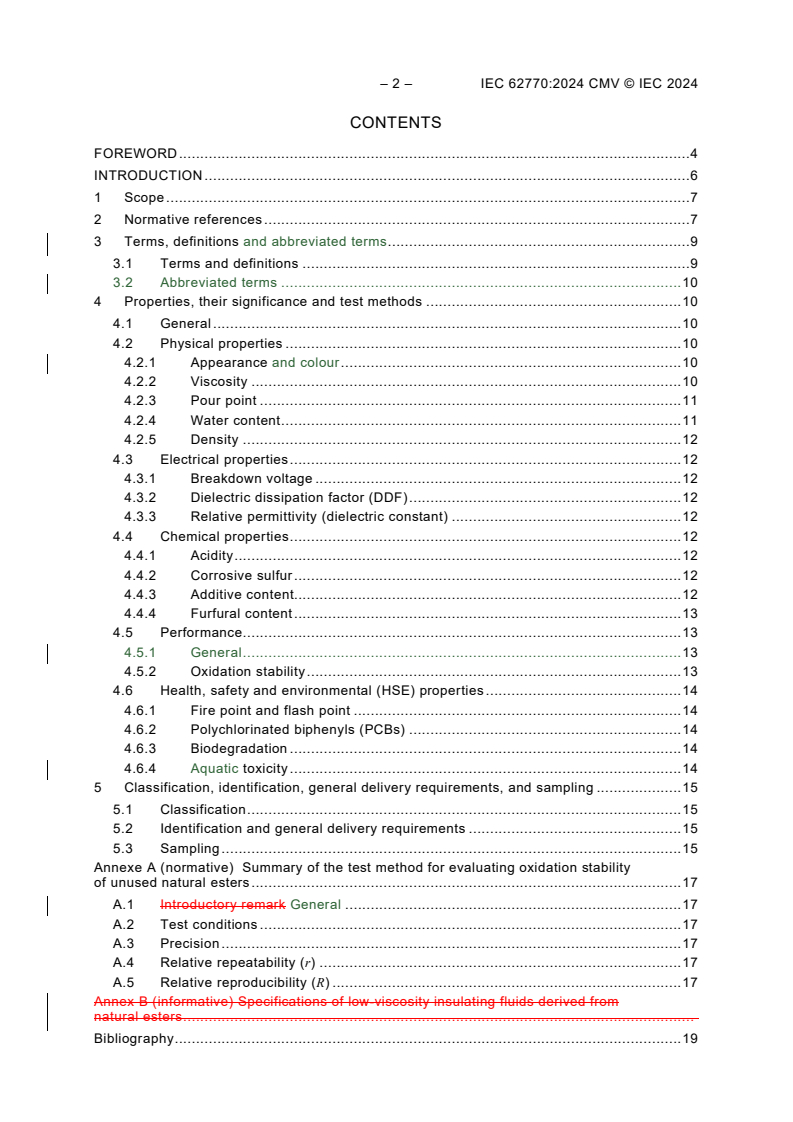
– 2 – IEC 62770:2024 CMV © IEC 2024
CONTENTS
FOREWORD .4
INTRODUCTION .6
1 Scope .7
2 Normative references .7
3 Terms, definitions and abbreviated terms .9
3.1 Terms and definitions .9
3.2 Abbreviated terms . 10
4 Properties, their significance and test methods . 10
4.1 General . 10
4.2 Physical properties . 10
4.2.1 Appearance and colour . 10
4.2.2 Viscosity . 10
4.2.3 Pour point . 11
4.2.4 Water content . 11
4.2.5 Density . 12
4.3 Electrical properties . 12
4.3.1 Breakdown voltage . 12
4.3.2 Dielectric dissipation factor (DDF) . 12
4.3.3 Relative permittivity (dielectric constant) . 12
4.4 Chemical properties . 12
4.4.1 Acidity . 12
4.4.2 Corrosive sulfur . 12
4.4.3 Additive content. 12
4.4.4 Furfural content . 13
4.5 Performance . 13
4.5.1 General . 13
4.5.2 Oxidation stability . 13
4.6 Health, safety and environmental (HSE) properties . 14
4.6.1 Fire point and flash point . 14
4.6.2 Polychlorinated biphenyls (PCBs) . 14
4.6.3 Biodegradation . 14
4.6.4 Aquatic toxicity . 14
5 Classification, identification, general delivery requirements, and sampling . 15
5.1 Classification . 15
5.2 Identification and general delivery requirements . 15
5.3 Sampling . 15
Annexe A (normative) Summary of the test method for evaluating oxidation stability
of unused natural esters . 17
A.1 Introductory remark General . 17
A.2 Test conditions . 17
A.3 Precision . 17
A.4 Relative repeatability (r) . 17
A.5 Relative reproducibility (R) . 17
Annex B (informative) Specifications of low-viscosity insulating fluids derived from
natural esters .
Bibliography . 19
List of comments . 21
Table 1 – Abbreviated terms . 10
Table 2 – General specifications . 16
Table A.1 – Relative repeatability and relative reproducibility obtained for different
parameters during RRT . 17
Table B.1 – Specifications for low-viscosity of monoesters derived from natural esters .
– 4 – IEC 62770:2024 CMV © IEC 2024
INTERNATIONAL ELECTROTECHNICAL COMMISSION
____________
FLUIDS FOR ELECTROTECHNICAL APPLICATIONS –
UNUSED NATURAL ESTERS FOR TRANSFORMERS
AND SIMILAR ELECTRICAL EQUIPMENT
FOREWORD
1) The International Electrotechnical Commission (IEC) is a worldwide organization for standardization comprising
all national electrotechnical committees (IEC National Committees). The object of IEC is to promote international
co-operation on all questions concerning standardization in the electrical and electronic fields. To this end and
in addition to other activities, IEC publishes International Standards, Technical Specifications, Technical Reports,
Publicly Available Specifications (PAS) and Guides (hereafter referred to as “IEC Publication(s)”). Their
preparation is entrusted to technical committees; any IEC National Committee interested in the subject dealt with
may participate in this preparatory work. International, governmental and non-governmental organizations liaising
with the IEC also participate in this preparation. IEC collaborates closely with the International Organization for
Standardization (ISO) in accordance with conditions determined by agreement between the two organizations.
2) The formal decisions or agreements of IEC on technical matters express, as nearly as possible, an international
consensus of opinion on the relevant subjects since each technical committee has representation from all
interested IEC National Committees.
3) IEC Publications have the form of recommendations for international use and are accepted by IEC National
Committees in that sense. While all reasonable efforts are made to ensure that the technical content of IEC
Publications is accurate, IEC cannot be held responsible for the way in which they are used or for any
misinterpretation by any end user.
4) In order to promote international uniformity, IEC National Committees undertake to apply IEC Publications
transparently to the maximum extent possible in their national and regional publications. Any divergence between
any IEC Publication and the corresponding national or regional publication shall be clearly indicated in the latter.
5) IEC itself does not provide any attestation of conformity. Independent certification bodies provide conformity
assessment services and, in some areas, access to IEC marks of conformity. IEC is not responsible for any
services carried out by independent certification bodies.
6) All users should ensure that they have the latest edition of this publication.
7) No liability shall attach to IEC or its directors, employees, servants or agents including individual experts and
members of its technical committees and IEC National Committees for any personal injury, property damage or
other damage of any nature whatsoever, whether direct or indirect, or for costs (including legal fees) and
expenses arising out of the publication, use of, or reliance upon, this IEC Publication or any other IEC
Publications.
8) Attention is drawn to the Normative references cited in this publication. Use of the referenced publications is
indispensable for the correct application of this publication.
9) IEC draws attention to the possibility that the implementation of this document may involve the use of (a)
patent(s). IEC takes no position concerning the evidence, validity or applicability of any claimed patent rights in
respect thereof. As of the date of publication of this document, IEC had not received notice of (a) patent(s), which
may be required to implement this document. However, implementers are cautioned that this may not represent
the latest information, which may be obtained from the patent database available at https://patents.iec.ch. IEC
shall not be held responsible for identifying any or all such patent rights.
This commented version (CMV) of the official standard IEC 62770:2024 edition 2.0 allows
the user to identify the changes made to the previous IEC 62770:2013
edition 1.0. Furthermore, comments from IEC TC 10 experts are provided to explain the
reasons of the most relevant changes, or to clarify any part of the content.
A vertical bar appears in the margin wherever a change has been made. Additions are in
green text, deletions are in strikethrough red text. Experts' comments are identified by a
blue-background number. Mouse over a number to display a pop-up note with the
comment.
This publication contains the CMV and the official standard. The full list of comments is
available at the end of the CMV.
IEC 62770 has been prepared by IEC technical committee 10: Fluids for electrotechnical
applications. It is an International Standard.
This second edition cancels and replaces the first edition published in 2013. This edition
constitutes a technical revision.
This edition includes the following significant technical changes with respect to the previous
edition: 1
a) Introduction of IEC 63012 which details other liquids not covered by this document.
IEC 63012 was published in 2019 after the first edition of IEC 62770 (2013).
b) New Table 1 inserted which clarifies definitions.
c) Appearance and colour requirements now merged.
d) Pour point: Introduction of the importance of LCSET with advice on cold temperature
behaviour of natural esters.
e) Additives: new agreed wording inserted on the declaration of additives
f) Flash and fire points: now only determined by Cleveland Open Cup method, since the
Pensky-Martens closed cup method was identified as problematic with natural esters.
g) Toxicity: Aquatic toxicity now emphasized.
h) Annex B removed as it is no longer needed since the publication of IEC 63012.
The text of this International Standard is based on the following documents:
Draft Report on voting
10/1215/FDIS 10/1243/RVD
Full information on the voting for its approval can be found in the report on voting indicated in
the above table.
The language used for the development of this International Standard is English.
This document was drafted in accordance with ISO/IEC Directives, Part 2, and developed in
accordance with ISO/IEC Directives, Part 1 and ISO/IEC Directives, IEC Supplement, available
at www.iec.ch/members_experts/refdocs. The main document types developed by IEC are
described in greater detail at www.iec.ch/publications.
The committee has decided that the contents of this document will remain unchanged until the
stability date indicated on the IEC website under webstore.iec.ch in the data related to the
specific document. At this date, the document will be
• reconfirmed,
• withdrawn, or
• revised.
IMPORTANT – The "colour inside" logo on the cover page of this document indicates
that it contains colours which are considered to be useful for the correct understanding
of its contents. Users should therefore print this document using a colour printer.
– 6 – IEC 62770:2024 CMV © IEC 2024
INTRODUCTION
Because of their higher fire points and better lower environmental compatibility impact relative
to hydrocarbon petroleum derived insulating mineral oil, the use of vegetable oils and other
natural esters is on the rise as insulating and heat transfer fluids in electrical devices such as
transformers.
This document sets performance criteria for unused natural esters earmarked for electrical
applications. However, the use of natural esters is recommended only for equipment that is not
open to the atmosphere, for example sealed transformers and reactors because these fluids
liquids are prone susceptible to rapid oxidation.
This document does not purport to address all the safety problems associated with its use. It is
the responsibility of the user of the document to establish appropriate health and safety
practices and determine the applicability of regulatory limitations prior to use.
Unused natural esters which are the subject of this document should be handled with due regard
to personal hygiene. Direct contact with eyes should be avoided. In case of eye contact,
irrigation with copious amounts of clean running water should be carried out and medical advice
sought.
Performance of some of the tests mentioned in this document could lead to a hazardous
situation. Attention is drawn to the relevant document test method for guidance.
The disposal of natural esters, chemicals and sample containers mentioned in this standard
should be carried out in accordance with current national legislation with regard to the impact
on the environment. Every precaution should be taken to prevent the release of natural esters
into the environment. 2
FLUIDS FOR ELECTROTECHNICAL APPLICATIONS –
UNUSED NATURAL ESTERS FOR TRANSFORMERS
AND SIMILAR ELECTRICAL EQUIPMENT
1 Scope
This document describes specifications and test methods for unused natural esters in
transformers and similar oil-impregnated liquid-immersed electrical equipment in which a liquid
is required as an insulating and heat transfer medium. The exposure of natural ester to air leads
to deterioration of the insulating liquid. Use of natural esters is not recommended for electrical
equipment that is open to the atmosphere therefore restricted to sealed units, or with the
conservator tank protected from the contact with atmosphere by a membrane or other suitable
system. 3
In this document the term "natural esters" applies to insulating fluids liquids for transformers
and similar electrical equipment with suitable biodegradability and lower environmental
compatibility impact. Such natural esters are vegetable oils obtained from seeds, and oils
obtained from other suitable biological materials and delivered to an agreed point, at a set time
period. These oils are comprised of triglycerides.
Natural esters with additives are within the scope of this document. Because of their different
chemical composition, natural esters differ from insulating mineral oils and other insulating
fluids liquids that have high fire points, such as synthetic esters or silicone fluids.
Natural ester-derived insulating fluids liquids with low viscosity have been introduced but are
not covered by this document. Pertinent properties of such fluids are given in Annex B.
IEC 63012 covers these liquids. 4
This document is applicable only to unused natural esters. Reclaimed natural esters and natural
esters blended with non-natural esters fluids other insulating liquids are beyond the scope of
this document.
NOTE The chemical nomenclature and scientific notations used in the document are in accordance with the IUPAC
handbook (Quantities, Units and Symbols in Physical Chemistry).
2 Normative references
The following documents are referred to in the text in such a way that some or all of their content
constitutes requirements of this document. For dated references, only the edition cited applies.
For undated references, the latest edition of the referenced document (including any
amendments) applies. 5
IEC 60076-14, Power transformers - Part 14: Liquid-immersed power transformers using high-
temperature insulation materials
IEC 60156, Insulating liquids – Determination of the breakdown voltage at power frequency –
Test method
IEC 60247, Insulating liquids – Measurement of relative permittivity, dielectric dissipation factor
(tan d) and d.c. resistivity of insulating fluids
IEC 60296, Fluids for electrotechnical applications – Unused mineral insulating oils for
transformers and switchgear
– 8 – IEC 62770:2024 CMV © IEC 2024
IEC 60475, Method of sampling liquid dielectrics insulating liquids
IEC 60666, Detection and determination of specific additives in mineral insulating oils
IEC 60814, Insulating liquids – Oil-impregnated paper and pressboard – Determination of water
by automatic coulometric Karl Fischer titration
IEC 61100, Classification of insulating liquids according to fire-point and net calorific value
IEC 61125:1992, Unused hydrocarbon-based insulating fluids Insulating liquids – Test methods
for oxidation stability – Test method for evaluating the oxidation stability of insulating liquids in
the delivered state
IEC 61198, Mineral insulating oils – Methods for the determination of 2-furfural and related
compounds
IEC 61619, Insulating liquids – Contamination by polychlorinated biphenyls (PCBs) – Method
of determination by capillary column gas chromatography
IEC 61620, Insulating liquids – Determination of the dielectric dissipation factor by
measurement of the conductance and capacitance – Test method
IEC 62021-3, Insulating liquids – Determination of acidity – Part 3: Test methods for non-
mineral insulating oils
IEC 62535:2008, Insulating liquids – Test method for detection of potentially corrosive sulphur
in used and unused insulating oil
IEC 62697-1, Test methods for quantitative determination of corrosive sulfur compounds in
unused and used insulating liquids – Part 1: Test method for quantitative determination of
dibenzyldisulfide (DBDS)
ISO 2049, Petroleum products – Determination of colour (ASTM scale)
ISO 2592, Petroleum and related products – Determination of flash and fire points – Cleveland
open cup method
ISO 2719, Determination of flash point – Pensky-Martens closed cup method
ISO 3016, Petroleum and related products from natural or synthetic sources – Determination of
pour point
ISO 3104, Petroleum products – Transparent and opaque fluids – Determination of kinematic
viscosity and calculation of dynamic viscosity
ISO 3675, Crude petroleum and liquid petroleum products – Laboratory determination of density
– Hydrometer method
ISO 12185, Crude petroleum and petroleum products – Determination of density – Oscillating
U-tube method
___________
Withdrawn in 2009 and partially replaced by IEC 61039.
To be published.
ASTM D 1275, Standard Test Method for Corrosive Sulfur in Electrical Insulating Oils
ASTM D1500, Standard Test Method for ASTM Color of Petroleum Products (ASTM Color
Scale)
ASTM D7042, Standard Test Method for Dynamic Viscosity and Density of Liquids by Stabinger
Viscometer (and the Calculation of Kinematic Viscosity)
OECD 201-203, Test Guidelines for ecotoxicity
OECD 301, Guideline for testing of chemicals adopted by European Council on July 17th 1992
US EPA, Office of Prevention, Pesticides and Toxic Substances (OPPTS)
835.311, Fate, Transport and Transformation Test Guidelines
3 Terms, definitions and abbreviated terms
3.1 Terms and definitions
For the purposes of this document, the following terms and definitions apply.
ISO and IEC maintain terminology databases for use in standardization at the following
addresses: 6
• IEC Electropedia: available at https://www.electropedia.org/
• ISO Online browsing platform: available at https://www.iso.org/obp
3.1.1
additives
suitable chemical substances which are deliberately added to natural ester insulating fluids
liquids in order to improve certain characteristics, e.g. pour point, viscosity, foaming, and
oxidation stability
Note 1 to entry: Examples include antioxidants, pour-point depressants, electrostatic charging tendency
depressant, metal passivator or deactivators, antifoam agent, refining process improver, etc.
3.2
corrosive sulfur
free sulfur and corrosive sulfur compounds detected by subjecting metals such as copper to
contact with an insulating liquid under standardized conditions
[SOURCE: IEC 60050-212:2010, definition 212-18-20, modified – inclusion of "metals such as"]
3.1.2
natural esters
vegetable oils obtained from seeds and oils obtained from other suitable biological materials
and comprised of triglycerides
3.4
potentially corrosive sulfur
organo-sulfur compounds present in transformer oils that may cause copper sulfide formation
[SOURCE: IEC 62535:2008, definition 3.1 – modified, the NOTE to entry has been omitted]
– 10 – IEC 62770:2024 CMV © IEC 2024
3.1.3
unused natural esters
unused natural esters as delivered by the supplier
Note 1 to entry: Such a liquid has not been used in, nor been in contact with, electrical equipment or other
equipment not required for its manufacture, storage or transport.
Note 2 to entry: The manufacturer and supplier of unused natural esters will have taken all reasonable precautions
to ensure that the natural esters are not contaminated with polychlorinated biphenyls, polychlorinated terphenyls or
polycyclic aromatics (PCB,PCT, PCAs,) or corrosive sulfur compounds; used, reclaimed, or dechlorinated oils, or
other contaminants.
3.2 Abbreviated terms
The abbreviated terms are given in Table 1.
Table 1 – Abbreviated terms 7
Abbreviated term Full term
DBDS Dibenzyl disulphide
DDF Dielectric dissipation factor
HSE Health, safety and environment
IBC Intermediate bulk container
LCSET Lowest cold start energizing temperature
PCBs Polychlorinated biphenyls
RRT Round robin test
4 Properties, their significance and test methods
4.1 General
Salient Required characteristics of unused natural esters are listed in Table 2.
NOTE 1 Additional information on natural esters for transformers and similar electrical equipment is available in
TM
CIGRE brochure 436 and IEEE C57.147-2018 .
NOTE 2 In natural ester at normal operating temperatures, a significant formation of stray gases such as hydrogen
and ethane is sometimes witnessed for a specific period (weeks to months) after the transformer is activated. Such
unexpected gas formation at low temperature can lead to confusion in the dissolved gas analyses interpretation.
Natural esters show a higher tendency towards stray gassing. 8
4.2 Physical properties
4.2.1 Appearance and colour
A visual inspection of unused natural esters (with light transmitted through a glass transparent
beaker of approximately 10 cm thickness of natural esters at ambient temperature) will indicate
the presence of visible contaminants, free water and suspended matter.
The colour of an insulating liquid is determined in transmitted light, and is expressed by a
numerical value based on comparison with a series of colour standards. Colour shall be
measured following ISO 2049 (reference method) or ASTM D1500.
4.2.2 Viscosity
Viscosity influences heat transfer and therefore affects the increase of temperature distribution
in the transformer and other equipment. The lower the viscosity, the easier the oil liquid
circulates, generally leading to better heat transfer. Viscosities at lower temperatures are a
critical factor for the cold start of transformers with ON cooling K class liquid insulation with
natural (not forced/pumped) flow (the absence of circulation can lead to possible overheating
at hot spots) 9. It can have a negative impact on the speed of moving parts, such as on-load
tap changer mechanisms, pumps and regulators. Due consideration should be given to viscosity
at the lowest cold start energizing temperature (LCSET). Viscosity at 40 °C and 100 °C shall
be measured according to ISO 3104 (referee method) or ASTM D7042.
4.2.3 Pour point
Pour point of unused natural esters is the lowest temperature at which the natural esters will
just flow. Pour point shall be measured in accordance with ISO 3016.
Crystallization behaviour of natural esters depends on time and temperature. Crystals should
not be present in liquid at application temperature; precautions shall be taken if oil temperature
inside the electrical device is lower than 0 °C. Below this temperature thermal and dielectric
behavior of the device with natural esters can be adversely affected. A well-defined method to
measure crystallization behavior is not available at present.
The pour point of liquids is the lowest temperature at which the liquid will flow. The pour point
shall be measured in accordance with ISO 3016.
Longer dwell times (weeks or months) below 0 °C can lead to an increase of the pour point, or,
alternatively, to an increase of viscosity of the liquid in comparison to the original state (the so-
called "cold-and-hold behaviour"). It depends on the individual molecular structure and
formulation and the time the liquid is exposed to the low temperature. While natural ester liquids
show pour points in the region of -15 °C to -31 °C, it has been noticed that they can show a
tendency to precipitate ester crystals if held for extended periods at temperatures slightly above
the pour point. These crystals will re-melt back into the bulk ester liquid with no side effects
once the mixture has been warmed up, but this can take time. For references see the
bibliography.
Precautions shall be taken if the electrical equipment is to be left or stored at continuously low
temperatures below 0 °C. The possible partial crystallization can result in an unforeseeable and
undetermined increase in viscosity, which can adversely affect the mechanical, thermal, and
dielectric behaviour of the device immersed in natural ester liquid.
An acknowledged method to measure the effect of crystallization behaviour is not available at
present. As a substitute, additional viscosity measurement at low temperatures according to
IEC 61868 is recommended, using standing times of 24 h, 72 h and 168 h. The lowest cold start
energizing temperature (LCSET) is the temperature which, after a defined holding time, leads
to a viscosity equal to or lower than the maximum admissible viscosity needed for the proper
function of the equipment. During the normal operation of the equipment, no crystals shall be
present in the liquid.
Tap-changers: It is common practice that, before energizing, the on-load tap-changer (if
present) is operated to reach a position where the transformer can be energized without
carrying an abnormally large load. It can happen that the spring-operated diverter switch cannot
complete its operation if the natural ester liquid is partially crystalized. Such situation shall be
avoided in any case. 10
4.2.4 Water content
Water content of natural esters affects their dielectric properties. Water content shall be
measured in accordance with IEC 60814.
NOTE 1 Due to the moderately polar nature of natural esters, water content at which free water will appear and
cause deterioration of electric strength is significantly higher in natural esters than that in mineral insulating oils.
NOTE 2 The terms “water” and “moisture” are the same in this document.
– 12 – IEC 62770:2024 CMV © IEC 2024
4.2.5 Density
85 (reference
Density of natural esters shall be measured in accordance with ISO 3675 ISO 121
method), but ISO 12185 ISO 3675 or ASTM D7042 are also acceptable.
4.3 Electrical properties
4.3.1 Breakdown voltage
Breakdown voltage of unused natural esters shall be measured in accordance with IEC 60156.
Because of the difference in properties of natural esters, an initial set-up time is required; it
may range between 15 min and 30 min, when there are no visible bubbles in the liquid before
measurements are made. 11
4.3.2 Dielectric dissipation factor (DDF)
DDF is a measure for dielectric losses caused by the liquid. High DDF can indicate
contamination of the liquid with moisture, particles, soluble polar contaminants, or poor refining
quality. DDF shall be measured in accordance with IEC 60247 or IEC 61620 at 90 °C. In case
of dispute, IEC 60247 at 90 °C should be used.
By agreement between parties, DDF may can be measured at temperatures other than 90 °C.
In such cases the measurement temperature should shall be stated in the report.
4.3.3 Relative permittivity (dielectric constant)
Relative permittivity is the ratio of the amount of electrical energy stored in the liquid at an
applied voltage, relative to that stored in a vacuum. It shall be measured in accordance with
IEC 60247 or IEC 61620 at 90 °C. In case of dispute, IEC 60247 (reference method) at 90 °C
should shall be used.
NOTE A typical value is between 2,8 and 3,3.
4.4 Chemical properties
4.4.1 Acidity
Unused natural esters should be near neutral; acidity shall be measured in accordance with
IEC 62021-3.
NOTE Natural esters may can contain very low concentrations of free fatty acids; presence of free fatty acids can
affect the acidity of natural esters. This is reflected in the values given in Table 2.
4.4.2 Corrosive sulfur
Free Corrosive sulfur and potentially corrosive compounds are shall be detected by contacting
copper with insulating liquid under the standardized conditions specified in IEC 62535 or ASTM
D1275B. Known corrosive sulfur compounds such as dibenzyl disulphide (DBDS) shall not be
present above the detection limit given in IEC 62697-1.
NOTE Corrosive sulfur compounds are not naturally present in vegetable oils or other natural esters. The tests
given in IEC 62535 can verify that any additives used are non-corrosive and that cross-contamination with a
potentially corrosive oils liquid has not occurred.
4.4.3 Additive content
Additives include antioxidants, metal deactivators, pour point depressants, dyes, etc. An
antioxidant additive slows down the oxidation of esters and, in turn, the formation of gels and
acidity. One such antioxidant is 2, 6-di-tert-butyl-p-cresol (DBPC), also known as BHT, but
others are also used. Detection and measurement of defined anti-oxidant additives shall be in
accordance with IEC 60666 or other suitable methods. Total concentration of additives shall be
less than a weight fraction of 5 %.
The supplier with mutual consent should declare the generic types of all additives, and their
concentrations in the case of antioxidants and passivators. Information on initial type and
concentration of additives is useful for supervision and maintenance guidance during the life of
natural esters in transformers and similar electrical equipment.
The chemical family and function of all additives and maximum concentration of each family
shall be declared in product data sheets and certificates of compliance. 12
NOTE Example of additives are DBPC = 2,6-di-tert-butyl-para-cresol (also known as BHT); DBP = 2,6-di-tert-butyl-
phenol, Irganox®109, Irganox® 1010, Irgamet® 39, Irgamet ®30 , methacrylate.
4.4.4 Furfural content
Furanic compounds, including 2-Furfural, are degradation products of kraft insulating paper;
such compounds are not typically present in unused natural esters. 2-Furfural and related
compounds shall be determined in accordance with IEC 61198. Furfural compounds shall be
determined via an adapted procedure for ester after revision of IEC 61198.
NOTE Certain furanic compounds may be present at trace levels in unused natural esters.
4.5 Performance
4.5.1 General
NOTE This concerns the properties that are related to the long-term behaviour of natural ester
insulating fluids liquids in service and/or their reaction to high electric stress and temperature,
or both. Acceptable operating temperatures for transformers filled with natural esters are
provided suggested in IEC 60076-14.
4.5.2 Oxidation stability
4.5.2.1 General
Unused natural ester liquids are recommended for application only in equipment that is not
open to atmosphere because these fluids liquids are prone to rapid oxidation. Oxidation stability
of these fluids can be assessed with modifications to the procedure as described in Method C
of IEC 61125:1992. Oxidation stability of natural esters shall be tested in accordance with
IEC 61125 with a test duration of 48 h. The acceptable final limits are indicated in Table 2. See
Annex A. 13
NOTE The modifications in IEC 61125 for natural esters are given in Annex A.
4.5.2.2 Total acidity
Acidity of natural esters subjected to oxidation stability test. Acidity should be measured in
accordance with 1.9.4 of IEC 61125:1992.
Total acidity is the sum of volatile and soluble acidity of natural esters subjected to the oxidation
stability test as specified in IEC 61125.
___________
Irganox®109, Irganox® 1010, Irgamet® 39, Irgamet ®30 are the trade names of products supplied by BASF. This
information is given for the convenience of users of this document and does not constitute an endorsement by
IEC of the product named. Equivalent products may be used if they can be shown to lead to the same results.
– 14 – IEC 62770:2024 CMV © IEC 2024
4.5.2.3 Viscosity
Viscosity of natural esters subjected to the oxidation stability test shall be measured at 40 °C
in accordance with ISO 3104 (reference method) or ASTM D7042.
4.5.2.4 Dielectric dissipation factor (DDF)
DDF measurements after the oxidation stability test provide a measure for dielectric losses
resulting from the water and soluble polar compounds formed in a dielectric liquid as a result
of oxidation. DDF shall be measured in accordance with IEC 60247 or IEC 61620.
4.6 Health, safety and environmental (HSE) properties
NOTE These are the properties that are related to safe handling of natural esters and minimization of their adverse
impact. Examples can include flash and fire points, polycyclic aromatics (PCAs), and polychlorinated
biphenyls/polychlorinated terphenyls (PCBs/PCTs).
4.6.1 Fire point and flash point
The safe operation of electrical equipment requires an adequately high flash and fire points that
is shall be measured in accordance with ISO 2592 (reference method) or ASTM D92 14. Flash
point is measured according to ISO 2719.
4.6.2 Polychlorinated biphenyls (PCBs)
Unused natural esters shall be free from PCBs.
ured according to IEC 61619; total
Concentrations of these chemicals can be meas
-1.
concentration shall be less than 2 mg kg
The reference test method that shall be used for these materials is as specified in IEC 61619.
The test method has been developed for mineral oil. Using it for esters could require
modification. 15
NOTE 1 PCBs and related compounds can be present in unused natural esters only because of cross-
contamination.
NOTE 2 Acceptable limits of total or individual PCBs are specified in national or local regulations. European
specifications are described in Directive 96/59/EC and UN guideline for the identification of PCBs and materials
containing PCBs.
4.6.3 Biodegradation
Natural esters exhibit better environmental compatibility relative to petroleum-derived insulating
mineral oils. Specific tests need to be undertaken to demonstrate ready biodegradability of
these fluids. Tests include OECD 301B, C or F; or US EPA – OPPTS 835.311.
NOTE Natural esters can be classified in accordance with IEC 61039, based on biodegradability observed with
OECD 301:1992.
Natural ester insulating liquids exhibit lower environmental impact relative to most mineral
insulating liquids. Specific tests need to be undertaken to demonstrate ready biodegradability
of these liquids. Tests include OECD 301B, C or F. These tests are based on natural materials
(inoculum) and hence have a certain variability. Biodegradation tests are defined in IEC 61039.
4.6.4 Aquatic toxicity 16
Unused natural ester liquids are generally considered non-toxic to aquatic life in the case of
accidental release. Suppliers shall supply assays that define the product as non-toxic.
National regulations dealing with the impact on the environment of the disposal of natural
esters, chemicals and sample containers mentioned in this document can apply. Every
precaution should be taken to prevent the release of natural esters into the environment. 17
NOTE Toxicity of natural esters can be assessed with test methods such as a modified Ames test or other suitable
internationally recognized assays such as OECD 201-203; US EPA 600/4.82.068:1983. Aquatic toxicity of natural
esters can be assessed using test methods such as OECD 201-203.
5 Classification, identification, general delivery requirements, and sampling
5.1 Classification
Natural esters conforming to this document are classified in a single class:
– less flammable natural ester dielectric liquids.
NOTE There are other natural ester derived liquids, which may have a different classification. However, these
liquids are not covered by this standard, an example of such liquids is described in Annex B. Other ester insulating
liquids not covered by this document or IEC 61099 are covered by IEC 63012.
5.2 Identification and general delivery requirements
a) Natural esters are normally delivered in bulk, rail tank cars, tank containers, or packed in
drums or intermediate bulk containers (IBCs). These shall be clean and suitable for this
purpose in order to avoid any contamination.
b) Liquid drums and sample containers shall carry at least the following markings:
– supplier’s designation;
– classification; and
– liquid net weight.
c) Each natural ester delivery shall be accompanied by a document from the supplier
specifying at least:
– supplier’s designation;
– liquid classification; and
– quality certificate. At the request of the purchaser and by mutual consent, the supplier
should declare all generic types of additives and their concentrations in a datasheet in
accordance with the international and local regulations.
5.3 Sampling
Sampling shall be carried out in accordance with the procedure described in IEC 60475.
– 16 – IEC 62770:2024 CMV © IEC 2024
Table 2 – General specifications 18
Property Test method Limits
Physical
Clear, free from sediment and
Appearance
suspended matter
ISO 2049 (reference method),
Colour Max. 1,0
ASTM D1500
ISO 3104 (reference method)
2 -1
Viscosity at 100 °C
Max. 15 mm ·s
ASTM D7042
ISO 3104 (reference method)
2 -1
Viscosity at 40 °C
Max. 50 mm ·s
ASTM D7042
Pour point ISO 3016 Max. –10 °C
-1
Water content IEC 60814 Max. 200 mg·kg
ISO 12185 (reference method)
-3
Density at 20 °C
Max. 1 000 kg·m
ISO 3675 or ASTM D7042
Electrical
a
Breakdown voltage IEC 60156 (2,5 mm gap)
Min. 35 kV
IEC 61620 or IEC 60247 (reference
Dissipation factor (tan δ) 90 °C Max. 0,05
method)
Chemical
-1
Max. 0,06 mg KOH g
Soluble Acidity IEC 62021-3
oil
Corrosive sulfur IEC 62535 or ASTM D1275B Non corrosive
DBDS IEC 62697-1 Below detection limit
Total additives IEC 60666 or other suitable methods Max. weight fraction 5 %
Performance – Salient Required properties after oxidation stability test in accordance with Method C of
b
IEC 61125:1992
-1
Max. 0,6 mg KOH g
Total acidity 1.9.4 of
...
IEC 62770 ®
Edition 2.0 2024-10
INTERNATIONAL
STANDARD
NORME
INTERNATIONALE
Fluids for electrotechnical applications – Unused natural esters for transformers
and similar electrical equipment
Fluides pour applications électrotechniques – Esters naturels neufs pour
transformateurs et matériels électriques analogues
All rights reserved. Unless otherwise specified, no part of this publication may be reproduced or utilized in any form
or by any means, electronic or mechanical, including photocopying and microfilm, without permission in writing from
either IEC or IEC's member National Committee in the country of the requester. If you have any questions about IEC
copyright or have an enquiry about obtaining additional rights to this publication, please contact the address below or
your local IEC member National Committee for further information.
Droits de reproduction réservés. Sauf indication contraire, aucune partie de cette publication ne peut être reproduite ni
utilisée sous quelque forme que ce soit et par aucun procédé, électronique ou mécanique, y compris la photocopie et
les microfilms, sans l'accord écrit de l'IEC ou du Comité national de l'IEC du pays du demandeur. Si vous avez des
questions sur le copyright de l'IEC ou si vous désirez obtenir des droits supplémentaires sur cette publication, utilisez
les coordonnées ci-après ou contactez le Comité national de l'IEC de votre pays de résidence.
IEC Secretariat Tel.: +41 22 919 02 11
3, rue de Varembé info@iec.ch
CH-1211 Geneva 20 www.iec.ch
Switzerland
About the IEC
The International Electrotechnical Commission (IEC) is the leading global organization that prepares and publishes
International Standards for all electrical, electronic and related technologies.
About IEC publications
The technical content of IEC publications is kept under constant review by the IEC. Please make sure that you have the
latest edition, a corrigendum or an amendment might have been published.
IEC publications search - webstore.iec.ch/advsearchform IEC Products & Services Portal - products.iec.ch
The advanced search enables to find IEC publications by a Discover our powerful search engine and read freely all the
variety of criteria (reference number, text, technical publications previews, graphical symbols and the glossary.
committee, …). It also gives information on projects, replaced With a subscription you will always have access to up to date
and withdrawn publications. content tailored to your needs.
IEC Just Published - webstore.iec.ch/justpublished
Electropedia - www.electropedia.org
Stay up to date on all new IEC publications. Just Published
The world's leading online dictionary on electrotechnology,
details all new publications released. Available online and once
containing more than 22 500 terminological entries in English
a month by email.
and French, with equivalent terms in 25 additional languages.
Also known as the International Electrotechnical Vocabulary
IEC Customer Service Centre - webstore.iec.ch/csc
(IEV) online.
If you wish to give us your feedback on this publication or need
further assistance, please contact the Customer Service
Centre: sales@iec.ch.
A propos de l'IEC
La Commission Electrotechnique Internationale (IEC) est la première organisation mondiale qui élabore et publie des
Normes internationales pour tout ce qui a trait à l'électricité, à l'électronique et aux technologies apparentées.
A propos des publications IEC
Le contenu technique des publications IEC est constamment revu. Veuillez vous assurer que vous possédez l’édition la
plus récente, un corrigendum ou amendement peut avoir été publié.
Recherche de publications IEC - IEC Products & Services Portal - products.iec.ch
webstore.iec.ch/advsearchform Découvrez notre puissant moteur de recherche et consultez
La recherche avancée permet de trouver des publications IEC gratuitement tous les aperçus des publications, symboles
en utilisant différents critères (numéro de référence, texte, graphiques et le glossaire. Avec un abonnement, vous aurez
comité d’études, …). Elle donne aussi des informations sur les toujours accès à un contenu à jour adapté à vos besoins.
projets et les publications remplacées ou retirées.
Electropedia - www.electropedia.org
IEC Just Published - webstore.iec.ch/justpublished
Le premier dictionnaire d'électrotechnologie en ligne au monde,
Restez informé sur les nouvelles publications IEC. Just
avec plus de 22 500 articles terminologiques en anglais et en
Published détaille les nouvelles publications parues.
français, ainsi que les termes équivalents dans 25 langues
Disponible en ligne et une fois par mois par email.
additionnelles. Egalement appelé Vocabulaire
Electrotechnique International (IEV) en ligne.
Service Clients - webstore.iec.ch/csc
Si vous désirez nous donner des commentaires sur cette
publication ou si vous avez des questions contactez-nous:
sales@iec.ch.
IEC 62770 ®
Edition 2.0 2024-10
INTERNATIONAL
STANDARD
NORME
INTERNATIONALE
Fluids for electrotechnical applications – Unused natural esters for
transformers and similar electrical equipment
Fluides pour applications électrotechniques – Esters naturels neufs pour
transformateurs et matériels électriques analogues
INTERNATIONAL
ELECTROTECHNICAL
COMMISSION
COMMISSION
ELECTROTECHNIQUE
INTERNATIONALE
ICS 29.040.01 ISBN 978-2-8322-9528-1
– 2 – IEC 62770:2024 © IEC 2024
CONTENTS
FOREWORD . 4
INTRODUCTION . 6
1 Scope . 7
2 Normative references . 7
3 Terms, definitions and abbreviated terms . 8
3.1 Terms and definitions . 8
3.2 Abbreviated terms . 9
4 Properties, their significance and test methods . 9
4.1 General . 9
4.2 Physical properties . 9
4.2.1 Appearance and colour . 9
4.2.2 Viscosity . 10
4.2.3 Pour point . 10
4.2.4 Water content . 10
4.2.5 Density . 10
4.3 Electrical properties . 11
4.3.1 Breakdown voltage . 11
4.3.2 Dielectric dissipation factor (DDF) . 11
4.3.3 Relative permittivity (dielectric constant) . 11
4.4 Chemical properties . 11
4.4.1 Acidity . 11
4.4.2 Corrosive sulfur . 11
4.4.3 Additive content . 11
4.4.4 Furfural content . 12
4.5 Performance . 12
4.5.1 General . 12
4.5.2 Oxidation stability . 12
4.6 Health, safety and environmental (HSE) properties . 12
4.6.1 Fire point and flash point . 12
4.6.2 Polychlorinated biphenyls (PCBs) . 12
4.6.3 Biodegradation . 13
4.6.4 Aquatic toxicity . 13
5 Classification, identification, general delivery requirements, and sampling . 13
5.1 Classification . 13
5.2 Identification and general delivery requirements . 13
5.3 Sampling. 13
Annex A (normative) Summary of the test method for evaluating oxidation stability
of unused natural esters . 15
A.1 General . 15
A.2 Test conditions . 15
A.3 Precision . 15
A.4 Relative repeatability (r) . 15
A.5 Relative reproducibility (R) . 15
Bibliography . 16
Table 1 – Abbreviated terms . 9
Table 2 – General specifications . 14
Table A.1 – Relative repeatability and relative reproducibility obtained for different
parameters during RRT . 15
– 4 – IEC 62770:2024 © IEC 2024
INTERNATIONAL ELECTROTECHNICAL COMMISSION
____________
FLUIDS FOR ELECTROTECHNICAL APPLICATIONS –
UNUSED NATURAL ESTERS FOR TRANSFORMERS
AND SIMILAR ELECTRICAL EQUIPMENT
FOREWORD
1) The International Electrotechnical Commission (IEC) is a worldwide organization for standardization comprising
all national electrotechnical committees (IEC National Committees). The object of IEC is to promote international
co-operation on all questions concerning standardization in the electrical and electronic fields. To this end and
in addition to other activities, IEC publishes International Standards, Technical Specifications, Technical Reports,
Publicly Available Specifications (PAS) and Guides (hereafter referred to as “IEC Publication(s)”). Their
preparation is entrusted to technical committees; any IEC National Committee interested in the subject dealt with
may participate in this preparatory work. International, governmental and non-governmental organizations liaising
with the IEC also participate in this preparation. IEC collaborates closely with the International Organization for
Standardization (ISO) in accordance with conditions determined by agreement between the two organizations.
2) The formal decisions or agreements of IEC on technical matters express, as nearly as possible, an international
consensus of opinion on the relevant subjects since each technical committee has representation from all
interested IEC National Committees.
3) IEC Publications have the form of recommendations for international use and are accepted by IEC National
Committees in that sense. While all reasonable efforts are made to ensure that the technical content of IEC
Publications is accurate, IEC cannot be held responsible for the way in which they are used or for any
misinterpretation by any end user.
4) In order to promote international uniformity, IEC National Committees undertake to apply IEC Publications
transparently to the maximum extent possible in their national and regional publications. Any divergence between
any IEC Publication and the corresponding national or regional publication shall be clearly indicated in the latter.
5) IEC itself does not provide any attestation of conformity. Independent certification bodies provide conformity
assessment services and, in some areas, access to IEC marks of conformity. IEC is not responsible for any
services carried out by independent certification bodies.
6) All users should ensure that they have the latest edition of this publication.
7) No liability shall attach to IEC or its directors, employees, servants or agents including individual experts and
members of its technical committees and IEC National Committees for any personal injury, property damage or
other damage of any nature whatsoever, whether direct or indirect, or for costs (including legal fees) and
expenses arising out of the publication, use of, or reliance upon, this IEC Publication or any other IEC
Publications.
8) Attention is drawn to the Normative references cited in this publication. Use of the referenced publications is
indispensable for the correct application of this publication.
9) IEC draws attention to the possibility that the implementation of this document may involve the use of (a)
patent(s). IEC takes no position concerning the evidence, validity or applicability of any claimed patent rights in
respect thereof. As of the date of publication of this document, IEC had not received notice of (a) patent(s), which
may be required to implement this document. However, implementers are cautioned that this may not represent
the latest information, which may be obtained from the patent database available at https://patents.iec.ch. IEC
shall not be held responsible for identifying any or all such patent rights.
IEC 62770 has been prepared by IEC technical committee 10: Fluids for electrotechnical
applications. It is an International Standard.
This second edition cancels and replaces the first edition published in 2013. This edition
constitutes a technical revision.
This edition includes the following significant technical changes with respect to the previous
edition:
a) Introduction of IEC 63012 which details other liquids not covered by this document.
IEC 63012 was published in 2019 after the first edition of IEC 62770 (2013).
b) New Table 1 inserted which clarifies definitions.
c) Appearance and colour requirements now merged.
d) Pour point: Introduction of the importance of LCSET with advice on cold temperature
behaviour of natural esters.
e) Additives: new agreed wording inserted on the declaration of additives
f) Flash and fire points: now only determined by Cleveland Open Cup method, since the
Pensky-Martens closed cup method was identified as problematic with natural esters.
g) Toxicity: Aquatic toxicity now emphasized.
h) Annex B removed as it is no longer needed since the publication of IEC 63012.
The text of this International Standard is based on the following documents:
Draft Report on voting
10/1215/FDIS 10/1243/RVD
Full information on the voting for its approval can be found in the report on voting indicated in
the above table.
The language used for the development of this International Standard is English.
This document was drafted in accordance with ISO/IEC Directives, Part 2, and developed in
accordance with ISO/IEC Directives, Part 1 and ISO/IEC Directives, IEC Supplement, available
at www.iec.ch/members_experts/refdocs. The main document types developed by IEC are
described in greater detail at www.iec.ch/publications.
The committee has decided that the contents of this document will remain unchanged until the
stability date indicated on the IEC website under webstore.iec.ch in the data related to the
specific document. At this date, the document will be
• reconfirmed,
• withdrawn, or
• revised.
– 6 – IEC 62770:2024 © IEC 2024
INTRODUCTION
Because of their higher fire points and lower environmental impact relative to hydrocarbon
petroleum derived insulating mineral oil, the use of vegetable oils and other natural esters is on
the rise as insulating and heat transfer fluids in electrical devices such as transformers.
This document sets performance criteria for unused natural esters earmarked for electrical
applications. However, the use of natural esters is recommended only for equipment that is not
open to the atmosphere, for example sealed transformers and reactors because these liquids
are susceptible to oxidation.
This document does not purport to address all the safety problems associated with its use. It is
the responsibility of the user of the document to establish appropriate health and safety
practices and determine the applicability of regulatory limitations prior to use.
Unused natural esters which are the subject of this document should be handled with due regard
to personal hygiene. Direct contact with eyes should be avoided. In case of eye contact,
irrigation with copious amounts of clean running water should be carried out and medical advice
sought.
Performance of some of the tests mentioned in this document could lead to a hazardous
situation. Attention is drawn to the relevant document test method for guidance.
FLUIDS FOR ELECTROTECHNICAL APPLICATIONS –
UNUSED NATURAL ESTERS FOR TRANSFORMERS
AND SIMILAR ELECTRICAL EQUIPMENT
1 Scope
This document describes specifications and test methods for unused natural esters in
transformers and similar liquid-immersed electrical equipment in which a liquid is required as
an insulating and heat transfer medium. The exposure of natural ester to air leads to
deterioration of the insulating liquid. Use of natural esters is therefore restricted to sealed units,
or with the conservator tank protected from the contact with atmosphere by a membrane or
other suitable system.
In this document the term "natural esters" applies to insulating liquids for transformers and
similar electrical equipment with suitable biodegradability and lower environmental impact.
Such natural esters are vegetable oils obtained from seeds, and oils obtained from other
suitable biological materials. These oils are comprised of triglycerides.
Natural esters with additives are within the scope of this document. Because of their different
chemical composition, natural esters differ from insulating mineral oils and other insulating
liquids that have high fire points, such as synthetic esters or silicone fluids.
Natural ester-derived insulating liquids with low viscosity have been introduced but are not
covered by this document. IEC 63012 covers these liquids.
This document is applicable only to unused natural esters. Reclaimed natural esters and natural
esters blended with other insulating liquids are beyond the scope of this document.
NOTE The chemical nomenclature and scientific notations used in the document are in accordance with the IUPAC
handbook (Quantities, Units and Symbols in Physical Chemistry).
2 Normative references
The following documents are referred to in the text in such a way that some or all of their content
constitutes requirements of this document. For dated references, only the edition cited applies.
For undated references, the latest edition of the referenced document (including any
amendments) applies.
IEC 60156, Insulating liquids – Determination of the breakdown voltage at power frequency –
Test method
IEC 60247, Insulating liquids – Measurement of relative permittivity, dielectric dissipation factor
(tan d) and d.c. resistivity
IEC 60475, Method of sampling insulating liquids
IEC 60666, Detection and determination of specific additives in mineral insulating oils
IEC 60814, Insulating liquids – Oil-impregnated paper and pressboard – Determination of water
by automatic coulometric Karl Fischer titration
IEC 61125, Insulating liquids – Test methods for oxidation stability – Test method for evaluating
the oxidation stability of insulating liquids in the delivered state
– 8 – IEC 62770:2024 © IEC 2024
IEC 61198, Mineral insulating oils – Methods for the determination of 2-furfural and related
compounds
IEC 61619, Insulating liquids – Contamination by polychlorinated biphenyls (PCBs) – Method
of determination by capillary column gas chromatography
IEC 61620, Insulating liquids – Determination of the dielectric dissipation factor by
measurement of the conductance and capacitance – Test method
IEC 62021-3, Insulating liquids – Determination of acidity – Part 3: Test methods for non-
mineral insulating oils
IEC 62535, Insulating liquids – Test method for detection of potentially corrosive sulphur in
used and unused insulating oil
IEC 62697-1, Test methods for quantitative determination of corrosive sulfur compounds in
unused and used insulating liquids – Part 1: Test method for quantitative determination of
dibenzyldisulfide (DBDS)
ISO 2049, Petroleum products – Determination of colour (ASTM scale)
ISO 2592, Petroleum and related products – Determination of flash and fire points – Cleveland
open cup method
ISO 3016, Petroleum and related products from natural or synthetic sources – Determination of
pour point
ISO 3104, Petroleum products – Transparent and opaque fluids – Determination of kinematic
viscosity and calculation of dynamic viscosity
ISO 3675, Crude petroleum and liquid petroleum products – Laboratory determination of density
– Hydrometer method
ISO 12185, Crude petroleum and petroleum products – Determination of density – Oscillating
U-tube method
ASTM D1500, Standard Test Method for ASTM Color of Petroleum Products (ASTM Color
Scale)
ASTM D7042, Standard Test Method for Dynamic Viscosity and Density of Liquids by Stabinger
Viscometer (and the Calculation of Kinematic Viscosity)
3 Terms, definitions and abbreviated terms
3.1 Terms and definitions
For the purposes of this document, the following terms and definitions apply.
ISO and IEC maintain terminology databases for use in standardization at the following
addresses:
• IEC Electropedia: available at https://www.electropedia.org/
• ISO Online browsing platform: available at https://www.iso.org/obp
3.1.1
additives
chemical substances which are deliberately added to natural ester insulating liquids in order to
improve certain characteristics
3.1.2
natural esters
vegetable oils obtained from seeds and oils obtained from other suitable biological materials
and comprised of triglycerides
3.1.3
unused natural esters
natural esters as delivered by the supplier
Note 1 to entry: Such a liquid has not been used in, nor been in contact with, electrical equipment or other
equipment not required for its manufacture, storage or transport.
3.2 Abbreviated terms
The abbreviated terms are given in Table 1.
Table 1 – Abbreviated terms
Abbreviated term Full term
DBDS Dibenzyl disulphide
DDF Dielectric dissipation factor
HSE Health, safety and environment
IBC Intermediate bulk container
LCSET Lowest cold start energizing temperature
PCBs Polychlorinated biphenyls
RRT Round robin test
4 Properties, their significance and test methods
4.1 General
Required characteristics of unused natural esters are listed in Table 2.
NOTE 1 Additional information on natural esters for transformers and similar electrical equipment is available in
TM
CIGRE brochure 436 and IEEE C57.147-2018 .
NOTE 2 In natural ester at normal operating temperatures, a significant formation of stray gases such as hydrogen
and ethane is sometimes witnessed for a specific period (weeks to months) after the transformer is activated. Such
unexpected gas formation at low temperature can lead to confusion in the dissolved gas analyses interpretation.
Natural esters show a higher tendency towards stray gassing.
4.2 Physical properties
4.2.1 Appearance and colour
A visual inspection of unused natural esters (with light transmitted through a glass transparent
beaker of approximately 10 cm thickness at ambient temperature) will indicate the presence of
visible contaminants, free water and suspended matter.
The colour of an insulating liquid is determined in transmitted light, and is expressed by a
numerical value based on comparison with a series of colour standards. Colour shall be
measured following ISO 2049 (reference method) or ASTM D1500.
– 10 – IEC 62770:2024 © IEC 2024
4.2.2 Viscosity
Viscosity influences heat transfer and therefore affects temperature distribution in the
transformer and other equipment. The lower the viscosity, the easier the liquid circulates,
generally leading to better heat transfer. Viscosities at lower temperatures are a critical factor
for the cold start of transformers with K class liquid insulation with natural (not forced/pumped)
flow (the absence of circulation can lead to possible overheating at hot spots). It can have a
negative impact on the speed of moving parts, such as on-load tap changer mechanisms, pumps
and regulators. Due consideration should be given to viscosity at the lowest cold start
energizing temperature (LCSET). Viscosity at 40 °C and 100 °C shall be measured according
to ISO 3104 (referee method) or ASTM D7042
4.2.3 Pour point
The pour point of liquids is the lowest temperature at which the liquid will flow. The pour point
shall be measured in accordance with ISO 3016.
Longer dwell times (weeks or months) below 0 °C can lead to an increase of the pour point, or,
alternatively, to an increase of viscosity of the liquid in comparison to the original state (the so-
called "cold-and-hold behaviour"). It depends on the individual molecular structure and
formulation and the time the liquid is exposed to the low temperature. While natural ester liquids
show pour points in the region of -15 °C to -31 °C, it has been noticed that they can show a
tendency to precipitate ester crystals if held for extended periods at temperatures slightly above
the pour point. These crystals will re-melt back into the bulk ester liquid with no side effects
once the mixture has been warmed up, but this can take time. For references see the
bibliography.
Precautions shall be taken if the electrical equipment is to be left or stored at continuously low
temperatures below 0 °C. The possible partial crystallization can result in an unforeseeable and
undetermined increase in viscosity, which can adversely affect the mechanical, thermal, and
dielectric behaviour of the device immersed in natural ester liquid.
An acknowledged method to measure the effect of crystallization behaviour is not available at
present. As a substitute, additional viscosity measurement at low temperatures according to
IEC 61868 is recommended, using standing times of 24 h, 72 h and 168 h. The lowest cold start
energizing temperature (LCSET) is the temperature which, after a defined holding time, leads
to a viscosity equal to or lower than the maximum admissible viscosity needed for the proper
function of the equipment. During the normal operation of the equipment, no crystals shall be
present in the liquid.
Tap-changers: It is common practice that, before energizing, the on-load tap-changer (if
present) is operated to reach a position where the transformer can be energized without
carrying an abnormally large load. It can happen that the spring-operated diverter switch cannot
complete its operation if the natural ester liquid is partially crystalized. Such situation shall be
avoided in any case.
4.2.4 Water content
Water content of natural esters affects their dielectric properties. Water content shall be
measured in accordance with IEC 60814.
NOTE 1 Due to the moderately polar nature of natural esters, water content at which free water will appear and
cause deterioration of electric strength is significantly higher in natural esters than that in mineral insulating oils.
NOTE 2 The terms “water” and “moisture” are the same in this document.
4.2.5 Density
Density of natural esters shall be measured in accordance with ISO 12185 (reference method),
but ISO 3675 or ASTM D7042 are also acceptable.
4.3 Electrical properties
4.3.1 Breakdown voltage
Breakdown voltage of unused natural esters shall be measured in accordance with IEC 60156.
4.3.2 Dielectric dissipation factor (DDF)
DDF is a measure for dielectric losses caused by the liquid. High DDF can indicate
contamination of the liquid with moisture, particles, soluble polar contaminants, or poor refining
quality. DDF shall be measured in accordance with IEC 60247 at 90 °C.
By agreement between parties, DDF can be measured at temperatures other than 90 °C. In
such cases the measurement temperature shall be stated in the report.
4.3.3 Relative permittivity (dielectric constant)
Relative permittivity is the ratio of the amount of electrical energy stored in the liquid at an
applied voltage, relative to that stored in a vacuum. It shall be measured in accordance with
IEC 60247 or IEC 61620 at 90 °C. In case of dispute, IEC 60247 (reference method) at 90 °C
shall be used.
NOTE A typical value is between 2,8 and 3,3.
4.4 Chemical properties
4.4.1 Acidity
Unused natural esters should be near neutral; acidity shall be measured in accordance with
IEC 62021-3.
NOTE Natural esters can contain very low concentrations of free fatty acids; presence of free fatty acids can affect
the acidity of natural esters. This is reflected in the values given in Table 2.
4.4.2 Corrosive sulfur
Corrosive sulfur and potentially corrosive compounds shall be detected by contacting copper
with insulating liquid under the standardized conditions specified in IEC 62535. Known
corrosive sulfur compounds such as dibenzyl disulphide (DBDS) shall not be present above the
detection limit given in IEC 62697-1.
NOTE Corrosive sulfur compounds are not naturally present in vegetable oils or other natural esters. The tests
given in IEC 62535 can verify that any additives used are non-corrosive and that cross-contamination with a
potentially corrosive liquid has not occurred.
4.4.3 Additive content
Additives include antioxidants, metal deactivators, pour point depressants, dyes, etc. An
antioxidant additive slows down the oxidation of esters and, in turn, the formation of gels and
acidity. Detection and measurement of defined anti-oxidant additives shall be in accordance
with IEC 60666 or other suitable methods. Total concentration of additives shall be less than a
weight fraction of 5 %.
The chemical family and function of all additives and maximum concentration of each family
shall be declared in product data sheets and certificates of compliance.
– 12 – IEC 62770:2024 © IEC 2024
NOTE Example of additives are DBPC = 2,6-di-tert-butyl-para-cresol (also known as BHT); DBP = 2,6-di-tert-butyl-
phenol, Irganox®109, Irganox® 1010, Irgamet® 39, Irgamet ®30 , methacrylate.
4.4.4 Furfural content
Furanic compounds, including 2-Furfural, are degradation products of kraft insulating paper;
such compounds are not typically present in unused natural esters. Furfural compounds shall
be determined via an adapted procedure for ester after revision of IEC 61198.
4.5 Performance
4.5.1 General
This concerns the properties that are related to the long-term behaviour of natural ester
insulating liquids in service or their reaction to high electric stress and temperature, or both.
Acceptable operating temperatures for transformers filled with natural esters are suggested in
IEC 60076-14.
4.5.2 Oxidation stability
4.5.2.1 General
Unused natural ester liquids are recommended for application only in equipment that is not
open to atmosphere because these liquids are prone to oxidation. Oxidation stability of natural
esters shall be tested in accordance with IEC 61125 with a test duration of 48 h. The acceptable
final limits are indicated in Table 2. See Annex A.
4.5.2.2 Total acidity
Total acidity is the sum of volatile and soluble acidity of natural esters subjected to the oxidation
stability test as specified in IEC 61125.
4.5.2.3 Viscosity
Viscosity of natural esters subjected to the oxidation stability test shall be measured at 40 °C
in accordance with ISO 3104 (reference method) or ASTM D7042.
4.5.2.4 Dielectric dissipation factor (DDF)
DDF measurements after the oxidation stability test provide a measure for dielectric losses
resulting from the water and soluble polar compounds formed in a dielectric liquid as a result
of oxidation. DDF shall be measured in accordance with IEC 60247.
4.6 Health, safety and environmental (HSE) properties
4.6.1 Fire point and flash point
The safe operation of electrical equipment requires an adequately high flash and fire points that
shall be measured in accordance with ISO 2592 (reference method) or ASTM D92.
4.6.2 Polychlorinated biphenyls (PCBs)
Unused natural esters shall be free from PCBs.
The reference test method that shall be used for these materials is as specified in IEC 61619.
___________
Irganox®109, Irganox® 1010, Irgamet® 39, Irgamet ®30 are the trade names of products supplied by BASF. This
information is given for the convenience of users of this document and does not constitute an endorsement by
IEC of the product named. Equivalent products may be used if they can be shown to lead to the same results.
The test method has been developed for mineral oil. Using it for esters could require
modification.
NOTE 1 PCBs and related compounds can be present in unused natural esters only because of cross-
contamination.
NOTE 2 Acceptable limits of total or individual PCBs are specified in national or local regulations. European
specifications are described in Directive 96/59/EC and UN guideline for the identification of PCBs and materials
containing PCBs.
4.6.3 Biodegradation
Natural ester insulating liquids exhibit lower environmental impact relative to most mineral
insulating liquids. Specific tests need to be undertaken to demonstrate ready biodegradability
of these liquids. Tests include OECD 301B, C or F. These tests are based on natural materials
(inoculum) and hence have a certain variability. Biodegradation tests are defined in IEC 61039.
4.6.4 Aquatic toxicity
Unused natural ester liquids are generally considered non-toxic to aquatic life in the case of
accidental release. Suppliers shall supply assays that define the product as non-toxic.
National regulations dealing with the impact on the environment of the disposal of natural
esters, chemicals and sample containers mentioned in this document can apply. Every
precaution should be taken to prevent the release of natural esters into the environment.
NOTE Aquatic toxicity of natural esters can be assessed using test methods such as OECD 201-203.
5 Classification, identification, general delivery requirements, and sampling
5.1 Classification
Natural esters conforming to this document are classified in a single class:
– less flammable natural ester dielectric liquids.
NOTE Other ester insulating liquids not covered by this document or IEC 61099 are covered by IEC 63012.
5.2 Identification and general delivery requirements
a) Natural esters are normally delivered in bulk, rail tank cars, tank containers, or packed in
drums or intermediate bulk containers (IBCs). These shall be clean and suitable for this
purpose in order to avoid any contamination.
b) Liquid drums and sample containers shall carry the following markings:
– supplier’s designation;
– classification; and
– liquid net weight.
c) Each natural ester delivery shall be accompanied by a document from the supplier
specifying:
– supplier’s designation;
– liquid classification; and
– quality certificate.
5.3 Sampling
Sampling shall be carried out in accordance with the procedure described in IEC 60475.
– 14 – IEC 62770:2024 © IEC 2024
Table 2 – General specifications
Property Test method Limits
Physical
Clear, free from sediment and
Appearance
suspended matter
ISO 2049 (reference method),
Colour Max. 1,0
ASTM D1500
ISO 3104 (reference method)
2 -1
Viscosity at 100 °C Max. 15 mm ·s
ASTM D7042
ISO 3104 (reference method)
2 -1
Viscosity at 40 °C Max. 50 mm ·s
ASTM D7042
Pour point ISO 3016 Max. –10 °C
-1
Water content IEC 60814
Max. 200 mg·kg
ISO 12185 (reference method)
-3
Density at 20 °C
Max. 1 000 kg·m
ISO 3675 or ASTM D7042
Electrical
a
Breakdown voltage IEC 60156 Min. 35 kV
IEC 61620 or IEC 60247 (reference
Dissipation factor (tan δ) 90 °C Max. 0,05
method)
Chemical
-1
Max. 0,06 mg KOH g
Acidity IEC 62021-3
oil
Corrosive sulfur IEC 62535 Noncorrosive
DBDS IEC 62697-1 Below detection limit
Total additives IEC 60666 or other suitable methods Max. weight fraction 5 %
b
Performance – Required properties after oxidation stability test in accordance with IEC 61125
-1
Max. 0,6 mg KOH g
Total acidity IEC 61125
oil
ISO 3104 (reference method) Max. 30 % increase over the initial
Viscosity at 40 °C
ASTM D7042 value
DDF (tan δ) at 90 °C IEC 60247 Max. 0,5
Health, safety and environment (HSE)
ISO 2592 (reference method)
Fire point Min. 300 °C
ASTM D92
ISO 2592 (reference method)
Flash point Min. 250 °C
ASTM D92
Biodegradation US EPA, OECD 301 B, C or F Readily biodegradable
a
At delivery. Expect >70 kV after lab treating, for example degassing and drying.
b
See Annex A for details of oxidation stability parameters.
Annex A
(normative)
Summary of the test method for evaluating
oxidation stability of unused natural esters
A.1 General
Oxidation stability of natural esters is evaluated under accelerated ageing conditions similar to
those described in IEC 61125.
Aliquots of the natural esters samples are maintained at 120 °C in the presence of a solid
copper catalyst, while a constant volume of air is bubbled through the samples for 48 h. The
resistance to oxidation is estimated by measuring volatile acidity, soluble acidity, sludge
formation, viscosity and DDF. The values obtained for these parameters after accelerated
oxidation are compared against the values obtained prior to accelerated oxidation.
A.2 Test conditions
All test conditions, i.e. the amount of natural esters, length and diameter of copper catalyst,
oxidation temperature and oxidant (air) flow rate are the same as described in IEC 61125. The
only modification is in the duration for accelerated ageing, which is set at 48 h.
A.3 Precision
Precision values obtained during the round robin test (RRT) on commercially available natural
esters after 48 h oxidation are given in Table A.1. Relative reproducibility for each parameter
is based on results obtained from 11 participating laboratories. The values reported in Table A.1
are in general agreement with values reported for mineral insulating oils in IEC 61125.
A.4 Relative repeatability (r)
Duplicate determinations carried out by one laboratory at the 95 % confidence level.
A.5 Relative reproducibility (R)
Duplicate determinations carried out by different laboratories at the 95 % confidence level.
Table A.1 – Relative repeatability and relative reproducibility
obtained for different parameters during RRT
Parameter r R
% %
Viscosity at 40 °C 5 7,5
Total acidity 13 38
Sludge 22 57
DDF (tan δ) at 90 °C – 47
– 16 – IEC 62770:2024 © IEC 2024
Bibliography
IEC 60050, International Electrotechnical Vocabulary (IEV) (available at www.electropedia.org)
IEC 60076-14, Power transformers – Part 14: Liquid-immersed power transformers using high-
temperature insulation materials
IEC 60296, Fluids for electrotechnical applications – Mineral insulating oils for electrical
equipment
IEC 60422, Mineral insulating oils in electrical equipment – Supervision and maintenance
guidance
IEC 61039, Classification of insulating fluids
IEC 61099, Insulating liquids – Specifications for unused synthetic organic esters for electrical
purposes
IEC 61868, Mineral insulating oils – Determination of kinematic viscosity at very low
temperatures
IEC 62975:2021, Natural esters – Guidelines for maintenance and use in electrical equipment
IEC 63012, Insulating liquids – Unused modified or blended esters for electrotechnical
applications
ASTM D6871, Standard specification for natural (vegetable oil) ester fluids used in electrical
apparatus
CIGRE-296 2020 CIGRE Canada Conference Toronto, Ontario, October 19-22, 2020“What it
takes to design, manufacture and operate power transformers under arctic temperature
conditions” Thomas Schneider Siemans Energy, Jinesh Malde M&I Materials Inc.
CIGRE Brochure 436, Experiences in Service with New Insulating Liquids. Working Group A2.
35, October, 2010
Council Directive 96/59/EC of 16 September 1996 on the disposal of polychlorinated biphenyls
and polychlorinated terphenyls (PCB/PCT)
IEEE C57.147-2018, IEEE Guide for Acceptance and Maintenance of Natural Ester Insulating
Liquid in Transformers
International Union of Pure and Applied Chemistry (IUPAC) Handbook of terms and definitions
OECD 201-203, Test Guidelines for ecotoxicity
OECD 301, Guideline for testing of chemicals adopted by European Council on July 17th 1992
UN Guidelines for the Identification of PCBs and Materials Containing PCBs, 1999
US EPA, Office of Prevention, Pesticides and Toxic Substances 835.311, Fate, Transport and
Transformation Test Guidelines
___________
– 18 – IEC 62770:2024 © IEC 2024
SOMMAIRE
AVANT-PROPOS . 20
INTRODUCTION .
...