

IEC 60534-4:2021
(Main)Industrial-process control valves - Part 4: Inspection and routine testing
General Information
- Abstract
IEC 60534-4:2021 specifies the requirements for the inspection and routine testing of control valves manufactured in conformity with the other parts of IEC 60534. This document is applicable to valves with pressure ratings not exceeding Class 2500. The requirements for actuators apply only to pneumatic actuators. This document does not apply to the types of control valves where radioactive service, fire safety testing, or other hazardous service conditions are encountered. If a standard for hazardous service conflicts with the requirements of this document, the standard for hazardous service should take precedence.
- Status
- Published
- Publication Date
- 15-Dec-2021
- Technical Committee
- SC 65B - Measurement and control devices
- Drafting Committee
- WG 9 - TC 65/SC 65B/WG 9
- Current Stage
- PPUB - Publication issued
- Start Date
- 16-Dec-2021
- Completion Date
- 07-Jan-2022
Buy Documents
IEC 60534-4:2021 RLV - Industrial-process control valves - Part 4: Inspection and routine testing Released:12/16/2021
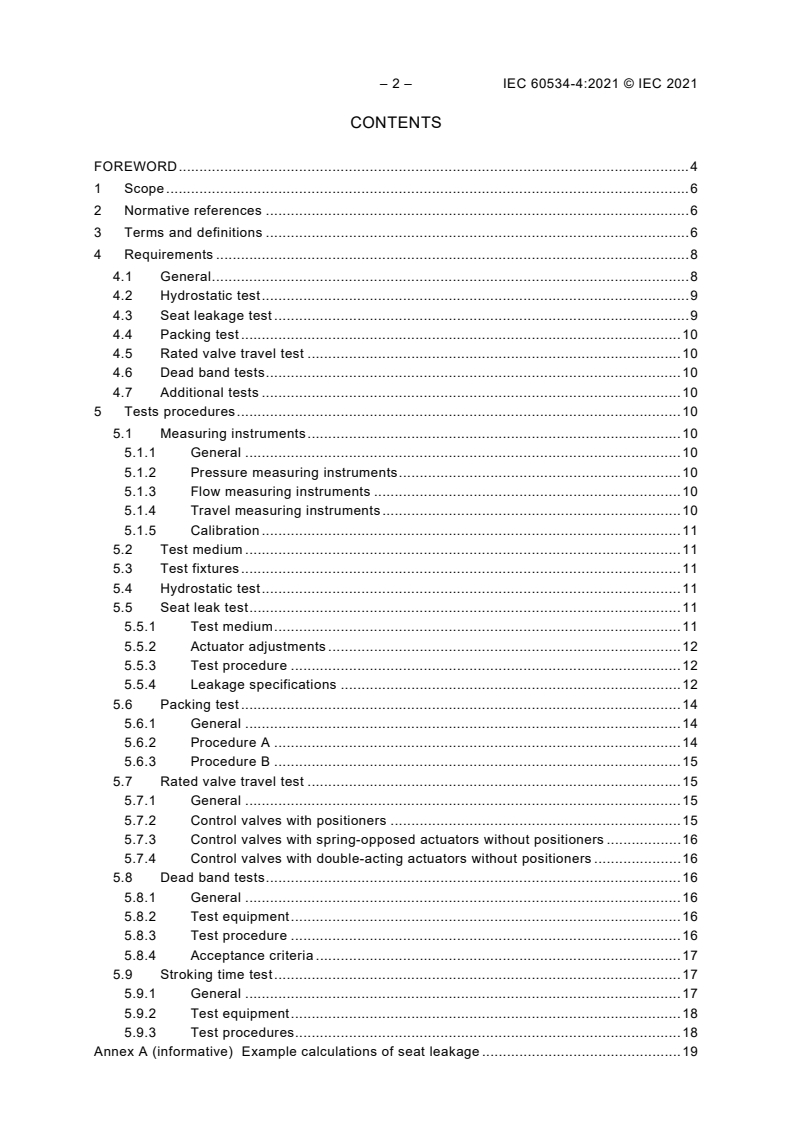
IEC 60534-4:2021 - Industrial-process control valves - Part 4: Inspection and routine testing Released:12/16/2021
Overview
IEC 60534-4:2021 - Industrial-process control valves - Part 4: Inspection and routine testing specifies inspection and routine test requirements for control valves manufactured to the IEC 60534 series. It applies to valves with pressure ratings up to Class 2500 and covers actuator requirements only for pneumatic actuators. The standard excludes valves intended for radioactive service, fire safety testing or other hazardous services (in such cases a hazardous‑service standard takes precedence).
This fourth edition (2021) is a technical revision that clarifies hydrostatic test responsibilities, introduces mandatory packing tests, adds stroking time tests, defines limits for reduced differential pressure seat leakage tests, and includes low‑temperature seat leakage guidance and expanded dimensional range for leakage class VI.
Key topics and technical requirements
The standard defines required routine inspections, test procedures and acceptance criteria, including:
- Hydrostatic test - general requirements; specific test pressures and durations are referenced to valve design codes as applicable.
- Seat leakage test - leakage class verification, test media, differential pressures and acceptance criteria; guidance on reduced and low‑temperature tests.
- Packing test - mandatory checks and two procedural options for evaluating seal integrity.
- Rated valve travel test - verification of travel and actuator adjustments for valves with positioners, spring‑opposed and double‑acting actuators.
- Dead band and hysteresis tests - methods to measure control response and allowable dead band error.
- Stroking time test - measurement of actuation speed and timing.
- Test procedure support: instrument requirements (pressure, flow, travel measurement), calibration, test fixtures, test media, and documented acceptance criteria.
Annexes include example calculations for seat leakage and an inspection/routine testing checklist to support implementation.
Practical applications
IEC 60534-4:2021 is used to:
- Establish factory acceptance testing (FAT) and routine inspection procedures for control valves.
- Define contractual test requirements between manufacturers and purchasers.
- Support quality control, final inspection and documentation for valve delivery.
- Guide test laboratories and third‑party inspectors in consistent valve evaluation.
- Provide plant operators and maintenance teams with acceptance criteria for in‑service valve replacements or spares.
Who should use this standard
- Valve manufacturers and assembly shops
- Quality assurance and factory testing teams
- Third‑party inspection and testing laboratories
- Process plant engineers, procurement specialists and maintenance organizations
- OEMs and integrators specifying control valves for process automation
Related standards
- IEC 60534 (all parts) - Industrial‑process control valves (series)
- IEC 61298 (all parts) - Process measurement and control devices - general methods and procedures for evaluating performance
Keywords: IEC 60534-4:2021, industrial‑process control valves, inspection, routine testing, seat leakage test, hydrostatic test, packing test, dead band, stroking time, pneumatic actuator, valve testing standards.
Relations
- Revises
IEC 60534-4:2006 - Industrial-process control valves - Part 4: Inspection and routine testing - Effective Date
- 05-Sep-2023
Buy Documents
IEC 60534-4:2021 RLV - Industrial-process control valves - Part 4: Inspection and routine testing Released:12/16/2021
IEC 60534-4:2021 - Industrial-process control valves - Part 4: Inspection and routine testing Released:12/16/2021
Get Certified
Connect with accredited certification bodies for this standard

IMQ S.p.A. (Certification)
Italian electrical product certification.

SLG Prüf- und Zertifizierungs GmbH
German testing and certification body.

UL Solutions
Global safety science company with testing, inspection and certification.
Sponsored listings
Frequently Asked Questions
IEC 60534-4:2021 is a standard published by the International Electrotechnical Commission (IEC). Its full title is "Industrial-process control valves - Part 4: Inspection and routine testing". This standard covers: IEC 60534-4:2021 specifies the requirements for the inspection and routine testing of control valves manufactured in conformity with the other parts of IEC 60534. This document is applicable to valves with pressure ratings not exceeding Class 2500. The requirements for actuators apply only to pneumatic actuators. This document does not apply to the types of control valves where radioactive service, fire safety testing, or other hazardous service conditions are encountered. If a standard for hazardous service conflicts with the requirements of this document, the standard for hazardous service should take precedence.
IEC 60534-4:2021 specifies the requirements for the inspection and routine testing of control valves manufactured in conformity with the other parts of IEC 60534. This document is applicable to valves with pressure ratings not exceeding Class 2500. The requirements for actuators apply only to pneumatic actuators. This document does not apply to the types of control valves where radioactive service, fire safety testing, or other hazardous service conditions are encountered. If a standard for hazardous service conflicts with the requirements of this document, the standard for hazardous service should take precedence.
IEC 60534-4:2021 is classified under the following ICS (International Classification for Standards) categories: 23.060 - Valves; 29.140.40 - Luminaires. The ICS classification helps identify the subject area and facilitates finding related standards.
IEC 60534-4:2021 has the following relationships with other standards: It is inter standard links to IEC 60534-4:2006. Understanding these relationships helps ensure you are using the most current and applicable version of the standard.
IEC 60534-4:2021 is available in PDF format for immediate download after purchase. The document can be added to your cart and obtained through the secure checkout process. Digital delivery ensures instant access to the complete standard document.
Standards Content (Sample)
IEC 60534-4 ®
Edition 4.0 2021-12
REDLINE VERSION
INTERNATIONAL
STANDARD
Industrial-process control valves –
Part 4: Inspection and routine testing
All rights reserved. Unless otherwise specified, no part of this publication may be reproduced or utilized in any form
or by any means, electronic or mechanical, including photocopying and microfilm, without permission in writing from
either IEC or IEC's member National Committee in the country of the requester. If you have any questions about IEC
copyright or have an enquiry about obtaining additional rights to this publication, please contact the address below or
your local IEC member National Committee for further information.
IEC Central Office Tel.: +41 22 919 02 11
3, rue de Varembé info@iec.ch
CH-1211 Geneva 20 www.iec.ch
Switzerland
About the IEC
The International Electrotechnical Commission (IEC) is the leading global organization that prepares and publishes
International Standards for all electrical, electronic and related technologies.
About IEC publications
The technical content of IEC publications is kept under constant review by the IEC. Please make sure that you have the
latest edition, a corrigendum or an amendment might have been published.
IEC publications search - webstore.iec.ch/advsearchform IEC online collection - oc.iec.ch
The advanced search enables to find IEC publications by a Discover our powerful search engine and read freely all the
variety of criteria (reference number, text, technical publications previews. With a subscription you will always
committee, …). It also gives information on projects, replaced have access to up to date content tailored to your needs.
and withdrawn publications.
Electropedia - www.electropedia.org
IEC Just Published - webstore.iec.ch/justpublished
The world's leading online dictionary on electrotechnology,
Stay up to date on all new IEC publications. Just Published
containing more than 22 000 terminological entries in English
details all new publications released. Available online and
and French, with equivalent terms in 18 additional languages.
once a month by email.
Also known as the International Electrotechnical Vocabulary
(IEV) online.
IEC Customer Service Centre - webstore.iec.ch/csc
If you wish to give us your feedback on this publication or
need further assistance, please contact the Customer Service
Centre: sales@iec.ch.
IEC 60534-4 ®
Edition 4.0 2021-12
REDLINE VERSION
INTERNATIONAL
STANDARD
Industrial-process control valves –
Part 4: Inspection and routine testing
INTERNATIONAL
ELECTROTECHNICAL
COMMISSION
ICS 23.060 ISBN 978-2-8322-4207-0
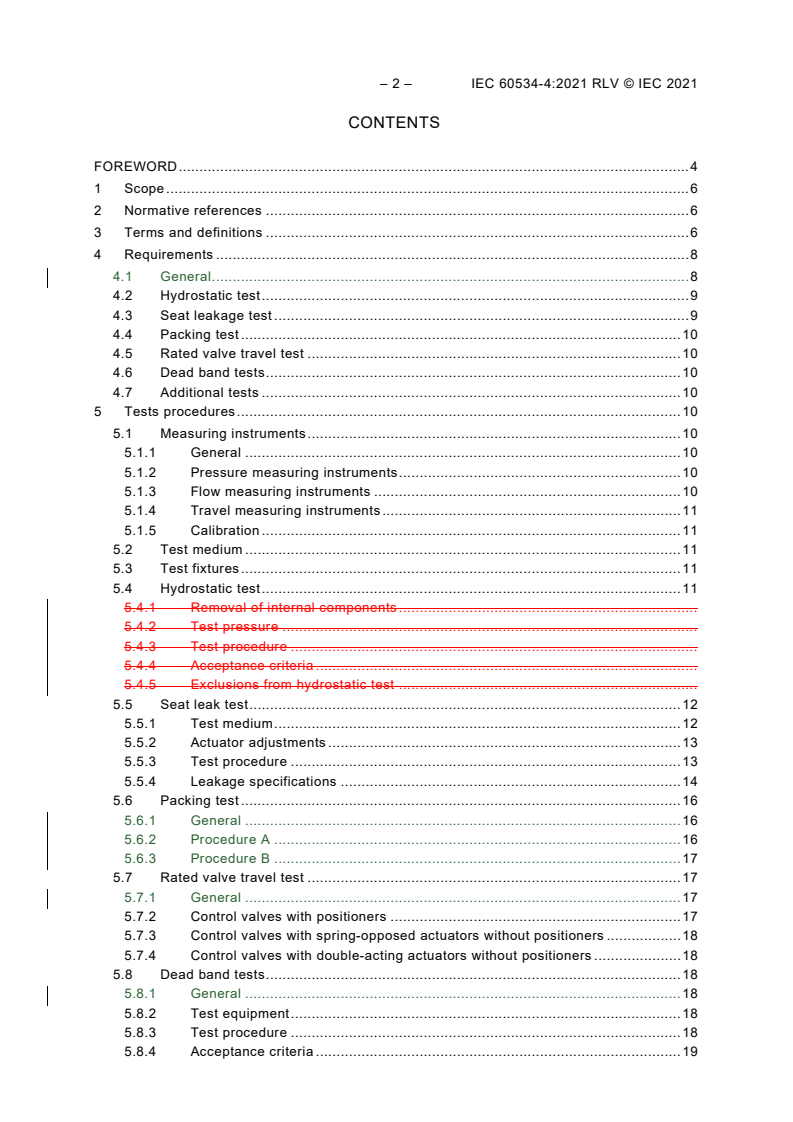
– 2 – IEC 60534-4:2021 RLV © IEC 2021
CONTENTS
FOREWORD . 4
1 Scope . 6
2 Normative references . 6
3 Terms and definitions . 6
4 Requirements . 8
4.1 General . 8
4.2 Hydrostatic test . 9
4.3 Seat leakage test . 9
4.4 Packing test . 10
4.5 Rated valve travel test . 10
4.6 Dead band tests . 10
4.7 Additional tests . 10
5 Tests procedures . 10
5.1 Measuring instruments . 10
5.1.1 General . 10
5.1.2 Pressure measuring instruments . 10
5.1.3 Flow measuring instruments . 10
5.1.4 Travel measuring instruments . 11
5.1.5 Calibration . 11
5.2 Test medium . 11
5.3 Test fixtures . 11
5.4 Hydrostatic test . 11
5.4.1 Removal of internal components .
5.4.2 Test pressure .
5.4.3 Test procedure .
5.4.4 Acceptance criteria .
5.4.5 Exclusions from hydrostatic test .
5.5 Seat leak test . 12
5.5.1 Test medium . 12
5.5.2 Actuator adjustments . 13
5.5.3 Test procedure . 13
5.5.4 Leakage specifications . 14
5.6 Packing test . 16
5.6.1 General . 16
5.6.2 Procedure A . 16
5.6.3 Procedure B . 17
5.7 Rated valve travel test . 17
5.7.1 General . 17
5.7.2 Control valves with positioners . 17
5.7.3 Control valves with spring-opposed actuators without positioners . 18
5.7.4 Control valves with double-acting actuators without positioners . 18
5.8 Dead band tests . 18
5.8.1 General . 18
5.8.2 Test equipment . 18
5.8.3 Test procedure . 18
5.8.4 Acceptance criteria . 19
5.9 Stroking time test . 19
5.9.1 General . 19
5.9.2 Test equipment . 20
5.9.3 Test procedures . 20
Annex A (informative) Example calculations of seat leakage . 21
A.1 General . 21
A.1.1 Overview . 21
A.1.2 Valve description . 21
A.1.3 Test differential pressures . 21
A.1.4 Calculation of rated valve capacity. 21
A.1.5 Calculated maximum allowable seat leakages . 24
A.2 General . 24
A.2.1 Overview . 24
A.2.2 Valve description . 24
A.2.3 Test differential pressure . 24
A.2.4 Calculation of class VI maximum allowable seat leakage . 25
Annex B (informative) Inspection and routine testing checklist (per IEC 60534-4) . 26
Bibliography . 26
Figure 1 – Hysteresis and dead band . 7
Table 1 – Tests . 9
Table 2 – Minimum duration of hydrostatic tests of shell .
Table 2 – Maximum seat leakage for each leakage class . 14
Table 3 – Maximum recommended values of dead band error . 19
Table A.1 – Maximum seat leakage for each leakage class . 24
– 4 – IEC 60534-4:2021 RLV © IEC 2021
INTERNATIONAL ELECTROTECHNICAL COMMISSION
____________
INDUSTRIAL-PROCESS CONTROL VALVES –
Part 4: Inspection and routine testing
FOREWORD
1) The International Electrotechnical Commission (IEC) is a worldwide organization for standardization comprising
all national electrotechnical committees (IEC National Committees). The object of IEC is to promote international
co-operation on all questions concerning standardization in the electrical and electronic fields. To this end and
in addition to other activities, IEC publishes International Standards, Technical Specifications, Technical Reports,
Publicly Available Specifications (PAS) and Guides (hereafter referred to as “IEC Publication(s)”). Their
preparation is entrusted to technical committees; any IEC National Committee interested in the subject dealt with
may participate in this preparatory work. International, governmental and non-governmental organizations liaising
with the IEC also participate in this preparation. IEC collaborates closely with the International Organization for
Standardization (ISO) in accordance with conditions determined by agreement between the two organizations.
2) The formal decisions or agreements of IEC on technical matters express, as nearly as possible, an international
consensus of opinion on the relevant subjects since each technical committee has representation from all
interested IEC National Committees.
3) IEC Publications have the form of recommendations for international use and are accepted by IEC National
Committees in that sense. While all reasonable efforts are made to ensure that the technical content of IEC
Publications is accurate, IEC cannot be held responsible for the way in which they are used or for any
misinterpretation by any end user.
4) In order to promote international uniformity, IEC National Committees undertake to apply IEC Publications
transparently to the maximum extent possible in their national and regional publications. Any divergence between
any IEC Publication and the corresponding national or regional publication shall be clearly indicated in the latter.
5) IEC itself does not provide any attestation of conformity. Independent certification bodies provide conformity
assessment services and, in some areas, access to IEC marks of conformity. IEC is not responsible for any
services carried out by independent certification bodies.
6) All users should ensure that they have the latest edition of this publication.
7) No liability shall attach to IEC or its directors, employees, servants or agents including individual experts and
members of its technical committees and IEC National Committees for any personal injury, property damage or
other damage of any nature whatsoever, whether direct or indirect, or for costs (including legal fees) and
expenses arising out of the publication, use of, or reliance upon, this IEC Publication or any other IEC
Publications.
8) Attention is drawn to the Normative references cited in this publication. Use of the referenced publications is
indispensable for the correct application of this publication.
9) Attention is drawn to the possibility that some of the elements of this IEC Publication may be the subject of patent
rights. IEC shall not be held responsible for identifying any or all such patent rights.
This redline version of the official IEC Standard allows the user to identify the changes made to
the previous edition IEC 60534-4:2006. A vertical bar appears in the margin wherever a change
has been made. Additions are in green text, deletions are in strikethrough red text.
IEC 60534-4 has been prepared by subcommittee 65B: Measurement and control devices, of
IEC technical committee 65: Industrial-process measurement, control and automation. It is an
International Standard.
This fourth edition cancels and replaces the third edition published in 2006. This edition
constitutes a technical revision.
This edition includes the following significant technical changes with respect to the previous
edition:
a) remove details about hydrostatic test but state that to be performed according to valve
design code;
b) include mandatory test for valve packing;
c) put in evidence limits of reduced differential pressure seat leakage test procedure;
d) introduce details about low temperature seat leakage test;
e) extend dimensional range for leakage class VI to less than 25 mm and over 400 mm seat
diameter;
f) include stroking time tests.
The text of this International Standard is based on the following documents:
Draft Report on voting
65B/1208/FDIS 65B/1211/RVD
Full information on the voting for its approval can be found in the report on voting indicated in
the above table.
The language used for the development of this International Standard is English.
This document was drafted in accordance with ISO/IEC Directives, Part 2, and developed in
accordance with ISO/IEC Directives, Part 1 and ISO/IEC Directives, IEC Supplement, available
at www.iec.ch/members_experts/refdocs. The main document types developed by IEC are
described in greater detail at www.iec.ch/standardsdev/publications.
A list of all parts in the IEC 60534 series, published under the general title Industrial-process
control valves, can be found on the IEC website.
The committee has decided that the contents of this document will remain unchanged until the
stability date indicated on the IEC website under webstore.iec.ch in the data related to the
specific document. At this date, the document will be
• reconfirmed,
• withdrawn,
• replaced by a revised edition, or
• amended.
IMPORTANT – The 'colour inside' logo on the cover page of this publication indicates that it
contains colours which are considered to be useful for the correct understanding of its
contents. Users should therefore print this document using a colour printer.
– 6 – IEC 60534-4:2021 RLV © IEC 2021
INDUSTRIAL-PROCESS CONTROL VALVES –
Part 4: Inspection and routine testing
1 Scope
This part of IEC 60534 specifies the requirements for the inspection and routine testing of
control valves manufactured in conformity with the other parts of IEC 60534.
This document is applicable to valves with pressure ratings not exceeding Class 2500. The
requirements for actuators apply only to pneumatic actuators.
This document does not apply to the types of control valves where radioactive service, fire
safety testing, or other hazardous service conditions are encountered. If a standard for
hazardous service conflicts with the requirements of this document, the standard for hazardous
service should take precedence.
NOTE This document can be extended to higher pressure ratings by agreement between the purchaser and the
manufacturer.
2 Normative references
The following documents are referred to in the text in such a way that some or all of their content
constitutes requirements of this document. For dated references, only the edition cited applies.
For undated references, the latest edition of the referenced document (including any
amendments) applies.
IEC 60534 (all parts), Industrial-process control valves
IEC 61298 (all parts), Process measurement and control devices – General methods and
procedures for evaluating performance
3 Terms and definitions
For the purposes of this document, the following definitions, as well as those given in
IEC 60534-1 and other parts of IEC 60534, apply.
For the purposes of this document, the terms and definitions given in the IEC 60534 series and
the following apply.
ISO and IEC maintain terminological databases for use in standardization at the following
addresses:
• IEC Electropedia: available at http://www.electropedia.org/
• ISO Online browsing platform: available at http://www.iso.org/obp
3.1
bench range
range of pressures to the actuator within which the nominal travel is performed in both
directions, with no pressure in the valve, but including friction forces
Note 1 to entry: The actuator operating range, i.e. when the valve is installed under actual process conditions, will
be different from the bench range.
3.2
dead band
finite range of values within which reversal of the input variable does not produce any noticeable
change in the output variable (see Figure 1)
a) Hysteresis
b) Dead band
c) Hysteresis with dead band
Figure 1 – Hysteresis and dead band
3.3
dead band error
maximum value of the span of the dead band (over the measuring range)
– 8 – IEC 60534-4:2021 RLV © IEC 2021
3.4
hysteresis
property of a device or instrument whereby it gives different output values in relation to its input
values depending on the directional sequence in which the input values have been applied
(see Figure 1)
3.5
hysteresis error
maximum deviation between the two calibration curves of the measured variable as obtained
by an upscale going traverse and a downscale going traverse over the full range and subtracting
the value of the dead band
3.6
type inspection and testing
inspection and testing carried out by the manufacturer in accordance with its own procedures
to assess whether products made by the same manufacturing process meet the requirements
of the purchase order
Note 1 to entry: The products inspected and tested need not necessarily be the products actually supplied.
3.7
actual inspection and testing
inspection and testing carried out, before delivery, according to the technical requirements of
the purchase order, on the products to be supplied or on test units of which the product supplied
is part, in order to verify whether these products comply with the requirements of the purchase
order
4 Requirements
4.1 General
Each valve shall be submitted to the mandatory tests specified in Table 1. Supplementary tests
given are subject to agreement between manufacturer and purchaser. An inspection and routine
testing check list as specified by the present document is given in Annex B.
Table 1 – Tests
Test Category Reference
1. Shell hydrostatic test M 4.2 and 5.4
2. Seat leakage test M 4.3 and 5.5
b
4.4 and 5.6.2
3. Packing test M
b
4.4 and 5.6.3
S
a
M 4.5 and 5.7
4. Rated valve travel
a
S 4.6 and 5.8
5. Dead band
6. Flow capacity S 4.7 and IEC 60534-2-3
7. Flow characteristic S 4.7 and IEC 60534-2-4
8. Stroking time test S 5.9
M = Mandatory
S = Supplementary
The shell hydrostatic test shall be performed first for safety reasons. Other tests should be done in the sequence
given above.
a
The results of tests of a valve under static conditions in a factory generally do not correspond to performance
under working conditions. This document is intended only to provide guidance for negotiations between the
manufacturer and the purchaser relative to tests of a specific valve.
b
The packing test shall be performed during the shell hydrostatic test if packing is installed during that test in
accordance with 4.4 and 5.6.2. The supplementary packing test can also be performed in accordance with 4.4
and 5.6.3 if desired or specified by the customer.
4.2 Hydrostatic test
All control valve assemblies, excluding welded on fittings (see 5.4.5), with or without the
actuator fitted, shall be subject to a hydrostatic test at the pressure stated in 5.4 as specified
in 5.4.
4.3 Seat leakage test
The manufacturer shall advise if the minimum achievable leak rate is less than the maximum
allowed leak rate. If agreed to by the manufacturer and the user, the actual leak rate and allowed
leak rate and the corresponding test pressure may be reported on the final certification.
Leakage shall be specified by the following code:
X X X
↓ ↓ ↓
Leakage class Test fluid Test procedure
as shown in Table 3: G: air or nitrogen 1 or 2
I to VI L: water
Example: III L 1
The seat leakage test as described in 5.5 shall be performed on each valve.
These seat leakage provisions do not apply to control valves with rated flow coefficients less
than the following:
K = 0,086; C = 0,1
v v
– 10 – IEC 60534-4:2021 RLV © IEC 2021
Class VI is intended to apply to resilient seated valves only.
NOTE 1 This part of the standard cannot be used as a basis for predicting leakage when the control valve is installed
under actual operating conditions.
NOTE 2 The actual and allowed leak rates, along with the corresponding test pressure, can also be included in the
test certification upon agreement between the manufacturer and the buyer.
4.4 Packing test
This test, as described in 5.6, applies to the main valve packing. Secondary packing of the
bellows is may be excluded from this test when it is not under pressure during the hydrostatic
test.
4.5 Rated valve travel test
Travel adjustment of control valves shall be verified by test in the factory as described in 5.7.
4.6 Dead band tests
The purpose of the dead band test is to measure the change in operating signal required to
produce a reversal of stem (or shaft) movement at approximately 25 %, 50 % and 75 % of the
rated travel of the valve actuator. This test as described in 5.8 may be performed on the valve
and actuator assembly (with or without positioner) or the actuator only (with or without
positioner). These tests as described in 5.8 shall be performed on the assembly as it will be
supplied.
4.7 Additional tests
Additional tests such as flow capacity, flow characteristic, stroking time, hysteresis, etc. (which
are outside the scope of this standard), if required, shall be the subject of agreement between
the manufacturer and the purchaser.
5 Tests procedures
5.1 Measuring instruments
5.1.1 General
Performance of measuring instruments is based on IEC 61298. The installation of all
instruments shall be capable of meeting the requested accuracy.
5.1.2 Pressure measuring instruments
The analogue or digital pressure measuring instruments used in testing shall be of the indicating
or recording type but shall be installed in such a manner that they represent the actual pressure
in the component under test. The measuring equipment shall be capable of measuring the test
pressure with a limit deviation of ±5 % of the required test pressure. For dead band testing, the
inaccuracy of the instruments shall not exceed ±0,5 % of full range, and the maximum signal
shall be not less than 50 % of the instrument range. The readout of attached digital positioners
can be used for the pressure measurement if the stated accuracy is maintained.
5.1.3 Flow measuring instruments
The accuracy of the instruments used for measuring seat leakage shall be within ±10 % of full
scale and shall be used within 20 % to 80 % of the scale range.
5.1.4 Travel measuring instruments
The accuracy of the instruments used to measure travel shall be within ±0,5 % of the rated
travel. Digital positioners may be used for deadband measurements if the repeatability is ±0,5 %
or better.
5.1.5 Calibration
It shall be the valve manufacturer's responsibility to maintain the accuracy of the measuring
instruments. Calibration records shall be made available upon request.
5.2 Test medium
The test medium may shall be liquid or gas at ambient temperature, as specified in each test
description.
a) Liquid: water at a temperature between 5 °C and 50 °C. The water may contain soluble oil
or a rust corrosion inhibitor.
b) Gas: air or nitrogen in clean condition, at a temperature between 5 °C and 50 °C. Clean
helium gas or nitrogen gas may also be used for low temperature seat leakage test using
the pressure and temperature corrections given in Table 2, footnote c.
5.3 Test fixtures
Test fixtures shall not subject the valve to externally applied stresses that may affect the results
of the tests.
NOTE The test equipment can apply external loads sufficient to react the forces resulting from the test pressure.
When using different test equipment and procedures to those detailed in this document, the
manufacturer shall be able to demonstrate the equivalence of its test procedures and
acceptance criteria with the requirements of this document.
For butt welding end valves when end plugs are used, the seal point shall be as close to the
weld end as practical without over-stressing the weld preparation.
5.4 Hydrostatic test
5.4.1 Removal of internal components
Components such as bellows, diaphragms, backseats or stem packing which may be damaged
by the hydrostatic test pressure may be temporarily removed.
5.4.2 Test pressure
Hydrostatic shell test pressure shall be according to the design code or standard for the valve
body or, alternatively, shall be not less than 1,5 times the 20 °C rated pressure, whichever is
appropriate.
If a valve is dual pressure rated (inlet rating higher than outlet rating), it may be necessary to
separate the high pressure portion of the valve from the low pressure portion with a temporary
barrier and test each portion with its respective pressure.
5.4.3 Test procedure
The test liquid shall meet the specifications of 5.2 a).
The body ends shall be sealed in such a way that all cavities pressurised in service shall be
simultaneously subjected to the test pressure for not less than the duration stated in Table 2.
– 12 – IEC 60534-4:2021 RLV © IEC 2021
Table 2 – Minimum duration of hydrostatic tests of shell
Nominal size Test duration
s
Up to and including DN 50 / NPS 2 15
DN 65 / NPS 2,5 to DN 200 / NPS 8 60
DN 250 / NPS 10 and over 180
During this test, the control valve shall be in the partially or fully open position.
Precautions shall be taken to first purge the valve of any residual air.
By agreement with the purchaser, hydrostatic tests may be conducted on components. If
hydrostatic tests are conducted on the individual components, the full assembled valve shall be
subjected to an air test at a pressure not to exceed 6 bar.
Tightening torques applied to the body bolting shall be as intended for use.
5.4.4 Acceptance criteria
Visually detectable leakage from any external surface of the shell is not permitted.
Unless otherwise specified in the appropriate valve product standard, leakage from the stem
seal is permitted at the shell test pressure provided that there is no visually detectable leakage
when the test pressure is reduced to 1,1 times the allowable pressure at room temperature.
If equipment such as a volume lost measurement device is used for the test, the manufacturer
shall be capable of demonstrating the equivalency of the system with the requirements of this
standard.
5.4.5 Exclusions from hydrostatic test
A hydrostatic shell test shall be performed according to the valve design code (or standard)
and/or to the applicable local regulations.
If a valve is dual pressure rated (inlet rating higher than outlet rating), it may be necessary to
separate the high pressure portion of the valve from the low pressure portion with a temporary
barrier, and test each portion with its respective test pressure.
Components such as bellows, diaphragms, backseats or stem packing which may be damaged
by the hydrostatic test pressure may be temporarily removed. If packing is present during the
hydro test, it shall be tested during the hydro test in accordance with the procedures given in
5.6.
Welded-on fittings (nipples, reducers and/or expanders) shall not be considered as part of the
valve assembly and, therefore, need not be included in the hydrostatic test. If it is not practical
to hydrostatically test the valve alone, the valve plus fitting assembly may be tested at the valve
hydrostatic pressure provided the fittings are adequate to sustain the said pressure. If agreed
upon between the manufacturer and the purchaser, the valve may be retested after the fittings
are welded on at a pressure in accordance with the applicable piping specifications.
5.5 Seat leak test
5.5.1 Test medium
The test medium shall meet the requirements of 5.2.
5.5.2 Actuator adjustments
The actuator shall be adjusted to meet the operating conditions specified. The required closing
thrust or torque, as obtained from air pressure, a spring or other means, shall then be applied.
No allowance or adjustment shall be made to compensate for any difference in seat load
obtained when the test differential is less than the maximum valve operating differential
pressure.
On valve body assemblies made for stock, tested without the actuator, a test fixture shall be
utilized which applies a net seat load not exceeding the manufacturer's normal expected load
under maximum service conditions.
5.5.3 Test procedure
5.5.3.1 General
The test medium shall be applied to the normal or specified valve body inlet. The valve body
outlet shall be open to atmosphere or connected to a low head-loss flow measuring device with
its outlet open to the atmosphere. Provisions shall be made to avoid subjecting the measuring
device to pressures above the safe operating pressure resulting from inadvertent opening of
the valve under test.
When liquid is used, the valve shall be opened and the valve body assembly filled completely,
including the outlet portion and any downstream connected piping. The valve shall then be
closed. Care shall be taken to eliminate air pockets in the valve body and piping. Air pockets
shall be eliminated from the valve body and piping.
When the leakage flow rate has been stabilised, the rate of flow should be observed over a
sufficient period of time to obtain the period of time that is necessary for obtaining the accuracy
specified in 5.1.3.
The maximum allowable seat leakage as specified for each class shall not exceed the values
in Table 3 using the test procedure as defined.
The seat leakage test, carried out with reduced differential pressure used as given in test
procedure 1 (5.5.3.2), is used to verify the quality of the sealing surfaces and the alignment of
internal parts, but it cannot be used to verify the mechanical strength and rigidity of parts
required for sealing, nor can it be used to verify the correct sizing of the actuator for the
maximum operating differential pressure since the seat load effect is disregarded.
For valves produced in a single copy, or when testing prototypes for a new series, it is therefore
recommended to perform the seat leak test in a manner that tests the whole valve closure
structure at the maximum operating differential pressure, using test procedure 2 (5.5.3.3), or to
adjust the actuator thrust by agreement with the purchaser.
5.5.3.2 Test procedure 1
The pressure of the test medium shall be between 300 kPa and 400 kPa (3 bar and 4 bar) gauge
or within ±5 % of the maximum operating differential pressure specified by the purchaser if it is
below 350 kPa (3,5 bar). See Table 3 for guidance on what fluid should be used.
5.5.3.3 Test procedure 2
The test differential pressure shall be within ±5 % of the maximum operating differential
pressure across the valve as specified by the purchaser.
– 14 – IEC 60534-4:2021 RLV © IEC 2021
5.5.4 Leakage specifications
Leakage classes, test mediums, test procedures and maximum seat leakages shall be specified
to be in accordance with Table 3.
See Annex A for example calculations of rated valve capacity and allowable seat leakage.
Table 2 – Maximum seat leakage for each leakage class
Leakage class Test medium Test Maximum seat leakage (note 4)
procedure
I As agreed between purchaser and manufacturer
–3
II L or G 1
5 × 10 × rated valve capacity (note 1 )
–3
III L or G 1
10 × rated valve capacity (note 1 )
–4
IV L 1 or 2
10 × rated valve capacity
–4
G 1
10 × rated valve capacity (note 1 )
–6
IV-S1 L 1 or 2
5 × 10 × rated capacity
–6
G 1
5 × 10 × rated capacity (note 1 )
–7
V L 2
1,8 × 10 × ∆p* × D l/h
–5
(1,8 × 10 × ∆p** × D) (note 1)
−6 3
G 1 10,8 x 10 x D Nm /h (note 3)
−6 3
11,1 x 10 x D std m /h (note 3)
–3
VI G 1
3 × 10 × ∆p* × leakage rate factor (note 2)
(0,3 × ∆p** × leakage rate factor) (note 2)
(see note 2)
*∆p (kPa); **∆p (bar); D is the seat diameter (mm); L = liquid; G = gas
NOTE 1 For the conversion of the compressible fluid volumetric flow rate, use standard conditions which is an
absolute pressure of 1 013,25 mbar and 15,6 °C or normal conditions which is an absolute pressure of 1013,25 mbar
and 0 °C.
NOTE 2 Leakage rate factors for Class VI:
Seat diameter Allowable leakage rate factor
mm ml/min Bubbles/min
25 0,15 1
40 0,30 2
50 0,45 3
65 0,60 4
80 0,90 6
100 1,70 11
150 4,00 27
200 6,75 45
250 11,1 –
300 16,0 –
350 21,6 –
400 28,4 –
The number of bubbles per minute as tabulated is a suggested alternative based on a suitable calibrated measuring
device, in this case a 6 mm tube (outer diameter; wall thickness 1 mm) submerged in water to a depth of between
5 mm and 10 mm. The tube end should be cut square and smooth with no chamfers or burrs, and the tube axis should
be perpendicular to the surface of the water.
If the valve seat diameter differs by more than 2 mm from one of the values listed, the leakage rate may be obtained
by interpolation, assuming that the leakage rate varies as the square of the seat diameter.
NOTE 3 The inlet pressure is 3,5 bar. If different test pressures are required, e.g. test procedure 2, subject to
agreement between the user and manufacturer, then the maximum allowable leakage flow rate in Nm /h with air or
nitrogen as the test medium shall be:
10,8 x 10− x ((p – 101)/350) x (p /552 + 0,2) x D where p is the inlet pressure in kPa absolute.
1 1 1
Or, 10,8 x 10− ((p – 1,01)/3,5) x (p /5,52 + 0,2) x D when p is in bar absolute
1 1 1
This conversion assumes laminar flow and is only valid with atmospheric outlet pressure and at a test temperature
between 10 °C and 30 °C. This conversion must not be used to predict flow rates under actual operating conditions.
Leakage class Test medium Test Maximum seat leakage
procedure
I As agreed between the purchaser and the manufacturer
−3 a
II L or G 1
5 × 10 × rated valve capacity
−3 a
III L or G 1
10 × rated valve capacity
−4
IV L 1 or 2
10 × rated valve capacity
−4 a
G 1
10 × rated valve capacity
−6
IV-S1 L 1 or 2
5 × 10 × rated capacity
−6 a
G 1
5 × 10 × rated capacity
−7
V L 2
1,8 × 10 × Δp [kPa] × D l/h
−5 a
(1,8 × 10 × Δp [bar] × D)
−6 3 c
G 1
10,8 × 10 × D Nm /h
−6 3 c
11,1 × 10 × D std m /h
–3 b
VI G 1
3 × 10 × Δp [kPa] × leakage rate factor
b
(0,3 × Δp [bar] × leakage rate factor)
(see note 2)
D is the seat diameter (mm); L = liquid; G = gas
a
For the conversion of the compressible fluid volumetric flow rate, use standard conditions, which is an absolute
pressure of 1 013,25 mbar and 15,6 °C, or normal conditions, which is an absolute pressure of 1 013,25 mbar
and 0 °C.
b
Leakage rate factors for Class VI:
Seat diameter Allowable leakage rate factor
mm ml/min Bubbles/min
≤ 25 0,15 1
40 0,30 2
50 0,45 3
65 0,60 4
80 0,90 6
100 1,70 11
150 4,00 27
200 6,75 45
250 11,1 –
300 16,0 –
350 21,6 –
d
≥ 400 0,071·Seat diameter –
– 16 – IEC 60534-4:2021 RLV © IEC 2021
The number of bubbles per minute as tabulated is a suggested alternative based on a suitable calibrated
measuring device, in this case a 6 mm tube (outer diameter; wall thickness 1 mm) submerged in water to a
depth of between 5 mm and 10 mm. The tube end should be cut square and smooth with no chamfers or burrs,
and the tube axis should be perpendicular to the surface of the water.
If the valve seat diameter differs by more than 2 mm from one of the values listed, the leakage rate may be
obtained by interpolation, assuming that the leakage rate varies as the square of the seat diameter.
c
The maximum seat leakage in the table refers to air/nitrogen at the test procedure 1 conditions. If different
test pressures are required, e.g. test procedure 2, subject to agreement between the user and manufacturer,
then the maximum allowable leakage flow rate in Nm /h with air or nitrogen as the test medium shall be:
−6
10,8 × 10 × ((p – 101)/350) × (p /552 + 0,2) × D where p is the inlet pressure in kPa absolute.
1 1
−6
Or, 10,8 × 10 ((p – 1,01)/3,5) × (p /5,52 + 0,2) × D when p is in bar absolute
1 1
In the case of other gases, like Helium or Nitrogen, with different inlet pressure and inlet temperature, the
maximum allowable leakage flow rate in Nm /h shall be:
−6
10,8 × 10 × ((p – 101)/350) × (p /552 + 0,2) × D × (288,15/T ) × (η /η )
1 1 1 Air Gas
where p is the inlet pressure in kPa absolute
−6
Or, 10,8 × 10 ((p – 1,01)/3,5) × (p /5,52 + 0,2) × D × (288,15/T ) × (η /η )
1 1 1 Air Gas
is in bar absolute in bar absolute,
where p
T the inlet temperature of the gas in K, η the dynamic viscosity of air at 288.15 K and η the dynamic
1 Air Gas
viscosity of the test gas at T .
These conversions assume laminar flow and are only valid with atmospheric outlet pressure. They shall not
be used to predict flow rates under actual operating conditions.
d
For seat diameters 400 mm and over the maximum seat leakage for leakage class VI is about 40 % of the
maximum seat leakage for leakage class V, test procedure 1.
5.6 Packing test
5.6.1 General
This test can be performed at the same time as the hydrostatic test, per 5.6.2, or the seat leak
test, as per 5.6.3. Procedure A, 5.6.2, is the procedure that shall be used unless otherwise
specified by purchaser or manufacturer. If the control valve shall be subjected to production
acceptance testing on fugitive emissions (such as ISO 15848-2), the packing test can be
waived.
5.6.2 Procedure A
MANDATORY (Packing test performed during hydrostatic test)
5.6.2.1 Packing tightening
The packing shall be tightened to the recommended procedure from the manufacturer.
Tightening of the packing shall not be modified after the packing test. Rated travel and dead
band tests as per 4.5 and 4.6 shall be completed without modification to the packing tightness.
5.6.2.2 Test medium
The test medium shall be liquid, in accordance with 5.2 a).
5.6.2.3 Test pressure
The test pressure shall be set according to the valve design code. If there is any visible leakage
during the test, the pressure may be reduced to 1,1 times the allowable operating pressure at
room temperature, and leakage rechecked.
5.6.2.4 Test procedure
Follow the procedure of the selected valve design code; while pressurized, visually check for
leakage through the packing.
5.6.2.5 Acceptance criteria
There can be no visible leakage through the packing.
5.6.3 Procedure B
SUPPLEMENTARY (Which can be done during seat leak test or by itself)
5.6.3.1 Packing tightening
The packing shall be tightened to the recommended procedure from the manufacturer.
Tightening of the packing shall not be modified until rated travel and dead band tests as per 4.5
and 4.6 have been completed.
5.6.3.2 Test medium
The test medium shall be gas, in accordance with 5.2 b).
5.6.3.3 Test pressure
The gas pressure inside the valve shall be between 300 kPa and 400 kPa (3 bar and 4 bar)
gauge or within ±5 % of the maximum operating pressure specified by the purchaser if it is
below 350 kPa (3,5 bar) (or refer to 5.5.3.2). Test procedure:
• Pressurize the valve with the test medium.
• Stroke the valve through the complete valve travel at least two times.
• Check the packing tightness before, and after the stroking.
5.6.3.4 Acceptance criteria
No visible leakage shall occur at the packing, using leak detection fluid or immersing the valve
in water.
5.7 Rated valve travel test
5.7.1 General
Rated valve travel tests are to be performed on the control valve (with its actuator) without
internal pressure and with packing tightened to withstand 5.4.4.and 5.6.1 5.6.2.1.
5.7.2 Control valves with positioners
Control valves with positioners shall start to open (or close) when an input signal between 0 %
and 3 % of span is added to the lower value of the signal range. They s
...
IEC 60534-4 ®
Edition 4.0 2021-12
INTERNATIONAL
STANDARD
NORME
INTERNATIONALE
Industrial-process control valves –
Part 4: Inspection and routine testing
Vannes de régulation des processus industriels –
Partie 4: Inspection et essais individuels de série
All rights reserved. Unless otherwise specified, no part of this publication may be reproduced or utilized in any form
or by any means, electronic or mechanical, including photocopying and microfilm, without permission in writing from
either IEC or IEC's member National Committee in the country of the requester. If you have any questions about IEC
copyright or have an enquiry about obtaining additional rights to this publication, please contact the address below or
your local IEC member National Committee for further information.
Droits de reproduction réservés. Sauf indication contraire, aucune partie de cette publication ne peut être reproduite
ni utilisée sous quelque forme que ce soit et par aucun procédé, électronique ou mécanique, y compris la photocopie
et les microfilms, sans l'accord écrit de l'IEC ou du Comité national de l'IEC du pays du demandeur. Si vous avez des
questions sur le copyright de l'IEC ou si vous désirez obtenir des droits supplémentaires sur cette publication, utilisez
les coordonnées ci-après ou contactez le Comité national de l'IEC de votre pays de résidence.
IEC Central Office Tel.: +41 22 919 02 11
3, rue de Varembé info@iec.ch
CH-1211 Geneva 20 www.iec.ch
Switzerland
About the IEC
The International Electrotechnical Commission (IEC) is the leading global organization that prepares and publishes
International Standards for all electrical, electronic and related technologies.
About IEC publications
The technical content of IEC publications is kept under constant review by the IEC. Please make sure that you have the
latest edition, a corrigendum or an amendment might have been published.
IEC publications search - webstore.iec.ch/advsearchform IEC online collection - oc.iec.ch
The advanced search enables to find IEC publications by a Discover our powerful search engine and read freely all the
variety of criteria (reference number, text, technical publications previews. With a subscription you will always
committee, …). It also gives information on projects, replaced have access to up to date content tailored to your needs.
and withdrawn publications.
Electropedia - www.electropedia.org
IEC Just Published - webstore.iec.ch/justpublished
The world's leading online dictionary on electrotechnology,
Stay up to date on all new IEC publications. Just Published
containing more than 22 000 terminological entries in English
details all new publications released. Available online and
and French, with equivalent terms in 18 additional languages.
once a month by email.
Also known as the International Electrotechnical Vocabulary
(IEV) online.
IEC Customer Service Centre - webstore.iec.ch/csc
If you wish to give us your feedback on this publication or
need further assistance, please contact the Customer Service
Centre: sales@iec.ch.
A propos de l'IEC
La Commission Electrotechnique Internationale (IEC) est la première organisation mondiale qui élabore et publie des
Normes internationales pour tout ce qui a trait à l'électricité, à l'électronique et aux technologies apparentées.
A propos des publications IEC
Le contenu technique des publications IEC est constamment revu. Veuillez vous assurer que vous possédez l’édition la
plus récente, un corrigendum ou amendement peut avoir été publié.
Recherche de publications IEC - IEC online collection - oc.iec.ch
webstore.iec.ch/advsearchform Découvrez notre puissant moteur de recherche et consultez
La recherche avancée permet de trouver des publications IEC gratuitement tous les aperçus des publications. Avec un
en utilisant différents critères (numéro de référence, texte, abonnement, vous aurez toujours accès à un contenu à jour
comité d’études, …). Elle donne aussi des informations sur adapté à vos besoins.
les projets et les publications remplacées ou retirées.
Electropedia - www.electropedia.org
IEC Just Published - webstore.iec.ch/justpublished
Le premier dictionnaire d'électrotechnologie en ligne au
Restez informé sur les nouvelles publications IEC. Just
monde, avec plus de 22 000 articles terminologiques en
Published détaille les nouvelles publications parues.
anglais et en français, ainsi que les termes équivalents dans
Disponible en ligne et une fois par mois par email.
16 langues additionnelles. Egalement appelé Vocabulaire
Electrotechnique International (IEV) en ligne.
Service Clients - webstore.iec.ch/csc
Si vous désirez nous donner des commentaires sur cette
publication ou si vous avez des questions contactez-nous:
sales@iec.ch.
IEC 60534-4 ®
Edition 4.0 2021-12
INTERNATIONAL
STANDARD
NORME
INTERNATIONALE
Industrial-process control valves –
Part 4: Inspection and routine testing
Vannes de régulation des processus industriels –
Partie 4: Inspection et essais individuels de série
INTERNATIONAL
ELECTROTECHNICAL
COMMISSION
COMMISSION
ELECTROTECHNIQUE
INTERNATIONALE
ICS 23.060 ISBN 978-2-8322-1059-3
– 2 – IEC 60534-4:2021 © IEC 2021
CONTENTS
FOREWORD . 4
1 Scope . 6
2 Normative references . 6
3 Terms and definitions . 6
4 Requirements . 8
4.1 General . 8
4.2 Hydrostatic test . 9
4.3 Seat leakage test . 9
4.4 Packing test . 10
4.5 Rated valve travel test . 10
4.6 Dead band tests . 10
4.7 Additional tests . 10
5 Tests procedures . 10
5.1 Measuring instruments . 10
5.1.1 General . 10
5.1.2 Pressure measuring instruments . 10
5.1.3 Flow measuring instruments . 10
5.1.4 Travel measuring instruments . 10
5.1.5 Calibration . 11
5.2 Test medium . 11
5.3 Test fixtures . 11
5.4 Hydrostatic test . 11
5.5 Seat leak test . 11
5.5.1 Test medium . 11
5.5.2 Actuator adjustments . 12
5.5.3 Test procedure . 12
5.5.4 Leakage specifications . 12
5.6 Packing test . 14
5.6.1 General . 14
5.6.2 Procedure A . 14
5.6.3 Procedure B . 15
5.7 Rated valve travel test . 15
5.7.1 General . 15
5.7.2 Control valves with positioners . 15
5.7.3 Control valves with spring-opposed actuators without positioners . 16
5.7.4 Control valves with double-acting actuators without positioners . 16
5.8 Dead band tests . 16
5.8.1 General . 16
5.8.2 Test equipment . 16
5.8.3 Test procedure . 16
5.8.4 Acceptance criteria . 17
5.9 Stroking time test . 17
5.9.1 General . 17
5.9.2 Test equipment . 18
5.9.3 Test procedures . 18
Annex A (informative) Example calculations of seat leakage . 19
A.1 General . 19
A.1.1 Overview . 19
A.1.2 Valve description . 19
A.1.3 Test differential pressures . 19
A.1.4 Calculation of rated valve capacity. 19
A.1.5 Calculated maximum allowable seat leakages . 22
A.2 General . 22
A.2.1 Overview . 22
A.2.2 Valve description . 22
A.2.3 Test differential pressure . 22
A.2.4 Calculation of class VI maximum allowable seat leakage . 23
Annex B (informative) Inspection and routine testing checklist (per IEC 60534-4) . 24
Bibliography . 25
Figure 1 – Hysteresis and dead band . 7
Table 1 – Tests . 9
Table 2 – Maximum seat leakage for each leakage class . 13
Table 3 – Maximum recommended values of dead band . 17
Table A.1 – Maximum seat leakage for each leakage class . 22
– 4 – IEC 60534-4:2021 © IEC 2021
INTERNATIONAL ELECTROTECHNICAL COMMISSION
____________
INDUSTRIAL-PROCESS CONTROL VALVES –
Part 4: Inspection and routine testing
FOREWORD
1) The International Electrotechnical Commission (IEC) is a worldwide organization for standardization comprising
all national electrotechnical committees (IEC National Committees). The object of IEC is to promote international
co-operation on all questions concerning standardization in the electrical and electronic fields. To this end and
in addition to other activities, IEC publishes International Standards, Technical Specifications, Technical Reports,
Publicly Available Specifications (PAS) and Guides (hereafter referred to as “IEC Publication(s)”). Their
preparation is entrusted to technical committees; any IEC National Committee interested in the subject dealt with
may participate in this preparatory work. International, governmental and non-governmental organizations liaising
with the IEC also participate in this preparation. IEC collaborates closely with the International Organization for
Standardization (ISO) in accordance with conditions determined by agreement between the two organizations.
2) The formal decisions or agreements of IEC on technical matters express, as nearly as possible, an international
consensus of opinion on the relevant subjects since each technical committee has representation from all
interested IEC National Committees.
3) IEC Publications have the form of recommendations for international use and are accepted by IEC National
Committees in that sense. While all reasonable efforts are made to ensure that the technical content of IEC
Publications is accurate, IEC cannot be held responsible for the way in which they are used or for any
misinterpretation by any end user.
4) In order to promote international uniformity, IEC National Committees undertake to apply IEC Publications
transparently to the maximum extent possible in their national and regional publications. Any divergence between
any IEC Publication and the corresponding national or regional publication shall be clearly indicated in the latter.
5) IEC itself does not provide any attestation of conformity. Independent certification bodies provide conformity
assessment services and, in some areas, access to IEC marks of conformity. IEC is not responsible for any
services carried out by independent certification bodies.
6) All users should ensure that they have the latest edition of this publication.
7) No liability shall attach to IEC or its directors, employees, servants or agents including individual experts and
members of its technical committees and IEC National Committees for any personal injury, property damage or
other damage of any nature whatsoever, whether direct or indirect, or for costs (including legal fees) and
expenses arising out of the publication, use of, or reliance upon, this IEC Publication or any other IEC
Publications.
8) Attention is drawn to the Normative references cited in this publication. Use of the referenced publications is
indispensable for the correct application of this publication.
9) Attention is drawn to the possibility that some of the elements of this IEC Publication may be the subject of patent
rights. IEC shall not be held responsible for identifying any or all such patent rights.
IEC 60534-4 has been prepared by subcommittee 65B: Measurement and control devices, of
IEC technical committee 65: Industrial-process measurement, control and automation. It is an
International Standard.
This fourth edition cancels and replaces the third edition published in 2006. This edition
constitutes a technical revision.
This edition includes the following significant technical changes with respect to the previous
edition:
a) remove details about hydrostatic test but state that to be performed according to valve
design code;
b) include mandatory test for valve packing;
c) put in evidence limits of reduced differential pressure seat leakage test procedure;
d) introduce details about low temperature seat leakage test;
e) extend dimensional range for leakage class VI to less than 25 mm and over 400 mm seat
diameter;
f) include stroking time tests.
The text of this International Standard is based on the following documents:
Draft Report on voting
65B/1208/FDIS 65B/1211/RVD
Full information on the voting for its approval can be found in the report on voting indicated in
the above table.
The language used for the development of this International Standard is English.
This document was drafted in accordance with ISO/IEC Directives, Part 2, and developed in
accordance with ISO/IEC Directives, Part 1 and ISO/IEC Directives, IEC Supplement, available
at www.iec.ch/members_experts/refdocs. The main document types developed by IEC are
described in greater detail at www.iec.ch/standardsdev/publications.
A list of all parts in the IEC 60534 series, published under the general title Industrial-process
control valves, can be found on the IEC website.
The committee has decided that the contents of this document will remain unchanged until the
stability date indicated on the IEC website under webstore.iec.ch in the data related to the
specific document. At this date, the document will be
• reconfirmed,
• withdrawn,
• replaced by a revised edition, or
• amended.
– 6 – IEC 60534-4:2021 © IEC 2021
INDUSTRIAL-PROCESS CONTROL VALVES –
Part 4: Inspection and routine testing
1 Scope
This part of IEC 60534 specifies the requirements for the inspection and routine testing of
control valves manufactured in conformity with the other parts of IEC 60534.
This document is applicable to valves with pressure ratings not exceeding Class 2500. The
requirements for actuators apply only to pneumatic actuators.
This document does not apply to the types of control valves where radioactive service, fire
safety testing, or other hazardous service conditions are encountered. If a standard for
hazardous service conflicts with the requirements of this document, the standard for hazardous
service should take precedence.
NOTE This document can be extended to higher pressure ratings by agreement between the purchaser and the
manufacturer.
2 Normative references
The following documents are referred to in the text in such a way that some or all of their content
constitutes requirements of this document. For dated references, only the edition cited applies.
For undated references, the latest edition of the referenced document (including any
amendments) applies.
IEC 60534 (all parts), Industrial-process control valves
3 Terms and definitions
For the purposes of this document, the terms and definitions given in the IEC 60534 series and
the following apply.
ISO and IEC maintain terminological databases for use in standardization at the following
addresses:
• IEC Electropedia: available at http://www.electropedia.org/
• ISO Online browsing platform: available at http://www.iso.org/obp
3.1
bench range
range of pressures to the actuator within which the nominal travel is performed in both
directions, with no pressure in the valve, but including friction forces
Note 1 to entry: The actuator operating range, i.e. when the valve is installed under actual process conditions, will
be different from the bench range.
3.2
dead band
finite range of values within which reversal of the input variable does not produce any noticeable
change in the output variable (see Figure 1)
a) Hysteresis
b) Dead band
c) Hysteresis with dead band
Figure 1 – Hysteresis and dead band
3.3
dead band error
maximum value of the span of the dead band (over the measuring range)
– 8 – IEC 60534-4:2021 © IEC 2021
3.4
hysteresis
property of a device or instrument whereby it gives different output values in relation to its input
values depending on the directional sequence in which the input values have been applied
(see Figure 1)
3.5
hysteresis error
maximum deviation between the two calibration curves of the measured variable as obtained
by an upscale going traverse and a downscale going traverse over the full range and subtracting
the value of the dead band
3.6
type inspection and testing
inspection and testing carried out by the manufacturer in accordance with its own procedures
to assess whether products made by the same manufacturing process meet the requirements
of the purchase order
Note 1 to entry: The products inspected and tested need not necessarily be the products actually supplied.
3.7
actual inspection and testing
inspection and testing carried out, before delivery, according to the technical requirements of
the purchase order, on the products to be supplied or on test units of which the product supplied
is part, in order to verify whether these products comply with the requirements of the purchase
order
4 Requirements
4.1 General
Each valve shall be submitted to the mandatory tests specified in Table 1. Supplementary tests
given are subject to agreement between manufacturer and purchaser. An inspection and routine
testing check list as specified by the present document is given in Annex B.
Table 1 – Tests
Test Category Reference
1. Shell hydrostatic test M 4.2 and 5.4
2. Seat leakage test M 4.3 and 5.5
b
4.4 and 5.6.2
3. Packing test M
b
4.4 and 5.6.3
S
a
M 4.5 and 5.7
4. Rated valve travel
a
S 4.6 and 5.8
5. Dead band
6. Flow capacity S 4.7 and IEC 60534-2-3
7. Flow characteristic S 4.7 and IEC 60534-2-4
8. Stroking time test S 5.9
M = Mandatory
S = Supplementary
The shell hydrostatic test shall be performed first for safety reasons. Other tests should be done in the sequence
given above.
a
The results of tests of a valve under static conditions in a factory generally do not correspond to performance
under working conditions. This document is intended only to provide guidance for negotiations between the
manufacturer and the purchaser relative to tests of a specific valve.
b
The packing test shall be performed during the shell hydrostatic test if packing is installed during that test in
accordance with 4.4 and 5.6.2. The supplementary packing test can also be performed in accordance with 4.4
and 5.6.3 if desired or specified by the customer.
4.2 Hydrostatic test
All control valve assemblies, excluding welded on fittings, with or without the actuator fitted,
shall be subject to a hydrostatic test as specified in 5.4.
4.3 Seat leakage test
The manufacturer shall advise if the achievable leak rate is less than the maximum allowed leak
rate. If agreed to by the manufacturer and the user, the actual leak rate and allowed leak rate
and the corresponding test pressure may be reported on the final certification.
Leakage shall be specified by the following code:
X X X
↓ ↓ ↓
Leakage class Test fluid Test procedure
as shown in Table 3: G: air or nitrogen 1 or 2
I to VI L: water
Example: III L 1
The seat leakage test as described in 5.5 shall be performed on each valve.
These seat leakage provisions do not apply to control valves with rated flow coefficients less
than the following:
K = 0,086; C = 0,1
v v
Class VI is intended to apply to resilient seated valves only.
– 10 – IEC 60534-4:2021 © IEC 2021
NOTE 1 This part of the standard cannot be used as a basis for predicting leakage when the control valve is installed
under actual operating conditions.
NOTE 2 The actual and allowed leak rates, along with the corresponding test pressure, can also be included in the
test certification upon agreement between the manufacturer and the buyer.
4.4 Packing test
This test, as described in 5.6, applies to the main valve packing. Secondary packing of the
bellows may be excluded from this test when it is not under pressure during the hydrostatic test.
4.5 Rated valve travel test
Travel adjustment of control valves shall be verified by test in the factory as described in 5.7.
4.6 Dead band tests
The purpose of the dead band test is to measure the change in operating signal required to
produce a reversal of stem (or shaft) movement at approximately 25 %, 50 % and 75 % of the
rated travel of the valve actuator. These tests as described in 5.8 shall be performed on the
assembly as it will be supplied.
4.7 Additional tests
Additional tests such as flow capacity, flow characteristic, stroking time, hysteresis, etc. (which
are outside the scope of this standard), if required, shall be the subject of agreement between
the manufacturer and the purchaser.
5 Tests procedures
5.1 Measuring instruments
5.1.1 General
Performance of measuring instruments is based on IEC 61298. The installation of all
instruments shall be capable of meeting the requested accuracy.
5.1.2 Pressure measuring instruments
The analogue or digital pressure measuring instruments used in testing shall be of the indicating
or recording type but shall be installed in such a manner that they represent the actual pressure
in the component under test. The measuring equipment shall be capable of measuring the test
pressure with a limit deviation of ±5 % of the required test pressure. For dead band testing, the
inaccuracy of the instruments shall not exceed ±0,5 % of full range, and the maximum signal
shall be not less than 50 % of the instrument range. The readout of attached digital positioners
can be used for the pressure measurement if the stated accuracy is maintained.
5.1.3 Flow measuring instruments
The accuracy of the instruments used for measuring seat leakage shall be within ±10 % of full
scale and shall be used within 20 % to 80 % of the scale range.
5.1.4 Travel measuring instruments
The accuracy of the instruments used to measure travel shall be within ±0,5 % of the rated
travel. Digital positioners may be used for deadband measurements if the repeatability is ±0,5 %
or better.
5.1.5 Calibration
It shall be the valve manufacturer's responsibility to maintain the accuracy of the measuring
instruments. Calibration records shall be made available upon request.
5.2 Test medium
The test medium shall be liquid or gas, as specified in each test description.
a) Liquid: water at a temperature between 5 °C and 50 °C. The water may contain soluble oil
or a corrosion inhibitor.
b) Gas: air or nitrogen in clean condition, at a temperature between 5 °C and 50 °C. Clean
helium gas or nitrogen gas may also be used for low temperature seat leakage test using
the pressure and temperature corrections given in Table 2, footnote c.
5.3 Test fixtures
Test fixtures shall not subject the valve to externally applied stresses that may affect the results
of the tests.
NOTE The test equipment can apply external loads sufficient to react the forces resulting from the test pressure.
When using different test equipment and procedures to those detailed in this document, the
manufacturer shall be able to demonstrate the equivalence of its test procedures and
acceptance criteria with the requirements of this document.
For butt welding end valves when end plugs are used, the seal point shall be as close to the
weld end as practical without over-stressing the weld preparation.
5.4 Hydrostatic test
A hydrostatic shell test shall be performed according to the valve design code (or standard)
and/or to the applicable local regulations.
If a valve is dual pressure rated (inlet rating higher than outlet rating), it may be necessary to
separate the high pressure portion of the valve from the low pressure portion with a temporary
barrier, and test each portion with its respective test pressure.
Components such as bellows, diaphragms, backseats or stem packing which may be damaged
by the hydrostatic test pressure may be temporarily removed. If packing is present during the
hydro test, it shall be tested during the hydro test in accordance with the procedures given in
5.6.
Welded-on fittings (nipples, reducers and/or expanders) shall not be considered as part of the
valve assembly and, therefore, need not be included in the hydrostatic test. If it is not practical
to hydrostatically test the valve alone, the valve plus fitting assembly may be tested at the valve
hydrostatic pressure provided the fittings are adequate to sustain the said pressure. If agreed
upon between the manufacturer and the purchaser, the valve may be retested after the fittings
are welded on at a pressure in accordance with the applicable piping specifications.
5.5 Seat leak test
5.5.1 Test medium
The test medium shall meet the requirements of 5.2.
– 12 – IEC 60534-4:2021 © IEC 2021
5.5.2 Actuator adjustments
The actuator shall be adjusted to meet the operating conditions specified. The required closing
thrust or torque, as obtained from air pressure, a spring or other means, shall then be applied.
No allowance or adjustment shall be made to compensate for any difference in seat load
obtained when the test differential is less than the maximum valve operating differential
pressure.
On valve body assemblies made for stock, tested without the actuator, a test fixture shall be
utilized which applies a net seat load not exceeding the manufacturer's normal expected load
under maximum service conditions.
5.5.3 Test procedure
5.5.3.1 General
The test medium shall be applied to the normal or specified valve body inlet. The valve body
outlet shall be open to atmosphere or connected to a low head-loss flow measuring device with
its outlet open to the atmosphere. Provisions shall be made to avoid subjecting the measuring
device to pressures above the safe operating pressure resulting from inadvertent opening of
the valve under test.
When liquid is used, the valve shall be opened and the valve body assembly filled completely,
including the outlet portion and any downstream connected piping. The valve shall then be
closed. Air pockets shall be eliminated from the valve body and piping.
When the leakage flow rate has been stabilised, the rate of flow should be observed over the
period of time that is necessary for obtaining the accuracy specified in 5.1.3.
The maximum allowable seat leakage as specified for each class shall not exceed the values
in Table 3 using the test procedure as defined.
The seat leakage test, carried out with reduced differential pressure used as given in test
procedure 1 (5.5.3.2), is used to verify the quality of the sealing surfaces and the alignment of
internal parts, but it cannot be used to verify the mechanical strength and rigidity of parts
required for sealing, nor can it be used to verify the correct sizing of the actuator for the
maximum operating differential pressure since the seat load effect is disregarded.
For valves produced in a single copy, or when testing prototypes for a new series, it is therefore
recommended to perform the seat leak test in a manner that tests the whole valve closure
structure at the maximum operating differential pressure, using test procedure 2 (5.5.3.3), or to
adjust the actuator thrust by agreement with the purchaser.
5.5.3.2 Test procedure 1
The pressure of the test medium shall be between 300 kPa and 400 kPa (3 bar and 4 bar) gauge
or within ±5 % of the maximum operating differential pressure specified by the purchaser if it is
below 350 kPa (3,5 bar). See Table 3 for guidance on what fluid should be used.
5.5.3.3 Test procedure 2
The test differential pressure shall be within ±5 % of the maximum operating differential
pressure across the valve as specified by the purchaser.
5.5.4 Leakage specifications
Leakage classes, test mediums, test procedures and maximum seat leakages shall be specified
to be in accordance with Table 3.
See Annex A for example calculations of rated valve capacity and allowable seat leakage.
Table 2 – Maximum seat leakage for each leakage class
Leakage class Test medium Test Maximum seat leakage
procedure
I As agreed between the purchaser and the manufacturer
−3 a
II L or G 1
5 × 10 × rated valve capacity
−3 a
III L or G 1
10 × rated valve capacity
−4
IV L 1 or 2
10 × rated valve capacity
−4 a
G 1
10 × rated valve capacity
−6
IV-S1 L 1 or 2
5 × 10 × rated capacity
−6 a
G 1
5 × 10 × rated capacity
−7
V L 2
1,8 × 10 × Δp [kPa] × D l/h
−5 a
(1,8 × 10 × Δp [bar] × D)
−6 3 c
G 1
10,8 × 10 × D Nm /h
−6 3 c
11,1 × 10 × D std m /h
–3 b
VI G 1
3 × 10 × Δp [kPa] × leakage rate factor
b
(0,3 × Δp [bar] × leakage rate factor)
(see note 2)
D is the seat diameter (mm); L = liquid; G = gas
a
For the conversion of the compressible fluid volumetric flow rate, use standard conditions, which is an absolute
pressure of 1 013,25 mbar and 15,6 °C, or normal conditions, which is an absolute pressure of 1 013,25 mbar
and 0 °C.
b
Leakage rate factors for Class VI:
Seat diameter Allowable leakage rate factor
mm ml/min Bubbles/min
≤ 25 0,15 1
40 0,30 2
50 0,45 3
65 0,60 4
80 0,90 6
100 1,70 11
150 4,00 27
200 6,75 45
250 11,1 –
300 16,0 –
350 21,6 –
d
≥ 400 0,071·Seat diameter –
– 14 – IEC 60534-4:2021 © IEC 2021
The number of bubbles per minute as tabulated is a suggested alternative based on a suitable calibrated
measuring device, in this case a 6 mm tube (outer diameter; wall thickness 1 mm) submerged in water to a
depth of between 5 mm and 10 mm. The tube end should be cut square and smooth with no chamfers or burrs,
and the tube axis should be perpendicular to the surface of the water.
If the valve seat diameter differs by more than 2 mm from one of the values listed, the leakage rate may be
obtained by interpolation, assuming that the leakage rate varies as the square of the seat diameter.
c
The maximum seat leakage in the table refers to air/nitrogen at the test procedure 1 conditions. If different
test pressures are required, e.g. test procedure 2, subject to agreement between the user and manufacturer,
then the maximum allowable leakage flow rate in Nm /h with air or nitrogen as the test medium shall be:
−6
10,8 × 10 × ((p – 101)/350) × (p /552 + 0,2) × D where p is the inlet pressure in kPa absolute.
1 1
−6
Or, 10,8 × 10 ((p – 1,01)/3,5) × (p /5,52 + 0,2) × D when p is in bar absolute
1 1
In the case of other gases, like Helium or Nitrogen, with different inlet pressure and inlet temperature, the
maximum allowable leakage flow rate in Nm /h shall be:
−6
10,8 × 10 × ((p – 101)/350) × (p /552 + 0,2) × D × (288,15/T ) × (η /η )
1 1 1 Air Gas
where p is the inlet pressure in kPa absolute
−6
Or, 10,8 × 10 ((p – 1,01)/3,5) × (p /5,52 + 0,2) × D × (288,15/T ) × (η /η )
1 1 1 Air Gas
is in bar absolute in bar absolute,
where p
T the inlet temperature of the gas in K, η the dynamic viscosity of air at 288.15 K and η the dynamic
1 Air Gas
viscosity of the test gas at T .
These conversions assume laminar flow and are only valid with atmospheric outlet pressure. They shall not
be used to predict flow rates under actual operating conditions.
d
For seat diameters 400 mm and over the maximum seat leakage for leakage class VI is about 40 % of the
maximum seat leakage for leakage class V, test procedure 1.
5.6 Packing test
5.6.1 General
This test can be performed at the same time as the hydrostatic test, per 5.6.2, or the seat leak
test, as per 5.6.3. Procedure A, 5.6.2, is the procedure that shall be used unless otherwise
specified by purchaser or manufacturer. If the control valve shall be subjected to production
acceptance testing on fugitive emissions (such as ISO 15848-2), the packing test can be
waived.
5.6.2 Procedure A
MANDATORY (Packing test performed during hydrostatic test)
5.6.2.1 Packing tightening
The packing shall be tightened to the recommended procedure from the manufacturer.
Tightening of the packing shall not be modified after the packing test. Rated travel and dead
band tests as per 4.5 and 4.6 shall be completed without modification to the packing tightness.
5.6.2.2 Test medium
The test medium shall be liquid, in accordance with 5.2 a).
5.6.2.3 Test pressure
The test pressure shall be set according to the valve design code. If there is any visible leakage
during the test, the pressure may be reduced to 1,1 times the allowable operating pressure at
room temperature, and leakage rechecked.
5.6.2.4 Test procedure
Follow the procedure of the selected valve design code; while pressurized, visually check for
leakage through the packing.
5.6.2.5 Acceptance criteria
There can be no visible leakage through the packing.
5.6.3 Procedure B
SUPPLEMENTARY (Which can be done during seat leak test or by itself)
5.6.3.1 Packing tightening
The packing shall be tightened to the recommended procedure from the manufacturer.
Tightening of the packing shall not be modified until rated travel and dead band tests as per 4.5
and 4.6 have been completed.
5.6.3.2 Test medium
The test medium shall be gas, in accordance with 5.2 b).
5.6.3.3 Test pressure
The gas pressure inside the valve shall be between 300 kPa and 400 kPa (3 bar and 4 bar)
gauge or within ±5 % of the maximum operating pressure specified by the purchaser if it is
below 350 kPa (3,5 bar) (or refer to 5.5.3.2). Test procedure:
• Pressurize the valve with the test medium.
• Stroke the valve through the complete valve travel at least two times.
• Check the packing tightness before, and after the stroking.
5.6.3.4 Acceptance criteria
No visible leakage shall occur at the packing, using leak detection fluid or immersing the valve
in water.
5.7 Rated valve travel test
5.7.1 General
Rated valve travel tests are to be performed on the control valve (with its actuator) without
internal pressure and with packing tightened to withstand 5.6.2.1.
5.7.2 Control valves with positioners
Control valves with positioners shall start to open (or close) when an input signal between 0 %
and 3 % of span is added to the lower value of the signal range. They shall be fully open (or
closed) when a signal between 97 % and 100 % of the signal range is applied.
For multirange applications, use 6 % instead of 3 %, and 94 % instead of 97 %.
NOTE For digital positioners, these values are optional because they can be programmed.
– 16 – IEC 60534-4:2021 © IEC 2021
5.7.3 Control valves with spring-opposed actuators without positioners
a) Control valves which open with increasing signal shall reach 100 % of travel when the upper
limit of the bench range is applied and shall be fully closed when the lower limit of the bench
range is applied.
b) Control valves which close with increasing signal shall reach 100 % of travel when the lower
limit of the bench range is applied and shall be fully closed when the upper limit of the bench
range is applied.
Because of hysteresis, dead band and manufacturing tolerances (spring, diaphragm area, etc.),
there can be a difference between the specified bench range and its in service values.
Verification of the bench range is required to assure that the correct spring has been installed.
The lower value of the bench range for a control valve, which opens with increasing actuator
pressure, and the upper value of the bench range for a control valve, which opens with
decreasing actuator pressure, affect the shutoff capability of the valve and should be checked.
5.7.4 Control valves with double-acting actuators without positioners
The test is carried out without a positioner. Control valves shall reach 100 % of travel when the
specified air pressure is supplied to one of the two chambers and shall be fully closed when the
specified air pressure is supplied to the other chamber. During the test, the non-pressurised
chamber of the actuator shall be exhausted to the atmosphere.
5.8 Dead band tests
5.8.1 General
Dead band tests are to be performed on the control valve (with its actuator) without internal
pressure and with packing tightened according to 5.6.2.1.
5.8.2 Test equipment
5.8.2.1 Test equipment for manually recorded test
The stem (or shaft) movement is detected by a dial indicator. Pneumatic signals are measured
by a manometer (water or mercury) or a sensitive test type pressure gauge. Electrical signals
are measured by a test meter of adequate range and sensitivity.
5.8.2.2 Test equipment for automatically recorded test
The stem (or shaft) movement and the operating signal are continually recorded by an analogue
X-Y plotter capable of measuring the full range of the travel and the operating signal. This is
used in conjunction with a displacement to voltage converter and a pressure or current to
voltage converter. Valve diagnostic instruments, including digital valve positioners, that
incorporate these features may also be used for this test.
5.8.3 Test procedure
5.8.3.1 Test procedure for valves with spring-opposed actuators
Starting with the valve actuator at one end of the travel (0 % or 100 %), the operating signal is
varied until the stem (or shaft) has moved to 25 % of the rated travel. The signal is held at this
point and its value (A) recorded. The signal is then slowly reversed until the stem (or shaft)
starts to move in the reverse direction. The value (B) of the operating signal at the
commencement of this reverse movement is recorded. Similar readings are taken and recorded
at 50 % and 75 % of the rated travel.
The dead band x at each of the reference points is the change in operating signal applied to
produce the reverse movement of the stem (or shaft). Dead band x is expressed as a percentage
of the full span of the operating signal as given by the following equation:
A − B
x = ×100 %
a − b
where
x is the dead band;
A is the signal recorded at termination of travel;
B is the signal required to cause reverse movement;
a is the upper limit of signal range;
b is the lower limit of signal range.
The data required for dead band calculation may be obtained from a com
...