

IEC TS 61851-3-1:2023
(Main)Electric vehicle conductive charging system - Part 3-1: DC EV supply equipment where protection relies on double or reinforced insulation - General rules and requirements for stationary equipment
General Information
- Abstract
IEC TS 61851-3-1:2023 This part of IEC 61851, which is a Technical Specification, applies to the equipment, including stationary equipment for
- the conductive transfer of electric power between the supply network and
- an electric road vehicle, or
- a removable rechargeable energy storage system (RESS), or
- an on-board RESS of an electric road vehicle,
- when the equipment is connected to the supply network having a supply voltage up to 480 V AC or up to 400 V DC and a rated output voltage up to 120 V DC, and
- where the protection against electric shock relies on double or reinforced insulation, and with double or reinforced insulation between all AC and DC inputs and outputs.
- Status
- Published
- Publication Date
- 17-Jul-2023
- Technical Committee
- TC 69 - Electrical power/energy transfer systems for electrically propelled road vehicles and industrial trucks
- Drafting Committee
- WG 10 - TC 69/WG 10
- Current Stage
- PPUB - Publication issued
- Start Date
- 18-Jul-2023
- Completion Date
- 04-Jul-2023
Buy Documents
IEC TS 61851-3-1:2023 - Electric vehicle conductive charging system - Part 3-1: DC EV supply equipment where protection relies on double or reinforced insulation - General rules and requirements for stationary equipment Released:7/18/2023
Overview
IEC TS 61851-3-1:2023 is a Technical Specification in the IEC 61851 series that defines general rules and requirements for stationary DC EV supply equipment where protection against electric shock relies on double or reinforced insulation. It covers conductive transfer of electric power between the supply network and an electric road vehicle, a removable rechargeable energy storage system (RESS), or an on‑board RESS when connected to supply networks up to 480 V AC or 400 V DC with a rated output up to 120 V DC. The specification requires double/reinforced insulation between all AC and DC inputs and outputs.
Key topics and technical requirements
The document addresses practical and safety-focused aspects of DC EV supply equipment, including:
- Scope & classification
- Equipment types and EV supply system configuration (types A–F) and relation to ISO 18246.
- Voltages and currents
- Rated input/output voltage classes and current/voltage regulation expectations.
- Protection against electric shock
- Mandatory double/reinforced insulation rules, IP ratings, touch current limits, fault protection and handling of stored energy (capacitor discharge).
- DC leakage and Y capacitors
- Limits and treatment of DC leakage currents and EMI filter components.
- Communications
- Mandatory command-and-control communication and optional communication interfaces for control and telemetry.
- Constructional and performance tests
- Clearances and creepage, dielectric withstand (AC and impulse), insulation resistance, temperature rise, IP ingress protection, damp heat and mechanical tests.
- Accessories and cable assemblies
- Requirements for adaptors, latching devices, cable ratings, strain relief and storage for tethered cables.
- Safety systems
- Overload and short-circuit protection, optional emergency disconnects, and protection for built-in VCUs (AC/DC or DC/DC).
- Marking and documentation
- Installation and user manuals, marking durability and required identification of equipment types.
- Informative annexes
- Acoustical/optical signalling, socket-outlet positioning, conversion device considerations and example VCU wiring.
Applications and who uses it
IEC TS 61851-3-1:2023 is intended for:
- EV charging station manufacturers designing stationary DC EV supply equipment relying on insulated protection.
- Component suppliers (VCUs, cable assemblies, connectors) ensuring compliance with insulation and testing requirements.
- Test laboratories and conformity assessment bodies performing constructional and safety tests.
- System integrators, fleet operators, site owners and specifiers selecting or installing DC charging systems for public, commercial or private facilities.
- Regulators and safety inspectors referencing requirements for electrical safety and installation.
Keywords: IEC TS 61851-3-1:2023, DC EV supply equipment, conductive charging, double insulation, reinforced insulation, EV charging station, RESS, VCU, DC leakage currents.
Related standards
- IEC 61851 series (other parts covering AC/DC charging system requirements)
- ISO 18246 (corresponding type designations and interfaces)
Buy Documents
IEC TS 61851-3-1:2023 - Electric vehicle conductive charging system - Part 3-1: DC EV supply equipment where protection relies on double or reinforced insulation - General rules and requirements for stationary equipment Released:7/18/2023
Get Certified
Connect with accredited certification bodies for this standard

TÜV Rheinland
TÜV Rheinland is a leading international provider of technical services.

TÜV SÜD
TÜV SÜD is a trusted partner of choice for safety, security and sustainability solutions.

DEKRA Certification Inc.
DEKRA US certification services.
Sponsored listings
Frequently Asked Questions
IEC TS 61851-3-1:2023 is a technical specification published by the International Electrotechnical Commission (IEC). Its full title is "Electric vehicle conductive charging system - Part 3-1: DC EV supply equipment where protection relies on double or reinforced insulation - General rules and requirements for stationary equipment". This standard covers: IEC TS 61851-3-1:2023 This part of IEC 61851, which is a Technical Specification, applies to the equipment, including stationary equipment for - the conductive transfer of electric power between the supply network and - an electric road vehicle, or - a removable rechargeable energy storage system (RESS), or - an on-board RESS of an electric road vehicle, - when the equipment is connected to the supply network having a supply voltage up to 480 V AC or up to 400 V DC and a rated output voltage up to 120 V DC, and - where the protection against electric shock relies on double or reinforced insulation, and with double or reinforced insulation between all AC and DC inputs and outputs.
IEC TS 61851-3-1:2023 This part of IEC 61851, which is a Technical Specification, applies to the equipment, including stationary equipment for - the conductive transfer of electric power between the supply network and - an electric road vehicle, or - a removable rechargeable energy storage system (RESS), or - an on-board RESS of an electric road vehicle, - when the equipment is connected to the supply network having a supply voltage up to 480 V AC or up to 400 V DC and a rated output voltage up to 120 V DC, and - where the protection against electric shock relies on double or reinforced insulation, and with double or reinforced insulation between all AC and DC inputs and outputs.
IEC TS 61851-3-1:2023 is classified under the following ICS (International Classification for Standards) categories: 43.120 - Electric road vehicles. The ICS classification helps identify the subject area and facilitates finding related standards.
IEC TS 61851-3-1:2023 is available in PDF format for immediate download after purchase. The document can be added to your cart and obtained through the secure checkout process. Digital delivery ensures instant access to the complete standard document.
Standards Content (Sample)
IEC TS 61851-3-1 ®
Edition 1.0 2023-07
TECHNICAL
SPECIFICATION
Electric vehicle conductive charging system –
Part 3-1: DC EV supply equipment where protection relies on double or
reinforced insulation – General rules and requirements for stationary equipment
All rights reserved. Unless otherwise specified, no part of this publication may be reproduced or utilized in any form
or by any means, electronic or mechanical, including photocopying and microfilm, without permission in writing from
either IEC or IEC's member National Committee in the country of the requester. If you have any questions about IEC
copyright or have an enquiry about obtaining additional rights to this publication, please contact the address below or
your local IEC member National Committee for further information.
IEC Secretariat Tel.: +41 22 919 02 11
3, rue de Varembé info@iec.ch
CH-1211 Geneva 20 www.iec.ch
Switzerland
About the IEC
The International Electrotechnical Commission (IEC) is the leading global organization that prepares and publishes
International Standards for all electrical, electronic and related technologies.
About IEC publications
The technical content of IEC publications is kept under constant review by the IEC. Please make sure that you have the
latest edition, a corrigendum or an amendment might have been published.
IEC publications search - webstore.iec.ch/advsearchform IEC Products & Services Portal - products.iec.ch
The advanced search enables to find IEC publications by a Discover our powerful search engine and read freely all the
variety of criteria (reference number, text, technical publications previews. With a subscription you will always have
committee, …). It also gives information on projects, replaced access to up to date content tailored to your needs.
and withdrawn publications.
Electropedia - www.electropedia.org
IEC Just Published - webstore.iec.ch/justpublished
The world's leading online dictionary on electrotechnology,
Stay up to date on all new IEC publications. Just Published
containing more than 22 300 terminological entries in English
details all new publications released. Available online and once
and French, with equivalent terms in 19 additional languages.
a month by email.
Also known as the International Electrotechnical Vocabulary
(IEV) online.
IEC Customer Service Centre - webstore.iec.ch/csc
If you wish to give us your feedback on this publication or need
further assistance, please contact the Customer Service
Centre: sales@iec.ch.
IEC TS 61851-3-1 ®
Edition 1.0 2023-07
TECHNICAL
SPECIFICATION
Electric vehicle conductive charging system –
Part 3-1: DC EV supply equipment where protection relies on double or
reinforced insulation – General rules and requirements for stationary equipment
INTERNATIONAL
ELECTROTECHNICAL
COMMISSION
ICS 43.120 ISBN 978-2-8322-7073-8
– 2 – IEC TS 61851-3-1:2023 © IEC 2023
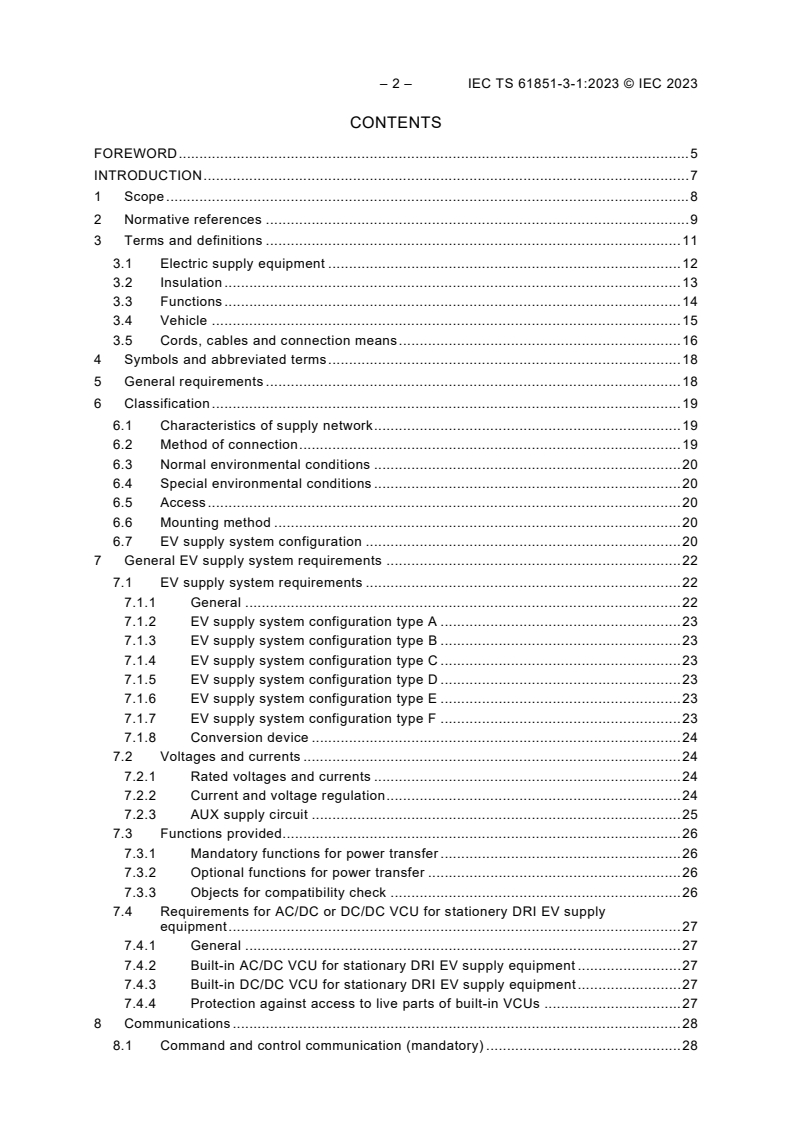
CONTENTS
FOREWORD . 5
INTRODUCTION . 7
1 Scope . 8
2 Normative references . 9
3 Terms and definitions . 11
3.1 Electric supply equipment . 12
3.2 Insulation . 13
3.3 Functions . 14
3.4 Vehicle . 15
3.5 Cords, cables and connection means . 16
4 Symbols and abbreviated terms . 18
5 General requirements . 18
6 Classification . 19
6.1 Characteristics of supply network . 19
6.2 Method of connection . 19
6.3 Normal environmental conditions . 20
6.4 Special environmental conditions . 20
6.5 Access . 20
6.6 Mounting method . 20
6.7 EV supply system configuration . 20
7 General EV supply system requirements . 22
7.1 EV supply system requirements . 22
7.1.1 General . 22
7.1.2 EV supply system configuration type A . 23
7.1.3 EV supply system configuration type B . 23
7.1.4 EV supply system configuration type C . 23
7.1.5 EV supply system configuration type D . 23
7.1.6 EV supply system configuration type E . 23
7.1.7 EV supply system configuration type F . 23
7.1.8 Conversion device . 24
7.2 Voltages and currents . 24
7.2.1 Rated voltages and currents . 24
7.2.2 Current and voltage regulation . 24
7.2.3 AUX supply circuit . 25
7.3 Functions provided. 26
7.3.1 Mandatory functions for power transfer . 26
7.3.2 Optional functions for power transfer . 26
7.3.3 Objects for compatibility check . 26
7.4 Requirements for AC/DC or DC/DC VCU for stationery DRI EV supply
equipment . 27
7.4.1 General . 27
7.4.2 Built-in AC/DC VCU for stationary DRI EV supply equipment . 27
7.4.3 Built-in DC/DC VCU for stationary DRI EV supply equipment . 27
7.4.4 Protection against access to live parts of built-in VCUs . 27
8 Communications . 28
8.1 Command and control communication (mandatory) . 28
8.2 Optional communication . 28
8.3 Communication circuit from the DRI EV supply equipment to the
telecommunication networks . 28
9 Protection against electric shock . 28
9.1 Protection against direct contact . 28
9.1.1 General . 28
9.1.2 IP ratings for protection against electric shock . 29
9.2 Stored energy – Discharge of capacitors . 29
9.2.1 Disconnection of plug connected EV supply equipment . 29
9.2.2 Loss of supply voltage to permanently connected EV supply equipment . 29
9.3 Fault protection . 30
9.4 DC leakage currents . 30
9.5 Y capacitors . 30
10 Specific requirements for accessories . 30
10.1 General requirements . 30
10.2 Adaptors . 30
10.3 Latching device . 30
10.4 Contact sequencing of accessories . 31
11 Cable assembly requirements . 31
11.1 General . 31
11.2 Electrical rating . 31
11.3 Mechanical characteristics . 31
11.4 Storage means for case C . 32
11.5 Strain relief . 32
12 DRI EV supply equipment constructional requirements and tests . 32
12.1 Characteristics of mechanical switching devices . 32
12.1.1 General . 32
12.1.2 Switch and switch-disconnector . 32
12.1.3 Contactor . 32
12.1.4 Circuit-breaker . 32
12.1.5 Relays . 33
12.1.6 Switch-on peak current . 33
12.2 Clearances and creepage distances . 33
12.3 IP degrees . 34
12.3.1 Degrees of protection against solid foreign objects and water for the
enclosure . 34
12.3.2 Degrees of protection against solid foreign objects and water for
accessories . 34
12.4 Insulation resistance . 34
12.5 Touch current . 35
12.6 Dielectric withstand voltage . 35
12.6.1 AC withstand voltage . 35
12.6.2 Impulse dielectric withstand (1,2/50 µs) . 36
12.7 Temperature rise . 36
12.8 Damp heat functional test . 36
12.9 Minimum temperature functional test . 36
12.10 Mechanical strength . 37
13 Overload and short-circuit protection . 37
14 Emergency switching or disconnect (optional) . 37
– 4 – IEC TS 61851-3-1:2023 © IEC 2023
15 Marking and instructions . 38
15.1 Installation manual . 38
15.2 User manual (instructions) for DRI EV supply equipment . 38
15.3 Marking of DRI EV supply equipment type A to type F . 39
15.4 Marking of cable assemblies type C and type E . 39
15.5 Durability test for marking . 39
Annex A (informative) Acoustical and optical signalling . 41
A.1 General . 41
A.2 Optical signalling . 41
A.3 Acoustical signalling . 41
Annex B (informative) Example of position for socket outlets . 42
Annex C (informative) Conversion device . 44
C.1 General . 44
C.2 Consideration on how to connect a manufacturer specific EV/RESS to a DRI
EV supply equipment . 44
Annex D (informative) Examples of VCU wirings . 45
D.1 Built-in AC/DC VCU for stationary DRI EV supply equipment . 45
D.2 Built-in DC/DC VCU for stationary DRI EV supply equipment . 46
Bibliography . 47
Figure 1 – EV supply system configuration. 21
Figure B.1 – Example of position of the socket-outlet overview . 42
Figure B.2 – Example of position of the socket-outlet details . 43
Figure D.1 – Built-in AC/DC VCU for stationary DRI EV supply equipment, design 1,
+60 V, –120 V output . 45
Figure D.2 – Built-in AC/DC VCU for stationary DRI EV supply equipment, design 2,
+60 V or –120 V output . 46
Figure D.3 – Built-in DC/DC VCU for stationary DRI EV supply equipment: 60 V to 400
V DC (side A), –120 V, +60 V output (side B) . 46
Table 1 – Corresponding type designations to ISO 18246 . 22
Table 2 – Rated system input voltages . 24
Table 3 – System output voltages class . 24
Table 4 – IP ratings . 29
Table 5 – Touch current limits . 35
INTERNATIONAL ELECTROTECHNICAL COMMISSION
____________
ELECTRIC VEHICLE CONDUCTIVE CHARGING SYSTEM –
Part 3-1: DC EV supply equipment where protection relies
on double or reinforced insulation – General rules
and requirements for stationary equipment
FOREWORD
1) The International Electrotechnical Commission (IEC) is a worldwide organization for standardization comprising
all national electrotechnical committees (IEC National Committees). The object of IEC is to promote international
co-operation on all questions concerning standardization in the electrical and electronic fields. To this end and
in addition to other activities, IEC publishes International Standards, Technical Specifications, Technical Reports,
Publicly Available Specifications (PAS) and Guides (hereafter referred to as “IEC Publication(s)”). Their
preparation is entrusted to technical committees; any IEC National Committee interested in the subject dealt with
may participate in this preparatory work. International, governmental and non-governmental organizations liaising
with the IEC also participate in this preparation. IEC collaborates closely with the International Organization for
Standardization (ISO) in accordance with conditions determined by agreement between the two organizations.
2) The formal decisions or agreements of IEC on technical matters express, as nearly as possible, an international
consensus of opinion on the relevant subjects since each technical committee has representation from all
interested IEC National Committees.
3) IEC Publications have the form of recommendations for international use and are accepted by IEC National
Committees in that sense. While all reasonable efforts are made to ensure that the technical content of IEC
Publications is accurate, IEC cannot be held responsible for the way in which they are used or for any
misinterpretation by any end user.
4) In order to promote international uniformity, IEC National Committees undertake to apply IEC Publications
transparently to the maximum extent possible in their national and regional publications. Any divergence between
any IEC Publication and the corresponding national or regional publication shall be clearly indicated in the latter.
5) IEC itself does not provide any attestation of conformity. Independent certification bodies provide conformity
assessment services and, in some areas, access to IEC marks of conformity. IEC is not responsible for any
services carried out by independent certification bodies.
6) All users should ensure that they have the latest edition of this publication.
7) No liability shall attach to IEC or its directors, employees, servants or agents including individual experts and
members of its technical committees and IEC National Committees for any personal injury, property damage or
other damage of any nature whatsoever, whether direct or indirect, or for costs (including legal fees) and
expenses arising out of the publication, use of, or reliance upon, this IEC Publication or any other IEC
Publications.
8) Attention is drawn to the Normative references cited in this publication. Use of the referenced publications is
indispensable for the correct application of this publication.
9) Attention is drawn to the possibility that some of the elements of this IEC Publication may be the subject of patent
rights. IEC shall not be held responsible for identifying any or all such patent rights.
IEC TS 61851-3-1 has been prepared by IEC technical committee 69: Electrical power/energy
transfer systems for electrically propelled road vehicles and industrial trucks. It is a Technical
Specification.
The text of this Technical Specification is based on the following documents:
Draft Report on voting
69/845/DTS 69/882/RVDTS
Full information on the voting for its approval can be found in the report on voting indicated in
the above table.
The language used for the development of this Technical Specification is English.
– 6 – IEC TS 61851-3-1:2023 © IEC 2023
This document was drafted in accordance with ISO/IEC Directives, Part 2, and developed in
accordance with ISO/IEC Directives, Part 1 and ISO/IEC Directives, IEC Supplement, available
at www.iec.ch/members_experts/refdocs. The main document types developed by IEC are
described in greater detail at www.iec.ch/publications.
In this document, the following print types are used:
– requirements: in roman type;
– test specifications: in italic type;
– notes: in small roman type.
A list of all parts in the IEC 61851 all parts, published under the general title Electric vehicles
conductive charging system, can be found on the IEC website.
The committee has decided that the contents of this document will remain unchanged until the
stability date indicated on the IEC website under webstore.iec.ch in the data related to the
specific document. At this date, the document will be
• reconfirmed,
• withdrawn,
• replaced by a revised edition, or
• amended.
INTRODUCTION
This document is published in separate parts according to the following structure:
IEC TS 61851-3-1, Electric vehicle conductive charging system – Part 3-1: DC EV supply
equipment where protection relies on double or reinforced insulation – General rules and
requirements for stationary equipment
IEC TS 61851-3-2, Electric vehicle conductive charging system – Part 3-2: DC EV supply
equipment where protection relies on double or reinforced insulation – Particular requirements
for portable and mobile equipment
IEC TS 61851-3-4, Electric vehicle conductive charging system – Part 3-4: DC EV supply
equipment where protection relies on double or reinforced insulation – General definitions and
requirements for CANopen communication
IEC TS 61851-3-5, Electric vehicle conductive charging system – Part 3-5: DC EV supply
equipment where protection relies on double or reinforced insulation – Pre-defined
communication parameters and general application objects
IEC TS 61851-3-6, Electric vehicle conductive charging system – Part 3-6: DC EV supply
equipment where protection relies on double or reinforced insulation – Voltage converter unit
communication
IEC TS 61851-3-7, Electric vehicle conductive charging system – Part 3-7: DC EV supply
equipment where protection relies on double or reinforced insulation – Battery system
communication
– 8 – IEC TS 61851-3-1:2023 © IEC 2023
ELECTRIC VEHICLE CONDUCTIVE CHARGING SYSTEM –
Part 3-1: DC EV supply equipment where protection relies
on double or reinforced insulation – General rules
and requirements for stationary equipment
1 Scope
This part of IEC 61851, which is a Technical Specification, applies to the equipment, including
stationary equipment
• for the conductive transfer of electric power between the supply network and
– an electric road vehicle, or
– a removable rechargeable energy storage system (RESS), or
– an on-board RESS of an electric road vehicle,
• when the equipment is connected to the supply network having a supply voltage up to 480 V
AC or up to 400 V DC and a rated output voltage up to 120 V DC, and
• where the protection against electric shock relies on double or reinforced insulation, and
with double or reinforced insulation between all AC and DC inputs and outputs.
NOTE 1 In the following countries, the acceptable nominal supply voltage is up to 600 V AC: CA, US.
Particular requirements for portable and mobile DRI EV supply equipment are covered by
IEC TS 61851-3-2023.
Equipment for the conductive transfer of electric power between the supply network and an
electric road vehicle/RESS according to the IEC TS 61851-3 series is intended to be connected
to vehicles where the vehicle power supply circuit is protected against electric shock by double
or reinforced insulation.
NOTE 2 For information regarding protection against electric shock by double or reinforced insulation of the EV or
of the vehicle power supply circuit, see ISO 18246:2023, 6.1.1 b) and Table 3.
Requirements for bidirectional energy transfer DC to AC are under consideration and are not
part of this document.
This document also applies to EV supply equipment supplied from on-site storage systems (e.g.
buffer batteries).
This document applies to VCUs intended to be a part of DRI EV supply equipment specified in
this document.
This document applies to equipment for the conductive transfer of electric power between the
supply network and an electric road vehicle/RESS intended to be installed and/or used at an
altitude of up to 2 000 m.
The aspects covered in this document include
• the connection to the vehicle,
• characteristics to be complied with by the vehicle with respect to the AC or DC,
• the specification for required level of electrical safety for the double or reinforced insulated
(DRI) EV supply equipment,
• operators and third-party electrical safety,
• requirements for command and control communication for safety and process matters, if
required,
• requirements for bidirectional power transfer DC to DC, and
• the connection to installations according to IEC 60364-7-722.
NOTE 3 In the following countries, electrical installation codes other than those from IEC 60364-7-722 are used:
CA, US.
Equipment covered by this document is not intended to be located in hazardous areas where
flammable gas or vapour and/or combustible materials, fuels or other combustible or explosive
materials are present. Additional requirements can apply to these locations.
This document does not apply to
• aspects related to maintenance,
• electrical devices and components, which are covered by their specific product standards,
• trolley buses and rail vehicles,
• vehicle power supply circuit, which is covered by ISO 18246, and
• EMC requirements for on-board equipment while connected to the supply, which are covered
by IEC 61851-21-1.
2 Normative references
The following documents are referred to in the text in such a way that some or all of their content
constitutes requirements of this document. For dated references, only the edition cited applies.
For undated references, the latest edition of the referenced document (including any
amendments) applies:
IEC 60038, IEC standard voltages
IEC 60068-2-1:2007, Environmental testing – Part 2-1: Tests – Test A: Cold
IEC 60068-2-11:2021, Environmental testing – Part 2-11: Tests – Test Ka: Salt mist
IEC 60068-2-30:2005, Environmental testing – Part 2-30: Tests – Test Db: Damp heat, cyclic
(12 h + 12 h cycle)
IEC 60068-2-78:2012, Environmental testing – Part 2-78: Tests – Test Cab: Damp heat, steady
state
IEC 60269 (all parts), Low-voltage fuses
IEC 60309-2:2021, Plugs, fixed or portable socket-outlets and appliance inlets for industrial
purposes – Part 2: Dimensional compatibility requirements for pin and contact-tube accessories
IEC 60320 (all parts), Appliance couplers for household and similar general purposes
IEC 60335-1:2020, Household and similar electrical appliances – Safety – Part 1: General
requirements
IEC 60364-4-41:2005, Low-voltage electrical installations – Part 4-41: Protection for safety –
Protection against electric shock
IEC 60364-4-41:2005/AMD1:2017
– 10 – IEC TS 61851-3-1:2023 © IEC 2023
IEC 60364-7-722:2018, Low-voltage electrical installations – Part 7-722: Requirements for
special installations or locations – Supplies for electric vehicles
IEC 60529, Degrees of protection provided by enclosures (IP Code)
IEC 60664-1:2020, Insulation coordination for equipment within low-voltage systems – Part 1:
Principles, requirements and tests
IEC 60884-1:2022, Plugs and socket-outlets for household and similar purposes – Part 2:
General requirements
IEC 60898 (all parts), Electrical accessories – Circuit-breakers for overcurrent protection for
household and similar installations
IEC 60898-1, Electrical accessories – Circuit-breakers for overcurrent protection for household
and similar installations – Part 1: Circuit-breakers for a.c. operation
IEC 60947-2, Low-voltage switchgear and controlgear – Part 2: Circuit-breakers
IEC 60947-3:2020, Low-voltage switchgear and controlgear – Part 3: Switches, disconnectors,
switch-disconnectors and fuse-combination units
IEC 60947-4-1:2018, Low-voltage switchgear and controlgear – Part 4-1: Contactors and motor-
starters – Electromechanical contactors and motor-starters
IEC 60947-6-2, Low-voltage switchgear and controlgear – Part 6-2: Multiple function equipment
– Control and protective switching devices (or equipment) (CPS)
IEC 60950-1:2005, Information technology equipment – Safety – Part 1: General requirements
IEC 60950-1:2005/AMD1:2009
IEC 60950-1:2005/AMD2:2013
IEC 60990:2016, Methods of measurement of touch current and protective conductor current
IEC 61009-1:2010, Residual current operated circuit-breakers with integral overcurrent
protection for household and similar uses (RCBOs) – Part 1: General rules
IEC 61009-1:2010/AMD1:2012
IEC 61009-1:2010/AMD2:2013
IEC 61180:2016, High-voltage test techniques for low-voltage equipment – Definitions, test and
procedure requirements, test equipment
IEC 61439-7:2022, Low-voltage switchgear and controlgear assemblies – Part 7: Assemblies
for specific applications such as marinas, camping sites, market squares, electric vehicles
charging stations
IEC 61558-2-6, Safety of transformers, reactors, power supply units and combinations thereof
– Part 2-6: Particular requirements and tests for safety isolating transformers and power supply
units incorporating safety isolating transformers for general applications
IEC 61810-1, Electromechanical elementary relays – Part 1: General and safety requirements
IEC 61851-1:2017, Electric vehicle conductive charging system – Part 1: General requirements
IEC 61851-3 (all parts), Electric vehicle conductive charging system – Part 3: DC EV supply
equipment where protection relies on double or reinforced insulation
IEC TS 61851-3-2:2023, Electric vehicle conductive charging system – Part 3-2: DC EV supply
equipment where protection relies on double or reinforced insulation – Particular requirements
for portable and mobile equipment
IEC TS 61851-3-4:2023, Electric vehicle conductive charging system – Part 3-4: DC EV supply
equipment where protection relies on double or reinforced insulation – General definitions and
requirements for CANopen communication
IEC TS 61851-3-5:2023, Electric vehicle conductive charging system – Part 3-5: DC EV supply
equipment where protection relies on double or reinforced insulation – Pre-defined
communication parameters and general application objects
IEC 62262, Degrees of protection provided by enclosures for electrical equipment against
external mechanical impacts (IK code)
IEC 62196-1:2022, Plugs, socket-outlets, vehicle connectors and vehicle inlets – Conductive
charging of electric vehicles – Part 1: General requirements
IEC TS 62196-4:2022, Plugs, socket-outlets, vehicle connectors and vehicles inlets –
Conductive charging of electric vehicles – Part 4: Dimensional compatibility and
interchangeability requirements for DC pin and contact-tube accessories for class II or class III
applications
IEC 62477-1:2022, Safety requirements for power electronic converter systems and equipment
– Part 1: General
IEC PAS 62840-3:2021, Electric vehicle battery swap system – Part 3: Particular safety and
interoperability requirements for battery swap systems operating with removable RESS/battery
systems
ISO 11898-1:2015, Road vehicles – Controller area network (CAN) – Part 1: Data link layer and
physical signalling
EN 50325-4:2002, Industrial communications subsystem based on ISO 11898 (CAN) for
controller-device interfaces – Part 4: CANopen
EN 50604-1:2016, Secondary lithium batteries for light EV (electric vehicle) applications –
Part 1: General safety requirements and test methods
EN 50604-1:2016/AMD1:2021
3 Terms and definitions
For the purposes of this document, the terms and definitions given in IEC 61851-1:2017,
IEC TS 61851-3-4:2023 and the following apply.
ISO and IEC maintain terminological databases for use in standardization at the following
addresses:
• IEC Electropedia: available at http://www.electropedia.org/
• ISO Online browsing platform: available at http://www.iso.org/obp
– 12 – IEC TS 61851-3-1:2023 © IEC 2023
3.1 Electric supply equipment
3.1.1
double or reinforced insulated EV supply equipment
DRI EV supply equipment
class II EV supply equipment
EV supply equipment in which protection against electric shock relies on double insulation or
reinforced insulation, there being no provision for protective earthing or reliance upon
installation conditions.
Note 1 to entry: DRI EV supply equipment intended to use in case C includes supply cable and vehicle connector.
Note 2 to entry: IEC 61851-1:2017, 3.1.1, Examples 1 and 2, are not applicable.
Note 3 to entry: See also Figure 1.
[SOURCE: IEC 60335-1:2020, 3.3.10, modified – Adapted for EV supply equipment.]
3.1.2
EV supply system
complete system including the DRI EV supply equipment and the EV/RESS functions that are
required to transfer power between the fixed installation/supply network and the EV/RESS
3.1.3
charging
all functions necessary to condition voltage and/or current provided by the AC or DC supply
network to assure the supply of electric energy to the RESS
[SOURCE: IEC 61851-1:2017, 3.1.8]
3.1.4
case A
connection of an EV to the supply network with a plug and cable permanently attached to the
EV
[SOURCE: IEC 61851-1:2017, 3.1.10, modified – The figure has been deleted.]
3.1.5
case B
connection of an EV to a supply network with a cable assembly detachable at both ends
[SOURCE: IEC 61851-1:2017, 3.1.11, modified – The figure has been deleted.]
3.1.6
case C
connection of an EV to a supply network utilizing a cable and vehicle connector permanently
attached to the DRI EV supply equipment
[SOURCE: IEC 61851-1:2017, 3.1.12, modified – The words "EV charging station" has been
replaced with "DRI EV supply equipment", and the figure has been deleted.]
3.1.7
voltage converter
set of equipment to convert one type of electric current to another type different in nature,
voltage and/or frequency
[SOURCE: IEC 60050-811:2017, 811-19-01, modified – The word "voltage" has been added to
the term, and the words "static or rotating" has been deleted from the definition.]
3.1.8
voltage converter unit
VCU
voltage converter with local EMS and communication interface
3.1.9
built-in voltage converter unit
built-in VCU
fixed VCU intended to be installed in a cabinet, in a prepared recess in a wall or in a similar
location
[SOURCE: IEC 60335-1:2020, 3.5.5, modified – The word "appliance" has been replaced with
"voltage converter unit" in the term and in the definition.]
3.1.10
AUX supply circuit
independent power supply that provides energy to a part of the components in EV supply
equipment or the EV
Note 1 to entry: AUX supply circuit is used for supplying the logic controller of active and passive devices.
3.1.11
DC power circuit
circuit for DC conductive power transfer
3.2 Insulation
3.2.1
basic insulation
insulation of hazardous-live-parts which provides basic protection
[SOURCE: IEC 60050-851:2008, 851-15-04]
3.2.2
direct contact
electric contact of persons or animals with live parts
[SOURCE: IEC 60050-195:2021, 195-06-03, modified – The words "human beings" and
"livestock" have been replaced with "persons" and "animals" respectively.]
3.2.3
double insulation
insulation comprising both basic insulation and supplementary insulation
[SOURCE: IEC 60050-851:2008, 851-15-06]
3.2.4
conductive part
part which can carry electric current
[SOURCE: IEC 60050-195:2021, 195-01-06]
3.2.5
exposed conductive part
conductive part of electrical equipment, which can be touched, and which is not normally live,
but which can become live when basic insulation fails
[SOURCE: IEC 60050-442:1998, 442-01-21, modified – The note has been deleted.]
– 14 – IEC TS 61851-3-1:2023 © IEC 2023
3.2.6
hazardous-live-part
live part which, under certain conditions, can give a harmful electric shock
[SOURCE: IEC 60050-195:2021, 195-06-05, modified – The note to entry has been deleted.]
3.2.7
insulation
materials and parts used to insulate conductive elements of a device, or a set of properties
which characterize the ability of an insulation to provide its function
[SOURCE: IEC 60050-151:2001, 151-15-41, modified – The end of the definition starting by "or
a set…" has been added.]
3.2.8
live part
conductive part intended to be energized under normal operating conditions, including a neutral
conductor, but by convention not a PEN conductor, PEM conductor or PEL conductor
Note 1 to entry: This concept does not necessarily imply a risk of electric shock.
[SOURCE: IEC 61851-1:2017, 3.2.9, modified – The words "conductor or" has been deleted
from the definition, and "operation" replaced with "operating conditions".]
3.2.9
reinforced insulation
insulation of hazardous-live-parts which provides a degree of protection against electric shock
equivalent to double insulation.
Note 1 to entry: Reinforced insulation may comprise several layers which cannot be tested singly as basic insulation
or supplementary insulation.
[SOURCE: IEC 60050-195:2021, 195-06-09, modified – The words "of hazardous-live-parts"
have been added.]
3.2.10
supplementary insulation
independent insulation applied in addition to basic insulation for fault protection
[SOURCE: IEC 60050-851:2008, 851-15-05]
3.3 Functions
3.3.1
CAN circuit
circuit and associate wiring used for communication according to ISO 11898-1:2015
3.3.2
gateway
functional unit that connects two networks with different network architectures and protocols
[SOURCE: IEC 60050-732:2010, 732-01-17, modified – The words "computer networks" have
been replaced with "networks" in the definition, and Note 1 and 2 have been deleted.]
3.3.3
energy management system
EMS
system consisting of active and passive devices for controlling the power transfer
3.3.4
active device
device connected to DC power circuit, AUX supply circuit and CAN circuit
3.3.5
passive device
device connected only to AUX supply circuit and CAN circuit
3.3.6
proximity function
electrical or mechanical means to indicate the insertion state of the vehicle connector in the
vehicle inlet to the EV and/or to indicate the insertion state of the plug in the socket-outlet of
the DRI EV supply equipment
[SOURCE: IEC 61851-1:2017, 3.3.5, modified – The words "EV charging station" have been
replaced with "DRI EV supply equipment".]
3.3.7
human machine interface
HMI
passive device that allows user interaction, interface between operating staff or end user and
the instrumentation and computer systems connected to the energy management system (EMS)
EXAMPLE Display or user communication system
[SOURCE: IEC TS 61851-3-4:2023, 3.14, modified – The spelled-out form of "EMS" is given in
the definition.]
3.3.8
set current value
parameter transmitted to the DRI EV supply equipment indicating the required current for power
transfer
Note 1 to entry: This parameter is defined in IEC 61851-3-5:2023, 6.4.5, for input current, and 6.4.6, for output
current.
3.3.9
set voltage value
parameter transmitted to the DRI EV supply equipment indicating the maximum voltage for
power transfer
Note 1 to entry: This parameter is defined in IEC 61851-3-5:2023, 6.4.3.
3.4 Vehicle
3.4.1
electric vehicle
EV
electric road vehicle
vehicle with one or more electric drive(s) for vehicle propulsion
[SOURCE: ISO 17409:2020, 3.19, modified – The word "propelled" has been removed from the
term, and the equivalent term "electric road vehicle" added.]
3.4.2
rechargeable energy storage system
RESS
rechargeable system that stores energy for delivery of electric energy for the electric drive
– 16 – IEC TS 61851-3-1:2023 © IEC 2023
Note 1 to entry: Reinforced insulation may comprise several layers that cannot be tested singly as basic insulation
or supplementary insulation.
Note 2 to entry: A battery system can be named in general within the context of the IEC 61851-3 series as an RESS.
[SOURCE: ISO 17409:2020, 3.47, modified – The example has been removed and the notes to
entry added.]
3.4.3
removable rechargeable energy storage system
removable RESS
RESS that can be moved/removed from an EV by hand (portable RESS) or with the assistance
of an installation/device (mobile RESS)
[SOURCE: EN 50604-1:2016, 3.18]
3.4.4
voltage class
classification of an electric component or circuit according to its maximum working voltage
Note 1 to entry: The classification to the voltage classes A and B is according to ISO 6469-3:2021.
[SOURCE: ISO 17409:2020, 3.62, modified – The date of publication has been updated in the
note to entry.]
3.4.5
vehicle power supply circuit
voltage class A or B electric circuit which includes all parts that are conductively connected to
the vehicle inlet (case B, case C) or the plug (case A) and that is operational when connected
to an external elec
...