

IEC 62282-3-200:2025
(Main)Fuel cell technologies - Part 3-200: Stationary fuel cell power systems - Performance test methods
General Information
- Abstract
IEC 62282-3-200:2025 covers operational and environmental aspects of the stationary fuel cell power systems performance. The test methods apply as follows:
- power output under specified operating and transient conditions;
- electrical and heat recovery efficiency under specified operating conditions;
- environmental characteristics, for example, exhaust gas emissions, noise, under specified operating and transient conditions.
This document applies to all kinds of stationary fuel cell technologies, such as:
- alkaline fuel cells (AFC);
- phosphoric acid fuel cells (PAFC);
- polymer electrolyte fuel cells (PEFC);
- molten carbonate fuel cells (MCFC);
- solid oxide fuel cells (SOFC).
This third edition cancels and replaces the second edition published in 2015. This edition includes the following significant technical changes with respect to the previous edition:
- revision of the Introduction, Scope and Clause 3;
- revision of the symbols in Table 1;
- revision of Figure 2 (symbol diagram);
- revision of measurement methods (8.3);
- revision of the efficiency test (10.2);
- revision of the electric power and thermal power response characteristics test (10.3);
- revision of the start-up and shutdown characteristics test (10.4);
- revision of Annex C.
- Status
- Published
- Publication Date
- 24-Sep-2025
- Technical Committee
- TC 105 - Fuel cell technologies
- Drafting Committee
- MT 202 - TC 105/MT 202
- Current Stage
- PPUB - Publication issued
- Start Date
- 25-Sep-2025
- Completion Date
- 05-Sep-2025
Buy Documents
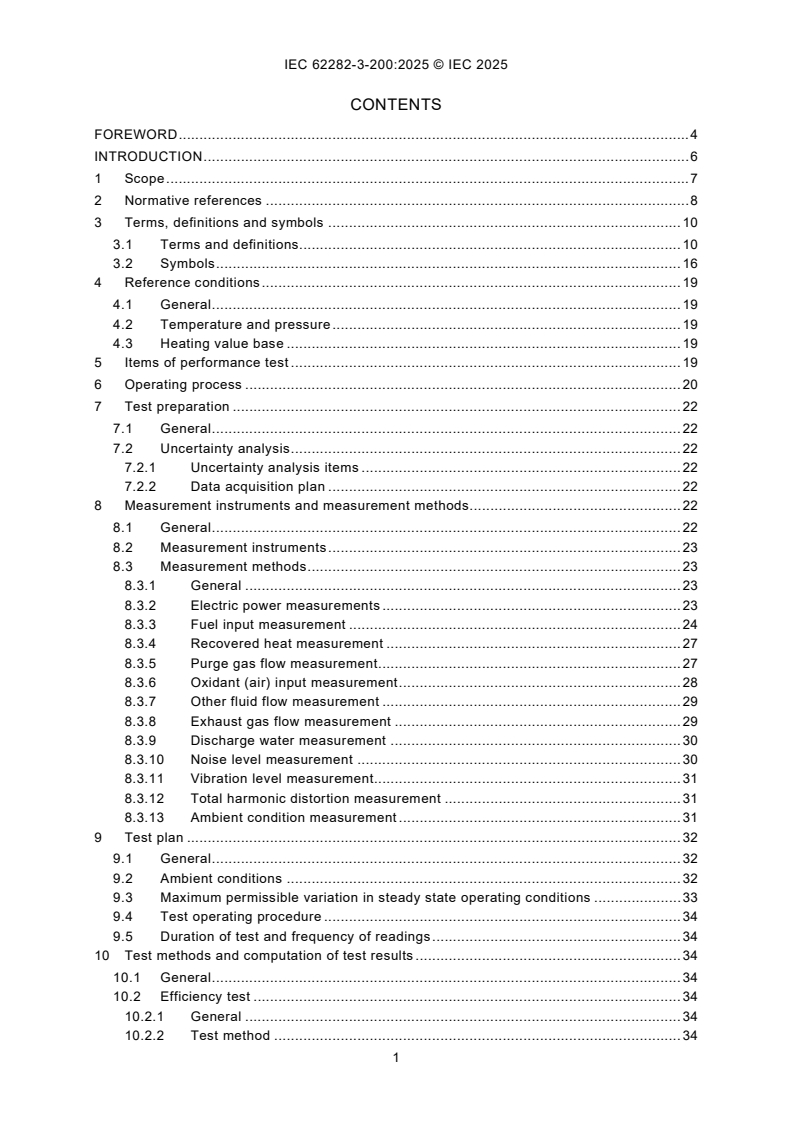
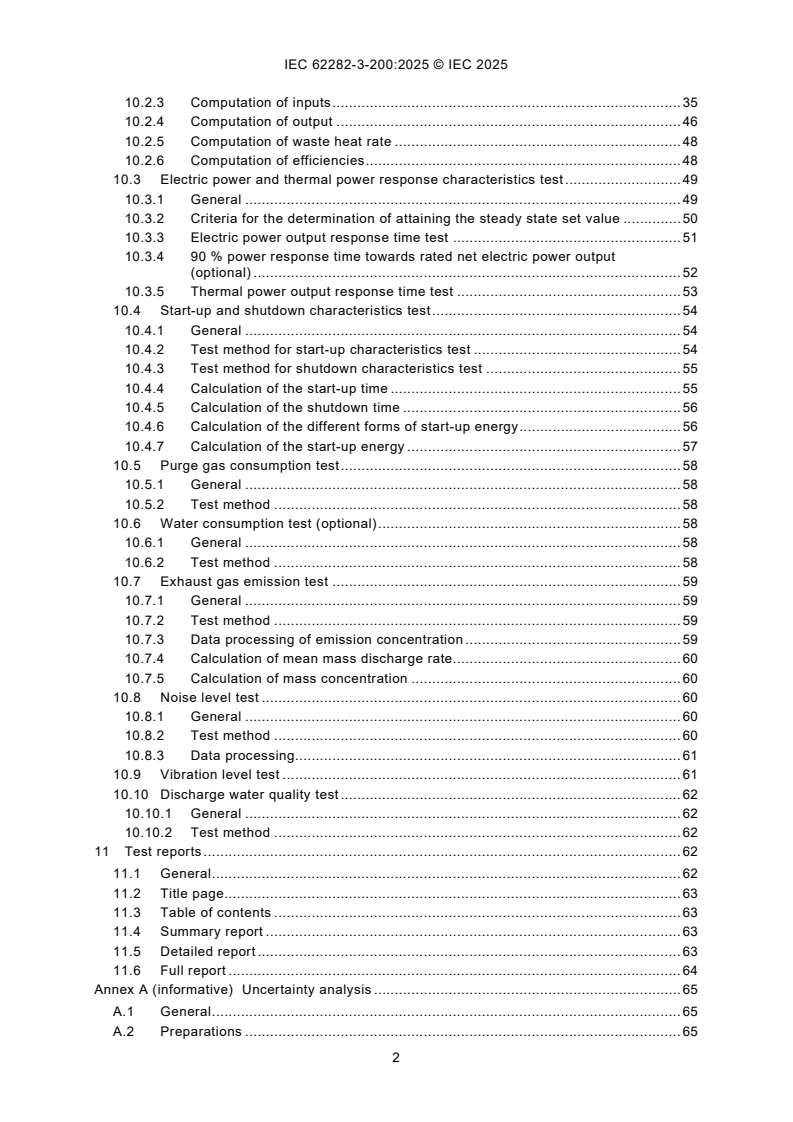
IEC 62282-3-200:2025 - Fuel cell technologies - Part 3-200: Stationary fuel cell power systems - Performance test methods/25/2025
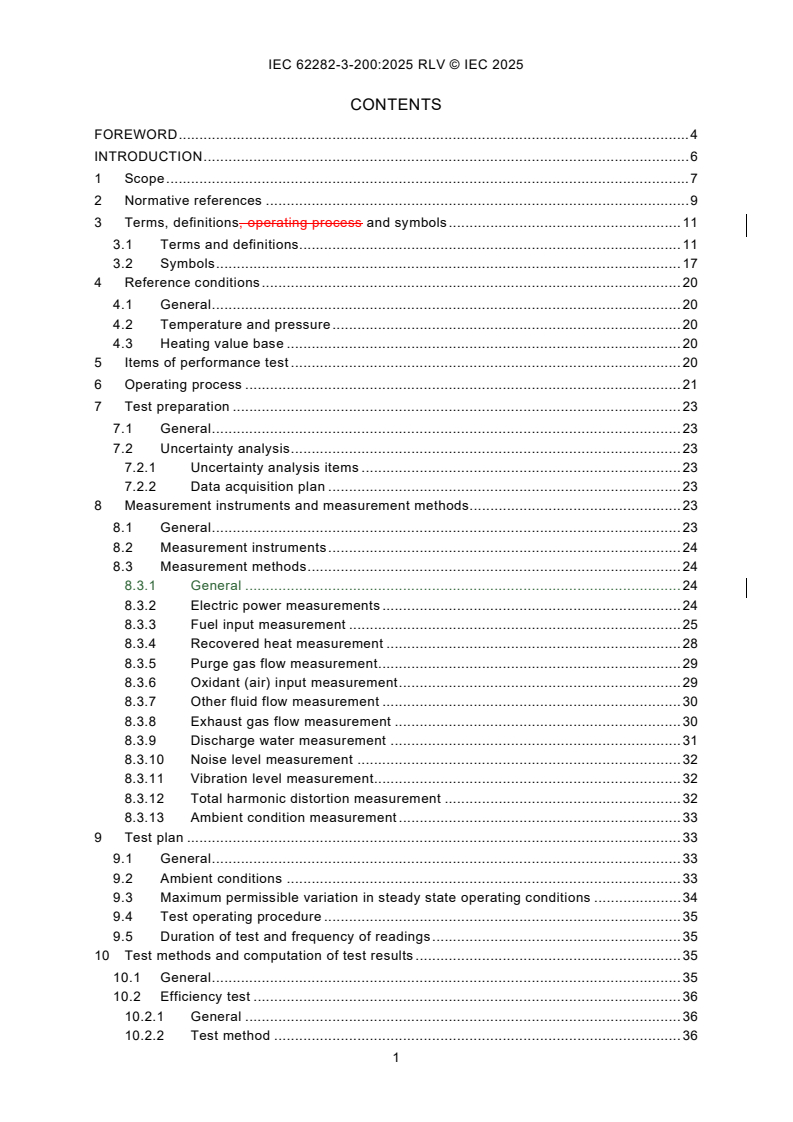
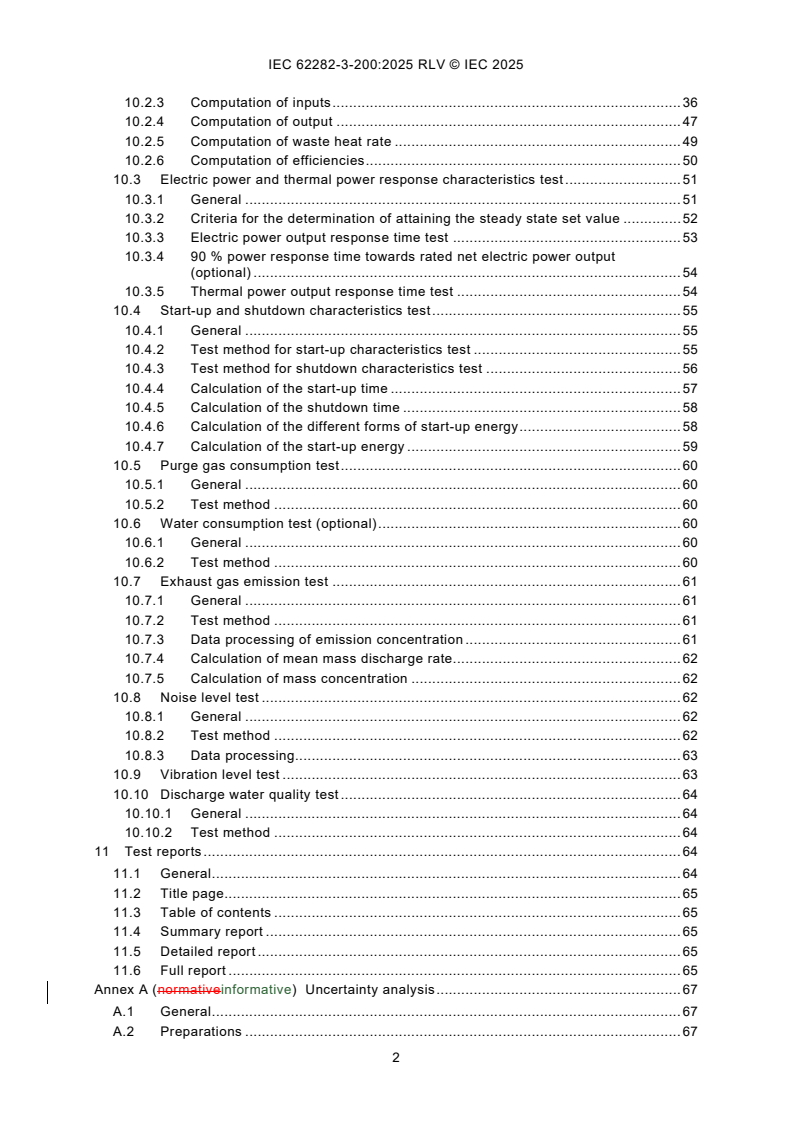
IEC 62282-3-200:2025 RLV - Fuel cell technologies - Part 3-200: Stationary fuel cell power systems - Performance test methods Released:9/25/2025
IEC 62282-3-200:2025 - Technologies des piles à combustible - Partie 3-200: Systèmes à piles à combustible stationnaires - Méthodes d'essai des performances/25/2025
IEC 62282-3-200:2025 - Fuel cell technologies - Part 3-200: Stationary fuel cell power systems - Performance test methods/25/2025
Overview
IEC 62282-3-200:2025, published by the International Electrotechnical Commission (IEC), specifies performance test methods for stationary fuel cell power systems. This international standard addresses comprehensive protocols for evaluating the operational and environmental performance of stationary fuel cells, supporting the consistent assessment of their efficiency, output, and environmental impact across a range of applications. The standard applies to various fuel cell technologies-including AFC, PAFC, PEFC, MCFC, and SOFC-for residential, commercial, agricultural, and industrial use.
Recent updates in this third edition incorporate technical revisions across key measurement methods, performance criteria, and system diagrams, ensuring alignment with evolving industry requirements.
Key Topics
Performance Test Methods: IEC 62282-3-200 outlines detailed procedures to determine:
- Power output under specified operating and transient conditions
- Electrical efficiency and heat recovery efficiency during steady-state operation
- Environmental characteristics such as exhaust gas emissions and system noise levels
System Boundary and Measurement: The standard defines a common system boundary for all stationary fuel cell power systems. This ensures comparability by specifying which components and energy streams are included during performance evaluation.
Types of Fuel Cell Technologies Covered:
- Alkaline Fuel Cells (AFC)
- Phosphoric Acid Fuel Cells (PAFC)
- Polymer Electrolyte Fuel Cells (PEFC)
- Molten Carbonate Fuel Cells (MCFC)
- Solid Oxide Fuel Cells (SOFC)
Environmental and Operational Assessment: Measurement of key environmental parameters including:
- Exhaust gas emissions (e.g., NOx, SOx, CO2)
- Noise and vibration under operating conditions
- Water quality from discharge
Test Documentation: Requirements for comprehensive test reporting, including uncertainty analysis and detailed data acquisition plans.
Applications
IEC 62282-3-200:2025 serves a broad range of stakeholders in the fuel cell industry:
- Manufacturers: Use the standard to design testing protocols, verify system performance, and benchmark against industry expectations for efficiency and emissions.
- Testing and Certification Bodies: Employ harmonized test methods to provide reliable, comparable results to regulatory authorities and clients.
- System Integrators and Operators: Validate the operational efficiency and environmental impact of installed stationary fuel cell systems in real-world scenarios.
- Researchers and Developers: Leverage standardized definitions and methodologies to ensure reproducibility and comparability in R&D projects.
- Regulators: Reference performance metrics and reporting formats when developing policies for clean energy systems and emissions limits.
By adopting IEC 62282-3-200:2025, fuel cell projects benefit from transparency, consistency, and international acceptance in performance evaluation.
Related Standards
- IEC 62282-3-201: Performance test methods for small stationary fuel cell power systems (less than 10 kW output).
- IEC 60051 series: Direct acting indicating analogue electrical measuring instruments and their accessories.
- IEC 60359: Expression of performance for electrical and electronic measurement equipment.
- IEC 61672 series: Specifications and tests for sound level meters.
- ISO 14687: Hydrogen fuel-specification for product quality.
- ISO 3744: Methods for determining sound power and energy levels of noise sources.
- ISO/IEC Guide 98-3: Guide to the expression of uncertainty in measurement.
These related documents offer additional guidance for measuring electrical, thermal, and environmental parameters, supporting broad adoption of standardized fuel cell testing practices.
Keywords: fuel cell standard, stationary fuel cell test methods, IEC 62282-3-200, fuel cell efficiency, environmental testing, power output, emissions testing, stationary fuel cell systems, performance evaluation, AFC, PAFC, PEFC, MCFC, SOFC.
Relations
- Effective Date
- 05-Sep-2023
Buy Documents
IEC 62282-3-200:2025 - Fuel cell technologies - Part 3-200: Stationary fuel cell power systems - Performance test methods/25/2025
IEC 62282-3-200:2025 RLV - Fuel cell technologies - Part 3-200: Stationary fuel cell power systems - Performance test methods Released:9/25/2025
IEC 62282-3-200:2025 - Technologies des piles à combustible - Partie 3-200: Systèmes à piles à combustible stationnaires - Méthodes d'essai des performances/25/2025
IEC 62282-3-200:2025 - Fuel cell technologies - Part 3-200: Stationary fuel cell power systems - Performance test methods/25/2025
Get Certified
Connect with accredited certification bodies for this standard

DNV
DNV is an independent assurance and risk management provider.

Lloyd's Register
Lloyd's Register is a global professional services organisation specialising in engineering and technology.
DNV Energy Systems
Energy and renewable energy certification.
Sponsored listings
Frequently Asked Questions
IEC 62282-3-200:2025 is a standard published by the International Electrotechnical Commission (IEC). Its full title is "Fuel cell technologies - Part 3-200: Stationary fuel cell power systems - Performance test methods". This standard covers: IEC 62282-3-200:2025 covers operational and environmental aspects of the stationary fuel cell power systems performance. The test methods apply as follows: - power output under specified operating and transient conditions; - electrical and heat recovery efficiency under specified operating conditions; - environmental characteristics, for example, exhaust gas emissions, noise, under specified operating and transient conditions. This document applies to all kinds of stationary fuel cell technologies, such as: - alkaline fuel cells (AFC); - phosphoric acid fuel cells (PAFC); - polymer electrolyte fuel cells (PEFC); - molten carbonate fuel cells (MCFC); - solid oxide fuel cells (SOFC). This third edition cancels and replaces the second edition published in 2015. This edition includes the following significant technical changes with respect to the previous edition: - revision of the Introduction, Scope and Clause 3; - revision of the symbols in Table 1; - revision of Figure 2 (symbol diagram); - revision of measurement methods (8.3); - revision of the efficiency test (10.2); - revision of the electric power and thermal power response characteristics test (10.3); - revision of the start-up and shutdown characteristics test (10.4); - revision of Annex C.
IEC 62282-3-200:2025 covers operational and environmental aspects of the stationary fuel cell power systems performance. The test methods apply as follows: - power output under specified operating and transient conditions; - electrical and heat recovery efficiency under specified operating conditions; - environmental characteristics, for example, exhaust gas emissions, noise, under specified operating and transient conditions. This document applies to all kinds of stationary fuel cell technologies, such as: - alkaline fuel cells (AFC); - phosphoric acid fuel cells (PAFC); - polymer electrolyte fuel cells (PEFC); - molten carbonate fuel cells (MCFC); - solid oxide fuel cells (SOFC). This third edition cancels and replaces the second edition published in 2015. This edition includes the following significant technical changes with respect to the previous edition: - revision of the Introduction, Scope and Clause 3; - revision of the symbols in Table 1; - revision of Figure 2 (symbol diagram); - revision of measurement methods (8.3); - revision of the efficiency test (10.2); - revision of the electric power and thermal power response characteristics test (10.3); - revision of the start-up and shutdown characteristics test (10.4); - revision of Annex C.
IEC 62282-3-200:2025 is classified under the following ICS (International Classification for Standards) categories: 27.070 - Fuel cells. The ICS classification helps identify the subject area and facilitates finding related standards.
IEC 62282-3-200:2025 has the following relationships with other standards: It is inter standard links to IEC 62282-3-200:2015. Understanding these relationships helps ensure you are using the most current and applicable version of the standard.
IEC 62282-3-200:2025 is available in PDF format for immediate download after purchase. The document can be added to your cart and obtained through the secure checkout process. Digital delivery ensures instant access to the complete standard document.
Standards Content (Sample)
IEC 62282-3-200 ®
Edition 3.0 2025-09
INTERNATIONAL
STANDARD
Fuel cell technologies -
Part 3-200: Stationary fuel cell power systems - Performance test methods
ICS 27.070 ISBN 978-2-8327-0638-1
All rights reserved. Unless otherwise specified, no part of this publication may be reproduced or utilized in any form or
by any means, electronic or mechanical, including photocopying and microfilm, without permission in writing from either
IEC or IEC's member National Committee in the country of the requester. If you have any questions about IEC copyright
or have an enquiry about obtaining additional rights to this publication, please contact the address below or your local
IEC member National Committee for further information.
IEC Secretariat Tel.: +41 22 919 02 11
3, rue de Varembé info@iec.ch
CH-1211 Geneva 20 www.iec.ch
Switzerland
About the IEC
The International Electrotechnical Commission (IEC) is the leading global organization that prepares and publishes
International Standards for all electrical, electronic and related technologies.
About IEC publications
The technical content of IEC publications is kept under constant review by the IEC. Please make sure that you have the
latest edition, a corrigendum or an amendment might have been published.
IEC publications search - IEC Products & Services Portal - products.iec.ch
webstore.iec.ch/advsearchform Discover our powerful search engine and read freely all the
The advanced search enables to find IEC publications by a publications previews, graphical symbols and the glossary.
variety of criteria (reference number, text, technical With a subscription you will always have access to up to date
committee, …). It also gives information on projects, content tailored to your needs.
replaced and withdrawn publications.
Electropedia - www.electropedia.org
The world's leading online dictionary on electrotechnology,
IEC Just Published - webstore.iec.ch/justpublished
Stay up to date on all new IEC publications. Just Published containing more than 22 500 terminological entries in English
details all new publications released. Available online and and French, with equivalent terms in 25 additional languages.
once a month by email. Also known as the International Electrotechnical Vocabulary
(IEV) online.
IEC Customer Service Centre - webstore.iec.ch/csc
If you wish to give us your feedback on this publication or
need further assistance, please contact the Customer
Service Centre: sales@iec.ch.
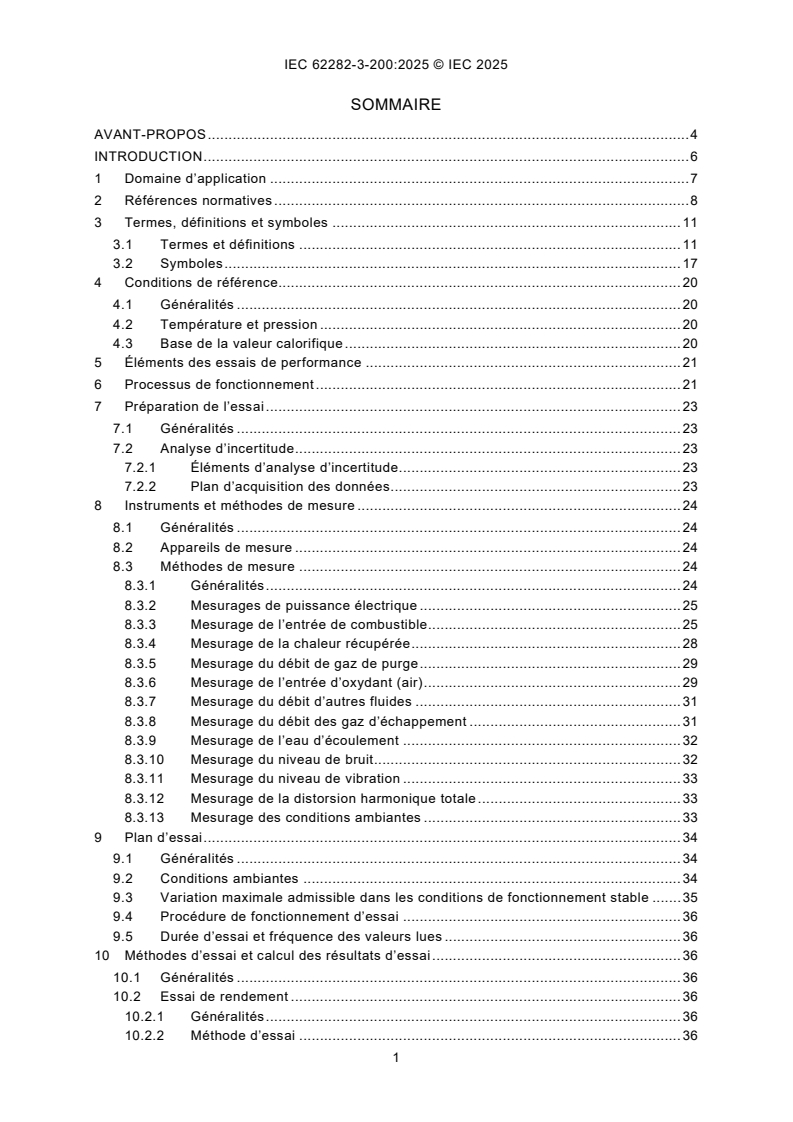
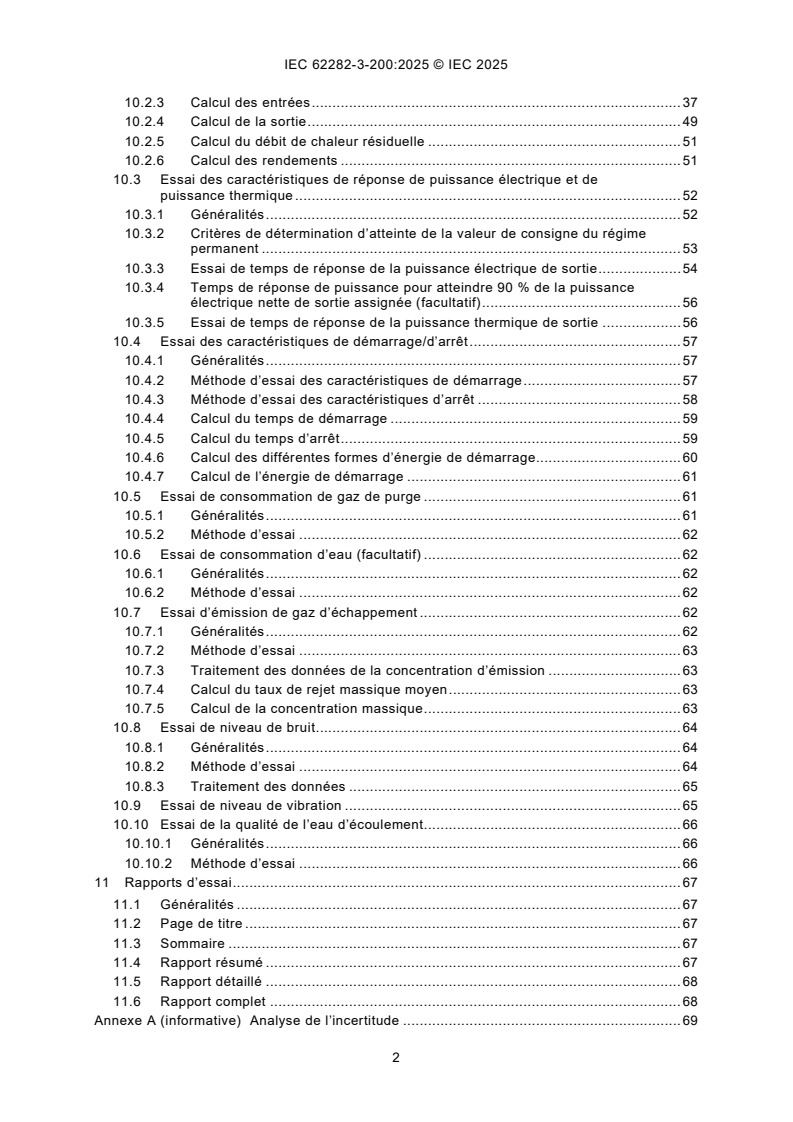
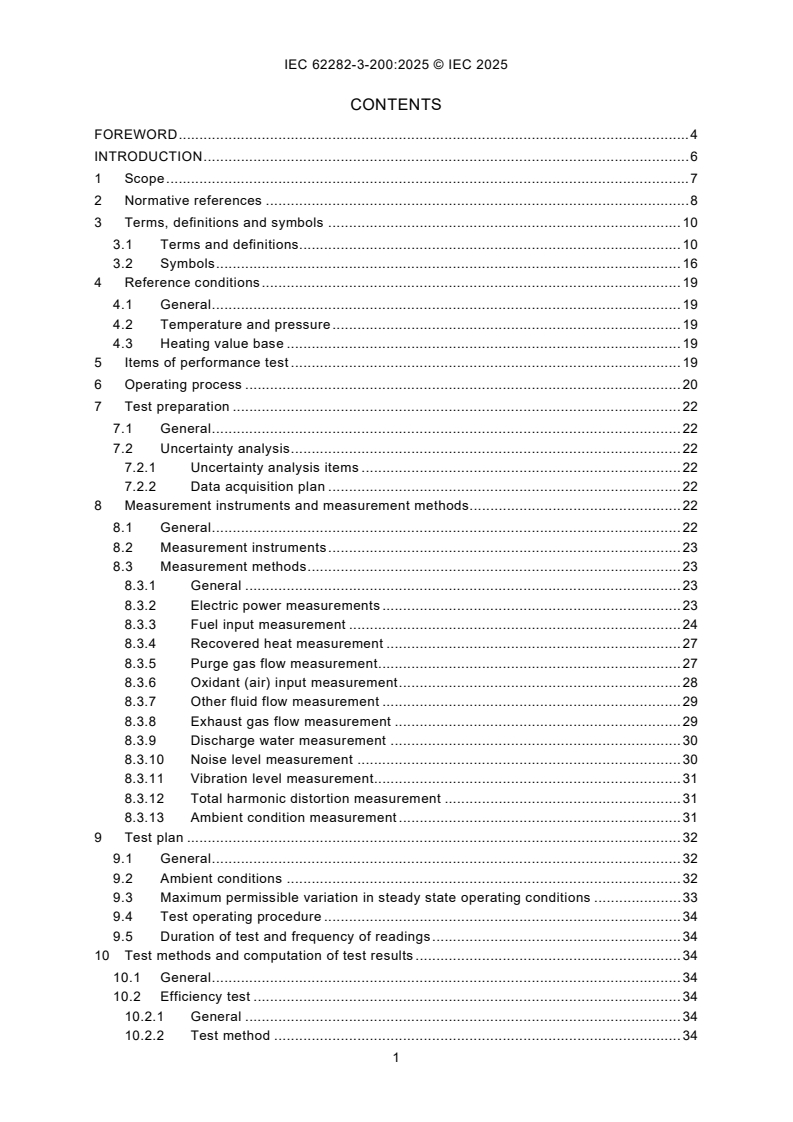
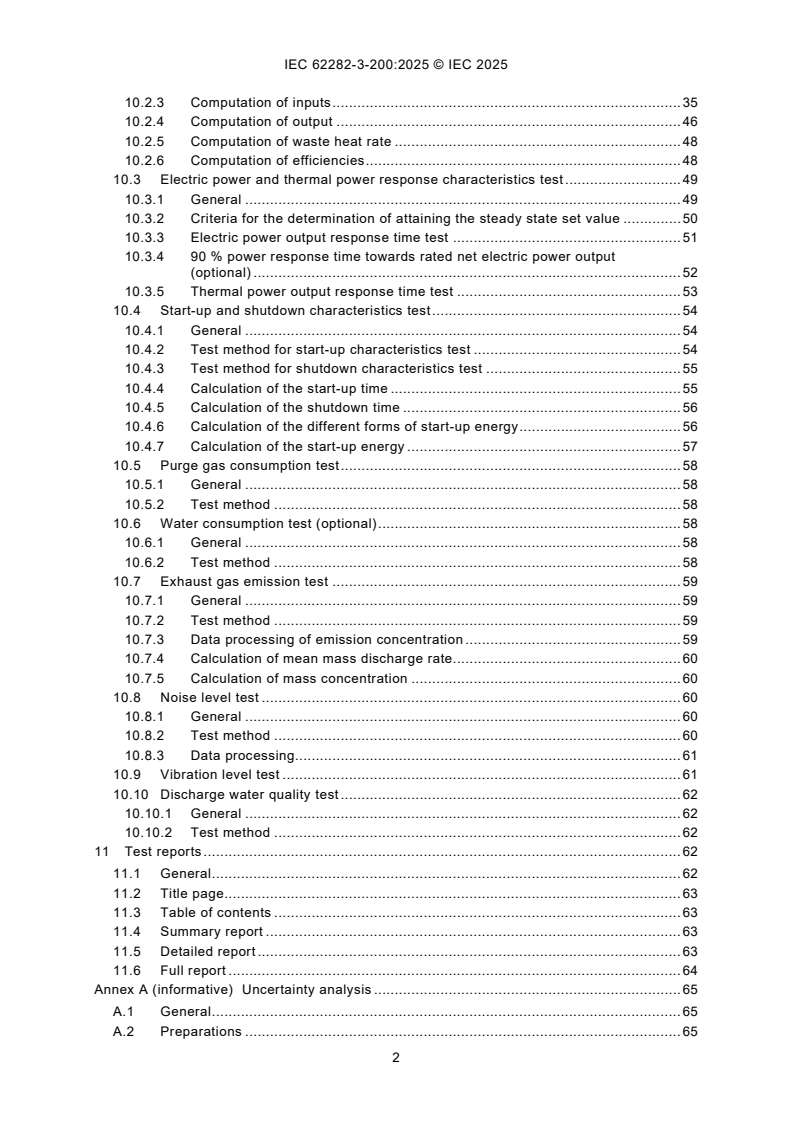
CONTENTS
FOREWORD . 4
INTRODUCTION . 6
1 Scope . 7
2 Normative references . 8
3 Terms, definitions and symbols . 10
3.1 Terms and definitions. 10
3.2 Symbols . 16
4 Reference conditions . 19
4.1 General . 19
4.2 Temperature and pressure . 19
4.3 Heating value base . 19
5 Items of performance test . 19
6 Operating process . 20
7 Test preparation . 22
7.1 General . 22
7.2 Uncertainty analysis . 22
7.2.1 Uncertainty analysis items . 22
7.2.2 Data acquisition plan . 22
8 Measurement instruments and measurement methods . 22
8.1 General . 22
8.2 Measurement instruments . 23
8.3 Measurement methods . 23
8.3.1 General . 23
8.3.2 Electric power measurements . 23
8.3.3 Fuel input measurement . 24
8.3.4 Recovered heat measurement . 27
8.3.5 Purge gas flow measurement . 27
8.3.6 Oxidant (air) input measurement . 28
8.3.7 Other fluid flow measurement . 29
8.3.8 Exhaust gas flow measurement . 29
8.3.9 Discharge water measurement . 30
8.3.10 Noise level measurement . 30
8.3.11 Vibration level measurement. 31
8.3.12 Total harmonic distortion measurement . 31
8.3.13 Ambient condition measurement . 31
9 Test plan . 32
9.1 General . 32
9.2 Ambient conditions . 32
9.3 Maximum permissible variation in steady state operating conditions . 33
9.4 Test operating procedure . 34
9.5 Duration of test and frequency of readings . 34
10 Test methods and computation of test results . 34
10.1 General . 34
10.2 Efficiency test . 34
10.2.1 General . 34
10.2.2 Test method . 34
10.2.3 Computation of inputs . 35
10.2.4 Computation of output . 46
10.2.5 Computation of waste heat rate . 48
10.2.6 Computation of efficiencies . 48
10.3 Electric power and thermal power response characteristics test . 49
10.3.1 General . 49
10.3.2 Criteria for the determination of attaining the steady state set value . 50
10.3.3 Electric power output response time test . 51
10.3.4 90 % power response time towards rated net electric power output
(optional) . 52
10.3.5 Thermal power output response time test . 53
10.4 Start-up and shutdown characteristics test . 54
10.4.1 General . 54
10.4.2 Test method for start-up characteristics test . 54
10.4.3 Test method for shutdown characteristics test . 55
10.4.4 Calculation of the start-up time . 55
10.4.5 Calculation of the shutdown time . 56
10.4.6 Calculation of the different forms of start-up energy . 56
10.4.7 Calculation of the start-up energy . 57
10.5 Purge gas consumption test . 58
10.5.1 General . 58
10.5.2 Test method . 58
10.6 Water consumption test (optional) . 58
10.6.1 General . 58
10.6.2 Test method . 58
10.7 Exhaust gas emission test . 59
10.7.1 General . 59
10.7.2 Test method . 59
10.7.3 Data processing of emission concentration . 59
10.7.4 Calculation of mean mass discharge rate. 60
10.7.5 Calculation of mass concentration . 60
10.8 Noise level test . 60
10.8.1 General . 60
10.8.2 Test method . 60
10.8.3 Data processing. 61
10.9 Vibration level test . 61
10.10 Discharge water quality test . 62
10.10.1 General . 62
10.10.2 Test method . 62
11 Test reports . 62
11.1 General . 62
11.2 Title page. 63
11.3 Table of contents . 63
11.4 Summary report . 63
11.5 Detailed report . 63
11.6 Full report . 64
Annex A (informative) Uncertainty analysis . 65
A.1 General . 65
A.2 Preparations . 65
A.3 Basic assumptions . 66
A.4 General approach . 67
Annex B (informative) Calculation of fuel heating value . 69
Annex C (normative) Reference gas . 74
Annex D (informative) Maximum acceptable instantaneous electric power output
transient . 77
Bibliography . 78
Figure 1 – Fuel cell power system diagram . 8
Figure 2 – Symbol diagram for power inputs and outputs . 19
Figure 3 – Operating process chart of fuel cell power system . 21
Figure 4 – Electric and thermal power response time . 50
Figure 5 – Criteria for attaining steady state . 51
Figure 6 – Example of electric power chart at start-up. 54
Figure 7 – Electric power chart at shutdown . 55
Table 1 – Symbols . 16
Table 2 – Test classification and test item . 20
Table 3 – Test item and system status . 32
Table 4 – Maximum permissible variations in test operating conditions . 33
Table 5 – Vibration correction factors. 62
Table B.1 – Heating value for component of gaseous fuel . 69
Table B.2 – Worksheet 1 – Calculation worksheet for energy of fuel gases . 71
Table B.3 – Worksheet 2 – Calculation worksheet for energy of air . 73
Table C.1 – Examples of compositions of natural gas . 75
Table C.2 – Examples of compositions of liquified petroleum gas (LPG) . 76
INTERNATIONAL ELECTROTECHNICAL COMMISSION
____________
Fuel cell technologies -
Part 3-200: Stationary fuel cell power systems -
Performance test methods
FOREWORD
1) The International Electrotechnical Commission (IEC) is a worldwide organization for standardization comprising
all national electrotechnical committees (IEC National Committees). The object of IEC is to promote international
co-operation on all questions concerning standardization in the electrical and electronic fields. To this end and
in addition to other activities, IEC publishes International Standards, Technical Specifications, Technical Reports,
Publicly Available Specifications (PAS) and Guides (hereafter referred to as "IEC Publication(s)"). Their
preparation is entrusted to technical committees; any IEC National Committee interested in the subject dealt with
may participate in this preparatory work. International, governmental and non-governmental organizations liaising
with the IEC also participate in this preparation. IEC collaborates closely with the International Organization for
Standardization (ISO) in accordance with conditions determined by agreement between the two organizations.
2) The formal decisions or agreements of IEC on technical matters express, as nearly as possible, an international
consensus of opinion on the relevant subjects since each technical committee has representation from all
interested IEC National Committees.
3) IEC Publications have the form of recommendations for international use and are accepted by IEC National
Committees in that sense. While all reasonable efforts are made to ensure that the technical content of IEC
Publications is accurate, IEC cannot be held responsible for the way in which they are used or for any
misinterpretation by any end user.
4) In order to promote international uniformity, IEC National Committees undertake to apply IEC Publications
transparently to the maximum extent possible in their national and regional publications. Any divergence between
any IEC Publication and the corresponding national or regional publication shall be clearly indicated in the latter.
5) IEC itself does not provide any attestation of conformity. Independent certification bodies provide conformity
assessment services and, in some areas, access to IEC marks of conformity. IEC is not responsible for any
services carried out by independent certification bodies.
6) All users should ensure that they have the latest edition of this publication.
7) No liability shall attach to IEC or its directors, employees, servants or agents including individual experts and
members of its technical committees and IEC National Committees for any personal injury, property damage or
other damage of any nature whatsoever, whether direct or indirect, or for costs (including legal fees) and
expenses arising out of the publication, use of, or reliance upon, this IEC Publication or any other IEC
Publications.
8) Attention is drawn to the Normative references cited in this publication. Use of the referenced publications is
indispensable for the correct application of this publication.
9) IEC draws attention to the possibility that the implementation of this document may involve the use of (a)
patent(s). IEC takes no position concerning the evidence, validity or applicability of any claimed patent rights in
respect thereof. As of the date of publication of this document, IEC had not received notice of (a) patent(s), which
may be required to implement this document. However, implementers are cautioned that this may not represent
the latest information, which may be obtained from the patent database available at https://patents.iec.ch. IEC
shall not be held responsible for identifying any or all such patent rights.
IEC 62282-3-200 has been prepared by IEC technical committee 105: Fuel cell technologies. It
is an International Standard.
This third edition cancels and replaces the second edition published in 2015. This edition
constitutes a technical revision.
This edition includes the following significant technical changes with respect to the previous
edition:
a) revision of the Introduction, Scope and Clause 3;
b) revision of the symbols in Table 1;
c) revision of Figure 2 (symbol diagram);
d) revision of measurement methods (8.3);
e) revision of the efficiency test (10.2);
f) revision of the electric power and thermal power response characteristics test (10.3);
g) revision of the start-up and shutdown characteristics test (10.4);
h) revision of Annex C.
The text of this International Standard is based on the following documents:
Draft Report on voting
105/1124/FDIS 105/1134/RVD
Full information on the voting for its approval can be found in the report on voting indicated in
the above table.
The language used for the development of this International Standard is English.
This document was drafted in accordance with ISO/IEC Directives, Part 2, and developed in
accordance with ISO/IEC Directives, Part 1 and ISO/IEC Directives, IEC Supplement, available
at www.iec.ch/members_experts/refdocs. The main document types developed by IEC are
described in greater detail at www.iec.ch/publications.
A list of all parts in the IEC 62282 series, published under the general title Fuel cell technologies,
can be found on the IEC website.
The committee has decided that the contents of this document will remain unchanged until the
stability date indicated on the IEC website under webstore.iec.ch in the data related to the
specific document. At this date, the document will be
• reconfirmed,
• withdrawn, or
• revised.
INTRODUCTION
This part of IEC 62282 describes how to measure the performance of stationary fuel cell power
systems for residential, commercial, agricultural and industrial applications.
This document describes type tests and their test methods only. In this document, no routine
tests are required or identified, and no performance targets are set.
A related but independent standard IEC 62282-3-201 on the performance test methods of small
stationary fuel cell power systems has been aligned with this document.
1 Scope
This part of IEC 62282 covers operational and environmental aspects of the stationary fuel cell
power systems performance. The test methods apply as follows:
– power output under specified operating and transient conditions;
– electrical and heat recovery efficiency under specified operating conditions;
– environmental characteristics, for example, exhaust gas emissions, noise, under specified
operating and transient conditions.
This document applies to all kinds of stationary fuel cell technologies, such as:
– alkaline fuel cells (AFC);
– phosphoric acid fuel cells (PAFC);
– polymer electrolyte fuel cells (PEFC);
– molten carbonate fuel cells (MCFC);
– solid oxide fuel cells (SOFC).
This document does not provide coverage for electromagnetic compatibility (EMC).
This document does not apply to small stationary fuel cell power systems with rated electric
power output of less than 10 kW which are dealt with in IEC 62282-3-201.
Fuel cell power systems can have different subsystems depending upon types of fuel cell and
applications, and they have different streams of material and energy into and out of them.
However, a common system diagram and boundary has been defined for evaluation of the fuel
cell power system (see Figure 1).
The following conditions are considered in order to determine the system boundary of the fuel
cell power system:
– all energy recovery systems are included within the system boundary;
– all kinds of electric energy storage devices are considered outside the system boundary;
– calculation of the heating value of the input fuel (such as natural gas, propane gas and pure
hydrogen gas) is based on the conditions of the fuel at the boundary of the fuel cell power
system.
The document does not provide safety requirements for the testing of stationary fuel cell power
systems. Details on safe operation of the tested system can be obtained from the manufacturers
instructions.
Key
Fuel cell power system including subsystems. The interface is defined as a conceptual or functional
one instead of hardware such as a power package.
Subsystems: fuel cell module, fuel processor, etc. These subsystem configurations depend on the kind
of fuel, type of fuel cell or system.
The interface points in the boundary to be measured for calculation data.
a
EMD electromagnetic disturbance
b
EMI electromagnetic interference
Figure 1 – Fuel cell power system diagram
2 Normative references
The following documents are referred to in the text in such a way that some or all of their content
constitutes requirements of this document. For dated references, only the edition cited applies.
For undated references, the latest edition of the referenced document (including any
amendments) applies.
IEC 60051 (all parts), Direct acting indicating analogue electrical measuring instruments and
their accessories
IEC 60359, Electrical and electronic measurement equipment - Expression of performance
IEC 60688, Electrical measuring transducers for converting AC and DC electrical quantities to
analogue or digital signals
IEC 61000-4-7, Electromagnetic compatibility (EMC) - Part 4-7: Testing and measurement
techniques - General guide on harmonics and interharmonics measurements and
instrumentation, for power supply systems and equipment connected thereto
IEC 61028, Electrical measuring instruments - X-Y recorders
IEC 61143 (all parts), Electrical measuring instruments - X-t recorders
IEC 61672-1, Electroacoustics - Sound level meters - Part 1: Specifications
IEC 61672-2, Electroacoustics - Sound level meters - Part 2: Pattern evaluation tests
IEC 62052-11, Electricity metering equipment - General requirements, tests and test
conditions - Part 11: Metering equipment
IEC 62053-22, Electricity metering equipment - Particular requirements - Part 22: Static meters
for AC active energy (classes 0,1S, 0,2S and 0,5S)
IEC 62282-3-201, Fuel cell technologies - Part 3-201: Stationary fuel cell power systems -
Performance test methods for small fuel cell power systems
ISO 3648, Aviation fuels - Estimation of net specific energy
ISO 3744, Acoustics - Determination of sound power levels and sound energy levels of noise
sources using sound pressure - Engineering methods for an essentially free field over a
reflecting plane
ISO 4677-1, Atmospheres for conditioning and testing - Determination of relative humidity –
Part 1: Aspirated psychrometer method
ISO 4677-2, Atmospheres for conditioning and testing - Determination of relative humidity –
Part 2: Whirling psychrometer method
ISO 5167 (all parts), Measurement of fluid flow by means of pressure differential devices
inserted in circular cross-section conduits running full
ISO 5348, Mechanical vibration and shock - Mechanical mounting of accelerometers
ISO 5815-2, Water quality - Determination of biochemical oxygen demand after n days (BODn)
- Part 2: Method for undiluted samples
ISO 6060, Water quality - Determination of the chemical oxygen demand
ISO 6974 (all parts), Natural gas - Determination of composition and associated uncertainty by
gas chromatography
ISO 6975, Natural gas - Extended analysis - Gas chromatographic method
ISO 7934, Stationary source emissions - Determination of the mass concentration of sulfur
dioxide - Hydrogen peroxide/barium perchlorate/Thorin method
ISO 7935, Stationary source emissions - Determination of the mass concentration of sulfur
dioxide in flue gases - Performance characteristics of automated measuring systems
ISO 8217:2024, Products from petroleum, synthetic and renewable sources - Fuels (class F) -
Specifications of marine fuels
ISO 10101 (all parts), Natural gas - Determination of water by the Karl Fisher method
___________
This publication was withdrawn.
ISO 10396, Stationary source emissions - Sampling for the automated determination of gas
emission concentrations for permanently-installed monitoring systems
ISO 10523, Water quality - Determination of pH
ISO 11626, Natural gas - Determination of sulfur compounds - Determination of hydrogen
sulfide content by UV absorption method
ISO 10849, Stationary source emissions - Determination of the mass concentration of nitrogen
oxides in flue gas - Performance characteristics of automated measuring systems
ISO 11042-1, Gas turbines - Exhaust gas emission - Part 1: Measurement and evaluation
ISO 11042-2, Gas turbines - Exhaust gas emission - Part 2: Automated emission monitoring
ISO 11541, Natural gas - Determination of water content at high pressure
ISO 11564, Stationary source emissions - Determination of the mass concentration of nitrogen
oxides - Naphthylethylenediamine photometric method
ISO 11632, Stationary source emissions - Determination of mass concentration of sulfur
dioxide - Ion chromatography method
ISO 14687, Hydrogen fuel - Product specification
ISO/TR 15916, Basic considerations for the safety of hydrogen systems
ISO 16622, Meteorology - Sonic anemometers/thermometers - Acceptance test methods for
mean wind measurements
ISO 16960, Natural gas - Determination of sulfur compounds - Determination of total sulfur by
oxidative microcoulometry method
ISO 19739, Natural gas - Determination of sulfur compounds using gas chromatography
ISO 20729, Natural gas - Determination of sulfur compounds - Determination of total sulfur
content by ultraviolet fluorescence method
ASTM D4809, Standard Test Method for Heat of Combustion of Liquid Hydrocarbon Fuels by
Bomb Calorimeter (Precision Method)
3 Terms, definitions and symbols
3.1 Terms and definitions
For the purposes of this document, the following terms and definitions apply.
ISO and IEC maintain terminology databases for use in standardization at the following
addresses:
• IEC Electropedia: available at https://www.electropedia.org/
• ISO Online browsing platform: available at https://www.iso.org/obp
3.1.1
auxiliary electric power input
electric power for auxiliary machines and equipment supplied from outside the system boundary
3.1.2
background noise level
sound pressure level of ambient noise at the measurement point
Note 1 to entry: This measurement is taken as described in this document with the fuel cell power system in the
cold state.
3.1.3
background vibration level
mechanical oscillations level caused by the environment that affect vibration level readings
Note 1 to entry: In this document, background vibration is measured with the fuel cell power system in the cold
state.
3.1.4
cold state
state of a fuel cell power system, which is entirely at ambient temperature with no power input
or output, ready for start-up
Note 1 to entry: Power input to a control device for monitoring the fuel cell power system during cold state is not
taken into consideration.
[SOURCE: IEC 60050-485:2020, 485-21-01, modified – "which is entirely" and "ready for start-
up" added; Note 1 to entry added.]
3.1.5
discharge water
water discharged from the fuel cell power system including waste water and condensate
3.1.6
electrical efficiency
ratio of the average net electric power output produced by a fuel cell power system to the
average total power input supplied to the fuel cell power system
Note 1 to entry: Lower heating value (LHV) is assumed unless otherwise stated.
Note 2 to entry: Any electric power that is supplied to auxiliary machines and equipment of a fuel cell power system
from an external source is deducted from the electric power output of the fuel cell power system.
[SOURCE: IEC 60050-485:2020, 485-10-02, modified – "electrical" instead of "electric" in the
preferred term; "average net electric power output" instead of "net electric power"; "average
total power input" instead of "total enthalpy flow"; “Note 2 to entry added.]
3.1.7
external thermal energy
additional thermal energy input from outside the system boundary
Note 1 to entry: External thermal energy can be supplied e.g. by make-up water or process condensate return.
3.1.8
fuel cell module
assembly incorporating one or more fuel cell stacks and, if applicable, additional components,
that is intended to be integrated into a power system
Note 1 to entry: A fuel cell module comprises the following main components: one or more fuel cell stack(s), a
piping system for conveying fuels, oxidants and exhausts, electric connections for the power delivered by the
stack(s), and means for monitoring, control or both. Additionally, a fuel cell module can comprise: means for
conveying additional fluids (e.g. cooling media, inert gas, CO (MCFC)), means for detecting normal and abnormal
operating conditions, enclosures or pressure vessels and module ventilation systems, and the required electronic
components for module operation and power conditioning.
[SOURCE: IEC 60050-485:2020, 485-09-03, modified – In the definition "or a vehicle" deleted
and in the Note to entry, "CO (MCFC)" added.]
3.1.9
fuel cell power system
generator system that uses one or more fuel cell modules to generate electric power and heat
Note 1 to entry: A fuel cell power system is composed of all or some of the systems shown in Figure 1.
[SOURCE: IEC 60050-485:2020, 485-09-01, modified – Note 1 to entry added.]
3.1.10
fuel input
amount of natural gas, hydrogen, methanol, liquid petroleum gas, propane, butane, or other
substance containing chemical energy introduced to the fuel cell power system during specified
operating conditions
3.1.11
heat recovery efficiency
ratio of the average recovered thermal power output of a fuel cell power system to the average
total power input supplied to the fuel cell power system
[SOURCE: IEC 60050-485:2020, 485-10-04, modified – "average recovered thermal power
output" instead of "recovered heat flow"; "average total power input" instead of "total enthalpy
flow"; Note 1 to entry deleted.]
3.1.12
interface point
measurement point at the boundary of a fuel cell power system at which material or energy, or
both, either enters or leaves
Note 1 to entry: This boundary is intentionally selected to accurately measure the performance of the system
including all normal operation, both steady state and transient. If necessary, the boundary or the interface points of
the fuel cell power system (Figure 1) to be assessed should be determined by agreement between the parties.
[SOURCE: IEC 60050-485:2020, 485-09-12, modified – In Note 1 to entry, reference to Figure 1
added and Note 2 to entry deleted.]
3.1.13
minimum power
lowest net electric power output at which a fuel cell power system is able to operate continuously
in a stable manner
[SOURCE: IEC 60050-485:2020, 485-14-02, modified – "output" added, Note 1 to entry
deleted.]
3.1.14
noise level
sound pressure level produced by a fuel cell power system
Note 1 to entry: Noise level is expressed in decibels (dB) and measured at a specified distance and in all operation
modes as described in this document.
3.1.15
operating temperature
temperature at which the fuel cell power system operates and with its determination specified
by the manufacturer
Note 1 to entry: The temperature can be either measured at a specific measuring point or determined from the
measurement at several specific points.
3.1.16
overall energy efficiency
ratio of total useable power output (net electrical power and recovered thermal power) to the
average total power input supplied to the fuel cell power system
Note 1 to entry: The supplied total power input of the fuel should be related to the lower heating value (LHV) for a
better comparison with other types of energy conversion systems.
Note 2 to entry: Refer to 4.3 regarding reporting based on LHV or HHV.
[SOURCE: IEC 60050-485:2020, 485-10-05, modified – Second preferred term "total thermal
efficiency" deleted; in the definition,"power output" instead of "energy flow"; "thermal power"
instead of "heat flow"; "average total power input" instead of "total enthalpy flow"; in Note 1 to
entry, "total power input" instead of "total (including reaction enthalpy) enthalpy flow" and Note
2 to entry added.]
3.1.17
oxidant input
amount of oxidant (air) input into the inside of the fuel cell module during specified operating
conditions
Note 1 to entry: The oxidant is usually air, but other oxidants (e.g. oxygen) can be used.
3.1.18
power response time
duration between the instant of initiating a change of electric or thermal power output and when
the electric or thermal power output attains the set value within tolerance
3.1.19
90 % power response time
duration between the instant of initiating a change of electric or thermal power output and when
the electric or thermal power output attains 90 % of the desired value within tolerance
3.1.20
pre-generation state
state of a fuel cell power system at a sufficient operating temperature and in such an operational
mode, with zero electric power output, that the fuel cell power system is capable of being
promptly switched to an operational state with a substantial net electric power output
[SOURCE: IEC 60050-485:2020, 485-21-04, modified – second preferred term "pre-generation
operation" deleted and in the definition, "net” added before “electric”]
3.1.21
purge gas consumption
amount of inert gas or dilution gas supplied to the fuel cell power system during specific
conditions to make it ready for operation or shutdown
3.1.22
net electric power output
power generated by the fuel cell power system and available for external use
[SOURCE: IEC 60050-485:2020, 485-14-03, modified – "output" added to the preferred term,
Notes 1 and 2 to entry deleted.]
3.1.23
rated power
maximum continuous electric power output that a fuel cell power system is designed to achieve
under normal operating conditions specified by the manufacturer
[SOURCE: IEC 60050-485:2020, 485-14-04, modified – "Note 1 to entry" deleted.]
3.1.24
recovered heat
thermal energy that is recovered for useful purposes
Note 1 to entry: The recovered heat is measured by determining the temperatures and flow rates of heat recovery
fluid (water, steam, air or oil, etc.), entering and leaving the thermal energy recovery subsystem at the interface point
of the fuel cell power system.
3.1.25
reference condition
values of influence quantities specified for testing the performance of a measuring instrument,
which in this document are 288,15 K (15 °C) for temperature and 101,325 kPa for pressure
3.1.26
response time
duration between the instant when the step load change from minimum to rated power or vice
versa is initiated and the first instant when the desired value is delivered within a specific
tolerance value
3.1.27
shaft work
mechanical energy input from outside the system boundary for accomplishing useful work
3.1.28
shutdown time
duration between the instant when a shutdown action is initiated at rated electric power output
and the instant when the shutdown is completed, as specified by the manufacturer
Note 1 to entry: The shutdown operation is classified into types: normal shutdown and emergency shutdown.
[SOURCE: IEC 60050-485:2020, 485-20-04, modified – "a shutdown action is initiated at rated
power output" instead of "the load is removed"; "as specified by the manufacturer" added and
Note 1 to entry added.]
3.1.29
start-up energy
sum of the electric, thermal, mechanical and chemical (fuel) energy required by a fuel cell power
system during the start-up time
[SOURCE: IEC 60050-485:2020, 485-18-05]
3.1.30
start-up time
duration required for transitioning from cold state to positive net electrical power output
[SOURCE: IEC 60050-485:2020, 485-20-05, modified – "positive" added.]
3.1.31
start-up time
duration
required for transitioning from storage state to positive net electrical power output
[SOURCE: IEC 60050-485:2020, 485-20-06, modified – "positive" added.]
3.1.32
steady state
state of a physical system in which the relevant characteristics remain constant with time
[SOURCE: IEC 60050-485:2020, 485-21-05]
3.1.33
storage state
state of a fuel cell power system being non-operational and possibly requiring, under conditions
specified by the manufacturer, the input of thermal energy, electric energy or an inert
atmosphere, or any combination thereof, in order to prevent deterioration of the components or
to energize the control systems, or both
[SOURCE: IEC 60060-485:2020, 485-21-06, modified – "or to energize the control system, or
both" added.]
3.1.34
test run
testing phase in which data points required for the computation of test results are recorded
3.1.35
thermal power output
thermal power generated by the fuel cell power system and available for external use
3.1.36
total power input
total consisting of fuel power input, oxidant (air) power input, auxiliary electric power input, shaft
work power input and external thermal power input
3.1.37
vibration level
mechanical oscillation level produced by the fuel cell power system during operation
Note 1 to entry: This is a value expressed in decibels (dB) as described in this document.
3.1.38
waste heat
thermal energy output released and not recovered
3.1.39
waste water
excess water that is removed from the fuel cell power system and that does not constitute part
of the thermal recovery system
3.1.40
water consumption
water supplied from outside the system boundary to the fuel cell power system other than the
initial fill
3.2 Symbols
The symbols and their meanings used in this document are given in Table 1, with the
appropriate units.
Table 1 – Symbols
Symbol Definition Unit
c Specific heat capacity
c
Specific heat capacity of heat recovery fluid kJ/(kg K)
HR
c
Specific heat capacity of pure component j kJ/(kg K)
j
E Energy
E
Start-up energy kJ
st
E
Electric start-up energy kJ
elst
E
Fuel start-up energy kJ
fst
E
Oxidant (air) start-up energy kJ
ast
E
Energy input of the fuel per unit volume
kJ/m
Vf
E
Energy input of fuel pe
...
IEC 62282-3-200 ®
Edition 3.0 2025-09
INTERNATIONAL
STANDARD
REDLINE VERSION
Fuel cell technologies -
Part 3-200: Stationary fuel cell power systems - Performance test methods
ICS 27.070 ISBN 978-2-8327-0748-7
All rights reserved. Unless otherwise specified, no part of this publication may be reproduced or utilized in any form or
by any means, electronic or mechanical, including photocopying and microfilm, without permission in writing from either
IEC or IEC's member National Committee in the country of the requester. If you have any questions about IEC copyright
or have an enquiry about obtaining additional rights to this publication, please contact the address below or your local
IEC member National Committee for further information.
IEC Secretariat Tel.: +41 22 919 02 11
3, rue de Varembé info@iec.ch
CH-1211 Geneva 20 www.iec.ch
Switzerland
About the IEC
The International Electrotechnical Commission (IEC) is the leading global organization that prepares and publishes
International Standards for all electrical, electronic and related technologies.
About IEC publications
The technical content of IEC publications is kept under constant review by the IEC. Please make sure that you have the
latest edition, a corrigendum or an amendment might have been published.
IEC publications search - IEC Products & Services Portal - products.iec.ch
webstore.iec.ch/advsearchform Discover our powerful search engine and read freely all the
The advanced search enables to find IEC publications by a publications previews, graphical symbols and the glossary.
variety of criteria (reference number, text, technical With a subscription you will always have access to up to date
committee, …). It also gives information on projects, content tailored to your needs.
replaced and withdrawn publications.
Electropedia - www.electropedia.org
The world's leading online dictionary on electrotechnology,
IEC Just Published - webstore.iec.ch/justpublished
Stay up to date on all new IEC publications. Just Published containing more than 22 500 terminological entries in English
details all new publications released. Available online and and French, with equivalent terms in 25 additional languages.
once a month by email. Also known as the International Electrotechnical Vocabulary
(IEV) online.
IEC Customer Service Centre - webstore.iec.ch/csc
If you wish to give us your feedback on this publication or
need further assistance, please contact the Customer
Service Centre: sales@iec.ch.
CONTENTS
FOREWORD . 4
INTRODUCTION . 6
1 Scope . 7
2 Normative references . 9
3 Terms, definitions, operating process and symbols . 11
3.1 Terms and definitions. 11
3.2 Symbols . 17
4 Reference conditions . 20
4.1 General . 20
4.2 Temperature and pressure . 20
4.3 Heating value base . 20
5 Items of performance test . 20
6 Operating process . 21
7 Test preparation . 23
7.1 General . 23
7.2 Uncertainty analysis . 23
7.2.1 Uncertainty analysis items . 23
7.2.2 Data acquisition plan . 23
8 Measurement instruments and measurement methods . 23
8.1 General . 23
8.2 Measurement instruments . 24
8.3 Measurement methods . 24
8.3.1 General . 24
8.3.2 Electric power measurements . 24
8.3.3 Fuel input measurement . 25
8.3.4 Recovered heat measurement . 28
8.3.5 Purge gas flow measurement . 29
8.3.6 Oxidant (air) input measurement . 29
8.3.7 Other fluid flow measurement . 30
8.3.8 Exhaust gas flow measurement . 30
8.3.9 Discharge water measurement . 31
8.3.10 Noise level measurement . 32
8.3.11 Vibration level measurement. 32
8.3.12 Total harmonic distortion measurement . 32
8.3.13 Ambient condition measurement . 33
9 Test plan . 33
9.1 General . 33
9.2 Ambient conditions . 33
9.3 Maximum permissible variation in steady state operating conditions . 34
9.4 Test operating procedure . 35
9.5 Duration of test and frequency of readings . 35
10 Test methods and computation of test results . 35
10.1 General . 35
10.2 Efficiency test . 36
10.2.1 General . 36
10.2.2 Test method . 36
10.2.3 Computation of inputs . 36
10.2.4 Computation of output . 47
10.2.5 Computation of waste heat rate . 49
10.2.6 Computation of efficiencies . 50
10.3 Electric power and thermal power response characteristics test . 51
10.3.1 General . 51
10.3.2 Criteria for the determination of attaining the steady state set value . 52
10.3.3 Electric power output response time test . 53
10.3.4 90 % power response time towards rated net electric power output
(optional) . 54
10.3.5 Thermal power output response time test . 54
10.4 Start-up and shutdown characteristics test . 55
10.4.1 General . 55
10.4.2 Test method for start-up characteristics test . 55
10.4.3 Test method for shutdown characteristics test . 56
10.4.4 Calculation of the start-up time . 57
10.4.5 Calculation of the shutdown time . 58
10.4.6 Calculation of the different forms of start-up energy . 58
10.4.7 Calculation of the start-up energy . 59
10.5 Purge gas consumption test . 60
10.5.1 General . 60
10.5.2 Test method . 60
10.6 Water consumption test (optional) . 60
10.6.1 General . 60
10.6.2 Test method . 60
10.7 Exhaust gas emission test . 61
10.7.1 General . 61
10.7.2 Test method . 61
10.7.3 Data processing of emission concentration . 61
10.7.4 Calculation of mean mass discharge rate. 62
10.7.5 Calculation of mass concentration . 62
10.8 Noise level test . 62
10.8.1 General . 62
10.8.2 Test method . 62
10.8.3 Data processing. 63
10.9 Vibration level test . 63
10.10 Discharge water quality test . 64
10.10.1 General . 64
10.10.2 Test method . 64
11 Test reports . 64
11.1 General . 64
11.2 Title page. 65
11.3 Table of contents . 65
11.4 Summary report . 65
11.5 Detailed report . 65
11.6 Full report . 65
Annex A (normativeinformative) Uncertainty analysis . 67
A.1 General . 67
A.2 Preparations . 67
A.3 Basic assumptions . 68
A.4 General approach . 69
Annex B (normativeinformative) Calculation of fuel heating value . 71
Annex C (normative) Reference gas . 76
Annex D (informative) Maximum acceptable instantaneous electric power output
transient . 79
Bibliography . 80
Figure 1 – Fuel cell power system diagram . 8
Figure 2 – Symbol diagram for power inputs and outputs . 20
Figure 3 – Operating process chart of fuel cell power system . 22
Figure 4 – Electric and thermal power response time . 51
Figure 5 – Example of electric and thermal power response time to attain steady-state
set value Criteria for attaining steady state . 52
Figure 6 – Example of electric power chart at start-up. 56
Figure 7 – Electric power chart at shutdown . 57
Table 1 – Symbols . 17
Table 2 – Test classification and test item . 21
Table 3 – Test item and system status . 34
Table 4 – Maximum permissible variations in test operating conditions . 35
Table 5 – Vibration correction factors. 64
Table B.1 – Heating value for component of gaseous fuel . 71
Table B.2 – Worksheet 1 – Calculation worksheet for energy of fuel gases . 73
Table B.3 – Worksheet 2 – Calculation worksheet for energy of air . 75
Table C.1 – Reference gas for Examples of compositions of natural gas . 77
Table C.2 – Reference gas for propane gas Examples of compositions of liquified
petroleum gas (LPG) . 78
INTERNATIONAL ELECTROTECHNICAL COMMISSION
____________
Fuel cell technologies -
Part 3-200: Stationary fuel cell power systems -
Performance test methods
FOREWORD
1) The International Electrotechnical Commission (IEC) is a worldwide organization for standardization comprising
all national electrotechnical committees (IEC National Committees). The object of IEC is to promote international
co-operation on all questions concerning standardization in the electrical and electronic fields. To this end and
in addition to other activities, IEC publishes International Standards, Technical Specifications, Technical Reports,
Publicly Available Specifications (PAS) and Guides (hereafter referred to as "IEC Publication(s)"). Their
preparation is entrusted to technical committees; any IEC National Committee interested in the subject dealt with
may participate in this preparatory work. International, governmental and non-governmental organizations liaising
with the IEC also participate in this preparation. IEC collaborates closely with the International Organization for
Standardization (ISO) in accordance with conditions determined by agreement between the two organizations.
2) The formal decisions or agreements of IEC on technical matters express, as nearly as possible, an international
consensus of opinion on the relevant subjects since each technical committee has representation from all
interested IEC National Committees.
3) IEC Publications have the form of recommendations for international use and are accepted by IEC National
Committees in that sense. While all reasonable efforts are made to ensure that the technical content of IEC
Publications is accurate, IEC cannot be held responsible for the way in which they are used or for any
misinterpretation by any end user.
4) In order to promote international uniformity, IEC National Committees undertake to apply IEC Publications
transparently to the maximum extent possible in their national and regional publications. Any divergence between
any IEC Publication and the corresponding national or regional publication shall be clearly indicated in the latter.
5) IEC itself does not provide any attestation of conformity. Independent certification bodies provide conformity
assessment services and, in some areas, access to IEC marks of conformity. IEC is not responsible for any
services carried out by independent certification bodies.
6) All users should ensure that they have the latest edition of this publication.
7) No liability shall attach to IEC or its directors, employees, servants or agents including individual experts and
members of its technical committees and IEC National Committees for any personal injury, property damage or
other damage of any nature whatsoever, whether direct or indirect, or for costs (including legal fees) and
expenses arising out of the publication, use of, or reliance upon, this IEC Publication or any other IEC
Publications.
8) Attention is drawn to the Normative references cited in this publication. Use of the referenced publications is
indispensable for the correct application of this publication.
9) IEC draws attention to the possibility that the implementation of this document may involve the use of (a)
patent(s). IEC takes no position concerning the evidence, validity or applicability of any claimed patent rights in
respect thereof. As of the date of publication of this document, IEC had not received notice of (a) patent(s), which
may be required to implement this document. However, implementers are cautioned that this may not represent
the latest information, which may be obtained from the patent database available at https://patents.iec.ch. IEC
shall not be held responsible for identifying any or all such patent rights.
This redline version of the official IEC Standard allows the user to identify the changes made
to the previous edition IEC 62282-3-200:2025. A vertical bar appears in the margin wherever a
change has been made. Additions are in green text, deletions are in strikethrough red text.
IEC 62282-3-200 has been prepared by IEC technical committee 105: Fuel cell technologies. It
is an International Standard.
This third edition cancels and replaces the second edition published in 2015. This edition
constitutes a technical revision.
This edition includes the following significant technical changes with respect to the previous
edition:
a) revision of the Introduction, Scope and Clause 3;
b) revision of the symbols in Table 1;
c) revision of Figure 2 (symbol diagram);
d) revision of measurement methods (8.3);
e) revision of the efficiency test (10.2);
f) revision of the electric power and thermal power response characteristics test (10.3);
g) revision of the start-up and shutdown characteristics test (10.4);
h) revision of Annex C.
The text of this International Standard is based on the following documents:
Draft Report on voting
105/1124/FDIS 105/1134/RVD
Full information on the voting for its approval can be found in the report on voting indicated in
the above table.
The language used for the development of this International Standard is English.
This document was drafted in accordance with ISO/IEC Directives, Part 2, and developed in
accordance with ISO/IEC Directives, Part 1 and ISO/IEC Directives, IEC Supplement, available
at www.iec.ch/members_experts/refdocs. The main document types developed by IEC are
described in greater detail at www.iec.ch/publications.
A list of all parts in the IEC 62282 series, published under the general title Fuel cell technologies,
can be found on the IEC website.
The committee has decided that the contents of this document will remain unchanged until the
stability date indicated on the IEC website under webstore.iec.ch in the data related to the
specific document. At this date, the document will be
• reconfirmed,
• withdrawn, or
• revised.
INTRODUCTION
This part of IEC 62282 describes how to measure the performance of stationary fuel cell power
systems for residential, commercial, agricultural and industrial applications.
This document describes type tests and their test methods only. In this document, no routine
tests are required or identified, and no performance targets are set.
The following fuel cell types have been considered:
– alkaline fuel cells (AFC);
– phosphoric acid fuel cells (PAFC);
– polymer electrolyte fuel cells (PEFC);
– molten carbonate fuel cells (MCFC);
– solid oxide fuel cells (SOFC).
A related but independent standard IEC 62282-3-201 on the performance test methods of small
stationary fuel cell power systems has been aligned with this document.
1 Scope
This part of IEC 62282 covers operational and environmental aspects of the stationary fuel cell
power systems performance. The test methods apply as follows:
– power output under specified operating and transient conditions;
– electrical and heat recovery efficiency under specified operating conditions;
– environmental characteristics, for example, exhaust gas emissions, noise, under specified
operating and transient conditions.
This document applies to all kinds of stationary fuel cell technologies, such as:
– alkaline fuel cells (AFC);
– phosphoric acid fuel cells (PAFC);
– polymer electrolyte fuel cells (PEFC);
– molten carbonate fuel cells (MCFC);
– solid oxide fuel cells (SOFC).
This document does not provide coverage for electromagnetic compatibility (EMC).
This document does not apply to small stationary fuel cell power systems with rated electric
power output of less than 10 kW which are dealt with in IEC 62282-3-201.
Fuel cell power systems may can have different subsystems depending upon types of fuel cell
and applications, and they have different streams of material and energy into and out of them.
However, a common system diagram and boundary has been defined for evaluation of the fuel
cell power system (see Figure 1).
The following conditions are considered in order to determine the system boundary of the fuel
cell power system:
– all energy recovery systems are included within the system boundary;
– all kinds of electric energy storage devices are considered outside the system boundary;
– calculation of the heating value of the input fuel (such as natural gas, propane gas and pure
hydrogen gas) is based on the conditions of the fuel at the boundary of the fuel cell power
system.
The document does not provide safety requirements for the testing of stationary fuel cell power
systems. Details on safe operation of the tested system can be obtained from the manufacturers
instructions.
Power inputs:
System boundary
electric, external
thermal, shaft work
Recovered heat
Thermal
management
Waste heat
Fuel
Fuel
Useable power
Fuel
processing
Power
cell
conditioning
Oxidant
Oxidant
Water
Water processing Internal power Discharge
treatment water
Inert Gas
Exhaust gases,
Automatic
Ventilation
Ventilation
til ti
EMI
control
s stem
EMD
Noise,
Vibration,
IEC
wind, rain,
Key
Fuel cell power system including subsystems. The interface is defined as a conceptual or functional
one instead of hardware such as a power package.
Subsystems: fuel cell module, fuel processor, etc. These subsystem configurations depend on the kind
of fuel, type of fuel cell or system.
The interface points in the boundary to be measured for calculation data.
a
EMD electromagnetic disturbance
b
EMI electromagnetic interference
Figure 1 – Fuel cell power system diagram
2 Normative references
The following documents are referred to in the text in such a way that some or all of their content
constitutes requirements of this document. For dated references, only the edition cited applies.
For undated references, the latest edition of the referenced document (including any
amendments) applies.
IEC 60051 (all parts), Direct acting indicating analogue electrical measuring instruments and
their accessories
IEC 60359, Electrical and electronic measurement equipment - Expression of performance
IEC 60688, Electrical measuring transducers for converting AC and DC electrical quantities to
analogue or digital signals
IEC 61000-4-7, Electromagnetic compatibility (EMC) - Part 4-7: Testing and measurement
techniques - General guide on harmonics and interharmonics measurements and
instrumentation, for power supply systems and equipment connected thereto
IEC 61000-4-13, Electromagnetic compatibility (EMC) – Part 4-13: Testing and measurement
techniques – Harmonics and interharmonics including mains signalling at a.c. power port, low
frequency immunity tests
IEC 61028, Electrical measuring instruments - X-Y recorders
IEC 61143 (all parts), Electrical measuring instruments - X-t recorders
IEC 61672-1, Electroacoustics - Sound level meters - Part 1: Specifications
IEC 61672-2, Electroacoustics - Sound level meters - Part 2: Pattern evaluation tests
IEC 62052-11, Electricity metering equipment (AC) - General requirements, tests and test
conditions - Part 11: Metering equipment
IEC 62053-22, Electricity metering equipment (a.c.) - Particular requirements - Part 22: Static
meters for AC active energy (classes 0,1S, 0,2S and 0,5S)
IEC 62282-3-201, Fuel cell technologies - Part 3-201: Stationary fuel cell power systems -
Performance test methods for small fuel cell power systems
ISO/IEC Guide 98-3, Uncertainty of measurement – Part 3: Guide to the expression of
uncertainty in measurement (GUM: 1995)
ISO 3648, Aviation fuels - Estimation of net specific energy
ISO 3744, Acoustics - Determination of sound power levels and sound energy levels of noise
sources using sound pressure - Engineering methods for an essentially free field over a
reflecting plane
ISO 4677-1, Atmospheres for conditioning and testing - Determination of relative humidity –
Part 1: Aspirated psychrometer method
ISO 4677-2, Atmospheres for conditioning and testing - Determination of relative humidity –
Part 2: Whirling psychrometer method
ISO 5167 (all parts), Measurement of fluid flow by means of pressure differential devices
inserted in circular cross-section conduits running full
ISO 5348, Mechanical vibration and shock - Mechanical mounting of accelerometers
ISO 5815-2, Water quality - Determination of biochemical oxygen demand after n days (BODn)
- Part 2: Method for undiluted samples
ISO 6060, Water quality - Determination of the chemical oxygen demand
ISO 6326 (all parts), Natural gas − Determination of sulfur compounds
ISO 6974 (all parts), Natural gas - Determination of composition and associated uncertainty by
gas chromatography
ISO 6975 (all parts), Natural gas - Extended analysis - Gas chromatographic method
ISO 7934, Stationary source emissions - Determination of the mass concentration of sulfur
dioxide - Hydrogen peroxide/barium perchlorate/Thorin method
ISO 7935, Stationary source emissions - Determination of the mass concentration of sulfur
dioxide in flue gases - Performance characteristics of automated measuring methods systems
ISO 8217:2024, Petroleum products Products from petroleum, synthetic and renewable sources
- Fuels (class F) - Specifications of marine fuels
ISO 10101 (all parts), Natural gas - Determination of water by the Karl Fisher method
ISO 10396, Stationary source emissions - Sampling for the automated determination of gas
emission concentrations for permanently-installed monitoring systems
ISO 10523, Water quality - Determination of pH
ISO 11626, Natural gas - Determination of sulfur compounds - Determination of hydrogen
sulfide content by UV absorption method
ISO 10849, Stationary source emissions - Determination of the mass concentration of nitrogen
oxides in flue gas - Performance characteristics of automated measuring systems
ISO 11042-1, Gas turbines - Exhaust gas emission - Part 1: Measurement and evaluation
ISO 11042-2, Gas turbines - Exhaust gas emission - Part 2: Automated emission monitoring
ISO 11541, Natural gas - Determination of water content at high pressure
ISO 11564, Stationary source emissions - Determination of the mass concentration of nitrogen
oxides - Naphthylethylenediamine photometric method
___________
This publication was withdrawn.
ISO 11632, Stationary source emissions - Determination of mass concentration of sulfur
dioxide - Ion chromatography method
ISO 14687, Hydrogen fuel - Product specification
ISO 14687-1, Hydrogen fuel – Product specification – Part 1: All applications except proton
exchange membrane (PEM) fuel cell for road vehicles
ISO/TR 15916, Basic considerations for the safety of hydrogen systems
ISO 16622, Meteorology - Sonic anemometers/thermometers - Acceptance test methods for
mean wind measurements
ISO 16960, Natural gas - Determination of sulfur compounds - Determination of total sulfur by
oxidative microcoulometry method
ISO 19739, Natural gas - Determination of sulfur compounds using gas chromatography
ISO 20729, Natural gas - Determination of sulfur compounds - Determination of total sulfur
content by ultraviolet fluorescence method
ASTM D4809, Standard Test Method for Heat of Combustion of Liquid Hydrocarbon Fuels by
Bomb Calorimeter (Precision Method)
ASTM F2602, Standard Test Method for Determining the Molar Mass of Chitosan and Chitosan
Salts by Size Exclusion Chromatography with Multi-angle Light Scattering Detection (SEC-
MALS)
3 Terms, definitions, operating process and symbols
3.1 Terms and definitions
For the purposes of this document, the following terms and definitions apply.
ISO and IEC maintain terminology databases for use in standardization at the following
addresses:
• IEC Electropedia: available at https://www.electropedia.org/
• ISO Online browsing platform: available at https://www.iso.org/obp
3.1.1
auxiliary electric power input
electric power for auxiliary machines and equipment supplied from outside the system boundary
3.1.2
background noise level
sound pressure level of ambient noise at the measurement point
Note 1 to entry: This measurement is taken as described in this document with the fuel cell power system in the
cold state.
3.1.3
background vibration level
mechanical oscillations level caused by the environment that affect vibration level readings
Note 1 to entry: In this document, background vibration is measured with the fuel cell power system in the cold
state.
3.1.4
cold state
state of a fuel cell power system, which is entirely at ambient temperature with no power input
or output, ready for start-up
Note 1 to entry: Power input to a control device for monitoring the fuel cell power system during cold state is not
taken into consideration.
[SOURCE: IEC 60050-485:2020, 485-21-01, modified – "which is entirely" and "ready for start-
up" added; Note 1 to entry added.]
3.1.5
discharge water
water discharged from the fuel cell power system including waste water and condensate
3.1.6
electrical efficiency
ratio of the average net electric power output produced by a fuel cell power system to the
average total power input supplied to the fuel cell power system
Note 1 to entry: Lower heating value (LHV) is assumed unless otherwise stated.
Note 2 to entry: Any electric power that is supplied to auxiliary machines and equipment of a fuel cell power system
from an external source is deducted from the electric power output of the fuel cell power system.
[SOURCE: IEC TS 62282-1:2013, 3.30.1, modified – ”average ” added to “net electric power
output”; “average total power input” instead of “total enthalpy flow”; Note 2 to entry” added
IEC 60050-485:2020, 485-10-02, modified – "electrical" instead of "electric" in the preferred
term; "average net electric power output" instead of "net electric power"; "average total power
input" instead of "total enthalpy flow"; “Note 2 to entry added.]
3.1.7
external thermal energy
additional thermal energy input from outside the system boundary, such as cycle make-up and
process condensate return
Note 1 to entry: External thermal energy can be supplied e.g. by make-up water or process condensate return.
3.1.8
fuel cell module
assembly incorporating one or more fuel cell stacks and, if applicable, additional components,
that is intended to be integrated into a power system
Note 1 to entry: A fuel cell module comprises the following main components: one or more fuel cell stack(s), a
piping system for conveying fuels, oxidants and exhausts, electric connections for the power delivered by the
stack(s), and means for monitoring, control or both. Additionally, a fuel cell module may can comprise: means for
conveying additional fluids (e.g. cooling media, inert gas, CO (MCFC)), means for detecting normal and/or abnormal
operating conditions, enclosures or pressure vessels and module ventilation systems, and the required electronic
components for module operation and power conditioning.
[SOURCE: IEC TS 62282-1:2013, 3.48, modified – “or a vehicle” deleted IEC 60050-485:2020,
485-09-03, modified – In the definition "or a vehicle" deleted and in the Note to entry, "CO
(MCFC)" added.]
3.1.9
fuel cell power system
generator system that uses one or more fuel cell modules to generate electric power and heat
Note 1 to entry: A fuel cell power system is composed of all or some of the systems shown in Figure 1.
[SOURCE: IEC 60050-485:2020, 485-09-01, modified – Note 1 to entry added.]
3.1.10
fuel input
amount of natural gas, hydrogen, methanol, liquid petroleum gas, propane, butane, or other
substance containing chemical energy introduced to the fuel cell power system during specified
operating conditions
3.1.11
heat recovery efficiency
ratio of the average recovered thermal power output of a fuel cell power system to the average
total power input supplied to the fuel cell power system
[SOURCE: IEC TS 62282-1:2013, 3.30.3, modified – “average recovered thermal power output”
instead of “recovered heat flow”; “average total power input” instead of “total enthalpy flow”
IEC 60050-485:2020, 485-10-04, modified – "average recovered thermal power output" instead
of "recovered heat flow"; "average total power input" instead of "total enthalpy flow"; Note 1 to
entry deleted.]
3.1.12
interface point
measurement point at the boundary of a fuel cell power system at which material or energy, or
both, either enters or leaves
Note 1 to entry: This boundary is intentionally selected to accurately measure the performance of the system
including all normal operation, both steady state and transient. If necessary, the boundary or the interface points of
the fuel cell power system (Figure 1) to be assessed should be determined by agreement between the parties.
[SOURCE: IEC 60050-485:2020, 485-09-12, modified – In Note 1 to entry, reference to Figure 1
added and Note 2 to entry deleted.]
3.1.13
minimum power
minimumlowest net electric power output at which a fuel cell power system is able to operate
continuously in a stable manner
[SOURCE: IEC TS 62282-1:2013, 3.85.2, modified – “output” added, “Note 1 to entry” deleted
IEC 60050-485:2020, 485-14-02, modified – "output" added, Note 1 to entry deleted.]
3.1.14
noise level
sound pressure level produced by a fuel cell power system
Note 1 to entry: Noise level is expressed in decibels (dB) and measured at a specified distance and in all operation
modes as described in this document.
3.1.15
operating temperature
temperature at which the fuel cell power system operates and is with its determination specified
with a measuring point by the manufacturer
Note 1 to entry: The temperature can be either measured at a specific measuring point or determined from the
measurement at several specific points.
3.1.16
overall energy efficiency
ratio of total useable power output (net electrical power and recovered thermal power) to the
average total power input supplied to the fuel cell power system
Note 1 to entry: The supplied total power input of the fuel should be related to the lower heating value (LHV) for a
better comparison with other types of energy conversion systems.
Note 2 to entry: Refer to 4.3 regarding reporting based on LHV or HHV.
[SOURCE: IEC TS 62282-1:2013, 3.30.4, modified – alternative expression “or total thermal
efficiency” deleted; “power output” instead of “energy flow”; “average total power input” instead
of “total enthalpy flow” IEC 60050-485:2020, 485-10-05, modified – Second preferred term "total
thermal efficiency" deleted; in the definition,"power output" instead of "energy flow"; "thermal
power" instead of "heat flow"; "average total power input" instead of "total enthalpy flow"; in
Note 1 to entry, "total power input" instead of "total (including reaction enthalpy) enthalpy flow"
and Note 2 to entry added.]
3.1.17
oxidant input
amount of oxidant (air) input into the inside of the fuel cell module during specified operating
conditions
Note 1 to entry: The oxidant is usually air, but other oxidants (e.g. oxygen) can be used.
3.1.18
power response time
duration between the instant of initiating a change of electric or thermal power output and when
the electric or thermal power output attains the steady state set value within tolerance
3.1.19
90 % power response time
duration between the instant of initiating a change of electric or thermal power output and when
the electric or thermal power output attains 90 % of the desired value within tolerance
3.1.20
pre-generation state
state of a fuel cell power system at a sufficient operating temperature and in such an operational
mode, with zero electric power output, that the fuel cell power system is capable of being
promptly switched to an operational state with a substantial net electric or thermal active power
output
[SOURCE: IEC TS 62282-1:2013, 3.110.4, modified – “or thermal active” added IEC 60050-
485:2020, 485-21-04, modified – second preferred term "pre-generation operation" deleted and
in the definition, "net” added before “electric”]
3.1.21
purge gas consumption
amount of inert gas or dilution gas supplied to the fuel cell power system during specific
conditions to make it ready for operation or shutdown
3.1.22
net electric power output
power generated by the fuel cell power system and available for external use
[SOURCE: IEC 60050-485:2020, 485-14-03, modified – "output" added to the preferred term,
Notes 1 and 2 to entry deleted.]
3.1.23
rated power
maximum continuous electric power output that a fuel cell power system is designed to achieve
under normal operating conditions specified by the manufacturer
[SOURCE: IEC TS 62282-1:2013, 3.85.4, modified – “Note 1 to entry” deleted IEC 60050-
485:2020, 485-14-04, modified – "Note 1 to entry" deleted.]
3.1.24
recovered heat
thermal energy that is recovered for useful purposes
Note 1 to entry: The recovered heat is measured by determining the temperatures and flow rates of heat recovery
fluid (water, steam, air or oil, etc.), entering and leaving the thermal energy recovery subsystem at the interface point
of the fuel cell power system.
[SOURCE: IEC TS 62282-1:2013, 2.2, modified – “Note 1 to entry” added]
3.1.25
reference condition
values of influence quantities prescribed specified for testing the performance of a measuring
instrument, which in this document are 288,15 K (15 °C) for temperature and 101,325 kPa for
pressure
3.1.26
response time to rated power
duration between the instant when the step load change from minimum to rated power or vice
versa is initiated and the first instant when this the desired value is delivered within a specific
tolerance value
3.1.27
shaft work
mechanical energy input from outside the system boundary for accomplishing useful work
3.1.28
shutdown time
duration between the instant when the load a shutdown action is removed initiated at rated
electric power output and the instant when the shutdown is completed, as specified by the
manufacturer
Note 1 to entry: The shutdown operation is classified into types: normal shutdown and emergency shutdown.
[SOURCE: IEC TS 62282-1:2013, 3.115.4, modified – “at rated power” added, “Note 1 to entry”
added IEC
...
IEC 62282-3-200 ®
Edition 3.0 2025-09
NORME
INTERNATIONALE
Technologies des piles à combustible -
Partie 3-200: Systèmes à piles à combustible stationnaires - Méthodes d'essai
des performances
ICS 27.070 ISBN 978-2-8327-0638-1
Droits de reproduction réservés. Sauf indication contraire, aucune partie de cette publication ne peut être reproduite ni
utilisée sous quelque forme que ce soit et par aucun procédé, électronique ou mécanique, y compris la photocopie et
les microfilms, sans l'accord écrit de l'IEC ou du Comité national de l'IEC du pays du demandeur. Si vous avez des
questions sur le copyright de l'IEC ou si vous désirez obtenir des droits supplémentaires sur cette publication, utilisez
les coordonnées ci-après ou contactez le Comité national de l'IEC de votre pays de résidence.
IEC Secretariat Tel.: +41 22 919 02 11
3, rue de Varembé info@iec.ch
CH-1211 Geneva 20 www.iec.ch
Switzerland
A propos de l'IEC
La Commission Electrotechnique Internationale (IEC) est la première organisation mondiale qui élabore et publie des
Normes internationales pour tout ce qui a trait à l'électricité, à l'électronique et aux technologies apparentées.
A propos des publications IEC
Le contenu technique des publications IEC est constamment revu. Veuillez vous assurer que vous possédez l’édition la
plus récente, un corrigendum ou amendement peut avoir été publié.
Recherche de publications IEC - IEC Products & Services Portal - products.iec.ch
webstore.iec.ch/advsearchform Découvrez notre puissant moteur de recherche et consultez
La recherche avancée permet de trouver des publications gratuitement tous les aperçus des publications, symboles
IEC en utilisant différents critères (numéro de référence, graphiques et le glossaire. Avec un abonnement, vous aurez
texte, comité d’études, …). Elle donne aussi des toujours accès à un contenu à jour adapté à vos besoins.
informations sur les projets et les publications remplacées
ou retirées. Electropedia - www.electropedia.org
Le premier dictionnaire d'électrotechnologie en ligne au
IEC Just Published - webstore.iec.ch/justpublished monde, avec plus de 22 500 articles terminologiques en
Restez informé sur les nouvelles publications IEC. Just anglais et en français, ainsi que les termes équivalents
dans 25 langues additionnelles. Egalement appelé
Published détaille les nouvelles publications parues.
Disponible en ligne et une fois par mois par email. Vocabulaire Electrotechnique International (IEV) en ligne.
Service Clients - webstore.iec.ch/csc
Si vous désirez nous donner des commentaires sur cette
publication ou si vous avez des questions contactez-
nous: sales@iec.ch.
SOMMAIRE
AVANT-PROPOS . 4
INTRODUCTION . 6
1 Domaine d’application . 7
2 Références normatives . 8
3 Termes, définitions et symboles . 11
3.1 Termes et définitions . 11
3.2 Symboles . 17
4 Conditions de référence. 20
4.1 Généralités . 20
4.2 Température et pression . 20
4.3 Base de la valeur calorifique . 20
5 Éléments des essais de performance . 21
6 Processus de fonctionnement . 21
7 Préparation de l’essai . 23
7.1 Généralités . 23
7.2 Analyse d’incertitude . 23
7.2.1 Éléments d’analyse d’incertitude. 23
7.2.2 Plan d’acquisition des données . 23
8 Instruments et méthodes de mesure . 24
8.1 Généralités . 24
8.2 Appareils de mesure . 24
8.3 Méthodes de mesure . 24
8.3.1 Généralités . 24
8.3.2 Mesurages de puissance électrique . 25
8.3.3 Mesurage de l’entrée de combustible . 25
8.3.4 Mesurage de la chaleur récupérée . 28
8.3.5 Mesurage du débit de gaz de purge . 29
8.3.6 Mesurage de l’entrée d’oxydant (air) . 29
8.3.7 Mesurage du débit d’autres fluides . 31
8.3.8 Mesurage du débit des gaz d’échappement . 31
8.3.9 Mesurage de l’eau d’écoulement . 32
8.3.10 Mesurage du niveau de bruit. 32
8.3.11 Mesurage du niveau de vibration . 33
8.3.12 Mesurage de la distorsion harmonique totale . 33
8.3.13 Mesurage des conditions ambiantes . 33
9 Plan d’essai . 34
9.1 Généralités . 34
9.2 Conditions ambiantes . 34
9.3 Variation maximale admissible dans les conditions de fonctionnement stable . 35
9.4 Procédure de fonctionnement d’essai . 36
9.5 Durée d’essai et fréquence des valeurs lues . 36
10 Méthodes d’essai et calcul des résultats d’essai . 36
10.1 Généralités . 36
10.2 Essai de rendement . 36
10.2.1 Généralités . 36
10.2.2 Méthode d’essai . 36
10.2.3 Calcul des entrées . 37
10.2.4 Calcul de la sortie . 49
10.2.5 Calcul du débit de chaleur résiduelle . 51
10.2.6 Calcul des rendements . 51
10.3 Essai des caractéristiques de réponse de puissance électrique et de
puissance thermique . 52
10.3.1 Généralités . 52
10.3.2 Critères de détermination d’atteinte de la valeur de consigne du régime
permanent . 53
10.3.3 Essai de temps de réponse de la puissance électrique de sortie . 54
10.3.4 Temps de réponse de puissance pour atteindre 90 % de la puissance
électrique nette de sortie assignée (facultatif) . 56
10.3.5 Essai de temps de réponse de la puissance thermique de sortie . 56
10.4 Essai des caractéristiques de démarrage/d’arrêt . 57
10.4.1 Généralités . 57
10.4.2 Méthode d’essai des caractéristiques de démarrage . 57
10.4.3 Méthode d’essai des caractéristiques d’arrêt . 58
10.4.4 Calcul du temps de démarrage . 59
10.4.5 Calcul du temps d’arrêt . 59
10.4.6 Calcul des différentes formes d’énergie de démarrage. 60
10.4.7 Calcul de l’énergie de démarrage . 61
10.5 Essai de consommation de gaz de purge . 61
10.5.1 Généralités . 61
10.5.2 Méthode d’essai . 62
10.6 Essai de consommation d’eau (facultatif) . 62
10.6.1 Généralités . 62
10.6.2 Méthode d’essai . 62
10.7 Essai d’émission de gaz d’échappement . 62
10.7.1 Généralités . 62
10.7.2 Méthode d’essai . 63
10.7.3 Traitement des données de la concentration d’émission . 63
10.7.4 Calcul du taux de rejet massique moyen . 63
10.7.5 Calcul de la concentration massique . 63
10.8 Essai de niveau de bruit . 64
10.8.1 Généralités . 64
10.8.2 Méthode d’essai . 64
10.8.3 Traitement des données . 65
10.9 Essai de niveau de vibration . 65
10.10 Essai de la qualité de l’eau d’écoulement. 66
10.10.1 Généralités . 66
10.10.2 Méthode d’essai . 66
11 Rapports d’essai . 67
11.1 Généralités . 67
11.2 Page de titre . 67
11.3 Sommaire . 67
11.4 Rapport résumé . 67
11.5 Rapport détaillé . 68
11.6 Rapport complet . 68
Annexe A (informative) Analyse de l’incertitude . 69
A.1 Généralités . 69
A.2 Préparations . 69
A.3 Hypothèses de base . 70
A.4 Approche générale . 71
Annexe B (informative) Calcul de la valeur calorifique du combustible . 73
Annexe C (normative) Gaz de référence . 78
Annexe D (informative) Transitoire de sortie de puissance électrique instantanée
acceptable maximale . 81
Bibliographie . 82
Figure 1 – Schéma du système à pile à combustible . 8
Figure 2 – Schéma des symboles pour les entrées et les sorties de puissance . 20
Figure 3 – Graphique du processus de fonctionnement du système à pile à
combustible . 22
Figure 4 – Temps de réponse des puissances électrique et thermique . 53
Figure 5 – Critères pour atteindre l’état d’équilibre . 54
Figure 6 – Exemple de graphique de la puissance électrique au démarrage . 58
Figure 7 – Graphique de la puissance électrique à l’arrêt . 59
Tableau 1 – Symboles . 17
Tableau 2 – Classification d’essai et élément d’essai . 21
Tableau 3 – Élément d’essai et statut du système . 34
Tableau 4 – Variations maximales admissibles dans les conditions de fonctionnement
d’essai . 35
Tableau 5 – Facteurs de correction du niveau de vibration . 66
Tableau B.1 – Valeur calorifique des composants du combustible gazeux . 73
Tableau B.2 – Feuille de calcul 1 – Feuille de calcul pour l’énergie des gaz
combustibles . 75
Tableau B.3 – Feuille de calcul 2 – Feuille de calcul pour l’énergie de l’air . 77
Tableau C.1 – Exemples de compositions du gaz naturel . 79
Tableau C.2 – Exemples de composition du gaz de pétrole liquéfié (GPL) . 80
COMMISSION ÉLECTROTECHNIQUE INTERNATIONALE
____________
Technologies des piles à combustible -
Partie 3-200: Systèmes à piles à combustible stationnaires -
Méthodes d’essai des performances
AVANT-PROPOS
1) La Commission Électrotechnique Internationale (IEC) est une organisation mondiale de normalisation
composée de l’ensemble des comités électrotechniques nationaux (Comités nationaux de l’IEC). L’IEC a pour
objet de favoriser la coopération internationale pour toutes les questions de normalisation dans les domaines
de l’électricité et de l’électronique. À cet effet, l’IEC – entre autres activités – publie des Normes
internationales, des Spécifications techniques, des Rapports techniques, des Spécifications accessibles au
public (PAS) et des Guides (ci-après dénommés "Publication(s) de l’IEC"). Leur élaboration est confiée à des
comités d’études, aux travaux desquels tout Comité national intéressé par le sujet traité peut participer. Les
organisations internationales, gouvernementales et non gouvernementales, en liaison avec l’IEC, participent
également aux travaux. L’IEC collabore étroitement avec l’Organisation Internationale de Normalisation (ISO),
selon des conditions fixées par accord entre les deux organisations.
2) Les décisions ou accords officiels de l’IEC concernant les questions techniques représentent, dans la mesure
du possible, un accord international sur les sujets étudiés, étant donné que les Comités nationaux de l’IEC
intéressés sont représentés dans chaque comité d’études.
3) Les Publications de l’IEC se présentent sous la forme de recommandations internationales et sont agréées
comme telles par les Comités nationaux de l’IEC. Tous les efforts raisonnables sont entrepris afin que l’IEC
s’assure de l’exactitude du contenu technique de ses publications; l’IEC ne peut pas être tenue responsable de
l’éventuelle mauvaise utilisation ou interprétation qui en est faite par un quelconque utilisateur final.
4) Dans le but d’encourager l’uniformité internationale, les Comités nationaux de l’IEC s’engagent, dans toute la
mesure possible, à appliquer de façon transparente les Publications de l’IEC dans leurs publications nationales
et régionales. Toutes divergences entre toutes Publications de l’IEC et toutes publications nationales ou
régionales correspondantes doivent être indiquées en termes clairs dans ces dernières.
5) L’IEC elle-même ne fournit aucune attestation de conformité. Des organismes de certification indépendants
fournissent des services d’évaluation de conformité et, dans certains secteurs, accèdent aux marques de
conformité de l’IEC. L’IEC n’est responsable d’aucun des services effectués par les organismes de certification
indépendants.
6) Tous les utilisateurs doivent s’assurer qu’ils sont en possession de la dernière édition de cette publication.
7) Aucune responsabilité ne doit être imputée à l’IEC, à ses administrateurs, employés, auxiliaires ou
mandataires, y compris ses experts particuliers et les membres de ses comités d’études et des Comités
nationaux de l’IEC, pour tout préjudice causé en cas de dommages corporels et matériels, ou de tout autre
dommage de quelque nature que ce soit, directe ou indirecte, ou pour supporter les coûts (y compris les frais
de justice) et les dépenses découlant de la publication ou de l’utilisation de cette Publication de l’IEC ou de
toute autre Publication de l’IEC, ou au crédit qui lui est accordé.
8) L’attention est attirée sur les références normatives citées dans cette publication. L’utilisation de publications
référencées est obligatoire pour une application correcte de la présente publication.
9) L’IEC attire l’attention sur le fait que la mise en application du présent document peut entraîner l’utilisation d’un
ou de plusieurs brevets. L’IEC ne prend pas position quant à la preuve, à la validité et à l’applicabilité de tout
droit de brevet revendiqué à cet égard. À la date de publication du présent document, l’IEC n’avait pas reçu
notification qu’un ou plusieurs brevets pouvaient être nécessaires à sa mise en application. Toutefois, il y a lieu
d’avertir les responsables de la mise en application du présent document que des informations plus récentes
sont susceptibles de figurer dans la base de données de brevets, disponible à l’adresse https://patents.iec.ch.
L’IEC ne saurait être tenue pour responsable de ne pas avoir identifié de tels droits de brevet.
L’IEC 62282-3-200 a été établie par le comité d’études 105 de l’IEC: Technologies des piles à
combustible. Il s’agit d’une Norme internationale.
Cette troisième édition annule et remplace la deuxième édition parue en 2015. Cette édition
constitue une révision technique.
Cette édition inclut les modifications techniques majeures suivantes par rapport à l’édition
précédente:
a) révision de l’Introduction, du Domaine d’application et de l’Article 3;
b) révision des symboles énumérés dans le Tableau 1;
c) révision de la Figure 2 (schéma des symboles);
d) révision des méthodes de mesure (8.3);
e) révision de l’essai de rendement (10.2);
f) révision de l’essai des caractéristiques de réponse de puissance électrique et de
puissance thermique (10.3);
g) révision de l’essai des caractéristiques de démarrage/d’arrêt (10.4);
h) révision de l’Annexe C.
Le texte de cette Norme internationale est issu des documents suivants:
Projet Rapport de vote
105/1124/FDIS 105/1134/RVD
Le rapport de vote indiqué dans le tableau ci-dessus donne toute information sur le vote ayant
abouti à son approbation.
La langue employée pour l’élaboration de cette Norme internationale est l’anglais.
Ce document a été rédigé selon les Directives ISO/IEC, Partie 2, il a été développé selon les
Directives ISO/IEC, Partie 1 et les Directives ISO/IEC, Supplément IEC, disponibles sous
www.iec.ch/members_experts/refdocs. Les principaux types de documents développés par
l’IEC sont décrits plus en détail sous www.iec.ch/publications.
Une liste de toutes les parties de la série IEC 62282, publiée sous le titre général
Technologies des piles à combustible, se trouve sur le site web de l’IEC.
Le comité a décidé que le contenu de ce document ne sera pas modifié avant la date de
stabilité indiquée sur le site Web de l’IEC sous webstore.iec.ch dans les données relatives au
document recherché. À cette date, le document sera
• reconduit,
• supprimé, ou
• révisé.
INTRODUCTION
La présente partie de l’IEC 62282 décrit la manière de mesurer les performances des
systèmes à piles à combustible stationnaires pour les applications résidentielles,
commerciales, agricoles et industrielles.
Le présent document décrit uniquement les essais de type et leurs méthodes d’essai. Dans le
présent document, aucun essai de série n’est exigé ou identifié, et aucune valeur cible de
performance n’est prévue.
Une norme connexe, mais indépendante (IEC 62282-3-201), sur les méthodes d’essai des
performances des petits systèmes à piles à combustible stationnaires, a été alignée avec le
présent document.
1 Domaine d’application
La présente partie de l’IEC 62282 couvre les aspects de fonctionnement et d’environnement
des performances des systèmes à piles à combustible stationnaires. Les méthodes d’essai
s’appliquent comme suit:
– puissance de sortie dans des conditions de fonctionnement spécifiées y compris les
conditions transitoires;
– rendement électrique et rendement de l’énergie thermique récupérée dans des conditions
de fonctionnement spécifiées;
– caractéristiques d’environnement, par exemple émissions de gaz d’échappement, bruit,
dans des conditions de fonctionnement spécifiées y compris les conditions transitoires.
Le présent document s’applique à toutes sortes de technologies des piles à combustible
stationnaires, telles que:
– piles à combustible alcalines (AFC);
– piles à combustible à acide phosphorique (PAFC);
– piles à combustible à électrolyte polymère (PEFC);
– piles à combustible à carbonates fondus (MCFC);
– piles à combustible à oxyde solide (SOFC).
Le présent document n’aborde pas la compatibilité électromagnétique (CEM).
Le présent document ne concerne pas les petits systèmes à piles à combustible stationnaires
de sortie de puissance électrique assignée inférieure à 10 kW qui sont traités dans
l’IEC 62282-3-201.
Les systèmes à piles à combustible peuvent avoir différents sous-systèmes en fonction des
types de piles à combustible et d’applications et ils subissent différents flux de matière et
d’énergie en entrée et en sortie. Toutefois, un schéma commun de système et de ses limites
a été défini pour l’évaluation du système à pile à combustible (voir Figure 1).
Les conditions suivantes sont prises en compte pour déterminer les limites du système du
système à pile à combustible:
– tous les systèmes de récupération d’énergie sont inclus dans les limites du système;
– toutes sortes de dispositifs de stockage d’énergie électrique sont considérées comme
étant en dehors des limites du système;
– le calcul de la valeur calorifique du combustible entrant (tel que le gaz naturel, le propane
et l’hydrogène pur) est fondé sur les conditions du combustible à la limite du système à
pile à combustible.
Le présent document n’aborde pas les exigences de sécurité relatives aux essais des
systèmes à piles à combustible stationnaires. Des détails concernant la sécurité d’exploitation
du système soumis à essai peuvent être consultés dans les instructions des fabricants.
Légende
Système à pile à combustible composé de sous-systèmes. L’interface est définie comme étant une
interface conceptuelle ou fonctionnelle, plutôt qu’un élément matériel comme une centrale
énergétique.
Sous-systèmes; module à pile à combustible, système de traitement de combustible, etc. Ces
configurations de sous-systèmes dépendent du type de combustible, du type de pile à combustible
ou du système.
Points d’interface de la limite à mesurer pour obtenir les données calculées.
a
EMD perturbation électromagnétique
b
EMI interférence électromagnétique
Figure 1 – Schéma du système à pile à combustible
2 Références normatives
Les documents suivants sont cités dans le texte de sorte qu’ils constituent, pour tout ou partie
de leur contenu, des exigences du présent document. Pour les références datées, seule
l’édition citée s’applique. Pour les références non datées, la dernière édition du document de
référence s’applique (y compris les éventuels amendements).
IEC 60051 (toutes les parties), Appareils de mesure électriques indicateurs analogiques à
action directe et leurs accessoires
IEC 60359, Appareils de mesure électriques et électroniques - Expression des performances
IEC 60688, Transducteurs électriques de mesure convertissant les grandeurs électriques
alternatives ou continues en signaux analogiques ou numériques
IEC 61000-4-7, Compatibilité électromagnétique (CEM) - Partie 4-7: Techniques d’essai et de
mesure - Guide général relatif aux mesures d’harmoniques et d’interharmoniques, ainsi qu’à
l’appareillage de mesure, applicable aux réseaux d’alimentation et aux appareils qui y sont
raccordés
IEC 61028, Appareils électriques de mesure - Enregistreurs X-Y
IEC 61143 (toutes les parties), Appareils électriques de mesure - Enregistreurs X-t
IEC 61672-1, Électroacoustique - Sonomètres - Partie 1: Spécifications
IEC 61672-2, Électroacoustique - Sonomètres - Partie 2: Essais d’évaluation d’un modèle
IEC 62052-11, Équipement de comptage de l’électricité - Exigences générales, essais et
conditions d’essai - Partie 11: Équipement de comptage
IEC 62053-22, Équipement de comptage de l’électricité - Exigences particulières -
Partie 22: Compteurs statiques d’énergie active en courant alternatif (classes 0,1 S, 0,2 S et
0,5 S)
IEC 62282-3-201, Technologies des piles à combustible - Partie 3-201: Systèmes à piles à
combustible stationnaires - Méthodes d’essai des performances pour petits systèmes à piles
à combustible
ISO 3648, Carburants aviation - Estimation de l’énergie spécifique inférieure
ISO 3744, Acoustique - Détermination des niveaux de puissance acoustique et des niveaux
d’énergie acoustique émis par les sources de bruit à partir de la pression acoustique -
Méthodes d’expertise pour des conditions approchant celles du champ libre sur plan
réfléchissant
ISO 4677-1, Atmosphères de conditionnement et d’essai - Détermination de l’humidité
relative - Partie 1: Méthode utilisant un psychromètre à aspiration
ISO 4677-2, Atmosphères de conditionnement et d’essai - Détermination de l’humidité
relative - Partie 2: Méthode utilisant un psychromètre fronde
ISO 5167 (toutes les parties), Mesure de débit des fluides au moyen d’appareils
déprimogènes insérés dans des conduites en charge de section circulaire
ISO 5348, Vibrations et chocs mécaniques - Fixation mécanique des accéléromètres
ISO 5815-2, Qualité de l’eau - Détermination de la demande biochimique en oxygène après n
jours (DBOn) - Partie 2: Méthode pour échantillons non dilués
ISO 6060, Qualité de l’eau - Détermination de la demande chimique en oxygène
ISO 6974 (toutes les parties), Gaz naturel - Détermination de la composition et de l’incertitude
associée par chromatographie en phase gazeuse
ISO 6975 (toutes les parties), Gaz naturel - Analyse étendue - Méthode par chromatographie
en phase gazeuse
ISO 7934, Émissions de sources fixes - Détermination de la concentration en masse de
dioxyde de soufre - Méthode au peroxyde d’hydrogène/perchlorate de baryum/Thorin
ISO 7935, Émissions de sources fixes - Détermination de la concentration en masse de
dioxyde de soufre - Caractéristiques de performance des systèmes de mesurage
automatiques
___________
Cette publication a été retirée.
ISO 8217:2024, Produits d’origine pétrolière, synthétique ou renouvelable - Combustibles
(classe F) - Spécifications des combustibles pour la marine
ISO 10101 (toutes les parties), Gaz naturel - Dosage de l’eau par la méthode de Karl Fischer
ISO 10396, Émissions de sources fixes - Échantillonnage pour la détermination automatisée
des concentrations d’émission de gaz pour des systèmes fixes de surveillance
ISO 10523, Qualité de l’eau - Détermination du pH
ISO 10849, Émissions de sources fixes - Détermination de la concentration en masse des
oxydes d’azote dans les effluents gazeux - Caractéristiques de performance des systèmes de
mesurage automatiques
ISO 11042-1, Turbines à gaz - Émissions de gaz d’échappement - Partie 1: Mesurage et
évaluation
ISO 11042-2, Turbines à gaz - Émissions de gaz d’échappement - Partie 2: Surveillance
automatisée des émissions
ISO 11541, Gaz naturel - Dosage de l’eau à haute pression
ISO 11564, Émissions de sources fixes - Détermination de la concentration en masse des
oxydes d’azote - Méthode photométrique à la naphtyléthylène diamine (NEDA)
ISO 11626, Gaz naturel - Détermination des composés soufrés - Détermination de la teneur
en sulfure d’hydrogène par la méthode d’absorption UV
ISO 11632, Émissions de sources fixes - Détermination de la concentration en masse de
dioxyde de soufre - Méthode par chromatographie ionique
ISO 14687, Qualité du carburant hydrogène - Spécification de produit
ISO/TR 15916, Considérations fondamentales pour la sécurité des systèmes à l’hydrogène
ISO 16622, Météorologie - Anémomètres/thermomètres soniques - Méthodes d’essai
d’acceptation pour les mesurages de la vitesse moyenne du vent
ISO 16960, Gaz naturel - Détermination des composés soufrés - Détermination de la teneur
totale en soufre par microcoulométrie oxydante
ISO 19739, Gaz naturel - Détermination des composés soufrés par chromatographie en phase
gazeuse
ISO 20729, Gaz naturel - Détermination des composés soufrés - Détermination de la teneur
en soufre total par la méthode par fluorescence UV
ASTM D4809, Standard Test Method for Heat of Combustion of Liquid Hydrocarbon Fuels by
Bomb Calorimeter (Precision Method)
3 Termes, définitions et symboles
3.1 Termes et définitions
Pour les besoins du présent document, les termes et définitions suivants s’appliquent.
L’ISO et l’IEC tiennent à jour des bases de données terminologiques destinées à être utilisées
en normalisation, consultables aux adresses suivantes:
• IEC Electropedia: disponible à l’adresse https://www.electropedia.org/
• ISO Online browsing platform: disponible à l’adresse https://www.iso.org/obp
3.1.1
puissance d’entrée électrique auxiliaire
puissance électrique pour des machines et équipements auxiliaires alimentés depuis
l’extérieur des limites du système
3.1.2
niveau de bruit de fond
niveau de pression acoustique d’un bruit ambiant au point de mesure
Note 1 à l’article: Ce mesurage est effectué comme cela est décrit dans le présent document avec le système à
pile à combustible à l’état froid.
3.1.3
niveau de vibration de fond
niveau des oscillations mécaniques causées par l’environnement qui affectent les valeurs
obtenues de niveau de vibration
Note 1 à l’article: Dans le présent document, le niveau de vibration de fond est mesuré avec le système à pile à
combustible à l’état froid.
3.1.4
état froid
état d’un système à pile à combustible, qui est entièrement à la température ambiante,
lorsqu’il ne reçoit pas d’énergie ou qu’il n’en produit pas, prêt à démarrer
Note 1 à l’article: La puissance d’entrée d’un dispositif de commande destiné à surveiller le système à pile à
combustible à l’état froid n’est pas prise en compte.
[SOURCE: IEC 60050-485:2020, 485-21-01, modifié – "qui est entièrement" et "prêt à
démarrer" ajoutés, Note 1 à l’article ajoutée.]
3.1.5
eau d’écoulement
eau qui s’écoule du système à pile à combustible, y compris l’eau résiduelle et le condensat
3.1.6
rendement électrique
rapport de la puissance électrique nette moyenne de sortie produite par un système à pile à
combustible et de la puissance d’entrée totale moyenne fournie au système à pile à
combustible
Note 1 à l’article: La valeur calorifique inférieure (LHV, lower heating value) est supposée, sauf indication
contraire.
Note 2 à l’article: Toute puissance électrique fournie à partir d’une source extérieure à des machines et
équipements auxiliaires d’un système à pile à combustible est déduite de la puissance électrique en sortie du
système à pile à combustible.
[SOURCE: IEC 60050-485:2020, 485-10-02, modifié – "puissance électrique nette moyenne
de sortie" au lieu de "puissance électrique nette"; "puissance d’entrée totale moyenne" au lieu
de "enthalpie totale"; Note 2 à l’article ajoutée.]
3.1.7
énergie de chaleur externe
énergie de chaleur d’entrée additionnelle provenant de l’extérieur des limites du système
Note 1 à l’article: L’énergie de chaleur externe peut être fournie, par exemple un rattrapage de cycle ou un retour
de condensat de procédé.
3.1.8
module à pile à combustible
assemblage incorporant une ou plusieurs piles à combustible et, le cas échéant, des
composants supplémentaires, qui est destiné à être intégré dans une installation
Note 1 à l’article: Un module à pile à combustible est constitué des composants principaux suivants: une ou
plusieurs piles à combustible, un système de tuyauterie pour le transport du combustible, des oxydants et des
échappements, des connexions électriques pour l’énergie délivrée par la ou les piles et des dispositifs de
surveillance, de commande ou des deux. De plus, un module à pile à combustible peut comprendre: des moyens
pour transporter des fluides supplémentaires [par exemple agents de refroidissement, gaz inerte, CO (MCFC)],
des moyens pour détecter les conditions normales et/ou anormales de fonctionnement, des enveloppes ou des
réservoirs sous pression et des systèmes de ventilation des modules et les composants électroniques exigés pour
le fonctionnement du module et le conditionnement de l’électricité.
[SOURCE: IEC 60050-485:2020, 485-09-03, modifié – "ou un véhicule" supprimé dans la
définition, "CO (MCFC)" ajouté dans la note à l’article.]
3.1.9
système à pile à combustible
système générateur qui utilise un ou plusieurs modules à pile à combustible pour produire de
l’énergie électrique et de la chaleur
Note 1 à l’article: Un système à pile à combustible est composé de tout ou partie des systèmes représentés à la
Figure 1.
[SOURCE: IEC 60050-485:2020, 485-09-01, modifié – Note 1 à l’article ajoutée.]
3.1.10
entrée de combustible
quantité de gaz naturel, d’hydrogène, de méthanol, de gaz de pétrole liquéfié, de propane, de
butane ou autre substance contenant de l’énergie chimique, fournie au système à pile à
combustible dans des conditions de fonctionnement spécifiées
3.1.11
rendement de la récupération d’énergie thermique
rapport de la puissance thermique récupérée moyenne de sortie d’un système à pile à
combustible à la puissance d’entrée totale moyenne fournie au système à pile à combustible
[SOURCE: IEC 60050-485:2020, 485-10-04, modifié – "puissance thermique récupérée
moyenne de sortie" au lieu de "énergie thermique récupérée"; "puissance d’entrée totale
moyenne" au lieu de "enthalpie totale"; Note 1 à l’article supprimée.]
3.1.12
point d’interface
point de mesure aux limites d’un système à pile à combustible, auquel la matière ou l’énergie,
ou les deux, entrent ou sortent
Note 1 à l’article: Ces limites sont spécialement choisies pour mesurer précisément les performances du système,
y compris tout type de fonctionnement normal, à la fois le régime transitoire et le régime permanent. Si nécessaire,
il convient de déterminer les limites ou points d’interface du système à pile à combustible (Figure 1) à évaluer d’un
commun accord entre les parties.
[SOURCE: IEC 60050-485:2020, 485-09-12, modifié – Référence à la Figure 1 ajoutée dans
la Note 1 à l’article, Note 2 à l’article supprimée.]
3.1.13
puissance minimale
puissance électrique nette de sortie la plus basse, à laquelle le système à pile à combustible
est capable de fonctionner de façon continue et stable
[SOURCE: IEC 60050-485:2020, 485-14-02, modifié – "de sortie" ajouté, Note 1 à l’article
supprimée.]
3.1.14
niveau de bruit
niveau de pression acoustique produit par un système à pile à combustible
Note 1 à l’article: Le niveau de bruit est exprimé en décibels (dB) et mesuré à une distance spécifiée et dans tous
les modes de fonctionnement, conformément à la description dans le présent document.
3.1.15
température de fonctionnement
température à laquelle le système à pile à combustible fonctionne et dont la détermination est
spécifiée par le fabricant
Note 1 à l’article: La température peut soit être mesurée en un point de mesure spécifique, soit être déterminée à
partir du mesurage en plusieurs points spécifiques.
3.1.16
rendement énergétique global
rapport de la puissance de sortie totale utilisable (puissance électrique nette et puissance
thermique récupérée) et de la puissance d’entrée totale moyenne fournie au système à pile à
combustible
Note 1 à l’article: Il convient d’associer la puissance d’entrée totale fournie du combustible à la valeur calorifique
inférieure (LHV) pour une meilleure comparaison avec d’autres types de systèmes de conversion d’énergie.
Note 2 à l’article: Voir 4.3 pour l’établissement de rapports sur la base de la valeur calorifique inférieure (LHV) ou
de la valeur calorifique supérieure (HHV, higher heating value).
[SOURCE: IEC 60050-485:2020, 485-10-05, modifié – Deuxième terme préférentiel
"rendement thermique global" supprimé; dans la définition, "la puissance de sortie" au lieu de
"’l’énergie"; "puissance thermique" au lieu de "chaleur"; "la puissance d’entrée totale
moyenne" au lieu de "l’enthalpie totale"; dans la Note 1 à l’article, "la puissance d’entrée
totale fournie" au lieu de "l’enthalpie totale fournie (y compris l’enthalpie de réaction)"; Note 2
à l’article ajoutée.]
3.1.17
entrée d’oxydant
quantité d’entrée d’oxydant (air) à l’intérieur du module à pile à combustible dans des
conditions de fonctionnement spécifiées
Note 1 à l’article: L’air est généralement utilisé comme oxydant, mais d’autres oxydants (par exemple l’oxygène)
peuvent être utilisés.
3.1.18
temps de réponse en puissance
durée qui s’écoule entre l’instant auquel est initié un changement de la valeur de sortie de la
puissance électrique ou thermique et l’instant auquel la puissance de sortie électrique ou
thermique atteint la valeur de consigne à la tolérance près
3.1.19
temps de réponse de puissance à 90 %
durée qui s’écoule entre l’instant auquel est initié un changement de la valeur de sortie de la
puissance électrique ou thermique et l’instant auquel la puissance de sortie électrique ou
thermique atteint 90 % de la valeur souhaitée, à la tolérance près
3.1.20
état de prégénération
état d’un système à pile à combustible étant à une température de fonctionnement suffisante
et dans un mode opérationnel tel que, avec une puissance de sortie électrique nulle, le
système à pile à combustible est capable d’être rapidement commuté dans un mode
opérationnel avec une puissance électrique active nette importante en sortie
[SOURCE: IEC 60050-485:2020, 485-21-04, modifié – Deuxième terme préférentiel "opération
de prégénération" supprimé, dans la définition, "nette" ajouté après "une puissance électrique
active".]
3.1.21
consommation de gaz de purge
quantité de gaz inerte ou de gaz de dilution fournie au système à pile à combustible dans des
conditions spécifiées afin de le préparer à un fonctionnement ou à un arrêt
3.1.22
puissance électrique nette de sortie
puissance générée par le système à pile à combustible disponible pour une utilisation externe
[SOURCE: IEC 60050-485:2020, 485-14-03, modifié – "de sortie" ajouté au terme préférentiel,
Notes 1 et 2 à l’article supprimées.]
3.1.23
puissance assignée
puissance de sortie électrique continue maximale, dans les conditions normales de
fonctionnement spécifiées par le fabricant, pour laquelle un système à pile à combustible est
conçu
[SOURCE: IEC 60050-485:2020, 485-14-04, modifié – Note 1 à l’article supprimée.]
3.1.24
chaleur récupérée
énergie d
...
IEC 62282-3-200 ®
Edition 3.0 2025-09
INTERNATIONAL
STANDARD
NORME
INTERNATIONALE
Fuel cell technologies -
Part 3-200: Stationary fuel cell power systems - Performance test methods
Technologies des piles à combustible -
Partie 3-200: Systèmes à piles à combustible stationnaires - Méthodes d'essai
des performances
ICS 27.070 ISBN 978-2-8327-0638-1
All rights reserved. Unless otherwise specified, no part of this publication may be reproduced or utilized in any form or
by any means, electronic or mechanical, including photocopying and microfilm, without permission in writing from either
IEC or IEC's member National Committee in the country of the requester. If you have any questions about IEC copyright
or have an enquiry about obtaining additional rights to this publication, please contact the address below or your local
IEC member National Committee for further information.
Droits de reproduction réservés. Sauf indication contraire, aucune partie de cette publication ne peut être reproduite ni
utilisée sous quelque forme que ce soit et par aucun procédé, électronique ou mécanique, y compris la photocopie et
les microfilms, sans l'accord écrit de l'IEC ou du Comité national de l'IEC du pays du demandeur. Si vous avez des
questions sur le copyright de l'IEC ou si vous désirez obtenir des droits supplémentaires sur cette publication, utilisez
les coordonnées ci-après ou contactez le Comité national de l'IEC de votre pays de résidence.
IEC Secretariat Tel.: +41 22 919 02 11
3, rue de Varembé info@iec.ch
CH-1211 Geneva 20 www.iec.ch
Switzerland
About the IEC
The International Electrotechnical Commission (IEC) is the leading global organization that prepares and publishes
International Standards for all electrical, electronic and related technologies.
About IEC publications
The technical content of IEC publications is kept under constant review by the IEC. Please make sure that you have the
latest edition, a corrigendum or an amendment might have been published.
IEC publications search - IEC Products & Services Portal - products.iec.ch
webstore.iec.ch/advsearchform Discover our powerful search engine and read freely all the
The advanced search enables to find IEC publications by a publications previews, graphical symbols and the glossary.
variety of criteria (reference number, text, technical With a subscription you will always have access to up to date
committee, …). It also gives information on projects, content tailored to your needs.
replaced and withdrawn publications.
Electropedia - www.electropedia.org
IEC Just Published - webstore.iec.ch/justpublished The world's leading online dictionary on electrotechnology,
Stay up to date on all new IEC publications. Just Published containing more than 22 500 terminological entries in English
details all new publications released. Available online and and French, with equivalent terms in 25 additional languages.
once a month by email. Also known as the International Electrotechnical Vocabulary
(IEV) online.
IEC Customer Service Centre - webstore.iec.ch/csc
If you wish to give us your feedback on this publication or
need further assistance, please contact the Customer
Service Centre: sales@iec.ch.
A propos de l'IEC
La Commission Electrotechnique Internationale (IEC) est la première organisation mondiale qui élabore et publie des
Normes internationales pour tout ce qui a trait à l'électricité, à l'électronique et aux technologies apparentées.
A propos des publications IEC
Le contenu technique des publications IEC est constamment revu. Veuillez vous assurer que vous possédez l’édition la
plus récente, un corrigendum ou amendement peut avoir été publié.
Recherche de publications IEC - IEC Products & Services Portal - products.iec.ch
webstore.iec.ch/advsearchform Découvrez notre puissant moteur de recherche et consultez
La recherche avancée permet de trouver des publications gratuitement tous les aperçus des publications, symboles
IEC en utilisant différents critères (numéro de référence, graphiques et le glossaire. Avec un abonnement, vous aurez
texte, comité d’études, …). Elle donne aussi des toujours accès à un contenu à jour adapté à vos besoins.
informations sur les projets et les publications remplacées
ou retirées. Electropedia - www.electropedia.org
Le premier dictionnaire d'électrotechnologie en ligne au
IEC Just Published - webstore.iec.ch/justpublished monde, avec plus de 22 500 articles terminologiques en
Restez informé sur les nouvelles publications IEC. Just anglais et en français, ainsi que les termes équivalents
Published détaille les nouvelles publications parues. dans 25 langues additionnelles. Egalement appelé
Disponible en ligne et une fois par mois par email. Vocabulaire Electrotechnique International (IEV) en ligne.
Service Clients - webstore.iec.ch/csc
Si vous désirez nous donner des commentaires sur cette
publication ou si vous avez des questions contactez-
nous: sales@iec.ch.
CONTENTS
FOREWORD . 4
INTRODUCTION . 6
1 Scope . 7
2 Normative references . 8
3 Terms, definitions and symbols . 10
3.1 Terms and definitions. 10
3.2 Symbols . 16
4 Reference conditions . 19
4.1 General . 19
4.2 Temperature and pressure . 19
4.3 Heating value base . 19
5 Items of performance test . 19
6 Operating process . 20
7 Test preparation . 22
7.1 General . 22
7.2 Uncertainty analysis . 22
7.2.1 Uncertainty analysis items . 22
7.2.2 Data acquisition plan . 22
8 Measurement instruments and measurement methods . 22
8.1 General . 22
8.2 Measurement instruments . 23
8.3 Measurement methods . 23
8.3.1 General . 23
8.3.2 Electric power measurements . 23
8.3.3 Fuel input measurement . 24
8.3.4 Recovered heat measurement . 27
8.3.5 Purge gas flow measurement . 27
8.3.6 Oxidant (air) input measurement . 28
8.3.7 Other fluid flow measurement . 29
8.3.8 Exhaust gas flow measurement . 29
8.3.9 Discharge water measurement . 30
8.3.10 Noise level measurement . 30
8.3.11 Vibration level measurement. 31
8.3.12 Total harmonic distortion measurement . 31
8.3.13 Ambient condition measurement . 31
9 Test plan . 32
9.1 General . 32
9.2 Ambient conditions . 32
9.3 Maximum permissible variation in steady state operating conditions . 33
9.4 Test operating procedure . 34
9.5 Duration of test and frequency of readings . 34
10 Test methods and computation of test results . 34
10.1 General . 34
10.2 Efficiency test . 34
10.2.1 General . 34
10.2.2 Test method . 34
10.2.3 Computation of inputs . 35
10.2.4 Computation of output . 46
10.2.5 Computation of waste heat rate . 48
10.2.6 Computation of efficiencies . 48
10.3 Electric power and thermal power response characteristics test . 49
10.3.1 General . 49
10.3.2 Criteria for the determination of attaining the steady state set value . 50
10.3.3 Electric power output response time test . 51
10.3.4 90 % power response time towards rated net electric power output
(optional) . 52
10.3.5 Thermal power output response time test . 53
10.4 Start-up and shutdown characteristics test . 54
10.4.1 General . 54
10.4.2 Test method for start-up characteristics test . 54
10.4.3 Test method for shutdown characteristics test . 55
10.4.4 Calculation of the start-up time . 55
10.4.5 Calculation of the shutdown time . 56
10.4.6 Calculation of the different forms of start-up energy . 56
10.4.7 Calculation of the start-up energy . 57
10.5 Purge gas consumption test . 58
10.5.1 General . 58
10.5.2 Test method . 58
10.6 Water consumption test (optional) . 58
10.6.1 General . 58
10.6.2 Test method . 58
10.7 Exhaust gas emission test . 59
10.7.1 General . 59
10.7.2 Test method . 59
10.7.3 Data processing of emission concentration . 59
10.7.4 Calculation of mean mass discharge rate. 60
10.7.5 Calculation of mass concentration . 60
10.8 Noise level test . 60
10.8.1 General . 60
10.8.2 Test method . 60
10.8.3 Data processing. 61
10.9 Vibration level test . 61
10.10 Discharge water quality test . 62
10.10.1 General . 62
10.10.2 Test method . 62
11 Test reports . 62
11.1 General . 62
11.2 Title page. 63
11.3 Table of contents . 63
11.4 Summary report . 63
11.5 Detailed report . 63
11.6 Full report . 64
Annex A (informative) Uncertainty analysis . 65
A.1 General . 65
A.2 Preparations . 65
A.3 Basic assumptions . 66
A.4 General approach . 67
Annex B (informative) Calculation of fuel heating value . 69
Annex C (normative) Reference gas . 74
Annex D (informative) Maximum acceptable instantaneous electric power output
transient . 77
Bibliography . 78
Figure 1 – Fuel cell power system diagram . 8
Figure 2 – Symbol diagram for power inputs and outputs . 19
Figure 3 – Operating process chart of fuel cell power system . 21
Figure 4 – Electric and thermal power response time . 50
Figure 5 – Criteria for attaining steady state . 51
Figure 6 – Example of electric power chart at start-up. 54
Figure 7 – Electric power chart at shutdown . 55
Table 1 – Symbols . 16
Table 2 – Test classification and test item . 20
Table 3 – Test item and system status . 32
Table 4 – Maximum permissible variations in test operating conditions . 33
Table 5 – Vibration correction factors. 62
Table B.1 – Heating value for component of gaseous fuel . 69
Table B.2 – Worksheet 1 – Calculation worksheet for energy of fuel gases . 71
Table B.3 – Worksheet 2 – Calculation worksheet for energy of air . 73
Table C.1 – Examples of compositions of natural gas . 75
Table C.2 – Examples of compositions of liquified petroleum gas (LPG) . 76
INTERNATIONAL ELECTROTECHNICAL COMMISSION
____________
Fuel cell technologies -
Part 3-200: Stationary fuel cell power systems -
Performance test methods
FOREWORD
1) The International Electrotechnical Commission (IEC) is a worldwide organization for standardization comprising
all national electrotechnical committees (IEC National Committees). The object of IEC is to promote international
co-operation on all questions concerning standardization in the electrical and electronic fields. To this end and
in addition to other activities, IEC publishes International Standards, Technical Specifications, Technical Reports,
Publicly Available Specifications (PAS) and Guides (hereafter referred to as "IEC Publication(s)"). Their
preparation is entrusted to technical committees; any IEC National Committee interested in the subject dealt with
may participate in this preparatory work. International, governmental and non-governmental organizations liaising
with the IEC also participate in this preparation. IEC collaborates closely with the International Organization for
Standardization (ISO) in accordance with conditions determined by agreement between the two organizations.
2) The formal decisions or agreements of IEC on technical matters express, as nearly as possible, an international
consensus of opinion on the relevant subjects since each technical committee has representation from all
interested IEC National Committees.
3) IEC Publications have the form of recommendations for international use and are accepted by IEC National
Committees in that sense. While all reasonable efforts are made to ensure that the technical content of IEC
Publications is accurate, IEC cannot be held responsible for the way in which they are used or for any
misinterpretation by any end user.
4) In order to promote international uniformity, IEC National Committees undertake to apply IEC Publications
transparently to the maximum extent possible in their national and regional publications. Any divergence between
any IEC Publication and the corresponding national or regional publication shall be clearly indicated in the latter.
5) IEC itself does not provide any attestation of conformity. Independent certification bodies provide conformity
assessment services and, in some areas, access to IEC marks of conformity. IEC is not responsible for any
services carried out by independent certification bodies.
6) All users should ensure that they have the latest edition of this publication.
7) No liability shall attach to IEC or its directors, employees, servants or agents including individual experts and
members of its technical committees and IEC National Committees for any personal injury, property damage or
other damage of any nature whatsoever, whether direct or indirect, or for costs (including legal fees) and
expenses arising out of the publication, use of, or reliance upon, this IEC Publication or any other IEC
Publications.
8) Attention is drawn to the Normative references cited in this publication. Use of the referenced publications is
indispensable for the correct application of this publication.
9) IEC draws attention to the possibility that the implementation of this document may involve the use of (a)
patent(s). IEC takes no position concerning the evidence, validity or applicability of any claimed patent rights in
respect thereof. As of the date of publication of this document, IEC had not received notice of (a) patent(s), which
may be required to implement this document. However, implementers are cautioned that this may not represent
the latest information, which may be obtained from the patent database available at https://patents.iec.ch. IEC
shall not be held responsible for identifying any or all such patent rights.
IEC 62282-3-200 has been prepared by IEC technical committee 105: Fuel cell technologies. It
is an International Standard.
This third edition cancels and replaces the second edition published in 2015. This edition
constitutes a technical revision.
This edition includes the following significant technical changes with respect to the previous
edition:
a) revision of the Introduction, Scope and Clause 3;
b) revision of the symbols in Table 1;
c) revision of Figure 2 (symbol diagram);
d) revision of measurement methods (8.3);
e) revision of the efficiency test (10.2);
f) revision of the electric power and thermal power response characteristics test (10.3);
g) revision of the start-up and shutdown characteristics test (10.4);
h) revision of Annex C.
The text of this International Standard is based on the following documents:
Draft Report on voting
105/1124/FDIS 105/1134/RVD
Full information on the voting for its approval can be found in the report on voting indicated in
the above table.
The language used for the development of this International Standard is English.
This document was drafted in accordance with ISO/IEC Directives, Part 2, and developed in
accordance with ISO/IEC Directives, Part 1 and ISO/IEC Directives, IEC Supplement, available
at www.iec.ch/members_experts/refdocs. The main document types developed by IEC are
described in greater detail at www.iec.ch/publications.
A list of all parts in the IEC 62282 series, published under the general title Fuel cell technologies,
can be found on the IEC website.
The committee has decided that the contents of this document will remain unchanged until the
stability date indicated on the IEC website under webstore.iec.ch in the data related to the
specific document. At this date, the document will be
• reconfirmed,
• withdrawn, or
• revised.
INTRODUCTION
This part of IEC 62282 describes how to measure the performance of stationary fuel cell power
systems for residential, commercial, agricultural and industrial applications.
This document describes type tests and their test methods only. In this document, no routine
tests are required or identified, and no performance targets are set.
A related but independent standard IEC 62282-3-201 on the performance test methods of small
stationary fuel cell power systems has been aligned with this document.
1 Scope
This part of IEC 62282 covers operational and environmental aspects of the stationary fuel cell
power systems performance. The test methods apply as follows:
– power output under specified operating and transient conditions;
– electrical and heat recovery efficiency under specified operating conditions;
– environmental characteristics, for example, exhaust gas emissions, noise, under specified
operating and transient conditions.
This document applies to all kinds of stationary fuel cell technologies, such as:
– alkaline fuel cells (AFC);
– phosphoric acid fuel cells (PAFC);
– polymer electrolyte fuel cells (PEFC);
– molten carbonate fuel cells (MCFC);
– solid oxide fuel cells (SOFC).
This document does not provide coverage for electromagnetic compatibility (EMC).
This document does not apply to small stationary fuel cell power systems with rated electric
power output of less than 10 kW which are dealt with in IEC 62282-3-201.
Fuel cell power systems can have different subsystems depending upon types of fuel cell and
applications, and they have different streams of material and energy into and out of them.
However, a common system diagram and boundary has been defined for evaluation of the fuel
cell power system (see Figure 1).
The following conditions are considered in order to determine the system boundary of the fuel
cell power system:
– all energy recovery systems are included within the system boundary;
– all kinds of electric energy storage devices are considered outside the system boundary;
– calculation of the heating value of the input fuel (such as natural gas, propane gas and pure
hydrogen gas) is based on the conditions of the fuel at the boundary of the fuel cell power
system.
The document does not provide safety requirements for the testing of stationary fuel cell power
systems. Details on safe operation of the tested system can be obtained from the manufacturers
instructions.
Key
Fuel cell power system including subsystems. The interface is defined as a conceptual or functional
one instead of hardware such as a power package.
Subsystems: fuel cell module, fuel processor, etc. These subsystem configurations depend on the kind
of fuel, type of fuel cell or system.
The interface points in the boundary to be measured for calculation data.
a
EMD electromagnetic disturbance
b
EMI electromagnetic interference
Figure 1 – Fuel cell power system diagram
2 Normative references
The following documents are referred to in the text in such a way that some or all of their content
constitutes requirements of this document. For dated references, only the edition cited applies.
For undated references, the latest edition of the referenced document (including any
amendments) applies.
IEC 60051 (all parts), Direct acting indicating analogue electrical measuring instruments and
their accessories
IEC 60359, Electrical and electronic measurement equipment - Expression of performance
IEC 60688, Electrical measuring transducers for converting AC and DC electrical quantities to
analogue or digital signals
IEC 61000-4-7, Electromagnetic compatibility (EMC) - Part 4-7: Testing and measurement
techniques - General guide on harmonics and interharmonics measurements and
instrumentation, for power supply systems and equipment connected thereto
IEC 61028, Electrical measuring instruments - X-Y recorders
IEC 61143 (all parts), Electrical measuring instruments - X-t recorders
IEC 61672-1, Electroacoustics - Sound level meters - Part 1: Specifications
IEC 61672-2, Electroacoustics - Sound level meters - Part 2: Pattern evaluation tests
IEC 62052-11, Electricity metering equipment - General requirements, tests and test
conditions - Part 11: Metering equipment
IEC 62053-22, Electricity metering equipment - Particular requirements - Part 22: Static meters
for AC active energy (classes 0,1S, 0,2S and 0,5S)
IEC 62282-3-201, Fuel cell technologies - Part 3-201: Stationary fuel cell power systems -
Performance test methods for small fuel cell power systems
ISO 3648, Aviation fuels - Estimation of net specific energy
ISO 3744, Acoustics - Determination of sound power levels and sound energy levels of noise
sources using sound pressure - Engineering methods for an essentially free field over a
reflecting plane
ISO 4677-1, Atmospheres for conditioning and testing - Determination of relative humidity –
Part 1: Aspirated psychrometer method
ISO 4677-2, Atmospheres for conditioning and testing - Determination of relative humidity –
Part 2: Whirling psychrometer method
ISO 5167 (all parts), Measurement of fluid flow by means of pressure differential devices
inserted in circular cross-section conduits running full
ISO 5348, Mechanical vibration and shock - Mechanical mounting of accelerometers
ISO 5815-2, Water quality - Determination of biochemical oxygen demand after n days (BODn)
- Part 2: Method for undiluted samples
ISO 6060, Water quality - Determination of the chemical oxygen demand
ISO 6974 (all parts), Natural gas - Determination of composition and associated uncertainty by
gas chromatography
ISO 6975, Natural gas - Extended analysis - Gas chromatographic method
ISO 7934, Stationary source emissions - Determination of the mass concentration of sulfur
dioxide - Hydrogen peroxide/barium perchlorate/Thorin method
ISO 7935, Stationary source emissions - Determination of the mass concentration of sulfur
dioxide in flue gases - Performance characteristics of automated measuring systems
ISO 8217:2024, Products from petroleum, synthetic and renewable sources - Fuels (class F) -
Specifications of marine fuels
ISO 10101 (all parts), Natural gas - Determination of water by the Karl Fisher method
___________
This publication was withdrawn.
ISO 10396, Stationary source emissions - Sampling for the automated determination of gas
emission concentrations for permanently-installed monitoring systems
ISO 10523, Water quality - Determination of pH
ISO 11626, Natural gas - Determination of sulfur compounds - Determination of hydrogen
sulfide content by UV absorption method
ISO 10849, Stationary source emissions - Determination of the mass concentration of nitrogen
oxides in flue gas - Performance characteristics of automated measuring systems
ISO 11042-1, Gas turbines - Exhaust gas emission - Part 1: Measurement and evaluation
ISO 11042-2, Gas turbines - Exhaust gas emission - Part 2: Automated emission monitoring
ISO 11541, Natural gas - Determination of water content at high pressure
ISO 11564, Stationary source emissions - Determination of the mass concentration of nitrogen
oxides - Naphthylethylenediamine photometric method
ISO 11632, Stationary source emissions - Determination of mass concentration of sulfur
dioxide - Ion chromatography method
ISO 14687, Hydrogen fuel - Product specification
ISO/TR 15916, Basic considerations for the safety of hydrogen systems
ISO 16622, Meteorology - Sonic anemometers/thermometers - Acceptance test methods for
mean wind measurements
ISO 16960, Natural gas - Determination of sulfur compounds - Determination of total sulfur by
oxidative microcoulometry method
ISO 19739, Natural gas - Determination of sulfur compounds using gas chromatography
ISO 20729, Natural gas - Determination of sulfur compounds - Determination of total sulfur
content by ultraviolet fluorescence method
ASTM D4809, Standard Test Method for Heat of Combustion of Liquid Hydrocarbon Fuels by
Bomb Calorimeter (Precision Method)
3 Terms, definitions and symbols
3.1 Terms and definitions
For the purposes of this document, the following terms and definitions apply.
ISO and IEC maintain terminology databases for use in standardization at the following
addresses:
• IEC Electropedia: available at https://www.electropedia.org/
• ISO Online browsing platform: available at https://www.iso.org/obp
3.1.1
auxiliary electric power input
electric power for auxiliary machines and equipment supplied from outside the system boundary
3.1.2
background noise level
sound pressure level of ambient noise at the measurement point
Note 1 to entry: This measurement is taken as described in this document with the fuel cell power system in the
cold state.
3.1.3
background vibration level
mechanical oscillations level caused by the environment that affect vibration level readings
Note 1 to entry: In this document, background vibration is measured with the fuel cell power system in the cold
state.
3.1.4
cold state
state of a fuel cell power system, which is entirely at ambient temperature with no power input
or output, ready for start-up
Note 1 to entry: Power input to a control device for monitoring the fuel cell power system during cold state is not
taken into consideration.
[SOURCE: IEC 60050-485:2020, 485-21-01, modified – "which is entirely" and "ready for start-
up" added; Note 1 to entry added.]
3.1.5
discharge water
water discharged from the fuel cell power system including waste water and condensate
3.1.6
electrical efficiency
ratio of the average net electric power output produced by a fuel cell power system to the
average total power input supplied to the fuel cell power system
Note 1 to entry: Lower heating value (LHV) is assumed unless otherwise stated.
Note 2 to entry: Any electric power that is supplied to auxiliary machines and equipment of a fuel cell power system
from an external source is deducted from the electric power output of the fuel cell power system.
[SOURCE: IEC 60050-485:2020, 485-10-02, modified – "electrical" instead of "electric" in the
preferred term; "average net electric power output" instead of "net electric power"; "average
total power input" instead of "total enthalpy flow"; “Note 2 to entry added.]
3.1.7
external thermal energy
additional thermal energy input from outside the system boundary
Note 1 to entry: External thermal energy can be supplied e.g. by make-up water or process condensate return.
3.1.8
fuel cell module
assembly incorporating one or more fuel cell stacks and, if applicable, additional components,
that is intended to be integrated into a power system
Note 1 to entry: A fuel cell module comprises the following main components: one or more fuel cell stack(s), a
piping system for conveying fuels, oxidants and exhausts, electric connections for the power delivered by the
stack(s), and means for monitoring, control or both. Additionally, a fuel cell module can comprise: means for
conveying additional fluids (e.g. cooling media, inert gas, CO (MCFC)), means for detecting normal and abnormal
operating conditions, enclosures or pressure vessels and module ventilation systems, and the required electronic
components for module operation and power conditioning.
[SOURCE: IEC 60050-485:2020, 485-09-03, modified – In the definition "or a vehicle" deleted
and in the Note to entry, "CO (MCFC)" added.]
3.1.9
fuel cell power system
generator system that uses one or more fuel cell modules to generate electric power and heat
Note 1 to entry: A fuel cell power system is composed of all or some of the systems shown in Figure 1.
[SOURCE: IEC 60050-485:2020, 485-09-01, modified – Note 1 to entry added.]
3.1.10
fuel input
amount of natural gas, hydrogen, methanol, liquid petroleum gas, propane, butane, or other
substance containing chemical energy introduced to the fuel cell power system during specified
operating conditions
3.1.11
heat recovery efficiency
ratio of the average recovered thermal power output of a fuel cell power system to the average
total power input supplied to the fuel cell power system
[SOURCE: IEC 60050-485:2020, 485-10-04, modified – "average recovered thermal power
output" instead of "recovered heat flow"; "average total power input" instead of "total enthalpy
flow"; Note 1 to entry deleted.]
3.1.12
interface point
measurement point at the boundary of a fuel cell power system at which material or energy, or
both, either enters or leaves
Note 1 to entry: This boundary is intentionally selected to accurately measure the performance of the system
including all normal operation, both steady state and transient. If necessary, the boundary or the interface points of
the fuel cell power system (Figure 1) to be assessed should be determined by agreement between the parties.
[SOURCE: IEC 60050-485:2020, 485-09-12, modified – In Note 1 to entry, reference to Figure 1
added and Note 2 to entry deleted.]
3.1.13
minimum power
lowest net electric power output at which a fuel cell power system is able to operate continuously
in a stable manner
[SOURCE: IEC 60050-485:2020, 485-14-02, modified – "output" added, Note 1 to entry
deleted.]
3.1.14
noise level
sound pressure level produced by a fuel cell power system
Note 1 to entry: Noise level is expressed in decibels (dB) and measured at a specified distance and in all operation
modes as described in this document.
3.1.15
operating temperature
temperature at which the fuel cell power system operates and with its determination specified
by the manufacturer
Note 1 to entry: The temperature can be either measured at a specific measuring point or determined from the
measurement at several specific points.
3.1.16
overall energy efficiency
ratio of total useable power output (net electrical power and recovered thermal power) to the
average total power input supplied to the fuel cell power system
Note 1 to entry: The supplied total power input of the fuel should be related to the lower heating value (LHV) for a
better comparison with other types of energy conversion systems.
Note 2 to entry: Refer to 4.3 regarding reporting based on LHV or HHV.
[SOURCE: IEC 60050-485:2020, 485-10-05, modified – Second preferred term "total thermal
efficiency" deleted; in the definition,"power output" instead of "energy flow"; "thermal power"
instead of "heat flow"; "average total power input" instead of "total enthalpy flow"; in Note 1 to
entry, "total power input" instead of "total (including reaction enthalpy) enthalpy flow" and Note
2 to entry added.]
3.1.17
oxidant input
amount of oxidant (air) input into the inside of the fuel cell module during specified operating
conditions
Note 1 to entry: The oxidant is usually air, but other oxidants (e.g. oxygen) can be used.
3.1.18
power response time
duration between the instant of initiating a change of electric or thermal power output and when
the electric or thermal power output attains the set value within tolerance
3.1.19
90 % power response time
duration between the instant of initiating a change of electric or thermal power output and when
the electric or thermal power output attains 90 % of the desired value within tolerance
3.1.20
pre-generation state
state of a fuel cell power system at a sufficient operating temperature and in such an operational
mode, with zero electric power output, that the fuel cell power system is capable of being
promptly switched to an operational state with a substantial net electric power output
[SOURCE: IEC 60050-485:2020, 485-21-04, modified – second preferred term "pre-generation
operation" deleted and in the definition, "net” added before “electric”]
3.1.21
purge gas consumption
amount of inert gas or dilution gas supplied to the fuel cell power system during specific
conditions to make it ready for operation or shutdown
3.1.22
net electric power output
power generated by the fuel cell power system and available for external use
[SOURCE: IEC 60050-485:2020, 485-14-03, modified – "output" added to the preferred term,
Notes 1 and 2 to entry deleted.]
3.1.23
rated power
maximum continuous electric power output that a fuel cell power system is designed to achieve
under normal operating conditions specified by the manufacturer
[SOURCE: IEC 60050-485:2020, 485-14-04, modified – "Note 1 to entry" deleted.]
3.1.24
recovered heat
thermal energy that is recovered for useful purposes
Note 1 to entry: The recovered heat is measured by determining the temperatures and flow rates of heat recovery
fluid (water, steam, air or oil, etc.), entering and leaving the thermal energy recovery subsystem at the interface point
of the fuel cell power system.
3.1.25
reference condition
values of influence quantities specified for testing the performance of a measuring instrument,
which in this document are 288,15 K (15 °C) for temperature and 101,325 kPa for pressure
3.1.26
response time
duration between the instant when the step load change from minimum to rated power or vice
versa is initiated and the first instant when the desired value is delivered within a specific
tolerance value
3.1.27
shaft work
mechanical energy input from outside the system boundary for accomplishing useful work
3.1.28
shutdown time
duration between the instant when a shutdown action is initiated at rated electric power output
and the instant when the shutdown is completed, as specified by the manufacturer
Note 1 to entry: The shutdown operation is classified into types: normal shutdown and emergency shutdown.
[SOURCE: IEC 60050-485:2020, 485-20-04, modified – "a shutdown action is initiated at rated
power output" instead of "the load is removed"; "as specified by the manufacturer" added and
Note 1 to entry added.]
3.1.29
start-up energy
sum of the electric, thermal, mechanical and chemical (fuel) energy required by a fuel cell power
system during the start-up time
[SOURCE: IEC 60050-485:2020, 485-18-05]
3.1.30
start-up time
duration required for transitioning from cold state to po
...