

IEC 60704-2-2:2023
(Main)Household and similar electrical appliances - Test code for the determination of airborne acoustical noise - Part 2-2: Particular requirements for fan heaters
General Information
- Abstract
IEC 60704-2-2:2023 applies to electric fan heaters, designed for placing on the floor, table or counter, etc., or for mounting. This document does not apply to:
- electric storage room heaters;
- room humidifiers;
- room dehumidifiers;
- air cleaners;
- heaters designed exclusively for industrial purposes.
For determining and verifying noise emission values declared in product specifications, refer to IEC 60704-3:2019. This third edition cancels and replaces the second edition published in 2009. This edition constitutes a technical revision.
This edition includes the following significant technical changes with respect to the previous edition:
- alignment with the latest edition of IEC 60704-1:2021,
- addition of several ISO standards,
- revision of built-in-conditions,
- addition of requirements on climatic conditions and on background noise.
This part 2-2 is intended to be used in conjunction with the fourth edition of IEC 60704-1:2021, Household and similar electrical appliances - Test code for the determination of airborne acoustical noise - Part 1: General requirements.
This part 2-2 supplements or modifies the corresponding clauses in IEC 60704-1:2021.
- Status
- Published
- Publication Date
- 13-Dec-2023
- Technical Committee
- SC 59C - Electrical heating appliances for household and similar purposes
- Drafting Committee
- JWG 2 - TC 59/JWG 2
- Current Stage
- PPUB - Publication issued
- Start Date
- 14-Dec-2023
- Completion Date
- 09-Jan-2024
Buy Documents
IEC 60704-2-2:2023 RLV - Household and similar electrical appliances - Test code for the determination of airborne acoustical noise - Part 2-2: Particular requirements for fan heaters Released:12/14/2023
IEC 60704-2-2:2023 EXV - Household and similar electrical appliances - Test code for the determination of airborne acoustical noise - Part 2-2: Particular requirements for fan heaters Released:12/14/2023
iec60704-2-2{ed3.0.EXV}en - IEC 60704-2-2:2023 EXV-RLV - Household and similar electrical appliances - Test code for the determination of airborne acoustical noise - Part 2-2: Particular requirements for fan heaters Released:14. 12. 2023
iec60704-2-2{ed3.0.RLV}en - IEC 60704-2-2:2023 EXV-RLV - Household and similar electrical appliances - Test code for the determination of airborne acoustical noise - Part 2-2: Particular requirements for fan heaters Released:14. 12. 2023
IEC 60704-2-2:2023 - Household and similar electrical appliances - Test code for the determination of airborne acoustical noise - Part 2-2: Particular requirements for fan heaters Released:12/14/2023
Overview
IEC 60704-2-2:2023 - "Household and similar electrical appliances - Test code for the determination of airborne acoustical noise - Part 2-2: Particular requirements for fan heaters" - is the third edition technical revision that defines particular test requirements for electric fan heaters (floor, table, counter or mounted types). It is intended to be used in conjunction with IEC 60704-1:2021 (general requirements) and updates the previous 2009 edition by aligning with the latest Part 1, adding relevant ISO references, and introducing revised built-in conditions plus requirements on climatic conditions and background noise.
This part excludes electric storage room heaters, room humidifiers, room dehumidifiers, air cleaners and heaters designed exclusively for industrial purposes. For rules on declaring and verifying noise emission values in product specifications, see IEC 60704-3:2019.
Key Topics
- Scope and applicability for domestic fan heaters and exclusions.
- Measurement methods: direct method and comparison method for airborne acoustical noise.
- Acoustical environments: free-field over a reflecting plane, hard-walled test rooms and special reverberation rooms, with criteria for adequacy and background-noise limits.
- Instrumentation: requirements for acoustic measurement equipment and instruments to record climatic and operating conditions.
- Operation and mounting: pre-conditioning, electrical supply, loading and precise location/mounting of the appliance under test.
- Microphone arrays and measurement surfaces: illustrated guidance for microphone placement and RSS (reference sound source) locations (figures and annexes provide layouts).
- Calculation and correction: procedures to compute sound pressure and sound power levels, plus background-noise and environment corrections.
- Measurement uncertainty: treatment of repeatability, reproducibility and standard deviations for declaration/verification.
- Informative and normative annexes: standard test table, test enclosure examples and guidance for simple test-room design.
Applications
- Product testing and type approval of fan heaters for noise performance.
- R&D and acoustic design: guiding designers and acoustic engineers to measure and reduce noise.
- Compliance and certification: for test laboratories and conformity assessment bodies validating declared noise values.
- Procurement and specification: helping buyers evaluate acoustical performance for residential and commercial markets.
- Marketing and labeling: establishing reproducible noise metrics for product literature.
Who should use this standard
- Manufacturers of electric fan heaters
- Acoustic test laboratories and certification bodies
- Product compliance engineers and regulatory authorities
- Noise consultants and product designers
Related Standards
- IEC 60704-1:2021 - General requirements for airborne acoustical noise tests (mandatory companion document).
- IEC 60704-3:2019 - Guidance for declaration and verification of noise emission values.
- Several ISO standards referenced within the text for harmonized measurement practices.
Keywords: IEC 60704-2-2:2023, fan heaters, airborne acoustical noise, test code, sound power level, measurement methods, background noise, climatic conditions, IEC 60704-1.
Relations
- Effective Date
- 05-Sep-2023
Buy Documents
IEC 60704-2-2:2023 RLV - Household and similar electrical appliances - Test code for the determination of airborne acoustical noise - Part 2-2: Particular requirements for fan heaters Released:12/14/2023
IEC 60704-2-2:2023 EXV - Household and similar electrical appliances - Test code for the determination of airborne acoustical noise - Part 2-2: Particular requirements for fan heaters Released:12/14/2023
iec60704-2-2{ed3.0.EXV}en - IEC 60704-2-2:2023 EXV-RLV - Household and similar electrical appliances - Test code for the determination of airborne acoustical noise - Part 2-2: Particular requirements for fan heaters Released:14. 12. 2023
iec60704-2-2{ed3.0.RLV}en - IEC 60704-2-2:2023 EXV-RLV - Household and similar electrical appliances - Test code for the determination of airborne acoustical noise - Part 2-2: Particular requirements for fan heaters Released:14. 12. 2023
IEC 60704-2-2:2023 - Household and similar electrical appliances - Test code for the determination of airborne acoustical noise - Part 2-2: Particular requirements for fan heaters Released:12/14/2023
Get Certified
Connect with accredited certification bodies for this standard

BSMI (Bureau of Standards, Metrology and Inspection)
Taiwan's standards and inspection authority.
Sponsored listings
Frequently Asked Questions
IEC 60704-2-2:2023 is a standard published by the International Electrotechnical Commission (IEC). Its full title is "Household and similar electrical appliances - Test code for the determination of airborne acoustical noise - Part 2-2: Particular requirements for fan heaters". This standard covers: IEC 60704-2-2:2023 applies to electric fan heaters, designed for placing on the floor, table or counter, etc., or for mounting. This document does not apply to: - electric storage room heaters; - room humidifiers; - room dehumidifiers; - air cleaners; - heaters designed exclusively for industrial purposes. For determining and verifying noise emission values declared in product specifications, refer to IEC 60704-3:2019. This third edition cancels and replaces the second edition published in 2009. This edition constitutes a technical revision. This edition includes the following significant technical changes with respect to the previous edition: - alignment with the latest edition of IEC 60704-1:2021, - addition of several ISO standards, - revision of built-in-conditions, - addition of requirements on climatic conditions and on background noise. This part 2-2 is intended to be used in conjunction with the fourth edition of IEC 60704-1:2021, Household and similar electrical appliances - Test code for the determination of airborne acoustical noise - Part 1: General requirements. This part 2-2 supplements or modifies the corresponding clauses in IEC 60704-1:2021.
IEC 60704-2-2:2023 applies to electric fan heaters, designed for placing on the floor, table or counter, etc., or for mounting. This document does not apply to: - electric storage room heaters; - room humidifiers; - room dehumidifiers; - air cleaners; - heaters designed exclusively for industrial purposes. For determining and verifying noise emission values declared in product specifications, refer to IEC 60704-3:2019. This third edition cancels and replaces the second edition published in 2009. This edition constitutes a technical revision. This edition includes the following significant technical changes with respect to the previous edition: - alignment with the latest edition of IEC 60704-1:2021, - addition of several ISO standards, - revision of built-in-conditions, - addition of requirements on climatic conditions and on background noise. This part 2-2 is intended to be used in conjunction with the fourth edition of IEC 60704-1:2021, Household and similar electrical appliances - Test code for the determination of airborne acoustical noise - Part 1: General requirements. This part 2-2 supplements or modifies the corresponding clauses in IEC 60704-1:2021.
IEC 60704-2-2:2023 is classified under the following ICS (International Classification for Standards) categories: 17.140.20 - Noise emitted by machines and equipment; 97.100.10 - Electric heaters. The ICS classification helps identify the subject area and facilitates finding related standards.
IEC 60704-2-2:2023 has the following relationships with other standards: It is inter standard links to IEC 60704-2-2:2009. Understanding these relationships helps ensure you are using the most current and applicable version of the standard.
IEC 60704-2-2:2023 is available in PDF format for immediate download after purchase. The document can be added to your cart and obtained through the secure checkout process. Digital delivery ensures instant access to the complete standard document.
Standards Content (Sample)
IEC 60704-2-2 ®
Edition 3.0 2023-12
REDLINE VERSION
INTERNATIONAL
STANDARD
colour
inside
Household and similar electrical appliances – Test code for the determination of
airborne acoustical noise –
Part 2-2: Particular requirements for fan heaters
All rights reserved. Unless otherwise specified, no part of this publication may be reproduced or utilized in any form
or by any means, electronic or mechanical, including photocopying and microfilm, without permission in writing from
either IEC or IEC's member National Committee in the country of the requester. If you have any questions about IEC
copyright or have an enquiry about obtaining additional rights to this publication, please contact the address below or
your local IEC member National Committee for further information.
IEC Secretariat Tel.: +41 22 919 02 11
3, rue de Varembé info@iec.ch
CH-1211 Geneva 20 www.iec.ch
Switzerland
About the IEC
The International Electrotechnical Commission (IEC) is the leading global organization that prepares and publishes
International Standards for all electrical, electronic and related technologies.
About IEC publications
The technical content of IEC publications is kept under constant review by the IEC. Please make sure that you have the
latest edition, a corrigendum or an amendment might have been published.
IEC publications search - webstore.iec.ch/advsearchform IEC Products & Services Portal - products.iec.ch
The advanced search enables to find IEC publications by a Discover our powerful search engine and read freely all the
variety of criteria (reference number, text, technical publications previews. With a subscription you will always have
committee, …). It also gives information on projects, replaced access to up to date content tailored to your needs.
and withdrawn publications.
Electropedia - www.electropedia.org
IEC Just Published - webstore.iec.ch/justpublished
The world's leading online dictionary on electrotechnology,
Stay up to date on all new IEC publications. Just Published
containing more than 22 300 terminological entries in English
details all new publications released. Available online and once
and French, with equivalent terms in 19 additional languages.
a month by email.
Also known as the International Electrotechnical Vocabulary
(IEV) online.
IEC Customer Service Centre - webstore.iec.ch/csc
If you wish to give us your feedback on this publication or need
further assistance, please contact the Customer Service
Centre: sales@iec.ch.
IEC 60704-2-2 ®
Edition 3.0 2023-12
REDLINE VERSION
INTERNATIONAL
STANDARD
colour
inside
Household and similar electrical appliances – Test code for the determination of
airborne acoustical noise –
Part 2-2: Particular requirements for fan heaters
INTERNATIONAL
ELECTROTECHNICAL
COMMISSION
ICS 17.140.20, 97.100.10 ISBN 978-2-8322-8042-3
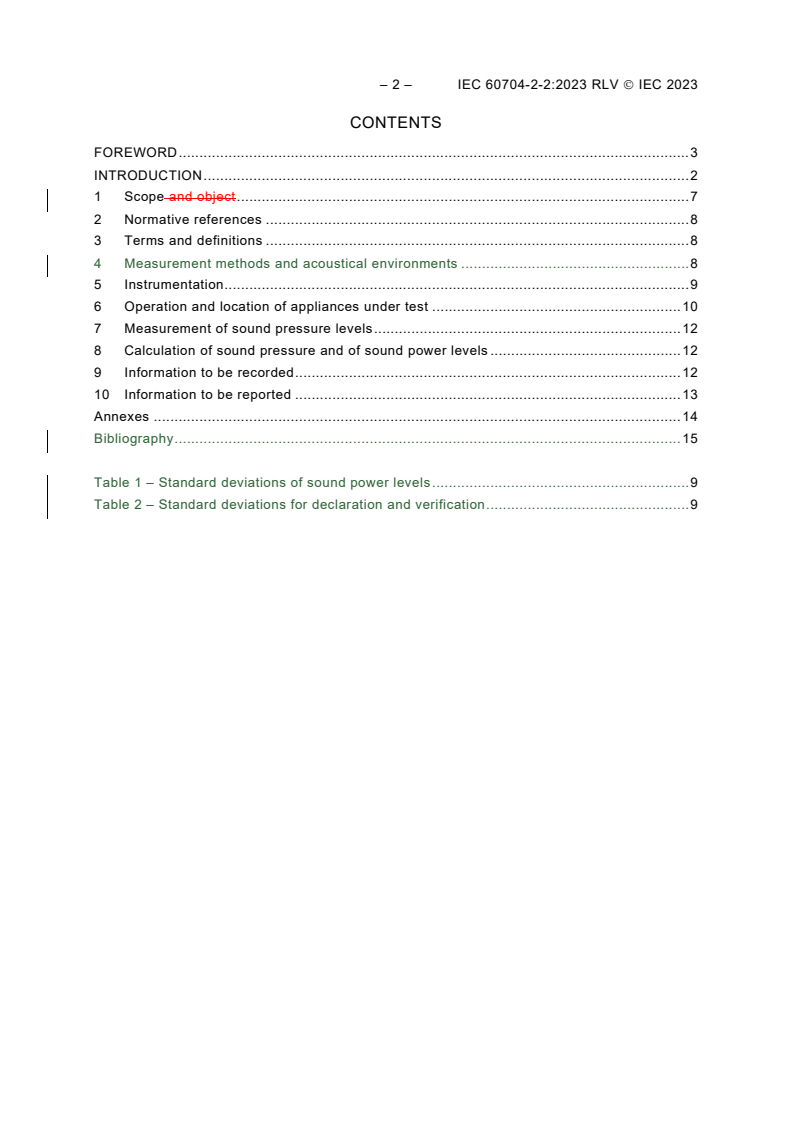
– 2 – IEC 60704-2-2:2023 RLV IEC 2023
CONTENTS
FOREWORD . 3
INTRODUCTION . 2
1 Scope and object . 7
2 Normative references . 8
3 Terms and definitions . 8
4 Measurement methods and acoustical environments . 8
5 Instrumentation . 9
6 Operation and location of appliances under test . 10
7 Measurement of sound pressure levels . 12
8 Calculation of sound pressure and of sound power levels . 12
9 Information to be recorded . 12
10 Information to be reported . 13
Annexes . 14
Bibliography . 15
Table 1 – Standard deviations of sound power levels . 9
Table 2 – Standard deviations for declaration and verification . 9
INTERNATIONAL ELECTROTECHNICAL COMMISSION
____________
HOUSEHOLD AND SIMILAR ELECTRICAL APPLIANCES –
TEST CODE FOR THE DETERMINATION OF
AIRBORNE ACOUSTICAL NOISE –
Part 2-2: Particular requirements for fan heaters
FOREWORD
1) The International Electrotechnical Commission (IEC) is a worldwide organization for standardization comprising
all national electrotechnical committees (IEC National Committees). The object of IEC is to promote
international co-operation on all questions concerning standardization in the electrical and electronic fields. To
this end and in addition to other activities, IEC publishes International Standards, Technical Specifications,
Technical Reports, Publicly Available Specifications (PAS) and Guides (hereafter referred to as “IEC
Publication(s)”). Their preparation is entrusted to technical committees; any IEC National Committee interested
in the subject dealt with may participate in this preparatory work. International, governmental and non-
governmental organizations liaising with the IEC also participate in this preparation. IEC collaborates closely
with the International Organization for Standardization (ISO) in accordance with conditions determined by
agreement between the two organizations.
2) The formal decisions or agreements of IEC on technical matters express, as nearly as possible, an international
consensus of opinion on the relevant subjects since each technical committee has representation from all
interested IEC National Committees.
3) IEC Publications have the form of recommendations for international use and are accepted by IEC National
Committees in that sense. While all reasonable efforts are made to ensure that the technical content of IEC
Publications is accurate, IEC cannot be held responsible for the way in which they are used or for any
misinterpretation by any end user.
4) In order to promote international uniformity, IEC National Committees undertake to apply IEC Publications
transparently to the maximum extent possible in their national and regional publications. Any divergence
between any IEC Publication and the corresponding national or regional publication shall be clearly indicated in
the latter.
5) IEC itself does not provide any attestation of conformity. Independent certification bodies provide conformity
assessment services and, in some areas, access to IEC marks of conformity. IEC is not responsible for any
services carried out by independent certification bodies.
6) All users should ensure that they have the latest edition of this publication.
7) No liability shall attach to IEC or its directors, employees, servants or agents including individual experts and
members of its technical committees and IEC National Committees for any personal injury, property damage or
other damage of any nature whatsoever, whether direct or indirect, or for costs (including legal fees) and
expenses arising out of the publication, use of, or reliance upon, this IEC Publication or any other IEC
Publications.
8) Attention is drawn to the Normative references cited in this publication. Use of the referenced publications is
indispensable for the correct application of this publication.
9) IEC draws attention to the possibility that the implementation of this document may involve the use of (a)
patent(s). IEC takes no position concerning the evidence, validity or applicability of any claimed patent rights in
respect thereof. As of the date of publication of this document, IEC had not received notice of (a) patent(s),
which may be required to implement this document. However, implementers are cautioned that this may not
represent the latest information, which may be obtained from the patent database available at
https://patents.iec.ch. IEC shall not be held responsible for identifying any or all such patent rights.
This redline version of the official IEC Standard allows the user to identify the changes
made to the previous edition IEC 60704-2-2:2009. A vertical bar appears in the margin
wherever a change has been made. Additions are in green text, deletions are in
strikethrough red text.
– 4 – IEC 60704-2-2:2023 RLV IEC 2023
IEC 60704-2-2 has been prepared by subcommittee 59C: Electrical heating appliances for
household and similar purposes, of IEC technical committee 59: Performance of household
and similar electrical appliances. It is an International Standard.
This third edition cancels and replaces the second edition published in 2009. This edition
constitutes a technical revision.
This edition includes the following significant technical changes with respect to the previous
edition:
– alignment with the latest edition of IEC 60704-1:2021,
– addition of several ISO standards,
– revision of built-in-conditions,
– addition of requirements on climatic conditions and on background noise.
The text of this International Standard is based on the following documents:
Draft Report on voting
59C/284/CDV 59C/286/RVC
Full information on the voting for its approval can be found in the report on voting indicated in
the above table.
The language used for the development of this International Standard is English.
This part 2-2 is intended to be used in conjunction with the fourth edition of IEC 60704-1:2021,
Household and similar electrical appliances – Test code for the determination of airborne
acoustical noise – Part 1: General requirements.
The relevant text of IEC 60704-1:2021 as amended by this publication establishes the test
code for fan heaters.
This part 2-2 supplements or modifies the corresponding clauses in IEC 60704-1:2021.
When a particular subclause of IEC 60704-1:2021 is not mentioned in this part 2-2, that
subclause applies as far as reasonable. Where this standard states "addition“,
"modification“ or "replacement“, the relevant requirement, test specifications or explanatory
matter in IEC 60704-1:2021 shall be adapted accordingly.
Subclauses or figures which are additional to those in IEC 60704-1:2021 are numbered
starting from 101.
Additional annexes are lettered AA, BB, etc.
This document was drafted in accordance with ISO/IEC Directives, Part 2, and developed in
accordance with ISO/IEC Directives, Part 1 and ISO/IEC Directives, IEC Supplement,
available at www.iec.ch/members_experts/refdocs. The main document types developed by
IEC are described in greater detail at www.iec.ch/publications.
A list of all the parts in the IEC 60704 series, under the general title Household and similar
electrical appliances – Test code for the determination of airborne acoustical noise, can be
found on the IEC website.
The committee has decided that the contents of this document will remain unchanged until the
stability date indicated on the IEC website under webstore.iec.ch in the data related to the
specific document. At this date, the document will be
• reconfirmed,
• withdrawn, or
• revised.
IMPORTANT – The "colour inside" logo on the cover page of this document indicates
that it contains colours which are considered to be useful for the correct
understanding of its contents. Users should therefore print this document using a
colour printer.
– 6 – IEC 60704-2-2:2023 RLV IEC 2023
INTRODUCTION
The measuring conditions specified in this part 2-2 provide for sufficient accuracy in
determining the noise emitted and comparing the results of measurements taken by different
laboratories, whilst simulating as far as possible the practical use of fan heaters.
It is recommended to consider the determination of noise levels as part of a comprehensive
testing procedure covering many aspects of the properties and performance of fan heaters.
NOTE As stated in the introduction to IEC 60704-1, this test code is concerned with airborne noise only.
HOUSEHOLD AND SIMILAR ELECTRICAL APPLIANCES –
TEST CODE FOR THE DETERMINATION OF
AIRBORNE ACOUSTICAL NOISE –
Part 2-2: Particular requirements for fan heaters
1 Scope and object
This clause of part 1 is applicable except as follows:
1.1 Scope
1.1.1 General
Replacement:
This part of IEC 60704 applies to electric fan heaters, designed for placing on the floor, table
or counter, etc., or for wall mounting.
This document does not apply to
– electric storage room heaters;
– room humidifiers;
– room dehumidifiers;
– air cleaners;
– heaters designed exclusively for industrial purposes.
1.1.2 Types of noise
Replacement:
ISO 3743-1, ISO 3743-2 and ISO 3744 can be used for measuring noise emitted by fan
heaters.
1.1.3 Size of the source
Replacement:
The method specified in ISO 3744 is applicable to noise sources of any size. When applying
ISO 3743-1 and ISO 3743-2, care should be taken that the maximum size of the appliance
under test fulfils the requirements specified in Subclause 1.3 of ISO 3743-1 and ISO 3743-2.
1.2 Object
Addition:
The frequency range of interest for sound power determination on fan heaters includes at
least the octave bands with centre frequencies from 63 Hz to 8000 Hz.
NOTE 1 In many cases, the 63 Hz octave band level does not participate significantly to the A-weighted level.
NOTE 2 When measuring this 63 Hz octave band, a special attention should be paid to the room effect.
– 8 – IEC 60704-2-2:2023 RLV IEC 2023
Requirements for the declaration of noise emission values are not within the scope of this
standard.
NOTE 3 For determining and verifying noise emission values, declared in product
specifications, refer to IEC 60704-3:2019.
1.3 Measurement uncertainty
Replacement:
The estimated values of standard deviations of sound power levels, determined according to
this standard, are as follows:
Standard deviation, dB
σ (repeatability) σ (reproducibility)
r R
0,4 1,0
1.101 Standard deviation for declaration and verification
For the purpose of determining and verifying declared noise emission values according to
IEC 60704-3, the following values apply:
Standard deviation, dB
σ (production) σ (total) σ (reference)
P t M
0,3 – 1,1 1,0 – 1,6 1,5
2 Normative references
This clause of IEC 60704-1:2021 is applicable.
3 Terms and definitions
This clause of IEC 60704-1:2021 is applicable.
4 Measurement methods and acoustical environments
This clause IEC 60704-1:2021 is applicable except as follows:
4.2 Direct method
Addition:
NOTE If pure tone components are present in the noise emitted, proper precautions should need to be taken as
specified in ISO 3743-2.
4.3 Comparison method
Addition:
NOTE If pure tone components are present in the noise emitted, proper precautions should need to be taken as
specified in ISO 3743-1 and 3743-2.
4.4 Acoustical environments
4.4.1 General requirements and criterion for adequacy of the test environment
Replacement:
ISO 3743-1, ISO 3743-2 and ISO 3744 can be used for measuring noise emitted by fan
heaters.
The method specified in ISO 3744 is applicable to noise sources of any size. When applying
ISO 3743-1 and ISO 3743-2, care shall be taken that the maximum size of the appliance
under test fulfils the requirements specified in ISO 3743-1:2010, 1.3 and ISO 3743-2.
4.5 Measurement uncertainties
4.5.2 Standard deviations on repeatability and reproducibility and standard deviations
related to declaration and verification
Replacement:
The estimated values of standard deviations of sound power levels determined according to
this document are given in Table 1:
Table 1 – Standard deviations of sound power levels
Standard deviation
dB
σ (repeatability) σ (reproducibility)
r R
0,4 1,0
For the purpose of determining and verifying declared noise emission values according to
IEC 60704-3, the values given in Table 2 apply:
Table 2 – Standard deviations for declaration and verification
Standard deviation
dB
σ (production) σ (total) σ (reference)
P t M
0,3 to 1,1 1,0 to 1,6 1,5
5 Instrumentation
This clause of IEC 60704-1:2021 is applicable except as follows:
5.1 Instrumentation for measuring acoustical data
Addition:
Windscreens should be used and the relevant corrections for changes in the microphone
sensitivity shall be added to the observed sound pressure levels.
– 10 – IEC 60704-2-2:2023 RLV IEC 2023
6 Operation and location of appliances under test
This clause of IEC 60704-1:2021 is applicable except as follows:
6.1 Equipping and pre-conditioning of appliances
6.1.1 Addition:
Air filters, if any, shall be clean.
6.1.3 Replacement:
Prior to noise measurements, the appliance, equipped in accordance with 6.1.1, shall have
been in operation for a total period of at least 2 h for running-in at the highest speed setting
with the maximum heating switched on for normal permanent use.
Oscillating function if available shall be switched on.
During the running-in procedure, air filters, if any, may shall be removed, if possible. If filters
remain in the appliances during this running-in period, they shall be cleaned or renewed after
this period.
6.1.4 Replacement:
Immediately before each series of noise measurements, the appliance equipped in
accordance with 6.1.1 shall be operated for stabilizing at the highest speed setting and
maximum heating switched on for normal permanent use for 5 min.
6.2 Supply of electric energy and of water or gas
6.2.1 Modification:
The voltage tolerance shall be ± 0,5 %.
6.2.2 Not applicable.
6.2.3 Replacement:
The appliance shall be operated with the heating elements switched on.
Special attention is required to be given to the possible effect of the temperature rise on the
acoustical behaviour of the test room.
6.2.4 Not applicable.
6.4 Loading and operating of appliances during tests
6.4.2 Replacement:
The appliance shall be equipped according to 6.1.1.
The noise emission shall be determined with the appliance at the highest speed setting and
maximum heating for normal permanent use. Oscillating mechanism function, if any, shall be
switched on.
NOTE Other possible speed settings (minimum heat output, boost position, etc.) can be measured in addition.
The respective noise levels should need to be linked to the relevant heat output.
Appropriate adjustment of air intake or exhaust openings shall be done taking into account
manufacturer's instructions if any, or otherwise selecting the configuration that gives the
highest noise emission.
6.4.3 Not applicable.
6.5 Location and mounting of appliances
6.5.12 Addition:
The tests under the conditions stated in 6.5.34 shall be repeated for floor-standing appliances
which may be placed either against or away from the wall.
For such appliances, both sets of results shall be recorded and the measurement that gives
highest noise is then chosen.
6.5.23 Not applicable.
6.5.34 Replacement:
For measurements on floor-standing appliances intended for placing against a wall, including
those for building-in into a cabinet, a vertical reflecting plane having an acoustic absorption
coefficient of less than 0,06 must shall be used.
When measurements are made in a reverberation test room, a part of the wall of the room will
serve for this purpose. The minimum area of this part of the wall should be determined by the
projection of the appliance extended by at least 0,5 m upwards and to both sides. The
minimum distance between any surface of the appliance or its cabinet and the nearest corner
of the room shall be 1 m.
When measurements are made in a free-field environment, the size of the vertical reflecting
plane (supported by the horizontal reflecting plane) shall be at least equal to the size of the
projection of the measurement surface.
For both types of test environment, the following requirements shall be complied with:
– the appliance shall be placed in the test environment without any resilient means of
support other than those incorporated in the appliance;
– care should be taken to avoid any direct contact between the appliance (including
protruding parts, worktops, spacers, etc.) and the vertical reflecting wall;
– the distance between the wall and the appliance shall be established by placing the
appliance in direct contact with the wall and moving it away for a distance not exceeding
10 cm ± 1 cm.
6.5.45 Modification:
The height of the lowest edge of the appliance from the floor shall be 25 cm ± 1 cm.
NOTE For appliances intended for mounting close to the ceiling with the air stream directed towards the floor,
measurements problems may can be caused when the appliance is mounted as specified in 6.5.45. It may can be
necessary to mount such an appliance in an inverted position, with the top of the appliance facing towards the floor
at a height of 0,25 m, or at the distance specified by the manufacturer for mounting close to the ceiling. The
manufacturer's approval must needs to be obtained before operating the appliance under the proposed test
conditions.
6.5.56 Modification:
– 12 – IEC 60704-2-2:2023 RLV IEC 2023
Built-in heaters such as plinth heaters shall be installed according to manufacturer's
instructions.
7 Measurement of sound pressure levels
This clause of IEC 60704-1:2021 is applicable except as follows:
7.1 Microphone array, measurement surface and RSS location for essentially freefield
conditions over reflecting plane(s)
Addition:
During measurements, care shall be taken to prevent direct blowing to the microphones.
7.1.34 Not applicable.
7.1.56 to 7.1.67 Not applicable.
7.4 Measurements
7.4.1 Addition:
The time-averaged A-weighted sound pressure levels shall be measured during at least 30 s
and including complete cycles (at least two cycles) of the oscillating mechanism function, if any.
The frequency range of interest for sound power determination on fan heaters includes at
least the octave bands with centre frequencies from 63 Hz to 8 000 Hz.
NOTE 2 In many cases, the 63 Hz octave band level does not participate significantly to the A-weighted level.
NOTE 3 When measuring this 63 Hz octave band, a special attention needs to be paid to the room effect.
7.4.4 Not applicable.
8 Calculation of sound pressure and of sound power levels
This clause of IEC 60704-1:2021 is applicable.
9 Information to be recorded
This clause of IEC 60704-1:2021 is applicable except as follows:
9.7 Electric supply, water supply, etc.
9.7.2 to 9.7.4 Not applicable.
9.12 Measurement data
9.12.5 Not applicable.
10 Information to be reported
This clause of IEC 60704-1:2021 is applicable except as follows:
10.3 Test conditions for the appliance
10.3.3 to 10.3.5 Not applicable.
10.3.11 Not applicable.
10.4 Acoustical data
10.4.10 Not applicable.
– 14 – IEC 60704-2-2:2023 RLV IEC 2023
Annexes
The annexes of IEC 60704-1:2021 are applicable.
Bibliography
The Bibliography of IEC 60704-1:2021 is applicable.
___________
IEC 60704-2-2 ®
Edition 3.0 2023-12
INTERNATIONAL
STANDARD
NORME
INTERNATIONALE
Household and similar electrical appliances – Test code for the determination of
airborne acoustical noise –
Part 2-2: Particular requirements for fan heaters
Appareils électrodomestiques et analogues – Code d'essai pour la détermination
du bruit aérien –
Partie 2-2: Exigences particulières pour les appareils de chauffage soufflants
– 2 – IEC 60704-2-2:2023 IEC 2023
CONTENTS
FOREWORD . 3
INTRODUCTION . 5
1 Scope . 6
2 Normative references . 6
3 Terms and definitions . 6
4 Measurement methods and acoustical environments . 6
5 Instrumentation . 7
6 Operation and location of appliances under test . 8
7 Measurement of sound pressure levels . 10
8 Calculation of sound pressure and of sound power levels . 10
9 Information to be recorded . 10
10 Information to be reported . 11
Annexes . 12
Bibliography . 13
Table 1 – Standard deviations of sound power levels . 7
Table 2 – Standard deviations for declaration and verification . 7
INTERNATIONAL ELECTROTECHNICAL COMMISSION
____________
HOUSEHOLD AND SIMILAR ELECTRICAL APPLIANCES –
TEST CODE FOR THE DETERMINATION OF
AIRBORNE ACOUSTICAL NOISE –
Part 2-2: Particular requirements for fan heaters
FOREWORD
1) The International Electrotechnical Commission (IEC) is a worldwide organization for standardization comprising
all national electrotechnical committees (IEC National Committees). The object of IEC is to promote
international co-operation on all questions concerning standardization in the electrical and electronic fields. To
this end and in addition to other activities, IEC publishes International Standards, Technical Specifications,
Technical Reports, Publicly Available Specifications (PAS) and Guides (hereafter referred to as “IEC
Publication(s)”). Their preparation is entrusted to technical committees; any IEC National Committee interested
in the subject dealt with may participate in this preparatory work. International, governmental and non-
governmental organizations liaising with the IEC also participate in this preparation. IEC collaborates closely
with the International Organization for Standardization (ISO) in accordance with conditions determined by
agreement between the two organizations.
2) The formal decisions or agreements of IEC on technical matters express, as nearly as possible, an international
consensus of opinion on the relevant subjects since each technical committee has representation from all
interested IEC National Committees.
3) IEC Publications have the form of recommendations for international use and are accepted by IEC National
Committees in that sense. While all reasonable efforts are made to ensure that the technical content of IEC
Publications is accurate, IEC cannot be held responsible for the way in which they are used or for any
misinterpretation by any end user.
4) In order to promote international uniformity, IEC National Committees undertake to apply IEC Publications
transparently to the maximum extent possible in their national and regional publications. Any divergence
between any IEC Publication and the corresponding national or regional publication shall be clearly indicated in
the latter.
5) IEC itself does not provide any attestation of conformity. Independent certification bodies provide conformity
assessment services and, in some areas, access to IEC marks of conformity. IEC is not responsible for any
services carried out by independent certification bodies.
6) All users should ensure that they have the latest edition of this publication.
7) No liability shall attach to IEC or its directors, employees, servants or agents including individual experts and
members of its technical committees and IEC National Committees for any personal injury, property damage or
other damage of any nature whatsoever, whether direct or indirect, or for costs (including legal fees) and
expenses arising out of the publication, use of, or reliance upon, this IEC Publication or any other IEC
Publications.
8) Attention is drawn to the Normative references cited in this publication. Use of the referenced publications is
indispensable for the correct application of this publication.
9) IEC draws attention to the possibility that the implementation of this document may involve the use of (a)
patent(s). IEC takes no position concerning the evidence, validity or applicability of any claimed patent rights in
respect thereof. As of the date of publication of this document, IEC had not received notice of (a) patent(s),
which may be required to implement this document. However, implementers are cautioned that this may not
represent the latest information, which may be obtained from the patent database available at
https://patents.iec.ch. IEC shall not be held responsible for identifying any or all such patent rights.
IEC 60704-2-2 has been prepared by subcommittee 59C: Electrical heating appliances for
household and similar purposes, of IEC technical committee 59: Performance of household
and similar electrical appliances. It is an International Standard.
This third edition cancels and replaces the second edition published in 2009. This edition
constitutes a technical revision.
– 4 – IEC 60704-2-2:2023 IEC 2023
This edition includes the following significant technical changes with respect to the previous
edition:
– alignment with the latest edition of IEC 60704-1:2021,
– addition of several ISO standards,
– revision of built-in-conditions,
– addition of requirements on climatic conditions and on background noise.
The text of this International Standard is based on the following documents:
Draft Report on voting
59C/284/CDV 59C/286/RVC
Full information on the voting for its approval can be found in the report on voting indicated in
the above table.
The language used for the development of this International Standard is English.
This part 2-2 is intended to be used in conjunction with the fourth edition of IEC 60704-1:2021,
Household and similar electrical appliances – Test code for the determination of airborne
acoustical noise – Part 1: General requirements.
The relevant text of IEC 60704-1:2021 as amended by this publication establishes the test
code for fan heaters.
This part 2-2 supplements or modifies the corresponding clauses in IEC 60704-1:2021.
When a particular subclause of IEC 60704-1:2021 is not mentioned in this part 2-2, that
subclause applies as far as reasonable. Where this standard states "addition“,
"modification“ or "replacement“, the relevant requirement, test specifications or explanatory
matter in IEC 60704-1:2021 shall be adapted accordingly.
Subclauses or figures which are additional to those in IEC 60704-1:2021 are numbered
starting from 101.
Additional annexes are lettered AA, BB, etc.
This document was drafted in accordance with ISO/IEC Directives, Part 2, and developed in
accordance with ISO/IEC Directives, Part 1 and ISO/IEC Directives, IEC Supplement,
available at www.iec.ch/members_experts/refdocs. The main document types developed by
IEC are described in greater detail at www.iec.ch/publications.
A list of all the parts in the IEC 60704 series, under the general title Household and similar
electrical appliances – Test code for the determination of airborne acoustical noise, can be
found on the IEC website.
The committee has decided that the contents of this document will remain unchanged until the
stability date indicated on the IEC website under webstore.iec.ch in the data related to the
specific document. At this date, the document will be
• reconfirmed,
• withdrawn, or
• revised.
INTRODUCTION
The measuring conditions specified in this part 2-2 provide for sufficient accuracy in
determining the noise emitted and comparing the results of measurements taken by different
laboratories, whilst simulating as far as possible the practical use of fan heaters.
It is recommended to consider the determination of noise levels as part of a comprehensive
testing procedure covering many aspects of the properties and performance of fan heaters.
NOTE As stated in the introduction to IEC 60704-1, this test code is concerned with airborne noise only.
– 6 – IEC 60704-2-2:2023 IEC 2023
HOUSEHOLD AND SIMILAR ELECTRICAL APPLIANCES –
TEST CODE FOR THE DETERMINATION OF
AIRBORNE ACOUSTICAL NOISE –
Part 2-2: Particular requirements for fan heaters
1 Scope
Replacement:
This part of IEC 60704 applies to electric fan heaters, designed for placing on the floor, table
or counter, etc., or for mounting.
This document does not apply to
– electric storage room heaters;
– room humidifiers;
– room dehumidifiers;
– air cleaners;
– heaters designed exclusively for industrial purposes.
For determining and verifying noise emission values declared in product specifications, refer
to IEC 60704-3:2019.
2 Normative references
This clause of IEC 60704-1:2021 is applicable.
3 Terms and definitions
This clause of IEC 60704-1:2021 is applicable.
4 Measurement methods and acoustical environments
This clause IEC 60704-1:2021 is applicable except as follows:
4.2 Direct method
Addition:
NOTE If pure tone components are present in the noise emitted, proper precautions need to be taken as specified
in ISO 3743-2.
4.3 Comparison method
Addition:
NOTE If pure tone components are present in the noise emitted, proper precautions need to be taken as specified
in ISO 3743-1 and 3743-2.
4.4 Acoustical environments
4.4.1 General requirements and criterion for adequacy of the test environment
Replacement:
ISO 3743-1, ISO 3743-2 and ISO 3744 can be used for measuring noise emitted by fan
heaters.
The method specified in ISO 3744 is applicable to noise sources of any size. When applying
ISO 3743-1 and ISO 3743-2, care shall be taken that the maximum size of the appliance
under test fulfils the requirements specified in ISO 3743-1:2010, 1.3 and ISO 3743-2.
4.5 Measurement uncertainties
4.5.2 Standard deviations on repeatability and reproducibility and standard deviations
related to declaration and verification
Replacement:
The estimated values of standard deviations of sound power levels determined according to
this document are given in Table 1:
Table 1 – Standard deviations of sound power levels
Standard deviation
dB
σ (repeatability) σ (reproducibility)
r R
0,4 1,0
For the purpose of determining and verifying declared noise emission values according to
IEC 60704-3, the values given in Table 2 apply:
Table 2 – Standard deviations for declaration and verification
Standard deviation
dB
σ (production) σ (total) σ (reference)
P t M
0,3 to 1,1 1,0 to 1,6 1,5
5 Instrumentation
This clause of IEC 60704-1:2021 is applicable except as follows:
5.1 Instrumentation for measuring acoustical data
Addition:
Windscreens should be used and the relevant corrections for changes in the microphone
sensitivity shall be added to the observed sound pressure levels.
– 8 – IEC 60704-2-2:2023 IEC 2023
6 Operation and location of appliances under test
This clause of IEC 60704-1:2021 is applicable except as follows:
6.1 Equipping and pre-conditioning of appliances
6.1.1 Addition:
Air filters, if any, shall be clean.
6.1.3 Replacement:
Prior to noise measurements, the appliance, equipped in accordance with 6.1.1, shall have
been in operation for a total period of at least 2 h for running-in at the highest speed setting
with the maximum heating switched on for normal permanent use.
Oscillating function if available shall be switched on.
During the running-in procedure, air filters, if any, shall be removed, if possible. If filters
remain in the appliances during this running-in period, they shall be cleaned or renewed after
this period.
6.1.4 Replacement:
Immediately before each series of noise measurements, the appliance equipped in
accordance with 6.1.1 shall be operated for stabilizing at the highest speed setting and
maximum heating switched on for normal permanent use for 5 min.
6.2 Supply of electric energy and of water or gas
6.2.1 Modification:
The voltage tolerance shall be ± 0,5 %.
6.2.2 Not applicable.
6.2.3 Replacement:
The appliance shall be operated with the heating elements switched on.
Special attention is required to be given to the possible effect of the temperature rise on the
acoustical behaviour of the test room.
6.2.4 Not applicable.
6.4 Loading and operating of appliances during tests
6.4.2 Replacement:
The appliance shall be equipped according to 6.1.1.
The noise emission shall be determined with the appliance at the highest speed setting and
maximum heating for normal permanent use. Oscillating function, if any, shall be switched on.
NOTE Other possible speed settings (minimum heat output, boost position, etc.) can be measured in addition.
The respective noise levels need to be linked to the relevant heat output.
Appropriate adjustment of air intake or exhaust openings shall be done taking into account
manufacturer's instructions if any, or otherwise selecting the configuration that gives the
highest noise emission.
6.4.3 Not applicable.
6.5 Location and mounting of appliances
6.5.2 Addition:
The tests under the conditions stated in 6.5.4 shall be repeated for floor-standing appliances
which may be placed either against or away from the wall.
For such appliances, both sets of results shall be recorded and the measurement that gives
highest noise is then chosen.
6.5.3 Not applicable.
6.5.4 Replacement:
For measurements on floor-standing appliances intended for placing against a wall, including
those for building-in into a cabinet, a vertical reflecting plane having an acoustic absorption
coefficient of less than 0,06 shall be used.
When measurements are made in a reverberation test room, a part of the wall of the room will
serve for this purpose. The minimum area of this part of the wall should be determined by the
projection of the appliance extended by at least 0,5 m upwards and to both sides. The
minimum distance between any surface of the appliance or its cabinet and the nearest corner
of the room shall be 1 m.
When measurements are made in a free-field environment, the size of the vertical reflecting
plane (supported by the horizontal reflecting plane) shall be at least equal to the size of the
projection of the measurement surface.
For both types of test environment, the following requirements shall be complied with:
– the appliance shall be placed in the test environment without any resilient means of
support other than those incorporated in the appliance;
– care should be taken to avoid any direct contact between the appliance (including
protruding parts, worktops, spacers, etc.) and the vertical reflecting wall;
– the distance between the wall and the appliance shall be established by placing the
appliance in direct contact with the wall and moving it away for a distance not exceeding
10 cm ± 1 cm.
6.5.5 Modification:
The height of the lowest edge of the appliance from the floor shall be 25 cm ± 1 cm.
NOTE For appliances intended for mounting close to the ceiling with the air stream directed towards the floor,
measurements problems can be caused when the appliance is mounted as specified in 6.5.5. It can be necessary
to mount such an appliance in an inverted position, with the top of the appliance facing towards the floor at a
height of 0,25 m, or at the distance specified by the manufacturer for mounting close to the ceiling. The
manufacturer's approval needs to be obtained before operating the appliance under the proposed test conditions.
6.5.6 Modification:
Built-in heaters such as plinth heaters shall be installed according to manufacturer's
instructions.
– 10 – IEC 60704-2-2:2023 IEC 2023
7 Measurement of sound pressure levels
This clause of IEC 60704-1:2021 is applicable except as follows:
7.1 Microphone array, measurement surface and RSS location for essentially freefield
conditions over reflecting plane(s)
Addition:
During measurements, care shall be taken to prevent direct blowing to the microphones.
7.1.4 Not applicable.
7.1.6 to 7.1.7 Not applicable.
7.4 Measurements
7.4.1 Addition:
The time-averaged A-weighted sound pressure levels shall be measured during at least 30 s
and including complete cycles (at least two cycles) of the oscillating function, if any.
The frequency range of interest for sound power determination on fan heaters includes at
least the octave bands with centre frequencies from 63 Hz to 8 000 Hz.
NOTE 2 In many cases, the 63 Hz octave band level does not participate significantly to the A-weighted level.
NOTE 3 When measuring this 63 Hz octave band, a special attention needs to be paid to the room effect.
7.4.4 Not applicable.
8 Calculation of sound pressure and of sound power levels
This clause of IEC 60704-1:2021 is applicable.
9 Information to be recorded
This clause of IEC 60704-1:2021 is applicable except as follows:
9.7 Electric supply, water supply, etc.
9.7.2 to 9.7.4 Not applicable.
9.12 Measurement data
9.12.5 Not applicable.
10 Information to be reported
This clause of IEC 60704-1:2021 is applicable except as follows
...
IEC 60704-2-2 ®
Edition 3.0 2023-12
EXTENDED VERSION
INTERNATIONAL
STANDARD
colour
inside
This extended version of IEC 60704-2-2:2023 includes the content of the references made to
IEC 60704-1:2021
Household and similar electrical appliances – Test code for the determination of
airborne acoustical noise –
Part 2-2: Particular requirements for fan heaters
All rights reserved. Unless otherwise specified, no part of this publication may be reproduced or utilized in any form
or by any means, electronic or mechanical, including photocopying and microfilm, without permission in writing from
either IEC or IEC's member National Committee in the country of the requester. If you have any questions about IEC
copyright or have an enquiry about obtaining additional rights to this publication, please contact the address below or
your local IEC member National Committee for further information.
IEC Secretariat Tel.: +41 22 919 02 11
3, rue de Varembé info@iec.ch
CH-1211 Geneva 20 www.iec.ch
Switzerland
About the IEC
The International Electrotechnical Commission (IEC) is the leading global organization that prepares and publishes
International Standards for all electrical, electronic and related technologies.
About IEC publications
The technical content of IEC publications is kept under constant review by the IEC. Please make sure that you have the
latest edition, a corrigendum or an amendment might have been published.
IEC publications search - webstore.iec.ch/advsearchform IEC Products & Services Portal - products.iec.ch
The advanced search enables to find IEC publications by a Discover our powerful search engine and read freely all the
variety of criteria (reference number, text, technical publications previews. With a subscription you will always have
committee, …). It also gives information on projects, replaced access to up to date content tailored to your needs.
and withdrawn publications.
Electropedia - www.electropedia.org
IEC Just Published - webstore.iec.ch/justpublished
The world's leading online dictionary on electrotechnology,
Stay up to date on all new IEC publications. Just Published
containing more than 22 300 terminological entries in English
details all new publications released. Available online and once
and French, with equivalent terms in 19 additional languages.
a month by email.
Also known as the International Electrotechnical Vocabulary
(IEV) online.
IEC Customer Service Centre - webstore.iec.ch/csc
If you wish to give us your feedback on this publication or need
further assistance, please contact the Customer Service
Centre: sales@iec.ch.
IEC 60704-2-2 ®
Edition 3.0 2023-12
EXTENDED VERSION
INTERNATIONAL
STANDARD
colour
inside
This extended version of IEC 60704-2-2:2023 includes the content of the references made to
IEC 60704-1:2021
Household and similar electrical appliances – Test code for the determination of
airborne acoustical noise –
Part 2-2: Particular requirements for fan heaters
INTERNATIONAL
ELECTROTECHNICAL
COMMISSION
ICS 17.140.20, 97.100.10 ISBN 978-2-8322-8046-1
– 2 – IEC 60704-2-2:2023 EXV IEC 2023
CONTENTS
FOREWORD . 4
INTRODUCTION . 7
1 Scope . 8
2 Normative references . 8
3 Terms and definitions . 9
4 Measurement methods and acoustical environments . 10
4.1 General . 10
4.2 Direct method . 10
4.3 Comparison method . 11
4.4 Acoustical environments . 11
4.4.1 General requirements and criterion for adequacy of the test
environment . 11
4.4.2 Criterion for background noise level . 11
4.4.3 Environmental conditions . 12
4.5 Measurement uncertainties . 12
4.5.1 General . 12
4.5.2 Standard deviations on repeatability and reproducibility and standard
deviations related to declaration and verification . 12
5 Instrumentation . 13
5.1 Instrumentation for measuring acoustical data . 13
5.2 Instrumentation for measuring climatic conditions . 13
5.3 Instrumentation for measuring operating conditions . 13
6 Operation and location of appliances under test . 13
6.1 Equipping and pre-conditioning of appliances . 13
6.2 Supply of electric energy and of water or gas . 14
6.3 Climatic conditions . 14
6.4 Loading and operating of appliances during tests . 15
6.5 Location and mounting of appliances . 15
7 Measurement of sound pressure levels . 17
7.1 Microphone array, measurement surface and RSS location for essentially
free field conditions over reflecting plane(s) . 17
7.2 Microphone array and RSS location in hard-walled test rooms . 21
7.3 Microphone array and RSS location in special reverberation test rooms . 21
7.4 Measurements . 21
8 Calculation of sound pressure and sound power levels . 22
8.1 General . 22
8.2 Corrections for background noise levels . 22
8.3 Corrections for the test environment . 23
8.4 Calculation of sound pressure level averaged over the microphone positions . 23
8.5 Calculation of sound power levels with the comparison method . 24
8.6 Calculation of sound power levels in free field conditions over a reflecting
plane . 24
8.7 Calculation of A-weighted sound power level with the direct method in
special reverberation test rooms . 24
9 Information to be recorded . 25
9.1 General data . 25
9.2 Description of appliance under test . 25
9.3 Measurement method . 25
9.4 Acoustical test environment . 26
9.5 Instrumentation . 26
9.6 Equipment and pre-conditioning of appliance under test . 26
9.7 Electric supply, water supply, etc. . 26
9.8 Climatic conditions . 26
9.9 Operation of the appliance under test . 27
9.10 Location and mounting of the appliance under test. 27
9.11 Microphone array . 27
9.12 Measurement data . 27
9.13 Calculated sound pressure and sound power levels . 28
9.14 Reporting . 28
10 Information to be reported . 28
10.1 General data . 28
10.2 Appliance under test . 28
10.3 Test conditions for the appliance . 28
10.4 Acoustical data . 29
Annex A (normative) Standard test table . 30
Annex B (normative) Test enclosure . 31
Annex C (informative) Guidelines for the design of simple test rooms with essentially
free field conditions. 32
Bibliography . 33
Figure 1 – Measurement surface – parallelepiped – with key microphone positions, for
floor free-standing appliances . 18
Figure 2 – Measurement surface – parallelepiped – with key microphone positions, for
floor standing appliances placed against a wall . 19
Figure 4 – Measurement surface – hemisphere – with key microphone positions, for
hand-held, table type and floor-treatment appliances . 20
Figure A.1 – Example of standard test table . 30
Figure B.1 – Test enclosure . 31
Table 1 – Standard deviations of sound power levels . 12
Table 2 – Standard deviations for declaration and verification . 12
– 4 – IEC 60704-2-2:2023 EXV IEC 2023
INTERNATIONAL ELECTROTECHNICAL COMMISSION
____________
HOUSEHOLD AND SIMILAR ELECTRICAL APPLIANCES –
TEST CODE FOR THE DETERMINATION OF
AIRBORNE ACOUSTICAL NOISE –
Part 2-2: Particular requirements for fan heaters
FOREWORD
1) The International Electrotechnical Commission (IEC) is a worldwide organization for standardization comprising
all national electrotechnical committees (IEC National Committees). The object of IEC is to promote
international co-operation on all questions concerning standardization in the electrical and electronic fields. To
this end and in addition to other activities, IEC publishes International Standards, Technical Specifications,
Technical Reports, Publicly Available Specifications (PAS) and Guides (hereafter referred to as “IEC
Publication(s)”). Their preparation is entrusted to technical committees; any IEC National Committee interested
in the subject dealt with may participate in this preparatory work. International, governmental and non-
governmental organizations liaising with the IEC also participate in this preparation. IEC collaborates closely
with the International Organization for Standardization (ISO) in accordance with conditions determined by
agreement between the two organizations.
2) The formal decisions or agreements of IEC on technical matters express, as nearly as possible, an international
consensus of opinion on the relevant subjects since each technical committee has representation from all
interested IEC National Committees.
3) IEC Publications have the form of recommendations for international use and are accepted by IEC National
Committees in that sense. While all reasonable efforts are made to ensure that the technical content of IEC
Publications is accurate, IEC cannot be held responsible for the way in which they are used or for any
misinterpretation by any end user.
4) In order to promote international uniformity, IEC National Committees undertake to apply IEC Publications
transparently to the maximum extent possible in their national and regional publications. Any divergence
between any IEC Publication and the corresponding national or regional publication shall be clearly indicated in
the latter.
5) IEC itself does not provide any attestation of conformity. Independent certification bodies provide conformity
assessment services and, in some areas, access to IEC marks of conformity. IEC is not responsible for any
services carried out by independent certification bodies.
6) All users should ensure that they have the latest edition of this publication.
7) No liability shall attach to IEC or its directors, employees, servants or agents including individual experts and
members of its technical committees and IEC National Committees for any personal injury, property damage or
other damage of any nature whatsoever, whether direct or indirect, or for costs (including legal fees) and
expenses arising out of the publication, use of, or reliance upon, this IEC Publication or any other IEC
Publications.
8) Attention is drawn to the Normative references cited in this publication. Use of the referenced publications is
indispensable for the correct application of this publication.
9) IEC draws attention to the possibility that the implementation of this document may involve the use of (a)
patent(s). IEC takes no position concerning the evidence, validity or applicability of any claimed patent rights in
respect thereof. As of the date of publication of this document, IEC had not received notice of (a) patent(s),
which may be required to implement this document. However, implementers are cautioned that this may not
represent the latest information, which may be obtained from the patent database available at
https://patents.iec.ch. IEC shall not be held responsible for identifying any or all such patent rights.
This extended version (EXV) of the official IEC Standard provides the user with the
comprehensive content of the Standard.
made to IEC 60704-1:2021.
The specific content of IEC 60704-2-2:2023 is displayed on a blue background.
IEC 60704-2-2 has been prepared by subcommittee 59C: Electrical heating appliances for
household and similar purposes, of IEC technical committee 59: Performance of household
and similar electrical appliances. It is an International Standard.
This third edition cancels and replaces the second edition published in 2009. This edition
constitutes a technical revision.
This edition includes the following significant technical changes with respect to the previous
edition:
– alignment with the latest edition of IEC 60704-1:2021,
– addition of several ISO standards,
– revision of built-in-conditions,
– addition of requirements on climatic conditions and on background noise.
The text of this International Standard is based on the following documents:
Draft Report on voting
59C/284/CDV 59C/286/RVC
Full information on the voting for its approval can be found in the report on voting indicated in
the above table.
The language used for the development of this International Standard is English.
This part 2-2 is intended to be used in conjunction with the fourth edition of IEC 60704-
1:2021, Household and similar electrical appliances – Test code for the determination of
airborne acoustical noise – Part 1: General requirements.
The relevant text of IEC 60704-1:2021 as amended by this publication establishes the test
code for fan heaters.
This part 2-2 supplements or modifies the corresponding clauses in IEC 60704-1:2021.
When a particular subclause of IEC 60704-1:2021 is not mentioned in this part 2-2, that
subclause applies as far as reasonable. Where this standard states "addition“, "modification“
or "replacement“, the relevant requirement, test specifications or explanatory matter in
IEC 60704-1:2021 shall be adapted accordingly.
Subclauses or figures which are additional to those in IEC 60704-1:2021 are numbered
starting from 101.
Additional annexes are lettered AA, BB, etc.
This document was drafted in accordance with ISO/IEC Directives, Part 2, and developed in
accordance with ISO/IEC Directives, Part 1 and ISO/IEC Directives, IEC Supplement,
available at www.iec.ch/members_experts/refdocs. The main document types developed by
IEC are described in greater detail at www.iec.ch/publications.
A list of all the parts in the IEC 60704 series, under the general title Household and similar
electrical appliances – Test code for the determination of airborne acoustical noise, can be
found on the IEC website.
– 6 – IEC 60704-2-2:2023 EXV IEC 2023
The committee has decided that the contents of this document will remain unchanged until the
stability date indicated on the IEC website under webstore.iec.ch in the data related to the
specific document. At this date, the document will be
• reconfirmed,
• withdrawn, or
• revised.
IMPORTANT – The "colour inside" logo on the cover page of this document indicates
that it contains colours which are considered to be useful for the correct
understanding of its contents. Users should therefore print this document using a
colour printer.
INTRODUCTION
The measuring conditions specified in this part 2-2 provide for sufficient accuracy in
determining the noise emitted and comparing the results of measurements taken by different
laboratories, whilst simulating as far as possible the practical use of fan heaters.
It is recommended to consider the determination of noise levels as part of a comprehensive
testing procedure covering many aspects of the properties and performance of fan heaters.
NOTE As stated in the introduction to IEC 60704-1, this test code is concerned with airborne noise only.
– 8 – IEC 60704-2-2:2023 EXV IEC 2023
HOUSEHOLD AND SIMILAR ELECTRICAL APPLIANCES –
TEST CODE FOR THE DETERMINATION
OF AIRBORNE ACOUSTICAL NOISE –
Part 2-2: Particular requirements for fan heaters
1 Scope
This part of IEC 60704 applies to electric fan heaters, designed for placing on the floor, table
or counter, etc., or for mounting.
This document does not apply to
– electric storage room heaters;
– room humidifiers;
– room dehumidifiers;
– air cleaners;
– heaters designed exclusively for industrial purposes.
For determining and verifying noise emission values declared in product specifications, refer
to IEC 60704-3:2019.
2 Normative references
The following documents are referred to in the text in such a way that some or all of their
content constitutes requirements of this document. For dated references, only the edition
cited applies. For undated references, the latest edition of the referenced document (including
any amendments) applies.
IEC 60704-2 (all parts), Household and similar electrical appliances – Test code for the
determination of airborne acoustical noise
IEC 60704-3:2019, Household and similar electrical appliances – Test code for the
determination of airborne acoustical noise – Part 3: Procedure for determining and verifying
declared noise emission values
IEC 61260-1:2014, Electroacoustics – Octave-band and fractional-octave-band filters – Part 1:
Specifications
IEC 61672-1:2013, Electroacoustics – Sound level meters – Part 1: Specifications
ISO 3743-1:2010, Acoustics – Determination of sound power levels of noise sources –
Engineering methods for small, movable sources in reverberant fields – Part 1: Comparison
method for hard-walled test rooms
ISO 3743-2:2018, Acoustics – Determination of sound power levels of noise sources using
sound pressure – Engineering methods for small, movable sources in reverberant fields –
Part 2: Methods for special reverberation test rooms
ISO 3744:2010, Acoustics – Determination of sound power levels of noise sources using
sound pressure – Engineering method in an essentially free field over a reflecting plane
ISO 9614-1:1993, Acoustics – Determination of sound power levels of noise sources using
sound intensity – Part 1: Measurement at discrete points
ISO 9614-2:1996, Acoustics – Determination of sound power levels of noise sources using
sound intensity – Part 2: Measurement by scanning
ISO 9614-3:2002, Acoustics – Determination of sound power levels of noise sources using
sound intensity – Part 3: Precision method for measurement by scanning
ISO 6926:2016, Acoustics – Requirements for the performance and calibration of reference
sound sources used for the determination of sound power levels
ISO 12001:1996, Acoustics – Noise emitted by machinery and equipment – Rules for the
drafting and presentation of a noise test code
3 Terms and definitions
For the purposes of this document, the following terms and definitions apply. Terms and
definitions pertinent to the determination of sound power levels can be found in ISO 3743-
1:2010, ISO 3743-2:2018 and ISO 3744:2010.
ISO and IEC maintain terminological databases for use in standardization at the following
addresses:
• IEC Electropedia: available at http://www.electropedia.org/
• ISO Online browsing platform: available at http://www.iso.org/obp
3.1
measurement time interval
portion or a multiple of an operational period or operational cycle for which the sound power
levels are determined
3.2
operational period
interval of time during which a specified process is accomplished by the appliance under test
(for example, washing or rinsing or drying for a dishwasher)
3.3
operational cycle
specific sequence of operational periods occurring while the appliance under test performs a
complete work cycle
Note 1 to entry: During the operational cycle, each operational period is associated with a specific process that
can occur only once, or can be repeated (for example, washing and rinsing and drying for a dishwasher).
3.4
time history
continuous recording of the sound pressure level (for a distinct microphone position) as a
function of time, which is obtained during one or more operational periods of an operational
cycle
3.5
reference box
hypothetical right parallelepiped terminating on the reflecting plane(s) on which the noise
source under test is located, that just encloses the source including all the significant sound
radiating components and any test table on which the source is mounted
[SOURCE: ISO 3744:2010, 3.10, modified – The note has been omitted.]
– 10 – IEC 60704-2-2:2023 EXV IEC 2023
3.6
test enclosure
enclosure used for simulating the typical acoustic built-in or/and mounting conditions
4 Measurement methods and acoustical environments
4.1 General
This document is concerned with objective methods of engineering accuracy grade 2 in
accordance with ISO 12001:1996 for determining sound power levels L , expressed in
W
decibels (dB), with reference to a sound power of one picowatt (1 pW), of airborne acoustical
noise within the specified frequency range of interest (generally including the octave-bands
with centre frequencies from 125 Hz to 8 000 Hz), and for prescribed operating conditions of
the appliance to be measured.
Methods for determining sound power levels with precision accuracy grade 1 in accordance
with ISO 12001:1996, as specified for example in ISO 3741 and ISO 3745, are not included in
this document. They may, however, be applied if the appropriate test environment and
instrumentation are available.
NOTE 1 The noise values obtained under the described conditions of this document will not necessarily
correspond to the noise experienced under the operational conditions of practical use.
NOTE 2 For quality control during production etc., simplified methods can be appropriate. For noise reduction
purposes, other measurement methods employing, for example, narrow-band analysis or intensity techniques
usually have to be applied. These methods are not covered by this document.
The total noise emitted by machinery or equipment and radiated in all directions to the space
surrounding the machine can be characterized by the sound power of the machine. Within the
accuracy range of this document, the sound power of a machine is basically independent of
the environment in which the machine is installed
Therefore, the concept of sound power level has been chosen for expressing the noise
emission of appliances for household and similar purposes.
The preferred noise emission quantity is the A-weighted sound power level, L , in dB
WA
(re 1 pW).
According to this document, two principal methods exist, the direct method and the
comparison method, as described in 4.2 and 4.3. These two methods can be used
alternatively.
Different types of environments, as described in 4.4, may be used. A part of the IEC 60704-2
series may, if necessary, exclude one or several combinations among those available.
4.2 Direct method
The direct method can be used only for measurements in qualified test environments in
accordance with ISO 3744:2010 for free field conditions over reflecting plane(s), and in
accordance with ISO 3743-2:2018 for special reverberation test rooms.
With this method, the sound power level is determined
– in free field conditions over reflecting plane(s), from time-averaged sound pressure levels
(on a mean-square basis) over the measurement surface and from the area of the
measurement surface, S, or
– in reverberation and special reverberation test rooms, from averaged sound pressure
levels, and from the reverberation time and the volume of the test room.
If for a measurement in a free field, reverberation or special reverberation room is not
possible because the appliance cannot be placed or operated in such an environment, the
intensity method in accordance with ISO 9614-1:1993, ISO 9614-2:1996, and ISO 9614-
3:2002 shall be applied. For the intensity method, the standard deviations given in the parts of
the IEC 60704-2 series and IEC 60704-3:2019 are not applicable unless stated explicitly.
These methods yield results expressed in A-weighted sound power levels (and in octave- or
1/3 octave-band sound power levels, if required) that are calculated directly from measured
sound pressure levels.
NOTE This method can also be used in conjunction with more precise methods, such as those given in ISO 3741
and ISO 3745.
NOTE If pure tone components are present in the noise emitted, proper precautions need to be taken as specified
in ISO 3743-2.
4.3 Comparison method
The comparison method for measurement is explicitly described in ISO 3743-1:2010 and in
ISO 3743-2:2018.
NOTE The term "comparison method" is not explicitly given in ISO 3744:2010, but when applying the "absolute
comparison test" for the determination of the environmental correction given in A.3 of ISO 3744:2010, by using a
reference sound source, the procedure is, in fact, a comparison method.
With this method, the sound power level is determined by comparing the averaged values (on
a mean-square basis) of the sound pressure levels produced by the source in the test room to
the averaged values of the sound pressure levels produced in the same room by a calibrated
reference sound source (RSS) of known sound power output, complying with the requirements
of ISO 6926:2016. The difference in sound pressure levels is equal to the difference in sound
power levels when conditions are the same for both sets of measurements.
This method yields results expressed in octave- or 1/3 octave-band sound power levels, and
the A-weighted sound power level is calculated from the octave- or 1/3 octave-band sound
power levels.
To check whether there is a systematic difference between results obtained in different
environments, the use of the comparison method is recommended.
NOTE If pure tone components are present in the noise emitted, proper precautions need to be taken as specified
in ISO 3743-1 and 3743-2.
4.4 Acoustical environments
4.4.1 General requirements and criterion for adequacy of the test environment
ISO 3743-1, ISO 3743-2 and ISO 3744 can be used for measuring noise emitted by fan
heaters.
The method specified in ISO 3744 is applicable to noise sources of any size. When applying
ISO 3743-1 and ISO 3743-2, care shall be taken that the maximum size of the appliance
under test fulfils the requirements specified in ISO 3743-1:2010, 1.3 and ISO 3743-2.
4.4.2 Criterion for background noise level
Requirements for the background noise level are given in 4.5 of ISO 3743-1:2010, in 6.5 of
ISO 3743-2:2018 and in 4.2 of ISO 3744:2010. Averaged over the microphone positions, the
background noise level shall be at least 6 dB below, and preferably more than 15 dB below,
the sound pressure level to be measured.
NOTE If the difference between the sound pressure levels of the background noise and the appliance noise is
less than 6 dB, see 8.2.
– 12 – IEC 60704-2-2:2023 EXV IEC 2023
4.4.3 Environmental conditions
Environmental conditions having an adverse effect on the microphone used for the
measurements (for example, strong electric or magnetic fields, wind, impingement of air
discharge from the equipment being tested, high or low temperatures) shall be avoided by
proper selection or positioning of the microphone.
The instructions of the manufacturers of the measurement instruments regarding adverse
environmental conditions shall be followed. The microphone shall always be oriented in such
a way that the angle of incidence of the sound waves is that for which the microphone is
calibrated.
4.5 Measurement uncertainties
4.5.1 General
The estimated values of the standard deviations of reproducibility of sound power levels
determined in accordance with this document are given in 9.1 of ISO 3743-1:2010, in 11.1 of
ISO 3743‑2:2018 and in 9.1 of ISO 3744:2010. But for a particular family of appliances of
similar size with similar operating conditions, the standard deviations of reproducibility can be
smaller than these values. Hence, in the IEC 60704-2 series, standard deviations smaller than
those listed in ISO standards can be stated if substantiation is available from the results of
suitable interlaboratory tests.
In the case of discrepancies between the measurements where the results normally remain
inside the foreseen standard deviation, it can be helpful to perform measurements according
to the upper grade of accuracy: grade 1, laboratory or precision, as described in ISO 3741 or
ISO 3745.
4.5.2 Standard deviations on repeatability and reproducibility and standard
deviations related to declaration and verification
The estimated values of standard deviations of sound power levels determined according to
this document are given in Table 1:
Table 1 – Standard deviations of sound power levels
Standard deviation
dB
σ (repeatability) σ (reproducibility)
r R
0,4 1,0
For the purpose of determining and verifying declared noise emission values according to
IEC 60704-3, the values given in Table 2 apply:
Table 2 – Standard deviations for declaration and verification
Standard deviation
dB
σ (production) σ (total) σ (reference)
P t M
0,3 to 1,1 1,0 to 1,6 1,5
5 Instrumentation
5.1 Instrumentation for measuring acoustical data
Requirements for the instrumentation system and for its calibration are given in Clause 5 of
ISO 3743-1:2010, in Clause 7 of ISO 3743-2:2018 and in Clause 5 of ISO 3744:2010.
The instrumentation system shall meet the requirements for a type 1 instrument laid down in
IEC 61672-1:2013, in accordance with the basic standard used. For measurements in octave-
and 1/3 octave-bands, the instrumentation system shall meet the requirements of
IEC 61260‑1:2014.
RSS shall meet the requirements of ISO 6926:2016, and shall be calibrated annually.
Windscreens should be used and the relevant corrections for changes in the microphone
sensitivity shall be added to the observed sound pressure levels.
5.2 Instrumentation for measuring climatic conditions
5.2.1 The temperature is determined with instruments having an accuracy of ±1 °C.
5.2.2 The relative humidity is determined with instruments having an absolute accuracy of
±2 % within the measuring range.
5.2.3 The absolute air pressure is determined with instruments having an accuracy of
±0,5 kPa.
5.3 Instrumentation for measuring operating conditions
5.3.1 The voltage at the plug of the cable or cord of mains-powered appliances is
measured with voltmeters having an accuracy of class 0,5 instruments.
5.3.2 The voltage at the battery terminals of battery-powered appliances is measured with
voltmeters having an accuracy of class 0,5 instruments.
5.3.3 The rotational speed of motors, attachments, etc. is measured, if necessary, with
speed indicators having an accuracy of ±1 % of full scale.
6 Operation and location of appliances under test
6.1 Equipping and pre-conditioning of appliances
6.1.1 The appliance is equipped with attachments, accessories, etc. as delivered by the
manufacturer for the intended use or function.
Air filters, if any, shall be clean.
6.1.2 Care shall be taken to ensure that any auxiliary equipment (such as electrical
conduits or cables, piping for water supply or drainage, air ducts, etc.) necessary for the
operation of the appliance, does not radiate a significant amount of sound into the test
environment or change the sound output of the appliance. Guidelines are given in 6.2 of
ISO 3743-1:2010, in 8.4 of ISO 3743-2:2018 and in 6.2 ISO 3744:2010.
6.1.3 Prior to noise measurements, the appliance, equipped in accordance with 6.1.1, shall
have been in operation for a total period of at least 2 h for running-in at the highest speed
setting with the maximum heating switched on for normal permanent use.
– 14 – IEC 60704-2-2:2023 EXV IEC 2023
Oscillating function if available shall be switched on.
During the running-in procedure, air filters, if any, shall be removed, if possible. If filters
remain in the appliances during this running-in period, they shall be cleaned or renewed after
this period.
6.1.4 Immediately before each series of noise measurements, the appliance equipped in
accordance with 6.1.1 shall be operated for stabilizing at the highest speed setting and
maximum heating switched on for normal permanent use for 5 min.
6.2 Supply of electric energy and of water or gas
6.2.1 Appliances with mains powered electric motor(s) are supplied at rated voltage and at
rated frequency. Appliances designed for DC only are supplied with DC. If a voltage range
and/or a frequency range are indicated, then the supply voltage and/or frequency shall be the
nominal system voltage and/or system frequency of the country in which the appliance is
intended to be used. Tolerances shall not exceed ±2 % for voltage and ±1 % for frequency
throughout the test.
Modification:
The voltage tolerance shall be ± 0,5 %.
The nominal system voltage and its values are defined in IEC 60038:2009.
If the rated voltage of a mains supplied appliance differs from the nominal system voltage as
common in the country of use, measurements should be carried out at the nominal voltage as
common in the country of use.
The supply voltage is measured at the plug of a non-detachable cable or cord, or at the
appliance inlet if a detachable cable is provided, but in no case at the entrance of extension
cables or cords.
6.2.2 Not applicable.
6.2.3 The appliance shall be operated with the heating elements switched on.
Special attention is required to be given to the possible effect of the temperature rise on the
acoustical behaviour of the test room.
6.2.4 Not applicable.
6.3 Climatic conditions
In general, household appliances (unless otherwise specified for a special family) are
operated under the following climatic conditions:
ambient temperature 18 °C to 28 °C
relative humidity 25 % to 70 %
atmospheric pressure 86 kPa to 106 kPa
6.4 Loading and operating of appliances during tests
6.4.1 General requirements are given in 6.5 of ISO 3743-1:2010, in 8.5 of ISO 3743-
2:2018 and in 6.6 of ISO 3744:2010. For the purpose of establishing a noise test code, the
following guidelines are given, unless otherwise specified in the relevant part of the
IEC 60704-2 series.
In general, the loading and operating conditions should, as far as practicable, simulate normal
use but, in every case, preference has to be given to simple conditions providing satisfactory
repeatability and reproducibility.
The presence of an operator should be avoided. An operator shall be present only if the
application of the load is not practicable without an operator. This operator shall not wear
abnormally sound absorptive clothing that might influence the sound measurements.
6.4.2 The appliance shall be equipped according to 6.1.1.
The noise emission shall be determined with the appliance at the highest speed setting and
maximum heating for normal permanent use. Oscillating function, if any, shall be switched on.
NOTE Other possible speed settings (minimum heat output, boost position, etc.) can be measured in addition.
The respective noise levels need to be linked to the relevant heat output.
Appropriate adjustment of air intake or exhaust openings shall be done taking into account
manufacturer's instructions if any, or otherwise selecting the configuration that gives the
highest noise emission.
6.4.3 Not applicable.
6.4.4 When applying loading and operating conditions for determining noise emission, care
shall be taken to avoid possible overheating of the appliance under test. Rated operating and
resting times and/or the manufacturer's instructions shall be followed.
6.5 Location and mounting of appliances
6.5.1 The basic requirements in 6.3 and 6.4 of ISO 3743-1:2010, in 8.2 and 8.3 of
ISO 3743-2:2018 and in 6.3 and 6.4 of ISO 3744:2010 shall be followed. The following
guidelines are given, unless otherwise specified in the relevant part of the IEC 60704-2
series.
6.5.2 Floor-standing appliances, counter-top or table-type appliances, are placed in their
normal position directly, without any resilient means other than those incorporated in the
appliance:
– either on the floor of the hard-walled test room or of the special reverberation test room
with a minimum distance of 1 m between any surface (including protruding parts)
of the appliance and the nearest wall;
– or on the reflecting plane of the free field environment, taking into account the
shape and size of the specified measurement surface.
Stand-type appliances (such as appliances designed for use on a stand, for example, hair
drying hoods) are placed on the stand supplied with the appliance, or on a stand constructed
in accordance with the manufacturer's instructions.
Sound radiation due to possible vibrations of the piece of floor covering shall be prevented.
The piece of floor covering is considered to be a part of the appliance under test, and its
possible influence on the acoustical characteristics of the test environment is not taken into
account.
– 16 – IEC 60704-2-2:2023 EXV IEC 2023
Table-top appliances, where a table is required for operation, are placed in the centre of the
top of the standard test table described in Annex A.
The tests under the conditions stated in 6.5.4 shall be repeated for floor-standing appliances
which may be placed either against or away from the wall.
For such appliances, both sets of results shall be recorded and the measurement that gives
highest noise is then chosen.
6.5.3 Not applicable.
6.5.4 For measurements on floor-standing appliances intended for placing against a wall,
including those for building-in into a cabinet, a vertical reflecting plane having an acoustic
absorption coefficient of less than 0,06 shall be used.
When measurements are made in a reverberation test room, a part of the wall of the room will
serve for this purpose. The minimum area of this part of the wall should be determined by the
projection of the appliance extended by at least 0,5 m upwards and to both sides. The
minimum distance between any surface of the appliance or its cabinet and the nearest corner
of the room shall be 1 m.
When measurements are made in a free-field environment, the size of the vertical reflecting
plane (supported by the horizontal reflecting plane) shall be at least equal to the size of the
projection of the measurement surface.
For both types of test environment, the following requirements shall be complied with:
– the appliance shall be placed in the test environment without any resilient means of
support other than those incorporated in the appliance;
– care should be taken to avoid any direct contact between the appliance (including
protruding parts, worktops, spacers, etc.) and the vertical reflecting wall;
– the distance between the wall and the appliance shall be established by placing the
appliance in direct contact with the wall and moving it away for a distance not exceeding
10 cm ± 1 cm.
6.5.5 Wall-mounted appliances, including their accessories, if any, are fastened or held by
an appropriat
...
IEC 60704-2-2 ®
Edition 3.0 2023-12
EXTENDED VERSION
INTERNATIONAL
STANDARD
colour
inside
This extended version of IEC 60704-2-2:2023 includes the content of the references made to
IEC 60704-1:2021
Household and similar electrical appliances – Test code for the determination of
airborne acoustical noise –
Part 2-2: Particular requirements for fan heaters
All rights reserved. Unless otherwise specified, no part of this publication may be reproduced or utilized in any form
or by any means, electronic or mechanical, including photocopying and microfilm, without permission in writing from
either IEC or IEC's member National Committee in the country of the requester. If you have any questions about IEC
copyright or have an enquiry about obtaining additional rights to this publication, please contact the address below or
your local IEC member National Committee for further information.
IEC Secretariat Tel.: +41 22 919 02 11
3, rue de Varembé info@iec.ch
CH-1211 Geneva 20 www.iec.ch
Switzerland
About the IEC
The International Electrotechnical Commission (IEC) is the leading global organization that prepares and publishes
International Standards for all electrical, electronic and related technologies.
About IEC publications
The technical content of IEC publications is kept under constant review by the IEC. Please make sure that you have the
latest edition, a corrigendum or an amendment might have been published.
IEC publications search - webstore.iec.ch/advsearchform IEC Products & Services Portal - products.iec.ch
The advanced search enables to find IEC publications by a Discover our powerful search engine and read freely all the
variety of criteria (reference number, text, technical publications previews. With a subscription you will always have
committee, …). It also gives information on projects, replaced access to up to date content tailored to your needs.
and withdrawn publications.
Electropedia - www.electropedia.org
IEC Just Published - webstore.iec.ch/justpublished
The world's leading online dictionary on electrotechnology,
Stay up to date on all new IEC publications. Just Published
containing more than 22 300 terminological entries in English
details all new publications released. Available online and once
and French, with equivalent terms in 19 additional languages.
a month by email.
Also known as the International Electrotechnical Vocabulary
(IEV) online.
IEC Customer Service Centre - webstore.iec.ch/csc
If you wish to give us your feedback on this publication or need
further assistance, please contact the Customer Service
Centre: sales@iec.ch.
IEC 60704-2-2 ®
Edition 3.0 2023-12
EXTENDED VERSION
INTERNATIONAL
STANDARD
colour
inside
This extended version of IEC 60704-2-2:2023 includes the content of the references made to
IEC 60704-1:2021
Household and similar electrical appliances – Test code for the determination of
airborne acoustical noise –
Part 2-2: Particular requirements for fan heaters
INTERNATIONAL
ELECTROTECHNICAL
COMMISSION
ICS 17.140.20, 97.100.10 ISBN 978-2-8322-8046-1
– 2 – IEC 60704-2-2:2023 EXV IEC 2023
CONTENTS
FOREWORD . 4
INTRODUCTION . 7
1 Scope . 8
2 Normative references . 8
3 Terms and definitions . 9
4 Measurement methods and acoustical environments . 10
4.1 General . 10
4.2 Direct method . 10
4.3 Comparison method . 11
4.4 Acoustical environments . 11
4.4.1 General requirements and criterion for adequacy of the test
environment . 11
4.4.2 Criterion for background noise level . 11
4.4.3 Environmental conditions . 12
4.5 Measurement uncertainties . 12
4.5.1 General . 12
4.5.2 Standard deviations on repeatability and reproducibility and standard
deviations related to declaration and verification . 12
5 Instrumentation . 13
5.1 Instrumentation for measuring acoustical data . 13
5.2 Instrumentation for measuring climatic conditions . 13
5.3 Instrumentation for measuring operating conditions . 13
6 Operation and location of appliances under test . 13
6.1 Equipping and pre-conditioning of appliances . 13
6.2 Supply of electric energy and of water or gas . 14
6.3 Climatic conditions . 14
6.4 Loading and operating of appliances during tests . 15
6.5 Location and mounting of appliances . 15
7 Measurement of sound pressure levels . 17
7.1 Microphone array, measurement surface and RSS location for essentially
free field conditions over reflecting plane(s) . 17
7.2 Microphone array and RSS location in hard-walled test rooms . 21
7.3 Microphone array and RSS location in special reverberation test rooms . 21
7.4 Measurements . 21
8 Calculation of sound pressure and sound power levels . 22
8.1 General . 22
8.2 Corrections for background noise levels . 22
8.3 Corrections for the test environment . 23
8.4 Calculation of sound pressure level averaged over the microphone positions . 23
8.5 Calculation of sound power levels with the comparison method . 24
8.6 Calculation of sound power levels in free field conditions over a reflecting
plane . 24
8.7 Calculation of A-weighted sound power level with the direct method in
special reverberation test rooms . 24
9 Information to be recorded . 25
9.1 General data . 25
9.2 Description of appliance under test . 25
9.3 Measurement method . 25
9.4 Acoustical test environment . 26
9.5 Instrumentation . 26
9.6 Equipment and pre-conditioning of appliance under test . 26
9.7 Electric supply, water supply, etc. . 26
9.8 Climatic conditions . 26
9.9 Operation of the appliance under test . 27
9.10 Location and mounting of the appliance under test. 27
9.11 Microphone array . 27
9.12 Measurement data . 27
9.13 Calculated sound pressure and sound power levels . 28
9.14 Reporting . 28
10 Information to be reported . 28
10.1 General data . 28
10.2 Appliance under test . 28
10.3 Test conditions for the appliance . 28
10.4 Acoustical data . 29
Annex A (normative) Standard test table . 30
Annex B (normative) Test enclosure . 31
Annex C (informative) Guidelines for the design of simple test rooms with essentially
free field conditions. 32
Bibliography . 33
Figure 1 – Measurement surface – parallelepiped – with key microphone positions, for
floor free-standing appliances . 18
Figure 2 – Measurement surface – parallelepiped – with key microphone positions, for
floor standing appliances placed against a wall . 19
Figure 4 – Measurement surface – hemisphere – with key microphone positions, for
hand-held, table type and floor-treatment appliances . 20
Figure A.1 – Example of standard test table . 30
Figure B.1 – Test enclosure . 31
Table 1 – Standard deviations of sound power levels . 12
Table 2 – Standard deviations for declaration and verification . 12
– 4 – IEC 60704-2-2:2023 EXV IEC 2023
INTERNATIONAL ELECTROTECHNICAL COMMISSION
____________
HOUSEHOLD AND SIMILAR ELECTRICAL APPLIANCES –
TEST CODE FOR THE DETERMINATION OF
AIRBORNE ACOUSTICAL NOISE –
Part 2-2: Particular requirements for fan heaters
FOREWORD
1) The International Electrotechnical Commission (IEC) is a worldwide organization for standardization comprising
all national electrotechnical committees (IEC National Committees). The object of IEC is to promote
international co-operation on all questions concerning standardization in the electrical and electronic fields. To
this end and in addition to other activities, IEC publishes International Standards, Technical Specifications,
Technical Reports, Publicly Available Specifications (PAS) and Guides (hereafter referred to as “IEC
Publication(s)”). Their preparation is entrusted to technical committees; any IEC National Committee interested
in the subject dealt with may participate in this preparatory work. International, governmental and non-
governmental organizations liaising with the IEC also participate in this preparation. IEC collaborates closely
with the International Organization for Standardization (ISO) in accordance with conditions determined by
agreement between the two organizations.
2) The formal decisions or agreements of IEC on technical matters express, as nearly as possible, an international
consensus of opinion on the relevant subjects since each technical committee has representation from all
interested IEC National Committees.
3) IEC Publications have the form of recommendations for international use and are accepted by IEC National
Committees in that sense. While all reasonable efforts are made to ensure that the technical content of IEC
Publications is accurate, IEC cannot be held responsible for the way in which they are used or for any
misinterpretation by any end user.
4) In order to promote international uniformity, IEC National Committees undertake to apply IEC Publications
transparently to the maximum extent possible in their national and regional publications. Any divergence
between any IEC Publication and the corresponding national or regional publication shall be clearly indicated in
the latter.
5) IEC itself does not provide any attestation of conformity. Independent certification bodies provide conformity
assessment services and, in some areas, access to IEC marks of conformity. IEC is not responsible for any
services carried out by independent certification bodies.
6) All users should ensure that they have the latest edition of this publication.
7) No liability shall attach to IEC or its directors, employees, servants or agents including individual experts and
members of its technical committees and IEC National Committees for any personal injury, property damage or
other damage of any nature whatsoever, whether direct or indirect, or for costs (including legal fees) and
expenses arising out of the publication, use of, or reliance upon, this IEC Publication or any other IEC
Publications.
8) Attention is drawn to the Normative references cited in this publication. Use of the referenced publications is
indispensable for the correct application of this publication.
9) IEC draws attention to the possibility that the implementation of this document may involve the use of (a)
patent(s). IEC takes no position concerning the evidence, validity or applicability of any claimed patent rights in
respect thereof. As of the date of publication of this document, IEC had not received notice of (a) patent(s),
which may be required to implement this document. However, implementers are cautioned that this may not
represent the latest information, which may be obtained from the patent database available at
https://patents.iec.ch. IEC shall not be held responsible for identifying any or all such patent rights.
This extended version (EXV) of the official IEC Standard provides the user with the
comprehensive content of the Standard.
made to IEC 60704-1:2021.
The specific content of IEC 60704-2-2:2023 is displayed on a blue background.
IEC 60704-2-2 has been prepared by subcommittee 59C: Electrical heating appliances for
household and similar purposes, of IEC technical committee 59: Performance of household
and similar electrical appliances. It is an International Standard.
This third edition cancels and replaces the second edition published in 2009. This edition
constitutes a technical revision.
This edition includes the following significant technical changes with respect to the previous
edition:
– alignment with the latest edition of IEC 60704-1:2021,
– addition of several ISO standards,
– revision of built-in-conditions,
– addition of requirements on climatic conditions and on background noise.
The text of this International Standard is based on the following documents:
Draft Report on voting
59C/284/CDV 59C/286/RVC
Full information on the voting for its approval can be found in the report on voting indicated in
the above table.
The language used for the development of this International Standard is English.
This part 2-2 is intended to be used in conjunction with the fourth edition of IEC 60704-
1:2021, Household and similar electrical appliances – Test code for the determination of
airborne acoustical noise – Part 1: General requirements.
The relevant text of IEC 60704-1:2021 as amended by this publication establishes the test
code for fan heaters.
This part 2-2 supplements or modifies the corresponding clauses in IEC 60704-1:2021.
When a particular subclause of IEC 60704-1:2021 is not mentioned in this part 2-2, that
subclause applies as far as reasonable. Where this standard states "addition“, "modification“
or "replacement“, the relevant requirement, test specifications or explanatory matter in
IEC 60704-1:2021 shall be adapted accordingly.
Subclauses or figures which are additional to those in IEC 60704-1:2021 are numbered
starting from 101.
Additional annexes are lettered AA, BB, etc.
This document was drafted in accordance with ISO/IEC Directives, Part 2, and developed in
accordance with ISO/IEC Directives, Part 1 and ISO/IEC Directives, IEC Supplement,
available at www.iec.ch/members_experts/refdocs. The main document types developed by
IEC are described in greater detail at www.iec.ch/publications.
A list of all the parts in the IEC 60704 series, under the general title Household and similar
electrical appliances – Test code for the determination of airborne acoustical noise, can be
found on the IEC website.
– 6 – IEC 60704-2-2:2023 EXV IEC 2023
The committee has decided that the contents of this document will remain unchanged until the
stability date indicated on the IEC website under webstore.iec.ch in the data related to the
specific document. At this date, the document will be
• reconfirmed,
• withdrawn, or
• revised.
IMPORTANT – The "colour inside" logo on the cover page of this document indicates
that it contains colours which are considered to be useful for the correct
understanding of its contents. Users should therefore print this document using a
colour printer.
INTRODUCTION
The measuring conditions specified in this part 2-2 provide for sufficient accuracy in
determining the noise emitted and comparing the results of measurements taken by different
laboratories, whilst simulating as far as possible the practical use of fan heaters.
It is recommended to consider the determination of noise levels as part of a comprehensive
testing procedure covering many aspects of the properties and performance of fan heaters.
NOTE As stated in the introduction to IEC 60704-1, this test code is concerned with airborne noise only.
– 8 – IEC 60704-2-2:2023 EXV IEC 2023
HOUSEHOLD AND SIMILAR ELECTRICAL APPLIANCES –
TEST CODE FOR THE DETERMINATION
OF AIRBORNE ACOUSTICAL NOISE –
Part 2-2: Particular requirements for fan heaters
1 Scope
This part of IEC 60704 applies to electric fan heaters, designed for placing on the floor, table
or counter, etc., or for mounting.
This document does not apply to
– electric storage room heaters;
– room humidifiers;
– room dehumidifiers;
– air cleaners;
– heaters designed exclusively for industrial purposes.
For determining and verifying noise emission values declared in product specifications, refer
to IEC 60704-3:2019.
2 Normative references
The following documents are referred to in the text in such a way that some or all of their
content constitutes requirements of this document. For dated references, only the edition
cited applies. For undated references, the latest edition of the referenced document (including
any amendments) applies.
IEC 60704-2 (all parts), Household and similar electrical appliances – Test code for the
determination of airborne acoustical noise
IEC 60704-3:2019, Household and similar electrical appliances – Test code for the
determination of airborne acoustical noise – Part 3: Procedure for determining and verifying
declared noise emission values
IEC 61260-1:2014, Electroacoustics – Octave-band and fractional-octave-band filters – Part 1:
Specifications
IEC 61672-1:2013, Electroacoustics – Sound level meters – Part 1: Specifications
ISO 3743-1:2010, Acoustics – Determination of sound power levels of noise sources –
Engineering methods for small, movable sources in reverberant fields – Part 1: Comparison
method for hard-walled test rooms
ISO 3743-2:2018, Acoustics – Determination of sound power levels of noise sources using
sound pressure – Engineering methods for small, movable sources in reverberant fields –
Part 2: Methods for special reverberation test rooms
ISO 3744:2010, Acoustics – Determination of sound power levels of noise sources using
sound pressure – Engineering method in an essentially free field over a reflecting plane
ISO 9614-1:1993, Acoustics – Determination of sound power levels of noise sources using
sound intensity – Part 1: Measurement at discrete points
ISO 9614-2:1996, Acoustics – Determination of sound power levels of noise sources using
sound intensity – Part 2: Measurement by scanning
ISO 9614-3:2002, Acoustics – Determination of sound power levels of noise sources using
sound intensity – Part 3: Precision method for measurement by scanning
ISO 6926:2016, Acoustics – Requirements for the performance and calibration of reference
sound sources used for the determination of sound power levels
ISO 12001:1996, Acoustics – Noise emitted by machinery and equipment – Rules for the
drafting and presentation of a noise test code
3 Terms and definitions
For the purposes of this document, the following terms and definitions apply. Terms and
definitions pertinent to the determination of sound power levels can be found in ISO 3743-
1:2010, ISO 3743-2:2018 and ISO 3744:2010.
ISO and IEC maintain terminological databases for use in standardization at the following
addresses:
• IEC Electropedia: available at http://www.electropedia.org/
• ISO Online browsing platform: available at http://www.iso.org/obp
3.1
measurement time interval
portion or a multiple of an operational period or operational cycle for which the sound power
levels are determined
3.2
operational period
interval of time during which a specified process is accomplished by the appliance under test
(for example, washing or rinsing or drying for a dishwasher)
3.3
operational cycle
specific sequence of operational periods occurring while the appliance under test performs a
complete work cycle
Note 1 to entry: During the operational cycle, each operational period is associated with a specific process that
can occur only once, or can be repeated (for example, washing and rinsing and drying for a dishwasher).
3.4
time history
continuous recording of the sound pressure level (for a distinct microphone position) as a
function of time, which is obtained during one or more operational periods of an operational
cycle
3.5
reference box
hypothetical right parallelepiped terminating on the reflecting plane(s) on which the noise
source under test is located, that just encloses the source including all the significant sound
radiating components and any test table on which the source is mounted
[SOURCE: ISO 3744:2010, 3.10, modified – The note has been omitted.]
– 10 – IEC 60704-2-2:2023 EXV IEC 2023
3.6
test enclosure
enclosure used for simulating the typical acoustic built-in or/and mounting conditions
4 Measurement methods and acoustical environments
4.1 General
This document is concerned with objective methods of engineering accuracy grade 2 in
accordance with ISO 12001:1996 for determining sound power levels L , expressed in
W
decibels (dB), with reference to a sound power of one picowatt (1 pW), of airborne acoustical
noise within the specified frequency range of interest (generally including the octave-bands
with centre frequencies from 125 Hz to 8 000 Hz), and for prescribed operating conditions of
the appliance to be measured.
Methods for determining sound power levels with precision accuracy grade 1 in accordance
with ISO 12001:1996, as specified for example in ISO 3741 and ISO 3745, are not included in
this document. They may, however, be applied if the appropriate test environment and
instrumentation are available.
NOTE 1 The noise values obtained under the described conditions of this document will not necessarily
correspond to the noise experienced under the operational conditions of practical use.
NOTE 2 For quality control during production etc., simplified methods can be appropriate. For noise reduction
purposes, other measurement methods employing, for example, narrow-band analysis or intensity techniques
usually have to be applied. These methods are not covered by this document.
The total noise emitted by machinery or equipment and radiated in all directions to the space
surrounding the machine can be characterized by the sound power of the machine. Within the
accuracy range of this document, the sound power of a machine is basically independent of
the environment in which the machine is installed
Therefore, the concept of sound power level has been chosen for expressing the noise
emission of appliances for household and similar purposes.
The preferred noise emission quantity is the A-weighted sound power level, L , in dB
WA
(re 1 pW).
According to this document, two principal methods exist, the direct method and the
comparison method, as described in 4.2 and 4.3. These two methods can be used
alternatively.
Different types of environments, as described in 4.4, may be used. A part of the IEC 60704-2
series may, if necessary, exclude one or several combinations among those available.
4.2 Direct method
The direct method can be used only for measurements in qualified test environments in
accordance with ISO 3744:2010 for free field conditions over reflecting plane(s), and in
accordance with ISO 3743-2:2018 for special reverberation test rooms.
With this method, the sound power level is determined
– in free field conditions over reflecting plane(s), from time-averaged sound pressure levels
(on a mean-square basis) over the measurement surface and from the area of the
measurement surface, S, or
– in reverberation and special reverberation test rooms, from averaged sound pressure
levels, and from the reverberation time and the volume of the test room.
If for a measurement in a free field, reverberation or special reverberation room is not
possible because the appliance cannot be placed or operated in such an environment, the
intensity method in accordance with ISO 9614-1:1993, ISO 9614-2:1996, and ISO 9614-
3:2002 shall be applied. For the intensity method, the standard deviations given in the parts of
the IEC 60704-2 series and IEC 60704-3:2019 are not applicable unless stated explicitly.
These methods yield results expressed in A-weighted sound power levels (and in octave- or
1/3 octave-band sound power levels, if required) that are calculated directly from measured
sound pressure levels.
NOTE This method can also be used in conjunction with more precise methods, such as those given in ISO 3741
and ISO 3745.
NOTE If pure tone components are present in the noise emitted, proper precautions need to be taken as specified
in ISO 3743-2.
4.3 Comparison method
The comparison method for measurement is explicitly described in ISO 3743-1:2010 and in
ISO 3743-2:2018.
NOTE The term "comparison method" is not explicitly given in ISO 3744:2010, but when applying the "absolute
comparison test" for the determination of the environmental correction given in A.3 of ISO 3744:2010, by using a
reference sound source, the procedure is, in fact, a comparison method.
With this method, the sound power level is determined by comparing the averaged values (on
a mean-square basis) of the sound pressure levels produced by the source in the test room to
the averaged values of the sound pressure levels produced in the same room by a calibrated
reference sound source (RSS) of known sound power output, complying with the requirements
of ISO 6926:2016. The difference in sound pressure levels is equal to the difference in sound
power levels when conditions are the same for both sets of measurements.
This method yields results expressed in octave- or 1/3 octave-band sound power levels, and
the A-weighted sound power level is calculated from the octave- or 1/3 octave-band sound
power levels.
To check whether there is a systematic difference between results obtained in different
environments, the use of the comparison method is recommended.
NOTE If pure tone components are present in the noise emitted, proper precautions need to be taken as specified
in ISO 3743-1 and 3743-2.
4.4 Acoustical environments
4.4.1 General requirements and criterion for adequacy of the test environment
ISO 3743-1, ISO 3743-2 and ISO 3744 can be used for measuring noise emitted by fan
heaters.
The method specified in ISO 3744 is applicable to noise sources of any size. When applying
ISO 3743-1 and ISO 3743-2, care shall be taken that the maximum size of the appliance
under test fulfils the requirements specified in ISO 3743-1:2010, 1.3 and ISO 3743-2.
4.4.2 Criterion for background noise level
Requirements for the background noise level are given in 4.5 of ISO 3743-1:2010, in 6.5 of
ISO 3743-2:2018 and in 4.2 of ISO 3744:2010. Averaged over the microphone positions, the
background noise level shall be at least 6 dB below, and preferably more than 15 dB below,
the sound pressure level to be measured.
NOTE If the difference between the sound pressure levels of the background noise and the appliance noise is
less than 6 dB, see 8.2.
– 12 – IEC 60704-2-2:2023 EXV IEC 2023
4.4.3 Environmental conditions
Environmental conditions having an adverse effect on the microphone used for the
measurements (for example, strong electric or magnetic fields, wind, impingement of air
discharge from the equipment being tested, high or low temperatures) shall be avoided by
proper selection or positioning of the microphone.
The instructions of the manufacturers of the measurement instruments regarding adverse
environmental conditions shall be followed. The microphone shall always be oriented in such
a way that the angle of incidence of the sound waves is that for which the microphone is
calibrated.
4.5 Measurement uncertainties
4.5.1 General
The estimated values of the standard deviations of reproducibility of sound power levels
determined in accordance with this document are given in 9.1 of ISO 3743-1:2010, in 11.1 of
ISO 3743‑2:2018 and in 9.1 of ISO 3744:2010. But for a particular family of appliances of
similar size with similar operating conditions, the standard deviations of reproducibility can be
smaller than these values. Hence, in the IEC 60704-2 series, standard deviations smaller than
those listed in ISO standards can be stated if substantiation is available from the results of
suitable interlaboratory tests.
In the case of discrepancies between the measurements where the results normally remain
inside the foreseen standard deviation, it can be helpful to perform measurements according
to the upper grade of accuracy: grade 1, laboratory or precision, as described in ISO 3741 or
ISO 3745.
4.5.2 Standard deviations on repeatability and reproducibility and standard
deviations related to declaration and verification
The estimated values of standard deviations of sound power levels determined according to
this document are given in Table 1:
Table 1 – Standard deviations of sound power levels
Standard deviation
dB
σ (repeatability) σ (reproducibility)
r R
0,4 1,0
For the purpose of determining and verifying declared noise emission values according to
IEC 60704-3, the values given in Table 2 apply:
Table 2 – Standard deviations for declaration and verification
Standard deviation
dB
σ (production) σ (total) σ (reference)
P t M
0,3 to 1,1 1,0 to 1,6 1,5
5 Instrumentation
5.1 Instrumentation for measuring acoustical data
Requirements for the instrumentation system and for its calibration are given in Clause 5 of
ISO 3743-1:2010, in Clause 7 of ISO 3743-2:2018 and in Clause 5 of ISO 3744:2010.
The instrumentation system shall meet the requirements for a type 1 instrument laid down in
IEC 61672-1:2013, in accordance with the basic standard used. For measurements in octave-
and 1/3 octave-bands, the instrumentation system shall meet the requirements of
IEC 61260‑1:2014.
RSS shall meet the requirements of ISO 6926:2016, and shall be calibrated annually.
Windscreens should be used and the relevant corrections for changes in the microphone
sensitivity shall be added to the observed sound pressure levels.
5.2 Instrumentation for measuring climatic conditions
5.2.1 The temperature is determined with instruments having an accuracy of ±1 °C.
5.2.2 The relative humidity is determined with instruments having an absolute accuracy of
±2 % within the measuring range.
5.2.3 The absolute air pressure is determined with instruments having an accuracy of
±0,5 kPa.
5.3 Instrumentation for measuring operating conditions
5.3.1 The voltage at the plug of the cable or cord of mains-powered appliances is
measured with voltmeters having an accuracy of class 0,5 instruments.
5.3.2 The voltage at the battery terminals of battery-powered appliances is measured with
voltmeters having an accuracy of class 0,5 instruments.
5.3.3 The rotational speed of motors, attachments, etc. is measured, if necessary, with
speed indicators having an accuracy of ±1 % of full scale.
6 Operation and location of appliances under test
6.1 Equipping and pre-conditioning of appliances
6.1.1 The appliance is equipped with attachments, accessories, etc. as delivered by the
manufacturer for the intended use or function.
Air filters, if any, shall be clean.
6.1.2 Care shall be taken to ensure that any auxiliary equipment (such as electrical
conduits or cables, piping for water supply or drainage, air ducts, etc.) necessary for the
operation of the appliance, does not radiate a significant amount of sound into the test
environment or change the sound output of the appliance. Guidelines are given in 6.2 of
ISO 3743-1:2010, in 8.4 of ISO 3743-2:2018 and in 6.2 ISO 3744:2010.
6.1.3 Prior to noise measurements, the appliance, equipped in accordance with 6.1.1, shall
have been in operation for a total period of at least 2 h for running-in at the highest speed
setting with the maximum heating switched on for normal permanent use.
– 14 – IEC 60704-2-2:2023 EXV IEC 2023
Oscillating function if available shall be switched on.
During the running-in procedure, air filters, if any, shall be removed, if possible. If filters
remain in the appliances during this running-in period, they shall be cleaned or renewed after
this period.
6.1.4 Immediately before each series of noise measurements, the appliance equipped in
accordance with 6.1.1 shall be operated for stabilizing at the highest speed setting and
maximum heating switched on for normal permanent use for 5 min.
6.2 Supply of electric energy and of water or gas
6.2.1 Appliances with mains powered electric motor(s) are supplied at rated voltage and at
rated frequency. Appliances designed for DC only are supplied with DC. If a voltage range
and/or a frequency range are indicated, then the supply voltage and/or frequency shall be the
nominal system voltage and/or system frequency of the country in which the appliance is
intended to be used. Tolerances shall not exceed ±2 % for voltage and ±1 % for frequency
throughout the test.
Modification:
The voltage tolerance shall be ± 0,5 %.
The nominal system voltage and its values are defined in IEC 60038:2009.
If the rated voltage of a mains supplied appliance differs from the nominal system voltage as
common in the country of use, measurements should be carried out at the nominal voltage as
common in the country of use.
The supply voltage is measured at the plug of a non-detachable cable or cord, or at the
appliance inlet if a detachable cable is provided, but in no case at the entrance of extension
cables or cords.
6.2.2 Not applicable.
6.2.3 The appliance shall be operated with the heating elements switched on.
Special attention is required to be given to the possible effect of the temperature rise on the
acoustical behaviour of the test room.
6.2.4 Not applicable.
6.3 Climatic conditions
In general, household appliances (unless otherwise specified for a special family) are
operated under the following climatic conditions:
ambient temperature 18 °C to 28 °C
relative humidity 25 % to 70 %
atmospheric pressure 86 kPa to 106 kPa
6.4 Loading and operating of appliances during tests
6.4.1 General requirements are given in 6.5 of ISO 3743-1:2010, in 8.5 of ISO 3743-
2:2018 and in 6.6 of ISO 3744:2010. For the purpose of establishing a noise test code, the
following guidelines are given, unless otherwise specified in the relevant part of the
IEC 60704-2 series.
In general, the loading and operating conditions should, as far as practicable, simulate normal
use but, in every case, preference has to be given to simple conditions providing satisfactory
repeatability and reproducibility.
The presence of an operator should be avoided. An operator shall be present only if the
application of the load is not practicable without an operator. This operator shall not wear
abnormally sound absorptive clothing that might influence the sound measurements.
6.4.2 The appliance shall be equipped according to 6.1.1.
The noise emission shall be determined with the appliance at the highest speed setting and
maximum heating for normal permanent use. Oscillating function, if any, shall be switched on.
NOTE Other possible speed settings (minimum heat output, boost position, etc.) can be measured in addition.
The respective noise levels need to be linked to the relevant heat output.
Appropriate adjustment of air intake or exhaust openings shall be done taking into account
manufacturer's instructions if any, or otherwise selecting the configuration that gives the
highest noise emission.
6.4.3 Not applicable.
6.4.4 When applying loading and operating conditions for determining noise emission, care
shall be taken to avoid possible overheating of the appliance under test. Rated operating and
resting times and/or the manufacturer's instructions shall be followed.
6.5 Location and mounting of appliances
6.5.1 The basic requirements in 6.3 and 6.4 of ISO 3743-1:2010, in 8.2 and 8.3 of
ISO 3743-2:2018 and in 6.3 and 6.4 of ISO 3744:2010 shall be followed. The following
guidelines are given, unless otherwise specified in the relevant part of the IEC 60704-2
series.
6.5.2 Floor-standing appliances, counter-top or table-type appliances, are placed in their
normal position directly, without any resilient means other than those incorporated in the
appliance:
– either on the floor of the hard-walled test room or of the special reverberation test room
with a minimum distance of 1 m between any surface (including protruding parts)
of the appliance and the nearest wall;
– or on the reflecting plane of the free field environment, taking into account the
shape and size of the specified measurement surface.
Stand-type appliances (such as appliances designed for use on a stand, for example, hair
drying hoods) are placed on the stand supplied with the appliance, or on a stand constructed
in accordance with the manufacturer's instructions.
Sound radiation due to possible vibrations of the piece of floor covering shall be prevented.
The piece of floor covering is considered to be a part of the appliance under test, and its
possible influence on the acoustical characteristics of the test environment is not taken into
account.
– 16 – IEC 60704-2-2:2023 EXV IEC 2023
Table-top appliances, where a table is required for operation, are placed in the centre of the
top of the standard test table described in Annex A.
The tests under the conditions stated in 6.5.4 shall be repeated for floor-standing appliances
which may be placed either against or away from the wall.
For such appliances, both sets of results shall be recorded and the measurement that gives
highest noise is then chosen.
6.5.3 Not applicable.
6.5.4 For measurements on floor-standing appliances intended for placing against a wall,
including those for building-in into a cabinet, a vertical reflecting plane having an acoustic
absorption coefficient of less than 0,06 shall be used.
When measurements are made in a reverberation test room, a part of the wall of the room will
serve for this purpose. The minimum area of this part of the wall should be determined by the
projection of the appliance extended by at least 0,5 m upwards and to both sides. The
minimum distance between any surface of the appliance or its cabinet and the nearest corner
of the room shall be 1 m.
When measurements are made in a free-field environment, the size of the vertical reflecting
plane (supported by the horizontal reflecting plane) shall be at least equal to the size of the
projection of the measurement surface.
For both types of test environment, the following requirements shall be complied with:
– the appliance shall be placed in the test environment without any resilient means of
support other than those incorporated in the appliance;
– care should be taken to avoid any direct contact between the appliance (including
protruding parts, worktops, spacers, etc.) and the vertical reflecting wall;
– the distance between the wall and the appliance shall be established by placing the
appliance in direct contact with the wall and moving it away for a distance not exceeding
10 cm ± 1 cm.
6.5.5 Wall-mounted appliances, including their accessories, if any, are fastened or held by
an appropriat
...
IEC 60704-2-2 ®
Edition 3.0 2023-12
REDLINE VERSION
INTERNATIONAL
STANDARD
colour
inside
Household and similar electrical appliances – Test code for the determination of
airborne acoustical noise –
Part 2-2: Particular requirements for fan heaters
All rights reserved. Unless otherwise specified, no part of this publication may be reproduced or utilized in any form
or by any means, electronic or mechanical, including photocopying and microfilm, without permission in writing from
either IEC or IEC's member National Committee in the country of the requester. If you have any questions about IEC
copyright or have an enquiry about obtaining additional rights to this publication, please contact the address below or
your local IEC member National Committee for further information.
IEC Secretariat Tel.: +41 22 919 02 11
3, rue de Varembé info@iec.ch
CH-1211 Geneva 20 www.iec.ch
Switzerland
About the IEC
The International Electrotechnical Commission (IEC) is the leading global organization that prepares and publishes
International Standards for all electrical, electronic and related technologies.
About IEC publications
The technical content of IEC publications is kept under constant review by the IEC. Please make sure that you have the
latest edition, a corrigendum or an amendment might have been published.
IEC publications search - webstore.iec.ch/advsearchform IEC Products & Services Portal - products.iec.ch
The advanced search enables to find IEC publications by a Discover our powerful search engine and read freely all the
variety of criteria (reference number, text, technical publications previews. With a subscription you will always have
committee, …). It also gives information on projects, replaced access to up to date content tailored to your needs.
and withdrawn publications.
Electropedia - www.electropedia.org
IEC Just Published - webstore.iec.ch/justpublished
The world's leading online dictionary on electrotechnology,
Stay up to date on all new IEC publications. Just Published
containing more than 22 300 terminological entries in English
details all new publications released. Available online and once
and French, with equivalent terms in 19 additional languages.
a month by email.
Also known as the International Electrotechnical Vocabulary
(IEV) online.
IEC Customer Service Centre - webstore.iec.ch/csc
If you wish to give us your feedback on this publication or need
further assistance, please contact the Customer Service
Centre: sales@iec.ch.
IEC 60704-2-2 ®
Edition 3.0 2023-12
REDLINE VERSION
INTERNATIONAL
STANDARD
colour
inside
Household and similar electrical appliances – Test code for the determination of
airborne acoustical noise –
Part 2-2: Particular requirements for fan heaters
INTERNATIONAL
ELECTROTECHNICAL
COMMISSION
ICS 17.140.20, 97.100.10 ISBN 978-2-8322-8042-3
– 2 – IEC 60704-2-2:2023 RLV IEC 2023
CONTENTS
FOREWORD . 3
INTRODUCTION . 2
1 Scope and object . 7
2 Normative references . 8
3 Terms and definitions . 8
4 Measurement methods and acoustical environments . 8
5 Instrumentation . 9
6 Operation and location of appliances under test . 10
7 Measurement of sound pressure levels . 12
8 Calculation of sound pressure and of sound power levels . 12
9 Information to be recorded . 12
10 Information to be reported . 13
Annexes . 14
Bibliography . 15
Table 1 – Standard deviations of sound power levels . 9
Table 2 – Standard deviations for declaration and verification . 9
INTERNATIONAL ELECTROTECHNICAL COMMISSION
____________
HOUSEHOLD AND SIMILAR ELECTRICAL APPLIANCES –
TEST CODE FOR THE DETERMINATION OF
AIRBORNE ACOUSTICAL NOISE –
Part 2-2: Particular requirements for fan heaters
FOREWORD
1) The International Electrotechnical Commission (IEC) is a worldwide organization for standardization comprising
all national electrotechnical committees (IEC National Committees). The object of IEC is to promote
international co-operation on all questions concerning standardization in the electrical and electronic fields. To
this end and in addition to other activities, IEC publishes International Standards, Technical Specifications,
Technical Reports, Publicly Available Specifications (PAS) and Guides (hereafter referred to as “IEC
Publication(s)”). Their preparation is entrusted to technical committees; any IEC National Committee interested
in the subject dealt with may participate in this preparatory work. International, governmental and non-
governmental organizations liaising with the IEC also participate in this preparation. IEC collaborates closely
with the International Organization for Standardization (ISO) in accordance with conditions determined by
agreement between the two organizations.
2) The formal decisions or agreements of IEC on technical matters express, as nearly as possible, an international
consensus of opinion on the relevant subjects since each technical committee has representation from all
interested IEC National Committees.
3) IEC Publications have the form of recommendations for international use and are accepted by IEC National
Committees in that sense. While all reasonable efforts are made to ensure that the technical content of IEC
Publications is accurate, IEC cannot be held responsible for the way in which they are used or for any
misinterpretation by any end user.
4) In order to promote international uniformity, IEC National Committees undertake to apply IEC Publications
transparently to the maximum extent possible in their national and regional publications. Any divergence
between any IEC Publication and the corresponding national or regional publication shall be clearly indicated in
the latter.
5) IEC itself does not provide any attestation of conformity. Independent certification bodies provide conformity
assessment services and, in some areas, access to IEC marks of conformity. IEC is not responsible for any
services carried out by independent certification bodies.
6) All users should ensure that they have the latest edition of this publication.
7) No liability shall attach to IEC or its directors, employees, servants or agents including individual experts and
members of its technical committees and IEC National Committees for any personal injury, property damage or
other damage of any nature whatsoever, whether direct or indirect, or for costs (including legal fees) and
expenses arising out of the publication, use of, or reliance upon, this IEC Publication or any other IEC
Publications.
8) Attention is drawn to the Normative references cited in this publication. Use of the referenced publications is
indispensable for the correct application of this publication.
9) IEC draws attention to the possibility that the implementation of this document may involve the use of (a)
patent(s). IEC takes no position concerning the evidence, validity or applicability of any claimed patent rights in
respect thereof. As of the date of publication of this document, IEC had not received notice of (a) patent(s),
which may be required to implement this document. However, implementers are cautioned that this may not
represent the latest information, which may be obtained from the patent database available at
https://patents.iec.ch. IEC shall not be held responsible for identifying any or all such patent rights.
This redline version of the official IEC Standard allows the user to identify the changes
made to the previous edition IEC 60704-2-2:2009. A vertical bar appears in the margin
wherever a change has been made. Additions are in green text, deletions are in
strikethrough red text.
– 4 – IEC 60704-2-2:2023 RLV IEC 2023
IEC 60704-2-2 has been prepared by subcommittee 59C: Electrical heating appliances for
household and similar purposes, of IEC technical committee 59: Performance of household
and similar electrical appliances. It is an International Standard.
This third edition cancels and replaces the second edition published in 2009. This edition
constitutes a technical revision.
This edition includes the following significant technical changes with respect to the previous
edition:
– alignment with the latest edition of IEC 60704-1:2021,
– addition of several ISO standards,
– revision of built-in-conditions,
– addition of requirements on climatic conditions and on background noise.
The text of this International Standard is based on the following documents:
Draft Report on voting
59C/284/CDV 59C/286/RVC
Full information on the voting for its approval can be found in the report on voting indicated in
the above table.
The language used for the development of this International Standard is English.
This part 2-2 is intended to be used in conjunction with the fourth edition of IEC 60704-1:2021,
Household and similar electrical appliances – Test code for the determination of airborne
acoustical noise – Part 1: General requirements.
The relevant text of IEC 60704-1:2021 as amended by this publication establishes the test
code for fan heaters.
This part 2-2 supplements or modifies the corresponding clauses in IEC 60704-1:2021.
When a particular subclause of IEC 60704-1:2021 is not mentioned in this part 2-2, that
subclause applies as far as reasonable. Where this standard states "addition“,
"modification“ or "replacement“, the relevant requirement, test specifications or explanatory
matter in IEC 60704-1:2021 shall be adapted accordingly.
Subclauses or figures which are additional to those in IEC 60704-1:2021 are numbered
starting from 101.
Additional annexes are lettered AA, BB, etc.
This document was drafted in accordance with ISO/IEC Directives, Part 2, and developed in
accordance with ISO/IEC Directives, Part 1 and ISO/IEC Directives, IEC Supplement,
available at www.iec.ch/members_experts/refdocs. The main document types developed by
IEC are described in greater detail at www.iec.ch/publications.
A list of all the parts in the IEC 60704 series, under the general title Household and similar
electrical appliances – Test code for the determination of airborne acoustical noise, can be
found on the IEC website.
The committee has decided that the contents of this document will remain unchanged until the
stability date indicated on the IEC website under webstore.iec.ch in the data related to the
specific document. At this date, the document will be
• reconfirmed,
• withdrawn, or
• revised.
IMPORTANT – The "colour inside" logo on the cover page of this document indicates
that it contains colours which are considered to be useful for the correct
understanding of its contents. Users should therefore print this document using a
colour printer.
– 6 – IEC 60704-2-2:2023 RLV IEC 2023
INTRODUCTION
The measuring conditions specified in this part 2-2 provide for sufficient accuracy in
determining the noise emitted and comparing the results of measurements taken by different
laboratories, whilst simulating as far as possible the practical use of fan heaters.
It is recommended to consider the determination of noise levels as part of a comprehensive
testing procedure covering many aspects of the properties and performance of fan heaters.
NOTE As stated in the introduction to IEC 60704-1, this test code is concerned with airborne noise only.
HOUSEHOLD AND SIMILAR ELECTRICAL APPLIANCES –
TEST CODE FOR THE DETERMINATION OF
AIRBORNE ACOUSTICAL NOISE –
Part 2-2: Particular requirements for fan heaters
1 Scope and object
This clause of part 1 is applicable except as follows:
1.1 Scope
1.1.1 General
Replacement:
This part of IEC 60704 applies to electric fan heaters, designed for placing on the floor, table
or counter, etc., or for wall mounting.
This document does not apply to
– electric storage room heaters;
– room humidifiers;
– room dehumidifiers;
– air cleaners;
– heaters designed exclusively for industrial purposes.
1.1.2 Types of noise
Replacement:
ISO 3743-1, ISO 3743-2 and ISO 3744 can be used for measuring noise emitted by fan
heaters.
1.1.3 Size of the source
Replacement:
The method specified in ISO 3744 is applicable to noise sources of any size. When applying
ISO 3743-1 and ISO 3743-2, care should be taken that the maximum size of the appliance
under test fulfils the requirements specified in Subclause 1.3 of ISO 3743-1 and ISO 3743-2.
1.2 Object
Addition:
The frequency range of interest for sound power determination on fan heaters includes at
least the octave bands with centre frequencies from 63 Hz to 8000 Hz.
NOTE 1 In many cases, the 63 Hz octave band level does not participate significantly to the A-weighted level.
NOTE 2 When measuring this 63 Hz octave band, a special attention should be paid to the room effect.
– 8 – IEC 60704-2-2:2023 RLV IEC 2023
Requirements for the declaration of noise emission values are not within the scope of this
standard.
NOTE 3 For determining and verifying noise emission values, declared in product
specifications, refer to IEC 60704-3:2019.
1.3 Measurement uncertainty
Replacement:
The estimated values of standard deviations of sound power levels, determined according to
this standard, are as follows:
Standard deviation, dB
σ (repeatability) σ (reproducibility)
r R
0,4 1,0
1.101 Standard deviation for declaration and verification
For the purpose of determining and verifying declared noise emission values according to
IEC 60704-3, the following values apply:
Standard deviation, dB
σ (production) σ (total) σ (reference)
P t M
0,3 – 1,1 1,0 – 1,6 1,5
2 Normative references
This clause of IEC 60704-1:2021 is applicable.
3 Terms and definitions
This clause of IEC 60704-1:2021 is applicable.
4 Measurement methods and acoustical environments
This clause IEC 60704-1:2021 is applicable except as follows:
4.2 Direct method
Addition:
NOTE If pure tone components are present in the noise emitted, proper precautions should need to be taken as
specified in ISO 3743-2.
4.3 Comparison method
Addition:
NOTE If pure tone components are present in the noise emitted, proper precautions should need to be taken as
specified in ISO 3743-1 and 3743-2.
4.4 Acoustical environments
4.4.1 General requirements and criterion for adequacy of the test environment
Replacement:
ISO 3743-1, ISO 3743-2 and ISO 3744 can be used for measuring noise emitted by fan
heaters.
The method specified in ISO 3744 is applicable to noise sources of any size. When applying
ISO 3743-1 and ISO 3743-2, care shall be taken that the maximum size of the appliance
under test fulfils the requirements specified in ISO 3743-1:2010, 1.3 and ISO 3743-2.
4.5 Measurement uncertainties
4.5.2 Standard deviations on repeatability and reproducibility and standard deviations
related to declaration and verification
Replacement:
The estimated values of standard deviations of sound power levels determined according to
this document are given in Table 1:
Table 1 – Standard deviations of sound power levels
Standard deviation
dB
σ (repeatability) σ (reproducibility)
r R
0,4 1,0
For the purpose of determining and verifying declared noise emission values according to
IEC 60704-3, the values given in Table 2 apply:
Table 2 – Standard deviations for declaration and verification
Standard deviation
dB
σ (production) σ (total) σ (reference)
P t M
0,3 to 1,1 1,0 to 1,6 1,5
5 Instrumentation
This clause of IEC 60704-1:2021 is applicable except as follows:
5.1 Instrumentation for measuring acoustical data
Addition:
Windscreens should be used and the relevant corrections for changes in the microphone
sensitivity shall be added to the observed sound pressure levels.
– 10 – IEC 60704-2-2:2023 RLV IEC 2023
6 Operation and location of appliances under test
This clause of IEC 60704-1:2021 is applicable except as follows:
6.1 Equipping and pre-conditioning of appliances
6.1.1 Addition:
Air filters, if any, shall be clean.
6.1.3 Replacement:
Prior to noise measurements, the appliance, equipped in accordance with 6.1.1, shall have
been in operation for a total period of at least 2 h for running-in at the highest speed setting
with the maximum heating switched on for normal permanent use.
Oscillating function if available shall be switched on.
During the running-in procedure, air filters, if any, may shall be removed, if possible. If filters
remain in the appliances during this running-in period, they shall be cleaned or renewed after
this period.
6.1.4 Replacement:
Immediately before each series of noise measurements, the appliance equipped in
accordance with 6.1.1 shall be operated for stabilizing at the highest speed setting and
maximum heating switched on for normal permanent use for 5 min.
6.2 Supply of electric energy and of water or gas
6.2.1 Modification:
The voltage tolerance shall be ± 0,5 %.
6.2.2 Not applicable.
6.2.3 Replacement:
The appliance shall be operated with the heating elements switched on.
Special attention is required to be given to the possible effect of the temperature rise on the
acoustical behaviour of the test room.
6.2.4 Not applicable.
6.4 Loading and operating of appliances during tests
6.4.2 Replacement:
The appliance shall be equipped according to 6.1.1.
The noise emission shall be determined with the appliance at the highest speed setting and
maximum heating for normal permanent use. Oscillating mechanism function, if any, shall be
switched on.
NOTE Other possible speed settings (minimum heat output, boost position, etc.) can be measured in addition.
The respective noise levels should need to be linked to the relevant heat output.
Appropriate adjustment of air intake or exhaust openings shall be done taking into account
manufacturer's instructions if any, or otherwise selecting the configuration that gives the
highest noise emission.
6.4.3 Not applicable.
6.5 Location and mounting of appliances
6.5.12 Addition:
The tests under the conditions stated in 6.5.34 shall be repeated for floor-standing appliances
which may be placed either against or away from the wall.
For such appliances, both sets of results shall be recorded and the measurement that gives
highest noise is then chosen.
6.5.23 Not applicable.
6.5.34 Replacement:
For measurements on floor-standing appliances intended for placing against a wall, including
those for building-in into a cabinet, a vertical reflecting plane having an acoustic absorption
coefficient of less than 0,06 must shall be used.
When measurements are made in a reverberation test room, a part of the wall of the room will
serve for this purpose. The minimum area of this part of the wall should be determined by the
projection of the appliance extended by at least 0,5 m upwards and to both sides. The
minimum distance between any surface of the appliance or its cabinet and the nearest corner
of the room shall be 1 m.
When measurements are made in a free-field environment, the size of the vertical reflecting
plane (supported by the horizontal reflecting plane) shall be at least equal to the size of the
projection of the measurement surface.
For both types of test environment, the following requirements shall be complied with:
– the appliance shall be placed in the test environment without any resilient means of
support other than those incorporated in the appliance;
– care should be taken to avoid any direct contact between the appliance (including
protruding parts, worktops, spacers, etc.) and the vertical reflecting wall;
– the distance between the wall and the appliance shall be established by placing the
appliance in direct contact with the wall and moving it away for a distance not exceeding
10 cm ± 1 cm.
6.5.45 Modification:
The height of the lowest edge of the appliance from the floor shall be 25 cm ± 1 cm.
NOTE For appliances intended for mounting close to the ceiling with the air stream directed towards the floor,
measurements problems may can be caused when the appliance is mounted as specified in 6.5.45. It may can be
necessary to mount such an appliance in an inverted position, with the top of the appliance facing towards the floor
at a height of 0,25 m, or at the distance specified by the manufacturer for mounting close to the ceiling. The
manufacturer's approval must needs to be obtained before operating the appliance under the proposed test
conditions.
6.5.56 Modification:
– 12 – IEC 60704-2-2:2023 RLV IEC 2023
Built-in heaters such as plinth heaters shall be installed according to manufacturer's
instructions.
7 Measurement of sound pressure levels
This clause of IEC 60704-1:2021 is applicable except as follows:
7.1 Microphone array, measurement surface and RSS location for essentially freefield
conditions over reflecting plane(s)
Addition:
During measurements, care shall be taken to prevent direct blowing to the microphones.
7.1.34 Not applicable.
7.1.56 to 7.1.67 Not applicable.
7.4 Measurements
7.4.1 Addition:
The time-averaged A-weighted sound pressure levels shall be measured during at least 30 s
and including complete cycles (at least two cycles) of the oscillating mechanism function, if any.
The frequency range of interest for sound power determination on fan heaters includes at
least the octave bands with centre frequencies from 63 Hz to 8 000 Hz.
NOTE 2 In many cases, the 63 Hz octave band level does not participate significantly to the A-weighted level.
NOTE 3 When measuring this 63 Hz octave band, a special attention needs to be paid to the room effect.
7.4.4 Not applicable.
8 Calculation of sound pressure and of sound power levels
This clause of IEC 60704-1:2021 is applicable.
9 Information to be recorded
This clause of IEC 60704-1:2021 is applicable except as follows:
9.7 Electric supply, water supply, etc.
9.7.2 to 9.7.4 Not applicable.
9.12 Measurement data
9.12.5 Not applicable.
10 Information to be reported
This clause of IEC 60704-1:2021 is applicable except as follows:
10.3 Test conditions for the appliance
10.3.3 to 10.3.5 Not applicable.
10.3.11 Not applicable.
10.4 Acoustical data
10.4.10 Not applicable.
– 14 – IEC 60704-2-2:2023 RLV IEC 2023
Annexes
The annexes of IEC 60704-1:2021 are applicable.
Bibliography
The Bibliography of IEC 60704-1:2021 is applicable.
___________
IEC 60704-2-2 ®
Edition 3.0 2023-12
INTERNATIONAL
STANDARD
NORME
INTERNATIONALE
Household and similar electrical appliances – Test code for the determination of
airborne acoustical noise –
Part 2-2: Particular requirements for fan heaters
Appareils électrodomestiques et analogues – Code d'essai pour la détermination
du bruit aérien –
Partie 2-2: Exigences particulières pour les appareils de chauffage soufflants
– 2 – IEC 60704-2-2:2023 IEC 2023
CONTENTS
FOREWORD . 3
INTRODUCTION . 5
1 Scope . 6
2 Normative references . 6
3 Terms and definitions . 6
4 Measurement methods and acoustical environments . 6
5 Instrumentation . 7
6 Operation and location of appliances under test . 8
7 Measurement of sound pressure levels . 10
8 Calculation of sound pressure and of sound power levels . 10
9 Information to be recorded . 10
10 Information to be reported . 11
Annexes . 12
Bibliography . 13
Table 1 – Standard deviations of sound power levels . 7
Table 2 – Standard deviations for declaration and verification . 7
INTERNATIONAL ELECTROTECHNICAL COMMISSION
____________
HOUSEHOLD AND SIMILAR ELECTRICAL APPLIANCES –
TEST CODE FOR THE DETERMINATION OF
AIRBORNE ACOUSTICAL NOISE –
Part 2-2: Particular requirements for fan heaters
FOREWORD
1) The International Electrotechnical Commission (IEC) is a worldwide organization for standardization comprising
all national electrotechnical committees (IEC National Committees). The object of IEC is to promote
international co-operation on all questions concerning standardization in the electrical and electronic fields. To
this end and in addition to other activities, IEC publishes International Standards, Technical Specifications,
Technical Reports, Publicly Available Specifications (PAS) and Guides (hereafter referred to as “IEC
Publication(s)”). Their preparation is entrusted to technical committees; any IEC National Committee interested
in the subject dealt with may participate in this preparatory work. International, governmental and non-
governmental organizations liaising with the IEC also participate in this preparation. IEC collaborates closely
with the International Organization for Standardization (ISO) in accordance with conditions determined by
agreement between the two organizations.
2) The formal decisions or agreements of IEC on technical matters express, as nearly as possible, an international
consensus of opinion on the relevant subjects since each technical committee has representation from all
interested IEC National Committees.
3) IEC Publications have the form of recommendations for international use and are accepted by IEC National
Committees in that sense. While all reasonable efforts are made to ensure that the technical content of IEC
Publications is accurate, IEC cannot be held responsible for the way in which they are used or for any
misinterpretation by any end user.
4) In order to promote international uniformity, IEC National Committees undertake to apply IEC Publications
transparently to the maximum extent possible in their national and regional publications. Any divergence
between any IEC Publication and the corresponding national or regional publication shall be clearly indicated in
the latter.
5) IEC itself does not provide any attestation of conformity. Independent certification bodies provide conformity
assessment services and, in some areas, access to IEC marks of conformity. IEC is not responsible for any
services carried out by independent certification bodies.
6) All users should ensure that they have the latest edition of this publication.
7) No liability shall attach to IEC or its directors, employees, servants or agents including individual experts and
members of its technical committees and IEC National Committees for any personal injury, property damage or
other damage of any nature whatsoever, whether direct or indirect, or for costs (including legal fees) and
expenses arising out of the publication, use of, or reliance upon, this IEC Publication or any other IEC
Publications.
8) Attention is drawn to the Normative references cited in this publication. Use of the referenced publications is
indispensable for the correct application of this publication.
9) IEC draws attention to the possibility that the implementation of this document may involve the use of (a)
patent(s). IEC takes no position concerning the evidence, validity or applicability of any claimed patent rights in
respect thereof. As of the date of publication of this document, IEC had not received notice of (a) patent(s),
which may be required to implement this document. However, implementers are cautioned that this may not
represent the latest information, which may be obtained from the patent database available at
https://patents.iec.ch. IEC shall not be held responsible for identifying any or all such patent rights.
IEC 60704-2-2 has been prepared by subcommittee 59C: Electrical heating appliances for
household and similar purposes, of IEC technical committee 59: Performance of household
and similar electrical appliances. It is an International Standard.
This third edition cancels and replaces the second edition published in 2009. This edition
constitutes a technical revision.
– 4 – IEC 60704-2-2:2023 IEC 2023
This edition includes the following significant technical changes with respect to the previous
edition:
– alignment with the latest edition of IEC 60704-1:2021,
– addition of several ISO standards,
– revision of built-in-conditions,
– addition of requirements on climatic conditions and on background noise.
The text of this International Standard is based on the following documents:
Draft Report on voting
59C/284/CDV 59C/286/RVC
Full information on the voting for its approval can be found in the report on voting indicated in
the above table.
The language used for the development of this International Standard is English.
This part 2-2 is intended to be used in conjunction with the fourth edition of IEC 60704-1:2021,
Household and similar electrical appliances – Test code for the determination of airborne
acoustical noise – Part 1: General requirements.
The relevant text of IEC 60704-1:2021 as amended by this publication establishes the test
code for fan heaters.
This part 2-2 supplements or modifies the corresponding clauses in IEC 60704-1:2021.
When a particular subclause of IEC 60704-1:2021 is not mentioned in this part 2-2, that
subclause applies as far as reasonable. Where this standard states "addition“,
"modification“ or "replacement“, the relevant requirement, test specifications or explanatory
matter in IEC 60704-1:2021 shall be adapted accordingly.
Subclauses or figures which are additional to those in IEC 60704-1:2021 are numbered
starting from 101.
Additional annexes are lettered AA, BB, etc.
This document was drafted in accordance with ISO/IEC Directives, Part 2, and developed in
accordance with ISO/IEC Directives, Part 1 and ISO/IEC Directives, IEC Supplement,
available at www.iec.ch/members_experts/refdocs. The main document types developed by
IEC are described in greater detail at www.iec.ch/publications.
A list of all the parts in the IEC 60704 series, under the general title Household and similar
electrical appliances – Test code for the determination of airborne acoustical noise, can be
found on the IEC website.
The committee has decided that the contents of this document will remain unchanged until the
stability date indicated on the IEC website under webstore.iec.ch in the data related to the
specific document. At this date, the document will be
• reconfirmed,
• withdrawn, or
• revised.
INTRODUCTION
The measuring conditions specified in this part 2-2 provide for sufficient accuracy in
determining the noise emitted and comparing the results of measurements taken by different
laboratories, whilst simulating as far as possible the practical use of fan heaters.
It is recommended to consider the determination of noise levels as part of a comprehensive
testing procedure covering many aspects of the properties and performance of fan heaters.
NOTE As stated in the introduction to IEC 60704-1, this test code is concerned with airborne noise only.
– 6 – IEC 60704-2-2:2023 IEC 2023
HOUSEHOLD AND SIMILAR ELECTRICAL APPLIANCES –
TEST CODE FOR THE DETERMINATION OF
AIRBORNE ACOUSTICAL NOISE –
Part 2-2: Particular requirements for fan heaters
1 Scope
Replacement:
This part of IEC 60704 applies to electric fan heaters, designed for placing on the floor, table
or counter, etc., or for mounting.
This document does not apply to
– electric storage room heaters;
– room humidifiers;
– room dehumidifiers;
– air cleaners;
– heaters designed exclusively for industrial purposes.
For determining and verifying noise emission values declared in product specifications, refer
to IEC 60704-3:2019.
2 Normative references
This clause of IEC 60704-1:2021 is applicable.
3 Terms and definitions
This clause of IEC 60704-1:2021 is applicable.
4 Measurement methods and acoustical environments
This clause IEC 60704-1:2021 is applicable except as follows:
4.2 Direct method
Addition:
NOTE If pure tone components are present in the noise emitted, proper precautions need to be taken as specified
in ISO 3743-2.
4.3 Comparison method
Addition:
NOTE If pure tone components are present in the noise emitted, proper precautions need to be taken as specified
in ISO 3743-1 and 3743-2.
4.4 Acoustical environments
4.4.1 General requirements and criterion for adequacy of the test environment
Replacement:
ISO 3743-1, ISO 3743-2 and ISO 3744 can be used for measuring noise emitted by fan
heaters.
The method specified in ISO 3744 is applicable to noise sources of any size. When applying
ISO 3743-1 and ISO 3743-2, care shall be taken that the maximum size of the appliance
under test fulfils the requirements specified in ISO 3743-1:2010, 1.3 and ISO 3743-2.
4.5 Measurement uncertainties
4.5.2 Standard deviations on repeatability and reproducibility and standard deviations
related to declaration and verification
Replacement:
The estimated values of standard deviations of sound power levels determined according to
this document are given in Table 1:
Table 1 – Standard deviations of sound power levels
Standard deviation
dB
σ (repeatability) σ (reproducibility)
r R
0,4 1,0
For the purpose of determining and verifying declared noise emission values according to
IEC 60704-3, the values given in Table 2 apply:
Table 2 – Standard deviations for declaration and verification
Standard deviation
dB
σ (production) σ (total) σ (reference)
P t M
0,3 to 1,1 1,0 to 1,6 1,5
5 Instrumentation
This clause of IEC 60704-1:2021 is applicable except as follows:
5.1 Instrumentation for measuring acoustical data
Addition:
Windscreens should be used and the relevant corrections for changes in the microphone
sensitivity shall be added to the observed sound pressure levels.
– 8 – IEC 60704-2-2:2023 IEC 2023
6 Operation and location of appliances under test
This clause of IEC 60704-1:2021 is applicable except as follows:
6.1 Equipping and pre-conditioning of appliances
6.1.1 Addition:
Air filters, if any, shall be clean.
6.1.3 Replacement:
Prior to noise measurements, the appliance, equipped in accordance with 6.1.1, shall have
been in operation for a total period of at least 2 h for running-in at the highest speed setting
with the maximum heating switched on for normal permanent use.
Oscillating function if available shall be switched on.
During the running-in procedure, air filters, if any, shall be removed, if possible. If filters
remain in the appliances during this running-in period, they shall be cleaned or renewed after
this period.
6.1.4 Replacement:
Immediately before each series of noise measurements, the appliance equipped in
accordance with 6.1.1 shall be operated for stabilizing at the highest speed setting and
maximum heating switched on for normal permanent use for 5 min.
6.2 Supply of electric energy and of water or gas
6.2.1 Modification:
The voltage tolerance shall be ± 0,5 %.
6.2.2 Not applicable.
6.2.3 Replacement:
The appliance shall be operated with the heating elements switched on.
Special attention is required to be given to the possible effect of the temperature rise on the
acoustical behaviour of the test room.
6.2.4 Not applicable.
6.4 Loading and operating of appliances during tests
6.4.2 Replacement:
The appliance shall be equipped according to 6.1.1.
The noise emission shall be determined with the appliance at the highest speed setting and
maximum heating for normal permanent use. Oscillating function, if any, shall be switched on.
NOTE Other possible speed settings (minimum heat output, boost position, etc.) can be measured in addition.
The respective noise levels need to be linked to the relevant heat output.
Appropriate adjustment of air intake or exhaust openings shall be done taking into account
manufacturer's instructions if any, or otherwise selecting the configuration that gives the
highest noise emission.
6.4.3 Not applicable.
6.5 Location and mounting of appliances
6.5.2 Addition:
The tests under the conditions stated in 6.5.4 shall be repeated for floor-standing appliances
which may be placed either against or away from the wall.
For such appliances, both sets of results shall be recorded and the measurement that gives
highest noise is then chosen.
6.5.3 Not applicable.
6.5.4 Replacement:
For measurements on floor-standing appliances intended for placing against a wall, including
those for building-in into a cabinet, a vertical reflecting plane having an acoustic absorption
coefficient of less than 0,06 shall be used.
When measurements are made in a reverberation test room, a part of the wall of the room will
serve for this purpose. The minimum area of this part of the wall should be determined by the
projection of the appliance extended by at least 0,5 m upwards and to both sides. The
minimum distance between any surface of the appliance or its cabinet and the nearest corner
of the room shall be 1 m.
When measurements are made in a free-field environment, the size of the vertical reflecting
plane (supported by the horizontal reflecting plane) shall be at least equal to the size of the
projection of the measurement surface.
For both types of test environment, the following requirements shall be complied with:
– the appliance shall be placed in the test environment without any resilient means of
support other than those incorporated in the appliance;
– care should be taken to avoid any direct contact between the appliance (including
protruding parts, worktops, spacers, etc.) and the vertical reflecting wall;
– the distance between the wall and the appliance shall be established by placing the
appliance in direct contact with the wall and moving it away for a distance not exceeding
10 cm ± 1 cm.
6.5.5 Modification:
The height of the lowest edge of the appliance from the floor shall be 25 cm ± 1 cm.
NOTE For appliances intended for mounting close to the ceiling with the air stream directed towards the floor,
measurements problems can be caused when the appliance is mounted as specified in 6.5.5. It can be necessary
to mount such an appliance in an inverted position, with the top of the appliance facing towards the floor at a
height of 0,25 m, or at the distance specified by the manufacturer for mounting close to the ceiling. The
manufacturer's approval needs to be obtained before operating the appliance under the proposed test conditions.
6.5.6 Modification:
Built-in heaters such as plinth heaters shall be installed according to manufacturer's
instructions.
– 10 – IEC 60704-2-2:2023 IEC 2023
7 Measurement of sound pressure levels
This clause of IEC 60704-1:2021 is applicable except as follows:
7.1 Microphone array, measurement surface and RSS location for essentially freefield
conditions over reflecting plane(s)
Addition:
During measurements, care shall be taken to prevent direct blowing to the microphones.
7.1.4 Not applicable.
7.1.6 to 7.1.7 Not applicable.
7.4 Measurements
7.4.1 Addition:
The time-averaged A-weighted sound pressure levels shall be measured during at least 30 s
and including complete cycles (at least two cycles) of the oscillating function, if any.
The frequency range of interest for sound power determination on fan heaters includes at
least the octave bands with centre frequencies from 63 Hz to 8 000 Hz.
NOTE 2 In many cases, the 63 Hz octave band level does not participate significantly to the A-weighted level.
NOTE 3 When measuring this 63 Hz octave band, a special attention needs to be paid to the room effect.
7.4.4 Not applicable.
8 Calculation of sound pressure and of sound power levels
This clause of IEC 60704-1:2021 is applicable.
9 Information to be recorded
This clause of IEC 60704-1:2021 is applicable except as follows:
9.7 Electric supply, water supply, etc.
9.7.2 to 9.7.4 Not applicable.
9.12 Measurement data
9.12.5 Not applicable.
10 Information to be reported
This clause of IEC 60704-1:2021 is applicable except as follows
...
IEC 60704-2-2 ®
Edition 3.0 2023-12
INTERNATIONAL
STANDARD
NORME
INTERNATIONALE
Household and similar electrical appliances – Test code for the determination of
airborne acoustical noise –
Part 2-2: Particular requirements for fan heaters
Appareils électrodomestiques et analogues – Code d'essai pour la détermination
du bruit aérien –
Partie 2-2: Exigences particulières pour les appareils de chauffage soufflants
All rights reserved. Unless otherwise specified, no part of this publication may be reproduced or utilized in any form
or by any means, electronic or mechanical, including photocopying and microfilm, without permission in writing from
either IEC or IEC's member National Committee in the country of the requester. If you have any questions about IEC
copyright or have an enquiry about obtaining additional rights to this publication, please contact the address below or
your local IEC member National Committee for further information.
Droits de reproduction réservés. Sauf indication contraire, aucune partie de cette publication ne peut être reproduite ni
utilisée sous quelque forme que ce soit et par aucun procédé, électronique ou mécanique, y compris la photocopie et
les microfilms, sans l'accord écrit de l'IEC ou du Comité national de l'IEC du pays du demandeur. Si vous avez des
questions sur le copyright de l'IEC ou si vous désirez obtenir des droits supplémentaires sur cette publication, utilisez
les coordonnées ci-après ou contactez le Comité national de l'IEC de votre pays de résidence.
IEC Secretariat Tel.: +41 22 919 02 11
3, rue de Varembé info@iec.ch
CH-1211 Geneva 20 www.iec.ch
Switzerland
About the IEC
The International Electrotechnical Commission (IEC) is the leading global organization that prepares and publishes
International Standards for all electrical, electronic and related technologies.
About IEC publications
The technical content of IEC publications is kept under constant review by the IEC. Please make sure that you have the
latest edition, a corrigendum or an amendment might have been published.
IEC publications search - webstore.iec.ch/advsearchform IEC Products & Services Portal - products.iec.ch
The advanced search enables to find IEC publications by a Discover our powerful search engine and read freely all the
variety of criteria (reference number, text, technical publications previews. With a subscription you will always have
committee, …). It also gives information on projects, replaced access to up to date content tailored to your needs.
and withdrawn publications.
Electropedia - www.electropedia.org
IEC Just Published - webstore.iec.ch/justpublished
The world's leading online dictionary on electrotechnology,
Stay up to date on all new IEC publications. Just Published
containing more than 22 300 terminological entries in English
details all new publications released. Available online and once
and French, with equivalent terms in 19 additional languages.
a month by email.
Also known as the International Electrotechnical Vocabulary
(IEV) online.
IEC Customer Service Centre - webstore.iec.ch/csc
If you wish to give us your feedback on this publication or need
further assistance, please contact the Customer Service
Centre: sales@iec.ch.
A propos de l'IEC
La Commission Electrotechnique Internationale (IEC) est la première organisation mondiale qui élabore et publie des
Normes internationales pour tout ce qui a trait à l'électricité, à l'électronique et aux technologies apparentées.
A propos des publications IEC
Le contenu technique des publications IEC est constamment revu. Veuillez vous assurer que vous possédez l’édition la
plus récente, un corrigendum ou amendement peut avoir été publié.
Recherche de publications IEC - IEC Products & Services Portal - products.iec.ch
webstore.iec.ch/advsearchform Découvrez notre puissant moteur de recherche et consultez
La recherche avancée permet de trouver des publications IEC gratuitement tous les aperçus des publications. Avec un
en utilisant différents critères (numéro de référence, texte, abonnement, vous aurez toujours accès à un contenu à jour
comité d’études, …). Elle donne aussi des informations sur les adapté à vos besoins.
projets et les publications remplacées ou retirées.
Electropedia - www.electropedia.org
IEC Just Published - webstore.iec.ch/justpublished
Le premier dictionnaire d'électrotechnologie en ligne au monde,
Restez informé sur les nouvelles publications IEC. Just
avec plus de 22 300 articles terminologiques en anglais et en
Published détaille les nouvelles publications parues.
français, ainsi que les termes équivalents dans 19 langues
Disponible en ligne et une fois par mois par email.
additionnelles. Egalement appelé Vocabulaire
Electrotechnique International (IEV) en ligne.
Service Clients - webstore.iec.ch/csc
Si vous désirez nous donner des commentaires sur cette
publication ou si vous avez des questions contactez-nous:
sales@iec.ch.
IEC 60704-2-2 ®
Edition 3.0 2023-12
INTERNATIONAL
STANDARD
NORME
INTERNATIONALE
Household and similar electrical appliances – Test code for the determination of
airborne acoustical noise –
Part 2-2: Particular requirements for fan heaters
Appareils électrodomestiques et analogues – Code d'essai pour la
détermination du bruit aérien –
Partie 2-2: Exigences particulières pour les appareils de chauffage soufflants
INTERNATIONAL
ELECTROTECHNICAL
COMMISSION
COMMISSION
ELECTROTECHNIQUE
INTERNATIONALE
ICS 17.140.20, 97.100.10 ISBN 978-2-8322-7974-8
– 2 – IEC 60704-2-2:2023 IEC 2023
CONTENTS
FOREWORD . 3
INTRODUCTION . 5
1 Scope . 6
2 Normative references . 6
3 Terms and definitions . 6
4 Measurement methods and acoustical environments . 6
5 Instrumentation . 7
6 Operation and location of appliances under test . 8
7 Measurement of sound pressure levels . 10
8 Calculation of sound pressure and of sound power levels . 10
9 Information to be recorded . 10
10 Information to be reported . 11
Annexes . 12
Bibliography . 13
Table 1 – Standard deviations of sound power levels . 7
Table 2 – Standard deviations for declaration and verification . 7
INTERNATIONAL ELECTROTECHNICAL COMMISSION
____________
HOUSEHOLD AND SIMILAR ELECTRICAL APPLIANCES –
TEST CODE FOR THE DETERMINATION OF
AIRBORNE ACOUSTICAL NOISE –
Part 2-2: Particular requirements for fan heaters
FOREWORD
1) The International Electrotechnical Commission (IEC) is a worldwide organization for standardization comprising
all national electrotechnical committees (IEC National Committees). The object of IEC is to promote
international co-operation on all questions concerning standardization in the electrical and electronic fields. To
this end and in addition to other activities, IEC publishes International Standards, Technical Specifications,
Technical Reports, Publicly Available Specifications (PAS) and Guides (hereafter referred to as “IEC
Publication(s)”). Their preparation is entrusted to technical committees; any IEC National Committee interested
in the subject dealt with may participate in this preparatory work. International, governmental and non-
governmental organizations liaising with the IEC also participate in this preparation. IEC collaborates closely
with the International Organization for Standardization (ISO) in accordance with conditions determined by
agreement between the two organizations.
2) The formal decisions or agreements of IEC on technical matters express, as nearly as possible, an international
consensus of opinion on the relevant subjects since each technical committee has representation from all
interested IEC National Committees.
3) IEC Publications have the form of recommendations for international use and are accepted by IEC National
Committees in that sense. While all reasonable efforts are made to ensure that the technical content of IEC
Publications is accurate, IEC cannot be held responsible for the way in which they are used or for any
misinterpretation by any end user.
4) In order to promote international uniformity, IEC National Committees undertake to apply IEC Publications
transparently to the maximum extent possible in their national and regional publications. Any divergence
between any IEC Publication and the corresponding national or regional publication shall be clearly indicated in
the latter.
5) IEC itself does not provide any attestation of conformity. Independent certification bodies provide conformity
assessment services and, in some areas, access to IEC marks of conformity. IEC is not responsible for any
services carried out by independent certification bodies.
6) All users should ensure that they have the latest edition of this publication.
7) No liability shall attach to IEC or its directors, employees, servants or agents including individual experts and
members of its technical committees and IEC National Committees for any personal injury, property damage or
other damage of any nature whatsoever, whether direct or indirect, or for costs (including legal fees) and
expenses arising out of the publication, use of, or reliance upon, this IEC Publication or any other IEC
Publications.
8) Attention is drawn to the Normative references cited in this publication. Use of the referenced publications is
indispensable for the correct application of this publication.
9) IEC draws attention to the possibility that the implementation of this document may involve the use of (a)
patent(s). IEC takes no position concerning the evidence, validity or applicability of any claimed patent rights in
respect thereof. As of the date of publication of this document, IEC had not received notice of (a) patent(s),
which may be required to implement this document. However, implementers are cautioned that this may not
represent the latest information, which may be obtained from the patent database available at
https://patents.iec.ch. IEC shall not be held responsible for identifying any or all such patent rights.
IEC 60704-2-2 has been prepared by subcommittee 59C: Electrical heating appliances for
household and similar purposes, of IEC technical committee 59: Performance of household
and similar electrical appliances. It is an International Standard.
This third edition cancels and replaces the second edition published in 2009. This edition
constitutes a technical revision.
– 4 – IEC 60704-2-2:2023 IEC 2023
This edition includes the following significant technical changes with respect to the previous
edition:
– alignment with the latest edition of IEC 60704-1:2021,
– addition of several ISO standards,
– revision of built-in-conditions,
– addition of requirements on climatic conditions and on background noise.
The text of this International Standard is based on the following documents:
Draft Report on voting
59C/284/CDV 59C/286/RVC
Full information on the voting for its approval can be found in the report on voting indicated in
the above table.
The language used for the development of this International Standard is English.
This part 2-2 is intended to be used in conjunction with the fourth edition of IEC 60704-1:2021,
Household and similar electrical appliances – Test code for the determination of airborne
acoustical noise – Part 1: General requirements.
The relevant text of IEC 60704-1:2021 as amended by this publication establishes the test
code for fan heaters.
This part 2-2 supplements or modifies the corresponding clauses in IEC 60704-1:2021.
When a particular subclause of IEC 60704-1:2021 is not mentioned in this part 2-2, that
subclause applies as far as reasonable. Where this standard states "addition“,
"modification“ or "replacement“, the relevant requirement, test specifications or explanatory
matter in IEC 60704-1:2021 shall be adapted accordingly.
Subclauses or figures which are additional to those in IEC 60704-1:2021 are numbered
starting from 101.
Additional annexes are lettered AA, BB, etc.
This document was drafted in accordance with ISO/IEC Directives, Part 2, and developed in
accordance with ISO/IEC Directives, Part 1 and ISO/IEC Directives, IEC Supplement,
available at www.iec.ch/members_experts/refdocs. The main document types developed by
IEC are described in greater detail at www.iec.ch/publications.
A list of all the parts in the IEC 60704 series, under the general title Household and similar
electrical appliances – Test code for the determination of airborne acoustical noise, can be
found on the IEC website.
The committee has decided that the contents of this document will remain unchanged until the
stability date indicated on the IEC website under webstore.iec.ch in the data related to the
specific document. At this date, the document will be
• reconfirmed,
• withdrawn, or
• revised.
INTRODUCTION
The measuring conditions specified in this part 2-2 provide for sufficient accuracy in
determining the noise emitted and comparing the results of measurements taken by different
laboratories, whilst simulating as far as possible the practical use of fan heaters.
It is recommended to consider the determination of noise levels as part of a comprehensive
testing procedure covering many aspects of the properties and performance of fan heaters.
NOTE As stated in the introduction to IEC 60704-1, this test code is concerned with airborne noise only.
– 6 – IEC 60704-2-2:2023 IEC 2023
HOUSEHOLD AND SIMILAR ELECTRICAL APPLIANCES –
TEST CODE FOR THE DETERMINATION OF
AIRBORNE ACOUSTICAL NOISE –
Part 2-2: Particular requirements for fan heaters
1 Scope
Replacement:
This part of IEC 60704 applies to electric fan heaters, designed for placing on the floor, table
or counter, etc., or for mounting.
This document does not apply to
– electric storage room heaters;
– room humidifiers;
– room dehumidifiers;
– air cleaners;
– heaters designed exclusively for industrial purposes.
For determining and verifying noise emission values declared in product specifications, refer
to IEC 60704-3:2019.
2 Normative references
This clause of IEC 60704-1:2021 is applicable.
3 Terms and definitions
This clause of IEC 60704-1:2021 is applicable.
4 Measurement methods and acoustical environments
This clause IEC 60704-1:2021 is applicable except as follows:
4.2 Direct method
Addition:
NOTE If pure tone components are present in the noise emitted, proper precautions need to be taken as specified
in ISO 3743-2.
4.3 Comparison method
Addition:
NOTE If pure tone components are present in the noise emitted, proper precautions need to be taken as specified
in ISO 3743-1 and 3743-2.
4.4 Acoustical environments
4.4.1 General requirements and criterion for adequacy of the test environment
Replacement:
ISO 3743-1, ISO 3743-2 and ISO 3744 can be used for measuring noise emitted by fan
heaters.
The method specified in ISO 3744 is applicable to noise sources of any size. When applying
ISO 3743-1 and ISO 3743-2, care shall be taken that the maximum size of the appliance
under test fulfils the requirements specified in ISO 3743-1:2010, 1.3 and ISO 3743-2.
4.5 Measurement uncertainties
4.5.2 Standard deviations on repeatability and reproducibility and standard deviations
related to declaration and verification
Replacement:
The estimated values of standard deviations of sound power levels determined according to
this document are given in Table 1:
Table 1 – Standard deviations of sound power levels
Standard deviation
dB
σ (repeatability) σ (reproducibility)
r R
0,4 1,0
For the purpose of determining and verifying declared noise emission values according to
IEC 60704-3, the values given in Table 2 apply:
Table 2 – Standard deviations for declaration and verification
Standard deviation
dB
σ (production) σ (total) σ (reference)
P t M
0,3 to 1,1 1,0 to 1,6 1,5
5 Instrumentation
This clause of IEC 60704-1:2021 is applicable except as follows:
5.1 Instrumentation for measuring acoustical data
Addition:
Windscreens should be used and the relevant corrections for changes in the microphone
sensitivity shall be added to the observed sound pressure levels.
– 8 – IEC 60704-2-2:2023 IEC 2023
6 Operation and location of appliances under test
This clause of IEC 60704-1:2021 is applicable except as follows:
6.1 Equipping and pre-conditioning of appliances
6.1.1 Addition:
Air filters, if any, shall be clean.
6.1.3 Replacement:
Prior to noise measurements, the appliance, equipped in accordance with 6.1.1, shall have
been in operation for a total period of at least 2 h for running-in at the highest speed setting
with the maximum heating switched on for normal permanent use.
Oscillating function if available shall be switched on.
During the running-in procedure, air filters, if any, shall be removed, if possible. If filters
remain in the appliances during this running-in period, they shall be cleaned or renewed after
this period.
6.1.4 Replacement:
Immediately before each series of noise measurements, the appliance equipped in
accordance with 6.1.1 shall be operated for stabilizing at the highest speed setting and
maximum heating switched on for normal permanent use for 5 min.
6.2 Supply of electric energy and of water or gas
6.2.1 Modification:
The voltage tolerance shall be ± 0,5 %.
6.2.2 Not applicable.
6.2.3 Replacement:
The appliance shall be operated with the heating elements switched on.
Special attention is required to be given to the possible effect of the temperature rise on the
acoustical behaviour of the test room.
6.2.4 Not applicable.
6.4 Loading and operating of appliances during tests
6.4.2 Replacement:
The appliance shall be equipped according to 6.1.1.
The noise emission shall be determined with the appliance at the highest speed setting and
maximum heating for normal permanent use. Oscillating function, if any, shall be switched on.
NOTE Other possible speed settings (minimum heat output, boost position, etc.) can be measured in addition.
The respective noise levels need to be linked to the relevant heat output.
Appropriate adjustment of air intake or exhaust openings shall be done taking into account
manufacturer's instructions if any, or otherwise selecting the configuration that gives the
highest noise emission.
6.4.3 Not applicable.
6.5 Location and mounting of appliances
6.5.2 Addition:
The tests under the conditions stated in 6.5.4 shall be repeated for floor-standing appliances
which may be placed either against or away from the wall.
For such appliances, both sets of results shall be recorded and the measurement that gives
highest noise is then chosen.
6.5.3 Not applicable.
6.5.4 Replacement:
For measurements on floor-standing appliances intended for placing against a wall, including
those for building-in into a cabinet, a vertical reflecting plane having an acoustic absorption
coefficient of less than 0,06 shall be used.
When measurements are made in a reverberation test room, a part of the wall of the room will
serve for this purpose. The minimum area of this part of the wall should be determined by the
projection of the appliance extended by at least 0,5 m upwards and to both sides. The
minimum distance between any surface of the appliance or its cabinet and the nearest corner
of the room shall be 1 m.
When measurements are made in a free-field environment, the size of the vertical reflecting
plane (supported by the horizontal reflecting plane) shall be at least equal to the size of the
projection of the measurement surface.
For both types of test environment, the following requirements shall be complied with:
– the appliance shall be placed in the test environment without any resilient means of
support other than those incorporated in the appliance;
– care should be taken to avoid any direct contact between the appliance (including
protruding parts, worktops, spacers, etc.) and the vertical reflecting wall;
– the distance between the wall and the appliance shall be established by placing the
appliance in direct contact with the wall and moving it away for a distance not exceeding
10 cm ± 1 cm.
6.5.5 Modification:
The height of the lowest edge of the appliance from the floor shall be 25 cm ± 1 cm.
NOTE For appliances intended for mounting close to the ceiling with the air stream directed towards the floor,
measurements problems can be caused when the appliance is mounted as specified in 6.5.5. It can be necessary
to mount such an appliance in an inverted position, with the top of the appliance facing towards the floor at a
height of 0,25 m, or at the distance specified by the manufacturer for mounting close to the ceiling. The
manufacturer's approval needs to be obtained before operating the appliance under the proposed test conditions.
6.5.6 Modification:
Built-in heaters such as plinth heaters shall be installed according to manufacturer's
instructions.
– 10 – IEC 60704-2-2:2023 IEC 2023
7 Measurement of sound pressure levels
This clause of IEC 60704-1:2021 is applicable
...