

IEC 60122-1:2002
(Main)Quartz crystal units of assessed quality - Part 1: Generic specification
General Information
- Abstract
Specifies the methods of test and general requirements for quartz crystal units of assessed quality using either capability approval or qualification approval procedures.
- Status
- Published
- Publication Date
- 07-Dec-2017
- Technical Committee
- TC 49 - Piezoelectric, dielectric and electrostatic devices and associated materials for frequency control, selection and detection
- Drafting Committee
- WG 1 - TC 49/WG 1
- Current Stage
- PPUB - Publication issued
- Start Date
- 09-Aug-2002
- Completion Date
- 30-Sep-2002
Buy Documents

IEC 60122-1:2002+AMD1:2017 CSV - Quartz crystal units of assessed quality - Part 1: Generic specification Released:12/8/2017
IEC 60122-1:2002 - Quartz crystal units of assessed quality - Part 1: Generic specification Released:8/9/2002

IEC 60122-1:2002+AMD1:2017 CSV - Quartz crystal units of assessed quality - Part 1: Generic specification Released:12/8/2017
Overview
IEC 60122-1:2002 (consolidated with Amendment 1, 2017) is the generic specification for quartz crystal units of assessed quality. It defines the methods of test and general requirements for assessing quartz crystal units using two formal approval procedures: capability approval and qualification approval. The standard is intended to ensure repeatable performance, reliability and traceability for crystal components used in electronic systems.
Key topics and requirements
The standard addresses the full test and assessment lifecycle for quartz crystal units, including:
Quality assessment procedures
- Primary manufacture, structural similarity, subcontracting and manufacturer approval.
- Eligibility, application and granting processes for capability approval and qualification approval.
Test and measurement procedures
- Standard conditions for testing, precision of measurement and permitted alternative methods.
- Electrical tests: frequency, resonance resistance, motional parameters, shunt capacitance, load resonance and drive-level dependency.
- Mechanical and environmental tests: robustness of terminations, sealing, solderability and resistance to soldering heat, vibration, bump, shock, free-fall, climatic sequences, damp heat and rapid temperature change.
- Visual inspection and dimensioning/gauging procedures.
Endurance and ageing
- Procedures for standard ageing, accelerated aging, reference aging and extended ageing; Annex A covers fitting parameters for frequency aging.
Administrative controls
- Screening, rework/repair rules, certified records of released lots, validity of release and release for delivery.
These topics form the baseline requirements to demonstrate component reliability and conformity for quartz crystal units used in critical applications.
Applications and who uses this standard
IEC 60122-1 is used by:
- Manufacturers of quartz crystal units to implement production controls, test plans and to apply for capability or qualification approval.
- Quality and reliability engineers to validate supplier performance and component conformance.
- Procurement and specification writers to define procurement requirements for assessed-quality quartz components.
- Test laboratories and certification bodies performing electrical, mechanical and environmental testing.
- Design engineers specifying timing and frequency-control components for telecommunications, industrial control, aerospace and consumer electronics where assessed quality is required.
Keywords: IEC 60122-1, quartz crystal units, assessed quality, capability approval, qualification approval, frequency aging, electrical test procedures, environmental testing.
Related standards
For complete conformity programs, consult other IEC publications on component testing and environmental testing available from the IEC webstore; these provide complementary test methods and vocabulary used alongside IEC 60122-1.
Relations
- Effective Date
- 05-Sep-2023
- Effective Date
- 05-Sep-2023
Buy Documents
IEC 60122-1:2002+AMD1:2017 CSV - Quartz crystal units of assessed quality - Part 1: Generic specification Released:12/8/2017
IEC 60122-1:2002 - Quartz crystal units of assessed quality - Part 1: Generic specification Released:8/9/2002
IEC 60122-1:2002+AMD1:2017 CSV - Quartz crystal units of assessed quality - Part 1: Generic specification Released:12/8/2017
Frequently Asked Questions
IEC 60122-1:2002 is a standard published by the International Electrotechnical Commission (IEC). Its full title is "Quartz crystal units of assessed quality - Part 1: Generic specification". This standard covers: Specifies the methods of test and general requirements for quartz crystal units of assessed quality using either capability approval or qualification approval procedures.
Specifies the methods of test and general requirements for quartz crystal units of assessed quality using either capability approval or qualification approval procedures.
IEC 60122-1:2002 is classified under the following ICS (International Classification for Standards) categories: 31.140 - Piezoelectric devices. The ICS classification helps identify the subject area and facilitates finding related standards.
IEC 60122-1:2002 has the following relationships with other standards: It is inter standard links to IEC 60302:1969, IEC 60122-1:2002/AMD1:2017. Understanding these relationships helps ensure you are using the most current and applicable version of the standard.
IEC 60122-1:2002 is available in PDF format for immediate download after purchase. The document can be added to your cart and obtained through the secure checkout process. Digital delivery ensures instant access to the complete standard document.
Standards Content (Sample)
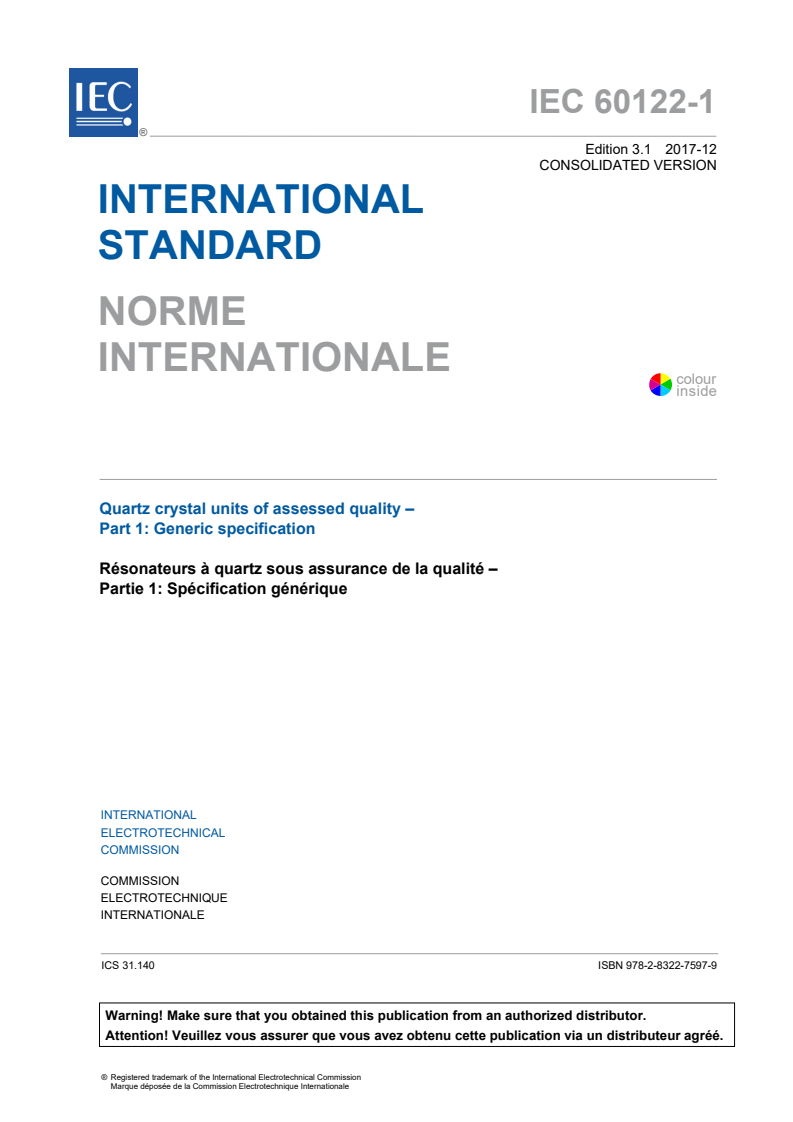
IEC 60122-1 ®
Edition 3.1 2017-12
CONSOLIDATED VERSION
INTERNATIONAL
STANDARD
colour
inside
Quartz crystal units of assessed quality –
Part 1: Generic specification
All rights reserved. Unless otherwise specified, no part of this publication may be reproduced or utilized in any form
or by any means, electronic or mechanical, including photocopying and microfilm, without permission in writing from
either IEC or IEC's member National Committee in the country of the requester. If you have any questions about IEC
copyright or have an enquiry about obtaining additional rights to this publication, please contact the address below or
your local IEC member National Committee for further information.
IEC Central Office Tel.: +41 22 919 02 11
3, rue de Varembé info@iec.ch
CH-1211 Geneva 20 www.iec.ch
Switzerland
About the IEC
The International Electrotechnical Commission (IEC) is the leading global organization that prepares and publishes
International Standards for all electrical, electronic and related technologies.
About IEC publications
The technical content of IEC publications is kept under constant review by the IEC. Please make sure that you have the
latest edition, a corrigendum or an amendment might have been published.
IEC publications search - webstore.iec.ch/advsearchform Electropedia - www.electropedia.org
The advanced search enables to find IEC publications by a The world's leading online dictionary on electrotechnology,
variety of criteria (reference number, text, technical containing more than 22 000 terminological entries in English
committee,…). It also gives information on projects, replaced and French, with equivalent terms in 16 additional languages.
and withdrawn publications. Also known as the International Electrotechnical Vocabulary
(IEV) online.
IEC Just Published - webstore.iec.ch/justpublished
Stay up to date on all new IEC publications. Just Published IEC Glossary - std.iec.ch/glossary
details all new publications released. Available online and 67 000 electrotechnical terminology entries in English and
once a month by email. French extracted from the Terms and Definitions clause of
IEC publications issued since 2002. Some entries have been
IEC Customer Service Centre - webstore.iec.ch/csc collected from earlier publications of IEC TC 37, 77, 86 and
If you wish to give us your feedback on this publication or CISPR.
need further assistance, please contact the Customer Service
Centre: sales@iec.ch.
IEC 60122-1 ®
Edition 3.1 2017-12
CONSOLIDATED VERSION
INTERNATIONAL
STANDARD
colour
inside
Quartz crystal units of assessed quality –
Part 1: Generic specification
INTERNATIONAL
ELECTROTECHNICAL
COMMISSION
ICS 31.140 ISBN 978-2-8322-7597-9
IEC 60122-1 ®
Edition 3.1 2017-12
CONSOLIDATED VERSION
REDLINE VERSION
colour
inside
Quartz crystal units of assessed quality –
Part 1: Generic specification
– 2 – IEC 60122-1:2002+AMD1:2017 CSV
IEC 2017
CONTENTS
FOREWORD . 5
1 General . 7
1.1 Scope . 7
1.2 Normative references . 7
1.3 Order of precedence . 8
2 Terminology and general requirements . 9
2.1 General . 9
2.2 Terms, definitions and classification of phenomena . 9
2.3 Preferred ratings and characteristics . 22
o
2.3.1 Temperature ranges in degrees Celsius ( C) suitable for ambient
operation . 22
o
2.3.2 Elevated temperature ranges in degrees Celsius ( C) suitable for oven
control . 23
–6
2.3.3 Frequency tolerance (1×10 ) . 23
2.3.4 Circuit conditions . 23
2.3.5 Levels of drive . 23
2.3.6 Drive level dependency . 24
2.3.7 Climatic category . 24
2.3.8 Bump severity . 24
2.3.9 Vibration severity . 24
2.3.10 Shock severity . 24
2.3.11 Leak rate . 25
2.4 Marking . 25
3 Quality assessment procedures . 25
3.1 Primary stage of manufacture . 25
3.2 Structurally similar components . 25
3.3 Subcontracting . 25
3.4 Manufacturer’s approval . 26
3.5 Approval procedures . 26
3.5.1 General . 26
3.5.2 Capability approval . 26
3.5.3 Qualification approval . 26
3.6 Procedures for capability approval . 26
3.6.1 General . 26
3.6.2 Eligibility for capability approval . 27
3.6.3 Application for capability approval . 27
3.6.4 Granting of capability approval . 27
3.6.5 Capability manual . 27
3.7 Procedures for qualification approval . 27
3.7.1 General . 27
3.7.2 Eligibility for qualification approval. 27
3.7.3 Application for qualification approval . 27
3.7.4 Granting of qualification approval . 27
3.7.5 Quality conformance inspection . 27
3.8 Test procedures . 27
IEC 2017
3.9 Screening requirements . 27
3.10 Rework and repair work . 28
3.10.1 Rework . 28
3.10.2 Repair work . 28
3.11 Certified records of released lots . 28
3.12 Validity of release . 28
3.13 Release for delivery . 28
3.14 Unchecked parameters . 28
4 Test and measurement procedures . 28
4.1 General . 28
4.2 Alternative test methods . 28
4.3 Precision of measurement . 29
4.4 Standard conditions for testing . 29
4.5 Visual inspection . 29
4.5.1 Visual test A . 29
4.5.2 Visual test B . 29
4.5.3 Visual test C . 29
4.6 Dimensioning and gauging procedures . 30
4.6.1 Dimensions, test A . 30
4.6.2 Dimensions, test B . 30
4.7 Electrical test procedures . 30
4.7.1 Frequency and resonance resistance . 30
4.7.2 Drive level dependency . 30
4.7.3 Frequency and resonance resistance as a function of temperature . 30
4.7.4 Unwanted responses . 31
4.7.5 Shunt capacitance . 31
4.7.6 Load resonance frequency and resistance . 31
4.7.7 Frequency pulling range (f , f ) . 31
L1 L2
4.7.8 Motional parameters . 31
4.7.9 Insulation resistance . 32
4.8 Mechanical and environmental test procedures . 32
4.8.1 Robustness of terminations (destructive) . 32
4.8.2 Sealing tests (non-destructive) . 32
4.8.3 Soldering (solderability and resistance to soldering heat) (destructive) . 34
4.8.4 Rapid change of temperature, two-fluid bath method (non-destructive) . 34
4.8.5 Rapid change of temperature with prescribed time of transition (non-
destructive) . 34
4.8.6 Bump (destructive) . 34
4.8.7 Vibration (destructive) . 35
4.8.8 Shock (destructive) . 35
4.8.9 Free fall (destructive) . 35
4.8.10 Acceleration, steady state (non-destructive) . 35
4.8.11 Dry heat (non-destructive) . 35
4.8.12 Damp heat, cyclic (destructive) . 35
4.8.13 Cold (non-destructive) . 36
4.8.14 Climatic sequence (destructive) . 36
4.8.15 Damp heat, steady state (destructive). 36
4.8.16 Immersion in cleaning solvents (non-destructive) . 36
– 4 – IEC 60122-1:2002+AMD1:2017 CSV
IEC 2017
4.9 Endurance test procedure . 36
4.9.1 Standard ageing (non-destructive) test for production verification . 36
4.9.2 Accelerated aging . 37
4.9.3 Reference aging test . 38
4.9.24.9.4 Extended ageing (non-destructive) . 40
Annex A (normative) Procedure for the determination of the fitting parameters for the
frequency aging . 41
Bibliography . 43
Figure 1 – Symbol and equivalent electrical circuit of a piezoelectric resonator . 11
Figure 2 – Impedance |Z|, resistance R , reactance X , series arm reactance X of a
e e 1
piezoelectric resonator as a function of frequency . 14
Figure 3 – Impedance and admittance diagram of a piezoelectric resonator . 15
Figure 4 – Resonance, anti-resonance and load resonance frequencies . 16
Figure 5 – Equivalent circuit of a piezoelectric resonator with a series (load)
capacitance C . 22
L
Figure 6 – Terminal bend test tool. 33
Table 1 – List of symbols used for the equivalent electric circuit of a piezoelectric
resonator . 19
Table 2 – Solutions for the various characteristic frequencies . 21
Table 3 – Minimum values for the ratio Q /r to be expected for various types of
piezoelectric resonators . 21
Table 4 – Approximate relations between the characteristic frequencies and the series
resonance frequency f of a piezoelectric resonator . 21
s
Table 5 – Time acceleration factors for E = 0,38 eV . 38
a
Table A.1 – Procedure for the determination of the frequency aging parameters . 42
IEC 2017
INTERNATIONAL ELECTROTECHNICAL COMMISSION
___________
QUARTZ CRYSTAL UNITS OF ASSESSED QUALITY –
Part 1: Generic specification
FOREWORD
1) The International Electrotechnical Commission (IEC) is a worldwide organization for standardization comprising
all national electrotechnical committees (IEC National Committees). The object of IEC is to promote
international co-operation on all questions concerning standardization in the electrical and electronic fields. To
this end and in addition to other activities, IEC publishes International Standards, Technical Specifications,
Technical Reports, Publicly Available Specifications (PAS) and Guides (hereafter referred to as “IEC
Publication(s)”). Their preparation is entrusted to technical committees; any IEC National Committee interested
in the subject dealt with may participate in this preparatory work. International, governmental and non-
governmental organizations liaising with the IEC also participate in this preparation. IEC collaborates closely
with the International Organization for Standardization (ISO) in accordance with conditions determined by
agreement between the two organizations.
2) The formal decisions or agreements of IEC on technical matters express, as nearly as possible, an international
consensus of opinion on the relevant subjects since each technical committee has representation from all
interested IEC National Committees.
3) IEC Publications have the form of recommendations for international use and are accepted by IEC National
Committees in that sense. While all reasonable efforts are made to ensure that the technical content of IEC
Publications is accurate, IEC cannot be held responsible for the way in which they are used or for any
misinterpretation by any end user.
4) In order to promote international uniformity, IEC National Committees undertake to apply IEC Publications
transparently to the maximum extent possible in their national and regional publications. Any divergence
between any IEC Publication and the corresponding national or regional publication shall be clearly indicated in
the latter.
5) IEC itself does not provide any attestation of conformity. Independent certification bodies provide conformity
assessment services and, in some areas, access to IEC marks of conformity. IEC is not responsible for any
services carried out by independent certification bodies.
6) All users should ensure that they have the latest edition of this publication.
7) No liability shall attach to IEC or its directors, employees, servants or agents including individual experts and
members of its technical committees and IEC National Committees for any personal injury, property damage or
other damage of any nature whatsoever, whether direct or indirect, or for costs (including legal fees) and
expenses arising out of the publication, use of, or reliance upon, this IEC Publication or any other IEC
Publications.
8) Attention is drawn to the Normative references cited in this publication. Use of the referenced publications is
indispensable for the correct application of this publication.
9) Attention is drawn to the possibility that some of the elements of this IEC Publication may be the subject of
patent rights. IEC shall not be held responsible for identifying any or all such patent rights.
This consolidated version of the official IEC Standard and its amendment has been prepared
for user convenience.
IEC 60122-1 edition 3.1 contains the third edition (2002-08) [documents 49/551/FDIS and 49/558/
RVD] and its amendment 1 (2017-12) [documents 49/1254/FDIS and 49/1259/RVD].
In this Redline version, a vertical line in the margin shows where the technical content is
modified by amendment 1. Additions are in green text, deletions are in strikethrough red text.
A separate Final version with all changes accepted is available in this publication.
– 6 – IEC 60122-1:2002+AMD1:2017 CSV
IEC 2017
International Standard IEC 60122-1 has been prepared by IEC technical committee 49:
Piezoelectric and dielectric devices for frequency control and selection.
This third edition of IEC 60122-1 constitutes a technical revision.
International Standard IEC 60122-1 is the first part of a new edition of the IEC standard series
for quartz crystal units of assessed quality.
This publication has been drafted in accordance with the ISO/IEC Directives, Part 3.
IEC 60122 consists of the following parts under the general title: Quartz crystal units of
assessed quality:
– Part 1: Generic specification (IEC 60122-1);
– Part 2: Guide to the use of quartz crystal units for frequency control and selection
(IEC 60122-2 at present);
– Part 3: Standard outlines and lead connections (IEC 60122-3);
– Part 4: Sectional specification – Capability Approval (IEC 61178-2 at present);
– Part 4-1: Blank detail specification – Capability Approval (IEC 61178-2-1 at present);
– Part 5: Sectional specification – Qualification Approval (IEC 61178-3 at present);
– Part 5-1: Blank detail specification – Qualification Approval (IEC 61178-3-1 at present).
The QC number which appears on the front cover of this publication is the specification
number in the IEC Quality Assessment System for Electronic Components (IECQ).
The committee has decided that the contents of the base publication and its amendment will
remain unchanged until the stability date indicated on the IEC web site under
"http://webstore.iec.ch" in the data related to the specific publication. At this date, the
publication will be
• reconfirmed,
• withdrawn,
• replaced by a revised edition, or
• amended.
A bilingual version of this publication may be issued at a later date.
IMPORTANT – The 'colour inside' logo on the cover page of this publication indicates
that it contains colours which are considered to be useful for the correct
understanding of its contents. Users should therefore print this document using a
colour printer.
IEC 2017
QUARTZ CRYSTAL UNITS OF ASSESSED QUALITY –
Part 1: Generic specification
1 General
1.1 Scope
This part of IEC 60122 specifies the methods of test and general requirements for quartz
crystal units of assessed quality using either capability approval or qualification approval
procedures.
1.2 Normative references
The following referenced documents are indispensable for the application of this document.
For dated references, only the edition cited applies. For undated references, the latest edition
of the referenced document (including any amendments) applies.
IEC 60027(all parts), Letter symbols to be used in electrical technology
IEC 60050(561):1991, International Electrotechnical Vocabulary (IEV) – Chapter 561:
Piezoelectric devices for frequency control and selection
IEC 60068-1:1988, Environmental testing – Part 1: General and guidance
IEC 60068-2-1:1990, Environmental testing – Part 2: Tests – Tests A: Cold
IEC 60068-2-2:1974, Environmental testing – Part 2: Tests – Tests B: Dry heat
IEC 60068-2-3:1969, Environmental testing – Part 2: Tests – Test Ca: Damp heat, steady state
IEC 60068-2-6:1995, Environmental testing – Part 2: Tests – Test Fc: Vibration (sinusoidal)
IEC 60068-2-7:1983, Environmental testing – Part 2: Tests – Test Ga: Acceleration,
steady state
IEC 60068-2-13:1983, Environmental testing – Part 2: Tests – Test M: Low air pressure
IEC 60068-2-14:1984, Environmental testing – Part 2: Tests – Test N: Change of temperature
IEC 60068-2-17:1994, Basic environmental testing procedures– Part 2: Tests – Test Q: Sealing
IEC 60068-2-20:1979, Environmental testing – Part 2: Tests – Test T: Soldering
IEC 60068-2-21:1999, Environmental testing – Part 2-21: Tests – Test U: Robustness of
terminations and integral mounting devices
IEC 60068-2-27:1987, Environmental testing – Part 2: Tests – Test Ea and guidance: Shock
IEC 60068-2-29:1987, Environmental testing – Part 2: Tests – Test Eb and guidance: Bump
IEC 60068-2-30:1980, Environmental testing – Part 2: Tests – Test Db and guidance: Damp
heat, cyclic (12 + 12-hour cycle)
IEC 60068-2-32:1975, Environmental testing – Part 2: Tests – Test Ed: Free fall (Procedure 1)
– 8 – IEC 60122-1:2002+AMD1:2017 CSV
IEC 2017
IEC 60068-2-45:1980, Environmental testing – Part 2: Tests – Test XA and guidance:
Immersion in cleaning solvents
IEC 60122-3:2001, Quartz crystal units of assessed quality – Part 3: Standard outlines and
lead connections
IEC 60444-1:1986, Measurement of quartz crystal unit parameters by zero phase technique in
a π-network – Part 1: Basic method for the measurement of resonance frequency and
resonance resistance of quartz crystal units by zero phase techniques in a π-network
IEC 60444-2:1980, Measurement of quartz crystal unit parameters by zero phase technique in
a π-network – Part 2: Phase offset method for the measurement of motional capacitance of
quartz crystal units
IEC 60444-4:1988, Measurement of quartz crystal unit parameters by zero phase technique in
a π-network – Part 4: Method for the measurement of the load resonance frequency f , load
L
resonance resistance R and the calculation of other derived values of quartz crystal units, up
L
to 30 MHz
IEC 60444-5:1995, Measurement of quartz crystal unit parameters – Part 5: Methods for the
determination of equivalent electrical parameters using automatic network analyzer
techniques and error corrections
IEC 60444-6:1995, Measurement of quartz crystal unit parameters – Part 6: Measurement of
drive level dependence (DLD)
IEC 60617 (all parts), Graphical symbols for diagrams
IEC 61178-2:1993, Quartz crystal units – A specification in the IEC Quality Assessment
System for Electronic Components (IECQ) – Part 2: Sectional specification – Capability
approval
IEC 61178-3:1993, Quartz crystal units – A specification in the IEC Quality Assessment
System for Electronic Components (IECQ) – Part 3: Sectional specification – Qualification
approval
IEC 61760-1:2006, Surface mounting technology – Part 1: Standard method for the
specification of surface mounting components (SMDs)
IEC QC 001001:2000, IEC Quality Assessment System for Electronic Components (IECQ) –
Basic Rules
IEC QC 001002-2:1998, ICQ Quality Assessment System for Electronic Components (IECQ) –
Rules of Procedure – Part 2: Documentation
IEC QC 001002-3:1998, IEC Quality Assessment System for Electronic Components (IECQ) –
Rules of Procedure – Part 3: Approval Procedures
IEC QC 001005:2000, Register of firms, products and services approved under the IECQ
System, including ISO 9000
ISO 1000:1992, Sl units and recommendations for the use of their multiples and of certain
other units
1.3 Order of precedence
Where any discrepancies occur for any reason, documents shall rank in the following order of
precedence:
– the detail specification;
– the sectional specification;
IEC 2017
– the generic specification;
– any other international documents (for example of the IEC) to which reference is made.
The same order of precedence shall apply to equivalent national documents.
2 Terminology and general requirements
2.1 General
Units, graphical symbols, letter symbols and terminology shall, wherever possible, be taken
from the following standards: IEC 60027, IEC 60050(561), IEC 60617 and ISO 1000.
2.2 Terms, definitions and classification of phenomena
The following paragraphs contain additional terminology applicable to quartz crystal units and
describe certain phenomena in this context.
2.2.1
crystal element (crystal blank)
piezoelectric material cut to a given geometrical shape, size and orientation with respect to
the crystallographic axes of the crystal
2.2.2
electrode
an electrically conductive plate or film in contact with, or in proximity to, a face of a crystal
element by means of which an electric field is applied to the element
2.2.3
crystal resonator
a mounted crystal element that vibrates when an alternating electric field exists between the
electrodes
2.2.4
mounting
the means by which the crystal resonator is supported (within its enclosure)
2.2.5
enclosure
the enclosure protecting the crystal resonator(s) and mounting
2.2.6
enclosure type
a crystal enclosure of specific outline dimensions and material with a defined method of
sealing
2.2.7
crystal unit
a crystal resonator mounted in an enclosure
2.2.8
socket
a component into which the crystal unit is inserted to hold the crystal unit and to provide
electrical connection
2.2.9
mode of vibration
the pattern of motion in a vibrating body of the individual particles resulting from stresses
applied to the body, the frequency of oscillation and the boundary conditions existing. The
common modes of vibration are:
– 10 – IEC 60122-1:2002+AMD1:2017 CSV
IEC 2017
– flexural;
– extensional;
– face shear;
– thickness shear.
2.2.10
fundamental crystal unit
a crystal resonator designed to operate at the lowest order of a given mode
2.2.11
overtone crystal unit
a crystal resonator designed to operate at a higher order than the lowest of the given mode
2.2.12
overtone order
the numbers allotted to the successive overtones of a given mode of vibration from the
ascending series of integral numbers commencing with the fundamental as unity. For shear
and extensional modes, this overtone is the integral multiple of the fundamental frequency to
which the overtone frequency approximates
2.2.13
crystal unit equivalent circuit
the electric circuit which has the same impedance as the crystal unit in the region of the
desired resonance and anti-resonance frequencies. It is represented by an inductance,
capacitance and resistance in series, this series arm being shunted by the capacitance
between the terminals of the unit. The parameters of the series branch of inductance,
capacitance and resistance are given by L , C and R respectively: these are termed
1 1 1
“motional parameters” of the crystal unit. The shunt (parallel) capacitance is denoted by C
(see figure 1).
The parameters are independent of frequency for isolated modes of motion. Generally, the
mode in question is sufficiently isolated from other modes to permit this assumption. When
this is not true, the equations and measuring methods outlined herein do not apply. For
identification of symbols used in this standard, see table 1.
NOTE 1 The equivalent circuit does not represent all the characteristics of a crystal unit.
NOTE 2 The values of R , X , G and B vary rapidly around the resonance frequency,
e e p p
where
R is the equivalent circuit series resistance of the resonator;
e
X is the equivalent circuit series reactance of the resonator;
e
G is the equivalent circuit parallel conductance of the resonator;
p
B is the equivalent circuit parallel susceptance of the resonator.
p
IEC 2017
Figure 1 – Symbol and equivalent electrical circuit of
a piezoelectric resonator
2.2.14
motional resistance (R )
the resistance in the motional (series) arm of the equivalent circuit
2.2.15
motional inductance (L )
the inductance in the motional (series) arm of the equivalent circuit
2.2.16
motional capacitance (C )
the capacitance in the motional (series) arm of the equivalent circuit
2.2.17
shunt capacitance (C )
the capacitance in parallel with the motional arm of the equivalent circuit
2.2.18
parameters of piezoelectric resonators
the fundamental parameters C , L , R and C define the equivalent electric circuit shown
1 1 1 0
in figure 1, and all other parameters may be derived from them. At a given frequency,
the parameters of the equivalent electric circuit generally approach constant values as the
amplitude of vibration approaches zero. The amplitude which can be tolerated before
the parameters are appreciably affected varies widely between resonators of various types
and can only be determined by experiment.
The equation for the impedance Z or admittance Y:
1 j Ω− jδ
Z= = × (1)
Y ωC 1−Ω+ jδ
of the equivalent electric circuit of the piezoelectric resonator is the basic equation describing
the relationships between the various parameters.
In equation (1):
2 2
f − f
s
Ω= and δ= 2πfC R
0 1
2 2
f − f
p s
– 12 – IEC 60122-1:2002+AMD1:2017 CSV
IEC 2017
are the normalized frequency factor and the normalized damping factor, respectively. See
table 1, for definitions of f , f , and the other symbols used in equation (1) and for other
p s
essential parameters. The characteristic frequencies of equation (1) are defined in table 2.
The magnitude of the impedance of the equivalent electric network (|Z|), its resistive
component (R ), its reactive component (X ), and the reactance X of the L , C , R branch
e e 1 1 1 1
are plotted as functions of frequency in figure 2, for the purpose of defining the different
characteristic frequencies. |Z | and |Z | denote minimum and maximum impedance
m n
respectively, and R , R the impedances at zero phase angle. These curves, however, have
r a
only qualitative character and do not represent a particular piezoelectric resonator.
For further clarification, the impedance and admittance circles of a piezoelectric resonator are
reproduced in figure 3. However, the circle representation of the impedance or admittance of
a piezoelectric resonator is valid only if the circle diameter of the admittance diagram is large
in the resonance range or if r << Q , which is fulfilled in
compared with the change of 2 πfC
most resonators. If the latter conditions are not fulfilled, the admittance curve shows a
cissoidal character. Throughout the remainder of this standard, it is assumed that the
impedance (or admittance) of the resonator can be represented by a circle diagram. Table 3
gives data for Q, r, and for various types of resonators, indicating that this assumption
Q r
is valid for all practical cases.
It is necessary to make approximations in deriving practical equations for general use. It is
the error of these approximations, in addition to the errors of instrumentation that govern the
overall accuracy of the experimentally derived parameters.
As a first approximation sufficient for many practical purposes, the following assumptions
can be made:
f = f = f and f = f = f
m r s a n p
More exact relations between the characteristic frequencies f , f , f , f , f , and the series
m r a p n
resonance frequency f of a resonator, valid for the figure of merit M > 10 and the capacitance
s
ratio r > 10, are shown in table 4. These relationships have been derived by various authors
under the assumption that M >> 1.
The separation between parallel and series resonance frequencies is given by:
2 2
f f
−
C 1
p s
= = (2)
C r
f 0
s
The approximation:
f − f
p s
−1
= 1+ r − 1
f
s
1 1 1
= 1− + . ≈
2r 4r 2r
(3)
1 C
=
2 C
can be used for larger values of r (for example, when r is greater than 25, the error is less
than 1 %).
IEC 2017
2.2.19
resonance frequency (f )
r
the lower of the two frequencies of the crystal unit alone, under specified conditions, at which
the electrical impedance of the crystal unit is resistive
2.2.20
resonance resistance (R )
r
the resistance of the crystal unit alone at the resonance frequency f
r
2.2.21
anti-resonance frequency (f )
a
the higher of the two frequencies of the crystal unit alone, under specified conditions, at which
the electrical impedance of the crystal unit is resistive
2.2.22
load capacitance (C )
L
the effective external capacitance associated with the crystal unit which determines the load
resonance frequency f
L
2.2.23
load resonance frequency (f )
L
one of the two frequencies of a crystal unit in association with a series or with a parallel load
capacitance, under specified conditions at which the electrical impedance of the combination
is resistive. The load resonance frequency is the lower of the two frequencies when the load
capacitance is in series and the higher when it is in parallel (see figure 4).
For a given value of load capacitance C , these frequencies are identical for all practical
L
purposes and are given by the expression
1 L C (C + C )
1 1 0 L
= 2π (4)
f C + C + C
L 1 0 L
NOTE 1 The frequencies defined in 2.2.19, 2.2.21 and 2.2.23 are listed as being the terms more commonly used.
The frequencies associated with a quartz crystal are numerous and for a full explanation tables 2 and 4 should be
consulted.
NOTE 2 When higher accuracies are required or secondary data (for example, values of crystal unit motional
parameters) are to be derived from the frequency measurements, table 1, IEC 60444-1 and IEC 60444-5 should be
consulted.
– 14 – IEC 60122-1:2002+AMD1:2017 CSV
IEC 2017
Figure 2 – Impedance |Z|, resistance R , reactance X , series arm reactance X
e e 1
of a piezoelectric resonator as a function of frequency
IEC 2017
Figure 3 – Impedance and admittance diagram of a piezoelectric resonator
The symbols conform with those in table 1 and figure 2.
– 16 – IEC 60122-1:2002+AMD1:2017 CSV
IEC 2017
NOTE 1 The values of load capacitances shown in b) and c) are equal.
NOTE 2 See 2.2.19, 2.2.21 and 2.2.23.
Figure 4 – Resonance, anti-resonance and load resonance frequencies
2.2.24
load resonance resistance (R )
L
the resistance of the crystal unit in series with a stated external capacitance at the load
resonance frequency f .
L
NOTE To a close approximation the value of R is related to the value of R by the expression:
L r
C
R ≅ R 1+ (5)
L r
C
L
IEC 2017
2.2.25
nominal frequency (f )
nom
the frequency assigned to the crystal unit by the manufacturer
2.2.26
working frequency (f )
w
the operational frequency of the crystal unit together with associated circuits
2.2.27
load resonance frequency offset (Δf )
L
Δf = f – f (6)
L L r
It can be calculated approximately from
f C
r 1
Δf ≅ (7)
L
2(C + C )
0 L
In usage, the load resonance frequency offset Δf for a given value of load capacitance can
L
be written as, for instance, Δf or Δf to indicate the actual value of load capacitance in
30 20
picofarads involved.
2.2.28
fractional load resonance frequency offset (D )
L
f − f
L r
D = (8)
L
f
r
It can be calculated approximately from
C
D ≅ (9)
L
2(C + C )
0 L
This can also be written as, for instance, D to indicate the fractional load resonance
with a load capacitance of 30 pF.
frequency offset D
L
2.2.29
frequency pulling range (Δf )
L1,L2
Δf = | f – f | (10)
L1,L2 L1 L2
It can be calculated approximately from:
f C (C − C )
r 1 L2 L1
Δf = (11)
L1,L2
2(C + C )(C + C )
0 L1 0 L2
This can also be written as, for instance Δf to indicate the frequency pulling range
20,30
between load capacitances of 20 pF and 30 pF
2.2.30
fractional pulling range (D )
L1,L2
f − f
L1 L2
D = = D − D (12)
L1, L2 L1 L2
f
r
It can be calculated approximately from:
– 18 – IEC 60122-1:2002+AMD1:2017 CSV
IEC 2017
C (C − C )
1 L2 L1
D = (13)
L1,L2
2(C + C )(C + C )
0 L1 0 L2
This can be written as, for instance, D , to indicate the fractional pulling range between
20,30
load capacitances of 20 pF and 30 pF
2.2.31
pulling sensitivity (S)
dD −C
L
S = ≅ (14)
dC
L 2(C + C )
0 L
This can be written as, for instance, S , to indicate the pulling sensitivity at a load
capacitance of 30 pF
2.2.32
operating temperature range
the range of temperatures as measured on the enclosure, over which the crystal unit shall be
within the specified tolerances
2.2.33
operable temperature range
the range of temperatures as measured on the enclosure over which the crystal unit will not
sustain permanent damage though not necessarily functioning within the specified tolerances
2.2.34
storage temperature range
the minimum and maximum temperatures, as measured on the enclosure, at which the crystal
unit may be stored without deterioration or damage to its performance
2.2.35
reference temperature
the temperature at which certain crystal measurements are made. For controlled temperature
units, the reference temperature is the mid-point of the controlled temperature range. For non-
o o
controlled temperature units, the reference temperature is normally 25 C ± 2 C
2.2.36
level of drive
a measure of the conditions imposed upon the crystal unit. This may be expressed in terms of
current through or power dissipated in the crystal element
2.2.37
drive level dependency
drive level dependency (DLD) is the effect of changes in drive level conditions upon the
resonance resistance of the crystal unit. This parameter can be specified by defining the ratio
of resistance between two specified drive levels. This ratio is represented by the expression:
R
r1
R
r2
where
R is the resistance at the lower level of drive;
r1
R is the resistance at the higher level of drive.
r2
IEC 2017
2.2.38
unwanted response
a state of resonance of a crystal resonator other than that associated with the working
frequency
2.2.39
frequency tolerance
the maximum permissible deviation of the working frequency due to a specified cause or a
–6
combination of causes. The frequency tolerance is usually stated in parts per million (1×10 )
of the nominal frequency
NOTE The tolerances normally used are as follows:
– deviation from nominal frequency at the reference temperature under specified conditions;
– deviation over the temperature range from the frequency at the specified reference temperature;
– deviation as a result of ageing under specified conditions;
– deviation from nominal frequency due to all causes (overall tolerance).
Table 1 – List of symbols used for the equivalent electric circuit
of a piezoelectric resonator
References
Symbols Meaning SI units
Equations Tables Figures
B Equivalent parallel susceptance of S 2 1
p
resonator
C
Shunt (parallel) capacitance in the F 2, 3 1, 5
equivalent electric circuit
C Motional capacitance in the F 2, 3 1, 5
equivalent electric circuit
f Frequency Hz 3
f Antiresonance frequency, zero Hz 2, 4 2, 3
a
susceptance
f Frequency of maximum Hz 2, 4 2, 3
m
admittance(minimum impedance)
f Frequency of minimum Hz 2, 4 2, 3
n
admittance(maximum impedance)
f Parallel resonance frequency Hz 2, 3 2, 4 2, 3
p
(lossless)
C C
1 0
2π L
C + C
1 0
f Resonance frequency, zero Hz 2, 4 2, 3, 4
r
susceptance
f
Motional (serie
...
NORME CEI
INTERNATIONALE IEC
60122-1
INTERNATIONAL
QC 680000
STANDARD
Troisième édition
Third edition
2002-08
Résonateurs à quartz sous assurance
de la qualité –
Partie 1:
Spécification générique
Quartz crystal units of assessed quality –
Part 1:
Generic specification
Numéro de référence
Reference number
CEI/IEC 60122-1:2002
Numérotation des publications Publication numbering
Depuis le 1er janvier 1997, les publications de la CEI As from 1 January 1997 all IEC publications are
sont numérotées à partir de 60000. Ainsi, la CEI 34-1 issued with a designation in the 60000 series. For
devient la CEI 60034-1. example, IEC 34-1 is now referred to as IEC 60034-1.
Editions consolidées Consolidated editions
Les versions consolidées de certaines publications de la The IEC is now publishing consolidated versions of its
CEI incorporant les amendements sont disponibles. Par publications. For example, edition numbers 1.0, 1.1
exemple, les numéros d’édition 1.0, 1.1 et 1.2 indiquent and 1.2 refer, respectively, to the base publication,
respectivement la publication de base, la publication de the base publication incorporating amendment 1 and
base incorporant l’amendement 1, et la publication de the base publication incorporating amendments 1
base incorporant les amendements 1 et 2. and 2.
Informations supplémentaires Further information on IEC publications
sur les publications de la CEI
Le contenu technique des publications de la CEI est The technical content of IEC publications is kept
constamment revu par la CEI afin qu'il reflète l'état under constant review by the IEC, thus ensuring that
actuel de la technique. Des renseignements relatifs à the content reflects current technology. Information
cette publication, y compris sa validité, sont dispo- relating to this publication, including its validity, is
nibles dans le Catalogue des publications de la CEI available in the IEC Catalogue of publications
(voir ci-dessous) en plus des nouvelles éditions, (see below) in addition to new editions, amendments
amendements et corrigenda. Des informations sur les and corrigenda. Information on the subjects under
sujets à l’étude et l’avancement des travaux entrepris consideration and work in progress undertaken by the
par le comité d’études qui a élaboré cette publication, technical committee which has prepared this
ainsi que la liste des publications parues, sont publication, as well as the list of publications issued,
également disponibles par l’intermédiaire de: is also available from the following:
• Site web de la CEI (www.iec.ch) • IEC Web Site (www.iec.ch)
• Catalogue des publications de la CEI • Catalogue of IEC publications
Le catalogue en ligne sur le site web de la CEI The on-line catalogue on the IEC web site
(www.iec.ch/catlg-f.htm) vous permet de faire des (www.iec.ch/catlg-e.htm) enables you to search
recherches en utilisant de nombreux critères, by a variety of criteria including text searches,
comprenant des recherches textuelles, par comité technical committees and date of publication. On-
d’études ou date de publication. Des informations line information is also available on recently
en ligne sont également disponibles sur les issued publications, withdrawn and replaced
nouvelles publications, les publications rempla- publications, as well as corrigenda.
cées ou retirées, ainsi que sur les corrigenda.
• IEC Just Published
• IEC Just Published
Ce résumé des dernières publications parues
This summary of recently issued publications
(www.iec.ch/JP.htm) est aussi disponible par
(www.iec.ch/JP.htm) is also available by email.
courrier électronique. Veuillez prendre contact
Please contact the Customer Service Centre (see
avec le Service client (voir ci-dessous) pour plus
below) for further information.
d’informations.
• Service clients
• Customer Service Centre
Si vous avez des questions au sujet de cette
If you have any questions regarding this
publication ou avez besoin de renseignements
publication or need further assistance, please
supplémentaires, prenez contact avec le Service
contact the Customer Service Centre:
clients:
Email: custserv@iec.ch
Email: custserv@iec.ch
Tél: +41 22 919 02 11
Tel: +41 22 919 02 11
Fax: +41 22 919 03 00
Fax: +41 22 919 03 00
.
NORME CEI
INTERNATIONALE IEC
60122-1
INTERNATIONAL
QC 680000
STANDARD
Troisième édition
Third edition
2002-08
Résonateurs à quartz sous assurance
de la qualité –
Partie 1:
Spécification générique
Quartz crystal units of assessed quality –
Part 1:
Generic specification
IEC 2002 Droits de reproduction réservés Copyright - all rights reserved
Aucune partie de cette publication ne peut être reproduite ni No part of this publication may be reproduced or utilized in any
utilisée sous quelque forme que ce soit et par aucun procédé, form or by any means, electronic or mechanical, including
électronique ou mécanique, y compris la photocopie et les photocopying and microfilm, without permission in writing from
microfilms, sans l'accord écrit de l'éditeur. the publisher.
International Electrotechnical Commission, 3, rue de Varembé, PO Box 131, CH-1211 Geneva 20, Switzerland
Telephone: +41 22 919 02 11 Telefax: +41 22 919 03 00 E-mail: inmail@iec.ch Web: www.iec.ch
CODE PRIX
W
Commission Electrotechnique Internationale PRICE CODE
International Electrotechnical Commission
Международная Электротехническая Комиссия
Pour prix, voir catalogue en vigueur
For price, see current catalogue
– 2 – 60122-1 CEI:2002
SOMMAIRE
AVANT-PROPOS . 8
1 Généralités .12
1.1 Domaine d’application .12
1.2 Références normatives .12
1.3 Ordre de priorité .16
2 Terminologie et prescriptions générales.16
2.1 Généralités.16
2.2 Termes, définitions et classification des phénomènes.16
2.3 Valeurs et caractéristiques préférentielles .46
o
2.3.1 Gammes de températures en degrés Celsius ( C) pour un
fonctionnement à température ambiante .46
o
2.3.2 Gammes de températures élevées en degrés Celsius ( C) convenant
pour un fonctionnement en enceinte .46
–6
2.3.3 Tolérance de fréquence (1×10 ) .46
2.3.4 Conditions de fonctionnement.46
2.3.5 Niveaux d’excitation.46
2.3.6 Influence du niveau d’excitation .48
2.3.7 Catégorie climatique .48
2.3.8 Sévérité des secousses .48
2.3.9 Sévérité des vibrations .50
2.3.10 Sévérité des chocs .50
2.3.11 Taux de fuite.50
2.4 Marquage .50
3 Procédures d’assurance de la qualité .52
3.1 Etape initiale de fabrication .52
3.2 Modèles associables .52
3.3 Sous-traitance .52
3.4 Agrément du fabricant .52
3.5 Procédures d’agrément.52
3.5.1 Généralités .52
3.5.2 Agrément de savoir-faire.52
3.5.3 Homologation.54
3.6 Procédures pour l’agrément de savoir-faire.54
3.6.1 Généralités .54
3.6.2 Aptitude à l’agrément de savoir-faire.54
3.6.3 Demande d’agrément de savoir-faire .54
3.6.4 Obtention de l’agrément de savoir-faire .54
3.6.5 Manuel de savoir-faire .54
3.7 Procédures pour l’homologation.54
3.7.1 Généralités .54
3.7.2 Aptitude à l’agrément du fabricant.54
3.7.3 Demande d’homologation.56
3.7.4 Obtention de l’homologation .56
3.7.5 Contrôle de conformité de la qualité.56
3.8 Méthodes d’essai.56
3.9 Exigences de sélection .56
60122-1 IEC:2002 – 3 –
CONTENTS
FOREWORD . 9
1 General .13
1.1 Scope .13
1.2 Normative references .13
1.3 Order of precedence.17
2 Terminology and general requirements .17
2.1 General .17
2.2 Terms, definitions and classification of phenomena .17
2.3 Preferred ratings and characteristics .47
o
2.3.1 Temperature ranges in degrees Celsius ( C) suitable for
ambient operation .47
o
2.3.2 Elevated temperature ranges in degrees Celsius ( C) suitable
for oven control.47
–6
2.3.3 Frequency tolerance (1×10 ) .47
2.3.4 Circuit conditions .47
2.3.5 Levels of drive .47
2.3.6 Drive level dependency.49
2.3.7 Climatic category .49
2.3.8 Bump severity.49
2.3.9 Vibration severity .51
2.3.10 Shock severity .51
2.3.11 Leak rate .51
2.4 Marking .51
3 Quality assessment procedures .53
3.1 Primary stage of manufacture .53
3.2 Structurally similar components .53
3.3 Subcontracting .53
3.4 Manufacturer’s approval .53
3.5 Approval procedures.53
3.5.1 General.53
3.5.2 Capability approval .53
3.5.3 Qualification approval .55
3.6 Procedures for capability approval.55
3.6.1 General.55
3.6.2 Eligibility for capability approval.55
3.6.3 Application for capability approval.55
3.6.4 Granting of capability approval.55
3.6.5 Capability manual .55
3.7 Procedures for qualification approval.55
3.7.1 General.55
3.7.2 Eligibility for qualification approval.55
3.7.3 Application for qualification approval.57
3.7.4 Granting of qualification approval.57
3.7.5 Quality conformance inspection .57
3.8 Test procedures.57
3.9 Screening requirements.57
– 4 – 60122-1 CEI:2002
3.10 Travaux de retouche et de réparation .56
3.10.1 Retouche .56
3.10.2 Réparation.56
3.11 Rapports certifiés de lots acceptés .56
3.12 Validité de livraison .56
3.13 Acceptation pour livraison.58
3.14 Paramètres non destinés au contrôle.58
4 Procédures d’essai et de mesure .58
4.1 Généralités.58
4.2 Autres méthodes d’essai.58
4.3 Précision de mesure .58
4.4 Conditions normales d’essai .58
4.5 Inspection visuelle .60
4.5.1 Inspection visuelle, essai A.60
4.5.2 Inspection visuelle, essai B.60
4.5.3 Inspection visuelle, essai C.60
4.6 Inspection dimensionnelle et de mesure .60
4.6.1 Dimensions, essai A .60
4.6.2 Dimensions, essai B .60
4.7 Procédures d’essais électriques .60
4.7.1 Fréquence et résistance de résonance.60
4.7.2 Influence du niveau d’excitation .60
4.7.3 Fréquence et résistance de résonance en fonction de la température .62
4.7.4 Réponses indésirables.62
4.7.5 Capacité parallèle.62
4.7.6 Fréquence et résistance avec charge.64
4.7.7 Plage de décalage de fréquence (f , f ) .64
L1 L2
4.7.8 Paramètres dynamiques .64
4.7.9 Résistance d’isolement .64
4.8 Méthodes d’essai mécaniques et en environnement .64
4.8.1 Robustesse des sorties (destructif) .64
4.8.2 Essais d’étanchéité (non destructifs).66
4.8.3 Brasage (brasabilité et résistance à la chaleur de brasage)
(destructif) .70
4.8.4 Variation rapide de température par immersion en utilisant
la méthode de deux bains (non destructif).70
4.8.5 Variation rapide de température avec un temps de transition prescrit
(non destructif) .70
4.8.6 Secousses (destructif) .70
4.8.7 Vibrations (destructif).72
4.8.8 Chocs (destructif) .72
4.8.9 Chutes libres (destructif).72
4.8.10 Accélération, constante (non destructif) .72
4.8.11 Chaleur sèche (non destructif) .72
4.8.12 Chaleur humide, essai cyclique (destructif) .72
4.8.13 Froid sec (non destructif) .72
4.8.14 Séquence climatique (destructif) .74
4.8.15 Chaleur humide, essai continu (destructif) .74
4.8.16 Tenue aux solvants de nettoyage (non destructif) .74
60122-1 IEC:2002 – 5 –
3.10 Rework and repair work .57
3.10.1 Rework .57
3.10.2 Repair work .57
3.11 Certified records of released lots .57
3.12 Validity of release .57
3.13 Release for delivery.59
3.14 Unchecked parameters .59
4 Test and measurement procedures .59
4.1 General .59
4.2 Alternative test methods .59
4.3 Precision of measurement .59
4.4 Standard conditions for testing .59
4.5 Visual inspection .61
4.5.1 Visual test A .61
4.5.2 Visual test B .61
4.5.3 Visual test C .61
4.6 Dimensioning and gauging procedures .61
4.6.1 Dimensions, test A.61
4.6.2 Dimensions, test B.61
4.7 Electrical test procedures .61
4.7.1 Frequency and resonance resistance.61
4.7.2 Drive level dependency.61
4.7.3 Frequency and resonance resistance as a function of temperature .63
4.7.4 Unwanted responses .63
4.7.5 Shunt capacitance .63
4.7.6 Load resonance frequency and resistance .65
4.7.7 Frequency pulling range (f , f ).65
L1 L2
4.7.8 Motional parameters .65
4.7.9 Insulation resistance .65
4.8 Mechanical and environmental test procedures.65
4.8.1 Robustness of terminations (destructive) .65
4.8.2 Sealing tests (non-destructive).67
4.8.3 Soldering (solderability and resistance to soldering heat) (destructive) .71
4.8.4 Rapid change of temperature, two-fluid bath method (non-destructive) .71
4.8.5 Rapid change of temperature with prescribed time of transition
(non-destructive).71
4.8.6 Bump (destructive).71
4.8.7 Vibration (destructive).73
4.8.8 Shock (destructive) .73
4.8.9 Free fall (destructive).73
4.8.10 Acceleration, steady state (non-destructive).73
4.8.11 Dry heat (non-destructive) .73
4.8.12 Damp heat, cyclic (destructive) .73
4.8.13 Cold (non-destructive).73
4.8.14 Climatic sequence (destructive) .75
4.8.15 Damp heat, steady state (destructive).75
4.8.16 Immersion in cleaning solvents (non-destructive) .75
– 6 – 60122-1 CEI:2002
4.9 Méthodes d’essai d’endurance.74
4.9.1 Vieillissement (non destructif) .74
4.9.2 Vieillissement prolongé (non destructif) .76
Bibliographie .78
Figure 1 – Symbole et circuit électrique équivalent d’un résonateur piézoélectrique
près d’une résonance.20
Figure 2 – Impédance |Z|, résistance R , réactance X et réactance de la branche
e e
série X d’un résonateur piézoélectrique représentées en fonction de la fréquence.26
Figure 3 – Diagramme donnant l’impédance et l’admittance
d’un résonateur piézoélectrique .28
Figure 4 – Fréquences de résonance, d’anti-résonance
et de résonance avec capacité de charge.30
Figure 5 – Circuit électrique équivalent du résonateur piézoélectrique
avec une capacité (de charge) C .44
L
Figure 6 – Outil de pliage des sorties .68
Tableau 1 – Liste des symboles utilisés pour le circuit électrique équivalent
d’un résonateur piézoélectrique .36
Tableau 2 – Solutions pour les différentes fréquences caractéristiques .40
Tableau 3 – Valeurs minimales pour le rapport Q r qu’il faut attendre pour des types
différents de résonateurs piézoélectriques .40
Tableau 4 – Relations approximatives entre les fréquences caractéristiques
et la fréquence de résonance série f d’un résonateur piézoélectrique .42
s
60122-1 IEC:2002 – 7 –
4.9 Endurance test procedure.75
4.9.1 Ageing (non-destructive).75
4.9.2 Extended ageing (non-destructive).77
Bibliography.79
Figure 1 – Symbol and equivalent electrical circuit of a piezoelectric resonator .21
Figure 2 – Impedance |Z|, resistance R , reactance X , series arm reactance X of
e e 1
a piezoelectric resonator as a function of frequency .27
Figure 3 – Impedance and admittance diagram of a piezoelectric resonator .29
Figure 4 – Resonance, anti-resonance and load resonance frequencies.31
Figure 5 – Equivalent circuit of a piezoelectric resonator with a series (load)
capacitance C .45
L
Figure 6 – Terminal bend test tool.69
Table 1 – List of symbols used for the equivalent electric circuit of
a piezoelectric resonator .37
Table 2 – Solutions for the various characteristic frequencies .41
Table 3 – Minimum values for the ratio Q r to be expected for various types
of piezoelectric resonators .41
Table 4 – Approximate relations between the characteristic frequencies and the series
resonance frequency f of a piezoelectric resonator .43
s
– 8 – 60122-1 CEI:2002
COMMISSION ÉLECTROTECHNIQUE INTERNATIONALE
___________
RÉSONATEURS À QUARTZ SOUS ASSURANCE DE LA QUALITÉ –
Partie 1: Spécification générique
AVANT-PROPOS
1) La CEI (Commission Électrotechnique Internationale) est une organisation mondiale de normalisation
composée de l'ensemble des comités électrotechniques nationaux (Comités nationaux de la CEI). La CEI a
pour objet de favoriser la coopération internationale pour toutes les questions de normalisation dans les
domaines de l'électricité et de l'électronique. A cet effet, la CEI, entre autres activités, publie des Normes
internationales. Leur élaboration est confiée à des comités d'études, aux travaux desquels tout Comité national
intéressé par le sujet traité peut participer. Les organisations internationales, gouvernementales et non
gouvernementales, en liaison avec la CEI, participent également aux travaux. La CEI collabore étroitement
avec l'Organisation Internationale de Normalisation (ISO), selon des conditions fixées par accord entre les
deux organisations.
2) Les décisions ou accords officiels de la CEI concernant les questions techniques représentent, dans la mesure
du possible, un accord international sur les sujets étudiés, étant donné que les Comités nationaux intéressés
sont représentés dans chaque comité d’études.
3) Les documents produits se présentent sous la forme de recommandations internationales. Ils sont publiés
comme normes, spécifications techniques, rapports techniques ou guides et agréés comme tels par les
Comités nationaux.
4) Dans le but d'encourager l'unification internationale, les Comités nationaux de la CEI s'engagent à appliquer de
façon transparente, dans toute la mesure possible, les Normes internationales de la CEI dans leurs normes
nationales et régionales. Toute divergence entre la norme de la CEI et la norme nationale ou régionale
correspondante doit être indiquée en termes clairs dans cette dernière.
5) La CEI n’a fixé aucune procédure concernant le marquage comme indication d’approbation et sa responsabilité
n’est pas engagée quand un matériel est déclaré conforme à l’une de ses normes.
6) L’attention est attirée sur le fait que certains des éléments de la présente Norme internationale peuvent faire
l’objet de droits de propriété intellectuelle ou de droits analogues. La CEI ne saurait être tenue pour
responsable de ne pas avoir identifié de tels droits de propriété et de ne pas avoir signalé leur existence.
La Norme internationale CEI 60122-1 a été établie par le comité d'études 49 de la CEI:
Dispositifs piézoélectriques et diélectriques pour la commande et le choix de la fréquence.
Cette troisième édition de la CEI 60122-1 annule et remplace la CEI 61178-1, parue en 1993,
et la CEI 60302, parue en 1969, et en constitue une révision technique.
La CEI 60122-1 est la première partie de la nouvelle édition de la série CEI 60122 pour
les résonateurs à quartz sous assurance de la qualité.
Le texte de cette norme est issu des documents suivants:
FDIS Rapport de vote
49/551/FDIS 49/558/RVD
Le rapport de vote indiqué dans le tableau ci-dessus donne toute information sur le vote ayant
abouti à l'approbation de cette norme.
Cette publication a été rédigée selon les Directives ISO/CEI, Partie 3.
60122-1 IEC:2002 – 9 –
INTERNATIONAL ELECTROTECHNICAL COMMISSION
___________
QUARTZ CRYSTAL UNITS OF ASSESSED QUALITY –
Part 1: Generic specification
FOREWORD
1) The IEC (International Electrotechnical Commission) is a worldwide organization for standardization comprising
all national electrotechnical committees (IEC National Committees). The object of the IEC is to promote
international co-operation on all questions concerning standardization in the electrical and electronic fields. To
this end and in addition to other activities, the IEC publishes International Standards. Their preparation is
entrusted to technical committees; any IEC National Committee interested in the subject dealt with may
participate in this preparatory work. International, governmental and non-governmental organizations liaising
with the IEC also participate in this preparation. The IEC collaborates closely with the International
Organization for Standardization (ISO) in accordance with conditions determined by agreement between the
two organizations.
2) The formal decisions or agreements of the IEC on technical matters express, as nearly as possible, an
international consensus of opinion on the relevant subjects since each technical committee has representation
from all interested National Committees.
3) The documents produced have the form of recommendations for international use and are published in the form
of standards, technical specifications, technical reports or guides and they are accepted by the National
Committees in that sense.
4) In order to promote international unification, IEC National Committees undertake to apply IEC International
Standards transparently to the maximum extent possible in their national and regional standards. Any
divergence between the IEC Standard and the corresponding national or regional standard shall be clearly
indicated in the latter.
5) The IEC provides no marking procedure to indicate its approval and cannot be rendered responsible for any
equipment declared to be in conformity with one of its standards.
6) Attention is drawn to the possibility that some of the elements of this International Standard may be the subject
of patent rights. The IEC shall not be held responsible for identifying any or all such patent rights.
International Standard IEC 60122-1 has been prepared by IEC technical committee 49:
Piezoelectric and dielectric devices for frequency control and selection.
This third edition of IEC 60122-1 cancels and replaces IEC 61178-1 published in 1993 and
IEC 60302 published in 1969 and constitutes their technical revision.
International Standard IEC 60122-1 is the first part of a new edition of the IEC standard series
for quartz crystal units of assessed quality.
The text of this standard is based on the following documents:
FDIS Report on voting
49/551/FDIS 49/558/RVD
Full information on the voting for the approval of this standard can be found in the report on
voting indicated in the above table.
This publication has been drafted in accordance with the ISO/IEC Directives, Part 3.
– 10 – 60122-1 CEI:2002
La CEI 60122 comprend les parties suivantes présentées sous le titre général: Résonateurs
à quartz sous assurance de la qualité:
– Partie 1: Spécification générique (CEI 60122-1);
– Partie 2: Guide pour l’emploi des résonateurs à quartz pour le contrôle et la sélection de
la fréquence (CEI 60122-2 à présent);
– Partie 3: Encombrements normalisés et connexions des sorties (CEI 60122-3);
– Partie 4: Spécification intermédiaire – Agrément de savoir-faire (CEI 61178-2 à présent);
– Partie 4-1: Spécification particulière cadre – Agrément de savoir-faire (CEI 61178-2-1
à présent);
– Partie 5: Spécification intermédiaire – Homologation (CEI 61178-3 à présent);
– Partie 5-1: Spécification particulière cadre – Homologation (CEI 61178-3-1 à présent)
Le numéro QC qui figure sur la page de couverture de la présente publication est le numéro
de spécification dans le Système CEI d’Assurance de la Qualité des Composants
Electroniques (IECQ).
Le comité a décidé que le contenu de cette publication ne sera pas modifié avant 2007.
A cette date, la publication sera
• reconduite;
• supprimée;
• remplacée par une édition révisée, ou
• amendée.
60122-1 IEC:2002 – 11 –
IEC 60122 consists of the following parts under the general title: Quartz crystal units of
assessed quality:
– Part 1: Generic specification (IEC 60122-1);
– Part 2: Guide to the use of quartz crystal units for frequency control and selection
(IEC 60122-2 at present);
– Part 3: Standard outlines and lead connections (IEC 60122-3);
– Part 4: Sectional specification – Capability Approval (IEC 61178-2 at present);
– Part 4-1: Blank detail specification – Capability Approval (IEC 61178-2-1 at present);
– Part 5: Sectional specification – Qualification Approval (IEC 61178-3 at present);
– Part 5-1: Blank detail specification – Qualification Approval (IEC 61178-3-1 at present).
The QC number which appears on the front cover of this publication is the specification
number in the IEC Quality Assessment System for Electronic Components (IECQ).
The committee has decided that the contents of this publication will remain unchanged until
2007. At this date, the publication will be
• reconfirmed;
• withdrawn;
• replaced by a revised edition, or
• amended.
– 12 – 60122-1 CEI:2002
RÉSONATEURS À QUARTZ SOUS ASSURANCE DE LA QUALITÉ –
Partie 1: Spécification générique
1 Généralités
1.1 Domaine d’application
La présente partie de la CEI 60122 spécifie les méthodes d’essai et les exigences générales
pour les résonateurs à quartz dont la qualité est garantie par les procédures d’agrément de
savoir-faire ou par les procédures d’homologation.
1.2 Références normatives
Les documents de référence suivants sont indispensables pour l'application du présent
document. Pour les références datées, seule l'édition citée s'applique. Pour les références
non datées, la dernière édition du document de référence s'applique (y compris les éventuels
amendements).
CEI 60027 (toutes les parties), Symboles littéraux à utiliser en électrotechnique
CEI 60050(561):1991, Vocabulaire Electrotechnique International (VEI) – Chapitre 561:
Dispositifs piézoélectriques pour la stabilisation des fréquences et le filtrage
CEI 60068-1:1988, Essais d’environnement – Première partie: Généralités et guide
CEI 60068-2-1:1990, Essais d’environnement – Deuxième partie: Essais – Essais A: Froid
CEI 60068-2-2:1974, Essais d’environnement – Deuxième partie: Essais – Essais B:
Chaleur sèche
CEI 60068-2-3:1969, Essais d’environnement – Deuxième partie: Essais – Essai Ca: Essai
continu de chaleur humide
CEI 60068-2-6:1995, Essais d’environnement – Partie 2: Essais – Essai Fc: Vibrations
(sinusoïdales)
CEI 60068-2-7:1983, Essais d’environnement – Deuxième partie: Essais – Essai Ga:
Accélération constante
CEI 60068-2-13:1983, Essais d’environnement – Deuxième partie: Essais. Essai M: Basse
pression atmosphérique
CEI 60068-2-14:1984, Essais d’environnement – Deuxième partie: Essais – Essai N:
Variations de température
CEI 60068-2-17:1994, Essais fondamentaux climatiques et de robustesse mécanique –
Partie 2: Essais – Essai Q: Etanchéité
CEI 60068-2-20:1979, Essais d’environnement – Deuxième partie: Essais – Essai T: Soudure
CEI 60068-2-21:1999, Essais d’environnement – Partie 2-21: Essais – Essai U: Robustesse
des sorties et des dispositifs de fixation
60122-1 IEC:2002 – 13 –
QUARTZ CRYSTAL UNITS OF ASSESSED QUALITY –
Part 1: Generic specification
1 General
1.1 Scope
This part of IEC 60122 specifies the methods of test and general requirements for quartz
crystal units of assessed quality using either capability approval or qualification approval
procedures.
1.2 Normative references
The following referenced documents are indispensable for the application of this document.
For dated references, only the edition cited applies. For undated references, the latest edition
of the referenced document (including any amendments) applies.
IEC 60027(all parts), Letter symbols to be used in electrical technology
IEC 60050(561):1991, International Electrotechnical Vocabulary (IEV) – Chapter 561:
Piezoelectric devices for frequency control and selection
IEC 60068-1:1988, Environmental testing – Part 1: General and guidance
IEC 60068-2-1:1990, Environmental testing – Part 2: Tests – Tests A: Cold
IEC 60068-2-2:1974, Environmental testing – Part 2: Tests – Tests B: Dry heat
IEC 60068-2-3:1969, Environmental testing – Part 2: Tests – Test Ca: Damp heat, steady state
IEC 60068-2-6:1995, Environmental testing – Part 2: Tests – Test Fc: Vibration (sinusoidal)
IEC 60068-2-7:1983, Environmental testing – Part 2: Tests – Test Ga: Acceleration,
steady state
IEC 60068-2-13:1983, Environmental testing – Part 2: Tests – Test M: Low air pressure
IEC 60068-2-14:1984, Environmental testing – Part 2: Tests – Test N: Change of temperature
IEC 60068-2-17:1994, Basic environmental testing procedures– Part 2: Tests – Test Q: Sealing
IEC 60068-2-20:1979, Environmental testing – Part 2: Tests – Test T: Soldering
IEC 60068-2-21:1999, Environmental testing – Part 2-21: Tests – Test U: Robustness of
terminations and integral mounting devices
– 14 – 60122-1 CEI:2002
CEI 60068-2-27:1987, Essais d’environnement – Deuxième partie: Essais – Essai Ea et
guide: Chocs
CEI 60068-2-29:1987, Essais d’environnement – Deuxième partie: Essais – Essai Eb
et guide: Secousses
CEI 60068-2-30:1980, Essais d’environnement – Deuxième partie: Essais – Essai Db et
guide: Essai cyclique de chaleur humide (cycle de 12 + 12 heures)
CEI 60068-2-32:1975, Essais d’environnement – Deuxième partie: Essais – Essai Ed: Chute
libre (méthode 1)
CEI 60068-2-45:1980, Essais d’environnement – Deuxième partie: Essais – Essai XA et guide:
Immersion dans les solvants de nettoyage
CEI 60122-3:2001, Résonateurs à quartz sous assurance de la qualité – Partie 3:
Encombrements normalisés et connexions des sorties
CEI 60444-1:1986, Mesure des paramètres des quartz piézoélectriques par la technique de
phase nulle dans le circuit en π – Première partie: Méthode fondamentale pour la mesure de
la fréquence de résonance et de la résistance de résona
...
IEC 60122-1 ®
Edition 3.1 2017-12
CONSOLIDATED VERSION
INTERNATIONAL
STANDARD
NORME
INTERNATIONALE
colour
inside
Quartz crystal units of assessed quality –
Part 1: Generic specification
Résonateurs à quartz sous assurance de la qualité –
Partie 1: Spécification générique
All rights reserved. Unless otherwise specified, no part of this publication may be reproduced or utilized in any form
or by any means, electronic or mechanical, including photocopying and microfilm, without permission in writing from
either IEC or IEC's member National Committee in the country of the requester. If you have any questions about IEC
copyright or have an enquiry about obtaining additional rights to this publication, please contact the address below or
your local IEC member National Committee for further information.
Droits de reproduction réservés. Sauf indication contraire, aucune partie de cette publication ne peut être reproduite
ni utilisée sous quelque forme que ce soit et par aucun procédé, électronique ou mécanique, y compris la photocopie
et les microfilms, sans l'accord écrit de l'IEC ou du Comité national de l'IEC du pays du demandeur. Si vous avez des
questions sur le copyright de l'IEC ou si vous désirez obtenir des droits supplémentaires sur cette publication, utilisez
les coordonnées ci-après ou contactez le Comité national de l'IEC de votre pays de résidence.
IEC Central Office Tel.: +41 22 919 02 11
3, rue de Varembé info@iec.ch
CH-1211 Geneva 20 www.iec.ch
Switzerland
About the IEC
The International Electrotechnical Commission (IEC) is the leading global organization that prepares and publishes
International Standards for all electrical, electronic and related technologies.
About IEC publications
The technical content of IEC publications is kept under constant review by the IEC. Please make sure that you have the
latest edition, a corrigendum or an amendment might have been published.
IEC publications search - webstore.iec.ch/advsearchform Electropedia - www.electropedia.org
The advanced search enables to find IEC publications by a The world's leading online dictionary on electrotechnology,
variety of criteria (reference number, text, technical containing more than 22 000 terminological entries in English
committee,…). It also gives information on projects, replaced and French, with equivalent terms in 16 additional languages.
and withdrawn publications. Also known as the International Electrotechnical Vocabulary
(IEV) online.
IEC Just Published - webstore.iec.ch/justpublished
Stay up to date on all new IEC publications. Just Published IEC Glossary - std.iec.ch/glossary
details all new publications released. Available online and 67 000 electrotechnical terminology entries in English and
once a month by email. French extracted from the Terms and Definitions clause of
IEC publications issued since 2002. Some entries have been
IEC Customer Service Centre - webstore.iec.ch/csc collected from earlier publications of IEC TC 37, 77, 86 and
If you wish to give us your feedback on this publication or CISPR.
need further assistance, please contact the Customer Service
Centre: sales@iec.ch.
A propos de l'IEC
La Commission Electrotechnique Internationale (IEC) est la première organisation mondiale qui élabore et publie des
Normes internationales pour tout ce qui a trait à l'électricité, à l'électronique et aux technologies apparentées.
A propos des publications IEC
Le contenu technique des publications IEC est constamment revu. Veuillez vous assurer que vous possédez l’édition la
plus récente, un corrigendum ou amendement peut avoir été publié.
Recherche de publications IEC - Electropedia - www.electropedia.org
webstore.iec.ch/advsearchform Le premier dictionnaire d'électrotechnologie en ligne au
La recherche avancée permet de trouver des publications IEC monde, avec plus de 22 000 articles terminologiques en
en utilisant différents critères (numéro de référence, texte, anglais et en français, ainsi que les termes équivalents dans
comité d’études,…). Elle donne aussi des informations sur les 16 langues additionnelles. Egalement appelé Vocabulaire
projets et les publications remplacées ou retirées. Electrotechnique International (IEV) en ligne.
IEC Just Published - webstore.iec.ch/justpublished Glossaire IEC - std.iec.ch/glossary
Restez informé sur les nouvelles publications IEC. Just 67 000 entrées terminologiques électrotechniques, en anglais
Published détaille les nouvelles publications parues. et en français, extraites des articles Termes et Définitions des
Disponible en ligne et une fois par mois par email. publications IEC parues depuis 2002. Plus certaines entrées
antérieures extraites des publications des CE 37, 77, 86 et
Service Clients - webstore.iec.ch/csc CISPR de l'IEC.
Si vous désirez nous donner des commentaires sur cette
publication ou si vous avez des questions contactez-nous:
sales@iec.ch.
IEC 60122-1 ®
Edition 3.1 2017-12
CONSOLIDATED VERSION
INTERNATIONAL
STANDARD
NORME
INTERNATIONALE
colour
inside
Quartz crystal units of assessed quality –
Part 1: Generic specification
Résonateurs à quartz sous assurance de la qualité –
Partie 1: Spécification générique
INTERNATIONAL
ELECTROTECHNICAL
COMMISSION
COMMISSION
ELECTROTECHNIQUE
INTERNATIONALE
ICS 31.140 ISBN 978-2-8322-7597-9
IEC 60122-1 ®
Edition 3.1 2017-12
CONSOLIDATED VERSION
REDLINE VERSION
VERSION REDLINE
colour
inside
Quartz crystal units of assessed quality –
Part 1: Generic specification
Résonateurs à quartz sous assurance de la qualité –
Partie 1: Spécification générique
– 2 – IEC 60122-1:2002+AMD1:2017 CSV
IEC 2017
CONTENTS
FOREWORD . 5
1 General . 7
1.1 Scope . 7
1.2 Normative references . 7
1.3 Order of precedence . 8
2 Terminology and general requirements . 9
2.1 General . 9
2.2 Terms, definitions and classification of phenomena . 9
2.3 Preferred ratings and characteristics . 22
o
2.3.1 Temperature ranges in degrees Celsius ( C) suitable for ambient
operation . 22
o
2.3.2 Elevated temperature ranges in degrees Celsius ( C) suitable for oven
control . 23
–6
2.3.3 Frequency tolerance (1×10 ) . 23
2.3.4 Circuit conditions . 23
2.3.5 Levels of drive . 23
2.3.6 Drive level dependency . 24
2.3.7 Climatic category . 24
2.3.8 Bump severity . 24
2.3.9 Vibration severity . 24
2.3.10 Shock severity . 24
2.3.11 Leak rate . 25
2.4 Marking . 25
3 Quality assessment procedures . 25
3.1 Primary stage of manufacture . 25
3.2 Structurally similar components . 25
3.3 Subcontracting . 25
3.4 Manufacturer’s approval . 26
3.5 Approval procedures . 26
3.5.1 General . 26
3.5.2 Capability approval . 26
3.5.3 Qualification approval . 26
3.6 Procedures for capability approval . 26
3.6.1 General . 26
3.6.2 Eligibility for capability approval . 27
3.6.3 Application for capability approval . 27
3.6.4 Granting of capability approval . 27
3.6.5 Capability manual . 27
3.7 Procedures for qualification approval . 27
3.7.1 General . 27
3.7.2 Eligibility for qualification approval. 27
3.7.3 Application for qualification approval . 27
3.7.4 Granting of qualification approval . 27
3.7.5 Quality conformance inspection . 27
3.8 Test procedures . 27
IEC 2017
3.9 Screening requirements . 27
3.10 Rework and repair work . 28
3.10.1 Rework . 28
3.10.2 Repair work . 28
3.11 Certified records of released lots . 28
3.12 Validity of release . 28
3.13 Release for delivery . 28
3.14 Unchecked parameters . 28
4 Test and measurement procedures . 28
4.1 General . 28
4.2 Alternative test methods . 28
4.3 Precision of measurement . 29
4.4 Standard conditions for testing . 29
4.5 Visual inspection . 29
4.5.1 Visual test A . 29
4.5.2 Visual test B . 29
4.5.3 Visual test C . 29
4.6 Dimensioning and gauging procedures . 30
4.6.1 Dimensions, test A . 30
4.6.2 Dimensions, test B . 30
4.7 Electrical test procedures . 30
4.7.1 Frequency and resonance resistance . 30
4.7.2 Drive level dependency . 30
4.7.3 Frequency and resonance resistance as a function of temperature . 30
4.7.4 Unwanted responses . 31
4.7.5 Shunt capacitance . 31
4.7.6 Load resonance frequency and resistance . 31
4.7.7 Frequency pulling range (f , f ) . 31
L1 L2
4.7.8 Motional parameters . 31
4.7.9 Insulation resistance . 32
4.8 Mechanical and environmental test procedures . 32
4.8.1 Robustness of terminations (destructive) . 32
4.8.2 Sealing tests (non-destructive) . 32
4.8.3 Soldering (solderability and resistance to soldering heat) (destructive) . 34
4.8.4 Rapid change of temperature, two-fluid bath method (non-destructive) . 34
4.8.5 Rapid change of temperature with prescribed time of transition (non-
destructive) . 34
4.8.6 Bump (destructive) . 34
4.8.7 Vibration (destructive) . 35
4.8.8 Shock (destructive) . 35
4.8.9 Free fall (destructive) . 35
4.8.10 Acceleration, steady state (non-destructive) . 35
4.8.11 Dry heat (non-destructive) . 35
4.8.12 Damp heat, cyclic (destructive) . 35
4.8.13 Cold (non-destructive) . 36
4.8.14 Climatic sequence (destructive) . 36
4.8.15 Damp heat, steady state (destructive). 36
4.8.16 Immersion in cleaning solvents (non-destructive) . 36
– 4 – IEC 60122-1:2002+AMD1:2017 CSV
IEC 2017
4.9 Endurance test procedure . 36
4.9.1 Standard ageing (non-destructive) test for production verification . 36
4.9.2 Accelerated aging . 37
4.9.3 Reference aging test . 38
4.9.24.9.4 Extended ageing (non-destructive) . 40
Annex A (normative) Procedure for the determination of the fitting parameters for the
frequency aging . 41
Bibliography . 43
Figure 1 – Symbol and equivalent electrical circuit of a piezoelectric resonator . 11
Figure 2 – Impedance |Z|, resistance R , reactance X , series arm reactance X of a
e e 1
piezoelectric resonator as a function of frequency . 14
Figure 3 – Impedance and admittance diagram of a piezoelectric resonator . 15
Figure 4 – Resonance, anti-resonance and load resonance frequencies . 16
Figure 5 – Equivalent circuit of a piezoelectric resonator with a series (load)
capacitance C . 22
L
Figure 6 – Terminal bend test tool. 33
Table 1 – List of symbols used for the equivalent electric circuit of a piezoelectric
resonator . 19
Table 2 – Solutions for the various characteristic frequencies . 21
Table 3 – Minimum values for the ratio Q /r to be expected for various types of
piezoelectric resonators . 21
Table 4 – Approximate relations between the characteristic frequencies and the series
resonance frequency f of a piezoelectric resonator . 21
s
Table 5 – Time acceleration factors for E = 0,38 eV . 38
a
Table A.1 – Procedure for the determination of the frequency aging parameters . 42
IEC 2017
INTERNATIONAL ELECTROTECHNICAL COMMISSION
___________
QUARTZ CRYSTAL UNITS OF ASSESSED QUALITY –
Part 1: Generic specification
FOREWORD
1) The International Electrotechnical Commission (IEC) is a worldwide organization for standardization comprising
all national electrotechnical committees (IEC National Committees). The object of IEC is to promote
international co-operation on all questions concerning standardization in the electrical and electronic fields. To
this end and in addition to other activities, IEC publishes International Standards, Technical Specifications,
Technical Reports, Publicly Available Specifications (PAS) and Guides (hereafter referred to as “IEC
Publication(s)”). Their preparation is entrusted to technical committees; any IEC National Committee interested
in the subject dealt with may participate in this preparatory work. International, governmental and non-
governmental organizations liaising with the IEC also participate in this preparation. IEC collaborates closely
with the International Organization for Standardization (ISO) in accordance with conditions determined by
agreement between the two organizations.
2) The formal decisions or agreements of IEC on technical matters express, as nearly as possible, an international
consensus of opinion on the relevant subjects since each technical committee has representation from all
interested IEC National Committees.
3) IEC Publications have the form of recommendations for international use and are accepted by IEC National
Committees in that sense. While all reasonable efforts are made to ensure that the technical content of IEC
Publications is accurate, IEC cannot be held responsible for the way in which they are used or for any
misinterpretation by any end user.
4) In order to promote international uniformity, IEC National Committees undertake to apply IEC Publications
transparently to the maximum extent possible in their national and regional publications. Any divergence
between any IEC Publication and the corresponding national or regional publication shall be clearly indicated in
the latter.
5) IEC itself does not provide any attestation of conformity. Independent certification bodies provide conformity
assessment services and, in some areas, access to IEC marks of conformity. IEC is not responsible for any
services carried out by independent certification bodies.
6) All users should ensure that they have the latest edition of this publication.
7) No liability shall attach to IEC or its directors, employees, servants or agents including individual experts and
members of its technical committees and IEC National Committees for any personal injury, property damage or
other damage of any nature whatsoever, whether direct or indirect, or for costs (including legal fees) and
expenses arising out of the publication, use of, or reliance upon, this IEC Publication or any other IEC
Publications.
8) Attention is drawn to the Normative references cited in this publication. Use of the referenced publications is
indispensable for the correct application of this publication.
9) Attention is drawn to the possibility that some of the elements of this IEC Publication may be the subject of
patent rights. IEC shall not be held responsible for identifying any or all such patent rights.
This consolidated version of the official IEC Standard and its amendment has been prepared
for user convenience.
IEC 60122-1 edition 3.1 contains the third edition (2002-08) [documents 49/551/FDIS and 49/558/
RVD] and its amendment 1 (2017-12) [documents 49/1254/FDIS and 49/1259/RVD].
In this Redline version, a vertical line in the margin shows where the technical content is
modified by amendment 1. Additions are in green text, deletions are in strikethrough red text. A
separate Final version with all changes accepted is available in this publication.
– 6 – IEC 60122-1:2002+AMD1:2017 CSV
IEC 2017
International Standard IEC 60122-1 has been prepared by IEC technical committee 49:
Piezoelectric and dielectric devices for frequency control and selection.
This third edition of IEC 60122-1 constitutes a technical revision.
International Standard IEC 60122-1 is the first part of a new edition of the IEC standard series
for quartz crystal units of assessed quality.
This publication has been drafted in accordance with the ISO/IEC Directives, Part 3.
IEC 60122 consists of the following parts under the general title: Quartz crystal units of
assessed quality:
– Part 1: Generic specification (IEC 60122-1);
– Part 2: Guide to the use of quartz crystal units for frequency control and selection
(IEC 60122-2 at present);
– Part 3: Standard outlines and lead connections (IEC 60122-3);
– Part 4: Sectional specification – Capability Approval (IEC 61178-2 at present);
– Part 4-1: Blank detail specification – Capability Approval (IEC 61178-2-1 at present);
– Part 5: Sectional specification – Qualification Approval (IEC 61178-3 at present);
– Part 5-1: Blank detail specification – Qualification Approval (IEC 61178-3-1 at present).
The QC number which appears on the front cover of this publication is the specification
number in the IEC Quality Assessment System for Electronic Components (IECQ).
The committee has decided that the contents of the base publication and its amendment will
remain unchanged until the stability date indicated on the IEC web site under
"http://webstore.iec.ch" in the data related to the specific publication. At this date, the
publication will be
• reconfirmed,
• withdrawn,
• replaced by a revised edition, or
• amended.
IMPORTANT – The 'colour inside' logo on the cover page of this publication indicates
that it contains colours which are considered to be useful for the correct
understanding of its contents. Users should therefore print this document using a
colour printer.
IEC 2017
QUARTZ CRYSTAL UNITS OF ASSESSED QUALITY –
Part 1: Generic specification
1 General
1.1 Scope
This part of IEC 60122 specifies the methods of test and general requirements for quartz
crystal units of assessed quality using either capability approval or qualification approval
procedures.
1.2 Normative references
The following referenced documents are indispensable for the application of this document.
For dated references, only the edition cited applies. For undated references, the latest edition
of the referenced document (including any amendments) applies.
IEC 60027(all parts), Letter symbols to be used in electrical technology
IEC 60050(561):1991, International Electrotechnical Vocabulary (IEV) – Chapter 561:
Piezoelectric devices for frequency control and selection
IEC 60068-1:1988, Environmental testing – Part 1: General and guidance
IEC 60068-2-1:1990, Environmental testing – Part 2: Tests – Tests A: Cold
IEC 60068-2-2:1974, Environmental testing – Part 2: Tests – Tests B: Dry heat
IEC 60068-2-3:1969, Environmental testing – Part 2: Tests – Test Ca: Damp heat, steady state
IEC 60068-2-6:1995, Environmental testing – Part 2: Tests – Test Fc: Vibration (sinusoidal)
IEC 60068-2-7:1983, Environmental testing – Part 2: Tests – Test Ga: Acceleration,
steady state
IEC 60068-2-13:1983, Environmental testing – Part 2: Tests – Test M: Low air pressure
IEC 60068-2-14:1984, Environmental testing – Part 2: Tests – Test N: Change of temperature
IEC 60068-2-17:1994, Basic environmental testing procedures– Part 2: Tests – Test Q: Sealing
IEC 60068-2-20:1979, Environmental testing – Part 2: Tests – Test T: Soldering
IEC 60068-2-21:1999, Environmental testing – Part 2-21: Tests – Test U: Robustness of
terminations and integral mounting devices
IEC 60068-2-27:1987, Environmental testing – Part 2: Tests – Test Ea and guidance: Shock
IEC 60068-2-29:1987, Environmental testing – Part 2: Tests – Test Eb and guidance: Bump
IEC 60068-2-30:1980, Environmental testing – Part 2: Tests – Test Db and guidance: Damp
heat, cyclic (12 + 12-hour cycle)
IEC 60068-2-32:1975, Environmental testing – Part 2: Tests – Test Ed: Free fall (Procedure 1)
– 8 – IEC 60122-1:2002+AMD1:2017 CSV
IEC 2017
IEC 60068-2-45:1980, Environmental testing – Part 2: Tests – Test XA and guidance:
Immersion in cleaning solvents
IEC 60122-3:2001, Quartz crystal units of assessed quality – Part 3: Standard outlines and
lead connections
IEC 60444-1:1986, Measurement of quartz crystal unit parameters by zero phase technique in
a π-network – Part 1: Basic method for the measurement of resonance frequency and
resonance resistance of quartz crystal units by zero phase techniques in a π-network
IEC 60444-2:1980, Measurement of quartz crystal unit parameters by zero phase technique in
a π-network – Part 2: Phase offset method for the measurement of motional capacitance of
quartz crystal units
IEC 60444-4:1988, Measurement of quartz crystal unit parameters by zero phase technique in
a π-network – Part 4: Method for the measurement of the load resonance frequency f , load
L
resonance resistance R and the calculation of other derived values of quartz crystal units, up
L
to 30 MHz
IEC 60444-5:1995, Measurement of quartz crystal unit parameters – Part 5: Methods for the
determination of equivalent electrical parameters using automatic network analyzer
techniques and error corrections
IEC 60444-6:1995, Measurement of quartz crystal unit parameters – Part 6: Measurement of
drive level dependence (DLD)
IEC 60617 (all parts), Graphical symbols for diagrams
IEC 61178-2:1993, Quartz crystal units – A specification in the IEC Quality Assessment
System for Electronic Components (IECQ) – Part 2: Sectional specification – Capability
approval
IEC 61178-3:1993, Quartz crystal units – A specification in the IEC Quality Assessment
System for Electronic Components (IECQ) – Part 3: Sectional specification – Qualification
approval
IEC 61760-1:2006, Surface mounting technology – Part 1: Standard method for the
specification of surface mounting components (SMDs)
IEC QC 001001:2000, IEC Quality Assessment System for Electronic Components (IECQ) –
Basic Rules
IEC QC 001002-2:1998, ICQ Quality Assessment System for Electronic Components (IECQ) –
Rules of Procedure – Part 2: Documentation
IEC QC 001002-3:1998, IEC Quality Assessment System for Electronic Components (IECQ) –
Rules of Procedure – Part 3: Approval Procedures
IEC QC 001005:2000, Register of firms, products and services approved under the IECQ
System, including ISO 9000
ISO 1000:1992, Sl units and recommendations for the use of their multiples and of certain
other units
1.3 Order of precedence
Where any discrepancies occur for any reason, documents shall rank in the following order of
precedence:
– the detail specification;
– the sectional specification;
IEC 2017
– the generic specification;
– any other international documents (for example of the IEC) to which reference is made.
The same order of precedence shall apply to equivalent national documents.
2 Terminology and general requirements
2.1 General
Units, graphical symbols, letter symbols and terminology shall, wherever possible, be taken
from the following standards: IEC 60027, IEC 60050(561), IEC 60617 and ISO 1000.
2.2 Terms, definitions and classification of phenomena
The following paragraphs contain additional terminology applicable to quartz crystal units and
describe certain phenomena in this context.
2.2.1
crystal element (crystal blank)
piezoelectric material cut to a given geometrical shape, size and orientation with respect to
the crystallographic axes of the crystal
2.2.2
electrode
an electrically conductive plate or film in contact with, or in proximity to, a face of a crystal
element by means of which an electric field is applied to the element
2.2.3
crystal resonator
a mounted crystal element that vibrates when an alternating electric field exists between the
electrodes
2.2.4
mounting
the means by which the crystal resonator is supported (within its enclosure)
2.2.5
enclosure
the enclosure protecting the crystal resonator(s) and mounting
2.2.6
enclosure type
a crystal enclosure of specific outline dimensions and material with a defined method of
sealing
2.2.7
crystal unit
a crystal resonator mounted in an enclosure
2.2.8
socket
a component into which the crystal unit is inserted to hold the crystal unit and to provide
electrical connection
2.2.9
mode of vibration
the pattern of motion in a vibrating body of the individual particles resulting from stresses
applied to the body, the frequency of oscillation and the boundary conditions existing. The
common modes of vibration are:
– 10 – IEC 60122-1:2002+AMD1:2017 CSV
IEC 2017
– flexural;
– extensional;
– face shear;
– thickness shear.
2.2.10
fundamental crystal unit
a crystal resonator designed to operate at the lowest order of a given mode
2.2.11
overtone crystal unit
a crystal resonator designed to operate at a higher order than the lowest of the given mode
2.2.12
overtone order
the numbers allotted to the successive overtones of a given mode of vibration from the
ascending series of integral numbers commencing with the fundamental as unity. For shear
and extensional modes, this overtone is the integral multiple of the fundamental frequency to
which the overtone frequency approximates
2.2.13
crystal unit equivalent circuit
the electric circuit which has the same impedance as the crystal unit in the region of the
desired resonance and anti-resonance frequencies. It is represented by an inductance,
capacitance and resistance in series, this series arm being shunted by the capacitance
between the terminals of the unit. The parameters of the series branch of inductance,
capacitance and resistance are given by L , C and R respectively: these are termed
1 1 1
“motional parameters” of the crystal unit. The shunt (parallel) capacitance is denoted by C
(see figure 1).
The parameters are independent of frequency for isolated modes of motion. Generally, the
mode in question is sufficiently isolated from other modes to permit this assumption. When
this is not true, the equations and measuring methods outlined herein do not apply. For
identification of symbols used in this standard, see table 1.
NOTE 1 The equivalent circuit does not represent all the characteristics of a crystal unit.
NOTE 2 The values of R , X , G and B vary rapidly around the resonance frequency,
e e p p
where
R is the equivalent circuit series resistance of the resonator;
e
X is the equivalent circuit series reactance of the resonator;
e
G is the equivalent circuit parallel conductance of the resonator;
p
B is the equivalent circuit parallel susceptance of the resonator.
p
IEC 2017
Figure 1 – Symbol and equivalent electrical circuit of
a piezoelectric resonator
2.2.14
motional resistance (R )
the resistance in the motional (series) arm of the equivalent circuit
2.2.15
motional inductance (L )
the inductance in the motional (series) arm of the equivalent circuit
2.2.16
motional capacitance (C )
the capacitance in the motional (series) arm of the equivalent circuit
2.2.17
shunt capacitance (C )
the capacitance in parallel with the motional arm of the equivalent circuit
2.2.18
parameters of piezoelectric resonators
the fundamental parameters C , L , R and C define the equivalent electric circuit shown
1 1 1 0
in figure 1, and all other parameters may be derived from them. At a given frequency,
the parameters of the equivalent electric circuit generally approach constant values as the
amplitude of vibration approaches zero. The amplitude which can be tolerated before
the parameters are appreciably affected varies widely between resonators of various types
and can only be determined by experiment.
The equation for the impedance Z or admittance Y:
1 j Ω− jδ
Z= = × (1)
Y ωC 1−Ω+ jδ
of the equivalent electric circuit of the piezoelectric resonator is the basic equation describing
the relationships between the various parameters.
In equation (1):
2 2
f − f
s
Ω= and δ= 2πfC R
0 1
2 2
f − f
p s
– 12 – IEC 60122-1:2002+AMD1:2017 CSV
IEC 2017
are the normalized frequency factor and the normalized damping factor, respectively. See
table 1, for definitions of f , f , and the other symbols used in equation (1) and for other
p s
essential parameters. The characteristic frequencies of equation (1) are defined in table 2.
The magnitude of the impedance of the equivalent electric network (|Z|), its resistive
component (R ), its reactive component (X ), and the reactance X of the L , C , R branch
e e 1 1 1 1
are plotted as functions of frequency in figure 2, for the purpose of defining the different
characteristic frequencies. |Z | and |Z | denote minimum and maximum impedance
m n
respectively, and R , R the impedances at zero phase angle. These curves, however, have
r a
only qualitative character and do not represent a particular piezoelectric resonator.
For further clarification, the impedance and admittance circles of a piezoelectric resonator are
reproduced in figure 3. However, the circle representation of the impedance or admittance of
a piezoelectric resonator is valid only if the circle diameter of the admittance diagram is large
compared with the change of 2 πfC in the resonance range or if r << Q , which is fulfilled in
most resonators. If the latter conditions are not fulfilled, the admittance curve shows a
cissoidal character. Throughout the remainder of this standard, it is assumed that the
impedance (or admittance) of the resonator can be represented by a circle diagram. Table 3
gives data for Q, r, and for various types of resonators, indicating that this assumption
Q r
is valid for all practical cases.
It is necessary to make approximations in deriving practical equations for general use. It is
the error of these approximations, in addition to the errors of instrumentation that govern the
overall accuracy of the experimentally derived parameters.
As a first approximation sufficient for many practical purposes, the following assumptions
can be made:
f = f = f and f = f = f
m r s a n p
More exact relations between the characteristic frequencies f , f , f , f , f , and the series
m r a p n
resonance frequency f of a resonator, valid for the figure of merit M > 10 and the capacitance
s
ratio r > 10, are shown in table 4. These relationships have been derived by various authors
under the assumption that M >> 1.
The separation between parallel and series resonance frequencies is given by:
2 2
f f
−
C 1
p s
= = (2)
C r
f 0
s
The approximation:
f − f
p s
−1
= 1+ r − 1
f
s
1 1 1
= 1− + . ≈
2r 4r 2r
(3)
C
=
2 C
can be used for larger values of r (for example, when r is greater than 25, the error is less
than 1 %).
IEC 2017
2.2.19
resonance frequency (f )
r
the lower of the two frequencies of the crystal unit alone, under specified conditions, at which
the electrical impedance of the crystal unit is resistive
2.2.20
resonance resistance (R )
r
the resistance of the crystal unit alone at the resonance frequency f
r
2.2.21
anti-resonance frequency (f )
a
the higher of the two frequencies of the crystal unit alone, under specified conditions, at which
the electrical impedance of the crystal unit is resistive
2.2.22
load capacitance (C )
L
the effective external capacitance associated with the crystal unit which determines the load
resonance frequency f
L
2.2.23
load resonance frequency (f )
L
one of the two frequencies of a crystal unit in association with a series or with a parallel load
capacitance, under specified conditions at which the electrical impedance of the combination
is resistive. The load resonance frequency is the lower of the two frequencies when the load
capacitance is in series and the higher when it is in parallel (see figure 4).
For a given value of load capacitance C , these frequencies are identical for all practical
L
purposes and are given by the expression
1 L C (C + C )
1 1 0 L
= 2π (4)
f C + C + C
L 1 0 L
NOTE 1 The frequencies defined in 2.2.19, 2.2.21 and 2.2.23 are listed as being the terms more commonly used.
The frequencies associated with a quartz crystal are numerous and for a full explanation tables 2 and 4 should be
consulted.
NOTE 2 When higher accuracies are required or secondary data (for example, values of crystal unit motional
parameters) are to be derived from the frequency measurements, table 1, IEC 60444-1 and IEC 60444-5 should be
consulted.
– 14 – IEC 60122-1:2002+AMD1:2017 CSV
IEC 2017
Figure 2 – Impedance |Z|, resistance R , reactance X , series arm reactance X
e e 1
of a piezoelectric resonator as a function of frequency
IEC 2017
Figure 3 – Impedance and admittance diagram of a piezoelectric resonator
The symbols conform with those in table 1 and figure 2.
– 16 – IEC 60122-1:2002+AMD1:2017 CSV
IEC 2017
NOTE 1 The values of load capacitances shown in b) and c) are equal.
NOTE 2 See 2.2.19, 2.2.21 and 2.2.23.
Figure 4 – Resonance, anti-resonance and load resonance frequencies
2.2.24
load resonance resistance (R )
L
the resistance of the crystal unit in series with a stated external capacitance at the load
resonance frequency f .
L
NOTE To a close approximation the value of R is related to the value of R by the expression:
L r
C
R ≅ R 1+ (5)
L r
C
L
IEC 2017
2.2.25
nominal frequency (f )
nom
the frequency assigned to the crystal unit by the manufacturer
2.2.26
working frequency (f )
w
the operational frequency of the crystal unit together with associated circuits
2.2.27
load resonance frequency offset (Δf )
L
Δf = f – f (6)
L L r
It can be calculated approximately from
f C
r 1
Δf ≅ (7)
L
2(C + C )
0 L
In usage, the load resonance frequency offset Δf for a given value of load capacitance can
L
be written as, for instance, Δf or Δf to indicate the actual value of load capacitance in
30 20
picofarads involved.
2.2.28
fractional load resonance frequency offset (D )
L
f − f
L r
D = (8)
L
f
r
It can be calculated approximately from
C
D ≅ (9)
L
2(C + C )
0 L
This can also be written as, for instance, D to indicate the fractional load resonance
frequency offset D with a load capacitance of 30 pF.
L
2.2.29
frequency pulling range (Δf )
L1,L2
Δf = | f – f | (10)
L1,L2 L1 L2
It can be calculated approximately from:
f C (C − C )
r 1 L2 L1
Δf = (11)
L1,L2
2(C + C )(C + C )
0 L1 0 L2
This can also be written as, for instance Δf to indicate the frequency pulling range
20,30
between load capacitances of 20 pF and 30 pF
2.2.30
fractional pulling range (D )
L1,L2
f − f
L1 L2
D = = D − D (12)
L1, L2 L1 L2
f
r
It can be calculated approximately from:
– 18 – IEC 60122-1:2002+AMD1:2017 CSV
IEC 2017
C (C − C )
1 L2 L1
D = (13)
L1,L2
2(C + C )(C + C )
0 L1 0 L2
This can be written as, for instance, D , to indicate the fractional pulling range between
20,30
load capacitances of 20 pF and 30 pF
2.2.31
pulling sensitivity (S)
dD −C
L 1
S = ≅ (14)
dC
L 2(C + C )
0 L
This can be written as, for instance, S , to indicate the pulling sensitivity at a load
capacitance of 30 pF
2.2.32
operating temperature range
the range of temperatures as measured on the enclosure, over which the crystal unit shall be
within the specified tolerances
2.2.33
operable temperature range
the range of temperatures as measured on the enclosure over which the crystal unit will not
sustain permanent dam
...