

IEC 62862-3-1:2022
(Main)Solar thermal electric plants - Part 3-1: Systems and components - General requirements for the design of parabolic-trough solar thermal power plants
General Information
- Abstract
IEC 62862-3-1:2022 specifies the general requirements for the design of parabolic-trough solar thermal power plants. It includes requirements for the electric power system, solar resource assessment, site selection, overall planning, collector system, heat transfer system, thermal energy storage system, steam generation system, steam turbine system, layout of solar field, layout of power block, electrical equipment and system, water treatment system, instrumentation and control, auxiliary system and ancillary facilities, as well as considerations concerning health and safety.
This document is applicable to the design of new, expanded or rebuilt parabolic-trough solar thermal power plants using a steam turbine.
- Status
- Published
- Publication Date
- 26-Jan-2022
- Technical Committee
- TC 117 - Solar thermal electric plants
- Drafting Committee
- PT 62862-3-1 - TC 117/PT 62862-3-1
- Current Stage
- PPUB - Publication issued
- Start Date
- 27-Jan-2022
- Completion Date
- 18-Feb-2022

Overview
IEC 62862-3-1:2022 - Solar thermal electric plants: General requirements for the design of parabolic-trough solar thermal power plants provides high-level design requirements for parabolic-trough solar thermal power plants that use a steam turbine. The standard covers design considerations for new builds, plant expansions and rebuilds and addresses the full plant system from solar field to power block, including safety and environmental aspects.
Key topics and technical requirements
The standard sets out general requirements across technical domains, including:
- Electric power system: grid connection, relay protection, dispatch automation, metering and communications.
- Solar resource assessment & site selection: solar irradiance evaluation, siting constraints and overall planning for optimal plant performance.
- Collector system: parabolic trough collectors, tracking/driving systems and layout of the solar field.
- Heat transfer system (HTF): HTF storage, filling, ullage and anti-freeze provisions.
- Thermal energy storage (TES): storage medium systems, heat-transfer interfaces and auxiliary components.
- Steam generation & turbine systems: steam generation equipment, live steam, feedwater, condensate and turbine auxiliaries.
- Power block and plant layout: integration of solar field, HTF piping, storage, steam generation and turbine hall.
- Electrical equipment & systems: generator, transformers, AC/DC auxiliaries, protection and grounding.
- Water treatment: pretreatment, demineralization, condensate polishing and wastewater handling.
- Instrumentation, control & automation: control architecture, measurement, alarming and protection strategies.
- Auxiliary systems & safety: auxiliary fuel, maintenance facilities, health, safety and protection measures.
Practical applications and users
IEC 62862-3-1:2022 is valuable for:
- Design and engineering teams (EPC contractors, consulting engineers) preparing plant design basis and specifications.
- Project developers and owners assessing site feasibility and specifying performance requirements.
- Operation & maintenance teams using the standard for safe operation, control strategies and water/HTF handling procedures.
- Regulators, utilities and certification bodies reviewing compliance and safety measures.
- Procurement teams writing technical tender documents for collectors, HTF systems, TES and steam turbine components.
Typical uses include preparing design specifications, creating layout and piping plans, defining instrumentation and control requirements, and ensuring health & safety and grid-integration compliance.
Related standards
- Part of the IEC 62862 series developed by IEC TC 117 (Solar thermal electric plants). Users should consult other parts of the series and the normative references listed in IEC 62862-3-1:2022 for detailed component standards and the latest amendments.
Get Certified
Connect with accredited certification bodies for this standard

DNV
DNV is an independent assurance and risk management provider.

Lloyd's Register
Lloyd's Register is a global professional services organisation specialising in engineering and technology.
DNV Energy Systems
Energy and renewable energy certification.
Sponsored listings
Frequently Asked Questions
IEC 62862-3-1:2022 is a standard published by the International Electrotechnical Commission (IEC). Its full title is "Solar thermal electric plants - Part 3-1: Systems and components - General requirements for the design of parabolic-trough solar thermal power plants". This standard covers: IEC 62862-3-1:2022 specifies the general requirements for the design of parabolic-trough solar thermal power plants. It includes requirements for the electric power system, solar resource assessment, site selection, overall planning, collector system, heat transfer system, thermal energy storage system, steam generation system, steam turbine system, layout of solar field, layout of power block, electrical equipment and system, water treatment system, instrumentation and control, auxiliary system and ancillary facilities, as well as considerations concerning health and safety. This document is applicable to the design of new, expanded or rebuilt parabolic-trough solar thermal power plants using a steam turbine.
IEC 62862-3-1:2022 specifies the general requirements for the design of parabolic-trough solar thermal power plants. It includes requirements for the electric power system, solar resource assessment, site selection, overall planning, collector system, heat transfer system, thermal energy storage system, steam generation system, steam turbine system, layout of solar field, layout of power block, electrical equipment and system, water treatment system, instrumentation and control, auxiliary system and ancillary facilities, as well as considerations concerning health and safety. This document is applicable to the design of new, expanded or rebuilt parabolic-trough solar thermal power plants using a steam turbine.
IEC 62862-3-1:2022 is classified under the following ICS (International Classification for Standards) categories: 27.160 - Solar energy engineering. The ICS classification helps identify the subject area and facilitates finding related standards.
IEC 62862-3-1:2022 is available in PDF format for immediate download after purchase. The document can be added to your cart and obtained through the secure checkout process. Digital delivery ensures instant access to the complete standard document.
Standards Content (Sample)
IEC 62862-3-1 ®
Edition 1.0 2022-01
INTERNATIONAL
STANDARD
Solar thermal electric plants –
Part 3-1: Systems and components – General requirements for the design of
parabolic-trough solar thermal power plants
All rights reserved. Unless otherwise specified, no part of this publication may be reproduced or utilized in any form
or by any means, electronic or mechanical, including photocopying and microfilm, without permission in writing from
either IEC or IEC's member National Committee in the country of the requester. If you have any questions about IEC
copyright or have an enquiry about obtaining additional rights to this publication, please contact the address below or
your local IEC member National Committee for further information.
IEC Secretariat Tel.: +41 22 919 02 11
3, rue de Varembé info@iec.ch
CH-1211 Geneva 20 www.iec.ch
Switzerland
About the IEC
The International Electrotechnical Commission (IEC) is the leading global organization that prepares and publishes
International Standards for all electrical, electronic and related technologies.
About IEC publications
The technical content of IEC publications is kept under constant review by the IEC. Please make sure that you have the
latest edition, a corrigendum or an amendment might have been published.
IEC publications search - webstore.iec.ch/advsearchform IEC Products & Services Portal - products.iec.ch
The advanced search enables to find IEC publications by a Discover our powerful search engine and read freely all the
variety of criteria (reference number, text, technical publications previews. With a subscription you will always
committee, …). It also gives information on projects, replaced have access to up to date content tailored to your needs.
and withdrawn publications.
Electropedia - www.electropedia.org
IEC Just Published - webstore.iec.ch/justpublished
The world's leading online dictionary on electrotechnology,
Stay up to date on all new IEC publications. Just Published
containing more than 22 300 terminological entries in English
details all new publications released. Available online and
and French, with equivalent terms in 19 additional languages.
once a month by email.
Also known as the International Electrotechnical Vocabulary
(IEV) online.
IEC Customer Service Centre - webstore.iec.ch/csc
If you wish to give us your feedback on this publication or
need further assistance, please contact the Customer Service
Centre: sales@iec.ch.
IEC 62862-3-1 ®
Edition 1.0 2022-01
INTERNATIONAL
STANDARD
Solar thermal electric plants –
Part 3-1: Systems and components – General requirements for the design of
parabolic-trough solar thermal power plants
INTERNATIONAL
ELECTROTECHNICAL
COMMISSION
ICS 27.160 ISBN 978-2-8322-1069-7
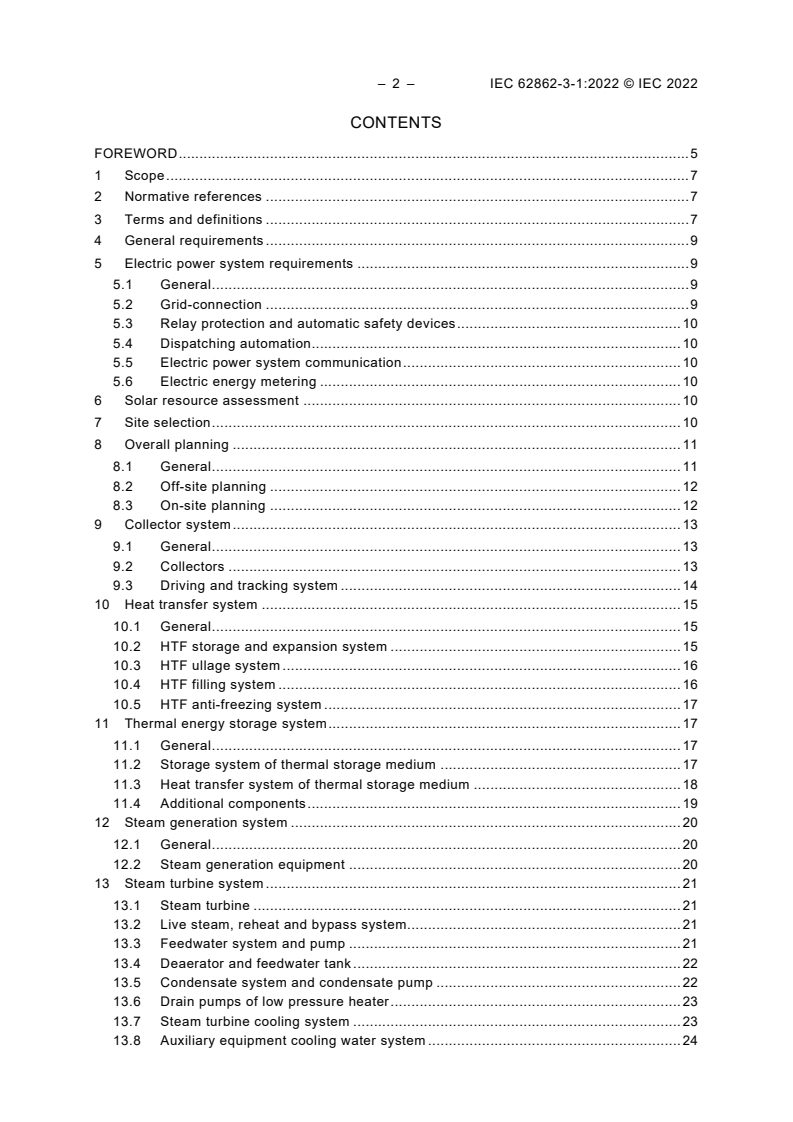
– 2 – IEC 62862-3-1:2022 © IEC 2022
CONTENTS
FOREWORD . 5
1 Scope . 7
2 Normative references . 7
3 Terms and definitions . 7
4 General requirements . 9
5 Electric power system requirements . 9
5.1 General . 9
5.2 Grid-connection . 9
5.3 Relay protection and automatic safety devices . 10
5.4 Dispatching automation . 10
5.5 Electric power system communication . 10
5.6 Electric energy metering . 10
6 Solar resource assessment . 10
7 Site selection . 10
8 Overall planning . 11
8.1 General . 11
8.2 Off-site planning . 12
8.3 On-site planning . 12
9 Collector system . 13
9.1 General . 13
9.2 Collectors . 13
9.3 Driving and tracking system . 14
10 Heat transfer system . 15
10.1 General . 15
10.2 HTF storage and expansion system . 15
10.3 HTF ullage system . 16
10.4 HTF filling system . 16
10.5 HTF anti-freezing system . 17
11 Thermal energy storage system . 17
11.1 General . 17
11.2 Storage system of thermal storage medium . 17
11.3 Heat transfer system of thermal storage medium . 18
11.4 Additional components . 19
12 Steam generation system . 20
12.1 General . 20
12.2 Steam generation equipment . 20
13 Steam turbine system . 21
13.1 Steam turbine . 21
13.2 Live steam, reheat and bypass system . 21
13.3 Feedwater system and pump . 21
13.4 Deaerator and feedwater tank . 22
13.5 Condensate system and condensate pump . 22
13.6 Drain pumps of low pressure heater . 23
13.7 Steam turbine cooling system . 23
13.8 Auxiliary equipment cooling water system . 24
13.9 Condenser and auxiliary facilities . 25
13.10 Regenerative system . 25
14 Layout of solar field . 25
14.1 General layout of solar field . 25
14.2 Layout of collectors and HTF pipelines . 26
14.3 Wind and sand protection . 26
15 Layout of power block . 26
15.1 General . 26
15.2 Layout of heat transfer facilities . 28
15.3 Layout of thermal storage facilities . 29
15.4 Layout of steam generation facilities . 29
15.5 Layout of steam turbine hall and central control building . 29
15.6 Layout of auxiliary fuel facilities . 30
15.7 Maintenance facilities . 31
16 Electrical equipment and system . 31
16.1 Generator and main transformer . 31
16.2 Main wiring . 32
16.3 AC auxiliary power system . 32
16.4 High-voltage distribution devices . 32
16.5 DC system . 32
16.6 Electrical monitoring and control . 32
16.7 Relay protection and safety automation devices . 33
16.8 Lighting system . 33
16.9 Cable selection and cable laying . 33
16.10 Overvoltage protection and grounding system . 33
17 Water treatment system . 33
17.1 Water quality and pretreatment . 33
17.2 Water pre-desalination . 34
17.3 Demineralized water treatment . 34
17.4 Condensed water fine treatment . 34
17.5 Chemical dosing and water and steam sampling . 35
17.6 Cooling water treatment . 35
17.7 Collector cleaning water treatment . 35
17.8 Waste water treatment . 35
17.9 Chemical storage . 35
18 Instrumentation and control . 36
18.1 General . 36
18.2 Automation level . 36
18.3 Control mode and control room . 36
18.4 Measurement and instrumentation . 36
18.5 Alarming . 37
18.6 Thermal process protection . 38
18.7 On-off control . 39
18.8 Analogue control . 39
18.9 Control system . 39
18.10 Control power supply . 40
18.11 Instrument tube, cable and layout of local equipment . 41
– 4 – IEC 62862-3-1:2022 © IEC 2022
19 Auxiliary systems and ancillary facilities . 41
20 Safety and protection measures . 41
Bibliography . 43
Table 1 – Various types of normal water and steam losses for a parabolic-trough solar
thermal power plant . 34
INTERNATIONAL ELECTROTECHNICAL COMMISSION
____________
SOLAR THERMAL ELECTRIC PLANTS –
Part 3-1: Systems and components – General requirements for the design
of parabolic-trough solar thermal power plants
FOREWORD
1) The International Electrotechnical Commission (IEC) is a worldwide organization for standardization comprising
all national electrotechnical committees (IEC National Committees). The object of IEC is to promote international
co-operation on all questions concerning standardization in the electrical and electronic fields. To this end and
in addition to other activities, IEC publishes International Standards, Technical Specifications, Technical Reports,
Publicly Available Specifications (PAS) and Guides (hereafter referred to as “IEC Publication(s)”). Their
preparation is entrusted to technical committees; any IEC National Committee interested in the subject dealt with
may participate in this preparatory work. International, governmental and non-governmental organizations liaising
with the IEC also participate in this preparation. IEC collaborates closely with the International Organization for
Standardization (ISO) in accordance with conditions determined by agreement between the two organizations.
2) The formal decisions or agreements of IEC on technical matters express, as nearly as possible, an international
consensus of opinion on the relevant subjects since each technical committee has representation from all
interested IEC National Committees.
3) IEC Publications have the form of recommendations for international use and are accepted by IEC National
Committees in that sense. While all reasonable efforts are made to ensure that the technical content of IEC
Publications is accurate, IEC cannot be held responsible for the way in which they are used or for any
misinterpretation by any end user.
4) In order to promote international uniformity, IEC National Committees undertake to apply IEC Publications
transparently to the maximum extent possible in their national and regional publications. Any divergence between
any IEC Publication and the corresponding national or regional publication shall be clearly indicated in the latter.
5) IEC itself does not provide any attestation of conformity. Independent certification bodies provide conformity
assessment services and, in some areas, access to IEC marks of conformity. IEC is not responsible for any
services carried out by independent certification bodies.
6) All users should ensure that they have the latest edition of this publication.
7) No liability shall attach to IEC or its directors, employees, servants or agents including individual experts and
members of its technical committees and IEC National Committees for any personal injury, property damage or
other damage of any nature whatsoever, whether direct or indirect, or for costs (including legal fees) and
expenses arising out of the publication, use of, or reliance upon, this IEC Publication or any other IEC
Publications.
8) Attention is drawn to the Normative references cited in this publication. Use of the referenced publications is
indispensable for the correct application of this publication.
9) Attention is drawn to the possibility that some of the elements of this IEC Publication may be the subject of patent
rights. IEC shall not be held responsible for identifying any or all such patent rights.
IEC 62862-3-1 has been prepared by IEC technical committee 117: Solar thermal electric plants.
It is an International Standard.
The text of this International Standard is based on the following documents:
Draft Report on voting
117/153/FDIS 117/158/RVD
Full information on the voting for its approval can be found in the report on voting indicated in
the above table.
The language used for the development of this International Standard is English.
– 6 – IEC 62862-3-1:2022 © IEC 2022
This document was drafted in accordance with ISO/IEC Directives, Part 2, and developed in
accordance with ISO/IEC Directives, Part 1 and ISO/IEC Directives, IEC Supplement, available
at www.iec.ch/members_experts/refdocs. The main document types developed by IEC are
described in greater detail at www.iec.ch/standardsdev/publications.
A list of all parts in the IEC 62862 series, published under the general title Solar thermal electric
plants, can be found on the IEC website.
The committee has decided that the contents of this document will remain unchanged until the
stability date indicated on the IEC website under webstore.iec.ch in the data related to the
specific document. At this date, the document will be
• reconfirmed,
• withdrawn,
• replaced by a revised edition, or
• amended.
SOLAR THERMAL ELECTRIC PLANTS –
Part 3-1: Systems and components – General requirements for the design
of parabolic-trough solar thermal power plants
1 Scope
This part of IEC 62862 specifies the general requirements for the design of parabolic-trough
solar thermal power plants. It includes requirements for the electric power system, solar
resource assessment, site selection, overall planning, collector system, heat transfer system,
thermal energy storage system, steam generation system, steam turbine system, layout of solar
field, layout of power block, electrical equipment and system, water treatment system,
instrumentation and control, auxiliary system and ancillary facilities, as well as considerations
concerning health and safety.
This document is applicable to the design of new, expanded or rebuilt parabolic-trough solar
thermal power plants using a steam turbine.
2 Normative references
The following documents are referred to in the text in such a way that some or all of their content
constitutes requirements of this document. For dated references, only the edition cited applies.
For undated references, the latest edition of the referenced document (including any
amendments) applies.
IEC 60076-2, Power transformers – Part 2: Temperature rise for liquid-immersed transformers
IEC 60870-5 (all parts), Telecontrol equipment and systems – Part 5: Transmission protocols
IEC 61850 (all parts), Communication networks and systems for power utility automation
IEC TS 62749, Assessment of power quality – Characteristics of electricity supplied by public
networks
IEC TS 62862-1-1, Solar thermal electric plants – Part 1-1: Terminology
IEC TS 62862-2-1, Solar thermal electric plants – Part 2-1: Thermal energy storage systems –
Characterization of active, sensible systems for direct and indirect configurations
IEC 62862-3-2, Solar thermal electric plants – Part 3-2: Systems and components – General
requirements and test methods for large-size parabolic-trough collectors
IEC TS 62862-3-3, Solar thermal electric plants – Part 3-3: Systems and components – General
requirements and test methods for solar receivers
ISO 9806, Solar energy – Solar thermal collectors – Test methods
3 Terms and definitions
For the purposes of this document, the terms and definitions given in IEC TS 62862-1-1 and
the following apply.
– 8 – IEC 62862-3-1:2022 © IEC 2022
ISO and IEC maintain terminological databases for use in standardization at the following
addresses:
• IEC Electropedia: available at https://www.electropedia.org/
• ISO Online browsing platform: available at https://www.iso.org/obp
3.1
parabolic mirror
reflector with a parabolic cross section mounted on the supporting structure of a parabolic-
trough collector
3.2
receiver efficiency
ratio of the thermal power transferred to the heat transfer fluid (HTF) to the radiant power at the
receiver aperture
3.3
heat exchanger efficiency
ratio of the energy gained by the heat transfer fluid to the energy supplied to the heat exchanger
in full-load discharge operation mode
3.4
thermal energy loss
lost energy by the thermal energy storage system during
the period of time considered, without involving any charge or discharge process and without
any external energy supply
3.5
molten salt
inorganic salt in liquid state usually composed of mixtures of alkali nitrates, alkali nitrites,
carbonates, chlorides, etc.
3.6
low-boiling-point substance
substance in heat transfer fluid whose distillation temperature is lower than the initial boiling
point of the unused heat transfer fluid
3.7
high-boiling-point substance
substance whose distillation temperature is higher than the final boiling point of the unused
heat transfer fluid, after heating testing similar to the distillation method
3.8
identification system
coding system allocating a unique identification tag to each physical object, in order to
distinguish such an object from others
3.9
drought index
ratio of the annual evaporation to the annual rainfall in a region
3.10
turbine maximum continuous rating
TMCR
maximum continuous output of the steam turbine under the conditions of design steam intake,
design live steam and reheat steam parameters, design exhaust pressure (4,9 kPa), and no
make-up water
3.11
boiler maximum continuous rating
BMCR
maximum evaporation rate of the boiler when it can produce steam safely and continuously at
design steam parameters and design make-up water temperature using the designed fuel
Note 1 to entry: The boiler maximum continuous rating condition corresponds to the inlet steam parameters when
turbine valves are wide open.
3.12
regulating volume
difference between the total volume of the heat transfer system at operating temperature and
the total volume of the heat transfer fluid at filling temperature
4 General requirements
4.1 For the design of a parabolic-trough solar thermal power plant, site resource conditions
should be evaluated considering long-term meteorological conditions at the proposed location
of the plant. As a minimum, the evaluation of average yearly direct normal irradiance (DNI)
values (P50 and P90), typical meteorological year series (P50), ambient temperature, ambient
pressure, wind speed, wind gust and relative humidity should be performed.
4.2 The steam turbine capacity, thermal storage system capacity, solar field size and
operation modes of the plant should be determined through techno-economic evaluation and
should meet the requirements of local electric power planning.
4.3 The design capacity of the plant should meet the following provisions:
a) The overall optimization should be done among the solar field aperture area, steam
generator evaporation, steam turbine capacity, HTF-thermal storage medium heat
exchanger charging power and thermal energy storage capacity.
b) The BMCR evaporation of the steam generation system should match the maximum inlet
steam flow rate of the steam turbine.
c) The turbine-generator capacity should match the maximum continuous output of the steam
turbine.
4.4 The design life time of the plant should meet the client's requirements.
4.5 A uniform identification system should be deployed in the plant design and should meet
the relevant provisions of the IEC 81346 series.
5 Electric power system requirements
5.1 General
The main transformer, circuit breaker and other electric equipment in connection with the power
grid should meet the requirements of frequent start-up/shutdown of the plant.
5.2 Grid-connection
5.2.1 The grid-connection scheme of the plant can be subject to regulations, provisions and
requirements of the local grid.
5.2.2 The voltage class for grid-connection should be selected according to the power plant
capacity.
– 10 – IEC 62862-3-1:2022 © IEC 2022
5.2.3 Off-load tap-changing transformers should be selected as main transformers. On-load
tap-changing transformers may be selected as main transformers if the voltage adjustment
calculation is proved necessary.
5.2.4 The rated power factor of the generating units of a power plant should meet the local
grid operation demands.
5.2.5 The power quality level at the point of common coupling shall meet the relevant
requirements of IEC TS 62749.
5.3 Relay protection and automatic safety devices
5.3.1 Relay protection and automatic safety devices should be designed according to the
IEC 60255 series, as well as the IEC 60870 series.
5.3.2 Configuration of line protection can be subject to requirements of the local grid.
5.4 Dispatching automation
5.4.1 Telecontrol information shall meet the requirements of the IEC 60870-5 series.
5.4.2 The solar power forecasting system may be installed in the plant, which forecasts solar
resource and power production together with the plant performance model.
5.5 Electric power system communication
The electric power system communication shall meet the requirements of the IEC 61850 series.
5.6 Electric energy metering
The electric energy metering device should meet the relevant requirements of the IEC 62053
series.
6 Solar resource assessment
Solar resource at the site should be assessed according to IEC TS 62862-1-2 and
IEC 62862-1-3.
7 Site selection
7.1 When selecting a site for a parabolic-trough solar thermal power plant, the following
factors should be considered:
a) local grid structure and local electric power planning;
b) auxiliary fuel supply;
c) requirements of urban planning;
d) water source;
e) traffic and transportation for large equipment;
f) environmental impact assessment;
g) social impact assessment;
h) outgoing line corridor;
i) landform;
j) geology;
k) seismicity;
l) hydrology;
m) meteorology;
n) construction.
7.2 When selecting a site for a parabolic-trough solar thermal power plant, the water source
should meet the following provisions:
a) If river water is used as water source, the water intake point should be located in the riverbed
section which is stable all year around, so that the impact of mud, sand, vegetation, ice,
drifting sundries and drained water backflow can be avoided.
b) If underground water is used as water source, a hydro-geological investigation report can
be subject to local requirements.
7.3 When selecting a site for a parabolic-trough solar thermal power plant, the natural
conditions should meet the following provisions:
a) The site should be selected in regions with abundant and stable DNI resources.
b) The site shall not be located in regions that include dangerous rocks, landslide, karst
development, mudslide section, seismogenic fault and goaf zone.
c) If geological disaster prone region cannot be avoided, risk assessment should be done, and
geological disaster risks should be comprehensively assessed.
d) Suspended particulate matter, airport runways and air routes, high wind speed regions, and
surrounding obstacles such as tall and large trees, mountains, buildings should be taken
into consideration.
e) The site should be located in a flat region.
f) Buildings or structures inside and outside the site should not shadow the solar field during
most of the daylight hours.
7.4 When selecting a site for a parabolic-trough solar thermal power plant, essential data of
the geological conditions of the site should be obtained, which will be used as the design basics
for buildings and structures.
7.5 The seismic fortification intensity of the site shall be determined subject to the local
provisions of seismic fortification intensity or seismic ground motion design parameters.
8 Overall planning
8.1 General
8.1.1 Overall planning of parabolic-trough solar thermal power plants should be done
considering the following factors:
a) impact of DNI on the solar field layout;
b) requirements relating to construction and production of the plant;
c) natural conditions of the site;
d) construction schedule;
e) water supply and drainage facilities;
f) heat supply piping;
g) off-site traffic;
h) outgoing line corridor;
i) flood control and drainage;
j) current stage and long-term development of the site.
– 12 – IEC 62862-3-1:2022 © IEC 2022
8.1.2 Planning for flood control and drainage should be done according to the natural
conditions and safety requirements of the site. A flood bank, flood trench or floodwall may be
used.
8.2 Off-site planning
8.2.1 Planning for off-site transportation can be subject to local laws and regulations.
8.2.2 Planning for off-site water supply and drainage facilities should be determined by
comparing alternative options, considering plant capacity, water source, topographic conditions,
environmental protection, soil and water conservation requirements, etc. Locations and piping
for off-site water intake and drainage should be planned in a harmonized way.
8.2.3 Planning for an outgoing line corridor should be done according to the design capacity
of the plant, construction scale of the current stage, planning of local electric power, as well as
direction, voltage and circuit number of transmission lines.
8.2.4 Auxiliary fuel supply, if any, shall be reasonably planned according to local
requirements of fuel supply, transportation and environmental protection.
8.3 On-site planning
8.3.1 On-site planning should meet the following provisions:
a) As per its different functions, the plant may be divided into solar field, power block and
thermal storage system. The solar field may be subdivided into subfields according to
different loop combinations.
b) Planning for corridors of incoming and outgoing power lines should be done according to
system requirements and line directions, and line crossing should be avoided.
c) Location of entrances and exits of the plant should be convenient for transportation, and
road specification can be subject to local requirements for production, living and fire
protection.
8.3.2 Planning for solar field should meet the following provisions:
a) The solar field should be reasonably arranged according to topographic conditions,
equipment specifications and construction requirements. The solar field should use the
modularization arrangement in subfields.
b) The layout of the solar field should be comprehensively determined considering longitude,
latitude, altitude and other geographical factors of the site, as well as site area and collector
cost.
c) The installation height of the collector should be determined considering local flood levels
and snow thickness.
d) For a site with high wind and dust, wind barriers and dust control facilities should be
considered according to the wind direction and collector layout direction.
e) The layout of piping in the solar field should be planned in a harmonized way, and pipelines
of HTF and cables should be laid along roadsides.
8.3.3 Planning for the power block should meet the following provisions:
a) The power block should be located in the centre of the plant.
b) Taking into account rational process flow, the planning for the subregion division and
building layout in the power block should be done according to local sunlight direction, wind
direction, topographical and geotechnical conditions.
c) Auxiliary and ancillary buildings with similar functions should be arranged side by side in
the same subregion.
d) The layout of auxiliary fuel facilities (if any) may be determined according to the fuel type,
supply and transportation conditions. If such facilities are located inside the power block,
they should be arranged in a separated area.
e) Thermal energy storage facilities should be arranged in a separated area.
f) The location of collector assembly workshops should be considered.
8.3.4 Plant layout and site selection can be subject to local regulations on environment and
safety for protection against flooding, earthquake and other natural disasters.
8.3.5 The flood protection standards of the plant can be subject to local codes and
regulations, and mutually agreed with the client.
9 Collector system
9.1 General
9.1.1 The scale of the collector system should be determined through techno-economic
evaluation considering plant capacity, annual equivalent operation hours, DNI conditions,
thermal energy storage system capacity and collector specifications.
9.1.2 Collectors shall meet the provisions of IEC 62862-3-2.
9.1.3 The specifications of each collector component should match each other.
9.1.4 Collectors should meet the design requirements of the plant under normal operating
conditions, considering exceptional situations such as extreme wind speed and extreme
temperature.
9.2 Collectors
9.2.1 Collectors should meet the following provisions:
a) Collectors should be designed to survive at the maximum wind speed with a recurrence
period of 50 years at stow position following the indications of local wind load codes and the
technical specification of the plant.
b) Collectors should be designed to bear the reference snow pressure with a recurrent period
of 50 years at stow position.
c) Collectors can be subject to other local meteorological conditions and applicable codes.
d) Loads to be applied to the collector structural models may be obtained from wind tunnel
tests or computational fluid dynamics previously calibrated and tested with wind tunnel
results.
9.2.2 Parabolic mirrors should be selected according to the following provisions:
a) Parabolic mirrors should be selected including but not limited to hot bending mirrors,
toughened mirrors, laminated mirrors, or mirrors made from metals and polymer reflective
materials.
b) Parabolic mirrors should satisfy the requirements of sand and hail impact on the basis of
local climate conditions.
c) The reflectance and curvature accuracy of the parabolic mirrors should meet the
performance requirements of the collectors.
d) Parabolic mirrors should have protective layer(s) to meet the durability requirements of anti-
wear and anti-ageing.
– 14 – IEC 62862-3-1:2022 © IEC 2022
9.2.3 In order to ensure performance of the solar field, the parabolic mirrors should have an
average solar specular reflectance not lower than 93 % according to ISO 9050. Durability of the
parabolic mirrors should be proven by accelerated ageing tests and should meet the design
lifetime requirement of the plant.
9.2.4 Receivers should be selected according to the following provisions:
a) The material of receivers should meet the requirements of the HTF.
b) The design temperature and pressure of the receivers should match the operating
temperature and pressure of the HTF.
c) The durability and technical performance parameters of solar receivers shall meet the
provisions of IEC TS 62862-3-3.
9.2.5 Supporting structures should meet the following provisions:
a) Supporting structures should be designed following applicable codes, considering local
ambient and climate conditions. The strength and stiffness of the supporting structure
should meet the requirements of focusing and tracking accuracy.
b) The anti-corrosion design of the supporting structure should be determined according to
local climatic conditions and design lifetime.
c) Supporting structures should be able to compensate the thermal expansion of the receivers
and related parts during operation.
9.3 Driving and tracking system
9.3.1 The tracking accuracy of the driving and tracking system should be determined through
techno-economic evaluation according to the collector overall performance.
9.3.2 Driving devices should be hydraulic or mechanical. Driving and tracking systems
should be adapted to the outdoor environment.
9.3.3 Driving devices should be designed to be compatible within the complete rotation angle
range, to prevent the collector from getting stuck and to drive the collector into stow position
within the required time specified in the design.
9.3.4 Electrical and control equipment of the driving devices should meet the following
provisions:
a) The protection level should not be lower than IP55.
b) The local controller should be placed on the drive pylon, and should match the drive pylon
to facilitate operation and maintenance.
c) The local controller should have an automatic mode and a manual mode. The automatic
mode should meet the requirements of normal operating conditions and emergency
protection of the system. The manual mode should meet the needs of commissioning,
maintenance and cleaning.
9.3.5 The driving device of the collector should be equipped with a shared or an individual
reliable emergency power supply and/or energy accumulator, in order to safely defocus the
collector in case of a power blackout to avoid overheating the HTF during operation. The
emergency power supply configuration should meet the power supply requirement to drive the
collector back to stow position in case of a power blackout.
9.3.6 The driving device should be able to hold the collector in any position under regular
design conditions, and no free rotation of the collector should be possible.
10 Heat transfer system
10.1 General
10.1.1 The design flow rate of the heat transfer system should be determined through techo-
economic evaluation considering the configuration of the collector system, design capacity of
the steam turbine and operation modes of the plant.
10.1.2 For the selection of HTF, the following factors should be considered:
a) thermal expansion coefficient;
b) thermal and chemical stability;
c) specific heat capacity, thermal conductivity, kinematic viscosity;
d) operating temperature, freezing point;
e) flash point, corrosion-free properties;
f) environment friendly qualities.
10.1.3 The HTF could be thermal oil. If it makes sense technically and economically, molten
salt, water or other heat transfer fluids could be used. This document mainly focuses on the
regulations and requirements of thermal oil as a heat transfer fluid.
10.1.4 If the historical extreme minimum temperature of the site is lower than the freezing
point of the HTF, anti-freezing measures should be considered in the plant design.
10.1.5 The flow rate and number of HTF main pumps should meet the following provisions:
a) The flow rate of the main pumps should meet the total flow rate requirement at the thermal
load design point of the solar field, plus at least a 5 % margin.
b) The main pumps should comprise at least two sets including at least one redundant set, and
should be equipped with variable frequency control devices. If one pump is out-of-service,
the remaining pump(s) should meet the total flow rate requirement.
c) For the discharge head of the main pumps, the following factors should be considered:
• pressure drop due to pipe flow friction and local fitting friction along all HTF pipeline
calculated at design point flow rate;
• the largest value among the following three sums calculated at design point flow rate:
sum of solar field pressure drop and steam generation system pressure drop, sum of
solar field pressure drop and thermal energy storage system pressure drop, and sum of
thermal energy storage system pressure drop and steam generation system pressure
drop in discharge operation mode;
• static pressure due to different height between the highest point of HTF returning pipe
and the minimum liquid level in the expansion tank;
• at least 5 % margin.
10.1.6 Bypass filters should be installed in the system pipeline, depending on the specific
properties of the HTF.
10.2 HTF storage and expansion system
10.2.1 If using thermal oil as HTF, the heat transfer system should include an expansion tank,
overflow tank(s), overflow pump(s) and a nitrogen coverage system. A nitrogen coverage
system shall be used if the HTF is easily flammable.
10.2.2 All venting pipes should be led to the expansion tank.
– 16 – IEC 62862-3-1:2022 © IEC 2022
10.2.3 The regulating volume should be at least 1,3 times the total volume increase of the
HTF from filling temperature to operating temperature.
10.2.4 The operating pressure of the expansion tank should not be less than the
corresponding vapour pressure at the maximum temperature of the HTF under all working
conditions, plus a margin of 30 kPa to 50 kPa.
10.2.5 Multiple overflow tanks may be used if the dimension of one single tank is too big and
difficult for manufacture or transportation.
10.2.6 The design pressure of the overflow tank(s) should be the same as that of the
expansion tank.
10.2.7 If it makes sense technically and economically, the volume of the expansion tank may
be increased and usage of overflow tank(s) may be cancelled.
10.2.8 When using overflow tanks, two or more overflow pumps sh
...