

IEC 60958-4-4:2016
(Main)Digital audio interface - Part 4-4: Professional applications - Physical and electrical parameters
General Information
- Abstract
IEC 60958-4-4:2016 specifies the physical and electrical parameters for different media. This part together with IEC 60958-1, IEC 60958-4-1, and IEC 60958-4-2 specify an interface for the serial digital transmission of two channels of periodically sampled and linearly represented digital audio data from one transmitter to one receiver. This first edition, together with IEC 60958-4-1 and IEC 60958-4-2, cancels and replaces the IEC 60958-4 published in 2003 and its Amendment 1:2008 and constitutes a technical revision. This edition includes the following significant technical changes with respect to IEC 60958-4:2003 with its Amendment 1:2008:
- support for a wider range of physical media;
- support for a wider range of audio sampling frequencies;
- deprecation of "minimum implementation" of channel status data.
- Status
- Published
- Publication Date
- 23-Mar-2016
- Technical Committee
- TC 100 - Audio, video and multimedia systems and equipment
- Current Stage
- PPUB - Publication issued
- Start Date
- 24-Mar-2016
- Completion Date
- 30-Apr-2016
Overview
IEC 60958-4-4:2016 is an international standard developed by the International Electrotechnical Commission (IEC) that specifies the physical and electrical parameters for digital audio interfaces used in professional audio applications. It is part 4-4 of the IEC 60958 series titled Digital audio interface. This standard provides detailed requirements for the serial digital transmission of two channels of periodically sampled and linearly represented digital audio data from a single transmitter to a single receiver.
This 2016 edition revises and replaces the original IEC 60958-4 standard published in 2003 and its Amendment 1:2008, enhancing the support for a wider range of physical media and audio sampling frequencies while deprecating the minimum implementation of channel status data.
Key Topics
Physical and Electrical Parameters
Defines how digital audio data is transmitted over different physical media such as balanced cables, coaxial cables, and optical fibers.Interface Characteristics
Specifies line driver and line receiver characteristics including output impedance, signal amplitude, rise and fall times, terminating impedance, and receiver equalization to ensure reliable signal transmission.Jitter Management
Details output interface jitter, intrinsic jitter, jitter gain, and receiver jitter tolerance to maintain signal integrity for professional audio equipment.Supported Audio Sampling Frequencies
Expands the range of supported audio sampling frequencies to accommodate modern high-resolution audio formats and professional broadcast standards.Connector and Cable Specifications
Outlines requirements for connectors such as XLR and 8-way modular connectors, as well as cable characteristics for balanced, coaxial, and optical transmission to ensure compatibility and performance.Technical Revisions
Incorporates updated requirements for faster symbol rates, better jitter control, and supports diverse transmission media, contributing to improved interoperability and robustness in professional audio installations.
Applications
IEC 60958-4-4:2016 is essential for:
Professional Audio Systems
Used in studios, broadcast facilities, live sound reinforcement, and post-production setups requiring high-fidelity digital audio distribution.Digital Audio Equipment Manufacturing
Guides manufacturers in designing hardware that complies with standardized digital interface parameters for reliable signal transmission and interoperability.Audio Signal Transmission Infrastructure
Informing the selection and deployment of appropriate cables, connectors, and transmission methods for various professional environments.High-Resolution Audio Transmission
Facilitates support for increased audio sampling rates, enabling compatibility with modern audio production and playback formats.Quality Assurance and Testing
Provides criteria for testing jitter performance, signal integrity, and electrical characteristics to meet professional audio standards.
Related Standards
IEC 60958-1
General requirements and definitions for digital audio interfaces.IEC 60958-4-1 and IEC 60958-4-2
Complementary parts covering professional applications detailing data structure and functional parameters associated with digital audio interfaces.IEC 60958 Series
The overarching set of standards defining the complete framework for digital audio interfaces in both consumer and professional environments.
Why IEC 60958-4-4:2016 Matters
This standard ensures international uniformity of digital audio interface specifications for professional use, supporting a wide range of physical transmission media and audio sampling rates. Compliance with IEC 60958-4-4:2016 guarantees high-quality audio transmission with minimized jitter and electrical interference, facilitating seamless interoperability among professional audio equipment across manufacturers and industries.
For audio engineers, manufacturers, and system integrators, adhering to IEC 60958-4-4 is critical for achieving reliable and precise digital audio signal transmission that meets contemporary professional demands.
Relations
- Effective Date
- 05-Sep-2023
- Effective Date
- 05-Sep-2023
Get Certified
Connect with accredited certification bodies for this standard

ANCE
Mexican certification and testing association.

IMP NDT d.o.o.
Non-destructive testing services. Radiography, ultrasonic, magnetic particle, penetrant, visual inspection.
Inštitut za kovinske materiale in tehnologije
Institute of Metals and Technology. Materials testing, metallurgical analysis, NDT.
Sponsored listings
Frequently Asked Questions
IEC 60958-4-4:2016 is a standard published by the International Electrotechnical Commission (IEC). Its full title is "Digital audio interface - Part 4-4: Professional applications - Physical and electrical parameters". This standard covers: IEC 60958-4-4:2016 specifies the physical and electrical parameters for different media. This part together with IEC 60958-1, IEC 60958-4-1, and IEC 60958-4-2 specify an interface for the serial digital transmission of two channels of periodically sampled and linearly represented digital audio data from one transmitter to one receiver. This first edition, together with IEC 60958-4-1 and IEC 60958-4-2, cancels and replaces the IEC 60958-4 published in 2003 and its Amendment 1:2008 and constitutes a technical revision. This edition includes the following significant technical changes with respect to IEC 60958-4:2003 with its Amendment 1:2008: - support for a wider range of physical media; - support for a wider range of audio sampling frequencies; - deprecation of "minimum implementation" of channel status data.
IEC 60958-4-4:2016 specifies the physical and electrical parameters for different media. This part together with IEC 60958-1, IEC 60958-4-1, and IEC 60958-4-2 specify an interface for the serial digital transmission of two channels of periodically sampled and linearly represented digital audio data from one transmitter to one receiver. This first edition, together with IEC 60958-4-1 and IEC 60958-4-2, cancels and replaces the IEC 60958-4 published in 2003 and its Amendment 1:2008 and constitutes a technical revision. This edition includes the following significant technical changes with respect to IEC 60958-4:2003 with its Amendment 1:2008: - support for a wider range of physical media; - support for a wider range of audio sampling frequencies; - deprecation of "minimum implementation" of channel status data.
IEC 60958-4-4:2016 is classified under the following ICS (International Classification for Standards) categories: 19.040 - Environmental testing; 33.160.30 - Audio systems. The ICS classification helps identify the subject area and facilitates finding related standards.
IEC 60958-4-4:2016 has the following relationships with other standards: It is inter standard links to IEC 60958-4:2003, IEC 60958-4:2003/AMD1:2008. Understanding these relationships helps ensure you are using the most current and applicable version of the standard.
IEC 60958-4-4:2016 is available in PDF format for immediate download after purchase. The document can be added to your cart and obtained through the secure checkout process. Digital delivery ensures instant access to the complete standard document.
Standards Content (Sample)
IEC 60958-4-4 ®
Edition 1.0 2016-03
INTERNATIONAL
STANDARD
NORME
INTERNATIONALE
Digital audio interface –
Part 4-4: Professional applications – Physical and electrical parameters
Interface audionumérique –
Partie 4-4: Applications professionnelles – Paramètres physiques et électriques
All rights reserved. Unless otherwise specified, no part of this publication may be reproduced or utilized in any form
or by any means, electronic or mechanical, including photocopying and microfilm, without permission in writing from
either IEC or IEC's member National Committee in the country of the requester. If you have any questions about IEC
copyright or have an enquiry about obtaining additional rights to this publication, please contact the address below or
your local IEC member National Committee for further information.
Droits de reproduction réservés. Sauf indication contraire, aucune partie de cette publication ne peut être reproduite
ni utilisée sous quelque forme que ce soit et par aucun procédé, électronique ou mécanique, y compris la photocopie
et les microfilms, sans l'accord écrit de l'IEC ou du Comité national de l'IEC du pays du demandeur. Si vous avez des
questions sur le copyright de l'IEC ou si vous désirez obtenir des droits supplémentaires sur cette publication, utilisez
les coordonnées ci-après ou contactez le Comité national de l'IEC de votre pays de résidence.
IEC Central Office Tel.: +41 22 919 02 11
3, rue de Varembé Fax: +41 22 919 03 00
CH-1211 Geneva 20 info@iec.ch
Switzerland www.iec.ch
About the IEC
The International Electrotechnical Commission (IEC) is the leading global organization that prepares and publishes
International Standards for all electrical, electronic and related technologies.
About IEC publications
The technical content of IEC publications is kept under constant review by the IEC. Please make sure that you have the
latest edition, a corrigenda or an amendment might have been published.
IEC Catalogue - webstore.iec.ch/catalogue Electropedia - www.electropedia.org
The stand-alone application for consulting the entire The world's leading online dictionary of electronic and
bibliographical information on IEC International Standards, electrical terms containing 20 000 terms and definitions in
Technical Specifications, Technical Reports and other English and French, with equivalent terms in 15 additional
documents. Available for PC, Mac OS, Android Tablets and languages. Also known as the International Electrotechnical
iPad. Vocabulary (IEV) online.
IEC publications search - www.iec.ch/searchpub IEC Glossary - std.iec.ch/glossary
The advanced search enables to find IEC publications by a 65 000 electrotechnical terminology entries in English and
variety of criteria (reference number, text, technical French extracted from the Terms and Definitions clause of
committee,…). It also gives information on projects, replaced IEC publications issued since 2002. Some entries have been
and withdrawn publications. collected from earlier publications of IEC TC 37, 77, 86 and
CISPR.
IEC Just Published - webstore.iec.ch/justpublished
Stay up to date on all new IEC publications. Just Published IEC Customer Service Centre - webstore.iec.ch/csc
details all new publications released. Available online and If you wish to give us your feedback on this publication or
also once a month by email. need further assistance, please contact the Customer Service
Centre: csc@iec.ch.
A propos de l'IEC
La Commission Electrotechnique Internationale (IEC) est la première organisation mondiale qui élabore et publie des
Normes internationales pour tout ce qui a trait à l'électricité, à l'électronique et aux technologies apparentées.
A propos des publications IEC
Le contenu technique des publications IEC est constamment revu. Veuillez vous assurer que vous possédez l’édition la
plus récente, un corrigendum ou amendement peut avoir été publié.
Catalogue IEC - webstore.iec.ch/catalogue Electropedia - www.electropedia.org
Application autonome pour consulter tous les renseignements
Le premier dictionnaire en ligne de termes électroniques et
bibliographiques sur les Normes internationales,
électriques. Il contient 20 000 termes et définitions en anglais
Spécifications techniques, Rapports techniques et autres
et en français, ainsi que les termes équivalents dans 15
documents de l'IEC. Disponible pour PC, Mac OS, tablettes
langues additionnelles. Egalement appelé Vocabulaire
Android et iPad.
Electrotechnique International (IEV) en ligne.
Recherche de publications IEC - www.iec.ch/searchpub
Glossaire IEC - std.iec.ch/glossary
La recherche avancée permet de trouver des publications IEC 65 000 entrées terminologiques électrotechniques, en anglais
en utilisant différents critères (numéro de référence, texte, et en français, extraites des articles Termes et Définitions des
comité d’études,…). Elle donne aussi des informations sur les publications IEC parues depuis 2002. Plus certaines entrées
projets et les publications remplacées ou retirées. antérieures extraites des publications des CE 37, 77, 86 et
CISPR de l'IEC.
IEC Just Published - webstore.iec.ch/justpublished
Service Clients - webstore.iec.ch/csc
Restez informé sur les nouvelles publications IEC. Just
Published détaille les nouvelles publications parues. Si vous désirez nous donner des commentaires sur cette
Disponible en ligne et aussi une fois par mois par email. publication ou si vous avez des questions contactez-nous:
csc@iec.ch.
IEC 60958-4-4 ®
Edition 1.0 2016-03
INTERNATIONAL
STANDARD
NORME
INTERNATIONALE
Digital audio interface –
Part 4-4: Professional applications – Physical and electrical parameters
Interface audionumérique –
Partie 4-4: Applications professionnelles – Paramètres physiques et électriques
INTERNATIONAL
ELECTROTECHNICAL
COMMISSION
COMMISSION
ELECTROTECHNIQUE
INTERNATIONALE
ICS 33.160.30 ISBN 978-2-8322-3233-0
– 2 – IEC 60958-4-4:2016 IEC 2016
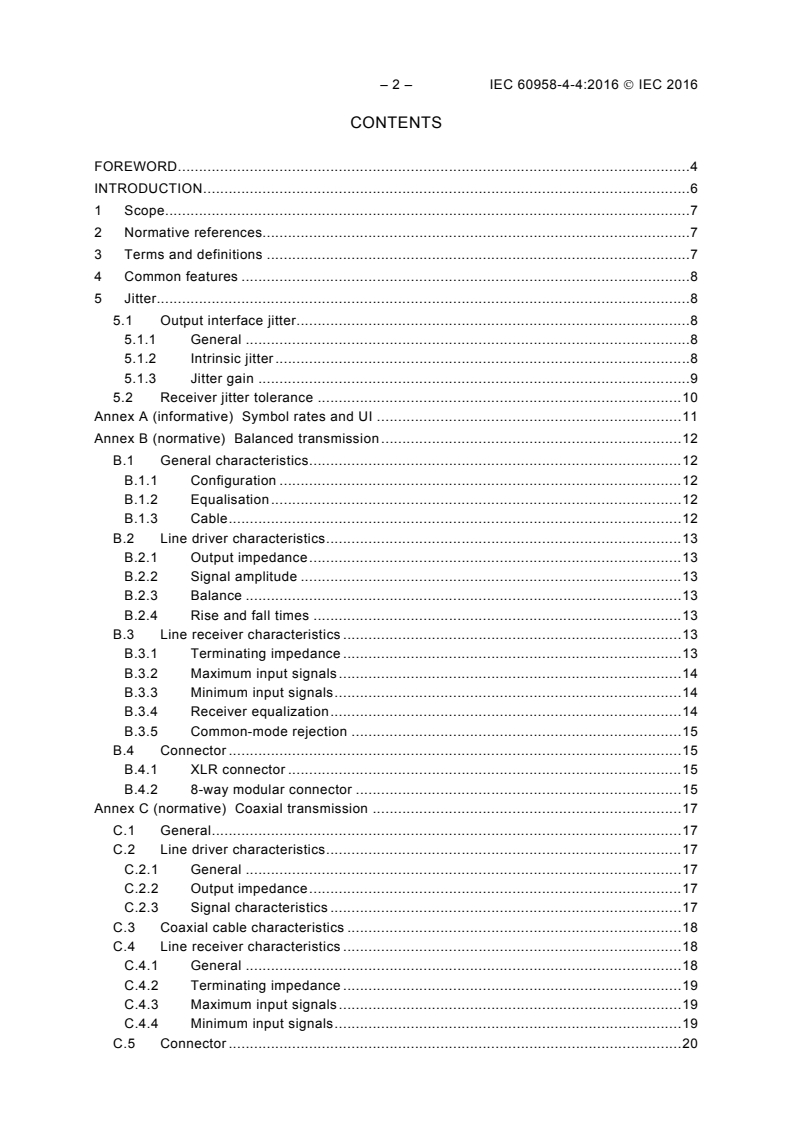
CONTENTS
FOREWORD . 4
INTRODUCTION . 6
1 Scope . 7
2 Normative references. 7
3 Terms and definitions . 7
4 Common features . 8
5 Jitter . 8
5.1 Output interface jitter . 8
5.1.1 General . 8
5.1.2 Intrinsic jitter . 8
5.1.3 Jitter gain . 9
5.2 Receiver jitter tolerance . 10
Annex A (informative) Symbol rates and UI . 11
Annex B (normative) Balanced transmission . 12
B.1 General characteristics . 12
B.1.1 Configuration . 12
B.1.2 Equalisation . 12
B.1.3 Cable . 12
B.2 Line driver characteristics . 13
B.2.1 Output impedance . 13
B.2.2 Signal amplitude . 13
B.2.3 Balance . 13
B.2.4 Rise and fall times . 13
B.3 Line receiver characteristics . 13
B.3.1 Terminating impedance . 13
B.3.2 Maximum input signals . 14
B.3.3 Minimum input signals . 14
B.3.4 Receiver equalization . 14
B.3.5 Common-mode rejection . 15
B.4 Connector . 15
B.4.1 XLR connector . 15
B.4.2 8-way modular connector . 15
Annex C (normative) Coaxial transmission . 17
C.1 General . 17
C.2 Line driver characteristics . 17
C.2.1 General . 17
C.2.2 Output impedance . 17
C.2.3 Signal characteristics . 17
C.3 Coaxial cable characteristics . 18
C.4 Line receiver characteristics . 18
C.4.1 General . 18
C.4.2 Terminating impedance . 19
C.4.3 Maximum input signals . 19
C.4.4 Minimum input signals . 19
C.5 Connector . 20
Annex D (informative) Optical transmission . 21
D.1 Short haul . 21
D.2 Medium haul . 21
D.3 Long haul . 21
Bibliography . 22
Figure 1 – Intrinsic-jitter measurement-filter characteristic . 9
Figure 2 – Jitter transfer-function mask . 10
Figure 3 – Jitter tolerance template . 10
Figure B.1 – Simplified example of the configuration of the circuit (balanced) . 12
Figure B.2 – Eye diagram, balanced receiver . 14
Figure B.3 – Suggested equalizing characteristic for a receiver operating at 48 kHz
frame rate . 15
Figure C.1 – Output signal waveform . 17
Figure C.2 – Eye diagram, coaxial receiver . 19
Figure C.3 – Eye pattern for long-distance transmission . 20
Table A.1 – Symbol rate versus sampling frequency . 11
Table A.2 – UI (ns) versus sampling frequency . 11
Table C.1 – Output signal characteristics . 18
– 4 – IEC 60958-4-4:2016 IEC 2016
INTERNATIONAL ELECTROTECHNICAL COMMISSION
____________
DIGITAL AUDIO INTERFACE –
Part 4-4: Professional applications –
Physical and electrical parameters
FOREWORD
1) The International Electrotechnical Commission (IEC) is a worldwide organization for standardization comprising
all national electrotechnical committees (IEC National Committees). The object of IEC is to promote
international co-operation on all questions concerning standardization in the electrical and electronic fields. To
this end and in addition to other activities, IEC publishes International Standards, Technical Specifications,
Technical Reports, Publicly Available Specifications (PAS) and Guides (hereafter referred to as “IEC
Publication(s)”). Their preparation is entrusted to technical committees; any IEC National Committee interested
in the subject dealt with may participate in this preparatory work. International, governmental and non-
governmental organizations liaising with the IEC also participate in this preparation. IEC collaborates closely
with the International Organization for Standardization (ISO) in accordance with conditions determined by
agreement between the two organizations.
2) The formal decisions or agreements of IEC on technical matters express, as nearly as possible, an international
consensus of opinion on the relevant subjects since each technical committee has representation from all
interested IEC National Committees.
3) IEC Publications have the form of recommendations for international use and are accepted by IEC National
Committees in that sense. While all reasonable efforts are made to ensure that the technical content of IEC
Publications is accurate, IEC cannot be held responsible for the way in which they are used or for any
misinterpretation by any end user.
4) In order to promote international uniformity, IEC National Committees undertake to apply IEC Publications
transparently to the maximum extent possible in their national and regional publications. Any divergence
between any IEC Publication and the corresponding national or regional publication shall be clearly indicated in
the latter.
5) IEC itself does not provide any attestation of conformity. Independent certification bodies provide conformity
assessment services and, in some areas, access to IEC marks of conformity. IEC is not responsible for any
services carried out by independent certification bodies.
6) All users should ensure that they have the latest edition of this publication.
7) No liability shall attach to IEC or its directors, employees, servants or agents including individual experts and
members of its technical committees and IEC National Committees for any personal injury, property damage or
other damage of any nature whatsoever, whether direct or indirect, or for costs (including legal fees) and
expenses arising out of the publication, use of, or reliance upon, this IEC Publication or any other IEC
Publications.
8) Attention is drawn to the Normative references cited in this publication. Use of the referenced publications is
indispensable for the correct application of this publication.
9) Attention is drawn to the possibility that some of the elements of this IEC Publication may be the subject of
patent rights. IEC shall not be held responsible for identifying any or all such patent rights.
International Standard IEC 60958-4-4 has been prepared by technical area 4: Digital system
interfaces and protocols, of IEC technical committee 100: Audio, video and multimedia
systems and equipment.
This first edition, together with IEC 60958-4-1 and IEC 60958-4-2, cancels and replaces the
IEC 60958-4 published in 2003 and its Amendment 1:2008 and constitutes a technical
revision.
This edition includes the following significant technical changes with respect to
IEC 60958-4:2003 with its Amendment 1:2008:
a) support for a wider range of physical media;
b) support for a wider range of audio sampling frequencies;
c) deprecation of “minimum implementation” of channel status data.
The text of this standard is based on the following documents:
CDV Report on voting
100/2454/CDV 100/2583/RVC
Full information on the voting for the approval of this standard can be found in the report on
voting indicated in the above table.
A list of all parts in the IEC 60958 series, published under the general title Digital audio
interface, can be found on the IEC website.
This publication has been drafted in accordance with the ISO/IEC Directives, Part 2.
The committee has decided that the contents of this publication will remain unchanged until
the stability date indicated on the IEC website under "http://webstore.iec.ch" in the data
related to the specific publication. At this date, the publication will be
• reconfirmed,
• withdrawn,
• replaced by a revised edition, or
• amended.
– 6 – IEC 60958-4-4:2016 IEC 2016
INTRODUCTION
The two-channel digital audio interface has been widely used in a variety of professional
audio applications that have reached beyond the vision of the original standard. In particular,
applications using increased sampling frequencies and alternative physical media.
Separating the standard into independently-maintainable parts allows, for example, additional
transmission media to be introduced in the future by revising IEC 60958-4-4 without affecting
the other parts of the IEC 60958-4 series. The parts comprise:
Part 4-1: Audio content: defines the format for coding audio used for the audio content. It
specifies the semantics of the audio data, including the "validity" flag. It also
specifies the sampling frequency by reference to AES5.
Part 4-2: Metadata and subcode: specifies the format for information, metadata, or subcode
transmitted with the audio data: principally the channel status but also user data
and the auxiliary bits. Implementors will note that the current implementation
options ("Standard" and "Enhanced") both require that status data be
implemented correctly in compliant equipment.
Part 4-4: Physical and electrical parameters: specifies the physical signals that convey the
bit stream specified in IEC 60958-1. The transport format is intended for use with
shielded twisted-pair cable of conventional design over distances of up to 100 m
at frame rates of up to 50 kHz. Longer cable lengths and higher frame rates may
be used, but with a rapidly increasing requirement for care in cable selection and
possible receiver equalization, or the use of active repeaters. Provision is made in
this standard for adapting the balanced terminals to use 75 Ω coaxial cable.
Transmission by fibre-optic cable is under consideration.
DIGITAL AUDIO INTERFACE –
Part 4-4: Professional applications –
Physical and electrical parameters
1 Scope
This part of IEC 60958 specifies the physical and electrical parameters for different media.
This part together with IEC 60958-1, IEC 60958-4-1, and IEC 60958-4-2 specify an interface
for the serial digital transmission of two channels of periodically sampled and linearly
represented digital audio data from one transmitter to one receiver.
The transport format defined in IEC 60958-1 is intended for use with shielded twisted-pair
cable of conventional design over distances of up to 100 m without transmission equalization
or any special equalization at the receiver and at frame rates of up to 50 kHz. Longer cable
lengths and higher frame rates may be used, but with a rapidly increasing requirement for
care in cable selection and possible receiver equalization or the use of active repeaters, or
both. Provision is made in this standard for adapting the balanced terminals to use 75 Ω
coaxial cable, and transmission by fibre-optic cable is under consideration. This standard
does not cover connection to any common carrier equipment. In this interface specification,
an interface for consumer use is also mentioned. The two interfaces are not identical.
2 Normative references
The following documents, in whole or in part, are normatively referenced in this document and
are indispensable for its application. For dated references, only the edition cited applies. For
undated references, the latest edition of the referenced document (including any
amendments) applies.
IEC 60268-12, Sound system equipment – Part 12: Application of connectors for broadcast
and similar use
IEC 60603-7 (all parts), Connectors for electronic equipment – Part 7: Detail specification for
8-way, unshielded, free and fixed connectors
IEC 60958-1:2008, Digital audio interface – Part 1: General
IEC 60958-1:2008/AMD1:2014
IEC 60958-4-1, Digital audio interface – Part 4-1: Professional applications – Audio content
IEC 60958-4-2, Digital audio interface – Part 4-2: Professional applications – Metadata and
subcode
IEC 61169-8, Radio-frequency connectors – Part 8: Sectional specification – RF coaxial
connectors with inner diameter of outer conductor 6,5 mm (0,256 in) with bayonet lock –
Characteristic impedance 50 Ω (type BNC)
ISO/IEC 11801, Information technology – Generic cabling for customer premises
3 Terms and definitions
For the purposes of this document, the following terms and definitions apply.
– 8 – IEC 60958-4-4:2016 IEC 2016
3.1
unit interval
UI
shortest nominal time interval in the coding scheme
Note 1 to entry: There are 128 UI in a sample frame. See Annex A.
Note 2 to entry: This note applies to the French language only.
3.2
interface jitter
deviation in timing of interface data transitions (zero crossings) when measured with respect
to an ideal clock
3.3
intrinsic jitter
output interface jitter of a device that is either free-running or synchronized to a jitter-free
reference
3.4
jitter gain
ratio of the amplitude of jitter at the synchronization input of a device to the resultant jitter at
the output of the device
Note 1 to entry: This definition excludes the effect of intrinsic jitter.
Note 2 to entry: The ratio is expressed in decibels.
3.5
frame rate
frequency at which frames are transmitted
4 Common features
All interfaces shall be subject to the common jitter requirements in accordance with Clause 5.
Other parameters shall comply with the transmission type specified.
The interface should use the balanced transmission format specified in Annex B. The
interface may use the format specified in Annex C or one of the alternative transmission
formats to be specified in a future edition (see Annex D).
5 Jitter
5.1 Output interface jitter
5.1.1 General
Jitter at the output of a device shall be measured as the sum of the jitter intrinsic to the device
and jitter being passed through from the timing reference of the device.
5.1.2 Intrinsic jitter
The peak value of the intrinsic jitter at the output of the interface, measured at all the
transition zero crossings shall be less than 0,025 UI when measured with the intrinsic-jitter
measurement filter.
The following aspects have to be considered.
• This jitter may be strongly asymmetric and the deviation from the ideal timing should meet
the specification in either direction.
• This requirement applies both when the equipment is locked to an effectively jitter-free
timing reference, which may be a modulated digital audio signal, and when the equipment
is free-running.
• The intrinsic-jitter measurement-filter characteristic is shown in Figure 1. It shows a
minimum-phase high-pass filter with 3 dB attenuation at 700 Hz, a first order roll-off to
70 Hz and with a pass-band gain of unity.
700 Hz, –3 dB
–10
–20
70 Hz, –20 dB
–30
4 5 6 7
10 100 1 000 10 10 10 10
Jitter frequency (Hz)
IEC
Figure 1 – Intrinsic-jitter measurement-filter characteristic
5.1.3 Jitter gain
The sinusoidal jitter gain from any timing reference input to the signal output shall be less
than 2 dB at all frequencies.
If jitter attenuation is provided and it is such that the sinusoidal jitter gain falls below the jitter
transfer function mask of Figure 2 then the equipment specification should state that the
equipment jitter attenuation is within the specification of this standard. The mask imposes no
additional limit on low-frequency jitter gain. The limit starts at the input-jitter frequency of
500 Hz where it is 0 dB, and falls to –6 dB at and above 1 kHz.
Gain (dB)
– 10 – IEC 60958-4-4:2016 IEC 2016
500 Hz, 0 dB
1 000 Hz, –6 dB
–10
4 5 6 7
10 100 1 000 10 10 10 10
Jitter frequency (Hz)
IEC
Figure 2 – Jitter transfer-function mask
5.2 Receiver jitter tolerance
An interface data receiver should correctly decode an incoming data stream with any
sinusoidal jitter defined by the jitter tolerance template of Figure 3.
The template requires a jitter tolerance of 0,25 UI peak-to-peak at high frequencies,
increasing with the inverse of frequency below 8 kHz to level off at 10 UI peak-to-peak below
200 Hz.
200 Hz
(UI)
Tolerance
8 000 Hz
0,25 UI
0,1
4 5 6 7
10 100 1 000
10 10 10 10
Jitter frequency (Hz)
IEC
Figure 3 – Jitter tolerance template
Tolerance (UI)
Gain (dB)
Annex A
(informative)
Symbol rates and UI
Demands on the performance of the interface are determined by the frame rate, which is in
turn determined by the audio sampling frequency. AES5 recommends a set of sampling
frequencies referred to a basic rate of 48 kHz with options to use 44,1 kHz or 32 kHz. These
basic rates may be scaled by certain multiples to achieve higher or lower sampling
frequencies.
Table A.1 and Table A.2 illustrate how the symbol rate at the interface, and the UI, change
with different sampling-frequency multiples.
Table A.1 – Symbol rate versus sampling frequency
Sampling frequency (F )
s
kHz
Multiple 32 44,1 48
0,25 1,024 1,411 2 1,536
0,5 2,048 2,822 4 3,072
1 4,096 5,644 8 6,144
2 8,192 11,289 6 12,288
4 16,384 22,579 2 24,576
8 32,768 45,158 4 49,152
Table A.2 – UI (ns) versus sampling frequency
Sampling Frequency (F )
s
kHz
Multiple 32 44,1 48
0,25 976,56 708,62 651,04
0,5 488,28 354,31 325,52
1 244,14 177,15 162,76
2 122,07 88,58 81,38
4 61,04 44,29 40,69
8 30,52 22,14 20,35
NOTE As the sampling frequency is increased, the demand on jitter performance will also increase. For example:
a sampling frequency of 8 × 48 kHz (384 kHz) will require an intrinsic jitter of 0,025 × 20,35 ns, or 0,51 ns (see
5.1.2)
– 12 – IEC 60958-4-4:2016 IEC 2016
Annex B
(normative)
Balanced transmission
B.1 General characteristics
B.1.1 Configuration
A circuit conforming to the general configuration shown in Figure B.1 may be used.
Line driver Interconnecting cable Line receiver
ZS = 110 Ω ZC = 110 Ω ZL = 110 Ω
Termination
Driving
and
network
isolation
network
IEC
NOTE The electrical parameters of the interface are based on those defined in ITU-T Recommendation V.11
which allow transmission of balanced-voltage digital signals over cables up to a few hundred meters in length.
Figure B.1 – Simplified example of the configuration of the circuit (balanced)
B.1.2 Equalisation
Equalization may be used at the receiver.
There shall be no equalization before transmission.
The frequency range used to qualify the interface electrical parameters is dependent on the
maximum data rate supported. The upper frequency is 128 times the maximum frame rate
(about 6 MHz for 48 kHz).
B.1.3 Cable
The interconnecting cable shall be balanced with a nominal characteristic impedance of 110 Ω
at frequencies from 100 kHz to 128 times the maximum frame rate.
The cable shall be one of the following types:
• shielded (screened) cable;
• unshielded (unscreened) twisted pair (UTP) structured wiring (Category 5 or better, see
ISO/IEC 11801); see item e) below.
• shielded (screened) twisted pair (STP) structured wiring (see ISO/IEC 11801).
The same cable type shall be used throughout any single interface connection, including
patch leads.
The following additional considerations have to be taken into account.
a) Holding closer tolerances for the characteristic impedance of the cable, and for the driving
and terminating impedances, can increase the cable lengths for reliable transmission and
for higher data rates.
b) Closer tolerances for the balance of the driving impedance, the terminating impedance,
and for the cable itself can reduce both electromagnetic susceptibility and emissions.
c) Using cable having lower loss at higher frequencies can improve the reliability of
transmission for greater distances and higher data rates.
d) Care should be taken concerning the design of the interface to provide adequate balance
on the twisted pair within the Category 5 cable. Using RJ45 connectors, conventionally
wired, current practice favours the use of pins 4 and 5 for signals using this balanced
interface (separating them from ATM signals on the same cable, for example). Pins 3 and
6 are the preferred second pair. For full protection, the interface may have to withstand
power voltages specified to support network equipment, and the use of transformers and
blocking capacitors on the balanced interface is strongly recommended.
e) The UTP cable has been shown to offer transmission up to 400 m overall unequalised, or
800 m equalised, at 48 kHz frame rate. (See AES preprint 3783.)
B.2 Line driver characteristics
B.2.1 Output impedance
The line driver shall have a balanced output with an internal impedance of 110 Ω with a
tolerance of 20 %, at frequencies from 0,1 MHz to 128 times the maximum frame rate when
measured at the output terminals.
B.2.2 Signal amplitude
The signal amplitude shall lie between 2 V and 7 V peak-to-peak, when measured across a
110 Ω resistor connected to the output terminals, without any interconnecting cable present.
NOTE A typical value is 4 V ± 10 %.
B.2.3 Balance
Any common-mode component at the output terminals shall be more than 30 dB below the
signal at frequencies from DC to 128 times the maximum frame rate when terminated in a
floating load of 110 Ω.
B.2.4 Rise and fall times
The rise and fall times, determined between the 10 % and 90 % amplitude points, shall be
between 0,03 UI and 0,18 UI when measured across a 110 Ω resistor connected to the output
terminals, without any interconnecting cable present. Care should be taken to meet local
regulations regarding electromagnetic compatibility (EMC).
NOTE 1 The minimum and maximum rise and fall times for a frame rate of 48 kHz are 5 ns and 30 ns respectively.
NOTE 2 Operation toward the lower limit of 5 ns may improve the received-signal eye pattern, but may increase
electromagnetic radiation at the transmitter.
B.3 Line receiver characteristics
B.3.1 Terminating impedance
The receiver shall present an essentially resistive impedance of 110 Ω with a tolerance of
20 % to the interconnecting cable over the frequency band from 0,1 MHz to 128 times the
maximum frame rate when measured across the input terminals. The application of more than
one receiver to any one line might create transmission errors due to the resulting impedance
mismatch.
– 14 – IEC 60958-4-4:2016 IEC 2016
B.3.2 Maximum input signals
The receiver shall correctly interpret the data when connected directly to a line driver working
between the extreme voltage limits specified in B.2.2.
NOTE In the first version of AES3 the maximum peak to peak signal amplitude for a line driver was specified as
10 V.
B.3.3 Minimum input signals
The receiver shall correctly sense the data when a random input signal produces the eye
diagram characterized by a V of 200 mV and T of 0,5 UI. See Figure B.2.
min min
T = 0,5 UI
min
1 UI
IEC
T : 0,5 UI
min
V : 200 mV
min
Figure B.2 – Eye diagram, balanced receiver
B.3.4 Receiver equalization
Equalization may be applied in the receiver to enable an interconnecting cable longer than
100 m to be used. A suggested frequency equalization characteristic for operation at frame
rates of 48 kHz is shown in Figure B.3. The receiver shall meet the requirements specified in
B.3.2 and B.3.3.
—————————
AES3-1985, AES standard for digital audio – Digital input-output interfacing – Serial transmission format for
two-channel linearly-represented digital audio data
V
min
0,1 0,3 1 3 10
Frequency (MHz)
IEC
Figure B.3 – Suggested equalizing characteristic
for a receiver operating at 48 kHz frame rate
B.3.5 Common-mode rejection
There shall be no data errors introduced by the presence of a common-mode signal of up to
7 V peak at frequencies from 0 kHz to 20 kHz.
B.4 Connector
B.4.1 XLR connector
The standard connector for both outputs and inputs shall be the circular latching three-pin
connector described in IEC 60268-12. Note that this type of connector is usually called XLR,
or XLR-3.
An output connector fixed on an item of equipment shall use male pins with a female shell.
The corresponding cable connector shall thus have female pins with a male shell.
An input connector fixed on an item of equipment shall use female pins with a male shell. The
corresponding cable connector shall thus have male pins with a female shell. The pin usage
shall be:
Pin 1 Cable shield or signal earth;
Pin 2 Signal;
Pin 3 Signal.
The channel coding means that the relative polarity of pins 2 and 3 is not important. See
IEC 60958-1:2008, 4.2. However, it is recommended that relative polarity is preserved for
these signal paths. See AES26.
B.4.2 8-way modular connector
Where Category 5 structured cabling is used, the 8-way modular connector specified in
IEC 60603-7 (sometimes called "RJ45") is required. While the interface is by definition
insensitive to polarity, for the purposes of constructing adaptors, XLR pin 2 should be
connected to RJ45 pin 5 (or other odd-numbered pin), XLR pin 3 should be connected to RJ45
pin 4 (or other even-numbered pin), consistent with using one of the four twisted pairs.
Equipment manufacturers should clearly label digital audio inputs and outputs as such,
including the terms digital audio input or digital audio output, as appropriate.
Relative gain (dB)
– 16 – IEC 60958-4-4:2016 IEC 2016
In such cases where panel space is limited and the function of the connector might be
confused with an analog signal connector, the abbreviation DI or DO should be used to
designate digital audio inputs and outputs, respectively.
Annex C
(normative)
Coaxial transmission
C.1 General
The parameters set in this annex apply to circuits where balanced equipment is adapted to
coaxial cable. Other standards call for more stringent figures where conventional video
equipment is used for digital audio signals (SMPTE ST 276:1995) or less stringent figures
where consumer equipment is connected over short distances using screened audio cable
(IEC 60958-1). Techniques for adapters are described in AES-2id.
C.2 Line driver characteristics
C.2.1 General
No equalization before transmission shall be permitted.
NOTE The specification for the line driver (also known as a generator or transmitter) is totally different from the
balanced interface electrical specification and is based on unbalanced coaxial-cable transmission consistent with
conventional professional analog-video practice.
C.2.2 Output impedance
The line driver shall have an unbalanced output circuit having a source impedance of 75 Ω
and a return loss better than 15 dB over the frequency band from 0,1 MHz to 128 × frame rate
(6,0 MHz in the case of 48 kHz).
C.2.3 Signal characteristics
The output signal characteristic shall be as shown in Figure C.1 and Table C.1 when
measured across a resistor connected to the output terminals. The resistor shall have a value
of 75 Ω with a relative tolerance of ±1 %.
T
B
V
H
90 %
V
10 %
V
L
T max.
r
T typ.
r
T min.
r
T max.
f
T typ.
f
T min.
f
IEC
Figure C.1 – Output signal waveform
V
O
– 18 – IEC 60958-4-4:2016 IEC 2016
Table C.1 – Output signal characteristics
Parameter Symbol Minimum Typical Maximum Unit
Output voltage V = V − V 0,8 1,0 1,2 V
O H L
DC offset – mV
V + V <50
–
H L
Rise time T 0,185 0,225 0,27 UI
r
(30 ns) (37 ns) (44 ns) see item f)
Fall time T 0,185 0,225 0,27 UI
f
(30 ns) (37 ns) (44 ns) see item f)
Bit width T – 1 – UI
B
(163 ns) see items a)
and f)
The following additional considerations have to be taken into account.
a) Equal to 1/(128 × frame rate).
b) The output voltage is similar to typical analog video signals.
c) Less DC offset provides a better result for long transmission.
d) The minimum value of the rise and fall times is chosen to restrict the bandwidth of the
output signal. When this digital audio signal is fed to a conventional analog video
distribution amplifier (VDA), restricting the bandwidth prevents unnecessary phase
distortion of the signal caused by limited bandwidth of the analog VDA. High frame rates
imply high video bandwidths free of phase distortion. Operation toward the lower limit may
improve the received-signal eye pattern, but may increase EMC at the transmitter. Care
should be taken to meet local regulations regarding EMC.
e) The maximum value of the rise and fall times is chosen with consideration given the
desirability of long-distance (1 000 m) transmission.
f) Figures in (brackets) represent time values where the frame rate is 48 kHz.
C.3 Coaxial cable characteristics
The interconnecting cable shall be coaxial and have a characteristic impedance of 75 Ω ± 3 Ω
over the frequency band from 0,1 MHz to 128 × frame rate (6,0 MHz in the case of 48 kHz).
See AES-2id for a discussion of design principles. The cable should be well screened.
C.4 Line receiver characteristics
C.4.1 General
Equalization may be used at the receiver.
Note that the recovered signal integrity is determined by the signal condition at the end of the
terminated cable and the receiver characteristics. Receiver characteristics such as threshold
level, hysteresis level, input sensitivity, and so on, depend on the application. The application
is defined in part by transmission distance, specific cable used, required noise margin, and
performance of the downstream clock-recovery circuitry. If the intention is to preserve the
integrity of the signal under various circumstances such that it be identical in all cases, then
the requirement for the optimum receiver will differ in each case. Thus, this standard
establishes only the minimum requirements, rather than specifying the characteristic of every
receiver.
C.4.2 Terminating impedance
The terminating impedance shall be a resistive impedance, at the cable connector, of 75 Ω
with return loss of 15 dB or more over the frequency band from 0,1 to 128 × frame rate
(6,0 MHz in the case of 48 kHz).
C.4.3 Maximum input signals
The receiver shall correctly interpret the data when connected directly to a line driver working
between the extreme voltage limits specified in C.2.3.
C.4.4 Minimum input signals
The receiver shall correctly interpret the data when a random signal at the input connector
produces the eye diagram characterized by a V of 320 mV and a T of 0,5 UI, (see
min min
Figure C.2).
T = 0,5 UI
min
1 UI
IEC
T : 0,5 UI
min
V : 320 mV
min
Figure C.2 – Eye diagram, coaxial receiver
Note that this specification is equivalent to the one for a minimum signal at the terminated
BNC connector at the receiving end of the coaxial cable. It is written to maintain compatibility
with existing equipment conforming to Annex B when a resistive pad or transformer
impedance-converter, adapting a BNC (75 Ω) connector to the type of XLR connector
described in Annex B (110 Ω), is used to connect the unbalanced coaxial cable to the
balanced interface input. See AES-2id for examples.
For transmissions beyond 1 000 m, experiments have found the necessity to use a receiver of
high sensitivity that can reliably operate with an input signal eye diagram characterized by a
V of 30 mV as shown in Figure C.3. See AES-2id for examples.
min
V
min
– 20 – IEC 60958-4-4:2016 IEC 2016
0,5 UI
IEC
Figure C.3 – Eye pattern for long-distance transmission
C.5 Connector
The connector shall have mechanical characteristics conforming to type BNC as described in
IEC 61169-8, but may feature an impedance of 75 Ω.
V
min
Annex D
(informative)
Optical transmission
D.1 Short haul
The use of plastic optical fibre for short distances (<10 m) is under consideration.
D.2 Medium haul
The use of graded index (multimode) optical fibre for medium distances (10 m to 2 km) is
under consideration.
D.3 Long haul
The use of single-mode (mono-mode) optical fibre for long distances (>1 km) is under
consideration
– 22 – IEC 60958-4-4:2016 IEC 2016
Bibliography
IEC 60958 (all parts), Digital audio interface
IEC 60958-3, Digital audio int
...