

IEC 60519-1:2010
(Main)Safety in electroheating installations - Part 1: General requirements
General Information
- Abstract
IEC 60519-1:2010 specifies the general safety requirements applicable to industrial electroheating installations. This fourth edition cancels and replaces the third edition published in 2003. It constitutes a technical revision. The main technical changes with respect to the previous edition are as follows:
- scope and object have been modified, voltage limits and classification removed;
- terms/definitions, normative references and bibliography have been updated and completed;
- Clause 4 on classification of equipment according to process frequency has been modified;
- Clause 5 (General requirements) has been redrafted and new provisions have been added (e.g. relating to single fault conditions and EMF issues), following the recommendations of IEC Guide 104;
- Clause 8 has been redrafted, the contents of subclauses 8.2 and 8.3 has been moved to a new normative Annex A and 8.4 has been deleted;
- a new Clause 12 (Protection against other hazards) has been added;
- clauses dealing with marking and documentation have been amended.
The French version of this standard has not been voted upon. The contents of the corrigendum of November 2012 have been included in this copy.
- Status
- Published
- Publication Date
- 28-Nov-2010
- Technical Committee
- TC 27 - Industrial electroheating and electromagnetic processing
- Drafting Committee
- MT 18 - TC 27/MT 18
- Current Stage
- DELPUB - Deleted Publication
- Start Date
- 10-Mar-2015
- Completion Date
- 28-Aug-2026
Overview
IEC 60519-1:2010 is the fourth edition of the international standard specifying general safety requirements for industrial electroheating installations. Published by the International Electrotechnical Commission (IEC), this standard addresses the design, installation, and operation of electroheating equipment to ensure worker safety, equipment reliability, and regulatory compliance. It replaces the 2003 third edition and introduces a number of technical revisions to reflect advancements in industrial practices and safety considerations.
The standard focuses on protecting users and infrastructure from electrical hazards inherent in electroheating processes. It removes previous voltage limits and classification restrictions to better adapt to evolving technologies and process frequencies. It also integrates updated terminology, normative references, and bibliographic information, in addition to new provisions related to electromagnetic fields, single fault conditions, and protection against other hazards.
Key Topics
Key content areas covered in IEC 60519-1:2010 include:
Scope and Object: Defines the applicability to industrial electroheating equipment, emphasizing safety during installation and operation.
Classification of Equipment: Revised classification based on process frequency including direct current, low-frequency, mains-frequency, medium-frequency, high-frequency, microwave, and infrared electroheating.
General Requirements: Comprehensive safety principles for electroheating and electrical equipment, including protections considering single fault conditions and electromagnetic field (EMF) concerns.
Protection Against Electric Shock: Detailed measures for preventing direct and indirect contact with hazardous voltages, including updated clauses moved to normative Annex A for special protective measures.
Isolation, Switching, and Connections: Guidelines for electrical isolation, switching-off protocols, and requirements for fixed and removable connections to the electrical supply network.
Equipotential Bonding: Mandates bonding methods to prevent electric shock, emphasizing protective conductor treatment, bonding continuity, and limitations on earth usage.
Control Circuits and Functions: Specifications for control circuits including start/stop, emergency operations, and safety function suspension protocols.
Protection Against Thermal and Other Hazards: Safety precautions addressing thermal influences and additional hazards in industrial environments.
Marking, Labelling, and Documentation: Requirements for safety markings, warning labels, and detailed technical documentation to facilitate safe operation, inspection, and maintenance.
Commissioning and Maintenance: Instructions covering the safe commissioning, inspection, operational, and maintenance procedures to ensure ongoing compliance.
Applications
IEC 60519-1:2010 is essential for manufacturers, installers, operators, and safety engineers involved in the design, deployment, and management of industrial electroheating installations, which are widely used in:
- Metal heat treatment processes such as annealing, tempering, and hardening.
- Induction heating for manufacturing parts.
- Infrared heating applications in surface treatment and drying operations.
- Microwave and high-frequency heating in specialized industrial processes.
- Electroheating in chemical and plastics industries for material processing.
Adopting this standard helps organizations mitigate risks of electric shock, equipment failure, and non-compliance with international safety mandates, enhancing operational safety and reliability.
Related Standards
IEC 60519-1:2010 is part of the IEC 60519 series titled Safety in Electroheating Installations, with each part addressing particular types of electroheating or specific safety considerations. Key related documents include:
- Other parts of IEC 60519 series addressing specific electroheating technologies and additional requirements.
- IEC Guide 104, providing guidance on electromagnetic fields and their safety implications in industrial installations.
- Standards related to electrical safety, such as IEC 60364 for electrical installations and IEC 61508 for functional safety of electrical/electronic systems.
Users should ensure they refer to the latest editions and amendments of IEC 60519-1 and complementary standards to maintain full regulatory compliance and best practice adherence in electroheating safety management.
Keywords: IEC 60519-1, electroheating safety, industrial electroheating installations, electric shock protection, electroheating equipment classification, electromagnetic fields, electroheating control circuits, safety standards, IEC, industrial heating safety, electroheating installation requirements.
Relations
- Effective Date
- 05-Sep-2023
- Effective Date
- 05-Sep-2023
- Effective Date
- 05-Sep-2023
Get Certified
Connect with accredited certification bodies for this standard

DVS-ZERT GmbH
German welding certification society.
Institut za varilstvo d.o.o. (Welding Institute)
Slovenia's leading welding institute since 1952. ISO 3834, EN 1090, pressure equipment certification, NDT personnel, welder qualification. Only IIW Au
CARES (UK Certification Authority for Reinforcing Steels)
UK certification for reinforcing steels and construction.
Sponsored listings
Frequently Asked Questions
IEC 60519-1:2010 is a standard published by the International Electrotechnical Commission (IEC). Its full title is "Safety in electroheating installations - Part 1: General requirements". This standard covers: IEC 60519-1:2010 specifies the general safety requirements applicable to industrial electroheating installations. This fourth edition cancels and replaces the third edition published in 2003. It constitutes a technical revision. The main technical changes with respect to the previous edition are as follows: - scope and object have been modified, voltage limits and classification removed; - terms/definitions, normative references and bibliography have been updated and completed; - Clause 4 on classification of equipment according to process frequency has been modified; - Clause 5 (General requirements) has been redrafted and new provisions have been added (e.g. relating to single fault conditions and EMF issues), following the recommendations of IEC Guide 104; - Clause 8 has been redrafted, the contents of subclauses 8.2 and 8.3 has been moved to a new normative Annex A and 8.4 has been deleted; - a new Clause 12 (Protection against other hazards) has been added; - clauses dealing with marking and documentation have been amended. The French version of this standard has not been voted upon. The contents of the corrigendum of November 2012 have been included in this copy.
IEC 60519-1:2010 specifies the general safety requirements applicable to industrial electroheating installations. This fourth edition cancels and replaces the third edition published in 2003. It constitutes a technical revision. The main technical changes with respect to the previous edition are as follows: - scope and object have been modified, voltage limits and classification removed; - terms/definitions, normative references and bibliography have been updated and completed; - Clause 4 on classification of equipment according to process frequency has been modified; - Clause 5 (General requirements) has been redrafted and new provisions have been added (e.g. relating to single fault conditions and EMF issues), following the recommendations of IEC Guide 104; - Clause 8 has been redrafted, the contents of subclauses 8.2 and 8.3 has been moved to a new normative Annex A and 8.4 has been deleted; - a new Clause 12 (Protection against other hazards) has been added; - clauses dealing with marking and documentation have been amended. The French version of this standard has not been voted upon. The contents of the corrigendum of November 2012 have been included in this copy.
IEC 60519-1:2010 is classified under the following ICS (International Classification for Standards) categories: 23.120 - Ventilators. Fans. Air-conditioners; 25.180.10 - Electric furnaces. The ICS classification helps identify the subject area and facilitates finding related standards.
IEC 60519-1:2010 has the following relationships with other standards: It is inter standard links to IEC 60519-1:2010/COR1:2012, IEC 60519-1:2003, IEC 60519-1:2015. Understanding these relationships helps ensure you are using the most current and applicable version of the standard.
IEC 60519-1:2010 is available in PDF format for immediate download after purchase. The document can be added to your cart and obtained through the secure checkout process. Digital delivery ensures instant access to the complete standard document.
Standards Content (Sample)
IEC 60519-1 ®
Edition 4.0 2010-11
INTERNATIONAL
STANDARD
NORME
INTERNATIONALE
Safety in electroheating installations –
Part 1: General requirements
Sécurité dans les installations électrothermiques –
Partie 1: Exigences générales
All rights reserved. Unless otherwise specified, no part of this publication may be reproduced or utilized in any form or by
any means, electronic or mechanical, including photocopying and microfilm, without permission in writing from either IEC or
IEC's member National Committee in the country of the requester.
If you have any questions about IEC copyright or have an enquiry about obtaining additional rights to this publication,
please contact the address below or your local IEC member National Committee for further information.
Droits de reproduction réservés. Sauf indication contraire, aucune partie de cette publication ne peut être reproduite
ni utilisée sous quelque forme que ce soit et par aucun procédé, électronique ou mécanique, y compris la photocopie
et les microfilms, sans l'accord écrit de la CEI ou du Comité national de la CEI du pays du demandeur.
Si vous avez des questions sur le copyright de la CEI ou si vous désirez obtenir des droits supplémentaires sur cette
publication, utilisez les coordonnées ci-après ou contactez le Comité national de la CEI de votre pays de résidence.
IEC Central Office
3, rue de Varembé
CH-1211 Geneva 20
Switzerland
Email: inmail@iec.ch
Web: www.iec.ch
About the IEC
The International Electrotechnical Commission (IEC) is the leading global organization that prepares and publishes
International Standards for all electrical, electronic and related technologies.
About IEC publications
The technical content of IEC publications is kept under constant review by the IEC. Please make sure that you have the
latest edition, a corrigenda or an amendment might have been published.
§ Catalogue of IEC publications: www.iec.ch/searchpub
The IEC on-line Catalogue enables you to search by a variety of criteria (reference number, text, technical committee,…).
It also gives information on projects, withdrawn and replaced publications.
§ IEC Just Published: www.iec.ch/online_news/justpub
Stay up to date on all new IEC publications. Just Published details twice a month all new publications released. Available
on-line and also by email.
§ Electropedia: www.electropedia.org
The world's leading online dictionary of electronic and electrical terms containing more than 20 000 terms and definitions
in English and French, with equivalent terms in additional languages. Also known as the International Electrotechnical
Vocabulary online.
§ Customer Service Centre: www.iec.ch/webstore/custserv
If you wish to give us your feedback on this publication or need further assistance, please visit the Customer Service
Centre FAQ or contact us:
Email: csc@iec.ch
Tel.: +41 22 919 02 11
Fax: +41 22 919 03 00
A propos de la CEI
La Commission Electrotechnique Internationale (CEI) est la première organisation mondiale qui élabore et publie des
normes internationales pour tout ce qui a trait à l'électricité, à l'électronique et aux technologies apparentées.
A propos des publications CEI
Le contenu technique des publications de la CEI est constamment revu. Veuillez vous assurer que vous possédez
l’édition la plus récente, un corrigendum ou amendement peut avoir été publié.
§ Catalogue des publications de la CEI: www.iec.ch/searchpub/cur_fut-f.htm
Le Catalogue en-ligne de la CEI vous permet d’effectuer des recherches en utilisant différents critères (numéro de référence,
texte, comité d’études,…). Il donne aussi des informations sur les projets et les publications retirées ou remplacées.
§ Just Published CEI: www.iec.ch/online_news/justpub
Restez informé sur les nouvelles publications de la CEI. Just Published détaille deux fois par mois les nouvelles
publications parues. Disponible en-ligne et aussi par email.
§ Electropedia: www.electropedia.org
Le premier dictionnaire en ligne au monde de termes électroniques et électriques. Il contient plus de 20 000 termes et
définitions en anglais et en français, ainsi que les termes équivalents dans les langues additionnelles. Egalement appelé
Vocabulaire Electrotechnique International en ligne.
§ Service Clients: www.iec.ch/webstore/custserv/custserv_entry-f.htm
Si vous désirez nous donner des commentaires sur cette publication ou si vous avez des questions, visitez le FAQ du
Service clients ou contactez-nous:
Email: csc@iec.ch
Tél.: +41 22 919 02 11
Fax: +41 22 919 03 00
IEC 60519-1 ®
Edition 4.0 2010-11
INTERNATIONAL
STANDARD
NORME
INTERNATIONALE
Safety in electroheating installations –
Part 1: General requirements
Sécurité dans les installations électrothermiques –
Partie 1: Exigences générales
INTERNATIONAL
ELECTROTECHNICAL
COMMISSION
COMMISSION
ELECTROTECHNIQUE
PRICE CODE
INTERNATIONALE
V
CODE PRIX
ICS 25.180.10 ISBN 978-2-88912-264-6
– 2 – 60519-1 Ó IEC:2010
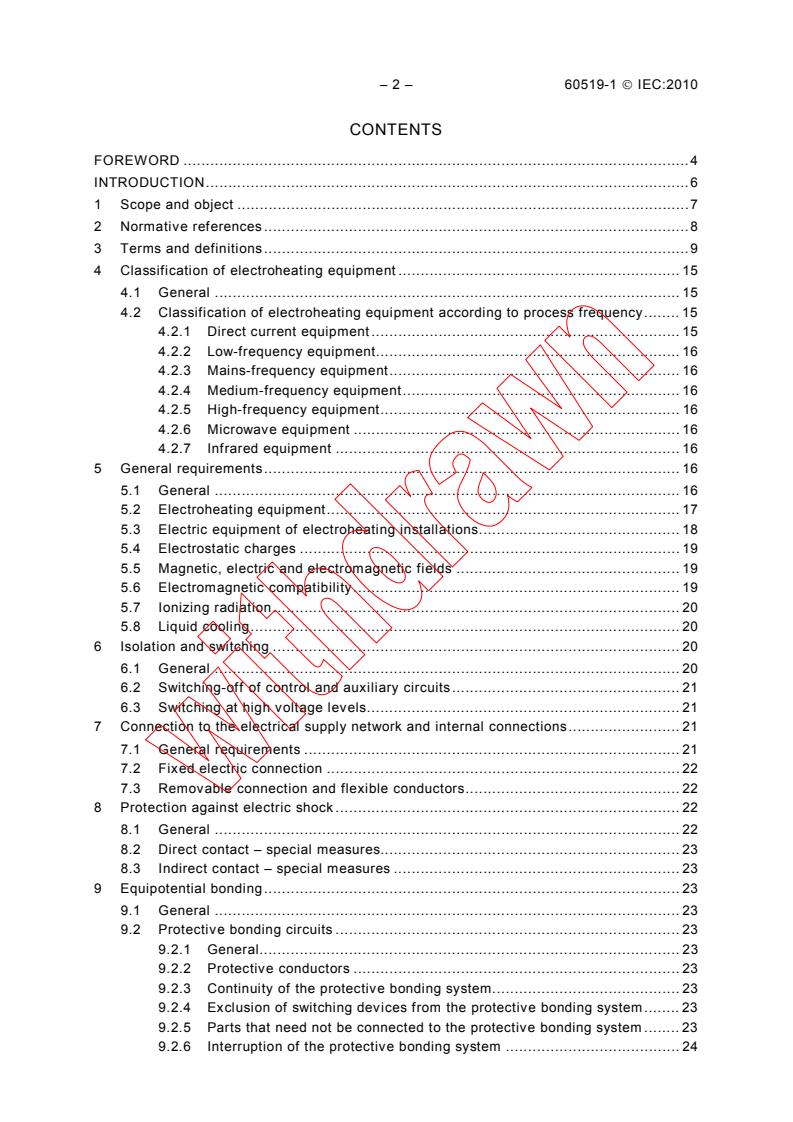
CONTENTS
FOREW ORD . 4
INTRODUCTION . 6
1 Scope and object . 7
2 Normativ e references . 8
3 Terms and definitions . 9
4 Classification of electroheating equipment . 15
4.1 General . 15
4.2 Classification of electroheating equipment according to process frequency . 15
4.2.1 Direct current equipment . 15
4.2.2 Low-frequency equipment. 16
4.2.3 Mains-frequency equipment . 16
4.2.4 Medium-frequency equipment . 16
4.2.5 High-frequency equipment . 16
4.2.6 Microwave equipment . 16
4.2.7 Infrared equipment . 16
5 General requirements . 16
5.1 General . 16
5.2 Electroheating equipment . 17
5.3 Electric equipment of electroheating installations . 18
5.4 Electrostatic charges . 19
5.5 Magnetic, electric and electromagnetic fields . 19
5.6 Electromagnetic compatibility . 19
5.7 Ionizing radiation . 20
5.8 Liquid cooling . 20
6 Isolation and switching . 20
6.1 General . 20
6.2 Switching-off of control and auxiliary circuits . 21
6.3 Switching at high voltage levels . 21
7 Connection to the electrical supply network and internal connections . 21
7.1 General requirements . 21
7.2 Fixed electric connection . 22
7.3 Removable connection and flexible conductors . 22
8 Protection against electric shock . 22
8.1 General . 22
8.2 Direct contact – special measures. 23
8.3 Indirect contact – special measures . 23
9 Equipotential bonding . 23
9.1 General . 23
9.2 Protective bonding circuits . 23
9.2.1 General. 23
9.2.2 Protective conductors . 23
9.2.3 Continuity of the protective bonding system. 23
9.2.4 Exclusion of switching devices from the protective bonding system . 23
9.2.5 Parts that need not be connected to the protective bonding system . 23
9.2.6 Interruption of the protective bonding system . 24
60519-1 Ó IEC:2010 – 3 –
9.2.7 Protective conductor connecting points . 24
9.2.8 Protective bonding for electroheating installations with earth
leakage current above 10 mA . 24
9.3 Functional bonding . 24
9.4 Prohibition of the use of earth as part of an active circuit . 24
10 Control circuits and control functions . 24
10.1 Control circuits . 24
10.2 Earthing of control circuits . 25
10.3 Control functions . 25
10.3.1 General. 25
10.3.2 Start and stop functions . 26
10.3.3 Operating modes . 26
10.3.4 Suspension of safety functions and/or protective measures . 26
10.3.5 Emergency operations . 26
10.3.6 Cableless control . 26
10.4 Control functions in the event of failure . 26
11 Protection against thermal influences . 26
12 Protection against other hazards . 27
13 Marking, labelling and technical documentation . 27
13.1 Marking . 27
13.2 Warning marking . 28
13.3 Labell ing . 28
13.4 Technical documentation . 28
14 Commissioning, inspection, operation and maintenance . 28
14.1 General requirements . 28
14.2 Commissioning and inspection. 29
14.3 Safety instructions for operation . 29
14.4 Instructions for maintenance work . 29
Annex A (normative) Protection against electric shock – special measures . 31
Bibliography . 32
– 4 – 60519-1 Ó IEC:2010
INTERNATIONAL ELECTROTECHNICAL COMMISSION
____________
SAFETY IN ELECTROHEATING INSTALLATIONS –
Part 1: General requirements
FOREWORD
1) The International Electrotechnical Commission (IEC) is a worldwide organization for standardization comprising
all national electrotechnical committees (IEC National Committees). The object of IEC is to promote international
co-operation on all questions concerning standardization in the electrical and electronic fields. To this end and in
addition to other activities, IEC publishes International Standards, Technical Specifications, Technical Reports,
Publicly Available Specifications (PAS) and Guides (hereafter referred to as “IEC Publication(s)”). Their
preparation is entrusted to technical committees; any IEC National Committee interested in the subject dealt with
may participate in this preparatory work. International, governmental and non-governmental organizations liaising
with the IEC also participate in this preparation. IEC collaborates closely with the International Organization for
Standardization (ISO) in accordance with conditions determined by agreement between the two organizations.
2) The formal decisions or agreements of IEC on technical matters express, as nearly as possible, an international
consensus of opinion on the relevant subjects since each technical committee has representation from all
interested IEC National Committees.
3) IEC Publications have the form of recommendations for international use and are accepted by IEC National
Committees in that sense. While all reasonable efforts are made to ensure that the technical content of IEC
Publications is accurate, IEC cannot be held responsible for the way in which they are used or for any
misinterpretation by any end user.
4) In order to promote international uniformity, IEC National Committees undertake to apply IEC Publications
transparently to the maximum extent possible in their national and regional publications. Any divergence between
any IEC Publication and the corresponding national or regional publication shall be clearly indicated in the latter.
5) IEC itself does not provide any attestation of conformity. Independent certification bodies provide conformity
assessment services and, in some areas, access to IEC marks of conformity. IEC is not responsible for any
services carried out by independent certification bodies.
6) All users should ensure that they have the latest edition of this publication.
7) No liability shall attach to IEC or its directors, employees, servants or agents including individual experts and
members of its technical committees and IEC National Committees for any personal injury, property damage or
other damage of any nature whatsoever, whether direct or indirect, or for costs (including legal fees) and
expenses arising out of the publication, use of, or reliance upon, this IEC Publication or any other IEC
Publications.
8) Attention is drawn to the Normative references cited in this publication. Use of the referenced publications is
indispensable for the correct application of this publication.
9) Attention is drawn to the possibility that some of the elements of this IEC Publication may be the subject of
patent rights. IEC shall not be held responsible for identifying any or all such patent rights.
International Standard IEC 60519-1 has been prepared by IEC technical committee 27:
Industrial electroheating.
This fourth edition cancels and replaces the third edition published in 2003. It constitutes
a technical revision.
The main technical changes with respect to the previous edition are as follows:
– scope and object have been modified, voltage limits and classification removed;
– terms/definitions, normative references and bibliography have been updated and
completed;
– Clause 4 on classification of equipment according to process frequency has been
modified;
– Clause 5 (General requirements) has been redrafted and new provisions have been
added (e.g. relating to single fault conditions and EMF issues), following the
recommendations of IEC Guide 104;
60519-1 IEC:2010 – 5 –
– Clause 8 has been redrafted, the contents of subclauses 8.2 and 8.3 has been moved to a
new normative Annex A and 8.4 has been deleted;
– a new Clause 12 (Protection against other hazards) has been added;
– clauses dealing with marking and documentation have been amended.
The text of this standard is based on the following documents:
FDIS Report on voting
27/770/FDIS 27/778/RVD
Full information on the voting for the approval of this standard can be found in the report on
voting indicated in the above table.
The French version of this standard has not been voted upon.
This publication has been drafted in accordance with the ISO/IEC Directives, Part 2.
A list of all parts of IEC 60519 series, under the general title Safety in electroheating
installations, can be found on the IEC website.
Future standards in this series will carry the new general title as cited above. Titles of
existing standards in this series will be updated at the time of a new edition.
The clauses of parts of the IEC 60519 series (hereinafter called Particular Requirements)
supplement or modify the corresponding clauses of Part 1. Where the text of subsequent
parts indicates an "addition" to or a "replacement" of the relevant provision of Part 1, these
changes are made to the relevant text of Part 1. Where no change is necessary, the words
"This clause of Part 1 is applicable" are used. Additional specific provisions to those in Part 1
are given in the Particular Requirements as additional clauses, subclauses or Annexes.
The committee has decided that the contents of this publication will remain unchanged until
the stability date indicated on the IEC web site under "http://webstore.iec.ch" in the data
related to the specific publication. At this date, the publication will be
• reconfirmed;
• withdrawn;
• replaced by a revised edition, or
• amended.
The contents of the corrigendum of November 2012 have been included in this copy.
– 6 – 60519-1 Ó IEC:2010
INTRODUCTION
International Standard IEC 60519 Safety in electroheating installations consists of several
parts. Part 1 comprises clauses of a general character and provisions common to various
types of industrial electroheating installations or equipment. Subsequent parts of the
IEC 60519 series (hereinafter called Particular Requirements) contain specific provisions
for particular types of electroheating installations or equipment.
Part 1: General requirements
Part 2: Particular requirements for resistance heating equipment
Part 3: Particular requirements for induction and conduction heating and induction
melting installations
Part 4: Particular requirements for arc furnace installations
Part 5: Specifications for safety in plasma installations
Part 6: Specifications for safety in industrial microwave heating equipment
Part 7: Particular requirements for installations with electron guns
Part 8: Particular requirements for electroslag remelting furnaces
Part 9: Particular requirements for high-frequency dielectric heating installations
Part 10: Particular requirements for electrical resistance trace heating systems for
industrial and commercial applications
Part 11: Particular requirements for installations using the effect of electromagnetic
forces on liquid metals
Part 21: Particular requirements for resistance heating equipment – Heating and
melting glass equipment
NOTE Additional parts covering particular industrial electroheating installations or equipment may be prepared in
the future.
60519-1 Ó IEC:2010 – 7 –
SAFETY IN ELECTROHEATING INSTALLATIONS –
Part 1: General requirements
1 Scope and object
This part of IEC 60519 specifies the general safety requirements applicable to industrial
electroheating installations.
In case these requirements differ from those of other IEC publications, an equivalent
degree of safety is ensured.
The requirements apply to industrial installations, intended for electroheating and
electroheat based treatment technologies, with the possible use of the following equipment:
– equipment for direct and indirect resistance heating;
– equipment for electric resistance trace heating;
– equipment for induction heating;
– equipment using the effect of EM forces on liquid metals;
– equipment for arc heating, including submerged arc heating;
– equipment for electroslag remelting;
– equipment for plasma heating;
– equipment for microwave heating;
– equipment for dielectric heating;
– equipment for electron beam heating;
– equipment for laser heating;
– equipment for infrared radiation heating.
NOTE 1 The list presents typical examples of equipment used in installations covered by this standard and is not
exhaustive.
This standard is not applicable for heating appliances for household (e.g. electric cooking),
laboratory or medical applications or for welding equipment, if covered by other particular
standards, nor does it apply to any kind of space heating.
This standard refers to normal operation of industrial electroheating installations. It is
intended to ensure the safety of persons also in the case of abnormal operation and when
faults occur in electroheating installations. This standard presumes that the installations are
operated and maintained only by personnel consisting of instructed or skilled persons,
respectively.
The object of this standard is to specify the general safety requirements for electroheating
installations. These safety requirements concern the protection of persons and the
environment against dangers of electrical origin and also against certain dangers of non-
electrical origin, common to all types of equipment and installations.
Certain clauses of this standard concern not only safety of personnel but also protection of
the environment.
The overall safety requirements result from the joint application of the general requirements
specified in this standard and Particular Requirements concerning the specific industrial
– 8 – 60519-1 Ó IEC:2010
application of electroheat. These Particular Requirements supplement, modify or replace
the general requirements.
The Particular Requirements cover particular safety relevant features such as high voltages
and electric fields or high currents and magnetic fields, also with respect to the frequencies.
NOTE 2 Information on non-electrical hazards possibly arising from the utilization of industrial electroheating
equipment may also be taken from European Standard EN 746-1 (see Bibliography), which specifies common safety
requirements for industrial thermoprocessing equipment.
General test methods for industrial electroheating installations are specified in IEC 60398.
2 Normative references
The following referenced documents are indispensable for the application of this document.
For dated references, only the edition cited applies. For undated references, the latest
edition of the referenced document (including any amendments) applies.
IEC 60050-841:2004, International Electrotechnical Vocabulary – Part 841: Industrial
electroheat
IEC 60071-1, Insulation co-ordination – Part 1: Definitions, principles and rules
IEC 60110-1:1998, Power capacitors for induction heating installations – Part 1: General
IEC 60204-1:2005 , Safety of machinery – Electrical equipment of machines – Part 1:
General requirements
Amendment 1 (2008)
IEC 60204-11, Safety of machinery – Electrical equipment of machines – Part 11:
Requirements for HV equipment for voltages above 1 000 V a.c. or 1 500 V d.c. and not
exceeding 36 kV
IEC 60364-1:2005, Low-voltage electrical installations – Part 1: Fundamental principles,
assessment of general characteristics, definitions
IEC 60364-4-41, Low-voltage electrical installations – Part 4-41: Protection for safety –
Protection against electric shock
IEC 60364-4-42, Low-voltage electrical installations – Part 4-42: Protection for safety –
Protection against thermal effects
IEC 60364-4-43, Low-voltage electrical installations – Part 4-43: Protection for safety –
Protection against overcurrent
IEC 60364-5-53, Electrical installations of buildings – Part 5-53: Selection and erection of
electrical equipment – Isolation, switching and control
IEC 60364-5-54, Electrical installations of buildings – Part 5-54: Selection and erection of
electrical equipment – Earthing arrangements, protective conductors and protective bonding
conductors
———————
There is a consolidated edition 5.1 (2009) that includes IEC 60204-1 (2005) and its amendment 1 (2008).
60519-1 Ó IEC:2010 – 9 –
IEC 60417, Graphical symbols for use on equipment
IEC 60446, Basic and safety principles for man-machine interface, marking and
identification – Identification of conductors by colours or alphanumerics
IEC 60529, Degrees of protection provided by enclosures (IP Code)
IEC 60664-1, Insulation coordination for equipment within low-voltage systems – Part 1:
Principles, requirements and tests
IEC 61140, Protection against electric shock – Common aspects for installation and
equipment
IEC 61936-1, Power installations exceeding 1 kV a.c. – Part 1: Common rules
CISPR 11, Industrial, scientific and medical equipment – Radio-frequency disturbance
characteristics – Limits and methods of measurement
ISO 3864-1, Graphical symbols – Safety colours and safety signs – Part 1: Design principles
for safety signs in workplaces and public areas
ISO 7000, Graphical symbols for use on equipment – Index and synopsis
3 Terms and definitions
For the purposes of this document, the terms and definitions given in IEC 60050-841:2004
and the following apply.
NOTE 1 Unless otherwise stated, the terms "voltage" and "current" apply to the r.m.s. values in the case of a.c.
NOTE 2 The electrical terms and quantities associated with the word "rated" refer to the electroheating equipment
itself, unless otherwise stated. The terms "rated voltage", "rated current" or "rated power" refer to the voltage (in the
case of a three-phase system, the voltage between phases), the current or the power specified by the manufacturer
and marked on the electroheating equipment.
3.1
direct contact
electric contact of persons or animals with live parts
[IEC 60050-195:1998, 195-06-03]
3.2
earthing conductor
grounding conductor (US)
earth conductor (deprecated)
conductor which provides a conductive path, or part of the conductive path, between a
given point in a system or in an installation or in equipment and an earth electrode
[IEC 60050-195:1998, 195-02-03]
3.3
earth leakage current
current flowing from the live parts of the installation to earth, in the absence of an insulation
fault
[IEC 60050-442: 1998, 442-01-24]
– 10 – 60519-1 Ó IEC:2010
3.4
electric connection
means or actual condition that allows or ensures the passage of electric current between
two conductive parts
3.5
electric equipment
item used for such purposes as generation, conversion, transmission, distribution or
utilization of electric energy, such as converters, transformers, capacitors, switchgear and
controlgear, measuring instruments, protective devices and wiring systems
[IEC 60050-826:2004, 826-16-01, modified]
3.6
electrical installation
assembly of associated electric equipment having co-ordinated characteristics to fulfil
specific purposes
[IEC 60050-826:2004, 826-10-01]
3.7
(electrically) instructed person
person adequately advised or supervised by electrically skilled persons to enable him or her
to perceive risks and to avoid hazards which electroheating installations can create
(operating and maintenance staff)
[IEC 60050-826:2004, 826-18-02, modified]
3.8
(electrically) skilled person
person with relevant education and experience to enable him or her to perceive risks and to
avoid hazards which electroheating installations can create
[IEC 60050-826:2004, 826-18-01, modified]
3.9
electroheat
branch of science and technology dealing with the conversion of electric energy into
thermal energy for useful purposes
[IEC 60050-841:2004, 841-21-22, modified]
3.10
electroheating equipment
electroheat equipment
equipment in which electric energy is converted into thermal energy for useful purposes
NOTE The term covers also equipment using the effect of electromagnetic forces on liquid metals.
[IEC 60050-841:2004, 841-22-01, modified]
3.11
electroheating installation
electroheat installation
installation composed of electroheating equipment, electric equipment and mechanical
accessories needed for its operation and use
[IEC 60050-841:2004, 841-22-02, modified]
60519-1 Ó IEC:2010 – 11 –
3.12
emergency switching-off
operation intended to switch-off any electric power from an electrical installation to avert or
alleviate a hazardous situation
[IEC 60050-826:2004, 826-17-03, modified]
3.13
enclosure
housing affording the type and degree of protection suitable for the intended application
[IEC 60050-195:1998, 195-02-35]
NOTE For the classification of degrees of protection provided by enclosures (IP Code), see IEC 60529.
3.14
equipotential bonding
provision of electric connections between conductive parts, intended to put them at a
substantially equal potential
[IEC 60050-195:1998, 195-01-10, modified]
3.15
equipotential bonding system
EBS
interconnection of conductive parts providing equipotential bonding between those parts
NOTE If an equipotential bonding system is earthed, it forms part of an earthing arrangement.
[IEC 60050-195:1998, 195-02-22]
3.16
exposed conductive part
conductive part of electrical equipment, which can be touched and which is not live in
normal operation, but which can become live under fault conditions
[IEC 60050-826:2004, 826-12-10, modified]
3.17
extraneous conductive part
conductive part not forming part of the electrical installation and liable to introduce an
electric potential, generally the electric potential of a local earth
[IEC 60050-826:2004, 826-12-11]
3.18
failure
termination of the ability of an item to perform a required function
NOTE 1 After a failure the item has a fault.
NOTE 2 "Failure" is an event, as distinguished from "fault", which is a state.
NOTE 3 This concept as defined does not apply to items consisting of software only.
NOTE 4 In practice, the terms fault and failure are often used synonymously.
[IEC 60204-1:2005, 3.25]
– 12 – 60519-1 Ó IEC:2010
3.19
fault
state of an item characterized by inability to perform a required function, excluding the
inability during preventive maintenance or other planned actions, or due to lack of external
resources
NOTE 1 A fault is often the result of a failure of the item itself, but may exist without prior failure.
NOTE 2 In English, the term “fault” and its definition are identical with those given in IEV 191-05-01. In the field of
machinery, the French term “défaut” and the German term “Fehler” are used rather than the terms “panne” and
“Fehlzustand” that appear with this definition.
[IEC 60204-1:2005, 3.26]
3.20
fixed electric connection
electric connection requiring the use of a tool for mounting and dismantling purposes
NOTE In all other cases, the connection is removable.
3.21
functional bonding
equipotential bonding necessary for proper functioning of electrical equipment
[IEC 60204-1:2005, 3.27]
3.22
functional switching
operation intended to switch on or off or vary the supply of electric energy to an electrical
installation or parts of it for normal operating purposes
[IEC 60050-826:2004, 826-17-05]
3.23
harm
physical injury or damage to the health of people, or damage to property or the environment
[ISO/IEC Guide 51:1999, 3.3]
3.24
hazard
potential source of harm
NOTE The term hazard can be qualified in order to define its origin (e.g. electrical hazard, mechanical hazard) or
the nature of the potential harm (e.g. electric shock hazard, cutting hazard, toxic hazard, fire hazard).
[ISO/IEC Guide 51:1999, 3.5, modified]
3.25
indirect contact
electric contact of persons or animals with exposed-conductive parts which have become
live under fault conditions
[IEC 60050-195:1998, 195-06-04]
3.26
input frequency
frequency of the supply voltage to the electroheating installation
60519-1 Ó IEC:2010 – 13 –
3.27
insulation
all the insulating materials necessary to ensure the proper operation of the equipment and
protection against electric shock
NOTE 1 It refers also to the action of insulating.
NOTE 2 Under certain circumstances, the heat insulation materials employed for electroheating equipment may
equally perform the function of the electrical insulation.
3.28
isolation
function intended to make dead for reasons of safety all or a discrete section of the
electrical installation by separating the electrical installation or section from every source of
electric energy
[IEC 60050-826:2004, 826-17-01]
3.29
leakage current
earth current (deprecated)
electric current in an unwanted conductive path under normal operating conditions
[IEC 60050-195:1998,195-05-15]
3.30
live part
conductor or conductive part intended to be energized in normal operation, including a
neutral conductor, but by convention not a PEN conductor or PEM conductor or PEL
conductor
NOTE This concept does not necessarily imply a risk of electric shock.
[IEC 60050-195:1998, 195-02-19]
3.31
manufacturer
maker of the electroheating equipment or installation (who may also be the supplier,
importer or agent) responsible for compliance with this standard
NOTE From the perspective of the user, the manufacturer is a party responsible for the design, development,
manufacture, supply and commissioning of the equipment or installation.
3.32
normal operation
operation of the electroheating installation or equipment specified by the manufacturer and
agreed with the user
3.33
PEL conductor
conductor combining the functions of both a protective earthing conductor and a line
conductor
[IEC 60050-195:1998,195-02-14]
3.34
PEM conductor
conductor combining the functions of both a protective earthing conductor and a mid-point
conductor
[IEC 60050-195:1998, 195-02-13]
– 14 – 60519-1 Ó IEC:2010
3.35
PEN conductor
conductor combining the functions of both a protective earthing conductor and a neutral
conductor
[IEC 60050-195:1998, 195-02-12]
3.36
photocoupler
optocoupler
optoelectronic device designed for the transfer of electrical signals by utilizing optical
radiation to provide coupling while the output is isolated from the input
[IEC 60050-521:2002, 521-04-45]
NOTE This device may provide immunity against electromagnetic influences as well as independence of the
distance of two voltage system levels.
3.37
process frequency
frequency of voltage or current used for the process in which electric energy is converted
into thermal energy
3.38
protective conductor
(identification: PE)
conductor provided for purposes of safety, for example protection against electric shock
[IEC 60050-195:1998, 195-02-09]
NOTE In an electrical installation, the PE conductor is normally also considered as a protective earthing conductor.
3.39
protective earthing
protective grounding (US)
earthing a point or points in a system or in an installation or in equipment, for purposes of
electrical safety
[IEC 60050-195:1998, 195-01-11]
3.40
protective equipotential bonding system
PEBS
equipotential bonding system providing protective-equipotential-bonding
[IEC 60050-826:2004, 826-13-31]
3.41
protective earthing conductor
protective grounding conductor (US)
protective conductor provided for protective earthing
[IEC 60050-195:1998, 195-02-11]
3.42
rated voltage
voltage for which an installation (or a part thereof) is designed
60519-1 Ó IEC:2010 – 15 –
3.43
reasonably foreseeable misuse
use of a product, process or service in a way not intended by the supplier, but which may
result from readily predictable human behaviour
[ISO/IEC Guide 51:1999, 3.14]
3.44
residual voltage (on a capacitor)
voltage remaining between the terminals of a capacitor after switching off its supply
[IEC 60110-1:1998, 1.3.24, modified]
3.45
single fault condition
condition in which one means for protection against hazard is defective
NOTE If a single fault condition results unavoidably in another single fault condition, the two failures are
considered as one single fault condition.
[IEC 60050-851:2008, 851-11-20]
3.46
supply network
supply system
electric power transmission or distribution system not exclusively used for supplying an
electroheating installation
3.47
switching-off for mechanical maintenance
opening operation of a switching device intended to inactivate an item or items of
electrically powered equipment for the purpose of preventing a hazard, other than that due
to electric shock or to arcing, during non-electrical work on the equipment
[IEC 60050-826:2004, 826-17-02]
3.48
user
party or parties responsible for the use and maintenance of the electroheating equipment or
installation, from putting into service to de-commissioning at the end of product life
3.49
workload
object or material being processed
4 Classification of electroheating equipment
4.1 General
Electroheating equipment is in general classified according to process frequency as
specified in 4.2.
4.2 Classification of electroheating equipment according to process frequency
4.2.1 Direct current equipment
Equipment with rated process frequency of 0 Hz.
– 16 – 60519-1 Ó IEC:2010
4.2.2 Low-frequency equipment
Equipment with rated process frequencies not greater than 60 Hz (excluding
mains-frequency equipment).
4.2.3 Mains-frequency equipment
Equipment with rated process frequency equal to the frequency of the a.c. public supply
network, usually 50 Hz or 60 Hz.
NOTE This frequency is used directly from the mains.
4.2.4 Medium-frequency equipment
Equipment with rated process frequencies greater than mains frequency but less than or
equal to 100 kHz.
4.2.5 High-frequency equipment
Equipment with rated process frequencies greater than 100 kHz but less than or equal to
300 MHz.
4.2.6 Microwave equipment
Equipment with rated process frequencies greater than 300 MHz but less than or equal to
300 GHz.
4.2.7 Infrared equipment
Equipment with rated process frequencies greater than 300 GHz but less than or equal to
400 THz.
NOTE 1 These frequencies correspond to the free space wavelengths of microwaves (1 mm) and visible light
(approximately 750 nm), respectively.
NOTE 2 Laser beam heating equipment also operates in this frequency range.
5 General requirements
5.1 General
5.1.1 Electroheating installations shall be so designed and constructed that when installed
and used in accordance with manufacturer’s instructions, any hazard to personnel or
environment is prevented, as far as practicable.
5.1.2 Electroheating installations shall be so designed and manufactured that they can
function safely in normal operation and under single fault condition.
NOTE Detailed provisions concerning normal operation and single fault conditions are given in the Particular
Requirements.
5.1.3 Abnormal operation shall be considered and avoided, as far as practicable.
NOTE 1 Abnormal operation may result from e.g. lack of attention of the operator, spillage, expulsion or shattering
of the workload, interruption of the flow of workload in equipment for continuous operation or operation without
workload in equipment for batch operation.
NOTE 2 Specifications for abnormal operation and resulting requirements are given in the Particular Requirements.
5.1.4 Assembly and operation of components shall be in accordance with the
manufacturer's instructions.
60519-1 Ó IEC:2010 – 17 –
5.1.5 For electroheating installations of voltages up to 1 000 V a.c. or 1 500 V smooth d.c.
and frequencies of up to 60 Hz, the following parts of IEC 60364 shall apply: IEC 60364-
1:2005, IEC 60364-4-41, IEC 60364-4-42, IEC 60364-4-43, IEC 60364-5-53 and
IEC 60364-5-54. For electroheating equipment of voltages exceeding 1 000 V a.c. or
1 500 V smooth d.c., special requirements of this standard shall be complied with.
IEC 60204-11 and IEC 61936-1 may be taken as guidance.
For electrical equipment of voltages up to 1 000 V a.c. or 1 500 V smooth d.c. and
frequencies of up to 200 Hz, IEC 60204-1:2005 may be taken as guidance. IEC 60204-
1:2005 however does not cover power circuits, where electrical energy is directly used as a
working tool.
5.1.6 Safety aspects vary with the frequency range.
NOTE For example, connections which are equipotential for d.c., mains or low frequencies may be not equipotential
for frequencies above 100 kHz.
5.1.7 Protective measures against overcurrent shall be provided in accordance with the
relevant standards, for example IEC 60364-4-43 and 7.2 of IEC 60204-1:2005.
5.1.8 Protective measures against electric shock shall be taken (see Clause 8).
5.1.9 Where danger or damage may arise due to an interruption of the supply, suitable
provisions shall be made (see 7.5 of IEC 60204-1:2005).
5.1.10 In hydraulic circuits measures shall be taken to avoid dangerous overpressure, for
example by safety valves or temperature limiters. Switching valves are to be placed in a
way ensuring avoidance of overpressure and damage of certain delicate parts.
5.1.11 Escape routes shall be provided, to allow fast evacuation of personnel from the
operating area in case of any hazardous incident, e.g. due to fire, noxious emissions,
workload eruptions and the like.
5.2 Electroheating equipment
5.2.1 All parts of electroheating equipment shall be designed, constructed and installed
taking into account the voltages and frequencies used (0 Hz included), the mode of
operation, the relevant IEC standards and the relevant instructions according to good
engineering practice.
The equipment shall be used only for purposes and in operating conditions for which it has
been designed.
5.2.2 For electroheating equipment with voltages exceeding 1 000
...