

IEC 61810-2-1:2011
(Main)Electromechanical elementary relays - Part 2-1: Reliability - Procedure for the verification of B10 values
General Information
- Abstract
IEC 61810-2-1:2011 specifies reliability test procedures for electromechanical elementary relays when enhanced requirements for the verification of reliability apply. Particular provisions are given for relays incorporated in safety-related control systems of machinery in accordance with IEC 62061 and ISO 13849-1. For such relays B10 values for dangerous failures (B10d values) are derived from the tests specified in this standard.
This publication is to be read in conjunction with IEC 61810-2:2011.
- Status
- Published
- Publication Date
- 24-Feb-2011
- Technical Committee
- TC 94 - Electrical relays
- Drafting Committee
- WG 3 - TC 94/WG 3
- Current Stage
- DELPUB - Deleted Publication
- Start Date
- 30-May-2017
- Completion Date
- 28-Aug-2026
Overview
IEC 61810-2-1:2011 is an international standard published by the International Electrotechnical Commission (IEC) that specifies reliability test procedures for electromechanical elementary relays, focusing on the verification of B10 values. These B10 values represent the mean number of operating cycles at which 10% of relays are expected to fail, providing a critical measure of relay longevity and reliability.
This standard is especially relevant for relays used in safety-related control systems in machinery, complying with IEC 62061 and ISO 13849-1. For such applications, the standard outlines how to determine B10 values specifically for dangerous failures (denoted B10d), which factor into assessments of mean time to dangerous failure (MTTFd), a vital parameter for functional safety evaluations.
IEC 61810-2-1:2011 supplements and must be used in conjunction with IEC 61810-2:2011, which provides general reliability requirements for electromechanical relays.
Key Topics
Scope and Application
Focuses on the enhanced reliability verification required for electromechanical elementary relays, particularly those incorporated in safety-related machinery control systems.Reliability Verification Procedures
Establishes test methodologies to obtain B10 values from lifecycle testing of relay samples. These tests consider various failure modes such as failure to open or close contacts, unintended bridging, and insulation breakdown.Failure Mode Definitions
Defines important terms like dangerous failure and differentiates between conformity tests (initial batch validation) and periodic tests (ongoing quality control from production).Environmental and Operating Conditions
Specifies the test conditions relating to contact loads, environmental factors, and cycling operations under which reliability is assessed.Data for Functional Safety Assessments
Provides the basis for calculating MTTFd metrics necessary for safety-related system design following IEC 62061 and ISO 13849-1 standards.Test Cycles and Statistical Analysis
Details how B10 (and B10d) values are statistically derived from test results to forecast operational lifetime and failure probability accurately.
Applications
IEC 61810-2-1:2011 is essential for manufacturers, designers, and safety engineers working with:
Industrial Machinery Safety Systems:
Relays that must meet stringent reliability and safety standards within automated or robotic equipment.Safety-Related Control Circuits:
Applications requiring reliable relay operation where failure modes could lead to hazards or system failures.Functional Safety Compliance:
Use in machinery designed per IEC 62061 and ISO 13849-1 where reliability data directly impacts system safety integrity levels (SIL) or performance levels (PL).Quality Control and Production Testing:
Provides the framework for ongoing verification of products post-manufacture to ensure consistent reliability and conformity to specifications.
Related Standards
IEC 61810-2:2011 – Electromechanical elementary relays – Reliability general requirements, to be used in conjunction with this standard.
IEC 62061:2005 – Safety of machinery – Functional safety of safety-related electrical, electronic, and programmable electronic control systems.
ISO 13849-1:2006 – Safety of machinery – Safety-related parts of control systems – General principles for design.
IEC 61810-1:2008 – Electromechanical elementary relays – General requirements covering basic relay performance and characteristics.
Keywords: IEC 61810-2-1, electromechanical elementary relays, B10 values, reliability testing, safety-related control systems, IEC 62061, ISO 13849-1, mean time to dangerous failure (MTTFd), relay failure modes, conformity test, periodic test, functional safety compliance.
Relations
- Effective Date
- 05-Sep-2023
- Effective Date
- 05-Sep-2023
Get Certified
Connect with accredited certification bodies for this standard

DNV
DNV is an independent assurance and risk management provider.

Lloyd's Register
Lloyd's Register is a global professional services organisation specialising in engineering and technology.
DNV Energy Systems
Energy and renewable energy certification.
Sponsored listings
Frequently Asked Questions
IEC 61810-2-1:2011 is a standard published by the International Electrotechnical Commission (IEC). Its full title is "Electromechanical elementary relays - Part 2-1: Reliability - Procedure for the verification of B<sub>10</sub> values". This standard covers: IEC 61810-2-1:2011 specifies reliability test procedures for electromechanical elementary relays when enhanced requirements for the verification of reliability apply. Particular provisions are given for relays incorporated in safety-related control systems of machinery in accordance with IEC 62061 and ISO 13849-1. For such relays B10 values for dangerous failures (B10d values) are derived from the tests specified in this standard. This publication is to be read in conjunction with IEC 61810-2:2011.
IEC 61810-2-1:2011 specifies reliability test procedures for electromechanical elementary relays when enhanced requirements for the verification of reliability apply. Particular provisions are given for relays incorporated in safety-related control systems of machinery in accordance with IEC 62061 and ISO 13849-1. For such relays B10 values for dangerous failures (B10d values) are derived from the tests specified in this standard. This publication is to be read in conjunction with IEC 61810-2:2011.
IEC 61810-2-1:2011 is classified under the following ICS (International Classification for Standards) categories: 17.240 - Radiation measurements; 27.120 - Nuclear energy engineering; 29.120.70 - Relays. The ICS classification helps identify the subject area and facilitates finding related standards.
IEC 61810-2-1:2011 has the following relationships with other standards: It is inter standard links to IEC PAS 61810-2-1:2008, IEC 61810-2-1:2017. Understanding these relationships helps ensure you are using the most current and applicable version of the standard.
IEC 61810-2-1:2011 is available in PDF format for immediate download after purchase. The document can be added to your cart and obtained through the secure checkout process. Digital delivery ensures instant access to the complete standard document.
Standards Content (Sample)
IEC 61810-2-1 ®
Edition 1.0 2011-02
INTERNATIONAL
STANDARD
NORME
INTERNATIONALE
Electromechanical elementary relays –
Part 2-1: Reliability – Procedure for the verification of B values
Relais électromécaniques élémentaires –
Partie 2-1: Fiabilité – Procédure de vérification des valeurs de B
All rights reserved. Unless otherwise specified, no part of this publication may be reproduced or utilized in any form or by
any means, electronic or mechanical, including photocopying and microfilm, without permission in writing from either IEC or
IEC's member National Committee in the country of the requester.
If you have any questions about IEC copyright or have an enquiry about obtaining additional rights to this publication,
please contact the address below or your local IEC member National Committee for further information.
Droits de reproduction réservés. Sauf indication contraire, aucune partie de cette publication ne peut être reproduite
ni utilisée sous quelque forme que ce soit et par aucun procédé, électronique ou mécanique, y compris la photocopie
et les microfilms, sans l'accord écrit de la CEI ou du Comité national de la CEI du pays du demandeur.
Si vous avez des questions sur le copyright de la CEI ou si vous désirez obtenir des droits supplémentaires sur cette
publication, utilisez les coordonnées ci-après ou contactez le Comité national de la CEI de votre pays de résidence.
IEC Central Office
3, rue de Varembé
CH-1211 Geneva 20
Switzerland
Email: inmail@iec.ch
Web: www.iec.ch
About the IEC
The International Electrotechnical Commission (IEC) is the leading global organization that prepares and publishes
International Standards for all electrical, electronic and related technologies.
About IEC publications
The technical content of IEC publications is kept under constant review by the IEC. Please make sure that you have the
latest edition, a corrigenda or an amendment might have been published.
Catalogue of IEC publications: www.iec.ch/searchpub
The IEC on-line Catalogue enables you to search by a variety of criteria (reference number, text, technical committee,…).
It also gives information on projects, withdrawn and replaced publications.
IEC Just Published: www.iec.ch/online_news/justpub
Stay up to date on all new IEC publications. Just Published details twice a month all new publications released. Available
on-line and also by email.
Electropedia: www.electropedia.org
The world's leading online dictionary of electronic and electrical terms containing more than 20 000 terms and definitions
in English and French, with equivalent terms in additional languages. Also known as the International Electrotechnical
Vocabulary online.
Customer Service Centre: www.iec.ch/webstore/custserv
If you wish to give us your feedback on this publication or need further assistance, please visit the Customer Service
Centre FAQ or contact us:
Email: csc@iec.ch
Tel.: +41 22 919 02 11
Fax: +41 22 919 03 00
A propos de la CEI
La Commission Electrotechnique Internationale (CEI) est la première organisation mondiale qui élabore et publie des
normes internationales pour tout ce qui a trait à l'électricité, à l'électronique et aux technologies apparentées.
A propos des publications CEI
Le contenu technique des publications de la CEI est constamment revu. Veuillez vous assurer que vous possédez
l’édition la plus récente, un corrigendum ou amendement peut avoir été publié.
Catalogue des publications de la CEI: www.iec.ch/searchpub/cur_fut-f.htm
Le Catalogue en-ligne de la CEI vous permet d’effectuer des recherches en utilisant différents critères (numéro de référence,
texte, comité d’études,…). Il donne aussi des informations sur les projets et les publications retirées ou remplacées.
Just Published CEI: www.iec.ch/online_news/justpub
Restez informé sur les nouvelles publications de la CEI. Just Published détaille deux fois par mois les nouvelles
publications parues. Disponible en-ligne et aussi par email.
Electropedia: www.electropedia.org
Le premier dictionnaire en ligne au monde de termes électroniques et électriques. Il contient plus de 20 000 termes et
définitions en anglais et en français, ainsi que les termes équivalents dans les langues additionnelles. Egalement appelé
Vocabulaire Electrotechnique International en ligne.
Service Clients: www.iec.ch/webstore/custserv/custserv_entry-f.htm
Si vous désirez nous donner des commentaires sur cette publication ou si vous avez des questions, visitez le FAQ du
Service clients ou contactez-nous:
Email: csc@iec.ch
Tél.: +41 22 919 02 11
Fax: +41 22 919 03 00
IEC 61810-2-1 ®
Edition 1.0 2011-02
INTERNATIONAL
STANDARD
NORME
INTERNATIONALE
Electromechanical elementary relays –
Part 2-1: Reliability – Procedure for the verification of B values
Relais électromécaniques élémentaires –
Partie 2-1: Fiabilité – Procédure de vérification des valeurs de B
INTERNATIONAL
ELECTROTECHNICAL
COMMISSION
COMMISSION
ELECTROTECHNIQUE
PRICE CODE
INTERNATIONALE
CODE PRIX Q
ICS 29.120.70 ISBN 978-2-88912-375-9
– 2 – 61810-2-1 IEC:2011
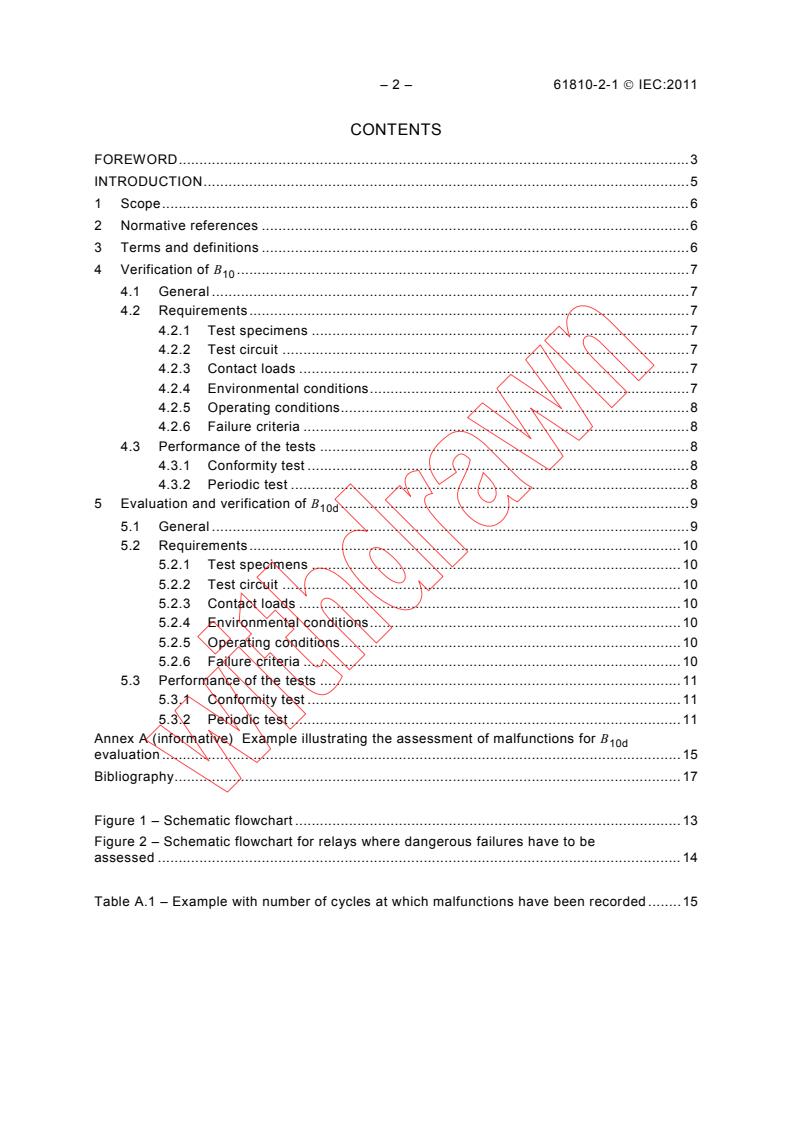
CONTENTS
FOREWORD . 3
INTRODUCTION . 5
1 Scope . 6
2 Normative references . 6
3 Terms and definitions . 6
4 Verification of B . 7
4.1 General . 7
4.2 Requirements . 7
4.2.1 Test specimens . 7
4.2.2 Test circuit . 7
4.2.3 Contact loads . 7
4.2.4 Environmental conditions . 7
4.2.5 Operating conditions . 8
4.2.6 Failure criteria . 8
4.3 Performance of the tests . 8
4.3.1 Conformity test . 8
4.3.2 Periodic test . 8
5 Evaluation and verification of B . 9
10d
5.1 General . 9
5.2 Requirements . 10
5.2.1 Test specimens . 10
5.2.2 Test circuit . 10
5.2.3 Contact loads . 10
5.2.4 Environmental conditions . 10
5.2.5 Operating conditions . 10
5.2.6 Failure criteria . 10
5.3 Performance of the tests . 11
5.3.1 Conformity test . 11
5.3.2 Periodic test . 11
Annex A (informative) Example illustrating the assessment of malfunctions for B
10d
evaluation . 15
Bibliography . 17
Figure 1 – Schematic flowchart . 13
Figure 2 – Schematic flowchart for relays where dangerous failures have to be
assessed . 14
Table A.1 – Example with number of cycles at which malfunctions have been recorded . 15
61810-2-1 IEC:2011 – 3 –
INTERNATIONAL ELECTROTECHNICAL COMMISSION
____________
ELECTROMECHANICAL ELEMENTARY RELAYS –
Part 2-1: Reliability –
Procedure for the verification of B values
FOREWORD
1) The International Electrotechnical Commission (IEC) is a worldwide organization for standardization comprising
all national electrotechnical committees (IEC National Committees). The object of IEC is to promote
international co-operation on all questions concerning standardization in the electrical and electronic fields. To
this end and in addition to other activities, IEC publishes International Standards, Technical Specifications,
Technical Reports, Publicly Available Specifications (PAS) and Guides (hereafter referred to as “IEC
Publication(s)”). Their preparation is entrusted to technical committees; any IEC National Committee interested
in the subject dealt with may participate in this preparatory work. International, governmental and non-
governmental organizations liaising with the IEC also participate in this preparation. IEC collaborates closely
with the International Organization for Standardization (ISO) in accordance with conditions determined by
agreement between the two organizations.
2) The formal decisions or agreements of IEC on technical matters express, as nearly as possible, an international
consensus of opinion on the relevant subjects since each technical committee has representation from all
interested IEC National Committees.
3) IEC Publications have the form of recommendations for international use and are accepted by IEC National
Committees in that sense. While all reasonable efforts are made to ensure that the technical content of IEC
Publications is accurate, IEC cannot be held responsible for the way in which they are used or for any
misinterpretation by any end user.
4) In order to promote international uniformity, IEC National Committees undertake to apply IEC Publications
transparently to the maximum extent possible in their national and regional publications. Any divergence
between any IEC Publication and the corresponding national or regional publication shall be clearly indicated in
the latter.
5) IEC itself does not provide any attestation of conformity. Independent certification bodies provide conformity
assessment services and, in some areas, access to IEC marks of conformity. IEC is not responsible for any
services carried out by independent certification bodies.
6) All users should ensure that they have the latest edition of this publication.
7) No liability shall attach to IEC or its directors, employees, servants or agents including individual experts and
members of its technical committees and IEC National Committees for any personal injury, property damage or
other damage of any nature whatsoever, whether direct or indirect, or for costs (including legal fees) and
expenses arising out of the publication, use of, or reliance upon, this IEC Publication or any other IEC
Publications.
8) Attention is drawn to the Normative references cited in this publication. Use of the referenced publications is
indispensable for the correct application of this publication.
9) Attention is drawn to the possibility that some of the elements of this IEC Publication may be the subject of
patent rights. IEC shall not be held responsible for identifying any or all such patent rights.
International Standard IEC 61810-2-1 has been prepared by IEC technical committee 94: All-
or-nothing electrical relays.
This standard cancels and replaces IEC/PAS 61810-2-1 published in 2008. This edition
constitutes a technical revision.
This standard includes the following significant technical changes with respect to
IEC/PAS 61810-2-1:
• addition of inductive loads in Clause 4;
• specification of dielectric tests under Clause 4 and Clause 5;
.
• addition of informative Annex A illustrating the assessment of malfunctions for B
10d
– 4 – 61810-2-1 IEC:2011
The text of this standard is based on the following documents:
FDIS Report on voting
94/317/FDIS 94/326/RVD
Full information on the voting for the approval of this standard can be found in the report on
voting indicated in the above table.
This publication has been drafted in accordance with the ISO/IEC Directives, Part 2.
A list of all parts of the IEC 61810 series can be found, under the general title
Electromechanical elementary relays, on the IEC website.
This International Standard is to be used in conjunction with IEC 61810-2:2011.
The committee has decided that the contents of this publication will remain unchanged until
the stability date indicated on the IEC web site under "http://webstore.iec.ch" in the data
related to the specific publication. At this date, the publication will be
• reconfirmed,
• withdrawn,
• replaced by a revised edition, or
• amended.
61810-2-1 IEC:2011 – 5 –
INTRODUCTION
Based on the general provisions of IEC 61810-2, this standard specifies reliability test
procedures for electromechanical elementary relays where enhanced requirements for the
verification of reliability apply. An initial conformity test is passed and then confirmed by
periodic tests with specified periodicity. This standard describes how figures for B (the
mean number of cycles until 10 % of the relays have failed) are derived from these life tests
performed with representative relay samples.
In particular when electromechanical elementary relays are intended to be incorporated in
safety-related control systems of machinery in accordance with IEC 62061 and ISO 13849-1,
the mean time to dangerous failure (MTTF ) is a measure that can be taken into account
d
when assessing the probability of dangerous failure of the safety function concerned.
Although a component failure cannot be defined as “dangerous” unless the detailed
application is known, it is common to consider a failure mode that is likely to result in danger
in a typical application of the component, and to refer to this failure mode as a “dangerous
failure”. The MTTF then becomes the expectation of the mean time to failure in this
d
“dangerous“ mode. For the calculation of MTTF for electromechanical relays the data
d
provided by the manufacturer for B can be used (see C.4 of ISO 13849-1:2006).
10d
Electromechanical elementary relays with forcibly guided (mechanically linked) contacts offer
the possibility of a high diagnostic coverage according to 4.5.3 of ISO 13849-1:2006.
NOTE Requirements for such relays are given in EN 50205.
– 6 – 61810-2-1 IEC:2011
ELECTROMECHANICAL ELEMENTARY RELAYS –
Part 2-1: Reliability –
Procedure for the verification of B values
1 Scope
This part of IEC 61810 specifies reliability test procedures for electromechanical elementary
relays when enhanced requirements for the verification of reliability apply.
Particular provisions are given for relays incorporated in safety-related control systems of
values for
machinery in accordance with IEC 62061 and ISO 13849-1. For such relays B
dangerous failures (B values) are derived from the tests specified in this standard.
10d
This International Standard is only intended to be used in conjunction with IEC 61810-2.
2 Normative references
The following referenced documents are indispensable for the application of this document.
For dated references, only the edition cited applies. For undated references, the latest edition
of the referenced document (including any amendments) applies.
IEC 61810-1:2008, Electromechanical elementary relays – Part 1: General requirements
IEC 61810-2:2011, Electromechanical elementary relays – Part 2: Reliability
IEC 62061:2005, Safety of machinery – Functional safety of safety-related electrical,
electronic and programmable electronic control systems
ISO 13849-1:2006, Safety of machinery – Safety-related parts of control systems – Part 1:
General principles for design
3 Terms and definitions
For the purposes of this document, the terms and definitions given in the IEC 61810-2, as well
as the following apply.
3.1
dangerous failure
failure which has the potential to put the safety-related part of a control system in a hazardous
or fail-to-function state
[ISO 13849-1:2006, 3.1.5, modified]
3.2
conformity test
test of a sample of relays made to a given design to verify that these relays comply with the
specified requirements
3.3
periodic test
test carried out periodically on a sample of relays drawn from running production
61810-2-1 IEC:2011 – 7 –
NOTE The results from periodic tests are used to verify that the level of technical performance is maintained.
4 Verification of B
4.1 General
This clause specifies requirements where the reliability of the relay has to be assessed and
verified.
This procedure is applicable to relays where wearout mechanisms prevail.
NOTE 1 For relays where random failures prevail, provisions are under consideration.
NOTE 2 For relays intended to be used in safety-related control systems of machinery, the provisions of Clause 5
are applicable.
The following failure modes can occur:
• failure to open of a relay contact;
• failure to close of a relay contact;
• unintended bridging of a changeover contact;
• insulation failure of the relay.
From a conformity test, a value for B is obtained that indicates the probability of the
occurrence of a relay failure. The value for B is given in numbers of cycles.
NOTE 3 With the knowledge of the frequency of operation (cycling rate) of the relay within a specific application
the number of cycles can be transformed into respective times.
Verification that this B value is applicable to relays from the series production shall be
carried out by periodic tests.
An overview of this procedure is given in Figure 1.
4.2 Requirements
4.2.1 Test specimens
The test shall be carried out with 10 relays in accordance with IEC 61810-2.
4.2.2 Test circuit
The test circuit described in Annex C of IEC 61810-1:2008 shall be used, unless otherwise
specified by the manufacturer and explicitly indicated in the test report. When feasible, one of
the circuits in accordance with Annex D of IEC 61810-1:2008 is to be used.
4.2.3 Contact loads
The contact loads shall be specified by the manufacturer and indicated in the test report. It is
recommended to select appropriate resistive loads according to 5.7 of IEC 61810-1:2008 or
inductive loads according to Annex B of IEC 61810-1:2008.
4.2.4 Environmental conditions
The conditions of Table 1 of IEC 61810-1:2008 apply. However, an extended ambient
temperature range of 18 °C to 40 °C is permitted.
– 8 – 61810-2-1 IEC:2011
4.2.5 Operating conditions
The provisions of 5.3 of IEC 61810-2:2011 apply.
Unless otherwise specified by the manufacturer, each cycle of the coil energization shall be
1 s ON and 9 s OFF.
The test is performed without coil suppression, unless explicitly specified.
4.2.6 Failure criteria
Generally the test is to be continued until all test specimens have failed. When the test is
truncated at a specific number of cycles, all relays that have not yet failed are considered to
fail at that number of cycles (worst case assumption). However, at least 7 of the tested relays
shall fail physically.
For the assessment of recorded malfunctions severity B according to Clause 6 of
IEC 61810-2:2011 applies. The dielectric test is performed:
• between coil and contacts;
• between adjacent contacts;
• across open contacts.
NOTE A contact that fails to open cannot be tested for compliance with the requirements for open contacts.
The verification of insulation requirements according to Clause 11 of IEC 61810-1:2008 (with
75 % of the initial voltage for the dielectric test specified under 10.3 of IEC 61810-1:2008)
may be performed in either of the following ways:
a) during the test, the dielectric test is performed periodically at given numbers of cycles.
When the relay does not pass the dielectric test, the number of cycles for the previous
dielectric test that has been passed is considered as the cycles to failure value for this
individual relay;
b) in the case that no periodical monitoring according to item a) is performed, the
dielectric test shall be made when a relay under test fails due to a functional contact
failure (see 4.1). If the relay does not comply with the dielectric test, the whole test is
not passed. The same applies when the test is truncated at a certain number of cycles.
4.3 Performance of the tests
4.3.1 Conformity test
The conformity test is carried out with a sample of 10 relays. Each failure shall be recorded.
The B value is evaluated based on the procedure given in IEC 61810-2.
After completion of a conformity test, the first periodic test shall be initiated for verification in
accordance with the periodicity specified under 4.3.2.
4.3.2 Periodic test
The periodic test shall be performed in regular intervals as specified by the manufacturer.
For each periodic test, the evaluated B value shall be at least 80 % of the B value
10 10
obtained from the conformity test.
NOTE This requirement is intended to take into account possible variations for the periodic tests.
61810-2-1 IEC:2011 – 9 –
In case these requirements are not met, suitable corrective actions have to be taken to
remove the failure causes. The complete conformity test shall be repeated with appropriately
modified test specimens or adapted contact loads (e.g. reduced switching current).
5 Evaluation and verification of B
10d
5.1 General
This clause specifies requirements for relays intended to be used in safety-related control
systems of machinery in accordance with IEC 62061 and ISO 13849-1. For this purpose
Clause 4 does not apply.
This procedure is applicable to relays where wearout mechanisms prevail.
NOTE 1 For relays where random failures prevail, provisions are under consideration.
The following failure modes can occur:
• failure to open of a relay contact;
• failure to close of a relay contact;
• unintended bridging of a changeover contact;
• insulation failure of the relay.
NOTE 2 The term “unintended bridging of a changeover contact” is equivalent to “simultaneous short-circuit
between the three terminals of a changeover contact” (used in Table D.9 of ISO 13849-2:2006).
For a given application it has to be assessed which of the above listed failure mode(s) is (are)
to be considered as dangerous failure(s).
Simultaneous closing of make contact(s) and break contact(s) is excluded if forcibly guided
(mechanically linked) contacts are used which offer the possibility of a high diagnostic
coverage according to 4.5.3 of ISO 13849-1:2006. Electromechanical elementary relays with
forcibly guided (mechanically linked) contacts are specified in EN 50205.
NOTE 3 In typical applications, the failure to open of a make contact and the insulation failure are dangerous
failure modes (see 7.2.2 and Table D.1 of ISO 13849-2:2003, where basic safety principles are compiled, in
particular the use of de-energisation with a normally open (make) contact for relays to achieve a system safe
state).
Where it is not clear which failure mode is to be considered as dangerous failure, the
manufacturer shall record during the test any malfunction (in number of cycles and type of
malfunction). This allows him to evaluate B values for any failure mode after the test has
been completed.
From a conformity test, a value for B is obtained that indicates the probability of the
10d
occurrence of a dangerous failure. This value is given in number of cycles.
NOTE 4 With the knowledge of the frequency of operation (cycling rate) of the relay within a specific application,
the number of cycles can be transformed into respective times.
Verification that these B values are applicable to relays from the series production shall be
10d
carried out by periodic tests.
An overview of this procedure is given in Figure 2.
– 10 – 61810-2-1 IEC:2011
5.2 Requirements
5.2.1 Test specimens
The test shall be carried out with 10 relays for each contact load rating in accordance with
IEC 61810-2. In case of relays with several contacts, those two contacts - of the same type
(e.g. two make contacts) if available - shall be tested which are considered as most critical
with respect to a possible insulation failure.
NOTE In general, adjacent contacts are the most critical ones.
5.2.2 Test circuit
The test circuit described in Annex C of IEC 61810-1:2008 shall be used, unless otherwise
specified by the manufacturer and explicitly indicated in the test report. When feasible, one of
the circuits in accordance with Annex D of IEC 61810-1:2008 is to be used.
5.2.3 Contact loads
The contact loads shall be specified by the manufacturer and indicated in the test report. It is
recommended to select load types according to Annex B (endurance test) of IEC 61810-1.
Unless otherwise specified, the conformity test shall be carried out for AC inductive load with
230 V and for DC inductive load with 24 V, respectively, with the following load currents:
• I
e
• I /2
e
/4
• I
e
with I = rated operating current.
e
NOTE In general, the periodic test is made with I only (see 5.3.2).
e
5.2.4 Environmental conditions
The conditions of Table 1 of IEC 61810-1:2008 apply. However, an ambient temperature
range of 18 °C to 40 °C is permitted.
5.2.5 Operating conditions
The provisions of 5.3 of IEC 61810-2:2011 apply.
Unless otherwise specified by the manufacturer, each cycle of the coil energization shall be
1 s ON and 9 s OFF.
The test is performed without coil suppression, unless explicitly specified.
5.2.6 Failure criteria
The test shall be continued until all test specimens have failed.
For the assessment of recorded malfunctions in accordance with Clause 6 of
IEC 61810-2:2011, the following applies:
• for malfunctions related to a dangerous failure mode: severity A;
• for other malfunctions: severity B.
The verification of insulation requirements according to Clause 11 of IEC 61810-1:2008 (with
75 % of the initial voltage for the dielectric test specified under 10.3 of IEC 61810-1:2008)
shall be performed when a relay under test fails due to a functional contact failure (see 5.1).
The dielectric test is performed:
61810-2-1 IEC:2011 – 11 –
• between coil and contacts;
• between adjacent contacts;
• across open contacts.
NOTE A contact that fails to open cannot be tested for compliance with the requirements for open contacts.
If the relay does not comply with the dielectric test, the whole test is not passed.
5.3 Performance of the tests
5.3.1 Conformity test
The conformity test is carried out with a sample of 10 relays for each contact load rating.
Each failure shall be recorded. The dangerous failures are registered separately.
In the first step the B value is evaluated based on the procedure given in IEC 61810-2
taking into account all registered failures (see also Annex A for a schematic example).
The B value is derived as follows:
10d
B = B × 10/N
10d 10 d
with
10 = number of tested relays;
N = number of registered dangerous failures.
d
NOTE When no dangerous failure has been registered, N = 1 is assumed.
d
Example:
From data obtained with a life test of 10 relays, a B value has been derived:
B = 6 × 10 cycles
During the test, 3 relays were registered with dangerous failures. Then the following
estimation for B is calculated:
10d
B = B × 10/3 = 6 × 10 × 10/3 = 2 × 10 cycles
10d 10
The conformity test yields 3 different values of B for I , I /2 and I /4, each for AC inductive
10d e e e
and DC inductive loads.
After completion of a conformity test, the first periodic test shall be initiated for verification in
accordance with the periodicity specified under 5.3.2.
5.3.2 Periodic test
The periodic test shall be performed in regular intervals as specified by the manufacturer, as
a minimum with the rated operating current I only.
e
NOTE 1 It is recommended to perform the periodic test for each load every two years. This allows the
manufacturer to perform alternate tests with either AC or DC inductive load once a year.
The total number of dangerous failures during the periodic test shall not exceed the value N
d
registered during the conformity test by more than two failures.
– 12 – 61810-2-1 IEC:2011
For each periodic test, the evaluated B value shall be at least 80 % of the B value
10 10
obtained from the conformity test.
NOTE 2 This requirement is intended to take into account possible variations for the periodic tests.
In the case that these requirements are not met, suitable corrective actions have to be taken
to remove the failure causes. The complete conformity test shall be repeated with
appropriately modified test specimens or adapted contact loads (e.g. reduced value for I ).
e
61810-2-1 IEC:2011 – 13 –
Take appropriate
Start periodic test
corrective
Start conformity test
Life test Life test
with specified contact load (same as for conformity test)
Determine cause
B value for the relay
no
according to IEC 61810-2
B10’ ≥ B10 × 0,8
yes
Test passed
Following the conformity test, the
first periodic test shall be
performed to verify the conformity
test
B10 = B10 value obtained from conformity test
B10’ = B10 value obtained from periodic test
IEC 424/11
Figure 1 – Schematic flowchart
– 14 – 61810-2-1 IEC:2011
Take appropriate
Start periodic test
corrective
Start conformity test
Life test: Life test
each with I , I /2 and I /4 with I
e e e e
no
Determine cause N ’ ≤ N + 2
d d
yes
B10 value for the relay
no
according to IEC 61810-2
B ’ ≥ B × 0,8
10 10
B = 10 / N × B
10d
d 10
yes
(1 ≤ N )
d
Test passed
Following the conformity test, the
first periodic test shall be
performed to verify the conformity
test
Note
N = Number of dangerous failures during the conformity test
d
The conformity test yields 3 results:
N ’ = Number of dangerous failures during the periodic test
d
B for I
10d e
B = B value obtained from the conformity test
10 10
B for I /2
10d e
B = B value obtained from the periodic test
10’ 10
B for I /4
10d e
B = B value obtained from the conformity test
10d 10d
IEC 425/11
Figure 2 – Schematic flowchart for relays where
dangerous failures have to be assessed
61810-2-1 IEC:2011 – 15 –
Annex A
(informative)
Example illustrating the assessment
of malfunctions for B evaluation
10d
A.1 Purpose
This annex contains a schematic example that is intended to illustrate the application of the
provisions contained in Clause 5 for deriving relay failure data to be used for the estimation of
B .
10d
NOTE The given values for cycles until malfunction/failure are just arbitrary figures to describe the procedures,
not figures obtained from real tests.
A.2 Basic assumptions
In this example 10 relays are submitted to the life test. It is assumed that the failure to open
of a relay contact is a dangerous failure. The failure to close is a non-dangerous failure.
Insulation failures do not occur in this example.
For malfunctions related to failure to open (dangerous failure mode), the first malfunction
causes a relay failure (severity A).
For malfunctions related to failure to close (non-dangerous failure mode) two consecutive
malfunctions or a total of six malfunctions cause a relay failure (severity B).
A.3 Example
In Table A.1 the number of cycles at which malfunctions have occurred are listed for 4 out of
10 specimens.
Table A.1 – Example with number of cycles
at which malfunctions have been recorded
Specimen Number of cycles Case
Malfunction No.
1 2 3 4 5 6
1 73 679 ↓ a
2 50 001 50 003 b
53 505 ↓
3 74 902 75 047 77 834 c
77 835 ↓
… … … … … … … …
10 44 967 45 024 45 239 45 343 45 402 d
45 478 ↓
Data for B 73 679 53 505 77 835 45 478
NOTE Bold type indicates that this malfunction results in a dangerous failure.
– 16 – 61810-2-1 IEC:2011
Case a: The first malfunction is due to a failure to open, and therefore causes a dangerous
failure (severity A).
Case b: The third malfunction is due to a failure to open, and therefore causes a dangerous
failure (severity A). The preceding malfunctions are due to failures to close (non-dangerous
failure mode) that did not result in a relay failure.
Case c: Two consecutive malfunctions due to failures to close (non-dangerous failure mode)
cause a relay failure (severity B).
th
Case d: The 6 observed malfunction (all due to failures to close – non-dangerous failure
mode) results in a relay failure (severity B).
The resulting numbers of cycles for the failure of each of the four relay specimens are filled in
the bottom line of Table A.1.
A.4 Evaluation
The numbers of cycles at which the relay specimens failed are used to obtain the B value
following the procedures of IEC 61810-2.
Finally the value for B is derived from this B value as given in 5.3.1.
10d 10
61810-2-1 IEC:2011 – 17 –
Bibliography
ISO 13849-2:2003, Safety of machinery – Safety-related parts of control systems – Part 2:
Validation
EN 50205:2002, Relays with forcibly guided (mechanically linked) contacts
___________
– 18 – 61810-2-1 CEI:2011
SOMMAIRE
AVANT-PROPOS . 19
INTRODUCTION . 21
1 Domaine d’application . 22
2 Références normatives . 22
3 Termes et définitions . 22
4 Vérification de B . 23
4.1 Généralités. 23
4.2 Exigences . 23
4.2.1 Eprouvettes . 23
4.2.2 Circuit d'essai . 23
4.2.3 Charges de contact . 23
4.2.4 Conditions liées à l'environnement . 24
4.2.5 Conditions de fonctionnement. 24
4.2.6 Critères de défaillance . 24
4.3 Performance des essais . 24
4.3.1 Essai de conformité . 24
4.3.2 Essai périodique . 25
5 Evaluation et vérification de B . 25
10d
5.1 Généralités. 25
5.2 Exigences . 26
5.2.1 Eprouvettes . 26
5.2.2 Circuit d'essai . 26
5.2.3 Charges de contact . 26
5.2.4 Conditions liées à l'environnement . 26
5.2.5 Conditions de fonctionnement. 26
5.2.6 Critères de défaillance . 27
5.3 Performance des essais . 27
5.3.1 Essai de conformité . 27
5.3.2 Essai périodique . 28
Annexe A (informative) Exemple illustrant l'évaluation des dysfonctionnements
................................................................................................. 31
pendant l'évaluation de B
10d
Bibliographie . 33
Figure 1 – Organigramme schématique . 29
Figure 2 – Organigramme schématique pour des relais lorsque des défaillances
dangereuses ont été évaluées . 30
Tableau A.1 – Exemple avec le nombre de cycles pour lesquels des
dysfonctionnements ont été enregistrés . 31
61810-2-1 CEI:2011 – 19 –
COMMISSION ÉLECTROTECHNIQUE INTERNATIONALE
____________
RELAIS ÉLECTROMÉCANIQUES ÉLÉMENTAIRES –
Partie 2-1: Fiabilité –
Procédure de vérification des valeurs de B
AVANT-PROPOS
1) La Commission Electrotechnique Internationale (CEI) est une organisation mondiale de normalisation
composée de l'ensemble des comités électrotechniques nationaux (Comités nationaux de la CEI). La CEI a
pour objet de favoriser la coopération internationale pour toutes les questions de normalisation dans les
domaines de l'électricité et de l'électronique. A cet effet, la CEI – entre autres activités – publie des Normes
internationales, des Spécifications techniques, des Rapports techniques, des Spécifications accessibles au
public (PAS) et des Guides (ci-après dénommés "Publication(s) de la CEI"). Leur élaboration est confiée à des
comités d'études, aux travaux desquels tout Comité national intéressé par le sujet traité peut participer. Les
organisations internationales, gouvernementales et non gouvernementales, en liaison avec la CEI, participent
également aux travaux. La CEI collabore étroitement avec l'Organisation Internationale de Normalisation (ISO),
selon des conditions fixées par accord entre les deux organisations.
2) Les décisions ou accords officiels de la CEI concernant les questions techniques représentent, dans la mesure
du possible, un accord international sur les sujets étudiés, étant donné que les Comités nationaux de la CEI
intéressés sont représentés dans chaque comité d’études.
3) Les Publications de la CEI se présentent sous la forme de recommandations internationales et sont agréées
comme telles par les Comités nationaux de la CEI. Tous les efforts raisonnables sont entrepris afin que la CEI
s'assure de l'exactitude du contenu technique de ses publications; la CEI ne peut pas être tenue responsable
de l'éventuelle mauvaise utilisation ou interprétation qui en est faite par un quelconque utilisateur final.
4) Dans le but d'encourager l'uniformité internationale, les Comités nationaux de la CEI s'engagent, dans toute la
mesure possible, à appliquer de façon transparente les Publications de la CEI dans leurs publications
nationales et régionales. Toutes divergences entre toutes Publications de la CEI et toutes publications
nationales ou régionales correspondantes doivent être indiquées en termes clairs dans ces dernières.
5) La CEI elle-même ne fournit aucune attestation de conformité. Des organismes de certification indépendants
fournissent des services d'évaluation de conformité et, dans certains secteurs, accèdent aux marques de
conformité de la CEI. La CEI n'est responsable d'aucun des services effectués par les organismes de
certification indépendants.
6) Tous les utilisateurs doivent s'assurer qu'ils sont en possession de la dernière édition de cette publication.
7) Aucune responsabilité ne doit être imputée à la CEI, à ses administrateurs, employés, auxiliaires ou
mandataires, y compris ses experts particuliers et les membres de ses comités d'études et des Comités
nationaux de la CEI, pour tout préjudice causé en cas de dommages corporels et matériels, ou de tout autre
dommage de quelque nature que ce soit, directe ou indirecte, ou pour supporter les coûts (y compris les frais
de justice) et les dépenses découlant de la publication ou de l'utilisation de cette Publication de la CEI ou de
toute autre Publication de la CEI, ou au crédit qui lui est accordé.
8) L'attention est attirée sur les références normatives citées dans cette publication. L'utilisation de publications
référencées est obligatoire pour une application correcte de la présente publication.
9) L’attention est attirée sur le fait que certains des éléments de la présente Publication de la CEI peuvent faire
l’objet de droits de brevet. La CEI ne saurait être tenue pour responsable de ne pas avoir identifié de tels droits
de brevets et de ne pas avoir signalé leur existence.
La Norme internationale CEI 61810-2-1 a été établie par le comité d'études
...