

IEC 60034-18-1:2022
(Main)Rotating electrical machines - Part 18-1: Functional evaluation of insulation systems - General guidelines
General Information
- Abstract
IEC 60034-18-1:2022 deals with the general guidelines for functional evaluation of electrical insulation systems, used or proposed to be used in rotating electrical machines within the scope of IEC 60034-1, in order to qualify them. IEC 60034-18-1 defines general requirements on the qualification of insulation systems, where – for thermal ageing – the Arrhenius equations do not necessarily fit, according to many experiences.
This third edition cancels and replaces the second edition published in 2010. This edition includes the following significant technical changes with respect to the previous edition:
a. provides general guidelines for functional evaluation of different types of windings as before but incorporates those changes, which have been introduced for the electrical qualification and evaluation of windings which are electrically stressed by converter-supply; b. is now focused on general guidelines with all technical details of procedures and qualification principles moved to the subsequent parts; c. details additional general aspects of functional evaluation and qualification, particularly the procedure for comparison between reference and candidate insulation systems, the introduction of the concept of qualification for different expected life-times in service and the evaluation of minor component or manufacturing changes.
- Status
- Published
- Publication Date
- 21-Dec-2022
- Technical Committee
- TC 2 - Rotating machinery
- Drafting Committee
- MT 10 - TC 2/MT 10
- Current Stage
- PPUB - Publication issued
- Start Date
- 22-Dec-2022
- Completion Date
- 20-Jan-2023
Buy Documents
REDLINE IEC 60034-18-1:2022 CMV - Rotating electrical machines - Part 18-1: Functional evaluation of insulation systems - General guidelines Released:12/22/2022
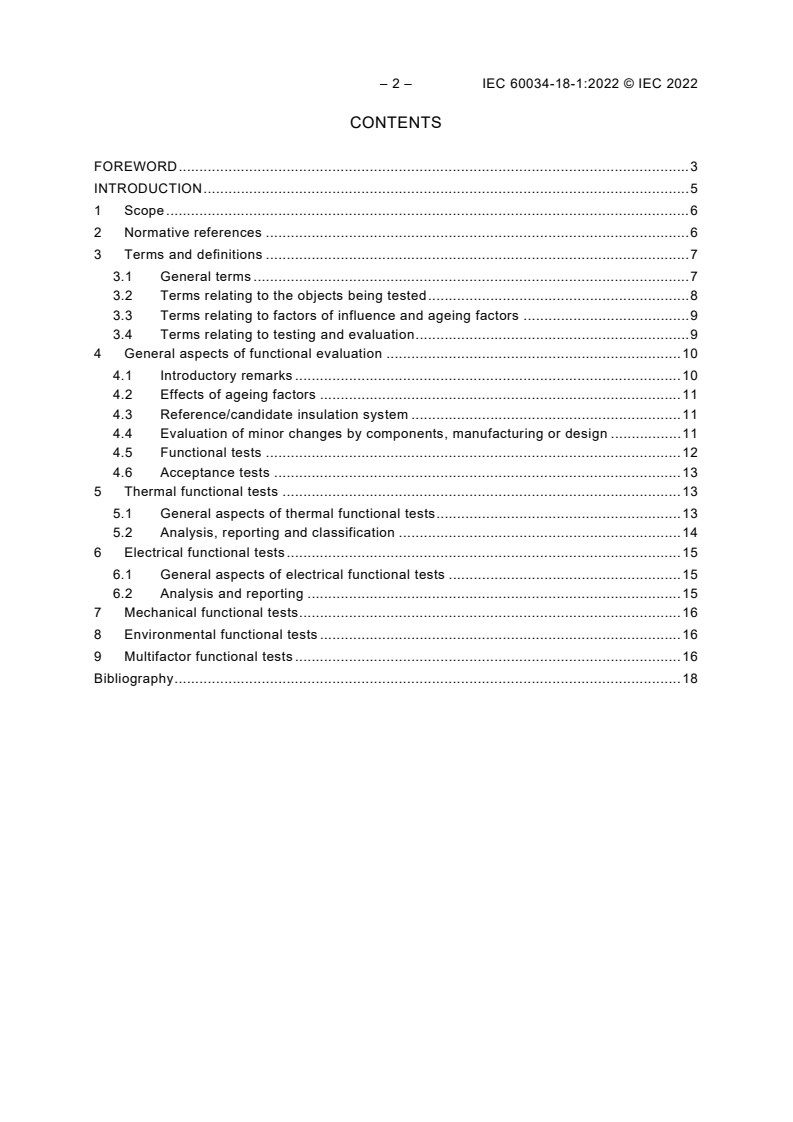
IEC 60034-18-1:2022 - Rotating electrical machines - Part 18-1: Functional evaluation of insulation systems - General guidelines Released:12/22/2022
Overview
IEC 60034-18-1:2022 - Rotating electrical machines - Part 18-1: Functional evaluation of insulation systems - General guidelines - provides high-level guidance for the qualification and functional evaluation of electrical insulation systems used in rotating electrical machines (within the scope of IEC 60034-1). Edition 3.0 (2022) replaces the 2010 edition and refocuses this part on general principles, while relocating procedural and detailed test methods to subsequent parts of the IEC 60034-18 series.
Key updates include guidance for windings electrically stressed by converter‑supply, a defined procedure for comparing reference and candidate insulation systems, introduction of qualification for different expected service life‑times, and evaluation of minor component or manufacturing changes. The standard also recognizes that thermal ageing does not always follow Arrhenius behaviour for complex insulation systems.
Key topics and requirements
- Scope and purpose: Framework for qualifying insulation systems for rotating machines rather than prescriptive test recipes.
- Functional evaluation approach: Emphasis on comparing a candidate system to a service‑proven reference system to assess suitability and endurance.
- Types of functional tests: General guidance for thermal, electrical, mechanical, environmental and multifactor tests (combined stresses).
- Converter-fed windings: Incorporates considerations introduced for electrical qualification of windings stressed by converters.
- Qualification concepts: Procedures for categorizing changes (minor component/manufacturing changes), and qualification for different expected lifetimes in service.
- Ageing considerations: Notes limitations of applying Arrhenius-based thermal ageing models to insulation systems and the need for service‑oriented evaluation.
- Reporting and comparison: Guidance on analysis, reporting and classification of test outcomes and on establishing acceptance criteria relative to reference systems.
Applications and who uses it
IEC 60034-18-1 is intended for:
- Motor and generator OEMs developing or modifying insulation systems.
- Design engineers selecting insulation for new rotating machines.
- Qualification and test laboratories establishing functional evaluation programs.
- Quality and certification bodies assessing changes to insulating systems and manufacturing processes.
- Utilities, industrial end users and R&D teams interested in life‑time performance and converter‑fed machine behaviour.
Practical uses include qualifying new insulation constructions, assessing component substitutions or manufacturing changes, and defining test strategies to validate expected service lifetimes.
Related standards
- IEC 60034-1 (Rating and performance)
- IEC 60034-18‑21 / -18‑22 / -18‑31 / -18‑32 / TS 60034-18‑33 / -18‑34 / -18‑41 / -18‑42 (detailed procedures)
- IEC 60216 (thermal endurance of materials)
- IEC 60085 (thermal evaluation and classes)
- IEC 60505 (ageing principles)
- IEC 62539 (statistical analysis of breakdown data)
Keywords: IEC 60034-18-1:2022, rotating electrical machines, insulation systems, functional evaluation, insulation qualification, converter-supply, thermal ageing, reference insulation system.
Relations
- Effective Date
- 05-Sep-2023
Buy Documents
REDLINE IEC 60034-18-1:2022 CMV - Rotating electrical machines - Part 18-1: Functional evaluation of insulation systems - General guidelines Released:12/22/2022
IEC 60034-18-1:2022 - Rotating electrical machines - Part 18-1: Functional evaluation of insulation systems - General guidelines Released:12/22/2022
Get Certified
Connect with accredited certification bodies for this standard

IMQ S.p.A. (Certification)
Italian electrical product certification.

SLG Prüf- und Zertifizierungs GmbH
German testing and certification body.

UL Solutions
Global safety science company with testing, inspection and certification.
Sponsored listings
Frequently Asked Questions
IEC 60034-18-1:2022 is a standard published by the International Electrotechnical Commission (IEC). Its full title is "Rotating electrical machines - Part 18-1: Functional evaluation of insulation systems - General guidelines". This standard covers: IEC 60034-18-1:2022 deals with the general guidelines for functional evaluation of electrical insulation systems, used or proposed to be used in rotating electrical machines within the scope of IEC 60034-1, in order to qualify them. IEC 60034-18-1 defines general requirements on the qualification of insulation systems, where – for thermal ageing – the Arrhenius equations do not necessarily fit, according to many experiences. This third edition cancels and replaces the second edition published in 2010. This edition includes the following significant technical changes with respect to the previous edition: a. provides general guidelines for functional evaluation of different types of windings as before but incorporates those changes, which have been introduced for the electrical qualification and evaluation of windings which are electrically stressed by converter-supply; b. is now focused on general guidelines with all technical details of procedures and qualification principles moved to the subsequent parts; c. details additional general aspects of functional evaluation and qualification, particularly the procedure for comparison between reference and candidate insulation systems, the introduction of the concept of qualification for different expected life-times in service and the evaluation of minor component or manufacturing changes.
IEC 60034-18-1:2022 deals with the general guidelines for functional evaluation of electrical insulation systems, used or proposed to be used in rotating electrical machines within the scope of IEC 60034-1, in order to qualify them. IEC 60034-18-1 defines general requirements on the qualification of insulation systems, where – for thermal ageing – the Arrhenius equations do not necessarily fit, according to many experiences. This third edition cancels and replaces the second edition published in 2010. This edition includes the following significant technical changes with respect to the previous edition: a. provides general guidelines for functional evaluation of different types of windings as before but incorporates those changes, which have been introduced for the electrical qualification and evaluation of windings which are electrically stressed by converter-supply; b. is now focused on general guidelines with all technical details of procedures and qualification principles moved to the subsequent parts; c. details additional general aspects of functional evaluation and qualification, particularly the procedure for comparison between reference and candidate insulation systems, the introduction of the concept of qualification for different expected life-times in service and the evaluation of minor component or manufacturing changes.
IEC 60034-18-1:2022 is classified under the following ICS (International Classification for Standards) categories: 29.160.01 - Rotating machinery in general. The ICS classification helps identify the subject area and facilitates finding related standards.
IEC 60034-18-1:2022 has the following relationships with other standards: It is inter standard links to IEC 60034-18-1:2010. Understanding these relationships helps ensure you are using the most current and applicable version of the standard.
IEC 60034-18-1:2022 is available in PDF format for immediate download after purchase. The document can be added to your cart and obtained through the secure checkout process. Digital delivery ensures instant access to the complete standard document.
Standards Content (Sample)
IEC 60034-18-1 ®
Edition 3.0 2022-12
COMMENTED VERSION
INTERNATIONAL
STANDARD
colour
inside
Rotating electrical machines –
Part 18-1: Functional evaluation of insulation systems – General guidelines
All rights reserved. Unless otherwise specified, no part of this publication may be reproduced or utilized in any form
or by any means, electronic or mechanical, including photocopying and microfilm, without permission in writing from
either IEC or IEC's member National Committee in the country of the requester. If you have any questions about IEC
copyright or have an enquiry about obtaining additional rights to this publication, please contact the address below or
your local IEC member National Committee for further information.
IEC Secretariat Tel.: +41 22 919 02 11
3, rue de Varembé info@iec.ch
CH-1211 Geneva 20 www.iec.ch
Switzerland
About the IEC
The International Electrotechnical Commission (IEC) is the leading global organization that prepares and publishes
International Standards for all electrical, electronic and related technologies.
About IEC publications
The technical content of IEC publications is kept under constant review by the IEC. Please make sure that you have the
latest edition, a corrigendum or an amendment might have been published.
IEC publications search - webstore.iec.ch/advsearchform IEC Products & Services Portal - products.iec.ch
The advanced search enables to find IEC publications by a
Discover our powerful search engine and read freely all the
variety of criteria (reference number, text, technical publications previews. With a subscription you will always
committee, …). It also gives information on projects, replaced have access to up to date content tailored to your needs.
and withdrawn publications.
Electropedia - www.electropedia.org
IEC Just Published - webstore.iec.ch/justpublished
The world's leading online dictionary on electrotechnology,
Stay up to date on all new IEC publications. Just Published
containing more than 22 300 terminological entries in English
details all new publications released. Available online and
and French, with equivalent terms in 19 additional languages.
once a month by email.
Also known as the International Electrotechnical Vocabulary
(IEV) online.
IEC Customer Service Centre - webstore.iec.ch/csc
If you wish to give us your feedback on this publication or
need further assistance, please contact the Customer Service
Centre: sales@iec.ch.
IEC 60034-18-1 ®
Edition 3.0 2022-12
COMMENTED VERSION
INTERNATIONAL
STANDARD
colour
inside
Rotating electrical machines –
Part 18-1: Functional evaluation of insulation systems – General guidelines
INTERNATIONAL
ELECTROTECHNICAL
COMMISSION
ICS 29.160.01 ISBN 978-2-8322-6315-0
– 2 – IEC 60034-18-1:2022 CMV © IEC 2022
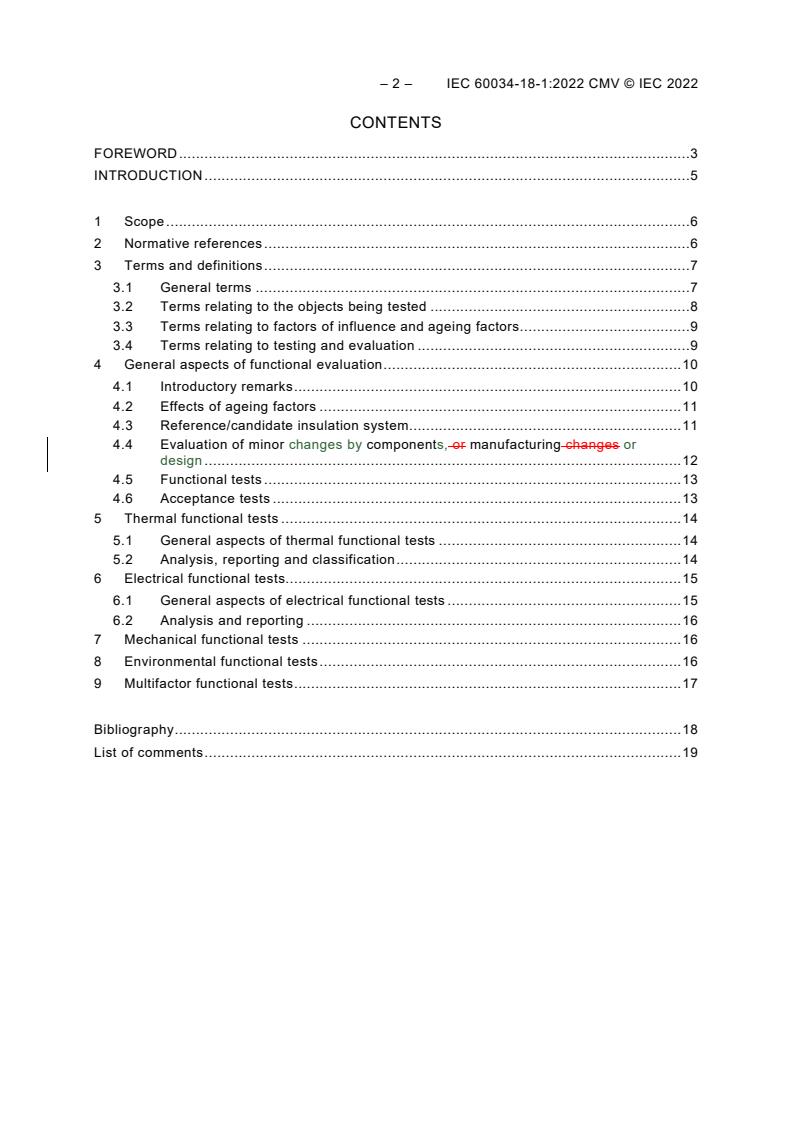
CONTENTS
FOREWORD .3
INTRODUCTION .5
1 Scope .6
2 Normative references .6
3 Terms and definitions .7
3.1 General terms .7
3.2 Terms relating to the objects being tested .8
3.3 Terms relating to factors of influence and ageing factors .9
3.4 Terms relating to testing and evaluation .9
4 General aspects of functional evaluation . 10
4.1 Introductory remarks . 10
4.2 Effects of ageing factors . 11
4.3 Reference/candidate insulation system . 11
4.4 Evaluation of minor changes by components, or manufacturing changes or
design . 12
4.5 Functional tests . 13
4.6 Acceptance tests . 13
5 Thermal functional tests . 14
5.1 General aspects of thermal functional tests . 14
5.2 Analysis, reporting and classification . 14
6 Electrical functional tests . 15
6.1 General aspects of electrical functional tests . 15
6.2 Analysis and reporting . 16
7 Mechanical functional tests . 16
8 Environmental functional tests . 16
9 Multifactor functional tests . 17
Bibliography . 18
List of comments . 19
INTERNATIONAL ELECTROTECHNICAL COMMISSION
____________
ROTATING ELECTRICAL MACHINES –
Part 18-1: Functional evaluation of insulation systems –
General guidelines
FOREWORD
1) The International Electrotechnical Commission (IEC) is a worldwide organization for standardization comprising
all national electrotechnical committees (IEC National Committees). The object of IEC is to promote international
co-operation on all questions concerning standardization in the electrical and electronic fields. To this end and
in addition to other activities, IEC publishes International Standards, Technical Specifications, Technical Reports,
Publicly Available Specifications (PAS) and Guides (hereafter referred to as “IEC Publication(s)”). Their
preparation is entrusted to technical committees; any IEC National Committee interested in the subject dealt with
may participate in this preparatory work. International, governmental and non-governmental organizations liaising
with the IEC also participate in this preparation. IEC collaborates closely with the International Organization for
Standardization (ISO) in accordance with conditions determined by agreement between the two organizations.
2) The formal decisions or agreements of IEC on technical matters express, as nearly as possible, an international
consensus of opinion on the relevant subjects since each technical committee has representation from all
interested IEC National Committees.
3) IEC Publications have the form of recommendations for international use and are accepted by IEC National
Committees in that sense. While all reasonable efforts are made to ensure that the technical content of IEC
Publications is accurate, IEC cannot be held responsible for the way in which they are used or for any
misinterpretation by any end user.
4) In order to promote international uniformity, IEC National Committees undertake to apply IEC Publications
transparently to the maximum extent possible in their national and regional publications. Any divergence between
any IEC Publication and the corresponding national or regional publication shall be clearly indicated in the latter.
5) IEC itself does not provide any attestation of conformity. Independent certification bodies provide conformity
assessment services and, in some areas, access to IEC marks of conformity. IEC is not responsible for any
services carried out by independent certification bodies.
6) All users should ensure that they have the latest edition of this publication.
7) No liability shall attach to IEC or its directors, employees, servants or agents including individual experts and
members of its technical committees and IEC National Committees for any personal injury, property damage or
other damage of any nature whatsoever, whether direct or indirect, or for costs (including legal fees) and
expenses arising out of the publication, use of, or reliance upon, this IEC Publication or any other IEC
Publications.
8) Attention is drawn to the Normative references cited in this publication. Use of the referenced publications is
indispensable for the correct application of this publication.
9) Attention is drawn to the possibility that some of the elements of this IEC Publication may be the subject of patent
rights. IEC shall not be held responsible for identifying any or all such patent rights.
This commented version (CMV) of the official standard IEC 60034-18-1:2022 edition 3.0
allows the user to identify the changes made to the previous IEC 60034-18-1:2010
edition 2.0. Furthermore, comments from IEC TC 2 experts are provided to explain the
reasons of the most relevant changes, or to clarify any part of the content.
A vertical bar appears in the margin wherever a change has been made. Additions are in
green text, deletions are in strikethrough red text. Experts' comments are identified by a
blue-background number. Mouse over a number to display a pop-up note with the
comment.
This publication contains the CMV and the official standard. The full list of comments is
available at the end of the CMV.
– 4 – IEC 60034-18-1:2022 CMV © IEC 2022
IEC 60034-18-1 has been prepared by IEC technical committee 2: Rotating machinery. It is an
International Standard.
This third edition cancels and replaces the second edition published in 2010. This edition
constitutes a technical revision.
This edition includes the following significant technical changes with respect to the previous
edition:
a) provides general guidelines for functional evaluation of different types of windings as before
but incorporates those changes, which have been introduced for the electrical qualification
and evaluation of windings which are electrically stressed by converter-supply;
b) is now focused on general guidelines with all technical details of procedures and
qualification principles moved to the subsequent parts;
c) details additional general aspects of functional evaluation and qualification, particularly the
procedure for comparison between reference and candidate insulation systems, the
introduction of the concept of qualification for different expected life-times in service and
the evaluation of minor component or manufacturing changes.
The text of this International Standard is based on the following documents:
Draft Report on voting
2/2113/FDIS 2/2118/RVD
Full information on the voting for its approval can be found in the report on voting indicated in
the above table.
The language used for the development of this International Standard is English.
This document was drafted in accordance with ISO/IEC Directives, Part 2, and developed in
accordance with ISO/IEC Directives, Part 1 and ISO/IEC Directives, IEC Supplement, available
at www.iec.ch/members_experts/refdocs. The main document types developed by IEC are
described in greater detail at www.iec.ch/standardsdev/publications.
A list of all parts in the IEC 60034 series, published under the general title Rotating electrical
machines, can be found on the IEC website.
The committee has decided that the contents of this document will remain unchanged until the
stability date indicated on the IEC website under webstore.iec.ch in the data related to the
specific document. At this date, the document will be
• reconfirmed,
• withdrawn,
• replaced by a revised edition, or
• amended.
IMPORTANT – The "colour inside" logo on the cover page of this document indicates that it
contains colours which are considered to be useful for the correct understanding of its
contents. Users should therefore print this document using a colour printer.
INTRODUCTION
IEC 60034-18 comprises several parts, dealing with different types of functional evaluation and
special kinds of test procedures for insulation systems of rotating electrical machines.
IEC 60034-18-1 provides general guidelines for such procedures and qualification principles,
whereas the subsequent parts IEC 60034-18-21, IEC 60034-18-22, IEC 60034-18-31,
IEC 60034-18-32, IEC TS 60034-18-33, IEC 60034-18-34, IEC 60034-18-41 and IEC 60034-
18-42 give detailed procedures for the various types of windings. Beyond that, part IEC 60034-
18-41 and IEC 60034-18-42 contain special test procedures for electrical evaluation of windings
electrically stressed by converter-supply.
The following standards provide the basis and background for the development of the afore
mentioned standards.
IEC 60505 establishes the basis for estimating the ageing of electrical insulation systems under
conditions of either electrical, thermal, mechanical, environmental stresses or combinations of
these (multifactor stresses). It specifies the general principles and procedures that should be
followed defining functional test and evaluation procedures.
The IEC 60216 series deals with the determination of thermal endurance properties of single
insulating materials. On the assumption, that the Arrhenius formulas describe the rate of
thermal ageing of the materials, test procedures and analyzing instructions for getting
characteristic parameters like the “Temperature index” (TI), the “Halving interval” (HIC) and the
“Relative thermal endurance index” (RTE) are given. For all these parameters selected
properties and accepted end-point-criteria are specified. Consequently, a material may be
assigned with more than one temperature index, derived from the measurement of different
properties and the use of different end-point criteria.
IEC 60034-18-1 defines general requirements on the qualification of insulation systems, where
– for thermal ageing – the Arrhenius equations do not necessarily fit, according to many
experiences.
IEC 60085 deals with thermal evaluation of electrical insulation materials and in particular
insulation systems used in electrical equipment. In particular, thermal classes of insulation
systems are defined and designations are given, such as 130 (B), 155 (F) and 180 (H) for use
in rotating machines belonging to IEC 60034-1. In the past, materials for insulation systems
were often selected solely on the basis of thermal endurance of individual materials performed
according to the IEC 60216 series. However, IEC 60085 recognizes that such selection may
be used only for screening materials prior to further functional evaluation of a new insulation
system which is not service-proven. Evaluation is performed on the basis of a comparison with
a service-proven reference insulation system. Service experience is the preferred basis for
assessing the thermal endurance of an insulation system.
IEC 62539 defines statistical methods to analyse times to breakdown and breakdown voltage
data obtained from electrical testing of solid insulation materials, for the purposes of
characterization of the system and comparison with other insulation systems. The methods of
analysis are described for the Weibull-distribution, but other distributions are also presented.
– 6 – IEC 60034-18-1:2022 CMV © IEC 2022
ROTATING ELECTRICAL MACHINES –
Part 18-1: Functional evaluation of insulation systems –
General guidelines
1 Scope
This part of IEC 60034 deals with the general guidelines for functional evaluation of electrical
insulation systems, used or proposed to be used in rotating electrical machines within the scope
of IEC 60034-1, in order to qualify them.
2 Normative references
The following documents are referred to in the text in such a way that some or all of their content
constitutes requirements of this document. For dated references, only the edition cited applies.
For undated references, the latest edition of the referenced document (including any
amendments) applies.
IEC 60034-1, Rotating electrical machines – Part 1: Rating and performance
IEC 60034-18-21, Rotating electrical machines – Part 18-21: Functional evaluation of insulation
systems – Test procedures for wire-wound windings – Thermal evaluation and classification
IEC 60034-18-22, Rotating electrical machines – Part 18-22: Functional evaluation of insulation
systems – Test procedures for wire-wound windings – Classification of changes and insulation
component substitutions
IEC 60034-18-31, Rotating electrical machines – Part 18-31: Functional evaluation of insulation
systems – Test procedures for form-wound windings – Thermal evaluation and classification of
insulation systems used in rotating machines up to and including 50 MVA and 15 kV
IEC 60034-18-32, Rotating electrical machines – Part 18-32: Functional evaluation of insulation
systems (Type II) – Test procedures for form-wound windings – Evaluation of electrical
endurance of insulation systems used in machines up to and including 50 MVA and 15 kV
Electrical endurance qualification procedures for form-wound windings
IEC TS 60034-18-33, Rotating electrical machines – Part 18-33: Functional evaluation of
insulation systems – Test procedures for form-wound windings – Multifactor functional
evaluation – endurance under combined thermal and electrical stresses of insulation systems
used in machines up to and including 50 MVA and 15 kV Multifactor evaluation by endurance
under simultaneous thermal and electrical stresses
IEC 60034-18-34, Rotating electrical machines – Part 18-34: Functional evaluation of insulation
systems – Test procedures for form-wound windings – Evaluation of thermomechanical
endurance of insulation systems
IEC 60034-18-41:2014, Rotating electrical machines – Part 18-41: Qualification and type tests
for Type I electrical insulation systems used in rotating electrical machines fed from voltage
converters Partial discharge free electrical insulation systems (Type I) used in rotating electrical
machines fed from voltage converters – Qualification and quality control tests
IEC 60034-18-41:2014/AMD1:2019
IEC/TS 60034-18-42, Rotating electrical machines – Part 18-42: Qualification and acceptance
tests for partial discharge resistant electrical insulation systems (Type II) used in rotating
electrical machines fed from voltage converters Partial discharge resistant electrical insulation
systems (Type II) used in rotating electrical machines fed from voltage converters –
Qualification tests
electrical machines – Part 27-3: Dielectric dissipation factor
IEC 60034-27-3, Rotating
measurement on stator winding insulation of rotating electrical machines
IEC 60085, Electrical insulation – Thermal evaluation and designation of electrical insulation
IEC 60216 (all parts), Electrical insulating materials – Properties of thermal endurance
IEC 60493-1, Guide for the statistical analysis of ageing test data – Part 1: Methods based on
mean values of normally distributed test results
IEC 60505:20042011, Evaluation and qualification of electrical insulation systems
IEC 61858-1:2014, Electrical insulation systems – Thermal evaluation of modifications to an
established electrical insulation system (EIS) – Part 1: Wire-wound winding EIS
IEC 61858-2:2014, Electrical insulation systems – Thermal evaluation of modifications to an
established electrical insulation system (EIS) – Part 2: Form-wound EIS
IEC 62539, Guide for the statistical analysis of electrical insulation breakdown data
3 Terms and definitions
For the purposes of this document, the following terms and definitions apply.
ISO and IEC maintain terminological databases for use in standardization at the following
addresses:
• IEC Electropedia: available at http://www.electropedia.org/
• ISO Online browsing platform: available at http://www.iso.org/obp
3.1 General terms
3.1.1
class temperature
temperature for which the insulation system is suitable, as defined by the thermal class in
IEC 60085 and as used in IEC 60505
3.1.2
electrical insulation system
EIS
insulating structure containing one or more electrical insulating materials (EIM) applied over
together with associated conducting parts employed in rotating electrical machines an
electrotechnical device
[SOURCE: IEC 60505:20042011, 3.1.1, modified]
NOTE 1 There may be several insulation components within the windings, each being designed for different stresses
in service, i.e. turn insulation, slot insulation and end-winding insulation. Different criteria may be applied to the
various components within the overall system.
NOTE 2 There may be more than one insulation system in a particular type of machine. These insulation systems
may have different thermal classes (e.g. stator and rotor windings).
– 8 – IEC 60034-18-1:2022 CMV © IEC 2022
3.1.3
candidate insulation system
insulation system being tested to determine its capability with respect to ageing factors
[SOURCE: IEC 60050-411:1996, Amendment 1:2007, 411-39-26, modified]
3.1.4
reference insulation system
insulation system whose performance has been established by satisfactory service experience
[SOURCE: IEC 60050-411:1996, Amendment 1:2007, 411-39-27]
3.1.5
coil
one or more turns of insulated conductors connected in series and surrounded by common
insulation, arranged to link or produce magnetic flux
[SOURCE: IEC 60050-411:1996, 411-38-03, modified]
3.1.6
bar
either of two parts which, after placed in their slots and when connected together, will form the
complete form-wound coil (see 3.1.8) and which comprise a coil side and an appropriate end
winding
Note 1 to entry: Large AC machines commonly use bars, and usually, though not always, they form single-turn coils
in a two-layer winding.
[SOURCE: IEC 60050-411:1996, 411-38-05, modified]
3.1.7
wire-wound winding
winding which is wound with one or several insulated conductors and in which the individual
conductors occupy random positions in the coil side
Note 1 to entry: It is usually random-wound with round conductors.
[SOURCE: IEC 60050-411:1996, 411-38-13, modified]
3.1.8
form-wound winding
winding consisting of coils or bars which are preformed to shape, insulated and substantially
completed before they are inserted into their final places
Note 1 to entry: Coils or bars are usually wound with rectangular conductors.
[SOURCE: IEC 60050-411:1996, 411-38-11, modified]
3.2 Terms relating to the objects being tested
3.2.1
test object
unit being tested
Note 1 to entry: It may be an actual machine or part thereof or a special test model (see 3.2.3 and 3.2.4) which can
be subjected to functional tests.
Note 2 to entry: A test object may contain more than one test specimen (see 3.2.2).
3.2.2
test specimen
individual component within a test object which can be used to generate one piece of test data
(e.g. time to failure)
Note 1 to entry: A test specimen may contain more than one insulation component (e.g. turn insulation and
conductor to earth insulation), any one of which can provide that piece of data.
3.2.3
formette
special test model used for the evaluation of the insulation systems for form-wound windings
[SOURCE: IEC 60050-411:1996, Amendment 1:2007, 411-53-64]
3.2.4
motorette
special test model used for the evaluation of the insulation systems for wire-wound (random-
wound) windings
[SOURCE: IEC 60050-411:1996, Amendment 1:2007, 411-53-65]
3.3 Terms relating to factors of influence and ageing factors
3.3.1
factor of influence
stress imposed by conditions of operation, environment or test that may affect ageing or life of
an insulation system
3.3.2
ageing factor
factor of influence that causes ageing
Note 1 to entry: In the winding of an electrical machine, different factors of influence or ageing factors can be
dominant in different parts (e.g. turn insulation and end-winding insulation). Therefore, different criteria may be used
to assess those parts of the insulation. It can also be appropriate to apply different procedures of functional evaluation
to these parts.
3.4 Terms relating to testing and evaluation
3.4.1
diagnostic factor
variable or fixed stress applied to an insulation component of a test specimen in order to
establish its condition after ageing without significantly adding to the ageing
which is applied to an EIS to establish the degree of ageing
[SOURCE: IEC 60505:20042011, 3.3.7, modified]
3.4.2
functional test
comparative test in which the candidate and the reference insulation systems are exposed to
ageing and diagnostic factors in order to qualify the candidate system, or, a functional test may
also be related to a diagnostic property 1
3.4.3
endurance test
test in which the insulation system of a test object is exposed to one or more ageing factors
related to service conditions and where changes in specific properties are evaluated by
diagnostic tests
– 10 – IEC 60034-18-1:2022 CMV © IEC 2022
3.4.4
diagnostic test
test in which the insulation system of a test object is exposed to one or more diagnostic factors
in order to discern its condition through measurements or proof tests and to determine when
the end-point criterion has been reached
3.4.5
end-point criterion
selected value of a characteristic of a test object indicating the end of its test life or arbitrarily
chosen for the purpose of the comparison of insulation systems
3.4.6
end-point
end of a test as defined by the end-point criterion
3.4.7
classification
set of actions leading to the determination of the thermal class of an insulation system, e.g.
Thermal Class or Impulse Voltage Insulation Class 2
3.4.8
type test
test conducted on first prototype of product to confirm the design specifications, it is usually not
repeated on other products of same type
3.4.9
quality control test
conducted in order to ensure that the quality of a product is maintained against a set of
benchmarks and that any errors encountered are either eliminated or reduced
3.4.10
routine test
test made on each individual device during or after manufacture to check if it complies with the
requirements of the standard concerned or the criteria specified
4 General aspects of functional evaluation
4.1 Introductory remarks
All Most functional tests given in the IEC 60034-18 series are comparative. The performance of
a candidate system is compared with that of a reference system when both are subjected to
equivalent test conditions with respect to test objects, methods of ageing and diagnostic tests.
It is not necessarily required that the reference system is physically to be tested in parallel, if
the test results of the reference system used have been documented previously and obtained
from same test conditions. 3
The reference system normally is particular and real – but its quantified minimum performance
can also be defined by an agreed reference lifeline, provided by an IEC standard as in
IEC 60034-18-42.
At the end of every functional test, the functional evaluation shall be made. This means it is
necessary to compare the diagnostic data obtained from the candidate and the reference
system, usually to compare the mean times to failure. and its spread, using appropriate
statistical methods.
If the data from the candidate system is no worse than from the reference system, the candidate
considered to be qualified. This is true if the 90 % confidence interval of that
system is
percentile of the used probability distribution which represents the mean value falls above or
within that obtained from the reference system (see IEC 60493-1 and IEC 62539).
The large differences found in rotating electrical machine windings, in terms of size, voltage,
operating conditions and expected lifetime-behaviour during service necessitate the use of
different procedures for functional evaluation of thermal, electrical and multifactor ageing
(IEC 60034-18-21, IEC 60034-18-31, IEC 60034-18-32, IEC TS 60034-18-33,
IEC 60034-18-34, IEC 60034-18-41, IEC 60034-18-42) to evaluate qualify various types of
windings. These procedures can be of different complexity, the simplest being based on a single
ageing factor (e.g. thermal or electrical).
The procedures for functional evaluation will permit comparisons and allow qualification of
candidate insulation systems. However, they cannot completely determine the merits of any
particular insulation system. Principally, it is not possible to give an operational lifetime forecast
of the individual winding insulation based on any kind of functional tests. Such information can
be obtained in general only from extended service experience.
The demonstration of IEC 60034-18 series results could contain proprietary information that the
manufacturer therefore does not want to share in the documentation. But in order to prove
compliance of the candidate system, key points shall be at least shown and explained to the
customer without the need to provide documents.
4.2 Effects of ageing factors
All ageing factors, i.e. thermal, electrical, environmental and mechanical, affect the life of all
types of machines but the significance of each factor varies with the type of machine and the
expected duty. In some cases, one of these ageing factors is considered to be dominant.
In other cases, several ageing factors may be acting significantly. These different conditions
have to be considered in choosing the appropriate functional test according to this document.
Insulation of small or medium low-voltage line-fed machines is degraded primarily by
temperature and environment, with electrical and mechanical stresses being of less importance.
Medium to large machines, using form-wound windings, are also affected by temperature and
environment but, in addition, the electrical and mechanical stresses can be important ageing
factors.
Very large machines, which generally utilize form-wound (with bars) windings and which can
operate in a special environment such as hydrogen, are normally most affected by mechanical
stresses or electrical stresses, or both. Temperature and environment can be less significant
ageing factors.
The winding insulation system of small, medium, large and very large converter fed machines
may be substantially electrically stressed (see IEC 60034-18-41 and IEC 60034-18-42).
4.3 Reference/candidate insulation system
An insulation system qualifies to be used as a reference insulation system if its performance
has been established by satisfactory service experience. This means:
– it has shown successful operation over suitably long periods of time at operating conditions
characteristic of the rating (or class) and in typical applications of that insulation system;
– its service experience is based on a sufficient number of machines.
A reference insulation system shall be tested together with the candidate system using the
same test procedure and the same test equipment, preferably in the same laboratory.
Alternatively, if the test results of the reference system used have been documented previously
– 12 – IEC 60034-18-1:2022 CMV © IEC 2022
and obtained from same test conditions, re-testing the reference system is not necessary (see
4.1).
If it is necessary to verify results in another laboratory, it can be found that the test-life values
differ if the conditions in the original test are not duplicated precisely. However, a comparison
of results between qualified laboratories should show at least nearly the same relative
performance between candidate and reference systems.
4.4 Evaluation of minor changes by components, or manufacturing changes or
design
Substitution of components, changes in the manufacturing process and design adaptions are
usual practice during the lifecycle of qualified insulation systems.
Any substitution of components (insulating materials) or any relevant change in manufacturing
process changes or design may turn a reference system into a candidate system with the need
for a new functional evaluation, unless the new component can be considered to be chemically
and physically identical (generically identical) and the intended changes in the manufacturing
process are not expected to have any influence on the electrical insulation system properties –
unless if the new component and the intended changes in manufacturing process or design are
expected to have no practical influence on the functional electrical insulation system properties,
e.g. by chemical and physical generic identity of the materials used.
It is to be therefore decided on a first step, if the change may alter the strength of the insulation
system against dominant ageing factors like electrical, thermal, mechanical or ambient
stresses.
In respect of the dominant ageing factor, or combinations of ageing factors, it may be that the
change proposed intended is only minor. Such a minor change is the substitution of a
component or a change in the manufacturing process which is expected to have no practical,
significant effect on the performance of the insulation system and may be the justification to
use, instead of a full functional evaluation, merely a reduced functional evaluation by single
point test or other special endurance tests (see IEC 60034-18-22 together with IEC 60034-18-
21, IEC 60034-18-31, IEC 60034-18-32 and IEC 60034-18-33).
In other cases, no system testing may be required but only material testing may be adequate,
e.g. different suppliers produce according to the same requirement specification of the client
on similar chemical basis. For this topic, horizontal standards describe simple material tests,
e.g. for round or flat wires, IEC 61858-1 or IEC 61858-2, respectively. 4
Often, no material nor major process change is intended, however it is desired to change the
thickness of the mainwall insulation: If the average and peak electric field stress (kV/mm) of the
EIS with the different insulation thickness do not exceed that of the qualified EIS, by more than
5 %, and if the thickness and rated voltage are not exceeding the range of +110 % / -50 % of
the qualified insulation system, then a new functional evaluation is not needed. For example, if
6,6 kV system has been functionally evaluated completely and qualified according to this
standard, this qualification would also apply for the 13,8 kV and for 3,3 kV system with the same
materials and processes but adapted thicknesses. This does not apply to the stress control
system which may to be qualified independently. 5
The voltage range is applicable only up to rated voltages of 15 kV – above that, specific
knowledge and alignments between manufacturer and user may be required.
It is the machine manufacturer's responsibility to determine the need for verification and to
justify the use and the focus of a reduced functional evaluation or and how special endurance
or screening tests should be undertaken. Full or reduced functional evaluation or special
endurance tests may be necessary.
In the documentation on insulation system, the manufacturer should include this verification of
a minor change when it is used in the system.
4.5 Functional tests
As defined in 3.4.2, functional tests are used to qualify the insulation systems. They are
performed by endurance test cycles, each cycle consisting of an ageing sub-cycle and a
diagnostic sub-cycle. In the ageing sub-cycle, test specimens are exposed to the specified
ageing factor, intensified appropriately to accelerate ageing. In the diagnostic sub-cycle, test
specimens are subjected to appropriate diagnostic tests to determine the end of test life or to
measure relevant properties of the insulation system at that time. In some cases, the ageing
factor itself can act as the diagnostic factor and produce the end-point.
Not all diagnostic tests need to be applied in all cases. Special considerations may render
certain diagnostic tests inapplicable.
The outcome of these tests is comparative and does not allow an estimate to be made, e.g. by
extrapolation or calculation, of a definite lifetime in service because additional factors of
influence can intervene.
ication for longer or shorter expected lifetimes may be required than
In specific cases, a qualif
that of the service proven reference system used – or for stress parameters not identical to
those of the reference system. In these cases, for the purpose of comparative evaluation of the
candidate sytem with the reference system, its life lines obtained may be shifted accordingly.
This particular comparative evaluation for unequal expected lifetimes or stress parameters is
allowed only for certain limited differences and both, the differences as well as the results must
transparently be documented (e.g. see IEC 60034-18-31 for thermal qualification) It is possible
to exclude a dominant aging factor endurance test by a specific test, e.g. the electrical ageing
by an appropriate partial discharge test as defined in IEC 60034-18-41. In this case, this specific
test may allow refraining from endurance test cycles for this particular ageing mechanism and
replacing it as a functional test. 6
4.6 Acceptance tests
Acceptance tests of the insulation system may be performed to verify that its insulation
materials and quantities used as well as the manufacturing procedure employed are of the
expected production quality level. In so far, the acceptance tests in themselves do not qualify
an insulation system. They are normally non-destructive tests performed with the machine
winding to be sold.
The decision as to whether acceptance tests are undertaken or not, shall be agreed between
the manufacturer and purchaser.
Whether and which acceptance tests beyond those defined in IEC 60034-1 are undertaken or
not, is usually defined in the manufacturers process standards. Further requirements are to be
agreed between the manufacturer and purchaser.
In cases where there is no chance to make the specific acceptance tests with the winding to be
sold or with test objects produced together with those windings elements to be sold according
to the contract, the acceptance test may be covered by a type test. Here, care has to be taken
to ensure and prove that the production quality of the winding to be sold is on the same level
as the type test winding tested before.
– 14 – IEC 60034-18-1:2022 CMV © IEC 2022
5 Thermal functional tests
5.1 General aspects of thermal functional tests
The purpose of the thermal functional tests in this document is to provide data which may be
used to establish the thermal class of a new insulation system before it is service-proven.
These guidelines are used in conjunction with IEC 60034-18-21, IEC 60034-18-22 IEC 61858-
1 and IEC 60034-18-31 and IEC 61858-2 for the specific type of winding being considered and
where the thermal ageing factor shall be considered dominant in comparison to the other ageing
factors.
The concepts implemented in this document are based on IEC 60085, IEC 60493-1, IEC 60505
and IEC 62539.
The thermal ageing processes in the insulation system of rotating electrical machines can be
complex in nature – refer to IEC 60505 for further information. Since the insulation systems of
rotating machines are complicated in varying degrees, simple systems referred to in IEC 60085
do not exist in rotating machines.
If the intended thermal class of the candidate system differs from the known thermal class of
the reference system, different ageing temperatures, sub-cycle lengths and (when technically
justified) different diagnostic values shall be used in an appropriate manner.
Diagnostic tests (such as mechanical, moisture and voltage tests) shall be applied after each
thermal ageing sub-cycle to check the condition of the insulation system.
It should be recognized that greater mechanical stress and higher concentration of the products
of decomposition can occur during ageing tests above the service temperature. Also, it is
recognized that failures from abnormally high mechanical or voltage stresses are generally of
a different character to those failures which are produced in long service.
5.2 Analysis, reporting and classification
Specific requirements on the analysis, reporting and classification for thermal functional tests
of rotating machine winding insulations are defined in IEC 60034-18-21 and IEC 60034-18-31.
The end of insulation test life is assumed to have occurred at the mid-point-time of the ageing
sub-cycle between the last two consecutive diagnostic sub-cycles.
The total number of hours of thermal ageing to the end of test shall be recorded for each
specimen and for each temperature.
A thermal endurance graph is drawn using the results of ageing, according to the guidelines
given in IEC 60493-1, IEC 62539, IEC 60034-18-21 and IEC 60034-18-31 for both the
candidate system and reference systems. Having chosen a distribution to represent the test
results of ageing, it is necessary to check that the distribution is adequate for this purpose.
If, in special cases of application, the requirements for the expected life time of the candidate
insulation system essentially differ from that of the reference insulation system within the same
thermal class, then the classification can be made, taking account of this fact (see
IEC 60034-18-21 and IEC 60034-18-31). This shall be stated in the report together with an
appropriate justification.
If the thermal endurance graphs of the reference and candidate systems have clearly dissimilar
slopes, it is evident that their ageing processes are significantly different and it is thus doubtful
whether a valid classification can be made from the comparison.
When reporting, it is useful to record all relevant details of the test, including those in the
following list:
– references to IEC test standards;
– detailed description of the insulation systems tested (the reference and candidate systems,
may partly be internal informations);
– ageing temperatures and ageing sub-cycle lengths for each insulation system;
– diagnostic tests used with applied test or stress levels for each insulation system;
– construction of the test specimens and test objects;
– number of specimens at each temperature for each insulation system;
– method of applying the ageing temperatures and the way in which the tempe
...
IEC 60034-18-1 ®
Edition 3.0 2022-12
INTERNATIONAL
STANDARD
NORME
INTERNATIONALE
Rotating electrical machines –
Part 18-1: Functional evaluation of insulation systems – General guidelines
Machines électriques tournantes –
Partie 18-1: Évaluation fonctionnelle des systèmes d'isolation – Lignes
directrices générales
All rights reserved. Unless otherwise specified, no part of this publication may be reproduced or utilized in any form
or by any means, electronic or mechanical, including photocopying and microfilm, without permission in writing from
either IEC or IEC's member National Committee in the country of the requester. If you have any questions about IEC
copyright or have an enquiry about obtaining additional rights to this publication, please contact the address below or
your local IEC member National Committee for further information.
Droits de reproduction réservés. Sauf indication contraire, aucune partie de cette publication ne peut être reproduite ni
utilisée sous quelque forme que ce soit et par aucun procédé, électronique ou mécanique, y compris la photocopie et
les microfilms, sans l'accord écrit de l'IEC ou du Comité national de l'IEC du pays du demandeur. Si vous avez des
questions sur le copyright de l'IEC ou si vous désirez obtenir des droits supplémentaires sur cette publication, utilisez
les coordonnées ci-après ou contactez le Comité national de l'IEC de votre pays de résidence.
IEC Secretariat Tel.: +41 22 919 02 11
3, rue de Varembé info@iec.ch
CH-1211 Geneva 20 www.iec.ch
Switzerland
About the IEC
The International Electrotechnical Commission (IEC) is the leading global organization that prepares and publishes
International Standards for all electrical, electronic and related technologies.
About IEC publications
The technical content of IEC publications is kept under constant review by the IEC. Please make sure that you have the
latest edition, a corrigendum or an amendment might have been published.
IEC publications search - webstore.iec.ch/advsearchform IEC Products & Services Portal - products.iec.ch
The advanced search enables to find IEC publications by a Discover our powerful search engine and read freely all the
variety of criteria (reference number, text, technical publications previews. With a subscription you will always have
committee, …). It also gives information on projects, replaced access to up to date content tailored to your needs.
and withdrawn publications.
Electropedia - www.electropedia.org
IEC Just Published - webstore.iec.ch/justpublished
The world's leading online dictionary on electrotechnology,
Stay up to date on all new IEC publications. Just Published
containing more than 22 300 terminological entries in English
details all new publications released. Available online and once
and French, with equivalent terms in 19 additional languages.
a month by email.
Also known as the International Electrotechnical Vocabulary
(IEV) online.
IEC Customer Service Centre - webstore.iec.ch/csc
If you wish to give us your feedback on this publication or need
further assistance, please contact the Customer Service
Centre: sales@iec.ch.
A propos de l'IEC
La Commission Electrotechnique Internationale (IEC) est la première organisation mondiale qui élabore et publie des
Normes internationales pour tout ce qui a trait à l'électricité, à l'électronique et aux technologies apparentées.
A propos des publications IEC
Le contenu technique des publications IEC est constamment revu. Veuillez vous assurer que vous possédez l’édition la
plus récente, un corrigendum ou amendement peut avoir été publié.
Recherche de publications IEC - Découvrez notre puissant moteur de recherche et consultez
webstore.iec.ch/advsearchform gratuitement tous les aperçus des publications. Avec un
La recherche avancée permet de trouver des publications IEC abonnement, vous aurez toujours accès à un contenu à jour
en utilisant différents critères (numéro de référence, texte, adapté à vos besoins.
comité d’études, …). Elle donne aussi des informations sur les
projets et les publications remplacées ou retirées. Electropedia - www.electropedia.org
Le premier dictionnaire d'électrotechnologie en ligne au monde,
IEC Just Published - webstore.iec.ch/justpublished
avec plus de 22 300 articles terminologiques en anglais et en
Restez informé sur les nouvelles publications IEC. Just
français, ainsi que les termes équivalents dans 19 langues
Published détaille les nouvelles publications parues.
additionnelles. Egalement appelé Vocabulaire
Disponible en ligne et une fois par mois par email.
Electrotechnique International (IEV) en ligne.
Service Clients - webstore.iec.ch/csc
Si vous désirez nous donner des commentaires sur cette
publication ou si vous avez des questions contactez-nous:
sales@iec.ch.
IEC Products & Services Portal - products.iec.ch
IEC 60034-18-1 ®
Edition 3.0 2022-12
INTERNATIONAL
STANDARD
NORME
INTERNATIONALE
Rotating electrical machines –
Part 18-1: Functional evaluation of insulation systems – General guidelines
Machines électriques tournantes –
Partie 18-1: Évaluation fonctionnelle des systèmes d'isolation – Lignes
directrices générales
INTERNATIONAL
ELECTROTECHNICAL
COMMISSION
COMMISSION
ELECTROTECHNIQUE
INTERNATIONALE
ICS 29.160.01 ISBN 978-2-8322-6303-7
– 2 – IEC 60034-18-1:2022 © IEC 2022
CONTENTS
FOREWORD . 3
INTRODUCTION . 5
1 Scope . 6
2 Normative references . 6
3 Terms and definitions . 7
3.1 General terms . 7
3.2 Terms relating to the objects being tested . 8
3.3 Terms relating to factors of influence and ageing factors . 9
3.4 Terms relating to testing and evaluation . 9
4 General aspects of functional evaluation . 10
4.1 Introductory remarks . 10
4.2 Effects of ageing factors . 11
4.3 Reference/candidate insulation system . 11
4.4 Evaluation of minor changes by components, manufacturing or design . 11
4.5 Functional tests . 12
4.6 Acceptance tests . 13
5 Thermal functional tests . 13
5.1 General aspects of thermal functional tests . 13
5.2 Analysis, reporting and classification . 14
6 Electrical functional tests . 15
6.1 General aspects of electrical functional tests . 15
6.2 Analysis and reporting . 15
7 Mechanical functional tests . 16
8 Environmental functional tests . 16
9 Multifactor functional tests . 16
Bibliography . 18
INTERNATIONAL ELECTROTECHNICAL COMMISSION
____________
ROTATING ELECTRICAL MACHINES –
Part 18-1: Functional evaluation of insulation systems –
General guidelines
FOREWORD
1) The International Electrotechnical Commission (IEC) is a worldwide organization for standardization comprising
all national electrotechnical committees (IEC National Committees). The object of IEC is to promote international
co-operation on all questions concerning standardization in the electrical and electronic fields. To this end and
in addition to other activities, IEC publishes International Standards, Technical Specifications, Technical Reports,
Publicly Available Specifications (PAS) and Guides (hereafter referred to as “IEC Publication(s)”). Their
preparation is entrusted to technical committees; any IEC National Committee interested in the subject dealt with
may participate in this preparatory work. International, governmental and non-governmental organizations liaising
with the IEC also participate in this preparation. IEC collaborates closely with the International Organization for
Standardization (ISO) in accordance with conditions determined by agreement between the two organizations.
2) The formal decisions or agreements of IEC on technical matters express, as nearly as possible, an international
consensus of opinion on the relevant subjects since each technical committee has representation from all
interested IEC National Committees.
3) IEC Publications have the form of recommendations for international use and are accepted by IEC National
Committees in that sense. While all reasonable efforts are made to ensure that the technical content of IEC
Publications is accurate, IEC cannot be held responsible for the way in which they are used or for any
misinterpretation by any end user.
4) In order to promote international uniformity, IEC National Committees undertake to apply IEC Publications
transparently to the maximum extent possible in their national and regional publications. Any divergence between
any IEC Publication and the corresponding national or regional publication shall be clearly indicated in the latter.
5) IEC itself does not provide any attestation of conformity. Independent certification bodies provide conformity
assessment services and, in some areas, access to IEC marks of conformity. IEC is not responsible for any
services carried out by independent certification bodies.
6) All users should ensure that they have the latest edition of this publication.
7) No liability shall attach to IEC or its directors, employees, servants or agents including individual experts and
members of its technical committees and IEC National Committees for any personal injury, property damage or
other damage of any nature whatsoever, whether direct or indirect, or for costs (including legal fees) and
expenses arising out of the publication, use of, or reliance upon, this IEC Publication or any other IEC
Publications.
8) Attention is drawn to the Normative references cited in this publication. Use of the referenced publications is
indispensable for the correct application of this publication.
9) Attention is drawn to the possibility that some of the elements of this IEC Publication may be the subject of patent
rights. IEC shall not be held responsible for identifying any or all such patent rights.
IEC 60034-18-1 has been prepared by IEC technical committee 2: Rotating machinery. It is an
International Standard.
This third edition cancels and replaces the second edition published in 2010. This edition
constitutes a technical revision.
This edition includes the following significant technical changes with respect to the previous
edition:
a) provides general guidelines for functional evaluation of different types of windings as before
but incorporates those changes, which have been introduced for the electrical qualification
and evaluation of windings which are electrically stressed by converter-supply;
b) is now focused on general guidelines with all technical details of procedures and
qualification principles moved to the subsequent parts;
– 4 – IEC 60034-18-1:2022 © IEC 2022
c) details additional general aspects of functional evaluation and qualification, particularly the
procedure for comparison between reference and candidate insulation systems, the
introduction of the concept of qualification for different expected life-times in service and
the evaluation of minor component or manufacturing changes.
The text of this International Standard is based on the following documents:
Draft Report on voting
2/2113/FDIS 2/2118/RVD
Full information on the voting for its approval can be found in the report on voting indicated in
the above table.
The language used for the development of this International Standard is English.
This document was drafted in accordance with ISO/IEC Directives, Part 2, and developed in
accordance with ISO/IEC Directives, Part 1 and ISO/IEC Directives, IEC Supplement, available
at www.iec.ch/members_experts/refdocs. The main document types developed by IEC are
described in greater detail at www.iec.ch/standardsdev/publications.
A list of all parts in the IEC 60034 series, published under the general title Rotating electrical
machines, can be found on the IEC website.
The committee has decided that the contents of this document will remain unchanged until the
stability date indicated on the IEC website under webstore.iec.ch in the data related to the
specific document. At this date, the document will be
• reconfirmed,
• withdrawn,
• replaced by a revised edition, or
• amended.
INTRODUCTION
IEC 60034-18 comprises several parts, dealing with different types of functional evaluation and
special kinds of test procedures for insulation systems of rotating electrical machines.
IEC 60034-18-1 provides general guidelines for such procedures and qualification principles,
whereas the subsequent parts IEC 60034-18-21, IEC 60034-18-31, IEC 60034-18-32,
IEC TS 60034-18-33, IEC 60034-18-34, IEC 60034-18-41 and IEC 60034-18-42 give detailed
procedures for the various types of windings. Beyond that, part IEC 60034-18-41 and
IEC 60034-18-42 contain special test procedures for electrical evaluation of windings
electrically stressed by converter-supply.
The following standards provide the basis and background for the development of the afore
mentioned standards.
IEC 60505 establishes the basis for estimating the ageing of electrical insulation systems under
conditions of either electrical, thermal, mechanical, environmental stresses or combinations of
these (multifactor stresses). It specifies the general principles and procedures that should be
followed defining functional test and evaluation procedures.
The IEC 60216 series deals with the determination of thermal endurance properties of single
insulating materials. On the assumption, that the Arrhenius formulas describe the rate of
thermal ageing of the materials, test procedures and analyzing instructions for getting
characteristic parameters like the “Temperature index” (TI), the “Halving interval” (HIC) and the
“Relative thermal endurance index” (RTE) are given. For all these parameters selected
properties and accepted end-point-criteria are specified. Consequently, a material may be
assigned with more than one temperature index, derived from the measurement of different
properties and the use of different end-point criteria.
IEC 60034-18-1 defines general requirements on the qualification of insulation systems, where
– for thermal ageing – the Arrhenius equations do not necessarily fit, according to many
experiences.
IEC 60085 deals with thermal evaluation of electrical insulation materials and in particular
insulation systems used in electrical equipment. In particular, thermal classes of insulation
systems are defined and designations are given, such as 130 (B), 155 (F) and 180 (H) for use
in rotating machines belonging to IEC 60034-1. In the past, materials for insulation systems
were often selected solely on the basis of thermal endurance of individual materials performed
according to the IEC 60216 series. However, IEC 60085 recognizes that such selection may
be used only for screening materials prior to further functional evaluation of a new insulation
system which is not service-proven. Evaluation is performed on the basis of a comparison with
a service-proven reference insulation system. Service experience is the preferred basis for
assessing the thermal endurance of an insulation system.
IEC 62539 defines statistical methods to analyse times to breakdown and breakdown voltage
data obtained from electrical testing of solid insulation materials, for the purposes of
characterization of the system and comparison with other insulation systems. The methods of
analysis are described for the Weibull-distribution, but other distributions are also presented.
– 6 – IEC 60034-18-1:2022 © IEC 2022
ROTATING ELECTRICAL MACHINES –
Part 18-1: Functional evaluation of insulation systems –
General guidelines
1 Scope
This part of IEC 60034 deals with the general guidelines for functional evaluation of electrical
insulation systems, used or proposed to be used in rotating electrical machines within the scope
of IEC 60034-1, in order to qualify them.
2 Normative references
The following documents are referred to in the text in such a way that some or all of their content
constitutes requirements of this document. For dated references, only the edition cited applies.
For undated references, the latest edition of the referenced document (including any
amendments) applies.
IEC 60034-1, Rotating electrical machines – Part 1: Rating and performance
IEC 60034-18-21, Rotating electrical machines – Part 18-21: Functional evaluation of insulation
systems – Test procedures for wire-wound windings – Thermal evaluation and classification
IEC 60034-18-31, Rotating electrical machines – Part 18-31: Functional evaluation of insulation
systems – Test procedures for form-wound windings – Thermal evaluation and classification of
insulation systems used in rotating machines
IEC 60034-18-32, Rotating electrical machines – Part 18-32: Functional evaluation of insulation
systems (Type II) – Electrical endurance qualification procedures for form-wound windings
IEC TS 60034-18-33, Rotating electrical machines – Part 18-33: Functional evaluation of
insulation systems – Test procedures for form-wound windings – Multifactor evaluation by
endurance under simultaneous thermal and electrical stresses
IEC 60034-18-34, Rotating electrical machines – Part 18-34: Functional evaluation of insulation
systems – Test procedures for form-wound windings – Evaluation of thermomechanical
endurance of insulation systems
IEC 60034-18-41:2014, Rotating electrical machines – Part 18-41: Partial discharge free
electrical insulation systems (Type I) used in rotating electrical machines fed from voltage
converters – Qualification and quality control tests
IEC 60034-18-41:2014/AMD1:2019
IEC 60034-18-42, Rotating electrical machines – Part 18-42: Partial discharge resistant
electrical insulation systems (Type II) used in rotating electrical machines fed from voltage
converters – Qualification tests
IEC 60034-27-3, Rotating electrical machines – Part 27-3: Dielectric dissipation factor
measurement on stator winding insulation of rotating electrical machines
IEC 60085, Electrical insulation – Thermal evaluation and designation
IEC 60493-1, Guide for the statistical analysis of ageing test data – Part 1: Methods based on
mean values of normally distributed test results
IEC 60505:2011, Evaluation and qualification of electrical insulation systems
IEC 61858-1:2014, Electrical insulation systems – Thermal evaluation of modifications to an
established electrical insulation system (EIS) – Part 1: Wire-wound winding EIS
IEC 61858-2:2014, Electrical insulation systems – Thermal evaluation of modifications to an
established electrical insulation system (EIS) – Part 2: Form-wound EIS
IEC 62539, Guide for the statistical analysis of electrical insulation breakdown data
3 Terms and definitions
For the purposes of this document, the following terms and definitions apply.
ISO and IEC maintain terminological databases for use in standardization at the following
addresses:
• IEC Electropedia: available at http://www.electropedia.org/
• ISO Online browsing platform: available at http://www.iso.org/obp
3.1 General terms
3.1.1
class temperature
temperature for which the insulation system is suitable, as defined by the thermal class in
and as used in IEC 60505
IEC 60085
3.1.2
electrical insulation system
EIS
insulating structure containing one or more electrical insulating materials (EIM) together with
associated conducting parts employed in an electrotechnical device
[SOURCE: IEC 60505:2011, 3.1.1]
3.1.3
candidate insulation system
insulation system being tested to determine its capability with respect to ageing factors
[SOURCE: IEC 60050-411:1996, 411-39-26]
3.1.4
reference insulation system
insulation system whose performance has been established by satisfactory service experience
[SOURCE: IEC 60050-411:1996, 411-39-27]
3.1.5
coil
one or more turns of insulated conductors connected in series and surrounded by common
insulation, arranged to link or produce magnetic flux
[SOURCE: IEC 60050-411:1996, 411-38-03]
– 8 – IEC 60034-18-1:2022 © IEC 2022
3.1.6
bar
either of two parts which, after placed in their slots and when connected together, will form the
complete form-wound coil (see 3.1.8) and which comprise a coil side and an appropriate end
winding
Note 1 to entry: Large AC machines commonly use bars, and usually, though not always, they form single-turn coils
in a two-layer winding.
[SOURCE: IEC 60050-411:1996, 411-38-05]
3.1.7
wire-wound winding
winding which is wound with one or several insulated conductors and in which the individual
conductors occupy random positions in the coil side
Note 1 to entry: It is usually random-wound with round conductors.
[SOURCE: IEC 60050-411:1996, 411-38-13]
3.1.8
form-wound winding
winding consisting of coils or bars which are preformed to shape, insulated and substantially
completed before they are inserted into their final places
Note 1 to entry: Coils or bars are usually wound with rectangular conductors.
[SOURCE: IEC 60050-411:1996, 411-38-11]
3.2 Terms relating to the objects being tested
3.2.1
test object
unit being tested
Note 1 to entry: It may be an actual machine or part thereof or a special test model (see 3.2.3 and 3.2.4) which can
be subjected to functional tests.
Note 2 to entry: A test object may contain more than one test specimen (see 3.2.2).
3.2.2
test specimen
individual component within a test object which can be used to generate one piece of test data
(e.g. time to failure)
Note 1 to entry: A test specimen may contain more than one insulation component (e.g. turn insulation and
conductor to earth insulation), any one of which can provide that piece of data.
3.2.3
formette
special test model used for the evaluation of the insulation systems for form-wound windings
[SOURCE: IEC 60050-411:1996, 411-53-64]
3.2.4
motorette
special test model used for the evaluation of the insulation systems for wire-wound (random-
wound) windings
[SOURCE: IEC 60050-411:1996, 411-53-65]
3.3 Terms relating to factors of influence and ageing factors
3.3.1
factor of influence
stress imposed by conditions of operation, environment or test that may affect ageing or life of
an insulation system
3.3.2
ageing factor
factor of influence that causes ageing
Note 1 to entry: In the winding of an electrical machine, different factors of influence or ageing factors can be
dominant in different parts (e.g. turn insulation and end-winding insulation). Therefore, different criteria may be used
to assess those parts of the insulation. It can also be appropriate to apply different procedures of functional evaluation
to these parts.
3.4 Terms relating to testing and evaluation
3.4.1
diagnostic factor
variable or fixed stress which is applied to an EIS to establish the degree of ageing
[SOURCE: IEC 60505:2011, 3.3.7]
3.4.2
functional test
comparative test in which the candidate and the reference insulation systems are exposed to
ageing and diagnostic factors in order to qualify the candidate system, or, a functional test may
also be related to a diagnostic property
3.4.3
endurance test
test in which the insulation system of a test object is exposed to one or more ageing factors
related to service conditions and where changes in specific properties are evaluated by
diagnostic tests
3.4.4
diagnostic test
test in which the insulation system of a test object is exposed to one or more diagnostic factors
in order to discern its condition through measurements or proof tests and to determine when
the end-point criterion has been reached
3.4.5
end-point criterion
selected value of a characteristic of a test object indicating the end of its test life or arbitrarily
chosen for the purpose of the comparison of insulation systems
3.4.6
end-point
end of a test as defined by the end-point criterion
3.4.7
classification
set of actions leading to the determination of the class of an insulation system, e.g. Thermal
Class or Impulse Voltage Insulation Class
3.4.8
type test
test conducted on first prototype of product to confirm the design specifications, it is usually not
repeated on other products of same type
– 10 – IEC 60034-18-1:2022 © IEC 2022
3.4.9
quality control test
conducted in order to ensure that the quality of a product is maintained against a set of
benchmarks and that any errors encountered are either eliminated or reduced
3.4.10
routine test
test made on each individual device during or after manufacture to check if it complies with the
requirements of the standard concerned or the criteria specified
4 General aspects of functional evaluation
4.1 Introductory remarks
Most functional tests given in the IEC 60034-18 series are comparative. The performance of a
candidate system is compared with that of a reference system when both are subjected to
equivalent test conditions with respect to test objects, methods of ageing and diagnostic tests.
It is not necessarily required that the reference system is physically to be tested in parallel, if
the test results of the reference system used have been documented previously and obtained
from same test conditions.
The reference system normally is particular and real – but its quantified minimum performance
can also be defined by an agreed reference lifeline, provided by an IEC standard as in
IEC 60034-18-42.
At the end of every functional test, the functional evaluation shall be made. This means it is
necessary to compare the diagnostic data obtained from the candidate and the reference
system, usually to compare the mean times to failure. and its spread, using appropriate
statistical methods.
If the data from the candidate system is no worse than from the reference system, the candidate
system is considered to be qualified. This is true if the 90 % confidence interval of that
percentile of the used probability distribution which represents the mean value falls above or
within that obtained from the reference system (see IEC 60493-1 and IEC 62539).
The large differences found in rotating electrical machine windings, in terms of size, voltage,
operating conditions and expected lifetime-behaviour during service necessitate the use of
different procedures for functional evaluation of thermal, electrical and multifactor ageing
(IEC 60034-18-21, IEC 60034-18-31, IEC 60034-18-32, IEC TS 60034-18-33,
IEC 60034-18-34, IEC 60034-18-41, IEC 60034-18-42) to qualify various types of windings.
These procedures can be of different complexity, the simplest being based on a single ageing
factor (e.g. thermal or electrical).
The procedures for functional evaluation will permit comparisons and allow qualification of
candidate insulation systems. However, they cannot completely determine the merits of any
particular insulation system. Principally, it is not possible to give an operational lifetime forecast
of the individual winding insulation based on any kind of functional tests. Such information can
be obtained in general only from extended service experience.
The demonstration of IEC 60034-18 series results could contain proprietary information that the
manufacturer therefore does not want to share in the documentation. But in order to prove
compliance of the candidate system, key points shall be at least shown and explained to the
customer without the need to provide documents.
4.2 Effects of ageing factors
All ageing factors, i.e. thermal, electrical, environmental and mechanical, affect the life of all
types of machines but the significance of each factor varies with the type of machine and the
expected duty. In some cases, one of these ageing factors is considered to be dominant.
In other cases, several ageing factors may be acting significantly. These different conditions
have to be considered in choosing the appropriate functional test according to this document.
Insulation of small or medium low-voltage line-fed machines is degraded primarily by
temperature and environment, with electrical and mechanical stresses being of less importance.
Medium to large machines, using form-wound windings, are also affected by temperature and
environment but, in addition, the electrical and mechanical stresses can be important ageing
factors.
Very large machines, which generally utilize form-wound (with bars) windings and which can
operate in a special environment such as hydrogen, are normally most affected by mechanical
stresses or electrical stresses, or both. Temperature and environment can be less significant
ageing factors.
The winding insulation system of small, medium, large and very large converter fed machines
may be substantially electrically stressed (see IEC 60034-18-41 and IEC 60034-18-42).
4.3 Reference/candidate insulation system
An insulation system qualifies to be used as a reference insulation system if its performance
has been established by satisfactory service experience. This means:
– it has shown successful operation over suitably long periods of time at operating conditions
characteristic of the rating (or class) and in typical applications of that insulation system;
– its service experience is based on a sufficient number of machines.
A reference insulation system shall be tested together with the candidate system using the
same test procedure and the same test equipment, preferably in the same laboratory.
Alternatively, if the test results of the reference system used have been documented previously
and obtained from same test conditions, re-testing the reference system is not necessary (see
4.1).
If it is necessary to verify results in another laboratory, it can be found that the test-life values
differ if the conditions in the original test are not duplicated precisely. However, a comparison
of results between qualified laboratories should show at least nearly the same relative
performance between candidate and reference systems.
4.4 Evaluation of minor changes by components, manufacturing or design
Substitution of components, changes in the manufacturing process and design adaptions are
usual practice during the lifecycle of qualified insulation systems.
Any substitution of components (insulating materials) or any relevant change in manufacturing
process or design may turn a reference system into a candidate system with the need for a new
functional evaluation – unless if the new component and the intended changes in manufacturing
process or design are expected to have no practical influence on the functional electrical
insulation system properties, e.g. by chemical and physical generic identity of the materials
used.
It is to be therefore decided on a first step, if the change may alter the strength of the insulation
system against dominant ageing factors like electrical, thermal, mechanical or ambient
stresses.
– 12 – IEC 60034-18-1:2022 © IEC 2022
In respect of the dominant ageing factor, or combinations of ageing factors, it may be that the
change intended is only minor. Such a minor change is the substitution of a component or a
change in the manufacturing process which is expected to have no practical, significant effect
on the performance of the insulation system and may be the justification to use, instead of a
full functional evaluation, merely a reduced functional evaluation by single point test or other
special endurance tests.
In other cases, no system testing may be required but only material testing may be adequate,
e.g. different suppliers produce according to the same requirement specification of the client
on similar chemical basis. For this topic, horizontal standards describe simple material tests,
e.g. for round or flat wires, IEC 61858-1 or IEC 61858-2, respectively.
Often, no material nor major process change is intended, however it is desired to change the
thickness of the mainwall insulation: If the average and peak electric field stress (kV/mm) of the
EIS with the different insulation thickness do not exceed that of the qualified EIS, by more than
5 %, and if the thickness and rated voltage are not exceeding the range of +110 % / -50 % of
the qualified insulation system, then a new functional evaluation is not needed. For example, if
6,6 kV system has been functionally evaluated completely and qualified according to this
standard, this qualification would also apply for the 13,8 kV and for 3,3 kV system with the same
materials and processes but adapted thicknesses. This does not apply to the stress control
system which may to be qualified independently.
The voltage range is applicable only up to rated voltages of 15 kV – above that, specific
knowledge and alignments between manufacturer and user may be required.
It is the machine manufacturer's responsibility to determine the need for verification and to
justify the use and the focus of a reduced functional evaluation and how special endurance or
screening tests should be undertaken. Full or reduced functional evaluation or special
endurance tests may be necessary.
In the documentation on insulation system, the manufacturer should include this verification of
a minor change when it is used in the system.
4.5 Functional tests
As defined in 3.4.2, functional tests are used to qualify the insulation systems. They are
performed by endurance test cycles, each cycle consisting of an ageing sub-cycle and a
diagnostic sub-cycle. In the ageing sub-cycle, test specimens are exposed to the specified
ageing factor, intensified appropriately to accelerate ageing. In the diagnostic sub-cycle, test
specimens are subjected to appropriate diagnostic tests to determine the end of test life or to
measure relevant properties of the insulation system at that time. In some cases, the ageing
factor itself can act as the diagnostic factor and produce the end-point.
Not all diagnostic tests need to be applied in all cases. Special considerations may render
certain diagnostic tests inapplicable.
The outcome of these tests is comparative and does not allow an estimate to be made, e.g. by
extrapolation or calculation, of a definite lifetime in service because additional factors of
influence can intervene.
In specific cases, a qualification for longer or shorter expected lifetimes may be required than
that of the service proven reference system used – or for stress parameters not identical to
those of the reference system. In these cases, for the purpose of comparative evaluation of the
candidate sytem with the reference system, its life lines obtained may be shifted accordingly.
This particular comparative evaluation for unequal expected lifetimes or stress parameters is
allowed only for certain limited differences and both, the differences as well as the results must
transparently be documented (e.g. see IEC 60034-18-31 for thermal qualification) It is possible
to exclude a dominant aging factor endurance test by a specific test, e.g. the electrical ageing
by an appropriate partial discharge test as defined in IEC 60034-18-41. In this case, this specific
test may allow refraining from endurance test cycles for this particular ageing mechanism and
replacing it as a functional test.
4.6 Acceptance tests
Acceptance tests of the insulation system may be performed to verify that its insulation
materials and quantities used as well as the manufacturing procedure employed are of the
expected production quality level. In so far, the acceptance tests in themselves do not qualify
an insulation system. They are normally non-destructive tests performed with the machine
winding to be sold.
Whether and which acceptance tests beyond those defined in IEC 60034-1 are undertaken or
not, is usually defined in the manufacturers process standards. Further requirements are to be
agreed between the manufacturer and purchaser.
In cases where there is no chance to make the specific acceptance tests with the winding to be
sold or with test objects produced together with those windings to be sold according to the
contract, the acceptance test may be covered by a type test. Here, care has to be taken to
ensure and prove that the production quality of the winding to be sold is on the same level as
the type test winding tested before.
5 Thermal functional tests
5.1 General aspects of thermal functional tests
The purpose of the thermal functional tests in this document is to provide data which may be
used to establish the thermal class of a new insulation system before it is service-proven.
These guidelines are used in conjunction with IEC 60034-18-21, IEC 61858-1 and
IEC 60034-18-31 and IEC 61858-2 for the specific type of winding being considered and where
the thermal ageing factor shall be considered dominant in comparison to the other ageing
factors.
The concepts implemented in this document are based on IEC 60085, IEC 60493-1, IEC 60505
and IEC 62539.
The thermal ageing processes in the insulation system of rotating electrical machines can be
complex in nature – refer to IEC 60505 for further information. If the intended thermal class of
the candidate system differs from the known thermal class of the reference system, different
ageing temperatures, sub-cycle lengths and (when technically justified) different diagnostic
values shall be used in an appropriate manner.
Diagnostic tests (such as mechanical, moisture and voltage tests) shall be applied after each
thermal ageing sub-cycle to check the condition of the insulation system.
It should be recognized that greater mechanical stress and higher concentration of the products
of decomposition can occur during ageing tests above the service temperature. Also, it is
recognized that failures from abnormally high mechanical or voltage stresses are generally of
a different character to those failures which are produced in long service.
– 14 – IEC 60034-18-1:2022 © IEC 2022
5.2 Analysis, reporting and classification
Specific requirements on the analysis, reporting and classification for thermal functional tests
of rotating machine winding insulations are defined in IEC 60034-18-21 and IEC 60034-18-31.
The end of insulation test life is assumed to have occurred at the mid-point-time of the ageing
sub-cycle between the last two consecutive diagnostic sub-cycles.
The total number of hours of thermal ageing to the end of test shall be recorded for each
specimen and for each temperature.
A thermal endurance graph is drawn using the results of ageing, according to the guidelines
given in IEC 60493-1, IEC 62539, IEC 60034-18-21 and IEC 60034-18-31 for both the
candidate system and reference systems. Having chosen a distribution to represent the test
results of ageing, it is necessary to check that the distribution is adequate for this purpose.
If, in special cases of application, the requirements for the expected life time of the candidate
insulation system essentially differ from that of the reference insulation system within the same
thermal class, then the classification can be made, taking account of this fact (see
IEC 60034-18-21 and IEC 60034-18-31). This shall be stated in the report together with an
appropriate justification.
If the thermal endurance graphs of the reference and candidate systems have clearly dissimilar
slopes, it is evident that their ageing processes are significantly different and it is thus doubtful
whether a valid classification can be made from the comparison.
When reporting, it is useful to record all relevant details of the test, including those in the
following list:
– references to IEC test standards;
– detailed description of the insulation systems tested (the reference and candidate systems,
may partly be internal informations);
– ageing temperatures and ageing sub-cycle lengths for each insulation system;
– diagnostic tests used with applied test or stress levels for each insulation system;
– construction of the test specimens and test objects;
– number of specimens at each temperature for each insulation system;
– method of applying the ageing temperatures and the way in which the temperatures have
been measured (including oven type, etc.);
– air change rate of the oven;
– individual times to failure and failure modes;
– mean log times to failure and the log standard deviation, or the lower confidence limits for
each ageing temperature and for each insulation system;
– thermal endurance graph with log mean points and regression line;
– temperature index and thermal class of the reference system;
– temperature index and thermal class of the candidate system as determined by the test.
6 Electrical functional tests
6.1 General aspects of electrical functional tests
Insulation systems are subjected to electrical ageing by applying a voltage between parts
operating at different electric potentials and where the electrical ageing factor is to be
considered dominant in comparison to the other ageing factors. Q
...