

IEC 60228:2004
(Main)Conductors of insulated cables
General Information
- Abstract
Specifies the nominal cross-sectional areas, in the range 0,5 mm2 to 2 500 mm2, for conductors in electric power cables and cords of a wide range of types. Requirements for numbers and sizes of wires and resistance values are also included. These conductors include solid and stranded copper, aluminium and aluminium alloy conductors in cables for fixed installations and flexible copper conductors. The standard does not apply to conductors for telecommunication purposes. The applicability of this standard to a particular type of cable is as specified in the standard for the type of cable. Unless indicated to the contrary in a particular clause, this standard relates to the conductors in the finished cable and not to the conductor as made or supplied for inclusion into a cable. Informative annexes are included giving supplementary information covering temperature correction factors for resistance measurement (Annex B) and dimensional limits of circular conductors (Annex C). The principal changes with respect to the previous edition are as follows: a) the consolidation of material from IEC 60228A; b) addition of a definition for nominal cross-sectional area; c) an increase in the range of conductor sizes in Tables 1 and 2; d) addition of a note that solid aluminum alloy conductors, having the same dimensions as aluminum conductors, will have a higher resistance; e) strengthening of the recommendations for dimensional limits of compacted stranded copper conductors.
- Status
- Published
- Publication Date
- 01-Nov-2004
- Technical Committee
- TC 20 - Electric cables
- Drafting Committee
- WG 19 - TC 20/WG 19
- Current Stage
- DELPUB - Deleted Publication
- Start Date
- 11-Dec-2023
- Completion Date
- 16-Dec-2021
Buy Documents
IEC 60228:2004 - Conductors of insulated cables Released:11/2/2004
IEC 60228:2004 - Ames des câbles isolés Released:11/2/2004
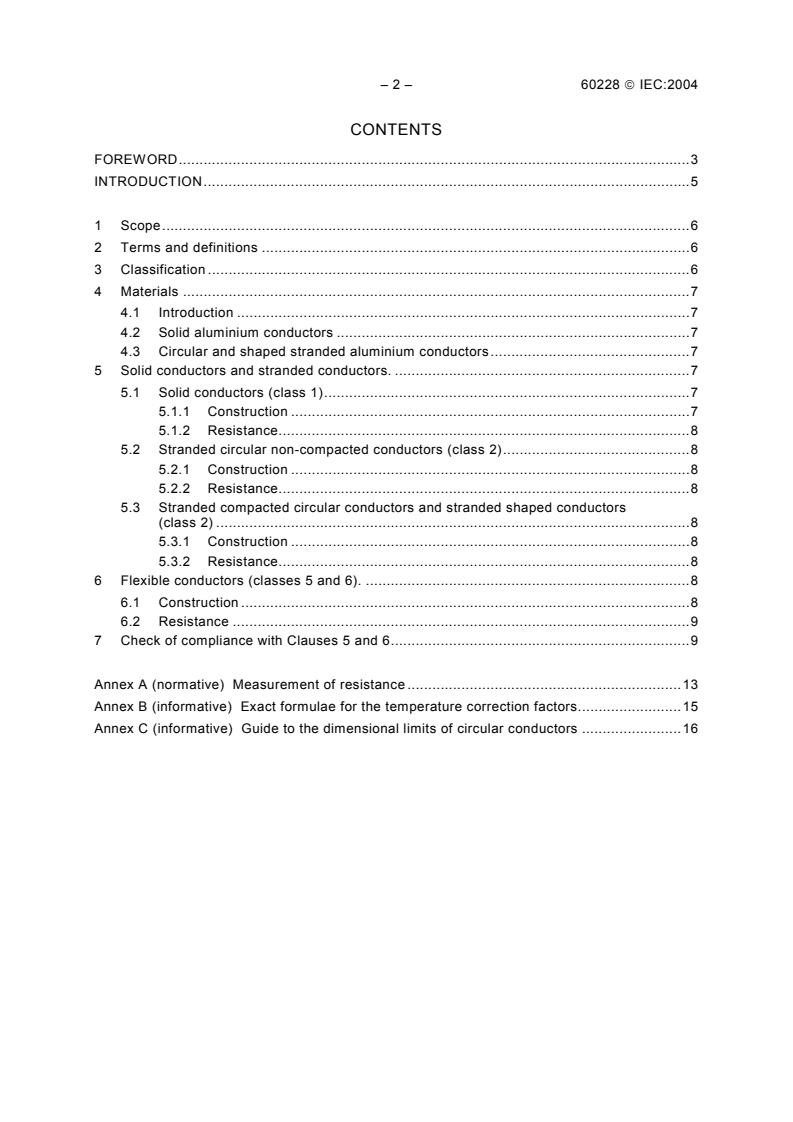
IEC 60228:2004 - Conductors of insulated cables
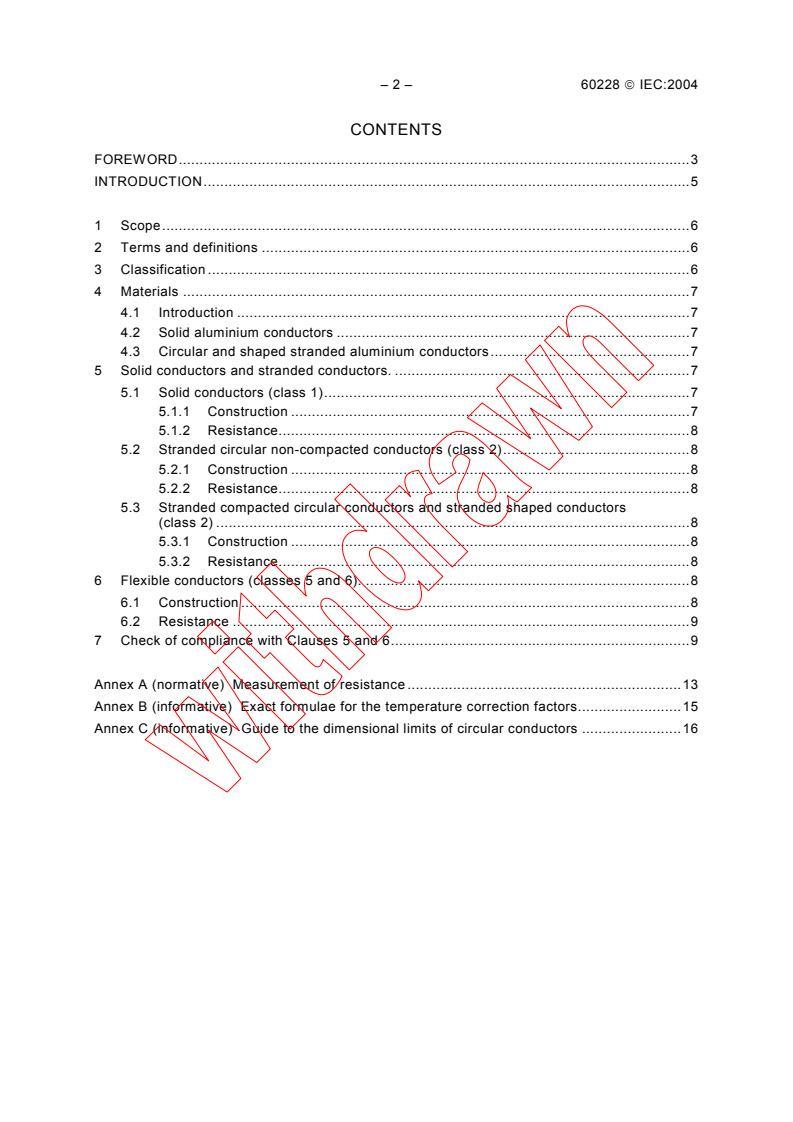
IEC 60228:2004 - Conductors of insulated cables
Overview
IEC 60228:2004 - "Conductors of insulated cables" is an international standard from the IEC (Technical Committee 20) that defines nominal conductor sizes, construction classes and resistance limits for conductors used in electric power cables and cords. The standard covers nominal cross‑sectional areas from 0.5 mm² to 2 500 mm², and includes solid and stranded copper, aluminium and aluminium alloy conductors for fixed installations and flexible copper conductors for cords. It does not apply to telecommunication conductors. Informative annexes provide temperature correction factors for resistance measurement (Annex B) and dimensional guidance for circular conductors (Annex C).
Key topics and technical requirements
- Nominal cross‑sectional areas: Standard sizes and the definition of nominal cross‑sectional area as an identifying value (0.5 mm² – 2 500 mm²).
- Conductor classes: Classification into Class 1 (solid), Class 2 (stranded), Class 5 and 6 (flexible), with intended uses for fixed and flexible cables.
- Materials and mechanical limits: Requirements for plain or metal‑coated annealed copper, aluminium and aluminium alloy conductors; tensile strength limits for solid and stranded aluminium wires where specified.
- Construction rules: Minimum numbers of wires, uniform wire diameters, limits on wire diameter ratios, and guidance on compacted and shaped stranded conductors.
- Electrical resistance: Maximum permissible resistance values measured at 20 °C (detailed in Tables 1–4), including a note that aluminium alloy conductors with the same dimensions as aluminium will have higher resistance (factor guidance provided).
- Testing & measurement: Clause references and Annex A/B for resistance measurement procedures and temperature correction factors.
- Dimensional guidance: Annex C gives recommended dimensional limits for circular conductors and strengthened guidance for compacted stranded copper.
Applications and users
IEC 60228 is a fundamental reference for:
- Cable designers and manufacturers for specifying conductor construction, sizes and resistance.
- Test laboratories and certification bodies verifying compliance with conductor resistance and construction classes.
- Standards committees and procurement/specification writers who reference conductor requirements in cable product standards.
- Electrical engineers and installers who need to match conductor performance (resistance, flexibility) to application requirements.
Note: For specific cable types, applicability is governed by the corresponding cable standard. The standard also includes practical conversion and usage notes (e.g., AWG/kcmil references used in some countries).
Related standards
- IEC 60228 is intended as a base reference for IEC cable product standards developed by IEC TC 20. For selection and full applicability, consult the specific cable type standard referenced by IEC or national regulations.
Relations
- Effective Date
- 25-Aug-2026
- Effective Date
- 03-Jun-2026
- Effective Date
- 05-Sep-2023
Buy Documents
IEC 60228:2004 - Conductors of insulated cables Released:11/2/2004
IEC 60228:2004 - Ames des câbles isolés Released:11/2/2004
IEC 60228:2004 - Conductors of insulated cables
IEC 60228:2004 - Conductors of insulated cables
Get Certified
Connect with accredited certification bodies for this standard

IMQ S.p.A. (Certification)
Italian electrical product certification.

SLG Prüf- und Zertifizierungs GmbH
German testing and certification body.

UL Solutions
Global safety science company with testing, inspection and certification.
Sponsored listings
Frequently Asked Questions
IEC 60228:2004 is a standard published by the International Electrotechnical Commission (IEC). Its full title is "Conductors of insulated cables". This standard covers: Specifies the nominal cross-sectional areas, in the range 0,5 mm2 to 2 500 mm2, for conductors in electric power cables and cords of a wide range of types. Requirements for numbers and sizes of wires and resistance values are also included. These conductors include solid and stranded copper, aluminium and aluminium alloy conductors in cables for fixed installations and flexible copper conductors. The standard does not apply to conductors for telecommunication purposes. The applicability of this standard to a particular type of cable is as specified in the standard for the type of cable. Unless indicated to the contrary in a particular clause, this standard relates to the conductors in the finished cable and not to the conductor as made or supplied for inclusion into a cable. Informative annexes are included giving supplementary information covering temperature correction factors for resistance measurement (Annex B) and dimensional limits of circular conductors (Annex C). The principal changes with respect to the previous edition are as follows: a) the consolidation of material from IEC 60228A; b) addition of a definition for nominal cross-sectional area; c) an increase in the range of conductor sizes in Tables 1 and 2; d) addition of a note that solid aluminum alloy conductors, having the same dimensions as aluminum conductors, will have a higher resistance; e) strengthening of the recommendations for dimensional limits of compacted stranded copper conductors.
Specifies the nominal cross-sectional areas, in the range 0,5 mm2 to 2 500 mm2, for conductors in electric power cables and cords of a wide range of types. Requirements for numbers and sizes of wires and resistance values are also included. These conductors include solid and stranded copper, aluminium and aluminium alloy conductors in cables for fixed installations and flexible copper conductors. The standard does not apply to conductors for telecommunication purposes. The applicability of this standard to a particular type of cable is as specified in the standard for the type of cable. Unless indicated to the contrary in a particular clause, this standard relates to the conductors in the finished cable and not to the conductor as made or supplied for inclusion into a cable. Informative annexes are included giving supplementary information covering temperature correction factors for resistance measurement (Annex B) and dimensional limits of circular conductors (Annex C). The principal changes with respect to the previous edition are as follows: a) the consolidation of material from IEC 60228A; b) addition of a definition for nominal cross-sectional area; c) an increase in the range of conductor sizes in Tables 1 and 2; d) addition of a note that solid aluminum alloy conductors, having the same dimensions as aluminum conductors, will have a higher resistance; e) strengthening of the recommendations for dimensional limits of compacted stranded copper conductors.
IEC 60228:2004 is classified under the following ICS (International Classification for Standards) categories: 29.060.20 - Cables. The ICS classification helps identify the subject area and facilitates finding related standards.
IEC 60228:2004 has the following relationships with other standards: It is inter standard links to EN ISO 15551:2023, EN ISO 13628-5:2009, IEC 60228:2023. Understanding these relationships helps ensure you are using the most current and applicable version of the standard.
IEC 60228:2004 is available in PDF format for immediate download after purchase. The document can be added to your cart and obtained through the secure checkout process. Digital delivery ensures instant access to the complete standard document.
Standards Content (Sample)
INTERNATIONAL IEC
STANDARD 60228
Third edition
2004-11
Conductors of insulated cables
This English-language version is derived from the original
bilingual publication by leaving out all French-language
pages. Missing page numbers correspond to the French-
language pages.
Reference number
Publication numbering
As from 1 January 1997 all IEC publications are issued with a designation in the
60000 series. For example, IEC 34-1 is now referred to as IEC 60034-1.
Consolidated editions
The IEC is now publishing consolidated versions of its publications. For example,
edition numbers 1.0, 1.1 and 1.2 refer, respectively, to the base publication, the
base publication incorporating amendment 1 and the base publication incorporating
amendments 1 and 2.
Further information on IEC publications
The technical content of IEC publications is kept under constant review by the IEC,
thus ensuring that the content reflects current technology. Information relating to
this publication, including its validity, is available in the IEC Catalogue of
publications (see below) in addition to new editions, amendments and corrigenda.
Information on the subjects under consideration and work in progress undertaken
by the technical committee which has prepared this publication, as well as the list
of publications issued, is also available from the following:
• IEC Web Site (www.iec.ch)
• Catalogue of IEC publications
The on-line catalogue on the IEC web site (www.iec.ch/searchpub) enables you to
search by a variety of criteria including text searches, technical committees
and date of publication. On-line information is also available on recently issued
publications, withdrawn and replaced publications, as well as corrigenda.
• IEC Just Published
This summary of recently issued publications (www.iec.ch/online_news/ justpub)
is also available by email. Please contact the Customer Service Centre (see
below) for further information.
• Customer Service Centre
If you have any questions regarding this publication or need further assistance,
please contact the Customer Service Centre:
Email: custserv@iec.ch
Tel: +41 22 919 02 11
Fax: +41 22 919 03 00
INTERNATIONAL IEC
STANDARD 60228
Third edition
2004-11
Conductors of insulated cables
IEC 2004 Copyright - all rights reserved
No part of this publication may be reproduced or utilized in any form or by any means, electronic or mechanical,
including photocopying and microfilm, without permission in writing from the publisher.
International Electrotechnical Commission, 3, rue de Varembé, PO Box 131, CH-1211 Geneva 20, Switzerland
Telephone: +41 22 919 02 11 Telefax: +41 22 919 03 00 E-mail: inmail@iec.ch Web: www.iec.ch
PRICE CODE
R
Commission Electrotechnique Internationale
International Electrotechnical Commission
МеждународнаяЭлектротехническаяКомиссия
For price, see current catalogue
60228 IEC:2004 – 3 –
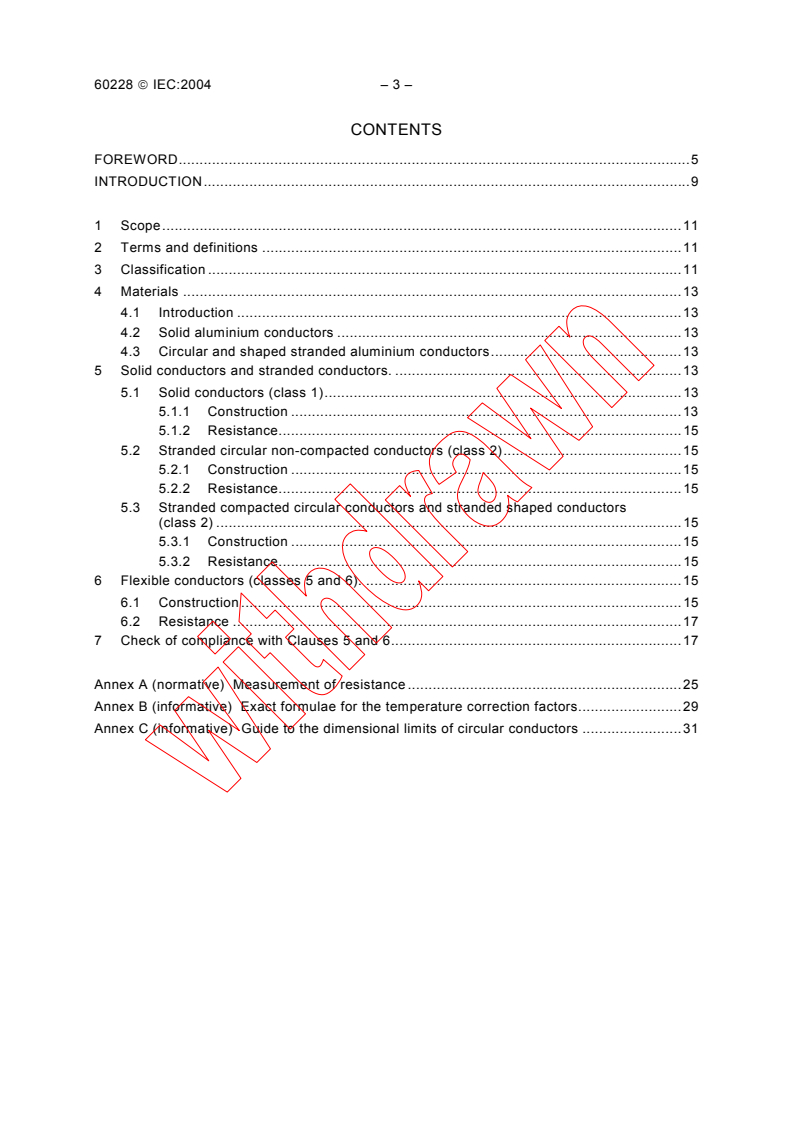
CONTENTS
FOREWORD.5
INTRODUCTION.9
1 Scope.11
2 Terms and definitions .11
3 Classification.11
4 Materials.13
4.1 Introduction.13
4.2 Solid aluminium conductors .13
4.3 Circular and shaped stranded aluminium conductors.13
5 Solid conductors and stranded conductors. .13
5.1 Solid conductors (class 1).13
5.1.1 Construction.13
5.1.2 Resistance.15
5.2 Stranded circular non-compacted conductors (class 2).15
5.2.1 Construction.15
5.2.2 Resistance.15
5.3 Stranded compacted circular conductors and stranded shaped conductors
(class 2) .15
5.3.1 Construction.15
5.3.2 Resistance.15
6 Flexible conductors (classes 5 and 6). .15
6.1 Construction.15
6.2 Resistance.17
7 Check of compliance with Clauses 5 and 6.17
Annex A (normative) Measurement of resistance .25
Annex B (informative) Exact formulae for the temperature correction factors.29
Annex C (informative) Guide to the dimensional limits of circular conductors .31
60228 IEC:2004 – 5 –
INTERNATIONAL ELECTROTECHNICAL COMMISSION
____________
CONDUCTORS OF INSULATED CABLES
FOREWORD
1) The International Electrotechnical Commission (IEC) is a worldwide organization for standardization comprising
all national electrotechnical committees (IEC National Committees). The object of IEC is to promote
international co-operation on all questions concerning standardization in the electrical and electronic fields. To
this end and in addition to other activities, IEC publishes International Standards, Technical Specifications,
Technical Reports, Publicly Available Specifications (PAS) and Guides (hereafter referred to as “IEC
Publication(s)”). Their preparation is entrusted to technical committees; any IEC National Committee interested
in the subject dealt with may participate in this preparatory work. International, governmental and non-
governmental organizations liaising with the IEC also participate in this preparation. IEC collaborates closely
with the International Organization for Standardization (ISO) in accordance with conditions determined by
agreement between the two organizations.
2) The formal decisions or agreements of IEC on technical matters express, as nearly as possible, an international
consensus of opinion on the relevant subjects since each technical committee has representation from all
interested IEC National Committees.
3) IEC Publications have the form of recommendations for international use and are accepted by IEC National
Committees in that sense. While all reasonable efforts are made to ensure that the technical content of IEC
Publications is accurate, IEC cannot be held responsible for the way in which they are used or for any
misinterpretation by any end user.
4) In order to promote international uniformity, IEC National Committees undertake to apply IEC Publications
transparently to the maximum extent possible in their national and regional publications. Any divergence
between any IEC Publication and the corresponding national or regional publication shall be clearly indicated in
the latter.
5) IEC provides no marking procedure to indicate its approval and cannot be rendered responsible for any
equipment declared to be in conformity with an IEC Publication.
6) All users should ensure that they have the latest edition of this publication.
7) No liability shall attach to IEC or its directors, employees, servants or agents including individual experts and
members of its technical committees and IEC National Committees for any personal injury, property damage or
other damage of any nature whatsoever, whether direct or indirect, or for costs (including legal fees) and
expenses arising out of the publication, use of, or reliance upon, this IEC Publication or any other IEC
Publications.
8) Attention is drawn to the Normative references cited in this publication. Use of the referenced publications is
indispensable for the correct application of this publication.
9) Attention is drawn to the possibility that some of the elements of this IEC Publication may be the subject of
patent rights. IEC shall not be held responsible for identifying any or all such patent rights.
International Standard IEC 60228 has been prepared by IEC technical committee 20: Electric
cables.
This third edition cancels and replaces the IEC 60228 (1978), its Amendment 1 (1993) and its
first supplement, IEC 60228A (1982).
The principal changes with respect to the previous edition are as follows:
a) the consolidation of material from IEC 60228A;
b) addition of a definition for nominal cross-sectional area;
c) an increase in the range of conductor sizes in Tables 1 and 2;
d) addition of a note that solid aluminum alloy conductors, having the same dimensions as
aluminum conductors, will have a higher resistance;
e) strengthening of the recommendations for dimensional limits of compacted stranded copper
conductors.
60228 IEC:2004 – 7 –
The text of this standard is based on the following documents:
FDIS Report on voting
20/718/FDIS 20/737/RVD
Full information on the voting for the approval of this standard can be found in the report on
voting indicated in the above table.
This publication has been drafted in accordance with the ISO/IEC Directives, Part 2.
The committee has decided that the contents of this publication will remain unchanged until the
maintenance result date indicated on the IEC web site under "http://webstore.iec.ch" in the data
related to the specific publication. At this date, the publication will be
• reconfirmed,
• withdrawn,
• replaced by a revised edition, or
• amended.
Conductors described in IEC 60228 are specified in metric sizes. Canada at present uses
conductor sizes and characteristics according to the American Wire Gauge (AWG) system and
kcmil for larger sizes as shown below. The use of these sizes is currently prescribed uniformly
across Canada for installations by sub-national regulations. IEC TC 20 cable product standards
do not prescribe cables with AWG/kcmil conductors.
AWG kcmil
Nominal Nominal Nominal Nominal
Conductor cross- Conductor cross- Conductor cross- Conductor cross-
size sectional size sectional size sectional size sectional
area area area area
2 2 2 2
mm mm mm mm
- - - - 250 127 750 380
- - - - 300 152 800 405
20 0,519 4 21,2 350 177 900 456
18 0,823 3 26,7 400 203 1000 507
16 1,31 2 33,6 450 228 1200 608
14 2,08 1 42,4 500 253 1250 633
12 3,31 1/0 53,5 550 279 1500 760
10 5,26 2/0 67,4 600 304 1750 887
8 8,37 3/0 85,0 650 329 2000 1010
6 13,3 4/0 107 700 355 - -
60228 IEC:2004 – 9 –
INTRODUCTION
IEC 60228 is intended as a fundamental reference standard for IEC Technical Committees and
National Committees in drafting standards for electric cables, and to the National Committees
in drafting specifications for use in their own countries. These committees should select from
the tables of this general standard the conductors appropriate to the particular applications with
which they are concerned and either include the applicable details in their cable specifications
or make appropriate references to this standard.
In preparing this edition the main objects have been to incorporate IEC 60228A into it and
maintain a simplified yet informative standard so far as is compatible with technical and
economic considerations.
60228 IEC:2004 – 11 –
CONDUCTORS OF INSULATED CABLES
1 Scope
This International Standard specifies the nominal cross-sectional areas, in the range 0,5 mm
to 2 500 mm , for conductors in electric power cables and cords of a wide range of types.
Requirements for numbers and sizes of wires and resistance values are also included. These
conductors include solid and stranded copper, aluminium and aluminium alloy conductors in
cables for fixed installations and flexible copper conductors.
The standard does not apply to conductors for telecommunication purposes.
The applicability of this standard to a particular type of cable is as specified in the standard for
the type of cable.
Unless indicated to the contrary in a particular clause, this standard relates to the conductors in
the finished cable and not to the conductor as made or supplied for inclusion into a cable.
Informative annexes are included giving supplementary information covering temperature
correction factors for resistance measurement (Annex B) and dimensional limits of circular
conductors (Annex C).
2 Terms and definitions
For the purposes of this document, the following terms and definitions apply.
2.1
metal-coated
coated with a thin layer of suitable metal, such as tin or tin alloy
2.2
nominal cross-sectional area
value that identifies a particular size of conductor but is not subject to direct measurement
NOTE Each particular size of conductor in this standard is required to meet a maximum resistance value.
3 Classification
The conductors have been divided into four classes, 1, 2, 5 and 6. Those in classes 1 and 2
are intended for use in cables for fixed installations. Classes 5 and 6 are intended for use in
flexible cables and cords but may also be used for fixed installations.
− Class 1: solid conductors.
− Class 2: stranded conductors.
− Class 5: flexible conductors.
− Class 6: flexible conductors which are more flexible than class 5.
60228 IEC:2004 – 13 –
4 Materials
4.1 Introduction
The conductors shall consist of one of the following:
− plain or metal-coated annealed copper;
− aluminium or aluminium alloy.
4.2 Solid aluminium conductors
Circular and shaped solid aluminium conductors shall be made from aluminium such that the
tensile strength of the completed conductor is within the following limits:
Nominal cross-sectional area Tensile strength
2 2
mm N/mm
10 and 16 110 to 165
25 and 35 60 to 130
50 60 to 110
70 and above 60 to 90
NOTE The values given above are not applicable to aluminium alloy conductors.
4.3 Circular and shaped stranded aluminium conductors
Stranded aluminium conductors shall be made from aluminium such that the tensile strength of
the individual wires is within the following limits:
Nominal cross-sectional area Tensile strength
2 2
mm N/mm
10 up to 200
16 and above 125 to 205
NOTE 1 The values given above are not applicable to aluminium alloy conductors.
NOTE 2 This data can only be checked on wires taken before stranding and not on wires taken from a stranded
conductor.
5 Solid conductors and stranded conductors
5.1 Solid conductors (class 1)
5.1.1 Construction
a) Solid conductors (class 1) shall consist of one of the materials specified in Clause 4.
b) Solid copper conductors shall be of circular cross-section.
NOTE Solid copper conductors having nominal cross-sectional areas of 25 mm and above are for particular
types of cable, e.g. mineral insulated, and not for general purposes.
2 2
c) Solid aluminium and solid aluminium alloy conductors of sizes 10 mm to 35 mm shall be
of circular cross-section. Larger sizes shall be of circular cross-section for single-core
cables and may be of either circular or shaped cross-section for multi-core cables.
60228 IEC:2004 – 15 –
5.1.2 Resistance
The resistance of each conductor at 20 °C, when determined in accordance with Clause 7,
shall not exceed the appropriate maximum value given in Table 1.
NOTE For solid aluminium alloy conductors, having the same nominal cross-sectional area as an aluminium
conductor the resistance value given in Table 1 should be multiplied by a factor of 1,162 unless otherwise agreed
between the manufacturer and the purchaser.
5.2 Stranded circular non-compacted conductors (class 2)
5.2.1 Construction
a) Stranded circular non-compacted conductors (class 2) shall consist of one of the materials
specified in Clause 4.
b) Stranded aluminium or aluminium alloy conductors shall have a cross-sectional area not
less than 10 mm .
c) The wires in each conductor shall all have the same nominal diameter.
d) The number of wires in each conductor shall be not less than the appropriate minimum
number given in Table 2.
5.2.2 Resistance
The resistance of each conductor at 20 °C, when determined in accordance with Clause 7,
shall not exceed the appropriate maximum value given in Table 2.
5.3 Stranded compacted cir
...
NORME CEI
INTERNATIONALE 60228
Troisième édition
2004-11
Âmes des câbles isolés
Cette version française découle de la publication d’origine
bilingue dont les pages anglaises ont été supprimées.
Les numéros de page manquants sont ceux des pages
supprimées.
Numéro de référence
CEI 60228:2004(F)
Numérotation des publications
Depuis le 1er janvier 1997, les publications de la CEI sont numérotées à partir de
60000. Ainsi, la CEI 34-1 devient la CEI 60034-1.
Editions consolidées
Les versions consolidées de certaines publications de la CEI incorporant les
amendements sont disponibles. Par exemple, les numéros d’édition 1.0, 1.1 et 1.2
indiquent respectivement la publication de base, la publication de base incorporant
l’amendement 1, et la publication de base incorporant les amendements 1 et 2
Informations supplémentaires sur les publications de la CEI
Le contenu technique des publications de la CEI est constamment revu par la CEI
afin qu'il reflète l'état actuel de la technique. Des renseignements relatifs à cette
publication, y compris sa validité, sont disponibles dans le Catalogue des
publications de la CEI (voir ci-dessous) en plus des nouvelles éditions, amende-
ments et corrigenda. Des informations sur les sujets à l’étude et l’avancement des
travaux entrepris par le comité d’études qui a élaboré cette publication, ainsi que la
liste des publications parues, sont également disponibles par l’intermédiaire de:
• Site web de la CEI (www.iec.ch)
• Catalogue des publications de la CEI
Le catalogue en ligne sur le site web de la CEI (www.iec.ch/searchpub) vous permet
de faire des recherches en utilisant de nombreux critères, comprenant des
recherches textuelles, par comité d’études ou date de publication. Des informations
en ligne sont également disponibles sur les nouvelles publications, les publications
remplacées ou retirées, ainsi que sur les corrigenda.
• IEC Just Published
Ce résumé des dernières publications parues (www.iec.ch/online_news/justpub)
est aussi disponible par courrier électronique. Veuillez prendre contact avec le
Service client (voir ci-dessous) pour plus d’informations.
• Service clients
Si vous avez des questions au sujet de cette publication ou avez besoin de
renseignements supplémentaires, prenez contact avec le Service clients:
Email: custserv@iec.ch
Tél: +41 22 919 02 11
Fax: +41 22 919 03 00
NORME CEI
INTERNATIONALE 60228
Troisième édition
2004-11
Âmes des câbles isolés
IEC 2004 Droits de reproduction réservés
Aucune partie de cette publication ne peut être reproduite ni utilisée sous quelque forme que ce soit et par aucun
procédé, électronique ou mécanique, y compris la photocopie et les microfilms, sans l'accord écrit de l'éditeur.
International Electrotechnical Commission, 3, rue de Varembé, PO Box 131, CH-1211 Geneva 20, Switzerland
Telephone: +41 22 919 02 11 Telefax: +41 22 919 03 00 E-mail: inmail@iec.ch Web: www.iec.ch
CODE PRIX
R
Commission Electrotechnique Internationale
International Electrotechnical Commission
МеждународнаяЭлектротехническаяКомиссия
Pour prix, voir catalogue en vigueur
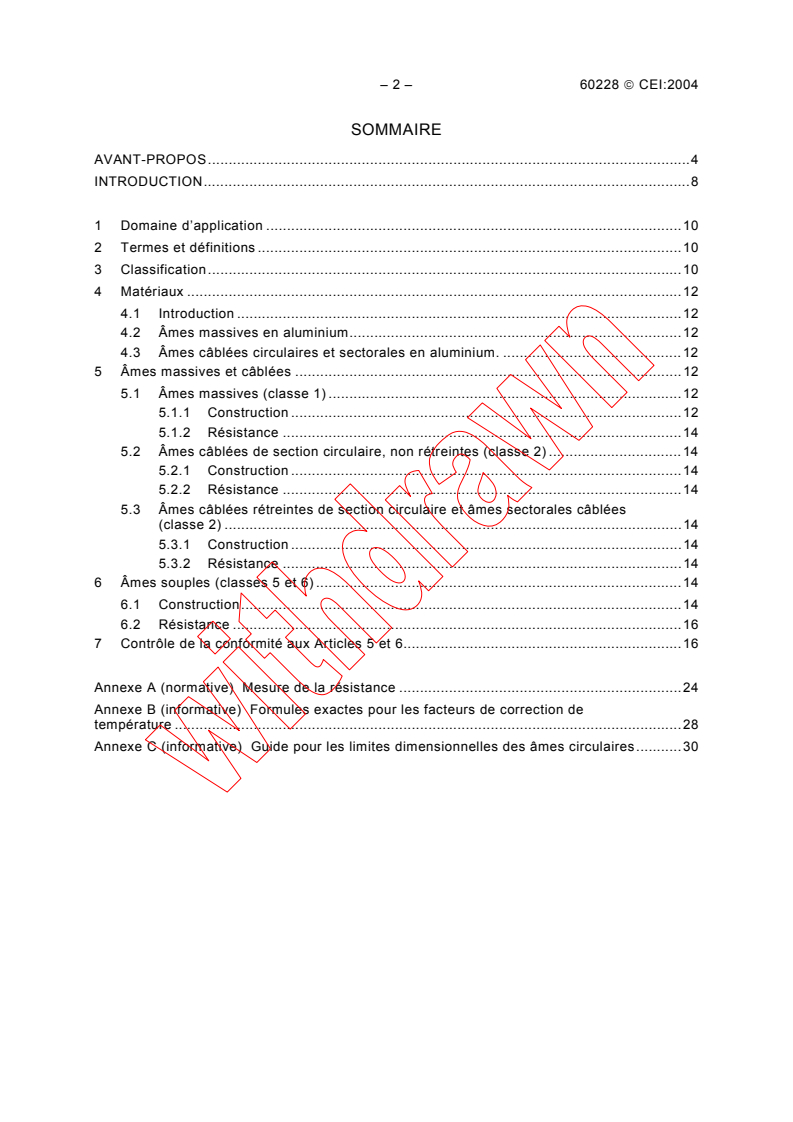
– 2 – 60228 CEI:2004
SOMMAIRE
AVANT-PROPOS.4
INTRODUCTION.8
1 Domaine d’application.10
2 Termes et définitions .10
3 Classification.10
4 Matériaux.12
4.1 Introduction.12
4.2 Âmes massives en aluminium.12
4.3 Âmes câblées circulaires et sectorales en aluminium. .12
5 Âmes massives et câblées .12
5.1 Âmes massives (classe 1) .12
5.1.1 Construction.12
5.1.2 Résistance.14
5.2 Âmes câblées de section circulaire, non rétreintes (classe 2) .14
5.2.1 Construction.14
5.2.2 Résistance.14
5.3 Âmes câblées rétreintes de section circulaire et âmes sectorales câblées
(classe 2) .14
5.3.1 Construction.14
5.3.2 Résistance.14
6 Âmes souples (classes 5 et 6) .14
6.1 Construction.14
6.2 Résistance.16
7 Contrôle de la conformité aux Articles 5 et 6.16
Annexe A (normative) Mesure de la résistance .24
Annexe B (informative) Formules exactes pour les facteurs de correction de
température .28
Annexe C (informative) Guide pour les limites dimensionnelles des âmes circulaires.30
– 4 – 60228 CEI:2004
COMMISSION ÉLECTROTECHNIQUE INTERNATIONALE
____________
ÂMES DES CÂBLES ISOLÉS
AVANT-PROPOS
1) La Commission Electrotechnique Internationale (CEI) est une organisation mondiale de normalisation
composée de l'ensemble des comités électrotechniques nationaux (Comités nationaux de la CEI). La CEI a
pour objet de favoriser la coopération internationale pour toutes les questions de normalisation dans les
domaines de l'électricité et de l'électronique. A cet effet, la CEI – entre autres activités – publie des Normes
internationales, des Spécifications techniques, des Rapports techniques, des Spécifications accessibles au
public (PAS) et des Guides (ci-après dénommés "Publication(s) de la CEI"). Leur élaboration est confiée à des
comités d'études, aux travaux desquels tout Comité national intéressé par le sujet traité peut participer. Les
organisations internationales, gouvernementales et non gouvernementales, en liaison avec la CEI, participent
également aux travaux. La CEI collabore étroitement avec l'Organisation Internationale de Normalisation (ISO),
selon des conditions fixées par accord entre les deux organisations.
2) Les décisions ou accords officiels de la CEI concernant les questions techniques représentent, dans la mesure
du possible, un accord international sur les sujets étudiés, étant donné que les Comités nationaux de la CEI
intéressés sont représentés dans chaque comité d’études.
3) Les Publications de la CEI se présentent sous la forme de recommandations internationales et sont agréées
comme telles par les Comités nationaux de la CEI. Tous les efforts raisonnables sont entrepris afin que la CEI
s'assure de l'exactitude du contenu technique de ses publications; la CEI ne peut pas être tenue responsable
de l'éventuelle mauvaise utilisation ou interprétation qui en est faite par un quelconque utilisateur final.
4) Dans le but d'encourager l'uniformité internationale, les Comités nationaux de la CEI s'engagent, dans toute la
mesure possible, à appliquer de façon transparente les Publications de la CEI dans leurs publications
nationales et régionales. Toutes divergences entre toutes Publications de la CEI et toutes publications
nationales ou régionales correspondantes doivent être indiquées en termes clairs dans ces dernières.
5) La CEI n’a prévu aucune procédure de marquage valant indication d’approbation et n'engage pas sa
responsabilité pour les équipements déclarés conformes à une de ses Publications.
6) Tous les utilisateurs doivent s'assurer qu'ils sont en possession de la dernière édition de cette publication.
7) Aucune responsabilité ne doit être imputée à la CEI, à ses administrateurs, employés, auxiliaires ou
mandataires, y compris ses experts particuliers et les membres de ses comités d'études et des Comités
nationaux de la CEI, pour tout préjudice causé en cas de dommages corporels et matériels, ou de tout autre
dommage de quelque nature que ce soit, directe ou indirecte, ou pour supporter les coûts (y compris les frais
de justice) et les dépenses découlant de la publication ou de l'utilisation de cette Publication de la CEI ou de
toute autre Publication de la CEI, ou au crédit qui lui est accordé.
8) L'attention est attirée sur les références normatives citées dans cette publication. L'utilisation de publications
référencées est obligatoire pour une application correcte de la présente publication.
9) L’attention est attirée sur le fait que certains des éléments de la présente Publication de la CEI peuvent faire
l’objet de droits de propriété intellectuelle ou de droits analogues. La CEI ne saurait être tenue pour responsable
de ne pas avoir identifié de tels droits de propriété et de ne pas avoir signalé leur existence.
La Norme Internationale CEI 60228 a été établie par le comité d’études 20 de la CEI: Câbles
électriques.
Cette troisième édition annule et remplace la CEI 60228 (1978), son amendement 1 (1993) et
son premier complément, la CEI 60228A (1982).
Les principaux changements par rapport à l’édition précédente sont les suivants:
a) l’incorporation des éléments contenus dans la CEI 60228A;
b) l’ajout d’une définition de la section nominale;
c) une extension de la gamme des sections d’âmes dans les Tableaux 1 et 2;
d) l’introduction d’une note précisant que les âmes massives en alliage d’aluminium ayant les
mêmes dimensions que les âmes en aluminium auront une résistance plus élevée;
e) un renforcement des recommandations concernant les limites dimensionnelles des âmes
câblées rétreintes en cuivre.
– 6 – 60228 CEI:2004
Le texte de cette norme est issu des documents suivants:
FDIS Rapport de vote
20/718/FDIS 20/737/RVD
Le rapport de vote indiqué dans le tableau ci-dessus donne toute information sur le vote ayant
abouti à l’approbation de cette norme.
Cette publication a été rédigée conformément aux Directives ISO/IEC, Partie 2.
Le comité a décidé que le contenu de cette publication ne sera pas modifié avant la date de
maintenance indiquée sur le site web de la CEI sous "http://webstore.iec.ch" dans les
données relatives à la publication recherchée. A cette date, la publication sera
• reconduite,
• supprimée,
• remplacée par une édition révisée, ou
• amendée.
Les dimensions des âmes, décrites dans la CEI 60228, sont spécifiées dans le système
métrique. Actuellement, le Canada utilise pour les dimensions et les caractéristiques des
âmes le système américain AWG (Âmerican Wire Gauge) et kcmil pour les dimensions plus
grandes, comme décrit ci-dessous. L’utilisation de ces dimensions est couramment prescrite
par les réglementations des provinces pour les installations électriques à travers tout le
Canada. Les normes de produit du TC 20 de la CEI ne prescrivent pas de câbles avec des
âmes AWG/kcmil.
AWG kcmil
Section Section Section
Section
Dimension Dimension Dimension
Dimension
nominale nominale nominale
nominale
de l’âme de l’âme de l’âme
de l’âme 2 2
2 2
mm mm
mm mm
- - - - 250 127 750 380
- - - - 300 152 800 405
20 0,519 4 21,2 350 177 900 456
18 0,823 3 26,7 400 203 1000 507
16 1,31 2 33,6 450 228 1200 608
14 2,08 1 42,4 500 253 1250 633
12 3,31 1/0 53,5 550 279 1500 760
10 5,26 2/0 67,4 600 304 1750 887
8 8,37 3/0 85,0 650 329 2000 1010
6 13,3 4/0 107 700 355 - -
– 8 – 60228 CEI:2004
INTRODUCTION
La CEI 60228 est destinée à servir de norme de référence de base aux Comités d’Etudes de
la CEI et aux Comités Nationaux pour l’établissement des normes des câbles électriques ainsi
qu’aux Comités Nationaux pour l’établissement des spécifications à utiliser dans leur propre
pays. Ces Comités devront choisir, dans les tableaux de cette norme générale, les âmes qui
conviennent aux utilisations particulières envisagées et, soit inclure les détails applicables
dans leurs spécifications de câbles, soit faire référence à cette norme.
Les objectifs principaux, dans la préparation de cette édition, ont été d’intégrer la CEI 60228A
et de conserver une norme simple, mais néanmoins instructive, dans la mesure où cela restait
compatible avec les considérations techniques et économiques.
– 10 – 60228 CEI:2004
ÂMES DES CÂBLES ISOLÉS
1 Domaine d’application
La présente Norme internationale spécifie les sections nominales, dans la plage de 0,5 mm à
2 500 mm , des âmes des conducteurs et des câbles électriques de puissance, dans une
large gamme de spécifications. Des exigences sur le nombre et le diamètre des brins et les
valeurs de résistance sont également incluses. Les âmes concernées sont les âmes massives
et câblées, en cuivre, en aluminium et en alliage d’aluminium, destinées aux câbles pour
installations fixes et les âmes en cuivre pour conducteurs souples.
Cette norme ne s’applique pas aux conducteurs de télécommunication.
L’applicabilité de cette norme à un type de câble particulier est précisée dans la norme
relative à ce type de câble.
Sauf indication contraire dans un article particulier, cette norme porte sur les âmes des
câbles terminés, et non sur les âmes seules ou fournies pour la fabrication d’un câble.
Des annexes informatives sont incluses, donnant des informations complémentaires sur les
facteurs de correction de température à utiliser dans les mesures de résistance (Annexe B) et
les limites dimensionnelles des âmes circulaires (Annexe C).
2 Termes et définitions
Pour les besoins du présent document, les termes et définitions suivants s’appliquent.
2.1
revêtu d’une couche métallique
revêtu d’une fine couche d’un métal approprié, tel que l’étain ou un alliage d’étain
2.2
section nominale
valeur identifiant une taille particulière d’âme mais qui ne peut pas être l’objet d’une mesure
directe
NOTE A chaque taille particulière d’âme de cette norme correspond une exigence sur la valeur maximale de la
résistance.
3 Classification
Les âmes sont réparties en quatre classes, 1, 2, 5 et 6. Celles des classes 1 et 2 sont
destinées aux câbles pour installations fixes. Les classes 5 et 6 sont destinées aux câbles et
conducteurs souples mais peuvent aussi être utilisées pour des installations fixes.
− Classe 1: âmes massives.
− Classe 2: âmes câblées.
− Classe 5: âmes souples.
− Classe 6: âmes souples, de souplesse supérieure à celle des âmes de la classe 5.
– 12 – 60228 CEI:2004
4 Matériaux
4.1 Introduction
Les âmes doivent appartenir à l’une des catégories suivantes:
– en cuivre recuit, nu ou revêtu d’une couche métallique;
– en aluminium ou alliage d’aluminium.
4.2 Âmes massives en aluminium
Les âmes massives en aluminium, de section circulaire et sectorale, doivent utiliser un
aluminium tel que la résistance à la traction de l’âme terminée se trouve dans les limites
suivantes:
Section nominale Résistance à la traction
2 2
mm N/mm
10 et 16 110 à 165
25 et 35 60 à 130
50 60 à 110
70 et au-dessus 60 à 90
NOTE Les valeurs données ci-dessus ne s’appliquent pas aux âmes en alliage d’aluminium.
4.3 Âmes câblées circulaires et sectorales en aluminium
Les âmes câblées en aluminium doivent utiliser un aluminium tel que la résistance à la
traction des fils individuels se trouve dans les limites suivantes:
Section nominale Résistance à la traction
2 2
mm N/mm
10 Inférieure à 200
16 et au-dessus 125 à 205
NOTE 1 Les valeurs données ci-dessus ne s’appliquent pas aux âmes en alliage d’aluminium.
NOTE 2 Ces valeurs peuvent être contrôlées uniquement sur des fils avant câblage et ne peuvent l’être sur des
fils prélevés dans une âme câblée.
5 Âmes massives et câblées
5.1 Âmes massives (classe 1)
5.1.1 Construction
a) Les âmes massives (classe 1) doivent utiliser l’un des matériaux spécifiés à l’Article 4.
b) Les âmes massives en cuivre doivent être de section circulaire.
NOTE Les âmes massives de section nominale supérieure ou égale à 25 mm sont destinées à des types
particuliers de câbles, par exemple à isolation minérale, et non à des câbles d’usage général.
c) Les âmes massives en aluminium et alliage d’aluminium de section comprise entre
2 2
10 mm et 35 mm doivent être circulaires. Les âmes de section supérieure doivent être à
section circulaire pour les câbles monoconducteurs mais peuvent être soit circulaires soit
sectorales pour les câbles multiconducteurs.
– 14 – 60228 CEI:2004
5.1.2 Résistance
La résistance à 20 °C de chaque âme, déterminée conformément à l’Article 7, ne doit pas
dépasser la valeur maximale spécifiée au Tableau 1.
NOTE Pour les âmes massives en alliage d’aluminium, de même section nominale qu’une âme en aluminium, il
convient que la résistance donnée au Tableau 1 soit multipliée par un facteur 1,162, à moins d’un accord
dérogatoire entre le fabricant et l’acheteur.
5.2 Âmes câblées de section circulaire, non rétreintes (classe 2)
5.2.1 Construction
a) Les âmes câblées de section circulaire, non rétreintes (classe 2) doivent utiliser l’un des
matériaux spécifiés à l’Article 4.
b) Les âmes câblées en aluminium ou alliage d’aluminium doivent avoir une section nominale
d’au moins 10 mm .
c) Les brins de chaque âme doivent tous avoir le même diamètre nominal.
d) Le nombre de brins de c
...
IEC 60228
Edition 3.0 2004-11
INTERNATIONAL
STANDARD
NORME
INTERNATIONALE
Conductors of insulated cables
Ames des câbles isolés
All rights reserved. Unless otherwise specified, no part of this publication may be reproduced or utilized in any form or by
any means, electronic or mechanical, including photocopying and microfilm, without permission in writing from either IEC or
IEC's member National Committee in the country of the requester.
If you have any questions about IEC copyright or have an enquiry about obtaining additional rights to this publication,
please contact the address below or your local IEC member National Committee for further information.
Droits de reproduction réservés. Sauf indication contraire, aucune partie de cette publication ne peut être reproduite
ni utilisée sous quelque forme que ce soit et par aucun procédé, électronique ou mécanique, y compris la photocopie
et les microfilms, sans l'accord écrit de la CEI ou du Comité national de la CEI du pays du demandeur.
Si vous avez des questions sur le copyright de la CEI ou si vous désirez obtenir des droits supplémentaires sur cette
publication, utilisez les coordonnées ci-après ou contactez le Comité national de la CEI de votre pays de résidence.
IEC Central Office
3, rue de Varembé
CH-1211 Geneva 20
Switzerland
Email: inmail@iec.ch
Web: www.iec.ch
About the IEC
The International Electrotechnical Commission (IEC) is the leading global organization that prepares and publishes
International Standards for all electrical, electronic and related technologies.
About IEC publications
The technical content of IEC publications is kept under constant review by the IEC. Please make sure that you have the
latest edition, a corrigenda or an amendment might have been published.
ƒ Catalogue of IEC publications: www.iec.ch/searchpub
The IEC on-line Catalogue enables you to search by a variety of criteria (reference number, text, technical committee,…).
It also gives information on projects, withdrawn and replaced publications.
ƒ IEC Just Published: www.iec.ch/online_news/justpub
Stay up to date on all new IEC publications. Just Published details twice a month all new publications released. Available
on-line and also by email.
ƒ Electropedia: www.electropedia.org
The world's leading online dictionary of electronic and electrical terms containing more than 20 000 terms and definitions
in English and French, with equivalent terms in additional languages. Also known as the International Electrotechnical
Vocabulary online.
ƒ Customer Service Centre: www.iec.ch/webstore/custserv
If you wish to give us your feedback on this publication or need further assistance, please visit the Customer Service
Centre FAQ or contact us:
Email: csc@iec.ch
Tel.: +41 22 919 02 11
Fax: +41 22 919 03 00
A propos de la CEI
La Commission Electrotechnique Internationale (CEI) est la première organisation mondiale qui élabore et publie des
normes internationales pour tout ce qui a trait à l'électricité, à l'électronique et aux technologies apparentées.
A propos des publications CEI
Le contenu technique des publications de la CEI est constamment revu. Veuillez vous assurer que vous possédez
l’édition la plus récente, un corrigendum ou amendement peut avoir été publié.
ƒ Catalogue des publications de la CEI: www.iec.ch/searchpub/cur_fut-f.htm
Le Catalogue en-ligne de la CEI vous permet d’effectuer des recherches en utilisant différents critères (numéro de référence,
texte, comité d’études,…). Il donne aussi des informations sur les projets et les publications retirées ou remplacées.
ƒ Just Published CEI: www.iec.ch/online_news/justpub
Restez informé sur les nouvelles publications de la CEI. Just Published détaille deux fois par mois les nouvelles
publications parues. Disponible en-ligne et aussi par email.
ƒ Electropedia: www.electropedia.org
Le premier dictionnaire en ligne au monde de termes électroniques et électriques. Il contient plus de 20 000 termes et
définitions en anglais et en français, ainsi que les termes équivalents dans les langues additionnelles. Egalement appelé
Vocabulaire Electrotechnique International en ligne.
ƒ Service Clients: www.iec.ch/webstore/custserv/custserv_entry-f.htm
Si vous désirez nous donner des commentaires sur cette publication ou si vous avez des questions, visitez le FAQ du
Service clients ou contactez-nous:
Email: csc@iec.ch
Tél.: +41 22 919 02 11
Fax: +41 22 919 03 00
IEC 60228
Edition 3.0 2004-11
INTERNATIONAL
STANDARD
NORME
INTERNATIONALE
Conductors of insulated cables
Ames des câbles isolés
INTERNATIONAL
ELECTROTECHNICAL
COMMISSION
COMMISSION
ELECTROTECHNIQUE
PRICE CODE
INTERNATIONALE
R
CODE PRIX
ICS 29.060.20 ISBN 2-8318-7706-7
– 2 – 60228 © IEC:2004
CONTENTS
FOREWORD.3
INTRODUCTION.5
1 Scope.6
2 Terms and definitions .6
3 Classification.6
4 Materials.7
4.1 Introduction.7
4.2 Solid aluminium conductors .7
4.3 Circular and shaped stranded aluminium conductors.
5 Solid conductors and stranded conductors. .7
5.1 Solid conductors (class 1).7
5.1.1 Construction.7
5.1.2 Resistance.8
5.2 Stranded circular non-compacted conductors (class 2).8
5.2.1 Construction.8
5.2.2 Resistance.8
5.3 Stranded compacted circular conductors and stranded shaped conductors
(class 2) .8
5.3.1 Construction.8
5.3.2 Resistance.8
6 Flexible conductors (classes 5 and 6). .8
6.1 Construction.8
6.2 Resistance.9
7 Check of compliance with Clauses 5 and 6.9
Annex A (normative) Measurement of resistance .13
Annex B (informative) Exact formulae for the temperature correction factors.15
Annex C (informative) Guide to the dimensional limits of circular conductors .16
60228 © IEC:2004 – 3 –
INTERNATIONAL ELECTROTECHNICAL COMMISSION
____________
CONDUCTORS OF INSULATED CABLES
FOREWORD
1) The International Electrotechnical Commission (IEC) is a worldwide organization for standardization comprising
all national electrotechnical committees (IEC National Committees). The object of IEC is to promote
international co-operation on all questions concerning standardization in the electrical and electronic fields. To
this end and in addition to other activities, IEC publishes International Standards, Technical Specifications,
Technical Reports, Publicly Available Specifications (PAS) and Guides (hereafter referred to as “IEC
Publication(s)”). Their preparation is entrusted to technical committees; any IEC National Committee interested
in the subject dealt with may participate in this preparatory work. International, governmental and non-
governmental organizations liaising with the IEC also participate in this preparation. IEC collaborates closely
with the International Organization for Standardization (ISO) in accordance with conditions determined by
agreement between the two organizations.
2) The formal decisions or agreements of IEC on technical matters express, as nearly as possible, an international
consensus of opinion on the relevant subjects since each technical committee has representation from all
interested IEC National Committees.
3) IEC Publications have the form of recommendations for international use and are accepted by IEC National
Committees in that sense. While all reasonable efforts are made to ensure that the technical content of IEC
Publications is accurate, IEC cannot be held responsible for the way in which they are used or for any
misinterpretation by any end user.
4) In order to promote international uniformity, IEC National Committees undertake to apply IEC Publications
transparently to the maximum extent possible in their national and regional publications. Any divergence
between any IEC Publication and the corresponding national or regional publication shall be clearly indicated in
the latter.
5) IEC provides no marking procedure to indicate its approval and cannot be rendered responsible for any
equipment declared to be in conformity with an IEC Publication.
6) All users should ensure that they have the latest edition of this publication.
7) No liability shall attach to IEC or its directors, employees, servants or agents including individual experts and
members of its technical committees and IEC National Committees for any personal injury, property damage or
other damage of any nature whatsoever, whether direct or indirect, or for costs (including legal fees) and
expenses arising out of the publication, use of, or reliance upon, this IEC Publication or any other IEC
Publications.
8) Attention is drawn to the Normative references cited in this publication. Use of the referenced publications is
indispensable for the correct application of this publication.
9) Attention is drawn to the possibility that some of the elements of this IEC Publication may be the subject of
patent rights. IEC shall not be held responsible for identifying any or all such patent rights.
International Standard IEC 60228 has been prepared by IEC technical committee 20: Electric
cables.
This third edition cancels and replaces the IEC 60228 (1978), its Amendment 1 (1993) and its
first supplement, IEC 60228A (1982).
The principal changes with respect to the previous edition are as follows:
a) the consolidation of material from IEC 60228A;
b) addition of a definition for nominal cross-sectional area;
c) an increase in the range of conductor sizes in Tables 1 and 2;
d) addition of a note that solid aluminum alloy conductors, having the same dimensions as
aluminum conductors, will have a higher resistance;
e) strengthening of the recommendations for dimensional limits of compacted stranded copper
conductors.
– 4 – 60228 © IEC:2004
The text of this standard is based on the following documents:
FDIS Report on voting
20/718/FDIS 20/737/RVD
Full information on the voting for the approval of this standard can be found in the report on
voting indicated in the above table.
This publication has been drafted in accordance with the ISO/IEC Directives, Part 2.
The committee has decided that the contents of this publication will remain unchanged until the
maintenance result date indicated on the IEC web site under "http://webstore.iec.ch" in the data
related to the specific publication. At this date, the publication will be
• reconfirmed,
• withdrawn,
• replaced by a revised edition, or
• amended.
Conductors described in IEC 60228 are specified in metric sizes. Canada at present uses
conductor sizes and characteristics according to the American Wire Gauge (AWG) system and
kcmil for larger sizes as shown below. The use of these sizes is currently prescribed uniformly
across Canada for installations by sub-national regulations. IEC TC 20 cable product standards
do not prescribe cables with AWG/kcmil conductors.
AWG kcmil
Nominal Nominal Nominal Nominal
Conductor cross- Conductor cross- Conductor cross- Conductor cross-
size sectional size sectional size sectional size sectional
area area area area
2 2 2 2
mm mm mm mm
- - - - 250 127 750 380
- - - - 300 152 800 405
20 0,519 4 21,2 350 177 900 456
18 0,823 3 26,7 400 203 1000 507
16 1,31 2 33,6 450 228 1200 608
14 2,08 1 42,4 500 253 1250 633
12 3,31 1/0 53,5 550 279 1500 760
10 5,26 2/0 67,4 600 304 1750 887
8 8,37 3/0 85,0 650 329 2000 1010
6 13,3 4/0 107 700 355 - -
60228 © IEC:2004 – 5 –
INTRODUCTION
IEC 60228 is intended as a fundamental reference standard for IEC Technical Committees and
National Committees in drafting standards for electric cables, and to the National Committees
in drafting specifications for use in their own countries. These committees should select from
the tables of this general standard the conductors appropriate to the particular applications with
which they are concerned and either include the applicable details in their cable specifications
or make appropriate references to this standard.
In preparing this edition the main objects have been to incorporate IEC 60228A into it and
maintain a simplified yet informative standard so far as is compatible with technical and
economic considerations.
– 6 – 60228 © IEC:2004
CONDUCTORS OF INSULATED CABLES
1 Scope
This International Standard specifies the nominal cross-sectional areas, in the range 0,5 mm
to 2 500 mm , for conductors in electric power cables and cords of a wide range of types.
Requirements for numbers and sizes of wires and resistance values are also included. These
conductors include solid and stranded copper, aluminium and aluminium alloy conductors in
cables for fixed installations and flexible copper conductors.
The standard does not apply to conductors for telecommunication purposes.
The applicability of this standard to a particular type of cable is as specified in the standard for
the type of cable.
Unless indicated to the contrary in a particular clause, this standard relates to the conductors in
the finished cable and not to the conductor as made or supplied for inclusion into a cable.
Informative annexes are included giving supplementary information covering temperature
correction factors for resistance measurement (Annex B) and dimensional limits of circular
conductors (Annex C).
2 Terms and definitions
For the purposes of this document, the following terms and definitions apply.
2.1
metal-coated
coated with a thin layer of suitable metal, such as tin or tin alloy
2.2
nominal cross-sectional area
value that identifies a particular size of conductor but is not subject to direct measurement
NOTE Each particular size of conductor in this standard is required to meet a maximum resistance value.
3 Classification
The conductors have been divided into four classes, 1, 2, 5 and 6. Those in classes 1 and 2
are intended for use in cables for fixed installations. Classes 5 and 6 are intended for use in
flexible cables and cords but may also be used for fixed installations.
− Class 1: solid conductors.
− Class 2: stranded conductors.
− Class 5: flexible conductors.
− Class 6: flexible conductors which are more flexible than class 5.
60228 © IEC:2004 – 7 –
4 Materials
4.1 Introduction
The conductors shall consist of one of the following:
− plain or metal-coated annealed copper;
− aluminium or aluminium alloy.
4.2 Solid aluminium conductors
Circular and shaped solid aluminium conductors shall be made from aluminium such that the
tensile strength of the completed conductor is within the following limits:
Nominal cross-sectional area Tensile strength
2 2
mm N/mm
10 and 16 110 to 165
25 and 35 60 to 130
50 60 to 110
70 and above 60 to 90
NOTE The values given above are not applicable to aluminium alloy conductors.
4.3 Circular and shaped stranded aluminium conductors
Stranded aluminium conductors shall be made from aluminium such that the tensile strength of
the individual wires is within the following limits:
Nominal cross-sectional area Tensile strength
2 2
mm N/mm
10 up to 200
16 and above 125 to 205
NOTE 1 The values given above are not applicable to aluminium alloy conductors.
NOTE 2 This data can only be checked on wires taken before stranding and not on wires taken from a stranded
conductor.
5 Solid conductors and stranded conductors
5.1 Solid conductors (class 1)
5.1.1 Construction
a) Solid conductors (class 1) shall consist of one of the materials specified in Clause 4.
b) Solid copper conductors shall be of circular cross-section.
NOTE Solid copper conductors having nominal cross-sectional areas of 25 mm and above are for particular
types of cable, e.g. mineral insulated, and not for general purposes.
2 2
c) Solid aluminium and solid aluminium alloy conductors of sizes 10 mm to 35 mm shall be
of circular cross-section. Larger sizes shall be of circular cross-section for single-core
cables and may be of either circular or shaped cross-section for multi-core cables.
– 8 – 60228 © IEC:2004
5.1.2 Resistance
The resistance of each conductor at 20 °C, when determined in accordance with Clause 7,
shall not exceed the appropriate maximum value given in Table 1.
NOTE For solid aluminium alloy conductors, having the same nominal cross-sectional area as an aluminium
conductor the resistance value given in Table 1 should be multiplied by a factor of 1,162 unless otherwise agreed
between the manufacturer and the purchaser.
5.2 Stranded circular non-compacted conductors (class 2)
5.2.1 Construction
a) Stranded circular non-compacted conductors (class 2) shall consist of one of the materials
specified in Clause 4.
b) Stranded aluminium or aluminium alloy conductors shall have a cross-sectional area not
less than 10 mm .
c) The wires in each conductor shall all have the same nominal diameter.
d) The number of wires in each conductor shall be not less than the appropriate minimum
number given in Table 2.
5.2.2 Resistance
The resistance of each conductor at 20 °C, when determined in accordance with Clause 7,
shall not exceed the appropriate maximum value given in Table 2.
5.3 Stranded compacted circular conductors and stranded shaped conductors
(class 2)
5.3.1 Construction
a) Stranded compacted circular conductors and stranded shaped conductors (class 2) shall
consist of one of the materials specified in Clause 4. Stranded compacted circular
aluminium or aluminium alloy conductors shall have a nominal cross-sectional area not less
than 10 mm . Stranded shaped copper, aluminium or aluminium alloy conductors shall have
a nominal cross-sectional area of not less than 25 mm .
b) The ratio of the diameters of two different wires in the same conductor shall not exceed 2.
c) The number of wires in each conductor shall be not less than the appropriate minimum
number given in Table 2.
NOTE This requirement applies to conductors made with wires of circular cross-section before compaction and not
to conductors made with pre-shaped wires.
5.3.2 Resistance
The resistance of each conductor at 20 °C, when determined in accordance with Clause 7,
shall not exceed the appropriate value given in Table 2.
6 Flexible conductors (classes 5 and 6)
6.1 Construction
a) Flexible conductors (classes 5 and 6) shall consist of plain or metal-coated annealed
copper.
b) The wires in each conductor shall have the same nominal diameter.
c) The diameter of the wires in each conductor shall not exceed the appropriate maximum
value given in Tables 3 or 4.
60228 © IEC:2004 – 9 –
6.2 Resistance
The resistance of each conductor at 20 °C, when determined in accordance with Clause 7,
shall not exceed the appropriate maximum value given in Tables 3 or 4.
7 Check of compliance with Clauses 5 and 6
Compliance with the requirements of 5.1.1, 5.2.1, 5.3.1 and 6.1 shall be checked on the
completed cable by inspection and measurement where practicable.
Compliance with the requirements for resistance given in 5.1.2, 5.2.2, 5.3.2 and 6.2 shall be
checked by measurement in accordance with Annex A and corrected for temperature by the
factors in Table A.1.
Table 1 – Class 1 solid conductors for single-core and multicore cables
1 2 3 4
Maximum resistance of conductor at 20 °C
Circular, annealed copper conductors Aluminium and
Nominal cross-sectional
aluminium alloy
area
conductors, circular or
Plain Metal-Coated
c
shaped
mm
Ω/km Ω/km Ω/km
0,5 36,0 36,7 -
0,75 24,5 24,8 -
1,0 18,1 18,2 -
1,5 12,1 12,2 -
2,5 7,41 7,56 -
4 4,61 4,70 -
6 3,08 3,11 -
a
10 1,83 1,84 3,08
a
16 1,15 1,16 1,91
b a
25 0,727 - 1,20
b a
35 0,524 - 0,868
b
50 0,387 - 0,641
b
70 0,268 - 0,443
b d
95 0,193 - 0,320
b d
120 0,153 - 0,253
b d
150 0,124 - 0,206
b d
185 0,101 - 0,164
b d
240 0,0775 - 0,125
b d
300 0,0620 - 0,100
b
400 0,0465 - 0,0778
500 - - 0,0605
630 - - 0,0469
800 - - 0,0367
1 000 - - 0,0291
1 200 - - 0,0247
a 2 2
Aluminium conductors 10 mm to 35 mm circular only; see 5.1.1 c).
b
See note to 5.1.1 b).
c
See note to 5.1.2.
d
For single core cables, four sectoral shaped conductors may be assembled into a single circular conductor. The
maximum resistance of the assembled conductor shall be 25 % of that of the individual component conductors.
– 10 – 60228 © IEC:2004
Table 2 – Class 2 stranded conductors for single-core and multi-core cables
1 2 3 4 5 6 7 8 9 10
Minimum number of wires in the conductor Maximum resistance of conductor at 20°C
Nominal
Circular
Aluminium or
cross- Circular Shaped Annealed copper conductor
compacted
aluminium
sectional
alloy
area
Metal-coated
c
Cu Al Cu Al Cu Al Plain wires
conductor
wires
mm
Ω/km Ω/km Ω/km
0,5 7 - - - - - 36,0 36,7 -
0,75 7 - - - - - 24,5 24,8 -
1,0 7 - - - - - 18,1 18,2 -
1,5 7 - 6 - - - 12,1 12,2 -
2,5 7 - 6 - - - 7,41 7,56 -
4 7 - 6 - - - 4,61 4,70 -
6 7 - 6 - - - 3,08 3,11 -
10 7 7 6 6 - - 1,83 1,84 3,08
16 7 7 6 6 - - 1,15 1,16 1,91
25 7 7 6 6 6 6 0,727 0,734 1,20
35 7 7 6 6 6 6 0,524 0,529 0,868
50 19 19 6 6 6 6 0,387 0,391 0,641
70 19 19 12 12 12 12 0,268 0,270 0,443
95 19 19 15 15 15 15 0,193 0,195 0,320
120 37 37 18 15 18 15 0,153 0,154 0,253
150 37 37 18 15 18 15 0,124 0,126 0,206
185 37 37 30 30 30 30 0,0991 0,100 0,164
240 37 37 34 30 34 30 0,0754 0,0762 0,125
300 61 61 34 30 34 30 0,0601 0,0607 0,100
400 61 61 53 53 53 53 0,0470 0,0475 0,0778
500 61 61 53 53 53 53 0,0366 0,0369 0,0605
630 91 91 53 53 53 53 0,0283 0,0286 0,0469
800 91 91 53 53 - - 0,0221 0,0224 0,0367
1 000 91 91 53 53 - - 0,0176 0,0177 0,0291
b
1 200 0,0151 0,0151 0,0247
b
a
1 400 0,0129 0,0129 0,0212
b
1 600 0,0113 0,0113 0,0186
b
a
1 800 0,0101 0,0101 0,0165
b
2 000 0,0090 0,0090 0,0149
b
2 500 0,0072 0,0072 0,0127
a
These sizes are non-preferred. Other non-preferred sizes are recognized for some specialized applications but
are not within the scope of this standard.
b
The minimum number of wires for these sizes is not specified. These sizes may be constructed from 4, 5 or 6
equal segments (Milliken).
c
For stranded aluminium alloy conductors having the same nominal cross-sectional area as an aluminium
conductor the resistance value should be agreed between the manufacturer and the purchaser.
60228 © IEC:2004 – 11 –
Table 3 – Class 5 flexible copper conductors for single core and multi-core cables
1 2 3 4
Nominal Maximum diameter of Maximum resistance of conductor at 20 °C
cross-sectional wires in
Plain wires Metal-coated wires
area conductor
mm mm Ω/km Ω/km
0,5 0,21 39,0 40,1
0,75 0,21 26,0 26,7
1,0 0,21 19,5 20,0
1,5 0,26 13,3 13,7
2,5 0,26 7,98 8,21
4 0,31 4,95 5,09
6 0,31 3,30 3,39
10 0,41 1,91 1,95
16 0,41 1,21 1,24
25 0,41 0,780 0,795
35 0,41 0,554 0,565
50 0,41 0,386 0,393
70 0,51 0,272 0,277
95 0,51 0,206 0,210
120 0,51 0,161 0,164
150 0,51 0,129 0,132
185 0,51 0,106 0,108
240 0,51 0,0801 0,0817
300 0,51 0,0641 0,0654
400 0,51 0,0486 0,0495
500 0,61 0,0384 0,0391
630 0,61 0,0287 0,0292
– 12 – 60228 © IEC:2004
Table 4 – Class 6 flexible copper conductors for single-core and multi-core cables
1 2 3 4
Maximum Maximum resistance of conductor at 20 °C
Nominal
diameter of wires
cross-sectional area
Plain wires Metal-coated wires
in conductor
mm mm
Ω/km Ω/km
0,5 0,16 39,0 40,1
0,75 0,16 26,0 26,7
0,16 19,5 20,0
1,0
1,5 0,16 13,3 13,7
2,5 0,16 7,98 8,21
4 0,16 4,95 5,09
6 0,21 3,30 3,39
10 0,21 1,91 1,95
16 0,21 1,21 1,24
25 0,21 0,780 0,795
35 0,21 0,554 0,565
50 0,31 0,386 0,393
70 0,31 0,272 0,277
95 0,31 0,206 0,210
120 0,31 0,161 0,164
150 0,31 0,129 0,132
185 0,41 0,106 0,108
240 0,41 0,0801 0,0817
300 0,41 0,0641 0,0654
60228 © IEC:2004 – 13 –
Annex A
(normative)
Measurement of resistance
The cable shall be kept in the test area for sufficient time to ensure that the conductor
temperature has reached a level which permits an accurate determination of resistance using
the correction factors provided.
Measure the d.c. resistance of the conductor(s), either on a complete length of cable or flexible
cord or on a sample of cable or flexible cord of at least 1 m in length, at room temperature and
record the temperature at which the measurement is made. Adjust the measured resistance by
means of the correction factors given in Table A.1.
Calculate the resistance per kilometre length of cable from the length of the complete cable
and not from the length of the individual core or wires.
If necessary, correction to 20 °C and 1 km length shall be made by applying the following
formula:
1 000
R = R × k ×
20 t t
L
where
k is the temperature correction factor from Table A.1;
t
R is the conductor resistance at 20 °C, in Ω/km;
R is the measured conductor resistance, in Ω;
t
L is the length of the cable, in m.
– 14 – 60228 © IEC:2004
Table A.1 – Temperature correction factors k for conductor resistance
t
to correct the measured resistance at t °C to 20 °C
1 2 1 2
Temperature of conductor Correction factor, k Temperature of Correction factor, k
t t
at time of measurement All conductors conductor at time of All conductors
measurement
t °C
t °C
0 1,087 21 0,996
1 1,082 22 0,992
2 1,078 23 0,988
3 1,073 24 0,984
4 1,068 25 0,980
5 1,064 26 0,977
6 1,059 27 0,973
7 1,055 28 0,969
8 1,050 29 0,965
9 1,046 30 0,962
10 1,042 31 0,958
11 1,037 32 0,954
12 1,033 33 0,951
13 1,029 34 0,947
14 1,025 35 0,943
15 1,020 36 0,940
16 1,016 37 0,936
17 1,012 38 0,933
18 1,008 39 0,929
19 1,004 40 0,926
20 1,000
NOTE The values of correction factors k are based on a resistance-temperature coefficient of 0,004 per K at 20 °C.
t
The values of temperature correction factors specified in column 2 are approximate but give practical values well
within the accuracy that can normally be achieved in the measurements of conductor temperature and length of
cables or flexible cords.
For more accurate values for the temperature correction factors for copper and aluminium, reference should be
made to Annex B. However, these should not be treated as a requirement for testing in compliance with this
standard in the assessment of resistances.
60228 © IEC:2004 – 15 –
Annex B
(informative)
Exact formulae for the temperature correction factors
a) Annealed copper conductors: plain or metal coated
254,5 1
k = =
t,Cu
234,5 + t 1 + 0,00393()t − 20
b) Aluminium conductors
248 1
k = =
t,Al
228 + t 1 + 0,00403()t − 20
NOTE For aluminium alloys, reference should be made to the manufacturer.
In all the above cases, t refers to the temperature of the conductor at the time of measurement
in degrees Celsius.
– 16 – 60228 © IEC:2004
Annex C
(informative)
Guidance on the dimensional limits of circular conductors
C.1 Object
This annex is intended as a guide to manufacturers of cables and cable connectors to assist in
ensuring that the conductors and connectors are dimensionally compatible. It gives guidance
on dimensional limits for the following types of conductor included in this standard:
a) circular solid conductors, (class 1) of copper, aluminium and aluminium alloy;
b) circular and compacted circular stranded conductors, (class 2), of copper, aluminium and
aluminium alloy.
c) flexible conductors, (classes 5 and 6), of copper.
C.2 Dimensional limits for circular copper conductors
The diameters of circular copper conductors should not exceed the values given in Table C.1.
If minimum diameters for class 1 circular copper conductors are needed, reference can be
made to the minimum diameters for solid circular aluminium or aluminium alloy conductors
indicated in Table C.3.
C.3 Dimensional limits for stranded compacted circular copper, aluminium and
aluminium alloy conductors
The diameters of stranded compacted circular copper, aluminium and aluminium alloy
conductors should not exceed the maximum values and should be not less than the minimum
values given in Table C.2.
In the exceptional case of uncompacted circular stranded aluminium or aluminium alloy
conductors the maximum diameters should not exceed the corresponding values for copper
conductors given in column 3 of Table C.1.
C.4 Dimensional limits for circular solid aluminium conductors
The diameters of circular solid aluminium and aluminium alloy conductors should not exceed
the maximum values and should be not less than the minimum values given in Table C.3.
60228 © IEC:2004 – 17 –
Table C.1 – Maximum diameters of circular copper conductors –
solid, non-compacted stranded and flexible
1 2 3 4
Conductors in cables for fixed installations
Flexible conductors
Cross sectional area
Solid Stranded
(Classes 5 and 6)
2 (Class 1) (Class 2)
mm
mm
mm mm
0,5 0,9 1,1 1,1
0,75 1,0 1,2 1,3
1,0 1,2 1,4 1,5
1,5 1,5 1,7 1,8
2,5 1,9 2,2 2,4
4 2,4 2,7 3,0
6 2,9 3,3 3,9
10 3,7 4,2 5,1
16 4,6 5,3 6,3
a
25 5,7 6,6 7,8
a
35 6,7 7,9 9,2
a
50 7,8 9,1 11,0
a
70 9,4 11,0 13,1
a
95 11,0 12,9 15,1
a
120 12,4 14,5 17,0
a
150 13,8 16,2 19,0
185 15,4 18,0 21,0
240 17,6 20,6 24,0
300 19,8 23,1 27,0
400 22,2 26,1 31,0
500 - 29,2 35,0
630 - 33,2 39,0
800 - 37,6 -
1 000 - 42,2 -
NOTE The values given for flexible conductors are intended to
...
IEC 60228
Edition 3.0 2004-11
INTERNATIONAL
STANDARD
NORME
INTERNATIONALE
Conductors of insulated cables
Ames des câbles isolés
All rights reserved. Unless otherwise specified, no part of this publication may be reproduced or utilized in any form or by
any means, electronic or mechanical, including photocopying and microfilm, without permission in writing from either IEC or
IEC's member National Committee in the country of the requester.
If you have any questions about IEC copyright or have an enquiry about obtaining additional rights to this publication,
please contact the address below or your local IEC member National Committee for further information.
Droits de reproduction réservés. Sauf indication contraire, aucune partie de cette publication ne peut être reproduite
ni utilisée sous quelque forme que ce soit et par aucun procédé, électronique ou mécanique, y compris la photocopie
et les microfilms, sans l'accord écrit de la CEI ou du Comité national de la CEI du pays du demandeur.
Si vous avez des questions sur le copyright de la CEI ou si vous désirez obtenir des droits supplémentaires sur cette
publication, utilisez les coordonnées ci-après ou contactez le Comité national de la CEI de votre pays de résidence.
IEC Central Office
3, rue de Varembé
CH-1211 Geneva 20
Switzerland
Email: inmail@iec.ch
Web: www.iec.ch
About the IEC
The International Electrotechnical Commission (IEC) is the leading global organization that prepares and publishes
International Standards for all electrical, electronic and related technologies.
About IEC publications
The technical content of IEC publications is kept under constant review by the IEC. Please make sure that you have the
latest edition, a corrigenda or an amendment might have been published.
ƒ Catalogue of IEC publications: www.iec.ch/searchpub
The IEC on-line Catalogue enables you to search by a variety of criteria (reference number, text, technical committee,…).
It also gives information on projects, withdrawn and replaced publications.
ƒ IEC Just Published: www.iec.ch/online_news/justpub
Stay up to date on all new IEC publications. Just Published details twice a month all new publications released. Available
on-line and also by email.
ƒ Electropedia: www.electropedia.org
The world's leading online dictionary of electronic and electrical terms containing more than 20 000 terms and definitions
in English and French, with equivalent terms in additional languages. Also known as the International Electrotechnical
Vocabulary online.
ƒ Customer Service Centre: www.iec.ch/webstore/custserv
If you wish to give us your feedback on this publication or need further assistance, please visit the Customer Service
Centre FAQ or contact us:
Email: csc@iec.ch
Tel.: +41 22 919 02 11
Fax: +41 22 919 03 00
A propos de la CEI
La Commission Electrotechnique Internationale (CEI) est la première organisation mondiale qui élabore et publie des
normes internationales pour tout ce qui a trait à l'électricité, à l'électronique et aux technologies apparentées.
A propos des publications CEI
Le contenu technique des publications de la CEI est constamment revu. Veuillez vous assurer que vous possédez
l’édition la plus récente, un corrigendum ou amendement peut avoir été publié.
ƒ Catalogue des publications de la CEI: www.iec.ch/searchpub/cur_fut-f.htm
Le Catalogue en-ligne de la CEI vous permet d’effectuer des recherches en utilisant différents critères (numéro de référence,
texte, comité d’études,…). Il donne aussi des informations sur les projets et les publications retirées ou remplacées.
ƒ Just Published CEI: www.iec.ch/online_news/justpub
Restez informé sur les nouvelles publications de la CEI. Just Published détaille deux fois par mois les nouvelles
publications parues. Disponible en-ligne et aussi par email.
ƒ Electropedia: www.electropedia.org
Le premier dictionnaire en ligne au monde de termes électroniques et électriques. Il contient plus de 20 000 termes et
définitions en anglais et en français, ainsi que les termes équivalents dans les langues additionnelles. Egalement appelé
Vocabulaire Electrotechnique International en ligne.
ƒ Service Clients: www.iec.ch/webstore/custserv/custserv_entry-f.htm
Si vous désirez nous donner des commentaires sur cette publication ou si vous avez des questions, visitez le FAQ du
Service clients ou contactez-nous:
Email: csc@iec.ch
Tél.: +41 22 919 02 11
Fax: +41 22 919 03 00
IEC 60228
Edition 3.0 2004-11
INTERNATIONAL
STANDARD
NORME
INTERNATIONALE
Conductors of insulated cables
Ames des câbles isolés
INTERNATIONAL
ELECTROTECHNICAL
COMMISSION
COMMISSION
ELECTROTECHNIQUE
PRICE CODE
INTERNATIONALE
R
CODE PRIX
ICS 29.060.20 ISBN 2-8318-7706-7
– 2 – 60228 © IEC:2004
CONTENTS
FOREWORD.3
INTRODUCTION.5
1 Scope.6
2 Terms and definitions .6
3 Classification.6
4 Materials.7
4.1 Introduction.7
4.2 Solid aluminium conductors .7
4.3 Circular and shaped stranded aluminium conductors.
5 Solid conductors and stranded conductors. .7
5.1 Solid conductors (class 1).7
5.1.1 Construction.7
5.1.2 Resistance.8
5.2 Stranded circular non-compacted conductors (class 2).8
5.2.1 Construction.8
5.2.2 Resistance.8
5.3 Stranded compacted circular conductors and stranded shaped conductors
(class 2) .8
5.3.1 Construction.8
5.3.2 Resistance.8
6 Flexible conductors (classes 5 and 6). .8
6.1 Construction.8
6.2 Resistance.9
7 Check of compliance with Clauses 5 and 6.9
Annex A (normative) Measurement of resistance .13
Annex B (informative) Exact formulae for the temperature correction factors.15
Annex C (informative) Guide to the dimensional limits of circular conductors .16
60228 © IEC:2004 – 3 –
INTERNATIONAL ELECTROTECHNICAL COMMISSION
____________
CONDUCTORS OF INSULATED CABLES
FOREWORD
1) The International Electrotechnical Commission (IEC) is a worldwide organization for standardization comprising
all national electrotechnical committees (IEC National Committees). The object of IEC is to promote
international co-operation on all questions concerning standardization in the electrical and electronic fields. To
this end and in addition to other activities, IEC publishes International Standards, Technical Specifications,
Technical Reports, Publicly Available Specifications (PAS) and Guides (hereafter referred to as “IEC
Publication(s)”). Their preparation is entrusted to technical committees; any IEC National Committee interested
in the subject dealt with may participate in this preparatory work. International, governmental and non-
governmental organizations liaising with the IEC also participate in this preparation. IEC collaborates closely
with the International Organization for Standardization (ISO) in accordance with conditions determined by
agreement between the two organizations.
2) The formal decisions or agreements of IEC on technical matters express, as nearly as possible, an international
consensus of opinion on the relevant subjects since each technical committee has representation from all
interested IEC National Committees.
3) IEC Publications have the form of recommendations for international use and are accepted by IEC National
Committees in that sense. While all reasonable efforts are made to ensure that the technical content of IEC
Publications is accurate, IEC cannot be held responsible for the way in which they are used or for any
misinterpretation by any end user.
4) In order to promote international uniformity, IEC National Committees undertake to apply IEC Publications
transparently to the maximum extent possible in their national and regional publications. Any divergence
between any IEC Publication and the corresponding national or regional publication shall be clearly indicated in
the latter.
5) IEC provides no marking procedure to indicate its approval and cannot be rendered responsible for any
equipment declared to be in conformity with an IEC Publication.
6) All users should ensure that they have the latest edition of this publication.
7) No liability shall attach to IEC or its directors, employees, servants or agents including individual experts and
members of its technical committees and IEC National Committees for any personal injury, property damage or
other damage of any nature whatsoever, whether direct or indirect, or for costs (including legal fees) and
expenses arising out of the publication, use of, or reliance upon, this IEC Publication or any other IEC
Publications.
8) Attention is drawn to the Normative references cited in this publication. Use of the referenced publications is
indispensable for the correct application of this publication.
9) Attention is drawn to the possibility that some of the elements of this IEC Publication may be the subject of
patent rights. IEC shall not be held responsible for identifying any or all such patent rights.
International Standard IEC 60228 has been prepared by IEC technical committee 20: Electric
cables.
This third edition cancels and replaces the IEC 60228 (1978), its Amendment 1 (1993) and its
first supplement, IEC 60228A (1982).
The principal changes with respect to the previous edition are as follows:
a) the consolidation of material from IEC 60228A;
b) addition of a definition for nominal cross-sectional area;
c) an increase in the range of conductor sizes in Tables 1 and 2;
d) addition of a note that solid aluminum alloy conductors, having the same dimensions as
aluminum conductors, will have a higher resistance;
e) strengthening of the recommendations for dimensional limits of compacted stranded copper
conductors.
– 4 – 60228 © IEC:2004
The text of this standard is based on the following documents:
FDIS Report on voting
20/718/FDIS 20/737/RVD
Full information on the voting for the approval of this standard can be found in the report on
voting indicated in the above table.
This publication has been drafted in accordance with the ISO/IEC Directives, Part 2.
The committee has decided that the contents of this publication will remain unchanged until the
maintenance result date indicated on the IEC web site under "http://webstore.iec.ch" in the data
related to the specific publication. At this date, the publication will be
• reconfirmed,
• withdrawn,
• replaced by a revised edition, or
• amended.
Conductors described in IEC 60228 are specified in metric sizes. Canada at present uses
conductor sizes and characteristics according to the American Wire Gauge (AWG) system and
kcmil for larger sizes as shown below. The use of these sizes is currently prescribed uniformly
across Canada for installations by sub-national regulations. IEC TC 20 cable product standards
do not prescribe cables with AWG/kcmil conductors.
AWG kcmil
Nominal Nominal Nominal Nominal
Conductor cross- Conductor cross- Conductor cross- Conductor cross-
size sectional size sectional size sectional size sectional
area area area area
2 2 2 2
mm mm mm mm
- - - - 250 127 750 380
- - - - 300 152 800 405
20 0,519 4 21,2 350 177 900 456
18 0,823 3 26,7 400 203 1000 507
16 1,31 2 33,6 450 228 1200 608
14 2,08 1 42,4 500 253 1250 633
12 3,31 1/0 53,5 550 279 1500 760
10 5,26 2/0 67,4 600 304 1750 887
8 8,37 3/0 85,0 650 329 2000 1010
6 13,3 4/0 107 700 355 - -
60228 © IEC:2004 – 5 –
INTRODUCTION
IEC 60228 is intended as a fundamental reference standard for IEC Technical Committees and
National Committees in drafting standards for electric cables, and to the National Committees
in drafting specifications for use in their own countries. These committees should select from
the tables of this general standard the conductors appropriate to the particular applications with
which they are concerned and either include the applicable details in their cable specifications
or make appropriate references to this standard.
In preparing this edition the main objects have been to incorporate IEC 60228A into it and
maintain a simplified yet informative standard so far as is compatible with technical and
economic considerations.
– 6 – 60228 © IEC:2004
CONDUCTORS OF INSULATED CABLES
1 Scope
This International Standard specifies the nominal cross-sectional areas, in the range 0,5 mm
to 2 500 mm , for conductors in electric power cables and cords of a wide range of types.
Requirements for numbers and sizes of wires and resistance values are also included. These
conductors include solid and stranded copper, aluminium and aluminium alloy conductors in
cables for fixed installations and flexible copper conductors.
The standard does not apply to conductors for telecommunication purposes.
The applicability of this standard to a particular type of cable is as specified in the standard for
the type of cable.
Unless indicated to the contrary in a particular clause, this standard relates to the conductors in
the finished cable and not to the conductor as made or supplied for inclusion into a cable.
Informative annexes are included giving supplementary information covering temperature
correction factors for resistance measurement (Annex B) and dimensional limits of circular
conductors (Annex C).
2 Terms and definitions
For the purposes of this document, the following terms and definitions apply.
2.1
metal-coated
coated with a thin layer of suitable metal, such as tin or tin alloy
2.2
nominal cross-sectional area
value that identifies a particular size of conductor but is not subject to direct measurement
NOTE Each particular size of conductor in this standard is required to meet a maximum resistance value.
3 Classification
The conductors have been divided into four classes, 1, 2, 5 and 6. Those in classes 1 and 2
are intended for use in cables for fixed installations. Classes 5 and 6 are intended for use in
flexible cables and cords but may also be used for fixed installations.
− Class 1: solid conductors.
− Class 2: stranded conductors.
− Class 5: flexible conductors.
− Class 6: flexible conductors which are more flexible than class 5.
60228 © IEC:2004 – 7 –
4 Materials
4.1 Introduction
The conductors shall consist of one of the following:
− plain or metal-coated annealed copper;
− aluminium or aluminium alloy.
4.2 Solid aluminium conductors
Circular and shaped solid aluminium conductors shall be made from aluminium such that the
tensile strength of the completed conductor is within the following limits:
Nominal cross-sectional area Tensile strength
2 2
mm N/mm
10 and 16 110 to 165
25 and 35 60 to 130
50 60 to 110
70 and above 60 to 90
NOTE The values given above are not applicable to aluminium alloy conductors.
4.3 Circular and shaped stranded aluminium conductors
Stranded aluminium conductors shall be made from aluminium such that the tensile strength of
the individual wires is within the following limits:
Nominal cross-sectional area Tensile strength
2 2
mm N/mm
10 up to 200
16 and above 125 to 205
NOTE 1 The values given above are not applicable to aluminium alloy conductors.
NOTE 2 This data can only be checked on wires taken before stranding and not on wires taken from a stranded
conductor.
5 Solid conductors and stranded conductors
5.1 Solid conductors (class 1)
5.1.1 Construction
a) Solid conductors (class 1) shall consist of one of the materials specified in Clause 4.
b) Solid copper conductors shall be of circular cross-section.
NOTE Solid copper conductors having nominal cross-sectional areas of 25 mm and above are for particular
types of cable, e.g. mineral insulated, and not for general purposes.
2 2
c) Solid aluminium and solid aluminium alloy conductors of sizes 10 mm to 35 mm shall be
of circular cross-section. Larger sizes shall be of circular cross-section for single-core
cables and may be of either circular or shaped cross-section for multi-core cables.
– 8 – 60228 © IEC:2004
5.1.2 Resistance
The resistance of each conductor at 20 °C, when determined in accordance with Clause 7,
shall not exceed the appropriate maximum value given in Table 1.
NOTE For solid aluminium alloy conductors, having the same nominal cross-sectional area as an aluminium
conductor the resistance value given in Table 1 should be multiplied by a factor of 1,162 unless otherwise agreed
between the manufacturer and the purchaser.
5.2 Stranded circular non-compacted conductors (class 2)
5.2.1 Construction
a) Stranded circular non-compacted conductors (class 2) shall consist of one of the materials
specified in Clause 4.
b) Stranded aluminium or aluminium alloy conductors shall have a cross-sectional area not
less than 10 mm .
c) The wires in each conductor shall all have the same nominal diameter.
d) The number of wires in each conductor shall be not less than the appropriate minimum
number given in Table 2.
5.2.2 Resistance
The resistance of each conductor at 20 °C, when determined in accordance with Clause 7,
shall not exceed the appropriate maximum value given in Table 2.
5.3 Stranded compacted circular conductors and stranded shaped conductors
(class 2)
5.3.1 Construction
a) Stranded compacted circular conductors and stranded shaped conductors (class 2) shall
consist of one of the materials specified in Clause 4. Stranded compacted circular
aluminium or aluminium alloy conductors shall have a nominal cross-sectional area not less
than 10 mm . Stranded shaped copper, aluminium or aluminium alloy conductors shall have
a nominal cross-sectional area of not less than 25 mm .
b) The ratio of the diameters of two different wires in the same conductor shall not exceed 2.
c) The number of wires in each conductor shall be not less than the appropriate minimum
number given in Table 2.
NOTE This requirement applies to conductors made with wires of circular cross-section before compaction and not
to conductors made with pre-shaped wires.
5.3.2 Resistance
The resistance of each conductor at 20 °C, when determined in accordance with Clause 7,
shall not exceed the appropriate value given in Table 2.
6 Flexible conductors (classes 5 and 6)
6.1 Construction
a) Flexible conductors (classes 5 and 6) shall consist of plain or metal-coated annealed
copper.
b) The wires in each conductor shall have the same nominal diameter.
c) The diameter of the wires in each conductor shall not exceed the appropriate maximum
value given in Tables 3 or 4.
60228 © IEC:2004 – 9 –
6.2 Resistance
The resistance of each conductor at 20 °C, when determined in accordance with Clause 7,
shall not exceed the appropriate maximum value given in Tables 3 or 4.
7 Check of compliance with Clauses 5 and 6
Compliance with the requirements of 5.1.1, 5.2.1, 5.3.1 and 6.1 shall be checked on the
completed cable by inspection and measurement where practicable.
Compliance with the requirements for resistance given in 5.1.2, 5.2.2, 5.3.2 and 6.2 shall be
checked by measurement in accordance with Annex A and corrected for temperature by the
factors in Table A.1.
Table 1 – Class 1 solid conductors for single-core and multicore cables
1 2 3 4
Maximum resistance of conductor at 20 °C
Circular, annealed copper conductors Aluminium and
Nominal cross-sectional
aluminium alloy
area
conductors, circular or
Plain Metal-Coated
c
shaped
mm
Ω/km Ω/km Ω/km
0,5 36,0 36,7 -
0,75 24,5 24,8 -
1,0 18,1 18,2 -
1,5 12,1 12,2 -
2,5 7,41 7,56 -
4 4,61 4,70 -
6 3,08 3,11 -
a
10 1,83 1,84 3,08
a
16 1,15 1,16 1,91
b a
25 0,727 - 1,20
b a
35 0,524 - 0,868
b
50 0,387 - 0,641
b
70 0,268 - 0,443
b d
95 0,193 - 0,320
b d
120 0,153 - 0,253
b d
150 0,124 - 0,206
b d
185 0,101 - 0,164
b d
240 0,0775 - 0,125
b d
300 0,0620 - 0,100
b
400 0,0465 - 0,0778
500 - - 0,0605
630 - - 0,0469
800 - - 0,0367
1 000 - - 0,0291
1 200 - - 0,0247
a 2 2
Aluminium conductors 10 mm to 35 mm circular only; see 5.1.1 c).
b
See note to 5.1.1 b).
c
See note to 5.1.2.
d
For single core cables, four sectoral shaped conductors may be assembled into a single circular conductor. The
maximum resistance of the assembled conductor shall be 25 % of that of the individual component conductors.
– 10 – 60228 © IEC:2004
Table 2 – Class 2 stranded conductors for single-core and multi-core cables
1 2 3 4 5 6 7 8 9 10
Minimum number of wires in the conductor Maximum resistance of conductor at 20°C
Nominal
Circular
Aluminium or
cross- Circular Shaped Annealed copper conductor
compacted
aluminium
sectional
alloy
area
Metal-coated
c
Cu Al Cu Al Cu Al Plain wires
conductor
wires
mm
Ω/km Ω/km Ω/km
0,5 7 - - - - - 36,0 36,7 -
0,75 7 - - - - - 24,5 24,8 -
1,0 7 - - - - - 18,1 18,2 -
1,5 7 - 6 - - - 12,1 12,2 -
2,5 7 - 6 - - - 7,41 7,56 -
4 7 - 6 - - - 4,61 4,70 -
6 7 - 6 - - - 3,08 3,11 -
10 7 7 6 6 - - 1,83 1,84 3,08
16 7 7 6 6 - - 1,15 1,16 1,91
25 7 7 6 6 6 6 0,727 0,734 1,20
35 7 7 6 6 6 6 0,524 0,529 0,868
50 19 19 6 6 6 6 0,387 0,391 0,641
70 19 19 12 12 12 12 0,268 0,270 0,443
95 19 19 15 15 15 15 0,193 0,195 0,320
120 37 37 18 15 18 15 0,153 0,154 0,253
150 37 37 18 15 18 15 0,124 0,126 0,206
185 37 37 30 30 30 30 0,0991 0,100 0,164
240 37 37 34 30 34 30 0,0754 0,0762 0,125
300 61 61 34 30 34 30 0,0601 0,0607 0,100
400 61 61 53 53 53 53 0,0470 0,0475 0,0778
500 61 61 53 53 53 53 0,0366 0,0369 0,0605
630 91 91 53 53 53 53 0,0283 0,0286 0,0469
800 91 91 53 53 - - 0,0221 0,0224 0,0367
1 000 91 91 53 53 - - 0,0176 0,0177 0,0291
b
1 200 0,0151 0,0151 0,0247
b
a
1 400 0,0129 0,0129 0,0212
b
1 600 0,0113 0,0113 0,0186
b
a
1 800 0,0101 0,0101 0,0165
b
2 000 0,0090 0,0090 0,0149
b
2 500 0,0072 0,0072 0,0127
a
These sizes are non-preferred. Other non-preferred sizes are recognized for some specialized applications but
are not within the scope of this standard.
b
The minimum number of wires for these sizes is not specified. These sizes may be constructed from 4, 5 or 6
equal segments (Milliken).
c
For stranded aluminium alloy conductors having the same nominal cross-sectional area as an aluminium
conductor the resistance value should be agreed between the manufacturer and the purchaser.
60228 © IEC:2004 – 11 –
Table 3 – Class 5 flexible copper conductors for single core and multi-core cables
1 2 3 4
Nominal Maximum diameter of Maximum resistance of conductor at 20 °C
cross-sectional wires in
Plain wires Metal-coated wires
area conductor
mm mm Ω/km Ω/km
0,5 0,21 39,0 40,1
0,75 0,21 26,0 26,7
1,0 0,21 19,5 20,0
1,5 0,26 13,3 13,7
2,5 0,26 7,98 8,21
4 0,31 4,95 5,09
6 0,31 3,30 3,39
10 0,41 1,91 1,95
16 0,41 1,21 1,24
25 0,41 0,780 0,795
35 0,41 0,554 0,565
50 0,41 0,386 0,393
70 0,51 0,272 0,277
95 0,51 0,206 0,210
120 0,51 0,161 0,164
150 0,51 0,129 0,132
185 0,51 0,106 0,108
240 0,51 0,0801 0,0817
300 0,51 0,0641 0,0654
400 0,51 0,0486 0,0495
500 0,61 0,0384 0,0391
630 0,61 0,0287 0,0292
– 12 – 60228 © IEC:2004
Table 4 – Class 6 flexible copper conductors for single-core and multi-core cables
1 2 3 4
Maximum Maximum resistance of conductor at 20 °C
Nominal
diameter of wires
cross-sectional area
Plain wires Metal-coated wires
in conductor
mm mm
Ω/km Ω/km
0,5 0,16 39,0 40,1
0,75 0,16 26,0 26,7
0,16 19,5 20,0
1,0
1,5 0,16 13,3 13,7
2,5 0,16 7,98 8,21
4 0,16 4,95 5,09
6 0,21 3,30 3,39
10 0,21 1,91 1,95
16 0,21 1,21 1,24
25 0,21 0,780 0,795
35 0,21 0,554 0,565
50 0,31 0,386 0,393
70 0,31 0,272 0,277
95 0,31 0,206 0,210
120 0,31 0,161 0,164
150 0,31 0,129 0,132
185 0,41 0,106 0,108
240 0,41 0,0801 0,0817
300 0,41 0,0641 0,0654
60228 © IEC:2004 – 13 –
Annex A
(normative)
Measurement of resistance
The cable shall be kept in the test area for sufficient time to ensure that the conductor
temperature has reached a level which permits an accurate determination of resistance using
the correction factors provided.
Measure the d.c. resistance of the conductor(s), either on a complete length of cable or flexible
cord or on a sample of cable or flexible cord of at least 1 m in length, at room temperature and
record the temperature at which the measurement is made. Adjust the measured resistance by
means of the correction factors given in Table A.1.
Calculate the resistance per kilometre length of cable from the length of the complete cable
and not from the length of the individual core or wires.
If necessary, correction to 20 °C and 1 km length shall be made by applying the following
formula:
1 000
R = R × k ×
20 t t
L
where
k is the temperature correction factor from Table A.1;
t
R is the conductor resistance at 20 °C, in Ω/km;
R is the measured conductor resistance, in Ω;
t
L is the length of the cable, in m.
– 14 – 60228 © IEC:2004
Table A.1 – Temperature correction factors k for conductor resistance
t
to correct the measured resistance at t °C to 20 °C
1 2 1 2
Temperature of conductor Correction factor, k Temperature of Correction factor, k
t t
at time of measurement All conductors conductor at time of All conductors
measurement
t °C
t °C
0 1,087 21 0,996
1 1,082 22 0,992
2 1,078 23 0,988
3 1,073 24 0,984
4 1,068 25 0,980
5 1,064 26 0,977
6 1,059 27 0,973
7 1,055 28 0,969
8 1,050 29 0,965
9 1,046 30 0,962
10 1,042 31 0,958
11 1,037 32 0,954
12 1,033 33 0,951
13 1,029 34 0,947
14 1,025 35 0,943
15 1,020 36 0,940
16 1,016 37 0,936
17 1,012 38 0,933
18 1,008 39 0,929
19 1,004 40 0,926
20 1,000
NOTE The values of correction factors k are based on a resistance-temperature coefficient of 0,004 per K at 20 °C.
t
The values of temperature correction factors specified in column 2 are approximate but give practical values well
within the accuracy that can normally be achieved in the measurements of conductor temperature and length of
cables or flexible cords.
For more accurate values for the temperature correction factors for copper and aluminium, reference should be
made to Annex B. However, these should not be treated as a requirement for testing in compliance with this
standard in the assessment of resistances.
60228 © IEC:2004 – 15 –
Annex B
(informative)
Exact formulae for the temperature correction factors
a) Annealed copper conductors: plain or metal coated
254,5 1
k = =
t,Cu
234,5 + t 1 + 0,00393()t − 20
b) Aluminium conductors
248 1
k = =
t,Al
228 + t 1 + 0,00403()t − 20
NOTE For aluminium alloys, reference should be made to the manufacturer.
In all the above cases, t refers to the temperature of the conductor at the time of measurement
in degrees Celsius.
– 16 – 60228 © IEC:2004
Annex C
(informative)
Guidance on the dimensional limits of circular conductors
C.1 Object
This annex is intended as a guide to manufacturers of cables and cable connectors to assist in
ensuring that the conductors and connectors are dimensionally compatible. It gives guidance
on dimensional limits for the following types of conductor included in this standard:
a) circular solid conductors, (class 1) of copper, aluminium and aluminium alloy;
b) circular and compacted circular stranded conductors, (class 2), of copper, aluminium and
aluminium alloy.
c) flexible conductors, (classes 5 and 6), of copper.
C.2 Dimensional limits for circular copper conductors
The diameters of circular copper conductors should not exceed the values given in Table C.1.
If minimum diameters for class 1 circular copper conductors are needed, reference can be
made to the minimum diameters for solid circular aluminium or aluminium alloy conductors
indicated in Table C.3.
C.3 Dimensional limits for stranded compacted circular copper, aluminium and
aluminium alloy conductors
The diameters of stranded compacted circular copper, aluminium and aluminium alloy
conductors should not exceed the maximum values and should be not less than the minimum
values given in Table C.2.
In the exceptional case of uncompacted circular stranded aluminium or aluminium alloy
conductors the maximum diameters should not exceed the corresponding values for copper
conductors given in column 3 of Table C.1.
C.4 Dimensional limits for circular solid aluminium conductors
The diameters of circular solid aluminium and aluminium alloy conductors should not exceed
the maximum values and should be not less than the minimum values given in Table C.3.
60228 © IEC:2004 – 17 –
Table C.1 – Maximum diameters of circular copper conductors –
solid, non-compacted stranded and flexible
1 2 3 4
Conductors in cables for fixed installations
Flexible conductors
Cross sectional area
Solid Stranded
(Classes 5 and 6)
2 (Class 1) (Class 2)
mm
mm
mm mm
0,5 0,9 1,1 1,1
0,75 1,0 1,2 1,3
1,0 1,2 1,4 1,5
1,5 1,5 1,7 1,8
2,5 1,9 2,2 2,4
4 2,4 2,7 3,0
6 2,9 3,3 3,9
10 3,7 4,2 5,1
16 4,6 5,3 6,3
a
25 5,7 6,6 7,8
a
35 6,7 7,9 9,2
a
50 7,8 9,1 11,0
a
70 9,4 11,0 13,1
a
95 11,0 12,9 15,1
a
120 12,4 14,5 17,0
a
150 13,8 16,2 19,0
185 15,4 18,0 21,0
240 17,6 20,6 24,0
300 19,8 23,1 27,0
400 22,2 26,1 31,0
500 - 29,2 35,0
630 - 33,2 39,0
800 - 37,6 -
1 000 - 42,2 -
NOTE The values given for flexible conductors are intended to allow fo
...